
In this guide
What is testosterone replacement therapy (TRT)?
Testosterone replacement therapy, or TRT, is prescribed testosterone for men whose own testosterone is low. The aim is to bring the blood level back into the normal range and relieve the symptoms low testosterone causes, such as a low sex drive. It is a long-term treatment with regular blood tests, not a short course. [3], [4]
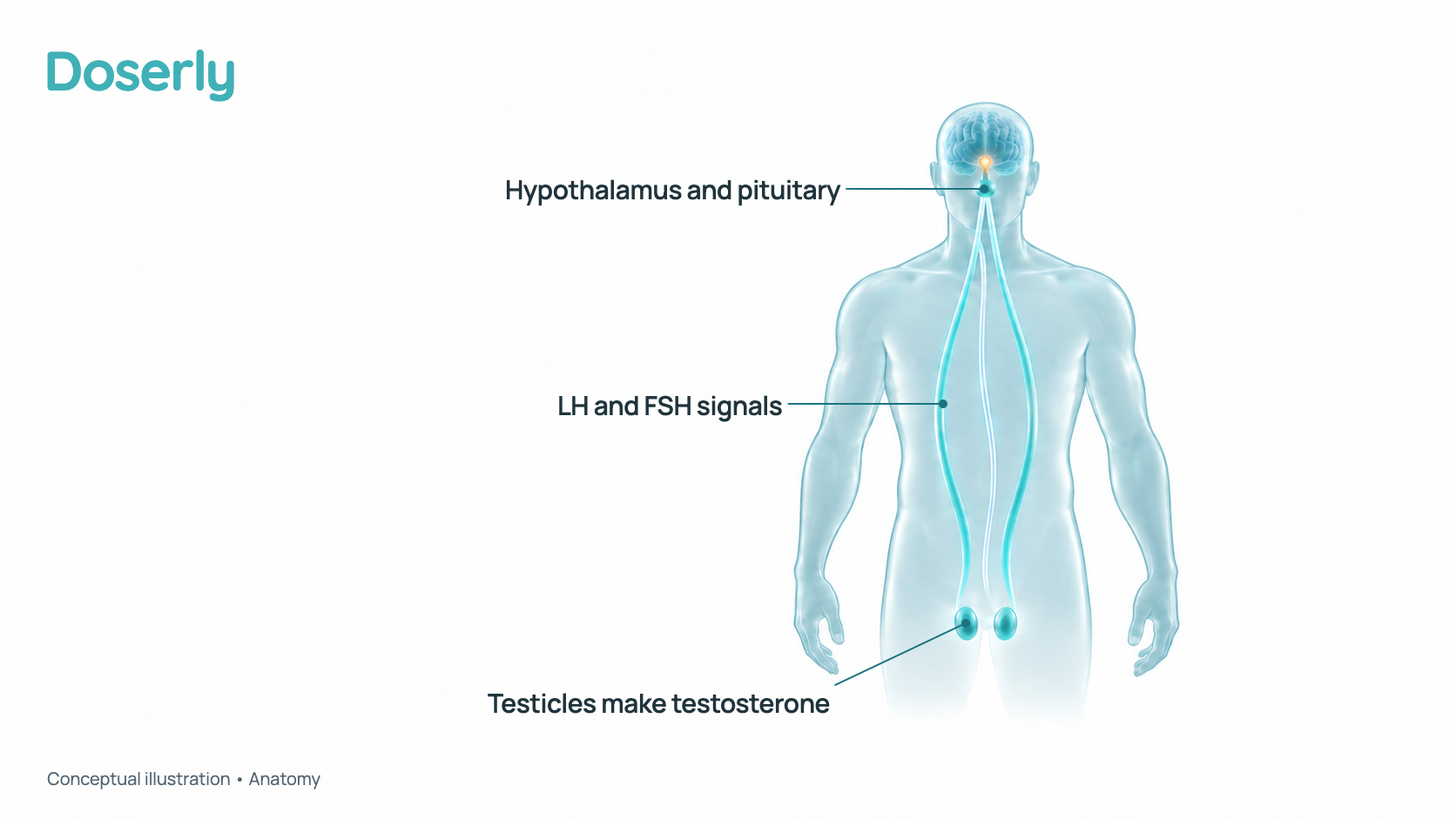
Testosterone is made mainly in the testicles, on instructions from the brain. When that system fails, doctors call it hypogonadism. The US Food and Drug Administration (FDA) has approved testosterone products for men with low testosterone plus an associated medical condition, such as damaged testicles or a pituitary problem, and none for low testosterone without one. [1]
Whether TRT suits older men whose testosterone has drifted down without a clear cause is the long-running argument. Every current US label still says safety and benefit in "age-related" low testosterone have not been established. On June 18, 2026, the FDA asked makers to remove that limitation, but no label had changed by September 2026. [2], [21], [20]
The hormone itself is not new. Leopold Ruzicka, who shared the 1939 Nobel Prize in Chemistry, showed that testosterone could be made from cholesterol. [22]
How common is low testosterone?
Much less common than a single blood test suggests. How many men "have low T" depends on whether you count a lab number alone or a lab number plus symptoms:
- Low number only. In a US community study of men aged 30 to 79, 24% had a total testosterone below 300 ng/dL, but only 5.6% met the study's stricter definition: low total and free testosterone plus specific symptoms. Among men over 50 with a low level, 47.6% had no symptoms at all. [23]
- Strict definition. In the European Male Ageing Study of men aged 40 to 79, only three symptoms tracked closely with low testosterone: fewer morning erections, low sexual desire and erectile problems. With those three symptoms plus a low total and free testosterone, 2.1% of men qualified, rising from 0.1% in their 40s to 5.1% in their 70s. [24], [25]
- With age. Following the same men over time, total testosterone fell by 1.6% a year in the Massachusetts Male Aging Study, and its authors suggest that new illness may speed the fall. [26] In a separate study of older men who reported very good health, average testosterone did not differ with age while obesity lowered it, so much of the difference between men tracks weight and health rather than age alone. [27]
The common claim that testosterone falls every year "after 30" does not come from these studies, which followed men from their 40s. The low testosterone guide covers symptoms and causes in full.
TRT: the key numbers
Testosterone for men comes in five main forms: injections, skin gels and creams, capsules, a nasal gel and pellets. This table shows each one's route, how often it is used and its typical labeled dose, checked in September 2026. Each form has its own guide with the full protocol and label details. [28]
| Form | Route | How often | Typical labeled dose | Guide |
|---|---|---|---|---|
| Testosterone cypionate (Depo-Testosterone, generics, Azmiro) | Intramuscular (into a muscle) | Every 2 to 4 weeks (US label) | 50 to 400 mg per injection | Testosterone cypionate |
| Testosterone enanthate (generic vials) | Intramuscular | Every 2 to 4 weeks (US label) | 50 to 400 mg per injection | Testosterone enanthate |
| Xyosted (enanthate autoinjector, US) | Subcutaneous (into the fatty layer under the skin) | Once a week | Starts at 75 mg, then adjusted by blood test | Xyosted |
| Sustanon 250 (four esters; UK and Australia, not US) | Intramuscular | Usually every 3 weeks | 250 mg (1 mL) | Sustanon 250 |
| Testosterone undecanoate injection (Aveed in the US, Nebido in the UK) | Intramuscular | Aveed: at the start, week 4, then every 10 weeks. Nebido: every 10 to 14 weeks | Aveed 750 mg; Nebido 1,000 mg | Undecanoate injection |
| Testosterone gel 1.62% (AndroGel 1.62%, generics; Testogel 16.2 mg/g in the UK) | Transdermal (absorbed through the skin) | Once daily, in the morning | 40.5 mg (range 20.25 to 81 mg) | Testosterone gel |
| Testosterone gel 1% (AndroGel 1%, Testim, Vogelxo, generics) | Transdermal | Once daily | 50 mg (up to 100 mg) | Testosterone gel |
| Testosterone 2% solution (armpit; generics) | Transdermal | Once daily | 60 mg (range 30 to 120 mg) | Testosterone gel |
| Testosterone cream (compounded in the US; AndroForte 5 is an approved cream in Australia) | Transdermal | Daily | AndroForte 5: 25 mg on the scrotum or 100 mg on the upper body. No FDA-approved US cream | Compounded cream |
| Oral testosterone undecanoate (Jatenzo, Kyzatrex, Tlando) | By mouth, with food | Twice daily | Jatenzo starts at 237 mg, Kyzatrex at 200 mg; Tlando is a fixed 225 mg | Oral testosterone |
| Natesto nasal gel | Intranasal (inside the nose) | Three times daily (US); starts twice daily in Canada | 11 mg per dose (one spray per nostril) | Natesto |
| Testopel pellets | Subcutaneous implant in the hip | Every 3 to 6 months | 150 to 450 mg (two to six 75 mg pellets) | Testosterone pellets |
| Testosterone propionate | Intramuscular | No US-approved product | Not applicable | Testosterone propionate |
[28], [29], [30], [11], [31], [32], [33], [34], [35], [36], [37], [38], [39], [40], [3], [41], [2], [12], [42], [43], [44]
No longer sold in the US (checked September 2026): Striant (a gum-side tablet), the Androderm patch and the Axiron and Fortesta brands have been discontinued; generic 2% solutions remain. [45], [46], [47], [48]
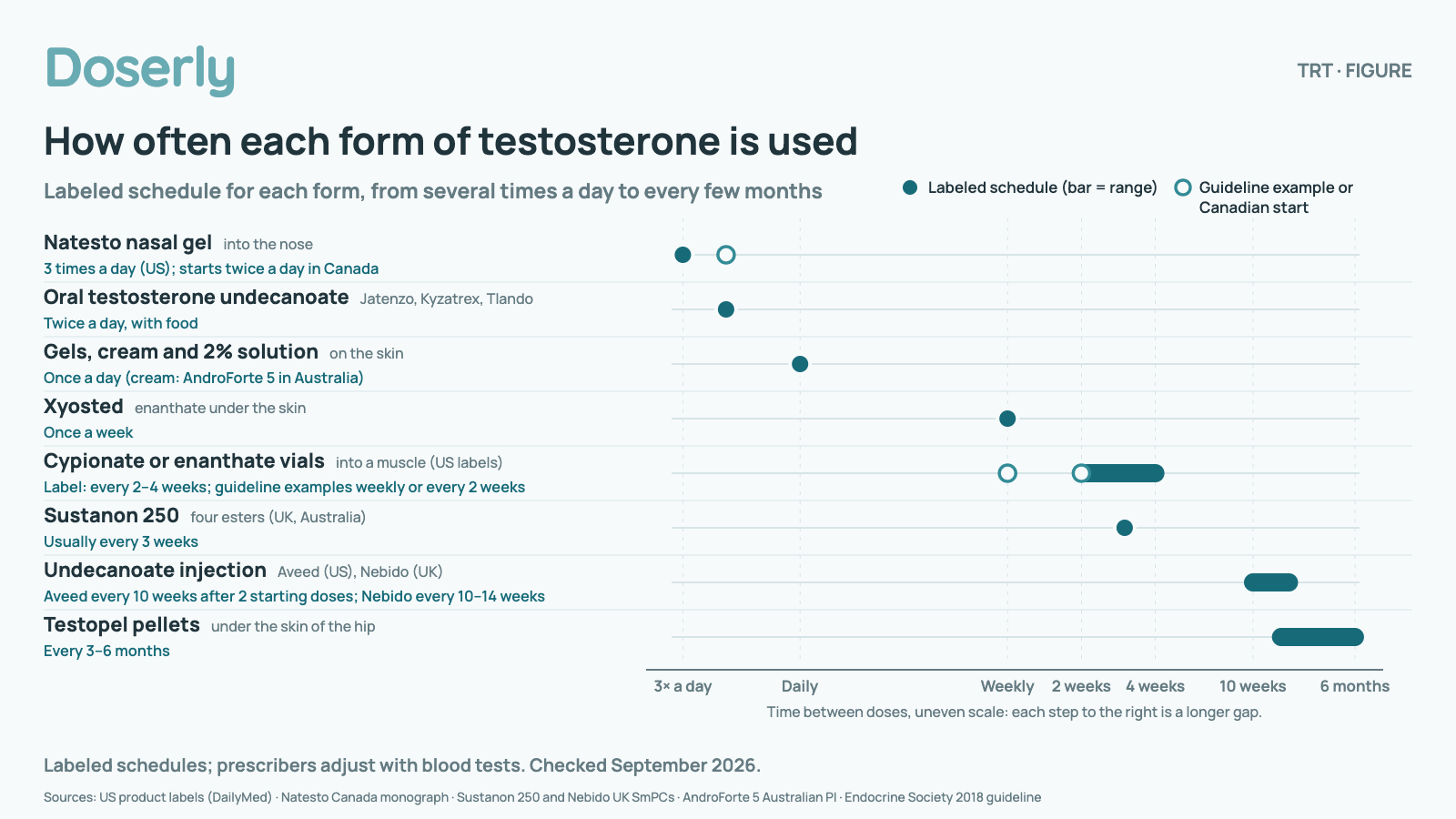
How often each form of testosterone is used
Labeled schedule for each form, from several times a day to every few months.
Each line runs from several times a day (left) to every 6 months (right); ticks mark daily, weekly and 4 weeks. Filled marks are labeled schedules; open circles are guideline examples or the Canadian start.
- Natesto nasal gel (into the nose)
- 3 times a day (US); starts twice a day in Canada
- Oral testosterone undecanoate (Jatenzo, Kyzatrex, Tlando)
- Twice a day, with food
- Gels, cream and 2% solution (on the skin)
- Once a day (cream: AndroForte 5 in Australia)
- Xyosted (enanthate under the skin)
- Once a week
- Cypionate or enanthate vials (into a muscle (US labels))
- Label: every 2–4 weeks · guideline examples weekly or every 2 weeks
- Sustanon 250 (four esters (UK, Australia))
- Usually every 3 weeks
- Undecanoate injection (Aveed (US), Nebido (UK))
- Aveed every 10 weeks after 2 starting doses · Nebido every 10–14 weeks
- Testopel pellets (under the skin of the hip)
- Every 3–6 months
Labeled schedules; prescribers adjust with blood tests. Checked September 2026.
The practical differences are how often you dose, how much the level swings between doses, how much red blood cells rise (in pooled trials the average rise was largest with cypionate or enanthate injections and oral undecanoate, but only the gap between injections and skin patches was clear) and, for gels, the risk of passing testosterone to a partner or child by skin contact, which carries a boxed warning on every US gel. [49], [34] The cypionate vs enanthate guide compares the two most common injections.
How do injection doses turn into mL and syringe units?
Injection doses are written in milligrams (mg) and measured in milliliters (mL). The Endocrine Society's example starting schedules for cypionate or enanthate are 75 to 100 mg weekly, or 150 to 200 mg every 2 weeks, and the American Urological Association (AUA) prefers smaller weekly doses such as 100 mg weekly. [4], [3]
To turn a dose into a volume, divide by the vial's strength. For example, 100 mg from a 200 mg/mL vial is 0.5 mL, which is 50 units on a U-100 insulin syringe. From a 100 mg/mL vial, the same 100 mg is 1 mL. Doserly's TRT dose calculator works through each step. These are labeled and guideline doses; prescribers adjust them using blood tests and symptoms. The TRT dosage guide covers split schedules and dose changes.
Testosterone for women uses different products and far smaller doses. See testosterone therapy for women.
What testosterone level counts as low, and what is the target?
This table shows the numbers each major guideline uses, checked in September 2026. Labs in the US report testosterone in ng/dL; most other countries use nmol/L (1 nmol/L is about 28.8 ng/dL).
| Guideline (version, year) | Threshold or target | How measured | What it is used for |
|---|---|---|---|
| AUA, American Urological Association (2018, validity reconfirmed 2024) | Below 300 ng/dL (10.4 nmol/L) | Two early-morning tests on separate days, plus symptoms | Diagnosis |
| Endocrine Society (2018) | Below 264 ng/dL (9.2 nmol/L) with standardized assays | Two fasting morning tests, plus symptoms | Diagnosis |
| Endocrine Society statement (July 2026) | "Near 300 ng/dL" | At least two early-morning fasting tests with certified assays | Diagnosis |
| EAU, European Association of Urology (2026); ICSM (2024); BSSM, British Society for Sexual Medicine (2023) | Below 12 nmol/L (about 350 ng/dL) | Morning samples, repeated | Diagnosis |
| CUA, Canadian Urological Association (2021) | Below 10 nmol/L (about 290 ng/dL) | Morning samples, 7 to 11 am | Diagnosis |
| AUA | 450 to 600 ng/dL (about 15.6 to 20.8 nmol/L) | Timed to the product | Target on treatment |
| Endocrine Society (2018) | Mid-normal; for cypionate or enanthate, adjust the dose if below 350 or above 600 ng/dL (about 12.1 or 20.8 nmol/L) | Midway between injections | Target on treatment |
| BSSM | 15 to 30 nmol/L (about 430 to 865 ng/dL) | Trough for injections; 2 to 4 hours after gel | Target on treatment |
| CUA | 14 to 17 nmol/L (about 400 to 490 ng/dL) | Mid-cycle for injections | Target on treatment |
| Most bodies (AUA, Endocrine Society, EAU, BSSM, ICSM) | Hematocrit 54% | Blood count | Lower the dose or pause. CUA uses 55%, the UK Society for Endocrinology above 50%, the US Department of Veterans Affairs (VA) 51% to adjust and 54% to stop |
| Endocrine Society (2018) | Confirmed PSA rise of more than 1.4 ng/mL in the first year | Blood test | Referral to a urologist |
| BSSM (2023) | PSA rise of more than 1.4 ng/mL in any one year | Blood test | Referral to a urologist |
[3], [4], [50], [5], [51], [52], [53], [54], [14]
Most guidelines diagnose low testosterone somewhere between about 264 and 350 ng/dL (9.2 and 12 nmol/L), always with symptoms and always on repeated morning tests. They differ because they rest on different lab methods and evidence: the Endocrine Society's 264 ng/dL is the lower limit of normal in healthy young men measured with standardized assays, the EAU calls 12 nmol/L a reliable threshold for diagnosis, and the UK Society for Endocrinology notes little evidence of benefit from treatment above 12 nmol/L. No guideline diagnoses low testosterone from a single test or from a number alone. [4], [5], [54]
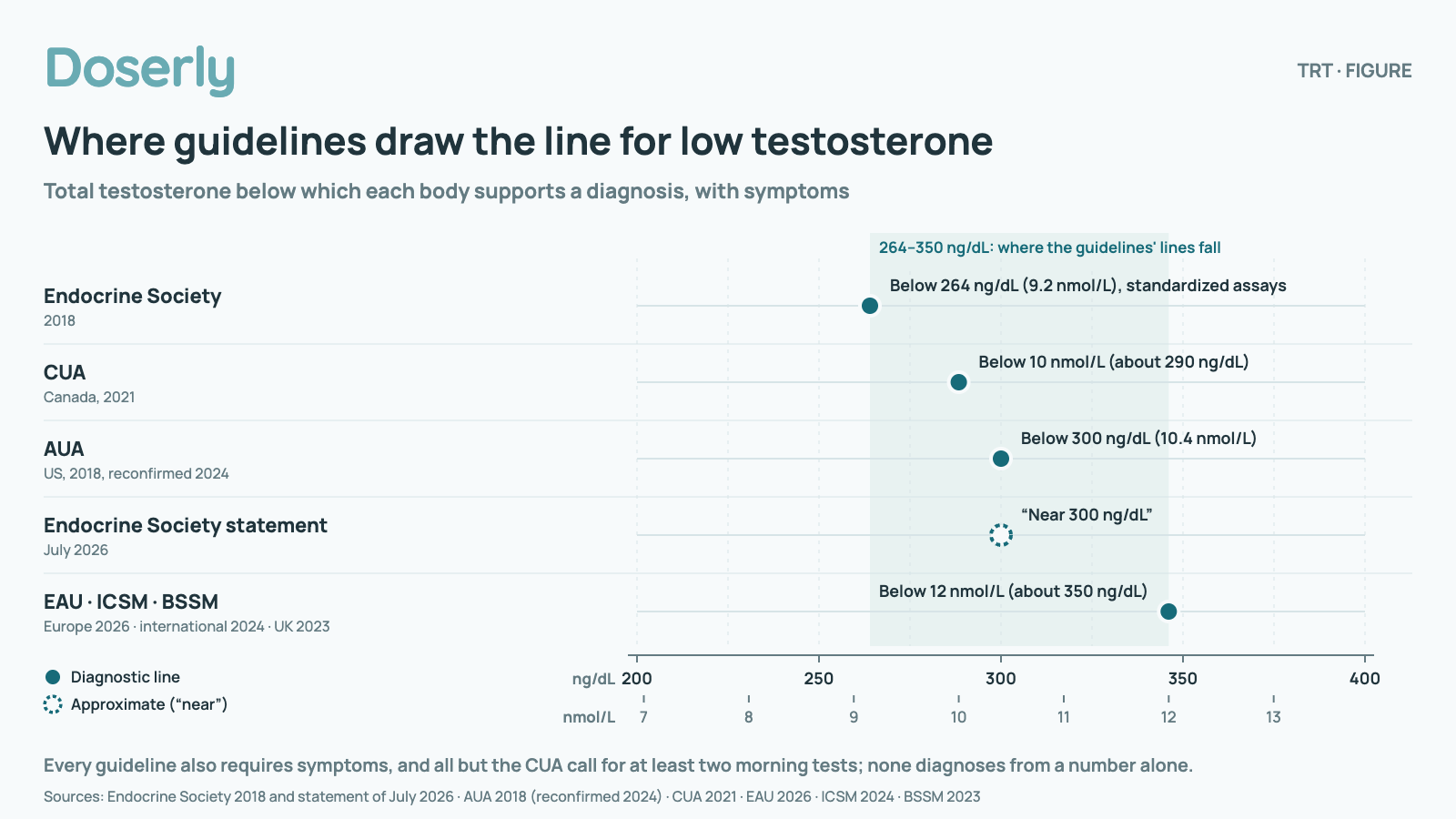
Where guidelines draw the line for low testosterone
Total testosterone below which each body supports a diagnosis, with symptoms.
Each line runs from 200 ng/dL (7 nmol/L, left) to 400 ng/dL (14 nmol/L, right); the shaded part is 264–350 ng/dL, where the guidelines' lines fall. A dashed circle means an approximate line.
- Endocrine Society (2018)
- Below 264 ng/dL (9.2 nmol/L), standardized assays
- CUA (Canada, 2021)
- Below 10 nmol/L (about 290 ng/dL)
- AUA (US, 2018, reconfirmed 2024)
- Below 300 ng/dL (10.4 nmol/L)
- Endocrine Society statement (July 2026)
- “Near 300 ng/dL”
- EAU · ICSM · BSSM (Europe 2026 · international 2024 · UK 2023)
- Below 12 nmol/L (about 350 ng/dL)
Every guideline also requires symptoms, and all but the CUA call for at least two morning tests; none diagnoses from a number alone.
Morning timing matters because testosterone is highest early in the day: in men aged 30 to 40 it was 20 to 25% lower at 4 pm than at 8 am. [55] The testosterone unit converter switches between ng/dL and nmol/L, and the TRT blood work guide explains when to draw each test on each form.
Where these numbers come from
The formulation rows come from the current product labels: US DailyMed labels for Depo-Testosterone (revised August 2026), Azmiro, generic enanthate, Xyosted, Aveed, AndroGel 1.62% and 1%, Testim, Vogelxo, the generic 2% solution, Jatenzo, Kyzatrex (August 2026), Tlando (February 2026), Natesto and Testopel; the UK summaries of product characteristics for Sustanon 250 (2026), Nebido (2025) and Testogel 16.2 mg/g; Canada's Natesto monograph; and Australia's AndroForte 5 product information. The discontinued-product line comes from FDA and Federal Register records. [28], [2], [12], [31], [33], [45]
The guideline rows come from the AUA guideline (2018, validity reconfirmed 2024), the Endocrine Society guideline (2018) and its July 2026 statement, the EAU guidelines (2026 edition), the ICSM 2024 recommendations, the BSSM guidelines (2023), the CUA guideline (2021), the Society for Endocrinology guideline (2022) and the VA recommendations (January 2026). [3], [4], [50], [5], [51], [52], [53], [54], [14]
The Endocrine Society's printed nmol/L targets (24.5 and 14.1) do not match its own ng/dL values, so this guide converts 350 and 600 ng/dL with the standard factor instead. nmol/L values in brackets for other bodies are conversions, rounded.
Not used: the earlier claim that saturation of the prostate's testosterone receptors happens at "60 to 90 ng/dL" (no primary source gives a number), a TRAVERSE event rate of "2.5% per year" (a legacy calculation), and averages of lean-mass gain of "2 to 5 kg" (the pooled trial figure is about 1.6 kg).
Who is TRT for, according to guidelines?
TRT is for men with symptoms of low testosterone whose level is low on at least two separate early-morning tests, after reversible causes have been looked for. Guidelines agree it is not for men with normal levels, and not something to screen every man for. [3], [4], [5]
How is low testosterone diagnosed?
Three things together: symptoms, a low number and a repeat test.
- Symptoms. The ones most closely tied to low testosterone are sexual: low desire, fewer morning erections and erectile problems. Tiredness and low mood are common but have many other causes. [24], [50]
- Two morning tests. US labels and the AUA require low results on at least two separate mornings before starting. The Endocrine Society also asks for fasting samples, and a free testosterone result when SHBG (the protein that carries testosterone in the blood) is unusual. [11], [3], [4]
- The cause. Guidelines then check LH and FSH, the pituitary signals, to tell primary hypogonadism (the testicles fail) from secondary hypogonadism (the brain's signal is too weak). The primary vs secondary hypogonadism guide explains why that matters for fertility and for stopping. [4], [5]
In the European Male Ageing Study, 11.8% of men aged 40 to 79 had the secondary pattern, mostly linked to obesity, and 2.0% the primary pattern, mostly linked to age. [56]
Should reversible causes be fixed first?
Yes, in every guideline. Obesity, opioid painkillers, corticosteroid medicines, sleep apnea, heavy alcohol use, acute illness, extreme exercise or dieting, and high prolactin can all lower testosterone, and the Canadian guideline asks for these to be managed and the level re-checked before starting. The Endocrine Society's 2026 statement calls weight loss the usual first step when overweight or obesity is the only cause. [53], [50], [5]
Lifestyle changes cannot fix some causes, such as testicular damage, Klinefelter syndrome (an extra X chromosome, about 1 in 650 men, most of them never diagnosed) or pituitary disease. These need their own medical assessment; for pituitary causes, other hormones can raise testosterone and restore fertility, which testosterone itself cannot. [57], [4], [5] See obesity-related hypogonadism and late-onset hypogonadism.
Do all men over 40 need TRT?
No. No guideline recommends testing or treating men just because of age. The Endocrine Society advises against routinely prescribing testosterone to all men 65 or older with a low level and offers it case by case to men with symptoms and consistently low morning tests. Its 2026 statement adds that diagnosis works the same way at any age. The 2014 EU-wide review concluded that raising testosterone in healthy older men is not an authorised use. [4], [50], [58]
Can TRT help if your testosterone is normal?
Not in the ways people hope. The European Association of Urology says not to use testosterone in men with normal levels, or to improve thinking, vitality or strength in ageing men. A 2024 Cochrane review of men with sexual problems who did not have diagnosed low testosterone found it probably has little to no effect on erections. [5], [59]
What should be discussed before starting?
- Fertility. Testosterone switches off sperm production, so the AUA says it should not be prescribed to men who are trying to conceive, and men who want children later should hear about the long-term effect first. [3] See TRT and fertility.
- Baseline checks. Hematocrit, and PSA in men over 40, before the first dose. [3], [4]
- What success would look like, and when to review. Several guidelines set a review point at 3 to 12 months (see how long a trial of TRT lasts).
The starting TRT guide walks through the first appointments and tests step by step.
How does TRT work?
TRT supplies testosterone from outside the body, and the brain responds by turning down its own signal to the testicles. That trade-off explains most of what TRT does, good and bad. [11], [60]
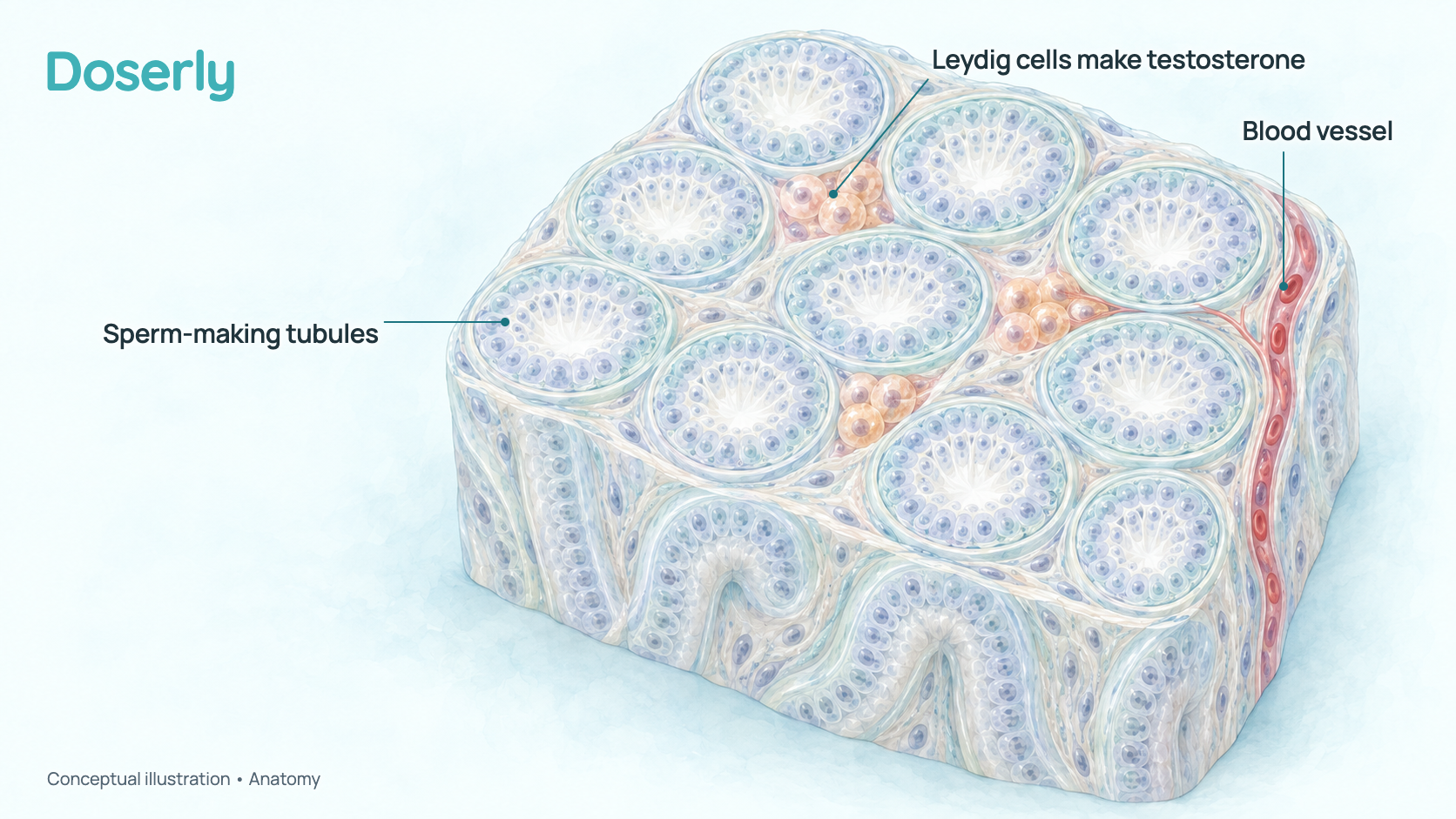
Normally the hypothalamus in the brain releases a hormone that tells the pituitary gland to send LH and FSH to the testicles. LH tells the Leydig cells to make testosterone, and FSH, with testosterone made inside the testicle, supports sperm production. When blood testosterone is high enough, the brain eases off. [11], [60]
TRT uses that feedback loop in reverse. Testosterone from outside tells the brain there is plenty, so LH and FSH fall and the testicles make less of their own. [11]
Why does TRT shrink the testicles and lower sperm counts?
Because sperm production needs far more testosterone inside the testicle than in the blood. In normal men, the level inside the testicle was about 40 to 100 times the blood level in two studies. When healthy men were given 200 mg of enanthate a week for 3 weeks in a research study, LH fell to 5% of its starting value and testosterone inside the testicle fell by 94%. In a small contraception study of enanthate combined with levonorgestrel (a progestin hormone), testosterone inside the testicle fell by 98% while blood testosterone stayed normal, and sperm counts fell from 65 to 1.3 million per mL. With less stimulation the testicles make fewer sperm, and labels report testicular shrinkage. [61], [62], [60], [34]
That is why TRT is not a fertility treatment, and why labels warn that reduced fertility on TRT may not fully reverse in some men. Medicines that keep the testicle working, such as hCG, are covered in the TRT and fertility guide. [11]
Why do men on TRT still need estrogen?
Because part of testosterone's effect comes from estradiol, the estrogen the body makes from it. In a trial in older men, testosterone gel improved spine bone density but anastrozole, which raised testosterone while blocking estrogen, did not. The AUA suggests measuring estradiol only when there are breast symptoms, and considers aromatase inhibitors only in specific cases. [63], [3] See estrogen on TRT.
What does the research show TRT can and cannot do?
In men with confirmed low testosterone, TRT reliably improves sex drive and sexual activity, bone density and anemia, with smaller effects on mood, erections and body composition. In the large trials it did not improve vitality, walking or thinking, although one TRAVERSE analysis found a small gain in self-reported energy. The best evidence comes from two large placebo-controlled programs: the Testosterone Trials (790 men aged 65 or older, 1 year of gel) and TRAVERSE (about 5,200 men aged 45 to 80 at high heart risk, gel for an average of 21.7 months). [6], [9], [7]
| Outcome | What the best trials found | Evidence |
|---|---|---|
| Sex drive and sexual activity | Improved in the Testosterone Trials and in TRAVERSE men with low libido | Placebo-controlled trials |
| Erections | Small gain, about 2 points on a standard erectile-function score in pooled trials; no gain in TRAVERSE's low-libido group | Pooled trials |
| Mood | Small improvement; no clear benefit in 49 men with persistent depressive disorder | Trials and a meta-analysis |
| Energy (vitality) | No benefit on the main vitality measure; small self-reported gain in one TRAVERSE analysis | Testosterone Trials; TRAVERSE; 2026 review |
| Walking and physical function | Main trial goal not met | Testosterone Trials |
| Memory and thinking | No benefit | Testosterone Trials; TEAAM |
| Bone density | Spine bone density on CT scan up 7.5% vs 0.8% in one year | Testosterone Trials |
| Fractures | More fractures on testosterone, not fewer (3.50% vs 2.46%) | TRAVERSE |
| Anemia | Unexplained anemia corrected more often (58.3% vs 22.2%) | Testosterone Trials |
| Body composition | About 1.6 kg less fat and 1.6 kg more lean mass, no change in weight | Meta-analysis of 29 trials |
| Diabetes | Fewer new cases with a lifestyle program in T4DM; no significant prevention in TRAVERSE | Two trials in different men; no proven prevention |
[6], [64], [65], [66], [7], [67], [68], [69], [10], [70], [71], [72], [8]
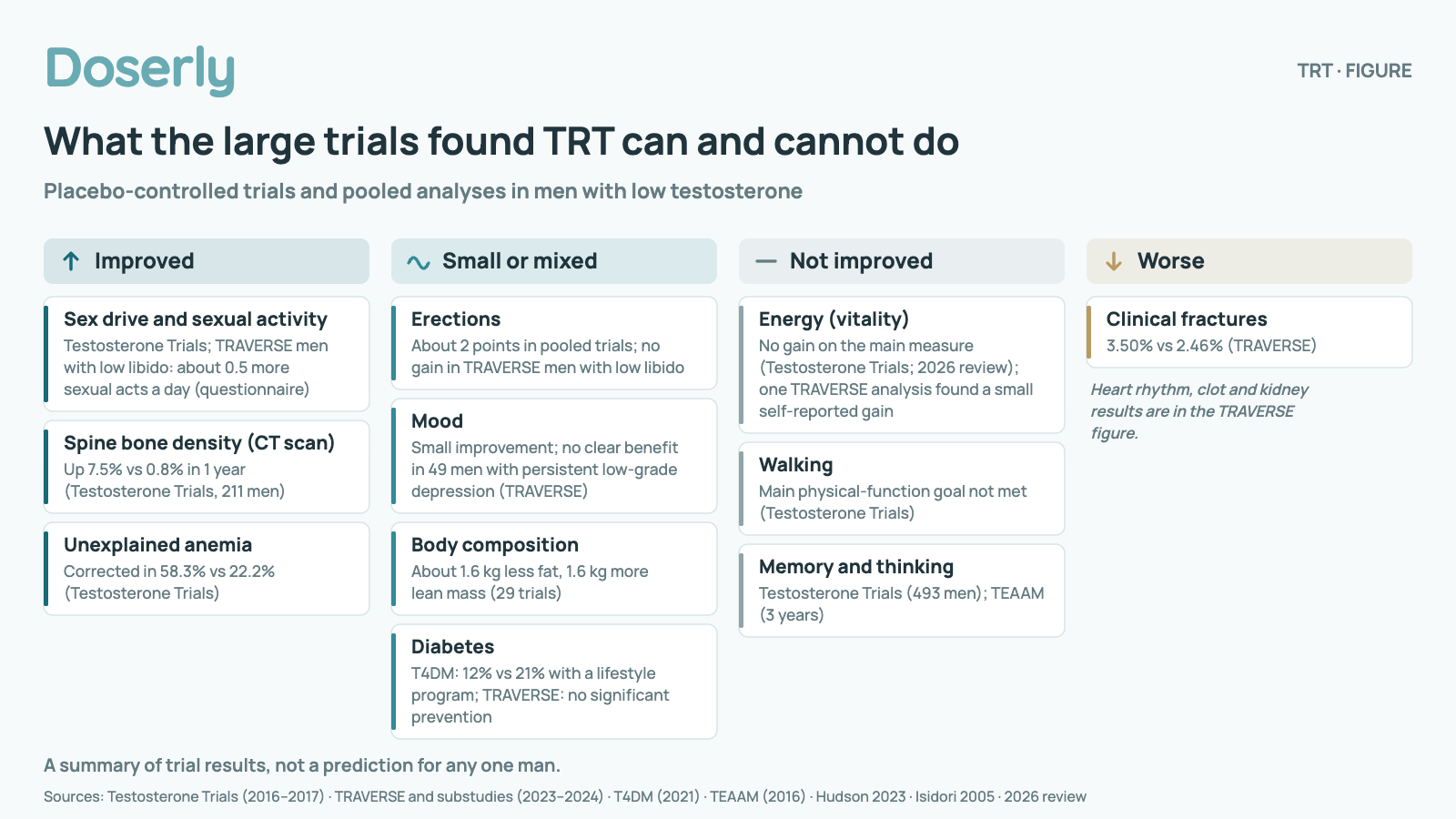
What the large trials found TRT can and cannot do
Placebo-controlled trials and pooled analyses in men with low testosterone.
Improved
- Sex drive and sexual activity
- Testosterone Trials; TRAVERSE men with low libido: about 0.5 more sexual acts a day (questionnaire)
- Spine bone density (CT scan)
- Up 7.5% vs 0.8% in 1 year (Testosterone Trials, 211 men)
- Unexplained anemia
- Corrected in 58.3% vs 22.2% (Testosterone Trials)
Small or mixed
- Erections
- About 2 points in pooled trials; no gain in TRAVERSE men with low libido
- Mood
- Small improvement; no clear benefit in 49 men with persistent low-grade depression (TRAVERSE)
- Body composition
- About 1.6 kg less fat, 1.6 kg more lean mass (29 trials)
- Diabetes
- T4DM: 12% vs 21% with a lifestyle program; TRAVERSE: no significant prevention
Not improved
- Energy (vitality)
- No gain on the main measure (Testosterone Trials; 2026 review); one TRAVERSE analysis found a small self-reported gain
- Walking
- Main physical-function goal not met (Testosterone Trials)
- Memory and thinking
- Testosterone Trials (493 men); TEAAM (3 years)
Worse
- Clinical fractures
- 3.50% vs 2.46% (TRAVERSE)
A summary of trial results, not a prediction for any one man. Heart rhythm, clot and kidney results are in the TRAVERSE figure.
Does TRT improve sex drive and erections?
Sex drive more than erections. In the Testosterone Trials, a year of gel improved sexual activity, desire and erectile function compared with placebo. In TRAVERSE, among 1,161 men with low libido, testosterone increased sexual activity by about half an act a day on the trial's questionnaire, which counted activity with or without a partner, and improved desire for up to 24 months, but did not improve erections. In pooled trials of men below 12 nmol/L, erectile scores rose by about 2 points, enough to matter for mild erectile problems. [6], [64], [65] See TRT and sexual health.
Does TRT help mood, energy or thinking?
Mood a little; energy and thinking not clearly.
- Mood. Depressive symptoms improved slightly in the Testosterone Trials and in a meta-analysis of 27 trials (1,890 men). In TRAVERSE, mood improved slightly overall, but the 49 men with persistent low-grade depression showed no clear benefit, too few to settle the question. The European Academy of Andrology advises against testosterone as the only treatment for depression. [6], [73], [66], [74]
- Energy. The Testosterone Trials found no improvement in vitality, and a September 2026 review of both big trial programs concluded that testosterone does not improve it. One TRAVERSE analysis found a small gain in self-reported energy, so TRT is not an established treatment for tiredness. [6], [7], [66]
- Thinking. A year of gel did not improve memory in 493 men with age-related memory problems, and 3 years of gel in the TEAAM trial did not improve any area of thinking tested. [67], [68]
Does TRT build muscle and burn fat?
Modestly. Across 29 trials in middle-aged and older men, testosterone reduced fat by about 1.6 kg and added about 1.6 kg of lean mass without changing body weight, and strength gains in older men were small on average. The extra lean mass was gone 6 months after stopping in frail older men, and guidelines advise against testosterone as a weight-loss treatment. [71], [75], [76], [5] See TRT, muscle and fat loss.
Does TRT strengthen bones?
It raises bone density, but in TRAVERSE it did not prevent fractures; fractures were more common. In 211 men in the Testosterone Trials, spine bone density measured by CT scan rose 7.5% on testosterone vs 0.8% on placebo in one year. Yet in TRAVERSE, clinical fractures occurred in 91 of 2,601 men on testosterone (3.50%) vs 64 of 2,603 on placebo (2.46%), and a 2026 meta-analysis also found more clinical fractures with testosterone (risk ratio 1.55), though not more hip or spine fractures. Nobody yet knows why. [69], [10], [77]
Does TRT prevent diabetes?
Not on its own. The two big trials studied different men and got different answers. In T4DM, 1,007 men aged 50 to 74 with a large waist, prediabetes or new diabetes and a testosterone level at or below 14 nmol/L but no known disease of the testicles or pituitary, all in a lifestyle program, had testosterone undecanoate injections or placebo for 2 years; diabetes at 2 years was 12% (55 of 443) vs 21% (87 of 413). TRAVERSE, using gel without a structured lifestyle program, found no significant slowing of progression to diabetes (for example 7.8% vs 10.7% at 12 months). [72], [8]
The American Diabetes Association's 2026 standards do not recommend testosterone to prevent diabetes, the Endocrine Society advises against it for blood-sugar control, and a 2026 review concluded that "TRT should not be regarded as an antidiabetic or lipid-lowering intervention." [78], [4], [79]
How long does TRT take to work?
Weeks for sex drive, months for most other changes. A review of treatment studies found sex drive improving from about 3 weeks, mood from 3 to 6 weeks, erections over up to 6 months, body composition from 12 to 16 weeks, and bone from 6 months onward; red blood cells rise within about 3 months and peak at 9 to 12 months. The Canadian guideline tells men to expect changes in libido and sexual function after 3 months or longer. [80], [53] See the TRT results timeline.
Does low testosterone shorten life?
Men with low natural testosterone die sooner on average in observational studies, but that does not show TRT lengthens life. A meta-analysis found the link, along with signs that low testosterone may mark poorer overall health rather than cause it. In TRAVERSE, deaths from any cause were similar: 144 of 2,596 men on testosterone vs 148 of 2,602 on placebo. [81], [9]
Is TRT safe?
For men with confirmed low testosterone who are monitored, TRT has well-understood risks, and the largest trial ruled out a large rise in its combined measure of heart attack, stroke and heart death over about two years of gel treatment. It is not risk-free: it raises red blood cells and blood pressure, switches off sperm production, and in TRAVERSE it increased atrial fibrillation, lung clots, kidney injury and fractures. Long-term safety beyond a few years, and on injections specifically, is still unknown. [9], [2], [10], [50]
Where did the heart-attack scare come from?
From one small trial and two records studies. In 2010, a gel trial in 209 men aged 65 and older with limited mobility and many health problems was stopped early after cardiovascular-related events in 23 men on testosterone vs 5 on placebo, out of 209 men split between the two groups; it was not designed to measure heart risk. A 2013 VA records study reported 3-year event rates of 25.7% with testosterone vs 19.9% without and was later corrected, and a 2014 claims study found heart attacks 1.36 times as common in the 90 days after a first prescription as in the year before. [82], [83], [84]
The FDA announced a review on January 31, 2014, while stating it had "not concluded" that testosterone raises heart risk, and an EU-wide review that year found no consistent evidence of higher heart risk. In March 2015 the FDA required labels to say benefit in age-related low testosterone is not established and called for a large safety trial, which became TRAVERSE. [85], [58], [13]
What did TRAVERSE show about the heart?
TRAVERSE randomized 5,204 men aged 45 to 80 with low testosterone (two fasting levels under 300 ng/dL), symptoms and existing heart disease or high heart risk to daily 1.62% testosterone gel or a placebo gel. Among the 2,596 men who used testosterone and the 2,602 who used placebo: [9], [86]
- Heart attack, stroke or heart death: 182 men (7.0%) vs 190 (7.3%); hazard ratio 0.96, with a 95% confidence interval of 0.78 to 1.17. That met the trial's safety margin, ruling out a large rise in risk. [9]
- Heart rhythm: atrial fibrillation 3.5% vs 2.4%; nonfatal rhythm problems needing treatment 5.2% vs 3.3%. [2]
- Clots: venous clots 1.7% vs 1.2%, including pulmonary embolism (a clot in the lungs) 0.9% vs 0.5%. [2]
- Kidneys: acute kidney injury 2.3% vs 1.5%. [2]
- Fractures: 3.50% vs 2.46%. [10]
- Blood pressure: systolic pressure rose 1.0 mm Hg on testosterone and fell 0.5 mm Hg on placebo by 36 months. [2]
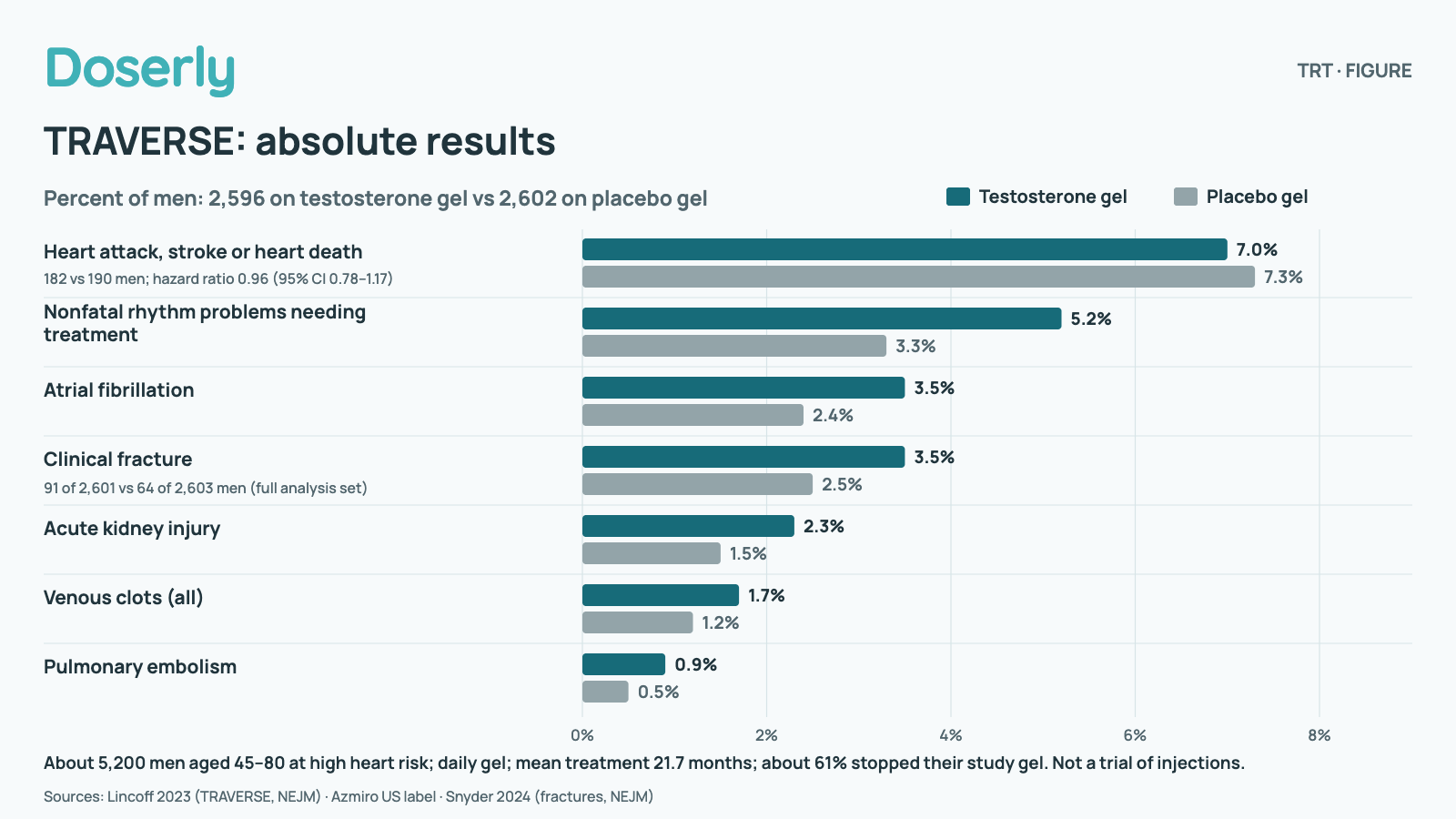
TRAVERSE: absolute results
Testosterone gel (2,596 men)Placebo gel (2,602 men)
- Heart attack, stroke or heart death
- Testosterone 7.0% vs placebo 7.3% (182 vs 190 men; hazard ratio 0.96, 95% CI 0.78–1.17; met the 1.5 safety margin)
- Nonfatal rhythm problems needing treatment
- Testosterone 5.2% vs placebo 3.3%
- Atrial fibrillation
- Testosterone 3.5% vs placebo 2.4%
- Clinical fracture
- Testosterone 3.5% vs placebo 2.5% (91 of 2,601 vs 64 of 2,603 in the full analysis set)
- Acute kidney injury
- Testosterone 2.3% vs placebo 1.5%
- Venous clots (all)
- Testosterone 1.7% vs placebo 1.2%
- Pulmonary embolism
- Testosterone 0.9% vs placebo 0.5%
About 5,200 men aged 45–80 at high heart risk; daily gel; mean treatment 21.7 months; about 61% stopped their study gel. Not a trial of injections.
Its limits matter. TRAVERSE tested only a daily gel, the average man used it for 21.7 months, about 61% stopped their study gel early, and it enrolled men at high heart risk. It did not test injections, which the Endocrine Society says raise red blood cells more often than gels. [9], [2], [4] On February 28, 2025, the FDA told makers to add TRAVERSE's results to all testosterone labels, remove the boxed-warning language about heart risk and add blood-pressure warnings. Most brand labels now carry TRAVERSE, but the cypionate and enanthate vial labels and the pellet label still say no long-term heart safety trial has been done (checked September 2026). [13], [28]
Pooled trials point the same way: a 2025 meta-analysis of 23 trials lasting at least a year found no increase in death, heart attack or stroke but about 50% more heart-rhythm problems (risk ratio 1.53), and a 2026 meta-analysis of 41 trials (11,161 men) found no increase in major heart events. [87], [88]
Is the heart question settled?
Medical societies read the same evidence differently:
Where the sources disagree. The Androgen Society, a medical society focused on testosterone, wrote in 2024 that it is "conclusively determined" that testosterone does not raise heart attack, stroke or heart death. The Endocrine Society's July 2026 statement agrees there was no meaningful rise in heart attack or stroke over 1 to 4 years, but points to a roughly 50% relative rise in pulmonary embolism and more fractures, says long-term safety, including for the prostate, is not established, and calls for a larger long-term study. [89], [50]
A second argument is about dose. One reviewer argues that TRAVERSE men were undertreated, saying the average increase was "only 9.3 to 12.9 nmol/L"; the label summary of the same trial reports average testosterone rising from 220 to about 440 ng/dL (about 15.3 nmol/L) at 12 months. [90], [2] The TRT and heart health guide covers the trial in full.
Does TRT cause prostate cancer?
The trials so far do not show it, but long-term data are missing and labels still forbid testosterone for men with prostate cancer. The fear goes back to Charles Huggins's 1941 research showing that prostate cancer depends on hormones; a later review notes that its finding against giving testosterone rested on a single patient. [91]
- The saturation idea. A later theory holds that prostate tissue stops responding to extra testosterone once its receptors fill up "well below the physiologic range". It remains a hypothesis, and a 2020 review urged caution in applying it. [92], [91]
- TRAVERSE, which excluded men with PSA above 3.0 ng/mL, found high-grade prostate cancer in 5 of 2,596 men on testosterone (0.19%) vs 3 of 2,602 on placebo (0.12%) (hazard ratio 1.62, 95% confidence interval 0.39 to 6.77). With so few cases, this neither shows a difference nor proves the risks are the same. PSA rose about 0.15 ng/mL more than on placebo at 12 months. [86]
- A 2026 trial of cypionate in 136 men treated surgically for low-grade prostate cancer found no PSA recurrence over 12 weeks, too short to judge long-term cancer safety. [93]
US labels contraindicate testosterone in known or suspected prostate cancer. In June 2026 the FDA asked for that to be narrowed to metastatic prostate cancer only; that change was still a request in September 2026. [28], [21] See TRT and the prostate.
What does TRT do to red blood cells?
It raises them. In a review of placebo-controlled trials in men aged 45 and older, testosterone nearly quadrupled the odds of a hematocrit above 50%. [94] In pooled trials, cypionate or enanthate injections raised hematocrit by about 4 points and gels by about 3, although that analysis could not confirm a difference between the two; in the T4DM trial of long-acting injections, 22% of men on testosterone (106 of 491) went above 54% vs 1% on placebo (6 of 484). Most guidelines act at 54%. [49], [72], [3] See hematocrit on TRT.
What does TRT do to fertility?
It lowers sperm production, often to zero: in a contraception trial, 200 mg of enanthate a week left 65% of healthy men with no sperm within 6 months. In an analysis of such trials, sperm counts were estimated to return to a fertile level (20 million per mL) in 67% of men within 6 months of stopping and 100% within 24 months, but men on TRT are older and have their own reasons for low testosterone, and labels warn that reduced fertility may be irreversible in some. [95], [96], [11] Guidelines say not to use testosterone in men trying to conceive. [3], [5] See TRT and fertility.
What other side effects do labels list?
The labels list acne, oily skin, male-pattern hair loss, breast enlargement (gynecomastia), fluid retention, changes in sex drive, headache, anxiety, depression, prolonged erections, a rise in red blood cells and, for injections, pain at the injection site. Labels also report testicular shrinkage. [28], [34]
- Blood pressure. FDA studies confirmed that all testosterone products can raise blood pressure, and labels advise against use with uncontrolled high blood pressure. [13]
- Sleep apnea. Labels warn testosterone may worsen sleep apnea, especially with obesity or lung disease; in T4DM, new sleep apnea diagnoses were more common on testosterone (3.0% vs 0.4%). [34], [97]
- Hair loss. No controlled study has measured how much replacement-dose TRT speeds male-pattern hair loss; the label lists it among reported reactions. [28]
- Transfer. Gels can pass testosterone to children or partners through skin contact, which is why US gels carry a boxed warning. [34]
- Aveed injections. Oil can reach the lungs, or a severe allergic reaction can happen, during or just after an injection, so the US label requires 30 minutes of observation in the clinic after every dose. [32]
- Mood. The Xyosted label warns about depression and suicidal thoughts: across its two trials (one lasting a year, one 6 months), 2 of 283 men stopped because of depression and 2 others attempted suicide, one fatally. New or worsening low mood needs prompt medical help. [11]
The TRT side effects guide covers each one, with what helps.
Will TRT make me aggressive?
At replacement doses, the evidence says no. A 2020 meta-analysis found that giving testosterone had a small effect on aggression that was not statistically significant. In an older study of 51 men with low testosterone restarting replacement, anger and irritability fell compared with their untreated state, although there was no placebo group. [98], [99]
Very high doses are different: in a trial of research doses far above replacement, 12% of healthy men became mildly and 4% markedly hypomanic (abnormally elevated and energetic), and labels link steroid misuse with hostility and aggression. [100], [28]
Who should be especially cautious?
- Men who want children now or soon. Testosterone suppresses sperm production; guidelines advise against it for men trying to conceive. [3]
- Men with prostate or breast cancer. Contraindicated on current US labels and in the Endocrine Society guideline; the European guideline lists locally advanced or metastatic prostate cancer and male breast cancer. [28], [4], [5]
- A PSA above 4 ng/mL (above 3 ng/mL at high prostate-cancer risk), a prostate nodule or severe urinary symptoms, until a urologist has checked. [4]
- A high hematocrit, a history of blood clots or an inherited clotting disorder. [4], [14]
- Untreated severe sleep apnea, uncontrolled heart failure, or a heart attack or stroke in the past 3 to 6 months. [4], [3]
- Serious heart, liver or kidney disease, because of fluid retention. [101]
- Women and children. Testosterone is contraindicated in pregnancy. These guides are for men; see testosterone therapy for women. In teenagers it can close growth plates early, so any use belongs in specialist care. [28]
- Drug-tested athletes. Banned at all times (see sport). [19]
- People taking other medicines (see the next question).
Which medicines interact with testosterone?
Labels name three interactions, the Xyosted and oral capsule labels add a fourth, and two other medicine groups matter for men on TRT:
- Insulin and other diabetes medicines. Testosterone can lower blood sugar and so the dose of diabetes medicine needed. [28]
- Blood thinners. Labels report bleeding in people also taking oral anticoagulants, and the Azmiro label advises frequent clotting tests (INR), especially when testosterone starts or stops. [28], [29]
- Corticosteroids. Together they can increase fluid retention. [101]
- Medicines that raise blood pressure. The Xyosted and oral capsule labels warn that some prescription medicines, and some over-the-counter pain and cold medicines, can add to testosterone's rise in blood pressure. [11], [2]
- SGLT2 inhibitors (diabetes medicines such as empagliflozin and dapagliflozin). In a study of 53,971 US veterans with diabetes, 756 (1.4%) developed a hematocrit above 54% within a year, and men taking an SGLT2 inhibitor with testosterone had about 2.5 times the odds of men on testosterone alone, and an EU safety review in September 2025 recommended adding this warning to testosterone labels. [102], [103]
- Opioid painkillers can themselves lower testosterone. Their labels note androgen deficiency with long-term use, and a 2020 meta-analysis found low testosterone in 63% of men using opioids. [104], [105]
Current US labels for GLP-1 weight-loss medicines such as semaglutide (Wegovy) and tirzepatide (Zepbound) list no interaction with testosterone, though they advise care with medicines taken by mouth, which includes oral testosterone. [106], [107] See TRT with GLP-1 medicines. Bring a complete list of what you take, including supplements, to a pharmacist or prescriber. Checked September 2026.
Is TRT legal, and is it allowed in sport?
Checked September 2026. Rules differ by country and change often.
TRT is legal with a prescription in every country covered here, and testosterone is a controlled medicine in each of them. It is not on the UN's list of internationally controlled psychotropic substances, so each country sets its own rules. [108]
United States. Testosterone and its esters are Schedule III controlled substances, and no proposal to deschedule them has been published. [15] The key steps:
- 2015 and 2016. Labels were required to say that benefit in age-related low testosterone is not established, and since 2016 they carry warnings on abuse and dependence. [13], [109]
- February 28, 2025. The FDA told makers to add TRAVERSE results and blood-pressure warnings to all labels and to remove the boxed-warning language about heart risk; the vial and pellet labels still lack the TRAVERSE results (checked September 2026). In July 2025 the blood-pressure boxed warnings on Xyosted, Jatenzo, Tlando and Kyzatrex were also removed, so the only boxed warnings left are on Aveed (oil reaching the lungs and allergic reactions) and on gels and solutions (transfer to others). [13], [110], [32]
- December 2025 and April 2026. The FDA held an expert panel on TRT for men, then invited makers to apply for a new use in low libido in men with low testosterone of unknown cause. That is an invitation; no such use is approved. [111], [112]
- June 18, 2026. The Department of Health and Human Services (HHS) announced that the FDA is requesting label changes: removing the age-related limitation, contraindicating testosterone only in metastatic prostate cancer, and revising the prostate-enlargement warning. These are requests; the newest labels still carry the old wording. [21], [20]
- Telehealth. Temporary rules let clinicians prescribe controlled medicines such as testosterone without an in-person visit through December 31, 2026. A permanent Drug Enforcement Administration (DEA) special-registration rule has been under White House review since August 25, 2026 and is not yet published. [113], [114]
United Kingdom. Testosterone is a Class C controlled drug in Schedule 4 Part II, prescription-only. Possessing it is not an offence, but supplying it without authority is. [16], [115]
Canada. Testosterone is a Schedule IV controlled substance and prescription-only. [17]
Australia. Testosterone is a Schedule 4 (prescription-only) medicine with extra controls on possession. [18]
European Union. Rules are national. The 2014 EU-wide review requires low testosterone to be confirmed by signs, symptoms and lab tests before treatment. [58] See the country guides for the US, the UK, Canada, Australia and Europe, which cover coverage and costs.
A "research use only" label on a vial does not make it legal, tested or the same as a licensed medicine.
Is testosterone banned in sport?
Yes. The World Anti-Doping Agency (WADA) prohibits testosterone at all times, and its 2027 list keeps the ban. An athlete with a medical need can apply for a therapeutic use exemption, which for adult men WADA grants only when low testosterone has an organic cause, such as a testicular or pituitary disorder, and not for age, obesity or earlier steroid use. Its guidance treats delayed puberty in teenagers as a separate specialist case. [19], [116], [117]
Is TRT for life, and can you stop?
Often, but not always. TRT replaces testosterone rather than fixing the cause, so levels fall again when it stops. Whether it is lifelong depends on that cause: permanent damage to the testicles or pituitary usually means lifelong treatment, while low testosterone driven by weight, medicines or illness can sometimes recover. [54], [118]
How long should a first trial of TRT last?
Guidelines disagree. Several set a review point and suggest stopping if symptoms have not improved despite a normal testosterone level: the Canadian guideline after about 3 months, the AUA at 3 to 6 months, the BSSM at 6 months and the VA at 6 to 12 months. The UK Society for Endocrinology rejects the idea of a time-limited trial and expects lifelong treatment once the diagnosis is confirmed. [53], [3], [52], [14], [54]
What happens if you stop TRT?
Testosterone falls, the brain's signals slowly restart, and symptoms of low testosterone can return in the meantime.
- Hormones recover slowly. After men stopped 2 years of testosterone undecanoate injections in the T4DM trial, their own LH and FSH recovered gradually over 12 months, and full recovery may take longer than a year after the last injection. [119]
- Some come back to it. About five years after T4DM ended, 6% of former testosterone users had restarted testosterone vs 2.8% of former placebo users. [97]
- Benefits fade. Gains in lean mass and symptoms were gone 6 months after stopping in frail older men. [76]
- No taper is required by the Canadian guideline. [53]
No study has followed natural recovery after stopping in men with permanent hypogonadism, where the testicles or pituitary are damaged. The stopping TRT guide covers recovery, fertility and restart medicines.
Is TRT the same as steroids?
No. Both use testosterone, but TRT aims to restore a normal level in a man whose level is low, with regular blood tests. Non-medical steroid use aims for levels well above normal, usually with several drugs at once. The Endocrine Society notes that most users are not competitive athletes but recreational weightlifters, and that they "frequently consume highly supraphysiologic doses" (far above the body's natural range). [120]
Non-medical steroid use is common: a meta-analysis of 187 studies estimated that 6.4% of men worldwide have used anabolic steroids at some point. [121]
What separates a replacement dose from steroid use?
The level it produces and the monitoring around it. In a research study that switched off healthy young men's own testosterone and gave rising weekly doses, higher doses added more lean mass but also raised hemoglobin and lowered HDL ("good") cholesterol, while sexual function, mood and a test of spatial thinking did not change at any dose. US labels state that testosterone "has not been shown to be safe and effective for the enhancement of athletic performance". [122], [28]
What happens to natural testosterone after steroids?
Recovery varies. In a study following 100 amateur athletes through one cycle, average testosterone was back to its starting level 3 months after the cycle ended, but 11% of those assessed still had low testosterone a year after the cycle began, and sperm took longer to recover. Smaller or selected samples of former and longer-term users find more lasting problems: among 33 former users about 2.5 years after stopping, 27% still had low testosterone. In a clinic of 641 men tested once, anywhere from a week to 36 months after stopping, only 48.2% had fully normal reproductive hormones. Neither is a recovery rate for all steroid users. [123], [124], [125] The TRT vs steroids guide explains the terms people use and the risks.
Can you raise testosterone without TRT?
Sometimes, when the cause is reversible, and weight loss has the best evidence. Supplements sold as "testosterone boosters" mostly do not.
- Weight loss. In a meta-analysis, testosterone rose about 2.9 nmol/L after a low-calorie diet and about 8.7 nmol/L after bariatric surgery, with bigger losses giving bigger rises. The European Association of Urology describes diet-related gains as more modest, about 1 to 2 nmol/L, and notes that most lost weight is regained within three years. [126], [5]
- GLP-1 medicines. In small, short studies of men with obesity-related low testosterone, GLP-1 drugs and tirzepatide raised total testosterone by about 2.5 to 5.2 nmol/L. [127]
- Sleep. One week of 5-hour nights lowered daytime testosterone by 10 to 15% in 10 healthy young men. [128]
- Exercise. Training did not change resting testosterone in inactive men with normal levels, in a meta-analysis of 11 trials, though it helps health and body composition. [129]
- Sleep apnea treatment. CPAP (a mask that keeps the airway open during sleep) did not significantly raise testosterone in a meta-analysis; obesity rather than the apnea itself seems to set the level. [130]
- "Testosterone boosters." In a review of 50 products, only 24.8% of ingredients had any data showing a rise in testosterone, 10.1% had data suggesting a fall, and 13 products exceeded safe upper limits for zinc, niacin or magnesium. The Canadian guideline says boosters cannot be recommended, and the FDA does not approve supplements for safety or effectiveness. [131], [53], [132]
Lifestyle cannot restore testosterone when the testicles or pituitary are damaged. The increase testosterone naturally guide covers each option in detail.
How do you find good TRT care?
Look for care that follows the guidelines: symptoms plus repeated morning tests before starting, a search for the cause, a fertility conversation, and regular checks of testosterone, hematocrit and PSA. Studies of online advertising and direct-to-consumer services show why this is worth checking. [3], [4]
Why do doctors worry about over-prescribing?
Because prescribing has swung widely, and not always with testing:
- Rise. Among US insured men aged 40 and older, testosterone use more than tripled from 0.81% in 2001 to 2.91% in 2011, and only 74.72% of new users had a testosterone test in the year before. In a second study, 40.2% of US and 53.8% of UK starters had no test recorded in the 180 days before starting. [133], [134]
- Fall. After the 2013 to 2014 heart reports and FDA action, use among US insured men aged 30 and older fell from 3.20% in 2013 to 1.67% in 2016. [135]
- Rise again. In US states that shared prescription-monitoring data, the number of people filling testosterone rose 27% from 2018 to 2022, with the largest rises at ages 35 to 54. In Australia, prescriptions were back to 98% of their 2014 peak by 2023. [136], [137]
No verified count exists of how many US men are on TRT today.
What do online TRT services get wrong?
In a 2022 "secret shopper" study, a man with normal testosterone who wanted children in the future approached 7 US direct-to-consumer platforms: 6 offered him testosterone, only 1 of the 7 asked about recent heart events and only 1 about future fertility, and 5 of the 6 did not discuss the risk of high red blood cells. [138] A 2026 analysis of 253 clinic websites in several languages found that 86.2% made at least one claim that disagreed with international guidelines, 9.9% offered testosterone to men with levels above 12 nmol/L, 20.6% claimed it lowers heart risk, and only 28.5% mentioned that it may impair fertility. [139]
The AUA also advises commercially made testosterone over compounded products when possible. [3] Good questions for any prescriber: Which guideline do you follow? How will you confirm the diagnosis and look for a cause? What happens if I want children? How often will you check hematocrit and PSA, and what will you do if they rise?
What do people on TRT report?
Public forums are full of men weighing whether to start, men who say TRT changed their lives, and men who stopped. The threads below are public Reddit discussions from the past year, read with their replies and described without identifying anyone. They show what people experience, not how often it happens.
What do positive reports look like?
Better sex drive, energy, mood and sleep, usually over months. A man in his 30s with a pretreatment level he gave as 200 described, after a year on 100 mg a week, more energy, better sexual function and mood, and muscle gain alongside new weight training, while noting smaller testicles and more body hair. [140] A man in his 30s with 15 years of insomnia began feeling sleepy at a normal bedtime within days of starting injections and still did at 6 months, though replies described sleep getting worse for others. [141] Some of the clearest responses come from men with very low levels and a known cause: one man with hypogonadotropic hypogonadism (a weak signal from the brain) and a level of 0.87 nmol/L felt no better on hCG alone, then reported feeling much better about seven weeks after starting testosterone. [142]
Does everyone feel better?
No, and the reason often turns out to be something else. A man in his 20s with levels of 305 and 375 had no relief after 10 months of TRT; a sleep study then found moderate sleep apnea, and after CPAP he reported sleeping well and, months later, feeling well. [143] A man in his 40s who had planned to start with a level of 340 treated low vitamin D and ferritin (stored iron) and changed his sleep timing instead; 14 weeks later he had more energy and a level of 510, with TRT on hold. [144] Others raised their testosterone, through weight loss or enclomiphene, without the symptom they hoped to fix changing. [145], [146]
Men who start with normal levels often describe regret. A man in his 20s who started at 550 ng/dL found his physique and focus largely unchanged after 6 months while he had hair shedding, worse skin and breast tissue changes (he had also used steroids before and took a hair-loss medicine). Another in his 20s, who started through an online clinic after seeing influencers' posts, on 250 mg a week (more than guideline starting doses), described modest early benefits, worse sleep, testicular shrinkage and a cost he could no longer afford. [147], [148] Replies regularly push back on starting from one result or from "normal" labs, and ask about sleep, weight, alcohol, medicines and mental health first. [149], [150]
What unwanted effects come up?
- Heart rhythm. A man in his 30s whose level was 565 before starting was diagnosed with atrial fibrillation a few months in and stopped; the post does not establish the cause. [151]
- Blood and iron. One man described six good months followed by high hematocrit, low ferritin, anxiety, hair loss and tinnitus, which a lower dose did not fix; he also reported an iron disorder, and stopped after about a year. [152]
- Blood pressure and headaches. A man in his 30s who felt markedly better on enanthate stopped because of high blood pressure and painful headaches during exercise. [153]
Is the "lifelong commitment" fear justified?
It is the most common worry before starting. A man in his 50s with levels of 204 to 327 ng/dL asked how others "crossed the bridge"; replies described injections as manageable but disagreed about whether treatment must be lifelong. [154] Stopping stories point both ways: one man stopped after about 2 years because he wanted children and felt worse off treatment than before he started, while another felt steadier after stopping but had also taken enclomiphene, a weight-loss medicine, a peptide and several supplements. [155], [156]
Where does TRT end and steroid use begin?
In many threads, not where posters draw it. When one man described alternating his usual dose with far higher "cycle" doses and calling it all TRT, replies strongly disputed the label, and a 19-year-old who felt great on a steroid cycle met replies disputing that a cycle predicts what replacement feels like. [157], [158]
How can you judge a TRT story?
Ask: What was the level before starting, on how many morning tests? Was a cause looked for? What was the dose, in mg per week, and was it prescribed? When was blood drawn relative to the last dose? What else changed at the same time, such as weight, sleep, alcohol, other hormones, weight-loss medicines or training? And what did the poster report months later?
These selected discussions show what people experience and the questions research has not answered. They are not a survey of all men on TRT, a success rate or a substitute for the trials above.
What should you track on TRT?
Guidelines check testosterone and hematocrit before starting, at 3 to 6 months, at 12 months and then yearly, plus PSA, blood pressure and how you feel; some product labels ask for hematocrit more often. Use this summary to prepare questions for your prescriber; it is not a personal testing plan. [4]
| What to track | What guidelines and labels say | Tracking category |
|---|---|---|
| Testosterone level | Endocrine Society: at 3 to 6 months, at 12 months, then yearly, timed to the product. AUA: every 6 to 12 months. EAU: at 3, 6 and 12 months, then yearly | Blood work |
| Hematocrit | Guidelines: before starting, at 3 to 6 months, then yearly; most act at 54%. Xyosted, Jatenzo and Kyzatrex labels: about every 3 months; Tlando: every 3 months in the first year, then every 6 months | Blood work |
| PSA and prostate | AUA: PSA before starting in men over 40. Endocrine Society: urology referral if PSA rises more than 1.4 ng/mL in the first year. UK labels: prostate checks at least yearly | Blood work; Urinary Symptoms |
| Blood pressure | All labels: check periodically; not for uncontrolled high blood pressure | Blood Pressure |
| Sleep | Snoring, pauses in breathing or daytime sleepiness can point to sleep apnea | Sleep Quality |
| Symptoms that started treatment | Guidelines review benefit at 3 to 12 months | Libido; Energy Levels; Mood & Wellbeing |
| Fertility | Semen analysis if children matter; testosterone suppresses sperm production | Other (semen result) |
[4], [3], [5], [35], [13], [34], [11], [41], [2], [12]
For every testosterone result, note the date and time of your last dose. On injections, a level drawn near the peak and one drawn near the trough can differ a lot, and guidelines time the draw differently for each form. The TRT blood work guide covers timing, and the testosterone level visualizer shows how injection frequency changes the peaks and troughs. [4]
Common questions about TRT
Is TRT worth it?
For men with symptoms and clearly low testosterone on repeated tests, trials show real gains in sex drive, sexual activity, bone density and anemia. For men with normal or borderline levels, the evidence of benefit is weak, and the costs are real: regular blood tests, lower fertility and often long-term treatment. Guidelines suggest reviewing whether it helped after about 3 to 12 months. [7], [5], [3] See what the research shows.
What is a normal testosterone level for a man?
There is no single number, because labs and guidelines differ. The Endocrine Society uses 264 ng/dL (9.2 nmol/L) as the lower limit of normal with standardized assays, the AUA uses 300 ng/dL, and European guidelines 12 nmol/L (about 350 ng/dL). A result only means something with symptoms and a repeat morning test. [4], [3], [5] See the key numbers.
Does TRT shrink your testicles?
It can. Testosterone from outside switches off LH, the signal that keeps the testicles working, and labels report testicular shrinkage. Medicines such as hCG are sometimes added, mainly to protect fertility. In contraception trials, sperm counts were estimated to return to a fertile level within 2 years of stopping, but that does not guarantee recovery after TRT, and labels warn it may not fully recover in some men. [60], [34], [3], [96], [11] See how TRT works.
Does TRT cause hair loss?
It may, but no controlled study has measured how much replacement-dose TRT speeds male-pattern hair loss. Labels list male-pattern baldness among reported androgen side effects, and it comes up often in forum accounts. [28], [159] See the TRT side effects guide.
Can you start TRT in your 20s?
Yes, when low testosterone has a clear cause such as testicular damage or pituitary disease. For young men with borderline results, guidelines ask for repeat morning tests and a search for reversible causes first, and advise against testosterone for men trying to conceive. [3], [53] See who TRT is for.
Which is better: injections, gel or pills?
None is best for everyone. Injections mean a shot every week to few weeks and, according to the Endocrine Society, raise red blood cells more often than gels; gels are applied daily and can transfer to others by skin contact; oral capsules avoid needles but are taken twice daily with food. No trial ranks the forms on long-term outcomes. [4], [34], [41] See the key numbers.
Glossary
Plain explanations of the medical, lab and research terms used in this guide. Underlined terms in the text link here.
- Anabolic steroid
- Testosterone or a man-made drug related to it, used to build muscle. The term usually means non-medical use at doses far above the body's natural range.
- Aromatase inhibitor
- A medicine, such as anastrozole, that blocks the enzyme that turns testosterone into estradiol.
- Azoospermia
- No sperm at all in a semen sample.
- Cohort study (records study)
- A study that follows a group of people, or looks back at their records, without assigning treatments. It can show links but not prove that one thing caused another.
- Controlled trial
- A study that compares people who receive a treatment with a similar group who do not, often receiving a placebo instead. Randomly assigning people to each group makes the comparison fairer.
- Estradiol
- The main form of estrogen. In men it is made mostly from testosterone, so it rises when testosterone rises, and men need it for healthy bones.
- Ester
- A chemical tail joined to testosterone that makes it dissolve in oil and release slowly after injection. The body removes the tail to free testosterone. Cypionate, enanthate and undecanoate are esters.
- Free testosterone
- The small share of testosterone in the blood that is not bound to proteins and can act on tissues. It is measured or calculated when SHBG is unusual.
- FSH (follicle-stimulating hormone)
- A pituitary hormone that acts on the cells supporting sperm production. Testosterone therapy lowers it.
- Clinical guideline
- Recommendations written by a medical society or health system, based on its review of the evidence and expert judgment. Different guidelines can reach different conclusions.
- Gynecomastia
- Growth of breast tissue in men, often tender at first. It is linked to a higher estrogen-to-testosterone balance.
- Hazard ratio
- A measure comparing how often an event happens over time in two groups. A hazard ratio of 1 means no difference; 0.96 means about 4% lower in the first group.
- Hematocrit
- The share of the blood made up of red blood cells. Testosterone raises it, and most guidelines act when it reaches about 54%.
- Secondary hypogonadism (hypogonadotropic hypogonadism)
- Low testosterone because the brain and pituitary send too little LH and FSH to the testicles. It can be present from birth or start later, for example with obesity, opioids or pituitary disease.
- Hypogonadism
- Low testosterone caused by a problem in the testicles or in the brain and pituitary signals that control them, confirmed with symptoms and repeated morning blood tests.
- Intramuscular (IM)
- Injected into a muscle. Most testosterone cypionate and enanthate is given this way.
- Klinefelter syndrome
- A genetic condition in which a male has an extra X chromosome (47,XXY). It causes primary hypogonadism and affects about 1 in 650 males.
- Product label (prescribing information)
- The official document approved by a medicines regulator for a product, describing its approved uses, doses, warnings and monitoring. In the UK it is called the summary of product characteristics.
- Leydig cells
- Cells in the spaces between the testicle's tubules that make testosterone when LH reaches them.
- LH (luteinizing hormone)
- A pituitary hormone that tells the testicles to make testosterone. Testosterone therapy switches it off.
- MACE (major adverse cardiovascular events)
- A combined measure used in heart-safety trials. In TRAVERSE it meant heart attack, stroke or death from heart disease.
- Meta-analysis and systematic review
- A systematic review gathers all studies on a question in a planned way. A meta-analysis combines their results statistically.
- Odds ratio
- A measure comparing the odds of an outcome in two groups. An odds ratio of 2 means roughly twice the odds; 1 means no difference.
- Placebo
- A dummy treatment with no active ingredient, used as a comparison in studies.
- Primary hypogonadism
- Low testosterone because the testicles themselves do not work well, even though the pituitary sends plenty of LH and FSH.
- PSA (prostate-specific antigen)
- A blood test for a protein made by the prostate. It rises slightly on testosterone and is used to decide whether prostate checks are needed.
- SHBG (sex hormone-binding globulin)
- A blood protein that carries testosterone. Testosterone bound to it is not immediately available to tissues, so SHBG affects how much free testosterone there is.
- Obstructive sleep apnea
- Repeated blocking of the airway during sleep, causing pauses in breathing and drops in oxygen. Loud snoring and daytime sleepiness are common signs.
- Subcutaneous (SC)
- Injected into the fatty layer just under the skin. Xyosted is given this way.
- Supraphysiologic
- Above the range the body makes naturally. Steroid cycles use supraphysiologic doses; TRT aims for the normal range.
- Transdermal
- Absorbed through the skin, as with testosterone gels, creams and patches.
- Trough level
- The lowest level of a medicine in the blood, just before the next dose.
- TRT (testosterone replacement therapy)
- Prescribed testosterone, by injection, gel or other forms, for men with low testosterone. It switches off the brain's LH and FSH signals.
- WADA
- The World Anti-Doping Agency, which publishes the list of substances banned in sport. Testosterone is banned at all times.
How this guide was researched
This guide is built from a thorough review of the sources cited throughout it: clinical guidelines from the United States, Canada, the United Kingdom, Europe and international bodies, current product labels, the large testosterone trials and their follow-up studies, meta-analyses, studies of prescribing and online care, and regulatory records. We also reviewed public online forums where men describe their own experience of starting, living on and stopping TRT.
The guide cites 159 sources, including 47 original studies in people, 11 clinical guidelines and position statements, 25 product labels and 20 public community discussions. Each type of source answers a different question. Guidelines and labels show what clinicians are told to do. Trials and studies show what was measured. Personal accounts show what individual people experienced. Every numbered citation links to its entry below, labeled by source type.
How this guide was made
Research and drafting were AI-assisted. Every cited source was checked against its original text (abstract, full text or official page), and the guide was reviewed and edited by Doserly before publication. It has not had an independent clinical review, and Doserly does not currently have medical reviewers. Doserly makes a medication and health-tracking app and runs Doserly Academy, both of which are promoted in this guide. Read our editorial policy for how guides are researched, updated and corrected.
This guide is for educational purposes. It summarizes what the reviewed sources report so the research is easier to understand; it is not medical advice. For a deeper dive, or to check any point for yourself, go straight to the cited sources.
Explore the sources
These are the documents cited in this guide. Guidelines, labels, studies, regulatory records and personal accounts answer different questions. A source being listed does not mean every statement on its page is endorsed.
Showing 159 sources
- 01
Testosterone Information (Postmarket Drug Safety Information for Patients and Providers) ↗
Regulatory document (US)
Full text reviewed.
Detail: FDA: approved testosterone products are for men with low testosterone plus an associated medical condition; none is approved for low testosterone without an associated condition (checked Sep 2026).
- 02
Kyzatrex (testosterone undecanoate) oral capsules 50, 100, 150, 200 mg prescribing information ↗
Product label (US)
Full label reviewed.
Detail: Kyzatrex starts at 200 mg twice daily with food; its label carries the class TRAVERSE results (atrial fibrillation 3.5% vs 2.4%, acute kidney injury 2.3% vs 1.5%, pulmonary embolism 0.9% vs 0.5%) and the age-related hypogonadism limitation.
- 03
Evaluation and Management of Testosterone Deficiency: AUA Guideline ↗
Clinical guideline (US)
Full guideline reviewed.
Detail: Diagnosis below 300 ng/dL on two early-morning tests plus symptoms; target 450–600 ng/dL; hematocrit action at 54%; PSA before starting in men over 40; no testosterone for men trying to conceive; discuss stopping at 3–6 months without benefit.
- 04
Testosterone Therapy in Men With Hypogonadism: An Endocrine Society Clinical Practice Guideline ↗
Clinical guideline
Full guideline reviewed.
Detail: Diagnosis on two fasting morning tests (lower limit 264 ng/dL with standardized assays); aim for mid-normal, adjusting cypionate or enanthate if the mid-interval level is below 350 or above 600 ng/dL; monitoring at 3–6 and 12 months then yearly; contraindications including near-term fertility plans, prostate or breast cancer, high hematocrit and untreated severe sleep apnea; against routine screening or routine treatment of all men 65+.
- 05
EAU Guidelines on Sexual and Reproductive Health, Chapter 3: Male Hypogonadism (2026 edition) ↗
Clinical guideline (Europe)
Full guideline reviewed.
Detail: 12 nmol/L diagnostic threshold; lifestyle and weight first; not for men with normal levels or to improve vitality or cognition; contraindications include advanced prostate cancer, male breast cancer, wish for children and hematocrit 54% or higher; monitoring at 3, 6 and 12 months, then yearly.
- 06
Effects of Testosterone Treatment in Older Men ↗
Human trial (randomized)
Full text reviewed.
Detail: In the Testosterone Trials (AndroGel 1% gel, starting 5 g daily, adjusted to keep testosterone in the normal range for age), one year of testosterone improved sexual activity, desire and erectile function compared with placebo.
- 07
Key Findings on the Efficacy and Safety of Testosterone Therapy from Two Large Randomized Trials ↗
Review
Original abstract reviewed.
Detail: A September 2026 review of the Testosterone Trials and TRAVERSE concluded that testosterone improves sexual function and mood but not energy, physical function or thinking, and did not increase heart attacks or strokes.
- 08
Effect of Testosterone on Progression From Prediabetes to Diabetes in Men With Hypogonadism: A Substudy of the TRAVERSE Randomized Clinical Trial ↗
Human trial (randomized substudy)
Original abstract reviewed.
Detail: T4DM (injections plus a lifestyle program) found fewer diabetes diagnoses at 2 years, while TRAVERSE (gel, no structured lifestyle program) found no significant diabetes prevention.
- 09
Cardiovascular Safety of Testosterone-Replacement Therapy ↗
Human trial (randomized)
Original abstract reviewed.
Detail: In TRAVERSE, heart attack, stroke or cardiovascular death occurred in 182 men on testosterone (7.0%) and 190 on placebo (7.3%) (registry safety set: 182 of 2,596 vs 190 of 2,602).
- 10
Testosterone Treatment and Fractures in Men with Hypogonadism ↗
Human trial (randomized)
Original abstract reviewed.
Detail: Clinical fractures in TRAVERSE: 91 of 2,601 on testosterone (3.50%) vs 64 of 2,603 on placebo (2.46%); hazard ratio 1.43 (95% CI 1.04 to 1.97).
- 11
Xyosted (testosterone enanthate) subcutaneous autoinjector 50, 75, 100 mg/0.5 mL prescribing information ↗
Product label (US)
Full label reviewed.
Detail: Labels: large doses of exogenous androgens suppress spermatogenesis; reduced fertility is seen in some men on TRT and may be irreversible.
- 12
Tlando (testosterone undecanoate) oral capsules 112.5 mg prescribing information ↗
Product label (US)
Full label reviewed.
Detail: Tlando: hematocrit about every 3 months in year one, then every 6 months.
- 13
FDA issues class-wide labeling changes for testosterone products ↗
Regulatory document (US)
Full text reviewed.
Detail: FDA: completed ambulatory blood-pressure studies confirmed that all testosterone products raise blood pressure (class-wide).
- 14
Evaluation for and Management of Males with Low Testosterone: Recommendations for Use (January 2026) ↗
Clinical recommendations (US)
Full guideline reviewed.
Detail: Hematocrit: do not start above 48%, adjust above 51%, stop above 54%; stop if no improvement after 6–12 months; contraindications include thrombophilia or unprovoked clots and severe untreated sleep apnea.
- 15
21 CFR 1308.13(f) Schedule III: anabolic steroids ↗
Law or regulation (US)
Full text reviewed.
Detail: US: testosterone (and its esters) is a Schedule III controlled substance (anabolic steroid, DEA code 4000).
- 16
Misuse of Drugs Act 1971, Schedule 2 Part III (Class C drugs) ↗
Law or regulation (UK)
Full text reviewed.
Detail: UK: testosterone is a Class C drug under the Misuse of Drugs Act 1971 and in Schedule 4 Part II of the Misuse of Drugs Regulations 2001.
- 17
Controlled Drugs and Substances Act (S.C. 1996, c. 19): ss. 4, 6 and Schedule IV ↗
Law or regulation (Canada)
Full text reviewed.
Detail: Canada: testosterone is a Schedule IV controlled substance under the Controlled Drugs and Substances Act (anabolic steroids, item 23).
- 18
Therapeutic Goods (Poisons Standard—June 2026) Instrument 2026 (F2026L00633) ↗
Law or regulation (Australia)
Full text reviewed.
Detail: Australia: testosterone is Schedule 4 (prescription only medicine) in the Poisons Standard, with Appendix D clause 5 controls (possession without authority is illegal).
- 19
World Anti-Doping Code International Standard: Prohibited List 2026 ↗
Anti-doping rule
Full text reviewed.
Detail: WADA 2026: testosterone is prohibited at all times (S1.1 anabolic androgenic steroid, non-Specified); athletes need a therapeutic use exemption.
- 20
DailyMed SPL: Testosterone cypionate injection (BPI Labs, ANDA 219478) ↗
Product label (US)
Full label reviewed.
Detail: As of Sep 2026, current US testosterone labels still carry the age-related hypogonadism Limitation of Use and the 'known or suspected' prostate cancer contraindication.
- 21
HHS Announces Requested Updates to Testosterone Therapy Product Labels ↗
Regulatory document (US)
Full text reviewed.
Detail: On 18 Jun 2026 HHS announced that FDA is requesting testosterone label changes: remove the age-related hypogonadism Limitation of Use.
- 22
Leopold Ruzicka - Facts (Nobel Prize in Chemistry 1939) ↗
Historical record
Full text reviewed.
Detail: Leopold Ruzicka shared the 1939 Nobel Prize in Chemistry (prize share 1/2) and later demonstrated that testosterone could be produced from cholesterol.
- 23
Prevalence of symptomatic androgen deficiency in men ↗
Human study (community survey)
Original abstract reviewed.
Detail: 1,475 Boston-area men 30-79: 24% had total T <300 ng/dL but symptomatic deficiency was 5.6%; many low-T men had no symptoms (47.6% of men 50+); 18.4% among 70-year-olds.
- 24
Identification of late-onset hypogonadism in middle-aged and elderly men ↗
Human study
Original abstract reviewed.
Detail: 3,369 European men 40-79: only three sexual symptoms (poor morning erections, low desire, erectile dysfunction) tracked low testosterone.
- 25
Characteristics of androgen deficiency in late-onset hypogonadism: results from the European Male Aging Study (EMAS) ↗
Human study
Original abstract reviewed.
Detail: In the European Male Ageing Study, strictly defined late-onset hypogonadism (at least three sexual symptoms plus total T below 11 nmol/L and free T below 220 pmol/L) affected only 2.1% of men aged 40-79.
- 26
Age trends in the level of serum testosterone and other hormones in middle-aged men: longitudinal results from the Massachusetts male aging study ↗
Human study
Original abstract reviewed.
Detail: Following the same men over time, total testosterone falls on average about 1% a year with age: 1.6% a year in the Massachusetts Male Aging Study, and 1.3% and 0.9% a year in two Australian cohorts.
- 27
Serum testosterone, dihydrotestosterone and estradiol concentrations in older men self-reporting very good health: the healthy man study ↗
Human study
Original abstract reviewed.
Detail: Healthy Man Study: in 325 men over 40 who reported very good or excellent health, sampled repeatedly over 3 months, mean serum testosterone did not vary with age, while obesity and past smoking lowered it.
- 28
Depo-Testosterone (testosterone cypionate) 100 and 200 mg/mL prescribing information ↗
Product label (US)
Full label reviewed.
Detail: Adverse reactions include gynecomastia, prolonged erections, male-pattern baldness, acne, fluid retention, polycythemia, changes in libido, anxiety and depression, and bleeding with oral anticoagulants; contraindicated in known or suspected prostate cancer and in pregnancy; can close growth plates early in adolescents.
- 29
Azmiro (testosterone cypionate) 200 mg/mL single-dose vial and prefilled syringe prescribing information ↗
Product label (US)
Full label reviewed.
Detail: Azmiro (cypionate 200 mg/mL): 50–400 mg every 2–4 weeks; advises frequent INR and prothrombin time monitoring with oral anticoagulants, especially when starting and stopping testosterone.
- 30
Testosterone enanthate injection USP 200 mg/mL (generic, Hikma) prescribing information ↗
Product label (US)
Full label reviewed.
Detail: US generic enanthate labels: 50–400 mg every 2 to 4 weeks for male hypogonadism.
- 31
Sustanon 250, 250 mg/ml solution for injection (testosterone esters: propionate 30 mg, phenylpropionate 60 mg, isocaproate 60 mg, decanoate 100 mg) SmPC ↗
Product label (UK)
Full label reviewed.
Detail: Sustanon 250 (UK; same in AU PI): usually 1 mL every 3 weeks; monitor PSA/DRE and hematocrit at baseline, quarterly for 12 months, then yearly.
- 32
Aveed (testosterone undecanoate) 750 mg/3 mL intramuscular injection prescribing information ↗
Product label (US)
Full label reviewed.
Detail: Aveed: 750 mg (3 mL) IM at start, at 4 weeks, then every 10 weeks; no titration.
- 33
Nebido 1000 mg/4 ml solution for injection (testosterone undecanoate) SmPC ↗
Product label (UK)
Full label reviewed.
Detail: Nebido (UK SmPC): 1000 mg IM every 10-14 weeks; the first interval may be shortened to a minimum of 6 weeks; measure testosterone at the end of an injection interval and aim for the lower third of the normal range.
- 34
AndroGel 1.62% (testosterone gel) pump and packets prescribing information ↗
Product label (US)
Full label reviewed.
Detail: AndroGel 1.62%: start 40.5 mg each morning (range 20.25–81 mg); boxed warning for secondary exposure of children; may worsen sleep apnea; testicular atrophy and oligospermia reported during use.
- 35
Testogel 16.2 mg/g gel (pump) SmPC ↗
Product label (UK)
Full label reviewed.
Detail: Testogel 16.2 mg/g (UK): 40.5 mg daily, maximum 81 mg; titrate on morning pre-application level after steady state.
- 36
AndroGel 1% (testosterone gel) pump and packets prescribing information ↗
Product label (US)
Full label reviewed.
Detail: AndroGel 1%: start 50 mg daily; may increase to 75 then 100 mg.
- 37
Testim (testosterone gel) 1%, 50 mg tube prescribing information ↗
Product label (US)
Full label reviewed.
Detail: Testim: 50 mg daily; morning pre-dose level at about 14 days; maximum 100 mg daily.
- 38
Vogelxo (testosterone gel) 1% tube, packet and pump prescribing information ↗
Product label (US)
Full label reviewed.
Detail: Vogelxo: 50 mg daily; increase to 100 mg if morning pre-dose level is below normal.
- 39
Testosterone topical solution USP 30 mg/1.5 mL actuation (generic of Axiron, Lupin) prescribing information ↗
Product label (US)
Full label reviewed.
Detail: Generic testosterone 2% solution (armpit): start 60 mg daily; range 30–120 mg; draw 2–8 hours after application, at least 14 days after a change; target 300–1050 ng/dL.
- 40
AndroForte 5 (testosterone 5% w/v cream) Australian PI ↗
Product information (Australia)
Full label reviewed.
Detail: AndroForte 5 cream (Australia): 25 mg (0.5 mL) daily to the scrotum, or 100 mg (2 mL) daily to the upper body.
- 41
Jatenzo (testosterone undecanoate) oral capsules 158, 198, 237 mg prescribing information ↗
Product label (US)
Full label reviewed.
Detail: Jatenzo: start 237 mg twice daily with food; range 158–396 mg twice daily; titrate on serum testosterone drawn 6 hours after the morning dose, at least 7 days after a change; keep dose at 425–970 ng/dL.
- 42
Natesto (testosterone) nasal gel 5.5 mg per actuation prescribing information ↗
Product label (US)
Full label reviewed.
Detail: Natesto (US): 11 mg (one spray per nostril) three times daily, 33 mg/day; check testosterone from one month; stop if consistently >1050 ng/dL; consider alternative if consistently <300 ng/dL.
- 43
Natesto (testosterone nasal gel 4.5%) product monograph ↗
Product monograph (Canada)
Full label reviewed.
Detail: Natesto (Canada): start 11 mg twice daily (22 mg/day), increase to three times daily if level <300 ng/dL (drawn 20 min–2 h after morning dose) or symptoms not treated in 90 days.
- 44
Testopel (testosterone pellets) 75 mg prescribing information ↗
Product label (US)
Full label reviewed.
Detail: Testopel: 150–450 mg (two to six 75 mg pellets) subcutaneously every 3 to 6 months.
- 45
Federal Register 2020-10367: Withdrawal of approval of 16 NDAs (includes Striant NDA 021543) ↗
Regulatory document (US)
Full text reviewed.
Detail: US discontinued: Striant (approval withdrawn 15 Jun 2020), Axiron brand (NDA withdrawn 23 Jul 2018; generic 2% solutions remain), Fortesta brand (discontinued per sponsor letter 1 Dec 2023).
- 46
Federal Register 2023-24120: Determination that listed products (incl. ANDRODERM NDA 020489) were not withdrawn for safety or effectiveness ↗
Regulatory document (US)
Full text reviewed.
Detail: FDA notice listing drug products no longer marketed, including the Androderm testosterone patch (NDA 020489), kept on the Orange Book discontinued list; not withdrawn for safety or effectiveness.
- 47
Federal Register 2018-24604: Determination that AXIRON was not withdrawn for safety or effectiveness ↗
Regulatory document (US)
Full text reviewed.
Detail: FDA determination that the Axiron testosterone 2% solution brand was discontinued and moved to the Orange Book discontinued list, not for safety or effectiveness reasons; generic versions may continue.
- 48
Federal Register 2024-27103: Determination that FORTESTA gel was not withdrawn for safety or effectiveness ↗
Regulatory document (US)
Full text reviewed.
Detail: FDA determination that the Fortesta testosterone gel brand was discontinued and moved to the Orange Book discontinued list, not for safety or effectiveness reasons.
- 49
The Effect of Route of Testosterone on Changes in Hematocrit: A Systematic Review and Bayesian Network Meta-Analysis of Randomized Trials ↗
Meta-analysis
Original abstract reviewed.
Detail: A network meta-analysis of 29 trials found every form of testosterone raises hematocrit.
- 50
Statement on Testosterone Replacement Therapy (Endocrine Society press statement, 16 July 2026) ↗
Position statement
Full text reviewed.
Detail: Threshold near 300 ng/dL on two early-morning fasting tests; no population screening; weight loss first for obesity-related low testosterone; TRAVERSE showed no meaningful heart attack or stroke rise over 1–4 years but about a 50% relative rise in pulmonary embolism and more fractures; long-term safety not established.
- 51
Male hypogonadism: recommendations from the Fifth International Consultation on Sexual Medicine (ICSM 2024) ↗
Clinical recommendations (international)
Full guideline reviewed.
Detail: Total testosterone 12 nmol/L is a reliable threshold, on repeated fasting morning samples; target the mid-normal range; do not use testosterone in men seeking to father children.
- 52
The British Society for Sexual Medicine Guidelines on Male Adult Testosterone Deficiency, with Statements for Practice ↗
Clinical guideline (UK)
Full guideline reviewed.
Detail: Below 12 nmol/L (or free T below 225 pmol/L) on two morning samples usually needs treatment; target 15–30 nmol/L; urology referral for a PSA rise above 1.4 ng/mL in a year; stop if no benefit within 6 months.
- 53
Canadian Urological Association guideline on testosterone deficiency in men: Evidence-based Q&A ↗
Clinical guideline (Canada)
Full guideline reviewed.
Detail: Diagnostic threshold 10 nmol/L; manage reversible causes first; target 14–17 nmol/L; hematocrit action at 55%; stop after about 3 months without improvement, no taper needed; testosterone boosters cannot be recommended.
- 54
Society for Endocrinology guidelines for testosterone replacement therapy in male hypogonadism ↗
Clinical guideline (UK)
Full guideline reviewed.
Detail: Expects lifelong treatment for a confirmed diagnosis and rejects time-limited trials; adjust treatment when hematocrit is above 0.50; little evidence of benefit above 12 nmol/L.
- 55
The effect of diurnal variation on clinical measurement of serum testosterone and other sex hormone levels in men ↗
Human study
Original abstract reviewed.
Detail: Testosterone is highest in the morning: in men aged 30-40 it was 20-25% lower at 4 pm than at 8 am, a gap that shrank to about 10% by age 70.
- 56
Characteristics of secondary, primary, and compensated hypogonadism in aging men: evidence from the European Male Ageing Study ↗
Human study
Original abstract reviewed.
Detail: In the European Male Ageing Study (3,369 community men aged 40-79), 11.8% had secondary hypogonadism (low T, normal or low LH), 2.0% primary (low T, high LH) and 9.5% 'compensated' (normal T, high LH).
- 57
Prenatal and postnatal prevalence of Klinefelter syndrome: a national registry study ↗
Human study
Original abstract reviewed.
Detail: Klinefelter syndrome (47,XXY) affects about 153 in 100,000 males (about 1 in 650) in a Danish national registry, and only about one in four adult men with it are diagnosed.
- 58
Testosterone-containing medicines: Article 31 referral (CMDh final position) ↗
Regulatory document (EU)
Full text reviewed.
Detail: EU 2014 Article 31 review (started 27 Mar 2014; CMDh position Nov 2014): no consistent evidence that testosterone raises heart risk in men with hypogonadism; low testosterone must be confirmed by signs, symptoms and lab tests.
- 59
Testosterone replacement in men with sexual dysfunction ↗
Systematic review
Original abstract reviewed.
Detail: A 2024 Cochrane review of men with sexual dysfunction who did NOT have diagnosed hypogonadism found testosterone raised erectile function scores by 2.37 points (6 trials, 2,016 men).
- 60
Low-dose human chorionic gonadotropin maintains intratesticular testosterone in normal men with testosterone-induced gonadotropin suppression ↗
Human trial (randomized)
Original abstract reviewed.
Detail: Outside testosterone (enanthate 200 mg weekly, 3 weeks) cut LH to 5% and testosterone inside the testis by 94% in normal men; low-dose hCG kept it normal.
- 61
Intratesticular testosterone concentrations comparable with serum levels are not sufficient to maintain normal sperm production in men receiving a hormonal contraceptive regimen ↗
Human trial (randomized)
Original abstract reviewed.
Detail: Intratesticular testosterone about 40 times serum at baseline; fell 98% on a contraceptive regimen while blood testosterone stayed normal, and sperm counts fell from 65 to 1.3 million/mL.
- 62
Bioactivity of androgens within the testes and serum of normal men ↗
Human study
Original abstract reviewed.
Detail: Testosterone inside the testis in normal fertile men was about 100 times the blood level (1236 vs 11.7 nM).
- 63
Effects of aromatase inhibition vs. testosterone in older men with low testosterone: randomized-controlled trial ↗
Human trial (randomized)
Original abstract reviewed.
Detail: In older men, testosterone gel improved spine bone density but anastrozole did not, even though both raised testosterone above 500 ng/dL, showing that bone benefit needs estradiol made from testosterone.
- 64
Effect of Testosterone Replacement Therapy on Sexual Function and Hypogonadal Symptoms in Men with Hypogonadism ↗
Human trial (randomized)
Original abstract reviewed.
Detail: In TRAVERSE men with low libido (n=1,161), testosterone increased sexual activity (about 0.5 more acts per day at 6 and 12 months) and desire, and the effect lasted to 24 months, but it did not improve erectile function.
- 65
Symptomatic benefits of testosterone treatment in patient subgroups: a systematic review, individual participant data meta-analysis, and aggregate data meta-analysis ↗
Meta-analysis
Original abstract reviewed.
Detail: Pooled individual data from trials in men with testosterone under 12 nmol/L found testosterone improved erectile function scores by about 2 points (IIEF erectile domain, enough for mild erectile dysfunction) regardless of age.
- 66
Depressive Syndromes in Men With Hypogonadism in the TRAVERSE Trial: Response to Testosterone-Replacement Therapy ↗
Human trial (randomized)
Original abstract reviewed.
Detail: In TRAVERSE, testosterone did not improve late-life low-grade persistent depressive disorder (LG-PDD): only 49 men met the criteria.
- 67
Testosterone Treatment and Cognitive Function in Older Men With Low Testosterone and Age-Associated Memory Impairment ↗
Human trial (randomized)
Original abstract reviewed.
Detail: In the Testosterone Trials, a year of testosterone did not improve memory or other thinking skills in 493 men with age-related memory problems.
- 68
Effects of long-term testosterone administration on cognition in older men with low or low-to-normal testosterone concentrations: a prespecified secondary analysis of data from the randomised, double-blind, placebo-controlled TEAAM trial ↗
Human trial (randomized)
Original abstract reviewed.
Detail: In the TEAAM trial (308 men aged 60+ with low or low-normal testosterone, 1% gel or placebo for 3 years), testosterone did not improve any area of thinking or memory tested.
- 69
Effect of Testosterone Treatment on Volumetric Bone Density and Strength in Older Men With Low Testosterone: A Controlled Clinical Trial ↗
Human trial (randomized)
Original abstract reviewed.
Detail: In the Testosterone Trials bone study (211 men), spine bone density rose 7.5% with testosterone vs 0.8% with placebo over one year.
- 70
Association of Testosterone Levels With Anemia in Older Men: A Controlled Clinical Trial ↗
Human trial (randomized)
Original abstract reviewed.
Detail: In the Testosterone Trials, among men with unexplained anemia, 58.3% on testosterone vs 22.2% on placebo were no longer anemic at 12 months.
- 71
Effects of testosterone on body composition, bone metabolism and serum lipid profile in middle-aged men: a meta-analysis ↗
Meta-analysis
Original abstract reviewed.
Detail: Across 29 randomized trials in middle-aged and older men, testosterone reduced fat by about 1.6 kg and added about 1.6 kg of fat-free mass without changing body weight, and raised spine bone density by 3.7%.
- 72
Testosterone treatment to prevent or revert type 2 diabetes in men enrolled in a lifestyle programme (T4DM): a randomised, double-blind, placebo-controlled, 2-year, phase 3b trial ↗
Human trial (randomized)
Original abstract reviewed.
Detail: Testosterone undecanoate injections or placebo for 2 years in 1,007 men in a lifestyle program: diabetes at 2 years 12% (55 of 443) vs 21% (87 of 413); hematocrit above 54% in 22% vs 1%.
- 73
Association of Testosterone Treatment With Alleviation of Depressive Symptoms in Men: A Systematic Review and Meta-analysis ↗
Meta-analysis
Original abstract reviewed.
Detail: A 2019 meta-analysis of 27 randomized trials (1,890 men) found testosterone reduced depressive symptoms by a small amount (Hedges g 0.21) compared with placebo.
- 74
European Academy of Andrology (EAA) guidelines on investigation, treatment and monitoring of functional hypogonadism in males (endorsed by the European Society of Endocrinology) ↗
Clinical guideline (Europe)
Full guideline reviewed.
Detail: For functional hypogonadism: lifestyle and weight loss first; testosterone not a weight-loss treatment, not the sole treatment for depression and not for cognition in ageing men.
- 75
Effects of Testosterone Replacement Therapy on Muscle Strength in Older Men with Low to Low-Normal Testosterone Levels: A Systematic Review and Meta-Analysis ↗
Meta-analysis
Original abstract reviewed.
Detail: A 2023 meta-analysis of 13 randomized trials (2,043 men over 60 with low or low-normal testosterone) found a small gain in muscle strength with testosterone (Hedges g 0.21, 95% CI 0.15-0.28).
- 76
Do the effects of testosterone on muscle strength, physical function, body composition, and quality of life persist six months after treatment in intermediate-frail and frail elderly men? ↗
Human trial (randomized)
Original abstract reviewed.
Detail: In 274 frail men aged 65-90 with low testosterone, 6 months of testosterone gel added 1.2 kg of lean mass (95% CI 0.8-1.7) and improved symptoms, but none of the differences remained 6 months after stopping.
- 77
Effect of testosterone replacement therapy on fracture risk in hypogonadal men: A systematic review and meta-analysis of randomized controlled trials ↗
Meta-analysis
Original abstract reviewed.
Detail: A 2026 meta-analysis found testosterone increased clinical fractures (risk ratio 1.55) but not major osteoporotic, spine or hip fractures.
- 78
3. Prevention or Delay of Diabetes and Associated Comorbidities: Standards of Care in Diabetes-2026 ↗
Clinical guideline (US)
Full guideline reviewed.
Detail: Does not recommend testosterone to prevent type 2 diabetes in men with hypogonadism; T4DM's benefit came with a lifestyle program and TRAVERSE found none.
- 79
Metabolic Effects of Testosterone Replacement Therapy in Men with Functional Secondary Hypogonadism, Obesity and Type 2 Diabetes or Metabolic Syndrome: A Systematic Review ↗
Systematic review
Original abstract reviewed.
Detail: 8 placebo-controlled trials: low-certainty improvement in body composition and HOMA-IR; very uncertain for glucose, lipids and long-term safety; TRT is not a diabetes drug.
- 80
Onset of effects of testosterone treatment and time span until maximum effects are achieved ↗
Review
Original abstract reviewed.
Detail: Typical TRT time courses from a literature review: sex drive from about 3 weeks (plateau at 6 weeks); erections up to 6 months; mood from 3 to 6 weeks (maximum 18 to 30 weeks).
- 81
Clinical review: Endogenous testosterone and mortality in men: a systematic review and meta-analysis ↗
Meta-analysis
Original abstract reviewed.
Detail: Observational: low natural testosterone is linked to higher all-cause and CV death, but heterogeneity suggests it may mark poorer underlying health.
- 82
Adverse events associated with testosterone administration ↗
Human trial (randomized)
Original abstract reviewed.
Detail: The TOM trial (209 men aged 65+, average 74, with limited mobility and many health problems, testosterone gel vs placebo) was stopped early because 23 men on testosterone vs 5 on placebo had cardiovascular-related adverse events.
- 83
Association of testosterone therapy with mortality, myocardial infarction, and stroke in men with low testosterone levels ↗
Human study
Original abstract reviewed.
Detail: VA retrospective cohort of 8,709 men with T <300 ng/dL after coronary angiography; 3-year cumulative composite events 25.7% with testosterone vs 19.9% without (absolute difference 5.8%, 95% CI -1.4 to 13.1).
- 84
Increased risk of non-fatal myocardial infarction following testosterone therapy prescription in men ↗
Human study
Original abstract reviewed.
Detail: Claims database: nonfatal MI rate in 90 days after a first testosterone prescription vs the prior year, RR 1.36 overall and 2.19 in men 65+.
- 85
FDA Office of New Drugs memorandum, Aveed NDA 022219 (2014) referencing the 31 Jan 2014 Drug Safety Communication ↗
Regulatory document (US)
Full text reviewed.
Detail: FDA stated in 2014 it had not concluded testosterone increases cardiovascular risk while it reassessed the signal announced in its 31 Jan 2014 safety communication.
- 86
Prostate Safety Events During Testosterone Replacement Therapy in Men With Hypogonadism: A Randomized Clinical Trial ↗
Human trial (randomized)
Full text reviewed.
Detail: TRAVERSE denominators: 5,246 randomization IDs; 42 IDs belonged to 20 men who enrolled more than once, so the full analysis set is 5,204 men (2,601 testosterone, 2,603 placebo).
- 87
Long-Term Cardiovascular Safety of Testosterone-Replacement Therapy in Middle-Aged and Older Men: A Meta-analysis of Randomized Controlled Trials ↗
Meta-analysis
Original abstract reviewed.
Detail: A 2025 meta-analysis of 23 trials (9,280 men, at least 12 months) found no increase in death, heart attack or stroke with testosterone but more heart-rhythm problems (risk ratio 1.53, 95% CI 1.20 to 1.97).
- 88
Cardiovascular and prostate cancer risk associated to testosterone replacement therapy - a systematic review and meta-analysis of 41 randomized controlled trials ↗
Meta-analysis
Original abstract reviewed.
Detail: 41 RCTs (11,161 men): no significant increase in MACE (OR 0.83, 0.52-1.32), prostate cancer events (OR 0.88, 0.52-1.51) or clinically significant prostate cancer (OR 1.13, 0.39-3.26).
- 89
Androgen Society Position Paper on Cardiovascular Risk With Testosterone Therapy ↗
Position paper
Original abstract reviewed.
Detail: Society position: says the 2013-2014 observational studies were strongly criticized, that FDA's 2015 warning led to TRAVERSE as a required safety study.
- 90
Long Term Cardiovascular Safety of Testosterone Therapy: A Review of the TRAVERSE Study ↗
Review
Full text reviewed.
Detail: Narrative review arguing TRAVERSE men were undertreated (mean on-treatment rise only to 9.3-12.9 nmol/L; 25% did not reach normal).
- 91
Questioning the evidence behind the Saturation Model for testosterone replacement therapy in prostate cancer ↗
Review
Full text reviewed.
Detail: Critique: the evidence behind the saturation model was often taken out of context; advises caution applying it in prostate cancer.
- 92
Shifting the paradigm of testosterone and prostate cancer: the saturation model and the limits of androgen-dependent growth ↗
Review
Original abstract reviewed.
Detail: Proposes the saturation model: prostate tissue responds to testosterone at very low levels but little above them, because maximal receptor binding is reached well below the normal range.
- 93
Testosterone Treatment in Prostate Cancer Survivors With Hypogonadism: A Randomized Clinical Trial ↗
Human trial (randomized)
Original abstract reviewed.
Detail: In a 2026 randomized trial of 136 men treated with surgery for low-grade prostate cancer, 12 weeks of testosterone cypionate 100 mg weekly caused no PSA recurrence and improved sexual activity and desire (erections unchanged).
- 94
Adverse events associated with testosterone replacement in middle-aged and older men: a meta-analysis of randomized, placebo-controlled trials ↗
Meta-analysis
Original abstract reviewed.
Detail: A 2005 meta-analysis of 19 randomized trials in men aged 45+ (651 on testosterone, 433 on placebo) found more prostate events (odds ratio 1.78, 95% CI 1.07-2.95) and nearly four times the odds of hematocrit above 50%.
- 95
Contraceptive efficacy of testosterone-induced azoospermia in normal men. World Health Organization Task Force on methods for the regulation of male fertility ↗
Human trial
Original abstract reviewed.
Detail: Weekly 200 mg testosterone enanthate made 65% of healthy men azoospermic (no sperm) within 6 months in a WHO contraception trial.
- 96
Rate, extent, and modifiers of spermatogenic recovery after hormonal male contraception: an integrated analysis ↗
Human study
Original abstract reviewed.
Detail: After hormonal contraceptive regimens in 1,549 healthy men, sperm returned to 20 million/mL in 67% within 6 months, 90% within 12, 96% within 16 and 100% within 24 months (median 3.4 months).
- 97
Long-term Outcomes of Testosterone Treatment in Men: A T4DM Postrandomization Observational Follow-up Study ↗
Human study (trial follow-up)
Original abstract reviewed.
Detail: About five years after T4DM, 6% of former testosterone users vs 2.8% of former placebo users had restarted testosterone; during the trial, new sleep apnea was more common on testosterone (3.0% vs 0.4%).
- 98
Is testosterone linked to human aggression? A meta-analytic examination of the relationship between baseline, dynamic, and manipulated testosterone on human aggression ↗
Meta-analysis
Original abstract reviewed.
Detail: Meta-analysis: giving testosterone had a small, not statistically significant effect on aggression (r=0.046, CI -0.015 to 0.108).
- 99
Testosterone replacement therapy improves mood in hypogonadal men--a clinical research center study ↗
Human study (uncontrolled)
Original abstract reviewed.
Detail: 51 hypogonadal men restarted replacement (enanthate 200 mg every 20 days or sublingual T) for 60 days; anger and irritability fell and energy and well-being rose versus their untreated baseline.
- 100
Effects of supraphysiologic doses of testosterone on mood and aggression in normal men: a randomized controlled trial ↗
Human trial (randomized)
Original abstract reviewed.
Detail: Research doses far above replacement in 56 healthy men: most (84%) had minimal psychiatric effects, 12% became mildly and 4% markedly hypomanic.
- 101
Testosterone gel 1% (generic, Encube) prescribing information ↗
Product label (US)
Full label reviewed.
Detail: US testosterone labels: androgens 'may promote retention of sodium and water' (edema, with or without heart failure, in people with heart, kidney or liver disease).
- 102
Increased risk of erythrocytosis in men with type 2 diabetes treated with combined sodium-glucose cotransporter-2 inhibitor and testosterone replacement therapy ↗
Human study
Original abstract reviewed.
Detail: Men with diabetes taking both an SGLT2 inhibitor and testosterone had about 2.5 times the odds of hematocrit above 54% compared with testosterone alone (adjusted odds ratio 2.49).
- 103
Minutes of the PRAC meeting 1-4 September 2025 (items 6.3.10 and 6.3.11, testosterone PSUSAs) ↗
Regulatory document (EU)
Full text reviewed.
Detail: EU safety review (PRAC, Sep 2025): benefit-risk of testosterone unchanged; recommended adding pulmonary oil microembolism (rare) for oil injections.
- 104
OXYCONTIN (oxycodone) extended-release tablets prescribing information ↗
Product label (US)
Full label reviewed.
Detail: Opioid labels: 'Cases of androgen deficiency have occurred with use of opioids for an extended period of time'; opioids suppress LH (the signal to the testes) and raise prolactin.
- 105
Opioids and Their Endocrine Effects: A Systematic Review and Meta-analysis ↗
Meta-analysis
Original abstract reviewed.
Detail: A 2020 meta-analysis found low testosterone (hypogonadism) in 63% of men using opioids (95% CI 55-70%; 15 studies, 3,250 patients).
- 106
WEGOVY (semaglutide) injection and tablets, US prescribing information (SPL v19) ↗
Product label (US)
Full label reviewed.
Detail: None of the current US labels for Wegovy, Ozempic, Zepbound, Mounjaro or Saxenda, nor the EU product information for Wegovy and Mounjaro, lists an interaction with testosterone or mentions hypogonadism.
- 107
ZEPBOUND (tirzepatide) injection, US prescribing information (SPL v40) ↗
Product label (US)
Full label reviewed.
Detail: Zepbound (tirzepatide) US label: no interaction with testosterone is listed; slowed stomach emptying may affect the absorption of medicines taken by mouth.
- 108
INCB Green List: List of Psychotropic Substances under International Control, 36th edition (2025) ↗
International control list
Full text reviewed.
Detail: Testosterone is not on the UN psychotropic (1971 Convention) list; it is controlled by national laws.
- 109
ANDRODERM supplement approval letter S-034 (abuse and dependence labeling) ↗
Regulatory document (US)
Full text reviewed.
Detail: Since 2016 all testosterone labels carry a warning on abuse and dependence (FDA safety-labeling letter of 10 Aug 2016; for example Androderm approved 25 Oct 2016).
- 110
Xyosted label approved 07/11/2025 (NDA 209863 S-020), Drugs@FDA PDF ↗
Regulatory document (US)
Full text reviewed.
Detail: The blood-pressure boxed warnings on Xyosted, Jatenzo, Tlando and Kyzatrex were removed in labeling approved 11 July 2025 (FDA label 'Removed 07/2025'); BP is now Warning 5.4.
- 111
FDA Expert Panel on Testosterone Replacement Therapy for Men (meeting page) ↗
Regulatory document (US)
Full text reviewed.
Detail: FDA held an Expert Panel on Testosterone Replacement Therapy for Men on 10 Dec 2025 (docket FDA-2025-N-6743; comments closed 9 Feb 2026).
- 112
FDA Takes Step Forward on Testosterone Therapy for Men (press release) ↗
Regulatory document (US)
Full text reviewed.
Detail: On 16 Apr 2026 FDA invited holders of approved TRT applications to seek a new indication for low libido in men with idiopathic hypogonadism (contact FDA by 30 Apr 2026).
- 113
Fourth Temporary Extension of COVID-19 Telemedicine Flexibilities for Prescription of Controlled Medications (FR 2025-24123) ↗
Regulatory document (US)
Full text reviewed.
Detail: US telemedicine flexibilities let clinicians prescribe Schedule II-V medicines (including testosterone) without a prior in-person visit through 31 Dec 2026 (fourth temporary extension).
- 114
OIRA EO 12866 review record: RIN 1117-AB40 (Special Registrations for Telemedicine), final rule stage ↗
Regulatory document (US)
Full text reviewed.
Detail: The DEA special registration for telemedicine rule was proposed 17 Jan 2025; the final rule reached White House review (OIRA) on 25 Aug 2026 and is pending, not published (checked Sep 2026).
- 115
Misuse of Drugs Regulations 2001, regulation 4 and Schedule 4 Part II (consolidated) ↗
Law or regulation (UK)
Full text reviewed.
Detail: UK (all four nations): possessing testosterone is not an offence, in any form, and bringing it into or out of the UK is exempt only when you carry it in person for your own use; supplying it without authority is an offence.
- 116
World Anti-Doping Code International Standard: Prohibited List 2027 (and explanatory note) ↗
Anti-doping rule
Full text reviewed.
Detail: WADA 2027 List (in force 1 Jan 2027) keeps testosterone, hCG/LH/gonadorelin/kisspeptin (males), aromatase inhibitors and SERMs prohibited; S4.2 now also names SERDs (imlunestrant added).
- 117
TUE Physician Guidelines – Male Hypogonadism, Version 9 (January 2026) ↗
Anti-doping rule
Full text reviewed.
Detail: WADA TUE guidelines (v9, Jan 2026): a therapeutic use exemption for testosterone or hCG is granted only for organic hypogonadism, not for functional low testosterone; low free testosterone alone does not qualify.
- 118
Development of and Recovery from Secondary Hypogonadism in Aging Men: Prospective Results from the EMAS ↗
Human study
Original abstract reviewed.
Detail: EMAS (3,369 men aged 40-79 followed 4.3 years; secondary hypogonadism = T below 10.5 nmol/L with LH 9.4 U/L or less): new secondary hypogonadism occurred at 155.9 per 10,000 men a year, driven by obesity and weight gain.
- 119
Recovery of male reproductive endocrine function after ceasing prolonged testosterone undecanoate injections ↗
Human study (trial follow-up)
Original abstract reviewed.
Detail: After men stopped 2 years of testosterone undecanoate 1,000 mg injections in T4DM, their own LH and FSH recovered slowly over 12 months, and full recovery may take longer than a year after the last injection.
- 120
Adverse health consequences of performance-enhancing drugs: an Endocrine Society scientific statement ↗
Scientific statement
Original abstract reviewed.
Detail: Endocrine Society: most performance-drug users are non-athlete weightlifters using highly supraphysiologic doses, often combined; linked to cardiovascular, psychiatric, endocrine and other harms.
- 121
The global epidemiology of anabolic-androgenic steroid use: a meta-analysis and meta-regression analysis ↗
Meta-analysis
Original abstract reviewed.
Detail: 187 studies: lifetime non-medical steroid use 3.3% overall, 6.4% in males.
- 122
Testosterone dose-response relationships in healthy young men ↗
Human trial (randomized)
Original abstract reviewed.
Detail: In a research study of healthy young men, weekly enanthate at 125, 300 and 600 mg added 3.4, 5.2 and 7.9 kg of fat-free mass over 20 weeks; hemoglobin rose and HDL fell with dose.
- 123
Disruption and recovery of testicular function during and after androgen abuse: the HAARLEM study ↗
Human study
Original abstract reviewed.
Detail: In 100 amateur athletes followed through one anabolic steroid cycle (HAARLEM), average testosterone was back to baseline 3 months after the cycle ended.
- 124
Former Abusers of Anabolic Androgenic Steroids Exhibit Decreased Testosterone Levels and Hypogonadal Symptoms Years after Cessation: A Case-Control Study ↗
Human study
Original abstract reviewed.
Detail: About 2.5 years after stopping anabolic steroids, 27% of former users still had testosterone below 12.1 nmol/L, vs none of the non-using controls.
- 125
Factors predicting normalization of reproductive hormones after cessation of anabolic-androgenic steroids in men: a single center retrospective study ↗
Human study
Original abstract reviewed.
Detail: 641 men seen after stopping steroids: only 48.2% had fully normal reproductive hormones on one test within 36 months.
- 126
Body weight loss reverts obesity-associated hypogonadotropic hypogonadism: a systematic review and meta-analysis ↗
Meta-analysis
Original abstract reviewed.
Detail: Weight loss raises testosterone: about 2.9 nmol/L with a low-calorie diet and 8.7 nmol/L after bariatric surgery, with bigger losses giving bigger rises.
- 127
Effects of Incretin-Based Therapies on Testosterone Levels and Incretin Response in Men with Hypogonadism: A Systematic Literature Review Following PRISMA 2020 Guidelines ↗
Review
Original abstract reviewed.
Detail: GLP-1 drugs and tirzepatide raised total testosterone by about 2.5 to 5.2 nmol/L in small, short studies (randomized trials and observational studies) of men with obesity-related low testosterone.
- 128
Effect of 1 week of sleep restriction on testosterone levels in young healthy men ↗
Human study
Full text reviewed.
Detail: In 10 healthy young men, one week of sleeping 5 hours a night lowered daytime testosterone from 18.4 to 16.5 nmol/L, a 10-15% fall, compared with fully rested nights.
- 129
Effects of Exercise Training on Resting Testosterone Concentrations in Insufficiently Active Men: A Systematic Review and Meta-Analysis ↗
Meta-analysis
Original abstract reviewed.
Detail: A 2021 meta-analysis of 11 randomized trials (421 inactive but healthy men, median 12 weeks of aerobic, resistance or combined training) found exercise had no effect on resting total testosterone (SMD 0.00, 95% CI -0.20 to 0.20).
- 130
Effects of CPAP on Testosterone Levels in Patients With Obstructive Sleep Apnea: A Meta-Analysis Study ↗
Meta-analysis
Original abstract reviewed.
Detail: Treating sleep apnea with CPAP did not significantly raise testosterone in a 2019 meta-analysis (12 studies, 388 patients; mean difference 1.08 nmol/L, 95% CI -0.48 to 2.64; Cignarelli et al.).
- 131
'Testosterone Boosting' Supplements Composition and Claims Are not Supported by the Academic Literature ↗
Product review (supplement labels)
Original abstract reviewed.
Detail: A review of 50 'testosterone booster' supplements found 90% claimed to boost testosterone, but only 24.8% of their ingredients had any data showing a rise, 10.1% had data suggesting a fall, and 61.5% had no data at all.
- 132
FDA consumer update 'Is It Really FDA Approved?' and Sexual Enhancement and Energy Product Notifications ↗
Regulatory document (US)
Full text reviewed.
Detail: US FDA: 'By statute, the FDA does not approve dietary supplements for safety and effectiveness' (content current 4 May 2026).
- 133
Trends in androgen prescribing in the United States, 2001 to 2011 ↗
Human study
Full text reviewed.
Detail: US insured men 40+: testosterone use rose from 0.81% (2001) to 2.91% (2011); only 74.72% of new users had a testosterone test in the prior 12 months; 50.58% had a hypogonadism diagnosis.
- 134
Testosterone lab testing and initiation in the United Kingdom and the United States, 2000 to 2011 ↗
Human study
Full text reviewed.
Detail: US starts rose from 20.2 to 75.7 per 10,000 person-years (2000-2011), UK 3.4-4.5; 40.2% of US and 53.8% of UK starters had no baseline test in the prior 180 days; US men more often started at normal levels.
- 135
Testosterone Prescribing in the United States, 2002-2016 ↗
Human study
Full text reviewed.
Detail: US insured men 30+: use fell from 3.20% (2013) to 1.67% (2016); new users 1.26% to 0.48%, after the 2013-2014 safety reports and FDA action.
- 136
Cross-sectional analysis of national testosterone prescribing through prescription drug monitoring programs, 2018-2022 ↗
Human study
Full text reviewed.
Detail: In participating US states, people filling testosterone rose 27% (1,216,982 to 1,656,641) from 2018 to 2022, mostly after 2020, largest rises at ages 35-54; mostly men.
- 137
Pharmacoepidemiology of testosterone prescribing in Australia, 2010-2023 ↗
Human study
Original abstract reviewed.
Detail: Australia: male testosterone prescriptions peaked in 2014, fell 30% to a low in 2016 after the PBS change, and climbed back to 98% of the 2014 peak by 2023 (Gialouris 2026, Eur J Endocrinol).
- 138
Guideline-Discordant Care Among Direct-to-Consumer Testosterone Therapy Platforms ↗
Audit study (secret shopper)
Full text reviewed.
Detail: Secret shopper (normal T, wants future fertility) at 7 US direct-to-consumer platforms: 6 offered testosterone; only 1 asked about fertility or recent CV events.
- 139
Discordance Between Online Information and Male Hypogonadism Clinical Guidelines: A Global Multilingual Content Analysis ↗
Content analysis (clinic websites)
Full text reviewed.
Detail: 253 clinic websites: 86.2% had at least one claim inconsistent with guidelines; 9.9% offered T to men with levels above 12 nmol/L; 20.6% claimed it lowers heart risk; only 28.5% mentioned fertility risk.
- 140
One year on TRT ↗
Community account
Public thread reviewed: opening post and 24 comments.
Detail: Energy, sexual function and mood improved despite several unwanted effects.
- 141
Life Changing Sleep on TRT ↗
Community account
Public thread reviewed: opening post and 48 comments.
Detail: Sleep and daily functioning improved quickly and reportedly remained better at six months.
- 142
HCG Not Working Well for Hypogonadotropic Hypogonadism, Considering TRT ↗
Community account
Public thread reviewed: opening post and 10 comments.
Detail: He reported feeling much better on testosterone after little symptom relief from hCG.
- 143
If you’re in your 20’s and considering TRT read this ↗
Community account
Public thread reviewed: opening post and 39 comments.
Detail: TRT brought no reported relief; sleep improved after CPAP.
- 144
Almost went on TRT for life when half my problems were a £40 vitamin D supplement ↗
Community account
Public thread reviewed: opening post and 36 comments.
Detail: Energy and lifts improved without TRT; libido improved incompletely.
- 145
Considering TRT, help interpret these labs ↗
Community account
Public thread reviewed: opening post and 7 comments.
Detail: Testosterone rose substantially after weight loss, while absent sexual interest persisted.
- 146
24M - Considering TRT despite "normal" labs. Looking for advice. ↗
Community account
Public thread reviewed: opening post and 13 comments.
Detail: Testosterone measures rose on enclomiphene, but the symptoms he hoped to relieve persisted.
- 147
I regret starting TRT ↗
Community account
Public thread reviewed: opening post and 118 comments.
Detail: Little perceived benefit was outweighed by hair shedding, skin changes and breast tissue symptoms.
- 148
6 months into TRT, now I regret it and can’t afford it anymore – what should I do? ↗
Community account
Public thread reviewed: opening post and 43 comments.
Detail: Modest early benefits faded while sleep, cost, and concern about continued treatment became burdens.
- 149
Am I crazy for considering TRT at 22 with 430 ng/dL? ↗
Community account
Public thread reviewed: opening post and 36 comments.
Detail: He remained untreated and intended to investigate the cause of his symptoms.
- 150
25M, lifestyle is dialed but labs aren’t moving, total T 498/480 + low free T, considering TRT ↗
Community account
Public thread reviewed: opening post and 31 comments.
Detail: Fatigue persisted, and he had not decided whether to start TRT.
- 151
My TRT experience (negative) ↗
Community account
Public thread reviewed: opening post and 1 comments.
Detail: Limited benefits, major unwanted effects and an atrial fibrillation diagnosis preceded stopping.
- 152
Long term TRT success stories? Is it just not for me? ↗
Community account
Public thread reviewed: opening post and 31 comments.
Detail: Six good months were followed by persistent adverse effects and treatment cessation.
- 153
Is TRT worth it? Borderline low T... ↗
Community account
Public thread reviewed: opening post and 24 comments.
Detail: Mood improved on treatment, but adverse effects and inconvenience led to stopping.
- 154
54M facing the "lifelong commitment" decision. How did you mentally cross the bridge to TRT? ↗
Community account
Public thread reviewed: opening post and 178 comments.
Detail: He became more willing to try TRT but reported no treatment outcome.
- 155
My TRT Journey Log (includes coming off) ↗
Community account
Public thread reviewed: opening post and 31 comments.
Detail: Strong benefits on TRT, followed by worse energy and drive after stopping.
- 156
There is life after TRT — my experience after 2 years on testosterone and a full recovery ↗
Community account
Public thread reviewed: opening post and 71 comments.
Detail: Initial TRT benefit faded; wellbeing improved after stopping amid several other changes.
- 157
2 Years of TRT and I am not going back! It makes me a better man,father, and husband ↗
Community account
Public thread reviewed: opening post and 305 comments.
Detail: Reports better energy and clarity, later reconsidering the 500 mg weekly regimen.
- 158
19 year old considering TRT after quality of life impact during cycle ↗
Community account
Public thread reviewed: opening post and 24 comments.
Detail: He reports broad mood and confidence gains on a cycle; TRT outcome is unknown.
- 159
Just over 3 years of TRT. Never looking back. ↗
Community account
Public thread reviewed: opening post and 46 comments.
Detail: Felt better overall and was pleased with his longer-term changes despite hair loss.
No matching sources
Try a different term or show the full list.
Updates and corrections
Published September 28, 2026. This guide replaces Doserly's earlier "TRT myths and facts" page and turns its myths into questions answered throughout the guide. It corrects several earlier statements: TRAVERSE analyzed about 5,200 men (not 5,246); energy did not improve in the large trials; average lean-mass gain is about 1.6 kg, not 2 to 5 kg; the Androderm patch and Striant are no longer sold in the US; no guideline uses 54% as a pre-treatment cut-off (most become cautious at 48 to 50%); and the claims that 10 to 20% of men never recover fertility and that TRAVERSE cut diabetes by 22.5% had no primary source and were removed. Steroid-cycle dose ranges were removed under Doserly's policy of never presenting them. The date describes this version, not a fresh check of every source.
Found an error or a relevant study we missed? Report a correction with the guide title, the specific passage and a supporting source if available. Please leave out personal health records. See our editorial policy for how we handle attribution, evidence limits and corrections.