
In this guide
What happens when you start TRT?
Starting testosterone replacement therapy (TRT) means beginning prescribed testosterone after blood tests confirm that your testosterone is low and you have symptoms that fit. The first three months work like a trial. You have baseline checks, take the first doses, get a follow-up blood test timed to your form of testosterone, and then review with your prescriber whether your symptoms actually improved. [2], [3]
Before any prescription, US labels require low morning testosterone on at least two separate days. The American Urological Association (AUA) uses 300 ng/dL as its cut-off, and a July 2026 Endocrine Society statement also points to about 300 ng/dL on at least two early-morning fasting tests. The low testosterone guide covers diagnosis in full. [1], [2], [22]
In the US, testosterone is approved for men whose low testosterone has a medical cause, such as a problem in the testicles or the pituitary gland (hypogonadism). The labels still say its safety and benefit in "age-related" low testosterone have not been established. In June 2026 the US Food and Drug Administration (FDA) asked makers to remove that line, but no label has changed yet (checked September 2026). [23], [1], [24], [21]
Three things change in the first weeks, each at its own speed:
- Your blood level. Gel brings testosterone into the normal range on the first day; injections take several doses to settle (see why changes arrive at different times). [6], [2]
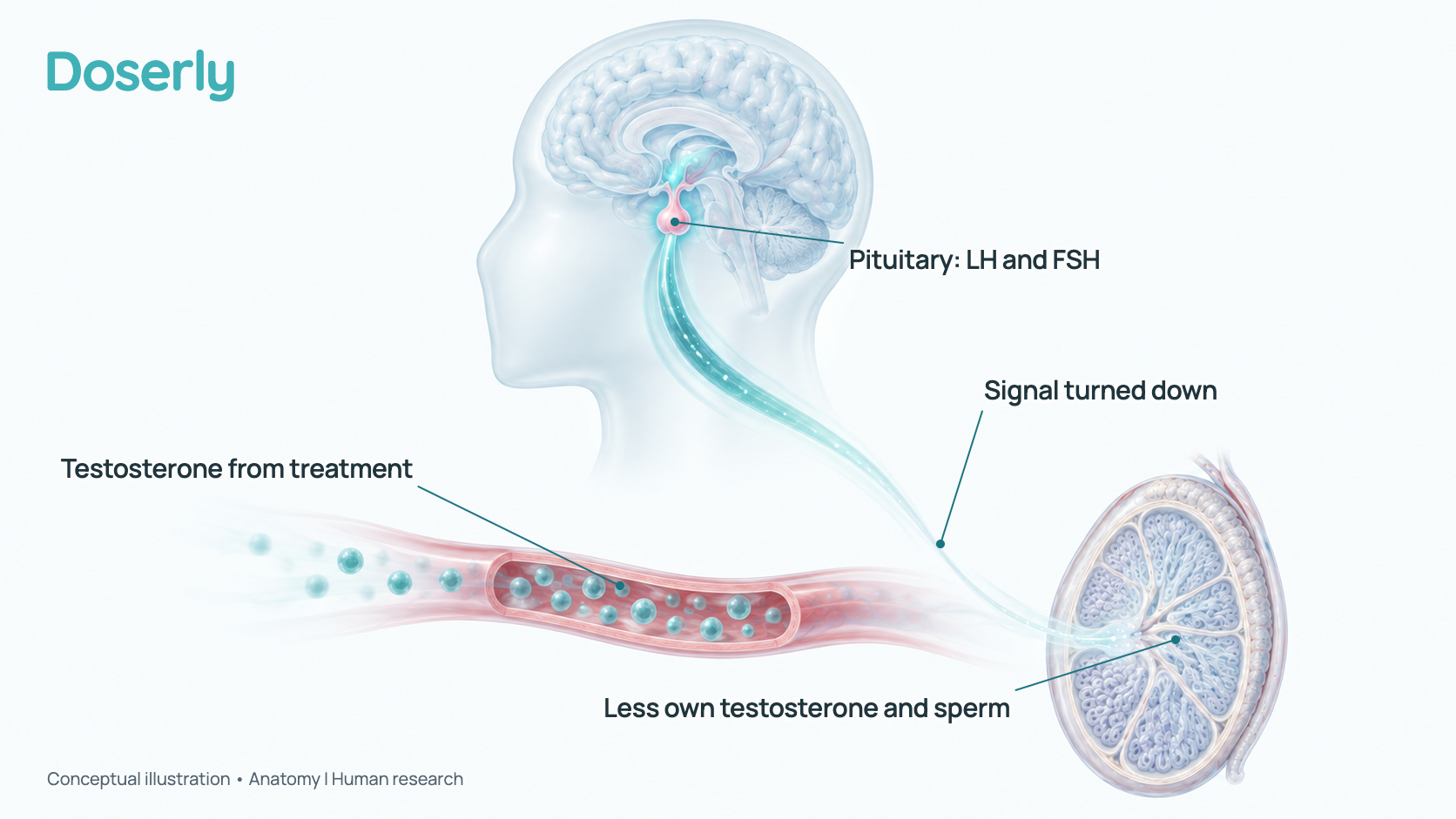
- Your own production. Testosterone from outside tells the brain to turn down its signals to the testicles, so the testicles make less of their own testosterone and fewer sperm. [10], [1]
- Your blood. Red blood cells start to increase within the first month. [11]
How you feel changes more slowly and less predictably. A review of placebo-controlled trials done for the Endocrine Society found small improvements in sexual desire, erections and sexual satisfaction, and no clear effect on energy or mood. That is worth knowing before the first dose. [25]
This guide covers men starting TRT. The TRT overview compares all the forms, and the TRT dosage guide covers dose schedules in depth.
Starting TRT: the key numbers
This table shows when each major clinical guideline rechecks testosterone and hematocrit (the share of the blood made up of red cells) after TRT starts, where in the dosing cycle the sample is taken, and what testosterone level it aims for. When each one judges symptoms is in the stopping rules. The numbers are what each document says, checked in September 2026.
| Guideline (version, year) | First recheck after starting | When the sample is taken on injections | Testosterone target |
|---|---|---|---|
| AUA, American Urological Association (2018, validity reconfirmed 2024) | By form: gels and nasal gel 2–4 weeks; cypionate or enanthate no earlier than after 3–4 injections; Aveed halfway between the first two 10-week injections; pellets 2–4 weeks, then 10–12 weeks. After that, every 6–12 months. Hematocrit: before starting, during dose finding if the clinician judges it needed, then every 6–12 months | Historically midway between injections | 450–600 ng/dL (about 15.6–20.8 nmol/L) |
| Endocrine Society (2018) | 3–6 months, 12 months, then yearly | Midway between injections; gels 2–8 hours after application, after at least 1 week | Mid-normal: adjust if above 600 or below 350 ng/dL (about 21 or 12 nmol/L) |
| EAU, European Association of Urology (2026) | 3, 6 and 12 months, then yearly; men at higher hematocrit risk every 3 months in year one | Not specified | Suggests the range used in the Testosterone Trials, 280–873 ng/dL (9.6–30 nmol/L) |
| BSSM, British Society for Sexual Medicine (2023) | Hematocrit before, at 3–6 months, 12 months, then yearly; PSA (a prostate blood test) at 3–6 and 12 months | At the trough, just before the next injection; gels 2–4 hours after application | 15–30 nmol/L (about 430–865 ng/dL) |
| CUA, Canadian Urological Association (2021) | Symptoms, testosterone and PSA at 3 and 6 months, then yearly; hematocrit at 3 months, then yearly | Midway between injections | 14–17 nmol/L (about 400–490 ng/dL) |
| VA, US Department of Veterans Affairs (January 2026) | Testosterone, hematocrit and PSA at 3–6 months and 12 months | Midway; for weekly injections, day 3–4; gels 2–8 hours after application | No single band; adjust the dose if testosterone is above 900 ng/dL or hematocrit above 51% |
| EAA, European Academy of Andrology (2020) | Response and side effects at 3 and 12 months, then at least yearly; hematocrit 3–6 months after starting | Not specified | The mid-normal range for young men, measured at each clinic visit; no number given |
| Society for Endocrinology (UK, 2022) | Gels 2–3 weeks after starting or a dose change; undecanoate injections at the trough before the third injection, then every 3–5 injections or yearly | At the trough, aiming for the lower end of normal; gels 2–6 hours after application | Mid-normal on gel; lower end of normal at the trough on injections |
[2], [3], [4], [15], [14], [16], [26], [17]
Most guidelines recheck testosterone and hematocrit about 3 to 6 months after starting and judge symptoms somewhere between 3 and 12 months. They differ on the exact month, on whether blood for injections is drawn midway between doses or at the trough, and on the target, which runs from 14–17 nmol/L in Canada to 15–30 nmol/L in the BSSM guideline. [3], [14], [15]
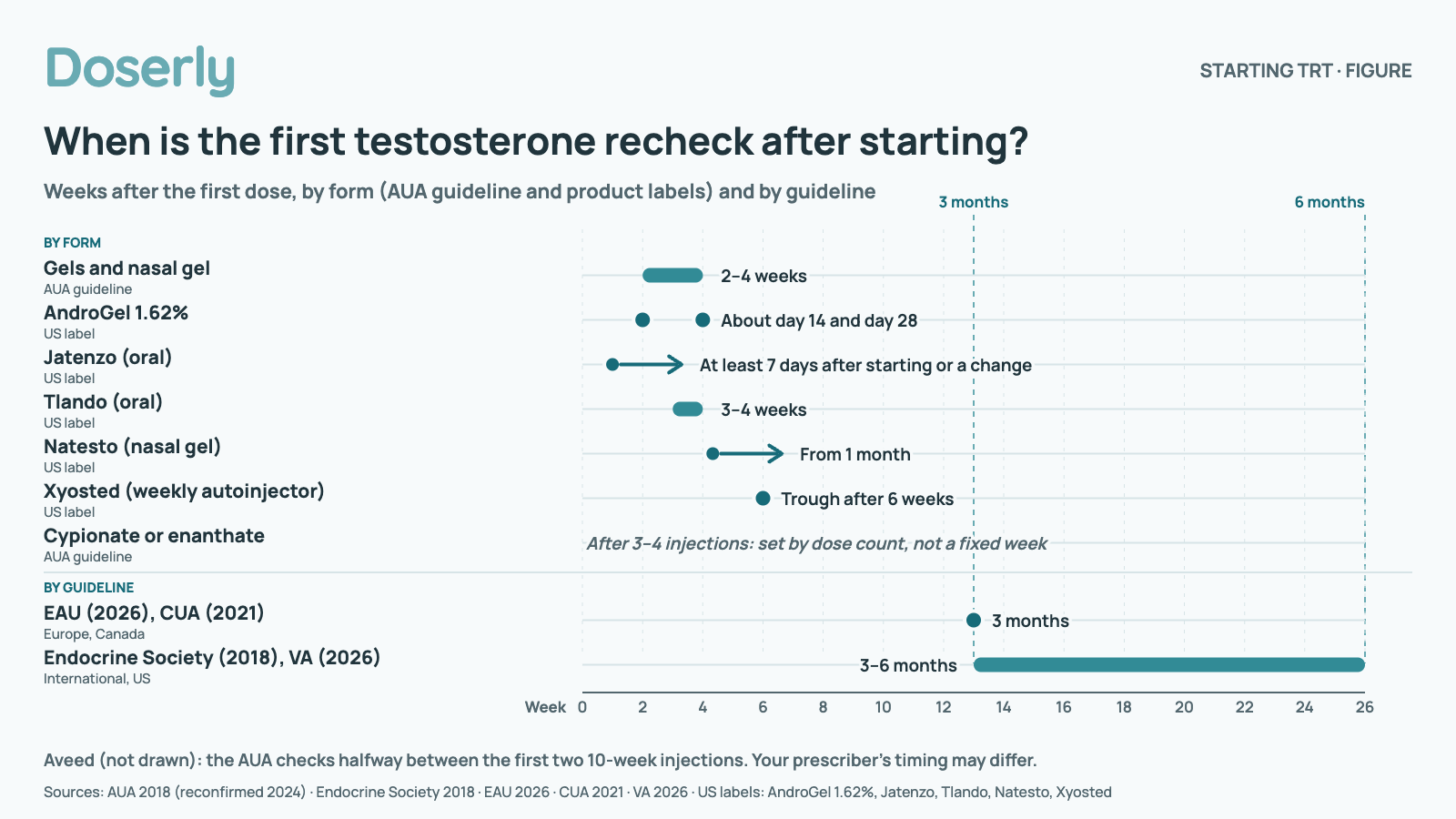
When is the first testosterone recheck after starting?
Weeks after the first dose, by form (AUA guideline and product labels) and by guideline.
By form
- 2–4 weeks
Gels and nasal gel (AUA guideline).
- About day 14 and day 28
AndroGel 1.62% (US label): morning level before that day's dose.
- At least 7 days after starting or a change
Jatenzo oral capsules (US label): 6 hours after the morning dose.
- 3–4 weeks
Tlando oral capsules (US label): 8–9 hours after the morning dose.
- From 1 month
Natesto nasal gel (US label).
- After 6 weeks
Xyosted weekly autoinjector (US label): trough, 7 days after the last dose.
- After 3–4 injections
Cypionate or enanthate (AUA guideline): set by dose count, not a fixed week.
By guideline
- 3 months
EAU (2026) and CUA (2021).
- 3–6 months
Endocrine Society (2018) and VA (2026).
Aveed: the AUA checks halfway between the first two 10-week injections. Your prescriber's timing may differ.
When do the product labels check first?
Some labels set their own first check with a dose rule tied to it: the Xyosted autoinjector checks a trough after 6 weeks and moves the dose in 25 mg steps, AndroGel 1.62% checks at about 14 and 28 days, the oral capsules check hours after a morning dose (Tlando at 3–4 weeks, with no dose changes), and Natesto from 1 month. Plain cypionate and enanthate vials give no timing, so the guidelines above apply. [5], [27], [28], [29], [1]
Label-by-label first checks
Every label that sets a first check, and what the result changes:
| Product (country) | First testosterone check on the label | What the result changes |
|---|---|---|
| Xyosted, enanthate autoinjector (US) | Trough, 7 days after the last dose, after 6 weeks | Keep the dose at 350 to under 650 ng/dL; add 25 mg below 350; take off 25 mg at 650 or more |
| AndroGel 1.62% (US) | Morning level before that day's dose, at about 14 and 28 days | Adjust to stay within 350–750 ng/dL |
| Testim (US) | Morning level before that day's dose, at about 14 days | If below the normal range (300–1,000 ng/dL), the dose may go from 50 to 100 mg a day; maximum 100 mg a day |
| Jatenzo, oral (US) | 6 hours after the morning dose, at least 7 days after starting or a change | Adjust to stay within 425–970 ng/dL |
| Kyzatrex, oral (US) | 3–5 hours after the morning dose, 7 days after a change | Adjust to stay within 460–971 ng/dL |
| Tlando, oral (US) | 8–9 hours after the morning dose, at 3–4 weeks | No dose changes: continue if 300–1,080 ng/dL, otherwise stop |
| Natesto, nasal gel (US) | From 1 month | Stop if consistently above 1,050 ng/dL; consider another treatment if consistently below 300 |
| Aveed, undecanoate injection (US) | No timing on the label (the AUA checks halfway between the first two 10-week injections) | No dose changes; levels reach steady state with the third injection, at 14 weeks |
| Nebido, undecanoate injection (UK) | At the end of an injection interval | Interval of 10–14 weeks; the first may be shortened to 6 weeks |
| Cypionate and enanthate vials (US) | No timing on the label | 50–400 mg every 2–4 weeks, adjusted to response |
[5], [27], [30], [31], [24], [28], [29], [32], [2], [33], [1], [34]
Why do guidelines disagree?
Mostly because the evidence behind each choice is thin, and the guidelines grade it that way themselves. The AUA rates its 450–600 ng/dL target a conditional recommendation (Grade C), the BSSM rates its 15–30 nmol/L target at evidence level 4 (Grade C), and the CUA rates the evidence for its 14–17 nmol/L target low and its recommendation weak. [2], [15], [14]
Timing is the other big difference. A test drawn midway between injections reads higher than one drawn at the trough, just before the next dose, so a trough-based guideline and a midway-based one can read the same man differently. Gels and oral capsules are tested a set number of hours after a dose instead. The TRT blood work guide explains each draw time.
The first recheck also has a practical purpose: the starting dose often changes. The Endocrine Society says "multiple dose titrations are usually necessary" to keep testosterone in range, and in US insurance claims for gel, dose increases appeared as early as the first month. [3], [35]
How do the units work?
US labs report testosterone in ng/dL; most other countries use nmol/L. One nmol/L equals 28.84 ng/dL, so 300 ng/dL is about 10.4 nmol/L and 600 ng/dL about 20.8 nmol/L. The testosterone unit converter switches between them.
Where these numbers come from
Each guideline row comes from that body's current document: the AUA testosterone deficiency guideline (published 2018, validity reconfirmed 2024), the Endocrine Society guideline (2018), the EAU guidelines on sexual and reproductive health (2026 edition), the BSSM guidelines (2023), the CUA guideline (2021), the VA recommendations (January 2026), the EAA guideline (2020) and the Society for Endocrinology guideline (2022). "Not specified" means the document we reviewed gives no value for that column. [2], [3], [4], [15], [14], [16], [26], [17]
The label rows come from the current US labels on DailyMed for Xyosted, AndroGel 1.62%, Testim, Jatenzo, Kyzatrex, Tlando, Natesto, Aveed, Depo-Testosterone and generic enanthate, and the UK Nebido summary of product characteristics. [5], [27], [30], [31], [24], [28], [29], [32], [1], [34], [33]
The Endocrine Society prints its own nmol/L conversions next to 600 and 350 ng/dL, and they do not match the standard factor; this guide converts with 1 nmol/L = 28.84 ng/dL. Not used: a claim that everyone's first check falls at "4–6 weeks" (no guideline or label sets one time for every form) and a 450–700 ng/dL "AUA target" that appears online (the guideline says 450–600).
Why do changes arrive at different times?
Because the blood level, your own hormone production and each body system respond on different clocks. The form of testosterone sets how fast the blood level settles, and each tissue then responds at its own pace. [8]
How fast do blood levels settle?
It depends almost entirely on the form.
- Gels. In a trial of 227 men, gel brought testosterone into the normal adult range on the first day. The AndroGel 1% label says levels are close to steady state (the point where each dose replaces what the body clears, so levels stop climbing) by the end of the first 24 hours and at steady state by day 2 or 3. [6], [36]
- Weekly enanthate autoinjector. The Xyosted label reports steady state by week 6, and a dosing study found exposure matched after the third weekly 100 mg injection. [5], [37]
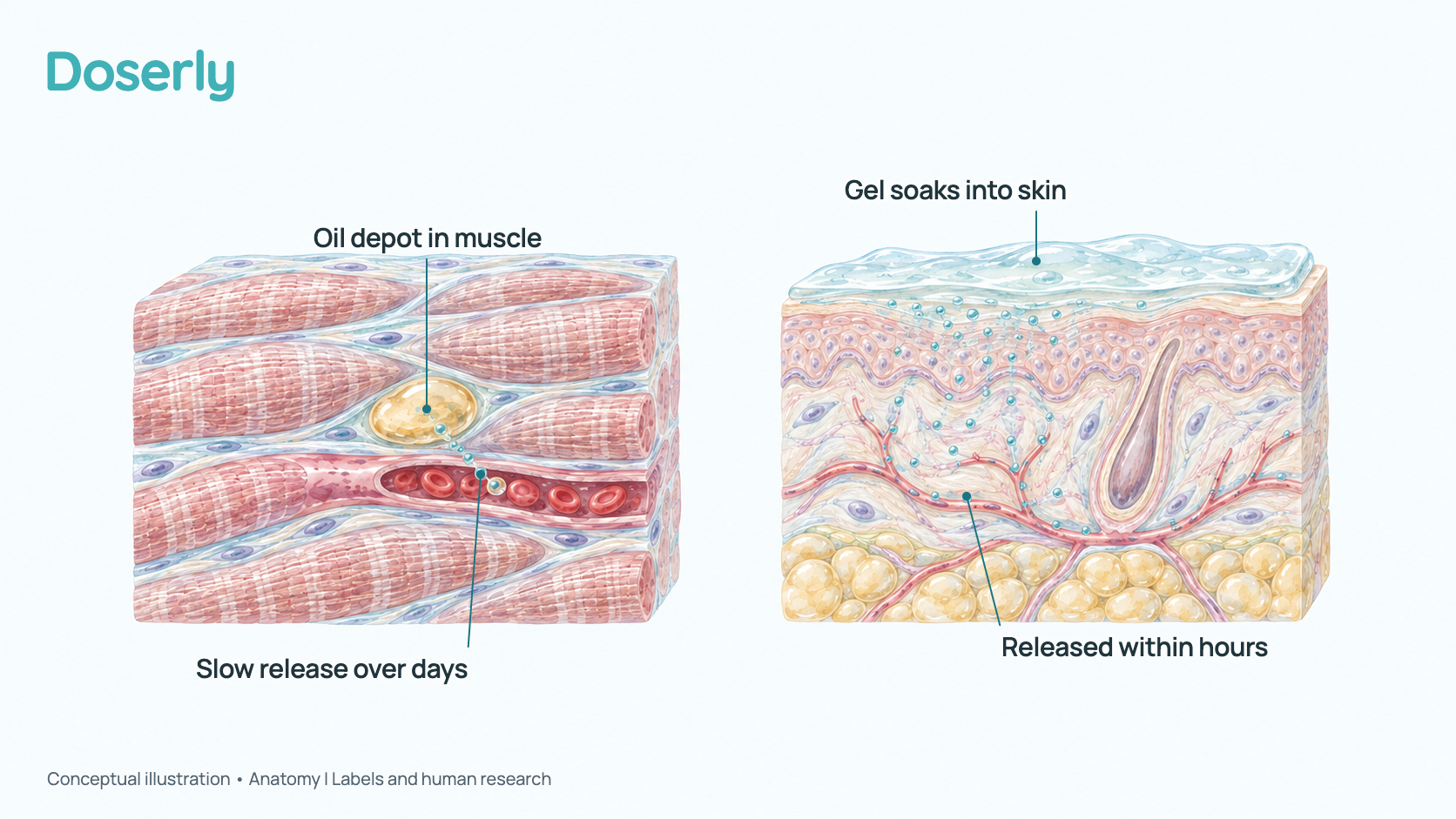
- Cypionate and enanthate injections. Testosterone is joined to a chemical tail (an ester) and dissolved in oil, so it releases slowly from a pool of oil in the muscle (a depot). The US cypionate label gives a half-life of about 8 days, and on the Azmiro label levels peaked a median of 71.7 hours after a 200 mg dose. The AUA does not check these injections until after 3–4 doses. [1], [38], [2]
- Long-acting undecanoate injection. On the Aveed label, levels peak a median of 7 days after an injection, and steady state arrives with the third injection, at 14 weeks. [32]
Testosterone itself lasts only minutes in the blood; the enanthate label gives a half-life of 10 to 100 minutes. The multi-day figures describe slow release from the oil, not the hormone. We found no study measuring exactly when weekly or every-2-week intramuscular (into a muscle) cypionate levels stop changing. [34]
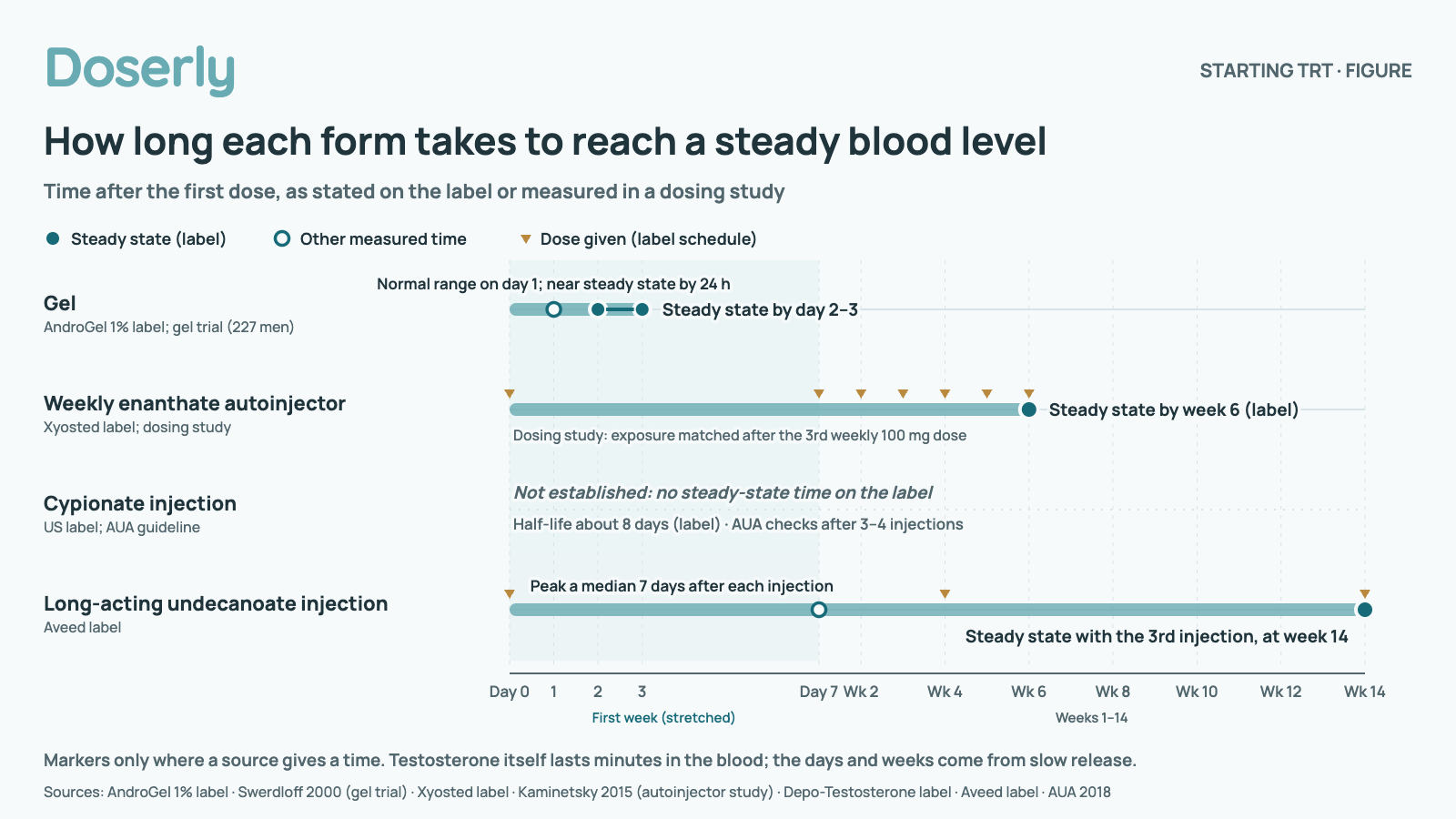
How long each form takes to reach a steady blood level
Time after the first dose, as stated on the label or measured in a dosing study.
- Gel: Day 1 to day 2–3
A trial of 227 men reached the normal range on day 1. The AndroGel 1% label: near steady state by 24 hours, steady state by day 2–3.
- Weekly enanthate autoinjector: By week 6
Xyosted label: steady state by week 6. A dosing study found exposure matched after the 3rd weekly 100 mg dose.
- Cypionate injection: Not established
No steady-state time on the label. Half-life about 8 days (label); the AUA checks after 3–4 injections.
- Long-acting undecanoate injection: Week 14
Aveed label: peak a median 7 days after each injection; steady state with the 3rd injection, at week 14.
Testosterone itself lasts minutes in the blood; the days and weeks come from slow release from the gel reservoir or the oil depot.
What happens to your own testosterone and sperm?
Your own production is turned down from the first doses. The brain reads the extra testosterone as "enough" and lowers LH (luteinizing hormone) and FSH (follicle-stimulating hormone), the two pituitary signals that drive the testicles. In healthy men given enanthate 200 mg weekly for three weeks, LH fell to 5% of its starting level and testosterone inside the testicles fell by 94%. [10]
Sperm production depends on that high level inside the testicles, normally about 40 to 100 times the level in the blood. That is why the labels warn that testosterone lowers sperm production and that reduced fertility may not always reverse. The TRT and fertility guide and the hCG guide cover ways to protect it. [39], [40], [1]
Why do red blood cells rise?
Testosterone makes the bone marrow produce more red blood cells, and the rise depends on the dose: in a study of healthy young and older men given graded doses, hemoglobin and hematocrit rose in step with the dose, more in older men, starting within a month and in many men still rising after week 12. The hematocrit guide explains why and what guidelines do about it. [11], [3]
What does the research show about the first 3 months?
Each outcome has its own timetable. Sex drive moves first, erections and mood take weeks, energy is the least consistent, and body composition and bone take months. Most of the week-by-week detail comes from small open studies (no placebo group) and a narrative review; placebo-controlled trials mostly measured at 3 months or later. [7], [8], [41]

What changed, and when, in the studies?
| Outcome | Earliest change seen | Where it levelled off | Placebo-controlled result | Limits |
|---|---|---|---|---|
| Sex drive and sexual thoughts | About 3 weeks | 3 weeks on injections; 6 weeks in a review | Better than placebo at 12 weeks on a 2% solution and at 3 months in the Testosterone Trials | Open studies have no comparison group [7], [8], [42], [41] |
| Erections | Within weeks | Total erections peaked over 9 weeks; up to 6 months in a review | Small: erectile scores up about 2 points in pooled trials; no improvement in TRAVERSE | Erections depend on more than testosterone [7], [8], [43], [44] |
| Mood and depressive symptoms | 3–6 weeks | Depression scores levelled off at 6 weeks; maximum at 18–30 weeks in a review | Small benefit in a meta-analysis of 27 trials; no clear effect in a review of 4 trials | Effect sizes small [7], [8], [45], [25] |
| Energy and fatigue | Fatigue improved after 9–12 weeks in an open study | Not established | Mixed: no vitality benefit in the Testosterone Trials; modest gains in TRAVERSE | The least consistent early change [7], [9], [46] |
| Quality of life | 3–4 weeks | Longer for the full effect | Not measured this early | Review, not a pooled analysis [8] |
| Muscle, fat and strength | Leg-press strength rose 11–13 kg by day 90 on gel | No further strength gain from day 90 to day 180; body composition settles at 6–12 months | Not measured this early | Gel trial had no placebo [47], [8] |
| Bone | After 6 months | Full effect took 24 months in severely deficient men | Spine bone density (trabecular, measured by CT) +7.5% vs +0.8% on placebo at 1 year | Not a 3-month change [48], [49] |
| Hematocrit | Within 1 month | Still rising after week 12 in many men; peak at 9–12 months in a review | Erythrocytosis more common than on placebo in pooled trials of 1,579 men (relative risk 8.1; the review does not give the rate in each group) | See the hematocrit guide [11], [8], [25] |
| PSA | Small rise by 3 months | Plateau at 12 months | 0.11 ng/mL above placebo at 3 months and 0.15 at 12 in TRAVERSE | Men at high prostate risk were excluded [50], [8] |
| Sperm | Mean 120 days to no sperm (azoospermia) at a contraceptive dose | 65% had no sperm by 6 months | Not applicable | Healthy men at 200 mg a week, not a replacement dose [13] |
Sex drive usually moves first and bone last. Energy is the change trials find least reliably. [8], [9], [25]
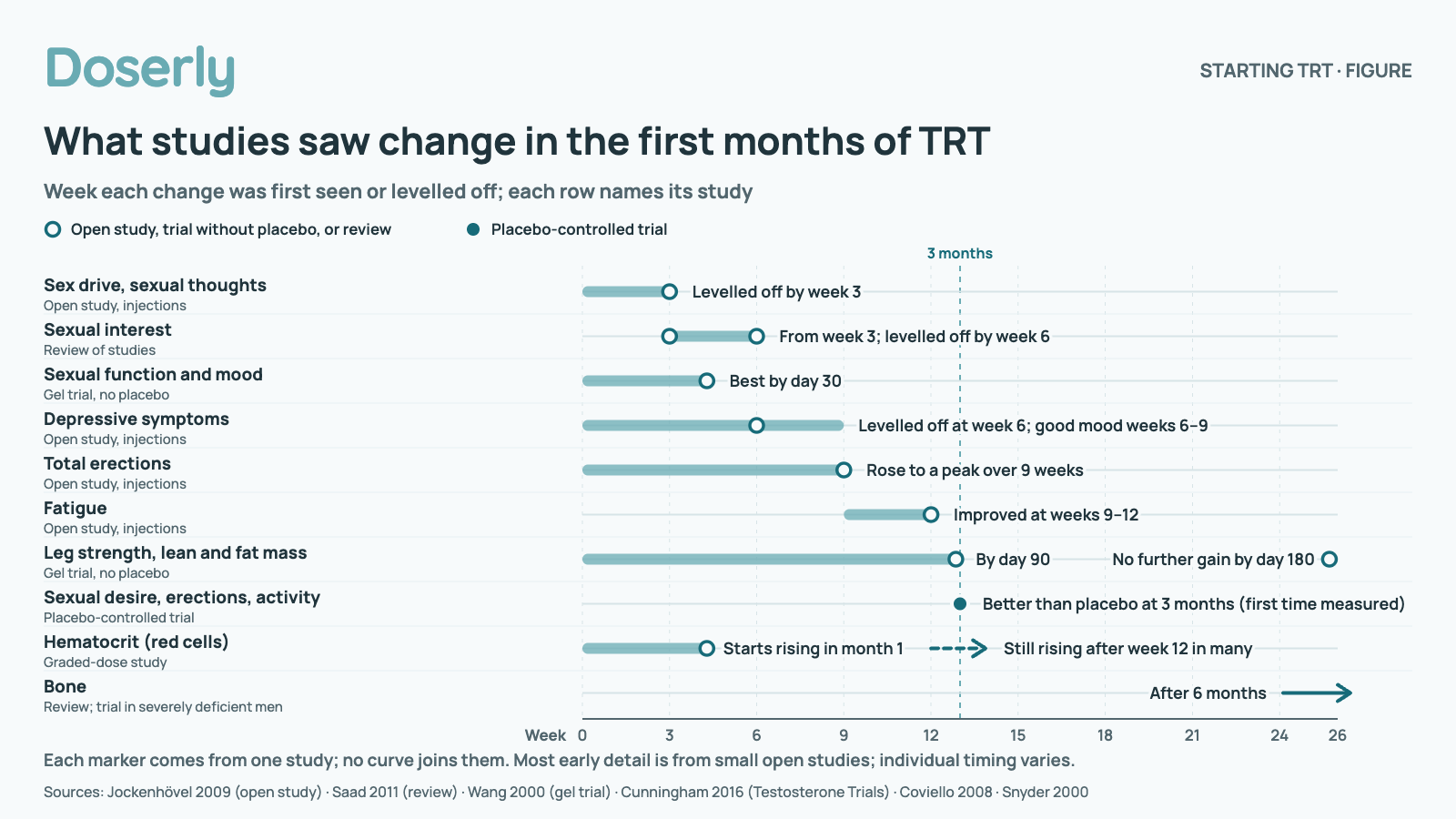
What studies saw change in the first months of TRT
Week each change was first seen or levelled off; each row names its study.
- By week 3without placebo
Sex drive and sexual thoughts levelled off (open study, injections).
- Weeks 3–6without placebo
Sexual interest from week 3, levelled off by week 6 (review of studies).
- By day 30without placebo
Sexual function and mood at their best on gel (gel trial, no placebo).
- Week 6 (mood weeks 6–9)without placebo
Depressive symptoms levelled off at week 6; good mood at weeks 6–9 (open study).
- Over 9 weekswithout placebo
Total erections rose to a peak (open study).
- Weeks 9–12without placebo
Fatigue improved (open study).
- By day 90without placebo
Leg strength, lean and fat mass changed on gel; no further strength gain by day 180 (gel trial, no placebo).
- 3 monthsplacebo-controlled
Sexual desire, erections and activity better than placebo at the first time measured (Testosterone Trials).
- Month 1 onwardwithout placebo
Hematocrit starts rising within the first month and is often still rising after week 12 (graded-dose study).
- After 6 monthswithout placebo
Bone changes (review; trial in severely deficient men).
Each point comes from one study; no curve joins them. Most early detail is from small open studies, and individual timing varies.
What do the placebo-controlled trials add?
They confirm the order but shrink the size of most changes. Sex drive is the most consistent: in the Testosterone Trials, desire, erectile function and sexual activity were better than on placebo at 3 months and stayed that way for the year. Erections improve less than desire: pooled trials put the gain at about 2 points on the International Index of Erectile Function (IIEF), TRAVERSE found no better erections, and in T4DM only 3 more men in 100 than on placebo had a meaningful gain. [41], [43], [44], [51]
Mood improves a little: a meta-analysis of 27 randomized trials found a small drop in depressive symptoms (effect size 0.21). Energy is uncertain: no vitality gain in the Testosterone Trials, a subgroup-only result in a 12-week trial of a 2% solution, and modest gains in TRAVERSE. Strength and body composition move by 3 months: in a 227-man gel trial, leg-press strength rose 11–13 kg by day 90 with no further gain by day 180, and lean mass rose 1.3–2.7 kg while fat fell by about 1 kg. [45], [9], [42], [46], [47] The guides on sexual health, mental health and muscle and fat loss go further.
Does everyone respond?
No. In one urology practice, 70% of 127 men reported better erections, sex drive, energy or mood by 3 months, and 63% finished a year with benefit. About 27% stopped because they felt no major benefit, and nearly two-thirds of those (64.7%) had reported nothing by 3 months. This was a look back at one practice's records, so it cannot predict any one man's result. [52]
In the Testosterone Trials, bigger rises in testosterone went with more sexual activity and desire, but no testosterone level worked as a threshold, and nothing measured at the start predicted who would respond. [41]
How many men are still on TRT after a year?
Fewer than you might expect, and the numbers depend heavily on how "stopping" is defined.
- In US insurance claims for 15,435 men starting gel, 34.7% were still filling prescriptions at 6 months and 15.4% at 12 months; about half of those who stopped later restarted. [35]
- In another claims study of 3,184 men starting gels, 17% were still taking it as prescribed at 12 months. [53]
- Among 4,797 Ontario men aged 66 or older, the median time to stopping was 319 days on gels and 283 days on injections. [54]
- In TRAVERSE, about 61% of men stopped their study gel early, whether it held testosterone or placebo. [55]
- In a survey of 382 men on TRT at one US clinic, 70% were satisfied and 14% dissatisfied; 35% of injection users said they chose injections for the lower cost. [56]
Each study counted stopping differently, so the figures cannot be compared or combined. No study we found broke down, across forms, why men stop in the first year.
Is starting TRT safe?
It is an approved medicine with well-described risks, which is why guidelines check blood at the start and again within months. In the largest safety trial, heart attacks, strokes and heart deaths were no more common on gel than on placebo over about two years, within the trial's safety margin, but there were more heart-rhythm problems, kidney injury, lung clots and fractures, and the first months bring predictable changes: fewer sperm, more red cells and slightly higher blood pressure. [57], [55], [58], [12]
What did TRAVERSE show about heart safety?
TRAVERSE randomized 5,204 men aged 45 to 80 with low testosterone and existing heart disease or high heart risk to daily testosterone gel or placebo gel. MACE, a combined measure of heart attack, stroke or death from heart disease, occurred in 7.0% of men on testosterone and 7.3% on placebo (hazard ratio 0.96), which met the trial's safety goal: 182 of the 2,596 men who took testosterone and 190 of the 2,602 who took placebo. The 95% confidence interval ran from 0.78 to 1.17, so a large rise in risk was ruled out, though a small one was not. [57], [55]
Some problems were more common on testosterone: atrial fibrillation 3.5% vs 2.4%, acute kidney injury 2.3% vs 1.5%, and pulmonary embolism 0.9% vs 0.5%. Clinical fractures were also more common, 3.50% vs 2.46%. [55], [58]
The trial has limits. It tested only a daily gel, men used it for an average of 21.7 months, about 61% stopped their study gel early, and everyone enrolled was at high heart risk. [57], [55] The TRT and heart health guide covers it in full.
The AUA asks clinicians to tell men that low testosterone is itself a risk factor for heart disease, and to tell men on treatment to report chest pain, shortness of breath, dizziness or fainting. [2]
What side effects show up in the first weeks?
Mostly local and predictable ones. For intramuscular injections, the Endocrine Society lists pain at the site, swings in mood or sex drive, and coughing fits straight after an injection. [3]
- Injection-site reactions. In a 26-week study of the Xyosted autoinjector, 4 of 133 men had bruising and 6 had bleeding at the site, and one man reported mild pain across 965 assessed injections. In 63 transgender men using weekly subcutaneous (into the fatty layer under the skin) injections, 9 had minor, short-lived reactions. After the large-volume undecanoate injection, 80% of men reported pain, which was back to normal by day 4. [59], [60], [61]
- Oil reactions. The Aveed label carries a boxed warning for pulmonary oil microembolism (oil droplets reaching the lungs, causing coughing or breathlessness) and severe allergic reactions, with 30 minutes of observation after every injection; one analysis counted 28 microembolism reports against 90,092 doses distributed. Two case reports traced severe allergy to depot undecanoate to ingredients in the oil. [32], [62], [63], [64]
- Sleep and breathing. At high research doses, sleep shortened by about an hour and breathing during sleep worsened within 3 weeks in 17 healthy older men; in obese men with severe sleep apnea, oxygen drops at night worsened at 7 weeks but not at 18. No study we found looked at sleep in the first weeks at usual replacement doses. [65], [66]
- Skin, breast tenderness and fluid. Common complaints, but we found no trial giving first-3-month rates with clear denominators; see the TRT side effects guide.
- Gel transfer. All US gels and solutions carry a boxed warning about secondary exposure: testosterone rubbing off onto other people, with early puberty-like changes reported in children. [27]
Pain that spreads from an injection site, a hot swelling with fever, or coughing and breathlessness straight after an injection needs prompt medical attention.
Who should be especially cautious?
- Men who want children now or soon. The AUA says testosterone should not be prescribed to men trying to conceive, and the AUA and the American Society for Reproductive Medicine say clinicians should not prescribe it to men interested in current or future fertility. The Endocrine Society advises against it for men wanting fertility in the next 6–12 months and suggests considering sperm banking if unsure. [2], [67], [3]
- Men with a recent heart attack or stroke. Guidelines wait before starting: the AUA 3–6 months, the Endocrine Society 6 months and the VA 4 months. Uncontrolled heart failure is a reason not to start. [2], [3], [16]
- Men with a high hematocrit before starting, above 48–50% under most guidelines (see before the first dose). [3], [2]
- Men with untreated severe sleep apnea, a clotting disorder (thrombophilia), breast or prostate cancer, a prostate nodule, a PSA above 4 ng/mL without a urology check, or severe urinary symptoms. The Endocrine Society and the VA list these among reasons not to start. [3], [16]
- Men taking insulin, blood thinners or corticosteroids (see interactions).
- Drug-tested athletes. Testosterone is banned in sport at all times, and an exemption is granted only for low testosterone with an organic cause, such as testicular or pituitary disease, not for age, weight or past steroid use. [20], [68]
- Under-18s. Testosterone for teenagers belongs only in specialist care.
- Women. This guide is written for men. Testosterone for women uses different products and far smaller doses; see testosterone therapy for women.
Which medicines interact with testosterone?
The US labels name three: testosterone can lower blood sugar and so reduce insulin needs in men with diabetes; it can change the effect of blood thinners such as warfarin, so the clotting test (INR) should be checked more often; and taken with corticosteroids it can add to fluid retention. [27]
Some diabetes medicines called SGLT2 inhibitors raise hematocrit on their own, which adds to the rise on testosterone; the hematocrit guide has the numbers. The TRT with GLP-1 medicines guide covers weight-loss medicines. Bring a full list of what you take, including supplements, to your prescriber or pharmacist. Checked September 2026.
Is TRT legal, and does it count as doping?
Checked September 2026. Rules differ by country and change often.
- United States. Testosterone and its esters are Schedule III controlled substances. A Schedule III prescription cannot be filled or refilled more than 6 months after it was written, or refilled more than 5 times. Temporary telehealth rules let clinicians prescribe it without an in-person visit through December 31, 2026; a DEA rule creating a special registration for telehealth prescribing reached White House review in August 2026 and has not been published. No proposal to remove testosterone from Schedule III has been published. [18], [19], [69], [70]
- US labels. The FDA's June 2026 requests (removing the age-related limitation and narrowing the prostate cancer contraindication) are requests, not yet in any label. [21], [23]
- United Kingdom. Testosterone is a Class C controlled drug. [71]
- Canada. Testosterone is a Schedule IV controlled substance. [72]
- Australia. Testosterone is a Schedule 4 prescription-only medicine. [73]
- Sport. The World Anti-Doping Agency (WADA) prohibits testosterone at all times, and its 2027 list, published in September 2026, keeps the ban. [20], [74]
Access, coverage and costs differ by country; see the guides for the United States, the United Kingdom, Canada, Australia and the European Union.
What do guidelines say to do before and after starting?
Confirm the diagnosis and its cause, check a few safety markers, talk about fertility, then recheck at a time that matches the form and review symptoms after a few months. This section describes what guidelines ask clinicians to do; it is not a personal plan. [2], [3]
What happens before the first dose?
| Check | Who asks for it | Why it matters |
|---|---|---|
| Two early-morning total testosterone tests | US labels, AUA, Endocrine Society (2018 guideline and 2026 statement) | Testosterone varies from day to day; one low result is not a diagnosis |
| LH and FSH | AUA (LH), Endocrine Society (both) | Separates a testicle problem (primary hypogonadism) from a brain or pituitary one (secondary) |
| Prolactin, and a pituitary scan in some men | AUA: prolactin if LH is low or normal; a scan if testosterone is below 150 ng/dL with low or normal LH. EAU: a scan in severe secondary cases (below 6 nmol/L) | Looks for a pituitary cause that needs its own treatment |
| Hematocrit | AUA: consider withholding above 50%. Endocrine Society: caution above 48% (above 50% at altitude). VA: do not start above 48%. EAU: 48–50% is a relative and 54% an absolute reason not to start | Testosterone raises it further |
| PSA | AUA: men over 40. Endocrine Society: men 55–69, or 40–69 at higher risk, after a shared decision | Sets a baseline for prostate monitoring |
| Estradiol (the main estrogen) | AUA: recommended with breast growth or breast symptoms; optional in other men | Gives a starting point if breast symptoms appear later |
| Fertility plans | AUA, AUA/ASRM, Endocrine Society, EAU | Testosterone suppresses sperm production |
| Weight, sleep apnea and other reversible causes | EAU: improve lifestyle and weight first. Endocrine Society 2026: weight loss is usually first for obesity-related low testosterone | Treating the cause can raise testosterone without TRT |
[1], [2], [3], [22], [4], [16], [67]
The low testosterone guide, the TRT blood work guide and the guide to raising testosterone naturally cover these steps in depth.
How often are these steps skipped?
Often. The AUA notes that up to 25% of men prescribed testosterone were not tested before starting, and nearly half were not rechecked after. [2]
- In US insurance claims for 61,474 men aged 40 or older (2001–2010), only 52.4% had a testosterone test and 43.3% a PSA test in the year after starting. [75]
- In 142 new starts in the VA health system, 47.2% had no testosterone test and 39.4% no hematocrit within 6 months. [76]
- When researchers posed as a man with normal testosterone who wanted children, 6 of 7 US direct-to-consumer platforms offered him testosterone, only 1 of 7 asked about recent heart problems or fertility, and 5 of 6 did not discuss the risk of a high red-cell count. [77]
The AUA also advises commercially made testosterone over compounded products when possible. [2]
What happens at the first follow-up?
The prescriber compares a correctly timed testosterone level with the target, checks hematocrit, and usually asks about symptoms and side effects. PSA and blood pressure are checked on schedules that differ by guideline (see what to track). [3], [14], [16]
Dose changes at this point are normal, not a sign of failure. Labels that set a first check also set a rule: Xyosted moves in 25 mg steps, AndroGel 1.62% adjusts to stay within 350–750 ng/dL, and Tlando has no dose changes at all. The Endocrine Society refers a man to urology if PSA rises by more than 1.4 ng/mL in the first 12 months. [5], [27], [28], [3]
When do guidelines say to stop if it is not helping?
When testosterone is back in range but the symptoms that started the treatment have not improved. The AUA puts it plainly: "There is no utility in continuing testosterone therapy in men who achieve target testosterone levels without symptom/sign improvement." [2]
| Guideline | When | Rule |
|---|---|---|
| CUA (2021) | About 3 months | Stop if there is no clinical improvement despite normal levels; no tapering needed |
| AUA (2018) | 3–6 months | Discuss stopping if levels are normal but symptoms have not improved; exceptions for low bone density or anemia that improves |
| Endocrine Society (2018) | 3–12 months | Evaluate whether symptoms have responded, then yearly |
| BSSM (2023) | 6 months | Stop if there is no benefit to sex drive, sexual function, muscle or body fat |
| VA (January 2026) | 6–12 months | Stop if symptoms have not improved despite in-range levels |
| Society for Endocrinology (UK, 2022) | Not applicable | Rejects time-limited trials; lifelong treatment for a confirmed diagnosis |
[14], [2], [3], [15], [16], [17]
The disagreement is real. Most bodies treat the first months as a test of whether testosterone helps you; the UK Society for Endocrinology treats a confirmed diagnosis as a reason for lifelong replacement. The stopping TRT guide explains what happens to your own hormones and sperm after stopping.
Your first weeks: practical questions
How will the first injection feel?
It depends on the form and the volume: in studies, pain ranged from rare with a small weekly autoinjector dose to common, lasting up to 4 days, after the large-volume undecanoate injection (see side effects). US cypionate labels say intramuscular use only, deep in the buttock muscle, and the Xyosted label says not to inject until you have been trained. [59], [61], [1], [5] The injection guide covers sites, needles and technique.
Why don't I feel anything yet?
Because the first weeks are mostly about the blood level catching up. Gel reaches the normal range on day 1, but the earliest symptom changes measured in studies appear at about 3 weeks, and injected testosterone takes several doses to settle. Many men notice little in week 1 or 2, and that says little about the result at 3 months. [6], [7], [8], [5]
We found no study measuring symptoms in the first week, so reports of an early "honeymoon" or a crash after it come from personal accounts, not trials (see what people report).
Is 100 mg a week a normal starting dose?
For cypionate or enanthate injections, yes: 100 mg weekly appears in the AUA and Endocrine Society examples. The Endocrine Society lists 75–100 mg weekly or 150–200 mg every 2 weeks, and the AUA prefers 100 mg weekly over 200 mg every 2 weeks or 300–400 mg monthly. The US labels allow a wider 50–400 mg every 2–4 weeks. Xyosted starts at 75 mg weekly, and AndroGel 1.62% at 40.5 mg a day. [3], [2], [1], [5], [27]
Read the units. A dose is written in milligrams, but you draw a volume. At 200 mg/mL, 100 mg is 0.5 mL, which is 50 units on a U-100 insulin syringe; at 100 mg/mL, the same 100 mg is 1 mL. The TRT dose calculator does this arithmetic for any strength and schedule, and the TRT dosage guide compares schedules. [1]
These are labeled and guideline doses; prescribers adjust them using blood tests and symptoms. They are for adult men. For women, see testosterone therapy for women.
Is a bigger first "loading" dose normal?
Not on the cypionate or enanthate labels, which contain no loading dose; we found no trial testing one. The only labeled shortcut is for the long-acting undecanoate injection: Aveed gives its second dose at week 4 instead of week 10, and Nebido allows a first interval as short as 6 weeks. [1], [34], [32], [33]
Why is my testosterone so high on a low dose?
Men respond very differently to the same dose. The Endocrine Society notes "considerable variation" in testosterone levels among men on the same treatment, and that "a small fraction" of men develop levels above the normal range on intramuscular injections. [3]
Before reading much into one result, check when it was drawn: on the Azmiro label, levels peak about 3 days after a 200 mg dose, so a sample taken then reads far higher than one taken just before the next dose. We found no study that defines "hyper-responders" as a group. The blood work guide explains the timing. [38]
Do I need an aromatase inhibitor or hCG from the start?
Not routinely, according to the guidelines. The AUA recommends an estradiol test before treatment for men with breast growth or breast symptoms and makes it optional for others, and the VA does not generally recommend aromatase inhibitors (medicines such as anastrozole that block estrogen production) because of links with heart events, belly fat and bone loss. In older men with low testosterone, a year of anastrozole lowered spine bone density compared with placebo. [2], [16], [78]
hCG is a fertility question, not a routine add-on. The AUA says clinicians may use hCG, aromatase inhibitors or SERMs (tablets such as clomiphene that raise the body's own LH and FSH) to help keep fertility, noting that only hCG is FDA-approved for men, and the VA reserves hCG for men with pituitary-type low testosterone who want children. See the hCG, estrogen on TRT and TRT and fertility guides. [2], [16]
What if I miss a dose?
Ask your prescriber or pharmacist. None of the US patient leaflets we checked (Xyosted, AndroGel 1.62%, Jatenzo, Kyzatrex, Tlando and Natesto) gives a missed-dose rule. UK leaflets differ: the Testogel and Tostran gel leaflets say not to double up and to apply the next dose at the usual time, the Sustanon leaflet says to talk to your doctor or nurse, and the Nebido leaflet says not to miss injection appointments. [79], [5], [27] The travel guide covers doses across time zones.
How soon does hematocrit rise?
Within the first month in many men, and it can keep rising after month 3. In a 26-week study of weekly Xyosted, 10 of 133 men (7.5%) reached 52% or more; in the records of a UK clinic whose patients mostly used subcutaneous injections, often with hCG, about 1 in 4 (24.15%) passed 54% within 12 months, with no comparison group. [11], [59], [80] The hematocrit guide covers what guidelines do next.
Should I use a symptom questionnaire?
As a personal log, it can help; as a test, no. The AUA does not recommend validated questionnaires either to decide who should get testosterone or to monitor the response to it. The ADAM questionnaire picked up 88% of men with low testosterone but also flagged many men without it (specificity 60%). [2], [81]
Trials rated symptoms with structured questionnaires at set times, such as every 3 months in the Testosterone Trials. In an uncontrolled study of 1,174 men, Aging Males' Symptoms scores fell 32% over 12 weeks, which cannot separate the medicine from expectation. A simple, consistent log of sex drive, erections, mood, energy and sleep, started before the first dose, gives the follow-up visit something concrete to compare. [41], [82]
What do people starting TRT report?
Public forums are full of men in their first days and weeks of TRT, asking whether what they feel is normal. The threads below are recent public Reddit discussions, read with their replies; they show what people experience, not how often it happens.
What do the first days feel like?
Anything from nothing to a lot. One man on 140 mg a week felt hyper-alert and skipped his usual coffee the day after his first dose; replies split between similar experiences and expectation. Another, two days into about 12 mg a day, felt nothing and was told day 2 was far too early to judge. [83], [84]
Some early changes were unpleasant. After a first 100 mg dose, one man felt calm for two days, then warm, sweaty, restless and unable to sleep. Another felt better than he had in years for several days, then had severe anxiety, racing thoughts and raised blood pressure after a later dose. [85], [86]
What happens by week 4 and month 3?
The range is wide. One man who started at 100 mg a week, half what his clinic suggested, felt better from week 1 and had back acne by week 12. Others felt little: no change at week 4 on 100 mg every 2 weeks, no clear benefit by week 8 on a cautious 60 mg a week despite much higher levels, and "unimpressed" at week 12 on 100 mg a week, with fewer morning erections, mood swings and ankle swelling. [87], [88], [89], [90]
Early gains sometimes faded. One man had much better erections for 5–6 weeks on 200 mg a week, then weaker ones by week 9, with very high testosterone and estradiol results and a hematocrit of 54.2%. [91]
What goes wrong with the first doses?
Volume and schedule mistakes come up again and again. One man injected a whole 1 mL vial (200 mg) for his first dose, thinking one vial was one dose, when his prescription was 0.25 mL every 2 weeks. Another's label said both 0.3 mL and 100 mg, which do not match at 200 mg/mL. A third, injecting 1 mL into his thigh each week, had soreness for days until he halved the volume. [92], [93], [94]
Why do first blood results surprise people?
Because timing, dose and other medicines all move the number, and the number does not always match how people feel. A man on gel felt more alert within hours, yet his testosterone had barely changed after a month. A man taking hCG alongside 80 mg a week measured about 1,300 ng/dL at a month, and about 1,800 ng/dL after lowering to 60 mg, with a hematocrit of 52%. Another's trough after 4 months on 80 mg a week was below his pretreatment level. [95], [96], [97], [98]
Schedules matter too. One man felt well on 100 mg weekly; when the same dose was moved to every 14 days, his day-13 level was 92 ng/dL and he felt much worse. At 4 weeks, another was offered a higher dose plus anastrozole although he felt no different; replies disagreed, and guidelines do not recommend routine aromatase inhibitors. [99], [100]
Who regrets starting, and why?
Regret shows up both on day 1 and months in. One man with untreated moderate sleep apnea regretted his first injection the next day. Another, who had few symptoms before starting, reported new anxiety and sexual problems after about 7 weekly injections while also losing weight on a GLP-1 medicine. A man in his 20s who started with a baseline of 550 ng/dL reported little benefit, heavy hair shedding and breast tissue growth after 6 months, and planned to stop because he wanted children. [101], [102], [103]
How can you judge an early TRT story?
Ask: Was low testosterone confirmed on two morning tests, and was the cause looked for? What form, dose and schedule, and how long after a dose was blood drawn? What else started at the same time: hCG, an aromatase inhibitor, a GLP-1 medicine, a new training plan, CPAP? And what did the follow-up visit show? One man about to start worried that success stories had inflated his expectations; replies ranged from life-changing to "feels normal". [104]
These selected discussions show what people experience and the questions research has not answered. They are not a survey of all men on TRT, a success rate or a substitute for the studies above.
What should you track in the first months?
Testosterone at the right point in the dosing cycle, hematocrit, PSA where your guideline or age calls for it, blood pressure, and the symptoms that led to treatment. Use this summary to prepare questions for your prescriber; it is not a personal testing plan. [3], [2]
| What | When to check in year one | Why it matters | Tracking category |
|---|---|---|---|
| Testosterone | First check by form (2–4 weeks on gel, after 3–4 injections, 6 weeks on Xyosted), or at 3–6 months; then at 12 months | Shows whether the dose reaches the target; the draw time must match your guideline | Blood work |
| Hematocrit and hemoglobin | Before starting, at 3–6 months and 12 months; every 3 months on some products | Rises within the first month; most guidelines act at 54% | Blood work |
| PSA | Before starting in men over 40 (AUA); at 3–12 months in men who choose monitoring (Endocrine Society) | A rise of more than 1.4 ng/mL in year one prompts a urology referral | Blood work |
| Blood pressure | At visits; labels and studies report average rises of 1.7–4.9 mm Hg systolic within 3–4 months on different products | All testosterone products raise blood pressure a little | Blood Pressure |
| Symptoms | Before starting and at the 3-month review | The reason for treatment, and the basis for continuing | Libido, Energy Levels, Mood & Wellbeing |
| Sleep and snoring | Before starting and if sleep changes | Untreated severe sleep apnea is a reason not to start | Sleep Quality |
| Injection sites | Each dose | Soreness, lumps or spreading pain | Side Effect Burden |
[2], [5], [3], [28], [24], [31], [12]
In 24-hour blood-pressure studies, average systolic pressure rose 3.9 mm Hg after 12 weeks on Xyosted, 4.9 after 4 months on Jatenzo, 4.3 on Tlando, 1.7 on Kyzatrex, 3.1 after 16 weeks on Aveed and 1.9 after 16 weeks on 1.62% gel. [5], [31], [28], [24], [32], [105], [12]
Write down the date and time of every blood draw and when your last dose was. Without that, a result cannot be compared with the next one. The testosterone level visualizer shows how injection frequency changes the peaks and troughs, and the TRT blood work guide covers each test.
Common questions about starting TRT
How long does TRT take to work?
Weeks for sex drive, months for most other changes. In studies, sex drive rose from about 3 weeks, depressive symptoms eased by about 6 weeks, erections kept improving for 9 weeks or longer and body composition changed over 12–16 weeks. Energy is the least predictable. Most guidelines judge the response between 3 and 12 months. [7], [8], [3] See what changed, and when.
When is the first blood test after starting TRT?
It depends on the form and the guideline. The AUA checks gels at 2–4 weeks and cypionate or enanthate after 3–4 injections; the Xyosted label checks at 6 weeks; the Endocrine Society and the VA recheck at 3–6 months, and the EAU and CUA at 3 months. The draw time within the dosing cycle matters as much as the week. [2], [5], [3], [4], [14] See the key numbers.
Will I lose fertility right away?
No, but it starts falling with the first doses, and TRT is not reliable birth control. In a WHO contraception trial at 200 mg a week, 65% of healthy men had no sperm by 6 months, and those who got there took an average of 120 days. After hormonal contraception studies in healthy men, 90% recovered to a normal count (20 million per mL) within a year of stopping; recovery after longer TRT may be slower. If you may want children, discuss sperm banking or alternatives before starting. [13], [106], [3] See the TRT and fertility guide.
Do I have to stay on TRT forever?
Not necessarily. Most guidelines treat the first 3–12 months as a trial and advise stopping if symptoms have not improved despite normal levels; the UK Society for Endocrinology instead expects lifelong treatment for a confirmed diagnosis. After stopping, your own production takes time to recover. [2], [17] See the stopping rules and the stopping TRT guide.
Does TRT cause heart attacks?
The largest trial found no rise, within its safety margin. In TRAVERSE, heart attack, stroke or death from heart disease occurred in 7.0% of men on testosterone gel and 7.3% on placebo (hazard ratio 0.96, 95% confidence interval 0.78 to 1.17). Atrial fibrillation (3.5% vs 2.4%), acute kidney injury (2.3% vs 1.5%) and pulmonary embolism (0.9% vs 0.5%) were more common. The trial tested only gel, in men at high heart risk, for an average of 21.7 months of treatment, and about 61% stopped their study gel early. [57], [55] See what TRAVERSE showed.
Is TRT the same as taking steroids?
Testosterone is legally an anabolic steroid, but replacement aims to bring a low level back into the normal range under monitoring. Performance use usually means far higher doses, often of several drugs combined, which an Endocrine Society statement links with heart, mental-health and hormonal harms. [18], [107] See TRT vs steroids.
Will TRT fix erectile dysfunction?
Sometimes partly, often not fully. Testosterone raised desire more than erections in placebo-controlled trials: erectile scores rose about 2 points in pooled data, TRAVERSE found no improvement in erections, and in T4DM only 3 more men in 100 than on placebo had a meaningful gain. [43], [44], [51] See the TRT and sexual health guide.
Can supplements replace TRT?
Not for confirmed hypogonadism. In a review of 50 "testosterone booster" products, only 27 of their 109 ingredients had any data showing a testosterone rise. Weight loss does raise testosterone in men with obesity: by about 2.9 nmol/L on a low-calorie diet and 8.7 nmol/L after bariatric surgery in a meta-analysis. [108], [109] See raising testosterone naturally.
Glossary
Plain explanations of the medical, lab and research terms used in this guide. Underlined terms in the text link here.
- Aromatase inhibitor
- A medicine, such as anastrozole, that blocks the enzyme that turns testosterone into estradiol. The VA does not generally recommend them for men on testosterone.
- Azoospermia
- No sperm at all in a semen sample.
- Controlled trial
- A study that compares people who receive a treatment with a similar group who do not, often receiving a placebo instead. Randomly assigning people to each group makes the comparison fairer.
- Depot
- A pool of medicine left in the body, such as oil in a muscle, that releases the drug slowly over days or weeks.
- Ester
- A chemical tail joined to testosterone that makes it dissolve in oil and release slowly after injection. The body removes the tail to free testosterone. Cypionate, enanthate and undecanoate are esters.
- Estradiol
- The main form of estrogen. In men it is made mostly from testosterone, so it rises when testosterone rises.
- FSH (follicle-stimulating hormone)
- A pituitary hormone that acts on the cells supporting sperm production. Testosterone therapy lowers it.
- Clinical guideline
- Recommendations written by a medical society or health system, based on its review of the evidence and expert judgment. Different guidelines can reach different conclusions.
- Half-life
- The time it takes for the level of a substance in the blood to fall by half. For injected testosterone cypionate the label gives about 8 days, which reflects slow release from the oil rather than testosterone itself.
- Hematocrit
- The share of the blood made up of red blood cells. Testosterone raises it, and most guidelines act when it reaches about 54%.
- Secondary hypogonadism (hypogonadotropic hypogonadism)
- Low testosterone because the brain and pituitary send too little LH and FSH to the testicles. It can be present from birth or start later.
- Hypogonadism
- Low testosterone caused by a problem in the testicles or in the brain and pituitary signals that control them, confirmed with symptoms and repeated morning blood tests.
- IIEF (International Index of Erectile Function)
- A standard questionnaire that scores erectile and sexual function. A gain of about 2 points on its erectile section is enough to matter for mild erectile dysfunction.
- Intramuscular (IM)
- Injected into a muscle. US testosterone cypionate labels specify deep injection into the buttock muscle.
- LH (luteinizing hormone)
- A pituitary hormone that tells the testicles to make testosterone. Testosterone therapy switches it off.
- MACE (major adverse cardiovascular events)
- A combined measure used in heart-safety trials. In TRAVERSE it meant heart attack, stroke or death from heart disease.
- Mid-interval level
- A blood test taken halfway between two injections, such as day 3–4 of a weekly schedule. Several guidelines use it to judge the dose.
- Open study (open-label)
- A study in which everyone knows they are getting the treatment and there is no placebo group. It shows what happened, but not how much was caused by the medicine rather than expectation.
- Placebo
- A dummy treatment with no active ingredient, used as a comparison in studies.
- Pulmonary oil microembolism (POME)
- Tiny droplets of injected oil reaching the lungs, causing a sudden cough or shortness of breath soon after an injection. The Aveed label carries a boxed warning for it.
- Primary hypogonadism
- Low testosterone because the testicles themselves do not work well, even though the pituitary sends plenty of LH and FSH.
- PSA (prostate-specific antigen)
- A blood test for a protein made by the prostate. It rises slightly on testosterone and is used to decide whether prostate checks are needed.
- Schedule III
- A US category of controlled substances with accepted medical use and some risk of misuse. Testosterone is listed there, which limits refills to 5 within 6 months.
- SERM (selective estrogen receptor modulator)
- A tablet, such as clomiphene, enclomiphene or tamoxifen, that blocks estrogen's feedback in the brain so the pituitary releases more LH and FSH.
- Obstructive sleep apnea
- Repeated blocking of the airway during sleep, causing pauses in breathing and drops in oxygen. Loud snoring and daytime sleepiness are common signs.
- Steady state
- The point where each dose replaces what the body clears, so the blood level stops climbing from one dose to the next. Gels reach it in days; weekly injections take several weeks.
- Subcutaneous (SC)
- Injected into the fatty layer just under the skin. Xyosted is given this way, and some prescribers use this route for other testosterone injections.
- Syringe units
- Markings on an insulin syringe that measure volume. On a U-100 syringe, 100 units equal 1 mL, so 0.5 mL is 50 units.
- Thrombophilia
- An inherited or acquired tendency to form blood clots more easily than normal.
- Titration
- Adjusting a dose in steps, usually based on blood tests and symptoms.
- Trough level
- The lowest level of a drug in the blood, measured just before the next dose. Some UK guidelines judge injections by it.
- TRT (testosterone replacement therapy)
- Prescribed testosterone, by injection, gel or other forms, for men with low testosterone. It switches off the brain's LH and FSH signals.
- WADA
- The World Anti-Doping Agency, which publishes the list of substances banned in sport. Testosterone is banned at all times.
How this guide was researched
This guide is built from a thorough review of the sources cited throughout it: clinical guidelines and statements from nine medical bodies, current product labels from the US and UK, published clinical trials and studies, insurance and clinic records, and regulatory documents. We also reviewed public online forums where men describe their first weeks and months on TRT.
The guide cites 109 sources, including 41 studies in people, 10 clinical guidelines and society statements, 14 product labels and 22 public community discussions. Each type of source answers a different question. Guidelines and labels show what clinicians are told to do. Trials and studies show what was measured. Personal accounts show what individual people experienced. Every numbered citation links to its entry below, labeled by source type.
How this guide was made
Research and drafting were AI-assisted. Every cited source was checked against the original, and the guide was reviewed and edited by Doserly before publication. It has not had an independent clinical review, and Doserly does not currently have medical reviewers. Doserly makes a medication and health-tracking app and runs Doserly Academy, both of which are promoted in this guide. Read our editorial policy for how guides are researched, updated and corrected.
This guide is for educational purposes. It summarizes what the reviewed sources report so the research is easier to understand; it is not medical advice. For a deeper dive, or to check any point for yourself, go straight to the cited sources.
Explore the sources
These are the documents cited in this guide. Guidelines, labels, studies, regulators and personal accounts answer different questions. A source being listed does not mean every statement on its page is endorsed.
Showing 109 sources
- 01
Depo-Testosterone (testosterone cypionate) 100 and 200 mg/mL prescribing information ↗
Product label (US)
Full label reviewed.
Detail: 50–400 mg every 2–4 weeks, deep in the buttock muscle; half-life about 8 days; confirm low testosterone on two separate mornings; safety in age-related low testosterone not established.
- 02
Evaluation and Management of Testosterone Deficiency: AUA Guideline ↗
Clinical guideline (US)
Full guideline reviewed.
Detail: Diagnosis on two early-morning tests below 300 ng/dL plus symptoms; target 450–600 ng/dL; first recheck by form (gels 2–4 weeks, cypionate or enanthate after 3–4 injections); discuss stopping at 3–6 months if levels are normal but symptoms have not improved; PSA before starting in men over 40.
- 03
Testosterone Therapy in Men With Hypogonadism: An Endocrine Society Clinical Practice Guideline ↗
Clinical guideline
Full guideline reviewed.
Detail: Testosterone and hematocrit at 3–6 months, 12 months, then yearly; symptoms evaluated at 3–12 months; injections measured midway between doses; says multiple dose adjustments are usually needed; lists reasons not to start.
- 04
EAU Guidelines on Sexual and Reproductive Health, Chapter 3: Male Hypogonadism (2026 edition) ↗
Clinical guideline (Europe)
Full guideline chapter reviewed.
Detail: Testosterone and hematocrit at 3, 6 and 12 months, then yearly, with the first clinical review after 3 months; improve lifestyle and weight first; no testosterone for men wishing to be fathers.
- 05
Xyosted (testosterone enanthate) subcutaneous autoinjector 50, 75, 100 mg/0.5 mL prescribing information ↗
Product label (US)
Full label reviewed.
Detail: Xyosted: start 75 mg weekly, injected subcutaneously in the abdomen; check a trough level after 6 weeks and adjust by 25 mg; steady state by week 6; train before the first self-injection.
- 06
Long-term pharmacokinetics of transdermal testosterone gel in hypogonadal men ↗
Human trial (analysis)
Original abstract reviewed.
Detail: Gel brings testosterone into the normal range on the first day.
- 07
Timetable of effects of testosterone administration to hypogonadal men on variables of sex and mood ↗
Human study
Original abstract reviewed.
Detail: Week-by-week onset data for sexual and mood variables on injections.
- 08
Onset of effects of testosterone treatment and time span until maximum effects are achieved ↗
Review
Original abstract reviewed.
Detail: Time courses: sexual interest from 3 weeks (plateau 6), quality of life within 3–4 weeks, mood from 3–6 weeks, red cells by 3 months (peak 9–12), body composition 12–16 weeks, bone after 6 months, PSA plateau at 12 months.
- 09
Effects of Testosterone Treatment in Older Men ↗
Human trial
Original full text reviewed.
Detail: Testosterone Trials (790 men aged 65 or older): better sexual function and slightly better mood, no improvement in vitality (energy) measured with the FACIT-Fatigue scale.
- 10
Low-dose human chorionic gonadotropin maintains intratesticular testosterone in normal men with testosterone-induced gonadotropin suppression ↗
Human trial
Original abstract reviewed.
Detail: Outside testosterone (enanthate 200 mg weekly, 3 weeks) cut LH to 5% and testosterone inside the testis by 94% in normal men; low-dose hCG kept it normal.
- 11
Effects of graded doses of testosterone on erythropoiesis in healthy young and older men ↗
Human trial (analysis)
Original full text reviewed.
Detail: Hematocrit starts rising in month 1 and may keep rising after month 3; more in older men.
- 12
FDA issues class-wide labeling changes for testosterone products ↗
Regulator statement (US)
Official page reviewed.
Detail: Class-wide labeling: blood-pressure studies confirmed that all testosterone products raise blood pressure.
- 13
Contraceptive efficacy of testosterone-induced azoospermia in normal men (WHO Task Force) ↗
Human trial
Original abstract reviewed.
Detail: Weekly 200 mg enanthate in 271 healthy men: mean 120 days to no sperm; 65% had no sperm by 6 months.
- 14
Canadian Urological Association guideline on testosterone deficiency in men: Evidence-based Q&A ↗
Clinical guideline (Canada)
Full text reviewed.
Detail: Symptoms, testosterone and PSA at 3 and 6 months, then yearly; target 14–17 nmol/L measured mid-cycle; stop if no improvement after about 3 months despite normal levels.
- 15
The British Society for Sexual Medicine Guidelines on Male Adult Testosterone Deficiency, with Statements for Practice ↗
Clinical guideline (UK)
Full text reviewed.
Detail: Aim for 15–30 nmol/L, injections judged on trough; hematocrit and PSA at 3–6 and 12 months; stop if there is no benefit within 6 months.
- 16
Evaluation for and Management of Males with Low Testosterone: Recommendations for Use (January 2026) ↗
Clinical recommendations (US)
Full document reviewed.
Detail: Testosterone, hematocrit and PSA at 3–6 and 12 months; weekly injections tested on day 3–4; stop if symptoms have not improved after 6–12 months; aromatase inhibitors not generally recommended.
- 17
Society for Endocrinology guidelines for testosterone replacement therapy in male hypogonadism ↗
Clinical guideline (UK)
Full text reviewed.
Detail: Gels checked 2–3 weeks after starting, 2–6 hours after application; injections by trough; rejects time-limited trials and expects lifelong treatment once the diagnosis is confirmed.
- 18
21 CFR 1308.13(f) Schedule III: anabolic steroids ↗
Regulation (US)
Official text reviewed.
Detail: Lists anabolic steroids, including testosterone and its esters, in Schedule III.
- 19
21 CFR 1306.22 Refilling of prescriptions (Schedule III and IV) ↗
Regulation (US)
Official text reviewed.
Detail: Schedule III/IV prescriptions cannot be filled more than 6 months after issue or refilled more than 5 times. Checked September 2026.
- 20
World Anti-Doping Code International Standard: Prohibited List 2026 ↗
Anti-doping list
Full list reviewed.
Detail: Testosterone is prohibited at all times (S1.1).
- 21
HHS Announces Requested Updates to Testosterone Therapy Product Labels ↗
Government announcement (US)
Official page reviewed.
Detail: FDA is requesting testosterone label changes (removing the age-related limitation, narrowing the prostate contraindication); requests, not yet in any label as of September 2026.
- 22
Statement on Testosterone Replacement Therapy (Endocrine Society press statement, 16 July 2026) ↗
Society statement (US)
Full statement reviewed.
Detail: Diagnosis on at least two early-morning fasting tests, with a common threshold near 300 ng/dL; weight loss is usually first-line for obesity-related low testosterone.
- 23
Testosterone Information (Postmarket Drug Safety Information for Patients and Providers) ↗
Regulator page (US)
Official page reviewed.
Detail: Approved testosterone products are for men with low testosterone plus an associated medical condition; FDA requested label updates in June 2026.
- 24
Kyzatrex (testosterone undecanoate) oral capsules 50, 100, 150, 200 mg prescribing information ↗
Product label (US)
Full label reviewed.
Detail: Kyzatrex: check 3–5 hours after the morning dose, 7 days after a change; still carries the age-related limitation of use.
- 25
The efficacy and adverse events of testosterone replacement therapy in hypogonadal men: A systematic review and meta-analysis of randomized, placebo-controlled trials ↗
Systematic review
Original abstract reviewed.
Detail: Small sexual benefits, no energy or mood effect, much more erythrocytosis.
- 26
European Academy of Andrology (EAA) guidelines on investigation, treatment and monitoring of functional hypogonadism in males (endorsed by the European Society of Endocrinology) ↗
Clinical guideline (Europe)
Full text reviewed.
Detail: Assess response and side effects at 3 and 12 months, then at least yearly; aim for the mid-normal range for young men; hematocrit 3–6 months after starting.
- 27
AndroGel 1.62% (testosterone gel) pump and packets prescribing information ↗
Product label (US)
Full label reviewed.
Detail: Adjust on pre-dose morning levels at about 14 and 28 days; hematocrit before, at 3–6 months, then yearly; insulin, anticoagulant and corticosteroid interactions.
- 28
Tlando (testosterone undecanoate) oral capsules 112.5 mg prescribing information ↗
Product label (US)
Full label reviewed.
Detail: Tlando: fixed dose; check 8–9 hours after the morning dose at 3–4 weeks and stop if outside 300–1,080 ng/dL; hematocrit every 3 months in year one.
- 29
Natesto (testosterone) nasal gel 5.5 mg per actuation prescribing information ↗
Product label (US)
Full label reviewed.
Detail: Natesto: check testosterone from one month; stop if consistently above 1,050 ng/dL.
- 30
Testim (testosterone gel) 1%, 50 mg tube prescribing information ↗
Product label (US)
Full label reviewed.
Detail: Testim: morning pre-dose level at about 14 days; maximum 100 mg daily.
- 31
Jatenzo (testosterone undecanoate) oral capsules 158, 198, 237 mg prescribing information ↗
Product label (US)
Full label reviewed.
Detail: Jatenzo: check testosterone 6 hours after the morning dose, at least 7 days after starting or a change; blood pressure rose 4.9/2.5 mm Hg after 4 months.
- 32
Aveed (testosterone undecanoate) 750 mg/3 mL intramuscular injection prescribing information ↗
Product label (US)
Full label reviewed.
Detail: Aveed: 750 mg at the start, at 4 weeks, then every 10 weeks; peak after a median of 7 days; steady state with the third injection at 14 weeks; 30-minute observation after every injection.
- 33
Nebido 1000 mg/4 ml solution for injection (testosterone undecanoate) SmPC ↗
Product information (UK)
Full SmPC reviewed.
Detail: Nebido: 1,000 mg every 10–14 weeks; the first interval may be shortened to 6 weeks; measure at the end of an interval.
- 34
Testosterone enanthate injection USP 200 mg/mL (generic, Hikma) prescribing information ↗
Product label (US)
Full label reviewed.
Detail: 50–400 mg every 2–4 weeks; testosterone itself has a half-life of 10–100 minutes in blood; no loading dose.
- 35
Medication adherence and treatment patterns for hypogonadal patients treated with topical testosterone therapy: a retrospective medical claims analysis ↗
Human study (records)
Original abstract reviewed.
Detail: Most gel starters stopped within a year; many restarted.
- 36
AndroGel 1% (testosterone gel) pump and packets prescribing information ↗
Product label (US)
Full label reviewed.
Detail: Levels approach steady state by the end of the first 24 hours and reach it by day 2 or 3.
- 37
Pharmacokinetic Profile of Subcutaneous Testosterone Enanthate Delivered via a Novel, Prefilled Single-Use Autoinjector: A Phase II Study ↗
Human study
Original full text reviewed.
Detail: Weekly subcutaneous enanthate autoinjector: exposure matched after the third 100 mg injection.
- 38
Azmiro (testosterone cypionate) 200 mg/mL single-dose vial and prefilled syringe prescribing information ↗
Product label (US)
Full label reviewed.
Detail: Azmiro: median time to peak 71.7 hours after a 200 mg dose; the prefilled syringe is given by a healthcare professional.
- 39
Intratesticular testosterone concentrations comparable with serum levels are not sufficient to maintain normal sperm production in men receiving a hormonal contraceptive regimen ↗
Human trial
Original abstract reviewed.
Detail: Intratesticular testosterone about 40 times serum at baseline; fell 98% on a contraceptive regimen while blood testosterone stayed normal, and sperm counts fell from 65 to 1.3 million/mL.
- 40
Bioactivity of androgens within the testes and serum of normal men ↗
Human study
Original abstract reviewed.
Detail: Testosterone inside the testis in normal fertile men was about 100 times the blood level (1236 vs 11.7 nM).
- 41
Testosterone Treatment and Sexual Function in Older Men With Low Testosterone Levels ↗
Human trial
Original abstract reviewed.
Detail: Testosterone Trials sexual function: desire, erectile function and activity improved at 3 months and held for 12; no threshold level or baseline trait predicted response.
- 42
Effect of Testosterone Solution 2% on Testosterone Concentration, Sex Drive and Energy in Hypogonadal Men: Results of a Placebo Controlled Study ↗
Human trial
Original abstract reviewed.
Detail: At 12 weeks, placebo-controlled: sex drive better, energy not significantly.
- 43
Symptomatic benefits of testosterone treatment in patient subgroups: a systematic review, individual participant data meta-analysis, and aggregate data meta-analysis ↗
Systematic review
Original abstract reviewed.
Detail: Individual data from trials: erectile function score up about 2 points, enough for mild erectile dysfunction; no improvement in depressive symptoms.
- 44
Effect of Testosterone Replacement Therapy on Sexual Function and Hypogonadal Symptoms in Men with Hypogonadism ↗
Human trial
Original abstract reviewed.
Detail: TRAVERSE sexual function study: more sexual activity and desire from 6 months, no improvement in erectile function.
- 45
Association of Testosterone Treatment With Alleviation of Depressive Symptoms in Men: A Systematic Review and Meta-analysis ↗
Systematic review
Original abstract reviewed.
Detail: 27 randomized trials: testosterone reduced depressive symptoms by a small amount (Hedges g 0.21).
- 46
Depressive Syndromes in Men With Hypogonadism in the TRAVERSE Trial: Response to Testosterone-Replacement Therapy ↗
Human trial
Original abstract reviewed.
Detail: TRAVERSE depression study: modest improvements in mood and energy in men with depressive symptoms, measured with the PHQ-9.
- 47
Transdermal testosterone gel improves sexual function, mood, muscle strength, and body composition parameters in hypogonadal men ↗
Human trial
Original abstract reviewed.
Detail: Earliest symptom timepoint in a large trial: sexual function and mood were at their best by day 30.
- 48
Effects of testosterone replacement in hypogonadal men ↗
Human study
Original abstract reviewed.
Detail: In untreated organic hypogonadism, most effects arrived within 3-6 months; bone took 24 months.
- 49
Effect of Testosterone Treatment on Volumetric Bone Density and Strength in Older Men With Low Testosterone: A Controlled Clinical Trial ↗
Human trial
Original abstract reviewed.
Detail: Testosterone Trials bone study: spine bone density +7.5% vs +0.8% on placebo after one year.
- 50
Prostate Safety Events During Testosterone Replacement Therapy in Men With Hypogonadism: A Randomized Clinical Trial ↗
Human trial
Original full text reviewed.
Detail: TRAVERSE prostate study: PSA rose 0.11 ng/mL more than placebo at 3 months and 0.15 at 12 months; high-grade prostate cancer 5 vs 3 cases.
- 51
Testosterone Treatment and Sexual Function in Men: Secondary Analysis of the T4DM (Testosterone for Diabetes) Trial ↗
Human trial
Original full text reviewed.
Detail: T4DM sexual function: meaningful gain in desire in 32% vs 22% on placebo; erectile function 23% vs 20%, not significant.
- 52
Symptomatic response rates to testosterone therapy and the likelihood of completing 12 months of therapy in clinical practice ↗
Human study (records)
Original abstract reviewed.
Detail: Most responders noticed benefit by 3 months; most non-responders had no benefit at 3 months.
- 53
Topical Testosterone Therapy Adherence and Outcomes Among Men With Primary or Secondary Hypogonadism ↗
Human study (records)
Original abstract reviewed.
Detail: Only about 1 in 6 gel starters were adherent at a year.
- 54
The appropriateness and persistence of testosterone replacement therapy in Ontario ↗
Human study (records)
Original abstract reviewed.
Detail: Older Ontario men stopped after about 9-10 months on median.
- 55
KYZATREX (testosterone undecanoate) capsules, prescribing information, section 5 and 6.1 (TRAVERSE class text) ↗
Product label (US)
Full label reviewed.
Detail: Class TRAVERSE text: atrial fibrillation 3.5% vs 2.4%, acute kidney injury 2.3% vs 1.5%, pulmonary embolism 0.9% vs 0.5%; about 61% stopped gel or placebo.
- 56
Patient satisfaction with testosterone replacement therapies: the reasons behind the choices ↗
Survey
Original abstract reviewed.
Detail: About 7 in 10 men on TRT were satisfied; cost drove injection choice.
- 57
Cardiovascular Safety of Testosterone-Replacement Therapy ↗
Human trial
Original abstract reviewed.
Detail: TRAVERSE: heart attack, stroke or cardiovascular death in 7.0% on testosterone gel vs 7.3% on placebo (hazard ratio 0.96); mean treatment 21.7 months.
- 58
Testosterone Treatment and Fractures in Men with Hypogonadism ↗
Human trial
Original abstract reviewed.
Detail: TRAVERSE fracture study: clinical fractures in 3.50% on testosterone vs 2.46% on placebo (hazard ratio 1.43).
- 59
Safety of a New Subcutaneous Testosterone Enanthate Auto-Injector: Results of a 26-Week Study ↗
Human study
Original abstract reviewed.
Detail: Xyosted 26-week study (133 men): hematocrit of 52% or more in 10 (7.5%); injection-site bruising in 4 and bleeding in 6; mild pain reported by 1 man across 965 assessed injections.
- 60
Subcutaneous Injection of Testosterone Is an Effective and Preferred Alternative to Intramuscular Injection: Demonstration in Female-to-Male Transgender Patients ↗
Human study
Original abstract reviewed.
Detail: Weekly subcutaneous testosterone in 63 transgender men: minor, short-lived injection-site reactions in 9.
- 61
Factors influencing time course of pain after depot oil intramuscular injection of testosterone undecanoate ↗
Human study
Original abstract reviewed.
Detail: Post-injection pain after large-volume depot usually settles within 4 days.
- 62
Occurrence of Pulmonary Oil Microembolism After Testosterone Undecanoate Injection: A Postmarketing Safety Analysis ↗
Postmarketing safety analysis
Original abstract reviewed.
Detail: POME reports are rare relative to distributed doses; no first-injection rate.
- 63
Anaphylaxis triggered by benzyl benzoate in a preparation of depot testosterone undecanoate ↗
Case report
Original abstract reviewed.
Detail: Excipient (benzyl benzoate) anaphylaxis to depot undecanoate; one case.
- 64
Basophil activation test as a helpful tool for the diagnostic and treatment of a case of anaphylaxis due to a preparation of depot testosterone ↗
Case report
Original abstract reviewed.
Detail: Castor-oil sensitization in one anaphylaxis case with depot undecanoate.
- 65
The short-term effects of high-dose testosterone on sleep, breathing, and function in older men ↗
Human trial
Original abstract reviewed.
Detail: High-dose testosterone shortened sleep and worsened breathing in 3 weeks; not replacement dosing.
- 66
Effects of testosterone therapy on sleep and breathing in obese men with severe obstructive sleep apnoea: a randomized placebo-controlled trial ↗
Human trial
Original abstract reviewed.
Detail: Obese men with severe sleep apnea: testosterone worsened night-time oxygen drops at 7 weeks but not at 18 weeks.
- 67
Diagnosis and Treatment of Infertility in Men: AUA/ASRM Guideline (2020; Amended 2024) ↗
Clinical guideline (US)
Full guideline reviewed.
Detail: For men interested in current or future fertility, clinicians should not prescribe testosterone.
- 68
TUE Physician Guidelines – Male Hypogonadism, Version 9 (January 2026) ↗
Anti-doping guidance
Full document reviewed.
Detail: A therapeutic use exemption for testosterone is granted only for organic hypogonadism, not for functional low testosterone.
- 69
Fourth Temporary Extension of COVID-19 Telemedicine Flexibilities for Prescription of Controlled Medications (FR 2025-24123) ↗
Federal rule (US)
Official text reviewed.
Detail: Extends telemedicine prescribing of controlled medicines without a prior in-person visit through 31 December 2026.
- 70
OIRA EO 12866 review record: RIN 1117-AB40 (Special Registrations for Telemedicine), final rule stage ↗
Regulatory review record (US)
Official record reviewed.
Detail: The DEA telemedicine special-registration final rule is under White House review; not yet published.
- 71
Misuse of Drugs Act 1971, Schedule 2 Part III (Class C drugs) ↗
Law (UK)
Official text reviewed.
Detail: Lists testosterone as a Class C drug.
- 72
Controlled Drugs and Substances Act (S.C. 1996, c. 19): ss. 4, 6 and Schedule IV ↗
Law (Canada)
Official text reviewed.
Detail: Lists testosterone among anabolic steroids in Schedule IV of the Controlled Drugs and Substances Act.
- 73
Therapeutic Goods (Poisons Standard—June 2026) Instrument 2026 (F2026L00633) ↗
Regulation (Australia)
Official text reviewed.
Detail: Poisons Standard: testosterone is a Schedule 4 prescription-only medicine.
- 74
World Anti-Doping Code International Standard: Prohibited List 2027 (and explanatory note) ↗
Anti-doping list
Full list reviewed.
Detail: Keeps testosterone prohibited at all times.
- 75
Screening and monitoring in men prescribed testosterone therapy in the U.S., 2001-2010 ↗
Human study (records)
Original full text reviewed.
Detail: About half of new users had any follow-up testosterone test within a year.
- 76
Development and Validation of Quality Measures for Testosterone Prescribing ↗
Human study (records)
Original full text reviewed.
Detail: In VA charts, nearly half had no testosterone recheck and 4 in 10 no hematocrit within 6 months of starting.
- 77
Guideline-Discordant Care Among Direct-to-Consumer Testosterone Therapy Platforms ↗
Human study (secret shopper)
Original full text reviewed.
Detail: Secret shopper (normal T, wants future fertility) at 7 US direct-to-consumer platforms: 6 offered testosterone; only 1 asked about fertility or recent CV events; 3 of 6 set targets of 1000 ng/dL or more without fertility counselling; 5 of 6 did not discuss polycythemia. No platform names used.
- 78
Effects of aromatase inhibition on bone mineral density and bone turnover in older men with low testosterone levels ↗
Human trial
Original abstract reviewed.
Detail: In older men with low testosterone, a year of anastrozole lowered spine bone density compared with placebo.
- 79
UK patient information leaflets: Testogel 16.2 mg/g, Tostran, Testavan, Sustanon 250, Nebido (emc) ↗
Patient leaflets (UK)
Official leaflets reviewed.
Detail: Missed-dose wording: Testogel and Tostran say do not double up; Sustanon says talk to your doctor or nurse; Nebido says do not miss appointments. US labels give no missed-dose instruction.
- 80
Real-World Outcomes and Safety of Testosterone Therapy: A Longitudinal, Retrospective Cohort Study of Over 9,000 Men ↗
Human study (records)
Original full text reviewed.
Detail: About 1 in 4 men in a UK clinic cohort crossed hematocrit 54% within a year.
- 81
Validation of a screening questionnaire for androgen deficiency in aging males ↗
Questionnaire study
Original abstract reviewed.
Detail: ADAM flags most low-T men but also many normal ones (specificity 60%).
- 82
The Aging Males' Symptoms scale (AMS) as outcome measure for treatment of androgen deficiency ↗
Human study
Original abstract reviewed.
Detail: AMS scores fell by about a third over 12 weeks of enanthate (uncontrolled).
- 83
Day 1 of TRT - is this normal? ↗
Community account
Public thread reviewed: opening post and 40 comments.
Detail: A man in his late 40s on 140 mg a week of cypionate, split into two subcutaneous doses, felt hyper-alert and skipped his usual coffee within a day of the first dose; replies were split between similar early experiences and expectation or placebo.
- 84
Day 2 on TRT - feel nothing 80mg/week. Too low? ↗
Community account
Public thread reviewed: opening post and 41 comments.
Detail: A man in his 30s on about 12 mg a day (80 mg a week) felt no change on day 2; replies said day 2 was far too early to judge.
- 85
Restless Feeling and Sleep Issues after Starting TRT ↗
Community account
Public thread reviewed: opening post and 21 comments.
Detail: After a first 100 mg dose (half of what was prescribed), a man felt calmer and more energetic for two days, then warm, sweaty, restless and unable to sleep from day 3.
- 86
First week on TRT. High highs and lower lows… ↗
Community account
Public thread reviewed: opening post and 22 comments.
Detail: A man in his 40s on 100 mg a week of cypionate, split into subcutaneous doses, felt calm and energetic for several days, then had severe anxiety, racing thoughts, headache, raised blood pressure and poor sleep after a later dose.
- 87
43Y male SUPER NEWBIE on TRT needs help! ↗
Community account
Public thread reviewed: opening post and 61 comments.
Detail: A man in his 40s started at half the clinic's suggested dose (100 mg a week of cypionate), felt better from week 1 and had back acne by week 12, with a much higher testosterone result.
- 88
Started TRT 4 weeks ago and I don't feel anything yet is this normal ↗
Community account
Public thread reviewed: opening post and 14 comments.
Detail: A man in his 30s on 100 mg cypionate every 2 weeks felt no change, or worse, at week 4 and planned to ask about the dose and interval at his follow-up.
- 89
First injection of T ↗
Community account
Public thread reviewed: opening post and 33 comments.
Detail: A man in his late 50s started at 60 mg a week, injected subcutaneously, because he is sensitive to medicines; by about week 8 his levels had risen a lot, but he could not identify clear benefits and reported nipple tenderness and urinary symptoms.
- 90
I’m on week 12 of TRT and fairly well unimpressed and not feeling optimistic. 49 YO and 188 lbs. Starting weight was 174. Dose is 100mg/week split into 2 shots Sub Q. ↗
Community account
Public thread reviewed: opening post and 81 comments.
Detail: A man in his 40s on 100 mg a week, split into two subcutaneous doses, was unimpressed at week 12: fewer morning erections, mood swings, ankle swelling and weight gain, with his first follow-up draw set for week 14.
- 91
Anyone else have great erections when first starting TRT, then have them fade as testosterone levels increased? ↗
Community account
Public thread reviewed: opening post and 73 comments.
Detail: A man in his 40s who switched from pellets to 200 mg a week of cypionate had much better erections for 5–6 weeks, then weaker ones by week 9, with a trough of 1,658 ng/dL, estradiol of 89 pg/mL and hematocrit of 54.2%.
- 92
Think i messed up. i may have made my first dose way to big ↗
Community account
Public thread reviewed: opening post and 130 comments.
Detail: A man prescribed 0.25 mL every 2 weeks injected a whole 1 mL vial of 200 mg/mL (200 mg) for his first dose, thinking one vial was one dose; he noticed no clear effect the next day and planned to call his doctor.
- 93
45M just started TRT — baseline labs + InBody — protocol/dose confusion — what to expect in weeks 1–12? ↗
Community account
Public thread reviewed: opening post and 15 comments.
Detail: A man in his 40s found his cypionate label said to inject 0.3 mL and also 100 mg twice a week, which do not match at 200 mg/mL (0.3 mL is 60 mg); replies pointed out the mismatch.
- 94
In my first month of weekly TRT, what is going so wrong? ↗
Community account
Public thread reviewed: opening post and 111 comments.
Detail: A man injecting 1 mL of 250 mg/mL cypionate into the thigh weekly had severe soreness after each shot, once spreading toward the knee with a soft lump; a half-volume injection four days later caused only a minor ache.
- 95
My experience starting TRT using gel ↗
Community account
Public thread reviewed: opening post and 5 comments.
Detail: A man around 50 felt more alert within hours of starting AndroGel 1%, yet his testosterone barely changed after a month on one then two pumps.
- 96
Is over 1,300 ng/dl Total T from only 80mg Test Cyp per week normal? ...blood test results after first month on TRT ↗
Community account
Public thread reviewed: opening post and 55 comments.
Detail: After one month of 80 mg a week of cypionate plus hCG, a man's testosterone was a bit over 1,300 ng/dL and estradiol about 70 pg/mL; he felt anxious and over-stimulated at bedtime.
- 97
Lowered my T dose from 80 mg to 60 mg weekly for second month of TRT. My T levels somehow went even higher to 1800 ng/dl. Any ideas what could caused this? ↗
Community account
Public thread reviewed: opening post and 28 comments.
Detail: The same man lowered to 60 mg a week (still with hCG) and his next result was about 1,800 ng/dL with hematocrit of 52%; sleep improved but sex drive and erections got worse, and replies raised hCG, dose measurement and assay differences.
- 98
Anyone’s testosterone drop after starting TRT? ↗
Community account
Public thread reviewed: opening post and 42 comments.
Detail: After 4 months on 80 mg a week of enanthate, a man in his 40s had a trough of 252 ng/dL, below his pretreatment 326 ng/dL; brain fog was better but other symptoms remained.
- 99
New to TRT. Need advice ↗
Community account
Public thread reviewed: opening post and 18 comments.
Detail: A man in his 30s felt well on 100 mg of cypionate weekly with a mid-interval level of 790 ng/dL; after his prescriber changed the same dose to every 14 days, a day-13 level was 92 ng/dL and he felt much worse.
- 100
Started TRT 1 Month already being prescribed Anastrozole, thoughts? ↗
Community account
Public thread reviewed: opening post and 28 comments.
Detail: At 4 weeks on 160 mg once weekly, a man in his 30s had a pre-dose level of 516 ng/dL and estradiol of 40 pg/mL and felt no different; his clinic proposed a higher dose plus anastrozole, and he was hesitant.
- 101
Took my first shot regretting it. Wondering if I really did all I could before committing. ↗
Community account
Public thread reviewed: opening post and 59 comments.
Detail: A man in his 20s with untreated moderate sleep apnea and excess weight regretted his first injection the next day; replies disagreed over treating sleep apnea and weight first or continuing.
- 102
Feel like I Should Not Have Started TRT ↗
Community account
Public thread reviewed: opening post and 31 comments.
Detail: A man in his 40s on 100 mg of cypionate weekly, who had few symptoms before starting, reported new anxiety near the end of each week and new erection and ejaculation problems after about 7 injections; he was also losing weight on a GLP-1 medicine and awaiting a sleep study.
- 103
I regret starting TRT ↗
Community account
Public thread reviewed: opening post and 118 comments.
Detail: A man in his 20s who started with a baseline of 550 ng/dL reported little benefit after 6 months, heavy hair shedding, worse skin and breast tissue growth on one side; he wanted children later and planned to stop.
- 104
Am I falling into confirmation bias before starting TRT this weekend? ↗
Community account
Public thread reviewed: opening post and 56 comments.
Detail: A man in his 40s about to start asked whether online success stories had inflated his expectations; replies ranged from large benefits to little change, with several saying TRT is meant to feel normal, not transformative.
- 105
Single-arm study of testosterone gel replacement therapy and ambulatory blood pressure outcomes in men with hypogonadism ↗
Human study
Original abstract reviewed.
Detail: 1.62% gel: 24-hour systolic blood pressure rose 1.9 mm Hg on average after 16 weeks (no comparison group).
- 106
Rate, extent, and modifiers of spermatogenic recovery after hormonal male contraception: an integrated analysis ↗
Human study (pooled)
Original abstract reviewed.
Detail: After hormonal contraceptive regimens in 1,549 healthy men, sperm recovered to 20 million per mL in 67% within 6 months, 90% within 12 and 100% within 24.
- 107
Adverse health consequences of performance-enhancing drugs: an Endocrine Society scientific statement ↗
Scientific statement
Original abstract reviewed.
Detail: Endocrine Society: most performance-drug users are non-athlete weightlifters using highly supraphysiologic doses, often combined; linked to cardiovascular, psychiatric, endocrine and other harms.
- 108
'Testosterone Boosting' Supplements Composition and Claims Are not Supported by the Academic Literature ↗
Review
Original full text reviewed.
Detail: 50 'T booster' products (109 ingredients): 90% claimed to boost T; only 27 of 109 ingredients (24.8%) had any data showing a rise, 11 (10.1%) data showing a fall; 13 products exceeded FDA upper intake limits. Ingredient-level counts, not product trials.
- 109
Body weight loss reverts obesity-associated hypogonadotropic hypogonadism: a systematic review and meta-analysis ↗
Systematic review
Original abstract reviewed.
Detail: Weight loss raised total testosterone by 2.87 nmol/L on low-calorie diets and 8.73 nmol/L after bariatric surgery.
No matching sources
Try a different term or show the full list.