
In this guide
What do we know about testosterone therapy and the heart?
In the largest trial so far, testosterone therapy (TRT) did not raise the risk of heart attack, stroke or death from heart disease. That trial, TRAVERSE, followed about 5,200 men at high heart risk who used a daily testosterone gel. It did find more of three other problems: an irregular heart rhythm called atrial fibrillation, sudden kidney injury, and blood clots in the lungs. Separate studies show that every testosterone product can raise blood pressure a little. [1], [2], [3]
The worry started between 2010 and 2015, when a small trial and several records studies suggested more heart problems in men on testosterone. The US Food and Drug Administration (FDA) then asked testosterone makers to run a large safety trial, and TRAVERSE was that trial. In February 2025 the FDA told testosterone makers to add its results to their labels, recommended removing boxed-warning language about heart outcomes, and required a blood-pressure warning on every product. Some labels have not been updated yet. [3]
"Heart health" covers separate questions with different evidence: heart attacks and strokes (MACE), blood pressure, heart rhythm, blood clots, heart failure, cholesterol and the kidneys. This guide takes them one at a time.
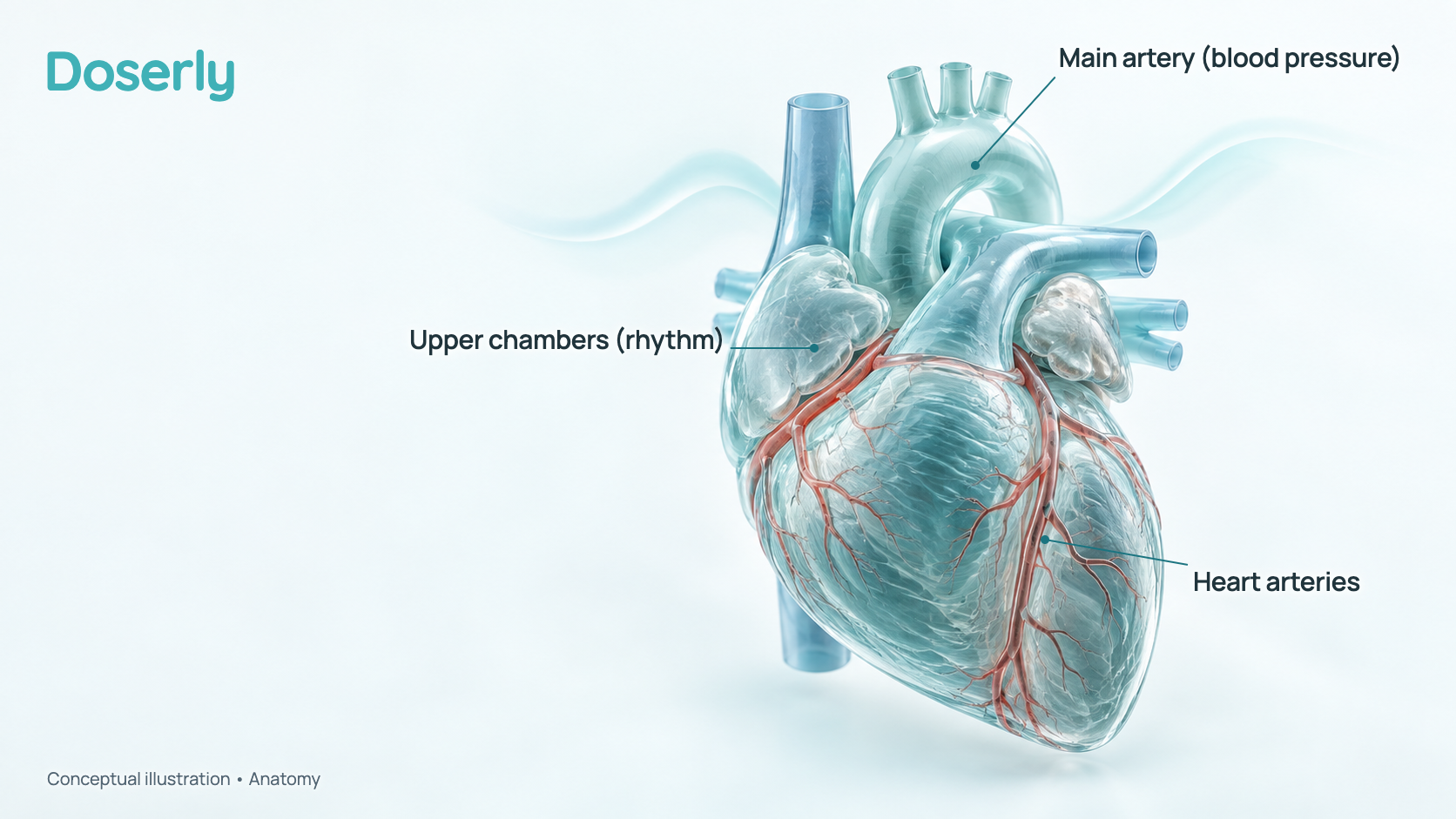
TRT and heart health: the key numbers
This table shows what each major clinical guideline and product label says about the heart and blood clots before and during testosterone treatment. The rules are what each document says, checked in September 2026.
| Guideline (version, year) | Heart and clot rules before starting | What is checked | Action on treatment |
|---|---|---|---|
| AUA, American Urological Association (2018, validity confirmed 2024) | Wait 3–6 months after a heart attack, stroke or other cardiovascular event | Heart risk factors: cholesterol, blood pressure, diabetes, smoking | Men should report chest pain, shortness of breath, dizziness or fainting |
| Endocrine Society (2018, plus a July 2026 statement) | Not recommended with uncontrolled heart failure, a heart attack or stroke in the last 6 months, or thrombophilia (a tendency to clot) | Hematocrit before starting, at 3–6 months, at 12 months, then yearly | Stop if hematocrit goes above 54% |
| VA, US Department of Veterans Affairs (January 2026) | Not recommended with poorly controlled heart failure, a heart attack or unstable chest pain, a stroke, or a stent or bypass procedure within 4 months, thrombophilia, or a past clot without a clear cause | Testosterone and hemoglobin or hematocrit at 3–6 and 12 months | Adjust the dose above 51% hematocrit; stop above 54% |
| EAU, European Association of Urology (2026) | Do not start with uncontrolled or poorly controlled heart failure. A family history of clots is a reason for caution. Assess heart risk factors first | Blood pressure before starting, at 3 and 12 months, then yearly; cholesterol and blood sugar before starting, at 12 months, then yearly | Men with heart disease, past clots or chronic heart failure: treat with caution, check closely, and keep hematocrit at or below 54% |
| BSSM, British Society for Sexual Medicine (2023) | Do not start in severe heart failure (NYHA class IV). Assess heart risk first | Heart risk factors throughout treatment | Lower the dose or switch form if hematocrit goes above 54% |
| EAA, European Academy of Andrology (2020) | Against treatment in severe heart failure (NYHA class III–IV) or after a recent major heart event or stroke. Take a personal and family clot history | Medical history | Caution before starting when hematocrit is above 48–50% |
| CUA, Canadian Urological Association (2021) | Not with unstable heart disease. Men with stable heart disease can still have a supervised trial of treatment | Hematocrit before starting, at 3 months, then yearly | Act if hematocrit stays at 55% or more |
| ESA, Endocrine Society of Australia (2016) | Unstable heart disease is a precaution | Blood count at 3 months, then yearly | High red-cell counts are usually managed by lowering the dose or frequency |
| US product labels (FDA, revised 2025–2026) | Not recommended with uncontrolled high blood pressure. The Depo-Testosterone vial label also rules out serious heart, liver or kidney disease | Blood pressure regularly; cholesterol regularly, especially after starting; hematocrit | Stop and check if a clot is suspected. Men on warfarin need more frequent blood-thinning (INR) checks when testosterone starts or stops |
| UK product labels (2024–2026) | Use with caution in high blood pressure and in thrombophilia or other clot risks | Clinical checks; INR with warfarin-type blood thinners | Stop at once if severe swelling or heart failure appears |
[6], [7], [11], [8], [5], [12], [13], [14], [15], [16], [2], [17], [18], [19]
No guideline sets a blood-pressure, heart-rate or heart-tracing (ECG) number for starting or stopping testosterone. What most of them share: wait 3 to 6 months after a heart attack or stroke (4 months in the VA's rules), avoid uncontrolled heart failure, ask about personal and family clot history, and keep hematocrit at or below 54%. US labels add one blood-pressure rule: do not use testosterone with uncontrolled high blood pressure. [6], [7], [8], [5], [2]
Why do guidelines differ?
Mostly on timing and severity. The waiting time after a heart attack or stroke ranges from 3 to 6 months, and the EAA says only "recent". Heart failure rules range from any uncontrolled heart failure (Endocrine Society, EAU) to only the most severe class (BSSM). On clots, the AUA said in 2018 that there was no definitive evidence linking testosterone to them, while the Endocrine Society and the VA rule out thrombophilia. The AUA and Endocrine Society guidelines predate TRAVERSE; the EAU 2026 edition, the VA's 2026 rules and the Endocrine Society's 2026 statement came after it. [13], [12], [6], [7], [8], [5], [11]
How do the units work?
Blood pressure is written as two numbers in millimeters of mercury (mm Hg): the top number, systolic, is the pressure when the heart beats, and the bottom number, diastolic, is the pressure between beats. A rise of "3.9/1.5 mm Hg" means systolic up 3.9 and diastolic up 1.5.
Testosterone levels appear in ng/dL (US) or nmol/L (most other countries). TRAVERSE enrolled men with two fasting levels under 300 ng/dL (10.4 nmol/L) and adjusted the gel to keep testosterone between 350 and 750 ng/dL (about 12 to 26 nmol/L). The testosterone unit converter switches between the two. [1]
Where these numbers come from
Each guideline row comes from that body's current document: the AUA testosterone deficiency guideline (2018, validity confirmed 2024), the Endocrine Society guideline (2018) and its 16 July 2026 statement, the VA clinical recommendations (January 2026), the EAU guidelines on sexual and reproductive health (2026 edition), the BSSM guidelines (2023), the EAA guideline (2020), the CUA guideline (2021) and the Endocrine Society of Australia position statement (2016, parts 1 and 2). [6], [7], [11], [8], [5], [12], [13], [14], [15], [16]
The US label row comes from the current Kyzatrex (August 2026), AndroGel 1.62% (October 2025) and Depo-Testosterone (August 2026) labels on DailyMed; the UK row from the Nebido (December 2025) and Sustanon 250 (2026) summaries of product characteristics. [2], [17], [19]
TRAVERSE numbers come from the trial's published abstract, its design paper, its ClinicalTrials.gov results record and the trial summary now printed in US labels. Percentages per 1,000 men are simple arithmetic on the label percentages. [1], [20], [21], [2]
Not used: numbers that circulate online without a readable primary source, including a TRAVERSE site count, an average gel dose, a 1.20 safety margin (the trial used 1.5), a hazard ratio of 0.84 for heart death (the component results are not in the published abstract), a "22.5% lower diabetes risk" (a later recalculation, not a trial result) and a claim that TRT lowers atrial fibrillation after 5 years.
How can testosterone affect the heart and blood vessels?
Through several separate routes, and they do not all point the same way. Some are measured in people on treatment; others are links seen in records or genetic studies that cannot prove cause. [3], [2], [22]
| Route | What the evidence shows | Evidence type |
|---|---|---|
| Blood pressure | Every product raises it slightly in 24-hour monitoring studies. With oral undecanoate, the men whose hematocrit rose most had the largest blood-pressure rise | Label studies, human trials [3], [23] |
| Salt and water | Testosterone can make the body hold on to salt and water. In men with existing heart, kidney or liver disease this can cause swelling (edema) with or without heart failure | Product labels [2] |
| Thicker blood | Testosterone raises hematocrit, the share of blood made up of red cells. In records, men whose hematocrit reached 52% had more heart attacks, strokes and clots in their first year (5.15% vs 3.87%) | Records study [22] |
| Clotting | Clots cluster in the first months and in men with clotting disorders. In TRAVERSE, larger rises in two kinds of white blood cells went with more clots | Records and case series; trial analysis [24], [25], [26] |
| Heart rhythm | Both low and high-normal natural testosterone go with more atrial fibrillation in population studies, and TRAVERSE found more on testosterone | Population studies, human trial [27], [28], [2] |
| Artery plaque | In a small trial, soft plaque in the heart arteries grew more on testosterone gel over a year, with no heart events | Human trial, imaging only [29] |
A high hematocrit may explain part of the risk, but no trial has shown that it causes heart events; the hematocrit on TRT guide covers it in full. Genetic (Mendelian randomization) studies of lifelong natural testosterone disagree: one found no direct effect on heart artery disease, and a 2026 study found about 17% higher odds, apparently through blood pressure. Neither tests treatment. [22], [30], [31]
How did the worry about TRT and the heart start?
With one small trial stopped early and a run of records studies between 2010 and 2015. Larger trials and pooled analyses since then have not confirmed a rise in heart attacks or strokes, but the early studies explain why labels, guidelines and many doctors are cautious. [32], [33], [34], [1]
- 2010: the TOM trial. In 209 frail men aged 65 or older using testosterone gel for 6 months, the safety board stopped the trial early after 23 men on testosterone and 5 on placebo had heart-related adverse events. These were reported events, not a planned heart outcome, and the authors said the small size and unusual group "prevent broader inferences". [32]
- 2013–2014: pooled trials and records studies. A meta-analysis of 27 short trials found more heart-related events on testosterone (odds ratio 1.54), though not in industry-funded trials. A VA records study reported deaths, heart attacks or strokes in 25.7% of men on testosterone vs 19.9% by 3 years; it was later corrected, and the likely range for the difference includes zero. An insurance study found 36% more heart attacks in the 90 days after a first prescription (rate ratio 1.36; the abstract gives no absolute counts). [35], [33], [34]
- 2014: regulators respond. The FDA began looking into reports of strokes, heart attacks and deaths, added a warning about blood clots in the veins to every US testosterone label, and held an advisory committee that led to the call for a large industry trial. A European review found no consistent evidence of higher heart risk. [3], [36], [37]
- 2015–2018: more caution, more data. A March 2015 FDA safety communication required label changes about a possible heart risk and urged caution for low levels caused by aging alone. In 2018 the FDA required 24-hour blood-pressure studies for every product. [3]
- 2023: TRAVERSE published. See the next section. [1]
- 2025: relabeling. In February the FDA told testosterone makers to add the TRAVERSE results to their labels, recommended removing boxed-warning language about heart outcomes and required blood-pressure warnings for every product. In July 2025 the boxed blood-pressure warnings on Xyosted, Jatenzo, Tlando and Kyzatrex were removed, and blood pressure became a standard warning. [3], [38]
- 2026: more changes requested. In June 2026 HHS announced that the FDA is requesting further label changes (dropping the limit on use for aging-related low testosterone, narrowing the prostate cancer warning to metastatic disease, and revising the enlarged-prostate warning). These are requests, not yet in any label. Checked September 2026. [39], [40]
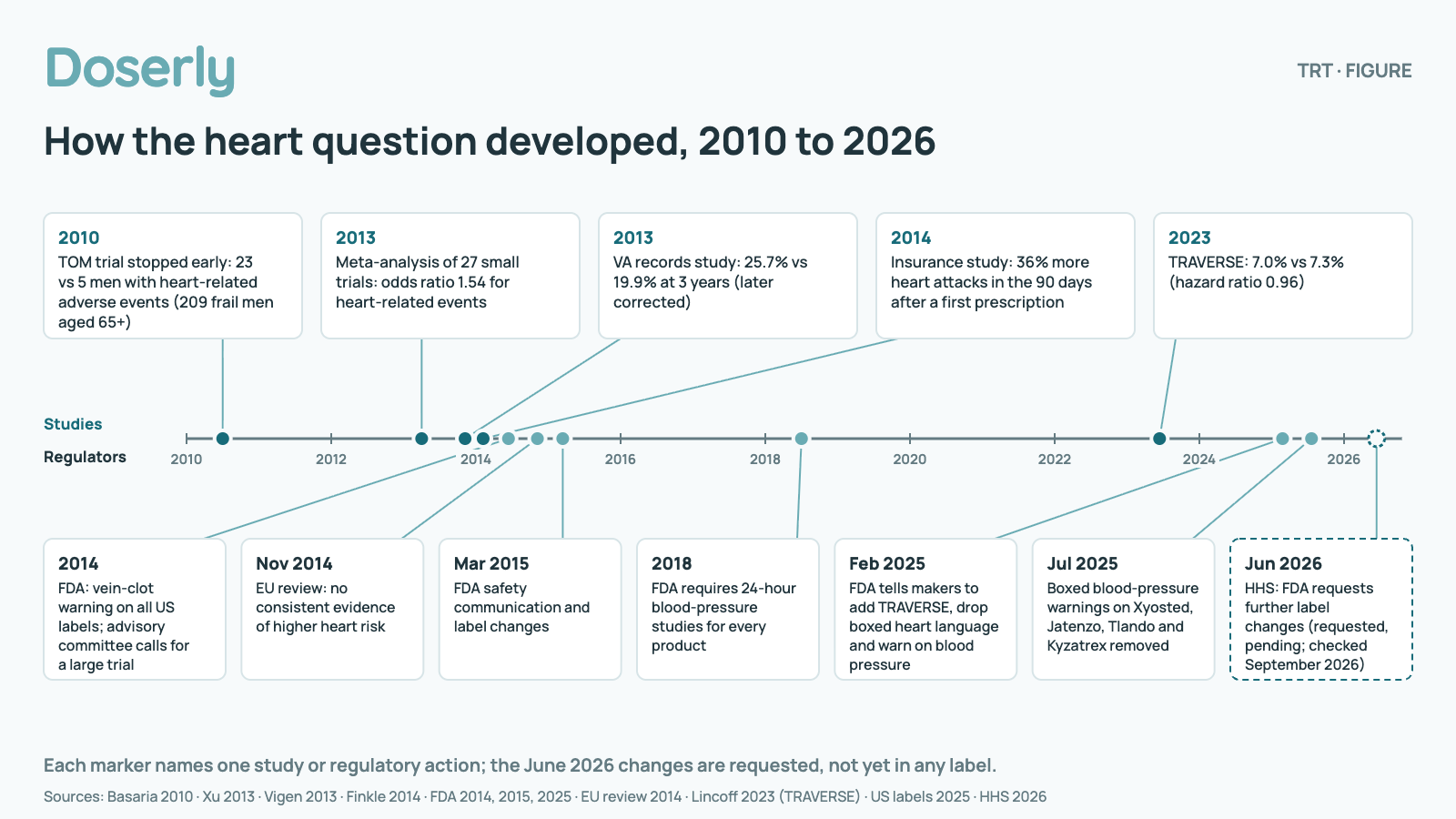
How the heart question developed, 2010 to 2026
- 2010Study
TOM trial stopped early: 23 vs 5 men with heart-related adverse events (209 frail men aged 65+)
- 2013Study
Meta-analysis of 27 small trials: odds ratio 1.54 for heart-related events
- 2013Study
VA records study: 25.7% vs 19.9% at 3 years (later corrected)
- 2014Study
Insurance study: 36% more heart attacks in the 90 days after a first prescription
- 2014Regulator
FDA: vein-clot warning on all US labels; advisory committee calls for a large trial
- Nov 2014Regulator
EU review: no consistent evidence of higher heart risk
- Mar 2015Regulator
FDA safety communication and label changes
- 2018Regulator
FDA requires 24-hour blood-pressure studies for every product
- 2023Study
TRAVERSE: 7.0% vs 7.3% (hazard ratio 0.96)
- Feb 2025Regulator
FDA tells makers to add TRAVERSE, drop boxed heart language and warn on blood pressure
- Jul 2025Regulator
Boxed blood-pressure warnings on Xyosted, Jatenzo, Tlando and Kyzatrex removed
- Jun 2026Requested, pending
HHS: FDA requests further label changes (requested, pending; checked September 2026)
Each marker names one study or regulatory action; the June 2026 changes are requested, not yet in any label.
What did the TRAVERSE trial find?
TRAVERSE found that testosterone gel did not raise the combined risk of heart attack, stroke or death from heart disease compared with a placebo gel, in middle-aged and older men at high heart risk. It also found more atrial fibrillation, acute kidney injury and clots in the lungs, and more fractures. [1], [2], [41]
Who was in the trial, and what did they take?
- Men: 5,204 men aged 45 to 80 with two fasting testosterone levels under 300 ng/dL (10.4 nmol/L), symptoms of low testosterone, and either existing heart disease or several heart risk factors. [1], [42]
- Their health: average age 63.3; about 55% already had heart disease; 69% had diabetes, 84% high cholesterol and 93% high blood pressure. [2]
- Treatment: a daily 1.62% testosterone gel or a placebo gel, with the dose adjusted to keep testosterone between 350 and 750 ng/dL. Average testosterone on the gel rose from 220 ng/dL at the start to about 440 ng/dL at 12 months. [1], [2]
- The question: whether testosterone was "noninferior" for major heart events. The trial ran until at least 256 heart events had happened, and counted testosterone as safe enough if the upper end of the likely range for its hazard ratio stayed below 1.5 (noninferiority). [20]
What were the main results?
| Result | Testosterone gel | Placebo gel | Difference per 1,000 men |
|---|---|---|---|
| Heart attack, stroke or heart death (main result) | 7.0% (182 of 2,596 men) | 7.3% (190 of 2,602 men) | About 3 fewer; within chance |
| Adding stents and bypass procedures | 10.4% (269 of 2,596 men) | 10.1% (264 of 2,602 men) | No difference |
| Death from any cause | 5.5% (144 of 2,596 men) | 5.7% (148 of 2,602 men) | No difference |
| Heart failure events | 2.1% (55 of 2,596 men) | 1.9% (50 of 2,602 men) | No clear difference |
| Nonfatal heart-rhythm problems needing treatment | 5.2% | 3.3% | About 19 more |
| Atrial fibrillation | 3.5% | 2.4% | About 11 more |
| Acute kidney injury | 2.3% | 1.5% | About 8 more |
| Blood clots in veins (all) | 1.7% | 1.2% | About 5 more |
| Clots in the lungs (pulmonary embolism) | 0.9% | 0.5% | About 4 more |
| Clinical fractures | 3.50% | 2.46% | About 10 more |
The last column shows absolute differences. Percentages are out of the 2,596 men on testosterone gel and 2,602 men on placebo in the trial's safety analysis. The main result had a hazard ratio of 0.96, with a likely range of 0.78 to 1.17, well inside the 1.5 limit. Heart attack, stroke and heart death each "appeared to be similar" in the two groups. The trial's registry record gives a hazard ratio of 1.02 for the wider count that adds stents and bypass, 0.98 for death from any cause and 1.11 for heart failure (likely range 0.76 to 1.62). [1], [21]
Not every rise was statistically clear. Venous clots overall had a hazard ratio of 1.46, but its likely range (0.92 to 2.32) includes no difference; the rise in clots reaching the lungs is the clearer signal, which the Endocrine Society describes as about a 50% relative increase. Blood pressure barely moved: systolic pressure rose 1.0 mm Hg on testosterone and fell 0.5 mm Hg on placebo by 36 months. [21], [11], [2]
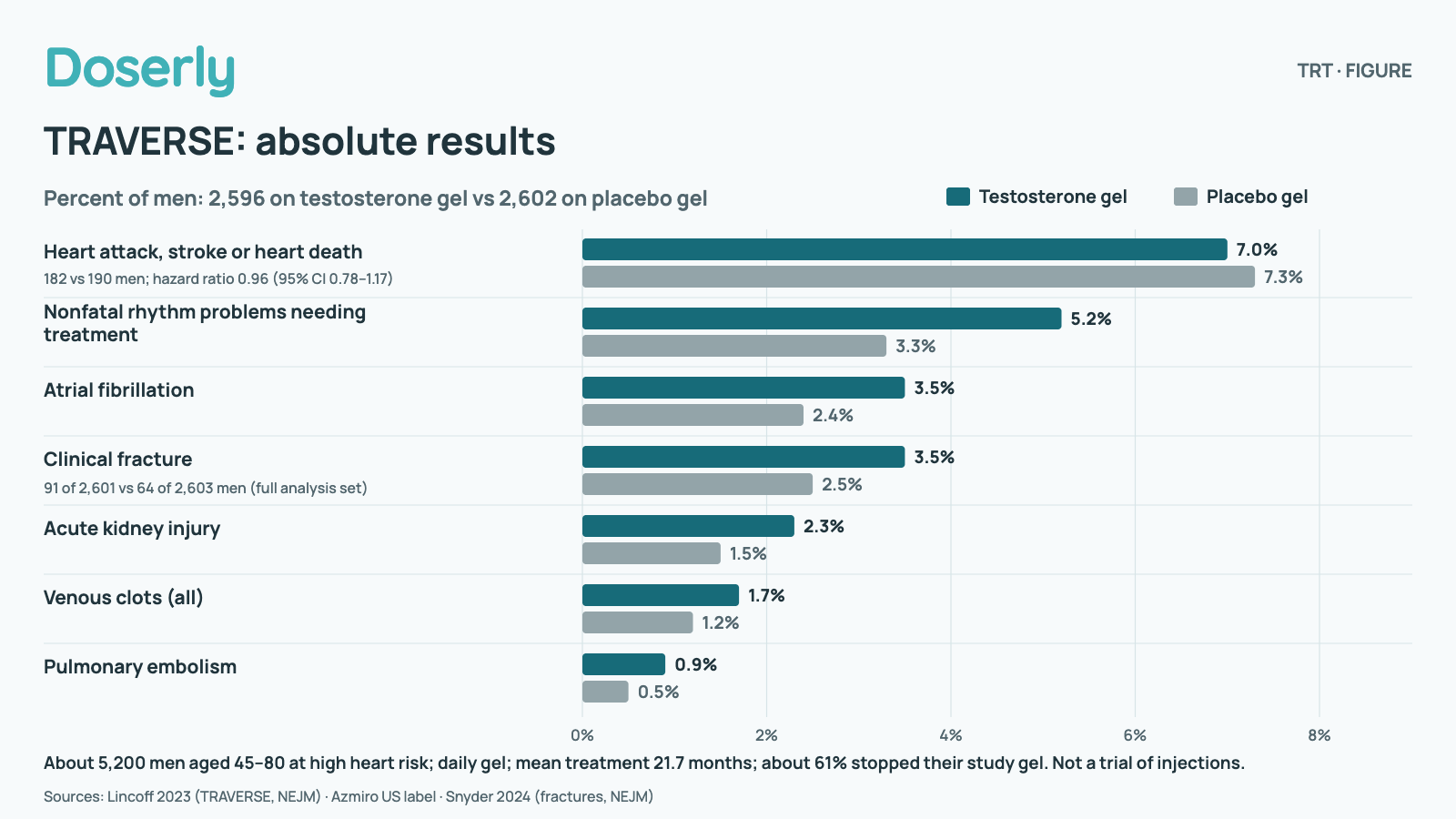
TRAVERSE: absolute results
Testosterone gel (2,596 men)Placebo gel (2,602 men)
- Heart attack, stroke or heart death
- Testosterone 7.0% vs placebo 7.3% (182 vs 190 men; hazard ratio 0.96, 95% CI 0.78–1.17; met the 1.5 safety margin)
- Nonfatal rhythm problems needing treatment
- Testosterone 5.2% vs placebo 3.3%
- Atrial fibrillation
- Testosterone 3.5% vs placebo 2.4%
- Clinical fracture
- Testosterone 3.5% vs placebo 2.5% (91 of 2,601 vs 64 of 2,603 in the full analysis set)
- Acute kidney injury
- Testosterone 2.3% vs placebo 1.5%
- Venous clots (all)
- Testosterone 1.7% vs placebo 1.2%
- Pulmonary embolism
- Testosterone 0.9% vs placebo 0.5%
About 5,200 men aged 45–80 at high heart risk; daily gel; mean treatment 21.7 months; about 61% stopped their study gel. Not a trial of injections.
What did the TRAVERSE substudies find?
- Fractures: 3.50% vs 2.46% (hazard ratio 1.43); testosterone did not prevent fractures, and the reason for the rise is unknown (side effects). [41]
- Diabetes: no significant reduction in progression from prediabetes (7.8% vs 10.7% at 12 months). [43]
- Sex life: in men with low libido, sexual activity and desire rose; erections did not improve (sexual health). [44]
- Mood: small gains in mood and energy; no benefit for persistent low-grade depression (mental health). [45]
- Prostate: high-grade prostate cancer in 5 vs 3 men, not a significant difference, in screened men (prostate). [42]
- Anemia: corrected more often on testosterone (45.0% vs 33.9% at 12 months). [46]
What are TRAVERSE's limits?
- Only a gel. It tested a daily 1.62% gel, not injections, pellets or oral capsules, which produce different peaks. In a pooled analysis of trials, hematocrit rose by about 4.0 points more than placebo on cypionate or enanthate injections, 4.3 on oral undecanoate and 3.0 on gel; only the difference between injections and patches was statistically significant, so the gap between gel and injections was not clear. [1], [47]
- About two years of use. Men used the gel for 21.7 months on average and were followed for 33 months. The EAU says the evidence is reliable for about 3 years of treatment, after which no study can exclude long-term heart events. [1], [5]
- Many stopped early. About 61% of men stopped their study gel (testosterone or placebo) before the end, which makes real differences harder to detect. [2]
- Only high-risk men aged 45 to 80. It did not enroll younger men or men without heart risk factors, so its absolute numbers do not transfer to them. [1]
- Moderate levels. Its target range was 350 to 750 ng/dL, and average testosterone on the gel was about 440 ng/dL, so it says little about higher levels. [1], [2]
How do experts read TRAVERSE?
Differently, mainly in how far they go:
- Endocrine Society (July 2026 statement): no meaningful rise in heart attack or stroke over 1 to 4 years, but roughly a 50% relative increase in lung clots and more fractures; long-term safety "remains unestablished". [11]
- European Expert Panel for Testosterone Research (2026): testosterone is safe from a heart point of view in carefully selected, monitored men. [48]
- Androgen Society (2024), a testosterone-focused professional group: it is "conclusively determined" that TRT does not raise heart attack, stroke or heart death. [49]
- A reviewer writing on the American College of Cardiology's website (2023, not an ACC guideline): reassuring overall, but it "may be prudent to avoid" testosterone in men with past clots, and perhaps with intermittent atrial fibrillation or earlier kidney problems. [50]
Labels have not all caught up. Newer-format brand labels, such as Kyzatrex and AndroGel 1.62%, carry the TRAVERSE results. The US cypionate and enanthate vial labels and the Testopel pellet label still say long-term heart safety trials "have not been conducted" (checked September 2026). [2], [18], [17], [51], [52]
What do other studies show about heart attacks and strokes?
Pooled randomized trials published after TRAVERSE agree with it: no clear rise in heart attacks, strokes or deaths, but more heart-rhythm problems. Records studies point in both directions, because they compare men who chose or were given treatment with men who were not. [53], [54], [55], [56], [57]

What do pooled trials show?
| Analysis | What was pooled | Result |
|---|---|---|
| 2025 meta-analysis | 23 trials of at least a year, 9,280 men aged 40 or older | No difference in death, heart death, heart attack or stroke; heart-rhythm problems about 50% more common (risk ratio 1.53) [53] |
| 2024 updated meta-analysis | 106 placebo-controlled trials | No difference in major heart events; the rise in atrial fibrillation came from TRAVERSE and was not significant without it [58] |
| 2024 meta-analysis | 26 trials, 10,941 men | No significant difference in any heart outcome, including atrial fibrillation and clots [54] |
| 2024 meta-analysis | 30 trials, 11,502 men | No rise in heart events (odds ratio 1.12, likely range 0.77 to 1.62) or deaths [55] |
| UK TestES review (pre-TRAVERSE trials) | 35 trials, 5,601 men, with individual data from 17 | Heart or stroke events in 7.5% on testosterone vs 7.2% on placebo (odds ratio 1.07) [59] |
The analyses overlap: several include TRAVERSE, so their totals should not be added together.
Do records studies show more heart attacks?
Some do and some show fewer. In a 2025 study of a large international health-records network (TriNetX), 117,908 treated men followed for 5 years had more atrial fibrillation (hazard ratio 1.27) and clots (1.26) than matched untreated men, slightly fewer heart attacks (0.94) and no difference in strokes or deaths. Earlier US studies found more heart events after starting injections than gels (1.26), fewer heart events in men given any testosterone (16.9 vs 23.9 per 1,000 person-years, hazard ratio 0.67), and fewer heart attacks and strokes in VA men whose levels reached normal. Men who get treatment, and who reach normal levels, differ from other men in ways records cannot fully adjust for. [60], [56], [57], [61]
What about long-term use?
This is the least settled question. In a Scottish records study, 440 men aged 51 or older with at least 2 years of prescriptions had more heart events than untreated men (adjusted hazard ratio 1.55); its heart-event count included heart failure, and the study cannot show cause. TRAVERSE followed men for 33 months on average, and the EAU says the trial evidence covers about 3 years of treatment; the EAU and the Endocrine Society both say long-term safety is not established. [62], [5], [11]
Is low testosterone itself bad for the heart?
Very low natural testosterone goes with higher death rates, but that does not prove treatment helps. Pooled data from large population studies linked only quite low natural testosterone, under about 213 ng/dL (7.4 nmol/L), with higher death from any cause, and under about 153 ng/dL (5.3 nmol/L) with more heart deaths. The AUA tells men that low testosterone is a heart risk factor but that it cannot be said for sure whether treatment raises or lowers heart risk. [63], [6]
Does testosterone raise blood pressure?
Yes, a little, with every product tested. In 24-hour monitoring studies required by the FDA, average systolic pressure rose by about 2 to 5 mm Hg after 3 to 6 months. US labels say to measure blood pressure regularly, especially in men who already have high blood pressure, and not to use testosterone when it is uncontrolled. [3], [2]
Ambulatory blood-pressure monitoring means wearing a cuff that measures automatically through a full day and night, which is more reliable than a single clinic reading. The results by product:
| Product | Form | Average 24-hour rise (systolic/diastolic, mm Hg) | After |
|---|---|---|---|
| Jatenzo | Oral undecanoate capsules | 4.9/2.5 (not yet leveling off) | 4 months |
| Tlando | Oral undecanoate capsules | 4.3/1.4 | 4 months |
| Xyosted | Weekly subcutaneous enanthate autoinjector (into the fatty layer under the skin) | 3.9/1.5 | 12 weeks |
| Aveed | Long-acting intramuscular undecanoate injection (into a muscle) | 3.1/2.0 | 16 weeks |
| AndroGel 1.62% | Transdermal gel (absorbed through the skin) | 1.9/1.3 (3.0/2.2 in men already treated for high blood pressure) | 16 weeks |
| Kyzatrex | Oral undecanoate capsules | 1.7/0.6 | 4 months |
[64], [65], [66], [67], [18], [68], [2]
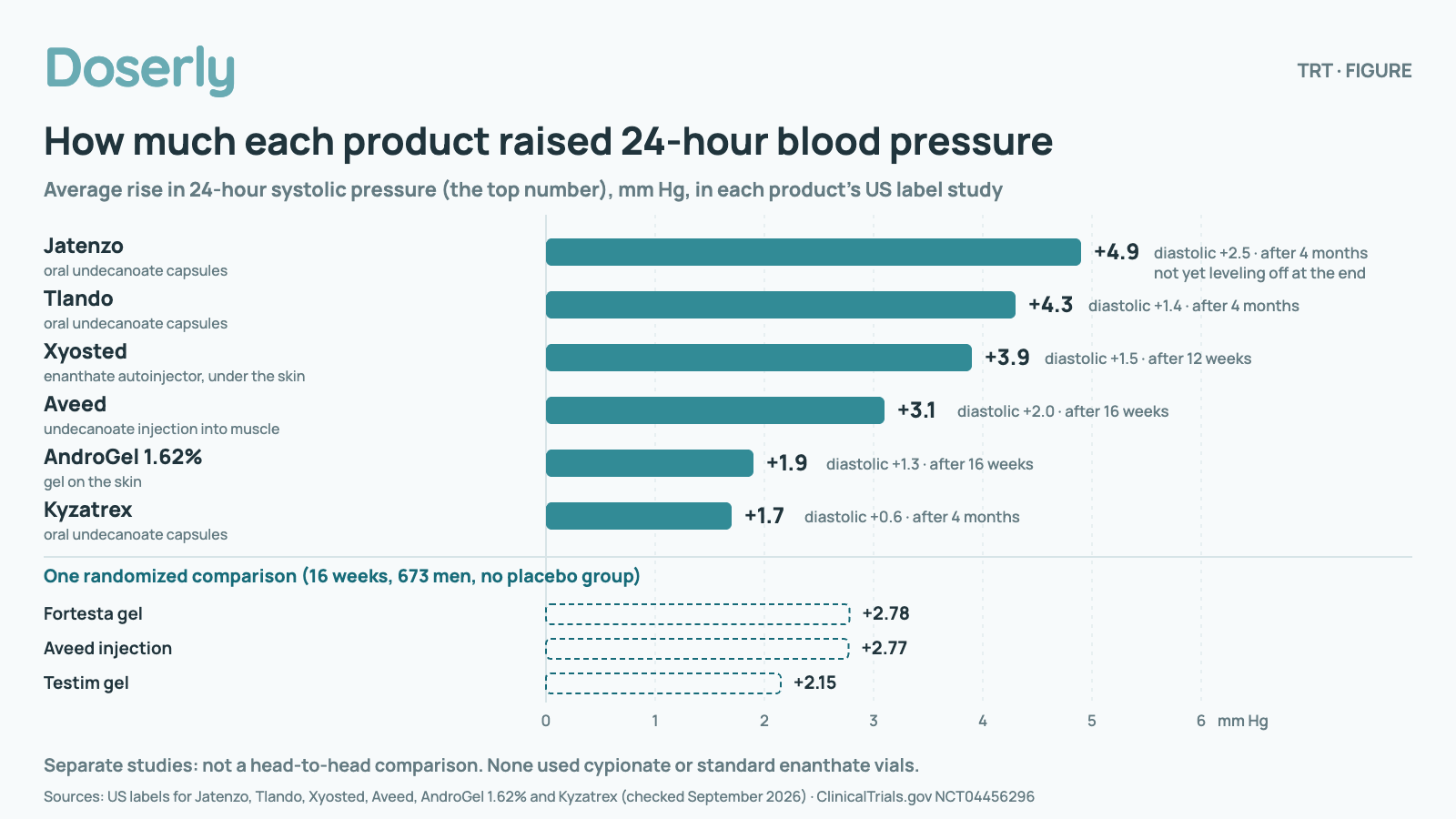
How much each product raised 24-hour blood pressure
Average rise in 24-hour systolic pressure (the top number), mm Hg, in each product's US label study.
Bars run from 0 to 6 mm Hg.
- Jatenzo (oral undecanoate capsules)
- +4.9 systolic / +2.5 diastolic mm Hg · after 4 months · not yet leveling off
- Tlando (oral undecanoate capsules)
- +4.3 systolic / +1.4 diastolic mm Hg · after 4 months
- Xyosted (enanthate autoinjector, under the skin)
- +3.9 systolic / +1.5 diastolic mm Hg · after 12 weeks
- Aveed (undecanoate injection into muscle)
- +3.1 systolic / +2.0 diastolic mm Hg · after 16 weeks
- AndroGel 1.62% (gel on the skin)
- +1.9 systolic / +1.3 diastolic mm Hg · after 16 weeks
- Kyzatrex (oral undecanoate capsules)
- +1.7 systolic / +0.6 diastolic mm Hg · after 4 months
One randomized comparison (16 weeks, 673 men, no placebo group)
- Fortesta gel
- +2.78 systolic mm Hg
- Aveed injection
- +2.77 systolic mm Hg
- Testim gel
- +2.15 systolic mm Hg
Separate studies: not a head-to-head comparison. None used cypionate or standard enanthate vials.
Do injections raise blood pressure more than gels?
Not in the one randomized comparison. In a 16-week study of 673 men randomly assigned to one of three products (with no placebo group), 24-hour systolic pressure rose by 2.77 mm Hg on Aveed injections, 2.78 on Fortesta gel and 2.15 on Testim gel. The label numbers above come from separate studies and should not be compared as if they were one trial. None of these studies used cypionate or standard enanthate vials. [4]
How big is a 2 to 5 mm Hg rise?
Small on one day, but it adds up across years, which is why labels warn that it "can increase cardiovascular (CV) risk over time". Some men rise more: in a published 4-month study of Tlando (138 men, average 24-hour systolic rise 3.8 mm Hg), the quarter of men whose hematocrit rose most (6 to 14 points) averaged 8.3 mm Hg, and in pooled heart-failure trials systolic pressure rose 5.68 mm Hg. [2], [23], [69]
The evidence conflicts on one point. A long-running registry of undecanoate injections reported falling, not rising, blood pressure (a median systolic drop of 12.5 mm Hg in men not on blood-pressure medicines). It had no randomized comparison, came from one practice and its authors report industry grants. The controlled 24-hour studies outrank it. [70]
The EAU recommends checking blood pressure before starting, at 3 months and 12 months, then yearly. The TRT side effects guide covers swelling and fluid retention. [5]
Can TRT cause atrial fibrillation or other heart-rhythm problems?
It can make them more likely. In TRAVERSE, atrial fibrillation occurred in 3.5% of men on testosterone and 2.4% on placebo, and nonfatal heart-rhythm problems needing treatment in 5.2% and 3.3%. A 2025 meta-analysis of long trials found about 50% more rhythm problems (risk ratio 1.53; the abstract gives no event counts). [2], [53]
Atrial fibrillation (AFib) is an irregular, often fast rhythm in the heart's upper chambers. It can cause palpitations, breathlessness or tiredness, or no symptoms at all, and it raises the risk of stroke because blood can pool and clot in the heart.
Why do studies disagree about AFib?
Because randomized trials and records studies ask different questions, and natural testosterone seems to have a U-shaped link with AFib. [71]
- Randomized evidence points up. TRAVERSE found more AFib, and it drives the signal in pooled trials: without it, a 2024 meta-analysis found no significant rise. [2], [58]
- Records studies point both ways. Higher AFib in 117,908 treated men in a large records network (hazard ratio 1.27). Lower AFib in VA men whose levels reached normal (0.79), in a large US records study (3.6% vs 4.0%) and in men with diabetes (0.91). Another US records study found a rise that was not statistically clear (risk ratio 1.48). [60], [72], [73], [74], [75]
- Natural testosterone: both low and high-normal. In the Framingham study, men aged 55 to 69 with lower natural testosterone developed AFib more often, and a Finnish study found a weak link. In 4,570 healthy older men, those in the top two-fifths of natural testosterone had about twice the AFib risk of men in the middle. [27], [76], [28]
- Genetics: no link with other rhythm measures. A genetic study found no link between lifelong testosterone level and heart block, fast rhythms, resting heart rate or the QT interval in men. It did not report a testosterone estimate for AFib itself. [77]
The randomized result is the most reliable, and a 2026 review suggests the risk may rise at both low and high levels, which fits all three kinds of evidence. No TRAVERSE paper has yet reported who developed AFib, when, or at what testosterone or hematocrit level. [71]
Does TRT change the heart tracing (ECG)?
Slightly. In a trial of testosterone gel, the QT interval lengthened less with age than on placebo (a 6.3 ms difference); a second trial found a smaller, non-significant change. The meaning is unclear. [78]
Can you take TRT if you have AFib?
None of the guidelines in the key numbers lists AFib as a reason not to use testosterone, and no trial we found reported results separately for men who already have AFib. The reviewer on the American College of Cardiology's website suggested that it may be prudent to avoid testosterone in men with intermittent AFib. Men who take warfarin for AFib need more frequent INR checks when testosterone starts or stops, because testosterone changes how strongly warfarin thins the blood. [50], [2], [19]
Does TRT cause blood clots?
It can raise the risk of clots in the veins, especially in the first months and in men with a clotting disorder. Every US testosterone label has warned about deep vein thrombosis (DVT) and pulmonary embolism since 2014. In TRAVERSE, clots reaching the lungs occurred in 0.9% of men on testosterone and 0.5% on placebo. [18], [36], [2]
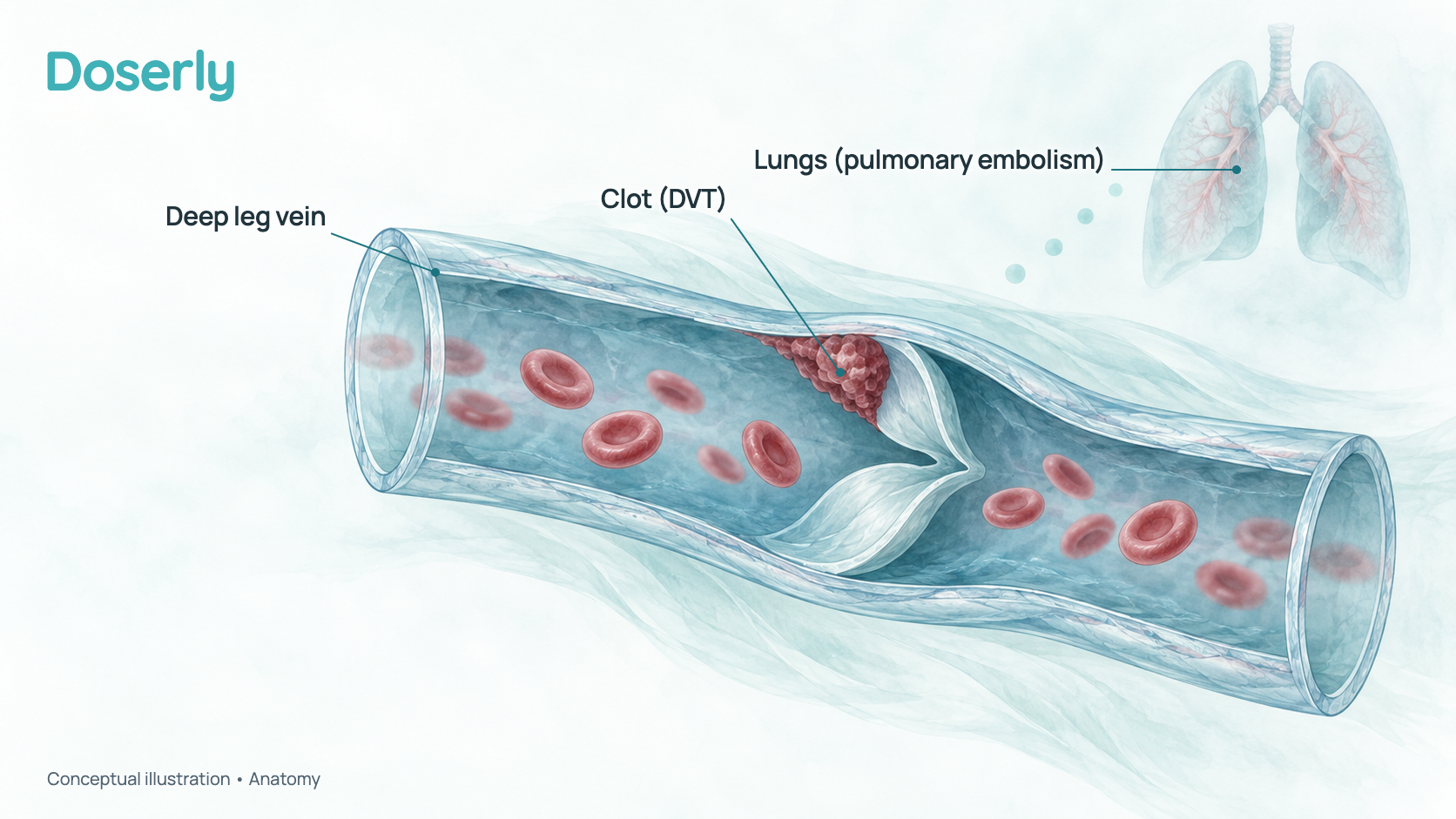
When is the clot risk highest?
In the first months, according to records studies. [24], [25]
- First 6 months. In a large UK study, men in their first 6 months of testosterone had 63% more clots (rate ratio 1.63), about 10 extra clots per 10,000 men per year above a base rate of 15.8. After 6 months, the rate was the same as in untreated men (1.00). [24]
- Around month 3. In one US clinic's series, clots peaked about 3 months after starting and fell by 10 months; 65% of clots came within the first 8 months. [25], [79]
- Other records studies disagree. A US study found men were about twice as likely to have been using testosterone just before a clot (odds ratio 2.32), while another found no link (0.90) and VA records found clots in about 4 to 5 per 1,000 men whether or not they were treated, in a group that excluded men with clotting disorders. [80], [81], [82]
- Trials are too small to settle it. Before TRAVERSE, pooled trials showed a wide range of possible effects (odds ratio 1.42, range 0.22 to 9.03). [83]
Who is most at risk of a clot?
Men with thrombophilia, an inherited or acquired tendency to clot, such as factor V Leiden. In a small US referral series of 17 people who had a clot or bone-death event (osteonecrosis) after starting testosterone or hCG, 76% had at least one clotting disorder, against 19% of healthy controls, and two men clotted again while still taking testosterone even on blood thinners. The EAU notes a study in which 40 of 42 men with clots on testosterone had thrombophilia. UK labels say that continuing testosterone after a first clot in a man with thrombophilia needs careful evaluation. [84], [79], [5], [19]
The Endocrine Society and the VA list thrombophilia as a reason not to start, the VA also lists a past clot without a clear trigger, and the EAA and EAU ask about personal and family clot history before treatment. The Endocrine Society notes case reports of clots in men with thrombophilia even without a high hematocrit, especially in the first 6 months. [7], [8], [13], [5]
What are the warning signs of a clot?
Labels list pain, swelling, warmth and redness in one leg for a deep vein clot, and sudden shortness of breath for a clot in the lungs. They say to stop testosterone and get checked if a clot is suspected. Sudden breathlessness or chest pain needs emergency care. [18]
What about heart failure, cholesterol and the kidneys?
Is TRT safe with heart failure?
Uncontrolled or severe heart failure is a reason not to start under most guidelines, because testosterone can cause salt and water retention. Labels warn that swelling, with or without heart failure, can be a serious problem in men with existing heart, kidney or liver disease; UK labels say to stop at once if it happens. [7], [5], [2], [19]
The trials in stable heart failure are small, and they disagree. A 2012 meta-analysis of 4 trials (198 patients) found walking distance improved by 54 meters with no extra heart events. A larger 2020 analysis of 8 trials (332 patients) found no clear benefit for exercise, heart function, quality of life or hospital stays, and systolic pressure 5.68 mm Hg higher. In TRAVERSE, heart failure events were similar (55 vs 50 men). [85], [69], [21]
Does TRT affect cholesterol?
Usually only a little, and the direction varies by product. US labels ask for cholesterol checks regularly, especially after starting. In Kyzatrex trials, total, LDL and HDL cholesterol and triglycerides all fell; the Depo-Testosterone label says cholesterol "may increase". [2]
Pooled trials found no harmful change overall. The UK TestES review found cholesterol and triglycerides slightly lower on testosterone, and in pooled trials of men with type 2 diabetes, total cholesterol and triglycerides fell slightly, with mixed results for HDL. [59], [86]
Adding an aromatase inhibitor is a separate question. A very small year-long trial found no cholesterol change with anastrozole, but the VA does not recommend aromatase inhibitors on TRT and notes they increased heart events in men with existing heart disease. See the anastrozole guide. [87], [8]
Can TRT affect the kidneys?
TRAVERSE found more acute kidney injury: 2.3% of men on testosterone and 1.5% on placebo, about 8 extra cases per 1,000 men. A US records study found a similar rise (risk ratio 1.53), and the VA states that testosterone increases the risk of acute kidney problems. A records study of men with diabetes found slightly less kidney injury (hazard ratio 0.93). No study has explained the TRAVERSE finding. [2], [75], [8], [74]
Is TRT safe for your heart?
For most men with confirmed low testosterone who are checked as guidelines describe, the best evidence shows no rise in heart attacks or strokes over about 2 to 3 years, with small rises in blood pressure, atrial fibrillation, kidney injury and lung clots. Men with certain heart and clotting conditions need more caution, and long-term safety is not established. [1], [2], [5], [11]
Who should be especially cautious?
- Men with a recent heart attack, stroke, stent or bypass (see the waiting times), uncontrolled high blood pressure or uncontrolled or severe heart failure. [6], [2], [5], [17]
- Men with a past clot, a clotting disorder or a family history of clots. See who is most at risk. [7], [8], [5]
- Men with atrial fibrillation or kidney disease. No trial we found reported results separately for men who already have AFib, and the VA lists kidney failure as a reason not to start; see the AFib question and the kidneys. [50], [8]
- Men with a high hematocrit, untreated sleep apnea or who smoke. These raise red-cell counts; see the hematocrit guide.
- Drug-tested athletes. Testosterone is prohibited in sport at all times. [10]
- Under-18s. Testosterone for teenagers belongs only in specialist care.
- Women. This guide is written for men. Testosterone for women uses different doses and products; see testosterone therapy for women.
Which medicines matter for the heart on TRT?
- Warfarin and similar blood thinners. Testosterone changes how strongly they work, so labels advise more frequent INR checks, especially when testosterone starts or stops. [2], [19]
- Steroid medicines (corticosteroids). Taking them with testosterone can increase fluid retention. [88]
- Aromatase inhibitors such as anastrozole. The VA notes more heart events with them in men with existing heart disease. [8]
- SGLT2 inhibitors (diabetes and heart medicines). They raise hematocrit on their own; see the hematocrit guide.
- Other anabolic steroids. Non-prescribed steroids carry much larger heart risks; see the next question.
Bring a complete list of what you take, including supplements, to a pharmacist or prescriber. Checked September 2026.
Is prescribed testosterone the same as steroid misuse for the heart?
No. The alarming heart findings come from non-prescribed steroids at doses far above replacement. Long-term users had weaker heart pumping (ejection fraction 52% vs 63% in non-users) and more artery plaque, and in Danish men caught using steroids, heart attacks were about 3 times as common over 11 years (adjusted hazard ratio 3.00 in 1,189 steroid users against 59,450 matched men; the abstract gives no event counts). A single cycle thickened the heart muscle, which recovered after about 8 months off. These studies do not describe replacement doses; see TRT vs steroids. [89], [90], [91]
Is testosterone legal, and is it allowed in sport?
Checked September 2026. Rules differ by country and change often.
- United States. Testosterone and its esters are Schedule III controlled substances, prescription only. [9]
- United Kingdom. Testosterone is a Class C controlled drug. [92]
- Canada. Testosterone is a Schedule IV controlled substance. [93]
- Australia. Testosterone is a Schedule 4 prescription-only medicine. [94]
- Sport. The World Anti-Doping Agency (WADA) prohibits testosterone at all times, and its 2027 list, published in September 2026, keeps the ban. [10], [95]
What do guidelines say to do about heart risk?
Check heart risk before starting, wait after a recent heart event, rule out uncontrolled heart failure and clotting disorders, then monitor blood pressure, hematocrit and cholesterol on treatment. This section describes what clinicians weigh; it is not a personal plan. [5], [12], [7]
- Before starting: assess blood pressure, cholesterol, diabetes and smoking (EAU and BSSM strong recommendations; AUA), and take a personal and family clot history (EAA, EAU). [5], [12], [6], [13]
- With stable heart disease: still a candidate for a supervised trial of treatment (CUA); treat with caution and check closely (EAU). [14], [5]
- On treatment: blood pressure at 3 and 12 months, then yearly, and cholesterol and blood sugar at 12 months, then yearly (EAU); hematocrit on each body's schedule. [5], [7]
- New symptoms: report chest pain, shortness of breath, dizziness or fainting (AUA); stop and get checked if a clot is suspected (labels). [6], [18]
What if you have had a heart attack or a stent?
Guidelines do not rule testosterone out for good; they say to wait: 3 to 6 months (AUA), 6 months (Endocrine Society) or 4 months after a heart attack, stroke, stent or bypass (VA). In TRAVERSE, about 55% of men already had heart disease, and heart events overall were not more common on testosterone; the published results reviewed here do not break this down by past stents or bypass. The decision belongs to you, your cardiologist and your prescriber together. [6], [7], [8], [14], [2]
Should testosterone be stopped before surgery?
No guideline says so. In records of 7,906 hip replacements in adults, people on testosterone had more leg clots at 1 year (4.3% vs 3.0%), heart events (2.9% vs 1.7%) and sudden damage to the kidneys (7.6% vs 5.6%), but a records study cannot show that testosterone caused this. Tell your surgical team that you take testosterone so they can plan clot prevention. [96]
Practical questions about TRT and the heart
Does TRAVERSE apply to injections?
Not directly. TRAVERSE tested only a daily gel, and no randomized trial has measured heart attacks or strokes with injections. What is known: the Endocrine Society says high hematocrit is more common with injections than with gels, though a pooled analysis of trials could not show a clear gap (about 4.0 vs 3.0 points above placebo), an insurance study found more heart events after starting injections than gels (hazard ratio 1.26, which cannot prove cause), and in the one randomized blood-pressure comparison an injection and two gels raised pressure by about the same amount. [1], [7], [47], [56], [4]
Does TRAVERSE apply to younger men?
Only partly. It enrolled men aged 45 to 80 with heart disease or several risk factors. Younger, healthier men start with a much lower risk of heart attack or stroke, so the same relative effect would mean fewer events; but the trial could not test that, and the rhythm and clot findings have not been studied in younger men. [1]
Does the dose or testosterone level matter for the heart?
Probably, though no trial has compared doses for heart outcomes. Higher doses and levels raise hematocrit more, men with the largest hematocrit rises had the largest blood-pressure rises, and high-normal natural testosterone went with more AFib in older men. In VA records, men whose treated levels reached normal did better than men whose levels stayed low. TRAVERSE kept levels between 350 and 750 ng/dL. [23], [28], [61], [1] The TRT dosage guide covers how doses are set, and the testosterone level visualizer shows how injection frequency changes peaks and troughs.
Can an injection cause sudden coughing or chest tightness?
Rarely, yes. Oil-based injections can cause pulmonary oil microembolism (POME), where tiny oil droplets reach the lungs. The Aveed label's boxed warning lists an urge to cough, breathlessness, throat tightening, chest pain, dizziness and fainting during or right after the injection, and a European safety review in 2025 recommended adding POME to the information for oil-based testosterone injections. The symptoms overlap with a heart attack or a lung clot, so they need urgent assessment. [67], [97]
What do people on TRT report about their heart?
Public forums are full of men watching their blood pressure, feeling their heart pound at night, or deciding with a cardiologist whether to continue. The threads below are recent public Reddit discussions, read with their replies; they show what people experience, not how often it happens.
What do people report about blood pressure?
Rises, mostly, often alongside other changes. Three weeks into testosterone cream, one man who usually measured 110/70 recorded up to 140/97 during the day and about 125/75 at night, and planned a lower dose with his provider. Another, two years into cream, moved from an average of 116/70 to 135–140 over 75–80, which settled on a blood-pressure medicine. A man already on a blood-pressure medicine saw systolic readings of 160–170 a week after raising his dose; they returned to normal once his medicine was doubled. [98], [99], [100]
Other stories show how many things move the number. One man's readings fell from about 130/90 to about 110/70 three months into cypionate, while he drank more water and had stopped exercising. Another's rise from 120/80 to 150/90 settled within two weeks of stopping daily electrolyte tablets. Men with high blood pressure before TRT describe the hardest time: one reading of 201/105 led to a hospital stroke assessment, with hematocrit at 54.7%. [101], [102], [103]
What about palpitations and AFib?
Palpitations are common, and many settle. A 50-year-old felt a forceful heartbeat a few days after starting, with unchanged heart rate and blood pressure, and it calmed within days. Another man's palpitations stopped after his prescriber lowered his weekly dose from 160 to 105 mg. One man's resting heart rate rose from about 62 to 78 beats a minute at a level near 800 ng/dL. [104], [105], [106]
A few threads describe atrial fibrillation. A 33-year-old went into AFib about three months into weekly cypionate; he stopped, was treated with a blood thinner and heart-rate medicine, and felt well six weeks later. Another man, whose heart monitor showed irregular beats 22% of the time, was advised by his cardiologist to stop and retest. Causes are rarely clear-cut: one man's first episode followed a very stressful week, four weeks after starting anastrozole, and his cardiologist blamed the stress. [107], [108], [109]
What do people report about clots and heart events?
Few threads, but serious ones. A 53-year-old with uncontrolled blood pressure, frequent donations for a hematocrit up to 54% and a small pulmonary embolism stopped on his doctors' advice; four weeks later his blood pressure was much better, but his libido and erections were gone. Another poster clotted two years into treatment, restarted at a low dose after six months of blood thinners, clotted again and was advised to stay off. [110], [111]
Cardiologists vary after a heart event. Two months into TRT, one man had a heart attack from long-standing blockages and needed bypass surgery; his cardiologist read TRAVERSE but wanted more data, noting that it used a gel, and planned to revisit the question in a year. A 64-year-old who had raised his dose had chest pain first treated as a heart attack, which turned out to be inflammation of the heart's outer lining. [112], [113]
A few men describe heart-structure findings. A man on scrotal cream with very high levels developed a thickened heart wall and, two years later, weaker pumping, and wrote that the cause was not established. After a steroid cycle at doses far above replacement, another poster's heart walls measured thicker on ultrasound. [114], [115]
How can you judge a heart story?
Ask: Was blood pressure measured the same way each time, seated and rested, at home and in the clinic? What was it before TRT? What else changed, such as caffeine, salt, electrolytes, alcohol, weight, stress, sleep or other medicines? What were the testosterone level and hematocrit, not only the dose? Was a rhythm problem confirmed on an ECG or monitor? Were other hormones or steroids involved? And what did the next reading show?
These selected discussions show what people experience and the questions research has not answered. They are not a survey of all men on TRT, a success rate or a substitute for the studies above.
What should you track?
Blood pressure, hematocrit and cholesterol, plus any new chest pain, breathlessness, palpitations or leg swelling. Use this summary to prepare questions for your prescriber; it is not a personal testing plan. [5], [2], [6]
| Why it matters | What guidelines and labels say | Tracking category |
|---|---|---|
| Blood pressure | EAU: before starting, at 3 and 12 months, then yearly. US labels: regularly, especially if you already have high blood pressure | Blood Pressure |
| Hematocrit | Before starting, at 3–6 months, at 12 months, then yearly (Endocrine Society); act above 54% on most guidelines | Blood work |
| Cholesterol and blood sugar | EAU: before starting, at 12 months, then yearly. US labels: cholesterol regularly, especially after starting | Blood work |
| Heart rate and palpitations | No guideline number; report new palpitations, fainting or a racing heart | Heart Rate & Palpitations |
| Symptoms to report | Chest pain, breathlessness, dizziness or fainting (AUA); signs of a clot (labels); new ankle swelling | Other |
| INR, if you take warfarin | More often when testosterone starts or stops | Blood work |
One blood-pressure reading is one point on a line; home readings taken the same way (seated, rested, at similar times) show a trend. The TRT blood work guide covers when to draw each test.
Common questions about TRT and heart health
Does TRT cause heart attacks?
Not in the largest trial. In TRAVERSE, heart attack, stroke or heart death occurred in 7.0% of men on testosterone gel and 7.3% on placebo, and pooled trials agree on those outcomes. TRAVERSE did find more atrial fibrillation (3.5% vs 2.4%), acute kidney injury (2.3% vs 1.5%) and lung clots (0.9% vs 0.5%). The studies that first raised the worry were small or based on records. TRAVERSE tested a gel for about two years, so injections and longer use are less certain. [1], [2], [53] See the TRAVERSE results.
Did the FDA remove the heart warning from testosterone?
Partly. There was never a class-wide boxed warning about heart attacks. In February 2025 the FDA told makers to add TRAVERSE to their labels and recommended removing boxed-warning language about heart outcomes, and in July 2025 four products' boxed blood-pressure warnings became standard warnings. Labels still warn about blood pressure and clots, and the US cypionate and enanthate vial labels still carry older heart wording. Checked September 2026. [3], [38], [17] See the history.
Does TRAVERSE prove TRT is safe?
It shows that a daily gel did not raise heart attacks or strokes over about two years in high-risk men aged 45 to 80. It also found more AFib, kidney injury, lung clots and fractures, and it did not test injections, higher levels or longer use. The Endocrine Society says long-term safety "remains unestablished". [2], [11] See its limits.
Can you take TRT if you have AFib?
No guideline rules it out, but no trial we found reported results separately for men who already have AFib, and TRAVERSE found more new AFib on testosterone (3.5% vs 2.4%). If you take warfarin, INR needs closer checks when testosterone starts or stops. [2] See AFib and heart rhythm.
Can you take TRT with factor V Leiden or after a blood clot?
Guidelines are cautious. The Endocrine Society and the VA list thrombophilia, which includes factor V Leiden, as a reason not to start, and the VA also lists a past clot without a clear trigger. UK labels say continuing after a first clot in a man with thrombophilia needs careful evaluation. [7], [8], [19] See blood clots.
Does TRT raise cholesterol?
Usually not much. Pooled trials found no harmful change, and a large UK review found cholesterol and triglycerides slightly lower on testosterone. The direction varies by product, so labels ask for regular checks. [59], [2] See cholesterol.
Glossary
Plain explanations of the medical, heart and research terms used in this guide. Underlined terms in the text link here.
- Ambulatory blood-pressure monitoring (ABPM)
- Wearing a cuff that measures blood pressure automatically, again and again, through a full day and night. It gives a more reliable average than a single clinic reading.
- Absolute risk
- The share of people who have an event, such as 7.0 out of every 100 men. It is easier to judge than a relative risk, which only says how much higher one group's risk is than another's.
- Aromatase inhibitor
- A medicine, such as anastrozole, that blocks the enzyme that turns testosterone into estradiol. It is sometimes added to TRT, off-label.
- Atrial fibrillation (AFib)
- An irregular, often fast rhythm in the heart's upper chambers. It can cause palpitations, breathlessness or tiredness, or no symptoms, and it raises the risk of stroke.
- Boxed warning
- The most prominent warning on a US medicine label, printed in a box at the top, for serious risks.
- Cholesterol (LDL and HDL)
- Fats carried in the blood. LDL is the kind linked with artery plaque; HDL is often called good cholesterol. Triglycerides are another blood fat measured in the same test.
- Cohort study (records study)
- A study that follows a group of people, or looks back at their records, without assigning treatments. It can show links but not prove that one thing caused another.
- Controlled trial
- A study that compares people who receive a treatment with a similar group who do not, often receiving a placebo instead. Randomly assigning people to each group makes the comparison fairer.
- Edema
- Swelling caused by fluid building up in the body's tissues, often in the ankles and legs.
- Ejection fraction
- The share of blood the heart's main pumping chamber pushes out with each beat, measured on a heart scan. About 55% or more is usually normal.
- Clinical guideline
- Recommendations written by a medical society or health system, based on its review of the evidence and expert judgment. Different guidelines can reach different conclusions.
- Hazard ratio
- A measure comparing how often an event happens over time in two groups. A hazard ratio of 1 means no difference; 0.96 means about 4% lower in the first group.
- Hematocrit
- The share of the blood made up of red blood cells. Testosterone therapy can raise it, which is why it is checked.
- INR (international normalized ratio)
- A blood test that shows how long blood takes to clot. People taking warfarin have it checked to keep their dose in range.
- Intramuscular (IM)
- Injected into a muscle. Most testosterone cypionate and enanthate is given this way.
- Product label (prescribing information)
- The official document approved by a medicines regulator for a product, describing its approved uses, doses, warnings and monitoring. In the UK it is called the summary of product characteristics.
- MACE (major adverse cardiovascular events)
- A combined count of serious heart and circulation events used in trials. In TRAVERSE it meant death from heart disease, a nonfatal heart attack or a nonfatal stroke.
- Mendelian randomization
- A genetic study method that uses gene variants affecting a hormone level to estimate the effect of that level over a lifetime. It describes natural levels, not treatment.
- Meta-analysis and systematic review
- A systematic review gathers all studies on a question in a planned way. A meta-analysis combines their results statistically.
- Noninferiority trial
- A trial designed to show that a treatment is not worse than a comparison by more than a set margin. TRAVERSE's margin was a hazard ratio of 1.5 for heart events.
- NYHA class
- The New York Heart Association scale for heart failure, from class I (no limits on activity) to class IV (symptoms even at rest).
- Odds ratio
- A measure comparing the odds of an outcome in two groups. An odds ratio of 2 means roughly twice the odds; 1 means no difference.
- Placebo
- A dummy treatment with no active ingredient, used as a comparison in studies. In TRAVERSE it was a gel with no testosterone.
- QT interval
- A measurement on a heart tracing (ECG) of how long the heart's lower chambers take to reset between beats. A long QT can raise the risk of dangerous rhythms.
- Subcutaneous (SC)
- Injected into the fatty layer just under the skin. Xyosted is given this way, and some prescribers use this route for other testosterone injections.
- Systolic and diastolic pressure
- The two numbers in a blood-pressure reading, in mm Hg. Systolic, the top number, is the pressure as the heart beats; diastolic, the bottom number, is the pressure between beats.
- Thrombophilia
- An inherited or acquired tendency to form blood clots more easily than normal. Factor V Leiden is a common inherited type.
- Transdermal
- Absorbed through the skin, as with testosterone gels and patches.
- TRT (testosterone replacement therapy)
- Prescribed testosterone, by injection, gel or other forms, for men with low testosterone.
- Venous thromboembolism (VTE)
- A blood clot in a vein, usually in the leg (deep vein thrombosis, DVT), which can travel to the lungs (pulmonary embolism).
- WADA
- The World Anti-Doping Agency, which publishes the list of substances banned in sport. Testosterone is prohibited at all times.
How this guide was researched
This guide is built from a thorough review of the sources cited throughout it: clinical guidelines from 8 medical bodies, product labels from the US and UK, published clinical trials and studies, regulatory documents and trial records. We also reviewed public online forums where men on TRT describe their own heart, blood-pressure and clot experiences.
The guide cites 115 sources, including 43 original studies in people, 10 guideline documents and statements, and 18 public community discussions. Each type of source answers a different question. Guidelines and labels show what clinicians are told to do. Trials and studies show what was measured. Personal accounts show what individual people experienced. Every numbered citation links to its entry below, labeled by source type.
How this guide was made
Research and drafting were AI-assisted. Every cited source was checked against the original, and the guide was reviewed and edited by Doserly before publication. It has not had an independent clinical review, and Doserly does not currently have medical reviewers. Doserly makes a medication and health-tracking app and runs Doserly Academy, both of which are promoted in this guide. Read our editorial policy for how guides are researched, updated and corrected.
This guide is for educational purposes. It summarizes what the reviewed sources report so the research is easier to understand; it is not medical advice. For a deeper dive, or to check any point for yourself, go straight to the cited sources.
Explore the sources
These are the documents cited in this guide. Guidelines, labels, trials, records studies and personal accounts answer different questions. A source being listed does not mean every statement on its page is endorsed.
Showing 115 sources
- 01
Cardiovascular Safety of Testosterone-Replacement Therapy ↗
Human trial
Original abstract reviewed.
Detail: TRAVERSE: heart attack, stroke or cardiovascular death in 7.0% on testosterone gel vs 7.3% on placebo (hazard ratio 0.96, 0.78–1.17); noninferiority margin 1.5; mean treatment 21.7 months. Heart attack, stroke and heart death each looked similar between groups; the component hazard ratios are only in the blocked full text.
- 02
Kyzatrex (testosterone undecanoate) oral capsules 50, 100, 150, 200 mg prescribing information ↗
Product label (US)
Full label reviewed.
Detail: Class TRAVERSE text: atrial fibrillation 3.5% vs 2.4%, nonfatal arrhythmias needing treatment 5.2% vs 3.3%, acute kidney injury 2.3% vs 1.5%, pulmonary embolism 0.9% vs 0.5%; about 61% stopped study gel; mean age 63.3, 69% diabetes, 93% high blood pressure. Every US testosterone label now warns that it can raise blood pressure and says to check it regularly. Labels ask for periodic cholesterol checks; the direction of change differs by product. Men on warfarin (for example for AF) need more frequent INR checks when testosterone starts or stops. Testosterone can make the body hold salt and water; in men with existing heart, kidney or liver disease this can cause swelling or worsen heart failure. Kyzatrex: 24-hour blood pressure rose 1.7/0.6 mm Hg on average after 4 months; carries the TRAVERSE results.
- 03
FDA issues class-wide labeling changes for testosterone products ↗
Regulator statement (US)
Official page reviewed.
Detail: Class-wide labeling changes: FDA told makers to add the TRAVERSE results, recommended removing boxed-warning language on increased cardiovascular outcomes, and required blood-pressure warnings for all products after ambulatory studies confirmed a class-wide rise. FDA's own timeline from the 2014 warnings to the 2025 relabeling.
- 04
Open-label randomized three-arm study of 24-hour ambulatory blood pressure after 16 weeks of Aveed, Fortesta or Testim (ClinicalTrials.gov results NCT04456296) ↗
Trial results record
Full registry record reviewed.
Detail: A postmarketing blood-pressure study found that an injection (Aveed) and two gels each raised 24-hour systolic blood pressure by about 2 to 3 mm Hg over about 16 weeks.
- 05
EAU Guidelines on Sexual and Reproductive Health, Chapter 3: Male Hypogonadism (2026 edition) ↗
Clinical guideline (Europe)
Full guideline chapter reviewed.
Detail: The EAU says the evidence covers about three years of treatment, asks for blood-pressure checks at the start, 3 months, 12 months and yearly, and advises caution with heart disease, past clots or heart failure. Absolute contraindications include uncontrolled or poorly controlled heart failure and hematocrit 54% or higher; a family history of blood clots is a relative contraindication.
- 06
Evaluation and Management of Testosterone Deficiency: AUA Guideline ↗
Clinical guideline (US)
Full guideline reviewed.
Detail: The AUA (written before TRAVERSE) says to tell men the heart question is unsettled and to report chest pain, breathlessness, dizziness or fainting. Assess heart risk factors in men with low testosterone; do not start for 3–6 months after a cardiovascular event; hematocrit 54% or higher warrants intervention.
- 07
Testosterone Therapy in Men With Hypogonadism: An Endocrine Society Clinical Practice Guideline ↗
Clinical guideline
Full guideline reviewed.
Detail: Recommends against testosterone with uncontrolled heart failure, a heart attack or stroke within 6 months, or thrombophilia; hematocrit above 54% on treatment: stop until it falls, then restart lower. The Endocrine Society notes that clots on testosterone seem to cluster in men with clotting disorders and in the first 6 months.
- 08
Evaluation for and Management of Males with Low Testosterone: Recommendations for Use (January 2026) ↗
Clinical recommendations (US)
Full document reviewed.
Detail: Not recommended with poorly controlled heart failure, acute coronary syndrome, stroke or revascularization within 4 months, or thrombophilia or an unprovoked clot; adjust the dose above 51% hematocrit, stop above 54%. The VA gives the shortest wait after a heart event (4 months) and cites kidney injury risk.
- 09
21 CFR 1308.13(f) Schedule III: anabolic steroids ↗
Regulation (US)
Official text reviewed.
Detail: Lists anabolic steroids, including testosterone and its esters, in Schedule III.
- 10
World Anti-Doping Code International Standard: Prohibited List 2026 ↗
Anti-doping list
Full list reviewed.
Detail: Testosterone is prohibited at all times (S1.1).
- 11
Statement on Testosterone Replacement Therapy (Endocrine Society press statement, 16 July 2026) ↗
Society statement
Full statement reviewed.
Detail: TRAVERSE found no meaningful increase in heart attack and stroke over 1 to 4 years, but roughly a 50% relative increase in pulmonary embolism and more fractures; long-term safety remains unestablished.
- 12
The British Society for Sexual Medicine Guidelines on Male Adult Testosterone Deficiency, with Statements for Practice ↗
Clinical guideline (UK)
Full text reviewed.
Detail: Contraindications include severe heart failure (NYHA class IV) and hematocrit above 54%; lower the dose or switch preparation if hematocrit exceeds 0.54. The BSSM asks for a heart-risk check before starting and ongoing monitoring of risk factors.
- 13
European Academy of Andrology (EAA) guidelines on investigation, treatment and monitoring of functional hypogonadism in males (endorsed by the European Society of Endocrinology) ↗
Clinical guideline (Europe)
Full text reviewed.
Detail: Against testosterone in severe heart failure (NYHA class III–IV) or after a recent major cardiovascular event; caution with hematocrit above 48–50% before starting. The EAA advises against testosterone in severe heart failure and asks about personal and family clot history first.
- 14
Canadian Urological Association guideline on testosterone deficiency in men: Evidence-based Q&A ↗
Clinical guideline (Canada)
Full text reviewed.
Detail: Unstable cardiovascular disease is a contraindication; persistent hematocrit of 55% or more may be managed by dose reduction, a break, a change of form or blood removal. Canada's urologists say men with stable heart disease can still try supervised treatment; unstable heart disease rules it out.
- 15
Endocrine Society of Australia position statement on male hypogonadism (part 1): assessment and indications for testosterone therapy ↗
Position statement (Australia)
Full text reviewed.
Detail: Part 1: lists unstable cardiac disease and untreated polycythaemia among precautions for testosterone treatment.
- 16
Endocrine Society of Australia position statement on male hypogonadism (part 2): treatment and therapeutic considerations ↗
Position statement (Australia)
Full text reviewed.
Detail: Part 2: haematology 3 months after starting, then yearly; polycythaemia is usually managed by lowering the dose or frequency.
- 17
Depo-Testosterone (testosterone cypionate) 100 and 200 mg/mL prescribing information ↗
Product label (US)
Full label reviewed.
Detail: The most-used US injection label still lists serious heart disease as a reason not to use it. Depo-Testosterone vial label: still states that long-term cardiovascular safety trials have not been conducted (pre-TRAVERSE wording), checked September 2026.
- 18
AndroGel 1.62% (testosterone gel) pump and packets prescribing information ↗
Product label (US)
Full label reviewed.
Detail: Labels list the warning signs of a leg clot (pain, swelling, warmth, redness) and a lung clot (sudden shortness of breath) and say to stop testosterone if a clot is suspected. AndroGel 1.62%: 24-hour blood pressure rose 1.9/1.3 mm Hg on average after 16 weeks (3.0/2.2 in men treated for high blood pressure).
- 19
UK SmPCs (Nebido, Testogel, Tostran, Sustanon 250, Testavan, Testosterone Enantate): cardiac, blood pressure, thrombophilia and anticoagulant warnings ↗
Product labels (UK)
Relevant label or official text reviewed.
Detail: UK labels add a specific caution for men with inherited clotting disorders and say to stop at once if heart failure swelling develops.
- 20
Effects of long-term testosterone treatment on cardiovascular outcomes in men with hypogonadism: Rationale and design of the TRAVERSE study ↗
Trial design paper
Original abstract reviewed.
Detail: The design fixed a 1.5 noninferiority margin and a 256-event target.
- 21
TRAVERSE: A Study to Evaluate the Effect of Testosterone Replacement Therapy (TRT) on the Incidence of Major Adverse Cardiovascular Events (MACE) and Efficacy Measures in Hypogonadal Men (ClinicalTrials.gov results record) ↗
Trial results record
Full registry record reviewed.
Detail: Posted counts: heart events 182 vs 190; death from any cause 144 vs 148 (hazard ratio 0.98); venous clots 44 vs 30 (hazard ratio 1.46, not significant). Adding stent and bypass procedures to the heart-attack, stroke and death count still showed no difference (269 vs 264); heart-failure events were similar (55 vs 50).
- 22
Secondary Polycythemia in Men Receiving Testosterone Therapy Increases Risk of Major Adverse Cardiovascular Events and Venous Thromboembolism in the First Year of Therapy ↗
Human study (records)
Original abstract reviewed.
Detail: Men whose hematocrit reached 52% or more had heart attack, stroke or clots in 5.15% vs 3.87% in the first year (odds ratio 1.35).
- 23
Effects of a Novel Oral Testosterone Undecanoate on Ambulatory Blood Pressure in Hypogonadal Men ↗
Human study
Original abstract reviewed.
Detail: Tlando: men in the top quarter of hematocrit rise (6–14 points) had systolic blood pressure up 8.3 mm Hg on average.
- 24
Testosterone treatment and risk of venous thromboembolism: population based case-control study ↗
Human study (records)
Original abstract reviewed.
Detail: Clot risk looked higher only in the first 6 months of treatment: about 10 extra clots per 10,000 men per year, then back to baseline.
- 25
Thromboembolism peaking 3 months after starting testosterone therapy: testosterone-thrombophilia interactions ↗
Case series
Original abstract reviewed.
Detail: In one clinic's series, clots on testosterone clustered around month 3 and in men with inherited or acquired clotting tendencies.
- 26
Association of testosterone-induced increase in neutrophil and monocyte counts with thromboembolic events: The TRAVERSE trial ↗
Human trial (secondary analysis)
Original abstract reviewed.
Detail: In TRAVERSE, rises in neutrophils and monocytes on testosterone were associated with venous clots.
- 27
Association of sex hormones, aging, and atrial fibrillation in men: the Framingham Heart Study ↗
Human study (records)
Original abstract reviewed.
Detail: In the general population, men with lower natural testosterone developed AF more often.
- 28
Testosterone and the risk of incident atrial fibrillation in older men: further analysis of the ASPREE study ↗
Human study (records)
Original abstract reviewed.
Detail: In healthy older men, natural testosterone in the high-normal range went with about twice the AF risk, which fits the TRAVERSE AF signal.
- 29
Testosterone Treatment and Coronary Artery Plaque Volume in Older Men With Low Testosterone ↗
Human trial
Original abstract reviewed.
Detail: Testosterone Trials imaging substudy: non-calcified coronary plaque volume rose more on testosterone (difference 41 mm3); no heart events in either group.
- 30
Causal effect of sex hormone-binding globulin and testosterone on coronary heart disease: A multivariable and network Mendelian randomization analysis ↗
Genetic study
Original abstract reviewed.
Detail: A genetic study found no direct effect of lifelong testosterone level on coronary disease once SHBG was accounted for.
- 31
Higher Circulating Testosterone Linked to Higher CAD Risk in Men: Mendelian Randomization and Survival Analyses ↗
Genetic study
Original abstract reviewed.
Detail: A 2026 genetic study linked naturally higher testosterone with more coronary disease in men, apparently through blood pressure; it is not a trial of treatment.
- 32
Adverse events associated with testosterone administration (TOM trial) ↗
Human trial
Original abstract reviewed.
Detail: A small 2010 trial in frail older men was stopped early after 23 vs 5 men had heart-related adverse events.
- 33
Association of testosterone therapy with mortality, myocardial infarction, and stroke in men with low testosterone levels ↗
Human study (records)
Original abstract reviewed.
Detail: A 2013 VA records study reported more deaths, heart attacks and strokes after testosterone; its published figures were later corrected and the absolute difference's confidence interval includes zero.
- 34
Increased risk of non-fatal myocardial infarction following testosterone therapy prescription in men ↗
Human study (records)
Original abstract reviewed.
Detail: A 2014 insurance study linked starting testosterone with more heart attacks in the next 90 days in older men and in younger men with heart disease.
- 35
Testosterone therapy and cardiovascular events among men: a systematic review and meta-analysis of placebo-controlled randomized trials ↗
Systematic review
Original abstract reviewed.
Detail: A 2013 pooled analysis of small trials suggested more heart-related events; later, larger analyses and TRAVERSE did not confirm it.
- 36
FDA approval package, Androderm sNDA 020489/S-031 (June 2014): class-wide venous thromboembolism warning, with the labeling review for all 11 testosterone products ↗
Regulator approval record (US)
Relevant label or official text reviewed.
Detail: In 2014 the FDA made every US testosterone label warn about blood clots in the veins, even without a high red-cell count, based on post-marketing reports.
- 37
Testosterone-containing medicines: Article 31 referral (CMDh final position) ↗
Regulator review (EU)
Official pages reviewed.
Detail: EU-wide review: no consistent evidence of an increased risk of heart problems with testosterone in men with hypogonadism.
- 38
Xyosted label approved 07/11/2025 (NDA 209863 S-020), Drugs@FDA PDF ↗
Product label (US)
Full label reviewed.
Detail: Xyosted label dated July 2025: the blood-pressure boxed warning is removed; blood pressure is now a standard warning (the same change applied to Jatenzo, Tlando and Kyzatrex).
- 39
HHS Announces Requested Updates to Testosterone Therapy Product Labels ↗
Government announcement (US)
Official page reviewed.
Detail: FDA is requesting further testosterone label changes; requested, not yet in labels (checked September 2026).
- 40
DailyMed SPL: Testosterone cypionate injection (BPI Labs, ANDA 219478) ↗
Product label (US)
Relevant label section reviewed.
Detail: Newest testosterone label checked: the June 2026 requested changes are not yet implemented.
- 41
Testosterone Treatment and Fractures in Men with Hypogonadism ↗
Human trial
Original abstract reviewed.
Detail: TRAVERSE fracture study: clinical fractures 3.50% vs 2.46% (hazard ratio 1.43).
- 42
Prostate Safety Events During Testosterone Replacement Therapy in Men With Hypogonadism: A Randomized Clinical Trial ↗
Human trial
Original full text reviewed.
Detail: TRAVERSE prostate study: high-grade prostate cancer 5 vs 3 men, not significant; 5,204 men in the full analysis set.
- 43
Effect of Testosterone on Progression From Prediabetes to Diabetes in Men With Hypogonadism: A Substudy of the TRAVERSE Randomized Clinical Trial ↗
Human trial
Original abstract reviewed.
Detail: TRAVERSE diabetes study: testosterone did not significantly reduce progression from prediabetes to diabetes.
- 44
Effect of Testosterone Replacement Therapy on Sexual Function and Hypogonadal Symptoms in Men with Hypogonadism ↗
Human trial
Original abstract reviewed.
Detail: TRAVERSE sexual function study: sexual activity and desire improved in men with low libido; erectile function did not.
- 45
Depressive Syndromes in Men With Hypogonadism in the TRAVERSE Trial: Response to Testosterone-Replacement Therapy ↗
Human trial
Original abstract reviewed.
Detail: TRAVERSE depression study: no benefit for persistent low-grade depression; small improvements in mood and energy.
- 46
Efficacy of Testosterone Replacement Therapy in Correcting Anemia in Men With Hypogonadism: A Randomized Clinical Trial ↗
Human trial
Original full text reviewed.
Detail: TRAVERSE anemia study: anemia corrected in 45.0% vs 33.9% at 12 months.
- 47
The Effect of Route of Testosterone on Changes in Hematocrit: A Systematic Review and Bayesian Network Meta-Analysis of Randomized Trials ↗
Systematic review
Original abstract reviewed.
Detail: Network meta-analysis: injections raised hematocrit about 4.0 points and gels about 3.0 points compared with placebo.
- 48
Cardiovascular safety of testosterone therapy - Insights from the TRAVERSE trial and beyond: A position statement of the European Expert Panel for Testosterone Research ↗
Expert position statement
Original abstract reviewed.
Detail: Testosterone therapy in appropriately selected, monitored men is safe from a cardiovascular standpoint.
- 49
Androgen Society Position Paper on Cardiovascular Risk With Testosterone Therapy ↗
Society position paper
Original abstract reviewed.
Detail: A testosterone-focused society says heart attack and stroke risk is settled; attribute it, and note that its 'no greater venothrombotic events' wording differs from the label's PE numbers.
- 50
Cardiovascular Safety of Testosterone-Replacement Therapy (ACC Journal Scan) ↗
Journal summary with commentary
Original full text reviewed.
Detail: A cardiology society summary called TRAVERSE reassuring but suggested caution in men with past clots and possibly paroxysmal AF or kidney problems. Individual commentary, not a guideline.
- 51
Testosterone enanthate injection USP 200 mg/mL (generic, Hikma) prescribing information ↗
Product label (US)
Full label reviewed.
Detail: Generic testosterone enanthate vial label: still states that long-term cardiovascular safety trials have not been conducted (pre-TRAVERSE wording), checked September 2026.
- 52
Testopel (testosterone pellets) 75 mg prescribing information ↗
Product label (US)
Full label reviewed.
Detail: Testopel pellet label: still states that long-term cardiovascular safety trials have not been conducted (pre-TRAVERSE wording), checked September 2026.
- 53
Long-Term Cardiovascular Safety of Testosterone-Replacement Therapy in Middle-Aged and Older Men: A Meta-analysis of Randomized Controlled Trials ↗
Systematic review
Original abstract reviewed.
Detail: 23 trials of at least a year: no difference in death, heart attack or stroke; cardiac arrhythmias risk ratio 1.53.
- 54
Cardiovascular Outcomes of Hypogonadal Men Receiving Testosterone Replacement Therapy: A Meta-analysis of Randomized Controlled Trials ↗
Systematic review
Original abstract reviewed.
Detail: 26 trials, 10,941 participants: no significant differences in heart outcomes, atrial fibrillation or clots.
- 55
Association between testosterone replacement therapy and cardiovascular outcomes: A meta-analysis of 30 randomized controlled trials ↗
Systematic review
Original abstract reviewed.
Detail: 30 trials, 11,502 patients: no increase in cardiovascular events or death.
- 56
Comparative Safety of Testosterone Dosage Forms ↗
Human study (records)
Original abstract reviewed.
Detail: In insurance records, men starting injections had more heart events than men starting gels; this is observational and cannot show that injections caused them.
- 57
Association of Testosterone Replacement With Cardiovascular Outcomes Among Men With Androgen Deficiency ↗
Human study (records)
Original abstract reviewed.
Detail: In one health system's records, men dispensed testosterone had fewer heart events; observational, so healthier-user bias is possible.
- 58
Cardiovascular safety of testosterone replacement therapy in men: an updated systematic review and meta-analysis ↗
Systematic review
Original abstract reviewed.
Detail: No difference in major heart events; atrial fibrillation rose only in TRAVERSE and not significantly without it.
- 59
The effects and safety of testosterone replacement therapy for men with hypogonadism: the TestES evidence synthesis and economic evaluation ↗
Systematic review
Original abstract reviewed.
Detail: TestES: cardiovascular or cerebrovascular events 7.5% on testosterone vs 7.2% on placebo (odds ratio 1.07); no adverse effect on lipids.
- 60
Testosterone therapy and the risk of atrial fibrillation, venous thromboembolism and cardiovascular events in cis men with hypogonadism and trans men ↗
Human study (records)
Original abstract reviewed.
Detail: 117,908 treated men vs matched untreated men in the TriNetX records network, 5-year follow-up: atrial fibrillation hazard ratio 1.27 and clots 1.26; heart attacks slightly lower (0.94); no difference in strokes or deaths.
- 61
Normalization of testosterone level is associated with reduced incidence of myocardial infarction and mortality in men ↗
Human study (records)
Original abstract reviewed.
Detail: In VA records, men whose testosterone reached normal on treatment had fewer heart attacks and strokes; observational only.
- 62
Association Between Long-Term Testosterone Exposure and Major Adverse Cardiovascular Events in Aging Men ↗
Human study (records)
Original abstract reviewed.
Detail: A Scottish records study of long-term users (2+ years) found more heart events; observational, only 440 treated men, and the MACE definition includes heart failure.
- 63
Associations of Testosterone and Related Hormones With All-Cause and Cardiovascular Mortality and Incident Cardiovascular Disease in Men: Individual Participant Data Meta-analyses ↗
Systematic review (population studies)
Original abstract reviewed.
Detail: Across large cohorts, only quite low natural testosterone (under about 213 ng/dL) went with higher death rates, and under about 153 ng/dL with higher heart deaths. This is association, not proof that treatment helps.
- 64
Jatenzo (testosterone undecanoate) oral capsules 158, 198, 237 mg prescribing information ↗
Product label (US)
Full label reviewed.
Detail: Jatenzo: 24-hour blood pressure rose 4.9/2.5 mm Hg on average after 4 months and had not plateaued.
- 65
Tlando (testosterone undecanoate) oral capsules 112.5 mg prescribing information ↗
Product label (US)
Full label reviewed.
Detail: Tlando: 24-hour blood pressure rose 4.3/1.4 mm Hg on average after 4 months.
- 66
Xyosted (testosterone enanthate) subcutaneous autoinjector 50, 75, 100 mg/0.5 mL prescribing information ↗
Product label (US)
Full label reviewed.
Detail: Xyosted: 24-hour blood pressure rose 3.9/1.5 mm Hg on average after 12 weeks.
- 67
Aveed (testosterone undecanoate) 750 mg/3 mL intramuscular injection prescribing information ↗
Product label (US)
Full label reviewed.
Detail: Aveed: boxed warning for pulmonary oil microembolism (POME) reactions and anaphylaxis; 24-hour blood pressure rose 3.1/2.0 mm Hg on average after 16 weeks.
- 68
Single-arm study of testosterone gel replacement therapy and ambulatory blood pressure outcomes in men with hypogonadism ↗
Human study
Original abstract reviewed.
Detail: Testosterone gel raised 24-hour systolic blood pressure by 1.9 mm Hg on average (single-arm study).
- 69
Testosterone Supplementation in Patients With Chronic Heart Failure: A Meta-Analysis of Randomized Controlled Trials ↗
Systematic review
Original abstract reviewed.
Detail: A later, larger pooled analysis found no clear benefit of testosterone in heart failure and a rise in systolic blood pressure of about 6 mm Hg.
- 70
Testosterone Replacement Therapy: Effects on Blood Pressure in Hypogonadal Men ↗
Human trial
Original abstract reviewed.
Detail: One long-running registry of undecanoate injections reported falling, not rising, blood pressure. It is observational and conflicts with controlled blood-pressure studies.
- 71
Association of testosterone and testosterone replacement therapy with atrial fibrillation: an updated review ↗
Review
Original abstract reviewed.
Detail: Evidence supports a U-shaped relationship, with both low and high testosterone associated with atrial fibrillation.
- 72
Normalization of Testosterone Levels After Testosterone Replacement Therapy Is Associated With Decreased Incidence of Atrial Fibrillation ↗
Human study (records)
Original abstract reviewed.
Detail: In VA records, reaching normal testosterone on treatment was linked with less AF; this conflicts with TRAVERSE, a randomized trial that found more AF.
- 73
Benefits of Testosterone Replacement Therapy in Hypogonadal Males ↗
Human study (records)
Original abstract reviewed.
Detail: One large records study found slightly less AF with treatment; this conflicts with TRAVERSE and with another TriNetX study.
- 74
Testosterone therapy is associated with reduced risk of acute kidney injury, kidney failure with renal replacement therapy, and cardiovascular events in men with diabetes and hypogonadism ↗
Human study (records)
Original abstract reviewed.
Detail: In men with diabetes, records showed slightly less kidney injury with testosterone, the opposite of TRAVERSE.
- 75
Association of testosterone replacement therapy with atrial fibrillation and acute kidney injury ↗
Human study (records)
Original abstract reviewed.
Detail: US records: acute kidney injury risk ratio 1.53 over 3 years; new atrial fibrillation risk ratio 1.48, not significant.
- 76
Low testosterone levels are predictive for incident atrial fibrillation and ischaemic stroke in men, but protective in women - results from the FINRISK study ↗
Human study (records)
Original abstract reviewed.
Detail: A Finnish cohort linked lower natural testosterone with more AF or stroke in men, a weak association.
- 77
Sex hormones and reproductive factors with cardiac arrhythmia and ECG indices: a mendelian randomization study ↗
Genetic study
Original abstract reviewed.
Detail: A genetic study found no link between lifelong testosterone level and other heart-rhythm measures in men; it did not report a testosterone estimate for atrial fibrillation.
- 78
Effects of Testosterone Replacement on Electrocardiographic Parameters in Men: Findings From Two Randomized Trials ↗
Human trial (secondary analysis)
Original abstract reviewed.
Detail: In two trials, testosterone gel slightly shortened the heart's QT interval compared with placebo; the clinical meaning is unclear.
- 79
Testosterone Therapy, Thrombophilia, Venous Thromboembolism, and Thrombotic Events ↗
Review of a case series
Original abstract reviewed.
Detail: Same group: most clots came in the first 8 months; men with clotting disorders sometimes clotted again even on blood thinners.
- 80
Association of Testosterone Therapy With Risk of Venous Thromboembolism Among Men With and Without Hypogonadism ↗
Human study (records)
Original abstract reviewed.
Detail: In US claims, men were about twice as likely to have been using testosterone in the months just before a clot.
- 81
Risk of Venous Thromboembolism in Men Receiving Testosterone Therapy ↗
Human study (records)
Original abstract reviewed.
Detail: Another claims study found no link between testosterone and clots.
- 82
Association Between Testosterone Replacement Therapy and the Incidence of DVT and Pulmonary Embolism: A Retrospective Cohort Study of the Veterans Administration Database ↗
Human study (records)
Original abstract reviewed.
Detail: In VA records that excluded men with clotting disorders, clots were rare (about 4 to 5 per 1,000) whether or not men took testosterone.
- 83
Testosterone replacement therapy and vascular thromboembolic events: a systematic review and meta-analysis ↗
Systematic review
Original abstract reviewed.
Detail: Randomized trials: venous clots odds ratio 1.42 (0.22 to 9.03), not significant.
- 84
Testosterone, thrombophilia, thrombosis ↗
Case series
Original abstract reviewed.
Detail: In a small referral series of 17 people with a clot or bone-death event after starting testosterone or hCG, most had an underlying clotting disorder, and two men clotted again while still taking testosterone.
- 85
Testosterone supplementation in heart failure: a meta-analysis ↗
Systematic review
Original abstract reviewed.
Detail: In small heart-failure trials, testosterone improved walking distance with no excess heart events; too small for safety conclusions.
- 86
Effects of testosterone supplementation therapy on lipid metabolism in hypogonadal men with T2DM: a meta-analysis of randomized controlled trials ↗
Systematic review
Original abstract reviewed.
Detail: In men with type 2 diabetes, testosterone slightly lowered total cholesterol and triglycerides in pooled small trials; HDL results were mixed.
- 87
Testosterone vs. aromatase inhibitor in older men with low testosterone: effects on cardiometabolic parameters ↗
Human trial
Original abstract reviewed.
Detail: A very small trial found no lipid difference with testosterone gel or anastrozole versus placebo over a year.
- 88
Testosterone gel 1% (generic, Encube) prescribing information ↗
Product label (US)
Relevant label section reviewed.
Detail: Testosterone gel class wording: taking testosterone with corticosteroids may result in increased fluid retention.
- 89
Cardiovascular Toxicity of Illicit Anabolic-Androgenic Steroid Use ↗
Human study (steroid misuse)
Original abstract reviewed.
Detail: Long-term non-prescribed steroid users had weaker heart pumping and more coronary plaque. This is about supraphysiologic misuse, not replacement doses.
- 90
Cardiovascular Disease in Anabolic Androgenic Steroid Users ↗
Human study (steroid misuse)
Original abstract reviewed.
Detail: Men caught using non-prescribed steroids had about 2 to 9 times the rate of several heart problems over 11 years. This is about misuse, not replacement doses.
- 91
Anabolic Androgenic Steroids Induce Reversible Left Ventricular Hypertrophy and Cardiac Dysfunction. Echocardiography Results of the HAARLEM Study ↗
Human study (steroid misuse)
Original abstract reviewed.
Detail: A steroid cycle thickened the heart muscle and weakened pumping, then it recovered after stopping. Supraphysiologic misuse only.
- 92
Misuse of Drugs Act 1971, Schedule 2 Part III (Class C drugs) ↗
Law (UK)
Official text reviewed.
Detail: Lists testosterone as a Class C drug.
- 93
Controlled Drugs and Substances Act (S.C. 1996, c. 19): ss. 4, 6 and Schedule IV ↗
Law (Canada)
Official text reviewed.
Detail: Lists testosterone among anabolic steroids in Schedule IV of the Controlled Drugs and Substances Act.
- 94
Therapeutic Goods (Poisons Standard—June 2026) Instrument 2026 (F2026L00633) ↗
Regulation (Australia)
Official text reviewed.
Detail: Poisons Standard: testosterone is a Schedule 4 prescription-only medicine.
- 95
World Anti-Doping Code International Standard: Prohibited List 2027 (and explanatory note) ↗
Anti-doping list
Full list reviewed.
Detail: Keeps testosterone prohibited at all times.
- 96
Preoperative Testosterone Replacement Therapy Is Associated With Increased Complication Risk After Total Hip Arthroplasty ↗
Human study (records)
Original abstract reviewed.
Detail: Around hip-replacement surgery in adults, people on testosterone had more leg clots, heart events and kidney injury in records data.
- 97
Minutes of the PRAC meeting 1-4 September 2025 (items 6.3.10 and 6.3.11, testosterone PSUSAs) ↗
Regulator minutes (EU)
Original document reviewed.
Detail: Recommended adding pulmonary oil microembolism for oil-based injections and an SGLT2-inhibitor interaction to testosterone product information; benefit-risk unchanged.
- 98
High Blood Pressure ↗
Community account
Public thread reviewed: opening post and 28 comments.
Detail: Three weeks into testosterone cream, a man who usually measured 110/70 recorded up to 140/97 during the day and about 125/75 at night; he linked the rise to the hours after applying the cream and planned a lower dose.
- 99
Test and Blood Pressure ↗
Community account
Public thread reviewed: opening post and 10 comments.
Detail: After two years on testosterone cream, average blood pressure had moved from 116/70 to 135–140 over 75–80; it stabilized on a blood-pressure medicine.
- 100
I must be hyper responsive (drastic BP change ↗
Community account
Public thread reviewed: opening post and 5 comments.
Detail: A week after raising his dose, a man already on a blood-pressure medicine saw systolic readings of 160–170; they returned to normal after the medicine dose was doubled.
- 101
Testosterone lowering blood pressure? ↗
Community account
Public thread reviewed: opening post and 23 comments.
Detail: Three months into weekly cypionate, readings had fallen from about 130/90 to about 110/70; he was drinking more water and not exercising because of injuries.
- 102
Stress, blood pressure and oestradiol ↗
Community account
Public thread reviewed: opening post and 9 comments.
Detail: More than a year into steady TRT, blood pressure rose from 120/80 to 150/90 within two weeks of adding daily electrolyte tablets and more cardio, then settled within two weeks of stopping the tablets.
- 103
High blood pressure high & heart thumping ↗
Community account
Public thread reviewed: opening post and 46 comments.
Detail: Four months into TRT, readings stayed near 165/89 on two medicines after a reading of 201/105 led to a hospital stroke assessment; hematocrit was 54.7% and he was also taking exemestane.
- 104
New to TRT and heart palpitations ↗
Community account
Public thread reviewed: opening post and 17 comments.
Detail: A 50-year-old felt a forceful heartbeat a few days after starting 100 mg a week, with unchanged heart rate and blood pressure; a few days later he reported it calming each day.
- 105
TRT Protocol Sanity Check ↗
Community account
Public thread reviewed: opening post and 3 comments.
Detail: Palpitations began on 160 mg a week; a cardiologist suggested stopping, and after his prescriber lowered the dose to 105 mg a week the palpitations stopped and cardiac tests were reported normal.
- 106
Tadalafil to lower resting heart rate? ↗
Community account
Public thread reviewed: opening post and 35 comments.
Detail: After a year of treatment, resting heart rate had risen from about 62 to 78 beats a minute at a testosterone level near 800 ng/dL, and 81 near 1,000 ng/dL.
- 107
My TRT experience (negative) ↗
Community account
Public thread reviewed: opening post and 1 comment.
Detail: A 33-year-old with a starting level of 565 went into atrial fibrillation about three months into weekly cypionate; he stopped, was treated with a blood thinner and rate medicine, and felt well six weeks later.
- 108
arrhythmia 22%, stopping testo ↗
Community account
Public thread reviewed: opening post and 4 comments.
Detail: After about eight months with levels of 700–1,000 ng/dL, a heart monitor showed irregular beats 22% of the time with a normal heart MRI; his cardiologist advised stopping and retesting.
- 109
Anastrozole and AFib ↗
Community account
Public thread reviewed: opening post and 10 comments.
Detail: Four months into TRT with hCG, and four weeks after starting anastrozole, a first episode of atrial fibrillation followed a very stressful week; his cardiologist blamed the stress.
- 110
Stopping TRT High BP Blood Clot ↗
Community account
Public thread reviewed: opening post and 11 comments.
Detail: A 53-year-old on TRT since 2018, with blood pressure he could not control, frequent donations for a hematocrit up to 54% and a small pulmonary embolism, stopped on his doctors' advice; four weeks later blood pressure was much better but libido and erections were gone.
- 111
Anybody else’s body refuse to burn fat when they have low testosterone? ↗
Community account
Public thread reviewed: opening post and 24 comments.
Detail: A poster had a blood clot two years into testosterone, stopped for six months of blood thinners, restarted at a low dose and had a second clot; doctors advised staying off it.
- 112
Anyone try TRT after heart attack? ↗
Community account
Public thread reviewed: opening post and 17 comments.
Detail: Two months into TRT, a man had a heart attack from long-standing artery blockages and needed bypass surgery; his cardiologist read TRAVERSE but wanted more data, noting it used a gel and did not separate bypass patients, and planned to revisit in a year.
- 113
Feedback on recent Full Bloodwork ↗
Community account
Public thread reviewed: opening post and 21 comments.
Detail: A 64-year-old, three years on TRT, raised his dose, then had chest pain that emergency staff first treated as a heart attack; it turned out to be inflammation of the heart's outer lining, a repeat scan a month later was normal, and he lowered his dose.
- 114
Research and Awareness - TRT Cream - Left Ventricular Hypertrophy - Safety Discussion ↗
Community account
Public thread reviewed: opening post and 11 comments.
Detail: On scrotal testosterone cream with very high levels, a man developed high blood pressure, very high hematocrit and a thickened heart wall; two years later his pumping strength was 40%, and he said the cause was not established.
- 115
Heart growth after cycle, looking for advice. ↗
Community account
Public thread reviewed: opening post and 10 comments.
Detail: After a first steroid cycle at doses far above replacement, heart-wall thickness on ultrasound rose from about 9 to 11 mm.
No matching sources
Try a different term or show the full list.