
In this guide
What does testosterone do to the prostate, and what is PSA?
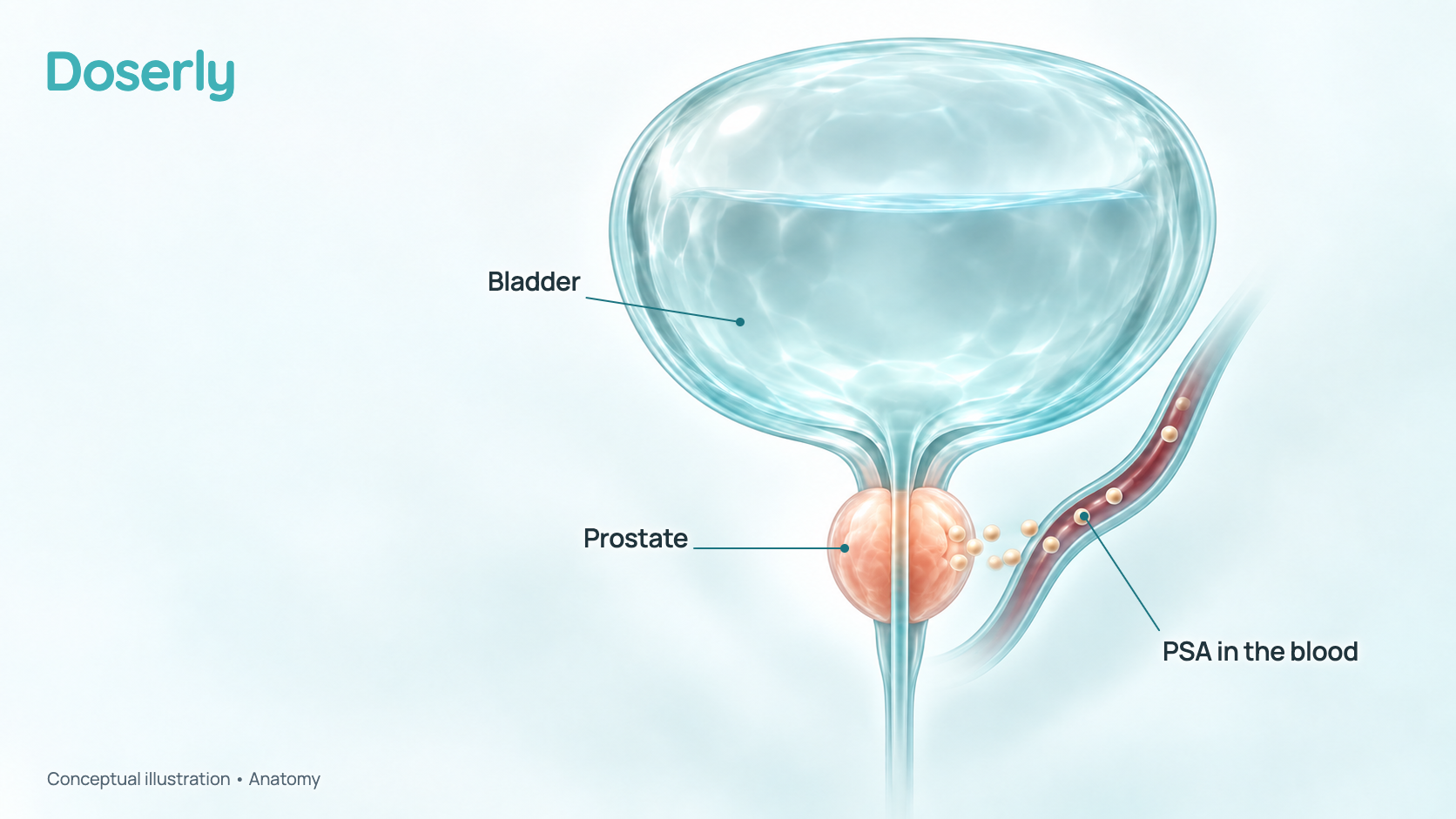
The prostate is a small, walnut-sized gland under the bladder that makes part of the fluid in semen. It depends on male hormones, and testosterone drives the growth of prostate cancer once it has spread, which is why testosterone therapy and the prostate are watched together. [13], [1]
PSA (prostate-specific antigen) is a protein the prostate makes, measured with a blood test. It is specific to the prostate but not to cancer: an enlarged prostate, inflammation, infection, recent ejaculation, long cycling and some procedures can all raise it. A single high result is a reason to look further, not a diagnosis. [17], [13]
PSA production depends on testosterone, so men with low testosterone tend to have lower PSA, and treatment usually nudges it up a little, mostly in the first year. [17], [18], [1]
Two other prostate problems come up on TRT:
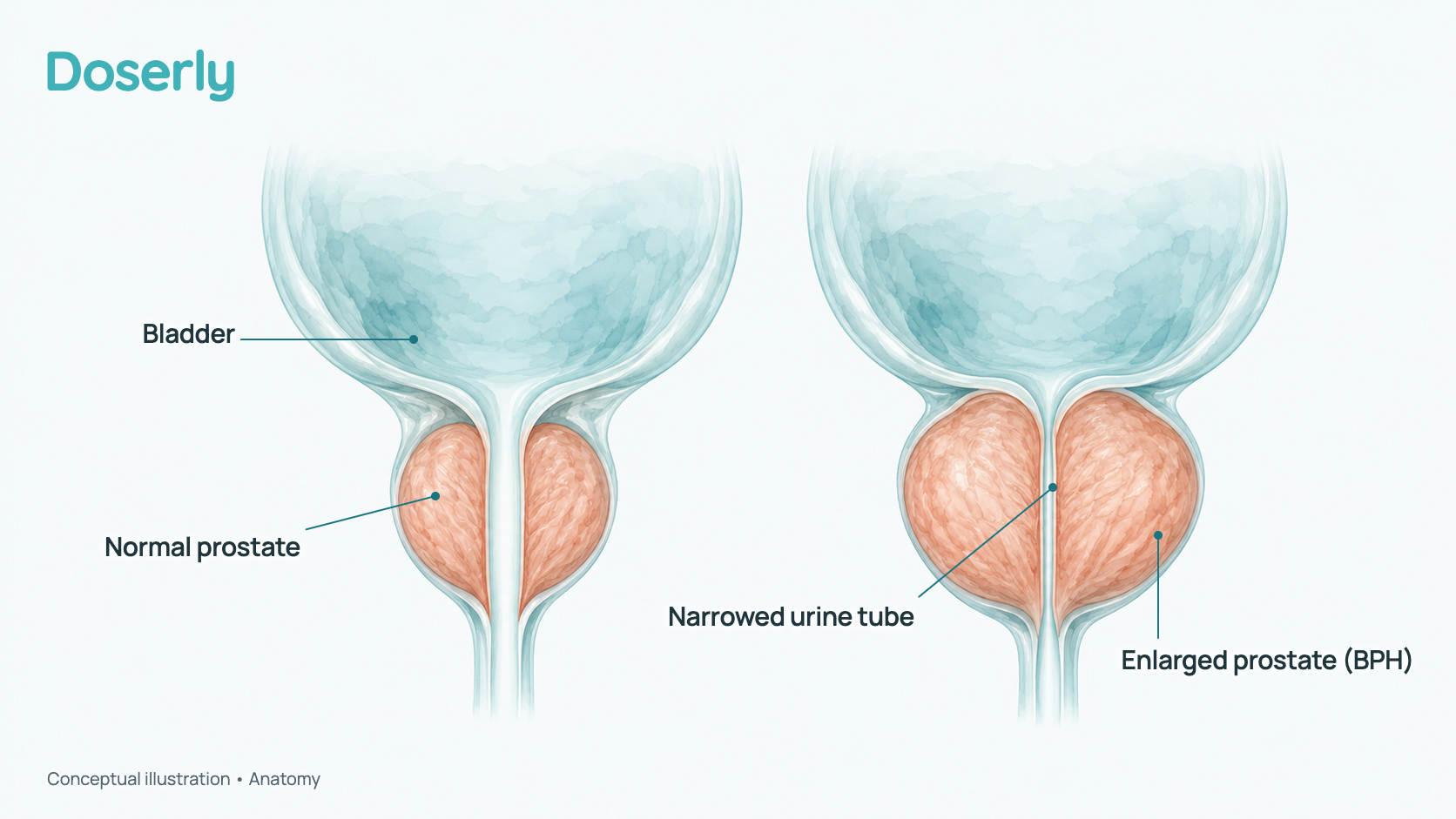
- BPH (benign prostatic hyperplasia) is an enlarged prostate that is not cancer. It can cause lower urinary tract symptoms such as peeing more often, a sudden urge to go and getting up at night to urinate. Doctors score these with a short questionnaire, the IPSS, and TRT guidelines treat a score above 19 as severe. [13], [3]
- Prostate cancer usually grows slowly; once it has spread, a standard treatment lowers testosterone (androgen deprivation therapy), which is where the old belief that testosterone "feeds" every prostate cancer came from. [1], [19]
TRT and the prostate: the key numbers
Two sets of numbers matter: the checks before treatment starts, and the change in PSA during treatment that leads to a urology referral. The tables show what each major clinical guideline says, checked in September 2026. PSA is written in ng/mL; UK, Canadian and Australian labs write the same number in µg/L.
Before starting: prostate checks by guideline
| Guideline (version, year) | Rule before starting | How checked | Action |
|---|---|---|---|
| AUA, American Urological Association (2018, validity reconfirmed 2024) | PSA in men over 40 | PSA; repeat if raised | Evaluate a worrying PSA first |
| Endocrine Society (2018) | Not with a PSA above 4 ng/mL (3 at high risk) or a lump or hardness in the prostate, until evaluated | PSA and digital rectal exam (DRE), by shared decision at 55–69 (40–69 at high risk) | Urology evaluation first |
| BSSM, British Society for Sexual Medicine (2023) | An unevaluated PSA above 4 ng/mL (3 at high risk), lump or hardness, or an IPSS above 19 | DRE and PSA | Evaluate before treating |
| VA, US Department of Veterans Affairs (January 2026) | An unevaluated PSA above 4 ng/mL, or above 3 with risk factors (including Agent Orange); severe urinary symptoms | PSA | Not until evaluated |
| EAU, European Association of Urology (2026) | No number; PSA and a DRE at the start are mandatory | PSA and DRE | Local prostate cancer guidelines decide next steps |
| EAA, European Academy of Andrology (2020) | Men over 40: PSA and DRE | PSA and DRE after a shared-decision talk | Avoid treating undiagnosed cancer |
| CUA (Canada, 2021), ICSM (2024) | No testosterone-specific number | PSA and DRE, as in cancer screening | As for any man |
| Society for Endocrinology (UK, 2022), ESA (Australia, 2016) | No mandatory screening because of testosterone | Ordinary screening for age; ESA adds DRE and PSA when prostate disease is reasonably possible | As for any man |
[9], [2], [3], [4], [10], [5], [20], [21], [22], [23]
Most bodies want a PSA, often with a DRE, before treatment in men over 40, and treat an unevaluated PSA above 4 ng/mL (above 3 ng/mL at high risk) as a reason to see a urologist first. The Endocrine Society's higher-risk factors include a father or brother with prostate cancer and African American race. [2]
On treatment: when a PSA change leads to referral
| Guideline (version, year) | Referral trigger | When PSA is checked | Action |
|---|---|---|---|
| Endocrine Society (2018) | A confirmed rise of more than 1.4 ng/mL in the first 12 months; a confirmed PSA above 4.0 ng/mL; an abnormal DRE | At the start and at 3–12 months, then standard screening | Urology consultation |
| BSSM (2023) | A rise of more than 1.4 ng/mL in any year, or more than 0.4 ng/mL a year over more than 2 years (PSA velocity) | At 3–6 and 12 months, then yearly; the 6-month result becomes the baseline | Urology referral |
| VA (January 2026) | A rise of more than 1.4 ng/mL within 12 months, or a PSA above 4 ng/mL at any time | At 3–6 and 12 months, then yearly (men 70 and older: screening guidance after year one) | Urology referral |
| EAA (2020) | A rise of more than 1.4 ng/mL within 12 months; a confirmed PSA above 4 ng/mL; an abnormal DRE or much worse urinary symptoms | At 3–12 months, then local screening | Further evaluation |
| EAU (2026) | No number: a "significant rise" in PSA or its speed | During treatment; DRE at least yearly | Further tests |
| CUA (2021), AUA (2018) | No testosterone-specific number | CUA: at the start, 3 and 6 months, then yearly; AUA: by shared decision | Investigate as for any man; the CUA says not to blame a big rise on testosterone alone |
| Product labels | No number | US: before and during treatment. UK: at least yearly, twice yearly in older and at-risk men | Monitoring only |
[2], [3], [4], [5], [10], [20], [9], [24], [25]
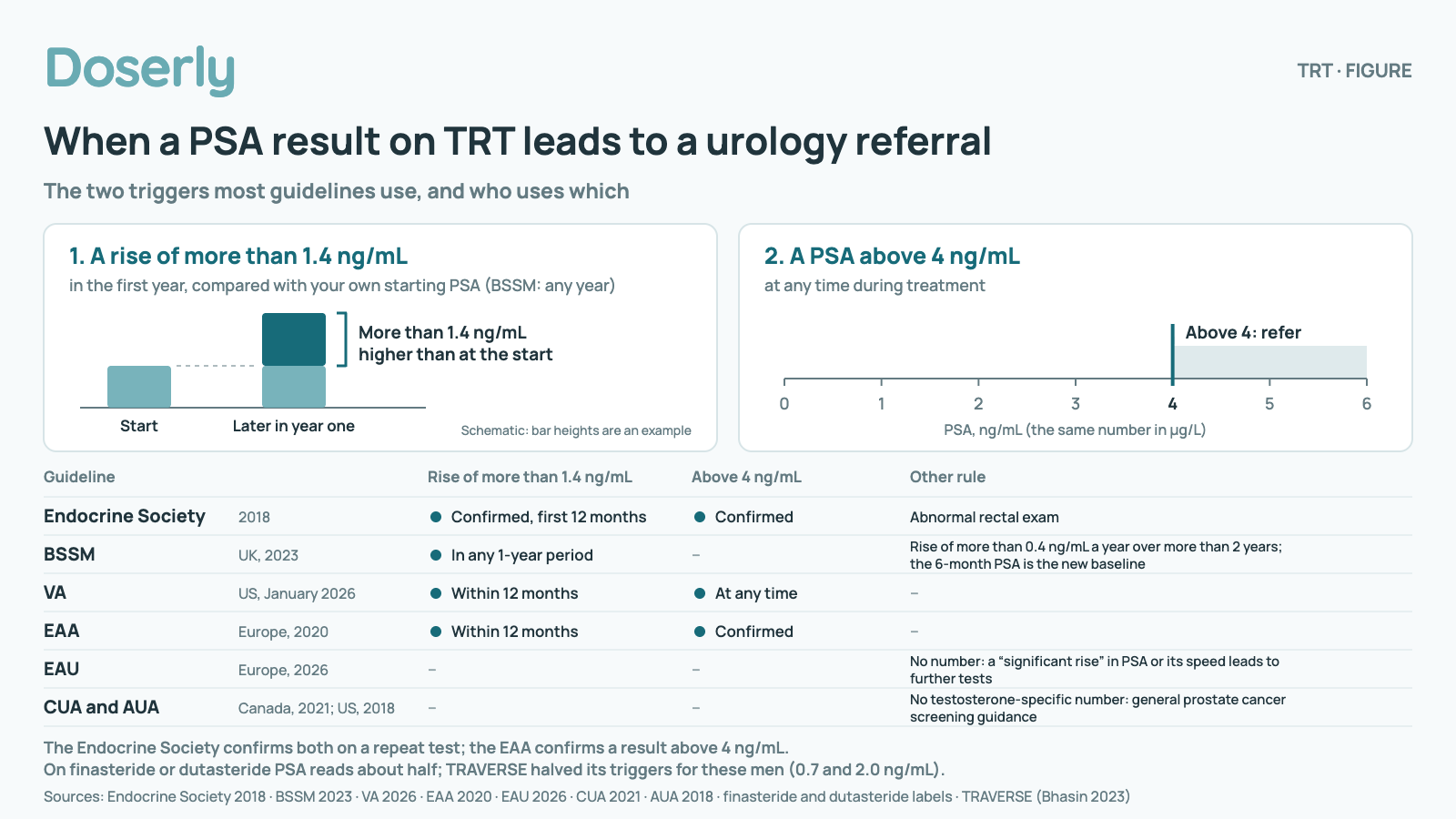
The Endocrine Society, the VA and the EAA refer a man for a rise of more than 1.4 ng/mL in the first year, or a PSA above 4 ng/mL. The BSSM uses a rise of more than 1.4 ng/mL in any year, or more than 0.4 ng/mL a year over 2 years. The Endocrine Society asks for both results to be confirmed on a repeat test, and the EAA for the result above 4 ng/mL. The EAU, the CUA and the AUA fall back on general prostate cancer guidance. [2], [3], [4], [5], [10], [20], [9]
When a PSA result on TRT leads to a urology referral
The two triggers most guidelines use, and who uses which.
- 1. A rise of more than 1.4 ng/mLin the first year, compared with your own starting PSA (the BSSM: in any year).
- 2. A PSA above 4 ng/mLat any time during treatment (4 ng/mL is 4 µg/L).
- Endocrine Society (2018)
- A confirmed rise of more than 1.4 ng/mL in the first 12 months; a confirmed PSA above 4 ng/mL; an abnormal rectal exam.
- BSSM (UK, 2023)
- A rise of more than 1.4 ng/mL in any 1-year period, or more than 0.4 ng/mL a year over more than 2 years. The 6-month PSA is the new baseline.
- VA (US, January 2026)
- A rise of more than 1.4 ng/mL within 12 months, or a PSA above 4 ng/mL at any time.
- EAA (Europe, 2020)
- A rise of more than 1.4 ng/mL within 12 months, or a confirmed PSA above 4 ng/mL.
- EAU (Europe, 2026)
- No number: a “significant rise” in PSA or its speed leads to further tests.
- CUA and AUA (Canada, 2021; US, 2018)
- No testosterone-specific number: general prostate cancer screening guidance.
The Endocrine Society confirms both on a repeat test; the EAA confirms a result above 4 ng/mL. On finasteride or dutasteride PSA reads about half; TRAVERSE halved its triggers for these men (0.7 and 2.0 ng/mL).
Where does the 1.4 ng/mL figure come from?
From normal test-to-test wobble. The Endocrine Society explains that 1.4 ng/mL is the 90% confidence limit for the change between two PSA tests taken 3 to 6 months apart in men with BPH, so a bigger rise is more than ordinary test-to-test variation. In the Testosterone Trials, rises of more than 1.4 ng/mL happened in 2.4% of men on testosterone at 3 months and 4.7% at 12 months, against 1.6% and 0.6% on placebo. [2]
Why do guidelines disagree?
Mostly because prostate cancer screening itself is disputed, and each testosterone guideline borrows its own country's screening rules:
- Screening by age. The US Preventive Services Task Force leaves screening at 55 to 69 to individual choice and advises against it at 70 and older (an update is in progress). The AUA's early-detection guideline suggests a first PSA at 45 to 50, then every 2 to 4 years from 50 to 69. The EAU starts at 50, earlier with a family history, African descent or a BRCA2 gene change. The NHS offers no routine screening unless a man carries a faulty BRCA2 gene. Checked September 2026. [26], [27], [28], [17], [13]
- The rectal exam. The EAU wants a DRE at the start and at least yearly; the BSSM advises one at the start, then yearly PSA; the UK Society for Endocrinology does not recommend mandatory screening at all. [10], [3], [22]
How do the units and medicines change the numbers?
PSA in ng/mL and µg/L is the same number: 4 ng/mL is 4 µg/L. Finasteride and dutasteride, taken for an enlarged prostate or hair loss, lower PSA by about half. So their labels say to double a result before comparing it with normal ranges (after 6 months on finasteride 5 mg, or 3 months on dutasteride). That is why TRAVERSE, which otherwise used the 1.4 and 4.0 ng/mL triggers, halved them for men on these medicines. [1], [14], [29]
For testosterone itself, the unit converter switches between ng/dL and nmol/L, and the TRT blood work guide explains when to draw each test.
Where these numbers come from
Each guideline row comes from that body's current document: the AUA testosterone deficiency guideline (published 2018, validity reconfirmed 2024), the Endocrine Society guideline (2018), the BSSM guidelines (2023), the VA clinical recommendations (January 2026), the EAU guidelines on sexual and reproductive health (2026 edition), the EAA guideline (2020), the CUA guideline (2021), the ICSM 2024 recommendations (published 2025), the Society for Endocrinology guideline (2022) and the Endocrine Society of Australia position statement (2016). [9], [2], [3], [4], [10], [5], [20], [21], [22], [23]
The label row comes from the current US AndroGel 1.62% label and the UK Testogel summary of product characteristics. TRAVERSE's halved thresholds for men on finasteride or dutasteride come from the trial's published prostate safety paper. [24], [25], [1]
Not used: a claim on older pages that any PSA above 4 ng/mL is an absolute bar to treatment (the guidelines say an unevaluated result, until a urologist has seen it), a claim that every man over 40 on TRT needs a yearly PSA (no guideline says this), and a claim that some guidelines require 2 years of undetectable PSA after cancer (2 years was the entry rule of one trial; the EAU says at least 1 year).
Why does testosterone affect PSA and the prostate?
Because the prostate runs on male hormones, but seems to need only a modest amount. An enzyme, 5-alpha reductase, turns testosterone into a stronger hormone, DHT (dihydrotestosterone), which drives much of the prostate's growth. The evidence below is mostly from people; the "saturation" idea is a model that fits it, not a proven fact. [14], [30], [19]
- Blocking DHT blocks the growth. In a 12-month trial in older men, testosterone injections (125 mg of enanthate a week, which the authors call higher than usual replacement) enlarged the prostate by 11.4 cm³, and finasteride prevented it completely. [30]
- The saturation model. This hypothesis says the prostate's hormone receptors are nearly full at fairly low testosterone levels, so raising testosterone into the normal range adds little. [19] Human studies fit it:
- In a 6-month randomized trial with prostate biopsies, injections raised blood testosterone from a median of 282 to 640 ng/dL, but testosterone and DHT inside the prostate did not change significantly. [31]
- In a 6-month gel trial of 274 men, PSA rose 0.2 ng/mL in men who started at 250 ng/dL or below and did not change above that. A registry of 451 men on gel found a statistically clear rise only in men who started below 250 ng/dL, with PSA highest after 1 month. The 250 ng/dL cut-off is where these studies split their groups, not a proven threshold. [32], [18]
- Natural testosterone levels. Pooled data from 18 long-term studies found no link between men's own testosterone and later prostate cancer. A pooling of 20 studies found fewer cancers only in the tenth of men with the lowest free testosterone (odds ratio 0.77). [33], [34]
- The genetic counterweight. Mendelian randomization studies use gene variants as a natural experiment. In UK Biobank, each step up in genetically higher bioavailable testosterone went with a 23% higher prostate cancer risk (odds ratio 1.23), and a second study found the same for aggressive cancer. These reflect lifelong exposure, not treatment started later, but the TRAVERSE authors cite them as the reason prostate safety still needs study. [35], [36], [1]
Does low testosterone hide prostate cancer?
It can make PSA less reassuring. In 77 men with low testosterone, a PSA of 4.0 ng/mL or less and a normal rectal exam, biopsies found cancer in 14%. In a later series of 345 men, the figure was 15.1%, rising from 5.6% at a PSA of 1.0 or less to 36.4% at 3.1 to 4.0. Neither series had a comparison group. The EAU notes that low testosterone lowers PSA, one reason guidelines check it before and after treatment starts. [37], [38], [17]
What does the research show?
PSA rises a little on testosterone, trials have not shown more prostate cancer or worse average urinary symptoms, and the long-term answer is still open because the cancer grows over many years. [1], [39], [40]
How much does PSA rise on TRT?
A few tenths of a ng/mL on average, mostly in the first year, with a few men rising much more.
| Study | Who and what | PSA result | What it cannot show |
|---|---|---|---|
| TRAVERSE (controlled trial, 2023) | 5,204 men aged 45–80, daily testosterone gel or placebo; PSA above 3.0 ng/mL excluded | 0.11 ng/mL above placebo at 3 months and 0.15 at 12 months; no further widening | Gel only; higher-risk men left out [1] |
| Testosterone Trials (2019 analysis) | 790 men aged 65 or older, gel or placebo, 1 year | In the Testosterone Trials, PSA rose 0.47 ng/mL on testosterone and 0.06 ng/mL on placebo; 5% of treated men rose 1.7 or more | One year [41] |
| AndroGel 1.62% trial | 274 men (234 gel, 40 placebo), 6 months | Average rise 0.1 ng/mL; "increased PSA" was the most common side effect (11.1%); 0.4 ng/mL in men 60 or older vs 0.05 in younger men | Short [32], [24] |
| Review of 15 trials (meta-analysis, 2015) | 1,124 men, 3–12 months | 0.15 ng/mL overall, 0.27 with intramuscular injections (into a muscle); abnormal results no more common | Short trials [42] |
| Xyosted and Kyzatrex (label data) | 283 men on weekly subcutaneous enanthate (injected under the skin); 155 on oral undecanoate | A rise of at least 1.4 ng/mL or a PSA above 4 led 4.6% to stop Xyosted; 2.6% on Kyzatrex rose more than 1.4 | No comparison group [43], [44] |
The pattern: a small average rise, bigger in older men and those starting very low, with a few larger rises. There is no single "normal" rise, which is why guidelines use a referral trigger. [32], [41], [2]
Does TRT cause prostate cancer?
Randomized trials have not shown it, but they are short compared with how slowly prostate cancer grows.
TRAVERSE, the largest trial, had an independent committee confirm prostate events over 14,304 person-years in 5,204 men: [1]
- High-grade prostate cancer: 5 of 2,596 men on testosterone (0.19%) and 3 of 2,602 on placebo (0.12%) (hazard ratio 1.62, likely range 0.39 to 6.77, too wide to show a difference). [1]
- Any prostate cancer: 12 men (0.46%) vs 11 (0.42%). [1]
- Referrals and biopsies: 57 men on testosterone (2.2%) and 28 on placebo (1.1%) met the referral rules; 16 of those 85 chose a biopsy. In all, 16 men on testosterone and 14 on placebo had a biopsy. [1]
- Limits: men with a PSA above 3.0 ng/mL or severe urinary symptoms were excluded; it tested only a gel; men used it for 21.7 months on average, and about 61% stopped early. [1], [6], [44]
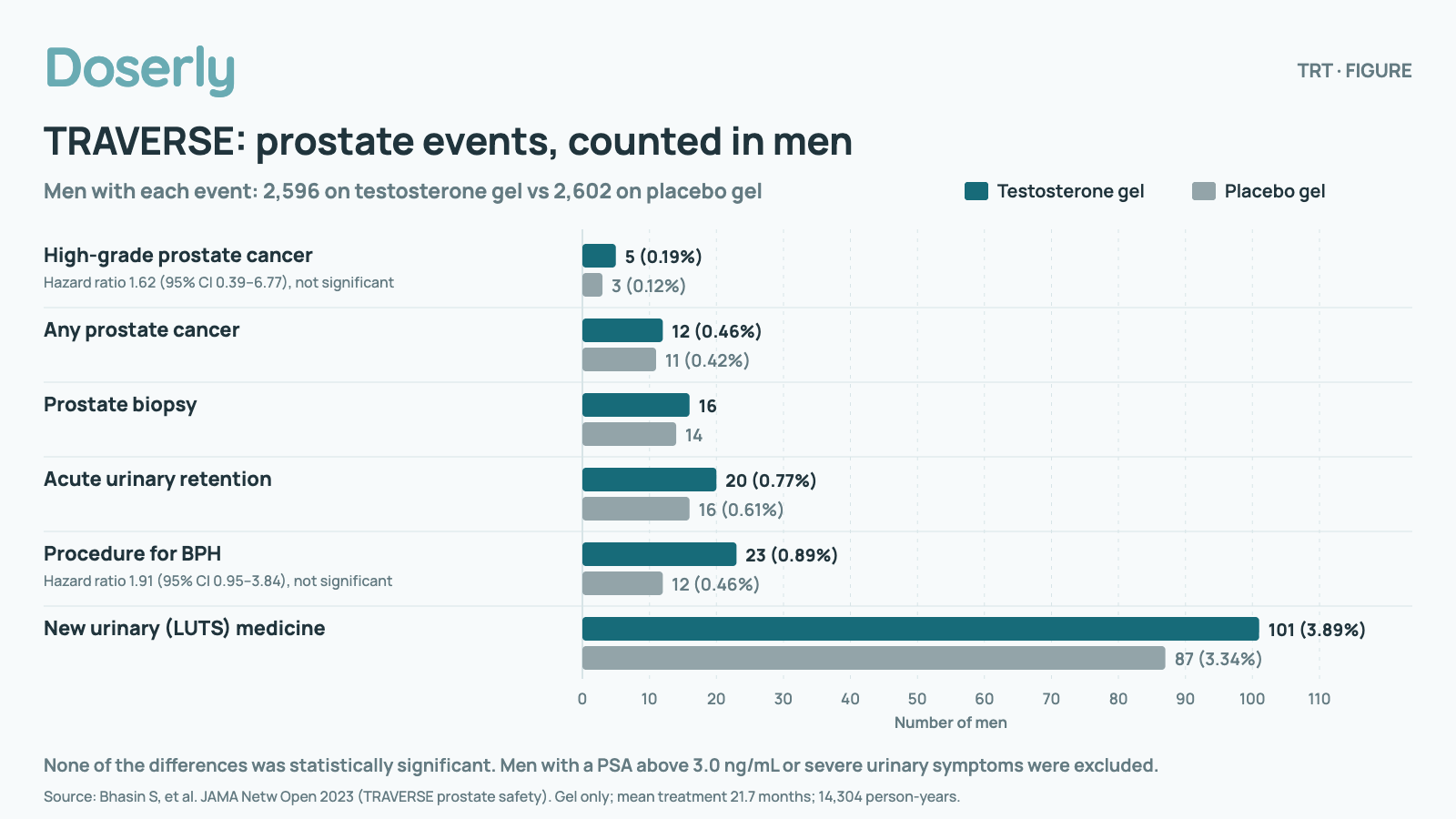
TRAVERSE: prostate events, counted in men
Testosterone gel (2,596 men)Placebo gel (2,602 men)
Numbers are men with the event (percent of the group). Bars run from 0 to 110 men.
- High-grade prostate cancer
- Testosterone 5 (0.19%) vs placebo 3 (0.12%); hazard ratio 1.62 (95% CI 0.39–6.77), not significant
- Any prostate cancer
- Testosterone 12 (0.46%) vs placebo 11 (0.42%)
- Prostate biopsy
- Testosterone 16 vs placebo 14
- Acute urinary retention
- Testosterone 20 (0.77%) vs placebo 16 (0.61%)
- Procedure for BPH
- Testosterone 23 (0.89%) vs placebo 12 (0.46%); hazard ratio 1.91 (95% CI 0.95–3.84), not significant
- New urinary (LUTS) medicine
- Testosterone 101 (3.89%) vs placebo 87 (3.34%)
None of the differences was statistically significant. Men with a PSA above 3.0 ng/mL or severe urinary symptoms were excluded.
Reviews of smaller trials agree. The newest (2026; 41 trials, 11,161 men) found no clear change in prostate cancer (odds ratio 0.88, likely range 0.52 to 1.51) or clinically significant cancer (1.13). Earlier reviews of 11, 22 and 51 studies found no significant effect. A 2005 review found more "prostate events" (odds ratio 1.78), but it counted PSA rises and biopsies together, and none was significant on its own. [39], [45], [46], [47], [48]
Large records studies (cohort studies) follow more men for longer, but show only links:
- Sweden (38,570 men with prostate cancer, 192,838 without): no link overall (odds ratio 1.03); more low-risk cancers found early (1.35), which the authors put down to more testing, and fewer aggressive ones (0.50). [49]
- US Medicare (52,579 men with prostate cancer): no link with high-grade cancer (0.84, range 0.67 to 1.05). [50]
- UK primary care (12,779 men with low testosterone): no increase (hazard ratio 0.97). [51]
- A registry of 999 men: 55 biopsies were done for suspected cancer, and the share that found cancer was nearly the same with testosterone (37.5%) and without (37.0%). [52]
The AUA tells clinicians to inform men "of the absence of evidence linking testosterone therapy to the development of prostate cancer", and the EAU says the literature does not support an increased risk. The Endocrine Society's July 2026 statement adds that long-term safety, including for prostate cancer, "remains unestablished", because the cancer develops slowly and trials may not have followed men long enough. [9], [10], [40]
Does TRT protect against prostate cancer?
No trial shows that. Records studies from Ontario (hazard ratio 0.60 at the highest exposure) and US Medicare (odds ratio 0.72 for cancer that had spread, with injections) found fewer cancers on testosterone. But the Medicare authors warn of "residual confounding", meaning other differences between the groups. In a US insurance database of 3.2 million men, men on testosterone had fewer localized cancers (0.49), but so did men with untreated low testosterone (0.46). That points to low testosterone or testing habits rather than the treatment. [53], [54], [55]
Does TRT make the prostate bigger or urinary symptoms worse?
On average, not in trials, although the evidence for men with severe symptoms is thin.
- TRAVERSE. The change in IPSS did not differ. Severe symptoms (IPSS above 19) at any visit occurred in 7.5% on testosterone and 8.2% on placebo; acute urinary retention in 20 men (0.77%) vs 16 (0.61%); new urinary medicine in 101 (3.89%) vs 87 (3.34%). Procedures for BPH were numerically more common on testosterone, 23 men (0.89%) vs 12 (0.46%) (hazard ratio 1.91, range 0.95 to 3.84), but not statistically clearly so. [1]
- Reviews. Reviews of 14 trials (2,029 men) and 28 trials (3,461 men) found no change in IPSS, and the larger one no change in prostate size. A network review of 21 trials found no worsening by any route, though short-term intramuscular injections enlarged the prostate slightly in one subgroup. [7], [56], [57]
- Who was studied. In a review of 35 trials, 46% excluded men with severe symptoms, and no high-quality evidence supports the common rule against treating them. That missing evidence, not proof of harm, is why the rule persists. [8]
- Prostate size. In 53 older men with BPH on gel, adding dutasteride shrank the prostate by 12% and lowered PSA by 35%, while gel alone grew it by 7.5% and raised PSA by 19%. [58] The Canadian AndroGel monograph lists "enlarged prostate" (11.9%) as the most frequently observed side effect at the recommended dose, with no placebo figure for comparison. [59]
- Small studies suggesting improvement. In an open trial of 52 men with BPH and low testosterone, symptom scores improved within the treated group (15.7 to 12.5), without blinding. [60]
Is TRT safe for the prostate?
For men without prostate cancer, trials lasting about 2 to 3 years have not shown more prostate cancer or worse mild-to-moderate urinary symptoms. PSA does rise a little, which leads to more referrals and some biopsies, and nobody knows the answer over 10 or 20 years. [1], [40]
What do product labels say today?
Checked September 2026. Labels differ by country and are changing.
- United States. Testosterone is contraindicated in known or suspected prostate cancer, and prescribers should check for prostate cancer before and during treatment. Men with BPH are at increased risk of worse symptoms, and older vial labels add that they "may develop acute urethral obstruction". [61], [24]
- United Kingdom. Testogel, other gels and Sustanon 250 contraindicate known or suspected prostate cancer; Nebido and enanthate injections say androgen-dependent prostate cancer. Nebido warns that androgens "may accelerate the progression of sub-clinical prostatic cancer and benign prostatic hyperplasia". [25], [62], [63], [64], [65], [66]
- Canada. Monographs contraindicate known or suspected prostate cancer. Health Canada started a safety review in May 2026, prompted by the FDA, reassessing the prostate cancer risk of testosterone products; no label change has been announced. [59], [67], [68]
- Australia. Testogel and Reandron use the same contraindication; the Testogel document adds that data on prostate cancer risk "are inconclusive". [69], [70]
What did the FDA ask to change in 2026?
On June 18, 2026, the US Department of Health and Human Services announced that the FDA was asking makers to change testosterone labels in three ways. Testosterone would be contraindicated "only in men with metastatic prostate cancer". Labels would say trial data "do not demonstrate worsening symptoms in men with mild to moderate benign prostatic hyperplasia, although evidence remains limited for men with severe symptoms". And they would drop the statement that safety in age-related low testosterone is not established. The FDA's testosterone page confirms the requests. [11], [71]
These are requests, not label changes. As of September 2026, US labels, including Depo-Testosterone (revised August 2026) and a generic cypionate label effective September 9, 2026, still say "known or suspected". [12], [61]
What did TRAVERSE show about heart safety overall?
Heart attack, stroke or cardiovascular death occurred in 182 of 2,596 men on testosterone gel and 190 of 2,602 on placebo. That is 7.0% of men on testosterone gel and 7.3% on placebo (hazard ratio 0.96), meeting the trial's safety goal. Atrial fibrillation (3.5% vs 2.4%), acute kidney injury (2.3% vs 1.5%) and pulmonary embolism (0.9% vs 0.5%) were more common on testosterone. So were fractures, in 91 of 2,601 men (3.50%) vs 64 of 2,603 (2.46%). The limits above apply: gel only, 21.7 months of use on average, about 61% stopped their study gel early, and the men were already at high heart risk. [6], [44], [72] The TRT and heart health guide covers the trial in full.
Who should be especially cautious?
- Men with a raised PSA or a prostate lump not yet checked: above 4 ng/mL, or 3 at high risk, most guidelines want a urologist's evaluation first. [2], [3], [4]
- Men at higher risk of prostate cancer: a father or brother with it, African American or African descent, or a BRCA2 gene change. Several guidelines start screening earlier for them. [2], [17], [13]
- Men with severe urinary symptoms (IPSS above 19): a reason not to start for the Endocrine Society, the VA and the BSSM, a relative contraindication for the EAU and a precaution in Australia. [2], [4], [3], [10], [73]
- Men with prostate cancer now or in the past. See testosterone after prostate cancer.
- Men taking finasteride or dutasteride, whose PSA reads about half its true level. [14], [29]
- Drug-tested athletes, since testosterone is banned in sport. [16]
- Under-18s. Testosterone for teenagers belongs only in specialist care.
- Women. This guide is written for men; see testosterone therapy for women.
Which medicines change PSA or the prostate on TRT?
- Finasteride and dutasteride (5-alpha reductase inhibitors), used for BPH and, at a lower finasteride dose, hair loss. At BPH doses they cut PSA by about 50%; finasteride 1 mg lowered average PSA from 0.7 to 0.5 ng/mL in men aged 18 to 41. Their labels say any confirmed rise from the lowest PSA reached on the medicine should be checked, even if the result still looks normal. [14], [29], [74]
- Their sexual side effects. On the US labels, dutasteride caused impotence in 4.7% vs 1.7% on placebo in the first 6 months, and finasteride 1 mg lower libido in 1.8% vs 1.3%. [29], [74]
- With testosterone. In a 12-month trial of 23 men on testosterone, PSA fell 0.46 ng/mL with dutasteride and rose 0.21 without it, a trend that was not statistically clear. [75]
- Prostate supplements such as saw palmetto and pygeum were not reviewed here; see the saw palmetto and pygeum guides.
Tell whoever orders your PSA test about everything you take, including hair-loss treatments and supplements. Checked September 2026.
Is testosterone legal, and is it allowed in sport?
Checked September 2026. Rules differ by country and change often.
- United States. Testosterone and its esters are Schedule III controlled substances, prescription only. No proposal to change that has been published. [15]
- United Kingdom. Testosterone is a Class C controlled drug, in Schedule 4 Part II of the Misuse of Drugs Regulations. [76]
- Canada. Testosterone is a Schedule IV controlled substance. [77]
- Australia. Testosterone is a Schedule 4 prescription-only medicine. [78]
- Sport. The World Anti-Doping Agency (WADA) prohibits testosterone at all times, and its 2027 list, published in September 2026, keeps the ban. [16], [79]
What do guidelines say to do about a PSA rise or urinary symptoms?
Repeat a surprising PSA result, then refer to a urologist if a confirmed rise crosses the guideline's line; pausing or biopsy follows ordinary prostate cancer rules. This describes the choices clinicians weigh, not a personal plan. [2], [10], [20]
| Situation | What guidelines say | Who says it |
|---|---|---|
| One PSA result higher than expected | Repeat it to rule out a passing rise, such as from prostatitis or lab variation | Endocrine Society; AUA early-detection guideline; EAU prostate cancer guideline |
| A rise of more than 1.4 ng/mL in the first year, or a PSA above 4 ng/mL | Urology referral | Endocrine Society, VA, EAA (the BSSM: a rise of more than 1.4 ng/mL in any year) |
| Whether to pause testosterone or have a biopsy | Follow local prostate cancer guidelines; a pause may be advised while investigating, but a significant rise needs investigating either way | EAU, CUA |
| After the first year | Standard screening for the man's age | Endocrine Society, EAA, VA (men 70 and older) |
| Severe urinary symptoms (IPSS above 19) | A reason not to start, or a relative contraindication | Endocrine Society, VA, BSSM, EAU, ESA |
[2], [28], [17], [3], [4], [5], [10], [20], [73]
Should a raised PSA be repeated first?
Yes, under every guideline that addresses it. The Endocrine Society tells clinicians to confirm a rise by repeating the test. The AUA's early-detection guideline notes that a newly raised PSA returns to normal in 25% to 40% of men on retesting. The EAU advises a second test after four weeks, in the same lab with the same test, for results of 3 to 10 ng/mL. PSA can vary by about 15% between tests in the same man. [2], [28], [17] See what to avoid before a PSA test.
Will TRT be stopped if PSA goes above 4?
Not automatically. The CUA says a pause may be advised while a raised PSA is investigated, but a significant rise "should not be attributed to the use of testosterone alone" and needs investigating either way. The EAU leaves the decision to local prostate cancer guidelines. For men with a past prostate cancer, the AUA notes that stopping testosterone may itself lower PSA. [20], [10], [9]
Can you start TRT with an enlarged prostate or urinary symptoms?
With mild to moderate symptoms, most guidelines do not rule it out. With severe symptoms (IPSS above 19), the Endocrine Society, the VA and the BSSM list them as a reason not to start, the EAU as a relative contraindication, and the Australian statement as a precaution. TRAVERSE excluded these men. US labels warn that BPH may worsen, and the FDA has requested softer wording for mild to moderate BPH (requested, not in labels; checked September 2026). Most bodies land on this line because such men were left out of trials, not because harm was shown. [2], [4], [3], [10], [73], [1], [24], [11], [8]
Can you take testosterone after prostate cancer?
Most guidelines rule it out in cancer that has spread. The AUA instead says it should ideally be given there only in research, and the ICSM also rules it out when PSA has come back after treatment. After low-risk cancer has been treated, the AUA, the EAU and the BSSM allow a carefully monitored trial, on short-term evidence.
| Guideline or label | Position |
|---|---|
| AUA (2018) | Evidence too thin to weigh risks and benefits (expert opinion); may be considered after surgery with favorable findings and undetectable PSA; locally advanced or metastatic disease ideally only in research |
| EAU hypogonadism chapter (2026) | Only at low risk of recurrence after surgery, starting after at least 1 year with PSA below 0.01 ng/mL; PSA at 3, 6 and 12 months, then yearly |
| EAU prostate cancer guideline | "No contraindication" for symptomatic men with low testosterone "where ADT is not the treatment of choice" |
| ICSM (2024), CUA (2021) | Never in biochemical recurrence or metastatic disease; the CUA adds high-risk cancer likely to need hormone-blocking treatment |
| BSSM (2023) | Locally advanced or metastatic cancer ruled out. Offer testosterone to men with symptoms after treated low-risk localized cancer (Gleason below 8, stage 1–2, PSA below 10 ng/mL before the operation) with no sign of active disease, starting no sooner than 1 year after treatment |
| EAU, Endocrine Society, VA, ESA | Locally advanced or metastatic cancer ruled out; the Endocrine Society and the VA advise against testosterone in (active) prostate cancer |
| US labels (checked September 2026) | Contraindicated in known or suspected prostate cancer; the FDA has requested narrowing this to metastatic cancer, not yet in labels |
[9], [10], [80], [21], [20], [3], [2], [4], [73], [61], [11]
The two EAU documents disagree: one limits testosterone to low-risk cancer after surgery and a year of undetectable PSA; the other sees no contraindication wherever hormone-blocking treatment is not the treatment of choice. [10], [80]
- The only randomized trial (2026). 136 men treated with surgery for low-grade cancer (Gleason 6 or 3+4), with undetectable PSA for at least 2 years, got testosterone cypionate 100 mg a week or placebo for 12 weeks. No man had a PSA recurrence; sexual activity and desire improved, erections did not. It was too short and small to judge long-term safety, and does not apply to high-grade cancer or men treated with radiation or hormone therapy. [81], [82]
- The largest records study. Among 69,984 US veterans treated with surgery or radiation, 1,012 later received testosterone (median follow-up 6.95 years); it was not linked with more recurrence (hazard ratio 1.07) or death. [83]
- Pooled studies. Recurrence was about 1% in a review of 21 studies (0% after surgery, 2% after radiation or other non-surgical treatment) and 3.5% in a 2026 review of 7 studies after surgery (398 men). A review of 109 men with high-risk cancer found no recurrences but called the evidence very low quality and testosterone "investigational" in this group. [84], [85], [86]
- After radiation. Of 98 men, 6 (6.1%) had a recurrence over a median of 40.8 months, with no comparison group. [87]
What about men on active surveillance?
Active surveillance means watching a low-risk cancer with regular tests instead of treating it straight away. The EAU advises telling these men, and men treated with radiation or other non-surgical cures, that safety data on testosterone are unclear. [10] The data are observational and small. In US Medicare, 167 men on surveillance who got testosterone moved on to treatment less often than 6,658 who did not (hazard ratio 0.66), and none died of prostate cancer, against 39 (0.6%). In a cohort of 3,324 men, the 79 on testosterone progressed at the same rate (hazard ratio 0.99). A 2026 review of 7 studies (295 men on testosterone) found no spread and no cancer deaths, from low-quality, short studies. It put the lower treatment rate in the Medicare study down most plausibly to which men were chosen for testosterone. [88], [89], [90]
ClinicalTrials.gov lists a non-randomized study recruiting up to 600 men on surveillance, with or without testosterone, for up to 5 years, and a planned single-group study of 35 men. We found no randomized trial recruiting such men. Checked September 2026. [91], [92]
How do sex, cycling and infections affect a PSA test?
What should you avoid before a PSA test?
The NHS asks men not to ejaculate, have anal sex, cycle or exercise hard enough to get out of breath for 48 hours before a PSA test. It also asks them to wait 4 to 6 weeks after a urine infection has cleared. [13] The studies behind those rules:
- Ejaculation raised PSA in 87% of 64 men, and 97% were back to baseline by 48 hours; in a smaller study, 40% were still above baseline at 24 hours. [93], [94]
- Cycling. A long ride raised PSA by 9.5% (0.23 ng/mL) in 129 men aged 50 or older, but a review of 8 studies found no significant change. The NHS rule is the cautious choice. [95], [96]
- Rectal exams and catheters did not meaningfully raise PSA (2,736 and 70 men). [97], [98], [17]
- Urinary retention and biopsy. Retention roughly doubled PSA for up to 2 weeks, and the EAU advises waiting at least a month after a biopsy. [99], [17]
The fairest comparison is a repeat test under the same conditions as the last one: the same lab and test, a similar time of day, and none of these triggers. [17]
Do you need a rectal exam?
It depends on the guideline. The EAU makes a DRE mandatory at the start and recommends one at least yearly. The Endocrine Society and the EAA pair it with PSA at the start, and the BSSM advises one initial exam, then yearly PSA. The UK Society for Endocrinology does not recommend mandatory prostate screening because a man is on testosterone. [10], [2], [5], [3], [22]
What do people on TRT report about their prostate?
Public forums are full of men looking at a PSA result that went up, or wondering whether testosterone will worsen an enlarged prostate. The threads below are recent public Reddit discussions, read with their replies; they show what people experience, not how often it happens.
What does a PSA rise usually look like?
Usually small. One man in his 40s went from 0.74 before treatment to 1.12 at 8 weeks and 1.28 at 5 months, and his urologist simply rechecked it. Another man's results moved between 0.87 and 1.17 over a year, and a third had 3.3 at 10 weeks, the same as before. [100], [101], [102] Bigger jumps worry people most: a man in his 70s saw 1.4 become 2.6 at 6 weeks, and a man in his 50s saw 2.358 become 3.999 at 3 months. [103], [104]
What happened after a big jump?
Posters often blame something just before the test. One man's 1.5 followed ejaculation the night before, and another's 4.3 on cream came after sex and cycling; his clinic would not refill until a urologist cleared him. [105], [106] A retest does not always fall. A man aged 50 went from 2.2 to 7.1 after several dose increases and weekend workouts on an exercise bike. He was still at 6.28 three days later, so his clinic stopped treatment until a urologist saw him. In the same thread, another man said his 4.5 after an indoor bike workout was normal on a retest two weeks later. [107] A man in his 60s on gel climbed from 2.2 before treatment to 3.1 and then 4.6 over two years, and was referred. [108]
Several men describe stopping testosterone for a few weeks before a PSA test so the number comes down; a result taken during a break is not the on-treatment PSA that guideline triggers compare. [107], [109]
What do men with an enlarged prostate report?
Experiences split. A man with mild BPH on medicine for it was cleared by his urologist and, 8 weeks into a low dose, said his dribbling and night-time urination had almost gone. [110] Others with mild BPH described urgency that became "not so minor" within a month, or pelvic pressure and a weaker stream by week 8. [111], [112] A man in his 40s stopped after about 5 weeks because of new urgency and trouble emptying his bladder. [113] After about 17 years of treatment, one man had a PSA of 6.1, a prostate that grew from 81 to 107 cc over four years and an MRI with no suspicious areas. [114] Some complaints are hard to pin down: one man's stream weakened before each long-acting injection, alongside a known narrowing of the urethra. [115]
What do men report before starting?
A raised PSA changes the path. Clinics declined one man with a PSA of 3.5, and another's PSA of 8 led to a negative biopsy. A third learned his baseline PSA was 7.7 only after two doses, because the clinic had prescribed before his results were back. [116], [117], [118] A man with readings of 5.6 and 5.5 had a clear MRI and, a year later, a PSA of 4.1 and normal testosterone. [119] A man not on testosterone saw PSA fall from 3.6 to 2.4 while losing weight, and another with BPH and a high PSA was cleared by a urologist to start. [120], [121]
What do men report after prostate cancer?
A man in his 60s said his oncologist would allow testosterone with close PSA checks after radiation and hormone therapy, while his family doctor opposed it. A reply from a man in his 70s described PSA low and stable at 0.4 almost 3 years after restarting. Another man in his 70s, treated in 2024, said his PSA had not risen in a year back on testosterone. [122], [109] These accounts cannot show how safe this is.
How do clinicians respond to prostate worries?
Often cautiously. Two men describe prescribers refusing a dose increase over prostate risk, in one case a grandfather's cancer, and both considered or booked another prescriber. [123], [124] One man said he was afraid to mention urinary symptoms in case treatment was stopped; he had also changed his injection schedule and started a hair-loss spray. [125] Men who took finasteride or dutasteride describe sexual side effects such as losing morning erections; in one case they faded weeks to months after stopping. [126], [127]
How can you judge a PSA story?
Ask: What was PSA before treatment? Was the test repeated in the same lab? Did ejaculation, cycling, an infection or a procedure come just before? Was he on finasteride, dutasteride or a break? What did the next test show?
These selected discussions show what people experience and the questions research has not answered. They are not a survey of all men on TRT, a success rate or a substitute for the studies above.
What should you track?
PSA before starting, at 3–12 months, then on your guideline's schedule, plus any change in urinary symptoms. Use this to prepare questions for your prescriber; it is not a personal testing plan. [2], [4], [3]
| Why it matters | What guidelines and labels say | Tracking category |
|---|---|---|
| PSA | Before starting; at 3–12 months (3–6 and 12 months under the VA and the BSSM); then yearly or by screening rules; UK labels at least yearly (see the key numbers) | Blood work |
| Rectal exam | At the start under most guidelines; at least yearly under the EAU | Other |
| Urinary symptoms | A new weak stream, urgency, night-time urination or trouble emptying; a score above 19 on the IPSS counts as severe | Other |
| Medicines that change PSA | The start date of finasteride or dutasteride, which halve PSA | Other |
| What came before each test | Ejaculation, cycling or hard exercise in the last 48 hours, a urine infection, a procedure, or a break from testosterone | Other |
| Testosterone level | Checked at the same visits; PSA rises most when testosterone starts very low | Blood work |
[2], [4], [3], [25], [10], [14], [13], [32]
A single PSA result is one point on a line; a trend of results drawn under similar conditions says more than any one number. The TRT blood work guide covers the full lab schedule, and the hematocrit guide the other main safety test. [17], [28]
Common questions about TRT and the prostate
Does TRT cause prostate cancer?
Trials have not shown that it does. In TRAVERSE, prostate cancer occurred in 12 men on testosterone and 11 on placebo, out of about 2,600 in each group, and a 2026 review of 41 trials found no clear change. The trials lasted a few years and left out higher-risk men, so long-term safety is not established. [1], [39], [40] See the research.
Is it normal for PSA to go up on TRT?
A small rise is common: 0.15 ng/mL above placebo at 12 months in TRAVERSE, most in older men and those who start very low. A rise that crosses a guideline trigger still needs checking. [1], [32] See why PSA rises.
How much can PSA rise on TRT before it's a problem?
Most guidelines that give a number refer a man to a urologist after a rise of more than 1.4 ng/mL in the first year, or a PSA above 4 ng/mL, usually after a repeat test. The BSSM applies the 1.4 ng/mL rule to any year and also flags more than 0.4 ng/mL a year over 2 years. [2], [3], [4], [5] See the key numbers.
Can you take TRT with BPH?
Often, with mild to moderate symptoms: trials found no worsening on average. Men with severe symptoms (IPSS above 19) were mostly left out, and most guidelines advise caution for them. US labels still warn about BPH; softer wording is requested, not yet in labels (checked September 2026). [1], [8], [11] See urinary symptoms.
Can you take testosterone after prostate cancer?
Sometimes, under specialist care. Most guidelines rule it out in cancer that has spread. The AUA and the EAU allow a monitored trial after low-risk cancer removed by surgery, and the BSSM after treated low-risk cancer. The only randomized trial lasted 12 weeks, and US labels still say no. [9], [10], [3], [81], [61] See after prostate cancer.
Does TRT make the prostate bigger?
Not clearly on average: a review of 28 trials found no significant change in size, though one trial of a higher-than-usual dose found growth of 11.4 cm³ in a year. [56], [30] See the research.
Should you stop TRT before a PSA test?
Not unless your prescriber asks. Guideline triggers compare PSA on treatment with the baseline, so a result taken during a break answers a different question. Avoid ejaculation, cycling and hard exercise for 48 hours instead. [2], [13] See before a PSA test.
Glossary
Plain explanations of the medical, lab and research terms used in this guide. Underlined terms in the text link here.
- Active surveillance
- Watching a low-risk prostate cancer with regular PSA tests, scans and biopsies instead of treating it straight away. Treatment starts if the cancer shows signs of growing.
- ADT (androgen deprivation therapy)
- Treatment that lowers testosterone, or blocks it, to slow prostate cancer. It is a standard treatment for cancer that has spread or is at high risk.
- Biochemical recurrence
- A rise in PSA after prostate cancer treatment that suggests the cancer has come back, before any other sign. After surgery, trials often define it as a PSA of 0.2 ng/mL or more.
- BPH (benign prostatic hyperplasia)
- An enlarged prostate that is not cancer. It can press on the tube that carries urine and cause urinary symptoms.
- Cohort study (records study)
- A study that follows a group of people, or looks back at their records, without assigning treatments. It can show links but not prove that one thing caused another.
- Controlled trial
- A study that compares people who receive a treatment with a similar group who do not, often receiving a placebo instead. Randomly assigning people to each group makes the comparison fairer.
- DHT (dihydrotestosterone)
- A stronger hormone made from testosterone by the enzyme 5-alpha reductase. It drives much of the prostate's growth and hair loss on the scalp.
- DRE (digital rectal exam)
- A quick exam in which a doctor feels the prostate with a gloved finger through the back passage, checking its size and for lumps or hard areas.
- 5-alpha reductase inhibitor
- A medicine, such as finasteride or dutasteride, that blocks the conversion of testosterone to DHT. It shrinks an enlarged prostate and lowers PSA by about half.
- Gleason score
- A grade given to prostate cancer under the microscope. Gleason 6 is low grade; 3+4 is the lower end of intermediate grade; higher scores mean more aggressive cancer.
- Clinical guideline
- Recommendations written by a medical society or health system, based on its review of the evidence and expert judgment. Different guidelines can reach different conclusions.
- Hazard ratio
- A measure comparing how often an event happens over time in two groups. A hazard ratio of 1 means no difference; 0.96 means about 4% lower in the first group.
- Intramuscular (IM)
- Injected into a muscle. Most testosterone cypionate and enanthate is given this way.
- IPSS (International Prostate Symptom Score)
- A short questionnaire that scores urinary symptoms such as a weak stream, urgency and getting up at night. TRT guidelines treat a score above 19 as severe.
- Product label (prescribing information)
- The official document approved by a medicines regulator for a product, describing its approved uses, doses, warnings and monitoring. In the UK it is called the summary of product characteristics.
- Lower urinary tract symptoms (LUTS)
- Problems passing or storing urine, such as a weak or stop-start stream, urgency, dribbling or getting up at night. BPH is a common cause, but not the only one.
- Mendelian randomization
- A study method that uses gene variants people are born with as a natural experiment, to test whether a lifelong difference, such as higher testosterone, is linked with a disease.
- Meta-analysis and systematic review
- A systematic review gathers all studies on a question in a planned way. A meta-analysis combines their results statistically. A network meta-analysis compares several treatments at once, even ones never tested head to head.
- Metastatic
- Cancer that has spread from where it started to other parts of the body, such as the bones or lymph nodes.
- Odds ratio
- A measure comparing the odds of an outcome in two groups. An odds ratio of 2 means roughly twice the odds; 1 means no difference.
- Placebo
- A dummy treatment with no active ingredient, used as a comparison in studies.
- PSA (prostate-specific antigen)
- A blood test for a protein made by the prostate. It rises slightly on testosterone and is used to decide whether prostate checks are needed. It is reported in ng/mL or µg/L, which are the same number.
- PSA velocity
- How fast PSA rises over time, usually in ng/mL per year. The BSSM flags a rise of more than 0.4 ng/mL a year over more than 2 years.
- Subcutaneous (SC)
- Injected into the fatty layer just under the skin. Xyosted is given this way, and some prescribers use this route for other testosterone injections.
- TRT (testosterone replacement therapy)
- Prescribed testosterone, by injection, gel or other forms, for men with low testosterone.
- Acute urinary retention
- Suddenly being unable to pass urine, which usually needs a catheter. An enlarged prostate is a common cause.
- Urologist
- A doctor who specializes in the urinary tract and male reproductive organs, including the prostate.
- WADA
- The World Anti-Doping Agency, which publishes the list of substances banned in sport. Testosterone is prohibited at all times.
How this guide was researched
This guide is built from a thorough review of the sources cited throughout it: clinical guidelines from ten medical bodies plus prostate cancer screening guidance, product labels from four countries, published clinical trials and studies, and regulatory documents. We also reviewed public online forums where men on TRT describe their own PSA results and urinary symptoms.
The guide cites 127 sources, including 35 original studies in people, 17 clinical guidelines, position statements and screening recommendations, and 28 public community discussions. Each type of source answers a different question. Guidelines and labels show what clinicians are told to do. Trials and studies show what was measured. Personal accounts show what individual people experienced. Every numbered citation links to its entry below, labeled by source type.
How this guide was made
Research and drafting were AI-assisted. Every cited source was checked against the original, and the guide was reviewed and edited by Doserly before publication. It has not had an independent clinical review, and Doserly does not currently have medical reviewers. Doserly makes a medication and health-tracking app and runs Doserly Academy, both of which are promoted in this guide. Read our editorial policy for how guides are researched, updated and corrected.
This guide is for educational purposes. It summarizes what the reviewed sources report so the research is easier to understand; it is not medical advice. For a deeper dive, or to check any point for yourself, go straight to the cited sources.
Explore the sources
These are the documents cited in this guide. Guidelines, labels, studies, trial registries and personal accounts answer different questions. A source being listed does not mean every statement on its page is endorsed.
Showing 127 sources
- 01
Prostate Safety Events During Testosterone Replacement Therapy in Men With Hypogonadism: A Randomized Clinical Trial ↗
Human trial
Original full text reviewed.
Detail: TRAVERSE prostate safety: high-grade cancer 5 vs 3, any cancer 12 vs 11, BPH procedures 23 vs 12 (not significant); PSA 0.15 ng/mL higher at 12 months; IPSS change did not differ; men with PSA above 3.0 or IPSS above 19 excluded.
- 02
Testosterone Therapy in Men With Hypogonadism: An Endocrine Society Clinical Practice Guideline ↗
Clinical guideline
Full guideline reviewed.
Detail: Do not start with PSA above 4 ng/mL (3 at high risk), a prostate nodule or severe urinary symptoms (IPSS above 19) without evaluation; refer for a confirmed PSA rise of more than 1.4 ng/mL in the first year or PSA above 4.0; 1.4 is the 90% limit of test-to-test change; confirm rises by repeating the test.
- 03
The British Society for Sexual Medicine Guidelines on Male Adult Testosterone Deficiency, with Statements for Practice ↗
Clinical guideline (UK)
Full text reviewed.
Detail: Refer for a PSA rise of more than 1.4 ng/mL in any year or more than 0.4 ng/mL a year over 2 years; the 6-month PSA becomes the baseline; an initial DRE, then yearly PSA; contraindications include advanced prostate cancer, unevaluated PSA above 4 ng/mL and IPSS above 19; offer testosterone to men with symptoms after treated localized low-risk prostate cancer with no active disease (Gleason below 8, stage 1–2, pre-operative PSA below 10 ng/mL, not before 1 year of follow-up).
- 04
Evaluation for and Management of Males with Low Testosterone: Recommendations for Use (January 2026) ↗
Clinical recommendations (US)
Full document reviewed.
Detail: Unevaluated PSA above 4 ng/mL (3 with risk factors, including Agent Orange) and severe urinary symptoms are contraindications; refer for a PSA rise of more than 1.4 ng/mL within 12 months or PSA above 4; men 70 and older follow screening guidance after year one.
- 05
European Academy of Andrology (EAA) guidelines on investigation, treatment and monitoring of functional hypogonadism in males (endorsed by the European Society of Endocrinology) ↗
Clinical guideline (Europe)
Full text reviewed.
Detail: PSA and DRE before starting in men over 40; further evaluation for a PSA rise of more than 1.4 ng/mL within 12 months or a confirmed PSA above 4 ng/mL.
- 06
Cardiovascular Safety of Testosterone-Replacement Therapy ↗
Human trial
Original abstract reviewed.
Detail: TRAVERSE: heart attack, stroke or cardiovascular death in 7.0% on testosterone gel vs 7.3% on placebo (hazard ratio 0.96); mean treatment 21.7 months.
- 07
Effects of Testosterone Replacement Therapy on Lower Urinary Tract Symptoms: A Systematic Review and Meta-analysis ↗
Systematic review
Original abstract reviewed.
Detail: 14 randomized trials (2,029 men): IPSS change -0.41 on testosterone vs +0.12 on placebo; no worsening of urinary symptoms.
- 08
The Relationship Between Testosterone-Replacement Therapy and Lower Urinary Tract Symptoms: A Systematic Review ↗
Systematic review
Original abstract reviewed.
Detail: 35 trials: 46% excluded men with severe urinary symptoms; no high-quality evidence supports the IPSS above 19 contraindication.
- 09
Evaluation and Management of Testosterone Deficiency: AUA Guideline ↗
Clinical guideline (US)
Full guideline reviewed.
Detail: PSA before starting in men over 40; inform men of the absence of evidence linking testosterone therapy to prostate cancer; after prostate cancer, evidence is inadequate to weigh risks and benefits, with treatment possible after surgery with favorable findings and undetectable PSA; in locally advanced or metastatic disease, ideally only in research (J Urol text, statement 18 discussion).
- 10
EAU Guidelines on Sexual and Reproductive Health, Chapter 3: Male Hypogonadism (2026 edition) ↗
Clinical guideline (Europe)
Full guideline chapter reviewed.
Detail: PSA before and during treatment and DRE at baseline are mandatory, DRE at least yearly; further tests for a significant PSA rise; IPSS above 19 is a relative contraindication; after prostate cancer, only low-risk men after surgery with at least 1 year of PSA below 0.01 ng/mL; men on active surveillance or after non-surgical curative treatment should be told safety data are unclear.
- 11
HHS Announces Requested Updates to Testosterone Therapy Product Labels ↗
Government announcement (US)
Official release reviewed.
Detail: Requested label changes: contraindicate only in metastatic prostate cancer; mild to moderate BPH not shown to worsen; remove the age-related limitation of use. Requested, not yet implemented.
- 12
DailyMed SPL: Testosterone cypionate injection (BPI Labs, ANDA 219478) ↗
Product label (US)
Full label reviewed.
Detail: A September 2026 generic cypionate label still carries the known or suspected prostate cancer contraindication.
- 13
PSA test (NHS website) ↗
Health service guidance (UK)
Official page reviewed.
Detail: Avoid ejaculation, anal sex, vigorous exercise and cycling for 48 hours before a PSA test; wait 4 to 6 weeks after a urine infection; routine screening not offered unless BRCA2.
- 14
PROSCAR (finasteride) tablets prescribing information (DailyMed) ↗
Product label (US)
Relevant label sections reviewed.
Detail: Finasteride 5 mg lowers PSA by about 50%; double an isolated PSA after 6 months; any confirmed rise from the lowest value should be evaluated.
- 15
21 CFR 1308.13(f) Schedule III: anabolic steroids ↗
Regulation (US)
Official text reviewed.
Detail: Lists anabolic steroids, including testosterone and its esters, in Schedule III.
- 16
World Anti-Doping Code International Standard: Prohibited List 2026 ↗
Anti-doping list
Full list reviewed.
Detail: Testosterone is prohibited at all times (S1.1).
- 17
EAU Guidelines on Prostate Cancer: Diagnostic evaluation (early detection; sources of PSA error) ↗
Clinical guideline (Europe)
Full chapter reviewed.
Detail: PSA is organ-specific but not cancer-specific; repeat a PSA of 3 to 10 after four weeks in the same lab; PSA varies about 15% between tests; delay PSA a month after biopsy; DRE does not affect PSA; screening from 50 (45 or 40 at higher risk).
- 18
Changes in prostate specific antigen in hypogonadal men after 12 months of testosterone replacement therapy: support for the prostate saturation theory ↗
Human study
Original abstract reviewed.
Detail: Registry of 451 men on gel: PSA rose significantly only when starting testosterone was below 250 ng/dL; highest PSA at 1 month.
- 19
Shifting the paradigm of testosterone and prostate cancer: the saturation model and the limits of androgen-dependent growth ↗
Review (hypothesis)
Original abstract reviewed.
Detail: Proposes the saturation model: prostate hormone receptors are maximally bound at testosterone levels well below the normal range. A hypothesis.
- 20
Canadian Urological Association guideline on testosterone deficiency in men: Evidence-based Q&A ↗
Clinical guideline (Canada)
Full text reviewed.
Detail: PSA and DRE per prostate cancer screening guidelines; a pause may be advised while investigating, but significant PSA rises should not be attributed to testosterone alone; contraindicated in metastatic or high-risk prostate cancer.
- 21
Male hypogonadism: recommendations from the Fifth International Consultation on Sexual Medicine (ICSM 2024) ↗
Consensus recommendations
Full text reviewed.
Detail: PSA and DRE per evidence-based screening guidance; no testosterone in biochemical recurrence or metastatic prostate cancer.
- 22
Society for Endocrinology guidelines for testosterone replacement therapy in male hypogonadism ↗
Clinical guideline (UK)
Full text reviewed.
Detail: Does not recommend mandatory prostate cancer screening during testosterone treatment.
- 23
Endocrine Society of Australia position statement on male hypogonadism (part 2): treatment and therapeutic considerations ↗
Position statement (Australia)
Full text reviewed.
Detail: Part 2: monitor for prostate disease as for men of similar age with normal testosterone; DRE and PSA before starting when prostate disease is reasonably possible.
- 24
AndroGel 1.62% (testosterone gel) pump and packets prescribing information ↗
Product label (US)
Full label reviewed.
Detail: AndroGel 1.62%: increased PSA was the most common adverse reaction (26 men, 11.1%); men with BPH are at increased risk of worsening; evaluate for prostate cancer before and during treatment.
- 25
Testogel 16.2 mg/g gel (pump) SmPC ↗
Product information (UK)
Full SmPC reviewed.
Detail: Testogel 16.2 mg/g: contraindicated in known or suspected prostate cancer; DRE and PSA at least yearly, twice yearly in elderly and at-risk men.
- 26
Screening for Prostate Cancer: US Preventive Services Task Force Recommendation Statement ↗
Screening recommendation (US)
Original abstract reviewed.
Detail: 2018 recommendation: screening at 55 to 69 is an individual decision; recommends against screening at 70 and older.
- 27
Prostate Cancer: Screening (USPSTF recommendation page) ↗
Screening recommendation (US)
Official page reviewed.
Detail: The 2018 screening recommendation remains current; the topic is being updated (checked Sep 2026).
- 28
Early Detection of Prostate Cancer: AUA/SUO Guideline Part I: Prostate Cancer Screening ↗
Clinical guideline (US)
Original full text reviewed.
Detail: Baseline PSA at 45 to 50; screening every 2 to 4 years at 50 to 69; a newly raised PSA returns to normal in 25% to 40% on retesting.
- 29
AVODART (dutasteride) capsules prescribing information (DailyMed) ↗
Product label (US)
Relevant label sections reviewed.
Detail: Dutasteride lowers PSA by about 50% within 3 to 6 months; double an isolated PSA after 3 months; sexual side effects mostly in the first 6 months.
- 30
Musculoskeletal and prostate effects of combined testosterone and finasteride administration in older hypogonadal men: a randomized, controlled trial ↗
Human trial
Original abstract reviewed.
Detail: 12-month trial in 60 older men: enanthate 125 mg weekly enlarged the prostate by 11.4 cm³, which finasteride prevented.
- 31
Effect of testosterone replacement therapy on prostate tissue in men with late-onset hypogonadism: a randomized controlled trial ↗
Human trial
Original abstract reviewed.
Detail: Randomized trial with biopsies (44 men): enanthate every 2 weeks raised blood testosterone, but prostate tissue testosterone and DHT did not change significantly.
- 32
Factors influencing prostate-specific antigen response among men treated with testosterone therapy for 6 months ↗
Human trial
Original abstract reviewed.
Detail: 274 men, gel or placebo for 6 months: PSA +0.1 ng/mL; +0.2 if starting testosterone was 250 ng/dL or less; +0.4 in men 60 or older vs 0.05 in younger men.
- 33
Endogenous sex hormones and prostate cancer: a collaborative analysis of 18 prospective studies ↗
Pooled human studies
Original abstract reviewed.
Detail: 18 prospective studies: no link between men's own testosterone levels and prostate cancer.
- 34
Low Free Testosterone and Prostate Cancer Risk: A Collaborative Analysis of 20 Prospective Studies ↗
Pooled human studies
Original abstract reviewed.
Detail: 20 prospective studies: fewer prostate cancers only in the lowest tenth of free testosterone (odds ratio 0.77); high-grade 1.56, not significant.
- 35
Using human genetics to understand the disease impacts of testosterone in men and women ↗
Genetic study
Original full text reviewed.
Detail: UK Biobank genetics: each standard deviation of higher bioavailable testosterone raised prostate cancer risk by 23% (odds ratio 1.23).
- 36
Circulating free testosterone and risk of aggressive prostate cancer: Prospective and Mendelian randomisation analyses in international consortia ↗
Genetic study
Original abstract reviewed.
Detail: Mendelian randomization: free testosterone and aggressive prostate cancer, odds ratio 1.23 per standard deviation.
- 37
Occult prostate cancer in men with low serum testosterone levels ↗
Human study
Original abstract reviewed.
Detail: 77 men with low testosterone, PSA 4.0 or less and normal DRE: cancer on biopsy in 14% (29% of men 60 or older).
- 38
Prevalence of prostate cancer among hypogonadal men with prostate-specific antigen levels of 4.0 ng/mL or less ↗
Human study
Original abstract reviewed.
Detail: 345 men with low testosterone and PSA 4.0 or less: cancer in 15.1%, from 5.6% at PSA 1.0 or less to 36.4% at 3.1 to 4.0.
- 39
Cardiovascular and prostate cancer risk associated to testosterone replacement therapy - a systematic review and meta-analysis of 41 randomized controlled trials ↗
Systematic review
Original abstract reviewed.
Detail: 41 randomized trials (11,161 men): prostate cancer odds ratio 0.88 (0.52 to 1.51); clinically significant cancer 1.13 (0.39 to 3.26).
- 40
Statement on Testosterone Replacement Therapy (Endocrine Society press statement, 16 July 2026) ↗
Position statement (US)
Full statement reviewed.
Detail: Long-term safety, including for prostate cancer, remains unestablished; prostate cancer develops slowly and trials may not have followed men long enough.
- 41
Prostate-Specific Antigen Levels During Testosterone Treatment of Hypogonadal Older Men: Data from a Controlled Trial ↗
Human trial
Original abstract reviewed.
Detail: Testosterone Trials: PSA rose 0.47 ng/mL on testosterone vs 0.06 on placebo; 5% rose 1.7 or more; confirmed PSA above 4.0 in 1.9% vs 0.3%.
- 42
The effect of testosterone replacement therapy on prostate-specific antigen (PSA) levels in men being treated for hypogonadism: a systematic review and meta-analysis ↗
Systematic review
Original abstract reviewed.
Detail: 15 randomized trials (1,124 men): PSA +0.154 ng/mL overall, +0.271 with intramuscular injections; abnormal PSA no more common (odds ratio 1.02).
- 43
Xyosted (testosterone enanthate) subcutaneous autoinjector 50, 75, 100 mg/0.5 mL prescribing information ↗
Product label (US)
Full label reviewed.
Detail: Xyosted: a PSA rise of at least 1.4 ng/mL or a PSA above 4 ng/mL led to discontinuation in 4.6% of 283 men in trials.
- 44
Kyzatrex (testosterone undecanoate) oral capsules 50, 100, 150, 200 mg prescribing information ↗
Product label (US)
Full label reviewed.
Detail: Kyzatrex: PSA rose more than 1.4 ng/mL in 4 of 155 men (2.6%), mean rise 0.15 ng/mL; class TRAVERSE text: atrial fibrillation 3.5% vs 2.4%, acute kidney injury 2.3% vs 1.5%, pulmonary embolism 0.9% vs 0.5%; about 61% stopped study gel.
- 45
Endogenous and exogenous testosterone and the risk of prostate cancer and increased prostate-specific antigen (PSA) level: a meta-analysis ↗
Systematic review
Original abstract reviewed.
Detail: Pooled trials: PSA difference 0.10 ng/mL (not significant); prostate cancer relative risk 0.87 (0.30 to 2.50) from 11 trials.
- 46
The effect of testosterone replacement therapy on prostate cancer: a systematic review and meta-analysis ↗
Systematic review
Original abstract reviewed.
Detail: 22 randomized trials (2,351 men): no significant increase in prostate cancer, biopsies or nodules by any route.
- 47
Clinical review 1: Adverse effects of testosterone therapy in adult men: a systematic review and meta-analysis ↗
Systematic review
Original abstract reviewed.
Detail: 51 studies: no significant effect on prostate outcomes; follow-up 3 months to 3 years.
- 48
Adverse events associated with testosterone replacement in middle-aged and older men: a meta-analysis of randomized, placebo-controlled trials ↗
Systematic review
Original abstract reviewed.
Detail: 19 randomized trials in men 45 and older: combined prostate events odds ratio 1.78, driven by PSA rises and biopsies; no single event significant.
- 49
Testosterone Replacement Therapy and Risk of Favorable and Aggressive Prostate Cancer ↗
Human study (records)
Original abstract reviewed.
Detail: Sweden, 38,570 men with prostate cancer and 192,838 controls: overall odds ratio 1.03; more favorable-risk cancers (1.35), suggesting detection bias; fewer aggressive cancers (0.50).
- 50
Long-term Exposure to Testosterone Therapy and the Risk of High Grade Prostate Cancer ↗
Human study (records)
Original abstract reviewed.
Detail: US Medicare, 52,579 men with prostate cancer: high-grade cancer odds ratio 0.84 (0.67 to 1.05).
- 51
Testosterone Replacement Therapy and the Risk of Prostate Cancer in Men With Late-Onset Hypogonadism ↗
Human study (records)
Original abstract reviewed.
Detail: UK primary care, 12,779 men with low testosterone: hazard ratio 0.97 (0.71 to 1.32).
- 52
Testosterone treatment is not associated with increased risk of prostate cancer or worsening of lower urinary tract symptoms: prostate health outcomes in the Registry of Hypogonadism in Men ↗
Human study (registry)
Original abstract reviewed.
Detail: Registry of 999 men: positive biopsies 37.5% with testosterone vs 37.0% without; no difference in PSA or IPSS.
- 53
Survival and cardiovascular events in men treated with testosterone replacement therapy: an intention-to-treat observational cohort study ↗
Human study (records)
Original abstract reviewed.
Detail: Ontario, 10,311 treated men and 28,029 controls: fewer prostate cancer diagnoses in the highest exposure group (hazard ratio 0.60).
- 54
Testosterone therapy and cancer risks among men in the SEER-Medicare linked database ↗
Human study (records)
Original abstract reviewed.
Detail: US Medicare case-control study: injections linked with fewer distant-stage prostate cancers (odds ratio 0.72); authors note possible residual confounding.
- 55
Untreated hypogonadism and testosterone replacement therapy in hypogonadal men are associated with a decreased risk of subsequent prostate cancer: a population-based study ↗
Human study (records)
Original abstract reviewed.
Detail: 3.2 million insured US men: fewer localized cancers on testosterone (0.49) but also in untreated low testosterone (0.46).
- 56
An updated systematic review and meta-analysis of the effects of testosterone replacement therapy on erectile function and prostate ↗
Systematic review
Original abstract reviewed.
Detail: 28 randomized trials (3,461 men): IPSS difference 0.00, prostate volume +0.38 mL and PSA +0.08 ng/mL, none significant.
- 57
Effect of testosterone replacement therapy on lower urinary tract symptoms: A systematic review and network meta-analysis ↗
Systematic review
Original abstract reviewed.
Detail: Network meta-analysis of 21 trials (2,453 men): no worsening of urinary symptoms by any route; short-term intramuscular injections raised prostate volume in a subgroup.
- 58
Dutasteride reduces prostate size and prostate specific antigen in older hypogonadal men with benign prostatic hyperplasia undergoing testosterone replacement therapy ↗
Human trial
Original abstract reviewed.
Detail: 53 older men with BPH on gel: adding dutasteride shrank the prostate 12% and lowered PSA 35%, vs growth of 7.5% and PSA +19% on gel alone.
- 59
AndroGel 1% (testosterone gel) sachets 2.5 g/5 g and pump product monograph ↗
Product monograph (Canada)
Full monograph reviewed.
Detail: AndroGel 1%: contraindicated in known or suspected prostate cancer; enlarged prostate (11.9%) was the most frequently observed adverse drug reaction at the recommended dose.
- 60
Androgen replacement therapy contributes to improving lower urinary tract symptoms in patients with hypogonadism and benign prostate hypertrophy: a randomised controlled study ↗
Human trial
Original abstract reviewed.
Detail: Open randomized study of 52 men with BPH and low testosterone: IPSS improved within the treated group (15.7 to 12.5).
- 61
Depo-Testosterone (testosterone cypionate) 100 and 200 mg/mL prescribing information ↗
Product label (US)
Full label reviewed.
Detail: Depo-Testosterone: contraindicated in known or suspected prostate cancer; men with BPH may develop acute urethral obstruction.
- 62
Tostran 20 mg/g transdermal gel (2%) SmPC ↗
Product information (UK)
Full SmPC reviewed.
Detail: Tostran 2% gel: contraindicated in known or suspected carcinoma of the breast or the prostate.
- 63
Irisel 16.2 mg/g transdermal gel SmPC ↗
Product information (UK)
Full SmPC reviewed.
Detail: Irisel 16.2 mg/g gel: contraindicated in known or suspected prostate cancer or breast carcinoma.
- 64
Sustanon 250, 250 mg/ml solution for injection (testosterone esters: propionate 30 mg, phenylpropionate 60 mg, isocaproate 60 mg, decanoate 100 mg) SmPC ↗
Product information (UK)
Full SmPC reviewed.
Detail: Sustanon 250: contraindicated in known or suspected prostate cancer; PSA and DRE at baseline, every 3 months for 12 months, then yearly.
- 65
Nebido 1000 mg/4 ml solution for injection (testosterone undecanoate) SmPC ↗
Product information (UK)
Full SmPC reviewed.
Detail: Nebido: contraindicated in androgen-dependent carcinoma of the prostate; androgens may accelerate the progression of sub-clinical prostatic cancer and BPH.
- 66
Testosterone Enantate 250 mg/ml solution for injection ampoules SmPC ↗
Product information (UK)
Full SmPC reviewed.
Detail: Testosterone Enantate 250 mg/ml injection: contraindicated in androgen-dependent carcinoma of the prostate or of the male mammary gland.
- 67
Taro-Testosterone Cypionate Injection 100 mg/mL product monograph ↗
Product monograph (Canada)
Full monograph reviewed.
Detail: Testosterone cypionate: contraindicated in men with known or suspected carcinoma of the prostate.
- 68
New safety and effectiveness reviews (date modified 2026-09-09) ↗
Regulator page (Canada)
Official page reviewed.
Detail: Lists a safety review started in May 2026 reassessing the prostate cancer risk of testosterone products; under review.
- 69
Testogel 1% gel (50 mg sachet and pump; PI shared) Australian PI ↗
Product information (Australia)
Full PI reviewed.
Detail: Testogel 1%: prostate contraindication; data on prostate cancer risk with testosterone therapy are inconclusive.
- 70
Reandron 1000 (testosterone undecanoate 1000 mg/4 mL) Australian PI ↗
Product information (Australia)
Full PI reviewed.
Detail: Reandron 1000: contraindicated in androgen-dependent prostate cancer.
- 71
Testosterone Information (Postmarket Drug Safety Information for Patients and Providers) ↗
Regulator page (US)
Official page reviewed.
Detail: Confirms that FDA requested updates to testosterone prescribing information in June 2026.
- 72
Testosterone Treatment and Fractures in Men with Hypogonadism ↗
Human trial
Original abstract reviewed.
Detail: TRAVERSE fracture substudy: clinical fractures in 91 of 2,601 men on testosterone (3.50%) vs 64 of 2,603 on placebo (2.46%); testosterone did not prevent fractures.
- 73
Endocrine Society of Australia position statement on male hypogonadism (part 1): assessment and indications for testosterone therapy ↗
Position statement (Australia)
Full text reviewed.
Detail: Part 1: advanced, metastatic or incurable prostate cancer is a contraindication; IPSS above 19 is a precaution.
- 74
PROPECIA (finasteride 1 mg) tablets prescribing information (DailyMed) ↗
Product label (US)
Relevant label sections reviewed.
Detail: Finasteride 1 mg: mean PSA fell from 0.7 to 0.5 ng/mL in men 18 to 41; any confirmed rise from the lowest value should be evaluated; label lists sexual side effects.
- 75
Dutasteride in men receiving testosterone therapy: a randomised, double-blind study ↗
Human trial
Original abstract reviewed.
Detail: 23 men on testosterone, randomized to dutasteride or placebo for 12 months: PSA -0.46 vs +0.21 ng/mL, not significant.
- 76
Misuse of Drugs Act 1971, Schedule 2 Part III (Class C drugs) ↗
Law (UK)
Official text reviewed.
Detail: Lists testosterone as a Class C drug.
- 77
Controlled Drugs and Substances Act (S.C. 1996, c. 19): ss. 4, 6 and Schedule IV ↗
Law (Canada)
Official text reviewed.
Detail: Lists testosterone among anabolic steroids in Schedule IV of the Controlled Drugs and Substances Act.
- 78
Therapeutic Goods (Poisons Standard—June 2026) Instrument 2026 (F2026L00633) ↗
Regulation (Australia)
Official text reviewed.
Detail: Poisons Standard: testosterone is a Schedule 4 prescription-only medicine.
- 79
World Anti-Doping Code International Standard: Prohibited List 2027 (and explanatory note) ↗
Anti-doping list
Full list reviewed.
Detail: Keeps testosterone prohibited at all times.
- 80
EAU Guidelines on Prostate Cancer: Quality of life outcomes in prostate cancer (testosterone supplementation) ↗
Clinical guideline (Europe)
Full chapter reviewed.
Detail: The EAU prostate cancer panel sees no contraindication to testosterone for symptomatic men with low testosterone and prostate cancer where ADT is not the treatment of choice.
- 81
Testosterone Treatment in Prostate Cancer Survivors With Hypogonadism: A Randomized Clinical Trial ↗
Human trial
Original abstract reviewed.
Detail: 136 men after surgery for low-grade prostate cancer: 12 weeks of testosterone cypionate 100 mg weekly or placebo; no biochemical recurrence; sexual activity and desire improved, erections did not.
- 82
Improving Quality of Life of Prostate Cancer Survivors With Androgen Deficiency ↗
Trial registry record
Registry record reviewed.
Detail: Registry record of the 2026 survivor trial: entry required undetectable PSA for at least 2 years after prostatectomy.
- 83
Testosterone therapy does not increase the risks of prostate cancer recurrence or death after definitive treatment for localized disease ↗
Human study (records)
Original abstract reviewed.
Detail: US veterans treated for localized prostate cancer (69,984): testosterone after surgery or radiation not linked with more recurrence (hazard ratio 1.07) or death; median 6.95 years.
- 84
Oncological safety of testosterone replacement therapy in prostate cancer survivors after definitive local therapy: A systematic literature review and meta-analysis ↗
Systematic review
Original abstract reviewed.
Detail: 21 studies of men after prostate cancer treatment: pooled recurrence about 1% (0% after surgery, 2% after radiation).
- 85
Testosterone Therapy After Radical Prostatectomy: Insights From a Systematic Review and Meta-Analysis ↗
Systematic review
Original abstract reviewed.
Detail: 7 retrospective studies after prostatectomy (398 men): pooled biochemical recurrence 3.5%.
- 86
Testosterone Therapy for High-risk Prostate Cancer Survivors: A Systematic Review and Meta-analysis ↗
Systematic review
Original abstract reviewed.
Detail: 109 men with high-risk prostate cancer in 13 studies: no recurrences, very low-quality evidence; testosterone remains investigational in this group.
- 87
Testosterone Therapy after Radiation Therapy for Low, Intermediate and High Risk Prostate Cancer ↗
Human study
Original abstract reviewed.
Detail: 98 men treated with testosterone after radiation: 6 (6.1%) had biochemical recurrence over a median of 40.8 months.
- 88
Oncologic Outcomes of Testosterone Therapy for Men on Active Surveillance for Prostate Cancer: A Population-based Analysis ↗
Human study (records)
Original abstract reviewed.
Detail: US Medicare, men on active surveillance: 167 given testosterone vs 6,658 not; conversion to treatment hazard ratio 0.66; no prostate cancer deaths on testosterone vs 39.
- 89
Testosterone Therapy in Men on Active Surveillance for Prostate Cancer Is Not Associated With Increased Risk of Disease Progression ↗
Human study (records)
Original abstract reviewed.
Detail: 3,324 men on active surveillance, 79 on testosterone: no difference in progression (hazard ratio 0.99, 0.67 to 1.48).
- 90
Testosterone Replacement Therapy in Men With Prostate Cancer on Active Surveillance: A Systematic Review of Oncological Safety ↗
Systematic review
Original abstract reviewed.
Detail: 7 observational studies (295 men on testosterone during active surveillance): no metastases or prostate cancer deaths; low-quality evidence.
- 91
Investigating the Effect of Testosterone Replacement Therapy Among Hypogonadal Men With Localized Prostate Cancer on Active Surveillance ↗
Trial registry record
Registry record reviewed.
Detail: Non-randomized study of up to 600 men on active surveillance with or without testosterone, up to 5 years; recruiting (checked Sep 2026).
- 92
Safety of Intramuscular Testosterone Replacement Therapy in Hypogonadal Patients With Prostate Cancer Under Active Surveillance ↗
Trial registry record
Registry record reviewed.
Detail: Single-group study of 35 men on active surveillance given testosterone cypionate for 12 months; not yet recruiting (checked Sep 2026).
- 93
Ejaculation increases the serum prostate-specific antigen concentration ↗
Human study
Original abstract reviewed.
Detail: 64 men: PSA rose after ejaculation in 87%, and 97% were back to baseline by 48 hours.
- 94
Effect of ejaculation on serum total and free prostate-specific antigen concentrations ↗
Human study
Original abstract reviewed.
Detail: 20 men: 40% still had PSA above baseline 24 hours after ejaculation.
- 95
Long distance bicycle riding causes prostate-specific antigen to increase in men aged 50 years and over ↗
Human study
Original abstract reviewed.
Detail: 129 men aged 50 or older: a long bike ride raised PSA by 9.5% (0.23 ng/mL) on average.
- 96
The effect of bicycling on PSA levels: a systematic review and meta-analysis ↗
Systematic review
Original abstract reviewed.
Detail: 8 studies: no significant PSA change after cycling (+0.027 ng/mL).
- 97
Digital rectal examination-associated alterations in serum prostate-specific antigen ↗
Human study
Original abstract reviewed.
Detail: 2,736 men in a screening program: a rectal exam did not meaningfully raise PSA.
- 98
The effect of urethral catheterization on the level of prostate-specific antigen ↗
Human study
Original abstract reviewed.
Detail: 70 men: a simple urinary catheter caused no significant rise in PSA.
- 99
The effect of acute urinary retention on serum prostate-specific antigen level ↗
Human study
Original abstract reviewed.
Detail: 45 men with acute urinary retention: PSA roughly doubled, for up to 2 weeks.
- 100
TRT with a rise in PSA ↗
Community account
Public thread reviewed: opening post and 12 comments.
Detail: A man in his 40s: PSA 0.74 before treatment, 1.12 at 8 weeks and 1.28 at 5 months; his urologist rechecked it.
- 101
190mg TRT current blood work ↗
Community account
Public thread reviewed: opening post and 26 comments.
Detail: PSA results of 0.87, 1.13, 0.91 and 1.17 over about a year on treatment.
- 102
10 weeks into TRT — 210 mg/week has me at 1500+ total. Thinking about reducing dose ↗
Community account
Public thread reviewed: opening post and 47 comments.
Detail: PSA of 3.3 at 10 weeks, described as essentially unchanged from before treatment.
- 103
PSA doubled after 6 weeks ↗
Community account
Public thread reviewed: opening post and 2 comments.
Detail: A man in his 70s saw PSA rise from 1.4 to 2.6 six weeks into treatment and planned a repeat test.
- 104
TRT and PSA level increase. ↗
Community account
Public thread reviewed: opening post and 12 comments.
Detail: A man in his 50s saw PSA rise from 2.358 to 3.999 after 3 months while testosterone rose from 216 to 648 ng/dL; a doctor's visit was booked.
- 105
PSA level change ↗
Community account
Public thread reviewed: opening post and 11 comments.
Detail: PSA went from 0.4 to 0.6 to 1.5; the poster had ejaculated the night before the last test.
- 106
PSA at 4.3, tested right after application. ↗
Community account
Public thread reviewed: opening post and 18 comments.
Detail: A man in his 60s on cream: PSA 3, then 4.3 a month later after sex and cycling before the test; the clinic required urology clearance before a refill.
- 107
PSA results on recent labs ↗
Community account
Public thread reviewed: opening post and 11 comments.
Detail: PSA rose from 2.2 to 7.1 after dose increases and weekend workouts, and was 6.28 on a retest three days later; the clinic paused treatment pending urology. A reply describes stopping testosterone before a work physical to lower PSA.
- 108
Anyone have issues with rising PSA? ↗
Community account
Public thread reviewed: opening post and 11 comments.
Detail: A man in his 60s on gel: PSA 2.2 before treatment, then 3.1 and 4.6 over two years; referred to urology.
- 109
TRT - The Impact on Prostate? ↗
Community account
Public thread reviewed: opening post and 15 comments.
Detail: Replies describe PSA falling during month-long breaks from treatment and, in a man treated for prostate cancer in 2024, no PSA rise a year after restarting.
- 110
💉TRT users with BPH 💉 ↗
Community account
Public thread reviewed: opening post and 32 comments.
Detail: A man with mild BPH controlled by terazosin was cleared by his urologist; at 8 weeks on a low dose he reported far fewer symptoms.
- 111
1 month in on TRT, BPH urgency worse ↗
Community account
Public thread reviewed: opening post and 36 comments.
Detail: A man in his 40s with mild BPH before treatment reported much worse urgency within the first month of injections.
- 112
Definitely feeling my prostate enlarged on TRT CYP ↗
Community account
Public thread reviewed: opening post and 53 comments.
Detail: A man with BPH felt pelvic pressure and a weaker stream by week 7 to 8, with PSA up about 1 point.
- 113
New PSA results showing % FREE 10L !! ↗
Community account
Public thread reviewed: opening post and 11 comments.
Detail: A man in his 40s stopped treatment after about 5 weeks because of new urgency and trouble emptying his bladder; PSA went from 0.4 to 1.0.
- 114
Long term testosterone replacement ↗
Community account
Public thread reviewed: opening post and 14 comments.
Detail: After about 17 years of treatment: PSA 6.1, prostate grown from 81 to 107 cc over four years, MRI with no lesions; symptoms managed with medicines.
- 115
Urination problems before next injection ↗
Community account
Public thread reviewed: opening post and 13 comments.
Detail: A man on long-acting undecanoate injections reports a weaker stream before each injection that improves afterwards, alongside a known narrowing of the urethra.
- 116
Labs, Goals...what doc should I seek out (moderately high PSA) ↗
Community account
Public thread reviewed: opening post and 5 comments.
Detail: Clinics declined to prescribe for a man in his 40s with a total PSA of 3.5 ng/mL.
- 117
Labwork ↗
Community account
Public thread reviewed: opening post and 6 comments.
Detail: A PSA of 8 before any treatment led to a prostate biopsy that was negative.
- 118
High PSA! Before taking test! ↗
Community account
Public thread reviewed: opening post and 9 comments.
Detail: A baseline PSA of 7.7 arrived after two doses because the clinic prescribed before the full results were back.
- 119
TRT Experiences with Pre Existing BPH ↗
Community account
Public thread reviewed: opening post and 9 comments.
Detail: A man aged 50 with mild BPH: PSA 5.6 and 5.5, a clear MRI, and a year later PSA 4.1 with testosterone no longer low; he did not start treatment.
- 120
TRT affect on your PSA level? ↗
Community account
Public thread reviewed: opening post and 18 comments.
Detail: A man not on testosterone saw PSA fall from 3.6 to 2.9 to 2.4 over nine months while losing weight; urology found nothing concerning.
- 121
Update: Urologist Asked Why I’d Go to A T Clinic ↗
Community account
Public thread reviewed: opening post and 14 comments.
Detail: A man with a history of BPH and a high PSA was cleared by a urologist and started weekly injections.
- 122
Anyone on TRT post prostate cancer treatment? ↗
Community account
Public thread reviewed: opening post and 8 comments.
Detail: A man in his 60s after radiation and hormone therapy: his oncologist would allow testosterone with close PSA checks, his family doctor opposed it; a reply describes a stable PSA of 0.4 almost 3 years after restarting.
- 123
50 mg/wk - Urologist refused to increase dose ↗
Community account
Public thread reviewed: opening post and 36 comments.
Detail: A urologist declined a dose increase, citing heart and prostate risks, and offered repeat labs in six months.
- 124
I think I need a new Doctor (a followup from previous post) ↗
Community account
Public thread reviewed: opening post and 12 comments.
Detail: An endocrinologist declined a dose increase, citing risks including a grandfather's prostate cancer; the poster booked other specialists.
- 125
Testosterone - feel great, look awful ↗
Community account
Public thread reviewed: opening post and 41 comments.
Detail: A man in his 40s developed an urge to urinate and said he was afraid to mention his prostate to his prescriber; he had also changed his injection schedule and started a hair-loss spray.
- 126
No morning wood while taking dutasteride 4month (for BPH) ↗
Community account
Public thread reviewed: opening post and 4 comments.
Detail: A man in his 20s taking dutasteride for BPH reports losing morning erections after four months.
- 127
Finasteride/Dutasteride after TRT — bad ED before, worth retrying now? ↗
Community account
Public thread reviewed: opening post and 6 comments.
Detail: Topical dutasteride for hair loss was followed by much worse erections and libido, which took weeks to months to recover after stopping.
No matching sources
Try a different term or show the full list.
Updates and corrections
Published September 28, 2026. This is a new guide. It brings together the prostate information that was scattered across the earlier TRT guides and corrects several of their statements: an untested PSA above 4 ng/mL is a reason for a urology evaluation, not an absolute bar; no guideline asks for a yearly PSA in every man over 40 on TRT; the 2 years of undetectable PSA sometimes quoted for men after prostate cancer was one trial's entry rule, while the EAU asks for at least 1 year; finasteride and dutasteride lower PSA by about half, not "modestly"; and TRAVERSE's BPH procedures were numerically more common on testosterone, although the difference was not statistically clear. The FDA's June 2026 label requests are described as pending. The date describes this version, not a fresh check of every source.
Found an error or a relevant study we missed? Report a correction with the guide title, the specific passage and a supporting source if available. Please leave out personal health records. See our editorial policy for how we handle attribution, evidence limits and corrections.