
In this guide
What are the side effects of TRT?
TRT side effects are the unwanted effects of prescribed testosterone at replacement doses, meaning doses meant to bring a low level back into the normal range. Most are mild, and most follow from what testosterone normally does in the body: it makes the skin's oil glands more active, pushes the bone marrow to make more red blood cells, tells the brain to turn down the body's own testosterone and sperm production, and helps the body hold on to salt and water. [1], [6], [15], [16]
It helps to sort them into three groups:
- Changes you may not feel. Blood tests pick these up: a rise in hematocrit (the share of blood made of red cells), a small rise in PSA, a small fall in HDL cholesterol and, if tested, fewer sperm. [17], [18], [6]
- Things you may notice. Acne and oily skin, sore or tender nipples, swelling, smaller testicles, changes in sleep or mood, headaches, and reactions where you inject or apply the medicine. [12], [19], [6]
- Rare but serious. Blood clots, a severe cough or allergic reaction after an undecanoate injection, gel passing to a child or partner by skin contact, and depression or thoughts of suicide. [8], [11], [20], [6]
Much of what you read online about testosterone side effects comes from people taking several times a replacement dose outside medical care. Those amounts are not TRT and carry different risks; the TRT vs steroids guide explains the difference. [12]
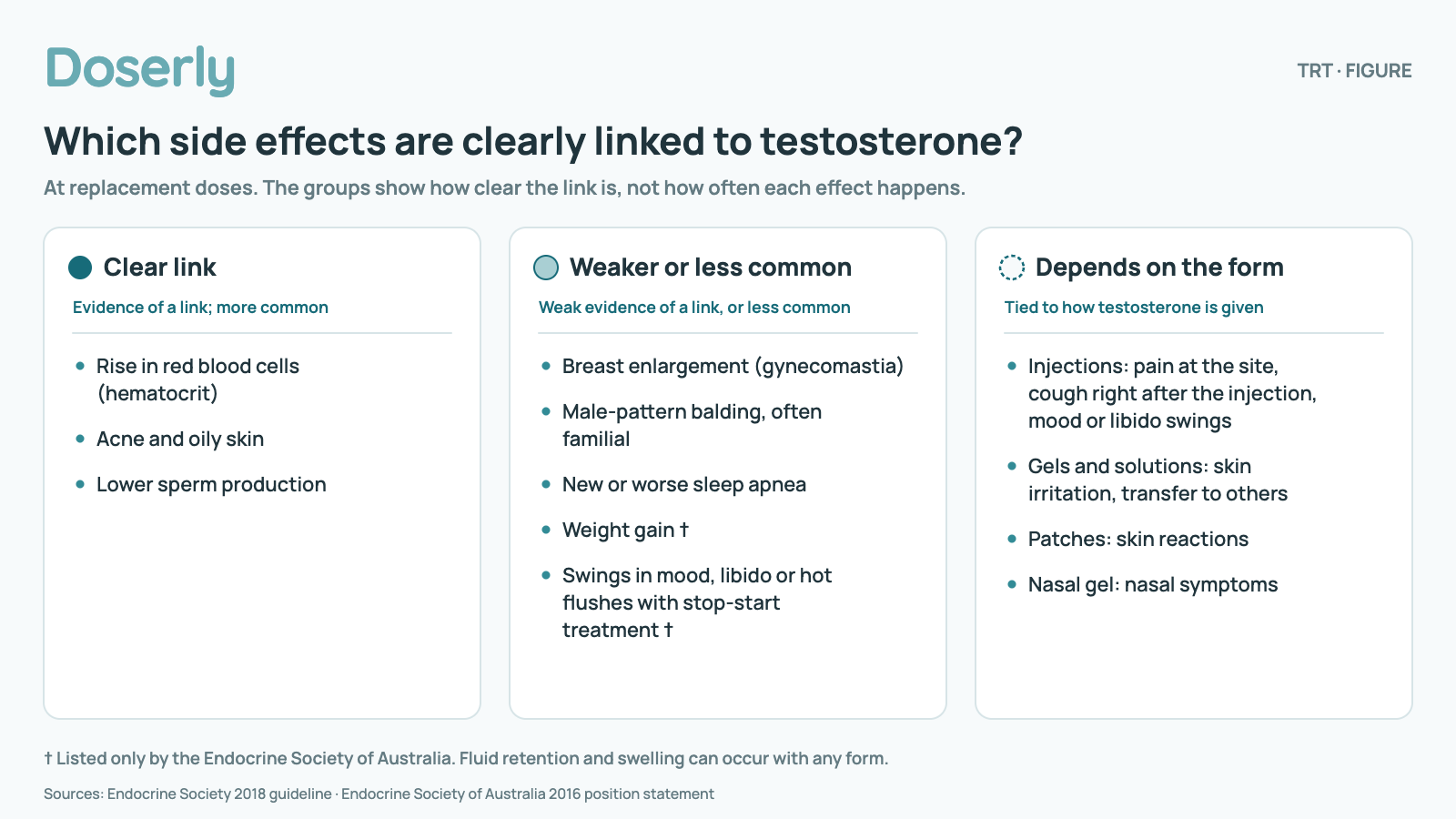
Which side effects are clearly linked to testosterone?
At replacement doses. The groups show how clear the link is, not how often each effect happens.
Clear link
Evidence of a link; more common
- Rise in red blood cells (hematocrit)
- Acne and oily skin
- Lower sperm production
Weaker or less common
Weak evidence of a link, or less common
- Breast enlargement (gynecomastia)
- Male-pattern balding, often familial
- New or worse sleep apnea
- Weight gain †
- Swings in mood, libido or hot flushes with stop-start treatment †
Depends on the form
Tied to how testosterone is given
- Injections: pain at the site, cough right after the injection, mood or libido swings
- Gels and solutions: skin irritation, transfer to others
- Patches: skin reactions
- Nasal gel: nasal symptoms
† Listed only by the Endocrine Society of Australia. Fluid retention and swelling can occur with any form. Grouping from the Endocrine Society 2018 guideline and the Endocrine Society of Australia 2016 position statement.
TRT side effects: the key numbers
This table shows what each major clinical guideline names as side effects, the numbers that trigger action, and how often they are checked. The numbers are what each document says, checked in September 2026.
| Guideline (version, year) | Side effects it names | Numbers that trigger action | How often checked | Action |
|---|---|---|---|---|
| AUA, American Urological Association (2018, validity reconfirmed 2024) | Hematocrit rise; breast symptoms (tenderness, gynecomastia); PSA | Hematocrit 54% or higher on treatment. Estradiol checked only with breast symptoms; referral if it stays above 40 pg/mL (about 147 pmol/L) before treatment | Testosterone and hematocrit every 6–12 months | Lower the dose or pause for hematocrit. New breast symptoms: watch, as they sometimes settle; if they persist with high estradiol, lower the dose when testosterone is high-normal |
| Endocrine Society (2018) | Clear link: high red cells, acne and oily skin, fewer sperm. Weaker link: breast enlargement, male-pattern balding, sleep apnea. Form-specific effects; fluid retention | Hematocrit above 54%; confirmed PSA rise above 1.4 ng/mL in year one, or confirmed above 4.0 ng/mL; untreated severe sleep apnea is a reason not to start | Symptoms and form-specific effects at each visit; testosterone and hematocrit at 3–6 months, 12 months, then yearly | Stop until hematocrit falls, check for low oxygen and sleep apnea, restart lower; refer to urology for PSA triggers |
| EAU, European Association of Urology (2026) | Hematocrit; says there is no evidence that testosterone causes or worsens sleep apnea (its evidence summary covers mild, moderate or CPAP-treated severe sleep apnea) | Hematocrit above 54%; 48–50% before starting is a reason for caution | Testosterone and hematocrit at 3, 6 and 12 months, then yearly | Adjust or stop, remove blood if needed, restart lower or switch to a gel |
| BSSM, British Society for Sexual Medicine (2023) | Hematocrit; PSA | Hematocrit above 54%; PSA rise above 1.4 ng/mL in any year | Before starting, 3–6 months, 12 months, then yearly | Lower the dose or switch preparation; consider stopping if hematocrit stays high |
| CUA, Canadian Urological Association (2021) | High red cells (called a common side effect); side effects in general | Hematocrit 55% or higher, if it persists | Symptoms and side effects at baseline, 3 and 6 months, then yearly | Lower the dose, take a break, change the form or give blood; stop for significant side effects, with no taper needed |
| VA, US Department of Veterans Affairs (January 2026) | High red cells; untreated severe sleep apnea; fluid retention worsening heart failure; PSA | Hematocrit above 48% before starting (do not start), above 51% (adjust), above 54% (stop); PSA rise above 1.4 ng/mL in 12 months or above 4 ng/mL | Testosterone, hematocrit and PSA at 3–6 and 12 months | Adjust the dose or stop; refer to urology |
| EAA, European Academy of Andrology (2020) | Hematocrit; side effects in general | Hematocrit above 54%; PSA rise above 1.4 ng/mL in 12 months | Response and side effects at 3 and 12 months, then at least yearly | Stop until safe, check for low oxygen and sleep apnea, restart lower |
| ESA, Endocrine Society of Australia (2016) | More common: high red cells, PSA rise, acne and oily skin, fewer sperm. Less common: breast enlargement, balding, weight gain, swings in mood, libido or hot flushes | Severe untreated sleep apnea and untreated high red cells are precautions | Blood count 3 months after starting, then yearly | Usually lower the dose or frequency |
| Society for Endocrinology, UK (2022) | Hematocrit | Hematocrit above 50% (0.50 L/L) | Blood count on treatment | Lower a gel dose, lengthen the time between injections or switch to a gel; urgent blood-specialist advice if markedly high |
| US product labels | Class warnings: red cells, blood clots, blood pressure, fluid retention, breast enlargement, sleep apnea, cholesterol, abuse and dependence | No numbers for most effects | Hematocrit, PSA, blood pressure and cholesterol; hematocrit timing differs by product | Stop until hematocrit falls; the labels leave other decisions to the prescriber |
[21], [1], [22], [23], [10], [24], [25], [2], [26], [6], [27]
Most guidelines act at a hematocrit of about 54%, and four use a PSA rise of more than 1.4 ng/mL. The Endocrine Society, EAA and VA refer to urology for a rise that size in the first year (the Endocrine Society asks for it to be confirmed); the BSSM applies it to any one-year period. The exceptions on hematocrit are the VA (adjust above 51%), the Society for Endocrinology (above 50%) and the CUA (55%). For symptoms such as acne, breast tenderness or mood changes, no guideline sets a number; they ask clinicians to review side effects at every visit and adjust. [1], [24], [26], [10], [25], [23]
Where do guidelines disagree?
On sleep apnea. The Endocrine Society calls the link weak but lists untreated severe sleep apnea as a reason not to start, and the US labels warn that testosterone may make sleep apnea worse, especially with obesity or chronic lung disease. The European urology guideline says there is no evidence that testosterone causes or worsens it, but its evidence summary covers mild or moderate sleep apnea and severe sleep apnea treated with CPAP, not untreated severe sleep apnea. The trials behind both views are covered in the sleep apnea question. [1], [6], [22]
How often did side effects appear in the product trials?
Each US label reports the side effects seen in its own trials. The numbers show what men on each product noticed, but they cannot be compared across products: the trials differed in length, men and methods, and most had no placebo group.
| Product (form) | Trial | Side effects reported | Stopped because of side effects |
|---|---|---|---|
| AndroGel 1.62% (gel) | 182 days, 234 men vs 40 on placebo | PSA increased 11.1%; mood swings, anger or aggression ("emotional lability") 2.6%; high blood pressure 2.1%; higher hematocrit or hemoglobin 2.1%; skin rash (contact dermatitis) 2.1%; placebo 0% for each. Application-site reactions 0.9% | 10.7%, mostly for PSA |
| AndroGel 1% (gel) | 180 days; 50 mg a day (77 men), 75 mg (40) or 100 mg (78) | Acne 1%, 3% and 8%; application-site reactions 5%, 3% and 4%; breast enlargement 1%, 0% and 3%; hair loss 1%, 0% and 1% | 4% |
| Testim (gel) | Up to 90 days; 50 mg (103 men) or 100 mg (149) vs placebo (99); 205 men in all, some counted at both doses | Application-site reactions 2% and 4% (placebo 3%); breast enlargement, trouble sleeping, mood swings and hot flushes 1% on 50 mg | 6 men |
| Testosterone 2% solution (underarm) | 120 days, 155 men | Skin irritation 7%; redness 5%; headache 5%; higher hematocrit 4% | 1 man, for mood swings and anger |
| Xyosted (under-the-skin enanthate autoinjector) | 1 year, 150 men, plus a 6-month study | Higher hematocrit 14.0%; high blood pressure 12.7%; PSA increased 12.0%; bruising at the site 6.7%; headache 5.3%; acne 2.7%; leg swelling 2.7%; sleep apnea 2.0% | No one stopped for site reactions |
| Aveed (undecanoate injection) | 84 weeks, 153 men | Acne 5.2%; injection-site pain 4.6%; PSA increased 4.6%; irritability, trouble sleeping and mood swings 2% each; aggression 1.3% | 4.6% |
| Jatenzo (oral undecanoate) | 4 months, 166 men | Headache 4.8%; higher hematocrit 4.8%; high blood pressure 3.6%; lower HDL 3.0%; nausea 2.4% | 1.8% |
| Kyzatrex (oral undecanoate) | 6 months, 155 men | High blood pressure 2.6%, the only effect in 2% or more | 1 man, for acne |
| Tlando (oral undecanoate) | About 4 months, 138 men | High blood pressure 5.1%; higher hematocrit 4.3% | 2.9% |
| Natesto (nasal gel) | 90 days, 78 men on the three-times-daily dose | PSA increased 5.1%; headache, runny nose, nosebleed, nasal discomfort and nasal scabs 3.8% each; a changed sense of smell (parosmia) in 4 of 69 men (5.8%) through the first 90-day extension | 6 of 306 men over all study periods |
| Azmiro (cypionate prefilled syringe) | One 200 mg dose, 27 men | Redness at the injection site 26%; other site reactions 4%; all mild | Not reported |
[20], [19], [28], [27], [6], [11], [9], [8], [29], [30], [31]
Only the AndroGel 1.62% and Testim trials had a placebo group, which is why the pooled trial reviews in the research section say more about what testosterone itself causes.
How do the units work?
Hematocrit is a percentage (54%) or a fraction (0.54 L/L). PSA is in ng/mL. Estradiol is in pg/mL in the US and pmol/L elsewhere: 40 pg/mL is about 147 pmol/L. The testosterone unit converter switches testosterone between ng/dL and nmol/L. [21]
Where these numbers come from
The guideline rows come from each body's current document: the AUA testosterone deficiency guideline (2018, validity reconfirmed 2024), the Endocrine Society guideline (2018), the EAU guidelines on sexual and reproductive health (2026 edition), the BSSM guidelines (2023), the CUA guideline (2021), the VA clinical recommendations (January 2026), the EAA guideline (2020), the Endocrine Society of Australia position statement (2016) and the Society for Endocrinology guideline (2022). [21], [1], [22], [23], [10], [24], [25], [2], [26]
The trial table comes from section 6.1 (Adverse Reactions) of each current US label, read in September 2026: AndroGel 1.62% (label effective October 2025), AndroGel 1% (July 2025), Testim (July 2025), testosterone 2% topical solution (January 2026), Xyosted (July 2025), Aveed (July 2025), Jatenzo (September 2025), Kyzatrex (August 2026), Tlando (February 2026), Natesto (July 2025) and Azmiro (July 2025). [20], [19], [28], [27], [6], [11], [9], [8], [29], [30], [31]
Not used: side-effect rates for Fortesta, Androderm and Striant, which are no longer sold in the US, and rates that circulate online without a traceable source, such as a 2.3% rate for the cough reaction after undecanoate injections (the clinic study behind it reports 19 per 1,000 injections, which is about 1.9%).
Why do side effects happen?
Most side effects are testosterone doing its normal jobs a little too much, in the wrong place, or on an uneven schedule. These mechanisms are measured in people. [1]
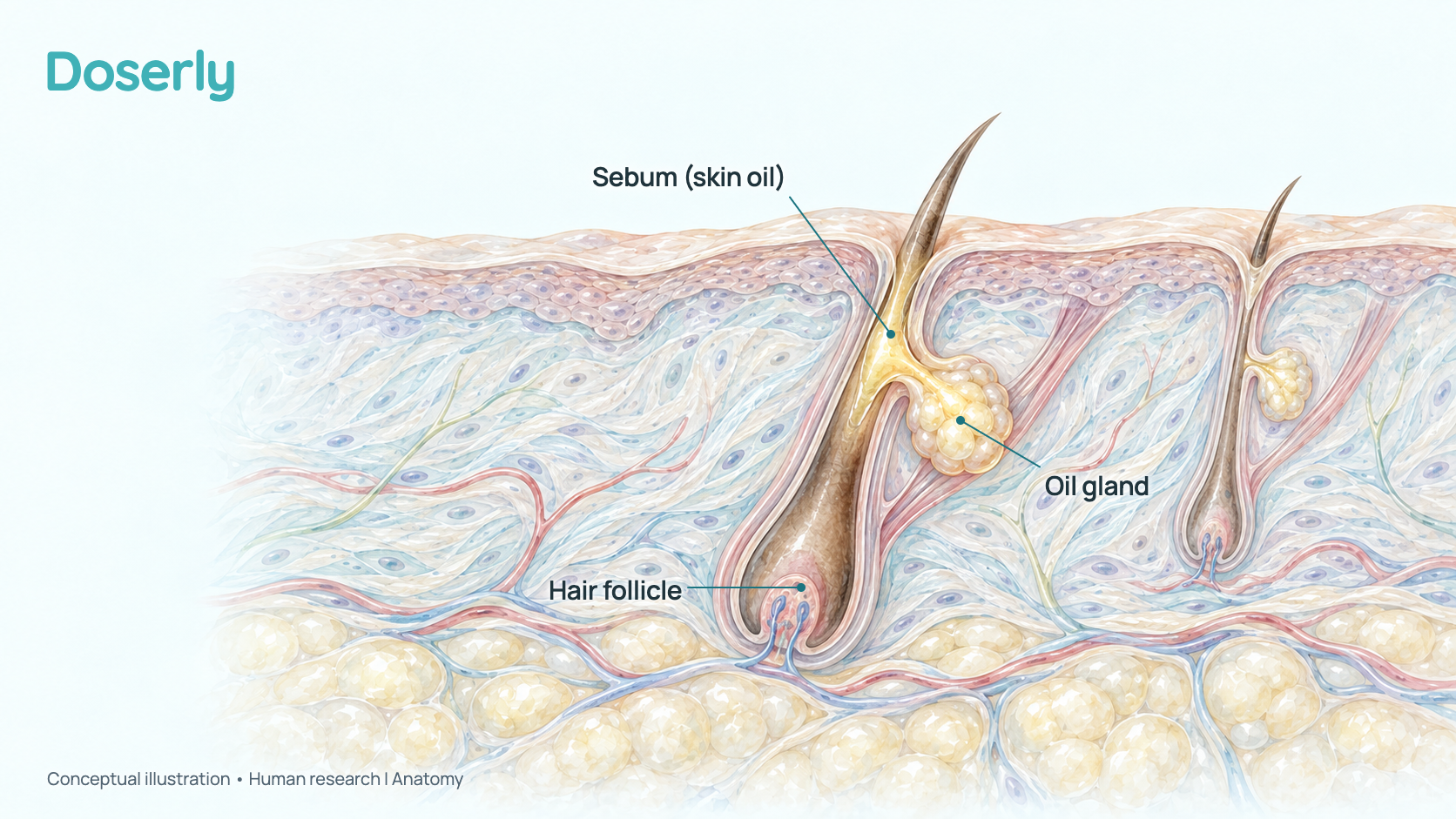
- Oil glands. Testosterone makes the skin's oil glands produce more sebum, the oily substance that can block pores and feed acne. In people starting testosterone, sebum production rose; in a research study of healthy men given graded doses, forehead sebum rose with the dose. [15], [32]
- It is not all DHT. The skin turns some testosterone into DHT (dihydrotestosterone), a stronger androgen. But in that same study, blocking DHT with dutasteride did not change sebum, acne or hematocrit, so "it's all DHT" is too simple. [33], [32]
- Estradiol. The body turns some testosterone into estradiol, and breast tissue responds to it. Injections every 2 weeks produced above-normal testosterone and estradiol for several days after each shot. The estrogen on TRT guide explains the balance. [34]
- Salt and water. Testosterone increases the water held outside the body's cells, measured directly in men with pituitary disease, and the labels say it "may promote retention of sodium and water". [16], [35]
- Testicles and sperm. Testosterone from outside tells the pituitary gland to stop sending its two signals to the testicles, LH and FSH. In a 3-week research study, testosterone inside the testicles fell by 94%, and in a contraceptive study the testicles shrank by about a fifth in 4 months. [36], [37]
- Red blood cells. The hematocrit guide explains how testosterone raises them. [17]
- Peaks and troughs. Injections make levels rise and fall across each interval. In one small comparison in men with HIV and low testosterone, free testosterone swung about ten times more between peak and trough on injections (26.7 pg/mL) than on a gel (2.7 pg/mL). The Endocrine Society lists swings in mood or libido as an injection-specific effect. [5], [1]
- Breathing in sleep. Small studies suggest testosterone changes how the brain controls breathing during sleep, rather than narrowing the airway itself. [38], [39], [40]
What does the research show?
In controlled trials with a placebo group, the most consistent change on testosterone is a rise in hematocrit. Two pooled reviews also found slightly more prostate-related events, a small difference in absolute terms. Most other effects were uncommon, and stopping because of side effects was about as common on testosterone as on placebo. [41], [42], [3]
What do the pooled trial reviews find?
| Review | What it covered | Side-effect findings |
|---|---|---|
| Cochrane review (2024) | 12 placebo-controlled trials (2,966 men aged 40 or older with sexual problems, excluding men with a known testicular or pituitary cause) for stopping | Stopping because of side effects: about 29 per 1,000 on testosterone vs 36 per 1,000 on placebo (relative risk 0.81, likely range 0.56 to 1.19); prostate-related events about 32 vs 19 per 1,000 men (10 trials, 3,439 men; relative risk 1.65), which the authors judged little or no difference [3] |
| Network meta-analysis (2017) | 48 trials reporting stopping, 12 weeks to 3 years | Stopped for side effects: 221 of 2,840 on testosterone (7.8%) vs 150 of 2,551 on placebo (5.9%); odds ratio 1.31, likely range 0.98 to 1.73 [4] |
| TestES (2024) | 35 trials, 5,601 men, with individual data from 17 | Heart or stroke events in 120 of 1,601 men on testosterone (7.5%) vs 110 of 1,519 on placebo (7.2%); no harmful effect on blood pressure, cholesterol or blood sugar [43] |
| Meta-analysis of 4 trials (2018) | 1,779 men with testosterone of 300 ng/dL or less and symptoms | High red cells about 8 times as likely on testosterone (relative risk 8.14); no effect on urinary symptoms [41] |
| Meta-analysis of 19 trials (2005) | 1,084 men aged 45 or older | Hematocrit above 50% the most frequent side effect (odds ratio 3.69); more prostate events (odds ratio 1.78); heart events, sleep apnea and death not different [42] |
| Meta-analysis of 51 studies (2010) | Adult men on testosterone | Hematocrit up 3.18 points, HDL down 0.49 mg/dL; no effect on death, prostate or heart outcomes [17] |
Stopping because of side effects was uncommon either way: about 3 in 100 men over 3 to 12 months in the Cochrane estimate, no more than on placebo, and slightly more on testosterone in the 2017 analysis, within a range that includes no difference. [3], [4]
Real-world use looks different. In US insurance records of 15,435 men starting a gel, only 34.7% were still filling prescriptions at 6 months, but the records do not say why men stopped. [44]
What about studies that used much higher doses?
Several often-quoted studies gave healthy men 250 to 600 mg a week to test how the body responds to very high levels (shorter sleep, more breathing pauses, mania-like symptoms in a few men). These are research doses, not treatment protocols, and this guide labels them wherever they appear. [39], [45], [46]
Is TRT safe, and which side effects are serious?
Is TRT safe?
For men with confirmed low testosterone who are monitored, testosterone therapy has a long record as standard treatment, and its main risks are well known and checked on routine tests. What remains uncertain is its long-term safety for the heart and prostate beyond about 2 years, and for forms other than the gel tested in the largest safety trial. [1], [47], [8]
What did the largest safety trial show?
TRAVERSE compared a daily testosterone gel with a placebo gel in about 5,200 men aged 45 to 80 with heart disease or high heart risk. Heart attack, stroke or cardiovascular death occurred in 182 of 2,596 men on testosterone (7.0%) and 190 of 2,602 on placebo (7.3%) (hazard ratio 0.96), which met the trial's safety goal. In the same two groups of about 2,600 men, some problems were more common on testosterone: atrial fibrillation 3.5% vs 2.4%, acute kidney injury 2.3% vs 1.5%, and pulmonary embolism 0.9% vs 0.5%. Fractures occurred in 91 of 2,601 men (3.50%) vs 64 of 2,603 (2.46%). In a prostate substudy, high-grade prostate cancer occurred in 5 of 2,596 men on testosterone (0.19%) vs 3 of 2,602 on placebo (0.12%), a difference that was not significant; men with a PSA above 3.0 ng/mL or severe urinary symptoms were excluded. [47], [8], [48], [18]
Its limits matter: it tested only a daily gel, men used it for an average of 21.7 months, about 61% stopped their study gel early, and it enrolled only men at high heart risk. [47], [8] The TRT and heart health guide covers the trial in full.
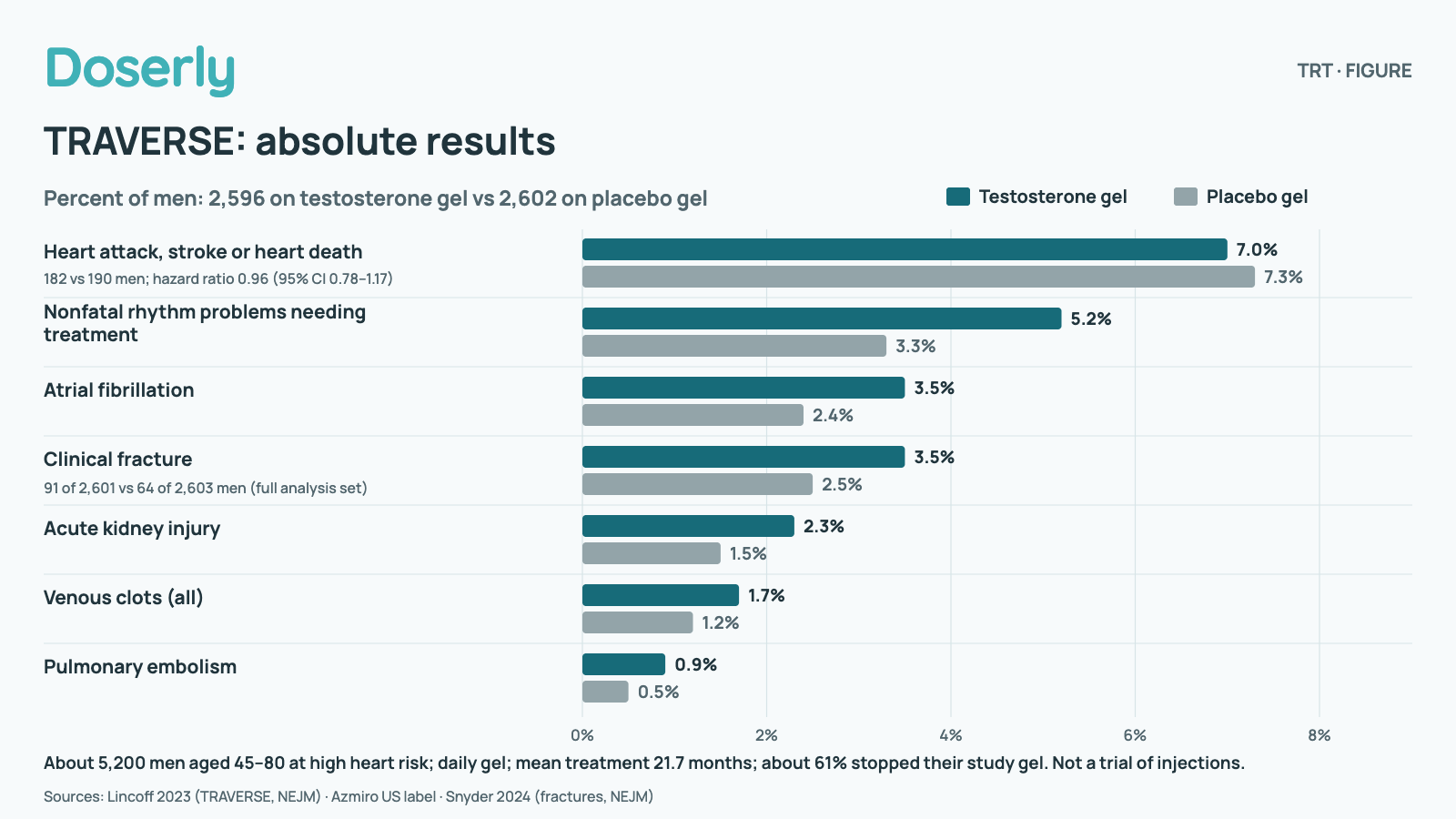
TRAVERSE: absolute results
Testosterone gel (2,596 men)Placebo gel (2,602 men)
- Heart attack, stroke or heart death
- Testosterone 7.0% vs placebo 7.3% (182 vs 190 men; hazard ratio 0.96, 95% CI 0.78–1.17; met the 1.5 safety margin)
- Nonfatal rhythm problems needing treatment
- Testosterone 5.2% vs placebo 3.3%
- Atrial fibrillation
- Testosterone 3.5% vs placebo 2.4%
- Clinical fracture
- Testosterone 3.5% vs placebo 2.5% (91 of 2,601 vs 64 of 2,603 in the full analysis set)
- Acute kidney injury
- Testosterone 2.3% vs placebo 1.5%
- Venous clots (all)
- Testosterone 1.7% vs placebo 1.2%
- Pulmonary embolism
- Testosterone 0.9% vs placebo 0.5%
About 5,200 men aged 45–80 at high heart risk; daily gel; mean treatment 21.7 months; about 61% stopped their study gel. Not a trial of injections.
Which symptoms need prompt medical care?
The US labels and patient leaflets tell men to contact a clinician promptly for these. This list comes from the labels; it is not a personal plan.
- Signs of a blood clot: pain, swelling, warmth or redness in one leg, or sudden shortness of breath. Blood clots in the legs and lungs are listed warnings, and TRAVERSE found more pulmonary embolism on testosterone. [6], [8]
- A cough fit, throat tightness or trouble breathing during or right after an undecanoate (Aveed) injection. Aveed carries a boxed warning for pulmonary oil microembolism (POME) and allergic reactions, and men are watched for 30 minutes after every injection. [11]
- An erection that lasts too long or happens too often. The labels list priapism and tell men to report "too frequent or persistent erections". [12]
- Yellow skin or eyes, which can mean liver problems. [49], [6]
- New or worse depression, or thoughts of suicide. The Xyosted and Jatenzo labels carry a depression and suicide warning (see mood). [6], [9]
- Breathing pauses or gasping at night, which can mean new or worse sleep apnea. [6]
- Changes in a child around you, such as early signs of puberty, after contact with a gel user's skin. [20]
Who should be especially cautious?
- Men with sleep apnea that is untreated or severe. The Endocrine Society and the VA list untreated severe sleep apnea as a reason not to start; the Endocrine Society of Australia lists it as a precaution. [1], [24], [2]
- Men with heart failure, kidney or liver disease. Fluid retention can be serious in these conditions, and the VA lists poorly controlled heart failure as a reason not to start. [35], [24]
- Men with high blood pressure, because every product raises it a little; some labels advise against use when it is uncontrolled. [7], [27]
- Men who start with a high hematocrit, or who have had a clot without a clear trigger or have an inherited clotting disorder. See hematocrit on TRT. [1], [24]
- Men with prostate or breast cancer, or a high PSA not yet checked by a urologist. [1]
- Men who want children now or soon, because testosterone lowers sperm production. See TRT and fertility. [1], [6]
- Men with depression or a history of it, given the label warnings above. [6]
- Drug-tested athletes. Testosterone is prohibited in sport at all times. A therapeutic use exemption is possible only for low testosterone with a clear medical cause, and a prescription alone does not grant one. [14], [50]
- Under-18s. Testosterone for teenagers belongs only in specialist care.
- Women. This guide is written for men. Testosterone for women uses different doses and products; see testosterone therapy for women.
Which medicines and supplements matter?
- Corticosteroids (such as prednisone). Taken with testosterone, they may increase fluid retention. [35]
- Blood thinners, insulin and diabetes medicines. Testosterone can change the effect of oral blood thinners and can lower blood sugar and insulin needs; the labels list both. [12], [31]
- SGLT2 inhibitor diabetes medicines (such as empagliflozin) raise hematocrit on their own, and UK testosterone labels now warn about the combination. See medicines that raise hematocrit. [51]
- Finasteride and dutasteride (5-alpha-reductase inhibitors, used for hair loss and prostate enlargement) lower PSA. In a small trial in men on TRT, dutasteride lowered PSA by 0.46 ng/mL, which changes how a PSA result should be read. Finasteride 1 mg has its own sexual side effects on its label. See hair loss. [52], [53]
- Aromatase inhibitors such as anastrozole are sometimes added to lower estradiol, but they are off-label in men. The VA advises against them in general, and in older men anastrozole lowered spine bone density. See anastrozole. [54], [24], [55]
Bring a complete list of what you take, including supplements, to a pharmacist or prescriber. Checked September 2026.
Is testosterone legal, and is it allowed in sport?
Checked September 2026. Rules differ by country and change often.
- United States. Testosterone and its esters are Schedule III controlled substances, prescription only. No proposal to change that had been published as of September 2026. [13]
- United Kingdom. Testosterone is a Class C controlled drug under the Misuse of Drugs Act 1971 and is in Schedule 4 Part II of the Misuse of Drugs Regulations 2001. [56], [57]
- Canada. Testosterone is a Schedule IV controlled substance. [58]
- Australia. Testosterone is a Schedule 4 prescription-only medicine. [59]
- Sport. The World Anti-Doping Agency (WADA) prohibits testosterone at all times, and its 2027 list, published in September 2026, keeps the ban. Athletes with low testosterone from a clear medical cause can apply for a therapeutic use exemption, which is not guaranteed. [14], [60], [50]
US label changes. Since 2016, all testosterone labels warn about abuse and dependence. In February 2025, FDA made blood pressure a class-wide warning, and in July 2025 it removed the boxed blood-pressure warnings from Xyosted, Jatenzo, Tlando and Kyzatrex. Boxed warnings remain for Aveed (POME and allergic reactions) and for gels and solutions (transfer to others). [61], [7], [62], [11], [20]
Requested, not yet in the labels. On June 18, 2026, the US Department of Health and Human Services (HHS) announced that FDA is requesting three label changes: dropping the limitation on use for age-related low testosterone, contraindicating testosterone only in prostate cancer that has spread, and revising the warning about an enlarged prostate. These are requests. As of September 2026, current labels still carry the old wording. [63], [64]
What do guidelines say to do about side effects?
Guidelines usually adjust before stopping: a lower dose, a different interval or a different form. This section describes the choices clinicians weigh; it is not a personal plan. [1], [10]
| Choice | Which guidelines or labels name it | Used for |
|---|---|---|
| Review symptoms and form-specific effects at each visit | Endocrine Society, EAA, CUA | Every side effect [1], [25], [10] |
| Lower the dose or change the interval | AUA, BSSM, VA, Society for Endocrinology, Endocrine Society of Australia; UK labels | High hematocrit; persistent breast symptoms with high estradiol and high-normal testosterone; irritability, nervousness, weight gain or frequent erections, which UK labels say may mean too much androgen [21], [23], [24], [26], [2], [51] |
| Switch form | BSSM, EAU, Society for Endocrinology, CUA | High hematocrit; form-specific problems such as skin or injection-site reactions [23], [22], [26], [10] |
| Watch and wait | AUA | New breast symptoms, which sometimes settle [21] |
| Check for sleep apnea and low oxygen | Endocrine Society, EAA | A hematocrit above 54% [1], [25] |
| Refer to urology | Endocrine Society, EAA, VA, BSSM | A confirmed PSA rise of more than 1.4 ng/mL in the first year, or a PSA above 4 ng/mL (Endocrine Society, EAA, VA); a rise of more than 1.4 ng/mL in any one-year period (BSSM) [1], [25], [24], [23] |
| Stop | CUA (for significant side effects, with no taper needed); Endocrine Society and EAA (hematocrit above 54%, until it falls) | Serious or persistent problems [10], [1], [25] |
What guidelines do not recommend as a first step: adding an aromatase inhibitor. The AUA considers one only when breast symptoms persist with a high estradiol while on-treatment testosterone is low or normal; when testosterone is in the upper normal range, it lowers the dose instead. The VA advises against them in general. [21], [24] The estrogen on TRT guide covers why estradiol that is pushed too low causes its own problems.
Skin, hair, breasts, swelling and testicles
Does TRT cause acne?
It can, and acne with oily skin is one of the side effects with the clearest evidence. In product trials it affected from about 1 in 100 men to about 1 in 12, and it rose with the dose: on AndroGel 1%, from 1% at 50 mg a day to 8% at 100 mg. [1], [19], [11], [65]
How long does it last? The clearest time course comes from trans men starting testosterone, a different group with a different starting point: acne peaked around 6 months, and after about 10 years 93.9% had no or mild acne. In a study of 323 trans men, acne was more likely with younger age, higher weight, testosterone above 10 nmol/L (about 288 ng/dL) and acne before starting. [66], [67]
What helps? Because acne tracks dose and level, prescribers may lower the dose, though no trial has tested how often that clears it, or whether more frequent injections help. Standard treatment still works: in 55 people whose acne came with testosterone, isotretinoin (a prescription acne medicine) improved it in 48 and cleared it in 26, with no comparison group. [19], [67], [68]
Does TRT cause hair loss?
It can speed up male-pattern hair loss in men who are prone to it, but how often is not known. The Endocrine Society lists "male pattern balding (familial)" among side effects with weak evidence, and in the AndroGel 1% trial hair loss affected 1% of men or fewer at each dose. No study has measured how many men with low testosterone develop new or faster hair loss on TRT. [1], [2], [19]
Numbers you may see online often come from trans men, whose hair started with a female pattern (after about 10 years, 32.7% had mild and 31% moderate to severe loss). They do not transfer to men who already had adult male testosterone levels. [66], [69]
What about finasteride or dutasteride with TRT? Some men and prescribers add one. In trials of older men on testosterone, finasteride limited prostate growth without removing the gains in bone or strength, and dutasteride in men on TRT lowered PSA, with a trend toward worse sexual-function scores that was not statistically clear. Finasteride 1 mg lists lower libido (1.8% vs 1.3% on placebo) and erection problems (1.3% vs 0.7%) on its label. Both medicines lower PSA, so tell whoever reads your PSA. [70], [71], [52], [53]
Why are my nipples sore on TRT? Is it gynecomastia?
Breast tenderness is common, and true breast enlargement (gynecomastia) is uncommon. The labels say gynecomastia "may develop and may persist". In trials, breast enlargement affected 0% to 3% of men on AndroGel 1% depending on the dose and 2.5% over its 3-year extension; "sensitive nipples" affected fewer than 1% on Testim. [1], [21], [6], [19], [28]
Does it go away? Sometimes: the AUA suggests watching new breast symptoms because they sometimes settle, and in a small trial gynecomastia resolved in 4 of 10 men on a patch and 1 of 9 on injections every 2 weeks. No study has found an estradiol level that predicts it on TRT. [21], [34]
What do guidelines do? The AUA checks estradiol when there are breast symptoms. If symptoms persist with a high estradiol, it lowers the testosterone dose when on-treatment testosterone is in the upper normal range. A lump, one-sided swelling or nipple discharge needs a clinician's examination. See tamoxifen and estrogen on TRT. [21]
Does TRT cause water retention or bloating?
Some men hold extra water, usually mildly. In a year-long trial, leg swelling affected 5.5% of men on oral undecanoate and 1.3% on a gel; it was 2.7% on Xyosted and under 1% on AndroGel 1%. The labels warn that swelling, with or without heart failure, can be serious in men with heart, kidney or liver disease, and that corticosteroids add to it. [65], [6], [19], [35]
No study has measured "facial bloat" or how much early weight gain on TRT is water. [72]
Will TRT shrink my testicles?
It can, and UK labels list smaller testicles as a common effect at high doses. Testicles are mostly sperm-making tissue, and testosterone from outside switches off the signals that keep it working. In a contraceptive study of 39 healthy men on enanthate injections, average testicle volume fell by 16.5% to 19.0% in 4 months, the shrinkage tracked the fall in sperm count, and size returned to normal after stopping. The study does not show how often this happens on routine TRT. [37], [72]
Sperm production falls too: in a World Health Organization contraceptive trial, 65% of men on 200 mg of enanthate a week had no sperm within 6 months. It usually returns after stopping, although US labels warn that reduced fertility may not reverse for some men. [73], [74], [6]
Does hCG stop the shrinkage? That is not established. hCG, a hormone that acts like LH, kept testosterone inside the testicles near normal in a 3-week research study, and in 26 men on TRT with hCG none lost all sperm, but these studies measured hormones and sperm, not testicle size. hCG protocols are in the hCG guide, and the TRT and fertility guide covers the options. [36], [75]
Sleep, mood, energy and headaches
Can TRT cause or worsen sleep apnea?
It may, in some men, early on; the evidence is thin and guidelines disagree. Obstructive sleep apnea means the airway keeps closing during sleep, causing breathing pauses and oxygen drops.
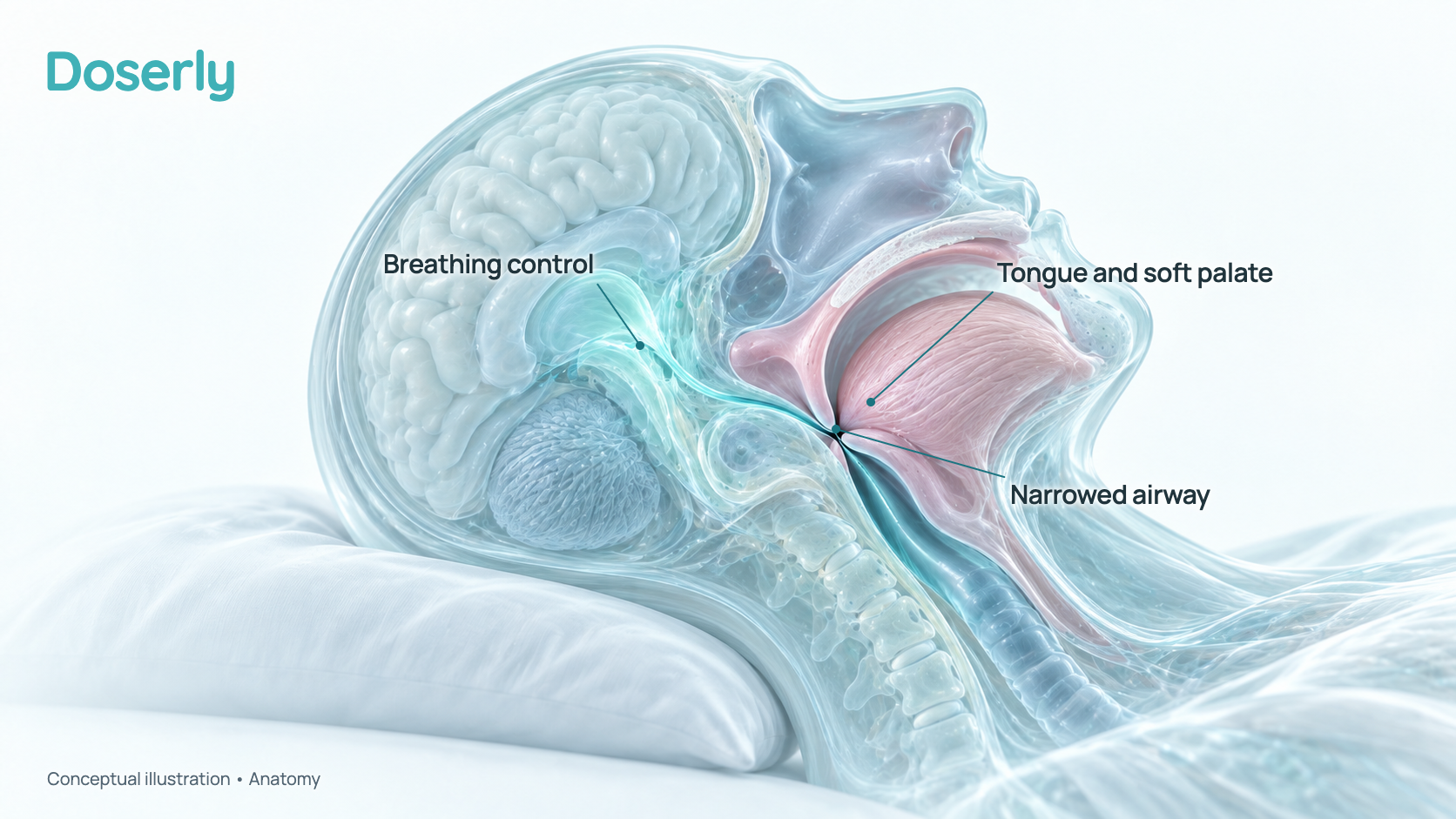
- The only placebo-controlled trial in men with sleep apnea. In 67 obese men with severe sleep apnea on a diet, undecanoate injections worsened nighttime oxygen drops by 10.3 events an hour at 7 weeks compared with placebo, but not at 18 weeks. [76]
- T4DM. In this 2-year trial in men aged 50 to 74 with prediabetes or new type 2 diabetes, who did not have diagnosed hypogonadism, a new diagnosis of sleep apnea was more common on undecanoate injections than on placebo during the trial (3.0% vs 0.4%) but not after it. A quarter of the men already had sleep apnea at entry. [77]
- Pooled trials and product trials. The 2005 meta-analysis found no more sleep apnea on testosterone, and the Endocrine Society says it has been "very low" in randomized trials. In the Xyosted trial, 2.0% of men were diagnosed with sleep apnea. [42], [1], [6]
- Records and small studies. In a US military health-records study (cohort study), sleep apnea was diagnosed within 2 years in 16.5% of men on TRT and 12.7% of matched men, though men on treatment may simply be tested more. In small older studies, breathing events during sleep rose on treatment. [78], [38], [79]
What does this mean in practice? The labels warn that testosterone may make sleep apnea worse, especially with obesity or chronic lung disease; the Endocrine Society and the VA advise against starting with untreated severe sleep apnea, while the European urology guideline sees no evidence of harm in mild, moderate or CPAP-treated sleep apnea. Treating sleep apnea with CPAP did not reliably raise testosterone in a meta-analysis, but weight loss did. [6], [1], [24], [22], [80], [81]
Can TRT cause insomnia or poor sleep?
A few men report it, but how often testosterone causes it is not known. In the placebo-controlled Testim trial, insomnia affected 1% of men on 50 mg, none on 100 mg and none on placebo, numbers too small to show an effect. In trials without a placebo, trouble sleeping affected 2.3% of men on Xyosted and 2% on Aveed. In a placebo-controlled trial of a gel in men with low testosterone caused by opioid painkillers, insomnia scores did not differ, and in TRAVERSE testosterone did not improve sleep quality. [6], [11], [28], [82], [83]
Does TRT cause mood swings, anxiety or anger?
At replacement doses, restoring low testosterone more often lowers irritability than raises it, but a minority of men report mood swings, and two labels carry a depression warning.
- Restoring low testosterone. In 51 hypogonadal men, anger, irritability and nervousness fell on treatment (no placebo group). In placebo-controlled trials, depressive symptoms improved by a small amount: 0.72 points on a standard depression scale in the Testosterone Trials, and a small effect in a meta-analysis of 27 trials. [84], [85], [86]
- Label signals. Mood swings, anger or aggression affected 2.6% of men on AndroGel 1.62% and none on placebo. In the Xyosted trials, 4 of 283 men (1.4%) had depression needing them to stop or made suicide attempts, and the Jatenzo label reports new or worse depression in 2 of 166 men. FDA later found no clear evidence that Xyosted carries a higher risk than other testosterone products, and both labels carry a warning. [20], [11], [6], [9], [87]
- Peaks and troughs. The Endocrine Society lists mood or libido swings as an injection-specific effect, and the Endocrine Society of Australia links swings in mood, libido and hot flushes to stop-start treatment or fluctuating levels. [1], [2]
- High research doses. At 600 mg of cypionate a week, 6 times a replacement dose, 12% of healthy men became mildly and 4% markedly hypomanic (hypomania is an abnormally high, driven mood). Across human experiments, giving testosterone had no clear effect on aggression. These are not TRT effects; see TRT vs steroids. [45], [88]
UK labels say irritability and nervousness can mean too much androgen and a reason to review the dose. Dependence has not been documented at approved doses, although after T4DM more former testosterone users restarted it (6% vs 2.8%), which the authors called consistent with dependence in some men. The TRT and mental health guide covers mood in depth. [51], [12], [77]
Why do I get hot flushes or night sweats on TRT?
Hot flushes in men come mainly from low estradiol. In experiments that switched off men's own hormones, flushes appeared at 26% of visits, and more often when estradiol was also blocked. On TRT they usually point to levels falling, for example late in an injection interval, after stopping, or when an aromatase inhibitor pushes estradiol too low. Aveed lists increased sweating in 1.3% of men and Testim hot flushes in 1%. [89], [2], [11], [28]
Does TRT cause headaches?
Headache appears in most product trials, usually in about 2% to 5% of men: 5.3% on Xyosted, 4.8% on Jatenzo, 5% on the 2% solution and 3.8% on Natesto. None of these trials had a placebo group, so how many headaches testosterone itself causes is not known. [6], [9], [27], [30]
Blood pressure, cholesterol, liver, red cells and prostate
Does TRT raise blood pressure?
Yes, a little, with every product. FDA's 24-hour blood-pressure studies confirmed a class-wide effect. In those studies, average systolic pressure (the top number) rose by these amounts:
| Product (form) | Average rise in 24-hour systolic / diastolic pressure | When |
|---|---|---|
| Jatenzo (oral undecanoate) | 4.9 / 2.5 mm Hg | About 4 months |
| Tlando (oral undecanoate) | 4.3 / 1.4 mm Hg (label); 3.8 mm Hg systolic in the published study | 4 months |
| Xyosted (under-the-skin enanthate) | 3.9 / 1.5 mm Hg | 12 weeks |
| Aveed (undecanoate injection) | 3.1 / 2.0 mm Hg | 16 weeks |
| AndroGel 1.62% (gel) | 1.9 mm Hg systolic | 16 weeks |
| Kyzatrex (oral undecanoate) | 1.7 / 0.6 mm Hg | 4 months |
[7], [9], [29], [90], [6], [11], [91], [8]
These were single-arm studies, so they show the change on treatment, not the difference from placebo. In TRAVERSE, which had a placebo, systolic pressure rose 1.0 mm Hg on the gel and fell 0.5 mm Hg on placebo by 36 months. On Xyosted, 10% of men started or changed blood-pressure medicine over a year, and Jatenzo raised heart rate by 2.2 beats a minute on average. [8], [6], [9]
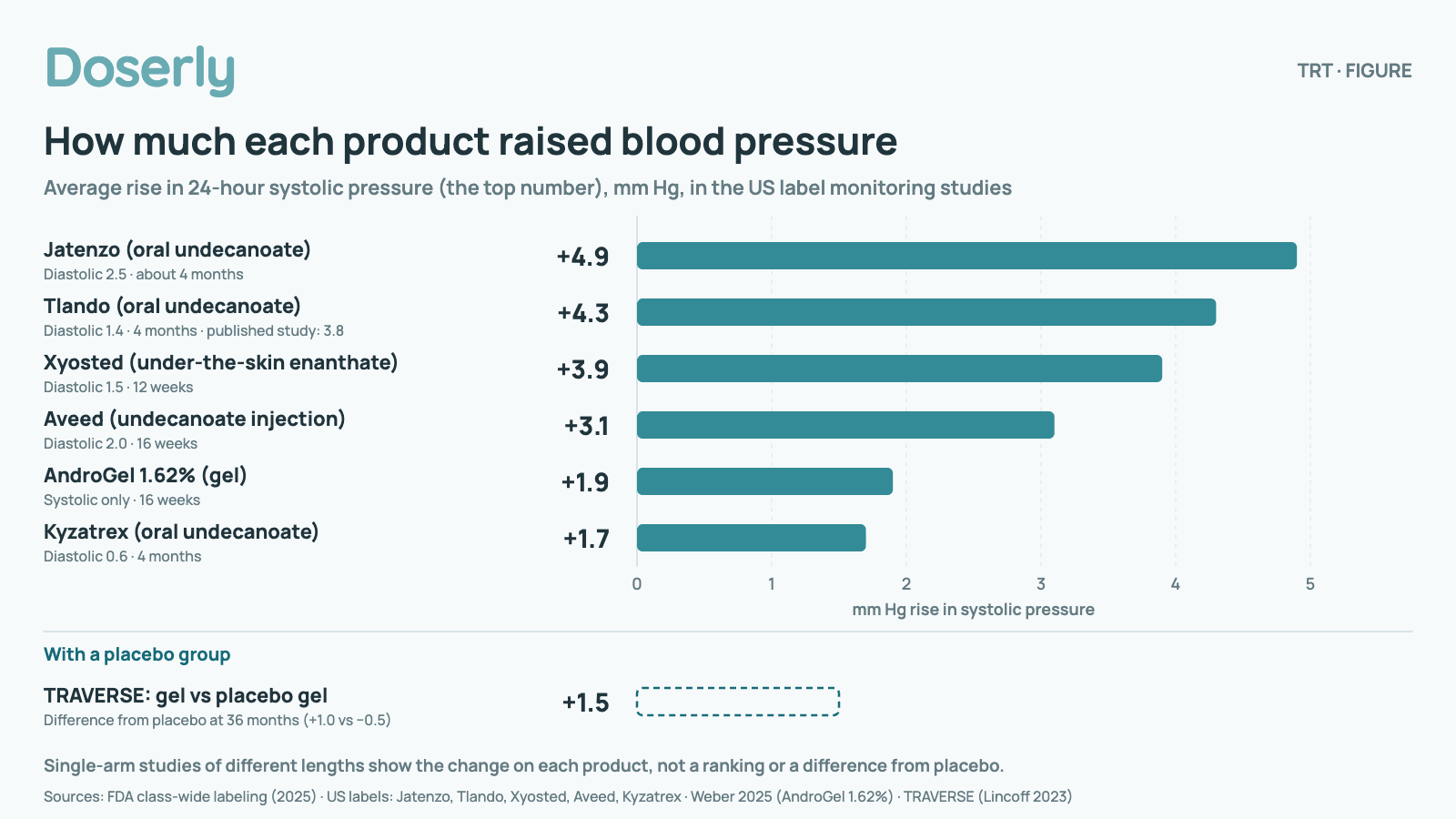
How much each product raised blood pressure
Average rise in 24-hour systolic pressure (the top number), mm Hg, in the US label monitoring studies.
Bars run from 0 to 5 mm Hg.
- Jatenzo (oral undecanoate)
- +4.9 / 2.5 mm Hg · about 4 months
- Tlando (oral undecanoate)
- +4.3 / 1.4 mm Hg · 4 months; published study: 3.8 systolic
- Xyosted (under-the-skin enanthate)
- +3.9 / 1.5 mm Hg · 12 weeks
- Aveed (undecanoate injection)
- +3.1 / 2.0 mm Hg · 16 weeks
- AndroGel 1.62% (gel)
- +1.9 mm Hg · 16 weeks
- Kyzatrex (oral undecanoate)
- +1.7 / 0.6 mm Hg · 4 months
With a placebo group
- TRAVERSE: gel vs placebo gel
- +1.5 mm Hg · Difference from placebo at 36 months (+1.0 vs −0.5)
Single-arm studies of different lengths: they show the change on each product, not a ranking or a difference from placebo.
The pooled evidence disagrees. The large TestES analysis found no harmful effect on blood pressure, while a smaller Chinese-language meta-analysis found higher pressure. In one placebo-controlled trial, the rise was larger in men whose hematocrit rose more. [43], [92], [93]
Does TRT affect cholesterol?
It lowers HDL, the "good" cholesterol, a little, and often lowers total and LDL cholesterol too. In older injection studies, HDL fell by about 4 mg/dL; a meta-analysis of 51 studies found an average fall of 0.49 mg/dL; and over 2 years on Jatenzo, HDL fell by 9.8 mg/dL. The TestES analysis of randomized trials found no harmful effect on cholesterol overall. The labels advise checking cholesterol periodically. [94], [17], [95], [43], [6]
Is TRT bad for the liver?
Serious liver injury is linked mainly to an older type of pill, the 17-alpha-alkylated methyltestosterone, which the AUA advises against. Oral testosterone undecanoate is different. The Kyzatrex label says it "is not known to cause hepatic adverse effects", and liver tests did not change meaningfully over 2 years on Jatenzo. The labels still mention liver tumors reported after long-term, high-dose use of androgens, including long-term enanthate injections. [49], [21], [8], [95], [6], [96]
Red blood cells, blood clots and the heart
- Red cells. Hematocrit rises about 3 points on average and is the most frequent side effect in trials; in the T4DM trial, hematocrit went above 54% in 22% of men on undecanoate injections (106 of 491) vs 1% on placebo (6 of 484). The hematocrit guide covers the numbers, causes and what lowers it. [17], [42], [97]
- Heart and blood clots. In TRAVERSE, heart attack, stroke or cardiovascular death occurred in 7.0% of men on testosterone gel and 7.3% on placebo gel (hazard ratio 0.96), which met the trial's safety goal. Atrial fibrillation (3.5% vs 2.4%), acute kidney injury (2.3% vs 1.5%) and pulmonary embolism (0.9% vs 0.5%) were more common on testosterone, and clots in veins occurred in 1.7% vs 1.2%. The trial tested only a gel, in men at high heart risk, for an average of 21.7 months, and about 61% stopped early. See what TRAVERSE showed and the heart health guide. [47], [8]
Does TRT affect the prostate or urination?
PSA rises slightly in the first months, and urinary symptoms did not worsen in trials, which mostly left out men with severe urinary symptoms. In TRAVERSE, PSA rose about 0.15 ng/mL more than on placebo at 12 months, and high-grade prostate cancer was not significantly more common (see what TRAVERSE showed). In a meta-analysis of 14 trials, urinary symptom scores changed by −0.41 points on testosterone and +0.12 on placebo, no real difference. The Endocrine Society refers to urology for a confirmed PSA rise of more than 1.4 ng/mL in the first year. The TRT and prostate guide covers PSA in full. [18], [98], [1]
Does TRT affect fertility and sex drive?
It lowers sperm production (see testicles), so men who want children soon need a different plan; see TRT and fertility. Sex drive usually improves, but some men report lower libido or erection problems on treatment; the labels list "increased or decreased libido", and the TRT and sexual health guide covers why. [12], [99]
What side effects does each form cause?
Every form shares the effects above; each also has its own. No trial has compared all forms head to head for overall side effects, so no form can be called the best tolerated. [1]
Injections: pain, lumps and site reactions
Reactions where the needle went in are the most common injection problem, and they are usually mild. Any injection-site reaction affected 12.7% of 283 men on Xyosted (none stopped), yet more than 95% reported no injection pain. Azmiro caused mild redness in 26% of men after one dose. Aveed caused injection pain in 4.6%. In an older trial, every-2-week enanthate injections into muscle caused local reactions in 33% of men. [6], [100], [101], [31], [11], [34]
Is subcutaneous injection less painful than intramuscular? No randomized trial in men with low testosterone has compared them. In 63 trans men on weekly subcutaneous (into the fatty layer under the skin) injections, 9 had minor, short-lived reactions, and the 22 who had switched from intramuscular (into a muscle) injections all preferred subcutaneous. The injection guide covers technique and site rotation. [102]
Why do some men cough right after an injection?
Oil injected into muscle can occasionally reach the lungs as tiny droplets, a reaction called pulmonary oil microembolism (POME). It causes a sudden urge to cough, shortness of breath or throat tightness, usually during or just after the injection, and most episodes pass within minutes.
- Undecanoate injections (Aveed, Nebido). In one clinic's watched injections, it happened after 56 of 3,022 injections (19 per 1,000), 66% mild. Across 18 trials of undecanoate injections, 9 events occurred in 8 of 3,556 men. After Aveed went on sale, 28 cases were reported while 90,092 doses were shipped, and most that had a recorded time resolved within 30 minutes. Shipped doses are not the same as injections given, and reports can be missed. The rates differ because watching every injection catches more than waiting for reports. [103], [11], [104]
- Cypionate and enanthate. The Endocrine Society lists coughing right after injections as a form-specific effect; it is reported more rarely than with undecanoate. [1]
Because of the risk of serious POME and allergic reactions, Aveed is available only through a safety program (REMS): certified providers give it in certified healthcare settings, with 30 minutes of observation after every injection. Checked September 2026. [11]
Gels, solutions and patches: skin reactions and transfer
Skin reactions where a transdermal product (absorbed through the skin) is applied affected 0.9% of men on AndroGel 1.62%, 3% to 5% on AndroGel 1%, 2% to 4% on Testim (3% on placebo) and up to 7% on the underarm solution. Patches caused far more: skin irritation affected 66% of men on an older patch against 5.5% on a gel, [20], [19], [28], [27], [105] Testosterone patches are no longer sold in the US (checked September 2026). [106]
The bigger risk with gels is transfer: all US gels and solutions carry a boxed warning because children have developed early signs of puberty after skin contact with a user. The testosterone gel guide covers how to prevent it. [20]
Nasal gel, oral capsules and pellets
- Natesto (nasal gel). Headache, runny nose, nosebleeds, nasal discomfort and nasal scabs each affected 3.8% of men, and a changed sense of smell affected 4 of 69 men (5.8%) through the first extension. See Natesto. [30]
- Oral undecanoate (Jatenzo, Kyzatrex, Tlando). Jatenzo and Tlando had two of the larger average blood-pressure rises in their label studies, while Kyzatrex had the smallest; separate studies cannot rank forms. They also cause some stomach effects: nausea in 2.4% on Jatenzo, with diarrhea and burping in more than 2% across its trials. Leg swelling was more common than on a gel in one trial. See oral testosterone. [9], [29], [8], [65]
- Pellets (Testopel). The label lists infection at the implant site and pellets working their way out. See testosterone pellets. [107]
Do side effects go away?
Many do. In trans men, acne peaked around 6 months and then settled for most. Breast symptoms sometimes settle, the AUA notes. The worsening of breathing in sleep seen at 7 weeks in one trial was gone by 18 weeks. Testicles returned to normal size after stopping in a contraceptive study. Long-acting injections are the exception: the UK Sustanon label notes that side effects "cannot be quickly reversed" by stopping, because the medicine stays in the body for weeks. [66], [21], [76], [37], [108]
If treatment stops, low-testosterone symptoms usually come back, and the body's own production can take months to recover. The stopping TRT guide covers what to expect. [10]
What do people on TRT report about side effects?
Public forums are full of men trying to work out whether a new symptom comes from testosterone, the dose, an added medicine or something else. The threads below are recent public Reddit discussions, read with their replies; they show what people experience, not how often it happens. Accounts involving doses above replacement or unregulated products were left out.
Acne, hair and skin
Several accounts describe chest or back acne after a dose increase. One man's back acne began when he went from 150 to 200 mg a week, despite injecting every other day; another's chest acne and night sweats appeared months after a rise from 120 to 140 mg, and isotretinoin cleared his face before his chest. One man credited splitting the same weekly volume into three injections, though his weight and diet changed too. [109], [110], [111]
Hair stories turn on timing. One man noticed crown thinning 3 months in, then admitted he had never looked closely before starting. Another's shedding began after he added hCG and a brief course of an aromatase inhibitor, and continued a month after he stopped both. One man who added finasteride for faster hair loss described weaker erections and mood swings. [112], [113], [114]
Nipples, estradiol and water
Tender nipples are common; confirmed breast enlargement is not. One man's tenderness continued across several normal estradiol results, and when an aromatase inhibitor had earlier pushed his estradiol to 8, he felt unwell and lost sexual function. Another's hard tissue under both nipples was almost gone 6 days after he stopped finasteride, which he had started alongside TRT. A tender lump sent a third man for an ultrasound, which found glandular tissue, with a mammogram pending. [115], [116], [117]
Threads about a "crashed E2" are a warning in themselves: men describe joint pain, stiffness, anxiety and loss of sexual function after aromatase inhibitors or over-the-counter estrogen blockers, improving after they stopped. See estrogen on TRT. Early water weight often passes, as it did for one man who gained about 5 lb; facial bloating comes up most at higher doses. [118], [119], [120], [121]
Testicles
Experiences range widely. One man described his testicles as about 30% smaller but did not mind, with good sexual function. Another's size improved in the first month of hCG and partly shrank again by the third; a third had used hCG for most of 3 years without restoring size, and his main problem was discomfort. [122], [123], [124]
Sleep, anxiety and mood
These are the hardest to pin on testosterone, because so much else changes at once. One man woke gasping 14 weeks in and was told to stop until a sleep study; reflux was also found. Another, 5 weeks into 50 mg once a week, felt anxious with swings that eased the day after each injection, alongside a history of health anxiety. One man's insomnia began after an aromatase inhibitor, dose cuts and major weight loss, and he later found low blood sugar. Schedule changes cut both ways: one man felt better splitting his weekly dose into two injections, another worse after moving to every 3 days. [125], [126], [127], [128], [129]
Blood pressure and injections
One man developed a pounding heartbeat, with a raised hematocrit and a reading of 201/105 that sent him to hospital; a blood-pressure medicine and a lower dose helped. Another's high readings were partly explained by coffee and a large meal. [130], [131]
Pain after a first injection into a new site, such as the side of the hip or the shoulder, is common. One man's itching and bruising at under-the-skin belly sites stopped when he moved to injections into muscle, while others find under-the-skin injections less painful; one man's redness and burning cleared when he changed to a product in a different carrier oil. [132], [133], [134], [135], [136]
How can you judge a side-effect story?
Ask: What was the dose in mg, how often, and was it prescribed? When did the symptom start, and what else changed around then, such as a dose increase, an aromatase inhibitor, finasteride, hCG, a weight-loss medicine, alcohol or cannabis? Was there a blood test at the time, and when was it drawn? Did the symptom exist before TRT? And what happened a few months later?
These selected discussions show what people experience and the questions research has not answered. They are not a survey of all men on TRT, a side-effect rate or a substitute for the studies above.
What should you track?
How you feel and what changed, at every visit, plus hematocrit, PSA, blood pressure and cholesterol on the schedule your guideline and label set. Use this summary to prepare questions for your prescriber; it is not a personal testing plan. [1], [6]
| Why it matters | What guidelines and labels say | Tracking category |
|---|---|---|
| Symptoms and form-specific side effects | Endocrine Society: at each visit (3–12 months, then yearly); CUA: baseline, 3 and 6 months, then yearly | Skin Health; Mood & Wellbeing; Sleep Quality; Side Effect Burden |
| Hematocrit and hemoglobin | Most guidelines: before starting, at 3–6 months, at 12 months, then yearly (see the key numbers) | Blood work |
| PSA | Endocrine Society, EAA, VA: refer for a confirmed rise of more than 1.4 ng/mL in the first year; BSSM: in any one-year period | Blood work; Other |
| Blood pressure | Labels: check periodically, especially if you already have high blood pressure | Blood Pressure |
| Cholesterol | Labels: check periodically, especially after starting | Blood work |
| Breasts, sleep and sexual function | Labels list breast enlargement, sleep apnea and changes in libido | Hormonal Symptoms; Sleep Quality; Libido |
[1], [10], [25], [24], [23], [6], [12]
Write down when a symptom started and what changed: the dose, the injection day, any new medicine and the timing of your last blood test. The testosterone level visualizer shows how injection frequency changes peaks and troughs.
Common questions about TRT side effects
What are the most common side effects of TRT?
A rise in red blood cells (hematocrit), acne and oily skin, and lower sperm production have the clearest evidence. In product trials, a higher hematocrit, a rise in PSA, high blood pressure, headache and reactions where the medicine is injected or applied were among the most frequently reported. [1], [6], [20] See the key numbers.
How long do TRT side effects last?
Many settle within months: acne tends to peak around 6 months, breast symptoms sometimes settle, and early changes in sleep breathing faded by 18 weeks in one trial. Others, such as a higher hematocrit and smaller testicles, last as long as treatment does; in a contraceptive study, testicle size returned to normal after stopping. [66], [21], [76], [37] See do side effects go away.
Can TRT make you angry or anxious?
A minority of men report mood swings, irritability or anxiety, often tied to peaks and troughs on injections; restoring low testosterone more often lowers irritability. The anger and mania reported in some studies came from research doses several times higher than TRT. [20], [84], [45] See mood.
Are injections or gels better for side effects?
Neither is better overall. Injections raise hematocrit more and swing levels more; gels cause skin reactions and carry a transfer risk; every form raises blood pressure a little, and separate label studies cannot rank them; nasal gel causes nasal symptoms. No trial has ranked them. [5], [20], [7], [30] See side effects by form.
Which side effects mean I should stop TRT?
Guidelines usually adjust before stopping, but the CUA stops treatment for significant side effects, with no taper needed, and the Endocrine Society stops it while hematocrit is above 54%. Signs of a clot, a serious reaction after an injection or thoughts of self-harm need prompt care. [10], [1], [6] See urgent symptoms.
Glossary
Plain explanations of the medical, lab and research terms used in this guide. Underlined terms in the text link here.
- 5-alpha-reductase inhibitor
- A medicine, such as finasteride or dutasteride, that blocks the enzyme turning testosterone into DHT. Used for male-pattern hair loss and an enlarged prostate. It lowers PSA.
- Acne
- Blocked, inflamed pores that form spots, often on the face, chest and back. Testosterone makes it more likely by increasing skin oil.
- Boxed warning
- The strongest warning on a US medicine label, printed in a box at the top. For testosterone it applies to Aveed injections and to gels and solutions.
- Cohort study (records study)
- A study that follows a group of people, or looks back at their records, without assigning treatments. It can show links but not prove that one thing caused another.
- Controlled trial
- A study that compares people who receive a treatment with a similar group who do not, often receiving a placebo instead. Randomly assigning people to each group makes the comparison fairer.
- CPAP
- Continuous positive airway pressure: a bedside machine that blows air through a mask to keep the airway open during sleep. It is the standard treatment for obstructive sleep apnea.
- DHT (dihydrotestosterone)
- A stronger androgen the body makes from testosterone, especially in the skin, hair follicles and prostate.
- Estradiol
- The main estrogen. Men make it from testosterone, and they need some of it for bone, sexual function and mood.
- Clinical guideline
- Recommendations written by a medical society or health system, based on its review of the evidence and expert judgment. Different guidelines can reach different conclusions.
- Gynecomastia
- Enlargement of the glandular breast tissue in men, felt as a firm disc under the nipple. It is different from fat in the chest area.
- Hazard ratio
- A measure comparing how often an event happens over time in two groups. A hazard ratio of 1 means no difference; 0.96 means about 4% lower in the first group.
- HDL cholesterol
- High-density lipoprotein, often called the good cholesterol because higher levels go with lower heart risk. Testosterone lowers it slightly.
- Hematocrit
- The share of the blood made up of red blood cells. Testosterone therapy can raise it, which is why it is checked.
- Hypomania
- A period of abnormally high, driven or irritable mood with more energy and less need for sleep, milder than full mania.
- Intramuscular (IM)
- Injected into a muscle. Most testosterone cypionate, enanthate and undecanoate is given this way.
- L/L (liters per liter)
- A way of writing hematocrit as a fraction instead of a percentage. 0.54 L/L is the same as 54%.
- Product label (prescribing information)
- The official document approved by a medicines regulator for a product, describing its approved uses, doses, warnings and side effects. In the UK it is called the summary of product characteristics.
- LH and FSH
- Luteinizing hormone and follicle-stimulating hormone: the pituitary gland's two signals to the testicles, telling them to make testosterone and sperm. Testosterone therapy switches them down.
- Meta-analysis and systematic review
- A systematic review gathers all studies on a question in a planned way. A meta-analysis combines their results statistically. A network meta-analysis compares several treatments at once.
- Odds ratio
- A measure comparing the odds of an outcome in two groups. An odds ratio of 2 means roughly twice the odds; 1 means no difference.
- Parosmia
- A changed or distorted sense of smell, reported with nasal testosterone.
- Placebo
- A dummy treatment with no active ingredient, used as a comparison in studies.
- Pulmonary oil microembolism (POME)
- Tiny droplets of injected oil reaching the lungs, causing a sudden cough, shortness of breath or throat tightness during or just after an injection. Most episodes pass within minutes.
- Priapism
- A painful erection lasting hours without sexual stimulation. It is a medical emergency.
- PSA (prostate-specific antigen)
- A protein made by the prostate and measured in blood. It rises slightly on testosterone and is used to decide when to refer to a urologist.
- Relative risk
- How much more or less likely an event is in one group than another. A relative risk of 0.81 means about 19% less likely; 1 means no difference.
- REMS
- Risk Evaluation and Mitigation Strategy: an FDA-required safety program. For Aveed, certified providers give it in certified healthcare settings, and men are observed for 30 minutes after each injection.
- Sebum
- The oily substance made by glands in the skin next to each hair follicle. More sebum makes acne and oily skin more likely.
- Obstructive sleep apnea
- Repeated blocking of the airway during sleep, causing pauses in breathing and drops in oxygen. Loud snoring and daytime sleepiness are common signs.
- Subcutaneous (SC)
- Injected into the fatty layer just under the skin. Xyosted is given this way, and some prescribers use this route for other testosterone injections.
- Transdermal
- Absorbed through the skin, as with testosterone gels and patches.
- Trough level
- The lowest blood level of a medicine, just before the next dose.
- TRT (testosterone replacement therapy)
- Prescribed testosterone, by injection, gel or other forms, for men with low testosterone.
- WADA
- The World Anti-Doping Agency, which publishes the list of substances banned in sport. Testosterone is prohibited at all times.
How this guide was researched
This guide is built from a thorough review of the sources cited throughout it: clinical guidelines from 9 medical bodies, current product labels from the US and UK, published clinical trials, reviews and studies, and regulatory documents. We also reviewed public online forums where men on TRT describe their own side effects.
The guide cites 136 sources, including 48 original studies in people, 14 reviews and meta-analyses, 9 clinical guidelines and position statements, 21 product labels and 28 public community discussions. Each type of source answers a different question. Guidelines and labels show what clinicians are told to do and what product trials recorded. Placebo-controlled trials and reviews show what testosterone itself causes. Personal accounts show what individual people experienced. Every numbered citation links to its entry below, labeled by source type.
How this guide was made
Research and drafting were AI-assisted. Every cited source was checked against the original, and the guide was reviewed and edited by Doserly before publication. It has not had an independent clinical review, and Doserly does not currently have medical reviewers. Doserly makes a medication and health-tracking app and runs Doserly Academy, both of which are promoted in this guide. Read our editorial policy for how guides are researched, updated and corrected.
This guide is for educational purposes. It summarizes what the reviewed sources report so the research is easier to understand; it is not medical advice. For a deeper dive, or to check any point for yourself, go straight to the cited sources.
Explore the sources
These are the documents cited in this guide. Guidelines, labels, studies, regulators and personal accounts answer different questions. A source being listed does not mean every statement on its page is endorsed.
Showing 136 sources
- 01
Testosterone Therapy in Men With Hypogonadism: An Endocrine Society Clinical Practice Guideline ↗
Clinical guideline
Full guideline reviewed.
Detail: Table of side effects by strength of evidence and by form; hematocrit above 54%: stop until it falls; untreated severe sleep apnea is a reason not to start; review side effects at each visit.
- 02
Endocrine Society of Australia position statement on male hypogonadism (part 2): treatment and therapeutic considerations ↗
Position statement (Australia)
Full text reviewed.
Detail: Lists the more and less common side effects, including swings in mood, libido and hot flushes with stop-start treatment; severe untreated sleep apnea is a precaution.
- 03
Testosterone replacement in men with sexual dysfunction ↗
Systematic review
Original full text reviewed.
Detail: Stopping because of side effects: about 29 per 1,000 on testosterone vs 36 per 1,000 on placebo (relative risk 0.81).
- 04
Testosterone therapy in hypogonadal men: a systematic review and network meta-analysis ↗
Systematic review
Original full text reviewed.
Detail: Stopped for side effects: 221 of 2,840 on testosterone vs 150 of 2,551 on placebo (odds ratio 1.31).
- 05
Prospective study of topical testosterone gel (AndroGel) versus intramuscular testosterone in testosterone-deficient HIV-infected men ↗
Human study
Original abstract reviewed.
Detail: Free testosterone swung 26.7 pg/mL between peak and trough on injections vs 2.7 on gel.
- 06
Xyosted (testosterone enanthate) subcutaneous autoinjector 50, 75, 100 mg/0.5 mL prescribing information ↗
Product label (US)
Full label reviewed.
Detail: Trial side effects, injection-site reactions 12.7% of 283 men, depression and suicide warning (4 of 283), sleep apnea and fluid warnings, blood pressure +3.9/1.5 mm Hg; fertility may not reverse.
- 07
FDA issues class-wide labeling changes for testosterone products ↗
Regulator statement (US)
Official page reviewed.
Detail: Blood-pressure studies confirmed that all testosterone products raise blood pressure; class-wide label changes.
- 08
Kyzatrex (testosterone undecanoate) oral capsules 50, 100, 150, 200 mg prescribing information ↗
Product label (US)
Full label reviewed.
Detail: High blood pressure 2.6% the only side effect in 2% or more; not known to cause liver problems; blood pressure +1.7/0.6 mm Hg. Its class text reports TRAVERSE: atrial fibrillation, acute kidney injury, blood clots and blood pressure; about 61% stopped their study gel.
- 09
Jatenzo (testosterone undecanoate) oral capsules 158, 198, 237 mg prescribing information ↗
Product label (US)
Full label reviewed.
Detail: Headache 4.8%, higher hematocrit 4.8%, lower HDL 3.0%; depression in 2 of 166 men; blood pressure +4.9/2.5 mm Hg and heart rate +2.2 beats a minute.
- 10
Canadian Urological Association guideline on testosterone deficiency in men: Evidence-based Q&A ↗
Clinical guideline (Canada)
Full text reviewed.
Detail: Review side effects at baseline, 3 and 6 months, then yearly; stop for significant side effects with no taper; hematocrit 55% or higher if persistent.
- 11
Aveed (testosterone undecanoate) 750 mg/3 mL intramuscular injection prescribing information ↗
Product label (US)
Full label reviewed.
Detail: Boxed warning for POME and allergic reactions (30-minute observation, REMS); POME in 8 of 3,556 men in trials; acne 5.2%, injection pain 4.6%; blood pressure +3.1/2.0 mm Hg.
- 12
Depo-Testosterone (testosterone cypionate) 100 and 200 mg/mL prescribing information ↗
Product label (US)
Full label reviewed.
Detail: Class side-effect list (acne, male-pattern baldness, breast enlargement, fluid retention, erections that are too frequent or persistent, injection-site pain); dependence not documented at approved doses; drug interactions.
- 13
21 CFR 1308.13(f) Schedule III: anabolic steroids ↗
Regulation (US)
Official text reviewed.
Detail: Testosterone and its esters are Schedule III controlled substances.
- 14
World Anti-Doping Code International Standard: Prohibited List 2026 ↗
Anti-doping list
Full list reviewed.
Detail: Testosterone is prohibited at all times (class S1).
- 15
Effects of sex steroid deprivation/administration on hair growth and skin sebum production in transsexual males and females ↗
Human study
Original abstract reviewed.
Detail: Different population (trans men): testosterone raised skin oil (sebum) production.
- 16
Independent and combined effects of testosterone and growth hormone on extracellular water in hypopituitary men ↗
Human trial
Original abstract reviewed.
Detail: Testosterone increased the water held outside cells in men with pituitary disease.
- 17
Clinical review 1: Adverse effects of testosterone therapy in adult men: a systematic review and meta-analysis ↗
Systematic review
Original abstract reviewed.
Detail: Main measured changes: more red blood cells and slightly lower HDL.
- 18
Prostate Safety Events During Testosterone Replacement Therapy in Men With Hypogonadism: A Randomized Clinical Trial ↗
Human trial
Original full text reviewed.
Detail: TRAVERSE prostate substudy: PSA about 0.15 ng/mL higher than placebo at 12 months; high-grade prostate cancer in 5 of 2,596 (0.19%) vs 3 of 2,602 (0.12%), not significant; men with PSA above 3.0 ng/mL were excluded.
- 19
AndroGel 1% (testosterone gel) pump and packets prescribing information ↗
Product label (US)
Full label reviewed.
Detail: Acne 1%, 3% and 8% by dose; breast enlargement up to 3%; hair loss 1% or less; swelling under 1%.
- 20
AndroGel 1.62% (testosterone gel) pump and packets prescribing information ↗
Product label (US)
Full label reviewed.
Detail: Placebo-controlled table (mood swings 2.6% vs 0%); application-site reactions 0.9%; boxed warning for transfer to children.
- 21
Evaluation and Management of Testosterone Deficiency: AUA Guideline ↗
Clinical guideline (US)
Full guideline reviewed.
Detail: Hematocrit 54% or higher: lower the dose or pause; estradiol checked only with breast symptoms; new breast symptoms may settle; advises against methyltestosterone.
- 22
EAU Guidelines on Sexual and Reproductive Health, Chapter 3: Male Hypogonadism (2026 edition) ↗
Clinical guideline (Europe)
Full guideline chapter reviewed.
Detail: Hematocrit above 54%: adjust or stop; states there is no evidence that testosterone causes or worsens sleep apnea.
- 23
The British Society for Sexual Medicine Guidelines on Male Adult Testosterone Deficiency, with Statements for Practice ↗
Clinical guideline (UK)
Full text reviewed.
Detail: Hematocrit above 54%: lower the dose or switch preparation; refer if PSA rises more than 1.4 ng/mL in a year.
- 24
Evaluation for and Management of Males with Low Testosterone: Recommendations for Use (January 2026) ↗
Clinical recommendations (US)
Full document reviewed.
Detail: Hematocrit: do not start above 48%, adjust above 51%, stop above 54%; untreated severe sleep apnea and poorly controlled heart failure are reasons not to start; aromatase inhibitors not generally recommended.
- 25
European Academy of Andrology (EAA) guidelines on investigation, treatment and monitoring of functional hypogonadism in males (endorsed by the European Society of Endocrinology) ↗
Clinical guideline (Europe)
Full text reviewed.
Detail: Assess response and side effects at 3 and 12 months, then yearly; hematocrit above 54%: stop, check for sleep apnea, restart lower.
- 26
Society for Endocrinology guidelines for testosterone replacement therapy in male hypogonadism ↗
Clinical guideline (UK)
Full text reviewed.
Detail: Hematocrit above 0.50 L/L: lower a gel dose, lengthen the injection interval or switch to a gel.
- 27
Testosterone topical solution USP 30 mg/1.5 mL actuation (generic of Axiron, Lupin) prescribing information ↗
Product label (US)
Full label reviewed.
Detail: Skin irritation 7%, redness 5%, headache 5%; warnings on fluid retention, breast enlargement, sleep apnea and cholesterol.
- 28
Testim (testosterone gel) 1%, 50 mg tube prescribing information ↗
Product label (US)
Full label reviewed.
Detail: Placebo-controlled table: application-site reactions 2–4% vs 3%; sensitive nipples under 1%; hot flushes and trouble sleeping 1%.
- 29
Tlando (testosterone undecanoate) oral capsules 112.5 mg prescribing information ↗
Product label (US)
Full label reviewed.
Detail: High blood pressure 5.1%, higher hematocrit 4.3%, 2.9% stopped; blood pressure +4.3/1.4 mm Hg.
- 30
Natesto (testosterone) nasal gel 5.5 mg per actuation prescribing information ↗
Product label (US)
Full label reviewed.
Detail: Nasal side effects 3.8% each; changed sense of smell 5.8% in the extension; 6 of 306 men stopped.
- 31
Azmiro (testosterone cypionate) 200 mg/mL single-dose vial and prefilled syringe prescribing information ↗
Product label (US)
Full label reviewed.
Detail: After one 200 mg dose in 27 men: injection-site redness 26%, other site reactions 4%, all mild; drug interactions.
- 32
Effect of testosterone supplementation with and without a dual 5α-reductase inhibitor on fat-free mass in men with suppressed testosterone production: a randomized controlled trial ↗
Human trial
Original full text reviewed.
Detail: Research doses up to 600 mg a week: forehead sebum rose with the dose, and blocking DHT did not change sebum, acne or hematocrit.
- 33
MK-386, an inhibitor of 5alpha-reductase type 1, reduces dihydrotestosterone concentrations in serum and sebum without affecting dihydrotestosterone concentrations in semen ↗
Human trial
Original abstract reviewed.
Detail: Background: the skin and blood make DHT from testosterone.
- 34
Pharmacokinetics, efficacy, and safety of a permeation-enhanced testosterone transdermal system in comparison with bi-weekly injections of testosterone enanthate for the treatment of hypogonadal men ↗
Human trial
Original abstract reviewed.
Detail: Every-2-week enanthate injections gave high testosterone and estradiol peaks and local reactions in 33%; gynecomastia resolved in 4 of 10 on a patch vs 1 of 9 on injections.
- 35
Testosterone gel 1% (generic, Encube) prescribing information ↗
Product label (US)
Full label reviewed.
Detail: Androgens may promote retention of salt and water; corticosteroids may add to fluid retention.
- 36
Low-dose human chorionic gonadotropin maintains intratesticular testosterone in normal men with testosterone-induced gonadotropin suppression ↗
Human trial
Original abstract reviewed.
Detail: Research regimen: testosterone inside the testicles fell 94% in 3 weeks; low-dose hCG kept it near normal.
- 37
Effect of testosterone enanthate on testis size ↗
Human study
Original abstract reviewed.
Detail: Contraceptive study in healthy men: testicles shrank 19.0% (weekly) and 16.5% (every 2 weeks) at 4 months and returned to normal after stopping.
- 38
Influence of testosterone on breathing during sleep ↗
Human study
Original abstract reviewed.
Detail: Breathing events during sleep rose from 6.4 to 15.4 an hour on testosterone in 11 men.
- 39
The short-term effects of high-dose testosterone on sleep, breathing, and function in older men ↗
Human trial
Original abstract reviewed.
Detail: Research doses in healthy men over 60: sleep about an hour shorter and more breathing events at night.
- 40
The effects of testosterone on ventilatory responses in men with obstructive sleep apnea: a randomised, placebo-controlled trial ↗
Human trial
Original abstract reviewed.
Detail: Substudy of the Hoyos trial on how testosterone affects breathing control in sleep apnea.
- 41
The efficacy and adverse events of testosterone replacement therapy in hypogonadal men: A systematic review and meta-analysis of randomized, placebo-controlled trials ↗
Systematic review
Original abstract reviewed.
Detail: In strict placebo-controlled trials, the one clear side effect was a rise in red blood cells.
- 42
Adverse events associated with testosterone replacement in middle-aged and older men: a meta-analysis of randomized, placebo-controlled trials ↗
Systematic review
Original abstract reviewed.
Detail: Older-men trials: hematocrit rise was the most frequent side effect; sleep apnea was not more common.
- 43
The effects and safety of testosterone replacement therapy for men with hypogonadism: the TestES evidence synthesis and economic evaluation ↗
Systematic review
Original full text reviewed.
Detail: The largest pooled trial dataset found no adverse effect on blood pressure or cholesterol.
- 44
Medication adherence and treatment patterns for hypogonadal patients treated with topical testosterone therapy: a retrospective medical claims analysis ↗
Human study (records)
Original abstract reviewed.
Detail: Only 34.7% of men starting a gel were still filling prescriptions at 6 months; reasons not recorded.
- 45
Effects of supraphysiologic doses of testosterone on mood and aggression in normal men: a randomized controlled trial ↗
Human trial
Original abstract reviewed.
Detail: Research dose of 600 mg a week: 12% of healthy men mildly and 4% markedly hypomanic.
- 46
Testosterone dose-response relationships in healthy young men ↗
Human trial
Original abstract reviewed.
Detail: Research doses up to 600 mg a week in healthy young men; not treatment protocols.
- 47
Cardiovascular Safety of Testosterone-Replacement Therapy ↗
Human trial
Original abstract reviewed.
Detail: TRAVERSE: heart attack, stroke or cardiovascular death in 182 of 2,596 men (7.0%) vs 190 of 2,602 on placebo gel (7.3%) (hazard ratio 0.96).
- 48
Testosterone Treatment and Fractures in Men with Hypogonadism ↗
Human trial
Original abstract reviewed.
Detail: TRAVERSE fracture substudy: fractures in 91 of 2,601 men (3.50%) vs 64 of 2,603 (2.46%).
- 49
Methyltestosterone capsules 10 mg (ANI) prescribing information ↗
Product label (US)
Full label reviewed.
Detail: Methyltestosterone, a 17-alpha-alkylated pill: jaundice and serious liver problems.
- 50
TUE Physician Guidelines – Male Hypogonadism, Version 9 (January 2026) ↗
Anti-doping guidance
Full document reviewed.
Detail: A therapeutic use exemption for testosterone is granted only for low testosterone with an organic (clear medical) cause, not for functional low testosterone such as from aging or obesity.
- 51
Nebido 1000 mg/4 ml solution for injection (testosterone undecanoate) SmPC ↗
Product information (UK)
Full SmPC reviewed.
Detail: POME in 1 in 10,000 to 1 in 1,000 injections in trials; irritability or nervousness may mean too much androgen; SGLT2 warning.
- 52
Dutasteride in men receiving testosterone therapy: a randomised, double-blind study ↗
Human trial
Original abstract reviewed.
Detail: Dutasteride lowered PSA and prostate size in men on TRT; sexual-function scores trended worse (not significant).
- 53
PROPECIA (finasteride) 1 mg tablets prescribing information ↗
Product label (US)
Relevant label section reviewed.
Detail: Finasteride 1 mg: lower libido 1.8% vs 1.3% on placebo, erection problems 1.3% vs 0.7% in year one.
- 54
Arimidex (anastrozole) 1 mg tablets prescribing information ↗
Product label (US)
Full label reviewed.
Detail: Anastrozole is approved only for breast cancer in postmenopausal women; use in men is off-label.
- 55
Effects of aromatase inhibition on bone mineral density and bone turnover in older men with low testosterone levels ↗
Human trial
Original abstract reviewed.
Detail: Anastrozole for a year in older men lowered spine bone density compared with placebo.
- 56
Misuse of Drugs Act 1971, Schedule 2 Part III (Class C drugs) ↗
Law (UK)
Official text reviewed.
Detail: Testosterone is a Class C drug.
- 57
Misuse of Drugs Regulations 2001, regulation 4 and Schedule 4 Part II (consolidated) ↗
Regulation (UK)
Official text reviewed.
Detail: Testosterone and other anabolic steroids are in Schedule 4 Part II of the Misuse of Drugs Regulations 2001.
- 58
Controlled Drugs and Substances Act (S.C. 1996, c. 19): ss. 4, 6 and Schedule IV ↗
Law (Canada)
Official text reviewed.
Detail: Testosterone is listed in Schedule IV.
- 59
Therapeutic Goods (Poisons Standard—June 2026) Instrument 2026 (F2026L00633) ↗
Regulation (Australia)
Official text reviewed.
Detail: Testosterone is a Schedule 4 prescription-only medicine.
- 60
World Anti-Doping Code International Standard: Prohibited List 2027 (and explanatory note) ↗
Anti-doping list
Full list reviewed.
Detail: The 2027 list keeps testosterone prohibited.
- 61
ANDRODERM supplement approval letter S-034 (abuse and dependence labeling) ↗
Regulator approval letter (US)
Original document reviewed.
Detail: Approval of the class-wide abuse and dependence warning.
- 62
Xyosted label approved 07/11/2025 (NDA 209863 S-020), Drugs@FDA PDF ↗
Product label (US)
Full label reviewed.
Detail: Labeling approved July 2025 that removed the boxed blood-pressure warning; blood pressure is now a standard warning.
- 63
HHS Announces Requested Updates to Testosterone Therapy Product Labels ↗
Regulator statement (US)
Official page reviewed.
Detail: FDA is requesting three label changes: drop the limitation on use for age-related low testosterone, contraindicate only in prostate cancer that has spread, and revise the enlarged-prostate warning. Requested, not yet in the labels (checked Sep 2026).
- 64
DailyMed SPL: Testosterone cypionate injection (BPI Labs, ANDA 219478) ↗
Product label (US)
Full label reviewed.
Detail: A testosterone cypionate label effective September 2026 still carries the age-related limitation of use and the known or suspected prostate cancer contraindication, so the June 2026 requests are not yet in labels.
- 65
A new oral testosterone undecanoate therapy comes of age for the treatment of hypogonadal men ↗
Review
Original full text reviewed.
Detail: In a year-long head-to-head trial, acne, breast enlargement and swelling were each uncommon; swelling was more frequent on oral TU than gel.
- 66
Short- and long-term clinical skin effects of testosterone treatment in trans men ↗
Human study
Original abstract reviewed.
Detail: Different population (trans men): acne peaked around 6 months; after about 10 years, 32.7% had mild and 31% moderate to severe hair loss.
- 67
The effects of gender-affirming testosterone therapy in transgender men on the development of acne, acne severity and the relationship with clinical parameters: a three-year follow-up study ↗
Human study
Original abstract reviewed.
Detail: Different population (trans men): moderate or severe acne rose from 11.8% to 39.1% in a year; higher with younger age, higher weight and higher testosterone.
- 68
Isotretinoin for Acne in Transgender and Gender-Diverse Individuals Receiving Masculinizing Hormone Therapy ↗
Case series
Original abstract reviewed.
Detail: Different population (people on masculinizing testosterone): isotretinoin improved acne in 48 of 55 and cleared it in 26.
- 69
Characterizing Dermatological Conditions in the Transgender Population: A Cross-Sectional Study ↗
Human study
Original abstract reviewed.
Detail: Different population (trans men): 76.1% had male-pattern hair loss after 2 years.
- 70
Exogenous testosterone or testosterone with finasteride increases bone mineral density in older men with low serum testosterone ↗
Human trial
Original abstract reviewed.
Detail: Adding finasteride kept testosterone's bone benefit while limiting prostate growth.
- 71
Musculoskeletal and prostate effects of combined testosterone and finasteride administration in older hypogonadal men: a randomized, controlled trial ↗
Human trial
Original abstract reviewed.
Detail: Finasteride blocked prostate growth but not the rise in red cells or muscle.
- 72
Testogel 16.2 mg/g gel (pump) SmPC ↗
Product information (UK)
Full SmPC reviewed.
Detail: High doses commonly and reversibly reduce sperm production and testicle size; water retention occasionally.
- 73
Contraceptive efficacy of testosterone-induced azoospermia in normal men (WHO Task Force) ↗
Human trial
Original abstract reviewed.
Detail: 65% of healthy men on 200 mg enanthate a week had no sperm within 6 months.
- 74
Rate, extent, and modifiers of spermatogenic recovery after hormonal male contraception: an integrated analysis ↗
Human study
Original abstract reviewed.
Detail: After hormonal contraceptive studies, sperm returned in 67% within 6 months and all within 24 months.
- 75
Concomitant intramuscular human chorionic gonadotropin preserves spermatogenesis in men undergoing testosterone replacement therapy ↗
Human study
Original abstract reviewed.
Detail: None of 26 men on testosterone with hCG lost all sperm; testicle size not measured.
- 76
Effects of testosterone therapy on sleep and breathing in obese men with severe obstructive sleep apnoea: a randomized placebo-controlled trial ↗
Human trial
Original abstract reviewed.
Detail: In obese men with severe sleep apnea, undecanoate worsened oxygen drops by 10.3 events an hour at 7 weeks, not at 18 weeks.
- 77
Long-term Outcomes of Testosterone Treatment in Men: A T4DM Postrandomization Observational Follow-up Study ↗
Human study
Original abstract reviewed.
Detail: T4DM follow-up: new sleep apnea 3.0% vs 0.4% during the trial, not after; more restarted testosterone (6% vs 2.8%).
- 78
Impact of testosterone replacement therapy on thromboembolism, heart disease and obstructive sleep apnoea in men ↗
Human study (records)
Original abstract reviewed.
Detail: Military health records: sleep apnea diagnosed in 16.5% on TRT vs 12.7% of matched men within 2 years.
- 79
Testosterone replacement in hypogonadal men: effects on obstructive sleep apnoea, respiratory drives, and sleep ↗
Human study
Original abstract reviewed.
Detail: In 5 men starting treatment, sleep apnea developed in one and worsened markedly in another.
- 80
Effects of CPAP on Testosterone Levels in Patients With Obstructive Sleep Apnea: A Meta-Analysis Study ↗
Systematic review
Original abstract reviewed.
Detail: Treating sleep apnea with CPAP did not reliably raise testosterone.
- 81
Body weight loss reverts obesity-associated hypogonadotropic hypogonadism: a systematic review and meta-analysis ↗
Systematic review
Original abstract reviewed.
Detail: Weight loss raises testosterone, more after surgery.
- 82
Effects of Testosterone Replacement on Pain Catastrophizing and Sleep Quality in Men with Opioid-Induced Androgen Deficiency ↗
Human trial
Original abstract reviewed.
Detail: In men with low testosterone from opioid painkillers, a gel did not change insomnia scores vs placebo.
- 83
Depressive Syndromes in Men With Hypogonadism in the TRAVERSE Trial: Response to Testosterone-Replacement Therapy ↗
Human trial
Original abstract reviewed.
Detail: TRAVERSE depression substudy: small gains in mood and energy, not in sleep quality.
- 84
Testosterone replacement therapy improves mood in hypogonadal men--a clinical research center study ↗
Human study
Original abstract reviewed.
Detail: In 51 hypogonadal men, anger, irritability and nervousness fell on treatment (no placebo).
- 85
Effects of Testosterone Treatment in Older Men ↗
Human trial
Original full text reviewed.
Detail: Testosterone Trials: depressive symptoms improved slightly (0.72 points).
- 86
Association of Testosterone Treatment With Alleviation of Depressive Symptoms in Men: A Systematic Review and Meta-analysis ↗
Systematic review
Original abstract reviewed.
Detail: Across 27 placebo-controlled trials, testosterone reduced depressive symptoms by a small amount.
- 87
Xyosted (NDA 209863) Summary Review for Regulatory Action (Reference ID 4327670) ↗
Regulator review (US)
Original document reviewed.
Detail: FDA found no clear evidence that Xyosted carries a higher depression or suicide risk than other testosterone products and approved it with warnings.
- 88
Is testosterone linked to human aggression? A meta-analytic examination of the relationship between baseline, dynamic, and manipulated testosterone on human aggression ↗
Systematic review
Original abstract reviewed.
Detail: Across human experiments, giving testosterone had no clear effect on aggression.
- 89
Effects of Testosterone and Estradiol Deficiency on Vasomotor Symptoms in Hypogonadal Men ↗
Human trial
Original abstract reviewed.
Detail: Hormone-suppression experiments: hot flushes at 26% of visits, more when estradiol was also blocked.
- 90
Effects of a Novel Oral Testosterone Undecanoate on Ambulatory Blood Pressure in Hypogonadal Men ↗
Human study
Original abstract reviewed.
Detail: Oral undecanoate (Tlando) raised 24-hour systolic pressure by 3.8 mm Hg after 4 months.
- 91
Single-arm study of testosterone gel replacement therapy and ambulatory blood pressure outcomes in men with hypogonadism ↗
Human study
Original abstract reviewed.
Detail: 24-hour systolic pressure rose 1.9 mm Hg after 16 weeks of 1.62% gel.
- 92
[Testosterone replacement therapy improves metabolic indexes of the patients with hypogonadism: A meta-analysis] ↗
Systematic review
Original abstract reviewed.
Detail: Chinese-language meta-analysis of 19 trials: higher systolic and diastolic pressure on TRT (abstract gives no amounts).
- 93
Blood pressure responses to testosterone therapy are amplified by hematocrit levels in opioid-induced androgen deficiency: a double-blind, randomized, placebo-controlled trial ↗
Human trial
Original abstract reviewed.
Detail: In men on opioid painkillers, office systolic pressure rose 6.2 mm Hg on testosterone and fell 7.0 on placebo, more with higher hematocrit.
- 94
Intramuscular testosterone esters and plasma lipids in hypogonadal men: a meta-analysis ↗
Systematic review
Original abstract reviewed.
Detail: Injections slightly lowered HDL (the 'good' cholesterol) along with total and LDL.
- 95
Two-Year Analysis of a New Oral Testosterone Undecanoate (TU) Formulation in Hypogonadal Men: Efficacy, Impact on Psychosexual Function, and Safety ↗
Human study
Original abstract reviewed.
Detail: Over 2 years on oral TU, HDL fell about 10 mg/dL and liver tests stayed normal.
- 96
Androgenic Steroids (LiverTox: Clinical and Research Information on Drug-Induced Liver Injury) ↗
Health reference (US)
Official summary reviewed; the full chapter could not be opened.
Detail: NIH summary: liver injury is mainly a problem of synthetic, especially 17-alpha-alkylated, androgens; long-term use has been linked with liver tumors.
- 97
Testosterone treatment to prevent or revert type 2 diabetes in men enrolled in a lifestyle programme (T4DM): a randomised, double-blind, placebo-controlled, 2-year, phase 3b trial ↗
Human trial
Original abstract reviewed.
Detail: T4DM: hematocrit above 54% in 22% on undecanoate injections vs 1% on placebo.
- 98
Effects of Testosterone Replacement Therapy on Lower Urinary Tract Symptoms: A Systematic Review and Meta-analysis ↗
Systematic review
Original abstract reviewed.
Detail: TRT did not worsen urinary symptoms in trials.
- 99
Effect of Testosterone Replacement Therapy on Sexual Function and Hypogonadal Symptoms in Men with Hypogonadism ↗
Human trial
Original abstract reviewed.
Detail: TRAVERSE sexual-function substudy: more sexual activity and desire, no change in erections.
- 100
Safety of a New Subcutaneous Testosterone Enanthate Auto-Injector: Results of a 26-Week Study ↗
Human study
Original abstract reviewed.
Detail: Subcutaneous autoinjector: minor bleeding or bruising at the site in a few percent.
- 101
A 52-Week Study of Dose Adjusted Subcutaneous Testosterone Enanthate in Oil Self-Administered via Disposable Auto-Injector ↗
Human study
Original abstract reviewed.
Detail: Almost all men reported no pain from weekly subcutaneous injections.
- 102
Subcutaneous Injection of Testosterone Is an Effective and Preferred Alternative to Intramuscular Injection: Demonstration in Female-to-Male Transgender Patients ↗
Human study (records)
Original abstract reviewed.
Detail: Different population (trans men): minor, short-lived reactions in 9 of 63 on weekly under-the-skin injections.
- 103
Complications of injectable testosterone undecanoate in routine clinical practice ↗
Human study
Original abstract reviewed.
Detail: Cough reaction (POME) after 56 of 3,022 undecanoate injections (19 per 1,000), 66% mild.
- 104
Occurrence of Pulmonary Oil Microembolism After Testosterone Undecanoate Injection: A Postmarketing Safety Analysis ↗
Postmarketing safety analysis
Original abstract reviewed.
Detail: 28 reported POME cases across 90,092 Aveed doses; most with a recorded time resolved within 30 minutes.
- 105
Transdermal testosterone gel improves sexual function, mood, muscle strength, and body composition parameters in hypogonadal men ↗
Human trial
Original abstract reviewed.
Detail: Gel irritated skin far less often than the old patch.
- 106
Federal Register 2023-24120: Determination that listed products (incl. ANDRODERM NDA 020489) were not withdrawn for safety or effectiveness ↗
Regulator notice (US)
Official text reviewed.
Detail: Androderm (testosterone patch) strengths are listed as no longer marketed; FDA determined they were not withdrawn for safety or effectiveness reasons.
- 107
Testopel (testosterone pellets) 75 mg prescribing information ↗
Product label (US)
Full label reviewed.
Detail: Implant-site infection and pellets coming out are listed side effects.
- 108
Sustanon 250, 250 mg/ml solution for injection (testosterone esters: propionate 30 mg, phenylpropionate 60 mg, isocaproate 60 mg, decanoate 100 mg) SmPC ↗
Product information (UK)
Full SmPC reviewed.
Detail: Side effects cannot be quickly reversed by stopping; weight gain listed as common.
- 109
200mg dose, small amount of sides but i dont want to regret this dose later if i ask to go lower it now ↗
Community account
Public thread reviewed: opening post and 46 comments.
Detail: Back acne began after an increase from 150 to 200 mg a week, despite every-other-day injections.
- 110
Severe Acne - What am I doing wrong??? ↗
Community account
Public thread reviewed: opening post and 13 comments.
Detail: Chest acne and night sweats months after an increase to 140 mg a week; isotretinoin cleared the face first.
- 111
Found myself a game changer! ↗
Community account
Public thread reviewed: opening post and 52 comments.
Detail: Acne improved after splitting the same weekly volume into three injections; weight and diet also changed.
- 112
Stopping TRT due to hair loss? ↗
Community account
Public thread reviewed: opening post and 75 comments.
Detail: Crown thinning noticed at 3 months on 80 mg a week, without a clear before-treatment comparison.
- 113
Used arimidex with TRT and now it's been more than a month and my hair shedding doesn't stop ↗
Community account
Public thread reviewed: opening post and 10 comments.
Detail: Shedding after adding hCG and a brief aromatase inhibitor course continued a month after stopping both.
- 114
ED issues, E2 too high or PFS? ↗
Community account
Public thread reviewed: opening post and 4 comments.
Detail: Oral and then topical finasteride were followed by weaker erections and mood swings.
- 115
Nipple sensitivity on TRT even with normal/low E2 — keep adding AI? ↗
Community account
Public thread reviewed: opening post and 21 comments.
Detail: Nipple tenderness persisted across several estradiol results; an earlier very low estradiol felt worse.
- 116
8 weeks into TRT 120mg a week and gyno showed up. ↗
Community account
Public thread reviewed: opening post and 43 comments.
Detail: Breast changes that began with TRT and finasteride almost resolved 6 days after stopping finasteride.
- 117
Possible gyno and not sure what to expect next - im really desperate ↗
Community account
Public thread reviewed: opening post and 9 comments.
Detail: A tender lump under one nipple; ultrasound found unchanged glandular tissue, mammogram pending.
- 118
Aromasin/Exemestane E2 Crash to a total ZERO Sensitive Test ↗
Community account
Public thread reviewed: opening post and 16 comments.
Detail: Joint pain, stiffness and anxiety after aromatase inhibitors drove estradiol very low.
- 119
Crashed E2 on TRT and AI ↗
Community account
Public thread reviewed: opening post and 18 comments.
Detail: Libido and erections weakened after anastrozole took estradiol below 5; better after skipping it.
- 120
Crashed E2 … I’m an idiot ( self induced ) ↗
Community account
Public thread reviewed: opening post and 40 comments.
Detail: Early water weight passed; an over-the-counter estrogen-lowering product was followed by hot flashes and joint pain.
- 121
Facial Bloat on TRT — What Helped You? ↗
Community account
Public thread reviewed: opening post and 49 comments.
Detail: Facial bloating on 180 mg a week; planned to lower to 160 mg.
- 122
Tell me about your experience with testicular atrophy/ shrinkage while on TRT. ↗
Community account
Public thread reviewed: opening post and 98 comments.
Detail: Testicles about 30% smaller and softer, with sexual function still good.
- 123
Do I need an HCG dose increase for shrinkage? ↗
Community account
Public thread reviewed: opening post and 3 comments.
Detail: hCG improved testicle size in the first month, with partial shrinkage again by month three.
- 124
Testicular atrophy help. ↗
Community account
Public thread reviewed: opening post and 73 comments.
Detail: Three years of hCG at rising doses did not restore testicle size; discomfort was the main concern.
- 125
Sleep apnea , urologist told me to stop TRT till results…. 😳 ↗
Community account
Public thread reviewed: opening post and 59 comments.
Detail: Woke gasping at 14 weeks and was told to stop pending a sleep study; reflux also found.
- 126
5 weeks into TRT -50mg mood swings, anxiety and brain fog. Did anyone else experience this? ↗
Community account
Public thread reviewed: opening post and 49 comments.
Detail: Anxiety and mood swings at 5 weeks on 50 mg once a week, with a history of health anxiety.
- 127
Insomnia 4 months after starting TRT, desperate for help ↗
Community account
Public thread reviewed: opening post and 27 comments.
Detail: Insomnia after an aromatase inhibitor, dose cuts and weight loss; low blood sugar found later.
- 128
Switched to twice a week, wow what a difference! ↗
Community account
Public thread reviewed: opening post and 24 comments.
Detail: Felt better after splitting the same weekly amount into two injections.
- 129
Switched to every 3 days and not for me.. ↗
Community account
Public thread reviewed: opening post and 18 comments.
Detail: Felt worse after moving from twice weekly to every 3 days.
- 130
High blood pressure high & heart thumping ↗
Community account
Public thread reviewed: opening post and 42 comments.
Detail: High blood pressure and pounding heartbeat with a raised hematocrit; eased with medicine and a lower dose.
- 131
Blood Pressure & Sleep Questions ↗
Community account
Public thread reviewed: opening post and 9 comments.
Detail: Systolic readings in the high 130s, some affected by coffee and a large meal.
- 132
Holy sh*t PIP! ↗
Community account
Public thread reviewed: opening post and 85 comments.
Detail: Severe pain after a first injection into the side of the hip.
- 133
Delt injection site? ↗
Community account
Public thread reviewed: opening post and 46 comments.
Detail: Shoulder pain after a first shoulder injection, still tender the next morning.
- 134
UPDATE ON INJECTION SITE IRRITATION ↗
Community account
Public thread reviewed: opening post and 20 comments.
Detail: Itching and bruising at under-the-skin belly sites stopped after moving to injections into muscle.
- 135
Help with SubQ Injection Sites? ↗
Community account
Public thread reviewed: opening post and 71 comments.
Detail: An under-the-skin injection hurt less than injections into muscle.
- 136
Careful starting TRT if you have sleep apnea ↗
Community account
Public thread reviewed: opening post and 65 comments.
Detail: Poorly controlled sleep apnea with worse sleep and fog on TRT; site reactions cleared with a different carrier oil.
No matching sources
Try a different term or show the full list.
Updates and corrections
Published September 28, 2026. This is a new guide. It brings together the side-effect information that was scattered across the earlier TRT guides and corrects several of their statements: side-effect rates for Natesto, Aveed and Jatenzo now match the current labels; the cough reaction after undecanoate injections is 19 per 1,000 injections in the clinic study behind it, not 2.3%; the claim that hCG preserves testicular size was removed because no study has measured it; unsourced figures about DHT's strength were removed; and products no longer sold in the US are described as history only. The date describes this version, not a fresh check of every source.
Found an error or a relevant study we missed? Report a correction with the guide title, the specific passage and a supporting source if available. Please leave out personal health records. See our editorial policy for how we handle attribution, evidence limits and corrections.