
In this guide
What is testosterone enanthate?
Testosterone enanthate is a prescription form of testosterone given by injection. It is testosterone with a small chemical tail attached, dissolved in oil. The tail makes the hormone release slowly from the injection site, so one injection lasts days rather than hours. It is sold alongside cypionate in the United States and Canada, and it is the enanthate injection on the UK and Australian product lists, where no cypionate appears. [1], [2], [3], [4]
"Enanthate" (also spelled enantate) is a 7-carbon ester (a chemical tail) joined to testosterone. The body snips the tail off to release ordinary testosterone. Because the tail adds weight, 100 mg of testosterone enanthate contains about 72 mg of testosterone; the UK label puts 250 mg of enanthate at about 180 mg of testosterone. [1], [2], [5]
It is labeled for men with hypogonadism (low testosterone from a medical cause): either primary hypogonadism, where the testicles fail, or hypogonadotropic hypogonadism, where the brain and pituitary do not send enough signal. US labels still say its safety and benefit in "age-related" low testosterone have not been established. It was first approved in the United States in 1953. [1], [2]
| Product | Where | Strength and container | Route on the label |
|---|---|---|---|
| Generic testosterone enanthate (Hikma, Eugia, Nexus) | United States | 200 mg/mL, 5 mL multi-dose vial, in sesame oil | Intramuscular, slowly and deeply into the buttock muscle |
| Xyosted | United States only | 50, 75 or 100 mg in 0.5 mL, single-dose autoinjector | Subcutaneous (into the fatty layer under the skin), abdomen only |
| Hikma testosterone enanthate | Canada | 200 mg/mL vial, in sesame oil | Intramuscular, deep in the buttock |
| Testosterone Enantate | United Kingdom | 250 mg/mL, 1 mL ampoule, in castor oil | Intramuscular, very slowly |
| Primoteston Depot | Australia | 250 mg/mL prefilled syringe, in castor oil | Intramuscular, extremely slowly |
| Androtardyl and generic Testosterone Desma | France | 250 mg/mL, 1 mL ampoule (Androtardyl in castor oil) | Intramuscular, very slowly |
[6], [1], [2], [7], [5], [8], [9], [10]
It is a controlled substance: Schedule III in the United States. People also meet it outside medical care, as compounded or unregulated "test E". Those products are not covered by the labels described here, and supraphysiologic (above the natural range) "cycle" doses are not testosterone replacement therapy, or TRT (see TRT vs steroids). [11], [1]
Typical Testosterone Enanthate Protocols
| Source | Amount each time | How often | Weekly total | Adjusted by | Source type |
|---|---|---|---|---|---|
| US label · generic vials (Hikma, Eugia, Nexus) | 50–400 mg | Every 2–4 weeks | Averages 12.5–200 mg a week | Age, diagnosis, response and side effects; no lab value or draw time named | Label The label adds that doses above 400 mg a month are not required and injections more often than every 2 weeks are rarely indicated |
| Canadian label · Hikma (usual dose) | 100–400 mg | Every 4 weeks | Averages 25–100 mg a week | Age, diagnosis, response and side effects | Label |
| Canadian label · regimen it quotes from an endocrinology task force | 50–100 mg | Every 7–10 days | About 35–100 mg a week | Trough level above 250–300 ng/dL (about 9–10 nmol/L), plus peaks and side effects | Label The same monograph calls 100–150 mg every 2 weeks a reasonable compromise and 300 mg every 3 weeks generally inadequate |
| Endocrine Society 2018 · weekly | 75–100 mg | Weekly | 75–100 mg | Level midway between injections: adjust if above 600 or below 350 ng/dL | Guideline |
| Endocrine Society 2018 · every 2 weeks | 150–200 mg | Every 2 weeks | Averages 75–100 mg a week | Same as above | Guideline |
| American Urological Association (AUA) · starting example | 100 mg | Weekly (preferred over 200 mg every 2 weeks or 300–400 mg monthly) | 100 mg | Aim for 450–600 ng/dL; first check after 3–4 injections | Guideline |
| Society for Endocrinology (UK) 2022 · every 2 weeks | 150–200 mg | Every 2 weeks | Averages 75–100 mg a week | Trough level at the end of the interval, aiming for the lower end of normal | Guideline |
| Society for Endocrinology (UK) 2022 · weekly, intramuscular or subcutaneous (into the fatty layer under the skin) | 50–100 mg | Weekly | 50–100 mg | Trough level, aiming for the lower end of normal | Guideline US and Canadian enanthate vials are labeled for intramuscular use only |
The Endocrine Society, AUA and UK society schedules all average 50–100 mg a week, and 100 mg weekly or 200 mg every 2 weeks fits all of them; the US urology guideline prefers 100 mg weekly, and the Canadian Urological Association (CUA) lists only a broad range for enanthate, 100–200 mg every 1–4 weeks, judged by a mid-cycle level of 14–17 nmol/L, rather than one schedule. The labels allow much wider ranges: 50–400 mg every 2–4 weeks in the United States and 100–400 mg every 4 weeks in Canada. Xyosted is a separate, fixed weekly schedule of 50–100 mg (below). [1], [7], [13], [14], [15], [16], [2]
- Titration Adjusting the dose in steps
- The US vial labels adjust the dose to response and side effects and name no blood test. Guidelines adjust by the testosterone level but disagree on when to draw it: the Endocrine Society measures midway between injections and adjusts above 600 or below 350 ng/dL (about 21 or 12 nmol/L), while UK sources use the level just before the next injection. Xyosted adjusts by 25 mg on a 7-day trough. Hematocrit can also force a change. [1], [13], [15], [2] See why draw timing matters.
- Breaks and cycles
- Not applicable. Testosterone replacement is continuous treatment; no label or guideline describes planned breaks or cycles, and the UK Society for Endocrinology expects lifelong treatment once the diagnosis is confirmed. Stopping is a separate decision (what happens when you stop). [15]
Read the units. Doses are written in milligrams (mg), but you draw a volume, and the volume depends on the strength. At 200 mg/mL (US and Canadian vials), 100 mg is 0.5 mL, which is 50 units on a U-100 insulin syringe. At 250 mg/mL (UK, Australian and European ampoules), the same 100 mg is 0.4 mL, or 40 units. The amount each time and the weekly total are different numbers: 200 mg every 2 weeks averages 100 mg a week. Xyosted needs no measuring, because each autoinjector holds one fixed dose. Doserly's TRT dose calculator does the arithmetic for any strength and schedule. [1], [5], [2]
These are labeled and guideline doses; prescribers adjust them using blood tests and symptoms. The ranges above are for adult men. For women, see testosterone therapy for women, which uses different products and far smaller doses.
Cautions for every schedule above. The labels rule out testosterone with breast or known or suspected prostate cancer, pregnancy and allergy to any ingredient (Xyosted names sesame oil), and oil injections must never go into a vein. It shuts down sperm production (fertility), and hematocrit, blood pressure and PSA (prostate-specific antigen, a prostate blood test) need checking (monitoring). [1], [2], [13]
Where these numbers come from
The US label row comes from the current Hikma label (DailyMed version effective May 8, 2026; printed revision June 2025), which the Eugia label matches on dosing; Nexus makes the third approved generic. The Canadian rows come from the Hikma Canada monograph (March 17, 2023): its own usual dose, and a regimen it reprints from an American Association of Clinical Endocrinologists (AACE) task force. Weekly totals for rows given every 2–4 weeks are simple averages; the labels do not state them. [1], [12], [6], [7]
The guideline rows each come from one document: the Endocrine Society guideline (2018, Table 5), the AUA testosterone deficiency guideline (2018, validity reconfirmed 2024) and the Society for Endocrinology guideline (2022, Table 2). The Endocrine Society and Society for Endocrinology rows apply to enanthate or cypionate alike. [13], [14], [15]
The 250 mg/mL rows come from the UK product information (revised December 30, 2025), the Australian product information (revised January 13, 2026), the French product information (updated March 3, 2026), the German product information (April 2022) and the European Association of Urology guideline (2026). The Xyosted row comes from its current label (effective July 1, 2025). [5], [8], [9], [17], [18], [2]
Not used for any row: the Canadian Urological Association's enanthate entry (2021, Table 3), which gives only a range of 100–200 mg every 1–4 weeks rather than one schedule and is quoted under the table instead; twice-weekly and daily schedules (no guideline or peer-reviewed practice source gives a complete enanthate schedule with an adjustment rule; see split dosing), a 1982 study's suggestion of 200 mg every 10–14 days (superseded by guidelines), and the 200 mg weekly dose of the World Health Organization (WHO) contraception trials (a research dose above replacement).
What schedule does Xyosted use?
| Source | Amount each time | How often | Weekly total | Adjusted by | Source type |
|---|---|---|---|---|---|
| US label · Xyosted | 75 mg to start; then 50, 75 or 100 mg | Once a week | 50–100 mg | Trough 7 days after a dose, first after 6 weeks: below 350 ng/dL add 25 mg; 650 ng/dL or more subtract 25 mg | Label Fixed strengths only; at week 12 of the main trial, 104 of 150 men were on 75 mg, 25 on 50 mg and 21 on 100 mg |
The label repeats the trough check 6 weeks after any dose change and periodically after that. Because the device holds a fixed dose, the only adjustments are the three strengths. [2] How Xyosted differs from vials ↓
What do labels outside North America use?
| Source | Amount each time | How often | Weekly total | Adjusted by | Source type |
|---|---|---|---|---|---|
| UK label · Testosterone Enantate | 250 mg | Every 2–3 weeks to start; every 3–6 weeks to maintain | About 42–125 mg a week | The interval, not the dose, set by the level at the end of the interval | Label |
| Australian label · Primoteston Depot | 250 mg | Every 2–3 weeks to start; every 3–4 weeks to maintain (up to 6 weeks in many cases) | About 42–125 mg a week | Testosterone levels as current guidelines recommend | Label |
| French label · Androtardyl | 250 mg | Every 2–4 weeks | About 62–125 mg a week | Level at the end of the interval: low means a shorter interval, high a longer one | Label |
| German label · Testosteron Depot Panpharma | 250 mg | Every 2–3 weeks to start; every 3–4 weeks to maintain | About 62–125 mg a week | Individual need; no lab value named | Label |
| European Association of Urology (EAU) 2026 | 250 mg | Every 2–3 weeks | About 83–125 mg a week | Not stated in the table; testosterone and hematocrit checked at 3, 6 and 12 months | Guideline |
These labels use a whole ampoule each time and adjust the interval rather than the dose. The French label says to use an ampoule immediately after opening, so a smaller weekly dose wastes the rest, a common complaint in the community section. [5], [9]
What do clinic protocol sources use?
| Source | Amount each time | How often | Weekly total | Adjusted by | Source type |
|---|---|---|---|---|---|
| Canadian pharmacist practice guideline (2022) · weekly | 100 mg | Weekly | 100 mg | Midway between injections, after 3–4 doses; aim for 14–17.5 nmol/L | Clinic protocol source |
| Canadian pharmacist practice guideline (2022) · every 2 weeks | 200 mg | Every 2 weeks | Averages 100 mg a week | Midway between injections, after 3–4 doses; aim for 14–17.5 nmol/L | Clinic protocol source |
| University endocrinology review (2022) · 200 mg | 200 mg | Every 2 weeks | Averages 100 mg a week | Trough near 300 ng/dL (about 10.4 nmol/L), or a mid-normal level one week after the injection | Clinic protocol source |
| University endocrinology review (2022) · 250 mg | 250 mg | Every 2 weeks | Averages 125 mg a week | Trough near 300 ng/dL (about 10.4 nmol/L), or a mid-normal level one week after the injection | Clinic protocol source The review gives 200 mg as the usual start and 250 mg as its alternative |
| NHS prescribing protocol (England, 2023) · every 2 weeks | 150–200 mg | Every 2 weeks | Averages 75–100 mg a week | Trough level, aiming for the lower end of normal | Clinic protocol source |
| NHS prescribing protocol (England, 2023) · weekly, intramuscular or subcutaneous | 50–100 mg | Weekly | 50–100 mg | Trough level, aiming for the lower end of normal | Clinic protocol source Offered mainly to men who want to self-inject; a 2025 NHS protocol from another region repeats it |
| Endocrinology practice review (2022) · subcutaneous from a vial | 75 mg to start, then 50 or 100 mg | Weekly | 50–100 mg | Level midway between injections, aiming for the middle of the young-adult range | Clinic protocol source Subcutaneous use of vials is off-label in the United States |
The rows are alternatives, not steps to move through. The NHS protocols share wording with the UK society guideline, so they are not independent of it. All of them average 50–125 mg a week. [22], [23], [15]
What is testosterone enanthate commonly used for?
Its approved use is replacing testosterone in men whose bodies cannot make enough because of a medical condition. The labels name two groups: testicular failure (from undescended testicles, twisting, infection, removal or a condition present from birth) and a missing signal from the brain or pituitary (from a hormone deficiency, a tumor, injury or radiation). [1], [2]
US vial labels also allow it, for a limited time, to start puberty in carefully selected boys with clearly delayed puberty. That is specialist care only. Xyosted is not approved under 18. [1], [2]
What does testosterone replacement improve?
In trials, mostly of gels, testosterone treatment for low testosterone mainly improves sexual desire and activity; effects on mood are small. In the Testosterone Trials of men 65 and older, a year of gel improved sexual activity, desire and erections a little, but not energy or walking. Across 29 randomized trials, testosterone reduced fat by about 1.6 kg and added about 1.6 kg of lean mass without changing body weight. [25], [26] See the evidence and the results timeline guide.
How long does testosterone enanthate take to work?
Blood levels rise within a day of the first injection, but symptoms change more slowly. In 40 men with hypogonadism given enanthate or undecanoate injections, sexual interest leveled off by about 3 weeks, erections by 9 weeks and depression scores by 6 weeks, while fatigue improved at 9–12 weeks. A widely cited review gives body composition 12 to 16 weeks. The Canadian Urological Association tells men to expect changes in libido, energy and sexual function after 3 months or longer. [27], [28], [29], [16]
Where do testosterone enanthate protocols differ?
The labels are broad and old; the guidelines are narrower and newer. Most real disagreements are about how often to inject, where to inject, how to split doses and when to draw blood.
Is the dose from the label or from a guideline?
A label schedule and a guideline schedule answer different questions. The US label, unchanged in its dosing for decades, says injections more often than every 2 weeks are rarely indicated; guidelines written with modern blood tests center on about 100 mg a week, and the AUA prefers weekly injections. The Canadian monograph holds both views at once: a usual dose every 4 weeks, and a reprinted regimen every 7–10 days. [1], [14], [13], [7]
Every 2 weeks, weekly or longer?
Guidelines increasingly prefer smaller weekly doses because of how enanthate behaves between injections:
- A classic enanthate study found that 100 mg weekly, 200 mg every 2 weeks and 300 mg every 3 weeks all kept testosterone mostly in the normal range, while 400 mg every 4 weeks did not keep the pituitary's luteinizing hormone (LH) suppressed. [30]
- At 200 mg every 2 weeks, levels ran above normal for several days after each injection, and in one group of 10 men only 3 stayed within 300–1,100 ng/dL through the first week. [31], [32]
- At longer intervals, the Canadian monograph warns that many men have symptoms in the week before the next injection. [7]
The only comparison with clinical results is observational: in one clinic's records, hematocrit rose above 54% in 1 of 102 men on 100 mg weekly and 4 of 51 on 200 mg every 2 weeks (the ester was not stated). No randomized trial has compared injection frequencies on health outcomes. [33]
What about twice-weekly or daily injections?
Twice-weekly and daily schedules are common online, but no guideline or peer-reviewed practice source gives a complete enanthate schedule for them. The British Society for Sexual Medicine mentions subcutaneous "micro-dosing" without a dose, and a 2026 practice review calls more frequent splits optional tools rather than standards. Splitting a weekly total narrows the gap between peak and trough, but no trial has tested split schedules on outcomes. [34], [35]
When a prescriber splits a weekly total, the arithmetic is simple: 100 mg a week given twice weekly is 50 mg per injection, or 0.25 mL at 200 mg/mL. What people report on these schedules is in the community section.
Intramuscular or subcutaneous?
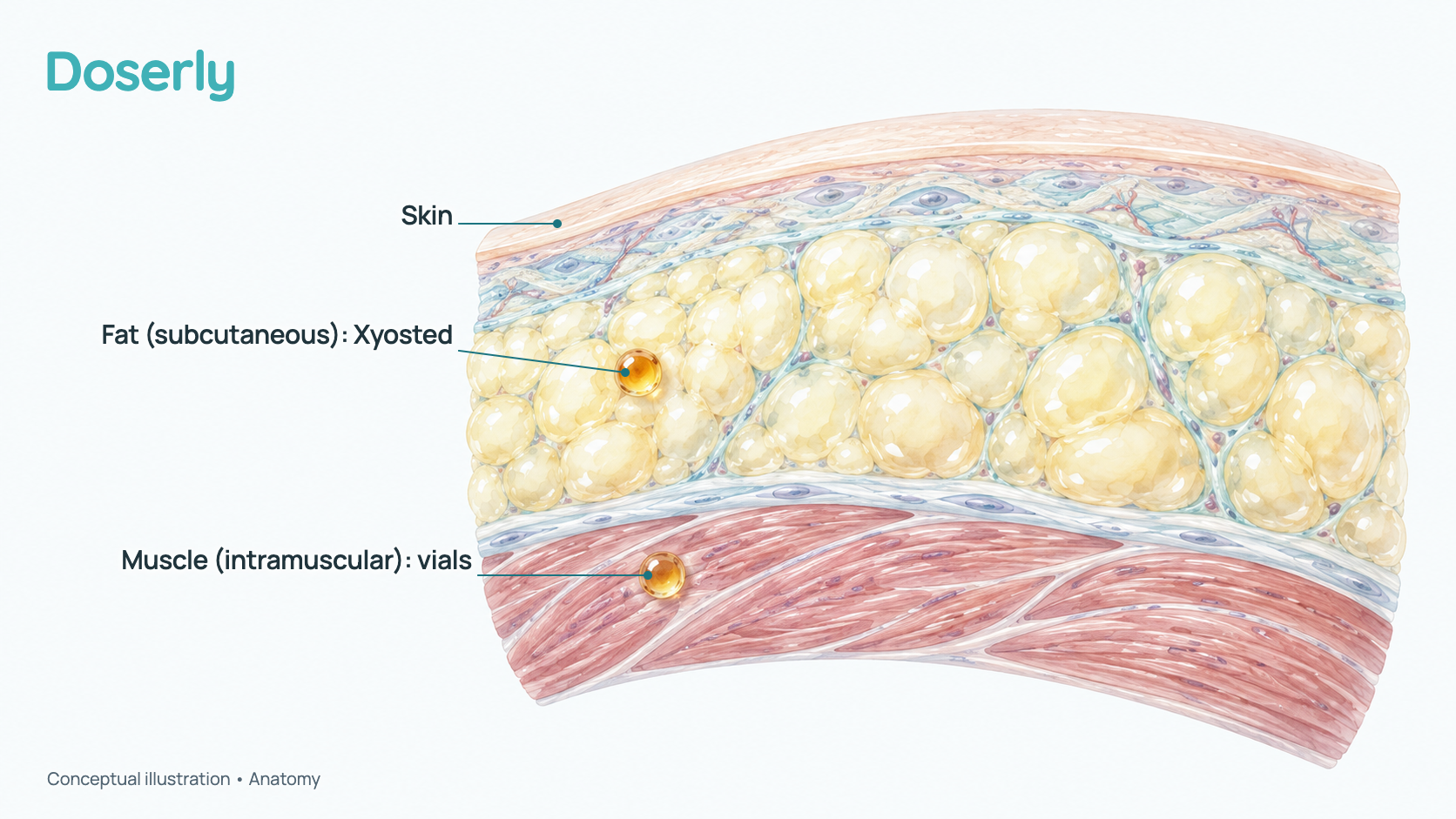
US and Canadian enanthate vials are labeled for intramuscular use only, and the European ampoules must be injected very slowly into a muscle. Xyosted is the exception: it is labeled only for subcutaneous injection in the abdomen. The UK Society for Endocrinology and NHS protocols also accept weekly subcutaneous doses of 50–100 mg from ordinary products. [1], [5], [2], [15], [22]
The evidence for subcutaneous injection is small:
- In the phase II Xyosted study, the authors concluded that bioavailability is similar by either route. [32]
- In 22 men injecting weekly subcutaneous enanthate with an insulin syringe, the trough was 14.5 nmol/L and the peak 21.7 nmol/L (about 418 and 626 ng/dL), all in the normal range. [36]
- In transgender men, weekly subcutaneous cypionate or enanthate reached the male range, and subcutaneous injections were preferred and rated less painful. [37], [38]
- In 234 men, a weekly subcutaneous enanthate autoinjector gave lower hematocrit and estradiol than weekly intramuscular cypionate, but the ester, device and route all differed. [39]
Not everything points one way: FDA reviewers judged the hematocrit rises in the Xyosted trials somewhat greater than usually reported for testosterone therapy, and direct safety comparisons between routes are missing. Technique is covered in how to inject testosterone. [40], [24]
When should blood be drawn: mid-interval or trough?
Guidelines and labels genuinely disagree, and the same blood test can look very different depending on the day it is drawn. After one injection, enanthate peaks within about a day or two and then drifts down over the next 1–2 weeks, so a level drawn on day 2 and one drawn on day 13 describe the same dose. [27], [5]
| Source | When to draw on injections | Target |
|---|---|---|
| Endocrine Society 2018 | Midway between injections | 350–600 ng/dL (about 12–21 nmol/L) |
| AUA 2018 | No earlier than after 3–4 injections; historically mid-cycle | 450–600 ng/dL (about 16–21 nmol/L) |
| Canadian Urological Association 2021 | Mid-cycle | 14–17 nmol/L (about 400–490 ng/dL) |
| International Consultation on Sexual Medicine 2024 | Mid-cycle | Middle of the normal range |
| British Society for Sexual Medicine 2023 | Trough, before the next injection | 15–30 nmol/L (about 430–865 ng/dL) |
| Society for Endocrinology (UK) 2022 | Trough, at the end of the interval | Lower end of the normal range |
| UK and French labels | End of the interval | Changes the interval, not the dose |
| Canadian label (task-force regimen) | Just before the next injection | Above 250–300 ng/dL (about 9–10 nmol/L) |
| Xyosted label | Trough, 7 days after a dose | Keep the dose at 350 to under 650 ng/dL |
[13], [14], [16], [41], [34], [15], [5], [9], [7], [2]
A mid-interval level estimates average exposure, and a trough shows whether levels fall too low before the next dose. Whatever timing a prescriber uses, recording the day of the draw relative to the last injection makes results comparable. [20], [21] See TRT blood work for the full picture.
What happens when you stop testosterone enanthate?
Blood levels from the last injection fall back within about 2 weeks in small studies, but your own hormone production takes much longer to return. [27], [42]
- The last injection. In healthy men, levels were back to baseline 9 days after one injection; in men with hypogonadism given 125 mg, they fell below the pretreatment level by day 14. [27], [43]
- Your own testosterone. Injected testosterone switches off the pituitary's two signals to the testicles, LH and follicle-stimulating hormone (FSH). How fast they recover depends on the original cause and how long treatment lasted; after 2 years of undecanoate injections in the T4DM trial, they recovered slowly over 12 months. With a lasting cause, low testosterone is expected to return. [42], [15]
- Sperm. In a WHO trial, healthy men who stopped weekly enanthate recovered a sperm count of 20 million per mL a median of 3.7 months later; across contraception trials, 90% recovered within 12 months and 100% within 24. The labels warn that the effect on fertility may be irreversible for some men. [44], [45], [2]
- Tapering. The Canadian Urological Association says no taper is needed. [16]
See stopping TRT for the full picture, including fertility recovery and what men describe.
How does testosterone enanthate compare with other forms?
It is a short-acting injectable ester, like cypionate. Compared with gels, injections cause high hematocrit more often, according to the Endocrine Society; compared with long-acting undecanoate injections, it is injected far more often. Xyosted is the only weekly subcutaneous autoinjector. [13], [46], [2]
How long does testosterone enanthate last in the body?
There is no single half-life figure, and the sources disagree. Each one measured something slightly different:
| Source | Half-life it gives | What it describes |
|---|---|---|
| UK label | 2–3 days | Testosterone in the blood of healthy men (dose not stated) |
| French label | About 4.5 days | Release of the ester from the injection site |
| EAU guideline 2026 | 4–5 days | Enanthate in its product table |
| Phase II Xyosted study | About 7.2 days intramuscular; about 10 days subcutaneous | Apparent half-life at steady state |
| German label | 8 days | Enanthate after injection |
| US labels | Not stated |
[5], [9], [18], [32], [17], [1]
All of these describe how slowly the oil depot releases the hormone, not how long testosterone itself lasts: testosterone released into the blood is cleared within minutes to about an hour (the US label gives 10 to 100 minutes). [1]
What do the peaks and troughs look like?
Measured studies give the shape, and it varies from person to person:
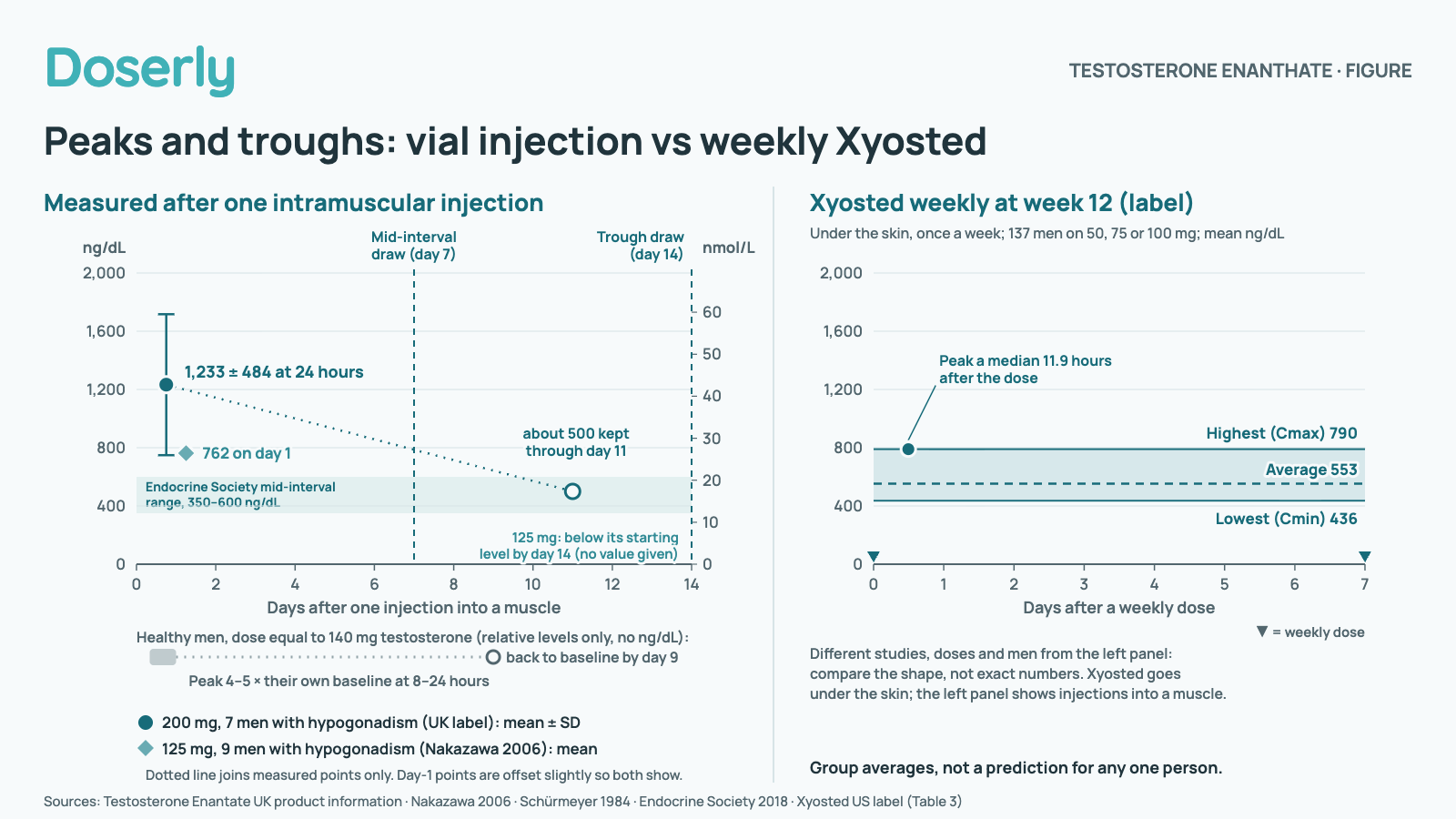
- Healthy men, one dose equal to 140 mg of testosterone: levels peaked at 4–5 times baseline 8–24 hours after the injection and were back to baseline by day 9. [27]
- 200 mg in 7 men with hypogonadism (UK label): a peak of 1,233 ± 484 ng/dL (about 43 nmol/L) at 24 hours, with about 500 ng/dL kept for 11 days. [5]
- 125 mg in 9 men with hypogonadism: an average of 762 ng/dL (about 26 nmol/L) on day 1, with one man at 1,960, and levels below the pretreatment value by day 14. [43]
- 200 mg vs 100 mg: 200 mg kept testosterone and estradiol in the normal range through day 11, and 100 mg through day 7. [47]
Weekly Xyosted behaves differently: at week 12, levels peaked a median of 11.9 hours after a dose and averaged 553 ng/dL (about 19 nmol/L), with a peak of 790 and a trough of 436 ng/dL. [2]
Peaks and troughs: vial injection vs weekly Xyosted
Measured after one intramuscular injection
- 200 mg, 7 men with hypogonadism (UK label)
- 1,233 ± 484 ng/dL (about 43 nmol/L) at 24 hours; about 500 ng/dL kept through day 11.
- 125 mg, 9 men with hypogonadism (Nakazawa 2006)
- An average of 762 ng/dL (about 26 nmol/L) on day 1; below their starting level by day 14 (no value given).
- Healthy men, dose equal to 140 mg testosterone (Schürmeyer 1984)
- A peak of 4–5 times their own baseline at 8–24 hours; back to baseline by day 9. Reported as relative levels only.
- When blood is drawn
- Mid-interval: day 7 of a 2-week schedule (Endocrine Society range 350–600 ng/dL). Trough: just before the next injection (day 14).
Xyosted weekly at week 12 (label)
Under the skin, once a week; 137 men on 50, 75 or 100 mg, mean values.
- Highest level
- 790 ng/dL (about 27 nmol/L), a median 11.9 hours after the dose.
- Average over the week
- 553 ng/dL (about 19 nmol/L).
- Lowest level
- 436 ng/dL (about 15 nmol/L).
Different studies, doses and men: compare the shape, not exact numbers. Group averages, not a prediction for any one person.
Is enanthate different from cypionate?
Very little in practice. The Canadian monograph describes a study in which equal amounts of testosterone given as enanthate (194 mg) or cypionate (200 mg) produced identical blood levels, peaking on days 1–2 and back to baseline by day 10, and guidelines give both the same doses. The real differences are the oil, the preservative and where each is sold. See cypionate vs enanthate and the cypionate guide. [7], [13], [1], [48]
What is in the vial or ampoule, and why can it crystallize?
- US and Canadian vials: sesame oil with chlorobutanol as a preservative (US cypionate uses benzyl alcohol instead). Crystals can form in the cold; the US label says warming the vial and rolling it between the palms redissolves them. [1], [7], [48]
- UK, Australian and European ampoules: castor oil with benzyl benzoate. [5], [8], [9]
- Xyosted: sesame oil only, with no preservative. [2]
People often describe enanthate as thick or slow to draw; the labels say nothing about that, and no study shows that one oil or preservative is better tolerated.
Xyosted: what is it, and how is it different from vial injections?
Xyosted is testosterone enanthate in a single-dose autoinjector that you use yourself once a week, pressing it against the skin of the abdomen. Each device holds 50, 75 or 100 mg in 0.5 mL of sesame oil, with no preservative. It is sold only in the United States, and no generic version is approved. [2], [6], [3], [4], [49]
How it is used, according to its instructions. Only the left or right side of the abdomen, never within 2 inches of the navel, and not into tender, bruised, scarred or hard skin. You hold the device against the skin for a full 10 seconds, even if its window turns orange sooner. If you are not sure the dose went in, the instructions say not to inject another one and to call your pharmacist or prescriber. The label allows no other site. [2]
The main trial. In a 52-week study of 150 men, 90% were in the normal range (300–1,100 ng/dL) at week 12 by FDA's analysis, and 92.7% by the sponsor's; none had a peak above 1,500 ng/dL in FDA's count. More than 95% reported no injection pain. Thirty stopped because of side effects such as a rise in hematocrit, blood pressure or PSA, and 97 completed the year. [2], [50], [51]
Safety numbers from the label (283 men treated for up to a year):
- Hematocrit rose by an average of 3.8 points at 6 months and 5.4 points at 1 year, and 12 men (4.2%) reached 55% or more; the label asks for a check about every 3 months. [2]
- Blood pressure rose by an average of 3.9/1.5 mm Hg after 12 weeks in the 62 men of the 6-month study with usable 24-hour recordings, and 10% of men in the 1-year study started or changed blood-pressure medicine. [2]
- Injection-site reactions such as bruising, bleeding or redness occurred in 36 men (12.7%); none stopped because of them. [2]
- Depression led 2 men to stop, and there were 2 suicide attempts, one of them fatal. [2]
Approval history. FDA turned down the first application in October 2017 over blood-pressure rises and the suicide attempts, then approved Xyosted on September 28, 2018 with a boxed warning about blood pressure and a required study in teenagers. In February 2025 FDA made blood pressure a class-wide warning for all testosterone products, and Xyosted's boxed warning was removed in labeling approved in July 2025. The label names Antares Pharma, part of Halozyme Therapeutics since May 24, 2022; Halozyme's study in boys aged 12 to 17 is still recruiting. [52], [53], [54], [55], [56], [57]
Cost (checked September 2026). Pharmacies paid about $158 per Xyosted autoinjector in September 2026, against about $72 for a whole 5 mL vial of generic enanthate. In Medicare Part D in 2024, the average gross cost was $788 per Xyosted prescription and $76 per generic enanthate prescription. What you pay depends on insurance, and several community accounts describe denials or a requirement to try vials first. [58], [59]
Is Xyosted better than vial injections? Not proven. Its weekly levels are steadier than every-2-week vial injections, but no trial has compared it head to head with intramuscular enanthate; the only larger comparison is observational and against cypionate. In a usability study, 99 of 123 attempted injections (80.5%) delivered a full dose; most failures came from not holding the device long enough. [32], [39], [60]
How the Xyosted label adjusts the weekly dose
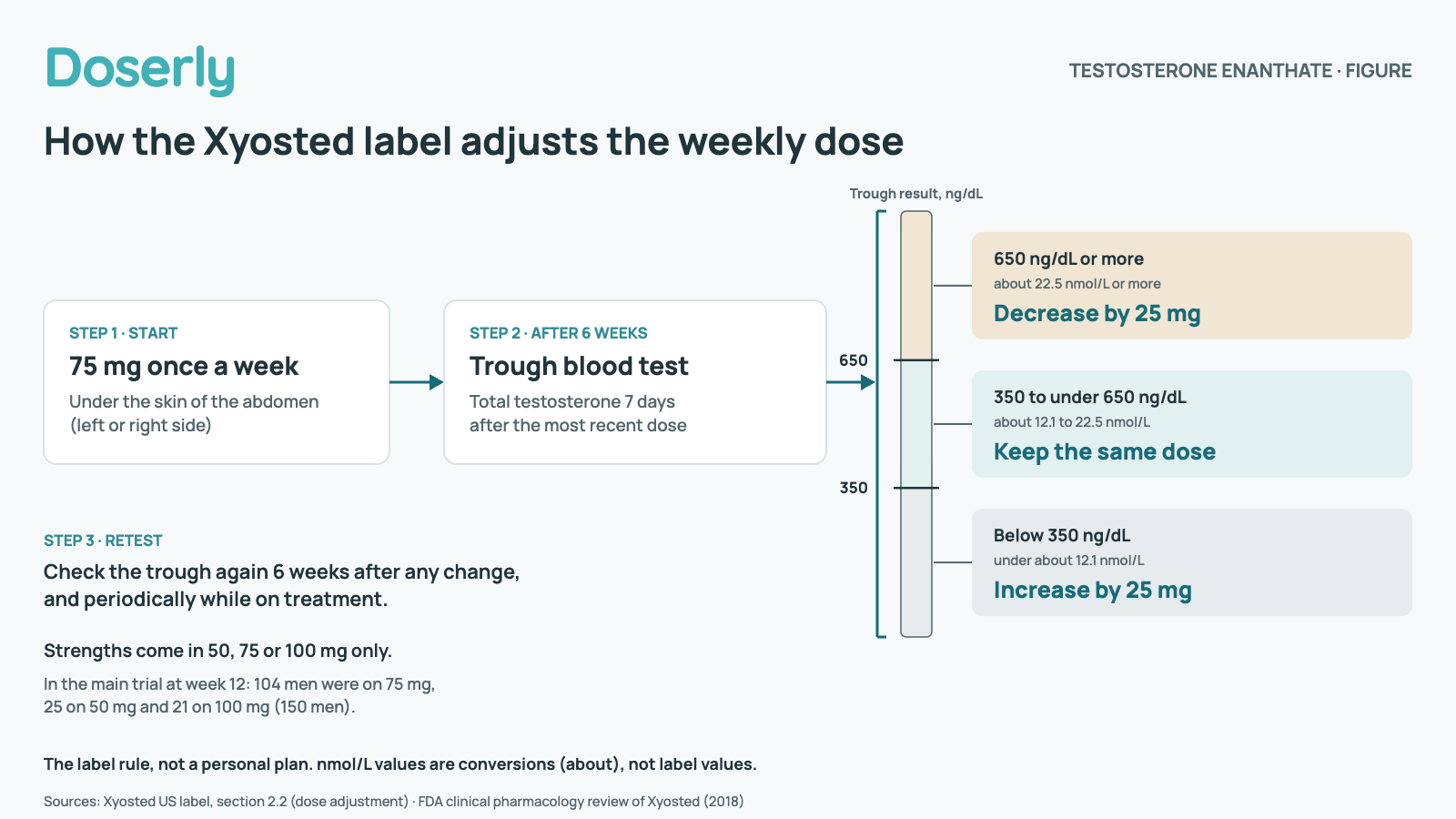
- Step 1: start
- 75 mg once a week, under the skin of the abdomen (left or right side).
- Step 2: after 6 weeks
- A trough blood test: total testosterone 7 days after the most recent dose.
- 650 ng/dL or more
- Decrease by 25 mg (about 22.5 nmol/L or more).
- 350 to under 650 ng/dL
- Keep the same dose (about 12.1 to 22.5 nmol/L).
- Below 350 ng/dL
- Increase by 25 mg (under about 12.1 nmol/L).
- Step 3: retest
- Check the trough again 6 weeks after any change, and periodically while on treatment. Strengths come in 50, 75 or 100 mg only.
In the main trial at week 12: 104 men were on 75 mg, 25 on 50 mg and 21 on 100 mg (150 men).
The label rule, not a personal plan. nmol/L values are approximate conversions, not label values.
No longer sold: Delatestryl
Delatestryl was the long-standing brand of testosterone enanthate in the United States and Canada. It is discontinued in the United States, where FDA records that it was not withdrawn for safety or effectiveness reasons, and it was cancelled in Canada on December 18, 2025. Generic enanthate vials replaced it; Xyosted contains the same drug in a weekly autoinjector. [6], [49]
How should testosterone enanthate be stored?
Store it at room temperature and protect it from light. Each product's label sets its own rules, so the leaflet in your box is the final word. [1], [2], [5]
| Product | Storage | After first use |
|---|---|---|
| US generic vials | 20–25 °C; warm and roll the vial to redissolve crystals | No in-use period stated |
| Canadian vial (Hikma) | 15–30 °C | No in-use period stated |
| UK ampoules | Protect from light | Shelf life 5 years unopened |
| French ampoules (Androtardyl) | See the leaflet | Use immediately after opening |
| Xyosted | 20–25 °C, in the carton; do not refrigerate or freeze | Single use; discard the device |
How long does an opened vial last? No US enanthate label gives an in-use period for a multi-dose vial. US guidance for healthcare settings, and the US Pharmacopeia (USP), which sets pharmacy standards, say to discard an opened multi-dose vial within 28 days unless the manufacturer states otherwise. That was written for clinics, but it is the only US standard. No label or study covers loading syringes days ahead. [1], [61], [62]
Traveling. In the United States, injectable medicines and their unused syringes are allowed in carry-on bags if declared at security; Xyosted must not be refrigerated or frozen. See traveling with testosterone. [63], [64], [2]
This guide does not teach injection technique; the Academy note below covers the practical basics, and how to inject testosterone covers sites and needles.
What does testosterone enanthate do to fertility, estrogen and red blood cells?
These effects come with every form of testosterone; each has its own hub guide.
Fertility. In a WHO trial of healthy men given 200 mg of enanthate weekly, a research dose above replacement, 157 of 271 men lost all sperm (azoospermia), an estimated 65% by 6 months. Replacement-range doses also suppress it: in a small study of healthy men, 100 mg weekly left all 7 with no sperm by week 20. The AUA says testosterone should not be prescribed to men trying to conceive, and the US male infertility guideline extends that to men interested in future fertility. See TRT and fertility. [44], [65], [14], [66]
Estrogen. Some testosterone is converted into estradiol, and the rise varies widely: after one 250 mg injection, estradiol tripled in 12 of 21 men and did not rise in 9. On weekly Xyosted 100 mg, average estradiol was 48.3 pg/mL, similar to the 50.0 pg/mL on 200 mg of intramuscular enanthate every 2 weeks. No guideline sets a routine estradiol target: the AUA measures it mainly when breast symptoms appear, and the VA does not generally recommend aromatase inhibitors. See estrogen on TRT. [67], [32], [14], [68]
Red blood cells. In a network meta-analysis of 29 randomized trials, hematocrit rose by about 4.0 percentage points more than on placebo with enanthate and cypionate injections, 3.0 with gel and 1.6 with undecanoate injections. On Xyosted, 10 of 133 men (7.5%) reached 52% or more in a 26-week study. In a 24-week randomized trial, abnormal hematocrit rises occurred in 43.8% of men on 200 mg every 2 weeks against 15.4% on a skin patch (the abstract does not give the cut-off). See hematocrit on TRT. [69], [70], [31]
What do we actually know about testosterone enanthate in people?
That it restores testosterone is settled; it has been used for decades and is labeled for that. The Xyosted studies are the only modern trials of enanthate itself, and they ran a year or less. What testosterone does over years comes mostly from trials of other forms.

Which studies used enanthate itself?
| Study | Who and what | What it found | What it cannot show |
|---|---|---|---|
| Kaminetsky 2019 (Xyosted main trial) | 150 men, weekly subcutaneous Xyosted, 52 weeks, no comparison group | 90–92.7% in range at week 12; trough 487 ng/dL at week 52; 30 stopped for side effects | How it compares with vials; outcomes beyond a year [50], [2] |
| Gittelman 2019 (Xyosted safety study) | 133 men, 26 weeks | Blood pressure up 3.7/1.3 mm Hg at week 12; hematocrit 52% or more in 7.5% | Long-term outcomes [70] |
| Kaminetsky 2015 (controlled trial, phase II) | 39 men randomized to 50 or 100 mg weekly subcutaneous; 10 men on 200 mg intramuscular every 2 weeks as a reference | Dose-proportional subcutaneous levels; the intramuscular group averaged 1,659 ng/dL in week 1 | A fair route comparison (the reference group was not randomized) [32] |
| Dobs 1999 (randomized trial) | 66 men, 200 mg every 2 weeks vs a skin patch, 24 weeks | Above-normal testosterone and estradiol for days after each injection; more hematocrit rises | Today's weekly schedules [31] |
| WHO 1990 (contraception trial) | 271 healthy men, 200 mg weekly | 157 of 271 lost all sperm (an estimated 65% by 6 months); median recovery 3.7 months after stopping | Men with hypogonadism at replacement doses [44] |
Older studies of schedules and single doses are covered in where protocols differ and peaks and troughs.
What did the large trials of other forms find?
- TRAVERSE (about 5,200 men, daily gel for an average of 21.7 months, with about 61% stopping the gel early): heart attack, stroke or heart death in 182 of 2,596 men on testosterone (7.0%) vs 190 of 2,602 on placebo (7.3%), which met the trial's safety margin, but more atrial fibrillation, kidney injury, lung clots and fractures. It did not test injections (full results). [71], [2]
- Testosterone Trials (790 men aged 65 or older, gel for 1 year): small gains in sexual function and mood; no gain in energy or walking in the physical function trial. [25]
- T4DM (1,007 men with prediabetes or new diabetes in a lifestyle program, undecanoate injections for 2 years): fewer men had diabetes-range glucose results at 2 years (55 of 443, 12%, vs 87 of 413, 21%), but hematocrit went above 54% in 106 of 491 men on testosterone (22%) vs 6 of 484 on placebo (1%). [72]
Whether those results transfer to weekly or every-2-week enanthate is not known; the higher peaks of vial injections and the rise in hematocrit are reasons for caution. [69]
How does testosterone enanthate work?
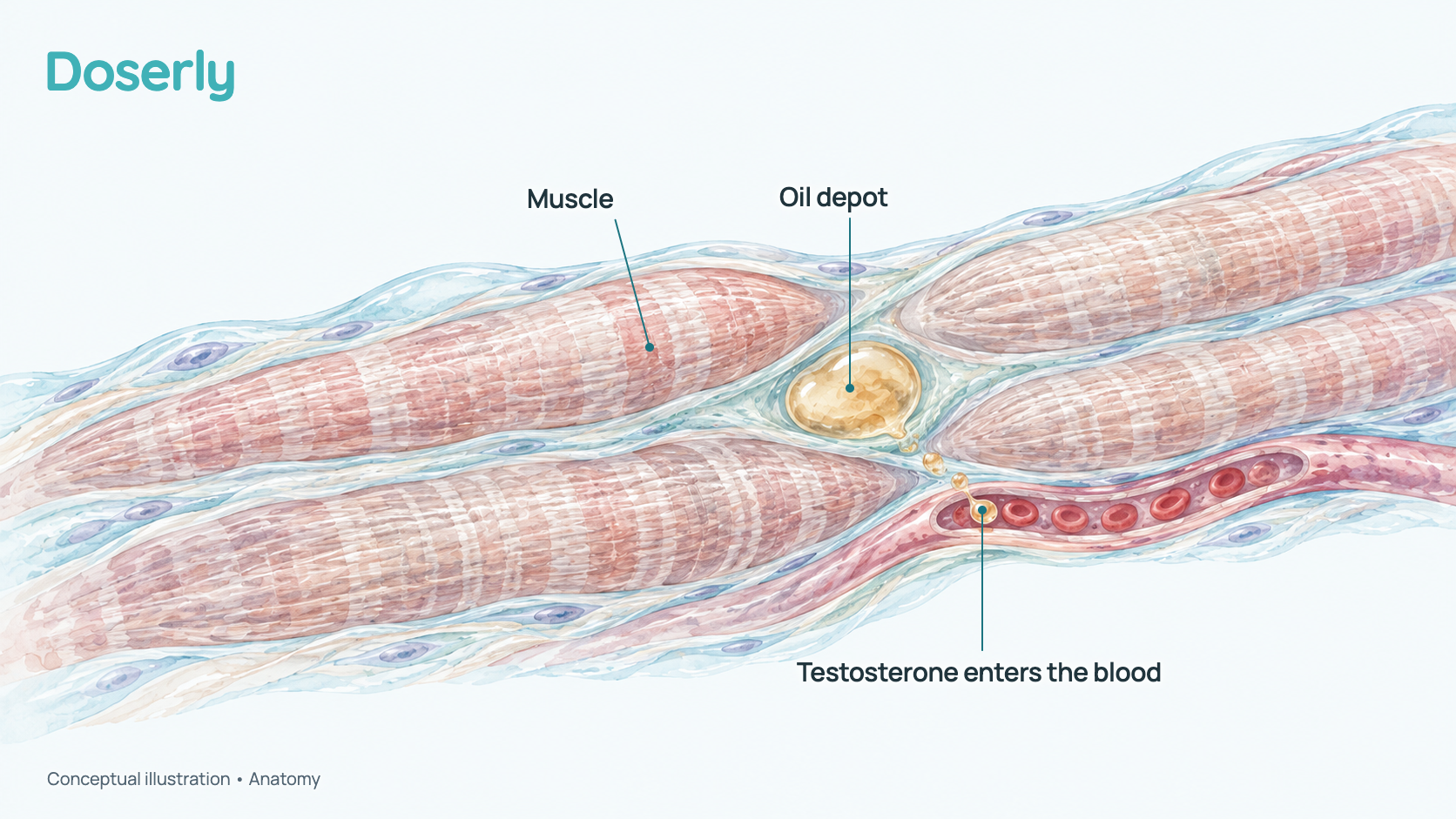
Once injected, the oil forms a depot in the muscle or, for Xyosted, in the subcutaneous fat. The ester slowly moves out of the oil into the blood, where enzymes cut off the enanthate tail and free testosterone. That slow exit, not testosterone's own short life in the blood, sets the dosing interval; in the phase II Xyosted study, release looked slower from fat than from muscle. [1], [2], [32]
Testosterone then acts like the body's own hormone, partly after conversion to dihydrotestosterone (DHT) or estradiol. In the blood, about 40% is bound to sex hormone-binding globulin (SHBG) and about 2% is free. [2]
Why it switches off your own production. The brain senses testosterone from any source. When levels are high, the pituitary lowers its LH and FSH signals to the testicles, so they make less testosterone and sperm production falls. [2], [44]
Why it raises red blood cells. Androgens stimulate red blood cell production, which shows up as a higher hematocrit; the studies do not show exactly why injections raise it more than some other forms. [2], [69]
What are the risks and unanswered questions?
Is testosterone enanthate safe?
For men with a confirmed diagnosis and regular monitoring, it has a long record as standard treatment, and its main risks are well known: a rise in red blood cells, higher blood pressure, blood clots, fluid retention, breast enlargement, prostate effects and loss of fertility. What remains uncertain is long-term heart and prostate safety on injections specifically, since the largest safety trial used a gel. [1], [2], [71]
What side effects do the labels list?
The US vial label lists breast enlargement (gynecomastia), too-frequent or prolonged erections, acne, male-pattern hair loss, fluid and salt retention, nausea, changes in libido, headache, anxiety, depression, a rise in red blood cells (polycythemia) and liver-test changes. [1]
In the 1-year Xyosted study of 150 men, the most common reactions were a rise in hematocrit (14.0%), high blood pressure (12.7%), a rise in PSA (12.0%), bruising at the injection site (6.7%) and headache (5.3%). [2]
Does testosterone enanthate raise blood pressure?
Yes, on average by a few points. On 24-hour monitoring, Xyosted raised blood pressure by an average of 3.9/1.5 mm Hg after 12 weeks in the 62 men with usable recordings. In 2025 FDA concluded from similar studies that all testosterone products raise blood pressure. The US vial label advises checking blood pressure periodically and says testosterone is not recommended with uncontrolled high blood pressure. [2], [54], [1]
Does testosterone enanthate affect the heart?
The best evidence comes from TRAVERSE, a randomized trial of about 5,200 men aged 45 to 80 with heart disease or high heart risk, given daily testosterone gel or a placebo gel. Among the 2,596 men who used testosterone gel and the 2,602 who used placebo gel, it found:
- Heart attack, stroke or heart death: 182 men (7.0%) on testosterone vs 190 (7.3%) on placebo; hazard ratio 0.96, with a 95% confidence interval of 0.78 to 1.17. The top of that range stayed below the trial's safety margin of 1.5, so a large rise in risk was ruled out. [71], [2]
- Heart rhythm: atrial fibrillation 3.5% vs 2.4%; nonfatal rhythm problems needing treatment 5.2% vs 3.3%. [2]
- Kidneys: acute kidney injury 2.3% vs 1.5%. [2]
- Clots: venous clots 1.7% vs 1.2%, including pulmonary embolism 0.9% vs 0.5%. [2]
- Fractures: 91 of 2,601 men (3.50%) vs 64 of 2,603 (2.46%), counting every randomized man. [73]
- Blood pressure: systolic pressure rose 1.0 mm Hg on testosterone and fell 0.5 mm Hg on placebo by 36 months. [2]
- Substudies: in men with low libido, testosterone increased sexual activity and desire but not erections; it did not significantly slow progression from prediabetes to diabetes; and it did not improve persistent depressive disorder in the 49 men who had it. [74], [75], [76]
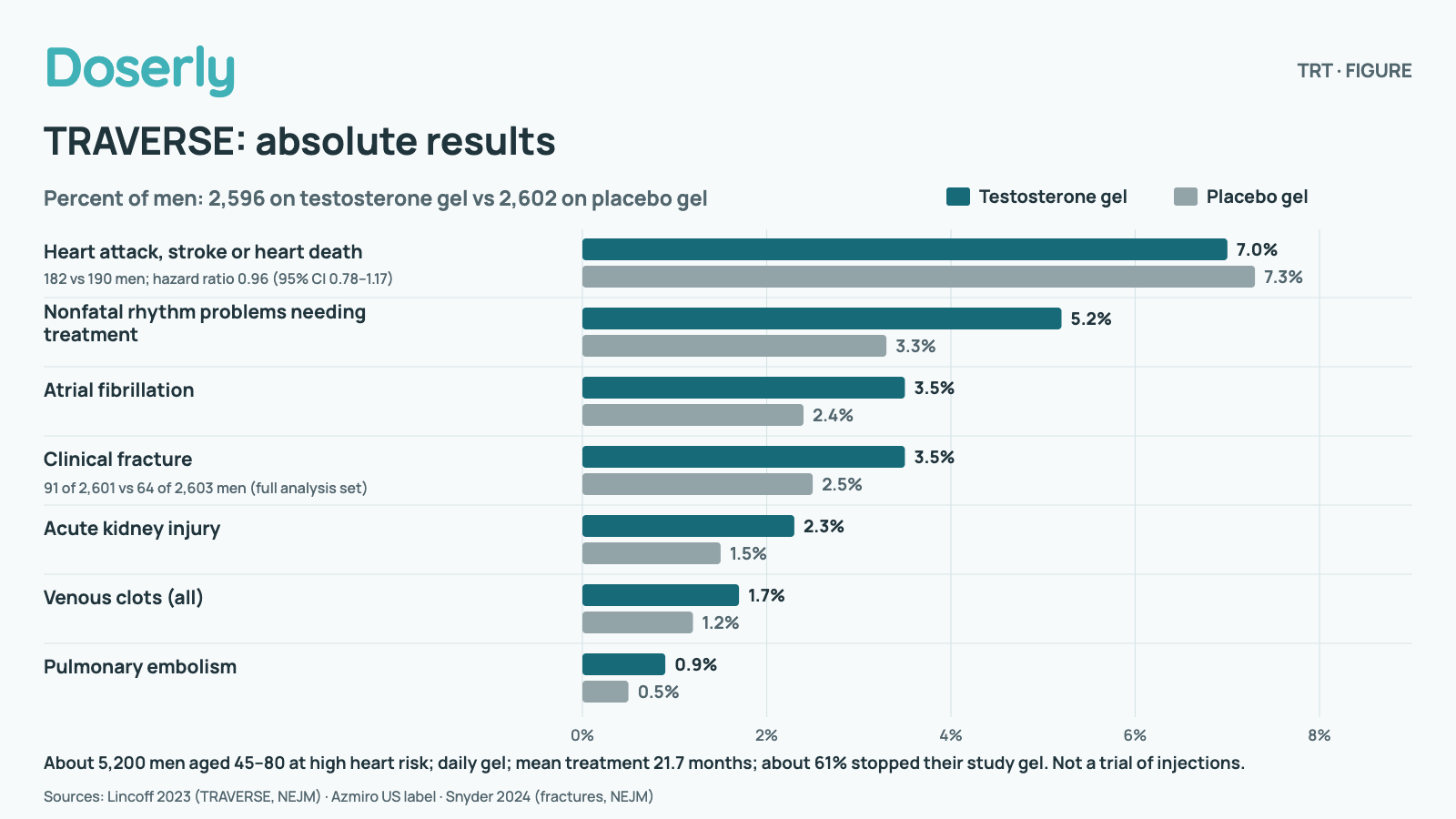
TRAVERSE: absolute results
Testosterone gel (2,596 men)Placebo gel (2,602 men)
- Heart attack, stroke or heart death
- Testosterone 7.0% vs placebo 7.3% (182 vs 190 men; hazard ratio 0.96, 95% CI 0.78–1.17; met the 1.5 safety margin)
- Nonfatal rhythm problems needing treatment
- Testosterone 5.2% vs placebo 3.3%
- Atrial fibrillation
- Testosterone 3.5% vs placebo 2.4%
- Clinical fracture
- Testosterone 3.5% vs placebo 2.5% (91 of 2,601 vs 64 of 2,603 in the full analysis set)
- Acute kidney injury
- Testosterone 2.3% vs placebo 1.5%
- Venous clots (all)
- Testosterone 1.7% vs placebo 1.2%
- Pulmonary embolism
- Testosterone 0.9% vs placebo 0.5%
About 5,200 men aged 45–80 at high heart risk; daily gel; mean treatment 21.7 months; about 61% stopped their study gel. Not a trial of injections.
Its limits matter for enanthate. TRAVERSE tested only a gel, the average man used it for 21.7 months, about 61% stopped their study gel early, and it enrolled men at high heart risk. It did not test the higher peaks and larger hematocrit rises of vial injections. A 2025 meta-analysis of 23 trials lasting at least a year found no increase in death, heart attack or stroke, but about 50% more heart-rhythm problems (risk ratio 1.53). [71], [2], [77]
Which label says what. In February 2025 FDA added the TRAVERSE results to testosterone labels. Xyosted's label carries them. The generic enanthate vial label, in its May 2026 version, still says long-term heart-safety trials "have not been conducted" (checked September 2026). [54], [2], [1]
Red cells and heart events. In a large records study of men on testosterone, heart attacks, strokes or clots in the first year occurred in 301 of 5,842 men whose hematocrit reached 52% or more (5.15%) vs 226 of 5,842 matched men whose hematocrit stayed lower (3.87%); it was observational, so it cannot prove cause. [78]
See TRT and heart health for the full picture.
What about blood clots, sleep apnea, fluid retention and the liver?
- Blood clots. The labels report clots in the legs (deep vein thrombosis) and lungs (pulmonary embolism) after marketing and in TRAVERSE; leg pain, swelling, warmth or redness, or sudden shortness of breath need urgent assessment. [1], [2]
- Sleep apnea. Xyosted's label warns that testosterone may worsen sleep apnea, especially with obesity or lung disease. [2]
- Fluid retention. Swelling, with or without heart failure, can be serious in people with heart, kidney or liver disease. [1]
- The liver. Xyosted's label notes that long-term intramuscular enanthate has produced multiple benign liver tumors (hepatic adenomas), and the vial label links prolonged high doses of androgens with rare liver problems. Jaundice needs prompt review. [2], [1]
Can oil injections cause a cough or an allergic reaction?
Rarely. Oil injected into muscle can occasionally reach the lungs as tiny droplets (pulmonary oil microembolism), causing a sudden urge to cough or shortness of breath. The US enanthate label describes rare reports of coughing fits right after injection, and the UK and Australian labels warn about the same reaction and ask for very slow injection. In 551 nurse-given weekly enanthate injections in castor oil, 1.5% were followed by a brief cough with faintness. FDA counted only 33 reports of severe oil or allergic reactions over 44 years across all approved testosterone injections combined. [1], [5], [8], [79], [80]
Could testosterone enanthate affect the prostate?
Testosterone can enlarge the prostate and raise PSA slightly. US labels contraindicate it in known or suspected prostate cancer, and in the Xyosted trials a rise in PSA was one of the reasons men stopped treatment. In TRAVERSE, which excluded men with PSA above 3.0 ng/mL, high-grade prostate cancer occurred in 5 of 2,596 men on testosterone (0.19%) vs 3 of 2,602 on placebo (0.12%), a difference that was not significant. [1], [2], [50], [81] See TRT and the prostate.
Can testosterone enanthate affect mood?
It can improve mood a little in men with low testosterone, but mood can also worsen. The suicide attempts in the Xyosted trials were one reason FDA delayed approval, and its label warns about depression and suicidal thoughts. New or worse depression, anxiety or thoughts of self-harm need prompt medical help. [2], [52] See TRT and mental health.
Is testosterone enanthate legal? Is it FDA approved?
Checked September 2026. Rules differ by country and change often.
United States. Testosterone enanthate is an FDA-approved prescription medicine and a Schedule III controlled substance. The key steps:
- Products. Generic 200 mg/mL vials from Hikma, Nexus and Eugia (the newest approved in February 2024) and Xyosted (approved September 28, 2018). Delatestryl is discontinued. [6], [53]
- 2015 and 2025. In 2015 FDA required labels to say that safety and benefit in "age-related" low testosterone have not been established. On February 28, 2025, it added TRAVERSE results and blood-pressure warnings and removed boxed-warning language about heart risk; Xyosted's blood-pressure boxed warning went in July 2025. Enanthate vials carry no boxed warning. [54], [55], [1]
- June 18, 2026. The Department of Health and Human Services (HHS) announced that FDA is requesting label changes: removing the age-related limitation, contraindicating testosterone only in metastatic prostate cancer, and revising the prostate-enlargement warning. These are requests: the enanthate labels still carry the old wording. [82], [1], [2]
- Telehealth. Temporary rules allow prescribing controlled medicines such as testosterone without an in-person visit through December 31, 2026; a permanent Drug Enforcement Administration (DEA) special-registration rule is still under review. [83], [84]
- Compounded enanthate. The AUA advises commercially made testosterone over compounded products when possible. [14]
Canada. Testosterone is a Schedule IV controlled substance and prescription-only; Hikma's enanthate is marketed and Xyosted is not sold. [85], [49]
United Kingdom. Testosterone is a Class C controlled drug, prescription-only; the product is Testosterone Enantate 250 mg/mL. [86], [3]
Australia. Testosterone is a Schedule 4 (prescription-only) medicine with extra controls on possession; the product is Primoteston Depot. [87], [4]
European Union. Rules are national. France markets Androtardyl and a generic; Germany has current product information for Testosteron Depot Panpharma, though its marketing status was not confirmed; Spain has no enanthate product. Other member states were not checked. [9], [10], [17], [88] See TRT in Europe.
A "research use only" label on a vial does not make it legal, tested or the same as a licensed product.
Is testosterone enanthate banned in sport? Does it show up on a drug test?
Yes. Testosterone and its esters are on the World Anti-Doping Agency (WADA) Prohibited List in class S1, banned in and out of competition, and the 2027 list keeps that from January 1, 2027. Athletes with a medical need can apply for a therapeutic use exemption, which WADA grants only when low testosterone has an organic cause (such as a testicular or pituitary disorder), not for age, obesity or earlier steroid use; its guidance describes 100 mg every week or 150–250 mg every 2 weeks for approved athletes, judged by trough levels. [89], [90], [91]
Anti-doping labs can detect injected enanthate. With one research method, the intact ester was found in dried blood spots for up to 144–216 hours after a single 100 mg dose. No source gives a general detection window, so there is no reliable clearance time to plan around. [92]
Who should be especially cautious?
- Men who want children now or soon. Testosterone suppresses sperm production; guidelines advise against it for men trying to conceive, and recovery can take months or longer. [14], [66]
- Men with prostate or breast cancer. Contraindicated on current US labels (known or suspected prostate cancer). [1], [2]
- Heart, kidney or liver disease, or high blood pressure. Fluid retention and blood-pressure rises can worsen these; the labels advise against use with uncontrolled high blood pressure. [1], [2]
- High hematocrit, clots or untreated sleep apnea. Guidelines treat a high starting hematocrit, unexplained clots or untreated severe sleep apnea as reasons not to start. [13], [68]
- Depression or an allergy to sesame oil. Xyosted's label warns about depression and is ruled out with sesame-oil allergy; US vials also use sesame oil. [2], [1]
- Women and children. Testosterone is contraindicated in pregnancy and can harm an unborn baby; these guides are for men. Use in teenagers is specialist care only, because it can close growth plates early. [1]
- Drug-tested athletes. Banned at all times. [89]
- People taking other medicines, such as blood thinners, insulin or corticosteroids; see the next question.
Can testosterone enanthate be taken with other medicines?
The labels list these interactions:
- Blood thinners (oral anticoagulants). Testosterone can change their effect; the Xyosted label advises more frequent clotting tests (INR and prothrombin time) with warfarin. [2], [1]
- Insulin and diabetes medicines. Testosterone can lower blood sugar and insulin needs. [1], [2]
- Corticosteroids. Together they can increase fluid retention. [1], [2]
- Medicines that raise blood pressure. Xyosted's label warns that they can add to its effect. [2]
- Oxyphenbutazone. The vial label notes that its blood levels may rise. [1]
Testosterone can also change total thyroid hormone results without changing thyroid function. Bring a full list of everything you take, including supplements, to a pharmacist or doctor. [1], [2]
Is testosterone enanthate available, and what does it cost?
Checked September 2026.
FDA's drug shortage data lists no testosterone shortage (updated September 26, 2026), and France's supply-problem list has no entry for enanthate. Local supply can still differ: several community accounts describe US and UK pharmacies that could not get enanthate (community). [93], [10]
There is no single US price. As a reference point, pharmacies paid $14.48 per mL for generic enanthate in September 2026, about $72 for a 5 mL vial of 200 mg/mL, and about $158 for one Xyosted autoinjector. What you pay depends on the pharmacy, insurance and any fees. In France, an ampoule costs about €6 and is 65% reimbursed. [58], [9], [10]
What should be monitored while using testosterone enanthate?
Xyosted's label asks for a hematocrit check before starting and about every 3 months, plus periodic PSA, lipid and blood-pressure checks; the vial label asks for periodic hematocrit checks on high doses. Neither gives a numeric limit; the numbers come from guidelines. Use this summary to prepare questions for your prescriber; it is not a personal testing plan. [2], [1]
| Why it matters | What labels and guidelines say | Tracking category |
|---|---|---|
| Testosterone level | Endocrine Society: 3–6 months after starting, at 12 months, then yearly; drawn midway between injections. Xyosted: a 7-day trough after 6 weeks. Some UK sources judge by trough instead (timing) | Blood work; Libido; Energy Levels |
| Hematocrit | Xyosted label: about every 3 months. Endocrine Society: baseline, 3–6 months, then yearly; stop if above 54% until it falls. AUA: intervene at 54% or higher. VA: adjust above 51%, stop above 54%. Society for Endocrinology: adjust above 50% | Blood work |
| PSA and prostate | AUA: PSA before starting in men over 40. Endocrine Society: urology referral if PSA rises by more than 1.4 ng/mL in the first 12 months or exceeds 4.0 ng/mL | Blood work; Urinary Symptoms |
| Blood pressure | Labels: check periodically; not for uncontrolled high blood pressure | Blood Pressure |
| Lipids | Xyosted label: monitor cholesterol periodically | Blood work |
| Breasts, mood, sleep | Labels list breast enlargement, depression and sleep apnea | Hormonal Symptoms; Mood & Wellbeing; Sleep Quality |
| Fertility | Semen analysis only if fertility matters; testosterone suppresses sperm production | Other (semen result) |
[13], [14], [68], [15], [2], [1]
The European urology guideline monitors testosterone and hematocrit at 3, 6 and 12 months and then yearly. The Canadian Urological Association uses its own hematocrit trigger of 55%. [18], [16] See TRT blood work and hematocrit on TRT.
Write down the timing. For every testosterone result, note the date and time of the last injection, the dose and the product; without its timing, a result is hard to interpret. [20], [35]
What do people in public communities report?
Public forums hold every kind of enanthate story: men who feel like themselves again, men who notice little, and men who stop after side effects. Many threads are about Xyosted, cost and supply rather than the medicine itself. The accounts below come from public Reddit threads from the past year and are described without identifying anyone.
What do the positive reports look like, and how long do they take?
Better energy, mood and sex drive are the usual good news, over weeks to months. A man on Xyosted 100 mg weekly felt substantially better at about 4 months, with a level of 942 ng/dL drawn 5 days after an injection (272 before treatment); another felt much better within a couple of months on the same dose. A man on 150 mg a week, split over 5 days, noticed the clearest change around week 5, but he was also using several peptides, and his level at 10 weeks was 1,307 ng/dL, above the range guidelines aim for. [94], [95], [96]
Some switches from cypionate were described as helpful: one man on 75 mg of enanthate weekly reported steadier weeks, better libido and average blood pressure falling from 140/90 to 118/84 on the same medicine. His dose and schedule had changed too, and the head-to-head study found identical levels from the two esters (cypionate vs enanthate). [97]
Does everyone respond?
No. A man on Xyosted 100 mg weekly after chemotherapy felt no better in sleep, recovery or libido after 3 months, with a level of 595 and hematocrit of 50.1%; his doctor declined to raise the dose. A man on 120 mg a week felt better around weeks 3–5, then back near baseline by 2 months. Another, after about 5 years on 200 mg every 8 days, described the benefit fading and was waiting for blood results. [98], [99], [100]
What unwanted effects come up?
- Sleep and anxiety early on. A man on 200 mg a week, twice the guideline center, had severe fatigue, anxiety and insomnia by week 3, with a level of 1,130 ng/dL. Another, on 100 mg a week as two 50 mg injections, had panic attacks and severe insomnia by week 2; his doctor advised continuing with blood tests later, and no resolution was posted. [101], [102]
- Breast changes and swelling. One man developed nipple sensitivity and a small firm lump after switching from gel to 100 mg a week in three injections; another had swollen feet and wrists that later settled, on 125 mg once a week. [103], [104]
- Hematocrit. Long-term Xyosted users describe high hematocrit managed with blood donation, and a rise after moving to vial injections. [105], [106]
What do Xyosted users say?
- Needle anxiety and convenience. One man's fear of ordinary injections had interrupted his treatment for months; Xyosted made weekly doses manageable until a pen jammed after about 4 months. [107]
- Site pain and sites off the label. After about 18 months on 100 mg, one man had two painful injections and lost part of a dose when he lifted the pen early; moving slightly farther from the navel helped. Another found abdominal injections painful after losing weight on a GLP-1 medicine. One man injected into his shoulders instead; replies pointed to the instructions, which allow only the abdomen. [108], [105], [109]
- Wearing off. A man who paid out of pocket for about 3 years on 100 mg weekly felt it wore off before the next dose; his urologist moved him to vial enanthate covered by insurance. [110]
- Cost and insurance. One man cancelled before starting because of the cost, even with a savings card; another's insurer required him to try intramuscular enanthate first. When coverage ended for a long-term user, monthly cypionate felt fine for a week and then much worse until he moved to twice-weekly injections. [111], [112], [113]
Why do blood results confuse people?
Timing. A man given 125 mg every 10 days by a nurse had a level of 130 ng/dL at the end of the interval and felt worse than before treatment; replies blamed the long interval rather than a bad injection. The opposite happened to a man on 150 mg a week in two injections, whose level was 2,200 ng/dL 66 hours after an injection; he planned to lower the dose. [114], [115] See when blood should be drawn.
What do people report about supply and ampoules?
- Shortages. A US man who had used enanthate for about 5 years, because cypionate gave him flu-like reactions, was told by local pharmacies that they could no longer get it. A UK man was offered cypionate at more than double the price, or Sustanon for less. [116], [117]
- Ampoules and pre-loading. Men prescribed 250 mg ampoules often want smaller weekly doses and ask how to store the rest, and replies disagree; one man's enanthate turned yellow after 7 days in a preloaded syringe. No label covers storing an opened ampoule or pre-loading syringes. [118], [119], [9]
Many other threads describe non-prescribed "cycles" at several times replacement doses. Those are outside replacement therapy and this guide (TRT vs steroids).
How can you judge an enanthate story?
Ask: Was the product prescribed, and was it a 200 mg/mL vial, a 250 mg/mL ampoule or Xyosted? What was the dose in mg and the weekly total? Into muscle or fat? When was blood drawn relative to the last injection? What else changed at the same time, such as hCG, an aromatase inhibitor, weight-loss medicine, peptides or training? What happened a few months later?
These selected discussions show what people experience and the questions research should answer. They are not a survey of all users, a success rate or a substitute for the studies.
How does testosterone enanthate compare with other testosterone forms?
These are the forms most often weighed against enanthate. Status was checked in September 2026.
| Form | What it is | Route and labeled schedule | What stands out | US status |
|---|---|---|---|---|
| Testosterone enanthate vials (this guide) | Short-acting ester in oil | Intramuscular, 50–400 mg every 2–4 weeks | Levels rise and fall across each interval; hematocrit rises about 4 points vs placebo | Approved; Schedule III [1], [69] |
| Xyosted (this guide) | Enanthate in a weekly autoinjector | Subcutaneous, 50–100 mg weekly in the abdomen | Steadier weekly levels; far higher price | Approved [2] |
| Testosterone cypionate | Short-acting ester in oil | Intramuscular, 50–400 mg every 2–4 weeks | Same US vial dosing and identical levels in a head-to-head study | Approved [48], [7] |
| Testosterone undecanoate injection (Aveed, Nebido) | Long-acting ester | Aveed: 750 mg at start, at 4 weeks, then every 10 weeks | Few injections; boxed warning for oil cough and allergic reactions | Approved (Aveed) [46] |
| Testosterone gel | Daily gel on the skin | For example AndroGel 1.62%: 40.5 mg each morning | Daily application; boxed warning about transfer to children and partners | Approved [120] |
| Oral testosterone undecanoate (Jatenzo, Kyzatrex, Tlando) | Capsules taken with food | Twice daily | No injections; blood-pressure monitoring | Approved [121] |
| Natesto | Nasal gel | 11 mg (one pump in each nostril) three times daily | Short-acting; several doses a day | Approved [122] |
| Testosterone pellets (Testopel) | Small pellets implanted subcutaneously near the hip | 150–450 mg every 3–6 months | Hard to adjust once inserted | Approved [123] |
No trial ranks these forms on long-term outcomes. [69] Outside the United States, Sustanon 250 and testosterone propionate are other injectable options. See cypionate vs enanthate for the closest comparison.
Common questions about testosterone enanthate
What is the usual dose of testosterone enanthate, and how long does one injection last?
US vial labels allow 50–400 mg every 2–4 weeks, and guideline schedules average 50–100 mg a week, typically 100 mg weekly or 200 mg every 2 weeks. UK and Australian ampoule labels use 250 mg every 2–6 weeks, and Xyosted is 50–100 mg weekly. After an intramuscular injection, levels peak within about 1–3 days and then fall over the next 1–3 weeks, depending on the dose, which is why many guidelines prefer weekly doses. [1], [13], [5], [8], [2], [27] See typical protocols.
How many units is 100 mg of testosterone enanthate?
At 200 mg/mL, 100 mg is 0.5 mL, which is 50 units on a U-100 insulin syringe. At 250 mg/mL, 100 mg is 0.4 mL, or 40 units. Units on an insulin syringe measure volume, so the answer always depends on the strength; check the label on your vial or ampoule. [1], [5] Doserly's TRT dose calculator shows each step. See typical protocols.
Is testosterone enanthate the same as cypionate?
Nearly. Both are short-acting testosterone esters in oil, guidelines give them the same doses, and a study giving equal amounts of testosterone as each ester found identical blood levels. They differ in the oil, the preservative and where each is sold. Switching between them is a prescribing decision, because product strengths differ. [7], [13], [1], [48] See cypionate vs enanthate.
Can testosterone enanthate be injected subcutaneously?
Xyosted is designed for it. US and Canadian vials are labeled for intramuscular use only, while the UK Society for Endocrinology and NHS protocols accept weekly subcutaneous doses of 50–100 mg. Small studies support similar levels, but no randomized trial has compared routes in men with hypogonadism, so discuss any change with your prescriber. [2], [1], [15], [22], [24] See intramuscular or subcutaneous.
Is Xyosted better than regular testosterone injections?
Not proven. It gives steadier weekly levels than every-2-week vials and avoids drawing up doses, but no trial has compared it head to head with intramuscular enanthate, and it costs far more: about $158 per autoinjector against about $72 for a 5 mL vial (what pharmacies paid, September 2026). [32], [58] See Xyosted.
What should I do if I miss an injection?
US labels give no missed-dose instruction, so ask your prescriber or pharmacist how to get back on schedule. Canada's monograph says to give a missed dose as soon as possible unless the next one is nearly due. For Xyosted, if you are not sure a dose went in, do not inject another. If a blood test is due, tell the prescriber when your last injection actually was. [1], [7], [2]
Is testosterone enanthate a steroid?
Yes. Testosterone is an anabolic-androgenic steroid hormone, and that is why it is a controlled substance. At replacement doses under medical supervision it restores normal levels; bodybuilding use relies on much higher doses with different risks. [11], [1] See TRT vs steroids.
Glossary
Plain explanations of the medical, dosing and research terms used in this guide. Underlined terms in the text link here.
- Ampoule
- A sealed glass container holding one dose, opened by snapping the neck. UK, Australian and European enanthate comes as 250 mg ampoules or prefilled syringes.
- Aromatase inhibitor
- A medicine, such as anastrozole, that blocks the enzyme that turns testosterone into estradiol. The VA does not generally recommend them for men on testosterone.
- Autoinjector
- A prefilled, single-use device that delivers a fixed dose when pressed against the skin. Xyosted is a weekly testosterone enanthate autoinjector.
- Azoospermia
- No sperm at all in a semen sample.
- Controlled substance
- A medicine whose prescribing and possession are restricted by law because it can be misused. Testosterone is Schedule III in the US, Schedule IV in Canada and Class C in the UK.
- Controlled trial
- A study that compares people who receive a treatment with a similar group who do not, often receiving a placebo instead. Randomly assigning people to each group makes the comparison fairer.
- Depot
- A pool of medicine left in the body, such as oil in a muscle or in subcutaneous fat, that releases the drug slowly over days or weeks.
- Dose (amount each time)
- The amount given on one occasion. A protocol lists both the dose and how often it is given.
- Ester
- A chemical tail joined to testosterone that makes it dissolve in oil and release slowly after injection. The body removes the tail to free testosterone. Enanthate, cypionate and undecanoate are esters.
- Estradiol
- The main form of estrogen. In men it is made mostly from testosterone, so it rises when testosterone rises.
- FSH (follicle-stimulating hormone)
- A pituitary hormone that acts on the cells supporting sperm production. Testosterone therapy lowers it.
- Gynecomastia
- Growth of breast tissue in men, often tender at first. It is linked to a higher estrogen-to-testosterone balance.
- Half-life
- The time it takes for the level of a substance in the blood to fall by half. For testosterone enanthate, sources give figures from 2 to 8 days after injection into a muscle and about 10 days after subcutaneous injection, which reflect slow release from the oil depot. It is not the same as how long an effect lasts.
- Hematocrit
- The share of the blood made up of red blood cells. Testosterone raises it, and most guidelines act when it reaches about 54%.
- Hypogonadotropic hypogonadism
- Low testosterone because the brain and pituitary send too little LH and FSH to the testicles. It can be present from birth or start later. Also called secondary hypogonadism.
- Hypogonadism
- Low testosterone caused by a problem in the testicles or in the brain and pituitary signals that control them, confirmed with symptoms and repeated morning blood tests.
- Intramuscular (IM)
- Injected into a muscle. US testosterone enanthate vials are labeled for slow, deep injection into the buttock muscle.
- LH (luteinizing hormone)
- A pituitary hormone that tells the testicles to make testosterone. Testosterone therapy switches it off.
- Mid-interval level
- A blood test taken halfway between two injections, such as day 7 of a 2-week schedule. Several guidelines use it to judge the dose.
- Multi-dose vial
- A vial meant for several doses, with a preservative. US enanthate comes in 5 mL multi-dose vials.
- Placebo
- A dummy treatment with no active ingredient, used as a comparison in studies.
- Polycythemia (erythrocytosis)
- Too many red blood cells, shown by a high hematocrit. Testosterone therapy is a common cause.
- Pulmonary oil microembolism (POME)
- Tiny droplets of injected oil reaching the lungs, causing a sudden cough or shortness of breath soon after an injection. It is rare.
- Primary hypogonadism
- Low testosterone because the testicles themselves do not work well, even though the pituitary sends plenty of LH and FSH.
- PSA (prostate-specific antigen)
- A blood test for a protein made by the prostate. It rises slightly on testosterone and is used to decide whether prostate checks are needed.
- SHBG (sex hormone-binding globulin)
- A blood protein that carries testosterone. Testosterone bound to it is not immediately available to tissues, so SHBG affects how much free testosterone there is.
- Subcutaneous (SC)
- Injected into the fatty layer just under the skin. Xyosted is labeled for subcutaneous injection in the abdomen; US enanthate vials are labeled for muscle only, but a UK guideline accepts weekly subcutaneous doses.
- Syringe units
- Markings on an insulin syringe that measure volume. On a U-100 syringe, 100 units equal 1 mL, so 0.5 mL is 50 units.
- Titration
- Adjusting a dose in steps, usually based on blood tests and symptoms.
- Trough level
- The lowest level of a drug in the blood, measured just before the next dose. The Xyosted label and several UK sources judge injections by it.
- TRT (testosterone replacement therapy)
- Prescribed testosterone, by injection, gel or other forms, for men with low testosterone. It switches off the brain's LH and FSH signals.
- WADA
- The World Anti-Doping Agency, which publishes the list of substances banned in sport. Testosterone is banned at all times.
- Weekly total
- All the amounts given in one week, added together. For example, 50 mg twice a week is a 100 mg weekly total, and 200 mg every 2 weeks averages 100 mg a week.
How this guide was researched
This guide is built from a thorough review of the sources cited throughout it: product labels from the United States, Canada, the United Kingdom, Australia, France and Germany, clinical guidelines and NHS prescribing protocols from the United States, Canada, the United Kingdom and Europe, published clinical trials and studies, FDA review documents and regulatory records. We also reviewed public online forums where people describe their own experiences with testosterone enanthate and Xyosted.
The guide cites 123 sources, including 15 product labels, 12 guidelines and prescribing protocols, and 31 original studies in people, plus 26 public community threads. Each type of source answers a different question. Labels, guidelines and trials show what was approved and measured. Practice papers show how prescribers typically use it. Personal accounts show what individual people experienced. Every numbered citation links to its entry below, labeled by source type.
How this guide was made
Research and drafting were AI-assisted. Every cited source was checked against the original, and the guide was reviewed and edited by Doserly before publication. It has not had an independent clinical review, and Doserly does not currently have medical reviewers. Doserly makes a medication and health-tracking app and runs Doserly Academy, both of which are promoted in this guide. Read our editorial policy for how guides are researched, updated and corrected.
This guide is for educational purposes. It summarizes what the reviewed sources report so the research is easier to understand; it is not medical advice. For a deeper dive, or to check any point for yourself, go straight to the cited sources.
Explore the sources
These are the documents cited in this guide. Labels, guidelines, studies and personal accounts answer different questions. A source being listed does not mean every statement on its page is endorsed.
Showing 123 sources
- 01
Testosterone enanthate injection, USP CIII (Hikma) ↗
Product label (US)
Full label reviewed.
Detail: 200 mg/mL in sesame oil with chlorobutanol, 5 mL multi-dose vial; 50–400 mg every 2–4 weeks, slowly and deeply into the buttock muscle; doses above 400 mg a month "are not required" and injections more often than every 2 weeks "are rarely indicated"; crystals redissolve with warming; still carries the pre-TRAVERSE heart-safety sentence.
- 02
XYOSTED (testosterone enanthate) injection, for subcutaneous use, CIII ↗
Product label (US)
Full label reviewed, including the Instructions for Use.
Detail: 50, 75 or 100 mg in 0.5 mL sesame oil, no preservative; starts at 75 mg weekly in the abdomen, adjusted by 25 mg on a trough level; week-12 average 553 ng/dL; hematocrit 55% or more in 12 of 283 men; blood pressure up 3.9/1.5 mm Hg; carries the TRAVERSE results.
- 03
Testosterone medicines with current UK product information (electronic medicines compendium) ↗
Product information listings (UK)
Current listings reviewed.
Detail: Current UK products include gels, undecanoate injections, Sustanon 250 and Testosterone Enantate 250 mg/mL; no Xyosted. A listing shows authorisation, not stock.
- 04
Testosterone medicines with current Australian product information (TGA) ↗
Product information listings (Australia)
Current product information documents reviewed.
Detail: Current documents include Primoteston Depot (enanthate), undecanoate injections, Sustanon 250, gels and a cream; no Xyosted.
- 05
Testosterone Enantate 250 mg/ml solution for injection ampoules: Summary of Product Characteristics ↗
Product information (UK)
Full product information reviewed.
Detail: 250 mg (about 180 mg testosterone) in 1 mL castor oil with benzyl benzoate; 250 mg every 2–3 weeks, then every 3–6 weeks, with the interval set by the level at its end; after 200 mg in 7 men with hypogonadism, peak about 1,233 ng/dL at 24 hours; blood half-life 2–3 days; inject very slowly.
- 06
Orange Book data files: testosterone enanthate products ↗
FDA product listing
Structured data reviewed.
Detail: Marketed: Xyosted (NDA 209863, approved Sep 28, 2018) and 200 mg/mL generic vials from Hikma, Nexus and Eugia (AO-rated). Delatestryl is discontinued, with a determination that it was not withdrawn for safety or effectiveness. No generic Xyosted.
- 07
Testosterone Enanthate Injection USP 200 mg/mL (Hikma Canada): Product Monograph ↗
Product monograph (Canada)
Full product monograph reviewed.
Detail: Usual dose 100–400 mg every 4 weeks; also quotes a task-force regimen of 50–100 mg every 7–10 days with a trough above 250–300 ng/dL; describes the 1980 study in which equal testosterone doses of enanthate and cypionate gave identical levels; store at 15–30 °C; missed-dose rule.
- 08
Primoteston Depot (testosterone enantate) Australian Product Information ↗
Product information (Australia)
Full product information reviewed.
Detail: 250 mg/mL prefilled syringe in castor oil with benzyl benzoate; every 2–3 weeks, then every 3–4 weeks (up to 6 in many cases); inject extremely slowly; duration of action about 2–4 weeks.
- 09
ANDROTARDYL 250 mg/1 ml, solution injectable: résumé des caractéristiques du produit ↗
Product information (France)
Full product information reviewed.
Detail: 250 mg every 2–4 weeks intramuscularly, very slowly; interval judged by the level at its end; release half-life about 4.5 days; use immediately after opening; 65% reimbursed, €6.53 per ampoule (checked September 2026).
- 10
Base de données publique des médicaments: data files for testosterone enanthate products ↗
Regulator database (France)
Structured data reviewed.
Detail: Generic Testosterone Desma 250 mg/1 mL also marketed (authorised Aug 21, 2024; €6.01, 65% reimbursed); neither enanthate product is on the supply-problem list.
- 11
21 CFR 1308.13 Schedule III (anabolic steroids) ↗
Regulation (US)
Original page reviewed.
Detail: Anabolic steroids, including testosterone and its esters, are Schedule III.
- 12
Testosterone enanthate injection, USP multiple-dose vial (Eugia) ↗
Product label (US)
Full label reviewed.
Detail: Generic 200 mg/mL vial label with the same dosing as the Hikma label.
- 13
Testosterone Therapy in Men With Hypogonadism: An Endocrine Society Clinical Practice Guideline ↗
Clinical practice guideline
Original full text reviewed.
Detail: Enanthate or cypionate 75–100 mg weekly or 150–200 mg every 2 weeks; measure midway between injections and adjust above 600 or below 350 ng/dL; stop if hematocrit is above 54%.
- 14
Evaluation and Management of Testosterone Deficiency: AUA Guideline ↗
Clinical practice guideline
Original full text reviewed.
Detail: Prefers 100 mg weekly to larger, less frequent doses; first level after 3–4 injections; target 450–600 ng/dL; intervene at hematocrit 54% or higher; no testosterone for men trying to conceive; commercial over compounded products.
- 15
Society for Endocrinology guidelines for testosterone replacement therapy in male hypogonadism ↗
Clinical practice guideline
Original full text reviewed.
Detail: Enanthate or cypionate 150–200 mg every 2 weeks, or 50–100 mg intramuscular or subcutaneous weekly; trough-based adjustment aiming for the lower end of normal; adjust if hematocrit is above 50%.
- 16
Canadian Urological Association guideline on testosterone deficiency in men: Evidence-based Q&A ↗
Clinical practice guideline
Original full text reviewed.
Detail: Enanthate 100–200 mg every 1–4 weeks; mid-cycle target 14–17 nmol/L; changes expected after 3 months or longer; no taper needed when stopping.
- 17
Testosteron Depot PANPHARMA 250 mg/ml Injektionslösung: Fachinformation ↗
Product information (Germany)
Full product information reviewed.
Detail: 250 mg every 2–3 weeks, then every 3–4 weeks; peak above the normal range at 24 hours; half-life given as 8 days; levels raised for 12–14 days. Current German marketing status not established.
- 18
EAU Guidelines on Sexual and Reproductive Health, Chapter 3: Male Hypogonadism ↗
Clinical practice guideline
Original full text reviewed.
Detail: Enanthate 250 mg every 2–3 weeks (half-life 4–5 days in its table); monitor testosterone and hematocrit at 3, 6 and 12 months, then yearly.
- 19
Clinical Pharmacology Review, NDA 209863 (Xyosted) ↗
FDA review
Original full text reviewed.
Detail: FDA's primary efficacy analysis: 135 of 150 men (90%) in the normal range at week 12; at week 12, 104 men were on 75 mg, 25 on 50 mg and 21 on 100 mg.
- 20
Practice guideline for pharmacists: The management of late-onset hypogonadism ↗
Pharmacist practice guideline (clinic protocol source)
Original full text reviewed.
Detail: 100 mg weekly or 200 mg every 2 weeks, deep intramuscular in the buttock or outer thigh; measure midway after 3–4 cycles; target 14–17.5 nmol/L.
- 21
Testosterone Replacement Therapy in Hypogonadal Men ↗
Practice review (clinic protocol source)
Original full text reviewed.
Detail: 200 (or 250) mg every 2 weeks to start, adjusted on a trough near 300 ng/dL or a mid-normal level one week after injection.
- 22
Testosterone for Hypogonadism in Men: Amber Recommendation Guideline, v1.0 ↗
NHS prescribing protocol (clinic protocol source)
Original full text reviewed.
Detail: Enanthate 150–200 mg intramuscular every 2 weeks, or 50–100 mg intramuscular or subcutaneous weekly, mainly for men who want to self-inject; trough-guided.
- 23
Prescribing guidance for testosterone in men, v0.9 ↗
NHS prescribing protocol (clinic protocol source)
Original full text reviewed.
Detail: Same schedules as the Buckinghamshire protocol, plus 250 mg every 3–6 weeks for maintenance; not independent of it.
- 24
Testosterone Therapy With Subcutaneous Injections: A Safe, Practical, and Reasonable Option ↗
Practice review (clinic protocol source)
Original full text reviewed.
Detail: Suggests starting subcutaneous enanthate or cypionate at 75 mg a week, measuring midway and adjusting to 50 or 100 mg; direct safety comparisons with intramuscular injection are lacking.
- 25
Effects of Testosterone Treatment in Older Men ↗
Human trial (randomized)
Original full text reviewed.
Result detail: 790 men aged 65 or older; a year of gel improved sexual function a little, not energy or walking in the physical function trial.
- 26
Effects of testosterone on body composition, bone metabolism and serum lipid profile in middle-aged men: a meta-analysis ↗
Meta-analysis of trials
Original abstract reviewed.
Result detail: 29 randomized trials: fat about 1.6 kg lower and lean mass about 1.6 kg higher, with no weight change.
- 27
Comparative pharmacokinetics of testosterone enanthate and testosterone cyclohexanecarboxylate as assessed by serum and salivary testosterone levels in normal men ↗
Human study
Original abstract reviewed.
Result detail: Healthy men, one dose equal to 140 mg testosterone: levels peaked at 4–5 times baseline 8–24 hours after injection and were back to baseline by day 9.
- 28
Timetable of effects of testosterone administration to hypogonadal men on variables of sex and mood ↗
Human study
Original abstract reviewed.
Result detail: 40 men on enanthate or undecanoate injections: sexual interest plateaued by 3 weeks, erections by 9, depression scores by 6; fatigue improved at 9–12 weeks.
- 29
Onset of effects of testosterone treatment and time span until maximum effects are achieved ↗
Review
Original abstract reviewed.
Detail: Sexual interest from about 3 weeks; erections up to 6 months; body composition over 12–16 weeks.
- 30
Treatment of male hypogonadism with testosterone enanthate ↗
Human study
Original abstract reviewed.
Result detail: 100 mg weekly, 200 mg every 2 weeks and 300 mg every 3 weeks kept testosterone mostly normal; 400 mg every 4 weeks did not keep LH suppressed.
- 31
Pharmacokinetics, efficacy, and safety of a permeation-enhanced testosterone transdermal system in comparison with bi-weekly injections of testosterone enanthate for the treatment of hypogonadal men ↗
Human trial (randomized)
Original abstract reviewed.
Result detail: 66 men, 24 weeks: enanthate 200 mg every 2 weeks gave above-normal testosterone and estradiol for several days after each injection; abnormal hematocrit rises 43.8% vs 15.4% on the patch (cut-off not stated); local reactions 33%.
- 32
Pharmacokinetic Profile of Subcutaneous Testosterone Enanthate Delivered via a Novel, Prefilled Single-Use Autoinjector: A Phase II Study ↗
Human trial (randomized, with a non-randomized comparison group)
Original full text reviewed.
Result detail: 39 men on 50 or 100 mg subcutaneous weekly for 6 weeks; average 422 and 896 ng/dL; a reference group of 10 men on 200 mg intramuscular every 2 weeks averaged 1,659 ng/dL in the first week, and only 3 of 10 stayed within 300–1,100 ng/dL.
- 33
Comparative assessment of outcomes and adverse effects using two different intramuscular testosterone therapy regimens: 100 mg IM weekly or 200 mg IM biweekly ↗
Human study (observational)
Original abstract reviewed.
Result detail: Hematocrit above 54% in 1 of 102 on weekly 100 mg vs 4 of 51 on 200 mg every 2 weeks; ester not stated in the abstract.
- 34
The British Society for Sexual Medicine Guidelines on Male Adult Testosterone Deficiency, with Statements for Practice ↗
Clinical practice guideline
Original full text reviewed.
Detail: Target 15–30 nmol/L; injections judged on trough; names subcutaneous micro-dosing without a dose and notes little long-term published data.
- 35
Individualizing Injectable Testosterone Replacement Therapy in Primary Care: Pharmacokinetics, Symptom Stability, Safety Monitoring, and Injection Frequency ↗
Narrative review
Original abstract reviewed.
Detail: Calls more frequent split schedules optional tools rather than universal standards; gives no complete schedule.
- 36
Subcutaneous administration of testosterone. A pilot study report ↗
Human study (pilot)
Original abstract reviewed.
Result detail: 22 men injecting weekly subcutaneous enanthate: trough 14.5 and peak 21.7 nmol/L, all in the normal range.
- 37
Subcutaneous Injection of Testosterone Is an Effective and Preferred Alternative to Intramuscular Injection: Demonstration in Female-to-Male Transgender Patients ↗
Human study
Original abstract reviewed.
Result detail: 63 transgender men on weekly subcutaneous cypionate or enanthate reached the male range; all 22 who switched preferred subcutaneous injection.
- 38
Pharmacokinetics, safety, and patient acceptability of subcutaneous versus intramuscular testosterone injection for gender-affirming therapy: A pilot study ↗
Human study (pilot)
Original abstract reviewed.
Result detail: In 14 transgender men, dose-adjusted exposure was similar by either route; subcutaneous injections were rated less painful.
- 39
Comparison of Outcomes for Hypogonadal Men Treated with Intramuscular Testosterone Cypionate versus Subcutaneous Testosterone Enanthate ↗
Human study (observational)
Original abstract reviewed.
Result detail: 234 men; the weekly subcutaneous enanthate autoinjector group had lower hematocrit and estradiol than weekly intramuscular cypionate; route, ester and device all differed.
- 40
Summary Review for Regulatory Action, NDA 209863 (Xyosted) ↗
FDA review
Original full text reviewed.
Detail: Reviewers judged hematocrit rises somewhat greater than generally reported for testosterone therapy and required hematocrit checks about every 3 months; no advisory committee was held.
- 41
Male hypogonadism: recommendations from the Fifth International Consultation on Sexual Medicine (ICSM 2024) ↗
International consensus recommendations
Original full text reviewed.
Detail: Mid-normal target; short-acting injections monitored at mid-cycle.
- 42
Recovery of male reproductive endocrine function after ceasing prolonged testosterone undecanoate injections ↗
Human study (trial follow-up)
Original abstract reviewed.
Result detail: After 2 years of undecanoate injections, LH and FSH recovered slowly over 12 months; full recovery may take longer.
- 43
Hormone profiles after intramuscular injection of testosterone enanthate in patients with hypogonadism ↗
Human study
Original abstract reviewed.
Result detail: 9 men (average age 59) given 125 mg: average 762 ng/dL on day 1 (one man 1,960), below the pretreatment level by day 14; estradiol 1.7 times higher on day 1.
- 44
Contraceptive efficacy of testosterone-induced azoospermia in normal men ↗
Human trial
Original abstract reviewed.
Result detail: 271 healthy men on a research dose of 200 mg enanthate weekly: 65% had no sperm within 6 months (mean 120 days); median recovery to 20 million/mL 3.7 months after stopping.
- 45
Rate, extent, and modifiers of spermatogenic recovery after hormonal male contraception: an integrated analysis ↗
Human study (pooled analysis)
Original abstract reviewed.
Result detail: 1,549 healthy men; sperm back to 20 million/mL in 67% by 6 months, 90% by 12, 96% by 16 and 100% by 24 months.
- 46
AVEED (testosterone undecanoate) injection ↗
Product label (US)
Full label reviewed.
Detail: 750 mg at start, at 4 weeks, then every 10 weeks; boxed warning for oil microembolism and anaphylaxis with 30 minutes' observation.
- 47
Comparison of the kinetics of injectable testosterone in eugonadal and hypogonadal men ↗
Human study
Original abstract reviewed.
Result detail: In men with hypogonadism, 200 mg kept testosterone and estradiol in the normal range through day 11 and 100 mg through day 7.
- 48
DEPO-Testosterone (testosterone cypionate) injection, USP CIII ↗
Product label (US)
Full label reviewed.
Detail: 50–400 mg every 2–4 weeks in cottonseed oil with benzyl benzoate and benzyl alcohol; half-life about 8 days.
- 49
Drug Product Database: testosterone products and status history ↗
Regulator database (Canada)
Structured database records reviewed.
Detail: Hikma testosterone enanthate is marketed; Delatestryl was cancelled on December 18, 2025; no Xyosted in Canada.
- 50
A 52-Week Study of Dose Adjusted Subcutaneous Testosterone Enanthate in Oil Self-Administered via Disposable Auto-Injector ↗
Human study (single-arm, 52 weeks)
Original abstract reviewed.
Result detail: 150 men; 92.7% in the normal range at week 12 (sponsor analysis); trough 487 ng/dL at week 52; more than 95% reported no injection pain; 30 stopped for adverse events.
- 51
NCT02159469: 52-week study of subcutaneous testosterone enanthate by autoinjector (results) ↗
Registered trial with results
Registry results reviewed.
Detail: 139 of 150 in range at week 12 by the sponsor's analysis; 30 of 150 stopped for adverse events; 97 completed 52 weeks.
- 52
NDA 209863 complete response letter (Xyosted) ↗
FDA action letter
Original document reviewed.
Detail: FDA declined the first application over blood-pressure rises on 24-hour monitoring and two suicide attempts (one completed) plus two cases of depression.
- 53
NDA 209863 approval letter (Xyosted) ↗
FDA approval letter
Original document reviewed.
Detail: Approval under section 505(b)(2), with a deferred pediatric study in males 14 and older (completion due April 2026) and a study of how well patients understand the blood-pressure warning.
- 54
FDA issues class-wide labeling changes for testosterone products ↗
Regulator notice (US)
Original page reviewed.
Detail: Adds TRAVERSE results and blood-pressure warnings to testosterone labels, removes boxed-warning language on heart risk and recounts the 2015 age-related limitation.
- 55
XYOSTED prescribing information approved July 2025 (NDA 209863/S-020) ↗
FDA-approved label
Original document reviewed.
Detail: The blood-pressure boxed warning is marked removed in this July 2025 labeling; blood pressure remains a warning.
- 56
Halozyme completes acquisition of Antares Pharma (press release, Exhibit 99.1) ↗
Company filing
Original document reviewed.
Detail: Used only for ownership: Antares, Xyosted's application holder, became part of Halozyme on May 24, 2022.
- 57
NCT06689085: Xyosted in male adolescents with hypogonadism (52 weeks plus extension) ↗
Registered study plan
Registry record reviewed.
Detail: Phase 3, ages 12 to 17, recruiting since March 7, 2025; primary completion estimated March 2028; no results.
- 58
NADAC (National Average Drug Acquisition Cost) 2026: testosterone enanthate and Xyosted ↗
Government price data (US)
Structured data reviewed.
Detail: What pharmacies pay, not what patients pay: generic enanthate 200 mg/mL $14.48 per mL; Xyosted about $316 per mL for every strength.
- 59
Medicare Part D Spending by Drug, data year 2024: testosterone enanthate and Xyosted ↗
Government spending data (US)
Structured data reviewed.
Detail: Xyosted: 36,669 claims for 6,819 people, $788 gross per claim; generic enanthate: 10,421 claims for 3,734 people, $76 gross per claim (before rebates).
- 60
Summative Usability Evaluation of the SCTE-AI Device: A Novel Prefilled Autoinjector for Subcutaneous Testosterone Administration ↗
Human study (usability)
Original abstract reviewed.
Result detail: 99 of 123 attempted injections (80.5%) delivered a full dose; most errors came from not holding the device long enough.
- 61
Preventing Unsafe Injection Practices ↗
Public health guidance (US)
Original page reviewed.
Detail: Opened multi-dose vials should be dated and discarded within 28 days unless the manufacturer states otherwise; written for healthcare settings.
- 62
USP General Chapter 797 FAQs ↗
Pharmacy standard (US)
Original document reviewed.
Detail: A multiple-dose vial must be discarded no later than 28 days after first puncture.
- 63
What Can I Bring? Medications (Liquid) ↗
Regulator guidance (US)
Original page reviewed.
Detail: Medically necessary liquids are allowed in carry-on bags in reasonable quantities above the usual limit if declared at the checkpoint.
- 64
What Can I Bring? Unused Syringes ↗
Regulator guidance (US)
Original page reviewed.
Detail: Unused syringes are allowed when carried with injectable medication; declare them at the checkpoint.
- 65
Sperm function in Indonesian men treated with testosterone enanthate ↗
Human study
Original abstract reviewed.
Result detail: Healthy men in contraception research: 100 mg weekly left 7 of 7 with no sperm by week 20; 50 mg weekly caused severe falls in 4 of 7; function recovered by 12 months.
- 66
Diagnosis and Treatment of Infertility in Men: AUA/ASRM Guideline (2020; amended 2024) ↗
Clinical practice guideline
Original full text reviewed.
Detail: Clinicians should not prescribe testosterone to men interested in current or future fertility.
- 67
Effect of a single injection of testosterone enanthate on 17beta estradiol and bone turnover markers in hypogonadal male patients ↗
Human study
Original abstract reviewed.
Result detail: After one 250 mg injection, estradiol tripled in 12 of 21 men and did not rise in 9.
- 68
Evaluation for and Management of Males with Low Testosterone: Recommendations for Use ↗
Health-system clinical recommendations
Original full text reviewed.
Detail: Starting hematocrit above 48% is a contraindication; adjust above 51%, stop above 54%; aromatase inhibitors not generally recommended.
- 69
The Effect of Route of Testosterone on Changes in Hematocrit: A Systematic Review and Bayesian Network Meta-Analysis of Randomized Trials ↗
Meta-analysis of trials
Original abstract reviewed.
Result detail: 29 trials; hematocrit rise vs placebo about 4.0 points for enanthate or cypionate injections, 3.0 for gel, 1.6 for undecanoate injections.
- 70
Safety of a New Subcutaneous Testosterone Enanthate Auto-Injector: Results of a 26-Week Study ↗
Human study (single-arm, 26 weeks)
Original abstract reviewed.
Result detail: 133 men; blood pressure up 3.7/1.3 mm Hg on 24-hour monitoring at week 12; hematocrit 52% or more in 10 (7.5%); trough 300–650 ng/dL in 82–83%; 1 mild pain report in 965 injections.
- 71
Cardiovascular Safety of Testosterone-Replacement Therapy (TRAVERSE) ↗
Human trial (randomized)
Original abstract reviewed.
Result detail: 5,204 men on daily gel or placebo; heart attack, stroke or heart death 7.0% vs 7.3% (hazard ratio 0.96); mean treatment 21.7 months.
- 72
Testosterone treatment to prevent or revert type 2 diabetes in men enrolled in a lifestyle programme (T4DM) ↗
Human trial (randomized)
Original abstract reviewed.
Result detail: Diabetes-range glucose test at 2 years in 55 of 443 men on testosterone (12%) vs 87 of 413 on placebo (21%); hematocrit above 54% in 106 of 491 (22%) vs 6 of 484 (1%).
- 73
Testosterone Treatment and Fractures in Men with Hypogonadism ↗
Human trial (randomized; TRAVERSE substudy)
Original abstract reviewed.
Result detail: Clinical fractures 91 of 2,601 (3.50%) vs 64 of 2,603 (2.46%).
- 74
Effect of Testosterone Replacement Therapy on Sexual Function and Hypogonadal Symptoms in Men with Hypogonadism ↗
Human trial (randomized; TRAVERSE substudy)
Original abstract reviewed.
Result detail: In 1,161 men with low libido, sexual activity rose more than on placebo, lasting to 24 months; erections did not improve.
- 75
Effect of Testosterone on Progression From Prediabetes to Diabetes in Men With Hypogonadism: A Substudy of the TRAVERSE Randomized Clinical Trial ↗
Human trial (randomized; TRAVERSE substudy)
Original abstract reviewed.
Result detail: No significant reduction in progression from prediabetes to diabetes.
- 76
Depressive Syndromes in Men With Hypogonadism in the TRAVERSE Trial: Response to Testosterone-Replacement Therapy ↗
Human trial (randomized; TRAVERSE substudy)
Original abstract reviewed.
Result detail: No improvement in late-life persistent depressive disorder (49 men qualified).
- 77
Long-Term Cardiovascular Safety of Testosterone-Replacement Therapy in Middle-Aged and Older Men: A Meta-analysis of Randomized Controlled Trials ↗
Meta-analysis of trials
Original abstract reviewed.
Result detail: 23 trials, 9,280 men; no increase in death, heart attack or stroke; heart-rhythm problems risk ratio 1.53.
- 78
Secondary Polycythemia in Men Receiving Testosterone Therapy Increases Risk of Major Adverse Cardiovascular Events and Venous Thromboembolism in the First Year of Therapy ↗
Human study (observational)
Original abstract reviewed.
Result detail: Hematocrit 52% or more: heart attack, stroke or clots in year one in 301 of 5,842 men (5.15%) vs 226 of 5,842 matched men (3.87%).
- 79
Tolerability of intramuscular injections of testosterone ester in oil vehicle ↗
Human study
Original abstract reviewed.
Result detail: 551 nurse-given weekly enanthate injections in castor oil; no complaint after 70.6%; brief cough with faintness after 8 (1.5%).
- 80
AVEED (NDA 022219) cross-discipline team leader review ↗
FDA review
Original document reviewed.
Detail: Rare reports of severe oil microembolism and anaphylaxis with enanthate and cypionate; 33 reports over 44 years across all approved testosterone injections combined.
- 81
Prostate Safety Events During Testosterone Replacement Therapy in Men With Hypogonadism: A Randomized Clinical Trial ↗
Human trial (randomized; TRAVERSE substudy)
Original full text reviewed.
Result detail: High-grade prostate cancer 5 of 2,596 (0.19%) vs 3 of 2,602 (0.12%); not significant; men with PSA above 3.0 ng/mL were excluded.
- 82
HHS Announces Requested Updates to Testosterone Therapy Product Labels ↗
Regulator notice (US)
Original page reviewed.
Detail: FDA is requesting removal of the age-related limitation, a contraindication only in metastatic prostate cancer, and a revised prostate-enlargement warning; requested, not yet in labels (checked September 2026).
- 83
Fourth Temporary Extension of COVID-19 Telemedicine Flexibilities for Prescription of Controlled Medications ↗
Regulation (US)
Original page reviewed.
Detail: Flexibilities run from January 1 to December 31, 2026.
- 84
OIRA review record: Special Registrations for Telemedicine (RIN 1117-AB40), final rule stage ↗
Regulatory record (US)
Original page reviewed.
Detail: The DEA special-registration final rule is under review, not published (checked September 2026).
- 85
Controlled Drugs and Substances Act (S.C. 1996, c. 19), Schedule IV ↗
Legislation (Canada)
Original page reviewed.
Detail: Anabolic steroids, including testosterone, are Schedule IV.
- 86
Misuse of Drugs Act 1971, Schedule 2 Part III (Class C drugs) ↗
Legislation (UK)
Original page reviewed.
Detail: Testosterone is a Class C controlled drug.
- 87
Therapeutic Goods (Poisons Standard, June 2026) Instrument 2026 ↗
Legislation (Australia)
Original page reviewed.
Detail: Testosterone is Schedule 4 (prescription only), with Appendix D controls on possession.
- 88
CIMA: testosterone medicines authorised in Spain ↗
Regulator database (Spain)
Structured records reviewed.
Detail: No testosterone enanthate product is authorised in Spain; injections there are cypionate, propionate and undecanoate.
- 89
World Anti-Doping Code International Standard: Prohibited List 2026 ↗
Anti-doping rule
Original document reviewed.
Detail: Testosterone and its esters are S1 anabolic agents, prohibited at all times.
- 90
World Anti-Doping Code International Standard: Prohibited List 2027 ↗
Anti-doping rule
Original document reviewed.
Detail: Keeps testosterone prohibited at all times.
- 91
TUE Physician Guidelines: Male Hypogonadism, Version 9 ↗
Anti-doping guidance
Original document reviewed.
Detail: Exemptions only for organic hypogonadism; for approved athletes, injected testosterone is typically 100 mg every week or 150–250 mg every 2 weeks, judged by trough levels.
- 92
Simultaneous detection of testosterone, nandrolone, and boldenone esters in dried blood spots for doping control in sports by LC-MS/MS ↗
Human study (anti-doping method)
Original abstract reviewed.
Result detail: After one 100 mg enanthate injection in 7 people, intact enanthate was found in dried blood spots for up to 144 hours (upper arm) and 216 hours (fingertip) with this method.
- 93
FDA Drug Shortages data (openFDA) ↗
Regulator database (US)
Structured data reviewed.
Detail: No current, resolved or discontinued shortage record for any testosterone product.
- 94
First set of labs. Xyosted. ↗
Community account
Public thread reviewed: opening post and 4 comments.
Detail: About 4 months on Xyosted 100 mg weekly; felt substantially better; total testosterone 272 before and 942 on treatment, drawn 5 days after an injection.
- 95
Xyosted results from recent blood test ↗
Community account
Public thread reviewed: opening post and 7 comments.
Detail: A couple of months on Xyosted 100 mg on Sundays; large improvement; testosterone 124 before and 454 on a Tuesday draw.
- 96
34M on 150mg Test E for 10 weeks ↗
Community account
Public thread reviewed: opening post and 16 comments.
Detail: 150 mg a week split over 5 days for 10 weeks, alongside several peptides; clearest change around week 5; testosterone 1,307 ng/dL and estradiol 91 pg/mL at 10 weeks.
- 97
Test C to Test E ↗
Community account
Public thread reviewed: opening post and 20 comments.
Detail: After several cypionate schedules, 75 mg of enanthate weekly; steadier weeks and better libido; average blood pressure 140/90 before and 118/84 after on the same medicine.
- 98
Guys help pls _ xyosted 100 per w . Hematocrit 50.1 ↗
Community account
Public thread reviewed: opening post and 9 comments.
Detail: Xyosted 100 weekly after chemotherapy; no benefit after 3 months; testosterone 595 and hematocrit 50.1; doctor declined a dose increase.
- 99
2 months in on 120 mg test E per week. Would you change dose or stay the course? ↗
Community account
Public thread reviewed: opening post and 1 comments.
Detail: 120 mg a week in two injections; libido, mood and energy improved around weeks 3–5, then felt close to baseline by 2 months.
- 100
Reduced Response After 5 Years on Legit TRT (Enanthate 200mg/8d) Considering 8-Week Receptor Reset + hCG. Pt141 ↗
Community account
Public thread reviewed: opening post and 7 comments.
Detail: About 5 years on 200 mg every 8 days; response faded over the past 10 months; waiting for blood results.
- 101
3 weeks on 200 mg/week of Test E: severe fatigue, anxiety and insomnia, has anyone experienced this? ↗
Community account
Public thread reviewed: opening post and 49 comments.
Detail: 200 mg a week as two 100 mg injections; after 3 weeks severe fatigue, anxiety and insomnia; testosterone 1,130 ng/dL and estradiol 60.2 pg/mL, up from about 450–461 ng/dL.
- 102
test e- 100mg/twice a week. Insomnia, axienty to the point of panic attacks. Only 2 weeks in ↗
Community account
Public thread reviewed: opening post and 28 comments.
Detail: 100 mg a week as 50 mg twice weekly; severe insomnia, anxiety and panic attacks by week 2; doctor advised continuing with later blood tests; no resolution posted.
- 103
100mg Enanthate/week Early Gyno symptoms -> Doc prescribed Tamoxifen 20mg daily + Exemestane 6.25mg 2x/week. ↗
Community account
Public thread reviewed: opening post and 3 comments.
Detail: 100 mg a week in three subcutaneous injections after switching from gel; nipple sensitivity and a small firm lump; prescribed tamoxifen and exemestane; no follow-up result.
- 104
High Estrogen (116 pg/ml) on 125 mg of testoerone Enanthate a week, should i be concerened? ↗
Community account
Public thread reviewed: opening post and 14 comments.
Detail: 125 mg once weekly at a clinic; swelling in the feet and wrists that later subsided; estradiol 116 pg/mL on a trough draw.
- 105
Questions for those of you on Xyosted ↗
Community account
Public thread reviewed: opening post and 8 comments.
Detail: Several years on Xyosted; abdominal injections became painful after weight loss on a GLP-1 medicine, and thigh injections too; high hematocrit managed with blood donation.
- 106
27g 0.5 in the shoulder hurts less than xyosted auto-pen in belly fat ↗
Community account
Public thread reviewed: opening post and 2 comments.
Detail: Moved from Xyosted in the abdomen to syringe injections in the shoulder, which hurt less for him; reports a rise in hematocrit.
- 107
Xyosted injector pen jammed ↗
Community account
Public thread reviewed: opening post and 10 comments.
Detail: Needle anxiety had interrupted vial treatment for months; Xyosted made injections manageable until a pen jammed after about 4 months.
- 108
Xyosted...how far from the belly button? ↗
Community account
Public thread reviewed: opening post and 2 comments.
Detail: Xyosted 100 mg for about 18 months; two painful injections, one partly spilled when the pen was lifted early; injecting a little farther from the navel helped.
- 109
Any harm in doing Xyosted in the delts twice a week? ↗
Community account
Public thread reviewed: opening post and 15 comments.
Detail: Xyosted 50 mg twice weekly injected into the shoulders rather than the abdomen; replies pointed to the product's abdominal instructions.
- 110
Being switched to Test E from XYOSTED. What protocol to request? ↗
Community account
Public thread reviewed: opening post and 6 comments.
Detail: About 3 years on Xyosted 100 mg weekly, paid out of pocket; felt it wore off before the next dose; urologist switching him to vial enanthate covered by insurance.
- 111
Clomid to Xyosted for TRT ↗
Community account
Public thread reviewed: opening post and 4 comments.
Detail: Prescribed Xyosted 75 mg; cancelled before starting because of the cost even with a savings card; asked for generic enanthate.
- 112
PRP Prescribed Xyosted 75mg. Awaiting Pre-Authorization. Questions? ↗
Community account
Public thread reviewed: opening post and 4 comments.
Detail: Insurer denied Xyosted until intramuscular enanthate had been tried first.
- 113
Caremark and Xyosted ↗
Community account
Public thread reviewed: opening post and 8 comments.
Detail: Four years on Xyosted helped greatly; after coverage ended, cypionate 200 mg once a month felt fine for a week, then much worse; later twice-weekly cypionate worked.
- 114
Was my Test e “wrongly” injected by the nurse? ↗
Community account
Public thread reviewed: opening post and 16 comments.
Detail: 125 mg every 10 days given by a nurse; 130 ng/dL at the end of the interval and feeling worse; replies blamed the long interval and timing.
- 115
2200ng/dl on 150mg test e ↗
Community account
Public thread reviewed: opening post and 14 comments.
Detail: 150 mg a week as two 75 mg buttock injections; 2,200 ng/dL 66 hours after an injection at week 7; planned a lower dose.
- 116
Enanthate shortage / discontinuation? ↗
Community account
Public thread reviewed: opening post and 6 comments.
Detail: About 5 years on enanthate after flu-like reactions to cypionate; local pharmacies said they could no longer get it.
- 117
UK - Test E / National Shortage? ↗
Community account
Public thread reviewed: opening post and 17 comments.
Detail: UK clinic reported an enanthate shortage and offered cypionate at more than double the price, or Sustanon for less.
- 118
How to move enanthate from ampoules into vials? ↗
Community account
Public thread reviewed: opening post and 7 comments.
Detail: Prescribed 100 mg every 2 weeks from ampoules; wanted 50 mg weekly and asked how to store the rest; replies disagreed.
- 119
Is this safe to inject (7 days preloaded test e) ↗
Community account
Public thread reviewed: opening post and 20 comments.
Detail: Enanthate turned yellow after 7 days in a preloaded syringe; replies disagreed about what it meant.
- 120
ANDROGEL (testosterone gel) 1.62% ↗
Product label (US)
Full label reviewed.
Detail: Starts at 40.5 mg each morning; boxed warning on secondary exposure of children.
- 121
KYZATREX (testosterone undecanoate) capsules ↗
Product label (US)
Full label reviewed.
Detail: Taken twice daily with food; blood-pressure monitoring.
- 122
NATESTO (testosterone) nasal gel ↗
Product label (US)
Full label reviewed.
Detail: 11 mg per dose (one pump actuation of 5.5 mg in each nostril) three times daily, 33 mg a day.
- 123
TESTOPEL (testosterone pellets) for subcutaneous implantation ↗
Product label (US)
Full label reviewed.
Detail: 150–450 mg (two to six 75 mg pellets) every 3 to 6 months.
No matching sources
Try a different term or show the full list.
Updates and corrections
Updated September 28, 2026. This version replaces the earlier testosterone enanthate and Xyosted guides with one rewrite based on the current US, Canadian, UK, Australian, French and German labels and current clinical guidelines. It adds protocol tables with each schedule's source, the 250 mg/mL labels used outside North America, the guideline disagreement over when to draw blood, a Xyosted section with its trials, safety numbers and approval history, storage and in-use rules, the full TRAVERSE results, what labels and guidelines ask prescribers to monitor, what happens when enanthate stops, a comparison with other forms and a dated legal-status summary. It corrects the earlier pages on several points: 100 mg of enanthate contains about 72 mg of testosterone (not 89 mg); TRAVERSE's safety margin was 1.5; Xyosted was approved on September 28, 2018 (not October) and was not the first subcutaneous testosterone product; its blood-pressure boxed warning was removed in labeling approved in July 2025; its 24-hour blood-pressure rise was 3.9/1.5 mm Hg in the 6-month study; the current UK product is Testosterone Enantate 250 mg/mL, not Testoviron Depot; and the half-life has no single agreed value. The date describes this revision, not a fresh check of every source.
Found an error or a relevant study we missed? Report a correction with the guide title, the specific passage and a supporting source if available. Please leave out personal health records. See our editorial policy for how we handle attribution, evidence limits and corrections.