
In this guide
What are testosterone pellets?
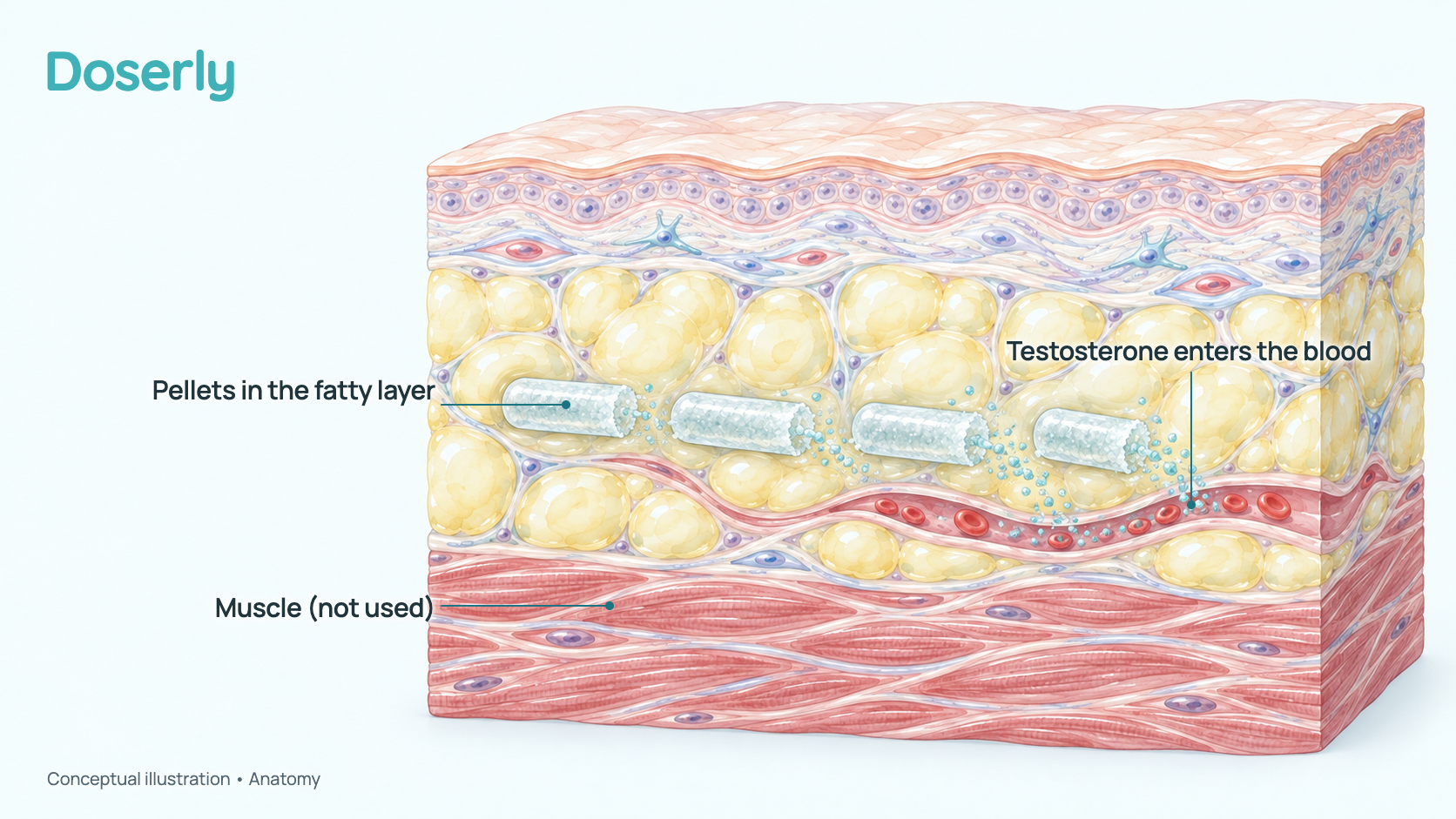
Testosterone pellets are small, solid rods of testosterone that a clinician places subcutaneously, in the fatty layer under the skin of the buttock or flank, through a small cut. They dissolve over months, so one insertion replaces weeks of injections or daily gels. The approved US product is Testopel; compounded pellets made by pharmacies are not FDA-approved. [1], [2], [3]
Each Testopel pellet is a cylinder about 3.2 mm (1/8 inch) across and 9 mm long, holding 75 mg of crystalline testosterone with small amounts of stearic acid and povidone. Unlike injections, the testosterone is not joined to an ester (a chemical tail) or dissolved in oil: the pellet itself is the slow-release store. The label says the pellets "slowly release the hormone for a long acting androgenic effect." [1]
Testopel is labeled for men with hypogonadism (low testosterone from a medical cause): primary hypogonadism, where the testicles fail, or hypogonadotropic hypogonadism, where the brain and pituitary do not send enough signal. Its label still says that safety and benefit in "age-related hypogonadism" have not been established. FDA approved it on July 13, 1972, and it remains the only FDA-approved testosterone pellet; the American Urological Association (AUA) notes that pellets were reformulated in the United States in 2008 and that no generic pellet exists. [1], [4], [2]
| Product | Where | Strength | Status (checked September 2026) |
|---|---|---|---|
| Testopel | United States | 75 mg per pellet; one pellet per vial, in boxes of 10 or 100 | FDA-approved; the only pellet in FDA's product listings |
| Compounded testosterone pellets | United States, made by compounding pharmacies | Varies; the one randomized trial used 100 mg pellets | Not FDA-approved and not generics |
| Older 100 mg and 200 mg implants (Organon) | Used in older research from Australia and Europe | 100 or 200 mg per pellet | Irish licence for the 100 mg implant withdrawn December 19, 2012; no current UK product information |
[1], [4], [5], [3], [6], [7], [8]
Two products share the word "pellet". Testopel is 75 mg per pellet, but most older research, including the release studies, used 100 mg or 200 mg implants. Pellet counts are not interchangeable between them, so this guide says which one each number comes from.
Typical Testosterone Pellet Protocols
| Source | Amount each time | How often | Weekly total | Adjusted by | Source type |
|---|---|---|---|---|---|
| US label · Testopel | 150–450 mg (2 to 6 pellets) | Every 3–6 months | Not applicable | Response and side effects; sized from the weekly injection dose a man needed; no lab value or draw time named | Label |
| American Urological Association (AUA) · Testopel | Start with 10 pellets (750 mg); range 6–12 pellets (450–900 mg) | Every 3–4 months | Not applicable | Level 2 and 12 weeks after each insertion; peak above 1,000 ng/dL: 2 fewer pellets next time, below 500 ng/dL: 2 more | Guideline Placed in the buttock or flank; the guideline's appendix calls reinsertion reasonable once total testosterone falls below 400 ng/dL |
| Endocrine Society 2018 | 600–1,200 mg in total (pellet number depends on the product) | Effect lasts 3–6 months | Not applicable | Level at the end of the interval; change the pellet number or interval to stay mid-normal | Guideline |
| Society for Endocrinology (UK) 2022 · 100 or 200 mg pellets | 3–6 pellets, 600–1,200 mg in total | Every 4–6 months | Not applicable | Not stated; the guideline says pellets are rarely used | Guideline |
| European Association of Urology (EAU) 2026 · 200 mg implants | 4–6 implants (800–1,200 mg) | Lasting up to 6 months | Not applicable | Not stated | Guideline The EAU says implants are available in a limited number of countries |
The label allows 2 to 6 Testopel pellets every 3 to 6 months; the US urology guideline starts with 10 and uses 6 to 12 every 3 to 4 months. The Endocrine Society, UK and European rows total 600–1,200 mg at a time, mostly using older 100 mg and 200 mg implants. [1], [2], [9], [10], [11]
- Titration Adjusting the dose in steps
- A pellet dose can only change at the next insertion. The label adjusts to response and side effects and names no blood test. The urology guideline checks a peak level soon after insertion (2–4 weeks in its main text, 1–4 weeks in its appendix and 2 weeks in its dosing table) and then adjusts the next insertion by 2 pellets: fewer if the peak is above 1,000 ng/dL (34.7 nmol/L), more if it is below 500 ng/dL (17.3 nmol/L). It checks again at about 10–12 weeks and calls reinsertion reasonable once total testosterone is below 400 ng/dL (13.9 nmol/L). The Endocrine Society instead measures at the end of the interval. [2], [9] See why draw timing matters.
- Breaks and cycles
- Not applicable. Testosterone replacement is continuous treatment, and no label or guideline describes planned breaks. Unlike injections, a pellet cannot be paused: the label says that if testosterone has to stop because of complications, "the pellets would have to be removed." (What happens when you stop). [1]
Read the units. Pellets are counted, not measured in mL: 10 Testopel pellets × 75 mg = 750 mg for one insertion, released over months, so it cannot be compared directly with a weekly injection dose. The label's own conversion uses an older, short-acting injection (testosterone propionate): two 75 mg pellets for each 25 mg a week, so a man who needed 75 mg a week would receive 450 mg (6 pellets). Blood results here are in ng/dL with nmol/L; the testosterone unit calculator converts them. [1]
These are labeled and guideline doses; prescribers adjust them using blood tests and symptoms. The ranges above are for adult men. For women, see testosterone therapy for women, which uses different products and far smaller doses.
Cautions for every schedule above. The label rules out testosterone with breast cancer or known or suspected prostate cancer, and in pregnancy. Pellets switch off sperm production (fertility); hematocrit, blood pressure and PSA (prostate-specific antigen, a prostate blood test) need checking (monitoring); and the procedure itself can cause bleeding, infection or pellets working their way out (insertion-site problems). [1]
Where these numbers come from
The label row comes from the current Testopel label (DailyMed version 28, revised July 2025). Its dosing text dates from the 1972 approval; the AUA says the label doses "are not based on current testosterone pellet formulations." [1], [2]
The AUA row comes from its 2018 guideline (validity reconfirmed 2024): Table 2 gives the starting count, range, interval, site and draw times, and the appendix gives the 2-pellet adjustment rule and the 400 ng/dL reinsertion level. The Endocrine Society row comes from its 2018 formulation table, the Society for Endocrinology row from its 2022 guideline (Table 2) and the EAU row from its 2026 male hypogonadism chapter. The Endocrine Society, UK and European rows describe 100 mg and 200 mg implants rather than Testopel; the Endocrine Society notes that the number of pellets varies with the product. [2], [9], [10], [11]
Not used for any row: pellet counts from company or clinic websites, schedules from personal accounts, and body-weight dosing tables that no single source describes. Research regimens appear in the evidence table.
What do clinic protocol sources use?
| Source | Amount each time | How often | Weekly total | Adjusted by | Source type |
|---|---|---|---|---|---|
| US specialist survey (2017) · 87 sexual-medicine specialists | At least 10 pellets (750 mg or more) to start | Every 4 months (the most common answer, 43.7%) | Not applicable | Level at 1 month (72.4%); most men stay on their first dose | Clinic protocol source 80.5% of respondents would start with at least 10 pellets and 4.6% with 6 or 7; 21.8% reinsert every 3 months |
The survey describes practice at US specialist centers. In the AUA's summary of a multi-center series, most cases used 10 or more pellets (63%), 27% used 8 or 9 and 10% used 6 or 7. No provider used 5 or fewer, which covers most of the label's range. [12], [2]
What are testosterone pellets commonly used for?
Their approved use is replacing testosterone in men whose bodies cannot make enough because of a medical condition. The label names testicular failure (from undescended testicles, twisting, infection, removal or a condition present from birth) and a missing signal from the brain or pituitary (from a hormone deficiency, a tumor, injury or radiation). It also allows brief, conservative treatment to start puberty in carefully selected boys with clearly delayed puberty, which is specialist care. [1]
In surveys, men who chose pellets most often cited convenience. In a survey of 113 men using Testopel at one academic clinic, convenience was the top reason for starting (68.8%). In a survey of 382 men on treatment, pellet users favored them for ease of use (64%) and convenience (58%). [13], [14]
What does testosterone replacement improve?
In trials, testosterone treatment for low testosterone mainly improves sexual desire and activity; effects on energy and mood are small or absent. Those findings come mostly from gels: in the Testosterone Trials of men 65 and older, a year of gel improved sexual activity, desire and erections a little, but not energy or walking. [15]
Pellet studies are small and mostly uncontrolled. In 15 men given 12 Testopel pellets (900 mg), erectile function, mood and low-testosterone symptom scores improved over 113 days, with no placebo group. In 37 men on implants for an average of 6.6 years, bone density was normal for their age. [16], [17] See the results timeline guide.
How long do testosterone pellets take to work?
Blood levels rise within days. In a Testopel study (as summarized in the AUA guideline), the average level peaked 1 week after insertion (845 ng/dL, about 29 nmol/L) and was still similar at week 4 (838 ng/dL). Symptoms change more slowly. The Canadian Urological Association tells men to expect changes in libido, energy and sexual function after 3 months or longer. Body composition and bone take 6 months or more, about the length of one pellet cycle. [2], [18], [19]
Where do testosterone pellet protocols differ?
Pellets have fewer moving parts than injections, but sources disagree on four practical questions: how many pellets, how long they last, when to draw blood and whether anything should be added to stretch the interval.
How many pellets: the label or the guidelines?
The label and current practice differ by a factor of two or more. Testopel's label, whose dosing text dates from 1972, allows 2 to 6 pellets (150–450 mg). The AUA says those numbers "are not based on current testosterone pellet formulations and contrast with pharmacokinetic data available," and starts at 10 pellets. A review by one pellet researcher concluded that label doses are too low for most men; that is expert opinion, not a trial result. [1], [2], [20]
The research behind the higher counts:
- Pellet count sets the peak. In a Testopel study whose protocol set 6 to 12 pellets by body mass index (BMI) and starting level, no man qualified for 6 and the median was 10 (the AUA's summary; the abstract reports 8 to 12 pellets given). Average peaks were 746, 866 and 913 ng/dL with 8, 10 and 12 pellets, while the duration was similar. [2], [18]
- Records from six academic centers. In 380 men, 6 to 10 or more pellets (450 to 750 mg or more) kept testosterone above 300 ng/dL for about 4 to 6 months; 10 to 12 gave higher and longer levels, and the authors judged 8 or more optimal. [21]
- Body size matters. In records of 273 men, those with a BMI of 25 or more had lower peaks. The authors advised fewer pellets for men with a BMI under 25, and reinsertion for all men 100 to 120 days after the last one. [22]
One Medicare contractor pays for at most six pellets, the label maximum, so the count can also be a coverage question (costs). [23]
How long does one insertion last?
Anywhere from about 3 to 7 months, depending on the pellet, the dose and what "lasting" means. Some studies measure when levels fall below a cut-off; others measure when symptoms come back.
| Source | Pellets | How long | What was measured |
|---|---|---|---|
| Testopel label | 75 mg | Usually 3–4 months, sometimes up to 6 | "Adequate effect" |
| Six-center records, 380 men | 6 to 10 or more Testopel | About 4–6 months | Total testosterone above 300 ng/dL (10.4 nmol/L) |
| University records, 273 men | 6–12 Testopel | About 100 days | Estimated time to fall to 300 ng/dL |
| Phase IV (after-approval) study, 30 men | Median 10 Testopel | Above 315 ng/dL (10.9 nmol/L) in 100% at 4 weeks, 86% at 12, 75% at 20 and 14% at 24 | Share of men above 315 ng/dL |
| Randomized trial, 33 men | 10 Testopel (750 mg) | Median 290 ng/dL (10.1 nmol/L) at 4 months and 209 ng/dL (7.2 nmol/L) at 6 | Median level |
| Crossover study (each man tried each dose in turn), 43 men | 600 or 1,200 mg of older implants | 4–5 months (600 mg) or 6 months (1,200 mg) | Levels in the normal range |
| Pooled trials, 136 men | 800 mg (4 × 200 mg) | Men returned for reinsertion at 5.8 months | Symptoms coming back |
| EAU guideline 2026 | Implants | 4–7 months | Guideline summary |
[1], [21], [22], [2], [6], [24], [25], [11]
Level-based cut-offs give shorter answers than symptom-based ones, and larger 200 mg implants last longer than 75 mg Testopel pellets.
Why men come back at different times. Over 5 years in 52 men on implants, symptoms returned at a consistent testosterone level for each man, but that level differed markedly between men. Two men with the same pellets can therefore need reinsertion weeks apart. [26]
When should blood be drawn on pellets?
Guidelines disagree on whether to test near the peak or at the end of the cycle, and the same pellets can give very different results depending on the week.
| Source | When to draw | What it is used for |
|---|---|---|
| AUA 2018, main text | 2–4 weeks after the first insertion, then at 10–12 weeks | Checking the peak, then the decline |
| AUA 2018, appendix | 1–4 weeks after insertion; around 3 months; an end-of-cycle level before reinsertion | Sizing the next insertion; confirming levels are low before reinserting |
| AUA 2018, dosing table | 2 and 12 weeks after each insertion | As above |
| Endocrine Society 2018 | At the end of the dosing interval | Changing the pellet number or interval to stay mid-normal |
| US specialist survey | At 1 month (72.4% of respondents); all within 3 months | Practice, not a guideline |
The difference matters. In the 2023 randomized trial, median Testopel levels were 543 ng/dL (18.8 nmol/L) at 2 months and 290 ng/dL at 4 months. The AUA also recommends an end-of-interval level before each reinsertion because levels vary within the same man from cycle to cycle. Recording the insertion date and pellet count next to every result makes results comparable. [6], [2] See TRT blood work for the full picture.
Can anything stretch the time between insertions?
Anastrozole, an aromatase inhibitor (a medicine that blocks the conversion of testosterone to estradiol), has been used off-label for this. In one clinic's records of 38 men and 65 insertions, men who also took anastrozole 1 mg a day went 198 days before reinsertion, compared with 128 days without it. The study was small, retrospective and not randomized. [27]
Anastrozole is not approved for men. The US Department of Veterans Affairs (VA) does not generally recommend aromatase inhibitors as a treatment for low testosterone, citing heart risks, more belly fat and bone loss. In older men with low testosterone, a year of anastrozole 1 mg daily lowered spine bone density compared with placebo. See anastrozole and estrogen on TRT. [28], [29]
What happens when you stop testosterone pellets?
A pellet cannot be switched off. Stopping early means surgery; otherwise the last insertion wears off over months. [1]
- Stopping early. The label says that if testosterone must stop because of complications, "the pellets would have to be removed." No published removal success rates were found; in one case report, six undissolved pellets were found at surgery after 3 years of insertions. [1], [30]
- The last insertion. In the Testopel phase IV study, testosterone and LH (luteinizing hormone, the pituitary signal to the testicles) were back to their starting levels by week 24. [18]
- Your own testosterone. Implants suppress LH for months: in men with primary hypogonadism, whose LH starts high, 600 mg or 1,200 mg of older implants lowered LH to normal levels, with the lowest point at 1 to 3 or 1 to 4 months. No study has tracked hormone recovery after long-term pellet use. [24]
- Sperm. In 9 healthy men given 1,200 mg of implants, sperm output was near zero from the second to the fourth month and back to normal by the sixth. After hormonal contraceptive regimens in 1,549 healthy men, sperm returned to 20 million per mL in 67% within 6 months, 90% within 12 months and 100% within 24 months. [31], [32]
- Tapering. Pellets taper by themselves as they dissolve; the Canadian Urological Association says no taper is needed when stopping testosterone. [19]
See stopping TRT for the full picture, including fertility recovery.
How do testosterone pellets compare with other forms?
Pellets are the least frequent way to take testosterone and the hardest to adjust. The label says pellet implantation "is much less flexible for dosage adjustment" than oral forms or injections, so "great care should be used when estimating the amount of testosterone needed." [1]
How do pellets release testosterone?
The pellet dissolves slowly in the fatty tissue. Testopel's label says about one-third is absorbed in the first month, one-quarter in the second and one-sixth in the third, which suggests release slows over time. Measured studies of older implants found absorption close to constant ("zero-order") for most of the pellets' life. Testosterone itself is cleared from the blood within minutes to under 2 hours (the label gives a half-life of 10 to 100 minutes), so the pellet's slow dissolving sets the interval. [1], [2], [24]
- Older implants, 43 men: levels peaked at month 1; release was about 1.5 mg a day per 200 mg pellet, with half the dose absorbed in about 2.5 months. [24]
- 1,200 mg of 200 mg implants, 14 men: a short burst to 49.0 nmol/L (about 1,410 ng/dL) half a day after insertion, a plateau to day 63, then below 10 nmol/L (about 290 ng/dL) after 180 days. [33]
- 12 Testopel pellets, 15 men: levels swung between 300 and 1,000 ng/dL in the first 2 weeks, then stayed at or above 300 ng/dL through day 113. [16]
In a small randomized crossover, pellets gave "the closest approximation to zero-order (steady-state) delivery conditions for up to 4 months" of the forms tested. So pellets are steadier week to week than short-acting injections, but not flat: levels are highest in the first weeks and fall across the interval. [34]
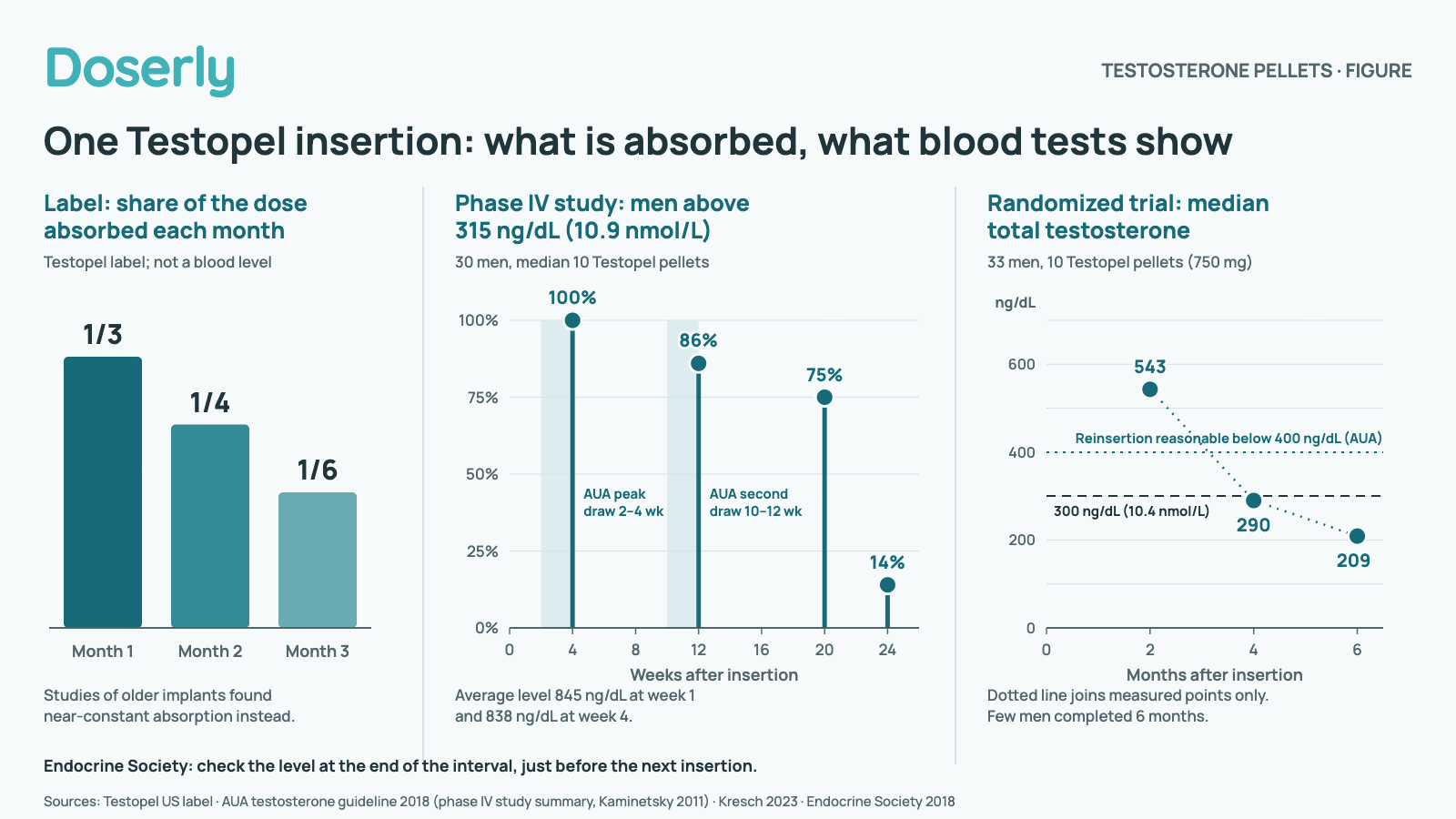
One Testopel insertion: what is absorbed, what blood tests show
Label: share of the dose absorbed each month
Testopel label figures, not a blood level. Studies of older implants found near-constant absorption instead.
- Month 1
- About one-third (1/3) of the dose
- Month 2
- About one-quarter (1/4) of the dose
- Month 3
- About one-sixth (1/6) of the dose
Phase IV study: men above 315 ng/dL (10.9 nmol/L)
30 men, median 10 Testopel pellets. Average level 845 ng/dL at week 1 and 838 ng/dL at week 4.
- Week 4
- 100% of men above 315 ng/dL
- Week 12
- 86% of men above 315 ng/dL
- Week 20
- 75% of men above 315 ng/dL
- Week 24
- 14% of men above 315 ng/dL
Randomized trial: median total testosterone
33 men, 10 Testopel pellets (750 mg). Dashed mark: 300 ng/dL (10.4 nmol/L). Few men completed 6 months.
- Month 2
- Median 543 ng/dL
- Month 4
- Median 290 ng/dL
- Month 6
- Median 209 ng/dL
When blood is drawn
- Urology guideline (AUA)
- A peak level 2–4 weeks after insertion, a second level at 10–12 weeks, and an end-of-cycle level before reinsertion. Reinsertion is reasonable once the level is below 400 ng/dL.
- Endocrine Society
- A level at the end of the interval, just before the next insertion.
Levels are highest in the first weeks after insertion and fall across the cycle, so a result only makes sense next to the week it was drawn.
What happens at the insertion visit?
Insertion is a short procedure done in a clinic, not at home. The clinician makes a small cut in the skin and places the pellets along one or more short tracks in the fatty tissue. The AUA lists the buttock and flank for Testopel; older implant studies in Australia and Germany used the abdominal wall. The Endocrine Society lists the need for a surgical cut, pellets coming out on their own, and rare hematoma (a pocket of blood) and infection as the main drawbacks. [2], [35], [33], [9]
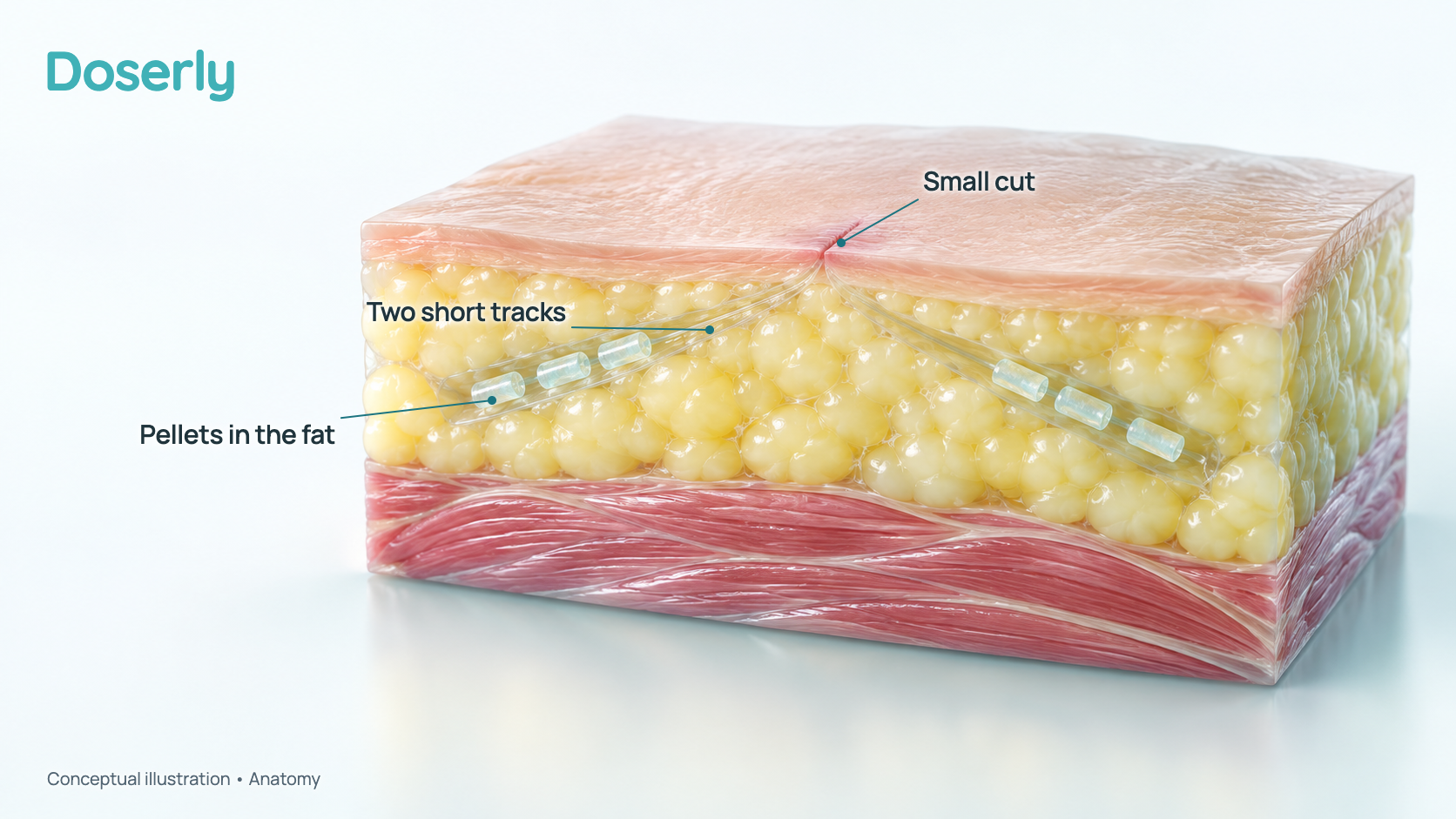
How and where the pellets are placed affects how often they come out (insertion-site problems). In the Testopel phase IV study, bruising (32–36% of men), tenderness (20–32%), pain (28–29%) and swelling (16–18%) were common but mild and gone by 4 months; in the six-center records, no man needed pain medicine. [2], [21]
Aftercare. No guideline or label gives activity rules after insertion; the label says most reported infections and extrusions happened in the first month. The largest database of compounded implants, written by the founder of the pellet company whose records were analyzed, says men were told to avoid strenuous buttock exercise, baths and swimming for 7 days. [1], [36]
Are pellets steadier than injections?
Week to week, yes; over a whole cycle, not necessarily. In the only randomized comparison of implants with a long-acting injection (undecanoate), in 38 men, the two gave different blood-level profiles but no consistent clinical differences, and 91% chose the injection at the end. Satisfaction surveys point both ways: in 382 men, 70% were satisfied with pellets, 73% with injections and 68% with gels; in a 140-man survey, 90.0% of pellet users were satisfied, compared with 67.5% of men on intramuscular injections. Of 113 Testopel users at one clinic, 28.3% had stopped, most often because of cost (50%). [37], [14], [38], [13]
Testopel and compounded pellets: what is the difference?
Testopel is the only FDA-approved testosterone pellet. It is 75 mg of crystalline testosterone per pellet, made for Endo, and sold one pellet per sterile vial. Compounded pellets are made by pharmacies in sizes such as 100 mg or 200 mg. FDA says drugs made by compounders, including outsourcing facilities, "are not FDA-approved." Compounded pellets are also not generics: the AUA notes that pellets are "available in branded form, with no generic agents currently available." [1], [4], [39], [3], [2]
The evidence. One randomized trial compared them. In 75 men at a US university center, 10 Testopel pellets (750 mg) and 8 compounded 100 mg pellets (800 mg) gave similar levels: medians of 543 vs 696.5 ng/dL at 2 months and 290 vs 277 ng/dL at 4 months. The registry reported one extrusion in the Testopel group (1 of 33) and none in the compounded group, with no serious adverse events. Few men stayed for the full 6 months (9.1% and 16.7%), and the doses were not equal. [6], [39]
What regulators and guidelines say.
- The AUA advises commercially made testosterone over compounded products when possible, and the Endocrine Society says there is no evidence-based need for compounded hormones when an FDA-approved product is available. [2], [40]
- In 2020, a National Academies committee recommended that FDA's compounding advisory committee consider all compounded hormone pellets as candidates for its Difficult to Compound List. FDA has not added pellets to that list. Its only proposal so far, a March 2024 proposed rule, names three other kinds of product (such as liposome medicines) and has not been finalized (checked September 2026). [41], [42], [43]
- In 2019, FDA reported that an inspection of one compounded-pellet company found 4,202 adverse events that had never been reported to the agency; it could attribute 61 of them, such as pellet extrusion and cellulitis, to compounded pellets containing testosterone. [44]
How they differ on paper:
- Dose. A Testopel count and a compounded count are not interchangeable: 10 × 75 mg is 750 mg, while 8 × 100 mg is 800 mg and 8 × 200 mg is 1,600 mg.
- Label and warnings. Testopel has an FDA label with warnings about implant-site infection, extrusion and blood clots; compounded products have none. The Medicare coverage article reviewed names Testopel (costs). [1], [23]
Forum threads often use company names for pellet programs. A company's name does not tell you which product it uses; asking whether the pellets are Testopel or compounded, and what each pellet contains, does.
How should Testopel be stored?
Clinics store it, not patients: Testopel is kept at 25 °C (77 °F), with short excursions to 15–30 °C allowed, in single sterile vials. Once implanted there is nothing to store or carry, which some men value when traveling; see traveling with testosterone for the rules on carrying other forms. [1]
What do testosterone pellets do to fertility, estrogen and red blood cells?
These three effects come with every form of testosterone, and each has its own hub guide. Here is what is specific to pellets.
Fertility. Implants switch off sperm production like other testosterone. In 9 healthy men given 1,200 mg, sperm output was near zero from the second to the fourth month, and 5 of the 9 had no sperm at all (azoospermia) at some point. In a contraception study, implants alone kept sperm below 1 million per mL in about 70% of 29 healthy men. The AUA says testosterone should not be prescribed to men trying to conceive, and pellets cannot be stopped quickly if plans change. See TRT and fertility. [31], [45], [2]
Estrogen. Some testosterone is converted into estradiol. In the 273-man Testopel records, estradiol rose with 10 to 12 pellets but not with 6 to 9; with 1,200 mg implants, it was raised from day 21 to day 105. No guideline sets a routine estradiol target: the AUA measures it mainly when breast symptoms appear. See estrogen on TRT. [22], [33], [2]
Red blood cells. In comparisons with injections, pellets raised hematocrit less, but on pellets the rise builds over time:
- Compared with other forms. In one clinic's records of 178 men, hematocrit above 50% occurred in 66.7% of the 57 on injections, 35.1% of the 74 on pellets and 12.8% of the 47 on gels; the injection group was younger. In 78 matched men at 16 weeks, hematocrit rose 4.4 points on injections and 1.7 on pellets, and fell 0.8 on nasal testosterone. [46], [47]
- Over time on pellets. In 228 men receiving an average of 12 pellets, hematocrit above 50% had occurred in 10.4% by 6 months, 17.3% by 12 months, 30.2% by 24 months and 41.8% by 36 months. Higher BMI raised the risk. In a smaller series, average hematocrit rose from 43.9% to 46.1%. In men treated for up to 21 years, higher end-of-cycle testosterone, not years on treatment, predicted high hematocrit. [48], [49], [50]
See hematocrit on TRT for guideline thresholds and what is done about a high result.
What do we actually know about testosterone pellets in people?
That pellets restore testosterone is settled; they have been used for decades and are labeled for that. What is thinner is everything else: the pellet literature is mostly small studies, clinic records and older implant research, and no pellet trial has measured heart attacks, strokes, fractures or deaths.

Which studies used pellets?
| Study | Who and what | What it found | What it cannot show |
|---|---|---|---|
| Kresch 2023 (randomized trial) | 75 men; Testopel 10 × 75 mg vs compounded 8 × 100 mg, one insertion | Similar levels; medians 290 vs 277 ng/dL at 4 months; one extrusion; most men still followed (82%) below 300 ng/dL by the end | Only 3 of 33 Testopel men finished 6 months; unequal doses; one center [6] |
| Fennell 2010 (randomized crossover) | 38 men; older implants vs undecanoate injections | Different blood-level profiles, no consistent clinical differences; 91% chose the injection | Older implants; one center [37] |
| Conway 1988 (randomized crossover) | 15 men; implants vs injections vs oral undecanoate | Pellets gave the steadiest delivery for up to 4 months | Small; older products [34] |
| McCullough 2012 (records) | 380 men, 702 Testopel insertions | Above 300 ng/dL for about 4–6 months; 8 or more pellets best | Retrospective; no comparison group [21] |
| Kaminetsky 2011 (open-label) | 30 men, median 10 Testopel | Peak 845 ng/dL at week 1; 14% above 315 ng/dL at 24 weeks; PSA unchanged | No comparison group [18], [2] |
| McMahon 2017 (open-label) | 15 men, 12 Testopel (900 mg) | At or above 300 ng/dL through day 113; symptom scores improved | Small; no placebo [16] |
| Rotker 2018 (records) | 228 men, mean 12 pellets | Hematocrit above 50% in 30.2% by 2 years | Retrospective; one institution [48] |
| Handelsman 1992 | 9 healthy men, 1,200 mg of implants | Sperm near zero in months 2–4, normal by month 6 | Healthy volunteers, not men with hypogonadism [31] |
The randomized pellet trials were small or short, and several used implants that are no longer sold; randomized trials of insertion technique are covered under site problems. No systematic review of pellets alone was found, and a 2026 study of 200 mg implants registered in Brazil has not reported. [51]
What did the large trials of other forms find?
- TRAVERSE (about 5,200 men, daily gel): heart attack, stroke or heart death in 7.0% vs 7.3% on placebo, which met the trial's safety margin, but more heart-rhythm, kidney, clot and fracture events. It tested only a gel, for 21.7 months on average, and about 61% stopped their study gel early (full results). [52], [53]
- Testosterone Trials (790 men aged 65 or older, gel for 1 year): small gains in sexual function and mood; no gain in energy or walking in the physical function trial. [15]
Whether those results transfer to pellets is not known. Pellets give a high level in the first weeks and a lower one near the end of each cycle, which neither trial tested.
How do testosterone pellets work?
Once implanted, the crystalline testosterone dissolves into the surrounding tissue and passes into small blood vessels. With no ester to remove and no oil depot, the pellet's dissolving rate sets the dose over time. Testosterone then acts like the body's own hormone: in many tissues it works after conversion to dihydrotestosterone (DHT), and some becomes estradiol. In the blood about 98% is bound to proteins, mainly sex hormone-binding globulin (SHBG); studies disagree on whether pellets change SHBG. [1], [24], [33]
Why it switches off your own production. The brain senses testosterone from any source. When levels are high, the pituitary lowers its LH signal to the testicles, and at large doses its FSH signal too, so the testicles make less testosterone and sperm production falls. [1], [24]
Why it raises red blood cells. Androgens stimulate red blood cell production; the label describes this as increased production of an erythropoietic (red-cell-making) factor. [1]
What are the risks and unanswered questions?
Are testosterone pellets safe?
For men with a confirmed diagnosis and regular monitoring, pellets deliver ordinary testosterone and share its known risks: a rise in red blood cells, blood clots, higher blood pressure, fluid retention, breast enlargement, prostate effects and loss of fertility. Pellets add two of their own: problems at the insertion site, and a dose that cannot be lowered until the pellets dissolve or are removed. What remains uncertain is long-term heart safety with pellets specifically, since no outcome trial used them. [1], [52]
What can go wrong at the insertion site?
Extrusion (a pellet working its way back out through the skin) and infection are the main pellet-specific problems, and their rates vary more than tenfold between studies. The label says reported signs include hardness, inflammation, fibrosis (scar tissue), bleeding, bruising, wound drainage, pain, itching and pellets coming out, and that most reported cases happened in the first month. [1]
| Series | Pellet | Procedures | Extrusion | Infection | Other |
|---|---|---|---|---|---|
| One US clinic, 2003–2008 | Testopel | 292 | 0.3% (1) | 0.3% (1) | 86% of men satisfied |
| One US clinic, single-track technique | Testopel | 40 | 7.5% | 5% | Pain leading to stopping 7.5% |
| Same clinic, two-track "V" technique | Testopel | 241 | 0.8% | 1.2% | Hematoma 1.2% |
| Randomized trial, 2023 | Testopel | 33 | 1 of 33 | None reported | No serious adverse events |
| Sydney implant unit, 13 years | Older 200 mg implants | 973 | 8.5% | 0.6% | Bleeding 2.3% |
| Randomized trial, 1999 | Older 200 mg implants | 251 | 11.1–12% | 4.0% | Bleeding or bruising 8.8% |
| Compounded-pellet company database (mostly women) | Compounded | Men's procedures only | 2.58% | 0.41% (cellulitis) | Practitioner-reported; written by the company's founder |
[54], [55], [6], [39], [56], [57], [36]
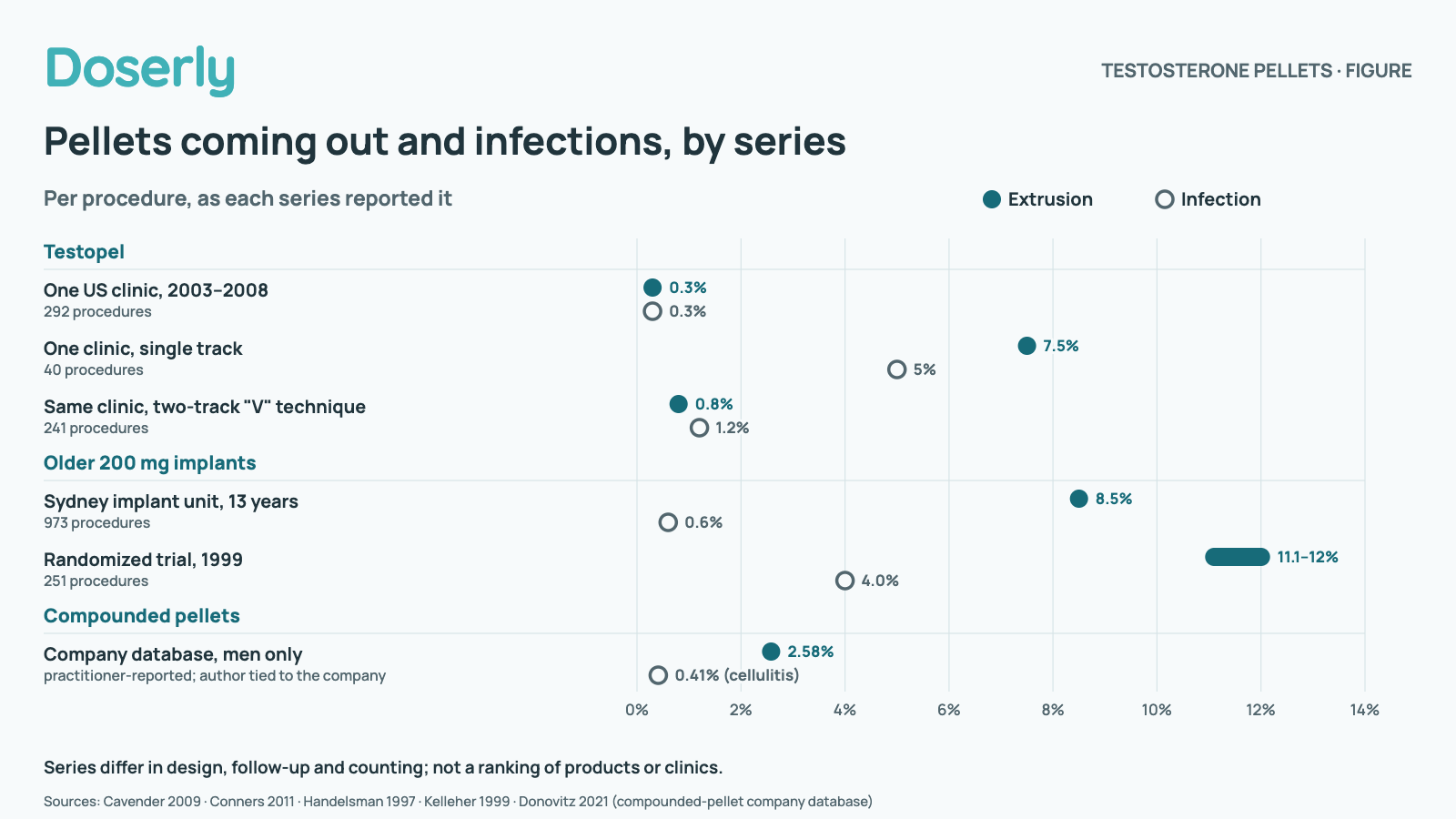
Pellets coming out and infections, by series
Extrusion (top line)Infection (bottom line)Scale 0–14% per procedure
Testopel
- One US clinic, 2003–2008
- 292 procedures. Extrusion 0.3%; infection 0.3%.
- One clinic, single track
- 40 procedures. Extrusion 7.5%; infection 5%.
- Same clinic, two-track "V" technique
- 241 procedures. Extrusion 0.8%; infection 1.2%.
Older 200 mg implants
- Sydney implant unit, 13 years
- 973 procedures. Extrusion 8.5%; infection 0.6%.
- Randomized trial, 1999
- 251 procedures. Extrusion 11.1–12%; infection 4.0%.
Compounded pellets
- Company database, men only
- Practitioner-reported; author tied to the company. Extrusion 2.58%; infection 0.41% (cellulitis).
Series differ in design, follow-up and counting; not a ranking of products or clinics.
What these numbers suggest:
- Technique and site matter. One clinic's extrusions and infections fell after it switched from a single track to two tracks fanning out from the same cut (a "V" technique), though that was not a randomized comparison. In randomized trials of older implants, the hip had more extrusions than the abdominal wall (12% vs 5%), one operator had fewer problems than the others, and washing pellets or soaking them in antibiotic did not help. [55], [35], [57], [58]
- Infection often leads to extrusion. In the 1999 trial, 6 of 10 treated infections were later followed by extrusion. [57]
- Rare problems. Case reports describe an inflamed fat reaction around six undissolved pellets found at surgery, and a recurring skin rash on the buttocks and thighs within 28 days of each Testopel insertion. [30], [59]
- Blood thinners. In one clinic, 1 of 59 insertions in men on blood thinners was followed by a hematoma, but the AUA notes that many clinicians remain cautious about pellets in this group. [55], [2]
What side effects does the label list?
The label lists breast enlargement (gynecomastia), frequent or prolonged erections, low sperm counts at high doses, excess body hair, male-pattern hair loss and acne. It also lists retention of salt and water, nausea, jaundice and liver test changes, a rise in red blood cells (polycythemia), increased or decreased libido, headache, anxiety, depression, tingling, raised cholesterol and blood clots in veins, and heart attack and stroke reported after marketing. It also lists bleeding in men on blood thinners and, rarely, liver tumors and allergic reactions. [1]
Do testosterone pellets affect the heart?
No trial has measured heart outcomes with pellets. The best evidence on testosterone and the heart comes from TRAVERSE, a randomized trial of about 5,200 men aged 45 to 80 with heart disease or high heart risk, given daily testosterone gel or a placebo gel. Among the 2,596 men who used testosterone gel and the 2,602 who used placebo gel, it found:
- Heart attack, stroke or heart death: 182 men (7.0%) on testosterone vs 190 (7.3%) on placebo. The hazard ratio (the risk on testosterone relative to placebo) was 0.96, and the likely range was 0.78 to 1.17 (the 95% confidence interval). The top of that range stayed below the trial's safety margin of 1.5, so a large rise in risk was ruled out. [52], [53]
- Heart rhythm: atrial fibrillation 3.5% vs 2.4%; nonfatal rhythm problems needing treatment 5.2% vs 3.3%. [53]
- Kidneys: acute kidney injury 2.3% vs 1.5%. [53]
- Clots: venous clots 1.7% vs 1.2%, including pulmonary embolism 0.9% vs 0.5%. [53]
- Fractures: 91 of 2,601 men (3.50%) vs 64 of 2,603 (2.46%), counting every randomized man. [60]
- Blood pressure: systolic pressure rose 1.0 mm Hg on testosterone and fell 0.5 mm Hg on placebo by 36 months. [53]
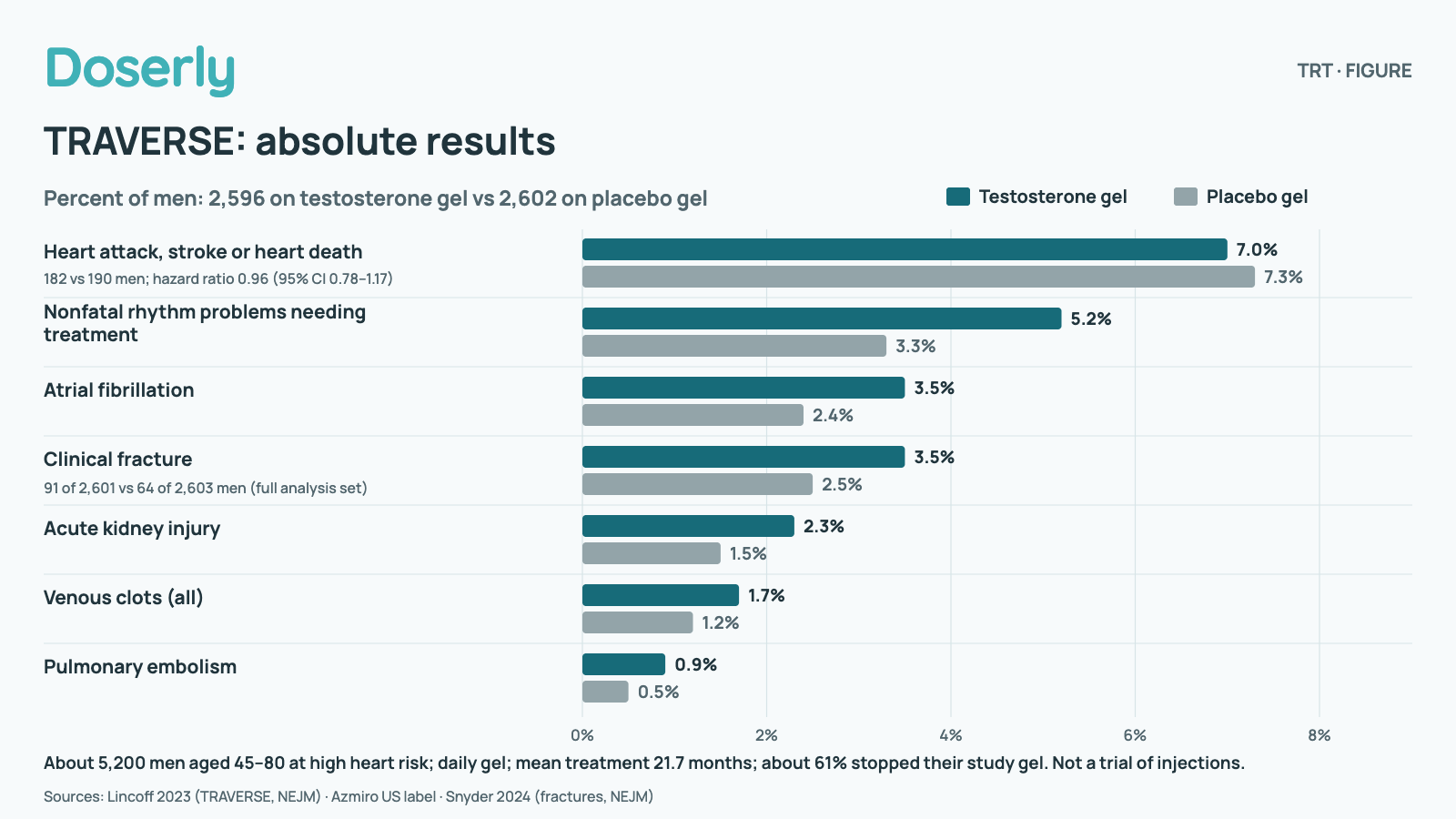
TRAVERSE: absolute results
Testosterone gel (2,596 men)Placebo gel (2,602 men)
- Heart attack, stroke or heart death
- Testosterone 7.0% vs placebo 7.3% (182 vs 190 men; hazard ratio 0.96, 95% CI 0.78–1.17; met the 1.5 safety margin)
- Nonfatal rhythm problems needing treatment
- Testosterone 5.2% vs placebo 3.3%
- Atrial fibrillation
- Testosterone 3.5% vs placebo 2.4%
- Clinical fracture
- Testosterone 3.5% vs placebo 2.5% (91 of 2,601 vs 64 of 2,603 in the full analysis set)
- Acute kidney injury
- Testosterone 2.3% vs placebo 1.5%
- Venous clots (all)
- Testosterone 1.7% vs placebo 1.2%
- Pulmonary embolism
- Testosterone 0.9% vs placebo 0.5%
About 5,200 men aged 45–80 at high heart risk; daily gel; mean treatment 21.7 months; about 61% stopped their study gel. Not a trial of pellets or injections.
Its limits matter for pellets. TRAVERSE tested only a gel, the average man used it for 21.7 months, about 61% stopped their study gel early, and it enrolled men at high heart risk. It did not test the high early levels and the gradual hematocrit rise seen with pellets. [52], [53]
Which label says what. In February 2025 FDA added the TRAVERSE results to testosterone labels and required blood-pressure warnings. The Testopel label, revised in July 2025, has the blood-pressure warning but still carries the older statement that long-term trials of heart outcomes "have not been conducted" (checked September 2026). It has no boxed warning. [61], [1]
See TRT and heart health for the full picture.
What about blood clots, blood pressure and fluid retention?
- Blood clots. The label reports clots in the legs (deep vein thrombosis) and lungs (pulmonary embolism) after marketing. Leg pain, swelling, warmth or redness, or sudden shortness of breath need urgent assessment, and the label says to stop treatment if a clot is suspected, which with pellets means removal. [1]
- Blood pressure. The label says testosterone can raise blood pressure, advises checking it periodically and says it is not recommended with uncontrolled high blood pressure. [1]
- Fluid retention. Swelling, with or without heart failure, can be serious in people with heart, kidney or liver disease. [1]
- Kidney stones. In a large insurance-records study, stones were more common on testosterone overall, but the difference was not significant for pellets. [62]
Could testosterone pellets affect the prostate?
Testosterone can enlarge the prostate and raise PSA slightly; in TRAVERSE, PSA rose about 0.15 ng/mL more than on placebo at 12 months. The Testopel label contraindicates it in known or suspected prostate cancer and warns that men treated with androgens may be at increased risk of prostate enlargement and prostate cancer. In TRAVERSE, which excluded men with PSA above 3.0 ng/mL, high-grade prostate cancer occurred in 5 of 2,596 men on testosterone (0.19%) vs 3 of 2,602 on placebo (0.12%), a difference that was not significant. In pellet studies, PSA did not change over 24 weeks, and in the 273-man records, no PSA recurrences occurred in men who had been treated for prostate cancer. [63], [1], [18], [22] See TRT and the prostate.
Are testosterone pellets legal? Are they FDA approved?
Checked September 2026. Rules differ by country and change often.
United States. Testopel is an FDA-approved prescription medicine, and testosterone is a Schedule III controlled substance in the United States. The key points:
- Products. Testopel (approved July 13, 1972) is the only approved testosterone pellet. Compounded pellets are made by pharmacies and are not FDA-approved. [4], [3], [64]
- Since 2015. FDA has required testosterone labels to say that safety and benefit in "age-related" low testosterone have not been established; the current Testopel label says this and also warns about abuse and dependence. [61], [1]
- February 28, 2025. FDA added TRAVERSE results and blood-pressure warnings to testosterone labels; Testopel's July 2025 label has the blood-pressure warning. [61], [1]
- June 18, 2026. The Department of Health and Human Services (HHS) announced that FDA is requesting label changes: removing the age-related limitation, contraindicating testosterone only in metastatic prostate cancer and revising the prostate-enlargement warning. These are requests; the Testopel label still carries the old wording. [65], [1]
Canada. Testosterone is a Schedule IV controlled substance in Canada. No human testosterone pellet is authorized: the only testosterone implants in Health Canada's product database are veterinary, and the Canadian Urological Association's table of approved formulations lists no pellets. [66], [67], [19]
United Kingdom. Testosterone is a Class C controlled drug (Schedule 4 Part II) in the UK and prescription-only. No testosterone implant has current UK product information, and the Society for Endocrinology describes pellets as "rarely administered." [68], [8], [10]
European Union. Rules are national. Ireland withdrew the licence for Organon's 100 mg implant on December 19, 2012. The European Academy of Andrology wrote in 2020 that implants were not available in European countries except the UK, and the EAU says they are available in a limited number of countries. [7], [69], [11] See TRT in Europe.
Australia. Testosterone is a Schedule 4 (prescription-only) medicine in Australia, with extra controls on possession. Whether any testosterone implant is currently registered could not be confirmed for this guide. [70]
Are testosterone pellets banned in sport?
Yes. Testosterone is on the World Anti-Doping Agency (WADA) Prohibited List in class S1, banned in and out of competition, and the 2027 list keeps that from January 1, 2027. Athletes with a medical need can apply for a therapeutic use exemption, which WADA grants only when low testosterone has an organic cause (such as a testicular or pituitary disorder), not for age, obesity or earlier steroid use. A pellet keeps releasing testosterone for months and cannot be stopped quickly. [71], [72], [73]
Who should be especially cautious?
- Men who want children now or soon. Testosterone suppresses sperm production, guidelines advise against it for men trying to conceive, and a pellet cannot be stopped quickly. [2], [31]
- Men with prostate or breast cancer. Contraindicated on the current US label (known or suspected prostate cancer). [1]
- Heart, kidney or liver disease, or high blood pressure. Fluid retention and blood-pressure rises can worsen these. [1]
- High hematocrit, a history of clots or untreated severe sleep apnea. Several guidelines treat these as reasons not to start, and with pellets the dose cannot be cut quickly if hematocrit climbs. [9], [11], [28]
- Men starting testosterone for the first time. The label warns that pellet doses are hard to adjust and urges "great care" in estimating the amount. [1]
- Men on blood thinners. The label says people on oral blood thinners need close monitoring when testosterone is started or stopped, and insertion can cause a hematoma. [1], [2]
- Women and children. Testosterone can harm an unborn baby; these guides are for men. Use in teenagers is specialist care only, because it can close growth plates early. Pellets are one of two testosterone forms FDA-approved for adolescent males in the US; in 18 boys in specialist care no pellets came out in 156 insertions. [1], [74], [75]
- Drug-tested athletes. Banned at all times. [71]
Can testosterone pellets be used with other medicines?
The label lists three interactions:
- Blood thinners (oral anticoagulants). Some androgens lower the dose of blood thinner needed; the label says people on them need close monitoring, especially when testosterone is started or stopped. [1]
- Insulin and diabetes medicines. Testosterone can lower blood sugar and insulin needs. [1]
- Oxyphenbutazone. Levels of this older anti-inflammatory can rise. [1]
Testosterone can also lower thyroxine-binding globulin, which changes total thyroid hormone results without changing thyroid function. Guidelines discuss hCG, clomiphene and aromatase inhibitors alongside testosterone for fertility or estrogen questions; see TRT and fertility and estrogen on TRT. Bring a full list of everything you take, including supplements, to a pharmacist or doctor. [1]
Does insurance cover testosterone pellets, and what do they cost?
Checked September 2026.
There is no single price. Pellets involve the medicine, a clinic procedure and follow-up blood tests, and costs depend on the clinic, insurer and product. No official price for Testopel or for compounded pellets was found. Out-of-pocket amounts that people report are in the community section; they are personal accounts, not a price survey.
- Medicare. Since January 1, 2026, a 75 mg testosterone pellet is billed under code J1073. One regional Medicare contractor covers Testopel for its approved use but only "the number of pellets actually implanted in the patient (maximum of six pellets)," and does not cover wasted pellets. Other contractors and private insurers set their own rules. [76], [23]
- Cost and stopping. In the 113-man survey, cost was the most common reason for stopping pellets (50% of the 32 men who stopped). [13]
FDA's drug shortage data lists no testosterone shortage (checked September 2026). [77]
What should be monitored while using testosterone pellets?
The label asks for periodic hemoglobin and hematocrit checks in men on high doses, blood pressure checks and attention to the insertion site, with no testosterone draw time or numeric hematocrit limit; the numbers come from guidelines. Use this summary to prepare questions for your prescriber; it is not a personal testing plan. [1]
| Why it matters | What labels and guidelines say | Tracking category |
|---|---|---|
| Testosterone level | AUA: 2–4 weeks after the first insertion, then at 10–12 weeks, with an end-of-cycle level before reinsertion; then every 6–12 months. Endocrine Society: at the end of the interval (timing) | Blood work; Libido; Energy Levels |
| Hematocrit | Label: periodically. Endocrine Society: baseline, 3–6 months, then yearly; stop if above 54% until it falls. AUA: intervene at 54% or higher. With pellets, a lower dose has to wait for the next insertion | Blood work |
| PSA and prostate | AUA: PSA before starting in men over 40. Endocrine Society: urology referral if PSA rises by more than 1.4 ng/mL in the first 12 months or exceeds 4.0 ng/mL | Blood work; Urinary Symptoms |
| Blood pressure | Label: check periodically; not for uncontrolled high blood pressure | Blood Pressure |
| Insertion site | Label: watch for hardness, redness, drainage, pain or a pellet coming out, mostly in the first month | Other (site notes) |
| Breasts, mood, sleep | Label lists breast enlargement, mood changes and other androgen effects | Hormonal Symptoms; Mood & Wellbeing; Sleep Quality |
| Fertility | Semen analysis only if fertility matters; testosterone suppresses sperm production | Other (semen result) |
The European urology guideline monitors testosterone and hematocrit at 3, 6 and 12 months and then yearly. See TRT blood work and hematocrit on TRT. [11]
Write down the cycle day. For every testosterone result on pellets, note the insertion date, the number and size of pellets and how many weeks had passed. A result without that timing is hard to interpret. [2]
What do people in public communities report?
Pellets divide opinion in public forums more than most forms of testosterone: some men describe years of easy, steady treatment, and others describe crashes, lumps and levels they could not bring down. The accounts below come from public Reddit threads posted from September 2025 to September 2026 and are described without identifying anyone.
What do the positive reports look like?
Convenience comes up again and again. One man who received 8 pellets (1,600 mg, above the 600–1,200 mg that guidelines describe) in the flank said he liked not injecting every week, found travel easier and felt more social, with libido "way up". His readings went from 192 before treatment to 1,003 a month after insertion and 534 before his second insertion 5 months later. Another, whose level had been 187, said "life was great for years" on pellets twice a year, felt worse after a switch to twice-weekly injections, and said he was back to normal a month after returning to pellets. [78], [79]
Long use without problems comes up too. One man said pellets "worked great" for about 12 years, until scar tissue made adding more difficult. In a thread asking why everyone does not use pellets, several replies described years of insertions every 5 to 6 months with little trouble. A 55-year-old who disliked the highs and lows of weekly injections found his energy steadier on pellets, though he also started a daily erection medicine and kept losing weight. [80], [81], [82]
What does insertion and recovery look like?
Recovery ranges from a few days to a couple of weeks. The man with 8 flank pellets was sore for about a week and skipped workouts for 10 to 12 days. Another took a day off work after an upper-buttock insertion and was still sore days later. One man was given antibiotics after insertion and had 1 to 2 weeks of soreness that stopped him training legs; most replies said they had never been given antibiotics. [78], [83], [84]
Some site problems lasted longer:
- Pellets coming out. A 29-year-old who felt "great" as his level rose from 380 to nearly 700 over 6 months decided against more pellets after his body "rejected" two of them. [85]
- Infection. One man developed an abscess that cleared within 3 weeks; another said a past insertion was very painful and became infected. [86], [87]
- Lumps and scarring. After 5 years of 12 pellets per insertion, one man had a marble-sized lump at one site and a golf-ball-sized lump at another, still there 2 years after he switched to injections. A wife described her husband's site as very sore, with pellet material sticking out where his belt sits. [88], [89]
What do people say about the end of the cycle?
The "crash" near the end of a cycle comes up often. One man felt at his best in week 3 and had "absolutely crashed" by week 10; his doctor suggested waiting it out or adding more pellets. After 5 years, another said each insertion was lasting less time, and his pellet clinic would not prescribe injections instead. [90], [91]
Does everyone respond?
No, and the same man can respond differently from one insertion to the next:
- Too low. One man's level went from 120 ng/dL before treatment to 280 at 1 month and 180 at 3 months on 8 Testopel pellets, and he felt terrible for about 6 weeks while his urologist planned more pellets. Another rose from 100 to only 230 at a 6-week peak; on weekly injections, his level before the next dose was 701 at 9 weeks and his midday fatigue was much better. [92], [93]
- Too high. A man's second round produced a level of 2,110 a month after insertion, after a first round that "went fine." A 41-year-old measured above 1,500 four weeks after insertion, with headaches, light-headedness and a hematocrit up from 47.4 to 50.7. He planned one fewer pellet next time. [94], [95]
- Stuck at the peak. A 49-year-old described peaks of 1,900 to 1,980 over 2.5 years, with palpitations, anxiety, a high hematocrit and blood pressure of about 149/105, compared with 125/80 at a level near 800. "I really couldn't get the pellets out," he wrote; he waited them out and moved to weekly injections, while crediting treatment with improving his bone density. [96]
- Different each round. One man's first round of 12 × 200 mg pellets (2,400 mg, twice the top of the guideline range) pushed his level above 1,600 for about 6 weeks with strong effects, plus water retention and mood changes. After a second round of 11 pellets he "felt absolutely nothing," and bloodwork 3 months later was a little below his pretreatment level. A thyroid problem was found and treated at the same time. [97]
What do people report about hematocrit and add-on medicines?
Pellets are sometimes chosen to protect hematocrit, with mixed results. A 65-year-old was moved to Testopel partly because his new doctor expected it to raise his blood counts less; his level on pellets was 495, below the 800 to 950 he had on injections, and his hematocrit (53.5) stayed high. Another man's doctor proposed pellets for a season at altitude for the same reason. [98], [99]
Add-on medicines complicate the stories. One man felt great for about 3 weeks; at 2 months his level was 997 and his estradiol 58, and after 2 weeks of anastrozole his libido dropped and had not recovered by month 4. A couple trying to conceive had to wait for pellets inserted in June to wear off; they started hCG and had to go to a fertility clinic to get a semen analysis. [100], [101]
What do people report about costs and access?
Men describe paying out of pocket. A man who travels for work several times a month, and did not want to carry needles and vials, paid $750 for one insertion. Two long-term users paid $800 an insertion, and one man paid $940 an insertion two or three times a year; he felt "amazing" on pellets but switched to cream because of the cost. The traveler's level was 1,338 three weeks after insertion, up from 176, with more energy and libido but also testicular shrinkage and more aggression. [102], [79], [81], [103]
Others come to pellets from injection problems. A man with itchy reactions to injection oils was offered 7 or 8 pellets of 75 mg (525 to 600 mg), using a conversion like the label's. After 16 years of weekly thigh injections, another asked about Testopel because of scar tissue; it was the only pellet his insurance covered. A man in recovery from alcohol use disorder, who sometimes took more injected testosterone than prescribed, wondered whether pellets would take the dose out of his hands; he decided to stay on injections and be open with his doctor. [104], [105], [106]
How can you judge a pellet story?
Ask: Were the pellets Testopel or compounded, what did each pellet contain (75, 100 or 200 mg), and how many were inserted? How many weeks after insertion was blood drawn? Was the level measured near the peak or near the end? What else changed at the same time, such as an aromatase inhibitor, hCG, weight-loss medicine, training or diet? What happened at the next insertion?
These selected discussions show what people experience and the questions research should answer. They are not a survey of all users, a success rate or a substitute for the studies.
How do testosterone pellets compare with other testosterone forms?
These are the forms most often weighed against pellets. Status was checked in September 2026.
| Form | What it is | Route and labeled schedule | What stands out | US status |
|---|---|---|---|---|
| Testosterone pellets (this guide) | Implants of crystalline testosterone | Subcutaneous implant; label 150–450 mg every 3–6 months; AUA 6–12 Testopel pellets every 3–4 months | Fewest doses; dose fixed until the next insertion; procedure and extrusion risks | Approved (Testopel); Schedule III [1], [2] |
| Testosterone cypionate | Short-acting ester in oil | Intramuscular, 50–400 mg every 2–4 weeks | Easy to adjust; levels swing within each interval; more hematocrit rises than pellets in one clinic's records | Approved [107], [46] |
| Testosterone undecanoate injection (Aveed) | Long-acting ester | 750 mg at the start, at 4 weeks, then every 10 weeks | Also infrequent; boxed warning for oil cough and allergic reactions; 91% preferred it to implants in one randomized crossover | Approved [108], [37] |
| Testosterone gel | Daily gel on the skin | For example AndroGel 1.62%: 40.5 mg each morning | Daily and easy to adjust; boxed warning about transfer to others; fewest hematocrit rises in one clinic's records | Approved [53], [46] |
| Natesto | Nasal gel | 11 mg (one 5.5 mg spray in each nostril) three times daily, 33 mg a day | Short-acting; hematocrit fell slightly in a matched comparison with pellets and injections | Approved [109], [47] |
No trial ranks these forms on long-term outcomes. The practical differences are how often you dose, how easily the dose can change, how much levels swing, how much hematocrit rises and whether someone else can be exposed. See also compounded testosterone cream and the TRT pillar guide.
Common questions about testosterone pellets
How many testosterone pellets do you need?
It depends on the source and the pellet. The Testopel label allows 2 to 6 pellets (150–450 mg) every 3 to 6 months, while the AUA starts with 10 pellets (750 mg) and uses 6 to 12 every 3 to 4 months. Of surveyed US specialists, 80.5% start with at least 10. The next insertion is adjusted by the peak level, typically by 2 pellets. [1], [2], [12] See typical protocols.
How long do testosterone pellets last?
Usually 3 to 4 months for Testopel, sometimes up to 6, according to its label; in records of 380 men, levels stayed above 300 ng/dL for about 4 to 6 months, and larger 200 mg implants lasted 4 to 7 months. In the 2023 randomized trial, the median Testopel level was 290 ng/dL at 4 months, and most men still followed were below 300 ng/dL by 6 months. [1], [21], [11], [6] See how long one insertion lasts.
Does pellet insertion hurt, and can I exercise afterward?
It is a minor procedure through a small cut. Bruising, tenderness, pain and swelling are common but mild, and no man needed pain medicine in one large series. No label or guideline sets activity rules; one database of compounded implants told men to avoid strenuous buttock exercise, baths and swimming for 7 days. Follow your clinic's instructions. [2], [21], [36], [1] See the insertion visit.
Can testosterone pellets be removed?
Yes, but only surgically. The label says pellets "would have to be removed" if testosterone must stop because of complications. No published removal success rates were found, and one case report describes six undissolved pellets found at surgery after 3 years of insertions. [1], [30] See stopping.
Do pellets raise hematocrit less than injections?
In short comparisons, yes: in 78 matched men at 16 weeks, hematocrit rose 1.7 points on pellets and 4.4 on injections. But the rise builds over time: in 228 men on pellets, 30.2% had a hematocrit above 50% by 2 years. [47], [48] See red blood cells.
Does insurance cover Testopel?
Sometimes. From 2026, Medicare bills a 75 mg testosterone pellet under code J1073, and one regional Medicare contractor covers up to six Testopel pellets for the approved use; other insurers set their own rules, and compounded pellets are not FDA-approved. Cost was the most common reason men stopped pellets in one survey. Checked September 2026. [76], [23], [13] See costs.
What if symptoms come back before the next insertion?
Tell the prescriber, and if possible get a blood test then. The AUA uses an end-of-cycle level to time reinsertion; it calls reinsertion reasonable once total testosterone is below 400 ng/dL, and the pellet count changes only at the next insertion. Each man seems to have his own level at which symptoms return. [2], [26] See blood-test timing.
Are compounded pellets the same as Testopel?
No. Testopel is the only FDA-approved testosterone pellet (75 mg each); compounded pellets vary in size and are not FDA-approved. One small randomized trial found similar levels with 8 compounded 100 mg pellets and 10 Testopel pellets, and the AUA advises commercially made products when possible. [1], [3], [6], [2] See Testopel and compounded pellets.
Glossary
Plain explanations of the medical, dosing and research terms used in this guide. Underlined terms in the text link here.
- Adverse event
- A harmful or unwanted medical event reported after someone used a treatment. A report alone does not prove the treatment caused it.
- Aromatase inhibitor
- A medicine, such as anastrozole, that blocks the enzyme that turns testosterone into estradiol. The VA does not generally recommend them as a treatment for low testosterone.
- Azoospermia
- No sperm at all in a semen sample.
- BMI (body mass index)
- Weight in kilograms divided by height in meters squared. In pellet studies, men with a higher BMI had lower peak testosterone levels.
- Cellulitis
- A bacterial infection of the skin and the tissue just beneath it, causing redness, warmth, swelling and pain.
- Compounded medicine
- A medicine mixed or made by a pharmacy for patients rather than manufactured under an FDA approval. Compounded pellets are not FDA-approved and are not generics.
- Controlled substance
- A medicine whose prescribing and possession are restricted by law because it can be misused. Testosterone is Schedule III in the US, Schedule IV in Canada and Class C in the UK.
- Controlled trial
- A study that compares people who receive a treatment with a similar group who do not, or who receive another treatment. Randomly assigning people to each group makes the comparison fairer.
- Ester
- A chemical tail joined to testosterone in injections such as cypionate, which makes it dissolve in oil and release slowly. Pellets contain plain testosterone with no ester.
- Estradiol
- The main form of estrogen. In men it is made mostly from testosterone, so it rises when testosterone rises.
- Extrusion
- A pellet working its way back out through the skin at or near the insertion site, often after an infection.
- Fibrosis
- Thickened scar tissue. It can form at an insertion site, especially after repeated insertions in the same area.
- FSH (follicle-stimulating hormone)
- A pituitary hormone that acts on the cells supporting sperm production. Testosterone therapy lowers it.
- Gynecomastia
- Growth of breast tissue in men, often tender at first. It is linked to a higher estrogen-to-testosterone balance.
- Hematocrit
- The share of the blood made up of red blood cells. Testosterone raises it, and most guidelines act when it reaches about 54%.
- Hematoma
- A pocket of blood that collects in the tissue after bleeding, like a deep bruise.
- Hypogonadotropic hypogonadism
- Low testosterone because the brain and pituitary send too little LH and FSH to the testicles. Also called secondary hypogonadism.
- Hypogonadism
- Low testosterone caused by a problem in the testicles or in the brain and pituitary signals that control them, confirmed with symptoms and repeated morning blood tests.
- LH (luteinizing hormone)
- A pituitary hormone that tells the testicles to make testosterone. Testosterone therapy switches it off.
- MACE (major adverse cardiovascular events)
- A combined measure used in heart-safety trials. In TRAVERSE it meant heart attack, stroke or death from heart disease.
- Peak level
- The highest blood level after a dose. For pellets it comes in the first weeks after insertion, and the AUA uses it to size the next insertion.
- Testosterone pellet (implant)
- A small solid rod of crystalline testosterone placed in the fatty layer beneath the skin, where it dissolves over months. Testopel pellets contain 75 mg each.
- Pharmacokinetics
- How the body absorbs, moves, breaks down and removes a substance.
- Placebo
- A dummy treatment with no active ingredient, used as a comparison in studies.
- Polycythemia (erythrocytosis)
- Too many red blood cells, shown by a high hematocrit. Testosterone therapy is a common cause.
- Primary hypogonadism
- Low testosterone because the testicles themselves do not work well, even though the pituitary sends plenty of LH and FSH.
- PSA (prostate-specific antigen)
- A blood test for a protein made by the prostate. It rises slightly on testosterone and is used to decide whether prostate checks are needed.
- SHBG (sex hormone-binding globulin)
- A blood protein that carries testosterone. Testosterone bound to it is not immediately available to tissues, so SHBG affects how much free testosterone there is.
- Subcutaneous (SC)
- Placed or injected into the fatty layer just under the skin, above the muscle. Testosterone pellets are implanted subcutaneously.
- Titration
- Adjusting a dose in steps, usually based on blood tests and symptoms. For pellets, it happens only at the next insertion.
- End-of-interval (trough) level
- The lowest blood level, measured just before the next dose or insertion. The Endocrine Society judges pellet doses by it.
- TRT (testosterone replacement therapy)
- Prescribed testosterone, by injection, gel, pellets or other forms, for men with low testosterone. It switches off the brain's LH and FSH signals.
- WADA
- The World Anti-Doping Agency, which publishes the list of substances banned in sport. Testosterone is banned at all times.
How this guide was researched
This guide is built from a thorough review of the sources cited throughout it: the current US product label and FDA records, clinical guidelines from the United States, Canada, the United Kingdom and Europe, published trials and studies of testosterone pellets, regulator statements on compounded pellets, Medicare coverage and billing records, and medicine registers from several countries. We also reviewed public online forums where people describe their own experiences with pellets.
The guide cites 109 sources, including 5 product labels, 8 guidelines and position statements, and 38 original studies in people (12 of them randomized), plus 29 public community threads. Each type of source answers a different question. Labels, guidelines and trials show what was approved and measured. Clinic records and surveys show how pellets are used in practice. Personal accounts show what individual people experienced. Every numbered citation links to its entry below, labeled by source type.
How this guide was made
Research and drafting were AI-assisted. Every cited source was checked against the original, and the guide was reviewed and edited by Doserly before publication. It has not had an independent clinical review, and Doserly does not currently have medical reviewers. Doserly makes a medication and health-tracking app and runs Doserly Academy, both of which are promoted in this guide. Read our editorial policy for how guides are researched, updated and corrected.
This guide is for educational purposes. It summarizes what the reviewed sources report so the research is easier to understand; it is not medical advice. For a deeper dive, or to check any point for yourself, go straight to the cited sources.
Explore the sources
These are the documents cited in this guide. Labels, guidelines, studies and personal accounts answer different questions. A source being listed does not mean every statement on its page is endorsed.
Showing 109 sources
- 01
TESTOPEL (testosterone pellets) for subcutaneous implantation, CIII ↗
Product label (US)
Full label reviewed.
Detail: 75 mg crystalline testosterone per pellet (3.2 mm × about 9 mm); 150–450 mg every 3 to 6 months; about one-third absorbed in month 1, one-quarter in month 2, one-sixth in month 3; implant-site infection and extrusion warning; 'the pellets would have to be removed' to stop; still carries the pre-TRAVERSE heart-safety sentence; store at 25 °C.
- 02
Evaluation and Management of Testosterone Deficiency: AUA Guideline (Table 2 and appendix on subcutaneous pellets) ↗
Clinical practice guideline
Original full text reviewed.
Detail: Pellets: start 10, range 6–12 every 3 to 4 months, buttock or flank, levels 2 and 12 weeks after each insertion; 2 fewer pellets if the peak is above 1,000 ng/dL, 2 more if below 500; reinsertion reasonable below 400 ng/dL; label doses 'not based on current testosterone pellet formulations'; commercial over compounded products; no testosterone for men trying to conceive.
- 03
Questions and Answers on Outsourcing Facility Registration ↗
FDA guidance page
Original full text reviewed.
Detail: 'Drugs made by compounders, including those made at outsourcing facilities, are not FDA-approved.'
- 04
Drugs@FDA: ANDA 080911, Testopel (testosterone) 75 mg pellet ↗
FDA approval record
Structured data reviewed.
Detail: Original approval July 13, 1972; holder Endo Operations; Testopel is the reference standard and the only approved testosterone pellet application.
- 05
NDC directory: testosterone listings with dosage form PELLET (openFDA) ↗
FDA product listing
Structured data reviewed.
Detail: Testopel (Endo) is the only testosterone pellet listed; 75 mg, Schedule III.
- 06
Efficacy and safety outcomes of a compounded testosterone pellet versus a branded testosterone pellet in men with testosterone deficiency: a single-center, open-label, randomized trial ↗
Randomized trial
Original full text reviewed.
Detail: 75 men: median testosterone with Testopel 543 ng/dL at 2 months, 290 at 4 and 209 at 6; similar with compounded pellets; most men (82%) below 300 ng/dL by the end of the trial; only 9.1% of the Testopel group (3 of 33) and 16.7% of the compounded group completed 6 months.
- 07
Testosterone 100 mg Implant (Organon), PA0061/014/001: withdrawn medicine record ↗
Medicine register (Ireland)
Original page reviewed.
Detail: Licence withdrawn December 19, 2012; not marketed.
- 08
electronic medicines compendium (emc) search: testosterone implant ↗
Medicine listing (UK)
Original page reviewed.
Detail: No UK product information (SmPC) for any testosterone implant.
- 09
Testosterone Therapy in Men With Hypogonadism: An Endocrine Society Clinical Practice Guideline ↗
Clinical practice guideline
Original full text reviewed.
Detail: Pellets containing 600–1,200 mg; peak at 1 month, sustained 3 to 6 months; measure at the end of the dosing interval; lists infection and pellet expulsion; stop if hematocrit is above 54%.
- 10
Society for Endocrinology guidelines for testosterone replacement therapy in male hypogonadism ↗
Clinical practice guideline
Original full text reviewed.
Detail: Pellets of 100 or 200 mg to a total of 600–1,200 mg, 3 to 6 pellets every 4 to 6 months, 'rarely administered'.
- 11
EAU Guidelines on Sexual and Reproductive Health, Chapter 3: Male Hypogonadism ↗
Clinical practice guideline
Original full text reviewed.
Detail: Implants 'available in a limited number of countries', 'the longest available testosterone formulation lasting from four to seven months'; four to six 200 mg implants lasting up to 6 months; risk of extrusion and site infection.
- 12
Testosterone Pellet Implantation Practices: A Sexual Medicine Society of North America (SMSNA) Member Questionnaire ↗
Clinician survey (clinic protocol source)
Abstract reviewed.
Detail: 87 of 687 specialists replied; 80.5% start with at least 10 pellets; 72.4% check levels at 1 month; most reinsert at 4 months (43.7%) or 3 months (21.8%).
- 13
Factors influencing patient decisions to initiate and discontinue subcutaneous testosterone pellets (Testopel) for treatment of hypogonadism ↗
Patient survey
Abstract reviewed.
Detail: 113 men: convenience was the top reason to start (68.8%); 28.3% had stopped, most often because of cost (50%).
- 14
Patient satisfaction with testosterone replacement therapies: the reasons behind the choices ↗
Patient survey
Abstract reviewed.
Detail: 382 men: satisfaction 70% with pellets, 73% with injections and 68% with gels; pellets favored for ease of use (64%) and convenience (58%).
- 15
Effects of Testosterone Treatment in Older Men ↗
Randomized trial
Original full text reviewed.
Detail: 790 men aged 65 or older, gel for 1 year: small gains in sexual function and mood; no gain in energy or walking in the physical function trial.
- 16
Pharmacokinetics, Clinical Efficacy, Safety Profile, and Patient-Reported Outcomes in Patients Receiving Subcutaneous Testosterone Pellets 900 mg for Treatment of Symptoms Associated With Androgen Deficiency ↗
Open-label study
Abstract reviewed.
Detail: 15 men, 12 Testopel pellets: levels swung between 300 and 1,000 ng/dL in the first 2 weeks, then stayed at or above 300 ng/dL through day 113; one extrusion and one case of polycythemia.
- 17
Bone mineral density outcomes following long-term treatment with subcutaneous testosterone pellet implants in male hypogonadism ↗
Human study
Abstract reviewed.
Detail: 37 men after a mean 6.6 years of implants: bone density within the normal range for age.
- 18
A phase IV prospective evaluation of the safety and efficacy of extended release testosterone pellets for the treatment of male hypogonadism ↗
Open-label study
Abstract reviewed.
Detail: Testopel, 8 to 12 pellets: testosterone up and LH down at weeks 1, 4 and 12, back to starting levels by week 24; PSA unchanged. Detailed results as summarized in the AUA guideline appendix.
- 19
Canadian Urological Association guideline on testosterone deficiency in men: Evidence-based Q&A ↗
Clinical practice guideline
Original full text reviewed.
Detail: Its table of Health Canada-approved formulations lists no pellets; changes in libido, energy and sexual function expected after 3 months or longer; no taper needed when stopping.
- 20
A review of testosterone pellets in the treatment of hypogonadism ↗
Review
Original full text reviewed.
Detail: Pellets approved in 1972 but not marketed until 2008; no published studies of current Testopel pellets before 2009; the author's view that label doses are too low for most men.
- 21
A multi-institutional observational study of testosterone levels after testosterone pellet (Testopel) insertion ↗
Records study
Abstract reviewed.
Detail: 380 men, 702 insertions at six academic centers: above 300 ng/dL from 1 month for 4 to 6 months; 8 or more pellets judged optimal; 4 extrusions and 3 hematomas early in the series.
- 22
Pharmacokinetic evaluation and dosing of subcutaneous testosterone pellets ↗
Records study
Abstract reviewed.
Detail: 273 men, 501 Testopel insertions: 300 ng/dL reached at about 100 days; lower peaks with BMI 25 or more; estradiol rose with 10–12 pellets; reinsert at 100–120 days.
- 23
Billing and Coding: Testopel Coverage (A55056) ↗
Coverage policy (US)
Original full text reviewed.
Detail: Medicare may cover Testopel for its approved use, up to 'a maximum of six pellets'; wastage is not covered. Applies to one regional contractor.
- 24
Pharmacokinetics and pharmacodynamics of testosterone pellets in man ↗
Randomized-order crossover study
Abstract reviewed.
Detail: 43 men, older 100 and 200 mg implants: peak at month 1, normal levels for 4 to 5 months (600 mg) or 6 months (1,200 mg); release about 1.5 mg a day per 200 mg pellet; SHBG unchanged.
- 25
Testosterone release rate and duration of action of testosterone pellet implants ↗
Pooled analysis of randomized trials
Abstract reviewed.
Detail: 136 men, 756 implantations of 800 mg: release about 1.34 mg a day per 200 mg pellet; men returned for reinsertion at 5.8 months.
- 26
Blood testosterone threshold for androgen deficiency symptoms ↗
Human study
Abstract reviewed.
Detail: 52 men over 5 years of implants: each man had a consistent testosterone level at which symptoms returned, and that level differed markedly between men.
- 27
Coadministration of anastrozole sustains therapeutic testosterone levels in hypogonadal men undergoing testosterone pellet insertion ↗
Records study
Abstract reviewed.
Detail: 38 men, 65 insertions: 198 days to reinsertion with anastrozole 1 mg a day vs 128 days without; off-label, retrospective.
- 28
Evaluation for and Management of Males with Low Testosterone: Recommendations for Use ↗
Health-system clinical recommendations
Original full text reviewed.
Detail: Aromatase inhibitors and other alternatives are not generally recommended to treat male hypogonadism; aromatase inhibitors raise the risk of heart events in people with heart disease, increase central body fat and lower bone density.
- 29
Effects of aromatase inhibition on bone mineral density and bone turnover in older men with low testosterone levels ↗
Randomized trial
Abstract reviewed.
Detail: Anastrozole 1 mg daily for a year raised testosterone but lowered spine bone density compared with placebo.
- 30
Granulomatous panniculitis as a complication of subcutaneous testosterone pellet therapy ↗
Case report
Abstract reviewed.
Detail: One man with pellets every 6 months for 3 years: six undissolved pellets found at surgery with inflamed fat.
- 31
Suppression of human spermatogenesis by testosterone implants ↗
Human study
Abstract reviewed.
Detail: 9 healthy men given 1,200 mg of implants: sperm output near zero from month 2 to 4 and back to normal by month 6; 5 of 9 had no sperm at some point.
- 32
Rate, extent, and modifiers of spermatogenic recovery after hormonal male contraception: an integrated analysis ↗
Pooled analysis
Abstract reviewed.
Detail: 1,549 healthy men: sperm returned to 20 million per mL in 67% within 6 months, 90% within 12 and 100% within 24.
- 33
Pharmacokinetics and pharmacodynamics of subcutaneous testosterone implants in hypogonadal men ↗
Human study
Abstract reviewed.
Detail: 1,200 mg of 200 mg implants: burst to 49.0 nmol/L at half a day, plateau to day 63, below 10 nmol/L after 180 days; SHBG fell; 6 infections in 112 implantations.
- 34
Randomized clinical trial of testosterone replacement therapy in hypogonadal men ↗
Randomized crossover trial
Abstract reviewed.
Detail: 15 men compared injections, oral undecanoate and 600 mg of implants: pellets gave 'the closest approximation to zero-order (steady-state) delivery conditions for up to 4 months'.
- 35
Influence of implantation site and track geometry on the extrusion rate and pharmacology of testosterone implants ↗
Randomized trial
Abstract reviewed.
Detail: 246 procedures: extrusion 12% at the hip vs 5% in the abdominal wall; track pattern made no difference; one operator had fewer problems.
- 36
Low complication rates of testosterone and estradiol implants for androgen and estrogen replacement therapy in over 1 million procedures ↗
Records study (practitioner-reported database)
Original full text reviewed.
Detail: Compounded implants, 85% of procedures in women: in men, extrusion after 2.58% and cellulitis after 0.41% of procedures; the author is the founder and chief medical officer of the pellet company whose database was analyzed.
- 37
Randomized cross-over clinical trial of injectable vs. implantable depot testosterone for maintenance of testosterone replacement therapy in androgen deficient men ↗
Randomized crossover trial
Abstract reviewed.
Detail: 38 men: implants and undecanoate injections were not bioequivalent, with no consistent clinical differences; 91% chose the injections afterward.
- 38
Testosterone replacement therapy is associated with high satisfaction rates: results of a survey study ↗
Patient survey
Abstract reviewed.
Detail: 140 men at one institution: 90.0% of pellet users satisfied, vs 67.5% on intramuscular injections.
- 39
Randomized Control Trial of Long Acting Subcutaneous Testosterone Pellets for Hypogonadism: Testopel vs. Generic Testosterone Pellets (NCT04523480) ↗
Trial registry record
Registry record and posted results reviewed.
Detail: 75 men; 10 Testopel pellets (750 mg) vs 8 compounded 100 mg pellets; one pellet extrusion in the Testopel arm (1 of 33), none in the compounded arm; no serious adverse events.
- 40
Compounded Bioidentical Hormone Therapy: Endocrine Society position statement ↗
Position statement
Original full text reviewed.
Detail: 'There is no evidence-based medical need for the use of compounded hormone therapy when an FDA-approved preparation is available.'
- 41
The Clinical Utility of Compounded Bioidentical Hormone Therapy: A Review of Safety, Effectiveness, and Use (Summary) ↗
Expert committee report (US)
Summary chapter reviewed.
Detail: Recommends that FDA's compounding advisory committee consider all compounded hormone pellets as candidates for its Difficult to Compound List.
- 42
Human Drug Compounding Policies and Rules ↗
FDA policy index
Original page reviewed.
Detail: The 'demonstrably difficult to compound' action exists only as a March 2024 proposed rule; no final rule covers compounded hormone pellets.
- 43
Drug Products or Categories of Drug Products That Present Demonstrable Difficulties for Compounding Under Sections 503A or 503B of the Federal Food, Drug, and Cosmetic Act (proposed rule, 2024-05801) ↗
Proposed rule (US)
Original full text reviewed.
Detail: Proposes the first three categories for the Demonstrable Difficulties for Compounding Lists: oral solid modified-release products with coated systems, liposome drug products and products made by hot melt extrusion. Pellets and hormone implants are not among them.
- 44
Statement on improving adverse event reporting of compounded drugs to protect patients ↗
FDA statement
Original full text reviewed.
Detail: An inspection of a compounded-pellet company found 4,202 adverse events never reported to FDA; 61 could be attributed to compounded pellets containing testosterone, such as extrusion and cellulitis.
- 45
Efficacy and acceptability of testosterone implants, alone or in combination with a 5alpha-reductase inhibitor, for male hormonal contraception ↗
Human study
Abstract reviewed.
Detail: 29 healthy men: implants alone kept sperm below 1 million per mL in about 70%.
- 46
Comparison of the Effects of Testosterone Gels, Injections, and Pellets on Serum Hormones, Erythrocytosis, Lipids, and Prostate-Specific Antigen ↗
Records study
Abstract reviewed.
Detail: Hematocrit above 50% in 66.7% on injections, 35.1% on pellets and 12.8% on gels; the injection group was younger; no PSA increases.
- 47
Prevalence of secondary erythrocytosis in men receiving testosterone therapy: A matched-cohort analysis of intranasal gel, injections, and pellets ↗
Records study
Abstract reviewed.
Detail: 78 matched men at 16 weeks: hematocrit rose 4.4 points on injections and 1.7 on pellets and fell 0.8 on nasal testosterone.
- 48
Association of subcutaneous testosterone pellet therapy with developing secondary polycythemia ↗
Records study
Original full text reviewed.
Detail: 228 men, mean 12 pellets: hematocrit above 50% in 10.4% by 6 months, 17.3% by 12, 30.2% by 24 and 41.8% by 36 months; higher BMI raised the risk.
- 49
Hematocrit Response and Risk Factors for Significant Hematocrit Elevation with Implantable Testosterone Pellets ↗
Records study
Abstract reviewed.
Detail: 97 men: mean hematocrit 43.9% before and 46.1% after insertion.
- 50
Trough serum testosterone predicts the development of polycythemia in hypogonadal men treated for up to 21 years with subcutaneous testosterone pellets ↗
Human study
Abstract reviewed.
Detail: 158 men treated for up to 21 years: higher trough testosterone, not years on treatment, predicted hematocrit above 0.50.
- 51
Clinical Evaluation of Subcutaneous Testosterone Implants in Men With Symptomatic Hypogonadism (NCT07500766) ↗
Trial registry record
Registry record reviewed.
Detail: Planned single-arm study of four 200 mg implants in about 30 men; the investigators state that implants are not yet available in Brazil.
- 52
Cardiovascular Safety of Testosterone-Replacement Therapy (TRAVERSE) ↗
Randomized trial
Abstract reviewed.
Detail: 5,204 men with or at high risk of heart disease, daily gel vs placebo gel: heart attack, stroke or heart death 7.0% vs 7.3% (hazard ratio 0.96); gel only; mean treatment 21.7 months.
- 53
ANDROGEL (testosterone gel) 1.62%, CIII ↗
Product label (US)
Full label reviewed.
Detail: 40.5 mg each morning; boxed warning about transfer to children and partners; the label reports the TRAVERSE results.
- 54
Subcutaneous testosterone pellet implant (Testopel) therapy for men with testosterone deficiency syndrome: a single-site retrospective safety analysis ↗
Records study
Abstract reviewed.
Detail: 80 men, 292 procedures: infection 0.3% and extrusion 0.3% (1 each); 86% satisfied.
- 55
Outcomes with the 'V' implantation technique vs. standard technique for testosterone pellet therapy ↗
Records study
Abstract reviewed.
Detail: 281 Testopel procedures: extrusion 7.5% vs 0.8% and infection 5% vs 1.2% with a single track vs a two-track 'V' technique; 1 of 3 hematomas occurred in a man on blood thinners, and 58 other insertions on blood thinners had no significant hematoma.
- 56
An analysis of testosterone implants for androgen replacement therapy ↗
Records study
Abstract reviewed.
Detail: 221 men, 973 procedures over 13 years: extrusion 8.5%, bleeding 2.3%, infection 0.6%; 92.7% continued treatment.
- 57
Extrusion of testosterone pellets: a randomized controlled clinical study ↗
Randomized trial
Abstract reviewed.
Detail: 251 procedures with 200 mg implants: extrusion 12% (washed pellets) vs 11.1% (standard); infection 4.0% and bleeding or bruising 8.8% per procedure.
- 58
A randomised controlled clinical trial of antibiotic impregnation of testosterone pellet implants to reduce extrusion rate ↗
Randomized trial
Abstract reviewed.
Detail: 400 procedures: extrusion 11.2% (standard) vs 9.2% (antibiotic-soaked pellets), not a significant difference.
- 59
Testosterone Pellet Associated Dermatitis: Report and Review of Testopel-Related Cutaneous Adverse Effects ↗
Case report
Abstract reviewed.
Detail: Recurrent red, scaly skin patches on the buttocks and thighs within 28 days of each Testopel insertion in one man.
- 60
Testosterone Treatment and Fractures in Men with Hypogonadism ↗
Randomized trial (TRAVERSE substudy)
Abstract reviewed.
Detail: Clinical fractures 91 of 2,601 (3.50%) vs 64 of 2,603 (2.46%).
- 61
FDA issues class-wide labeling changes for testosterone products ↗
FDA safety communication
Original full text reviewed.
Detail: Adds TRAVERSE results and blood-pressure warnings to testosterone labels, removes boxed-warning language about heart outcomes and keeps the age-related limitation.
- 62
Testosterone replacement therapy is associated with an increased risk of urolithiasis ↗
Records study
Abstract reviewed.
Detail: Kidney stones were more common on testosterone overall; the difference was significant for gels and injections but not for pellets (p = 0.27).
- 63
Prostate Safety Events During Testosterone Replacement Therapy in Men With Hypogonadism: A Randomized Clinical Trial ↗
Randomized trial (TRAVERSE substudy)
Original full text reviewed.
Detail: High-grade prostate cancer 5 of 2,596 (0.19%) vs 3 of 2,602 (0.12%); PSA about 0.15 ng/mL higher than placebo at 12 months.
- 64
21 CFR 1308.13 Schedule III (anabolic steroids) ↗
Regulation (US)
Original page reviewed.
Detail: Anabolic steroids, including testosterone, are Schedule III.
- 65
HHS Announces Requested Updates to Testosterone Therapy Product Labels ↗
Government announcement (US)
Original full text reviewed.
Detail: FDA is requesting removal of the age-related limitation, a contraindication limited to metastatic prostate cancer and a revised prostate-enlargement warning; requests, not yet in labels.
- 66
Controlled Drugs and Substances Act (S.C. 1996, c. 19), Schedule IV ↗
Law (Canada)
Original page reviewed.
Detail: Anabolic steroids, including testosterone, are Schedule IV.
- 67
Drug Product Database: testosterone products and status history ↗
Medicine register (Canada)
Structured data reviewed.
Detail: The only testosterone implants listed are veterinary products; no human testosterone pellet is authorized in Canada.
- 68
Misuse of Drugs Act 1971, Schedule 2 Part III (Class C drugs) ↗
Law (UK)
Original page reviewed.
Detail: Testosterone is a Class C drug and in Schedule 4 Part II of the Misuse of Drugs Regulations 2001.
- 69
European Academy of Andrology (EAA) guidelines on investigation, treatment and monitoring of functional hypogonadism in males ↗
Clinical practice guideline
Original full text reviewed.
Detail: Pellet implants 'not available in European countries except the UK' (2020); a minor procedure with a risk of extrusion or infection.
- 70
Therapeutic Goods (Poisons Standard, June 2026) Instrument 2026 ↗
Regulation (Australia)
Original document reviewed.
Detail: Testosterone is Schedule 4 (prescription-only), with extra controls on possession.
- 71
World Anti-Doping Code International Standard: Prohibited List 2026 ↗
Anti-doping rule
Original full text reviewed.
Detail: Testosterone is prohibited at all times (S1.1, anabolic androgenic steroids).
- 72
World Anti-Doping Code International Standard: Prohibited List 2027 ↗
Anti-doping rule
Original full text reviewed.
Detail: Keeps testosterone prohibited at all times.
- 73
TUE Physician Guidelines: Male Hypogonadism, Version 9 ↗
Anti-doping guidance
Original full text reviewed.
Detail: Exemptions for testosterone only for hypogonadism with an organic cause, not for age, obesity or earlier steroid use.
- 74
Testosterone use in adolescent males: current practice and unmet needs ↗
Review
Abstract reviewed.
Detail: Only testosterone enanthate and testosterone pellets are FDA-approved for adolescent males in the US.
- 75
Treatment of hypogonadal adolescent boys with long acting subcutaneous testosterone pellets ↗
Human study
Abstract reviewed.
Detail: 18 boys in specialist care: no extrusions in 156 insertions.
- 76
HCPCS Application Summary, Quarter 3 2025: Drugs and Biologicals (J1073, testosterone pellet, implant, 75 mg) ↗
Billing code decision (US)
Original full text reviewed.
Detail: New code J1073 for a 75 mg testosterone pellet replaces S0189 from January 1, 2026.
- 77
FDA Drug Shortages data (openFDA) ↗
Regulator database (US)
Structured data reviewed.
Detail: No current, resolved or discontinued shortage record for any testosterone product.
- 78
Pellet Therapy Experience (so far) ↗
Community account
Public thread reviewed: opening post and 3 comments.
Detail: A man in r/trt reports 8 pellets (1,600 mg) in the flank, then 9 pellets 5 months later, with blood results, soreness and blood donation.
- 79
My Pellet Therapy experience ↗
Community account
Public thread reviewed: opening post and 3 comments.
Detail: A man describes years on twice-yearly pellets, a worse spell on twice-weekly injections and a return to pellets.
- 80
Being switched to Test E from XYOSTED. What protocol to request? ↗
Community account
Public thread reviewed: opening post and 6 comments.
Detail: A man describes about 12 years on pellets until scar tissue led his urologist to switch him to a weekly autoinjector.
- 81
Why isn't everybody using pellets? ↗
Community account
Public thread reviewed: opening post and 60 comments.
Detail: A man asks why pellets are not more popular; replies range from years of satisfied use to downtime, fixed doses and end-of-cycle decline.
- 82
6 months on TRT ↗
Community account
Public thread reviewed: opening post and 3 comments.
Detail: A man in his 50s moved from weekly injections to pellets and reports steadier energy, with other changes at the same time.
- 83
Anyone gets the pellets? ↗
Community account
Public thread reviewed: opening post and 14 comments.
Detail: A man describes soreness after insertion in the upper buttock and time off work.
- 84
Pellets aren’t that great ↗
Community account
Public thread reviewed: opening post and 29 comments.
Detail: A man describes soreness and antibiotics after insertion; replies describe different aftercare.
- 85
Switching from pellets ↗
Community account
Public thread reviewed: opening post and 5 comments.
Detail: A man reports good results over 6 months but two expelled pellets and a slow recovery after insertion.
- 86
5 week pellet update ↗
Community account
Public thread reviewed: opening post and 3 comments.
Detail: A man reports his results 5 weeks after insertion, including an abscess that cleared.
- 87
My Experience With Nebido Injections ↗
Community account
Public thread reviewed: opening post and 2 comments.
Detail: A man now on long-acting injections mentions a painful, infected pellet insertion in the past.
- 88
[Pellet company] pellets issue ↗
Community account
Public thread reviewed: opening post and 1 comments.
Detail: A man describes lumps that remained at two insertion sites years after stopping pellets.
- 89
Asking for my husband (59)about different types of TRT and subQ vs IM. ↗
Community account
Public thread reviewed: opening post and 10 comments.
Detail: A woman describes her husband's pellet highs and lows and a sore insertion site.
- 90
Quick question/vent: Has anyone else experienced the 'Pellet Rollercoaster'? ↗
Community account
Public thread reviewed: opening post and 2 comments.
Detail: A man reports feeling best in week 3 of a pellet cycle and a crash by week 10.
- 91
How to find good T injection provider? ↗
Community account
Public thread reviewed: opening post and 24 comments.
Detail: A man on pellets for 5 years looks for a provider who prescribes injections.
- 92
Discouraging results with pellets, is this normal? How many did you get? ↗
Community account
Public thread reviewed: opening post and 6 comments.
Detail: A man reports small, falling testosterone results after 8 Testopel pellets.
- 93
Adjustments after bloodwork, would appreciate review ↗
Community account
Public thread reviewed: opening post and 7 comments.
Detail: A man reports a small rise on pellets and a larger one after switching to weekly injections.
- 94
Pellet Therapy Question: My total Test. 1 month after pellets is very high (2110) and my PCP is concerned. ↗
Community account
Public thread reviewed: opening post and 3 comments.
Detail: A man reports a very high testosterone result 1 month after a second pellet insertion.
- 95
High level question / searched couldn't find a good answer. ↗
Community account
Public thread reviewed: opening post and 15 comments.
Detail: A man reports a result above 1,500 four weeks after insertion, with headaches and a higher hematocrit.
- 96
New to injections ↗
Community account
Public thread reviewed: opening post and 28 comments.
Detail: A man describes 2.5 years of very high pellet peaks, symptoms and a switch to injections.
- 97
Pellets have me confused ↗
Community account
Public thread reviewed: opening post and 9 comments.
Detail: A man reports a strong first pellet round and no perceived effect from the second.
- 98
Test Cyp vs Pellets - experience? ↗
Community account
Public thread reviewed: opening post and 4 comments.
Detail: A man in his 60s moved to Testopel expecting lower blood counts; his hematocrit stayed high.
- 99
Pellets instead of injections? ↗
Community account
Public thread reviewed: opening post and 12 comments.
Detail: A man's doctor proposes pellets for a stay at altitude because of high blood counts.
- 100
Advice on switching over from pellets to subq ↗
Community account
Public thread reviewed: opening post and 7 comments.
Detail: A man reports a drop in libido after a short course of anastrozole during a pellet cycle.
- 101
500 iu hcg EOD enough to jumpstart fertility on TRT? ↗
Community account
Public thread reviewed: opening post and 9 comments.
Detail: A couple trying to conceive describes waiting for pellets to wear off and starting hCG.
- 102
36 M started [clinic] T pellets yesterday. ↗
Community account
Public thread reviewed: opening post and 8 comments.
Detail: A man who travels often paid out of pocket for pellets and reports his 3-week results and side effects.
- 103
Pellets Vs Topical Creams ↗
Community account
Public thread reviewed: opening post and 13 comments.
Detail: A man who felt well on pellets moved to cream because of the cost of each insertion.
- 104
Long term pellet users? Experiences? Dose? Frequency? Pain? ↗
Community account
Public thread reviewed: opening post and 3 comments.
Detail: A man with injection-site reactions asks about pellets; his doctor proposed 7 to 8 Testopel pellets.
- 105
Will Testopel pellets help? ↗
Community account
Public thread reviewed: opening post and 18 comments.
Detail: A man with injection scar tissue asks about Testopel, the only pellet his insurance covers.
- 106
Are pellets a better choice for TRT for people with substance use disorders? ↗
Community account
Public thread reviewed: opening post and 34 comments.
Detail: A man in recovery asks whether pellets would stop him taking extra testosterone, and decides to stay on injections.
- 107
DEPO-Testosterone (testosterone cypionate) injection, USP CIII ↗
Product label (US)
Full label reviewed.
Detail: 50–400 mg every 2 to 4 weeks by intramuscular injection.
- 108
AVEED (testosterone undecanoate) injection, for intramuscular use, CIII ↗
Product label (US)
Full label reviewed.
Detail: 750 mg at the start, at 4 weeks, then every 10 weeks; boxed warning for oil microembolism and allergic reactions with 30 minutes' observation.
- 109
NATESTO (testosterone) nasal gel, CIII ↗
Product label (US)
Full label reviewed.
Detail: 11 mg (2 pump actuations, one 5.5 mg actuation per nostril) three times daily, 33 mg a day.
No matching sources
Try a different term or show the full list.
Updates and corrections
Updated September 28, 2026. This version replaces the earlier Testopel guide with a rewrite covering Testopel and compounded pellets, based on the current US label, current clinical guidelines and the pellet research literature. It adds a protocol table with each schedule's source, the disagreement between label and guideline pellet counts, what each study measured when it reported how long pellets last, the guideline disagreement over when to draw blood, insertion-site complication rates by pellet type and technique, the full TRAVERSE results, what labels and guidelines ask prescribers to monitor, a dated legal-status summary and Medicare billing and coverage rules. It corrects the earlier page on several points: the 600–1,200 mg range comes from the Endocrine Society and UK guidelines, not the AUA; the anastrozole study found 198 vs 128 days to reinsertion (not 194 vs 124); the satisfaction figures attributed to a 2014 paper come from a 2013 survey; release from 200 mg implants was about 1.5 mg a day in the 1990 study; the short burst after 1,200 mg of implants reached 49.0 nmol/L, not 144 ng/dL; extrusion below 1% holds only for some Testopel series; compounded pellets are not generics; and a body-weight dosing table that no single source describes was removed. The date describes this revision, not a fresh check of every source.
Found an error or a relevant study we missed? Report a correction with the guide title, the specific passage and a supporting source if available. Please leave out personal health records. See our editorial policy for how we handle attribution, evidence limits and corrections.