
In this guide
What is a TRT dose?
A TRT dose is the amount of testosterone a prescriber sets for testosterone replacement therapy (TRT), plus how often it is given. The aim is to bring a man's testosterone back into the normal range, not above it, and the product labels say the dose "is adjusted according to the patient's response and the appearance of adverse reactions". Before treatment starts, US labels say to confirm low testosterone with morning blood tests on at least two separate days. [1], [2], [15]
For the common injections, testosterone cypionate and enanthate, the number that matters is the weekly total. Guideline examples sit at about 75–100 mg a week. The labels are wider, 50–400 mg every 2–4 weeks, and name no blood-test target. [2], [1], [16]
Three things make milligrams confusing:
- The dose is ester weight, not testosterone weight. An ester is a chemical tail that makes testosterone dissolve in oil and release slowly. It adds weight: by molecular weight, 100 mg of cypionate holds about 70 mg of testosterone, and a UK 250 mg enanthate ampoule holds "about 180 mg testosterone". Prescriptions always use the ester amount. [1], [17]
- Milligrams do not transfer between products. The Azmiro label says injectable testosterone products "are not substitutable on a milligram-per-milligram basis", and only about 10% of a testosterone gel dose is absorbed through the skin, so 50 mg of gel and 50 mg of injection are not the same exposure. [18], [19]
- The same dose can be drawn as different volumes, depending on the vial's strength; see mg to mL to units.
TRT dosage: the key numbers
This table shows the injectable testosterone doses in current US, Canadian, UK and Australian labels and in the major clinical guidelines, with the blood level each one uses to adjust the dose. Checked September 2026.
| Source (version) | Dose each time | How often | Weekly equivalent | Level used, and when it is drawn |
|---|---|---|---|---|
| US labels: cypionate (Depo-Testosterone, generics, Azmiro) and enanthate vials | 50–400 mg | Every 2–4 weeks, intramuscular (into a muscle) | About 12.5–200 mg a week | No number. The enanthate label adds that monthly totals above 400 mg "are not required" and injections more often than every 2 weeks "are rarely indicated" |
| Xyosted (enanthate autoinjector, US label 2025) | 75 mg to start; 50, 75 or 100 mg | Once a week, subcutaneous (into the fatty layer under the skin) of the abdomen | 50–100 mg a week | Trough level (7 days after a dose) at 6 weeks and 6 weeks after any change: keep the dose at 350 to under 650 ng/dL (about 12–22.5 nmol/L), up 25 mg if lower, down 25 mg if higher |
| Canada, cypionate (Taro, 100 mg/mL) | 200 mg | Every 2 weeks; at most 400 mg a month | About 100 mg a week | Response and side effects |
| Canada, enanthate (Hikma, 200 mg/mL) | 100–400 mg | Every 4 weeks | About 25–100 mg a week | The monograph also quotes an older task-force regimen: 50–100 mg every 7–10 days, with the level just before the next injection "in the range of 250 to 300 ng/dL" |
| UK, Testosterone Enantate (250 mg/mL ampoules) | 250 mg | Every 2–3 weeks to start, every 3–6 weeks to maintain | About 42–125 mg a week | Level at the end of an interval: low means a shorter interval, high means a longer one |
| UK and Australia, Sustanon 250 (mixed esters) | 250 mg | Usually every 3 weeks | About 83 mg a week | "Adjusted to the response of the individual patient" |
| Australia, Primoteston Depot (enanthate 250 mg) | 250 mg | Every 2–3 weeks to start, every 3–4 weeks to maintain (up to 6 weeks in many cases) | About 42–125 mg a week | Testosterone before starting and periodically |
| Endocrine Society (2018) | 75–100 mg, or 150–200 mg | Weekly, or every 2 weeks | 75–100 mg a week | Midway between injections: adjust dose or frequency above 600 or below 350 ng/dL (about 21 or 12 nmol/L) |
| AUA, American Urological Association (2018, validity confirmed 2024) | 100 mg | Weekly, preferred over 200 mg every 2 weeks or 300–400 mg monthly | 100 mg a week | Aim for 450–600 ng/dL (about 16–21 nmol/L); first check after 3–4 injections, historically mid-cycle |
| VA, US Department of Veterans Affairs (January 2026) | 50–100 mg, or 100–200 mg | Weekly, or every 2 weeks | 50–100 mg a week | Midway (day 3–4 on a weekly schedule); adjust if outside the lab's range or total testosterone is above 900 ng/dL (about 31 nmol/L) |
| Society for Endocrinology, UK (2022) | 150–200 mg, or 50–100 mg | Every 2 weeks, or weekly (intramuscular or subcutaneous) | 50–100 mg a week | Trough at the end of the interval, aiming for the lower end of normal; the interval is adjusted |
| CUA, Canadian Urological Association (2021), cypionate | 200 mg, or 100 mg | Every 2 weeks, or weekly | 100 mg a week | Mid-cycle target of 14–17 nmol/L (about 400–490 ng/dL) |
| CUA (2021), enanthate | 100–200 mg | Every 1–4 weeks | About 25–200 mg a week | Mid-cycle target of 14–17 nmol/L (about 400–490 ng/dL) |
| EAU, European Association of Urology (2026) | Enanthate 250 mg; cypionate 200 mg | Every 2–3 weeks | About 67–125 mg a week | Warns that these older injections cause "wide fluctuations" in levels |
| BSSM, British Society for Sexual Medicine (2023) | Not stated in mg | Enanthate every 2–3 weeks; cypionate every 1–4 weeks, "also subcutaneous micro-dosing" | Not stated | Trough level; target 15–30 nmol/L (about 430–865 ng/dL) |
[1], [16], [18], [15], [20], [21], [17], [22], [23], [2], [3], [4], [5], [24], [25], [6]
Most guideline examples land at about 75–100 mg a week of cypionate or enanthate, given weekly or as double that every 2 weeks. The labels are wider, UK and Australian products come as fixed 250 mg ampoules that are adjusted by changing the interval, and the bodies differ on the level they aim for and on whether they judge it midway or at the trough. "Weekly equivalent" is simple arithmetic (dose divided by weeks), shown so the rows can be compared; no source recommends it as a dose. [2], [3], [5], [17]
These are doses for adult men. Testosterone for women uses different products and far smaller doses; see testosterone therapy for women.
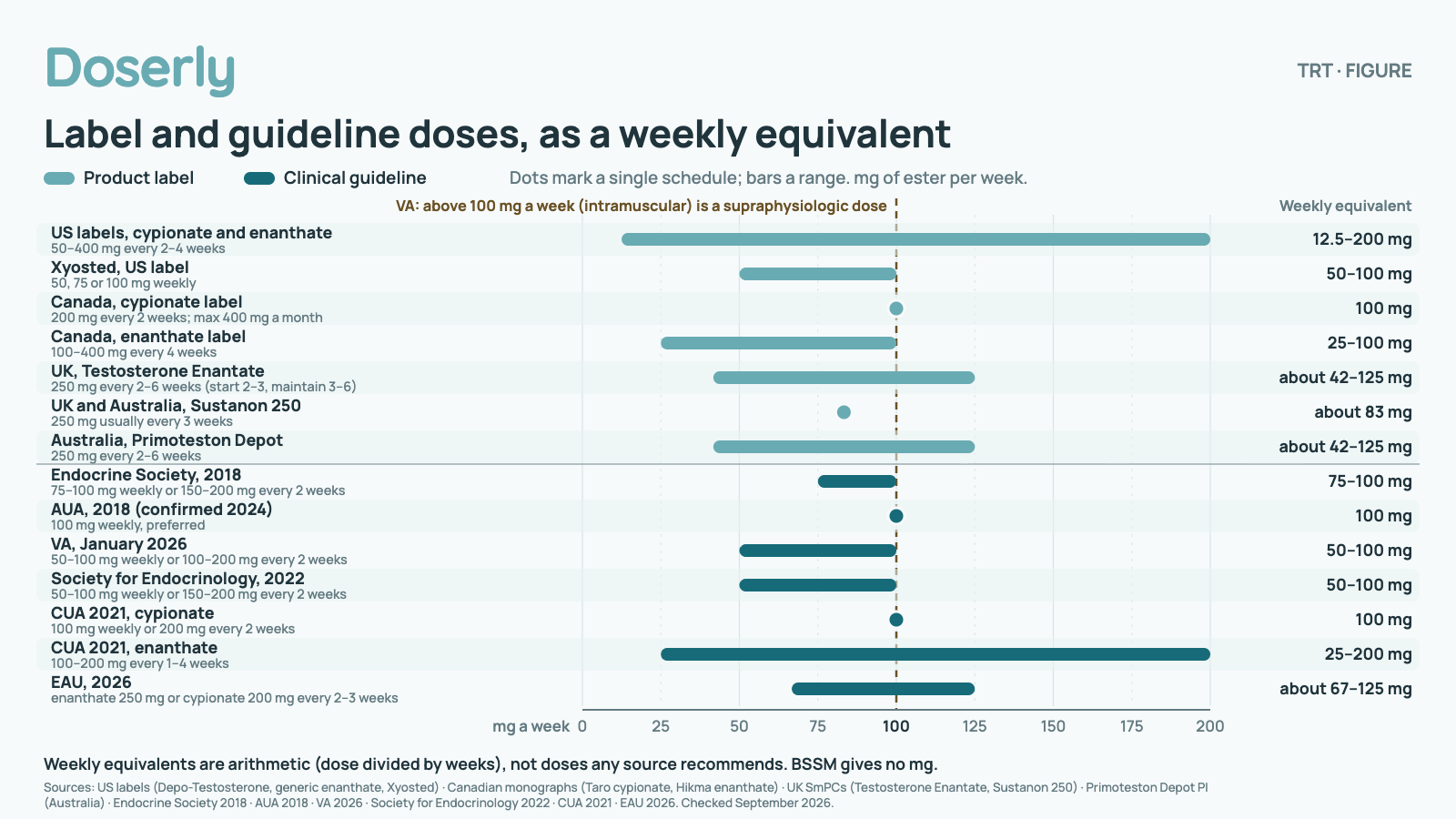
Label and guideline doses, as a weekly equivalent
Each bar runs from 0 (left) to 200 mg a week (right); the dashed line marks 100 mg a week, above which the VA calls intramuscular cypionate or enanthate a supraphysiologic dose.
Product labels
- US labels, cypionate and enanthate
- 50–400 mg every 2–4 weeks. Weekly equivalent: 12.5–200 mg.
- Xyosted, US label
- 50, 75 or 100 mg weekly. Weekly equivalent: 50–100 mg.
- Canada, cypionate label
- 200 mg every 2 weeks; max 400 mg a month. Weekly equivalent: 100 mg.
- Canada, enanthate label
- 100–400 mg every 4 weeks. Weekly equivalent: 25–100 mg.
- UK, Testosterone Enantate
- 250 mg every 2–6 weeks (start 2–3, maintain 3–6). Weekly equivalent: about 42–125 mg.
- UK and Australia, Sustanon 250
- 250 mg usually every 3 weeks. Weekly equivalent: about 83 mg.
- Australia, Primoteston Depot
- 250 mg every 2–6 weeks. Weekly equivalent: about 42–125 mg.
Clinical guidelines
- Endocrine Society, 2018
- 75–100 mg weekly or 150–200 mg every 2 weeks. Weekly equivalent: 75–100 mg.
- AUA, 2018 (confirmed 2024)
- 100 mg weekly, preferred. Weekly equivalent: 100 mg.
- VA, January 2026
- 50–100 mg weekly or 100–200 mg every 2 weeks. Weekly equivalent: 50–100 mg.
- Society for Endocrinology, 2022
- 50–100 mg weekly or 150–200 mg every 2 weeks. Weekly equivalent: 50–100 mg.
- CUA 2021, cypionate
- 100 mg weekly or 200 mg every 2 weeks. Weekly equivalent: 100 mg.
- CUA 2021, enanthate
- 100–200 mg every 1–4 weeks. Weekly equivalent: 25–200 mg.
- EAU, 2026
- enanthate 250 mg or cypionate 200 mg every 2–3 weeks. Weekly equivalent: about 67–125 mg.
Weekly equivalents are arithmetic (dose divided by weeks), not doses any source recommends. BSSM gives no mg.
Why do labels and guidelines give different numbers?
Because they answer different questions. The US cypionate and enanthate labels describe what the medicine is approved to do, with broad dosing and no blood-test rule. Guidelines, written with modern testosterone tests, center on about 100 mg a week and adjust it by the level. The AUA itself says "the optimal dosing strategy has not been defined" for these injections. [1], [16], [3]
The guidelines also disagree on the target, from the lower end of normal at the trough (Society for Endocrinology) to the middle of the range midway (AUA), as the last column shows. None of these targets comes from a trial comparing outcomes at different levels. [5], [3]
How do the units work?
Doses are in milligrams (mg) of the ester; volumes are in milliliters (mL); blood levels are in ng/dL in the US and nmol/L in most other countries. To convert total testosterone, divide ng/dL by 28.84 to get nmol/L: 600 ng/dL is about 20.8 nmol/L. The testosterone unit converter does this for you, and the TRT blood work guide explains each test.
Where these numbers come from
The US label row comes from the current Depo-Testosterone label (DailyMed, effective August 21, 2026), the Azmiro label (July 25, 2025) and the generic enanthate label (May 8, 2026); the Xyosted row from its label (July 1, 2025). The Canadian rows come from the Taro cypionate monograph (May 26, 2022) and the Hikma enanthate monograph (March 17, 2023); the UK rows from the Testosterone Enantate (January 19, 2026) and Sustanon 250 (February 16, 2026) summaries of product characteristics; the Australian row from the Primoteston Depot product information (January 13, 2026). [1], [18], [16], [15], [20], [21], [17], [22], [23]
The guideline rows each come from one document: the Endocrine Society guideline (2018), the AUA testosterone deficiency guideline (2018, validity confirmed 2024), the VA's January 2026 recommendations, the Society for Endocrinology guideline (2022), the CUA guideline (2021), the EAU guidelines (2026 edition, Table 3.5) and the BSSM guidelines (2023). The Endocrine Society prints its nmol/L conversions as 24.5 and 14.1; this guide gives the standard conversions of its ng/dL values instead. [2], [3], [4], [5], [24], [25], [6]
Weekly equivalents are simple averages; the sources do not state them. Not used: research doses from dose-finding studies (described only in the research section), schedules from superseded guidelines, doses posted online and any population-wide "typical prescribed dose", because no such dataset was found.
How do dose and frequency shape your testosterone levels?
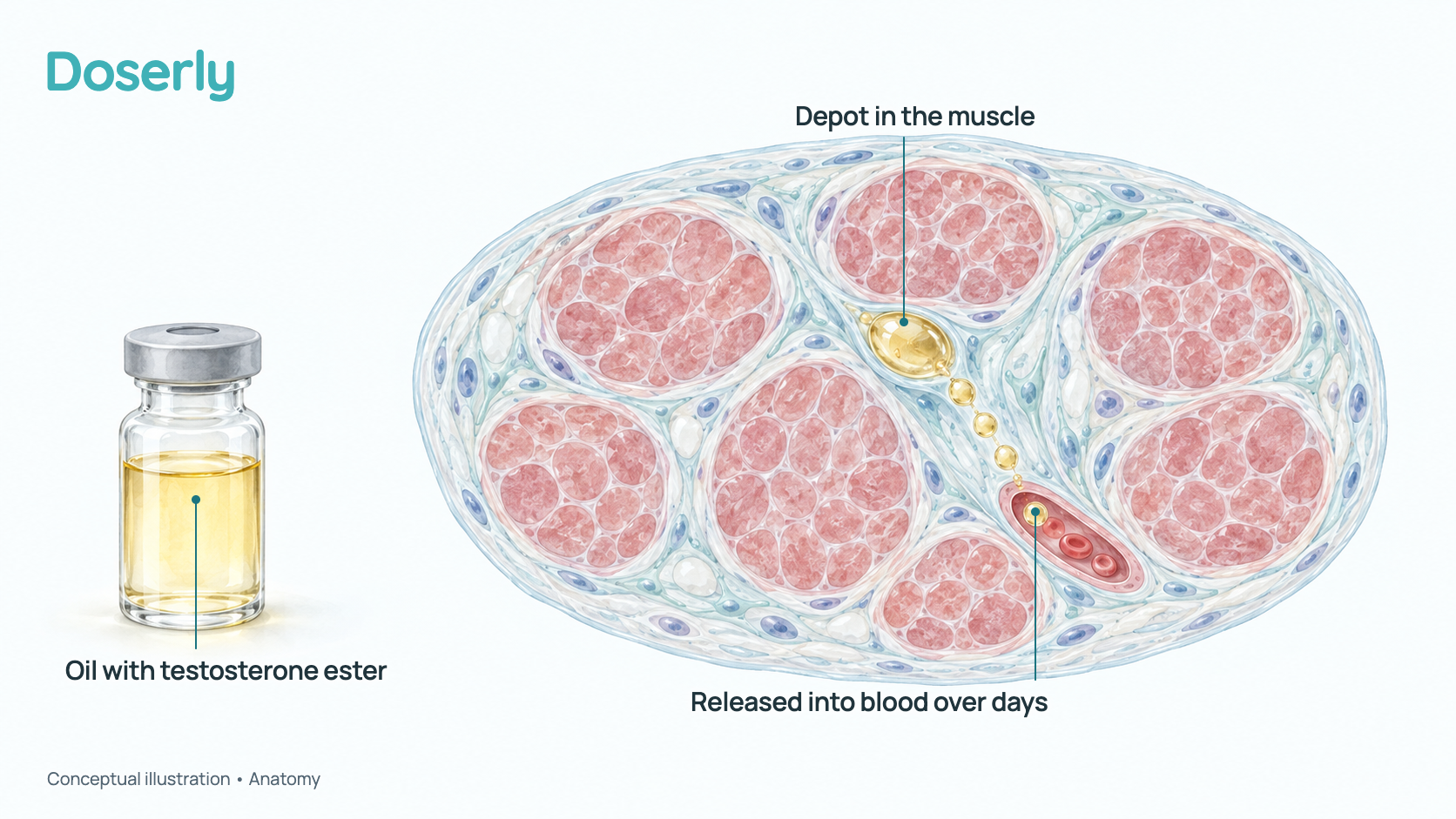
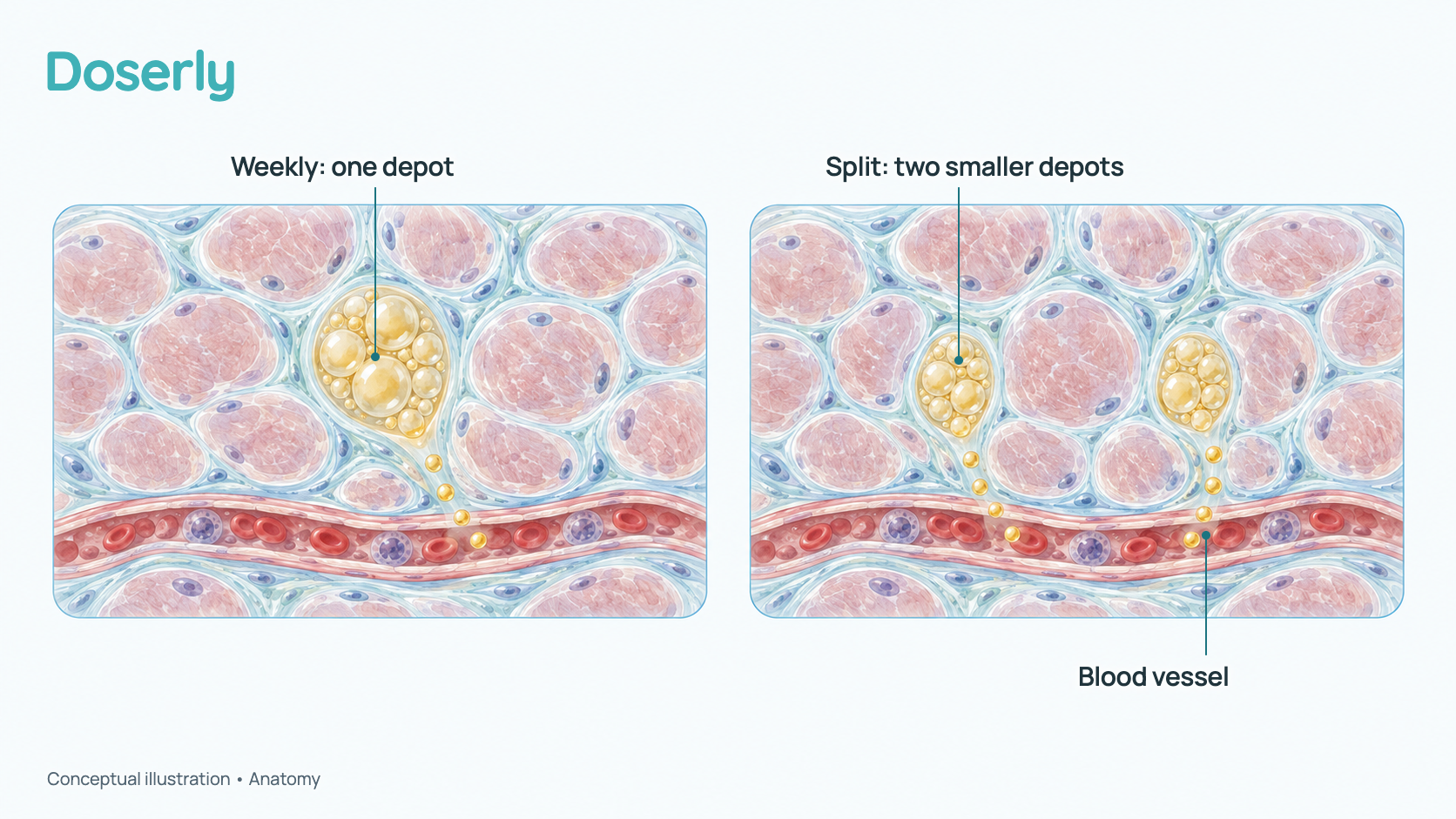
An injection leaves a pool of oil, a depot, that releases testosterone over days. Testosterone itself has a very short half-life in the blood (the US enanthate label gives figures that range from 10 to 100 minutes), so the multi-day half-life quoted for injections describes how slowly the depot empties. [16], [1]
- One large dose makes a big peak and a deep trough. After a single 200 mg cypionate injection in 11 men with low testosterone, levels roughly tripled, peaking on days 2 to 5, many men were above the normal range from days 2 to 7, and levels were back to their starting point by days 13 to 14. Estradiol tripled too. For Azmiro, the label reports a median time to peak of 71.7 hours. [26], [18]
- The same weekly amount, spread out, swings less. In a classic study of 23 men, enanthate at 100 mg weekly, 200 mg every 2 weeks, 300 mg every 3 weeks and 400 mg every 4 weeks (all about 100 mg a week) produced levels that "fluctuated largely within the normal range", but the average level between doses was highest with 100 mg weekly and lowest with 400 mg every 4 weeks. [7]
- Weekly subcutaneous doses give a flatter curve. With weekly subcutaneous enanthate at 100 mg, the average level was 895 ng/dL, with a peak of 1,346 and a trough of 568 ng/dL. On Xyosted's weekly schedule, levels peaked a median of 11.9 hours after the dose, reached a steady state by week 6, and none of the 137 men who completed 12 weeks was above 1,500 ng/dL at week 12. [27], [15], [28]
The half-life figures differ by product and method: the US cypionate label gives about 8 days, the UK enanthate summary 2–3 days, and the EAU guideline table lists 4–5 days for enanthate. Even so, the US labels give cypionate and enanthate the same dose range, 50–400 mg every 2–4 weeks. [1], [17], [25], [16]
Why is about 100 mg a week called a replacement dose?
Because it roughly matches what the body would make and brings levels back into the normal range. Healthy men make about 4 to 9 mg of testosterone a day in isotope studies: 3.7 mg in one study, and 9.11 mg in young White men, 7.22 mg in young Asian men and 3.88 mg in middle-aged White men in another. Esters, absorption and clearance differ, so this is orientation, not a formula for a prescription. [29], [30]
The research on dose shows the same picture. In 61 young men whose own testosterone was switched off, weekly enanthate at 125 mg gave an average lowest level of 542 ng/dL, inside the normal range, while 25 and 50 mg left it at 253 and 306 ng/dL. Research doses several times higher pushed the lowest level to 1,345 and 2,370 ng/dL, far above normal. Lean (fat-free) mass rose with dose, but so did hemoglobin, and HDL ("good") cholesterol fell; sexual function and mood did not change significantly at any dose. These were research doses, not treatment schedules. [31]
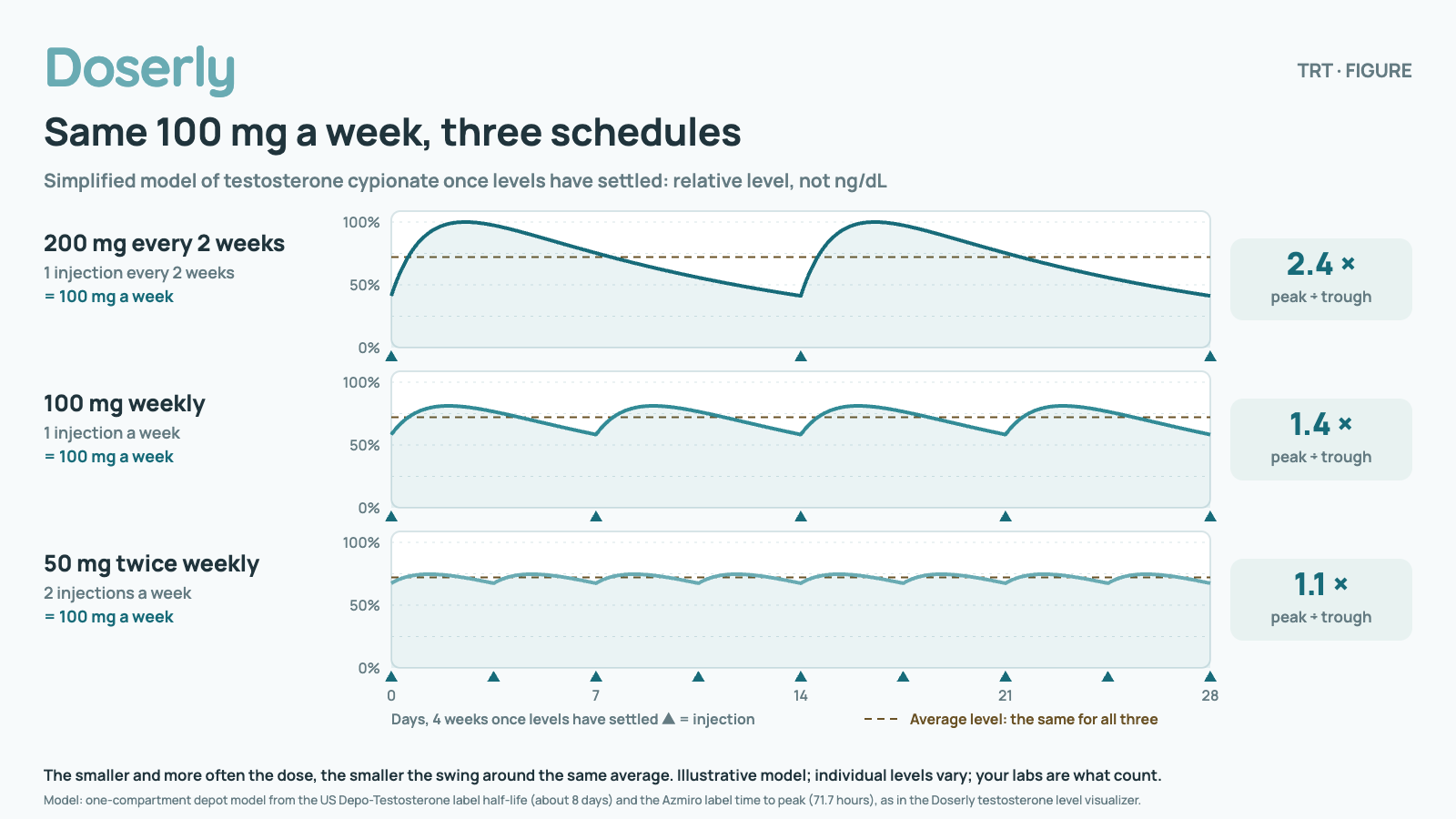
Same 100 mg a week, three schedules
Simplified model of testosterone cypionate once levels have settled: relative level, not ng/dL. Triangles mark injections; the dashed line is the average level, the same for all three.
- 200 mg every 2 weeks
- Peak about 2.4 × the trough
- 100 mg weekly
- Peak about 1.4 × the trough
- 50 mg twice weekly
- Peak about 1.1 × the trough
The smaller and more often the dose, the smaller the swing around the same average. Illustrative model; individual levels vary; your labs are what count.
The testosterone level visualizer lets you compare schedules with the same simplified model.
What does the research show about dose and frequency?
The strongest evidence on dose comes from dose-finding studies and product trials; the evidence on frequency is mostly pharmacokinetic (how levels move) or observational. We found no randomized trial that compared injection frequencies on health outcomes. [8], [3]

Does splitting the same weekly dose change anything?
Possibly for red blood cells, but it has never been tested directly. Here is what exists:
| Study | Who and what | Result | What it cannot show |
|---|---|---|---|
| Clinic records (2022) | 263 men on 100 mg weekly or 200 mg every 2 weeks, intramuscular | Hematocrit above 54% in 1 of 102 men on 100 mg weekly vs 4 of 51 on 200 mg every 2 weeks; no difference in the rise in testosterone, free testosterone, estradiol or PSA | Not randomized; the authors link it to a higher average level on the 200 mg schedule [8] |
| Daily injections (2018) | 54 men at one practice on 7–18 mg of cypionate a day (about 49–126 mg a week), subcutaneous | Average total testosterone rose from 385 to 847 ng/dL | Every man also took hCG and anastrozole, and there was no comparison group [32] |
| Longer intervals (2025) | 49 trans men on testosterone who already had high hematocrit | Spacing out every-2-week cypionate did not lower hematocrit; stopping for 3 months did | Different population; small records study [33] |
| Weekly subcutaneous at scale (2026) | 9,537 men at a UK men's health provider, 89% on subcutaneous injections, starting at about 100 mg of cypionate (weekly or split twice weekly) or 125 mg of enanthate a week | An estimated 24% had hematocrit above 0.54 by 12 months | No comparison schedule; 75% also took hCG; 3 of 4 authors worked for the provider [34] |
We found no study in men that kept the weekly total exactly the same and compared once weekly with twice weekly, every other day or daily. The British Society for Sexual Medicine notes that subcutaneous "micro-dosing" has "become fashionable, but long-term studies are not available". A 2026 practice review argues that every-2-week dosing "should not be the automatic default" and treats twice-weekly to daily schedules as "optional tools rather than universal standards"; that is expert opinion from one clinic-affiliated author, not trial evidence. [6], [35]
Is a subcutaneous dose the same as an intramuscular dose?
Roughly, according to the available studies, though none compared the same dose of cypionate or enanthate by both routes in men with low testosterone. The UK Society for Endocrinology says subcutaneous injection of 50–100 mg once a week has "comparable pharmacokinetics, safety and tolerability" to injection into a muscle. A 2022 review suggests starting subcutaneous cypionate or enanthate at 75 mg a week, measuring midway between injections and adjusting to 50 or 100 mg. [5], [36]
- Men with low testosterone. In a pilot of 22 men injecting low weekly doses of subcutaneous enanthate with a 0.5 mL insulin syringe, the average trough was 14.5 nmol/L and the peak 21.7 nmol/L, all within normal. In the Xyosted trial, 135 of 150 men (90%) had an average level in the normal range at week 12. [37], [15]
- Same weekly dose, different route and product. In 234 men on 100 mg a week, trough levels were similar with intramuscular cypionate (536 ng/dL) and a subcutaneous enanthate autoinjector (553 ng/dL), but the autoinjector was linked with lower estradiol and hematocrit. The ester, device and route all differed, so the study cannot isolate the route. [38]
- Trans men. All 63 reached the normal male range on 50–150 mg a week of subcutaneous testosterone (with a median of 75 to 80 mg), and all 22 who had switched from muscle injections preferred subcutaneous ones. In smaller studies, weekly subcutaneous levels stayed fairly steady (average 627 ng/dL), and exposure per mg was similar by either route, with wide variation between people. [39], [40], [41]
- Long-acting undecanoate. In a crossover of 20 long-term users, 1,000 mg given subcutaneously gave peaks similar to injection into a muscle; the authors concluded no dose change was needed, though the injection hurt more the next day. [42]
In practice, labels and guidelines treat a route change like any other change: the level is rechecked and the dose adjusted. Technique is covered in how to inject testosterone.
Does a higher weekly dose do more?
It raises levels in a predictable way, and it raises red blood cells with them. In dose-finding research, hemoglobin and hematocrit rose in a straight line with the weekly dose in both young and older men, and more older men had to leave the study because hematocrit went above 54%. Older men clear testosterone more slowly and had more side effects at the same dose; the researchers judged 125 mg a week the best trade-off in that research setting. [11], [43]
In one US clinic that used 100–200 mg of cypionate or enanthate weekly, hematocrit above 50% occurred in 66.7% of the 57 men on injections, against 12.8% of 47 on gels and 35.1% of 74 on pellets over 3 years of follow-up, although the groups differed in age and were not randomized. Across 29 randomized trials, cypionate or enanthate injections raised hematocrit by about 4 points on average. The hematocrit guide covers what that means. [44], [45]
How often does a starting dose need changing?
Often, which is why guidelines measure rather than guess. In the Xyosted trial, 150 men started at 75 mg a week with one adjustment based on the trough level: at week 12, 104 were still on 75 mg, 25 had moved down to 50 mg and 21 up to 100 mg. About one in three needed a different dose from the starting one. [28]
What do guidelines and labels say about adjusting the dose?
They adjust by blood level, hematocrit and symptoms, one step at a time (titration), and they differ on timing and targets. This section describes what the documents say; it is not a personal plan.
| Question | What the sources say |
|---|---|
| When is the first check? | AUA: no earlier than after 3–4 injections, and "reasonable" at 4 weeks after starting. Xyosted: after 6 weeks. Endocrine Society: at 3–6 months, then at 12 months and yearly [3], [15], [2] |
| When in the cycle? | Midway between injections: Endocrine Society, VA (day 3–4 on a weekly schedule), CUA. Trough, just before the next dose: Society for Endocrinology, BSSM, Xyosted and the UK enanthate summary. The AUA calls mid-cycle testing the historical habit and says "there may be value in assessing peak level (18-36 hours after injection)" [2], [4], [24], [5], [6], [15], [17], [3] |
| What changes: the dose or the interval? | Endocrine Society: the dose or the frequency. Xyosted: 25 mg steps. Fixed 250 mg ampoules of UK enanthate and long-acting undecanoate: the interval [2], [15], [17], [46] |
| What else forces a change? | Hematocrit (the VA adjusts above 51% and stops above 54%), a level far above range (the VA adjusts above 900 ng/dL) and side effects [4] |
| How soon to recheck after a change? | Among injections, only the Xyosted label states it: 6 weeks after any dose change. We found no cypionate or enanthate vial label that gives a retest time. Gel and capsule labels set their own, for example about 14 and 28 days after a change for AndroGel 1.62%. The VA says weight change or new symptoms may prompt earlier testing [15], [47], [4] |
Where do the sources disagree?
- How often to inject. The US enanthate label says injections more often than every 2 weeks "are rarely indicated", while the AUA prefers 100 mg weekly and the VA, Society for Endocrinology and CUA all list weekly options. [16], [3], [4], [5], [24]
- How low is too low. An older task-force regimen quoted in the Canadian enanthate monograph accepts a pre-injection level of 250–300 ng/dL and calls 100–150 mg every 2 weeks "a reasonable compromise", while calling 300 mg every 3 weeks "generally inadequate". Current guideline targets are set higher, although most are measured midway rather than just before the next injection. [21], [2], [3]
- Where to measure. A midway level estimates average exposure; a trough shows whether levels fall too low before the next dose or build up over time. The same 200 mg dose can read above the normal range on day 2 and be back near the starting level by day 13, so the timing of the draw matters as much as the result. [3], [26]
- Compounded products. The AUA prefers commercially made testosterone over compounded versions when possible. [3]
How are long-acting injections adjusted?
By the interval, not the milligrams. Nebido is 1,000 mg every 10–14 weeks, measured at the end of an interval; the EAU aims for a pre-injection level between 12 and 18 nmol/L. At one Sydney clinic, 297 patients' intervals were adjusted this way to a median of 12.0 weeks, and 70% ended on the approved 12-week interval. In the US, Aveed is a fixed 750 mg at the start, at 4 weeks and then every 10 weeks. See the undecanoate injection guide. [46], [25], [48], [49]
How do you turn a dose into mL and syringe units?
Divide the dose by the vial's strength: mL = mg ÷ mg/mL. At 200 mg/mL, 100 mg is 0.5 mL, which is 50 units on a U-100 insulin syringe. The strength is printed on the vial and carton, and it differs between products and countries. [1], [9]
| Product | Where | Strength |
|---|---|---|
| Depo-Testosterone (cypionate) | US | 100 mg/mL or 200 mg/mL |
| Generic testosterone cypionate | US | 200 mg/mL in the generic labels reviewed here; check your vial |
| Azmiro (cypionate) | US | 200 mg/mL |
| Generic testosterone enanthate | US | 200 mg/mL |
| Xyosted (enanthate autoinjector) | US | Fixed 50, 75 or 100 mg in 0.5 mL; nothing to draw |
| Aveed (undecanoate) | US | 750 mg in 3 mL (250 mg/mL) |
| Testosterone cypionate (Taro) | Canada | 100 mg/mL |
| Testosterone enanthate (Hikma) | Canada | 200 mg/mL |
| Testosterone Enantate, Sustanon 250 | UK | 250 mg/mL ampoules |
| Nebido (undecanoate) | UK | 1,000 mg in 4 mL |
| Primoteston Depot (enanthate) | Australia | 250 mg in a prefilled syringe |
[1], [50], [18], [16], [15], [49], [20], [21], [17], [22], [46], [23]
How many units is that on an insulin syringe?
An FDA device file puts it simply: "U-100 means there are 100 units of insulin in every mL." So each unit mark on a U-100 syringe is 0.01 mL, whatever the liquid. The units measure volume, not milligrams of testosterone: the milligrams in each unit depend on the vial. [9]
| Dose each time | At 100 mg/mL | At 200 mg/mL | At 250 mg/mL |
|---|---|---|---|
| 50 mg | 0.5 mL (50 units) | 0.25 mL (25 units) | 0.2 mL (20 units) |
| 75 mg | 0.75 mL (75 units) | 0.375 mL (37.5 units) | 0.3 mL (30 units) |
| 100 mg | 1.0 mL (100 units) | 0.5 mL (50 units) | 0.4 mL (40 units) |
| 200 mg | 2.0 mL (more than one 1 mL syringe) | 1.0 mL (100 units) | 0.8 mL (80 units) |
This is arithmetic, shown for doses inside the guideline and label range. The dose itself always comes from the prescription. A result such as 37.5 units falls between whole-unit marks, so ask a pharmacist how to measure it with the syringe you use.
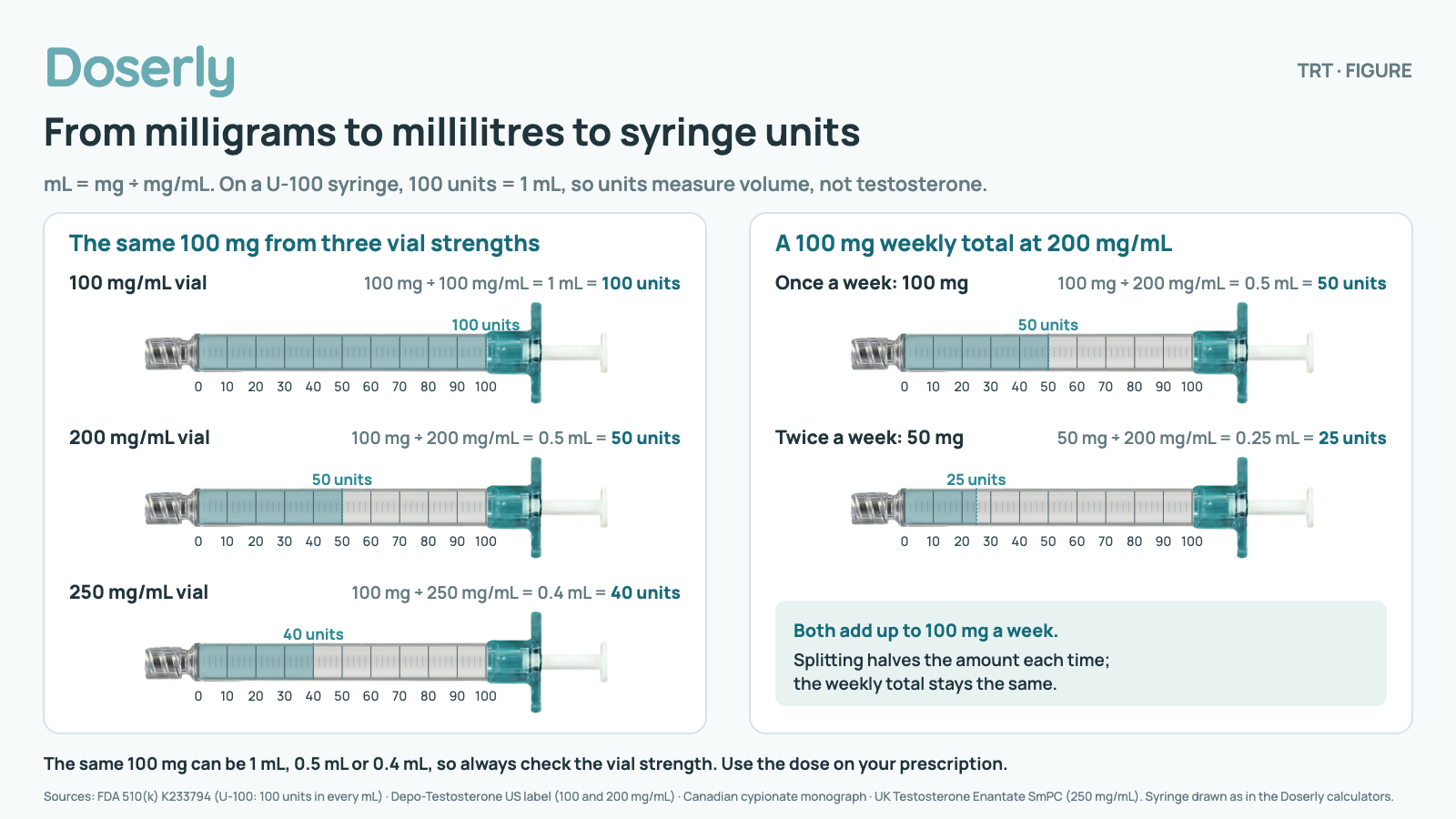
From milligrams to millilitres to syringe units
mL = mg ÷ mg/mL. On a U-100 syringe, 100 units = 1 mL, so units measure volume, not testosterone.
The same 100 mg from three vial strengths
- 100 mg/mL vial
- 100 mg ÷ 100 mg/mL = 1 mL = 100 units
- 200 mg/mL vial
- 100 mg ÷ 200 mg/mL = 0.5 mL = 50 units
- 250 mg/mL vial
- 100 mg ÷ 250 mg/mL = 0.4 mL = 40 units
A 100 mg weekly total at 200 mg/mL
- Once a week: 100 mg
- 100 mg ÷ 200 mg/mL = 0.5 mL = 50 units
- Twice a week: 50 mg
- 50 mg ÷ 200 mg/mL = 0.25 mL = 25 units
The same 100 mg can be 1 mL, 0.5 mL or 0.4 mL, so always check the vial strength. The TRT dose calculator does this math for the dose on your prescription.
How does splitting a weekly dose change the math?
Divide the weekly total by the number of injections. At 200 mg/mL, 100 mg a week given twice weekly is 50 mg, or 0.25 mL (25 units), each time. Every other day gives 3 or 4 injections in a calendar week, 3.5 on average, so each dose is the weekly total divided by 3.5. The weekly total is still the number the guidelines describe.
A 10 mL multi-dose vial at 200 mg/mL holds 2,000 mg, or 20 weeks at 100 mg a week, but follow the in-use limit for the vial you actually have, which may end it sooner. For example, the Canadian monograph for a 100 mg/mL cypionate vial says to discard a vial 56 days after first use. [20]
What goes wrong with the math?
Mostly mix-ups between strengths and units. The Institute for Safe Medication Practices has received reports of possible wrong-strength or wrong-volume errors with Depo-Testosterone, which comes as 100 and 200 mg/mL in similar cartons. In a separate warning about compounded semaglutide, not testosterone, the US Food and Drug Administration (FDA) described patients told to draw 5 units who drew 50, and blamed confusion between mL, mg and "units". [10], [51]
Small volumes are also harder to measure: in a bench study of syringes filled with water, errors above 5% became more likely when less than 20% of a syringe's capacity was measured. A syringe close in size to the volume being drawn measures more accurately. [52]
Doserly's TRT dose calculator converts a prescribed dose into mL and syringe units for any strength and schedule. It converts units; it does not suggest doses. Needle and injection technique are covered in how to inject testosterone.
What else do people ask about TRT dosing?
Weekly, twice weekly or every other day?
All three are in use, and the evidence favors smaller, more frequent doses only on pharmacokinetic grounds. Weekly injections are the main guideline option alongside every 2 weeks, and the AUA prefers 100 mg weekly to 200 mg every 2 weeks. Twice-weekly, every-other-day and daily schedules flatten the curve further, but none of the guidelines reviewed here gives a complete schedule for them, and we found no trial showing they improve health outcomes. The choice is the prescriber's, often shaped by symptoms between shots, hematocrit and how many injections a person is willing to do. [3], [2], [7], [6]
Is 150 or 200 mg a week too much?
It is above most guideline examples. The Endocrine Society, VA and Society for Endocrinology give 50–100 mg a week, the AUA 100 mg, and Xyosted tops out at 100 mg; only the top of the CUA's broad enanthate range (100–200 mg every 1–4 weeks) reaches 200 mg a week. The VA goes further: it treats intramuscular cypionate or enanthate above 100 mg weekly as a supraphysiologic (above-normal) dose that should raise suspicion of misuse. [2], [4], [5], [3], [15], [24]
The US labels allow up to 400 mg every 2 weeks, which averages 200 mg a week, but the enanthate label adds that totals above 400 mg a month "are not required", and Canada's cypionate label caps it at 400 mg a month. One US academic clinic used 100–200 mg weekly. Some online testosterone services aim far higher: in a 2022 secret-shopper study, 3 of 6 platforms that offered testosterone stated a goal of 1,000 ng/dL or more, against the AUA's 450–600 ng/dL. What separates replacement from steroid use is covered in TRT vs steroids. [1], [16], [20], [44], [53], [3]
What if you miss or are late with a dose?
The US testosterone injection labels reviewed here give no missed-dose instruction. Canada's cypionate and enanthate monographs say to give a missed dose as soon as possible unless the next one is almost due, and not to double up. UK leaflets tell Sustanon users to contact their doctor or nurse and not to take a double dose, tell Testosterone Enantate users to keep to the injection intervals agreed with their doctor, and warn Nebido users not to miss appointments because levels will not be maintained. Ask the prescriber what to do rather than guessing. [20], [21], [54], [55], [56]
How long after a dose change should you retest?
Long enough for levels to settle. Xyosted's label sets 6 weeks after any change, and its levels reached a steady state by week 6. For cypionate and enanthate vials we found no label that gives a time; the AUA's advice for starting (after 3–4 injections, or about 4 weeks) is the closest guide. Draw the retest at the same point in the injection cycle as the last one, or the two results are not comparable. [15], [3]
Does the dose depend on age or body weight?
None of the guidelines reviewed here sets a dose by weight or age; the dose follows the blood level. Age still matters: older men clear testosterone more slowly and had larger hemoglobin rises and more side effects at the same research dose. Weight can matter too: the VA says significant weight gain or loss may prompt an earlier level check, and in one clinic's records the interval for long-acting undecanoate varied with age and body size. [43], [11], [4], [48]
What is the "dose" for gels, capsules, nasal gel and pellets?
Each form has its own labeled dose, and the milligrams cannot be compared with injections:
- Gel. AndroGel 1.62%: 40.5 mg each morning, adjusted between 20.25 and 81 mg by the pre-dose level. About 10% of a gel dose is absorbed. See testosterone gel. [47], [19]
- Oral capsules. Jatenzo: 237 mg twice daily with food, adjusted between 158 and 396 mg twice daily. See oral testosterone. [57]
- Nasal gel. Natesto: 11 mg (one spray per nostril) three times a day, 33 mg a day. See Natesto. [58]
- Pellets. Testopel: 150–450 mg (two to six 75 mg pellets) every 3 to 6 months. See testosterone pellets. [59]
Is TRT dosing safe, and what are the risks?
At labeled and guideline doses, with monitoring, testosterone has a well-described set of risks; higher doses and bigger peaks make some of them more likely. The main dose-related risk is a rise in hematocrit. Labels also warn about blood pressure, fluid retention, sleep apnea, prostate effects, reduced sperm production and misuse, and their dose-adjustment text starts from response and side effects. [1], [60], [15]
Is a higher dose riskier?
For red blood cells, yes: hematocrit rises in a straight line with dose, more in older men. In a large records study, men whose hematocrit reached 52% or more on testosterone had more heart attacks, strokes or blood clots in their first year: 301 of 5,842 (5.15%) against 226 of 5,842 matched men whose hematocrit stayed lower (3.87%), although a records study cannot prove cause. The US labels also warn that taking more than treatment doses can bring withdrawal symptoms such as depressed mood, fatigue and low libido when stopped. [11], [61], [1]
What did TRAVERSE show about heart safety?
TRAVERSE, the largest heart-safety trial of testosterone, randomly assigned about 5,200 men aged 45 to 80 with low testosterone and heart disease or high heart risk to daily testosterone gel or placebo gel, with the dose adjusted to keep levels at 350–750 ng/dL. Among the 2,596 men who used testosterone gel and the 2,602 who used placebo gel, heart attack, stroke or cardiovascular death occurred in 182 (7.0%) and 190 (7.3%) (hazard ratio 0.96), which met the trial's safety goal. Some problems were more common on testosterone: atrial fibrillation 3.5% vs 2.4%, acute kidney injury 2.3% vs 1.5%, and pulmonary embolism 0.9% vs 0.5%. [62], [63]
Its limits matter for dosing: it tested only a daily gel, not injections; men used it for an average of 21.7 months; about 61% stopped their study gel early; and everyone was already at high heart risk. The TRT and heart health guide covers it in full. [62], [63]
Who should be especially cautious?
- Older men, who get larger hematocrit rises and more side effects at the same dose. [43], [11]
- Men who already start near the hematocrit line or have sleep apnea. See the hematocrit guide. [4]
- Men with heart, kidney or liver disease, because testosterone can cause fluid retention: the Depo-Testosterone label rules it out in serious heart, liver or kidney disease, and the enanthate and Xyosted labels warn that swelling can be a serious complication in these men. Men with high blood pressure should also take care, because testosterone can raise it; the labels say it is not recommended with uncontrolled hypertension. [15], [1], [16]
- Men with known or suspected prostate or breast cancer, for whom the current US labels rule testosterone out. In June 2026 FDA requested narrowing the prostate wording to metastatic prostate cancer; that change is requested, not yet in the labels (checked September 2026). [1], [64]
- Men who want children soon. Testosterone switches off sperm production, and the labels say reduced fertility may be irreversible for some men. See TRT and fertility. [15]
- Drug-tested athletes. Testosterone is banned in sport at all times. [14]
- Under-18s. Testosterone for teenagers belongs only in specialist care.
- Women. This guide is for men; testosterone for women uses different products and doses.
Which medicines interact with testosterone?
- Warfarin and other blood thinners. Androgens can change their effect; the labels recommend more frequent INR checks, especially when testosterone starts or stops. [15], [1]
- Insulin and other diabetes medicines. Testosterone can lower blood sugar and may mean a lower diabetes-medicine dose. [15], [1]
- Corticosteroids. Together with testosterone they may increase fluid retention. [15]
Bring a complete list of what you take, including supplements, to a pharmacist or prescriber. Checked September 2026.
Is testosterone legal, and is it allowed in sport?
Checked September 2026. Rules differ by country and change often.
- United States. Testosterone and its esters are Schedule III controlled substances, prescription only. [12]
- United Kingdom. Testosterone is a Class C controlled drug, in Schedule 4 Part II of the Misuse of Drugs Regulations. [13]
- Canada. Testosterone is a Schedule IV controlled substance. [65]
- Australia. Testosterone is a Schedule 4 prescription-only medicine. [66]
- Sport. The World Anti-Doping Agency (WADA) prohibits testosterone at all times, and its 2027 list, published in September 2026, keeps the ban. [14], [67]
What do people on TRT report about their dose?
Public forums are full of men comparing weekly doses, and of men puzzled by blood results that do not match their dose. The threads below are recent public Reddit discussions, read with their replies. They show what people experience, not how often it happens, and the doses in them are what people reported, not protocols.
Why do similar doses give such different numbers?
Draw timing explains many of them. One man on 200 mg of cypionate a week, with no dose change, measured total testosterone of 750 ng/dL 4 days after a shot, 850 at 2 days, 1,600 when a scheduling conflict put the draw 1 day after a shot, and 1,300 at 2.5 days. [68] Another, on 100 mg weekly, read 1,400 the day after an injection and 805 four days after. [69]
Real differences between people show up too. A man in his 30s on 50 mg a week measured a trough of 1,046 ng/dL, while another on 100 mg a week measured 353 ng/dL midway after six months and still felt unwell. [70], [71] A man in his 60s lowered his dose in steps from 150 to 110 mg a week over two years, but his lab only ever reported "above 13.5 ng/mL" (1,350 ng/dL), its upper limit, so none of the changes showed. [72] At-home tests add another layer: one reading of 2,450 ng/dL, taken about a day after an injection, drew replies asking for a lab test drawn midway between injections. [73]
What happens when people split the same weekly dose?
Results are mixed. A man prescribed 200 mg once a week felt great for four to six weeks, then had low-energy days, weak erections and sore nipples. Splitting it into two 100 mg injections seemed to fix the energy and erections, but a test drawn the day after a 70 mg injection read 1,750 with high estradiol, and his doctor cut the weekly dose to 100 mg. [74]
Others saw little change. One man moved from 100 mg every 5 days to 110 mg a week split every 3.5 days; his trough fell from 1,010 to 750 ng/dL, but estradiol barely moved (57 to 55 pg/mL) and his irritability and anxiety hardly improved. [75] Another switched from twice weekly to every other day at the same 110 mg a week and found his libido and erections got worse. [76] Splitting did not settle hematocrit in the accounts we read: one man reached 56% on 100 mg a week split twice weekly despite giving blood every three months. [77], [78]
What happens after raising or lowering the dose?
Raising the dose raised levels, but not always symptoms. One man went from 125 to 150 mg a week and saw total testosterone rise from 762 to 1,099 ng/dL with no change in his fatigue, poor sleep or weak erections; replies pointed to sleep apnea. [79] Another reached only 437 ng/dL after a clinic raised him from 140 to 160 mg once a week, and felt little difference. [80]
Lowering the dose helped some men and not others. A man who felt terrible at 140 mg a week (low mood, bloating, poor sleep) felt much better for three months at 108 mg split three times weekly. [81] Another cut from 110 to 90 mg a week: he slept better but lost drive and libido, while his trough fell from 808 to 591 ng/dL and estradiol stayed about the same. [82] A Sustanon user whose clinician cut the dose from 125 to 75 mg a week, because of high free testosterone and a hematocrit of 0.52, described fatigue and erection problems four weeks later; replies thought the step was large. [83]
Starting high is a recurring theme. One man started on 200 mg a week and three weeks later reported severe fatigue, anxiety and insomnia, with total testosterone of 1,130 ng/dL. [84] Another, prescribed 210 mg a week by an online clinic, felt great but tested at 1,500 ng/dL or more and chose to reduce. [85] At the other end, a man in his 50s who deliberately started at 60 mg a week, split twice weekly, reported a midway level of 799 ng/dL (from 340) and better energy at his first follow-up, while also taking a weight-loss medicine. [86]
What goes wrong with the math?
Volume mistakes come up again and again. One man meant to inject 0.13 mL three times a week but was drawing 0.33 mL, about two and a half times the planned amount, and found out only after a trough of 65.6 nmol/L and feeling worse. [87] A new patient noticed his instructions read "Inject 0.3 mL, 100 mg" twice a week from a 200 mg/mL vial, figures that do not match: 0.3 mL of that vial is 60 mg. [88] Another wrote "20 mg three times a week" and "140–160 mg a week" for the same schedule, then worked out that 20 units every other day at 200 mg/mL is 40 mg a shot, or about 140 mg a week. [89]
Products bought outside a normal prescription add a different risk: one man's level fell from 1,208 to 340 ng/dL on the same dose of an underground product, and a new vial of the same brand tested the same. [90]
What advice do replies give?
Replies disagree with each other and often with guidelines. A commenter who said he was a physician told one man he would like to see him at 900 ng/dL or more at the trough. [91] Many threads end with the same practical points: draw blood at a consistent point in the cycle, change one thing at a time, and wait several weeks before retesting. [92], [82] In a 2022 study, half of the online testosterone services that offered treatment stated a goal of 1,000 ng/dL or more, well above every guideline target in the key numbers. [53]
How can you judge a dose story?
Ask: What was the dose in mg, and what vial strength and volume produced it? How many hours or days after an injection was the blood drawn, and was it a lab test or a home test? Was it a prescribed product? What else changed at the same time, such as weight, sleep, hCG, an aromatase inhibitor or a weight-loss medicine? And what did the next test, drawn the same way, show?
These selected discussions show what people experience and the questions research has not answered. They are not a survey of all men on TRT, a success rate or a substitute for the studies above.
What should you track when your dose changes?
The dose, the date and time of each injection, and blood tests drawn at a known point in the cycle. Use this summary to prepare questions for your prescriber; it is not a personal testing plan. [2], [3], [4]
| What | What guidelines and labels say | Tracking category |
|---|---|---|
| Testosterone level | At the point in the cycle your guideline or label uses (midway or trough), first after 3–6 weeks depending on the product, then at 3–6 months, 12 months and yearly | Blood work |
| Hematocrit and hemoglobin | Before starting, at 3–6 months, at 12 months, then yearly; the VA adjusts the dose above 51% | Blood work |
| PSA (prostate-specific antigen) | The VA checks it at 3–6 months and 12 months, then yearly | Blood work |
| Blood pressure | Checked periodically on every testosterone product | Blood Pressure |
| Dose, time of last injection and any missed doses | Needed to read any level: a result means little without knowing when it was drawn | Other |
A single result is one point on a line. Because draw timing moves the number so much, results drawn at the same point in the cycle, under similar conditions, say more than any one value. The TRT blood work guide covers each test.
Common questions about TRT dosage
How much testosterone should I take a week?
The amount your prescriber sets, based on your blood levels and symptoms; there is no single right number. For cypionate or enanthate injections, guideline examples are about 75–100 mg a week, and the AUA's example starting dose is 100 mg weekly. Labels allow a wider range, and about a third of men in the Xyosted trial needed a dose other than the starting one. [2], [3], [28] See the key numbers.
How many mL is 100 mg of testosterone, and how many units?
It depends on the vial. At 200 mg/mL, 100 mg is 0.5 mL, or 50 units on a U-100 insulin syringe; at 100 mg/mL it is 1 mL (100 units); at 250 mg/mL it is 0.4 mL (40 units). Check the strength on the vial every time, because US Depo-Testosterone comes in both 100 and 200 mg/mL. [1], [9] See mg to mL to units.
Is it better to inject once or twice a week?
Twice weekly gives smaller peaks and troughs for the same weekly total, but we found no trial showing better health outcomes from it. The evidence that more frequent doses help is pharmacokinetic, plus one clinic's records linking 100 mg weekly with fewer high hematocrit results than 200 mg every 2 weeks. [7], [8] See weekly, twice weekly or every other day.
Can a 200 mg every-2-weeks prescription be given as 100 mg weekly?
Only if the prescriber changes the prescription. The weekly average is the same, and the AUA prefers 100 mg weekly, but the timing of blood tests changes with the schedule, so the prescriber needs to know which schedule the results reflect. [3] See adjusting the dose.
Why are my levels high on a low dose, or low on a high dose?
Usually because of when the blood was drawn, and sometimes because people simply respond differently. After a single 200 mg injection, levels roughly triple within days and fall back by day 14, so a level drawn soon after a shot can look far higher than one drawn just before the next. Doses that put trans men in the normal range ranged from 50 to 150 mg a week, and measuring errors or product problems can also play a part. [26], [39] See what people report.
How long does it take for a dose change to show up in blood tests?
Among injections, Xyosted is the only product with a stated rule: its levels settled by week 6, and its label rechecks 6 weeks after any change. For other injections, the AUA's first check comes after 3–4 injections. Gels and capsules have their own label timings. [15], [3] See how long to wait.
Glossary
Plain explanations of the dosing, lab and research terms used in this guide. Underlined terms in the text link here.
- Aromatase inhibitor
- A medicine, such as anastrozole, that blocks the enzyme that turns testosterone into estradiol. The VA does not recommend them for men on testosterone.
- Clinical guideline
- Recommendations written by a medical society or health system, based on its review of the evidence and expert judgment. Different guidelines can reach different conclusions.
- Concentration (strength)
- How much medicine is in each milliliter of a vial, written in mg/mL. The same dose needs half the volume from a 200 mg/mL vial as from a 100 mg/mL vial.
- Controlled substance
- A medicine whose prescribing and possession are restricted by law because it can be misused. Testosterone is Schedule III in the US, Schedule IV in Canada and Class C in the UK.
- Controlled trial
- A study that compares people who receive a treatment with a similar group who do not, often receiving a placebo instead. Randomly assigning people to each group makes the comparison fairer.
- Depot
- A pool of medicine left in the body, such as oil in a muscle, that releases the drug slowly over days or weeks.
- Dose (amount each time)
- The amount given on one occasion. A protocol lists both the dose and how often it is given.
- Ester
- A chemical tail joined to testosterone that makes it dissolve in oil and release slowly after injection. The body removes the tail to free testosterone. Cypionate, enanthate and undecanoate are esters, and doses are written as the weight of the ester.
- Estradiol
- The main form of estrogen. In men it is made mostly from testosterone, so it rises when testosterone rises.
- Half-life
- The time it takes for the level of a substance in the blood to fall by half. For injected testosterone esters it reflects slow release from the oil depot, about 8 days for cypionate on the US label. It is not the same as how long an effect lasts.
- Hazard ratio
- A measure comparing how often an event happens over time in two groups. A hazard ratio of 1 means no difference; 0.96 means about 4% lower in the first group.
- hCG (human chorionic gonadotropin)
- A hormone medicine that acts like the pituitary signal LH and makes the testicles produce their own testosterone. Some clinics give it alongside TRT.
- Hematocrit
- The share of the blood made up of red blood cells. Testosterone raises it, more at higher doses, and most guidelines act when it reaches about 54%.
- Intramuscular (IM)
- Injected into a muscle. US cypionate and enanthate vial labels use this route.
- Mid-interval level
- A blood test taken halfway between two injections, such as day 3 or 4 of a weekly schedule. Several guidelines use it to judge the dose.
- Multi-dose vial
- A vial meant for several doses, with a preservative. A single-dose vial is used once and any leftover is discarded.
- Observational study (records study)
- A study that follows a group of people, or looks back at their records, without assigning treatments. It can show links but not prove that one thing caused another.
- Peak level
- The highest level of a drug in the blood after a dose. After a cypionate injection it comes a few days later; after a weekly subcutaneous dose, within about a day.
- Pharmacokinetics
- How the body absorbs, moves, breaks down and removes a substance, and so how blood levels rise and fall after a dose.
- Placebo
- A dummy treatment with no active ingredient, used as a comparison in studies.
- Product label (prescribing information)
- The official document approved by a medicines regulator for a product, describing its approved uses, doses, warnings and monitoring. In the UK it is called the summary of product characteristics, and in Canada the product monograph.
- PSA (prostate-specific antigen)
- A blood test for a protein made by the prostate. It rises slightly on testosterone and is used to decide whether prostate checks are needed.
- Steady state
- The point, after several doses, when blood levels rise and fall in the same pattern from one dose to the next. Blood tests taken before it can mislead.
- Subcutaneous (SC)
- Injected into the fatty layer just under the skin. Xyosted uses this route, and a UK guideline accepts it for weekly cypionate or enanthate doses.
- Supraphysiologic
- Above the range the body makes naturally. The VA treats intramuscular cypionate or enanthate above 100 mg a week as a supraphysiologic dose.
- Syringe units (U-100)
- Markings on an insulin syringe that measure volume. On a U-100 syringe, 100 units equal 1 mL, so 0.5 mL is 50 units; the milligrams in each unit depend on the vial.
- Titration
- Adjusting a dose in steps, usually based on blood tests and symptoms.
- Trough level
- The lowest level of a drug in the blood, measured just before the next dose. Some UK guidelines and the Xyosted label judge injections by it.
- TRT (testosterone replacement therapy)
- Prescribed testosterone, by injection, gel or other forms, for men with low testosterone. It switches off the brain's LH and FSH signals.
- WADA
- The World Anti-Doping Agency, which publishes the list of substances banned in sport. Testosterone is banned at all times.
- Weekly total
- All the amounts given in one week, added together. For example, 50 mg twice a week is a 100 mg weekly total, and 200 mg every 2 weeks averages 100 mg a week.
How this guide was researched
This guide is built from a thorough review of the sources cited throughout it: current product labels from the United States, Canada, the United Kingdom and Australia, clinical guidelines from seven medical bodies, published pharmacokinetic and dose-finding studies, device and medication-safety documents, and legal and anti-doping rules. We also reviewed public online forums where men on TRT describe their own doses and blood results.
The guide cites 92 sources, including 18 product labels and monographs, 7 clinical guidelines, 24 studies in people and 25 public community discussions. Each type of source answers a different question. Labels and guidelines show what clinicians are told to do. Studies show what was measured. Personal accounts show what individual people experienced. Every numbered citation links to its entry below, labeled by source type.
How this guide was made
Research and drafting were AI-assisted. Every cited source was checked against the original, and the guide was reviewed and edited by Doserly before publication. It has not had an independent clinical review, and Doserly does not currently have medical reviewers. Doserly makes a medication and health-tracking app and runs Doserly Academy, both of which are promoted in this guide. Read our editorial policy for how guides are researched, updated and corrected.
This guide is for educational purposes. It summarizes what the reviewed sources report so the research is easier to understand; it is not medical advice. For a deeper dive, or to check any point for yourself, go straight to the cited sources.
Explore the sources
These are the documents cited in this guide. Labels, guidelines, studies, safety alerts and personal accounts answer different questions. A source being listed does not mean every statement on its page is endorsed.
Showing 92 sources
- 01
Depo-Testosterone (testosterone cypionate) 100 and 200 mg/mL prescribing information ↗
Product label (US)
Full label reviewed.
Detail: 50–400 mg every 2–4 weeks intramuscularly; 100 and 200 mg/mL; 'Dosage is adjusted according to the patient's response and the appearance of adverse reactions'; half-life about 8 days; anticoagulant and insulin interactions; contraindications include breast and known or suspected prostate cancer.
- 02
Testosterone Therapy in Men With Hypogonadism: An Endocrine Society Clinical Practice Guideline ↗
Clinical guideline
Full guideline reviewed.
Detail: Typical starting doses for enanthate or cypionate: 75–100 mg weekly or 150–200 mg every 2 weeks; measure midway between injections and adjust dose or frequency above 600 or below 350 ng/dL; monitor at 3–6 months, 12 months, then yearly.
- 03
Evaluation and Management of Testosterone Deficiency: AUA Guideline ↗
Clinical guideline (US)
Full guideline reviewed.
Detail: Short-acting injections: a starting dose of 100 mg weekly is preferred to 200 mg every 2 weeks or 300–400 mg monthly; aim for 450–600 ng/dL; first check no earlier than after 3–4 injections, historically mid-cycle; 'the optimal dosing strategy has not been defined'; prefers commercial over compounded testosterone.
- 04
Evaluation for and Management of Males with Low Testosterone: Recommendations for Use (January 2026) ↗
Clinical recommendations (US)
Full document reviewed.
Detail: 50–100 mg weekly or 100–200 mg every 2 weeks intramuscular; test midway (day 3–4 on weekly dosing); adjust if outside lab limits, total testosterone above 900 ng/dL or hematocrit above 51%; stop above 54%; intramuscular enanthate or cypionate above 100 mg weekly is a supraphysiologic dose that should raise suspicion of misuse.
- 05
Society for Endocrinology guidelines for testosterone replacement therapy in male hypogonadism ↗
Clinical guideline (UK)
Full text reviewed.
Detail: Enanthate or cypionate 150–200 mg every 2 weeks or 50–100 mg weekly (intramuscular or subcutaneous); subcutaneous weekly dosing has 'comparable pharmacokinetics, safety and tolerability'; adjust the interval by the trough, aiming for the lower end of normal.
- 06
The British Society for Sexual Medicine Guidelines on Male Adult Testosterone Deficiency, with Statements for Practice ↗
Clinical guideline (UK)
Full text reviewed.
Detail: Enanthate every 2–3 weeks; cypionate every 1–4 weeks, 'also subcutaneous micro-dosing', which 'has become fashionable, but long-term studies are not available'; injections judged on the trough; target 15–30 nmol/L.
- 07
Treatment of male hypogonadism with testosterone enanthate ↗
Human study
Original abstract reviewed.
Detail: Enanthate 100 mg weekly, 200 mg every 2 weeks, 300 mg every 3 weeks and 400 mg every 4 weeks all kept levels largely normal; the average between doses was highest with 100 mg weekly.
- 08
Comparative assessment of outcomes and adverse effects using two different intramuscular testosterone therapy regimens: 100 mg IM weekly or 200 mg IM biweekly ↗
Human study (records)
Original abstract reviewed.
Detail: 263 men: hematocrit above 54% in 1 of 102 on 100 mg weekly vs 4 of 51 on 200 mg every 2 weeks; no difference in testosterone, estradiol or PSA rises; not randomized.
- 09
FDA 510(k) K233794: Insulin Syringe (U-40 and U-100), 510(k) summary ↗
Device file (US)
Official document reviewed.
Detail: 'U-100 means there are 100 units of insulin in every mL', so each unit mark is 0.01 mL.
- 10
ISMP Medication Safety Alert! Long-Term Care Advise-ERR, December 2016: Wrong strength Depo-Testosterone ↗
Medication-safety alert
Official document reviewed.
Detail: Reports of possible wrong-strength or wrong-volume errors with Depo-Testosterone, which comes as 100 and 200 mg/mL.
- 11
Effects of graded doses of testosterone on erythropoiesis in healthy young and older men ↗
Human study
Original full text reviewed.
Detail: In 121 young and older men, hemoglobin and hematocrit rose in a straight line with the weekly dose; more older men were withdrawn for hematocrit above 54%.
- 12
21 CFR 1308.13(f) Schedule III: anabolic steroids ↗
Regulation (US)
Official text reviewed.
Detail: Lists anabolic steroids, including testosterone and its esters, in Schedule III.
- 13
Misuse of Drugs Act 1971, Schedule 2 Part III (Class C drugs) ↗
Law (UK)
Official text reviewed.
Detail: Lists testosterone as a Class C drug.
- 14
World Anti-Doping Code International Standard: Prohibited List 2026 ↗
Anti-doping list
Full list reviewed.
Detail: Testosterone is prohibited at all times (S1.1).
- 15
Xyosted (testosterone enanthate) subcutaneous autoinjector 50, 75, 100 mg/0.5 mL prescribing information ↗
Product label (US)
Full label reviewed.
Detail: Start 75 mg weekly, subcutaneous; trough at 6 weeks and 6 weeks after a change; +25 mg below 350, −25 mg at 650 ng/dL or more; steady state by week 6; 135 of 150 men (90%) in the normal range at week 12; insulin, warfarin and corticosteroid interactions; confirm diagnosis with two morning tests.
- 16
Testosterone enanthate injection USP 200 mg/mL (generic, Hikma) prescribing information ↗
Product label (US)
Full label reviewed.
Detail: 200 mg/mL; 50–400 mg every 2–4 weeks; totals above 400 mg a month 'are not required'; injections more often than every 2 weeks 'are rarely indicated'; testosterone's own half-life 10–100 minutes.
- 17
Testosterone Enantate 250 mg/ml solution for injection ampoules SmPC ↗
Product information (UK)
Full SmPC reviewed.
Detail: 250 mg (about 180 mg testosterone) every 2–3 weeks to start and every 3–6 weeks to maintain; low end-of-interval levels mean a shorter interval, high levels a longer one; half-life 2–3 days.
- 18
Azmiro (testosterone cypionate) 200 mg/mL single-dose vial and prefilled syringe prescribing information ↗
Product label (US)
Full label reviewed.
Detail: 200 mg/mL cypionate; 50–400 mg every 2–4 weeks; median time to peak 71.7 hours after 200 mg; injectable testosterone products 'are not substitutable on a milligram-per-milligram basis'.
- 19
Testim (testosterone gel) 1%, 50 mg tube prescribing information ↗
Product label (US)
Full label reviewed.
Detail: About 10% of the applied testosterone dose is absorbed over 24 hours.
- 20
Taro-Testosterone Cypionate Injection 100 mg/mL product monograph ↗
Product monograph (Canada)
Full monograph reviewed.
Detail: 200 mg every 2 weeks, maximum 400 mg a month; give a missed dose as soon as possible unless the next is due, never double; discard 56 days after first use.
- 21
Testosterone enanthate injection USP 200 mg/mL (Hikma Canada) product monograph ↗
Product monograph (Canada)
Full monograph reviewed.
Detail: Usual dose 100–400 mg every 4 weeks; reprints a task-force regimen of 50–100 mg every 7–10 days, calls 100–150 mg every 2 weeks 'a reasonable compromise' and 300 mg every 3 weeks 'generally inadequate', with a pre-injection level of 250–300 ng/dL.
- 22
Sustanon 250, 250 mg/ml solution for injection (testosterone esters: propionate 30 mg, phenylpropionate 60 mg, isocaproate 60 mg, decanoate 100 mg) SmPC ↗
Product information (UK)
Full SmPC reviewed.
Detail: 250 mg/mL of four esters, 176 mg testosterone per mL; usually 1 mL every 3 weeks, 'adjusted to the response of the individual patient'.
- 23
Primoteston Depot (testosterone enanthate 250 mg/mL prefilled syringe) Australian PI ↗
Product information (Australia)
Full PI reviewed.
Detail: 250 mg every 2–3 weeks to start and every 3–4 weeks to maintain (up to 6 weeks in many cases).
- 24
Canadian Urological Association guideline on testosterone deficiency in men: Evidence-based Q&A ↗
Clinical guideline (Canada)
Full text reviewed.
Detail: Enanthate 100–200 mg every 1–4 weeks; cypionate 200 mg every 2 weeks or 100 mg weekly; mid-cycle monitoring; target 14–17 nmol/L.
- 25
EAU Guidelines on Sexual and Reproductive Health, Chapter 3: Male Hypogonadism (2026 edition) ↗
Clinical guideline (Europe)
Full guideline chapter reviewed.
Detail: Table 3.5: enanthate 250 mg and cypionate 200 mg every 2–3 weeks, with 'wide fluctuations' in levels; enanthate half-life listed as 4–5 days; long-acting undecanoate interval 10–14 weeks by a pre-injection level of about 12–18 nmol/L.
- 26
Hormone kinetics after intramuscular testosterone cypionate ↗
Human study
Original abstract reviewed.
Detail: 11 men given 200 mg intramuscular cypionate: testosterone roughly tripled, peaking on days 2–5, many above normal on days 2–7, back to baseline by days 13–14; estradiol also tripled.
- 27
Pharmacokinetic Profile of Subcutaneous Testosterone Enanthate Delivered via a Novel, Prefilled Single-Use Autoinjector: A Phase II Study ↗
Human study
Original full text reviewed.
Detail: Weekly subcutaneous enanthate 100 mg: average 895, peak 1,346 and trough 568 ng/dL; a 200 mg intramuscular reference averaged 1,659 ng/dL.
- 28
FDA Clinical Pharmacology Review, NDA 209863 (Xyosted), primary efficacy analysis Table 5 ↗
Regulator review (US)
Official document reviewed.
Detail: Pivotal Xyosted trial: at week 12, 104 of 150 men were on the 75 mg starting dose, 25 on 50 mg and 21 on 100 mg.
- 29
Determination of testosterone production rates in men and women using stable isotope/dilution and mass spectrometry ↗
Human study
Original abstract reviewed.
Detail: Healthy men produced about 3.7 mg of testosterone a day by stable-isotope method.
- 30
Testosterone metabolic clearance and production rates determined by stable isotope dilution/tandem mass spectrometry in normal men: influence of ethnicity and age ↗
Human study
Original abstract reviewed.
Detail: Daily production of 9.11 mg in young White men, 7.22 mg in young Asian men and 3.88 mg in middle-aged White men.
- 31
Testosterone dose-response relationships in healthy young men ↗
Human study
Original abstract reviewed.
Detail: In 61 young men with testosterone suppressed, weekly enanthate at 125 mg gave an average lowest level of 542 ng/dL; lower doses left it low and research doses several times higher pushed it far above normal.
- 32
Daily subcutaneous testosterone for management of testosterone deficiency ↗
Clinic protocol source (case series)
Original full text reviewed.
Detail: 54 men at one practice on daily subcutaneous cypionate 7–18 mg plus routine hCG and anastrozole; average total testosterone rose from 385 to 847 ng/dL; no comparison group.
- 33
Comparison of different testosterone formulations discontinuation and dose spacing on hematocrit and testosterone levels in transgender individuals with erythrocytosis ↗
Human study (records)
Original abstract reviewed.
Detail: 49 trans men with erythrocytosis: spacing out every-2-week cypionate did not lower hematocrit; stopping for 3 months did.
- 34
Real-world outcomes and safety of testosterone therapy: a longitudinal, retrospective cohort study of over 9,000 men ↗
Human study (records); clinic protocol source
Original full text reviewed.
Detail: 9,537 men at a UK provider (3 of 4 authors employed there), 89% on subcutaneous injections, starting at about 100 mg cypionate or 125 mg enanthate a week; estimated hematocrit above 0.54 in 24% by 12 months.
- 35
Individualizing injectable testosterone replacement therapy in primary care: pharmacokinetics, symptom stability, safety monitoring, and injection frequency ↗
Practice review (opinion)
Original full text reviewed.
Detail: Single clinic-affiliated author: every-2-week dosing 'should not be the automatic default'; more frequent regimens are 'optional tools rather than universal standards'.
- 36
Testosterone therapy with subcutaneous injections: a safe, practical, and reasonable option ↗
Systematic review
Original full text reviewed.
Detail: Subcutaneous doses similar to intramuscular give comparable levels; suggests starting at 75 mg a week, measuring midway and adjusting to 50 or 100 mg.
- 37
Subcutaneous administration of testosterone. A pilot study report ↗
Human study (pilot)
Original abstract reviewed.
Detail: 22 men self-injecting weekly low-dose subcutaneous enanthate with a 0.5 mL insulin syringe: trough 14.5 and peak 21.7 nmol/L, all normal.
- 38
Comparison of Outcomes for Hypogonadal Men Treated with Intramuscular Testosterone Cypionate versus Subcutaneous Testosterone Enanthate ↗
Human study
Original abstract reviewed.
Detail: 234 men on 100 mg weekly: similar troughs (536 vs 553 ng/dL) with intramuscular cypionate and a subcutaneous enanthate autoinjector; the autoinjector was linked with lower estradiol and hematocrit.
- 39
Subcutaneous injection of testosterone is an effective and preferred alternative to intramuscular injection: demonstration in female-to-male transgender patients ↗
Human study (records)
Original abstract reviewed.
Detail: 63 trans men reached the normal male range on 50–150 mg a week subcutaneously; all 22 who switched from intramuscular preferred subcutaneous.
- 40
Serum testosterone concentrations remain stable between injections in patients receiving subcutaneous testosterone ↗
Human study
Original full text reviewed.
Detail: 11 trans men on weekly subcutaneous cypionate: average 627 ng/dL, stable between injections.
- 41
Pharmacokinetics, safety, and patient acceptability of subcutaneous versus intramuscular testosterone injection for gender-affirming therapy: a pilot study ↗
Human study (crossover)
Original abstract reviewed.
Detail: 14 trans men: exposure per mg similar by either route, with wide variability; subcutaneous better tolerated.
- 42
Pharmacokinetics and acceptability of subcutaneous injection of testosterone undecanoate ↗
Human trial (crossover)
Original abstract reviewed.
Detail: 20 long-term undecanoate users: 1,000 mg subcutaneously gave peaks similar to intramuscular, 'without a need to change dose'; more pain the next day.
- 43
Older men are as responsive as young men to the anabolic effects of graded doses of testosterone on the skeletal muscle ↗
Human study
Original abstract reviewed.
Detail: Older men cleared testosterone more slowly, had larger hemoglobin rises and more side effects; 125 mg weekly was the best trade-off in that research setting.
- 44
Comparison of the Effects of Testosterone Gels, Injections, and Pellets on Serum Hormones, Erythrocytosis, Lipids, and Prostate-Specific Antigen ↗
Human study (records)
Original full text reviewed.
Detail: Injection group used 100–200 mg cypionate or enanthate weekly; hematocrit above 50% in 66.7% on injections vs 12.8% on gels and 35.1% on pellets.
- 45
The Effect of Route of Testosterone on Changes in Hematocrit: A Systematic Review and Bayesian Network Meta-Analysis of Randomized Trials ↗
Systematic review
Original abstract reviewed.
Detail: Network meta-analysis of 29 trials: enanthate or cypionate injections raised hematocrit by about 4.0 points vs placebo.
- 46
Nebido 1000 mg/4 ml solution for injection (testosterone undecanoate) SmPC ↗
Product information (UK)
Full SmPC reviewed.
Detail: 1,000 mg in 4 mL every 10–14 weeks, measured at the end of an interval; 1,000 mg undecanoate corresponds to 631.5 mg testosterone.
- 47
AndroGel 1.62% (testosterone gel) pump and packets prescribing information ↗
Product label (US)
Full label reviewed.
Detail: 40.5 mg each morning, adjusted between 20.25 and 81 mg by the pre-dose level.
- 48
Optimal injection interval for testosterone undecanoate treatment of hypogonadal and transgender men ↗
Human study
Original abstract reviewed.
Detail: 297 patients on undecanoate injections: individually titrated interval a median of 12.0 weeks; 70% ended on the approved 12 weeks; interval influenced by age and body size.
- 49
Aveed (testosterone undecanoate) 750 mg/3 mL intramuscular injection prescribing information ↗
Product label (US)
Full label reviewed.
Detail: 750 mg in 3 mL (250 mg/mL) at the start, at 4 weeks, then every 10 weeks.
- 50
Testosterone cypionate injection USP (generic, Hikma) prescribing information ↗
Product label (US)
Full label reviewed.
Detail: Available in one strength, 200 mg/mL.
- 51
FDA alerts health care providers, compounders and patients of dosing errors associated with compounded injectable semaglutide products ↗
Regulator alert (US)
Official document reviewed.
Detail: Not about testosterone: patients told to draw 5 units drew 50; confusion between mL, mg and 'units' contributed.
- 52
Development of guidelines for accurate measurement of small volume parenteral products using syringes ↗
Laboratory study
Original abstract reviewed.
Detail: Bench study with water: errors above 5% more likely when less than 20% of a syringe's capacity was measured.
- 53
Guideline-discordant care among direct-to-consumer testosterone therapy platforms ↗
Human study (secret shopper)
Original full text reviewed.
Detail: 3 of 6 online platforms that offered testosterone stated a treatment goal of 1,000 ng/dL or more.
- 54
Sustanon 250 patient information leaflet (emc): missed injections ↗
Patient leaflet (UK)
Official document reviewed.
Detail: If a scheduled injection is missed, talk to the doctor or nurse as soon as possible; no double dose should be injected.
- 55
Testosterone Enantate 250 mg/ml patient information leaflet (emc): injection intervals ↗
Patient leaflet (UK)
Official document reviewed.
Detail: If you forget an injection, keep to the injection intervals agreed with your doctor.
- 56
Nebido 1000 mg/4 ml patient information leaflet (emc): injection appointments ↗
Patient leaflet (UK)
Official document reviewed.
Detail: Do not miss injection appointments, or testosterone levels will not be maintained; the interval stays within 10 to 14 weeks.
- 57
Jatenzo (testosterone undecanoate) oral capsules 158, 198, 237 mg prescribing information ↗
Product label (US)
Full label reviewed.
Detail: Start 237 mg twice daily with food; range 158–396 mg twice daily, adjusted by a level 6 hours after the morning dose.
- 58
Natesto (testosterone) nasal gel 5.5 mg per actuation prescribing information ↗
Product label (US)
Full label reviewed.
Detail: 11 mg (one spray per nostril) three times daily, 33 mg a day.
- 59
Testopel (testosterone pellets) 75 mg prescribing information ↗
Product label (US)
Full label reviewed.
Detail: 150–450 mg (two to six 75 mg pellets) every 3–6 months.
- 60
FDA issues class-wide labeling changes for testosterone products ↗
Regulator statement (US)
Official page reviewed.
Detail: Class-wide labeling changes: TRAVERSE results added; blood-pressure warnings required for all testosterone products.
- 61
Secondary Polycythemia in Men Receiving Testosterone Therapy Increases Risk of Major Adverse Cardiovascular Events and Venous Thromboembolism in the First Year of Therapy ↗
Human study (records)
Original abstract reviewed.
Detail: Men whose hematocrit reached 52% or more had heart attack, stroke or clots in 5.15% vs 3.87% in the first year.
- 62
Cardiovascular Safety of Testosterone-Replacement Therapy ↗
Human trial
Original abstract reviewed.
Detail: TRAVERSE: 5,204 men aged 45–80 at high heart risk on daily gel or placebo; heart attack, stroke or cardiovascular death 7.0% vs 7.3% (hazard ratio 0.96); mean treatment 21.7 months.
- 63
KYZATREX (testosterone undecanoate) capsules, prescribing information, section 5 and 6.1 (TRAVERSE class text) ↗
Product label (US)
Full label reviewed.
Detail: Class TRAVERSE text: atrial fibrillation 3.5% vs 2.4%, acute kidney injury 2.3% vs 1.5%, pulmonary embolism 0.9% vs 0.5%; about 61% stopped study gel early.
- 64
HHS Announces Requested Updates to Testosterone Therapy Product Labels ↗
Regulator announcement (US)
Official page reviewed.
Detail: FDA is requesting label changes, including limiting the prostate contraindication to metastatic prostate cancer; requested, not yet in labels (checked September 2026).
- 65
Controlled Drugs and Substances Act (S.C. 1996, c. 19): ss. 4, 6 and Schedule IV ↗
Law (Canada)
Official text reviewed.
Detail: Lists testosterone among anabolic steroids in Schedule IV of the Controlled Drugs and Substances Act.
- 66
Therapeutic Goods (Poisons Standard—June 2026) Instrument 2026 (F2026L00633) ↗
Regulation (Australia)
Official text reviewed.
Detail: Poisons Standard: testosterone is a Schedule 4 prescription-only medicine.
- 67
World Anti-Doping Code International Standard: Prohibited List 2027 (and explanatory note) ↗
Anti-doping list
Full list reviewed.
Detail: Keeps testosterone prohibited at all times.
- 68
Test levels doubled, no TRT dosage change, looking for wisdom. ↗
Community account
Public thread reviewed: opening post and 10 comments.
Detail: On 200 mg of cypionate a week with no dose change, total testosterone read 750 ng/dL 4 days after a shot, 850 at 2 days, 1,600 at 1 day and 1,300 at 2.5 days.
- 69
100mg/week at 32 y/o, test results ↗
Community account
Public thread reviewed: opening post and 12 comments.
Detail: On 100 mg of cypionate weekly: 1,400 the day after an injection, 805 four days after, then 290 four days after during heavy work and training while taking anastrozole; the dose was doubled.
- 70
6 months on TRT. Total libido crash. 50mg/week puts me at 1046 ng/dL. 1 month on Caber with NO change. ↗
Community account
Public thread reviewed: opening post and 53 comments.
Detail: 50 mg of cypionate a week split twice weekly gave a trough of 1,046 ng/dL; libido fell after 3 months and prolactin was high.
- 71
Please help! dose isnt working. ↗
Community account
Public thread reviewed: opening post and 47 comments.
Detail: After six months on 100 mg a week, a midway level was 353 ng/dL and the poster still felt unwell.
- 72
Total test remains high with dose reductions. ↗
Community account
Public thread reviewed: opening post and 12 comments.
Detail: A man in his 60s lowered his dose from 150 to 110 mg a week over two years, but the lab reported only 'above 13.5 ng/mL' each time.
- 73
Why are my testosterone levels 2400 on just 100 mg/wk split SubQ? ↗
Community account
Public thread reviewed: opening post and 42 comments.
Detail: An at-home test about 24 hours after an injection read 2,450 ng/dL on about 100 mg a week split three times; replies asked for a midway lab test.
- 74
How long for E2 to come down after lowering test dose? ↗
Community account
Public thread reviewed: opening post and 18 comments.
Detail: Prescribed 200 mg once weekly; splitting into two 100 mg injections seemed to help energy and erections; a test the day after a 70 mg shot read 1,750, and the dose was cut to 100 mg a week.
- 75
High E2 on TRT Despite Lowering Dose and Increasing Injection Frequency - Advice Needed ↗
Community account
Public thread reviewed: opening post and 96 comments.
Detail: Moving from 100 mg every 5 days to 110 mg a week split every 3.5 days lowered the trough from 1,010 to 750 ng/dL; estradiol went from 57 to 55 pg/mL and symptoms barely changed.
- 76
Same TRT dose but testosterone jumped from 15.5 → 39.8 nmol/L + low libido/soft erections — advice? ↗
Community account
Public thread reviewed: opening post and 15 comments.
Detail: Switching from twice weekly to every other day at 110 mg a week was followed by lower libido and softer erections; a level 48 hours after a shot was 39.8 nmol/L, up from 15.5.
- 77
Persistent High Hematocrit (56%) on 100mg/wk Split Protocols. Already donating every 3 months. What next? ↗
Community account
Public thread reviewed: opening post and 73 comments.
Detail: Hematocrit reached 56% on 100 mg a week split twice weekly despite donating blood every three months.
- 78
High hematocrit. Considering microdosing ↗
Community account
Public thread reviewed: opening post and 51 comments.
Detail: Hematocrit stayed at 55–56% after lowering from 200 mg a week to a split 100 mg and donating blood.
- 79
31M, 5 months daily TRT, total T 1099 but still feel like garbage. Raise dose or am I chasing the wrong thing? ↗
Community account
Public thread reviewed: opening post and 21 comments.
Detail: Raising daily injections from 125 to 150 mg a week took total testosterone from 762 to 1,099 ng/dL with no change in symptoms; replies suggested sleep apnea.
- 80
Dosage increase struggles ↗
Community account
Public thread reviewed: opening post and 24 comments.
Detail: A clinic started 140 mg once weekly and raised it to 160 mg; total testosterone reached 437 ng/dL at 12 weeks with little felt change.
- 81
39M. Low SHBG. E2 47 despite reducing dosage. Looking to add HCG for fertility purposes. ↗
Community account
Public thread reviewed: opening post and 2 comments.
Detail: Felt terrible at 140 mg a week; reported feeling much better for three months at 108 mg split three times weekly, trough 592.
- 82
Lowered dose to fix ED/sleep/High E2 -> Total T tanked, E2 stayed up, feel worse. Advice? ↗
Community account
Public thread reviewed: opening post and 21 comments.
Detail: Lowering from 110 to 90 mg a week improved sleep but lowered drive and libido; trough 808 to 591 ng/dL, estradiol about the same.
- 83
Reduced from 125 mg/week to 75 mg/week Sustanon after high labs. Now experiencing fatigue, low libido and ED ↗
Community account
Public thread reviewed: opening post and 16 comments.
Detail: A clinician cut Sustanon from 125 to 75 mg a week after high free testosterone and a hematocrit of 0.52; four weeks later the poster reported fatigue and erection problems.
- 84
3 weeks on 200 mg/week of Test E: severe fatigue, anxiety and insomnia, has anyone experienced this? ↗
Community account
Public thread reviewed: opening post and 49 comments.
Detail: Three weeks after starting 200 mg a week: severe fatigue, anxiety and insomnia; total testosterone 1,130 ng/dL and estradiol 60.2 pg/mL.
- 85
10 weeks into TRT — 210 mg/week has me at 1500+ total. Thinking about reducing dose ↗
Community account
Public thread reviewed: opening post and 47 comments.
Detail: An online clinic prescribed 0.15 mL of 200 mg/mL daily (210 mg a week); at 10 weeks the level was 1,500 ng/dL or more and the poster reduced to 0.10 mL daily.
- 86
60 mg/week TRT - first labs look good ↗
Community account
Public thread reviewed: opening post and 8 comments.
Detail: Started deliberately at 60 mg a week split twice weekly; a midway level of 799 ng/dL (from 340) and better energy at first follow-up, alongside a weight-loss medicine.
- 87
Am I a super responder to TRT? 99 mg/week put me at 65.6 nmol/L total T after only 3 weeks ↗
Community account
Public thread reviewed: opening post and 43 comments.
Detail: Meant to inject 0.13 mL three times a week but drew 0.33 mL; trough 65.6 nmol/L and felt worse.
- 88
45M just started TRT — baseline labs + InBody — protocol/dose confusion — what to expect in weeks 1–12? ↗
Community account
Public thread reviewed: opening post and 15 comments.
Detail: Instructions read 'Inject 0.3 mL, 100 mg' twice weekly from a 200 mg/mL vial; 0.3 mL of that vial is 60 mg.
- 89
4 Weeks into TRT (150mg/week), considering Deca + HCG, questions about AI protocol and dosing ↗
Community account
Public thread reviewed: opening post and 15 comments.
Detail: Worked out that 20 units every other day at 200 mg/mL is 40 mg per injection, about 140 mg a week.
- 90
On ~210 mg/week TRT but labs suddenly show hypogonadal testosterone looking for insight ↗
Community account
Public thread reviewed: opening post and 39 comments.
Detail: On a non-prescription product at the same dose, total testosterone fell from 1,208 to 340 ng/dL; a new vial of the same brand tested the same.
- 91
Still not doing well 6 months into TRT - Would more frequent dosing possibly save it, or not make much difference? ↗
Community account
Public thread reviewed: opening post and 46 comments.
Detail: On 75 mg a week in two intramuscular injections, the poster felt worst the day after each shot; a reply from a self-described physician wanted 900 ng/dL or more at trough.
- 92
How Much Should I Taper Down? ↗
Community account
Public thread reviewed: opening post and 16 comments.
Detail: After switching from cream to 80 mg twice weekly, the poster planned one change at a time; replies advised retesting 4–5 weeks after a dose change.
No matching sources
Try a different term or show the full list.