
In this guide
What is the TRT results timeline, and how long does TRT take to work?
The TRT results timeline is the order in which the effects of testosterone therapy show up. Blood testosterone rises within hours to weeks, depending on the form, but each part of the body answers on its own schedule. In trials, sex drive usually changed first, within weeks; erections, muscle and fat changed over about 3 to 6 months; and bone density kept rising for 1 to 2 years. Mood can shift within weeks, but the gain against placebo was small. [1], [2], [18], [7]
The clearest example comes from 18 men with very low testosterone who had never been treated. Testosterone through the skin brought their levels into the normal range by 3 months. Their energy and sexual function rose mostly within the first 3 months, their lean mass mostly within the first 6 months, and their spine bone density kept rising until 24 months. [2]
Two things make the timeline harder to read than any chart suggests:
- Trials measure at set visits. "Sex drive improved by day 30" means the first check was on day 30, not that it took 30 days. [18]
- Not everyone responds, and placebo helps too. Men given a dummy gel often feel better in the first months, so an early lift is hard to credit to testosterone alone. [7], [19]
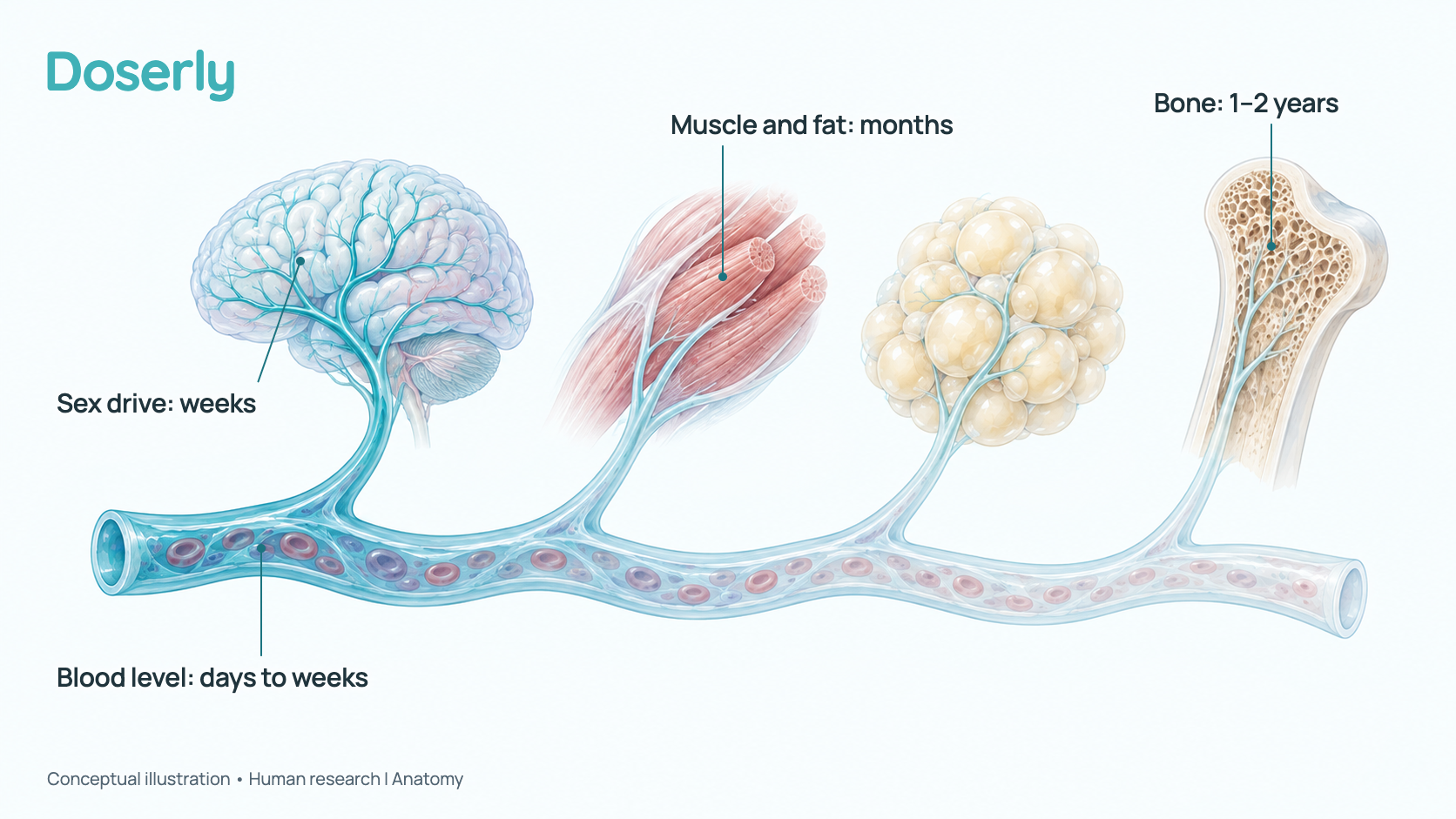
TRT results timeline: the key numbers
Guidelines do not agree on one timeline. This table shows when each major clinical guideline reviews men after starting, what it says to expect, and how long it waits for a benefit before stopping. The numbers are what each document says, checked in September 2026.
| Guideline (version, year) | First review or blood test | When benefit is expected | Stop if no benefit by |
|---|---|---|---|
| AUA, American Urological Association (2018, validity confirmed 2024) | Testosterone 2–4 weeks after starting gels or nasal gel; after 3–4 injection cycles for cypionate or enanthate; halfway between the first two 10-week undecanoate injections | No timeline given | Discuss stopping at 3–6 months if testosterone is normal but symptoms and signs have not improved (bone loss or anemia that improves are exceptions) |
| Endocrine Society (2018) | Review 3–12 months after starting; testosterone and hematocrit at 3–6 months; gels drawn 2–8 hours after application, after at least 1 week | No timeline given | Not stated |
| EAU, European Association of Urology (2026) | First clinical review after 3 months; testosterone and hematocrit at 3, 6 and 12 months | No timeline given | Not stated |
| CUA, Canadian Urological Association (2021) | Symptoms, testosterone and PSA at 3 and 6 months; hematocrit at 3 months | Libido, energy and sexual function after 3 months or longer; body composition and bone after 6 months or more | About 3 months if there is no clinical improvement despite normal levels; no taper needed |
| BSSM, British Society for Sexual Medicine (2023) | Hematocrit and PSA at 3–6 months | Men with levels of 8–14 nmol/L (about 230–400 ng/dL) may need a trial of at least 6 months | 6 months (libido, sexual function, muscle, body fat) |
| VA, US Department of Veterans Affairs (January 2026) | Testosterone, hemoglobin or hematocrit, and PSA at 3–6 months; injections drawn midway between doses, gels after at least 1 week | No timeline given | 6–12 months if symptoms have not improved despite in-range testosterone |
| EAA, European Academy of Andrology (2020) | Response and side effects at 3 months | No timeline given | Not stated |
| ACP, American College of Physicians (2020, now listed as inactive) | Reevaluate within 12 months | Sexual function only, for age-related low testosterone | Stop if sexual function has not improved |
| Society for Endocrinology, UK (2022) | Gels sampled 2–6 hours after application; injections judged by the lowest level before the next dose | Sexual interest, depressive symptoms and energy can change within 3–6 weeks; physical changes take longer | Rejects a time-limited "trial of therapy"; expects lifelong treatment for a confirmed diagnosis |
[4], [20], [15], [3], [5], [6], [21], [22], [23]
Most bodies review men about 3 months after starting, but they wait anywhere from 3 to 12 months for a benefit before suggesting a stop. The Society for Endocrinology rejects time-limited trials altogether. Only the CUA and the Society for Endocrinology describe when effects should appear. The differences come from weak evidence for benefits other than sexual ones, and from some bodies treating a confirmed diagnosis as lifelong. [3], [4], [5], [6], [22], [23]
Why do guidelines disagree on how long to wait?
Because no trial has tested when to give up. No study has followed men with no benefit at 3 months to see whether they improved later. In one clinic's records, 70% of men reported some benefit by 3 months. Of the men who later stopped for lack of benefit, 64.7% had reported none by then. That is a look back at charts, not a test. [24]
Some evidence argues for patience. In a trial of men with type 2 diabetes, erections improved only at week 30, and only in men whose testosterone started at 8 nmol/L or below. The authors wrote that trials of therapy in men with diabetes "may need to be given for much longer than 3-6 months". The BSSM likewise allows at least 6 months for men with borderline levels. [9], [10], [5]
When does each effect show up?
This table gathers the first study visit at which each effect was measured and when it leveled off. "First measured change" is when a study first checked, not the day a man will notice it. Most of the controlled data come from gel trials in older men. The only broad timetable is a 2011 review written by researchers including employees of a testosterone maker, so its numbers are paired here with trial data where they exist. [1]
| Effect | First measured change | When it levels off | Type of evidence |
|---|---|---|---|
| Sex drive | Day 30 against placebo (100 mg gel); 3 weeks in timetable studies | Plateau at about 6 weeks (review); similar size from month 3 to month 12 (Testosterone Trials) | Controlled trials and review |
| Sexual activity | By month 3 (Testosterone Trials) | Smaller by month 12 in the Testosterone Trials; kept to 24 months in TRAVERSE | Controlled trials |
| Erections | Month 3 (Testosterone Trials); week 30 in men with diabetes and very low testosterone | Up to 6 months (review); small average gain; none in TRAVERSE | Controlled trials and meta-analysis |
| Mood | 3–6 weeks (review) | Largest effect at 18–30 weeks (review); controlled effect small or none | Review and controlled trials |
| Energy | Improved as much on placebo by month 3 | No clear benefit at 12 months (Testosterone Trials); small gain in TRAVERSE | Controlled trials |
| Lean mass and fat | By day 90 on gel | Mostly within 6 months; steady at 6–12 months | Controlled trials and meta-analysis |
| Strength | Day 90 on gel (no placebo group); 6 months in frail older men | Often no change in other trials | Mixed trials |
| Bone density | 6 months (one gel dose) | Largest rise in year 1; maximum by 24 months | Controlled trials and cohorts |
| Red blood cells | Months 1–3 | Peak at 9–12 months (review) | Controlled trial and review |
| PSA | About 0.3 ng/mL higher by month 3 | About 0.5 ng/mL higher at 12 months | Controlled trials |
| Blood sugar | 3–6 months in some trials | No benefit in others, including TRAVERSE | Mixed trials |
| Sleep and thinking | No benefit found | No benefit at 12–36 months | Controlled trials |
[18], [25], [7], [26], [9], [11], [1], [27], [2], [28], [29], [30], [31], [32], [33], [34], [13], [35]
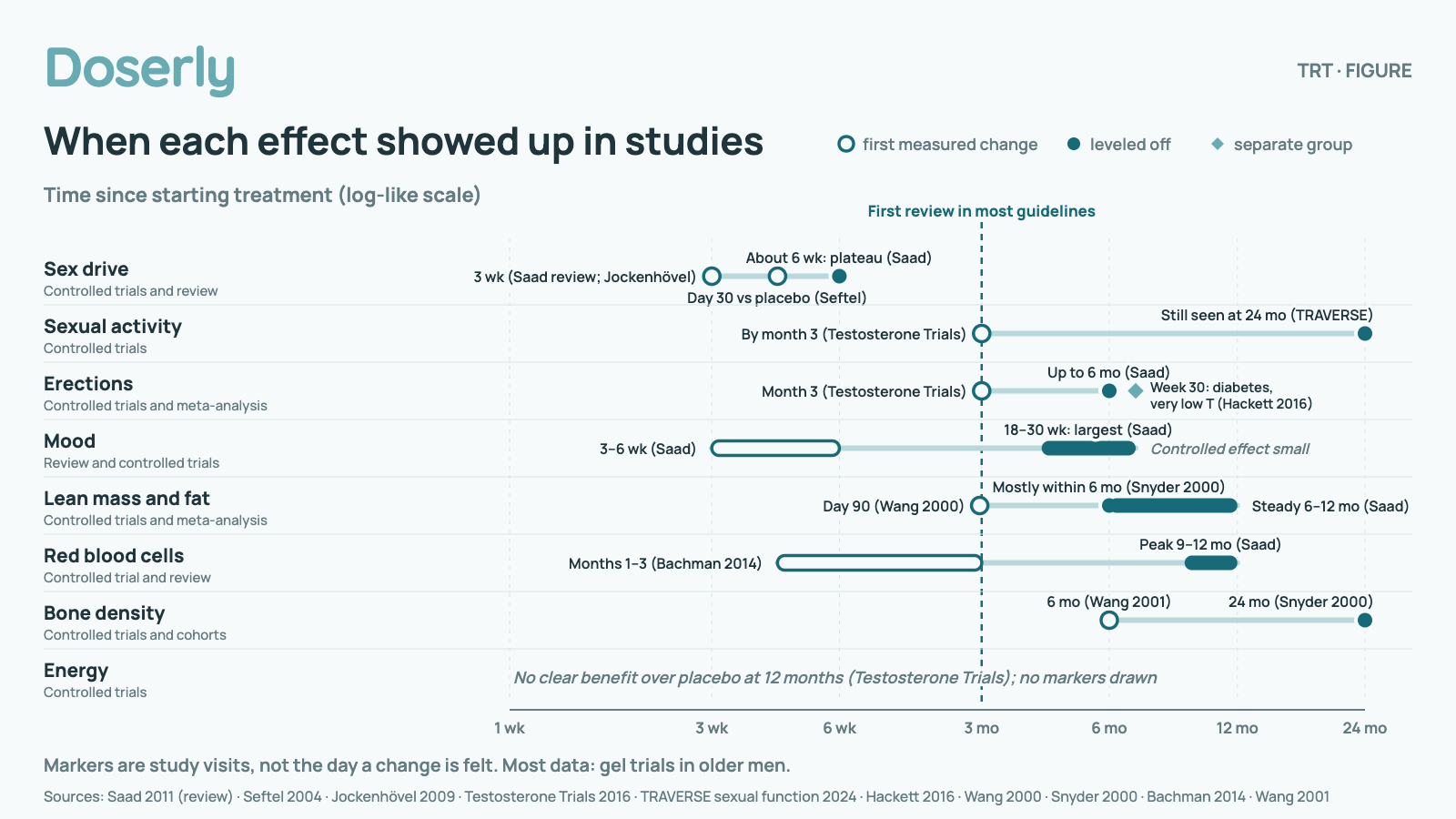
When each effect showed up in studies
first measured changeleveled off
Each line runs from 1 week (left) to 24 months (right) on a log-like scale; the dashed line is 3 months, the first review in most guidelines.
- Sex drive
- First measured: 3 wk (Saad review; Jockenhövel); day 30 vs placebo (Seftel). Leveled off: about 6 wk: plateau (Saad).
- Sexual activity
- First measured: by month 3 (Testosterone Trials). Leveled off: still seen at 24 mo (TRAVERSE).
- Erections
- First measured: month 3 (Testosterone Trials). Leveled off: up to 6 mo (Saad). Week 30: diabetes, very low T (Hackett 2016).
- Mood
- First measured: 3–6 wk (Saad). Leveled off: 18–30 wk: largest (Saad). Controlled effect small.
- Lean mass and fat
- First measured: day 90 (Wang 2000). Leveled off: mostly within 6 mo (Snyder 2000); steady 6–12 mo (Saad).
- Red blood cells
- First measured: months 1–3 (Bachman 2014). Leveled off: peak 9–12 mo (Saad).
- Bone density
- First measured: 6 mo (Wang 2001). Leveled off: 24 mo (Snyder 2000).
- Energy
- No clear benefit over placebo at 12 months (Testosterone Trials).
Markers are study visits, not the day a change is felt. Most data: gel trials in older men.
How do the units work?
Testosterone results appear in ng/dL (US) or nmol/L (most other countries). Multiply ng/dL by 0.0347 to convert, so 300 ng/dL is about 10.4 nmol/L. The testosterone unit converter does this for you, and the TRT blood work guide covers when to draw each test.
Where these numbers come from
The guideline rows come from each body's current document: the AUA testosterone deficiency guideline (published 2018, validity confirmed 2024), the Endocrine Society guideline (2018), the EAU guidelines on sexual and reproductive health (2026 edition), the CUA guideline (2021), the BSSM guidelines (2023), the VA clinical recommendations (January 2026), the EAA guideline (2020), the ACP guideline (2020, now listed by the ACP as inactive) and the Society for Endocrinology guideline (2022). [4], [20], [15], [3], [5], [6], [21], [22], [23]
The onset table comes from the trials cited in each row. Where only the 2011 timetable review gives a number, the table says so. That review was a narrative summary of earlier studies; two of its authors worked for a testosterone maker and two others had received grants or fees from it. [1]
Not used: a claim that about 800 men had a 22% drop in fatigue scores on gel (no primary source found), lean-mass gains of "2 to 5 kg" (the pooled trial average is about 1.6 kg), "gels take 2 to 4 weeks to reach steady state" (labels say days for most gels) and "undecanoate injections take 6 to 12 months to reach steady state" (the Aveed label says the third injection, at week 14). No trial defines a "honeymoon phase"; this guide treats it as a community term.
Why do some effects take longer than others?
Because blood levels and tissues run on different clocks. The level in the blood depends on the form of testosterone and can settle within days. Each tissue then responds at its own speed: in untreated men with very low testosterone, the full effect on bone density took 24 months, while most other effects were complete in 3 to 6 months. [2]
How fast do testosterone levels rise on each form?
Within hours on gels and oral capsules, and within days on injections. Product labels say when levels settle into a steady pattern (steady state), and that is when the first blood test is most useful.
| Form | When levels settle | When the first test is usually drawn |
|---|---|---|
| AndroGel 1% gel | Normal range within 4 hours; steady state by day 2–3 | About day 14 (Testim, a similar gel) |
| AndroGel 1.62% gel | No day stated | About day 14 and day 28, before the morning dose |
| Testosterone 2% solution (armpit) | Steady state by about day 14 | At least 14 days after a change |
| Xyosted (weekly subcutaneous enanthate, injected into the fatty layer under the skin) | Steady state by week 6 | Lowest level, 7 days after a dose, after 6 weeks |
| Cypionate or enanthate injections | No label states a week; the cypionate half-life is about 8 days | After 3–4 injection cycles (AUA), midway between doses (VA) |
| Oral testosterone undecanoate (Jatenzo, Kyzatrex, Tlando) | About 14 days of twice-daily doses (Tlando review) | At least 7 days after a dose change |
| Aveed (undecanoate injection) | Peak about 7 days after an injection (range 4–42); steady state at the third injection, week 14 | Halfway between the first two 10-week injections (AUA) |
| Nebido (undecanoate injection, UK) | Steady state between the 3rd and 5th injection | At the end of an injection interval |
[36], [37], [38], [39], [40], [41], [42], [4], [6], [43], [44], [45], [46], [47]
The UK label for Testogel says levels reach steady state from day 2. [38]
For weekly injections, the only study that tracked the lowest levels over time used a high contraceptive dose in healthy men; those levels settled around week 12, so injections take weeks, not days, to reach a steady pattern. The testosterone level visualizer shows how injection frequency shapes the peaks and troughs. [48]
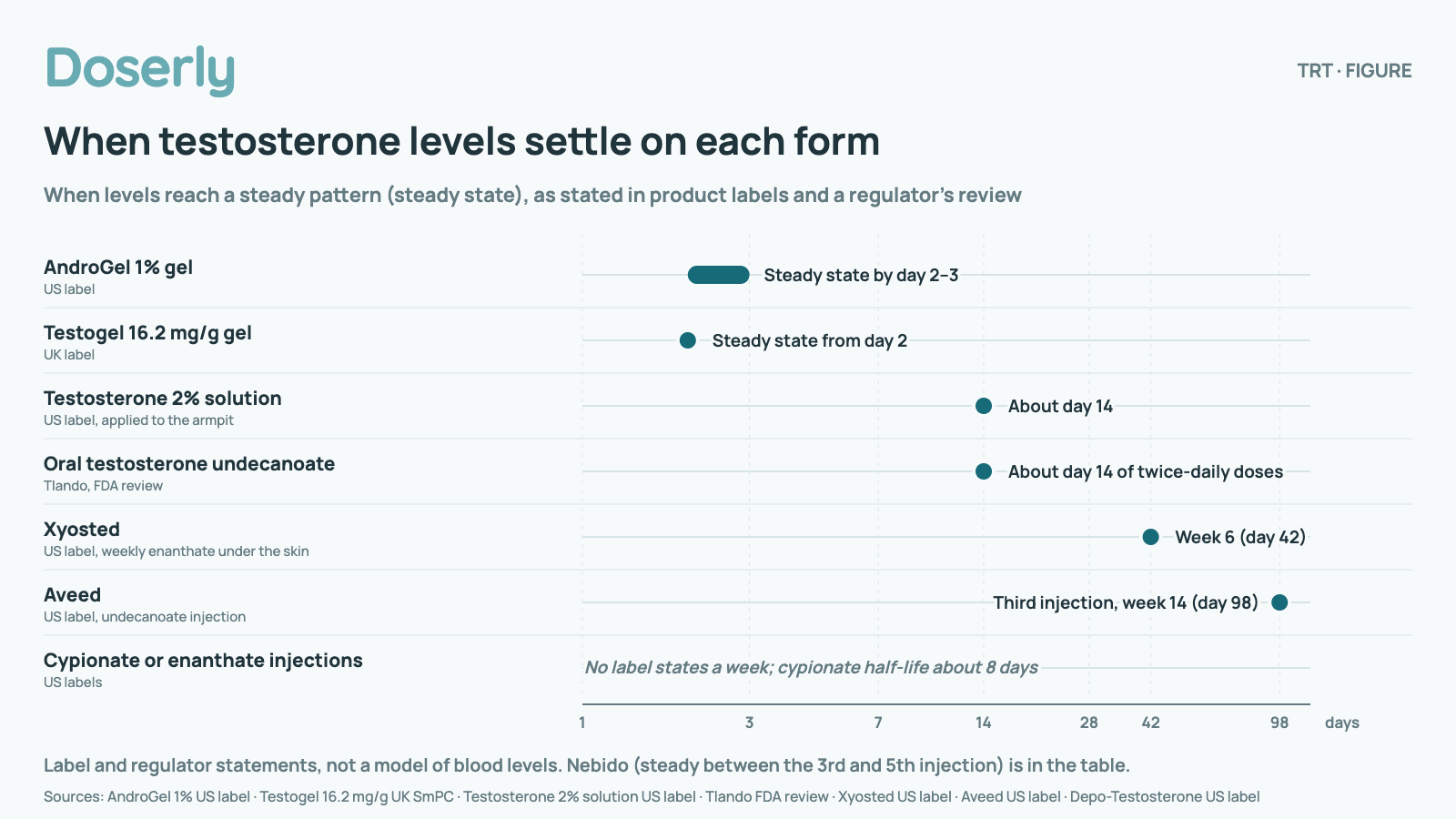
When testosterone levels settle on each form
When levels reach a steady pattern (steady state), as stated in product labels and a regulator's review. Each line runs from day 1 (left) to day 120 (right) on a log-like scale.
- AndroGel 1% gel (US label)
- Steady state by day 2–3
- Testogel 16.2 mg/g gel (UK label)
- Steady state from day 2
- Testosterone 2% solution (US label, applied to the armpit)
- About day 14
- Oral testosterone undecanoate (Tlando, FDA review)
- About day 14 of twice-daily doses
- Xyosted (US label, weekly enanthate under the skin)
- Week 6 (day 42)
- Aveed (US label, undecanoate injection)
- Third injection, week 14 (day 98)
- Cypionate or enanthate injections (US labels)
- No label states a week; cypionate half-life about 8 days
Label and regulator statements, not a model of blood levels. Nebido (steady between the 3rd and 5th injection) is in the table.
What happens to your own testosterone signal?
It switches off quickly. In healthy men given enanthate injections, the brain's signal to the testicles (LH) fell within 24 hours of the first injection, and LH and FSH were below 0.5 U/L by week 4. Those men were on a high contraceptive dose, but treatment doses turn the same signals down: after men stopped 2 years of long-acting injections in one trial, their LH and FSH were still recovering a year later. This is why testicle size and sperm production change on TRT, covered below. [48], [49], [50]
What does the research show?
For sex drive, the evidence is consistent: a change within weeks that holds. For erections, mood and body composition it is smaller and slower. For energy, sleep and thinking, the large trials found little or nothing. The best data come from placebo-controlled trials of gels in older men; timetables for injections come mostly from small studies without a placebo group. [14], [7], [25]
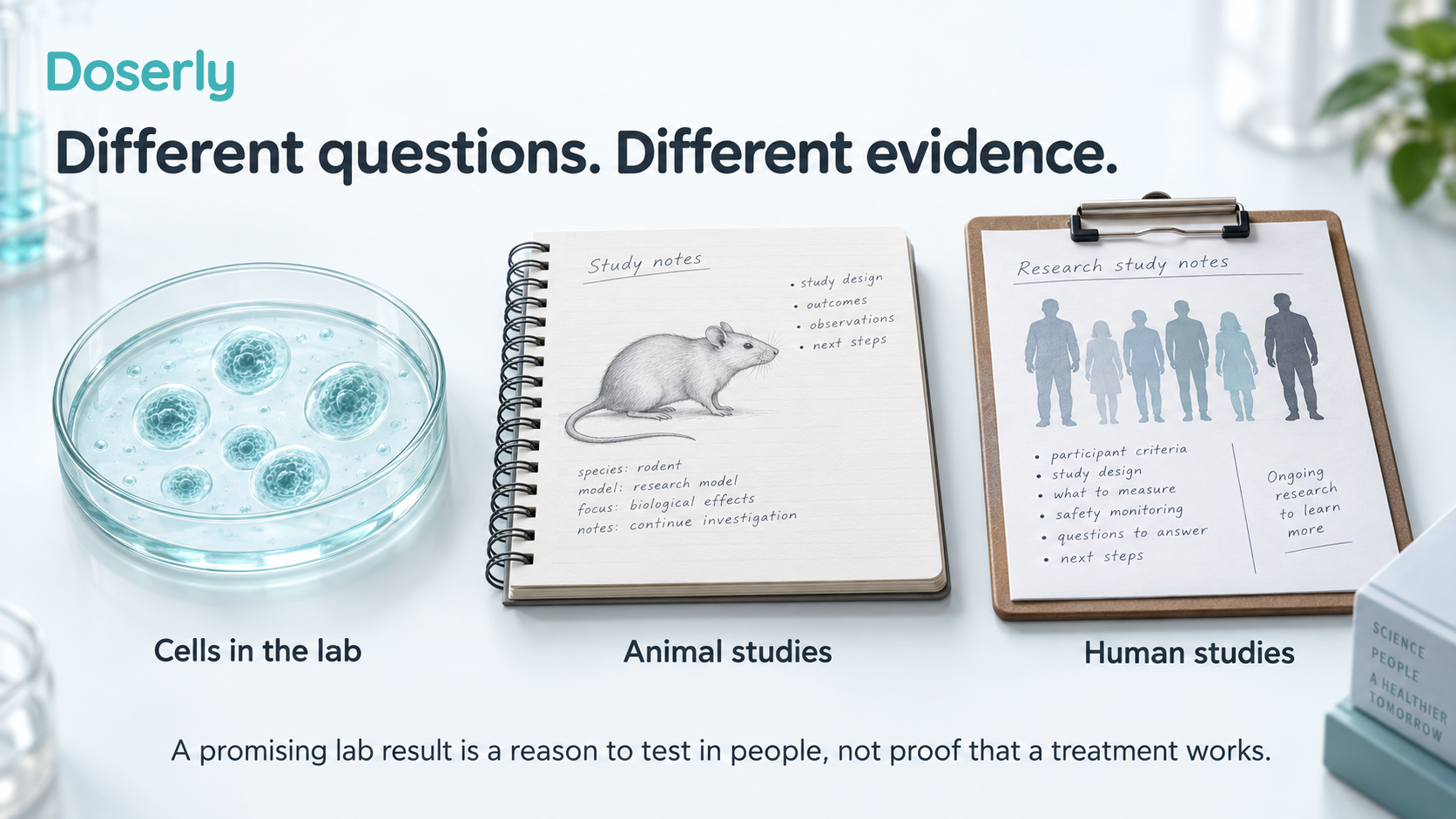
How much of the early change is placebo?
A lot, for some effects. In the Testosterone Trials, 790 men aged 65 or older used testosterone gel or placebo gel for a year. At month 3, 67.6% of men on testosterone and 66.7% on placebo had improved enough on a fatigue questionnaire to meet the trial's goal. By month 12 the numbers were 72.4% and 62.8%, and the difference was not statistically clear. [7]
Sex drive separated from placebo, but not in every man. In the same trials:
These responder counts come from the half of the sexual-function trial set aside to test the questionnaire cut-offs (about 230 men).
- Sex drive. A meaningful rise in desire came in 48 of 111 men on testosterone (43.2%) and 21 of 108 on placebo (19.4%) at month 3. At month 12 the numbers were 40 of 112 (35.7%) and 14 of 103 (13.6%) on the same questionnaire. On another, 34.6–47.2% of men on testosterone had a meaningful gain across months 3 to 12, against 20–22% on placebo. [19], [8]
- Sexual activity. A meaningful rise came in 45 of 102 men on testosterone (45.1%) and 27 of 102 on placebo (26.5%) at month 3, falling to 31 of 97 (32.0%) and 22 of 92 (23.9%) at month 12. [19]
In other words, at each visit more than half of the men on testosterone had not reached a meaningful change in desire. Up to about 1 in 4 men on placebo had (23.5% at month 6). [19]
Early studies without a placebo group show big, fast changes. In 638 men starting a gel, sexual activity, desire and mood improved within the first week and peaked by week 2. Without a comparison group, that cannot be separated from expectation. [51]
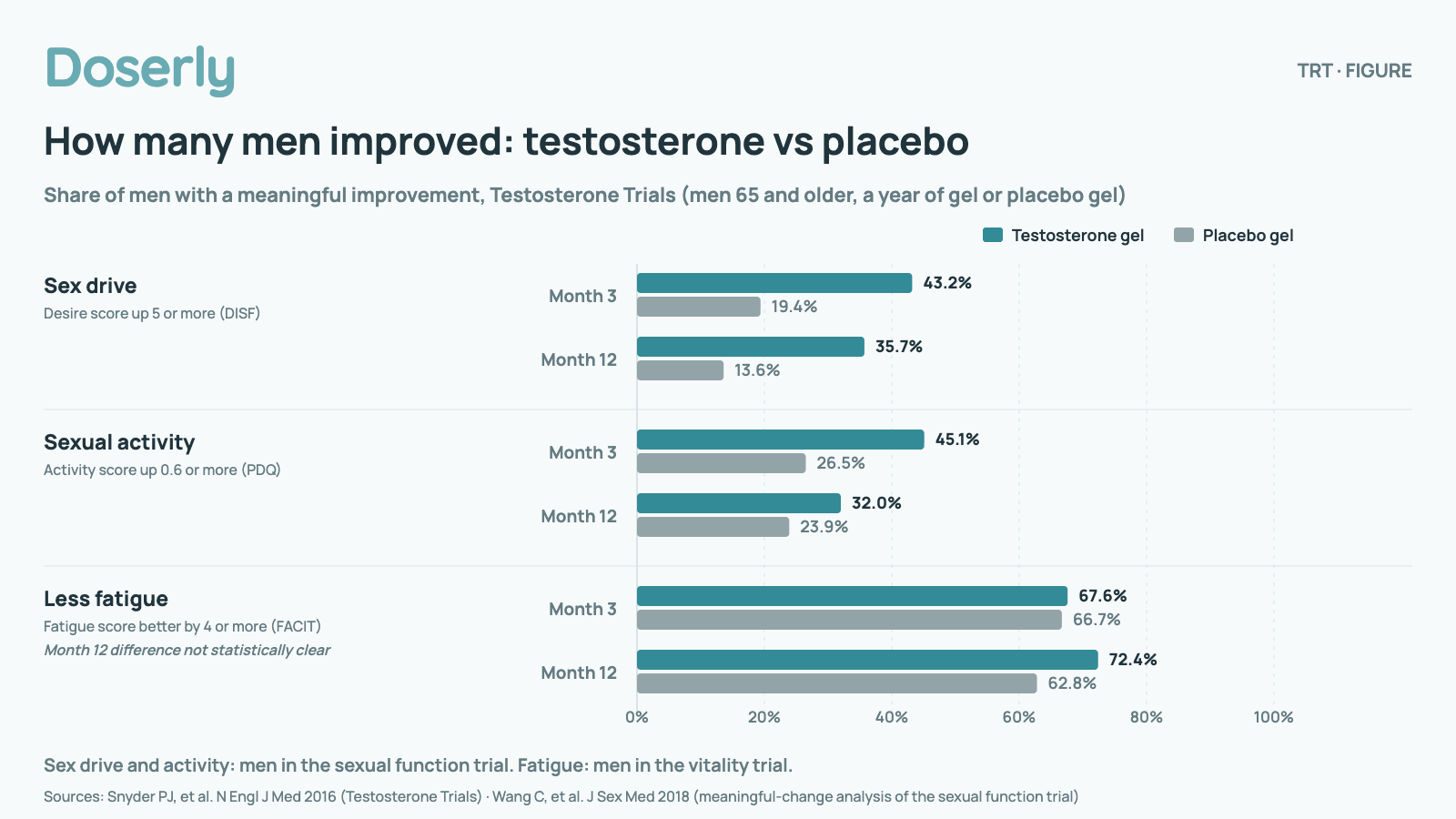
How many men improved: testosterone vs placebo
Testosterone gelPlacebo gel
Share of men with a meaningful improvement, Testosterone Trials (men 65 and older, a year of gel or placebo gel). Bars run from 0 to 100%.
- Sex drive, month 3
- Desire score up 5 or more (DISF): testosterone 43.2% vs placebo 19.4%
- Sex drive, month 12
- Desire score up 5 or more (DISF): testosterone 35.7% vs placebo 13.6%
- Sexual activity, month 3
- Activity score up 0.6 or more (PDQ): testosterone 45.1% vs placebo 26.5%
- Sexual activity, month 12
- Activity score up 0.6 or more (PDQ): testosterone 32.0% vs placebo 23.9%
- Less fatigue, month 3
- Fatigue score better by 4 or more (FACIT): testosterone 67.6% vs placebo 66.7%
- Less fatigue, month 12
- Fatigue score better by 4 or more (FACIT): testosterone 72.4% vs placebo 62.8% (difference not statistically clear)
Sex drive and activity: men in the sexual function trial. Fatigue: men in the vitality trial.
When does sex drive improve?
Usually within weeks, and it then holds rather than keeps growing.
- Day 30. In a placebo-controlled trial of 406 men, desire rose 1.2 points on a 100 mg daily gel against 0.4 on placebo at day 30; nighttime erections increased in 51% against 26%, and intercourse in 39% against 24%. [18]
- Then a plateau. In a 180-day gel trial without a placebo group, sexual function peaked by day 30, and the gains held for up to 42 months. [27], [52]
- 3 weeks on injections. In a timetable of 40 men on enanthate or undecanoate injections, sexual thoughts, desire and morning erections rose quickly and leveled off after 3 weeks. There was no placebo group. [25]
- Month 3 onward. In the Testosterone Trials, desire had risen by the first check at month 3 (3.5 points against 0.7 on placebo), and the benefit was similar through month 12. In TRAVERSE, men with low libido had more sexual activity at 6 months, the first check, and the gain lasted to 24 months. [7], [53], [26]
- Size. In T4DM, a 2-year trial in men with a large waist and prediabetes or new diabetes, 32% of men on testosterone and 22% on placebo had a clinically meaningful gain in desire. [54]
When do erections improve?
More slowly, less reliably and by a smaller amount. In the Testosterone Trials, the erection score (IIEF) rose 3.4 points by month 3, against 1.0 on placebo. [7]
- How much. Across 14 randomized trials (2,298 men), the erection score rose 2.31 points more than placebo. The gain was 2.95 points when testosterone started below 8 nmol/L (about 230 ng/dL), 1.47 points below 12 nmol/L, and smaller with diabetes or obesity. [11]
- How long. In men with type 2 diabetes, erections separated from placebo only at week 30, and only in those who started at 8 nmol/L or below. The 2011 review says erections may take up to 6 months. [9], [1]
- Not always. In TRAVERSE, testosterone raised desire and activity but did not improve erections. [26]
- With erection medicines. In 75 men who had not responded to sildenafil, adding gel improved erection scores by week 4 (4.4 points against 2.1). In 140 men whose sildenafil dose had first been optimized, adding testosterone gave no extra benefit over 14 weeks. [55], [56]
The evidence conflicts on who gains most. The 2017 analysis above found bigger erection gains when testosterone started very low, and smaller gains with diabetes or obesity. A larger 2023 analysis pooled the records of 3,431 individual men with testosterone below 12 nmol/L from 17 trials, and added published results from other trials. It found an average gain of about 2 points on the erection score, enough to matter for mild erection problems. That gain did not depend on age, obesity, diabetes or the starting testosterone level. So a very low starting level does not promise a bigger response, and diabetes or obesity does not rule one out. [11], [12]
For comparison, a 2024 Cochrane review studied men with erection problems who did not have diagnosed low testosterone. There, testosterone raised the erection score by 2.37 points, below the 4-point change the authors took as clinically important. [57]
When does mood improve, and by how much?
The review timetable puts the first change at 3–6 weeks and the largest at 18–30 weeks. A small timetable of 40 men on injections found depression scores leveling off after 6 weeks. The controlled size is small. [1], [25]
- In the Testosterone Trials, depression scores (PHQ-9) improved by 0.72 points more than placebo, a very small effect. [7]
- Across 27 randomized trials (1,890 men), testosterone reduced depressive symptoms by a small amount (effect size 0.21). [58]
- Pooled individual trial data, T4DM over 2 years and a 6-week trial in 100 men with major depression found no improvement in depressive symptoms. [12], [59], [60]
- TRAVERSE found small improvements in mood and energy, but no benefit for persistent low-grade depression. [61]
The Society for Endocrinology notes that mood, sleep and thinking symptoms are "much less likely to improve" with testosterone than sexual symptoms. [23]
Does TRT improve energy, and when?
Not clearly, in the trials that could tell. The Testosterone Trials' fatigue goal was met about equally often on placebo at month 3, and the year-long difference was not statistically clear. A 12-week trial of a 2% solution improved sex drive but missed its prespecified goal for energy. TRAVERSE found a small gain in energy. [7], [62], [61]
A September 2026 review of the two largest trials concluded that testosterone improves sexual function and mood but not energy, physical function or thinking. A small timetable without placebo put fatigue changes at 9–12 weeks. [14], [25]
When do muscle, fat and weight change?
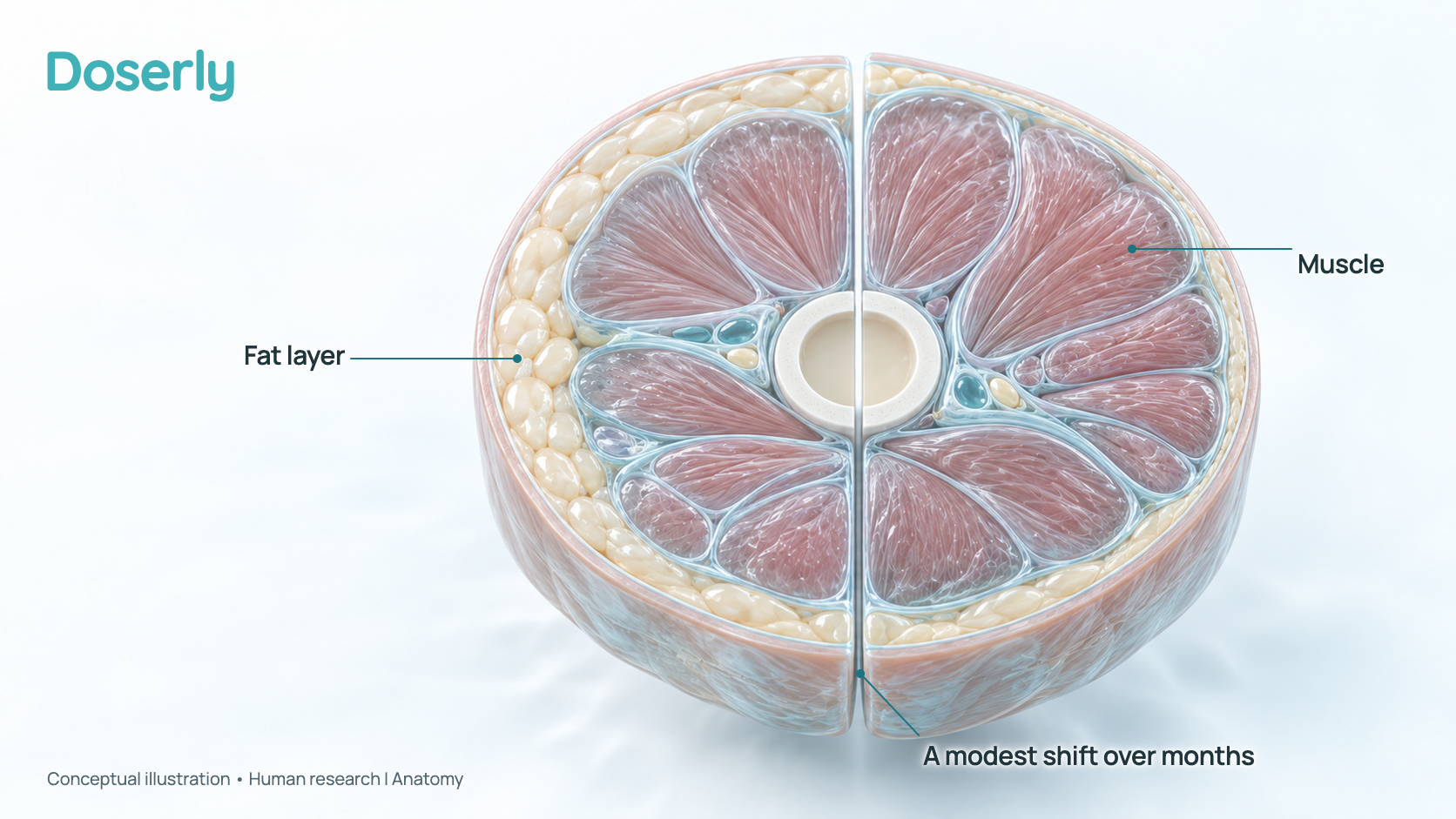
Lean mass starts to rise by about 3 months, and most of the change comes within 6 months. The average change is modest. [27], [2]
- By day 90. On gel, lean mass rose 2.74 kg on 100 mg a day and 1.28 kg on 50 mg, and fat fell by about 1 kg. [27]
- Average. Across 29 randomized trials in middle-aged and older men, testosterone added about 1.6 kg of lean mass and removed about 1.6 kg of fat, without changing body weight. [63]
- Range. Placebo-controlled trials found lean-mass gains from 0.9 kg at 6 months in healthy older men to 3.4 kg at 24 weeks in men with diabetes. [64], [65]
- With weight loss. In T4DM, where all men joined a lifestyle program, fat mass fell 4.6 kg on testosterone and 1.9 kg on placebo over 2 years. Changes in body composition, mainly fat loss, accounted for about two thirds of the lower diabetes rate. In T4DM, weight loss rather than testosterone went with better mental quality of life. [66], [59]
The scale can move the other way at first. US labels say testosterone "may promote retention of sodium and water", and they give no week when this starts or stops. [67]
Does strength improve?
Sometimes, and not by much. Leg-press strength rose 11–13 kg by day 90 on gel in a trial with no placebo group, then stayed flat. In frail or mobility-limited older men, strength and function improved at 6 months. One such trial, which had enrolled 209 men, was stopped early: 23 men on testosterone had heart-related adverse events, against 5 on placebo. In the much larger TRAVERSE trial, heart attack, stroke and heart-related death were no more common on testosterone gel, though some other problems were; the safety section gives the full results. Placebo-controlled trials lasting 3 years found no clear change in leg strength, though one found modest gains in stair-climbing, chest-press strength and leg power. Across 13 trials in men over 60, the average gain was small. [27], [28], [68], [69], [70], [64], [71]
In the Testosterone Trials, walking did not improve in the men enrolled for physical function. [7] The TRT muscle and fat loss guide covers training and body composition in detail.
When does bone density improve?
Slowly: it is measurable at 6 months in some men and keeps rising for 1 to 2 years.
- 6 months. On 100 mg daily gel, spine density rose 2.2% and hip 1.1%; only this higher dose showed a clear change. [29]
- 12 months. In the Testosterone Trials, spine density measured by CT scan rose 7.5% on testosterone against 0.8% on placebo. [72]
- 1 to 2 years. In untreated men, the largest rise came in year 1, and density peaked by 24 months. [30], [2]
- Who benefits. Over 3 years, a model of one trial's results estimated a 5.9% rise in men starting at 200 ng/dL (about 6.9 nmol/L), against 0.9% at 400 ng/dL (about 13.9 nmol/L). [73]
Denser bone did not mean fewer broken bones. In TRAVERSE, fractures occurred in 3.50% on testosterone and 2.46% on placebo (91 of 2,601 men against 64 of 2,603; hazard ratio 1.43). [74]
What about red blood cells, PSA and blood sugar?
These are measured on blood tests, and they move on their own timelines.
- Red blood cells. The body's red-cell signals change in months 1–3. In the small untreated group, hematocrit rose from 38.0% to 43.1% within 3 months; the review puts the peak at 9–12 months. In the Testosterone Trials, 62 men had anemia with no known cause; at 12 months, 58.3% of those on testosterone and 22.2% on placebo were no longer anemic. The hematocrit guide covers the numbers guidelines act on. [31], [2], [1], [75]
- PSA. In the Testosterone Trials, average PSA was about 0.3 ng/mL higher by month 3 and about 0.5 ng/mL higher by month 12, and 5% of men had a rise of 1.7 ng/mL or more. In TRAVERSE, PSA was about 0.15 ng/mL higher than on placebo at 12 months, with no further widening. See the TRT and prostate guide. [32], [76]
- Blood sugar. Some trials found gains within 3–6 months, but others found none at 40 weeks, over 3 years or in TRAVERSE. The Endocrine Society advises against using testosterone to control blood sugar. [33], [77], [78], [79], [34], [20]
Does TRT improve sleep or thinking?
Not in controlled trials. Sleep quality did not improve at 14 weeks in one trial (in men taking opioids) or in TRAVERSE. A year of testosterone did not improve memory in men with age-related memory problems, and 3 years did not improve thinking in healthy older men. [80], [61], [13], [35]
In obese men with severe sleep apnea, injections made nighttime oxygen drops worse at week 7, but not at week 18. [81]
When do testicle size and sperm change?
Within months, in studies of healthy men given high contraceptive doses. Testicles were about 16–19% smaller after 4 months, and 65% of men had no sperm (azoospermia) within 6 months on 200 mg of enanthate weekly. No study has measured this timing at usual treatment doses. The TRT and fertility guide covers protecting fertility. [50], [82]
Who responds more, and who less?
Bone gains were larger when testosterone started very low. In men with diabetes, depression at the start went with a much weaker response, and men with diabetes and only modestly low testosterone saw no clear symptom gain over 40 weeks. For erections, the large analyses disagree on whether the starting level, diabetes or obesity changes the size of the gain (see erections). In the Testosterone Trials, no threshold or starting trait predicted who would respond. [73], [10], [83], [11], [12], [53]
Is TRT safe, and what can slow or muddy the timeline?
For men with confirmed low testosterone, TRT did not raise heart attack or stroke rates in the largest trial, but it has known risks that need monitoring. It is an approved treatment, and its main safety questions are about the heart, red blood cells, the prostate and fertility. Timing matters for safety too: several blood-test changes happen in the same first 3 months as the benefits. [69], [42], [20]
Is TRT safe for the heart?
TRAVERSE is the largest trial on this question. About 5,200 men aged 45 to 80 with low testosterone and existing heart disease or high heart risk used a daily testosterone gel or placebo gel. Heart attack, stroke or cardiovascular death occurred in 7.0% of men on testosterone and 7.3% on placebo (182 of 2,596 men against 190 of 2,602). The hazard ratio of 0.96 means the rate was about 4% lower on testosterone, a difference small enough to be chance, and it met the trial's safety goal. [69]
Some problems were more common on testosterone:
- Atrial fibrillation (an irregular, often fast heartbeat): 3.5% vs 2.4%.
- Acute kidney injury (a sudden drop in kidney function): 2.3% vs 1.5%.
- Pulmonary embolism (a blood clot in the lungs): 0.9% vs 0.5%.
Its limits matter: it tested only a gel, men used it for an average of 21.7 months, about 61% stopped their study gel early, and it enrolled men at high heart risk. The TRT and heart health guide covers the trial in full. [69], [84]
US labels still say safety and benefit have not been established for low testosterone caused by aging alone. In June 2026, the US health department announced that the FDA is requesting label changes, including removing that statement; as of September 2026 they had been requested, not made. [45], [85]
Which side effects show up early?
Labels list the side effects but not when they start. Hematocrit and PSA rise within the first 3 months (see the research). Beyond that:
- Fluid retention is listed on labels without a start week, and adding corticosteroid medicines "may result in increased fluid retention". [67]
- Sleep apnea got worse at week 7 in severe cases, then not at week 18. [81]
- Fertility can fall within months, and labels warn it may not fully recover in some men. [82], [41]
Who should be especially cautious?
- Men hoping mainly for more energy or better mood. These improved little or no more than placebo in the large trials. The ACP advised against starting testosterone for energy or thinking in age-related low testosterone. [7], [22]
- Men whose levels are only borderline low. Benefits were smaller, and the BSSM allows at least 6 months to judge them. [5], [83]
- Men with untreated sleep apnea, diabetes, obesity or depression. These can blunt the response or cause the same symptoms; the CUA advises looking for reversible causes first. [3], [10]
- Men who want children soon. See the fertility guide. [82]
- Drug-tested athletes. Testosterone is prohibited in sport at all times. [17]
- Under-18s. Testosterone for teenagers belongs only in specialist care.
- Women. This guide is written for men. Testosterone for women uses different doses and products; see testosterone therapy for women.
Which medicines and conditions change the timeline?
- Erection medicines (PDE5 inhibitors). They can make testosterone's effect on erections hard to see, or add to it (see above). Their labels forbid combining them with nitrate heart medicines. [56], [86]
- Diabetes medicines. US testosterone labels say testosterone may lower blood sugar and insulin needs in men with diabetes, so doses may need review. [42]
- Weight-loss medicines. Current GLP-1 medicine labels list no interaction with testosterone, but starting one at the same time makes it hard to tell which medicine changed weight, energy or mood. See TRT with GLP-1 medicines. [87]
- Several changes at once. Adding an aromatase inhibitor, a hair-loss medicine, a new diet or training plan in the same weeks makes the timeline much harder to read. See estrogen on TRT for what aromatase inhibitors do.
Bring a complete list of what you take, including supplements, to a pharmacist or prescriber. Checked September 2026.
Is testosterone legal, and is it allowed in sport?
Checked September 2026. Rules differ by country and change often.
- United States. Testosterone and its esters are Schedule III controlled substances, prescription only. No proposal to change that has been published. [16]
- United Kingdom. Testosterone is a Class C controlled drug, in Schedule 4 Part II of the Misuse of Drugs Regulations. [88]
- Canada. Testosterone is a Schedule IV controlled substance. [89]
- Australia. Testosterone is a Schedule 4 prescription-only medicine. [90]
- Sport. The World Anti-Doping Agency (WADA) prohibits testosterone at all times, and its 2027 list, published in September 2026, keeps the ban. [17], [91]
What do guidelines say about judging whether TRT is working?
Guidelines check the testosterone level first, then symptoms, and give treatment a set time before deciding. This section describes the choices clinicians weigh; it is not a personal plan. [4], [3]
| When | What guidelines check | Which guidelines |
|---|---|---|
| First weeks | Whether the testosterone level is in range, drawn at the right time for the form: gels after at least 1 week (Endocrine Society, VA) or 2–4 weeks (AUA), injections after several doses | AUA, Endocrine Society, VA; product labels |
| About 3 months | First clinical review of symptoms and side effects, with testosterone, hematocrit and often PSA | EAU, CUA, EAA; Endocrine Society and VA at 3–6 months |
| 3–12 months | Decide whether to continue if symptoms have not improved despite normal levels: about 3 months (CUA), 3–6 (AUA), 6 (BSSM), 6–12 (VA), within 12 for sexual function (ACP) | CUA, AUA, BSSM, VA, ACP |
| 12 months, then yearly | Ongoing benefit and safety tests | Most guidelines |
[4], [20], [15], [3], [21], [6], [5], [22]
What do clinicians consider when there is no benefit?
- Was the level right? The AUA's stopping rule applies when testosterone is in the normal range. A level drawn at the wrong time, or a dose that is too low or too high, changes the picture. [4]
- Is it the right symptom? Sexual symptoms respond best. Mood, sleep and thinking are less specific to low testosterone and much less likely to improve. [23]
- Is something else going on? Sleep apnea, weight, diabetes, depression and medicines can cause the same symptoms. [3]
- Is the wait long enough? Most guidelines allow 3 to 12 months, and the diabetes trial authors argue for longer in men with diabetes. [10]
- Stop or continue? The CUA says treatment can stop without a taper if there is no benefit after about 3 months at normal levels. The Society for Endocrinology instead expects lifelong treatment when the diagnosis is confirmed. [3], [23]
Does a dose change restart the clock?
For blood levels, yes: labels time the next test from the change, for example at least 7 days after an oral dose change, 14 days after a 2% solution change, and after 6 weeks on Xyosted. No trial has measured how long symptoms take to respond after a dose change. The TRT dosage guide covers how prescribers adjust doses, and the TRT dose calculator converts a dose into volume. [44], [40], [41]
What should you expect in the first weeks and months?
What happens in the first week?
Blood levels rise, often within hours on gels and within days on injections, and your own LH signal starts to fall. Any lift in energy or mood that week is hard to credit to testosterone: no placebo-controlled trial has measured week 1, and placebo improved fatigue about as much as testosterone by month 3. [36], [48], [7]
Is 6 weeks too early to judge TRT?
For sex drive, 6 weeks is enough to see a change in many men, but not all. For most other effects it is early: guidelines first review at about 3 months, and muscle, fat and erections often take 3 to 6 months. At each visit in the Testosterone Trials, fewer than half of the men on testosterone had a meaningful rise in desire. [1], [15], [8]
Why do some men feel worse after starting TRT?
No trial has measured this, so nobody knows how common it is. Men describe anxiety, low mood, poor sleep or flushing in the first weeks (see what people report). The 2011 review mentions anger only in men with normal levels given very high doses, which is a different situation. New chest pain, breathlessness, one swollen leg or severe low mood need prompt medical care. [1]
Is there a TRT "honeymoon phase"?
Not in trials. It is a community term for an early lift that fades. The trials show effects that level off rather than fade: gel gains held to 42 months, and TRAVERSE's sexual-activity gain lasted to 24 months. The one trial signal is that the Testosterone Trials' gain in sexual activity was larger at month 3 (0.6 points) than at month 12 (0.2 points), while placebo barely changed. [52], [26], [7]
Why did I gain weight in the first weeks?
Often water. Labels list sodium and water retention without a start week, and in the forum posts reviewed for this guide, early weight gain came alongside more food, creatine or new training. Lean mass gains come later, over about 3 months. [67], [27]
Does the form change how fast it works?
It changes how fast the blood level settles (see the forms), but no trial has compared how fast symptoms respond on different forms. Gel trials and a small injection timetable both found sex drive changing within weeks. [25], [18]
What happens to the results if you stop?
They fade. Levels fall within days on gels (back to the starting level by day 5 on AndroGel 1%) and over months on long-acting injections, whose levels halve about every 53 days after a single dose. In frail older men, the gains in lean mass, strength and symptoms were gone 6 months after stopping gel, and in obese men the extra fat loss and lean-mass protection were gone about 82 weeks after stopping. In one trial, men's own hormone signals were still recovering a year after long-acting injections stopped. The stopping TRT guide covers what to expect. [36], [92], [93], [94], [49]
What do people on TRT report about the timeline?
Public forums are full of week-by-week diaries: men who felt better within days, men who notice nothing at 2 months, and men whose early gains faded. The threads below are recent public Reddit discussions, read with their replies; they show what people experience, not how often it happens.
What do the first weeks feel like?
Mixed, and often up and down. One man noticed nothing in week 1. He felt "magically superman" after his second injection, then decided "it was in my head". He felt calmer with stronger erections in week 3, had a "down week" in week 4 and saw energy returning in week 5. In the same weeks he changed his diet, started lifting and was ill. [95] A man with very low levels felt "surprisingly well rested" 24 hours after his first injection, wrote that it "could be a placebo", and felt anxious the next day. [96]
Others describe separate clocks for separate effects. A man in his early 40s said his libido "kicked in" by about week 2, his weight rose within 4 to 6 weeks, and energy and mood were "a slower burn", still building at week 9. [97]
What does "no change yet" look like at 6 to 8 weeks?
Common, and frustrating. A 30-year-old on 120 mg a week had "maybe noticed a slight increase in energy" at 7 weeks but no change in libido; erection medicines helped erections but not desire, and by week 8 he had "not noticed much difference". One reply suggested another couple of weeks, saying 8 weeks was when most people noticed injections working. [98] A 38-year-old whose testosterone rose from 262 to 980 ng/dL felt no benefit at 6 weeks; he also took an antidepressant and had had 10 years of unexplained fatigue. [99] A man in Australia had more energy and better workouts by week 6 but no gain in libido, and in the same weeks developed anxiety, a higher resting heart rate and a feeling that he could not get enough air. [100]
What about men who feel nothing after months?
Some threads end in stopping. A man at 4 months had no more energy or libido with a level of 600 ng/dL before his next dose, and was waking often at night. [101] A 46-year-old had "not seen any improvements whatsoever" after about 9 months, with severe acne, and had just gone back on CPAP for sleep apnea. [102] A 42-year-old who started at 500 ng/dL reached about 1,100 ng/dL with no change in daytime fatigue, stopped after 6 months and was using CPAP for borderline sleep apnea. [103]
Do early gains fade?
Some men say so, and in several of these threads something else changed at the same time. One man's energy and libido were "everything i could have hoped for" at week 4 and faded by week 6; he had started a hair-loss medicine at week 4. [104] Another had "great libido" for 7 or 8 weeks that was gone by week 10, while also taking a prescribed aromatase inhibitor. [105] A 38-year-old had 3 great months, then 2 months with no libido; his prolactin was high and a month of cabergoline had not helped. [106] A man with a spinal cord injury had only about 3 good weeks in his first 2.5 months, while his mood and confidence stayed better. [107]
Others describe gains that last. A 30-year-old at 3 months felt a "night and day difference" in energy, focus, libido, mood and recovery, and called it "very early days or the 'honeymoon' period" himself. [108]
Why do some men feel worse first?
The accounts vary, and several involve other health problems. A 51-year-old with post-viral fatigue felt a bit more energy in week 2, then "crushing depression/anxiety" in week 3 as his levels rose from 203 to 474 ng/dL; lowering and splitting the dose had not fixed it by week 5. [109] A 39-year-old with a history of health anxiety described anxiety, brain fog and good and bad days in his first 5 weeks. [110] A 55-year-old felt anxious, dizzy and sweaty by week 3 and agreed with his doctor to stop for now. [111] One man whose early weeks felt great developed dizziness, brain fog and low mood around months 3 to 4, when his hematocrit had reached 52.7% and he was also taking an aromatase inhibitor and an antidepressant. [112]
What happens to weight in the first weeks?
Several men describe fast early gains that look like water. One man went from 168 to 175 lb in 3 weeks while eating less, with a puffy face, and stopped creatine after replies pointed to it. [113] A man at 6 weeks gained 12 lb after raising his calories from 2,200 to 3,200 a day, and described better energy, sleep and recovery. [114]
What do people say at 3 months and beyond?
Later accounts in these threads are more modest than the early hopes. A 51-year-old at 3 months estimated "10-15% more energy and 20-25% higher sex drive", having expected more energy. [115] A 42-year-old's arms grew an inch in the first 4 months and then "stabilized", while acne came back and he donated blood for thick blood. [116] A 39-year-old stopped after about 15 weeks of mixed results and felt stable, with good erections, 7 to 8 weeks later. [117]
How can you judge a timeline story?
Ask: How low was testosterone before treatment, confirmed on more than one morning test? What was the dose, and when was blood drawn relative to it? What else started in the same weeks: an aromatase inhibitor, hCG, a hair-loss or weight-loss medicine, a new diet or training plan? Was sleep apnea, depression or another illness in the picture? And what did the next 3 months look like?
These selected discussions show what people experience and the questions research has not answered. They are not a survey of all men on TRT, a success rate or a substitute for the studies above.
What should you track?
Your symptoms from before you start, a testosterone level drawn at the right time for your form, and the safety tests guidelines use at about 3–6 months and 12 months. Use this summary to prepare for your review; it is not a personal testing plan. [15], [6], [20]
| Why it matters | What guidelines and labels say | Tracking category |
|---|---|---|
| Symptoms you started for (sex drive, erections, energy, mood, sleep) | Reviewed at about 3 months, then at 6 and 12 months; a baseline record makes the comparison fairer | Check-ins |
| Testosterone level | First test timed to the form (see the key numbers); then at 3–6 and 12 months | Blood work |
| Hematocrit | At 3–6 months, 12 months, then yearly | Blood work |
| PSA, where it applies | At 3–6 months and 12 months, then as advised | Blood work |
| Weight and waist | Fat and lean mass shift over months; early weight gain may be water | Body measurements |
| Other changes | New medicines, diet, training or illness in the same weeks | Notes |
A single week is one point on a line. Because placebo and everyday life move how people feel, a record that starts before treatment and follows the same few symptoms says more than memory at a 3-month visit. [7]
Common questions about the TRT results timeline
How long does TRT take to work?
Sex drive often changes within 3 to 6 weeks; erections, muscle and fat over about 3 to 6 months; bone over 1 to 2 years. Mood can shift within weeks, but only slightly more than on placebo. Most guidelines review progress at about 3 months. [1], [2], [7], [15] See the key numbers.
How long does it take for TRT to increase libido?
Desire had risen more than on placebo by day 30 in one trial, and timetable studies put the plateau at about 3 to 6 weeks. Not every man responds. [18], [1], [8] See the research.
How long until TRT helps erections?
Usually 3 to 6 months, and the average gain is small. Analyses disagree on whether it is larger when testosterone starts very low, and TRAVERSE found no gain in erections. In men already on an optimized dose of sildenafil, adding testosterone gave no extra benefit. [7], [11], [12], [26], [56] See erections.
When will I see muscle or fat changes on TRT?
Lean mass starts rising by about 3 months, mostly within 6 months: about 1.6 kg more lean mass and 1.6 kg less fat on average. Early weight gain is often water. [27], [63], [67] See muscle, fat and weight.
Is the TRT honeymoon phase real?
It is a community term, not something trials have defined. Trials show effects that level off rather than disappear, although in the Testosterone Trials the gain in sexual activity was smaller at month 12 than at month 3. [7], [26] See the honeymoon question.
Does TRT help depression or energy, and how fast?
Only a little, in controlled trials. Mood improved slightly and energy did not clearly improve in the Testosterone Trials, and testosterone did not treat major depression. [7], [58], [60] See mood.
What happens if TRT hasn't helped after 6 months?
Guidelines suggest reviewing whether to continue if symptoms have not improved despite normal levels: the CUA after about 3 months, the AUA at 3–6 months, the BSSM at 6 months and the VA at 6–12 months. The Society for Endocrinology instead treats a confirmed diagnosis as lifelong. [3], [4], [5], [6], [23] See what guidelines do.
Glossary
Plain explanations of the medical, lab and research terms used in this guide. Underlined terms in the text link here.
- Aromatase inhibitor
- A medicine, such as anastrozole, that blocks the enzyme that turns testosterone into estradiol.
- Azoospermia
- No sperm at all in a semen sample.
- Bone density
- How much mineral is packed into bone, measured by a DEXA or CT scan. Higher density usually means stronger bone, but it does not guarantee fewer fractures.
- Controlled trial
- A study that compares people who receive a treatment with a similar group who do not, often receiving a placebo instead. Randomly assigning people to each group makes the comparison fairer.
- Effect size
- A measure of how big a difference is, in a form that can be compared across studies. Smaller numbers mean smaller differences.
- FSH (follicle-stimulating hormone)
- A pituitary hormone that acts on the testicles and is needed for sperm production. Prescribed testosterone turns it down.
- Clinical guideline
- Recommendations written by a medical society or health system, based on its review of the evidence and expert judgment. Different guidelines can reach different conclusions.
- Half-life
- The time it takes for the level of a substance in the blood to fall by half. It is not the same as how long an effect lasts.
- Hazard ratio
- A measure comparing how often an event happens over time in two groups. A hazard ratio of 1 means no difference; 0.96 means about 4% lower in the first group.
- Hematocrit
- The share of the blood made up of red blood cells. Testosterone therapy can raise it, which is why it is checked.
- Honeymoon phase
- A community term for an early lift in how someone feels on TRT that later fades. No trial has defined or measured it.
- Hypogonadism (low testosterone)
- A condition in which the testicles make too little testosterone, because of a problem in the testicles or in the brain signals that control them. It is diagnosed from symptoms plus repeated low morning blood tests.
- IIEF (International Index of Erectile Function)
- A standard questionnaire about erections and sex. A change of about 4 points in its erectile function score is often treated as clinically important.
- Intramuscular (IM)
- Injected into a muscle. Most testosterone cypionate and enanthate is given this way.
- Product label (prescribing information)
- The official document approved by a medicines regulator for a product, describing its approved uses, doses, warnings and monitoring. In the UK it is called the summary of product characteristics.
- Lean mass
- Everything in the body except fat, mostly muscle, organs, bone and water. Scans measure it in kilograms.
- LH (luteinizing hormone)
- A pituitary hormone that tells the testicles to make testosterone. Prescribed testosterone switches it off, which is why the testicles' own production falls.
- Meta-analysis and systematic review
- A systematic review gathers all studies on a question in a planned way. A meta-analysis combines their results statistically.
- PDE5 inhibitor
- A group of erection medicines, such as sildenafil (Viagra) and tadalafil (Cialis). They must not be taken with nitrate heart medicines.
- PHQ-9
- A 9-question survey that scores depressive symptoms. Lower scores mean fewer symptoms.
- Placebo
- A dummy treatment with no active ingredient, used as a comparison in studies.
- PSA (prostate-specific antigen)
- A protein made by the prostate and measured in the blood. It rises a little on testosterone and is used to decide whether the prostate needs a closer look.
- Responder analysis
- A way of reporting a trial by counting how many people improved by at least a set, meaningful amount, rather than only the average change.
- Obstructive sleep apnea
- Repeated blocking of the airway during sleep, causing pauses in breathing and drops in oxygen. Loud snoring and daytime sleepiness are common signs.
- Steady state
- The point at which a medicine's blood levels follow the same pattern from one dose to the next, because the amount taken in balances the amount removed.
- Subcutaneous (SC)
- Injected into the fatty layer just under the skin. Xyosted is given this way, and some prescribers use this route for other testosterone injections.
- Transdermal
- Absorbed through the skin, as with testosterone gels and patches.
- Trough level
- The lowest blood level of a medicine, just before the next dose or implant.
- TRT (testosterone replacement therapy)
- Prescribed testosterone, by injection, gel or other forms, for men with low testosterone.
- WADA
- The World Anti-Doping Agency, which publishes the list of substances banned in sport. Testosterone is prohibited at all times.
How this guide was researched
This guide is built from a thorough review of the sources cited throughout it: clinical guidelines from 9 medical bodies, product labels and regulator reviews, published clinical trials and studies, and legal and anti-doping documents. We also reviewed public online forums where men on TRT describe how their own treatment went, week by week.
The guide cites 117 sources, including 53 original studies in people, 9 clinical guidelines and 23 public community discussions. Each type of source answers a different question. Guidelines and labels show what clinicians are told to do. Trials and studies show what was measured, and placebo-controlled trials show what testosterone did beyond expectation. Personal accounts show what individual people experienced. Every numbered citation links to its entry below, labeled by source type.
How this guide was made
Research and drafting were AI-assisted. Every cited source was checked against the original, and the guide was reviewed and edited by Doserly before publication. It has not had an independent clinical review, and Doserly does not currently have medical reviewers. Doserly makes a medication and health-tracking app and runs Doserly Academy, both of which are promoted in this guide. Read our editorial policy for how guides are researched, updated and corrected.
This guide is for educational purposes. It summarizes what the reviewed sources report so the research is easier to understand; it is not medical advice. For a deeper dive, or to check any point for yourself, go straight to the cited sources.
Explore the sources
These are the documents cited in this guide. Guidelines, labels, studies, regulator documents and personal accounts answer different questions. A source being listed does not mean every statement on its page is endorsed.
Showing 117 sources
- 01
Onset of effects of testosterone treatment and time span until maximum effects are achieved ↗
Review
Original full text reviewed.
Detail: Narrative timetable: sexual interest after 3 weeks, plateau at 6 weeks; erections up to 6 months; depressive mood from 3–6 weeks, maximum 18–30 weeks; red cells peak 9–12 months; body composition 12–16 weeks, stable at 6–12 months; bone from 6 months.
- 02
Effects of testosterone replacement in hypogonadal men ↗
Human study
Original abstract reviewed.
Detail: In untreated men with very low testosterone, most effects were complete in 3-6 months; bone took 2 years.
- 03
Canadian Urological Association guideline on testosterone deficiency in men: Evidence-based Q&A ↗
Clinical guideline (Canada)
Full text reviewed.
Detail: Expect libido, energy and sexual function changes after 3 months or longer and body composition and bone after 6 months or more; stop without taper if no improvement after about 3 months at normal levels; look for reversible causes first.
- 04
Evaluation and Management of Testosterone Deficiency: AUA Guideline ↗
Clinical guideline (US)
Full guideline reviewed.
Detail: First testosterone check 2–4 weeks after starting gels, after 3–4 cycles for cypionate or enanthate, halfway between the first two 10-week undecanoate injections; discuss stopping at 3–6 months if levels are normal but symptoms have not improved.
- 05
The British Society for Sexual Medicine Guidelines on Male Adult Testosterone Deficiency, with Statements for Practice ↗
Clinical guideline (UK)
Full text reviewed.
Detail: Failure to benefit within 6 months should prompt stopping; levels of 8–14 nmol/L may need a trial of at least 6 months; hematocrit and PSA at 3–6 months.
- 06
Evaluation for and Management of Males with Low Testosterone: Recommendations for Use (January 2026) ↗
Clinical recommendations (US)
Full document reviewed.
Detail: Testosterone, hemoglobin or hematocrit and PSA at 3–6 and 12 months; injections drawn midway, gels after at least 1 week; stop if symptoms have not improved after 6–12 months despite in-range levels.
- 07
Effects of Testosterone Treatment in Older Men ↗
Human trial
Original full text reviewed.
Detail: Testosterone Trials (790 men aged 65+, 1 year of gel): desire +3.5 vs +0.7 and erection score +3.4 vs +1.0 at month 3; fatigue goal met by 67.6% vs 66.7% at month 3 and 72.4% vs 62.8% at month 12 (not significant).
- 08
Clinically Meaningful Change in Sexual Desire in the Psychosexual Daily Questionnaire in Older Men from the TTrials ↗
Human study
Original full text reviewed.
Detail: About a third to half of men on testosterone had a meaningful desire gain vs about a fifth on placebo.
- 09
Testosterone undecanoate improves sexual function in men with type 2 diabetes and severe hypogonadism: results from a 30-week randomized placebo-controlled study ↗
Human trial
Original abstract reviewed.
Detail: Erections took about 30 weeks to separate from placebo, and only in men with very low starting testosterone.
- 10
Testosterone replacement therapy with long-acting testosterone undecanoate improves sexual function and quality-of-life parameters vs. placebo in a population of men with type 2 diabetes ↗
Human trial
Original abstract reviewed.
Detail: In men with diabetes, sexual benefit appeared by week 6; trials of 3-6 months may be too short, the authors argue.
- 11
Meta-analysis of Results of Testosterone Therapy on Sexual Function Based on International Index of Erectile Function Scores ↗
Systematic review
Original abstract reviewed.
Detail: Erection gains are modest on average and bigger when starting testosterone is very low.
- 12
Symptomatic benefits of testosterone treatment in patient subgroups: a systematic review, individual participant data meta-analysis, and aggregate data meta-analysis ↗
Systematic review
Original abstract reviewed.
Detail: Individual participant data from 17 trials (3,431 men with testosterone below 12 nmol/L): erection scores about 2 points better, enough for mild erectile dysfunction, and not dependent on age, obesity, diabetes or starting testosterone; no improvement in depressive symptoms.
- 13
Testosterone Treatment and Cognitive Function in Older Men With Low Testosterone and Age-Associated Memory Impairment ↗
Human trial
Original abstract reviewed.
Detail: Testosterone Trials: a year of testosterone did not improve memory or other thinking skills.
- 14
Key Findings on the Efficacy and Safety of Testosterone Therapy from Two Large Randomized Trials ↗
Review
Original abstract reviewed.
Detail: Review of the Testosterone Trials and TRAVERSE: improves sexual function and mood, not energy, physical function or thinking.
- 15
EAU Guidelines on Sexual and Reproductive Health, Chapter 3: Male Hypogonadism (2026 edition) ↗
Clinical guideline (Europe)
Full guideline chapter reviewed.
Detail: First clinical review after 3 months; testosterone and hematocrit at 3, 6 and 12 months, then yearly.
- 16
21 CFR 1308.13(f) Schedule III: anabolic steroids ↗
Regulation (US)
Official text reviewed.
Detail: Lists anabolic steroids, including testosterone and its esters, in Schedule III.
- 17
World Anti-Doping Code International Standard: Prohibited List 2026 ↗
Anti-doping list
Full list reviewed.
Detail: Testosterone is prohibited at all times (S1.1).
- 18
Restorative increases in serum testosterone levels are significantly correlated to improvements in sexual functioning ↗
Human trial
Original abstract reviewed.
Detail: Placebo-controlled: by day 30 the higher gel dose raised desire, night erections and intercourse more than placebo, but placebo also improved.
- 19
Validity and Clinically Meaningful Changes in the Psychosexual Daily Questionnaire and Derogatis Interview for Sexual Function Assessment: Results From the Testosterone Trials ↗
Human study
Original full text reviewed.
Detail: About 45% of men on testosterone vs 27% on placebo had a meaningful rise in sexual activity by month 3; fewer by month 12.
- 20
Testosterone Therapy in Men With Hypogonadism: An Endocrine Society Clinical Practice Guideline ↗
Clinical guideline
Full guideline reviewed.
Detail: Evaluate 3–12 months after starting; testosterone and hematocrit at 3–6 months, 12 months, then yearly; gels drawn 2–8 hours after application after at least 1 week; advises against testosterone to improve blood sugar control.
- 21
European Academy of Andrology (EAA) guidelines on investigation, treatment and monitoring of functional hypogonadism in males (endorsed by the European Society of Endocrinology) ↗
Clinical guideline (Europe)
Full text reviewed.
Detail: Assess response and side effects at 3 and 12 months, then at least yearly.
- 22
Testosterone Treatment in Adult Men With Age-Related Low Testosterone: A Clinical Guideline From the American College of Physicians ↗
Clinical guideline (US)
Original abstract reviewed.
Detail: For age-related low testosterone, discuss treatment only for sexual dysfunction, reevaluate within 12 months and stop if sexual function has not improved; do not start for energy, physical function or cognition.
- 23
Society for Endocrinology guidelines for testosterone replacement therapy in male hypogonadism ↗
Clinical guideline (UK)
Full text reviewed.
Detail: Rejects a time-limited trial of therapy for a confirmed diagnosis; sexual interest, depressive symptoms and energy can change within 3–6 weeks; mood, sleep and thinking are much less likely to improve.
- 24
Symptomatic response rates to testosterone therapy and the likelihood of completing 12 months of therapy in clinical practice ↗
Human study (records)
Original abstract reviewed.
Detail: In one clinic, most men who benefited said so by 3 months; about a quarter stopped for no benefit.
- 25
Timetable of effects of testosterone administration to hypogonadal men on variables of sex and mood ↗
Human trial
Original abstract reviewed.
Detail: Descriptive timetable in 40 men on enanthate or undecanoate injections: desire by 3 weeks, erections by 9 weeks, mood by 6 weeks, fatigue 9-12 weeks.
- 26
Effect of Testosterone Replacement Therapy on Sexual Function and Hypogonadal Symptoms in Men with Hypogonadism ↗
Human trial
Original abstract reviewed.
Detail: TRAVERSE, men with low libido: more sexual activity and desire from 6 months to 24 months; no improvement in erections.
- 27
Transdermal testosterone gel improves sexual function, mood, muscle strength, and body composition parameters in hypogonadal men ↗
Human trial
Original abstract reviewed.
Detail: Among hypogonadal men starting gel, sexual function and mood peaked by day 30; lean mass and leg strength rose by day 90.
- 28
Effects of testosterone on muscle strength, physical function, body composition, and quality of life in intermediate-frail and frail elderly men: a randomized, double-blind, placebo-controlled study ↗
Human trial
Original abstract reviewed.
Detail: In frail older men, strength and lean mass improved slightly by 6 months.
- 29
Effects of transdermal testosterone gel on bone turnover markers and bone mineral density in hypogonadal men ↗
Human trial
Original abstract reviewed.
Detail: A small bone density rise was measurable at 6 months at the higher gel dose.
- 30
Long-term effect of testosterone therapy on bone mineral density in hypogonadal men ↗
Human study
Original abstract reviewed.
Detail: Bone density rose most in the first year of treatment.
- 31
Testosterone induces erythrocytosis via increased erythropoietin and suppressed hepcidin: evidence for a new erythropoietin/hemoglobin set point ↗
Human study
Original abstract reviewed.
Detail: Red-cell signals change within the first 1-3 months.
- 32
Prostate-Specific Antigen Levels During Testosterone Treatment of Hypogonadal Older Men: Data from a Controlled Trial ↗
Human study
Original full text reviewed.
Detail: Most of the PSA rise happens in the first 3 months.
- 33
Testosterone replacement therapy improves insulin resistance, glycaemic control, visceral adiposity and hypercholesterolaemia in hypogonadal men with type 2 diabetes ↗
Human trial
Original abstract reviewed.
Detail: Small blood-sugar gains within 3 months in a small trial.
- 34
Effect of Testosterone on Progression From Prediabetes to Diabetes in Men With Hypogonadism: A Substudy of the TRAVERSE Randomized Clinical Trial ↗
Human trial
Original abstract reviewed.
Detail: TRAVERSE: testosterone did not significantly slow progression from prediabetes to diabetes.
- 35
Effects of long-term testosterone administration on cognition in older men with low or low-to-normal testosterone concentrations: a prespecified secondary analysis of data from the randomised, double-blind, placebo-controlled TEAAM trial ↗
Human trial
Original abstract reviewed.
Detail: No thinking-skill benefit over 3 years.
- 36
AndroGel 1% (testosterone gel) pump and packets prescribing information ↗
Product label (US)
Relevant label section reviewed.
Detail: Normal-range levels within 4 hours; steady state by day 2–3; back to baseline about 5 days after stopping.
- 37
Testim (testosterone gel) 1%, 50 mg tube prescribing information ↗
Product label (US)
Relevant label section reviewed.
Detail: Morning pre-dose level at about 14 days.
- 38
Testogel 16.2 mg/g gel (pump) SmPC ↗
Product information (UK)
Full SmPC reviewed.
Detail: Levels reach steady state from day 2.
- 39
AndroGel 1.62% (testosterone gel) pump and packets prescribing information ↗
Product label (US)
Relevant label section reviewed.
Detail: Titrate on the morning pre-dose level at about day 14 and day 28.
- 40
Testosterone topical solution USP 30 mg/1.5 mL actuation (generic of Axiron, Lupin) prescribing information ↗
Product label (US)
Relevant label section reviewed.
Detail: Steady state by about day 14; draw at least 14 days after a dose change; baseline 7–10 days after stopping.
- 41
Xyosted (testosterone enanthate) subcutaneous autoinjector 50, 75, 100 mg/0.5 mL prescribing information ↗
Product label (US)
Relevant label section reviewed.
Detail: Weekly subcutaneous enanthate: steady state by week 6; first trough level after 6 weeks; reduced fertility is seen in some men on testosterone therapy and may be irreversible.
- 42
Depo-Testosterone (testosterone cypionate) 100 and 200 mg/mL prescribing information ↗
Product label (US)
Relevant label section reviewed.
Detail: Cypionate half-life about 8 days; testosterone may lower blood sugar and insulin needs in men with diabetes; testicular atrophy, subfertility and infertility are listed among reported reactions.
- 43
Tlando (testosterone undecanoate) NDA 208088 multi-discipline review ↗
Regulator review (US)
Original document reviewed.
Detail: Oral TU levels settle in about 2 weeks.
- 44
Jatenzo (testosterone undecanoate) oral capsules 158, 198, 237 mg prescribing information ↗
Product label (US)
Relevant label section reviewed.
Detail: Oral undecanoate: check testosterone at least 7 days after a dose change.
- 45
Kyzatrex (testosterone undecanoate) oral capsules 50, 100, 150, 200 mg prescribing information ↗
Product label (US)
Relevant label section reviewed.
Detail: Oral undecanoate: check 7 days after a dose change; states safety and efficacy in age-related low testosterone have not been established.
- 46
Aveed (testosterone undecanoate) 750 mg/3 mL intramuscular injection prescribing information ↗
Product label (US)
Relevant label section reviewed.
Detail: Undecanoate injection: peak a median of 7 days after injection (range 4–42); steady state with the third injection, at week 14.
- 47
Nebido 1000 mg/4 ml solution for injection (testosterone undecanoate) SmPC ↗
Product information (UK)
Full SmPC reviewed.
Detail: Steady state between the 3rd and 5th injection; measure at the end of an injection interval.
- 48
Comparison between testosterone enanthate-induced azoospermia and oligozoospermia in a male contraceptive study. II. Pharmacokinetics and pharmacodynamics of once weekly administration of testosterone enanthate ↗
Human study
Original abstract reviewed.
Detail: Own hormone signals (LH, FSH) switch off within days to weeks of injections.
- 49
Recovery of male reproductive endocrine function after ceasing prolonged testosterone undecanoate injections ↗
Human study
Original abstract reviewed.
Detail: After 2 years of undecanoate injections in T4DM, own LH and FSH recovered slowly over 12 months; full recovery may take longer.
- 50
Effect of testosterone enanthate on testis size ↗
Human study
Original abstract reviewed.
Detail: Testes shrank by about a sixth within 4 months at contraceptive doses.
- 51
Early Response Time in Sexual Activity and Mood Following Testosterone Gel Replacement in Hypogonadal Males from the Testim(R) START Study ↗
Human study
Original abstract reviewed.
Detail: Uncontrolled: men reported improvement within 1-2 weeks; cannot separate drug from expectation.
- 52
Long-term testosterone gel (AndroGel) treatment maintains beneficial effects on sexual function and mood, lean and fat mass, and bone mineral density in hypogonadal men ↗
Human study
Original abstract reviewed.
Detail: Gains seen early on gel were maintained for up to 42 months; bone density rose gradually.
- 53
Testosterone Treatment and Sexual Function in Older Men With Low Testosterone Levels ↗
Human trial
Original full text reviewed.
Detail: Testosterone Trials sexual function: desire, erections and activity improved at 3 months and were sustained for 12 months.
- 54
Testosterone Treatment and Sexual Function in Men: Secondary Analysis of the T4DM (Testosterone for Diabetes) Trial ↗
Human trial
Original full text reviewed.
Detail: T4DM: clinically meaningful desire gain in 32% on testosterone vs 22% on placebo over 2 years; erection difference not significant.
- 55
Randomized study of testosterone gel as adjunctive therapy to sildenafil in hypogonadal men with erectile dysfunction who do not respond to sildenafil alone ↗
Human trial
Original abstract reviewed.
Detail: In sildenafil non-responders, adding gel improved erection scores by week 4.
- 56
Effect of testosterone replacement on response to sildenafil citrate in men with erectile dysfunction: a parallel, randomized trial ↗
Human trial
Original abstract reviewed.
Detail: For men already on optimized sildenafil, adding testosterone did not further improve erections over 14 weeks.
- 57
Testosterone replacement in men with sexual dysfunction ↗
Systematic review
Original abstract reviewed.
Detail: In men with sexual dysfunction without diagnosed hypogonadism, erection scores rose 2.37 points, below the 4-point change the authors took as clinically important.
- 58
Association of Testosterone Treatment With Alleviation of Depressive Symptoms in Men: A Systematic Review and Meta-analysis ↗
Systematic review
Original abstract reviewed.
Detail: 27 randomized trials (1,890 men): small reduction in depressive symptoms (Hedges g 0.21).
- 59
Testosterone Treatment, Weight Loss, and Health-related Quality of Life and Psychosocial Function in Men: A 2-year Randomized Controlled Trial ↗
Human trial
Original full text reviewed.
Detail: T4DM: 2 years of testosterone did not change depressive symptoms or mental quality of life; weight loss was linked to better mental quality of life.
- 60
Parallel-group placebo-controlled trial of testosterone gel in men with major depressive disorder displaying an incomplete response to standard antidepressant treatment ↗
Human trial
Original abstract reviewed.
Detail: Testosterone did not treat major depression over 6 weeks.
- 61
Depressive Syndromes in Men With Hypogonadism in the TRAVERSE Trial: Response to Testosterone-Replacement Therapy ↗
Human trial
Original abstract reviewed.
Detail: TRAVERSE: no benefit for persistent low-grade depression; small gains in mood and energy; none in thinking or sleep quality.
- 62
Effect of Testosterone Solution 2% on Testosterone Concentration, Sex Drive and Energy in Hypogonadal Men: Results of a Placebo Controlled Study ↗
Human trial
Original abstract reviewed.
Detail: At 12 weeks, sex drive improved beyond placebo; energy did not clearly.
- 63
Effects of testosterone on body composition, bone metabolism and serum lipid profile in middle-aged men: a meta-analysis ↗
Systematic review
Original abstract reviewed.
Detail: 29 randomized trials: about 1.6 kg more lean mass and 1.6 kg less fat, no change in body weight.
- 64
Effects of Testosterone Supplementation for 3 Years on Muscle Performance and Physical Function in Older Men ↗
Human trial
Original full text reviewed.
Detail: Lean mass gain appeared by 6 months and was small; strength gains were modest.
- 65
Insulin Resistance and Inflammation in Hypogonadotropic Hypogonadism and Their Reduction After Testosterone Replacement in Men With Type 2 Diabetes ↗
Human trial
Original abstract reviewed.
Detail: Over 24 weeks, fat fell and lean mass rose by about 3 kg each.
- 66
Mediation analysis of the testosterone treatment effect to prevent type 2 diabetes in the T4DM trial ↗
Human trial
Original full text reviewed.
Detail: T4DM: fat mass fell 4.6 kg on testosterone vs 1.9 kg on placebo over 2 years; body-composition and hormone changes together mediated about 65% of the lower diabetes rate, mainly through fat mass.
- 67
Testosterone gel 1% (generic, Encube) prescribing information ↗
Product label (US)
Relevant label section reviewed.
Detail: Androgens may promote retention of sodium and water; corticosteroids may increase fluid retention.
- 68
Adverse events associated with testosterone administration ↗
Human trial
Original abstract reviewed.
Detail: Strength gains within 6 months in frail older men, alongside more cardiovascular events (pre-TRAVERSE).
- 69
Cardiovascular Safety of Testosterone-Replacement Therapy ↗
Human trial
Original abstract reviewed.
Detail: TRAVERSE: heart attack, stroke or cardiovascular death in 182 of 2,596 men on testosterone gel (7.0%) vs 190 of 2,602 on placebo (7.3%) (hazard ratio 0.96, 95% CI 0.78 to 1.17); mean treatment 21.7 months.
- 70
Effect of testosterone treatment on body composition and muscle strength in men over 65 years of age ↗
Human trial
Original abstract reviewed.
Detail: Over 3 years, fat fell and lean mass rose modestly; leg strength did not change.
- 71
Effects of Testosterone Replacement Therapy on Muscle Strength in Older Men with Low to Low-Normal Testosterone Levels: A Systematic Review and Meta-Analysis ↗
Systematic review
Original abstract reviewed.
Detail: 13 randomized trials in men over 60: small gain in muscle strength (Hedges g 0.21).
- 72
Effect of Testosterone Treatment on Volumetric Bone Density and Strength in Older Men With Low Testosterone: A Controlled Clinical Trial ↗
Human trial
Original abstract reviewed.
Detail: Testosterone Trials bone study: spine density +7.5% on testosterone vs +0.8% on placebo over 1 year.
- 73
Effect of testosterone treatment on bone mineral density in men over 65 years of age ↗
Human trial
Original abstract reviewed.
Detail: Bone benefit depended on how low testosterone was at the start.
- 74
Testosterone Treatment and Fractures in Men with Hypogonadism ↗
Human trial
Original abstract reviewed.
Detail: TRAVERSE: clinical fractures in 91 of 2,601 men on testosterone (3.50%) vs 64 of 2,603 on placebo (2.46%) (hazard ratio 1.43, 95% CI 1.04 to 1.97).
- 75
Association of Testosterone Levels With Anemia in Older Men: A Controlled Clinical Trial ↗
Human trial
Original abstract reviewed.
Detail: Testosterone Trials: of 62 men with unexplained anemia, 58.3% on testosterone vs 22.2% on placebo were no longer anemic at 12 months.
- 76
Prostate Safety Events During Testosterone Replacement Therapy in Men With Hypogonadism: A Randomized Clinical Trial ↗
Human trial
Original full text reviewed.
Detail: TRAVERSE: PSA about 0.15 ng/mL higher than placebo at 12 months, with no further widening.
- 77
Testosterone replacement in hypogonadal men with type 2 diabetes and/or metabolic syndrome (the TIMES2 study) ↗
Human trial
Original abstract reviewed.
Detail: Insulin resistance improved by 6 months in one trial.
- 78
Effect of testosterone treatment on glucose metabolism in men with type 2 diabetes: a randomized controlled trial ↗
Human trial
Original abstract reviewed.
Detail: A null metabolic trial despite fat loss and lean gain at 40 weeks.
- 79
Long-Term Testosterone Administration on Insulin Sensitivity in Older Men With Low or Low-Normal Testosterone Levels ↗
Human study
Original abstract reviewed.
Detail: No insulin-sensitivity benefit over 3 years.
- 80
Effects of Testosterone Replacement on Pain Catastrophizing and Sleep Quality in Men with Opioid-Induced Androgen Deficiency ↗
Human trial
Original abstract reviewed.
Detail: No sleep improvement at 14 weeks.
- 81
Effects of testosterone therapy on sleep and breathing in obese men with severe obstructive sleep apnoea: a randomized placebo-controlled trial ↗
Human trial
Original abstract reviewed.
Detail: Obese men with severe sleep apnea: nighttime oxygen drops worse at week 7 on injections, not at week 18.
- 82
Contraceptive efficacy of testosterone-induced azoospermia in normal men (WHO Task Force) ↗
Human trial
Original abstract reviewed.
Detail: Weekly 200 mg enanthate made 65% of healthy men azoospermic within 6 months (contraception trial).
- 83
Effect of testosterone treatment on constitutional and sexual symptoms in men with type 2 diabetes in a randomized, placebo-controlled clinical trial ↗
Human trial
Original abstract reviewed.
Detail: In men with only modestly low testosterone, 40 weeks brought no symptom gain.
- 84
KYZATREX (testosterone undecanoate) capsules, prescribing information, section 5 and 6.1 (TRAVERSE class text) ↗
Product label (US)
Relevant label section reviewed.
Detail: Class TRAVERSE text: atrial fibrillation 3.5% vs 2.4%, acute kidney injury 2.3% vs 1.5%, pulmonary embolism 0.9% vs 0.5%; about 61% stopped gel or placebo.
- 85
HHS Announces Requested Updates to Testosterone Therapy Product Labels ↗
Government announcement (US)
Official page reviewed.
Detail: FDA is requesting testosterone label changes, including removal of the age-related low testosterone limitation of use; requested, not yet in labels (checked September 2026).
- 86
CIALIS (tadalafil) tablets prescribing information (SPL v52) ↗
Product label (US)
Relevant label section reviewed.
Detail: Taking nitrates with PDE5 inhibitors is contraindicated.
- 87
WEGOVY (semaglutide) injection and tablets, US prescribing information (SPL v19) ↗
Product label (US)
Relevant label section reviewed.
Detail: Lists no interaction with testosterone.
- 88
Misuse of Drugs Act 1971, Schedule 2 Part III (Class C drugs) ↗
Law (UK)
Official text reviewed.
Detail: Lists testosterone as a Class C drug.
- 89
Controlled Drugs and Substances Act (S.C. 1996, c. 19): ss. 4, 6 and Schedule IV ↗
Law (Canada)
Official text reviewed.
Detail: Lists testosterone among anabolic steroids in Schedule IV of the Controlled Drugs and Substances Act.
- 90
Therapeutic Goods (Poisons Standard—June 2026) Instrument 2026 (F2026L00633) ↗
Regulation (Australia)
Official text reviewed.
Detail: Poisons Standard: testosterone is a Schedule 4 prescription-only medicine.
- 91
World Anti-Doping Code International Standard: Prohibited List 2027 (and explanatory note) ↗
Anti-doping list
Full list reviewed.
Detail: Keeps testosterone prohibited at all times.
- 92
Reandron 1000 (testosterone undecanoate 1000 mg/4 mL) Australian PI ↗
Product information (Australia)
Full PI reviewed.
Detail: After one 1,000 mg injection, levels peaked at about 7–14 days, then fell with a half-life of about 53 days.
- 93
Do the effects of testosterone on muscle strength, physical function, body composition, and quality of life persist six months after treatment in intermediate-frail and frail elderly men? ↗
Human study
Original abstract reviewed.
Detail: Gains faded within 6 months of stopping.
- 94
The effects of testosterone on body composition in obese men are not sustained after cessation of testosterone treatment ↗
Human trial
Original abstract reviewed.
Detail: Extra fat loss and lean-mass protection were gone about 82 weeks after stopping testosterone in obese men.
- 95
My first 5 weeks on trt ↗
Community account
Public thread reviewed: opening post and 50 comments.
Detail: Week-by-week diary on 100 mg a week: nothing in week 1, a brief lift after the second injection he later put down to expectation, calmer with stronger erections in week 3, a down week 4, energy returning in week 5; diet, training, illness and a new job changed at the same time.
- 96
First injection today, 200mg loading dose. How long until I look like The Rock? ↗
Community account
Public thread reviewed: opening post and 91 comments.
Detail: After a first injection at very low levels, felt more rested at 24 hours and said it could be placebo; felt anxious the next day.
- 97
My experience 9 weeks in ↗
Community account
Public thread reviewed: opening post and 33 comments.
Detail: Man in his early 40s: libido up by about week 2, weight up within 4 to 6 weeks, energy and mood improving more slowly through week 9.
- 98
7 weeks on TRT no libido improvements considering switching to cream, opinions? ↗
Community account
Public thread reviewed: opening post and 23 comments.
Detail: 30-year-old on 120 mg a week: slight energy gain but no libido change at 7 to 8 weeks; erection medicines helped erections but not desire. A reply said 8 weeks is when most notice injections working.
- 99
6 weeks in, don't feel any positive benefits yet, too early? ↗
Community account
Public thread reviewed: opening post and 54 comments.
Detail: 38-year-old: testosterone 262 to 980 ng/dL with no benefit at 6 weeks; also took sertraline and had 10 years of unexplained fatigue.
- 100
6 weeks in ↗
Community account
Public thread reviewed: opening post and 65 comments.
Detail: At 6 weeks: more energy and better workouts, no libido gain, ongoing erection problems, plus anxiety, a higher resting heart rate and breathlessness; starting level 6.4 nmol/L.
- 101
4 months on TRT, but still no energy or libido — what am I missing? ↗
Community account
Public thread reviewed: opening post and 93 comments.
Detail: At 4 months: no energy or libido gain with a trough level of 600 ng/dL; 320 lb and waking often at night.
- 102
9 months on TRT with zero benefits (Total T from 540 to 900), severe acne, and sleep apnea—where do I go from here? ↗
Community account
Public thread reviewed: opening post and 87 comments.
Detail: 46-year-old: no improvements after about 9 months (540 to about 900 ng/dL), severe acne; recently back on CPAP for sleep apnea.
- 103
Stopping TRT after 6 months. When will I feel shitty? ↗
Community account
Public thread reviewed: opening post and 64 comments.
Detail: 42-year-old starting at 500 ng/dL reached about 1,100 ng/dL without less daytime fatigue; stopped after about 6 months; uses CPAP for borderline sleep apnea.
- 104
Positive effects already subsiding, 5 weeks in? ↗
Community account
Public thread reviewed: opening post and 25 comments.
Detail: Energy and libido excellent at week 4, faded by week 6; started finasteride at week 4.
- 105
Barely any libido, so-so erections...10 weeks on TRT so far ↗
Community account
Public thread reviewed: opening post and 44 comments.
Detail: Strong libido and erections for 7 to 8 weeks, gone by week 10, while taking a prescribed aromatase inhibitor and hCG.
- 106
6 months on TRT. Total libido crash. 50mg/week puts me at 1046 ng/dL. 1 month on Caber with NO change. ↗
Community account
Public thread reviewed: opening post and 53 comments.
Detail: 38-year-old: 3 good months, then 2 months without libido; trough testosterone 1,046 ng/dL and prolactin 34.67 ng/mL (lab range 2.6 to 13.1); no change after a month of cabergoline.
- 107
Five months in, still not seeing typical benefits ↗
Community account
Public thread reviewed: opening post and 38 comments.
Detail: Man with a spinal cord injury: about 3 good weeks of libido over the first 2.5 months, and a good 10 days after a small dose increase; mood and confidence stayed better.
- 108
30M - 3 months into TRT, feeling great but labs came back high (33nmol / 950 ng/dL). Looking for advice on dose/timing & long-term balance. ↗
Community account
Public thread reviewed: opening post and 12 comments.
Detail: 30-year-old at 3 months of a planned 6-month trial: a night-and-day difference in energy, focus, libido, mood and recovery, which he called possibly the honeymoon period.
- 109
5 weeks on TRT and feel like dog sh**. ↗
Community account
Public thread reviewed: opening post and 106 comments.
Detail: 51-year-old with post-viral fatigue: slight energy gain in week 2, severe depression and anxiety from week 3 as testosterone rose from 203 to 474 ng/dL; still unwell at week 5 after the dose was lowered and split.
- 110
5 weeks into TRT -50mg mood swings, anxiety and brain fog. Did anyone else experience this? ↗
Community account
Public thread reviewed: opening post and 50 comments.
Detail: 39-year-old with a history of health anxiety: anxiety, brain fog and good and bad days through his first 5 weeks on 50 mg a week.
- 111
TRT + clomid/enclomiphene - 3 weeks in and thinking of quitting ↗
Community account
Public thread reviewed: opening post and 19 comments.
Detail: 55-year-old: anxiety, dizziness and sweating by week 3; agreed with his doctor to stop testosterone for now.
- 112
Help! Symptoms 3-4 months in. ↗
Community account
Public thread reviewed: opening post and 24 comments.
Detail: 37-year-old: early benefits, then dizziness, brain fog and low mood around months 3 to 4 with hematocrit 52.7%; also taking anastrozole and an SSRI antidepressant.
- 113
3 weeks into trt - gained 7lbs in a deficit ↗
Community account
Public thread reviewed: opening post and 54 comments.
Detail: Weight 168 to 175 lb in 3 weeks during a calorie deficit, with facial bloating; stronger lifts; stopped creatine.
- 114
6 weeks on TRT at 120 mg/week — TT 700, free T 184.6. Would you increase the dose? ↗
Community account
Public thread reviewed: opening post and 13 comments.
Detail: At 6 weeks: better energy, recovery and sleep; gained 12 lb after raising calories from 2,200 to 3,200 a day; brief nipple sensitivity in week 5 that settled.
- 115
3 Months on TRT - Testosterone numbers are very high. ↗
Community account
Public thread reviewed: opening post and 23 comments.
Detail: 51-year-old at 3 months estimated 10 to 15% more energy and 20 to 25% higher sex drive, and had expected more energy; blood drawn near a peak.
- 116
TRT experience 7 months in ↗
Community account
Public thread reviewed: opening post and 59 comments.
Detail: 42-year-old at 7 months: arms grew an inch in the first 4 months then stabilized; higher libido; acne returned; donated blood for thick blood.
- 117
Quit TRT after ~15 weeks — now 6–7 weeks off and still no “crash”. When did withdrawal symptoms hit you? ↗
Community account
Public thread reviewed: opening post and 62 comments.
Detail: 39-year-old stopped after about 15 weeks of mixed benefits and side effects; 7 to 8 weeks later felt stable with good erections.
No matching sources
Try a different term or show the full list.