
Testosterone Therapy for Women: HSDD Evidence and Safety
On this page
Quick Reference Card
Attribute
Guide Type
- Value
- Treatment overview
Attribute
Main Hormone
- Value
- Testosterone
Attribute
Hormone Class
- Value
- Androgen
Attribute
Evidence-based indication
Attribute
Not evidence-based for routine use
Attribute
Common routes used in practice
- Value
- Transdermal gels or creams; less commonly patches (historically), implants/pellets, injections, oral formulations
Attribute
Guideline-preferred route
Attribute
US regulatory status
- Value
- No FDA-approved testosterone product for women; approved testosterone products are labeled for men [7]
Attribute
Female-specific approved product confirmed in current research
- Value
- AndroFeme 1 in Australia for postmenopausal HSDD [6]
Attribute
Prescription required
- Value
- Yes
Attribute
Typical monitoring
Attribute
Major cautions
- Value
- Off-label use in many countries, androgenic side effects, uncertain long-term safety, pregnancy risk, dose overshoot with pellets/injections
Attribute
Medical supervision
- Value
- Required
Overview / What Is Testosterone Therapy for Women?
The Basics
Testosterone therapy for women is one of the most talked-about and most misunderstood topics in menopause care. The short version is this: testosterone can help some postmenopausal women with persistent low sexual desire that causes distress, but it is not a general-purpose menopause upgrade and it is not routine hormone replacement for every woman.
Women make testosterone naturally. It is produced by the ovaries, adrenal glands, and by peripheral conversion of androgen precursors. Those levels tend to decline with age, and they can fall more abruptly after bilateral oophorectomy. Even so, low blood testosterone by itself does not diagnose a problem and does not automatically mean treatment is appropriate [1][4][5].
What matters clinically is a specific pattern of symptoms, most importantly hypoactive sexual desire disorder, or HSDD. HSDD is not just "I am less interested than I was at 25." It means a persistent drop in sexual desire that causes meaningful personal distress and is not better explained by pain, relationship strain, medication effects, depression, illness, or untreated genitourinary symptoms [1][3][4].
That distinction is where much of the confusion starts. Testosterone therapy has become popular online as a proposed fix for fatigue, brain fog, weight gain, strength loss, and general midlife dissatisfaction. Current guideline documents do not support routine testosterone prescribing for those goals. In other words, the conversation around testosterone is broader than the evidence base [1][4][5].
This guide focuses on what is actually known in 2026: where testosterone therapy may help, where it remains off-label, why transdermal low-dose use is preferred over oral therapy or pellets, and why treatment should be monitored carefully rather than treated as a wellness add-on.
The Science
The modern evidence and guideline landscape is unusually consistent. The 2019 Global Consensus Position Statement, endorsed by multiple major societies, concluded that the only evidence-based indication for testosterone therapy in women is HSDD in postmenopausal women [1]. The 2021 ISSWSH clinical practice guideline operationalized that consensus into real-world prescribing guidance, and later Menopause Society and British Menopause Society materials kept the same core position: carefully selected postmenopausal women with HSDD may benefit from physiologic-dose systemic testosterone, but evidence does not support routine use for mood, cognition, musculoskeletal health, or disease prevention [3][4][5].
The evidence base also has a practical limitation: in most countries there is no female-specific product on the market. That means many women who receive testosterone are prescribed male products off label at reduced doses or compounded products of variable quality. Australia is the clearest exception identified in this research pass, with TGA-approved AndroFeme 1 for postmenopausal HSDD [6]. By contrast, the US FDA still states testosterone products are approved solely for men with specific associated medical conditions [7].
This mismatch between evidence, patient demand, and product availability is why testosterone therapy for women often feels more controversial than the data alone would suggest. The evidence is neither zero nor broad. It is narrow, clinically relevant, and easy to misuse.
Medical / Chemical Identity
Property
Active hormone used in therapy
- Value
- Testosterone
Property
Hormone class
- Value
- Androgen
Property
Major receptor target
- Value
- Androgen receptor
Property
Important downstream conversions
- Value
- Dihydrotestosterone via 5-alpha-reductase; estradiol via aromatase
Property
Product types discussed in this guide
- Value
- Transdermal gel, transdermal cream, patch, pellet, injection, oral testosterone formulations
Property
Female-specific product confirmed in current research
- Value
- AndroFeme 1% cream (Australia) [6]
Property
Common off-label practice
- Value
- Male-labeled gels or creams reduced to female doses; compounded topical products
Property
Controlled substance issues
- Value
- Testosterone products are regulated prescription drugs in many jurisdictions and may carry controlled-substance handling requirements
Property
US approval for women
- Value
- None confirmed; FDA testosterone labeling is male-specific [7]
Testosterone therapy for women is better understood as a treatment category than as a single product. That matters because route, formulation, dose precision, transfer risk, and monitoring burden all change depending on whether someone is using a metered gel, cream, pellet, injection, or investigational oral formulation. In practice, "testosterone therapy for women" may describe very different risk profiles under the same label.
Mechanism of Action / Pathophysiology
The Basics
Testosterone influences sexual desire, arousal, and sexual responsiveness through actions in the brain and peripheral tissues. It is not acting as a simple on-off libido switch. Instead, it participates in a broader network that includes reward processing, motivation, genital tissue sensitivity, and the hormonal environment created by estrogen, SHBG, and tissue-level androgen metabolism.
That is one reason why testosterone alone is not a cure-all. If vaginal dryness, dyspareunia, depression, SSRI use, relationship strain, or sleep disruption are the main drivers of low desire, testosterone may do little. The best candidates are women whose clinical picture still points to HSDD after those other contributors are addressed.
It is also why blood tests are only part of the story. A woman can have low-normal testosterone and feel well, or have symptoms that are not explained by testosterone biology at all. Guidelines repeatedly emphasize that treatment is symptom-driven and assessment-driven, not lab-driven [1][3][5].
The Science
Testosterone acts directly at the androgen receptor and indirectly through tissue conversion to dihydrotestosterone and estradiol. The physiologic system is complicated by intracrine metabolism, protein binding, and variability in assay accuracy. Total testosterone is generally preferred over direct free-testosterone assays in women because direct free-testosterone testing is unreliable in the female range [1][5].
The consensus literature does not support a diagnostic testosterone cutoff for female sexual dysfunction. No measured circulating androgen threshold can cleanly separate women with and without sexual dysfunction [1]. This is a critical point because many commercial clinics market therapy as if a single "low T" result establishes androgen deficiency in menopause. That framing is not supported by major society guidance.
Mechanistically, testosterone appears most relevant to centrally mediated sexual desire and arousal symptoms. It may also interact with peripheral sexual function indirectly, particularly when tissues are adequately estrogenized. That is one reason some guidelines recommend first optimizing conventional HRT or treating GSM before adding testosterone [4][5].
Visual guide
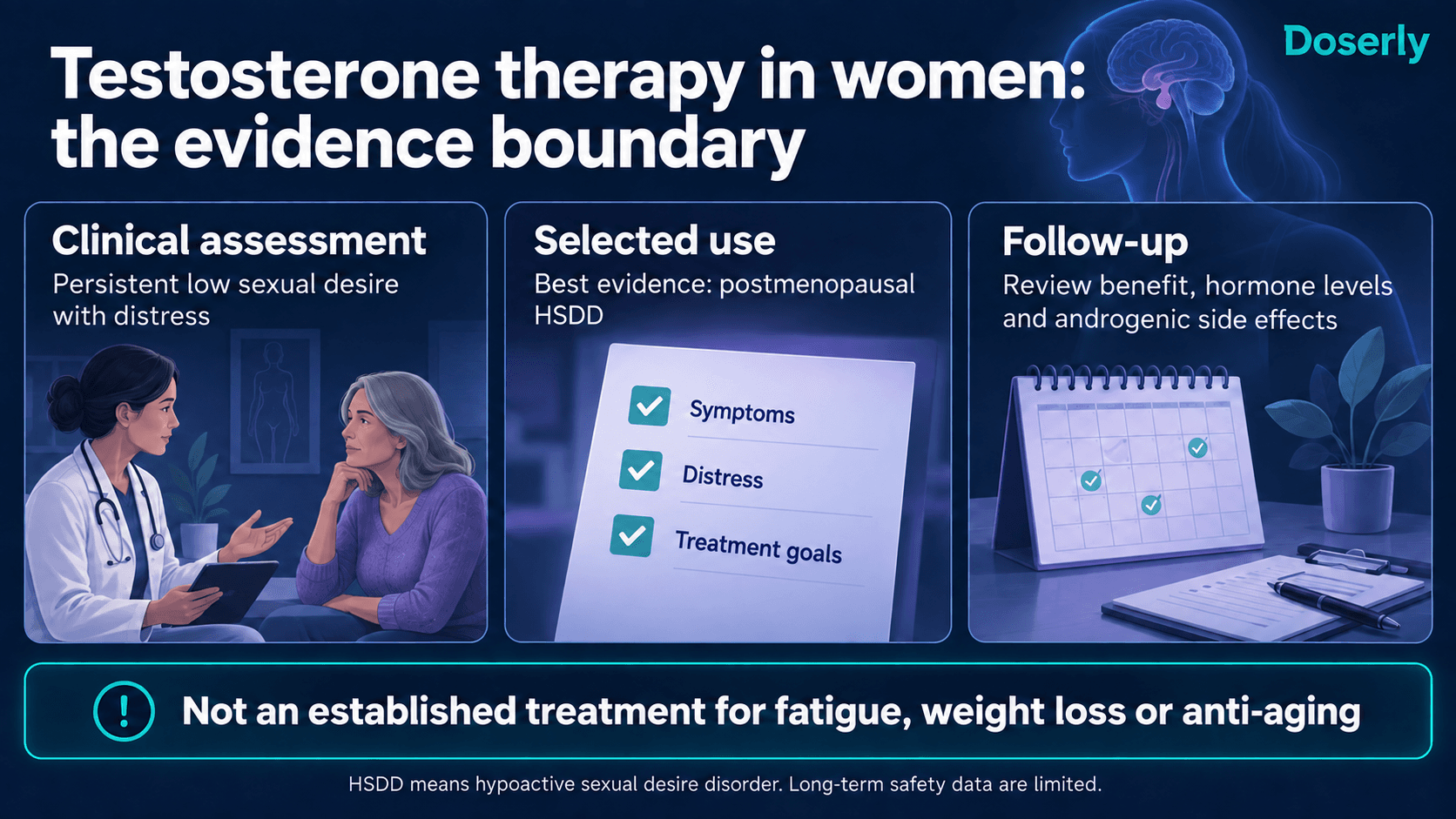
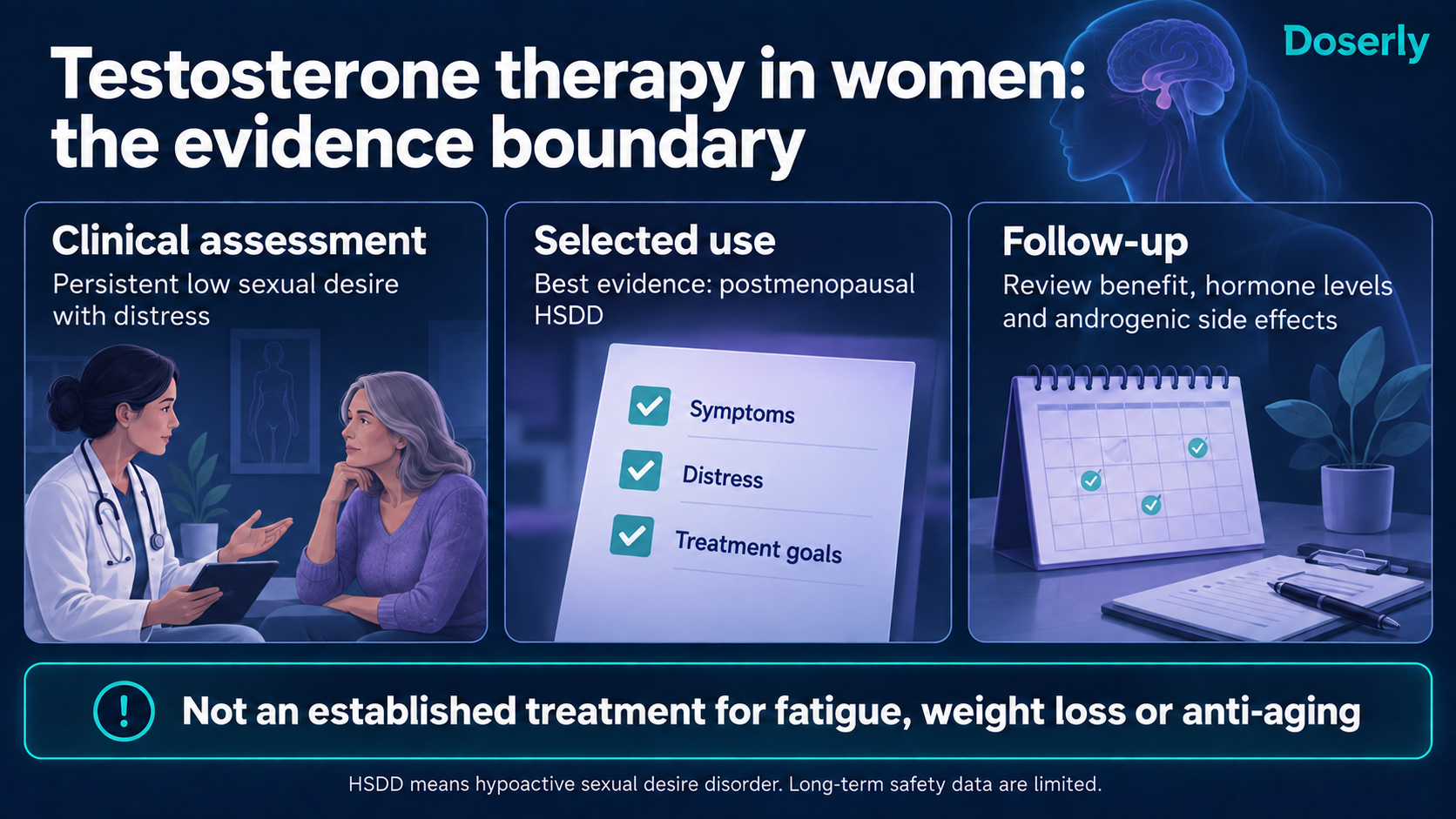
The strongest evidence concerns systemic transdermal testosterone for postmenopausal HSDD after assessment. It does not validate oral testosterone undecanoate as an equivalent treatment. A testosterone level alone cannot diagnose HSDD.
ISSWSH testosterone guideline for women.
Pharmacokinetics / Hormone Physiology
The Basics
How testosterone behaves depends heavily on how it is delivered. This is not a small technical detail; it is one of the main reasons guidelines prefer some formulations and discourage others.
With transdermal therapy, testosterone is absorbed through the skin into the bloodstream and can be titrated more gradually. That makes it easier to stay in the normal female physiologic range. Oral testosterone behaves differently because it goes through intestinal absorption and hepatic handling, and oral formulations have been associated with less favorable lipid effects. Pellets and injections can be harder to fine-tune and can overshoot into supraphysiologic exposure, especially when they are borrowed from male-treatment workflows [1][2][5].
Another key physiologic issue is SHBG, or sex hormone-binding globulin. When SHBG is high, less testosterone is readily bioavailable. Oral estrogen can raise SHBG substantially, which is why some women on oral estrogen appear to have less response to testosterone than women using transdermal estrogen. In practical terms, switching estrogen route can matter before testosterone dose is escalated [5].
Finally, menopause itself is not a clean "testosterone crash" event in the way many people assume. Testosterone generally declines with age, but not every woman with bothersome symptoms has a clinically meaningful androgen deficit, and bilateral oophorectomy is a different situation from natural menopause [1][4].
The Science
The 2019 meta-analysis found a route-dependent safety signal: oral testosterone worsened lipid profile, whereas non-oral testosterone was lipid-neutral in the short-term trial data [2]. That route split is central to current practice. It is also why oral testosterone remains outside guideline preference for women, even though oral testosterone undecanoate continues to be studied in women as an investigational route in dedicated programs [1][5].
From a monitoring perspective, total testosterone is the practical biomarker most commonly used, but it is not a treatment target in the bodybuilding sense. The goal is simply to avoid high baseline values before treatment and to avoid supraphysiologic exposure after treatment begins [1][3][5].
Key physiologic and PK points:
Parameter
Total testosterone
- Clinical relevance
- Preferred practical monitoring marker
Parameter
Direct free testosterone assay
Parameter
SHBG
- Clinical relevance
- Helps explain poor response or side effects in selected cases
Parameter
Oral estrogen
- Clinical relevance
- Can raise SHBG and reduce free or bioavailable testosterone effect [5]
Parameter
Non-oral testosterone
- Clinical relevance
- Preferred route pattern because short-term lipid profile is more neutral [2]
Parameter
Pellets / injections
Research & Clinical Evidence
The Basics
The best-supported use of testosterone therapy in women is narrow but real: it can improve sexual desire and related sexual-function outcomes in postmenopausal women with HSDD. The effect is not dramatic for everyone, but it is meaningful enough that multiple major societies support its use in the right patient group [1][2][3][4].
That same evidence base does not extend cleanly to other common claims. Women often report better energy, better focus, and improved mood online, but randomized trials have not shown reliable benefit for those outcomes. This is one of the most important "separate the anecdote from the evidence" moments in menopause medicine [1][4][5].
Another important evidence limit is route. Most supportive trial data come from physiologic-dose transdermal therapy, especially patches and creams used in controlled studies. The evidence is far weaker for pellets, injections used like mini-TRT, or oral formulations in women. So a statement like "testosterone works for women" is too broad to be clinically useful. The better statement is that low-dose non-oral therapy has evidence for postmenopausal HSDD, while other approaches carry more uncertainty.
The Science
Testosterone for postmenopausal HSDD
The 2019 meta-analysis of 36 randomized controlled trials including 8,480 participants found that testosterone improved satisfying sexual events, desire, arousal, orgasm, pleasure, responsiveness, self-image, and sexual distress in postmenopausal women with low sexual desire causing distress [2]. The pooled effect on satisfying sexual events was about 0.85 more events per 4 weeks versus placebo or comparator, which is not a miracle-level effect but is clinically relevant for some women.
What the evidence does not support
The same consensus and guideline set does not support testosterone as routine therapy for depressed mood, cognitive enhancement, general wellbeing, bone-density improvement, lean-mass improvement, or disease prevention [1][2][4][5]. That does not mean no individual reports improvement. It means the evidence is not strong enough to recommend routine prescribing for those reasons.
Formulation and route matter
The consensus statement explicitly says its supportive recommendations do not apply to pellets, injectables, or formulations that create supraphysiologic blood levels, and it does not recommend oral testosterone because of adverse lipid effects [1]. The BMS 2026 tool echoes that oral androgens are not recommended and compounded products are not preferred [5].
Current regulatory evidence gap
Real-world practice is ahead of product approval in many countries. Australia has a regulated female-specific option, but the US still lacks an FDA-approved testosterone product for women [6][7]. As a result, clinicians and patients are often choosing between off-label male products, imported products, or compounded formulations with different evidence and quality profiles.
Benefits & Therapeutic Effects
The Basics
The benefit conversation around testosterone therapy should start narrow and only widen if new evidence earns that wider framing. Right now, the established benefit is improvement in sexual desire and related sexual function for postmenopausal women with HSDD.
That can include more interest in sex, better arousal, more satisfying sexual experiences, and less distress about low desire. For women who feel dismissed because their symptoms are "not life-threatening," this is still a meaningful clinical outcome. Sexual wellbeing is a legitimate quality-of-life outcome, not a cosmetic one.
What should be resisted is the temptation to sell testosterone as a universal menopause enhancer. Some women do report feeling mentally sharper or more energetic, but that is not the same as guideline-supported evidence. If a clinician is offering testosterone mainly for brain fog, weight loss, "motivation," or prevention of aging, the current evidence base does not back that promise [1][4][5].
The Science
The most important benefit data come from randomized trials summarized in the 2019 meta-analysis [2]. In postmenopausal women with distressing low sexual desire, testosterone improved:
- sexual desire
- arousal
- orgasmic function
- pleasure
- responsiveness
- sexual self-image
- sexual distress
The average increase of about 0.85 satisfying sexual events per 4 weeks helps put the effect size in perspective [2]. This is a moderate, not transformative, treatment effect. That framing matters because overstated expectations create disappointment and overtreatment.
The current society consensus is therefore careful: testosterone is an evidence-based option for one specific sexual-health problem, not a broad menopause hormone replacement strategy [1][3][4][5].
Reading about potential benefits helps set realistic expectations. Tracking what changes in your own life is what tells you whether the therapy is actually earning its place in your plan. Doserly helps you monitor libido, arousal, sleep, mood, and other symptoms over time so you can see what is improving, what is not, and whether the pattern justifies continuing treatment.
When follow-up comes around, you are not relying on a vague impression from three months ago. You have a record of symptom trends that makes the next clinical decision much more precise.
Risks, Side Effects & Safety
The Basics
Testosterone therapy in women is not risk-free, but its risk profile depends heavily on dose, route, and patient selection. The main short-term problems are usually androgenic side effects, not catastrophic events.
The most common unwanted effects are acne, increased facial or body hair, oily skin, and sometimes scalp hair thinning. These effects are much more likely when dosing drifts above the normal female physiologic range. Voice deepening and clitoral enlargement are treated as uncommon at physiologic dosing, but they are among the side effects people worry about most because they may not fully reverse if treatment is pushed too far [1][5].
Oral testosterone deserves separate caution because it has shown adverse lipid effects. Pellets and injections also deserve separate caution because they can be harder to dose conservatively and harder to reverse once given. If a woman is given a pellet that overshoots, the exposure cannot simply be turned off the next day.
There is also a more mundane but important safety issue with gels and creams: skin transfer. Testosterone can transfer to partners or children if application sites are not dried, covered, and handled correctly. That matters for route choice and for practical patient education.
Finally, the long-term safety question is still not fully answered. Randomized trials have not shown a major serious-adverse-event signal in short-term physiologic use, but those trials were not designed to settle decades-long questions about breast, cardiovascular, or thrombotic outcomes [1][2].
The Science
The 2019 consensus and meta-analysis found that physiologic-dose testosterone in trial populations was mainly associated with mild androgenic side effects, especially acne and hair growth [1][2]. Importantly:
- oral testosterone worsened lipid profile [1][2]
- non-oral testosterone had a more neutral short-term lipid profile [2]
- no long-term safety dataset beyond about 24 months adequately resolves breast or cardiometabolic safety [1]
The FDA's February 28, 2025 class-wide testosterone labeling update is also relevant in practice because many women are treated with male-labeled products off label. FDA now describes testosterone products as approved solely for men and notes class-wide blood-pressure concerns based on ambulatory blood-pressure studies, even as it removed earlier class-wide boxed-warning language about cardiovascular risk after TRAVERSE [7]. That does not mean women on off-label therapy were studied in TRAVERSE. It means the warnings attached to the products women may be prescribed still come from male-product safety frameworks.
Practical risk hierarchy
Issue
Androgenic side effects
- Lower concern when
- Low-dose transdermal use with monitoring
- Higher concern when
- Supraphysiologic dosing, pellets, injection overshoot
Issue
Lipid effects
- Lower concern when
- Non-oral route
Issue
Transfer to others
- Lower concern when
- Careful topical application and hand washing
- Higher concern when
- Uncovered gel/cream contact
Issue
Long-term uncertainty
- Lower concern when
- Short therapeutic trial with clear reassessment
- Higher concern when
- Indefinite use without ongoing review
Being informed about population-level risks is only the first step. The safer part is noticing what is happening in your own case, early. Doserly lets you log side effects with timing and severity so you can tell whether acne, hair changes, headaches, irritability, or other symptoms are settling, persisting, or trending upward.
That kind of record is especially useful when symptoms are subtle or gradual. A clear timeline gives your prescriber something better than memory to work from when deciding whether the current formulation and dose are still appropriate.
Dosing & Treatment Protocols
The Basics
There is no one global standard product for testosterone therapy in women, which is part of the dosing problem. In countries without a female-specific option, clinicians usually adapt male products to female doses. The practical goal is not to normalize a lab value to the top of the range; it is to use the lowest dose that can produce benefit while keeping exposure in the normal female physiologic range [1][3][5].
In guideline-oriented practice, low-dose transdermal therapy is the usual starting point. A female-specific cream such as AndroFeme 1% is easier to dose because it was designed for women. Where that is unavailable, some clinicians use a fraction of a male gel or cream packet, usually around one-tenth of the male amount [5].
It is also important to know when not to escalate. If GSM is untreated, if oral estrogen is raising SHBG, or if the main problem is pain, relationship distress, or medication-induced sexual dysfunction, pushing testosterone higher may not solve the actual issue.
The Science
Examples from current society materials include:
Product / approach
AndroFeme 1% cream
Product / approach
Testogel sachet used off label
- Example starting approach
- About 1/8 sachet daily, roughly 5 mg/day [5]
Product / approach
Tostran used off label
- Example starting approach
- 10 mg on alternate days [5]
Product / approach
Patch evidence base
- Example starting approach
- 300 mcg/day was used in multiple trials cited by guidelines [4]
What to Expect (Timeline)
Weeks 1-4: Many women notice little or no change yet. Some experience early androgenic side effects before they experience meaningful benefit, especially if the starting dose is not conservative.
Weeks 4-8: Some women begin noticing better desire, arousal, or reduced sexual distress. Others still notice no clear difference.
Months 3-6: This is the key evaluation window used in guideline-style practice. By this point, the therapy should be showing a meaningful pattern of benefit if it is going to be worth continuing [1][3][5].
After 6 months: If there is still no clear benefit, guidelines recommend stopping rather than drifting into indefinite use [1].
Ongoing: Women who do benefit still need periodic review because the question eventually becomes not "Did it work at all?" but "Is the current dose still appropriate, and are side effects or risk tradeoffs emerging?"
Timing Hypothesis & Window of Opportunity
The Basics
The classic HRT "timing hypothesis" belongs mainly to estrogen therapy, especially cardiovascular risk-benefit discussions about starting systemic estrogen before age 60 or within 10 years of menopause. Testosterone therapy does not have the same evidence structure, and it should not be framed as if it carries an equivalent window-of-opportunity rule.
The timing question for testosterone is more practical: has conventional menopause care already been optimized, is the woman actually postmenopausal, and is the symptom pattern still consistent with HSDD after other factors are addressed?
In other words, the relevant sequence is often:
- assess the full biopsychosocial picture
- optimize estrogen or treat GSM if needed
- then consider testosterone if distressing low desire persists
The Science
Current consensus documents do not provide a testosterone equivalent of the estrogen timing hypothesis [1][5]. Instead, they focus on population and indication: postmenopausal women with HSDD. Data for premenopausal women remain insufficient [1], and clinical materials such as the 2023 Menopause Society Practice Pearl and 2026 BMS tool keep the emphasis on postmenopausal use after adequate assessment [4][5].
That means timing in testosterone therapy is more about appropriateness of context than about an age-defined vascular window. Trying testosterone before evaluating pain, untreated GSM, medication effects, or relationship factors is poor sequencing even if the patient is otherwise a candidate.
Interactions & Compatibility
SYNERGISTIC
- Transdermal estrogen, when indicated, may improve the hormonal context for response by avoiding SHBG elevation seen with oral estrogen [5].
- Vaginal estrogen can be important when dyspareunia or GSM is contributing to low desire.
- Psychosexual therapy, pelvic floor care, and medication review can improve overall outcomes because HSDD is rarely purely hormonal.
CAUTION
- Oral estrogen may reduce clinical response by raising SHBG [5].
- Concurrent androgenic products, including DHEA or other testosterone sources, can increase side-effect risk.
- Women with acne-prone skin, androgenic alopecia risk, or bothersome hair growth concerns may be more side-effect sensitive.
- Women with hormone-sensitive breast cancer history require specialist-level shared decision-making; many guidelines urge caution [1][5].
AVOID
- Pregnancy and breastfeeding
- Supraphysiologic dosing strategies
- Unmonitored pellets or injections used as a shortcut around careful dose titration
- Oral testosterone use for routine women-focused menopause care, because of adverse lipid effects [1][2][5]
Related guides
- Sexual Health During Menopause
- Genitourinary Syndrome of Menopause
- Surgical Menopause
- Premature Ovarian Insufficiency
- Compounded & Bioidentical HRT
- Testosterone Undecanoate (Investigational)
Decision-Making Framework
Testosterone therapy makes the most sense when the question is precise. The strongest candidate is a postmenopausal woman with persistent low desire that causes distress, after relationship, pain, GSM, medication, mood, sleep, and overall HRT issues have been reviewed.
Questions worth asking before treatment
- Is low desire the main problem, or is pain the problem?
- Have estrogen needs or GSM treatment already been addressed?
- Are SSRIs, contraceptives, alcohol use, depression, or sleep disruption major contributors?
- Is the plan using the lowest reasonable dose and a route that can be monitored safely?
- What would count as a meaningful benefit by 3 to 6 months?
- What side effects would make treatment no longer worth it?
Green flags for a trial
- Clear postmenopausal HSDD pattern
- Real personal distress
- Reasonable prescriber comfort with monitoring
- Willingness to stop if there is no meaningful benefit
Yellow or red flags
- Desire for testosterone mainly for energy, fat loss, or "optimization"
- Untreated dyspareunia or major relationship distress
- Pellet-first or injection-first sales framing
- No plan for follow-up labs or clinical review
The best HRT decisions are made with organized information, not after trying to remember a few months of symptoms on the spot. Doserly helps you bring a clean record of your symptoms, current protocol, and questions into your appointment so treatment decisions can be based on your actual experience.
Instead of debating from memory, you and your clinician can review trend data, side effects, and what has or has not changed since starting therapy. That usually makes the conversation much more useful.
Administration & Practical Guide
Transdermal gels and creams
- Apply to clean, dry skin exactly as instructed.
- Wash hands after application.
- Let the site dry before skin contact.
- Rotate sites if advised to reduce local irritation or hair growth.
- Keep application areas covered from children and partners until fully dry.
Measuring small doses
This is one of the practical problems with off-label male products. A fraction of a sachet or pump can be hard to measure consistently. That is one reason female-specific products are preferable when available.
Pellets
Pellets appeal to people who want convenience, but convenience is not the same as control. Once inserted, they cannot be dose-adjusted downward in a simple way if levels overshoot or side effects appear.
Injections
Some women use very low-dose injections, but this approach sits outside the strongest guideline support and can create peaks and troughs that are harder to interpret clinically.
Travel and storage
Because testosterone is a prescription hormone and may be treated as a controlled product depending on jurisdiction, women should travel with the original labeled container and be clear on local rules for importation or telehealth prescribing.
Monitoring & Lab Work
Before starting
- confirm the symptom pattern is consistent with HSDD
- review relationship, mood, pain, GSM, medication, and sleep contributors
- obtain baseline total testosterone
- consider SHBG when the response picture is confusing, especially with oral estrogen use [5]
Early follow-up
- repeat total testosterone around 3 to 6 weeks if possible, or at the first practical follow-up visit [1][5]
- assess clinical benefit, acne, hair growth, scalp changes, voice symptoms, mood changes, and transfer issues
Ongoing
- repeat clinical review and testosterone periodically, commonly every 6 months in consensus-style practice [1]
- adjust dose based on symptoms plus lab context, not lab numbers alone
- consider broader safety labs depending on route, comorbidities, and product used
What monitoring should not become
Monitoring should not turn into endless lab chasing or attempts to reach a "high-normal" target. The purpose is to stay within a female physiologic range and to prevent overuse, not to maximize numbers [1][3][5].
Complementary Approaches & Lifestyle
Testosterone works best when it is not asked to carry the whole menopause story by itself.
Helpful complementary measures include:
- optimizing estrogen therapy when appropriate
- treating GSM directly if vaginal dryness or pain is present
- pelvic floor therapy for dyspareunia and pelvic pain patterns
- exercise, especially resistance training and aerobic activity, for overall midlife health
- sleep optimization, because sleep disruption can flatten desire independent of androgen status
- review of SSRIs, contraception, or other medications that may reduce libido
- psychosexual or relationship counseling when relational context is a major contributor
These measures do not "replace" testosterone when HSDD is truly present, but they often determine whether testosterone has a fair chance to help.
Stopping HRT / Discontinuation
Stopping testosterone is usually simpler than stopping systemic estrogen because there is no classic withdrawal syndrome at physiologic female dosing. The harder question is why treatment is being stopped.
Stop early if:
- there is no meaningful benefit by about 6 months [1]
- androgenic side effects are not acceptable
- blood levels are repeatedly too high
- the treatment goal has changed or the original problem was misidentified
If treatment has helped:
- periodic annual re-evaluation is still appropriate [5]
- some women will decide the benefit remains worth it
- others may choose to taper or stop and see whether the improvement was truly treatment-related
If testosterone is helping genuine HSDD symptoms, desire and related sexual-function improvements may recede after stopping. There is no universal rule for duration, which is why ongoing reassessment matters more than arbitrary time limits.
Special Populations & Situations
Breast cancer survivors
This is a high-caution group. Randomized HSDD trials generally excluded women with prior hormone-sensitive breast cancer, and expert guidance recommends caution and multidisciplinary decision-making [1][5].
Premature Ovarian Insufficiency
Women with POI are not the same as women undergoing natural menopause at the average age. Testosterone may still be considered in selected cases of low desire, but the evidence base is thinner and the broader hormone-replacement framework is different.
Surgical menopause
This is one of the clearest clinical contexts where testosterone questions arise because ovarian androgen production can fall more abruptly. Still, treatment should remain symptom-guided rather than automatic [4].
Perimenopause / premenopause
Evidence is insufficient for routine testosterone recommendations in premenopausal women [1]. This is a common area of overreach in commercial practice.
Cardiometabolic disease
Trial data are limited in higher-risk women. Short-term physiologic use has not shown a strong serious-event signal, but long-term safety in at-risk populations is not settled [1][2].
Active liver disease
Use caution, especially if any oral androgen is being considered. Oral therapy is generally a poor fit for women-focused menopause care [5].
Pregnancy risk
Testosterone therapy should be avoided in pregnancy and breastfeeding. Women in the menopause transition who may still conceive need this addressed explicitly.
Competitive athletes
Even when treatment is clinically appropriate, women who compete under anti-doping frameworks need expert guidance because testosterone rules can be strict and documentation requirements can be significant [5].
Regulatory, Insurance & International
United States
The US still has no FDA-approved testosterone product for women in menopause care. FDA's February 28, 2025 testosterone safety update states testosterone products are approved solely for men with associated medical conditions [7]. In practice, women who receive testosterone are usually prescribed male products off label or compounded formulations. Insurance coverage is inconsistent and often poor.
United Kingdom
Current UK menopause practice guidance supports carefully selected use for low sexual desire, usually by adapting male products to female doses. The BMS 2026 tool also reports that female-specific AndroFeme access is evolving in the UK private/import landscape and notes a marketing-authorization pathway tied to pump-pack availability [5]. Exact NHS versus private access varies locally.
Canada
I did not confirm a female-specific testosterone approval for menopause care in Canada during this research pass. Practical access is likely to depend on off-label prescribing, compounding, and provincial coverage rules.
Australia
Australia is the clearest major-market exception identified in this guide. TGA lists AndroFeme 1 cream for treatment of HSDD in postmenopausal women and explicitly ties use to prior correction of modifiable biopsychosocial factors [6].
European Union
I did not confirm a current centralized EMA-approved female-specific testosterone product for menopause HSDD during this restart. Access appears to remain country-specific and often off label.
FAQ
1. Is testosterone therapy part of standard HRT for all women?
No. Current evidence supports it mainly for postmenopausal HSDD, not as routine menopause replacement for everyone [1][4][5].
2. Can a blood test alone tell me whether I need testosterone?
No. Guidelines are clear that no testosterone cutoff diagnoses HSDD by itself [1].
3. Is testosterone FDA-approved for women in the US?
No female-specific testosterone product was confirmed in current FDA research for US menopause use [7].
4. Is there any country with an approved female-specific product?
Yes. Australia has TGA-approved AndroFeme 1 for postmenopausal HSDD [6].
5. What route is generally preferred?
Low-dose non-oral transdermal treatment is the guideline-oriented route pattern [1][2][4][5].
6. Are pellets recommended?
Major consensus guidance does not recommend pellets that create supraphysiologic levels [1].
7. How long should I try testosterone before deciding it is not helping?
About 3 to 6 months is the practical evaluation window, and many guidelines say to stop by 6 months if there is no meaningful benefit [1][5].
8. Can testosterone help brain fog or low energy?
Some women report that it does, but current guideline evidence does not support routine prescribing for those goals [1][4][5].
9. What side effects should I watch for first?
Acne, extra facial or body hair, scalp hair changes, oily skin, irritability, and signs of dose overshoot are the most practical early watchouts [1][2][5].
10. Do I still need estrogen if I am using testosterone?
Often yes, depending on the broader symptom picture. If low desire is tied to GSM or poor estrogenization, testosterone alone may not fix the underlying problem [4][5].
11. Is compounded testosterone automatically safer because it is "bioidentical"?
No. Guideline groups do not recommend compounded testosterone when an appropriate equivalent exists [1][5].
12. Can premenopausal women use testosterone for libido?
Evidence is currently insufficient for routine recommendations in premenopausal women [1].
Myth vs. Fact
Myth: Testosterone is the missing hormone behind most menopause symptoms.
Fact: Current evidence supports testosterone mainly for postmenopausal HSDD, not for most menopause complaints [1][4][5].
Myth: A low testosterone result proves I need treatment.
Fact: No cutoff level can diagnose HSDD on its own [1].
Myth: If it is off label, it must be unsafe or ineffective.
Fact: Off-label use can still be evidence-based, but off-label status does mean the product was not specifically approved for that female indication in that jurisdiction [1][7].
Myth: Pellets are better because they are stronger and more convenient.
Fact: Stronger is not the goal. Consensus guidance warns against formulations that create supraphysiologic levels [1][5].
Myth: Testosterone is a proven treatment for brain fog, mood, and weight gain.
Fact: Those uses remain unsupported by current randomized evidence [1][2][4].
Myth: Oral testosterone is just another convenient option.
Fact: Oral testosterone has shown adverse lipid effects and is not guideline-preferred for women [1][2][5].
Myth: Compounded testosterone is the most natural choice.
Fact: "Natural" does not solve quality-control and dose-consistency concerns. Major guidance does not prefer compounded therapy when regulated alternatives exist [1][5].
Myth: If testosterone helps, more testosterone will help more.
Fact: The goal is to stay in the normal female physiologic range. Pushing higher mainly increases side-effect risk [1][3][5].
Sources & References
[1] Davis SR, Baber R, Panay N, et al. Global Consensus Position Statement on the Use of Testosterone Therapy for Women. Climacteric. 2019;22(5):429-434. PubMed: 31474158. DOI: 10.1080/13697137.2019.1637079.
[2] Islam RM, Bell RJ, Green S, et al. Safety and efficacy of testosterone for women: a systematic review and meta-analysis of randomised controlled trial data. Lancet Diabetes Endocrinol. 2019;7(10):754-766. PubMed: 31353194. DOI: 10.1016/S2213-8587(19)30189-5.
[3] Parish SJ, Simon JA, Davis SR, et al. International Society for the Study of Women's Sexual Health Clinical Practice Guideline for the Use of Systemic Testosterone for Hypoactive Sexual Desire Disorder in Women. J Sex Med. 2021;18(5):849-867. PubMed: 33814355. DOI: 10.1016/j.jsxm.2020.10.009.
[4] Parish SJ, Kling JM. Testosterone Use for Hypoactive Sexual Desire Disorder in Postmenopausal Women. The Menopause Society Practice Pearl. Released March 9, 2023.
[5] Panay N, British Menopause Society Medical Advisory Council. Testosterone replacement in menopause. BMS Tool for Clinicians. Reviewed February 2026.
[6] Therapeutic Goods Administration. ANDROFEME, ANDROFORTE (Lawley Pharmaceuticals Pty Ltd). Accessed March 25, 2026.
[7] U.S. Food and Drug Administration. FDA issues class-wide labeling changes for testosterone products. February 28, 2025.
Related Guides & Cross-Links
Same category
- Testosterone Undecanoate (Investigational)
- Compounded & Bioidentical HRT
- Transdermal HRT (Patches, Gels, Sprays)
Related conditions and symptom guides
- Sexual Health During Menopause
- Genitourinary Syndrome of Menopause (GSM)
- Surgical Menopause
- Premature Ovarian Insufficiency (POI)
Related treatment approaches
- Vaginal Estrogen Therapy
- Getting Started with HRT
- Non-Hormonal Menopause Treatments
- HRT Monitoring & Lab Work Guide