
In this guide
What is estrogen, and why does it matter on TRT?
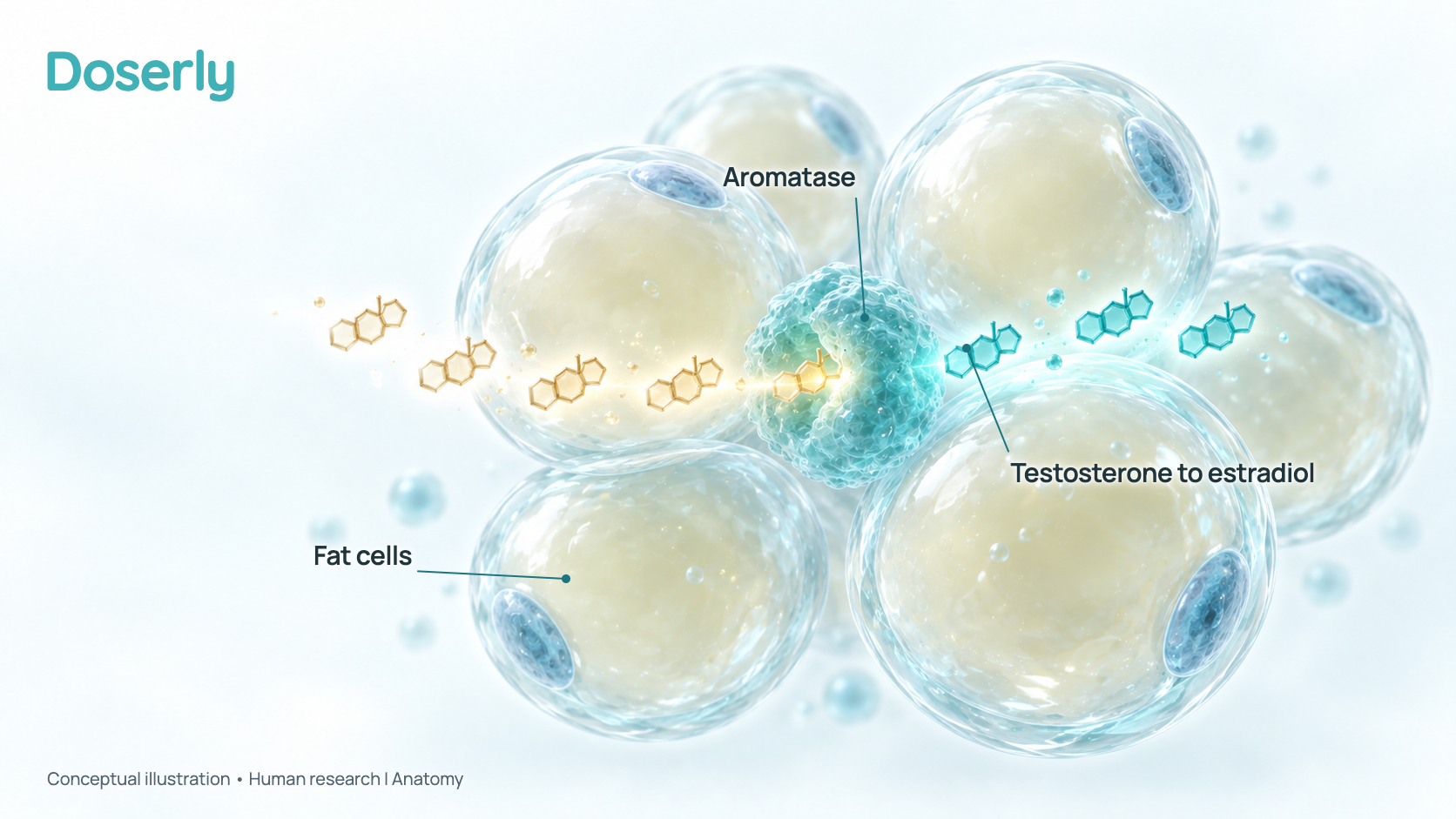
In men, "estrogen" mostly means estradiol, a hormone the body makes from testosterone. An enzyme called aromatase does the conversion in the testicles, brain, fat, muscle, bone, blood vessels and hair. When testosterone therapy raises testosterone, estradiol usually rises with it. [1], [3]
Men need estradiol. The Endocrine Society's guideline says estradiol is required to prevent gains in body fat and hot flushes, and that testosterone and estradiol together keep up sexual function and bone density. Men born unable to make estrogen show what happens without it: one 24-year-old man with this rare condition had estradiol below 7 pg/mL, had grown to 204 cm because his growth plates never closed, and had very thin bones despite plenty of testosterone. [2], [19]
The amounts are small. A man makes about 35–45 micrograms of estradiol a day, and his blood holds roughly 1/200 as much estradiol as testosterone. Normally about 20% is released directly by the testicles and about 60% starts there one way or another. Testosterone therapy turns down the brain's signal to the testicles, so on treatment a larger share likely comes from conversion elsewhere, especially in fat. [1], [2]
Lab reports can also list "total estrogen", which adds several estrogens together and reads higher than estradiol alone. Mixing the two up is a common source of alarm in forums (see what people report), so this guide uses estradiol throughout. [20]
Estrogen on TRT: the key numbers
This table shows what each major clinical guideline says about estradiol for men on testosterone, checked in September 2026. Most give no number at all.
| Guideline (version, year) | Threshold or target | How measured | Action at this level |
|---|---|---|---|
| AUA, American Urological Association (2018, validity reconfirmed 2024) | Estradiol that stays above 40 pg/mL (about 147 pmol/L) before treatment: refer to an endocrinologist. No target on treatment | Before treatment: recommended with breast symptoms or gynecomastia (expert opinion), optional in any man as a baseline. On treatment: optional alongside testosterone; recommended if breast symptoms appear or an aromatase inhibitor is used | New breast symptoms on treatment: watch first, as they sometimes settle. If they persist with a high estradiol: lower the testosterone dose when testosterone is in the upper normal range, or consider an aromatase inhibitor when it is low or normal |
| Endocrine Society (2018) | None | Not part of routine monitoring, which is testosterone and hematocrit at 3–6 months, 12 months, then yearly | Explains why men need estradiol; lists gynecomastia as uncommon, with weak evidence linking it to testosterone |
| CUA, Canadian Urological Association (2021) | None | Before treatment in men with breast symptoms or gynecomastia (strong recommendation) | Mentions aromatase inhibitors only as off-label ways to raise a man's own testosterone when fertility matters |
| VA, US Department of Veterans Affairs (January 2026) | None | Not in the routine monitoring list | Aromatase inhibitors not recommended in general: they raise heart events from narrowed arteries in people with heart disease, add belly fat and lower bone density, and no placebo-controlled trial has lasted longer than a year |
| EAU, European Association of Urology (2026) | None | Not in the routine monitoring list | Aromatase inhibitors and SERMs are off-label with poor evidence, and long-term use can lower bone density. DHT, which cannot become estradiol, "can be useful" for gynecomastia. Weight loss lowers estrogens |
| BSSM, British Society for Sexual Medicine (2023) | None | Not stated | Aromatase inhibitors can raise testosterone but lower estradiol and bone density and need close long-term monitoring; combining them with TRT is unproven |
| Society for Endocrinology, UK (2022) | None | Not part of TRT monitoring. When hCG is used instead of testosterone for fertility, estradiol is checked after 4 weeks | Breast growth and mood swings can be minimized by getting the testosterone dose right. With hCG used for fertility, a high estradiol may call for a lower hCG dose; it does not endorse combining hCG with testosterone |
| EAA, European Academy of Andrology (2020) | None | Not stated | Aromatase inhibitors such as letrozole suggested off-label instead of testosterone, to keep fertility in men with functional hypogonadism; the evidence is poor (few, short, small trials). Not an add-on to TRT |
| ESA, Endocrine Society of Australia (2016) | None | Not stated | Gynecomastia a less common side effect; aromatase inhibition listed as an open research question |
| AUA/ASRM male infertility (2020, amended 2024) | None | Estradiol checked in the fertility work-up when testosterone is low | Aromatase inhibitors may be considered, instead of testosterone, for men with low testosterone and high estradiol who want children (conditional) |
[4], [2], [15], [5], [21], [22], [8], [23], [24], [25]
No major guideline sets a routine estradiol target for men on TRT. The AUA is the only one with a number, and it applies before treatment: estradiol that stays above 40 pg/mL (about 147 pmol/L) earns a referral to look for another cause. Four bodies (the VA, BSSM, EAU and EAA) warn that aromatase inhibitors are off-label, weakly studied or bad for bone. [4], [5], [22], [21], [23]
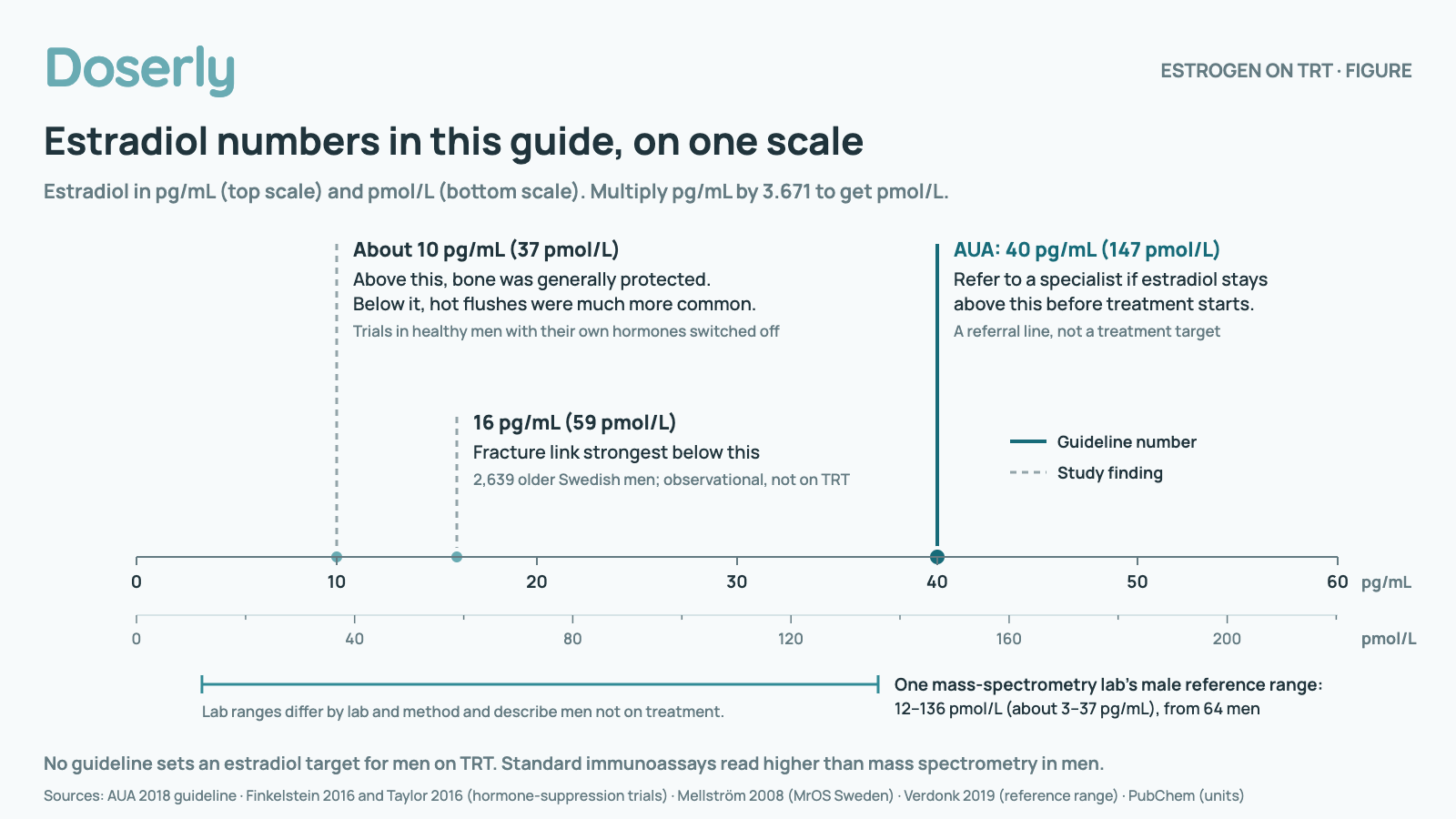
Estradiol numbers in this guide, on one scale
Estradiol in pg/mL (top scale) and pmol/L (bottom scale). Multiply pg/mL by 3.671 to get pmol/L.
Each bar runs from 0 (left) to 60 pg/mL (right). A solid mark is a guideline number; a dashed mark is a study finding.
- AUA: 40 pg/mL (about 147 pmol/L)
- Refer to a specialist if estradiol stays above this before treatment starts. A referral line, not a treatment target.
- 16 pg/mL (about 59 pmol/L)
- Fracture link strongest below this (2,639 older Swedish men; observational, not on TRT).
- About 10 pg/mL (about 37 pmol/L)
- Above this, bone was generally protected; below it, hot flushes were much more common (trials in healthy men with their own hormones switched off).
- 12–136 pmol/L (about 3–37 pg/mL)
- One mass-spectrometry lab's male reference range, from 64 men. Ranges differ by lab and method and describe men not on treatment.
No guideline sets an estradiol target for men on TRT. Standard immunoassays read higher than mass spectrometry in men.
Why don't guidelines set a target?
Because no trial has tested one. Experiments that controlled men's hormones show where estradiol becomes too low: below about 10 pg/mL, bone loss and hot flushes became much more likely. No study has found a level above which men on TRT do worse; breast symptoms, not a number, are what guidelines act on. The AUA's 40 pg/mL line asks for a referral before treatment starts; it is not a treatment goal. [14], [13], [4]
What is a normal estradiol level for men?
It depends on the lab and the method, and a lab reference range describes healthy men who are not on treatment. Using mass spectrometry, one laboratory's male range, traceable to the US Centers for Disease Control and Prevention's reference method, was 12–136 pmol/L (about 3–37 pg/mL), based on 64 men. In 394 very healthy Australian men aged 70 or older, the lowest 2.5% had estradiol below 28 pmol/L (about 7.6 pg/mL). Ranges printed next to standard immunoassay results are different again. [26], [27]
How do the units work?
US labs usually report estradiol in pg/mL (picograms per milliliter); most other countries use pmol/L (picomoles per liter). Estradiol's molecular weight is 272.4, so multiply pg/mL by 3.671 to get pmol/L, or divide pmol/L by 3.671 to get pg/mL. That makes 40 pg/mL about 147 pmol/L, and a UK result of 206 pmol/L about 56 pg/mL. A few labs write ng/L, which is the same number as pg/mL. Testosterone uses other units (ng/dL and nmol/L); the testosterone unit converter switches between those. [28], [29]
What about the testosterone-to-estradiol ratio?
It is popular online but not a validated target. A 2025 review said a testosterone-to-estradiol ratio between 10 and 30 "seems" beneficial, then added that the best value "has not yet been determined". The ratio also changes with the units each number is reported in, and no guideline uses it. [30]
Where these numbers come from
Each guideline row comes from that body's current document: the AUA testosterone deficiency guideline (published 2018, validity reconfirmed 2024), the Endocrine Society guideline (2018), the CUA guideline (2021), the VA clinical recommendations (January 2026), the EAU guidelines on sexual and reproductive health (2026 edition), the BSSM guidelines (2023), the Society for Endocrinology guideline (2022), the EAA guideline on functional hypogonadism (2020), the Endocrine Society of Australia position statement (2016, still current) and the AUA/ASRM male infertility guideline (2020, amended 2024). [4], [2], [15], [5], [21], [22], [8], [23], [24], [25]
The unit factor comes from estradiol's molecular weight in PubChem (1,000 divided by 272.4 is 3.671). The reference ranges come from a mass-spectrometry study traceable to the CDC reference method and a large Australian study of older men. [28], [26], [27]
Not used: a single "normal" range such as 10–40 pg/mL, which belongs to particular tests and is not a target; the 2024 International Consultation on Sexual Medicine (ICSM) hypogonadism recommendations, whose estradiol section we could not read in full (its sexual-function committee says estradiol's clinical use is limited by measurement problems); and a widely repeated claim that estradiol below 5 pg/mL raises heart deaths, which we could not trace to a primary source. [31]
Why does estradiol rise on TRT?
Because more testosterone gives aromatase more to work with. Estradiol follows the testosterone level, and how much a man converts depends on his body fat, his age and the individual. These effects are measured in people. [3], [32]
- Dose and level. In a randomized trial, 103 healthy young and older men had their own hormones switched off and then received one of five weekly enanthate doses for 5 months (25–600 mg; the top doses were research doses, far above treatment). Estradiol rose with the dose. In one practice's records of 178 men on gels, injections or pellets, the testosterone level, not age or body mass index, predicted estradiol. [3], [32]
- Age and body fat. In the same trial, older men converted more: their maximum conversion rate was 40% higher, partly because they carried more body fat. Obesity lowers a man's own testosterone partly through extra conversion to estradiol in fat, as the CUA describes, and the EAU notes that a low-calorie diet lowers estrogens. [3], [15], [21]
- Big differences between men. After a single 250 mg enanthate injection in 21 men with low testosterone, estradiol peaked at the one-week blood draw. In 12 men it tripled on average; in the other 9 it did not rise at any weekly test. [33]
- What the labels report. On AndroGel 1%, estradiol rose within 30 days and stayed higher, but within the normal male range, and the AndroGel 1.62% label says estradiol rose in line with testosterone. In the 84-week Aveed (undecanoate injection) study, "estradiol increased" was listed as a side effect in 4 of 153 men (2.6%) and was one of the reasons some stopped. [12], [34], [35]
- hCG. hCG makes the testicles produce their own testosterone again, and they turn part of it into estradiol. See does hCG raise estradiol?. [8]
Do the form and the injection schedule matter?
Possibly, but only observational studies compare them, and they do not agree on a simple rule.
- Form. In one practice's records, estradiol rose most with injections and gels and least with pellets, but the men were not randomized. [32]
- Route. In 234 men, a weekly subcutaneous (into the fatty layer under the skin) enanthate autoinjector (Xyosted) was linked with lower estradiol than weekly intramuscular (into a muscle) cypionate at similar testosterone levels, but the ester, route and device all differed. When 20 long-term users of undecanoate injections took the same dose both ways in random order, estradiol did not differ between the routes. [36], [37]
- Frequency. Among 263 men, 100 mg weekly and 200 mg every 2 weeks raised estradiol by similar amounts. [7]
No randomized trial has tested whether splitting the same weekly dose into more injections lowers estradiol. The TRT dosage guide covers splitting schedules, and the testosterone level visualizer shows how injection frequency changes the peaks and troughs that estradiol follows.
What does the research show?
Estradiol has clearer effects when it is too low than when it is high. Trials that blocked estradiol in men caused body fat gain, hot flushes, lower sex drive and bone loss. Studies have not shown that high estradiol harms men on TRT beyond breast symptoms, and trials of aromatase inhibitors have not shown a benefit men can feel. [38], [13], [14], [39]
How common is high estradiol on TRT?
It depends on the test and the cut-off, and good data are scarce.
- One US clinic chain. In its records (cohort study), 7,215 of 34,016 men (about 21%; the paper prints 20.2%) had estradiol of 42.6 pg/mL or more on a standard immunoassay. The records mixed men being screened with men on injections, and clinicians prescribed aromatase inhibitors and SERMs "irrespective of blood estradiol levels". [40]
- One US sexual-medicine practice. Of 1,708 men on testosterone or clomiphene, 44 (2.6%) were given anastrozole for estradiol above 60 pg/mL, or 40–60 pg/mL with breast or nipple tenderness. That is the share one practice treated, not the share of men with high estradiol. [41]
- Clinicians disagree. In a survey of 489 members of the International Society for Sexual Medicine (a 22.5% response rate), 54.7% said they monitor estradiol on TRT; 69.4% treat high estradiol with symptoms, 47.7% treat it without symptoms and 14.4% prescribe an estrogen-lowering medicine preventively. Anastrozole starting doses varied widely. [42]
Does high estradiol cause symptoms?
For breast tenderness and growth, it can; for most other complaints, the evidence is thin.
- Breast symptoms are the side effect guidelines tie to estradiol: the AUA and CUA check estradiol when they appear. [4], [15]
- Sex drive. In the Testosterone Trials of older men with low libido, bigger rises in estradiol, as well as testosterone, went with bigger gains in sexual desire and activity, though not in erections. In a clinic chain's records, high estradiol was not linked with low libido. In 126 young men and women, raising estradiol for 2 days had only minor effects on desire. [43], [40], [44]
- Water retention, mood swings and erection problems are often blamed on high estradiol online. We found no study showing that high estradiol causes them in men on TRT, and in the Testosterone Trials estradiol rises were not linked with erectile function (see the symptoms table). [43]
How common is breast growth (gynecomastia) on TRT?
Uncommon in trials, though many trials do not report it.
- Gel labels. On AndroGel 1%, gynecomastia affected 1% of men at 50 mg, 0% at 75 mg and 3% at 100 mg over 180 days, and 2.5% over a 3-year extension. On Testim it was 1% at 50 mg and 0% at 100 mg over 90 days, against 0% on placebo. [12], [45]
- Injections. No gynecomastia occurred in 130 men over 24 weeks of undecanoate injections. [46]
- Guideline reviews. The AUA's evidence review found gynecomastia events in only 3 of its studies; in one gel trial, 2 of the 4 men with it at 180 days had it before treatment. The Endocrine Society calls it uncommon, with weak evidence of a link. [4], [2]
- Missing data. A 2026 review of 30 testosterone trials found that only 17% reported gynecomastia at all, and none graded it. [47]
- Label wording. The older Testopel pellet label says gynecomastia "frequently develops", while current injection labels say it may develop. [48], [49]
What happens when estradiol is too low?
This is where the evidence is strongest, and most of it comes from experiments in healthy men.
- Body fat and sex drive. In 400 healthy men aged 20–50 whose own hormones were switched off for 16 weeks, adding anastrozole to block estradiol showed that estradiol deficiency mainly accounted for gains in body fat, and that low testosterone and low estradiol both lowered sexual function. [38]
- Hot flushes. In the same experiments, hot flushes were reported at 35% of visits when estradiol was blocked and 26% when it was not, and at 38% of visits with estradiol of 5–9.9 pg/mL against 16% at 10–14.9 pg/mL. [13]
- Bone. Spine bone density fell at every testosterone dose when estradiol was blocked; estradiol above 10 pg/mL and testosterone above 200 ng/dL were generally enough to protect bone. In older men given testosterone gel or anastrozole for a year, only the gel improved spine bone density, even though both raised testosterone above 500 ng/dL. [14], [50]
- Blood sugar. Six weeks of anastrozole lowered insulin sensitivity in 17 healthy men. In 29 older men, a year of anastrozole did not change insulin resistance, inflammation or cholesterol. [51], [52]
- Libido on aromatase inhibitors. In a randomized trial of 296 men with infertility, decreased libido was reported by 12.2% on letrozole against 5.4% of controls. [53]
- Long-term links in men not on TRT. In 2,639 older Swedish men, lower estradiol went with more fractures, most strongly below 16 pg/mL. In the Framingham study of 793 older men, 39 had a hip fracture: 11.0 per 1,000 person-years in men with estradiol of 2.0–18.1 pg/mL against 3.9 in men at 34.3 pg/mL or more (3.1 times the risk after adjustment). In pooled community studies using mass spectrometry, very low estradiol (below 5.1 pmol/L, about 1.4 pg/mL) went with higher death rates. These show links, not cause. [54], [55], [56]
Do aromatase inhibitors help men on TRT?
No trial has shown that adding one improves how men on TRT feel or function, and the longest trials in men found bone loss. Only small or short studies have tested one alongside testosterone:
| Study | Who and what | Result | What it cannot show |
|---|---|---|---|
| Herzog 2010 (controlled trial) | 40 men with epilepsy and low testosterone, testosterone injections plus anastrozole or placebo, 3 months | Sexual function normalized in 72.2% with anastrozole and 47.4% without, not a significant difference | Small, short, a special group [57] |
| Cherrier 2005 (controlled trial) | 60 healthy men aged 50–90, enanthate 100 mg weekly with or without anastrozole, 6 weeks | Estradiol rose 81% on testosterone alone and fell 50% with anastrozole; verbal memory improved only when estradiol rose | Six weeks [58] |
| Mechlin 2014 (records) | 38 men on testosterone pellets, some offered anastrozole | Lower estradiol and a longer time before the next implant (198 vs 128 days) | Not randomized; no symptom or bone results [59] |
| Punjani 2021 (records) | 44 men at one practice given anastrozole for high estradiol | Median estradiol fell from 65 to 22 pg/mL; testosterone unchanged | No symptom, bone or safety results; included clomiphene users [41] |
| Rhoden 2004 (case report) | 2 men with gynecomastia on TRT | Improved on anastrozole | Two cases [60] |
Larger trials used aromatase inhibitors instead of testosterone, in older or heavier men with low testosterone. They raise testosterone reliably, but benefits did not follow:
- Older men, anastrozole, 1 year. In 69 men aged 60 or older, testosterone rose from 319 to 524 ng/dL by month 3 and estradiol fell from 15 to 12 pg/mL. Spine bone density fell (1.121 to 1.102 g/cm²) while it rose on placebo (1.180 to 1.189). A companion report of 88 men found no gain in body composition or strength. [9], [61]
- Older men, anastrozole, 12 weeks. In 37 men aged 62–74, testosterone rose into the young-adult range and estradiol fell from about 26 to 17 pg/mL, but erection scores and quality of life did not change. [62]
- Obese men, letrozole, 6 months. In 42 men, testosterone rose from 8.6 to 21.5 nmol/L, with no physical or psychological benefit. [63]
- Obese men, leflutrozole, 24 weeks. In 271 men, testosterone normalized, but sexual symptoms and body composition did not improve, and spine bone density fell 1.2–2.1% against a 0.7% rise on placebo. [10]
- Pooled trials. A 2022 meta-analysis of 3 randomized trials (118 men) found testosterone about 7 nmol/L higher at 3 months and spine bone density 0.04 g/cm² lower at 6 months. [64]
A 2026 review summed it up: rises in testosterone "did not consistently translate" into better sexual function or performance, and aromatase inhibitors "should not be regarded as general testosterone-restoring or performance-enhancing agents". [39]
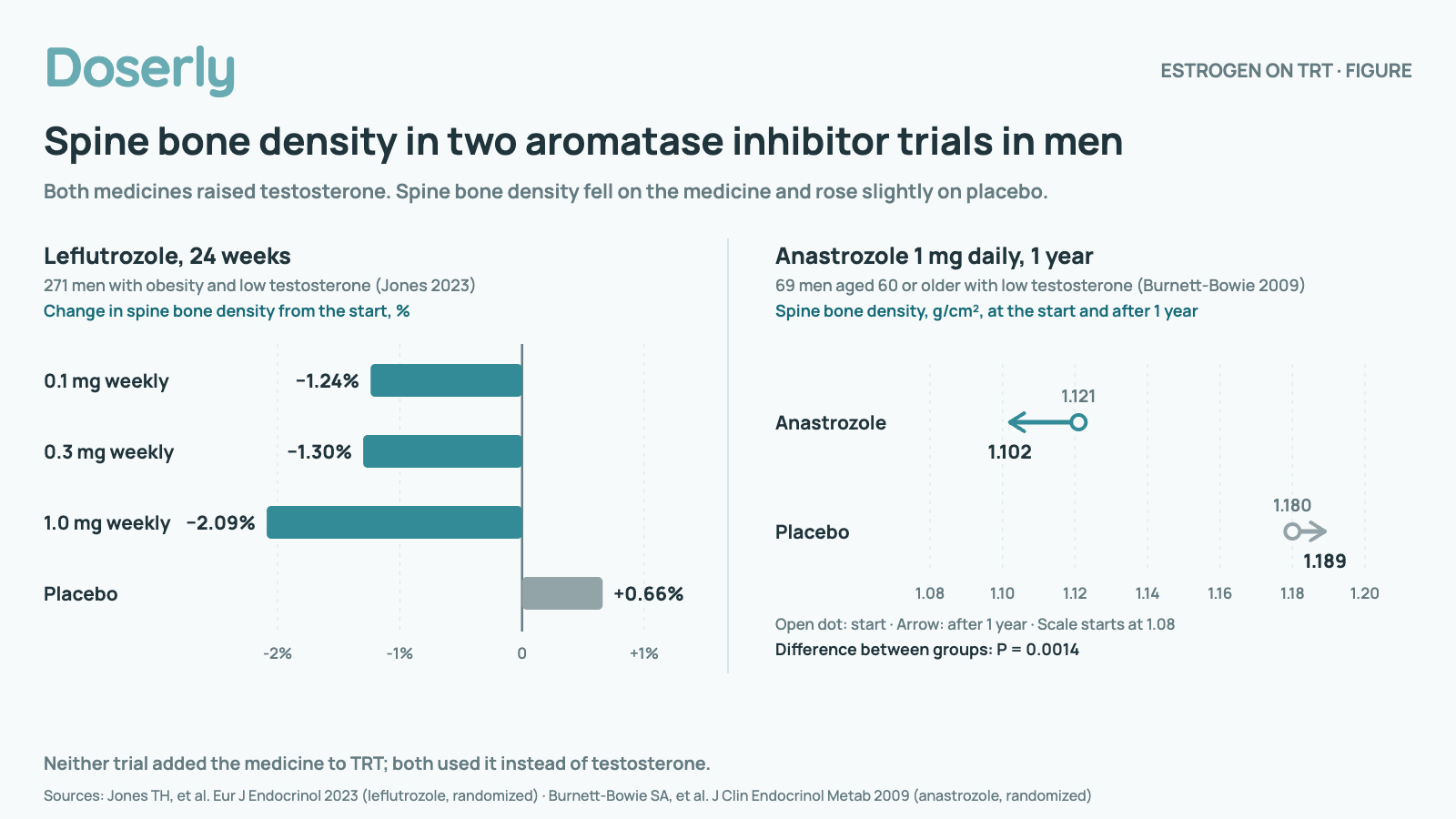
Spine bone density in two aromatase inhibitor trials in men
Both medicines raised testosterone. Spine bone density fell on the medicine and rose slightly on placebo.
Leflutrozole, 24 weeks (Jones 2023)
271 men with obesity and low testosterone. Change in spine bone density from the start; bars run from −2.5% (left) to +1% (right), with the line at 0.
- 0.1 mg weekly
- −1.24%
- 0.3 mg weekly
- −1.30%
- 1.0 mg weekly
- −2.09%
- Placebo
- +0.66%
Anastrozole 1 mg daily, 1 year (Burnett-Bowie 2009)
69 men aged 60 or older with low testosterone. Spine bone density in g/cm² at the start (open dot) and after 1 year (arrow); the scale runs from 1.08 to 1.20. Difference between groups: P = 0.0014.
- Anastrozole
- 1.121 to 1.102 g/cm²
- Placebo
- 1.180 to 1.189 g/cm²
Neither trial added the medicine to TRT; both used it instead of testosterone.
Is high or low estradiol on TRT dangerous?
High estradiol on its own has not been shown to harm men on TRT, apart from breast symptoms. The documented harms come from pushing estradiol too low, usually with an aromatase inhibitor: bone loss, body fat gain, hot flushes and lower sex drive. [4], [14], [9], [38]
Are aromatase inhibitors safe for men?
Their long-term safety in men has not been established, and the warnings that exist point to bone.
- Approval and warnings. Anastrozole (Arimidex), letrozole (Femara) and exemestane (Aromasin) are approved only for breast cancer in women after menopause, and each label warns about bone density loss. The anastrozole label also says cholesterol may rise, and reports more heart events from narrowed arteries than with tamoxifen in women who already had heart disease. [11], [65], [66]
- In men. Spine bone loss appeared in the trials above, and in 80 boys with gynecomastia during puberty, anastrozole did no better than placebo. Reported side effects of leflutrozole included raised hematocrit, high blood pressure, higher PSA and headache. [9], [10], [11]
- Guidelines. The VA advises against them in general, and the BSSM calls for close long-term monitoring. [5], [22]
The anastrozole guide covers the medicine in full.
Does estradiol affect heart health on TRT?
Nobody knows for men on TRT. In 501 men with heart failure, both the lowest (below 12.9 pg/mL) and the highest (37.4 pg/mL or more) fifths of estradiol had higher 3-year death rates than the middle (adjusted 3-year survival about 45% and 64%, against 82% in the middle fifth), and pooled community studies link very low estradiol with higher death rates. Neither tested a treatment. The VA and the anastrozole label warn about heart events with aromatase inhibitors in people who already have heart disease, based on data from women with breast cancer. [67], [56], [5], [11]
The largest heart-safety trial of testosterone, TRAVERSE, compared a daily testosterone gel with placebo in about 5,200 men aged 45–80 at high heart risk; it did not test aromatase inhibitors. Heart attack, stroke or cardiovascular death occurred in 7.0% of men on testosterone and 7.3% on placebo (hazard ratio 0.96), 182 and 190 men out of about 2,600 in each group, which met the trial's safety goal. Some problems were more common on testosterone: atrial fibrillation 3.5% vs 2.4%, acute kidney injury 2.3% vs 1.5%, and pulmonary embolism 0.9% vs 0.5%. Its limits: it tested only a gel, men used it for an average of 21.7 months, about 61% stopped their study gel early, and it enrolled men already at high heart risk. The TRT and heart health guide covers it in full. [68], [69]
Who should be especially cautious?
- Men with thin bones, a past fracture or other risks for osteoporosis, before any estrogen-lowering medicine, because every aromatase inhibitor label warns about bone loss. [11], [65], [66]
- Men with heart disease, for the heart-event warnings above. [5], [11]
- Men who want children. Testosterone therapy lowers sperm production, and fertility guidelines list aromatase inhibitors only as an alternative to testosterone, not an add-on. See TRT and fertility. [25]
- Men with a new breast lump, a hard one-sided swelling or nipple discharge. These need a clinician's examination rather than an estrogen test alone. Current US testosterone labels and the EAU list breast cancer in men as a reason not to use testosterone (checked September 2026). [49], [21]
- Drug-tested athletes. Testosterone, aromatase inhibitors and SERMs are prohibited at all times. [18]
- Under-18s. Testosterone and estrogen-lowering medicines for teenagers belong only in specialist care; anastrozole did not help pubertal gynecomastia in boys. [11]
- Women. This guide is written for men. Testosterone for women uses different doses and products; see testosterone therapy for women.
Which medicines and supplements affect estradiol?
- Tamoxifen with anastrozole. Taken together, anastrozole levels fell by 27% in a breast cancer trial, and the US tamoxifen label says the two should not be taken together. [70], [11]
- hCG adds estradiol made in the testicles (see does hCG raise estradiol?). [8]
- Weight-loss medicines. In a small non-randomized study, tirzepatide plus lifestyle changes lowered estradiol more than lifestyle changes alone in men with obesity and low testosterone. See TRT and GLP-1 medicines. [71]
- Supplements sold to "block estrogen" have not been tested for this in men (see supplements).
Bring a complete list of what you take, including supplements, to a pharmacist or prescriber. Checked September 2026.
Is it legal, and is it allowed in sport?
Checked September 2026. Rules differ by country and change often.
- United States. Testosterone and its esters are Schedule III controlled substances. Anastrozole, letrozole and exemestane are prescription medicines approved only for breast cancer in women after menopause, so prescribing them to men is off-label; the raloxifene (Evista) label says it is not recommended in men. [72], [11], [65], [66], [73]
- United Kingdom. Testosterone is a Class C controlled drug. [74]
- Canada. Testosterone is a Schedule IV controlled substance. [75]
- Australia. Testosterone is a Schedule 4 prescription-only medicine. [76]
- Sport. The World Anti-Doping Agency (WADA) prohibits testosterone, aromatase inhibitors and SERMs such as tamoxifen and clomiphene at all times, and its 2027 list, published in September 2026, keeps them all. [18], [77]
What do guidelines say to do about high estradiol?
Start with symptoms, not the number. For breast symptoms on treatment, the AUA watches first, lowers the testosterone dose if testosterone is in the upper normal range, and considers an aromatase inhibitor only when testosterone is low or normal. No guideline recommends treating a high estradiol result in a man without symptoms. This section describes the choices clinicians weigh; it is not a personal plan. [4], [5]
| Choice | Which guidelines name it | What the evidence shows |
|---|---|---|
| Watch and recheck | AUA (new breast symptoms sometimes settle); EAA and SIAMS gynecomastia guidelines (watch recent cases) | No trial in men on TRT [4], [78], [79] |
| Lower the testosterone dose | AUA (if testosterone is upper normal); Society for Endocrinology (optimize the dose) | Estradiol follows testosterone [3]; no trial of a dose cut for estradiol |
| Lower the hCG dose | No TRT guideline; the Society for Endocrinology suggests it when hCG is used instead of testosterone for fertility | No trial [8] |
| Add an aromatase inhibitor | AUA (persistent breast symptoms with low or normal testosterone); against in general: VA; with caution: BSSM, EAU; EAA mentions them only instead of testosterone | Lowers estradiol; no symptom benefit in trials; spine bone loss (see the research) |
| Tamoxifen for breast tissue | EAA: "not justified in general"; SIAMS: selected painful or unexplained cases | Prevented most breast growth caused by a prostate cancer drug; anastrozole did not (see breast changes) [80] |
| An androgen that cannot become estradiol (DHT) | EAU: "can be useful"; EAA: "not justified in general" | No trial on TRT |
| Surgery | EAA (long-lasting gynecomastia); SIAMS (long-standing, fibrous tissue or marked distress) | Used when tissue does not regress [78], [79] |
| Lose weight | EAU (a low-calorie diet lowers estrogens) | Lowers estradiol in men not on TRT (see weight loss) [6] |
[4], [8], [5], [22], [21], [23], [78], [79]
Should an aromatase inhibitor be added to TRT?
Not routinely: no guideline recommends it, and only the AUA names a situation for it (see the table). The Endocrine Society, the Society for Endocrinology and the CUA do not suggest aromatase inhibitors for men on TRT at all. [4], [2], [8], [15]
When one is prescribed, the AUA rechecks blood tests no sooner than 4 weeks after anastrozole starts, and the anastrozole label suggests considering bone density and cholesterol monitoring. One US practice started anastrozole at 0.5 mg three times a week, off-label, adjusting it to keep estradiol between 20 and 40 pg/mL; it did not report symptoms, bone density or side effects. The anastrozole guide covers the medicine's protocols and evidence. [4], [11], [41]
Does lowering the testosterone dose lower estradiol?
Usually estradiol falls when testosterone falls, which is why the AUA lowers the dose first when on-treatment testosterone is in the upper normal range. No trial has tested a dose cut specifically to lower estradiol, and a lower dose can bring back symptoms of low testosterone. In community threads, some men's estradiol halved with their dose while others' barely moved (see what people report). [4], [3]
What about breast growth (gynecomastia)?
Gynecomastia is growth of the glandular breast tissue, felt as a firm, sometimes tender disc under the nipple; it is different from fat on the chest. Gynecomastia guidelines recommend dealing with the cause and waiting first, medicine only for selected cases, and surgery for long-standing growth. [78], [79]
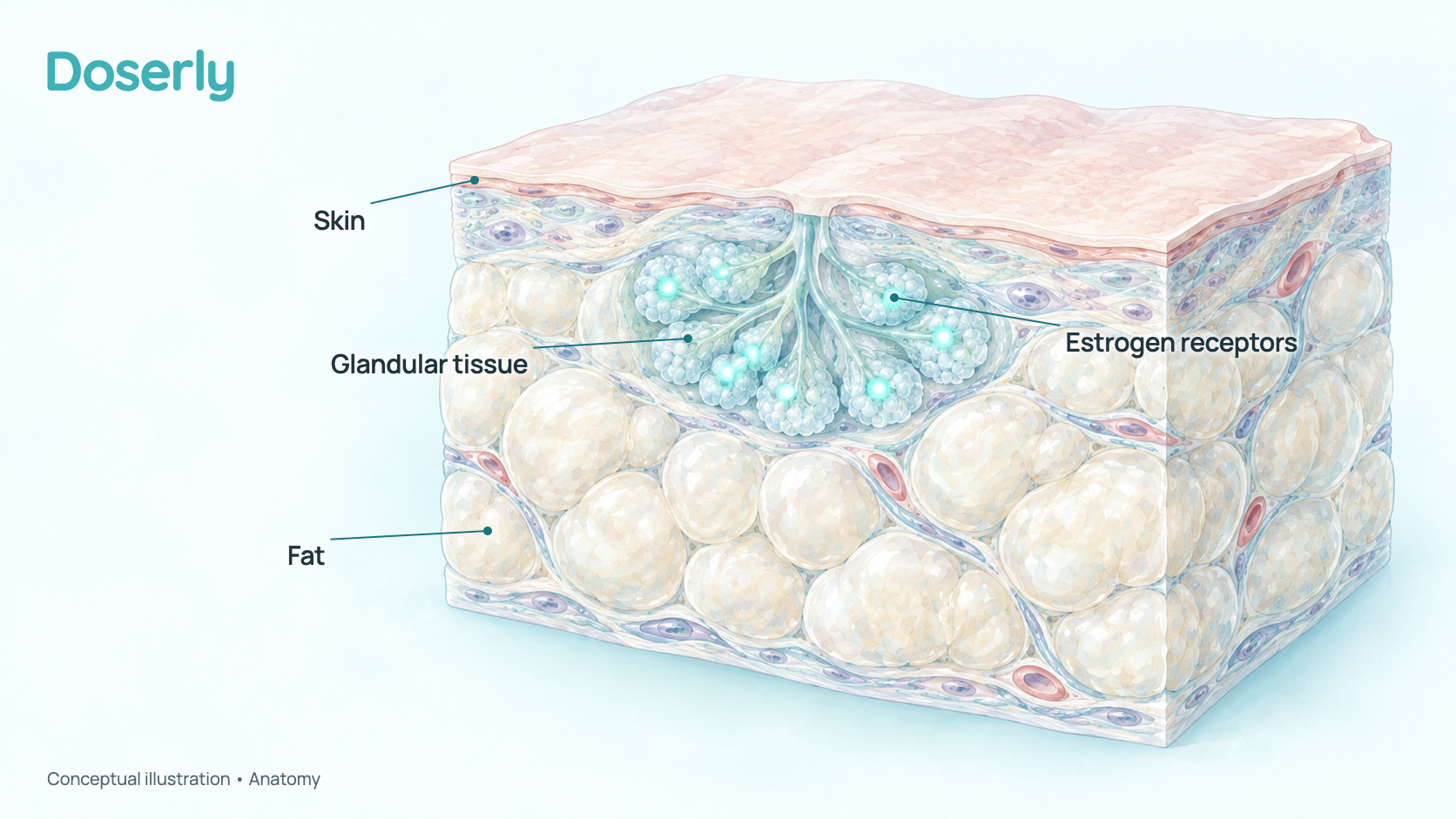
- Watch first. The AUA says breast symptoms sometimes settle; the European Academy of Andrology (EAA) and Italy's andrology society (SIAMS) recommend waiting and watching recent cases once the cause is dealt with. [4], [78], [79]
- Blocking the receptor worked better than lowering estradiol. In a 48-week trial of 114 men taking bicalutamide, a prostate cancer medicine that often causes breast growth, gynecomastia developed in 73% on bicalutamide alone, 51% with anastrozole added and 10% with tamoxifen added. Anastrozole did not significantly reduce it; tamoxifen did. That was a different situation from TRT, but it matches the anastrozole label's trial in boys, which found no benefit. [80], [11]
- Guidelines disagree on medicines. The EAA says SERMs, aromatase inhibitors and androgens that cannot become estradiol are "not justified in general". SIAMS says medicine "may be considered" in selected unexplained or painful cases. The EAU says DHT "can be useful". In the US, none of these medicines is approved for gynecomastia (checked September 2026), and the raloxifene label says it is not recommended in men. [78], [79], [21], [11], [70], [73]
- Surgery is the EAA's treatment of choice for long-lasting gynecomastia, and SIAMS reserves it for long-standing, fibrous tissue or marked distress. [78], [79]
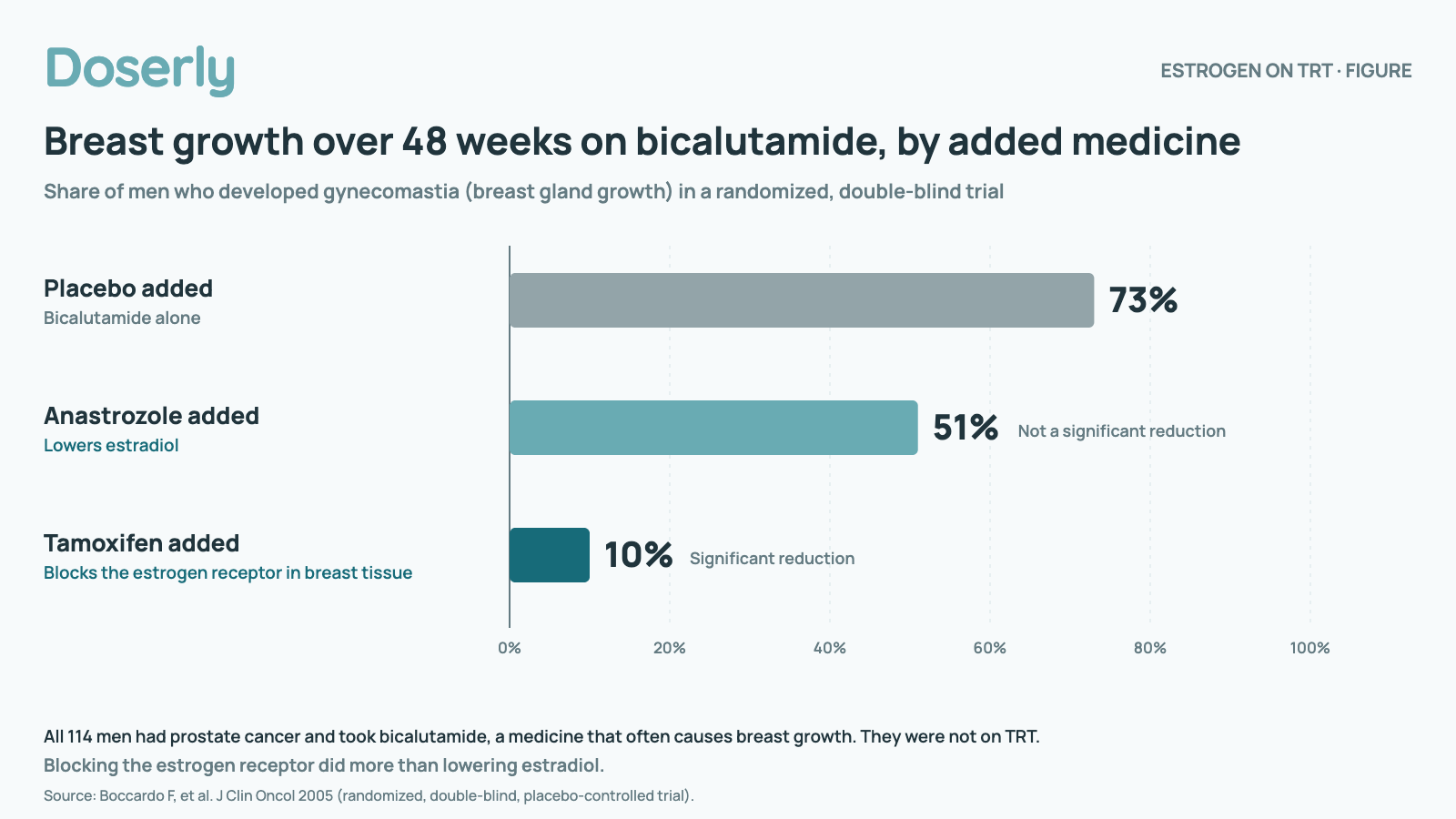
Breast growth over 48 weeks on bicalutamide, by added medicine
Share of men who developed gynecomastia (breast gland growth) in a randomized, double-blind trial.
Bars run from 0% to 100% of men.
- Placebo added
- 73% of men. Bicalutamide alone.
- Anastrozole added
- 51% of men. Lowers estradiol. Not a significant reduction.
- Tamoxifen added
- 10% of men. Blocks the estrogen receptor in breast tissue. Significant reduction.
114 men with prostate cancer on bicalutamide; not men on TRT. Blocking the receptor did more than lowering estradiol.
The tamoxifen guide covers its doses, evidence and risks, including clots, and the TRT side effects guide covers sore nipples alongside other side effects.
How do tests, weight, hCG and supplements affect estradiol?
What is the sensitive estradiol test, and does it matter?
It matters, because the standard test reads high in men. A "sensitive" or "ultrasensitive" estradiol usually means one measured by mass spectrometry (often written LC-MS/MS), which identifies molecules by weight. Standard blood tests use an immunoassay, which detects estradiol with antibodies and struggles at the low levels found in men. Check which method your lab used, because the name on the report varies.
- The Endocrine Society's position statement says estradiol levels in men are "too low to be routinely measured accurately or precisely". [17]
- Readings run high. In 101 healthy men over 40, all five direct immunoassays tested read higher than mass spectrometry, by 6% to 74%, and only mass spectrometry correlated with testosterone and SHBG as expected. [16]
- Low results get missed. In 3,174 European men aged 40–79, a widely used platform immunoassay caught only 13.3% of truly low estradiol results; the authors concluded it may only be suitable for detecting high estradiol. [81]
- Something else gets counted. In more than 6,000 men from three studies, immunoassay results tracked C-reactive protein, a marker of inflammation, while mass-spectrometry results did not, suggesting interference. [82]
No guideline requires the sensitive test for TRT follow-up, but when a decision rests on an estradiol number, the method behind it matters. The TRT blood work guide covers when to draw each test.
Does losing weight lower estradiol?
Yes, in men not on TRT; no study has tested it in men on TRT.
- Pooled studies. A 2013 meta-analysis of 24 studies found that weight loss, by diet or bariatric surgery, lowered estradiol and raised testosterone (about 2.9 nmol/L with a low-calorie diet and 8.7 nmol/L after surgery). A 2026 meta-analysis of 59 surgery studies also found estradiol fell after surgery. [6], [83]
- A diet trial. In 40 frail older men with obesity, diet-led weight loss of about 10% lowered estradiol by about 2.5 pg/mL over a year. [84]
- Medicines. In the tirzepatide pilot described above, estradiol fell further than with lifestyle changes alone. [71]
The obesity-related hypogonadism guide and the TRT and GLP-1 guide cover weight and testosterone together.
Does hCG raise estradiol?
It can. hCG makes the testicles produce their own testosterone, and the testicles turn part of it into estradiol. In the one series of 26 men on TRT plus hCG 500 IU every other day, estradiol did not change significantly, but that study was small and looked back at records. UK Society for Endocrinology guidance checks estradiol after 4 weeks when hCG is used instead of testosterone for fertility, and says a high result may call for a lower hCG dose; it does not endorse combining hCG with testosterone, so no guideline sets an estradiol check for TRT plus hCG. The hCG guide explains the timing. [85], [8]
Do DIM, calcium D-glucarate, zinc or other supplements lower estradiol?
We found no human trial in men that measured estradiol after DIM, calcium D-glucarate, zinc, chrysin or grape seed extract. In the US, supplements are not approved by the FDA for safety or effectiveness (checked September 2026). One man's estradiol read 57 and 59 before, and 57 after, more than three months of daily DIM and calcium D-glucarate. See the supplement guides for DIM, calcium D-glucarate, zinc and grape seed extract. [86], [87]
What are the symptoms of high and low estradiol in men?
Some are well studied; many online "estrogen symptoms" are not.
| Symptom | Linked to | Strength of evidence |
|---|---|---|
| Breast tenderness or growth | High estradiol relative to testosterone | Guidelines and labels [4], [12] |
| Hot flushes and night sweats | Low estradiol | Controlled trials in men [13] |
| Lower sex drive | Low estradiol (and low testosterone) | Controlled trials [38], [53]; high estradiol was not linked with low libido in records [40] |
| Body fat gain | Low estradiol | Controlled trial [38] |
| Bone loss (no symptoms until a fracture) | Low estradiol | Controlled trials [14], [9] |
| Weaker erections | Not shown for high estradiol | Estradiol rises in the Testosterone Trials were not linked with erectile function [43] |
| Water retention, mood swings, joint pain | Blamed on both high and low estradiol online | No trials in men on TRT; testosterone itself can cause fluid retention [34] |
Many of these symptoms have other causes. In community threads, other explanations (a thyroid problem, a dosing error, a large hCG dose) often turned up once people looked closer. [88], [89], [29]
How long does "crashed" estradiol take to recover?
No study has measured it in men. People use "crashed E2" for estradiol pushed very low, usually by an aromatase inhibitor. The medicines themselves have half-lives of about 50 hours (anastrozole), 2 days (letrozole) and 24 hours (exemestane), but symptoms in community accounts took days to weeks to ease, and one man's repeat test rose from 0 to 20 while he still felt unwell. [11], [65], [66], [90]
What do people on TRT report about estrogen?
Estrogen is one of the most argued-over topics in public TRT forums. The threads below are recent public Reddit discussions, read with their replies; they show what people experience, not how often it happens.
Does a high number always mean symptoms?
No, and that is the most common surprise. One man felt very well six weeks into treatment with an estradiol of 154 pg/mL and testosterone of 1,500 ng/dL; his doctor still advised a lower dose. Another, 13 months in and in the best shape of his life, had no nipple, libido or erection problems at 74. A third had 167 pmol/L at three months with no symptoms and declined the aromatase inhibitor he was offered. [91], [92], [93]
Others do link symptoms to high readings, but the symptoms are often vague. One man at 374 pmol/L had no nipple symptoms but felt tired and anxious after feeling great in his first weeks, and chose a small dose cut and more frequent injections instead of a medicine. [94]
What happens when estradiol is pushed too low?
Accounts of "crashed E2" are among the most vivid in these forums. One man with an estradiol of 43 and no symptoms was started on weekly anastrozole by his clinic; his energy and libido fell from the first dose, his next result was below 5, and he stopped it. Another, whose estradiol had risen from 41 to 61, took a small weekly dose for four weeks and described panic, night sweats, broken sleep and a collapse in libido. [95], [96]
Recovery can be slow. After anastrozole and then exemestane, one man's sensitive estradiol read 0, and he described stiff, painful legs and knees, shoulder pain and anorgasmia; weeks later his repeat result was 20 and he felt only slightly better. [90] Another man felt his erections, mood and joints improve after stopping anastrozole, then found his prescriber wanted to restart it because his estradiol of 66 was outside the lab range, although he had no symptoms. [97] A man who added an over-the-counter "estrogen blocker" to his TRT developed fatigue, anxiety, hot flushes and joint pain within weeks, without a blood test to confirm a fall, and improved after stopping it. [98]
Does anyone feel better on an aromatase inhibitor?
Some do. One man who skipped his prescribed anastrozole saw estradiol rise from 42 to 112 over three months with puffy hands and returning fatigue, and reported more energy and strength within a week of starting it; he also carried a lot of weight around his middle and planned to lose it. [99] Another man on twice-weekly anastrozole had an ultrasensitive result of 40 with poor erections and low mood, and his provider suggested letting estradiol rise a little. [100]
Does lowering the dose or splitting injections work?
Results pull both ways. One man cut cypionate from 100 to 60 mg a week and saw estradiol halve (66 to 33 pg/mL) and felt better, even though his testosterone fell from 731 to 339 ng/dL. [101] Others saw estradiol barely move: a lower dose split into two injections took one man's trough testosterone from 1,010 to 750 ng/dL while estradiol went from 57 to 55 pg/mL, and another man's estradiol stayed near 50 pg/mL after a dose cut that left him with less drive. [102], [103] A third was still at 245 pmol/L (from 298) after 11 weeks on a much lower dose, with nipple tenderness, and his GP suggested pausing to check his baseline hormones and thyroid. [104]
What do breast lumps look like in these threads?
Usually a small, tender lump under one nipple. One man felt a lump months into treatment; an ultrasound found a gland about an inch across that did not change over two weeks, and a mammogram was booked while his clinic advised waiting. [105] Another felt a marble-sized lump after his testosterone rose from about 900–1,000 to 1,500 ng/dL on the same dose. [106] A third, six weeks in, found small lumps but had old photos showing puffy nipples before TRT, and his estradiol (143 pmol/L) was inside his lab's range. [107] A fourth noticed breast fullness within about a week of raising his dose and injecting daily while also taking hCG. [89] Tenderness does not always track the number: one man's sore nipple persisted across estradiol results from the teens to the high 30s, and an early result of 8 on a high anastrozole dose came with poor sexual function and low energy. [108]
How often is the number itself the problem?
Often. One man alarmed by a jump from 90 to 250 found, on checking his reports, that 250 was total estrogen and his estradiol had gone from 32 to about 90. [20] Unit confusion is common: 206 pmol/L sounds high but is about 56 pg/mL, and one man's 165 pmol/L (about 45 pg/mL) sat just above a lab range that ended at 159. [29], [109] Timing and other medicines muddy it further: one man's 206 pmol/L came with 3,000 IU of hCG a week, and another's estradiol of 99 pg/mL came with hCG and a thyroid test (TSH) of 68 while on thyroid replacement. [29], [88]
How can you judge an estradiol story?
Ask: Which test was used, standard or mass spectrometry, and was it estradiol or total estrogen? Which units? When was the blood drawn relative to the last injection? What was testosterone at the same draw? Was hCG, a weight-loss medicine or anything else changed at the same time? Were the symptoms there before TRT? Was the result repeated? And what happened a few months later?
These selected discussions show what people experience and the questions research has not answered. They are not a survey of all men on TRT, a success rate or a substitute for the studies above.
What should you track?
Breast symptoms first, then estradiol when they appear. Routine TRT monitoring under most guidelines is testosterone, hematocrit and, for some men, PSA, not estradiol. Use this summary to prepare questions for your prescriber; it is not a personal testing plan. [2], [4]
| Why it matters | What guidelines and labels say | Tracking category |
|---|---|---|
| Breast tenderness, growth or a lump | AUA and CUA: check estradiol with breast symptoms before treatment; AUA: also when they appear on treatment, and new symptoms sometimes settle | Hormonal Symptoms |
| Estradiol | Not routine on TRT (Endocrine Society); optional alongside testosterone (AUA); ideally by mass spectrometry | Blood work |
| Testosterone, at the same draw | Testosterone and hematocrit at 3–6 months, 12 months, then yearly (Endocrine Society); if breast symptoms persist, the AUA lowers an upper-normal testosterone first | Blood work |
| If an aromatase inhibitor is prescribed | Estradiol checks for everyone on an aromatase inhibitor, no sooner than 4 weeks after starting anastrozole (AUA); consider bone density and cholesterol (label); close long-term monitoring (BSSM) | Blood work; Bone Health |
| Hot flushes, night sweats, low sex drive | Signs estradiol may be too low, especially on an estrogen-lowering medicine | Temperature Regulation; Libido |
| Weight and waist | Weight loss lowers estradiol in men not on TRT | Weight Management |
[4], [15], [2], [11], [22], [13], [6]
A single estradiol result is one point on a line. Because the test method, the units and the timing all move the number, results from the same lab and method, drawn at a similar point in the injection cycle, say more than any one reading. The TRT blood work guide covers draw timing, and the TRT dose calculator shows what a dose change means in mL and syringe units.
Common questions about estrogen on TRT
Do I need an aromatase inhibitor on TRT?
Most men do not, and no guideline recommends one routinely. The AUA considers one only for persistent breast symptoms with a high estradiol when on-treatment testosterone is low or normal; the VA advises against them in general. In trials, they lowered estradiol and spine bone density without improving how men felt. [4], [5], [9] See what guidelines do.
What estradiol level is too high on TRT?
No guideline sets one. The AUA refers men whose estradiol stays above 40 pg/mL (about 147 pmol/L) before treatment, and on treatment it acts on breast symptoms, not a number. Standard tests read high in men, so the method matters as much as the result. [4], [16] See the key numbers.
Can high estrogen cause erectile dysfunction?
It has not been shown in men on TRT. In the Testosterone Trials, rises in estradiol were not linked with erectile function, and bigger rises went with better sexual desire and activity. Estradiol pushed too low did lower sexual function in controlled experiments. Erection problems have many causes worth checking first. [43], [38] See the symptoms table and the TRT sexual health guide.
Does injecting more often lower estrogen?
No trial has shown it. In 263 men, 100 mg weekly and 200 mg every 2 weeks raised estradiol by similar amounts, and route comparisons conflict. Men in forums report both outcomes. [7], [36], [37] See form and schedule.
Is anastrozole safe long-term?
Not established for men. It is approved only for breast cancer in women, its label warns about bone density loss and higher cholesterol, and a 1-year trial in older men found spine bone loss. The VA notes that no placebo-controlled trial in men has lasted longer than a year. [11], [9], [5] See the risks and the anastrozole guide.
Does DIM lower estrogen on TRT?
We found no trial in men that measured it. One man's estradiol was unchanged after more than three months of daily DIM with calcium D-glucarate, and supplements are not FDA-approved for safety or effectiveness. [87], [86] See supplements.
Is estrogen the same as estradiol on a blood test?
Not quite. Estradiol is the main estrogen and the one guidelines refer to; a "total estrogen" result adds several estrogens together and reads higher. Check which one your report shows, and in which units (pg/mL or pmol/L). [1], [28] See the units.
Glossary
Plain explanations of the medical, lab and research terms used in this guide. Underlined terms in the text link here.
- Aromatase
- The enzyme that turns testosterone into estradiol. It is found in fat, the brain, bone, muscle, blood vessels and the testicles.
- Aromatase inhibitor
- A medicine, such as anastrozole, letrozole or exemestane, that blocks the enzyme that turns testosterone into estradiol, so estradiol falls. They are approved only for breast cancer in women, so use in men is off-label.
- Bone mineral density
- A measure of how much mineral the bones hold, usually checked with a low-dose X-ray scan (DXA). Lower density means weaker bones and a higher fracture risk.
- Cohort study (records study)
- A study that follows a group of people, or looks back at their records, without assigning treatments. It can show links but not prove that one thing caused another.
- Controlled trial
- A study that compares people who receive a treatment with a similar group who do not, often receiving a placebo instead. Randomly assigning people to each group makes the comparison fairer.
- DHT (dihydrotestosterone)
- A stronger form of testosterone made in some tissues. It cannot be turned into estradiol.
- Estradiol (E2)
- The main form of estrogen. In men it is made mostly from testosterone, so it rises when testosterone rises.
- Clinical guideline
- Recommendations written by a medical society or health system, based on its review of the evidence and expert judgment. Different guidelines can reach different conclusions.
- Gynecomastia
- Growth of breast tissue in men, often tender at first. It is linked to a higher estrogen-to-testosterone balance.
- Half-life
- The time it takes for the level of a substance in the blood to fall by half. For anastrozole it is about 50 hours. It is not the same as how long an effect lasts.
- Hazard ratio
- A measure comparing how often an event happens over time in two groups. A hazard ratio of 1 means no difference; 0.96 means about 4% lower in the first group.
- hCG (human chorionic gonadotropin)
- A hormone medicine that acts like LH, telling the testicles to make their own testosterone. It is sometimes added to TRT to keep the testicles working.
- Hot flush (hot flash)
- A sudden feeling of heat, often with sweating and a flushed face. In men it is driven mainly by low estradiol.
- Immunoassay
- A common lab method that uses antibodies to detect a hormone. For estradiol at men's low levels, it tends to read high.
- Intramuscular (IM)
- Injected into a muscle. Most testosterone cypionate and enanthate is given this way.
- Product label (prescribing information)
- The official document approved by a medicines regulator for a product, describing its approved uses, doses, warnings and monitoring. In the UK it is called the summary of product characteristics.
- Mass spectrometry (LC-MS/MS)
- A lab method that identifies molecules by their weight. It measures men's estradiol more accurately than an immunoassay and is what "sensitive" estradiol tests usually use.
- Meta-analysis and systematic review
- A systematic review gathers all studies on a question in a planned way. A meta-analysis combines their results statistically.
- Off-label use
- Prescribing an approved medicine for a use, dose or group of people that its label does not cover. It is legal for prescribers but means the regulator has not reviewed evidence for that use.
- pg/mL and pmol/L
- The two units for estradiol. Multiply pg/mL by 3.671 to get pmol/L: 40 pg/mL is about 147 pmol/L. ng/L is the same number as pg/mL.
- Placebo
- A dummy treatment with no active ingredient, used as a comparison in studies.
- Reference range
- The spread of results a lab expects in healthy people, printed next to your result. It differs between labs and methods and is not a treatment target.
- SERM (selective estrogen receptor modulator)
- A tablet, such as tamoxifen, raloxifene, clomiphene or enclomiphene, that blocks estrogen's action in some tissues and mimics it in others. Tamoxifen blocks it in breast tissue without lowering estradiol.
- SHBG (sex hormone-binding globulin)
- A blood protein that carries testosterone and estradiol. Hormone bound to it is not immediately available to tissues.
- Subcutaneous (SC)
- Injected into the fatty layer just under the skin. Xyosted is given this way, and some prescribers use this route for other testosterone injections.
- Testosterone-to-estradiol ratio
- Testosterone divided by estradiol. It is discussed online, but no guideline uses it, no best value has been established and it changes with the units used.
- TRT (testosterone replacement therapy)
- Prescribed testosterone, by injection, gel or other forms, for men with low testosterone. It switches off the brain's LH and FSH signals.
- WADA
- The World Anti-Doping Agency, which publishes the list of substances banned in sport. Testosterone, aromatase inhibitors and SERMs are banned at all times.
How this guide was researched
This guide is built from a thorough review of the sources cited throughout it: clinical guidelines and position statements from 12 medical bodies, product labels, published clinical trials and studies, lab-method comparisons and regulatory documents. We also reviewed public online forums where men on TRT describe their own estradiol results.
The guide cites 109 sources, including 42 original studies in people, 14 clinical guidelines and position statements, 12 product labels and 25 public community discussions. Each type of source answers a different question. Guidelines and labels show what clinicians are told to do. Trials and studies show what was measured. Personal accounts show what individual people experienced. Every numbered citation links to its entry below, labeled by source type.
How this guide was made
Research and drafting were AI-assisted. Every cited source was checked against the original, and the guide was reviewed and edited by Doserly before publication. It has not had an independent clinical review, and Doserly does not currently have medical reviewers. Doserly makes a medication and health-tracking app and runs Doserly Academy, both of which are promoted in this guide. Read our editorial policy for how guides are researched, updated and corrected.
This guide is for educational purposes. It summarizes what the reviewed sources report so the research is easier to understand; it is not medical advice. For a deeper dive, or to check any point for yourself, go straight to the cited sources.
Explore the sources
These are the documents cited in this guide. Guidelines, labels, studies, lab-method comparisons and personal accounts answer different questions. A source being listed does not mean every statement on its page is endorsed.
Showing 109 sources
- 01
Aromatase inhibitors in men: effects and therapeutic options ↗
Review
Original full text reviewed.
Detail: Review: men make 35–45 micrograms of estradiol a day, about 20% secreted directly by the testes and about 60% testicular in origin; blood estradiol is about 1/200 of testosterone; aromatase-deficient men have very low bone mass.
- 02
Testosterone Therapy in Men With Hypogonadism: An Endocrine Society Clinical Practice Guideline ↗
Clinical guideline
Full guideline reviewed.
Detail: Estradiol is required to prevent fat gain and hot flushes; testosterone and estradiol together maintain sexual function and bone density. Monitoring covers testosterone and hematocrit, not estradiol. Gynecomastia: uncommon, weak evidence of association.
- 03
The effects of injected testosterone dose and age on the conversion of testosterone to estradiol and dihydrotestosterone in young and older men ↗
Human trial
Original abstract reviewed.
Detail: Randomized trial in 103 young and older men with hormones suppressed, weekly enanthate 25–600 mg (research doses at the top) for 5 months: estradiol rose with the dose; older men's maximum conversion rate was 40% higher, partly from more body fat.
- 04
Evaluation and Management of Testosterone Deficiency: AUA Guideline ↗
Clinical guideline (US)
Full guideline reviewed.
Detail: Measure estradiol before treatment with breast symptoms or gynecomastia (expert opinion; optional in any man as a baseline, and on treatment optional alongside testosterone, recommended with new breast symptoms or on an aromatase inhibitor); refer if it stays above 40 pg/mL at baseline; breast symptoms on treatment sometimes settle; if they persist with high estradiol, lower the testosterone dose when testosterone is upper normal, or use an aromatase inhibitor when it is low or normal; recheck no sooner than 4 weeks after starting anastrozole. Its evidence review found gynecomastia events in only 3 included studies; in one gel trial, 2 of the 4 men with it at 180 days had it before treatment.
- 05
Evaluation for and Management of Males with Low Testosterone: Recommendations for Use (January 2026) ↗
Clinical recommendations (US)
Full document reviewed.
Detail: Aromatase inhibitors not generally recommended: they raise ischemic cardiovascular events in people with heart disease, increase central fat and lower bone density, and have not been studied in placebo-controlled trials longer than a year.
- 06
Body weight loss reverts obesity-associated hypogonadotropic hypogonadism: a systematic review and meta-analysis ↗
Systematic review
Original abstract reviewed.
Detail: Meta-analysis of 24 studies: weight loss by diet or bariatric surgery lowered estradiol and raised testosterone (about 2.9 nmol/L with diet, 8.7 nmol/L after surgery), in men not on TRT.
- 07
Comparative assessment of outcomes and adverse effects using two different intramuscular testosterone therapy regimens: 100 mg IM weekly or 200 mg IM biweekly ↗
Human study
Original abstract reviewed.
Detail: 263 men: 100 mg weekly vs 200 mg every 2 weeks showed no significant difference in the rise in estradiol; not randomized.
- 08
Society for Endocrinology guidelines for testosterone replacement therapy in male hypogonadism ↗
Clinical guideline (UK)
Full text reviewed.
Detail: Gynaecomastia and mood swings can be minimised with optimised testosterone treatment; when hCG is used instead of testosterone for fertility, oestradiol is checked at 4 weeks and a high level may suggest reducing the hCG dose; the guideline does not endorse combining hCG with testosterone.
- 09
Effects of aromatase inhibition on bone mineral density and bone turnover in older men with low testosterone levels ↗
Human trial
Original abstract reviewed.
Detail: 69 men aged 60 or older, anastrozole 1 mg daily or placebo for a year: testosterone 319 to 524 ng/dL, estradiol 15 to 12 pg/mL; spine bone density fell (1.121 to 1.102 g/cm²) vs a rise on placebo.
- 10
Leflutrozole in male obesity-associated hypogonadotropic hypogonadism: Ph 2b double-blind randomised controlled trial ↗
Human trial
Original abstract reviewed.
Detail: Randomized trial of weekly leflutrozole (0.1, 0.3 or 1.0 mg) instead of TRT in 271 obese men, 24 weeks: testosterone normalized, but sexual symptoms and body composition did not improve; spine bone density fell 1.2–2.1% vs a 0.7% rise on placebo.
- 11
Arimidex (anastrozole) 1 mg tablets prescribing information ↗
Product label (US)
Full label reviewed.
Detail: Arimidex (anastrozole): approved only for breast cancer in postmenopausal women; no benefit over placebo for pubertal gynecomastia in 80 boys; half-life about 50 hours; bone density loss and cholesterol rises may occur; more ischemic heart events than tamoxifen in women with ischemic heart disease; tamoxifen lowers anastrozole levels by 27%.
- 12
AndroGel 1% (testosterone gel) prescribing information (clinical pharmacology and adverse reactions) ↗
Product label (US)
Relevant label sections reviewed.
Detail: AndroGel 1%: estradiol rose within 30 days and stayed raised but within the normal male range; gynecomastia in 1% (50 mg), 0% (75 mg) and 3% (100 mg) over 180 days, and 2.5% in a 3-year extension.
- 13
Effects of Testosterone and Estradiol Deficiency on Vasomotor Symptoms in Hypogonadal Men ↗
Human trial
Original abstract reviewed.
Detail: Same hormone-suppression trials: hot flushes at 35% of visits when estradiol was blocked vs 26% when not; 38% of visits at 5–9.9 pg/mL vs 16% at 10–14.9 pg/mL.
- 14
Gonadal steroid-dependent effects on bone turnover and bone mineral density in men ↗
Human trial
Original abstract reviewed.
Detail: Healthy men with hormones suppressed, 16 weeks: when anastrozole blocked estradiol, spine bone density fell at every testosterone dose; estradiol above 10 pg/mL and testosterone above 200 ng/dL generally protected bone.
- 15
Canadian Urological Association guideline on testosterone deficiency in men: Evidence-based Q&A ↗
Clinical guideline (Canada)
Full text reviewed.
Detail: Measure estradiol before treatment in men with breast symptoms or gynecomastia (strong recommendation); aromatase inhibitors are off-label alternatives to raise a man's own testosterone when fertility matters; obesity increases aromatization in fat.
- 16
Performance of direct estradiol immunoassays with human male serum samples ↗
Human study
Original abstract reviewed.
Detail: In 101 healthy men over 40, all five direct estradiol immunoassays read higher than mass spectrometry, by 6% to 74%; only mass spectrometry correlated with testosterone and SHBG.
- 17
Challenges to the measurement of estradiol: an Endocrine Society position statement ↗
Position statement
Original abstract reviewed.
Detail: Position statement: the low estradiol levels found in men and children are too low to be measured accurately or precisely by routine methods.
- 18
World Anti-Doping Code International Standard: Prohibited List 2026 ↗
Anti-doping list
Full list reviewed.
Detail: Testosterone (S1) and aromatase inhibitors and anti-estrogens, including anastrozole, letrozole, exemestane, tamoxifen, raloxifene and clomifene (S4), are prohibited at all times.
- 19
Aromatase deficiency in male and female siblings caused by a novel mutation and the physiological role of estrogens ↗
Case report
Original abstract reviewed.
Detail: Case report: a 24-year-old man unable to make estrogen (estradiol below 7 pg/mL) was 204 cm tall with open growth plates (bone age 14) and very low bone density.
- 20
Looking for Advice: Estradiol Went from 90 to 250 After Switching to SubQ (But overall I feel better than ever) ↗
Community account
Public thread reviewed: opening post, the poster's replies and top comments.
Detail: A reported jump from 90 to 250 turned out to be total estrogen; the actual estradiol results were 32 and then about 90 pg/mL, and 94.6 on retest.
- 21
EAU Guidelines on Sexual and Reproductive Health, Chapter 3: Male Hypogonadism (2026 edition) ↗
Clinical guideline (Europe)
Full guideline chapter reviewed.
Detail: SERMs and aromatase inhibitors are off-label with poor evidence; long-term use can reduce bone density. DHT is not aromatised and can be useful for gynaecomastia. A low-calorie diet reduces oestrogens. Male breast cancer is an absolute contraindication to testosterone.
- 22
The British Society for Sexual Medicine Guidelines on Male Adult Testosterone Deficiency, with Statements for Practice ↗
Clinical guideline (UK)
Full text reviewed.
Detail: Aromatase inhibitors may raise testosterone but reduce oestradiol and bone density and need close long-term monitoring; combining them with testosterone needs further study.
- 23
European Academy of Andrology (EAA) guidelines on investigation, treatment and monitoring of functional hypogonadism in males (endorsed by the European Society of Endocrinology) ↗
Clinical guideline (Europe)
Full text reviewed.
Detail: As alternatives to testosterone in functional hypogonadism, to maintain fertility, aromatase inhibitors such as letrozole have been suggested off-label; the evidence is poor (few, short, small trials).
- 24
Endocrine Society of Australia position statement on male hypogonadism (part 2): treatment and therapeutic considerations ↗
Position statement (Australia)
Full text reviewed.
Detail: Gynaecomastia is a less common adverse effect; aromatase inhibition to restore the hormone axis is listed as an open research question.
- 25
Diagnosis and Treatment of Infertility in Men: AUA/ASRM Guideline (2020; Amended 2024) ↗
Clinical guideline (US)
Full guideline reviewed.
Detail: Aromatase inhibitors may be considered for men with low testosterone and elevated estradiol who want fertility (conditional); exogenous testosterone should not be prescribed to men interested in fertility.
- 26
Estradiol reference intervals in women during the menstrual cycle, postmenopausal women and men using an LC-MS/MS method ↗
Human study
Original abstract reviewed.
Detail: Mass-spectrometry method traceable to the CDC reference method: male reference interval 12–136 pmol/L (about 3–37 pg/mL), from 64 men. A lab range, not a TRT target.
- 27
Reference ranges and determinants of testosterone, dihydrotestosterone, and estradiol levels measured using liquid chromatography-tandem mass spectrometry in a population-based cohort of older men ↗
Human study
Original abstract reviewed.
Detail: Health In Men Study (Perth), men aged 70–89: in 394 very healthy men, the mass-spectrometry 2.5th percentile for estradiol was 28 pmol/L (about 7.6 pg/mL).
- 28
PubChem Compound Summary: Estradiol (CID 5757), molecular weight ↗
Chemical database (US)
Official page reviewed.
Detail: Estradiol's molecular weight is 272.4 g/mol, so 1 pg/mL equals about 3.671 pmol/L.
- 29
too much estradiol? on 100mg test cyp the past 4 weeks, lab says 206 pmol/L of estradiol ↗
Community account
Public thread reviewed: opening post, the poster's replies and top comments.
Detail: A result of 206 pmol/L (about 56 pg/mL) drawn 7 days after a weekly 100 mg injection, while also taking 3,000 IU of hCG a week; the poster planned to split his testosterone and ask about the hCG amount.
- 30
A Review on Testosterone: Estradiol Ratio-Does It Matter, How Do You Measure It, and Can You Optimize It? ↗
Review
Original abstract reviewed.
Detail: Review: a testosterone-to-estradiol ratio of 10–30 "seems" beneficial, but the optimal value has not been determined.
- 31
The hormonal regulation of men's sexual desire, arousal, and penile erection: recommendations from the fifth International Consultation on Sexual Medicine (ICSM 2024) ↗
Consensus recommendations
Original abstract reviewed.
Detail: ICSM 2024 sexual-function committee: estradiol may matter, but its clinical use is limited by measurement problems.
- 32
Comparison of the Effects of Testosterone Gels, Injections, and Pellets on Serum Hormones, Erythrocytosis, Lipids, and Prostate-Specific Antigen ↗
Human study (records)
Original full text reviewed.
Detail: One practice's records of 178 men on gels, injections or pellets: estradiol rose most with injections and gels; the testosterone level, not age or body mass index, predicted estradiol. Not randomized; the paper's printed estradiol values are not quoted because of an apparent unit error.
- 33
Effect of a single injection of testosterone enanthate on 17beta estradiol and bone turnover markers in hypogonadal male patients ↗
Human study
Original abstract reviewed.
Detail: 21 men given one 250 mg enanthate injection and tested weekly: estradiol peaked at the 1-week draw; it tripled on average in 12 men and did not rise in 9.
- 34
AndroGel 1.62% (testosterone gel) pump and packets prescribing information ↗
Product label (US)
Relevant label sections reviewed.
Detail: AndroGel 1.62%: estradiol rose in line with testosterone; androgens may promote retention of sodium and water.
- 35
Aveed (testosterone undecanoate injection) prescribing information (adverse reactions) ↗
Product label (US)
Relevant label sections reviewed.
Detail: Aveed: "estradiol increased" in 4 of 153 men (2.6%) in the 84-week study, and among the reasons for stopping.
- 36
Comparison of Outcomes for Hypogonadal Men Treated with Intramuscular Testosterone Cypionate versus Subcutaneous Testosterone Enanthate ↗
Human study
Original abstract reviewed.
Detail: 234 men: a weekly subcutaneous enanthate autoinjector was associated with lower estradiol and hematocrit than weekly intramuscular cypionate; route, ester and device all differed.
- 37
Pharmacokinetics and Acceptability of Subcutaneous Injection of Testosterone Undecanoate ↗
Human trial
Original abstract reviewed.
Detail: Crossover study in 20 long-term undecanoate users: estradiol did not differ between subcutaneous and intramuscular injection of the same dose.
- 38
Gonadal steroids and body composition, strength, and sexual function in men ↗
Human trial
Original abstract reviewed.
Detail: 400 healthy men with hormones suppressed, with or without anastrozole, 16 weeks: estrogen deficiency mainly accounted for body-fat gain; both hormones contributed to lower sexual function.
- 39
Aromatase inhibitors as endocrine modulators: From breast cancer therapy to male off-label use and doping practice ↗
Review
Original abstract reviewed.
Detail: Review: in men, aromatase inhibitors raise testosterone, but the rise did not consistently translate into better sexual function, performance or wellbeing; they should not be regarded as general testosterone-restoring agents.
- 40
High estrogen in men after injectable testosterone therapy: the low T experience ↗
Human study (records)
Original abstract reviewed.
Detail: Records of 34,016 men at a US men's clinic chain: 7,215 (printed as 20.2%) had estradiol of 42.6 pg/mL or more by immunoassay; aromatase inhibitors and SERMs were prescribed irrespective of estradiol; high estradiol was not linked with low libido. The denominator mixes screened and treated men.
- 41
The Utilization and Impact of Aromatase Inhibitor Therapy in Men With Elevated Estradiol Levels on Testosterone Therapy ↗
Human study (records)
Original full text reviewed.
Detail: One surgeon's records, 2005–2019: of 1,708 men on testosterone or clomiphene, 44 (2.6%) were given anastrozole (0.5 mg three times weekly, off-label) for estradiol above 60 pg/mL, or 40–60 pg/mL with breast or nipple tenderness; median estradiol fell from 65 to 22 pg/mL with testosterone unchanged. Symptoms, bone and side effects not reported.
- 42
Treatment of Estrogen Levels in the Management of Hypogonadism: An Anonymous Survey of ISSM Members ↗
Clinician survey
Original abstract reviewed.
Detail: Survey of 489 International Society for Sexual Medicine members (22.5% response): 54.7% monitor estradiol on TRT; 69.4%, 47.7% and 14.4% treat symptomatic, symptom-free and preventively; anastrozole starting doses varied widely.
- 43
Testosterone Treatment and Sexual Function in Older Men With Low Testosterone Levels ↗
Human trial
Original abstract reviewed.
Detail: Testosterone Trials: larger increases in testosterone and estradiol went with larger gains in sexual activity and desire, but not erectile function.
- 44
The effect of short-term increase of estradiol levels on sexual desire and orgasm frequency in women and men: A double-blind, randomized, placebo-controlled trial ↗
Human trial
Original abstract reviewed.
Detail: Randomized trial in 126 young men and women: raising estradiol for 2 days had no effect on orgasm frequency and only minor effects on desire. Not TRT.
- 45
Testim (testosterone gel) 1% prescribing information (adverse reactions) ↗
Product label (US)
Relevant label sections reviewed.
Detail: Testim: gynecomastia in 1% (50 mg) and 0% (100 mg) vs 0% on placebo over 90 days.
- 46
Long acting testosterone undecanoate therapy in men with hypogonadism: results of a pharmacokinetic clinical study ↗
Human study
Original abstract reviewed.
Detail: Single-arm study of undecanoate injections in 130 men over 24 weeks: no gynecomastia observed.
- 47
A critical analysis of the quality of testosterone therapy randomized controlled trials ↗
Review
Original abstract reviewed.
Detail: Review of 30 testosterone trials: only 17% reported gynecomastia and none graded it.
- 48
Testopel (testosterone pellets) prescribing information (warnings) ↗
Product label (US)
Relevant label sections reviewed.
Detail: Testopel (older label wording): gynecomastia "frequently develops" and occasionally persists.
- 49
Depo-Testosterone (testosterone cypionate) 100 and 200 mg/mL prescribing information ↗
Product label (US)
Relevant label sections reviewed.
Detail: Depo-Testosterone: gynecomastia may develop; contraindicated in men with breast cancer.
- 50
Effects of aromatase inhibition vs. testosterone in older men with low testosterone: randomized-controlled trial ↗
Human trial
Original abstract reviewed.
Detail: 43 older men, testosterone gel, anastrozole or placebo for 12 months: both raised testosterone above 500 ng/dL, but only the gel improved spine bone density.
- 51
Aromatase Inhibition Reduces Insulin Sensitivity in Healthy Men ↗
Human trial
Original abstract reviewed.
Detail: Crossover trial in 17 healthy men: 6 weeks of anastrozole lowered estradiol (60 vs 102 pmol/L on placebo) and reduced insulin sensitivity.
- 52
Testosterone vs. aromatase inhibitor in older men with low testosterone: effects on cardiometabolic parameters ↗
Human trial
Original abstract reviewed.
Detail: 29 older men, 12 months: neither testosterone gel nor anastrozole changed insulin resistance, C-reactive protein or lipids compared with placebo.
- 53
Letrozole and Infertility Among Males With Spermatogenic Failure: A Randomized Clinical Trial ↗
Human trial
Original abstract reviewed.
Detail: Randomized trial in 296 men with infertility: decreased libido in 12.2% on letrozole vs 5.4% of controls. Not TRT.
- 54
Older men with low serum estradiol and high serum SHBG have an increased risk of fractures ↗
Human study
Original abstract reviewed.
Detail: MrOS Sweden, 2,639 men with a mean age of 75: lower estradiol predicted fractures (hazard ratio 1.34 per standard deviation lower), most strongly below 16 pg/mL. Observational.
- 55
Estradiol, testosterone, and the risk for hip fractures in elderly men from the Framingham Study ↗
Human study
Original abstract reviewed.
Detail: Framingham, 793 men with a mean age of 71: estradiol of 2.0–18.1 pg/mL went with 3.1 times the hip-fracture risk of 34.3 pg/mL or more (11.0 vs 3.9 per 1,000 person-years; 39 fractures). Observational.
- 56
Associations of Testosterone and Related Hormones With All-Cause and Cardiovascular Mortality and Incident Cardiovascular Disease in Men: Individual Participant Data Meta-analyses ↗
Systematic review
Original abstract reviewed.
Detail: Individual-data meta-analysis of community cohorts using mass spectrometry: estradiol below 5.1 pmol/L (about 1.4 pg/mL) went with higher all-cause mortality. Observational; men not on TRT.
- 57
A comparison of anastrozole and testosterone versus placebo and testosterone for treatment of sexual dysfunction in men with epilepsy and hypogonadism ↗
Human trial
Original abstract reviewed.
Detail: 40 men with epilepsy and low testosterone, testosterone plus anastrozole or placebo for 3 months: sexual function normalized in 72.2% vs 47.4%, not significant.
- 58
The role of aromatization in testosterone supplementation: effects on cognition in older men ↗
Human trial
Original abstract reviewed.
Detail: Randomized trial in 60 healthy men aged 50–90, 6 weeks: enanthate 100 mg weekly raised estradiol 81%; with anastrozole it fell 50%; verbal memory improved only when estradiol rose.
- 59
Coadministration of anastrozole sustains therapeutic testosterone levels in hypogonadal men undergoing testosterone pellet insertion ↗
Human study (records)
Original abstract reviewed.
Detail: Records of 38 men on testosterone pellets: those given anastrozole had lower estradiol and a longer time before re-implantation (198 vs 128 days). No bone or symptom outcomes.
- 60
Treatment of testosterone-induced gynecomastia with the aromatase inhibitor, anastrozole ↗
Case report
Original abstract reviewed.
Detail: Two men with gynecomastia on TRT improved with anastrozole.
- 61
Effects of aromatase inhibition in hypogonadal older men: a randomized, double-blind, placebo-controlled trial ↗
Human trial
Original abstract reviewed.
Detail: Anastrozole 1 mg daily for a year in 88 men aged 60 or older raised testosterone and modestly lowered estradiol but did not improve body composition or strength.
- 62
Effects of aromatase inhibition in elderly men with low or borderline-low serum testosterone levels ↗
Human trial
Original abstract reviewed.
Detail: 37 men aged 62–74, anastrozole or placebo for 12 weeks: testosterone rose into the youthful range and estradiol fell (26 to 17 pg/mL); erectile function and quality-of-life scores did not change.
- 63
Somatic and psychological effects of low-dose aromatase inhibition in men with obesity-related hypogonadotropic hypotestosteronemia ↗
Human trial
Original abstract reviewed.
Detail: Letrozole in 42 obese men with low testosterone, 6 months: testosterone rose from 8.6 to 21.5 nmol/L with no somatic or psychological effects.
- 64
Role of Aromatase Inhibitors in Managing Hypogonadism in Adult Males Related to Obesity and Aging: A Systematic Review and Meta-Analysis ↗
Systematic review
Original abstract reviewed.
Detail: Meta-analysis of aromatase inhibitors used instead of testosterone (3 randomized trials, 118 men, plus 52 men in uncontrolled studies): testosterone about 7 nmol/L higher at 3 months; spine bone density 0.04 g/cm² lower at 6 months.
- 65
Femara (letrozole) tablets prescribing information ↗
Product label (US)
Relevant label sections reviewed.
Detail: Femara (letrozole): approved only for breast cancer in postmenopausal women; half-life about 2 days; may decrease bone density.
- 66
Aromasin (exemestane) tablets prescribing information ↗
Product label (US)
Relevant label sections reviewed.
Detail: Aromasin (exemestane): approved only for breast cancer in postmenopausal women; half-life about 24 hours; bone density reductions over time.
- 67
Circulating estradiol and mortality in men with systolic chronic heart failure ↗
Human study
Original abstract reviewed.
Detail: 501 men with heart failure: the lowest (below 12.9 pg/mL) and highest (37.4 pg/mL or more) estradiol fifths had higher 3-year mortality than the middle (adjusted 3-year survival 44.6% and 63.6% vs 82.4%). Observational; not men on TRT.
- 68
Cardiovascular Safety of Testosterone-Replacement Therapy ↗
Human trial
Original abstract reviewed.
Detail: TRAVERSE: heart attack, stroke or cardiovascular death in 7.0% on testosterone gel vs 7.3% on placebo (hazard ratio 0.96); mean treatment 21.7 months.
- 69
KYZATREX (testosterone undecanoate) capsules, prescribing information, section 5 and 6.1 (TRAVERSE class text) ↗
Product label (US)
Full label reviewed.
Detail: Class TRAVERSE text: atrial fibrillation 3.5% vs 2.4%, acute kidney injury 2.3% vs 1.5%, pulmonary embolism 0.9% vs 0.5%; about 61% stopped gel or placebo.
- 70
Tamoxifen citrate tablets (Mylan) prescribing information ↗
Product label (US)
Relevant label sections reviewed.
Detail: Tamoxifen: should not be coadministered with anastrozole, which it lowers by 27%.
- 71
Short-term impact of tirzepatide on metabolic hypogonadism and body composition in patients with obesity: a controlled pilot study ↗
Human study (pilot)
Original abstract reviewed.
Detail: Non-randomized pilot in 83 men with obesity and low testosterone, 2 months: tirzepatide plus lifestyle changes lowered estradiol more than lifestyle alone or testosterone gel.
- 72
21 CFR 1308.13(f) Schedule III: anabolic steroids ↗
Regulation (US)
Official text reviewed.
Detail: Lists anabolic steroids, including testosterone and its esters, in Schedule III.
- 73
Evista (raloxifene) 60 mg tablets prescribing information ↗
Product label (US)
Relevant label sections reviewed.
Detail: Evista (raloxifene): no indication in men; not adequately studied in men and not recommended.
- 74
Misuse of Drugs Act 1971, Schedule 2 Part III (Class C drugs) ↗
Law (UK)
Official text reviewed.
Detail: Lists testosterone as a Class C drug.
- 75
Controlled Drugs and Substances Act (S.C. 1996, c. 19): ss. 4, 6 and Schedule IV ↗
Law (Canada)
Official text reviewed.
Detail: Lists testosterone among anabolic steroids in Schedule IV of the Controlled Drugs and Substances Act.
- 76
Therapeutic Goods (Poisons Standard—June 2026) Instrument 2026 (F2026L00633) ↗
Regulation (Australia)
Official text reviewed.
Detail: Poisons Standard: testosterone is a Schedule 4 prescription-only medicine.
- 77
World Anti-Doping Code International Standard: Prohibited List 2027 (and explanatory note) ↗
Anti-doping list
Full list reviewed.
Detail: Keeps testosterone, aromatase inhibitors and SERMs prohibited at all times.
- 78
EAA clinical practice guidelines - gynecomastia evaluation and management ↗
Clinical guideline (Europe)
Original abstract reviewed.
Detail: Gynecomastia guideline: watchful waiting after treating or removing the cause; SERMs, aromatase inhibitors and non-aromatizable androgens "not justified in general"; surgery for long-lasting gynecomastia.
- 79
Management of gynecomastia in adolescence and adults: the clinical practice guidelines from the Italian Society of Andrology and Sexual Medicine (SIAMS) ↗
Clinical guideline (Italy)
Original abstract reviewed.
Detail: Gynecomastia guideline: observation for recent cases; medicine may be considered in selected idiopathic or painful cases; surgery for long-standing fibrotic gynecomastia or marked distress.
- 80
Evaluation of tamoxifen and anastrozole in the prevention of gynecomastia and breast pain induced by bicalutamide monotherapy of prostate cancer ↗
Human trial
Original abstract reviewed.
Detail: Randomized trial in 114 men with prostate cancer on bicalutamide, 48 weeks: gynecomastia in 73% on bicalutamide alone, 51% with anastrozole and 10% with tamoxifen.
- 81
Comparison of serum testosterone and estradiol measurements in 3174 European men using platform immunoassay and mass spectrometry; relevance for the diagnostics in aging men ↗
Human study
Original abstract reviewed.
Detail: European Male Ageing Study, 3,174 men aged 40–79: a platform immunoassay detected only 13.3% of low estradiol values found by mass spectrometry and may only be suitable for detecting high estradiol.
- 82
Comparisons of immunoassay and mass spectrometry measurements of serum estradiol levels and their influence on clinical association studies in men ↗
Human study
Original abstract reviewed.
Detail: Three cohorts of men (MrOS Sweden and US, EMAS): immunoassay and mass-spectrometry estradiol agreed only moderately, and immunoassay values tracked C-reactive protein, suggesting interference.
- 83
Metabolic and bariatric surgery and male endocrine and reproductive health: a GRADE-assessed meta-analysis ↗
Systematic review
Original abstract reviewed.
Detail: Meta-analysis of 59 bariatric-surgery studies: estradiol fell after surgery while testosterone and SHBG rose. The size of the estradiol change is not quoted because of a unit error in the abstract.
- 84
Effect of Lifestyle Intervention on the Hormonal Profile of Frail, Obese Older Men ↗
Human trial
Original abstract reviewed.
Detail: Randomized trial in 40 frail obese men aged 65 or older: diet-led weight loss lowered estradiol by about 2.5 pg/mL over a year. Not on TRT.
- 85
Concomitant intramuscular human chorionic gonadotropin preserves spermatogenesis in men undergoing testosterone replacement therapy ↗
Human study
Original abstract reviewed.
Detail: 26 men on TRT plus hCG 500 IU every other day: estradiol did not change significantly. The printed estradiol values are not quoted because of an apparent unit error.
- 86
FDA consumer update 'Is It Really FDA Approved?' and Sexual Enhancement and Energy Product Notifications ↗
Regulator consumer page (US)
Official page reviewed.
Detail: By statute, the FDA does not approve dietary supplements for safety and effectiveness.
- 87
DIM and CDG not Effective for High Estrogen on TRT ↗
Community account
Public thread reviewed: opening post, the poster's replies and top comments.
Detail: Estradiol read 57 and 59 before and 57 after more than three months of daily DIM and calcium D-glucarate; mood symptoms did not change.
- 88
High free T + E2 of 99 on 120mg TRT + HCG — libido is shot, muscle/joint pain. What would you change? ↗
Community account
Public thread reviewed: opening post, the poster's replies and top comments.
Detail: Estradiol of 99 pg/mL at trough on 120 mg a week plus hCG, with low libido and joint pain; the poster later disclosed a TSH of 68 on thyroid replacement.
- 89
No Results After 6 Weeks and Now Possible Gyno Symptoms ↗
Community account
Public thread reviewed: opening post, the poster's replies and top comments.
Detail: Breast fullness and itchy nipples appeared within about a week of raising the dose from about 116 to 180 mg a week and injecting daily, alongside hCG, with estradiol of 32 at the previous test.
- 90
Aromasin Total E2 Crash to Zero 0 ↗
Community account
Public thread reviewed: opening post, the poster's replies and top comments.
Detail: After anastrozole and then exemestane, a sensitive estradiol test read 0, followed by stiff, painful legs and knees, joint pain and anorgasmia; a repeat test read 20 with slight improvement.
- 91
Do I need an AI. Total Estradiol 154 ↗
Community account
Public thread reviewed: opening post, the poster's replies and top comments.
Detail: Estradiol of 154 pg/mL and testosterone of 1,500 ng/dL six weeks into 140 mg a week, with no symptoms and feeling very well; his doctor advised lowering the dose.
- 92
40/m 13 months post TRT - Estradiol - 74 // Best shape of my life ↗
Community account
Public thread reviewed: opening post, the poster's replies and top comments.
Detail: Estradiol of 74 with no nipple, libido or erection problems after 13 months; a short earlier course of anastrozole had made him feel much worse.
- 93
SHBG and Estradiol Help ↗
Community account
Public thread reviewed: opening post, the poster's replies and top comments.
Detail: Estradiol of 167 pmol/L at three months with no breast, mood or erection symptoms; the poster did not want to start the aromatase inhibitor his doctor offered.
- 94
Extremely high E2 but no obvious sides? ↗
Community account
Public thread reviewed: opening post, the poster's replies and top comments.
Detail: Estradiol of 374 pmol/L with no nipple symptoms but tiredness and anxiety; the poster chose a small dose cut and more frequent injections over an aromatase inhibitor.
- 95
Clinic completely tanked my estradiol with AI - How long until I feel alright again?? ↗
Community account
Public thread reviewed: opening post, the poster's replies and top comments.
Detail: Estradiol of 43 without symptoms; a clinic added weekly anastrozole, after which energy and libido fell and estradiol read below 5. The poster stopped it.
- 96
TRT struggles; now E2 drop is crushing me. ↗
Community account
Public thread reviewed: opening post, the poster's replies and top comments.
Detail: Estradiol had risen from 41 before TRT to 61; four weeks of a small weekly anastrozole dose were followed by panic, night sweats, poor sleep and low libido, with a result reported only as below 30.
- 97
Estradiol levels and aromatase inhibitors with TRT ↗
Community account
Public thread reviewed: opening post, the poster's replies and top comments.
Detail: Erection, mood and joint problems on weekly anastrozole eased after stopping it; estradiol then read 66 with no symptoms, and the prescriber wanted to restart it because of the lab range.
- 98
Crashed E2 … I’m an idiot ( self induced ) ↗
Community account
Public thread reviewed: opening post, the poster's replies and top comments.
Detail: New fatigue, anxiety, hot flushes and joint pain after a few weeks of an over-the-counter product sold to lower estrogen, without a blood test; he felt better soon after stopping it.
- 99
On TRT, skipped estrogen blockers, bad idea! ↗
Community account
Public thread reviewed: opening post, the poster's replies and top comments.
Detail: Estradiol rose from 42 to 112 in three months without the prescribed anastrozole, with puffiness and fatigue; the poster reported more energy within a week of starting it. He also had substantial belly fat.
- 100
Anyone feel better on TRT with E2 above the reference range? ↗
Community account
Public thread reviewed: opening post, the poster's replies and top comments.
Detail: On twice-weekly anastrozole, an ultrasensitive estradiol of 40 came with poor erections and low mood; the provider suggested letting estradiol rise a little.
- 101
Less T = MORE (feel great and lowered E2) ↗
Community account
Public thread reviewed: opening post, the poster's replies and top comments.
Detail: Lowering cypionate from 100 to 60 mg a week took estradiol from 66 to 33 pg/mL and total testosterone from 731 to 339 ng/dL; the poster felt better on the lower dose.
- 102
High E2 on TRT Despite Lowering Dose and Increasing Injection Frequency - Advice Needed ↗
Community account
Public thread reviewed: opening post, the poster's replies and top comments.
Detail: Lowering the weekly dose and injecting twice weekly took trough testosterone from 1,010 to 750 ng/dL, while estradiol barely changed (57 to 55 pg/mL) and symptoms did not improve.
- 103
Lowered dose to fix ED/sleep/High E2 -> Total T tanked, E2 stayed up, feel worse. Advice? ↗
Community account
Public thread reviewed: opening post, the poster's replies and top comments.
Detail: Cutting enanthate from 110 to 90 mg a week lowered testosterone from about 808 to 591 ng/dL, but estradiol stayed near 50 pg/mL (48.8 to 52.1) and libido fell.
- 104
Help please. High E2 even on low dose. ↗
Community account
Public thread reviewed: opening post, the poster's replies and top comments.
Detail: After 11 weeks at 90 mg a week (down from 150 mg), estradiol was still 245 pmol/L (from 298) with nipple tenderness; his GP advised a pause to recheck baseline hormones and thyroid tests.
- 105
Possible gyno and not sure what to expect next - im really desperate ↗
Community account
Public thread reviewed: opening post, the poster's replies and top comments.
Detail: A tender lump under one nipple months into TRT; ultrasound found a gland about an inch across that did not change over two weeks, and a mammogram was booked.
- 106
Gyno at 100mg a week? ↗
Community account
Public thread reviewed: opening post, the poster's replies and top comments.
Detail: A marble-sized lump under one nipple after 8 or 9 months on 100 mg a week, when testosterone had risen from about 900–1,000 to 1,500 on the same dose; the poster started anastrozole.
- 107
Unsure if I'm starting to develop gyno, or if it's always been present or that it's all in my head? ↗
Community account
Public thread reviewed: opening post, the poster's replies and top comments.
Detail: Small lumps found six weeks into TRT in a man with longstanding puffy nipples; estradiol of 143 pmol/L was inside his lab's range (41.4–159).
- 108
Nipple sensitivity on TRT even with normal/low E2 — keep adding AI? ↗
Community account
Public thread reviewed: opening post, the poster's replies and top comments.
Detail: Nipple tenderness continued across estradiol results from the teens to the high 30s; an early result of 8 on a high anastrozole dose came with poor sexual function and low energy.
- 109
Three month blood test results, Prolactin & Oestradiol are high ↗
Community account
Public thread reviewed: opening post, the poster's replies and top comments.
Detail: Estradiol of 165 pmol/L (about 45 pg/mL), just above a lab range of 41.4–159, on subcutaneous cypionate plus 1,500 IU of hCG a week; the poster planned to reduce the hCG.
No matching sources
Try a different term or show the full list.