
In this guide
What is the difference between TRT and steroids?
TRT and steroid use involve the same hormone. Testosterone is itself an anabolic-androgenic steroid (AAS), and US law names it in its definition of "anabolic steroid". What separates testosterone replacement therapy (TRT) from non-medical steroid use is why it is taken, how much, where it comes from and who checks the results. [1], [2]
- Diagnosis first. TRT is for men with symptoms and low testosterone confirmed on at least two morning blood tests. [21], [4]
- A replacement dose. Treatment aims to bring testosterone back into the normal range, not above it. [4], [5]
- A known product. Prescribed testosterone is an approved medicine made to regulated standards. By contrast, only 47% of 272 steroid samples collected from Dutch gym users contained the steroid named on the label. [21], [22]
- Monitoring. Guidelines check the testosterone level, hematocrit and prostate markers at set times. [4]
Non-medical use usually means several steroids (stacking) at doses far above replacement, taken to build muscle or change appearance, often without medical checks. Most people who do this are not competitive athletes but recreational weightlifters. [3], [23] The American College of Sports Medicine calls therapeutic use "an accepted mainstream treatment" and "deplores" use for sport and recreation. US labels state that testosterone "has not been shown to be safe and effective for the enhancement of athletic performance." [24], [21]
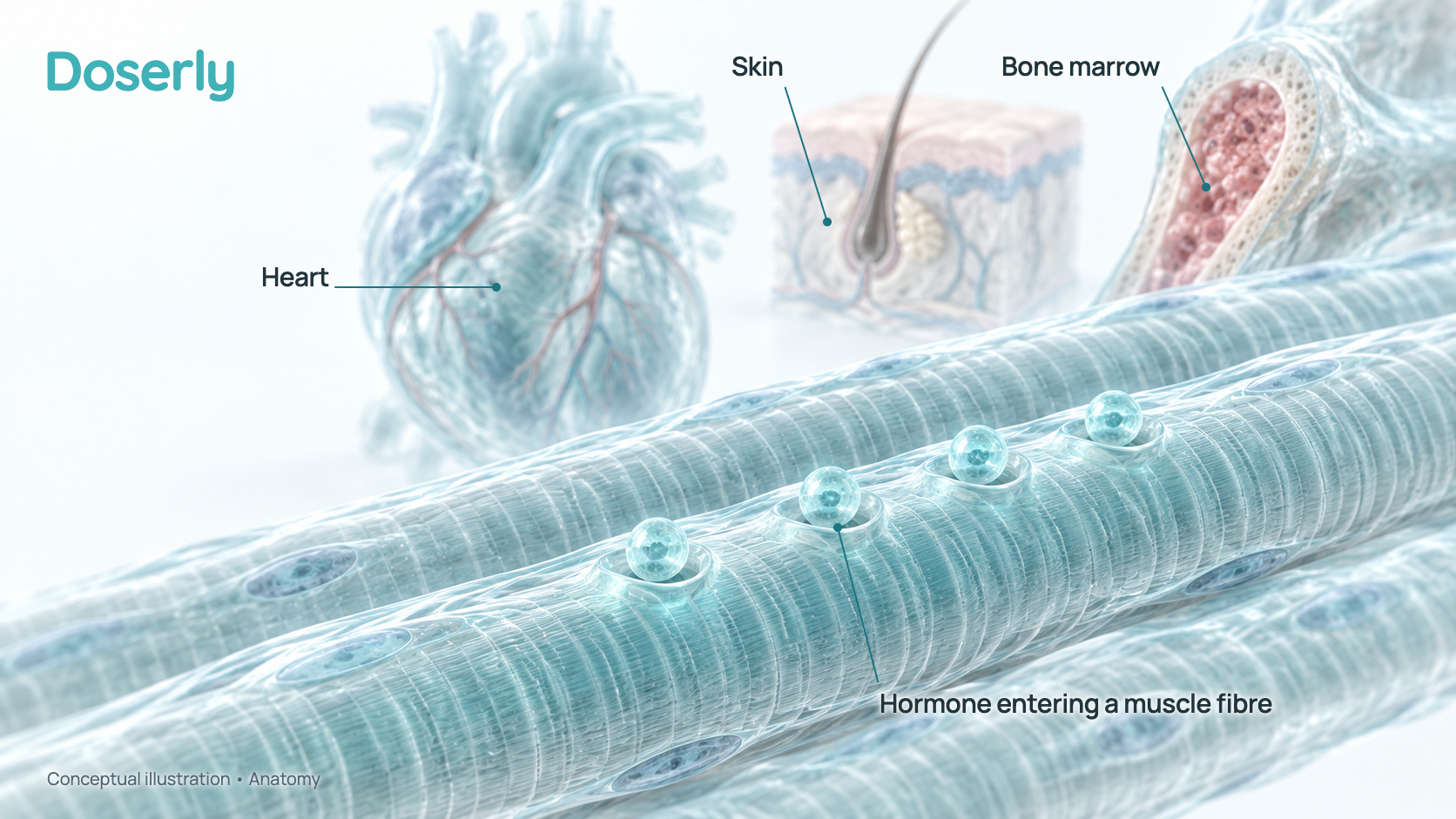
TRT vs steroids: the key numbers
This table shows the replacement doses and target levels in the US label and the main guidelines, checked in September 2026. The testosterone level each one aims for is the clearest line between replacement and excess.
| Source (version, year) | Type | Replacement dose it describes | Target level | How measured | Action at this level |
|---|---|---|---|---|---|
| US testosterone cypionate label (Depo-Testosterone, label revised September 2025) | Label | 50–400 mg into a muscle every 2–4 weeks | No number given | Two low morning tests on separate days before starting | If misuse is suspected, check that testosterone is within the therapeutic range |
| Endocrine Society (2018) | Guideline | 75–100 mg a week, or 150–200 mg every 2 weeks (enanthate or cypionate) | Mid-normal, 350–600 ng/dL (about 12.1–20.8 nmol/L) | Blood test midway between injections | Change the dose or interval if above 600 or below 350 ng/dL |
| AUA, American Urological Association (2018, validity reconfirmed 2024) | Guideline | 100 mg weekly, preferred as an example start | 450–600 ng/dL (about 15.6–20.8 nmol/L) | Total testosterone | Adjust the dose to reach the middle third of the normal range |
| CUA, Canadian Urological Association (2021) | Guideline | Cypionate 200 mg every 2 weeks or 100 mg weekly | Mid-normal, 14–17 nmol/L (about 404–490 ng/dL) | Midway between injections | A higher dose can be considered if symptoms persist below mid-normal |
| BSSM, British Society for Sexual Medicine (2023) | Guideline | Enanthate every 2–3 weeks; no milligram amount given | Mid to upper range, 15–30 nmol/L (about 430–865 ng/dL) | Trough level for injections; 2–4 hours after gel | Aim for this range for the best response |
| EAU, European Association of Urology (2026) | Guideline | Cypionate 200 mg or enanthate 250 mg every 2–3 weeks | The young-men range used in the US Testosterone Trials, 9.6–30 nmol/L (280–873 ng/dL) | Timing depends on the form | A similar range "could be considered" during follow-up |
| ICSM, International Consultation on Sexual Medicine (2024) | Guideline | — | Mid-normal, no number given | Midway between injections for short-acting injections | Aim for the mid-normal range (strong recommendation) |
[21], [4], [5], [25], [26], [27], [28]
A dash means the guideline gives no number for that column in the sections reviewed.
US and Canadian guidelines aim for the middle of the normal range, about 350–600 ng/dL (12.1–20.8 nmol/L). The BSSM aims higher, at 15–30 nmol/L (about 430–865 ng/dL), and the EAU points to the whole young-men range. They differ in how high they aim within the normal range, and the AUA, CUA and BSSM all grade the evidence for their targets as weak or conditional. For weekly injections, the guideline examples come to about 75–100 mg a week. In a 1991 trial, 100 mg of enanthate a week simply kept young men's testosterone at their own pretreatment level. The dose is adjusted by the blood level, not by how much muscle it builds. [4], [5], [25], [26], [27], [29]
What do studies report about non-medical doses?
This table describes what researchers measured or were told by people using steroids without a prescription. Each weekly amount is shown as a multiple of 100 mg a week, a typical replacement dose. These are findings, not doses to take.
| Source | What it reports | How it was measured |
|---|---|---|
| Endocrine Society scientific statement (2014) | Users typically take at least 5 times a typical replacement dose, and often well over 10 times | Review of field studies |
| HAARLEM study (100 Dutch men starting a cycle, 2015–2018) | An average of about 9 times, ranging from about 2.5 to 34 times, counted in testosterone equivalents | Self-report, using the strength printed on the product |
| Survey of 500 users (2006) | 59.6% used at least 10 times | Online self-report |
| Survey of 2,385 men (2020) | The most common weekly amount, used by 47%, was 5 to 10 times (the authors' "five to 10 times" a replacement dose); 46% used less than 5 times | Online self-report |
| NIDA, US National Institute on Drug Abuse | Misuse doses "can be 10 to 100 times higher" than medical doses | Agency research report |
Where sources disagree: the survey authors say five to 10 times a replacement dose; NIDA says 10 to 100 times. The measured averages fit the lower multiple better, but no single number applies to everyone. [6], [2], [22]
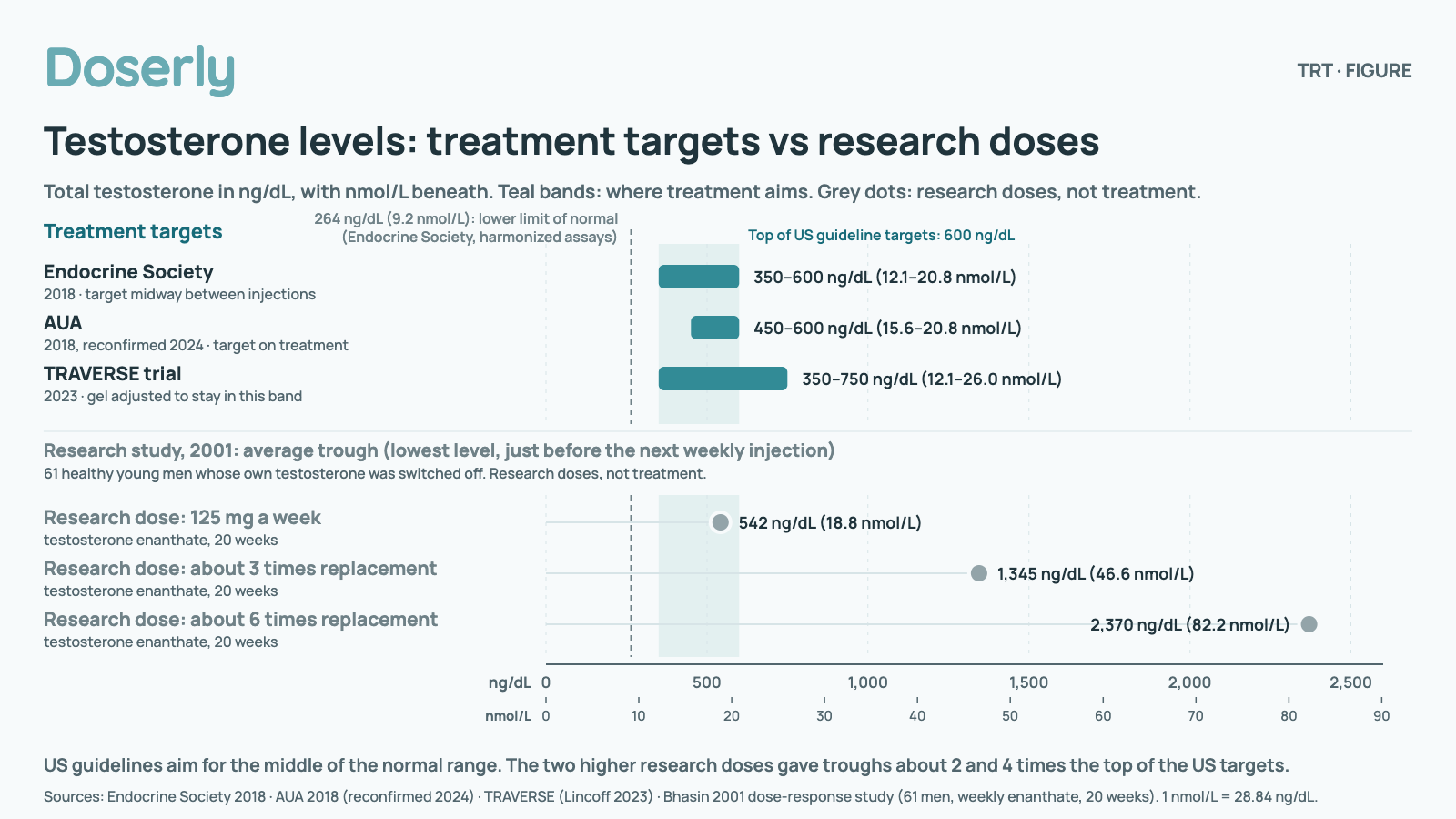
Testosterone levels: treatment targets vs research doses
Total testosterone in ng/dL and nmol/L.
Each bar runs from 0 (left) to 2,600 ng/dL (right); the shaded part is 350–600 ng/dL, where US guidelines aim on treatment.
Treatment targets
- Endocrine Society (2018)
- 350–600 ng/dL (12.1–20.8 nmol/L); target midway between injections
- AUA (2018, reconfirmed 2024)
- 450–600 ng/dL (15.6–20.8 nmol/L); target on treatment
- TRAVERSE trial (2023)
- 350–750 ng/dL (12.1–26.0 nmol/L); gel adjusted to stay in this band
- Lower limit of normal (Endocrine Society)
- 264 ng/dL (9.2 nmol/L), harmonized assays
Research study, 2001 (not treatment)
Average trough levels in 61 healthy young men whose own testosterone was switched off, after 20 weeks of weekly enanthate.
- Research dose: 125 mg a week
- 542 ng/dL (18.8 nmol/L)
- Research dose: about 3 times replacement
- 1,345 ng/dL (46.6 nmol/L)
- Research dose: about 6 times replacement
- 2,370 ng/dL (82.2 nmol/L)
US guidelines aim for the middle of the normal range. The two higher research doses gave troughs about 2 and 4 times the top of the US targets.
Is there an official cut-off for "supraphysiologic"?
No. Supraphysiologic means above the body's natural range, and we found no guideline or regulator that turns it into a milligram number. Three reference points help:
- The label's top dose. The US cypionate label's highest amount, 400 mg every 2 weeks, averages 200 mg a week. [21]
- The clinicians' view. The HAARLEM investigators, who run a Dutch clinic for steroid users, say a normal injectable replacement dose "should not exceed 100 mg per week". [7]
- A research definition. A 2025 paper proposed diagnosing lasting low testosterone after steroid use only in people who had taken at least 150 mg a week for at least six months. It is a proposal for research, not a guideline. [30]
The clearest evidence comes from blood levels. In a 2001 research study of 61 healthy young men whose own testosterone was switched off, three of the weekly enanthate doses tested were 125 mg, about 3 times and about 6 times a typical replacement dose. They gave average trough levels of 542, 1,345 and 2,370 ng/dL (about 18.8, 46.6 and 82.2 nmol/L). The 125 mg level sat inside guideline targets. The two higher doses gave troughs about 2 and 4 times the top of the US targets (600 ng/dL), well above the top of the BSSM range (about 865 ng/dL). Muscle mass rose with the dose, and so did hemoglobin, while HDL ("good") cholesterol fell. These were research doses, not treatment. [31]
How do the units work?
Testosterone levels appear in ng/dL (mostly in the US) or nmol/L (most other countries). Divide ng/dL by 28.84 to get nmol/L: 600 ng/dL is about 20.8 nmol/L. The testosterone unit converter switches between the two. Doses in this guide are weekly totals; an amount "every 2 weeks" is halved to give the weekly average.
Where these numbers come from
The label row comes from the current US Depo-Testosterone label (printed revision September 2025; DailyMed version effective August 21, 2026). The guideline rows each come from one document: the Endocrine Society guideline (2018, Table 5 and its monitoring section), the AUA testosterone deficiency guideline (published 2018, validity reconfirmed 2024, unabridged text), the CUA guideline (2021, its injectable table and question 18), the BSSM guideline (2023, its formulation and follow-up tables), the EAU guideline (2026 edition, its injectable table and section 3.5.8) and the ICSM recommendations (2024). The Endocrine Society prints nmol/L equivalents for its 350 and 600 ng/dL lines that do not match the standard conversion, so this guide gives the converted values (12.1 and 20.8 nmol/L); other conversions use 1 nmol/L = 28.84 ng/dL, except the EAU's own 280–873 ng/dL. The 100 mg comparison comes from a 1991 randomized trial in young men with normal testosterone, and the HAARLEM statement below from the investigators' 2020 review. [21], [4], [5], [25], [26], [27], [28], [29], [7]
The non-medical rows are descriptions from a scientific statement, a prospective cohort, two online surveys and an agency report. They are shown only so readers can see how far real-world use sits from replacement, and each weekly amount is given as a multiple of 100 mg (the AUA's example starting dose) rather than in milligrams. They are not doses, schedules or recommendations, and the cohort figure used the strength printed on products that often did not match their contents. [3], [22], [23], [6], [2]
Not used: a circulating claim that steroid transformations take "5–20 times" a TRT dose (no source found), and an "80–200 mg a week" TRT range with no traceable source.
What do "cycle", "stack", "blast and cruise", "TRT+" and "PCT" mean?
These are community and research terms, not medical ones. This section explains what they mean; it does not describe how to do any of them.
- Cycle. Cycling means "taking multiple doses of steroids over a specific period of time, stopping for a period, and starting again", in NIDA's words. [2]
- Stack. Stacking means taking "two or more different anabolic steroids", often mixing tablets and injections and sometimes veterinary products. The Endocrine Society also describes pyramiding: raising and then lowering amounts within a cycle. [2], [3]
- Blast and cruise. Blast and cruise means "cycles with multiple high dose AAS are alternated with a lower maintenance dose", "never completely ceasing drug use". In a survey of 2,385 men using steroids, 47.3% described this pattern, and clinicians who treat steroid users list continuous use among the signs of higher-risk use. [7], [8], [6]
- UGL. An underground lab is an unlicensed maker of unapproved products.
- TRT+. We found no medical, research or regulatory definition. Online it is used for replacement-range testosterone plus another steroid, or for testosterone above the replacement range. US labels describe taking "higher doses of legally obtained testosterone than prescribed" as misuse. [21]
- PCT. Post-cycle therapy means medicines taken after a cycle to try to restart the body's own testosterone, most commonly selective estrogen receptor modulators (SERMs), human chorionic gonadotropin (hCG, a hormone that copies the brain's signal to the testes) and aromatase inhibitors. [32]
Is a "cruise" the same as TRT?
No. A cruise is the lower-dose phase of continuous non-prescribed use. It is not TRT, because it did not start with a diagnosis of low testosterone, and any low testosterone the person now has was usually caused by the steroids themselves. [7], [8]
Does PCT work?
The evidence is thin. A 2026 review concluded that "from an academic standpoint, PCT is generally not recommended because of uncertain benefits and potential risks." [32] In the US, FDA has not approved clomiphene, hCG or testosterone to treat steroid withdrawal, and no treatment for it has been tested in clinical trials. [33]
- In a UK clinic of 641 men, those who used PCT had normal hormones sooner (a median of 13 vs 26 weeks), but PCT made no difference for men who had stopped more than 3 months earlier. [34]
- In a 2026 records study of 79 men who had used steroids for 6 months or less, hormones were normal in every group by month 6. Normal sperm results at 12 months were more common with clomiphene plus hCG (87.5%) than with no treatment (58.6%), but the men chose their own treatment, so this is not a fair comparison. [35]
The medicines themselves are covered in their own guides: clomiphene, enclomiphene, tamoxifen, anastrozole and hCG. None of those guides gives a PCT schedule, and neither does this one.
Why do steroids and TRT switch off your own testosterone?
Because the brain measures testosterone in the blood and turns down its own signal when there is enough. This happens with any outside testosterone, prescribed or not, and longer use slows recovery. [21], [9], [36]
The pituitary gland releases LH (luteinizing hormone), which tells the Leydig cells in the testes to make testosterone, and FSH (follicle-stimulating hormone), which supports sperm production. When outside testosterone raises blood levels, the brain cuts both, so the testes make less testosterone and fewer sperm, and can shrink. During one steroid cycle in the HAARLEM study, 77% of men had a total sperm count below 40 million. [9]
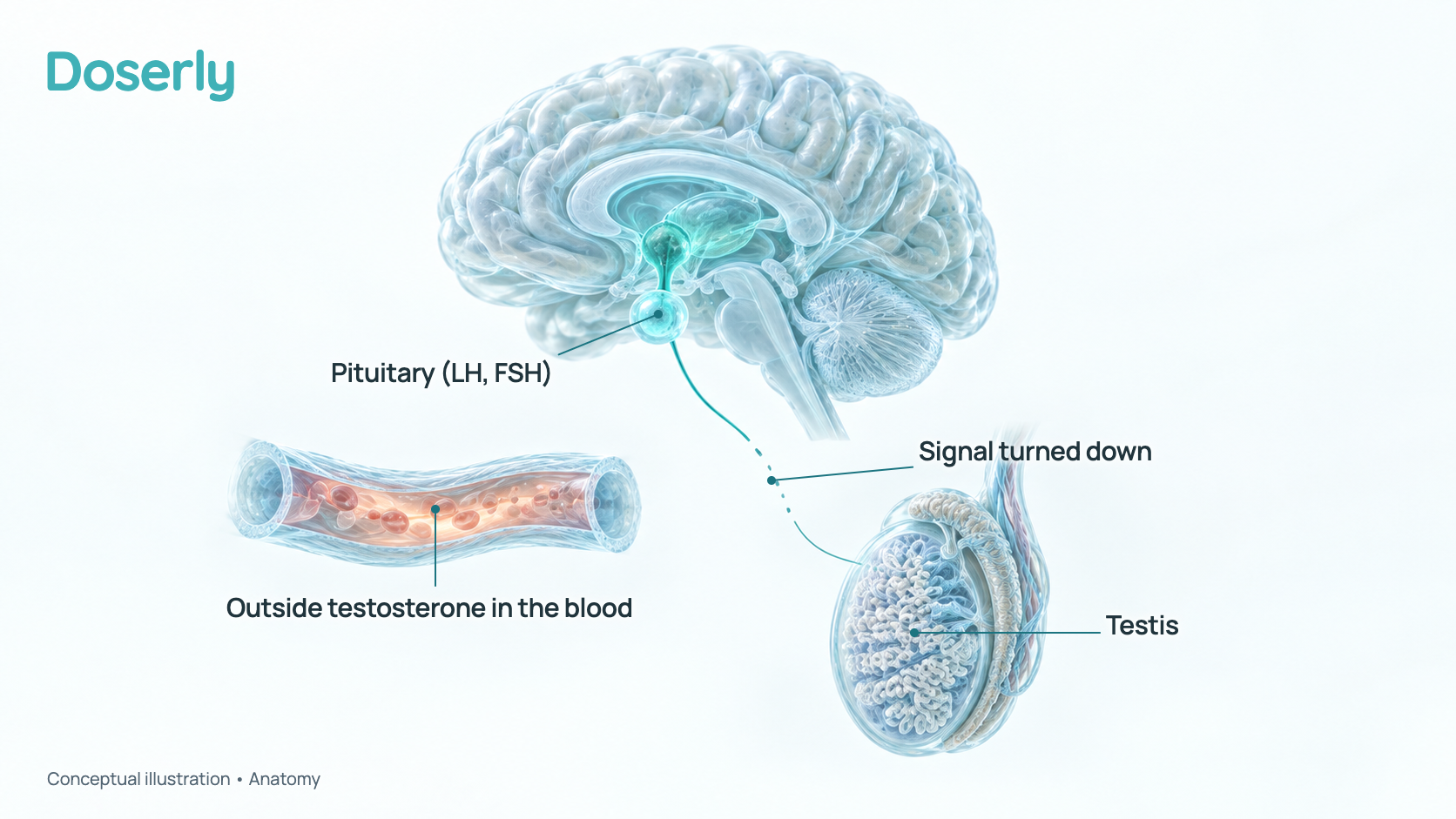
TRT does the same, which is why the AUA says men should be told about its effect on sperm. [5] The difference comes at stopping: a man on TRT had low testosterone before he started, while a man coming off steroids usually had normal levels, and his own production has to restart from a switched-off state. US labels say people taking supratherapeutic doses "may experience withdrawal symptoms lasting for weeks or months", including depressed mood, fatigue, low libido and hypogonadotropic hypogonadism (low testosterone because the brain's signal is off). [21] The stopping TRT guide and the TRT and fertility guide cover the prescribed side.
Recovery can also be incomplete at the testes themselves. About 2 years after stopping, former users had lower Leydig cell capacity when their testes were stimulated in tests, and lower levels of INSL3, a hormone made by Leydig cells, about 32 months after stopping. [37], [38]
Why do non-medical steroids cause more harm than replacement?
Four things add up:
- Dose. Harms rise with the amount. In the 2001 dose-response study, hemoglobin rose and HDL cholesterol fell as the dose went up, and the Endocrine Society describes dose-related rises in hemoglobin and hematocrit, with polycythemia (too many red blood cells) "a frequent adverse event". [31], [3]
- Other steroids. Stacks often include oral steroids with a chemical change (17-alpha-alkylation) that makes them work as tablets. "Virtually all" steroid-related liver damage is linked to these tablets. [3]
- Unknown products. Many products do not contain what the label says (see underground testosterone). [39]
- No monitoring. In a survey of 2,385 users, 56.1% had not told their doctor about their steroid use. [6]
What does the research show?
Most of what is known about steroid harms comes from people using steroids outside medicine: volunteers followed through a cycle, national registries, surveys and case reports. The few randomized trials gave testosterone alone to healthy men for weeks. Real-world studies show links more often than proof of cause, and their results do not apply to prescribed TRT. [40], [31], [11]
Does a steroid cycle cause lasting low testosterone?
Usually not permanently, but recovery is slower and less complete than many expect, and a minority are still low years later.
| Study | Who | What happened to testosterone | What it cannot show |
|---|---|---|---|
| HAARLEM (cohort study, 2021) | 100 Dutch amateur athletes followed through one cycle | Back to baseline 3 months after the cycle in most men. A year after the cycle began, 9 men (11% of those tested) still had low testosterone and 25 (34%) a total sperm count below 40 million | Healthy volunteers and one cycle; long-term users may differ [9] |
| Australian study (2020, recruited through social media) | 41 current users, 31 past users a median of 300 days after stopping, 21 non-users | Past users did not differ from non-users, apart from smaller testes, which the authors read as full recovery. Average recovery took 10.7 months for LH and 14.1 months for sperm output; longer use slowed sperm recovery | Compares groups rather than following each man [36] |
| UK clinic records (2023) | 641 men within 36 months of stopping | 48.2% had normal LH, FSH and testosterone | One random blood test per man [34] |
| Danish case-control study (2016) | 33 former users about 2.5 years after stopping, 30 non-users | 27% had testosterone below 12.1 nmol/L (about 350 ng/dL), against none of the non-users | Small groups [10] |
| US study of former users (2015) | 24 former long-term users, 36 weightlifters who had never used | 5 of the 19 former users not on treatment had testosterone below 200 ng/dL 3–26 months after stopping; 7 of all 24 (29%) had major depression during withdrawal | Small groups [41] |
| Review of published cases (2021) | 179 steroid users described in published reports | Only 4 of the 38 cases with a known outcome fully recovered | Published cases favor severe ones; not a recovery rate [42] |
This fits an expert review's summary that men who used steroids for less than a year "typically recover" within a year of stopping. [33] Former users about 2 years off also had lower testosterone (median 14 vs 19 nmol/L) and lower quality of life than non-users. [43] The stopping TRT guide covers recovery after prescribed testosterone.
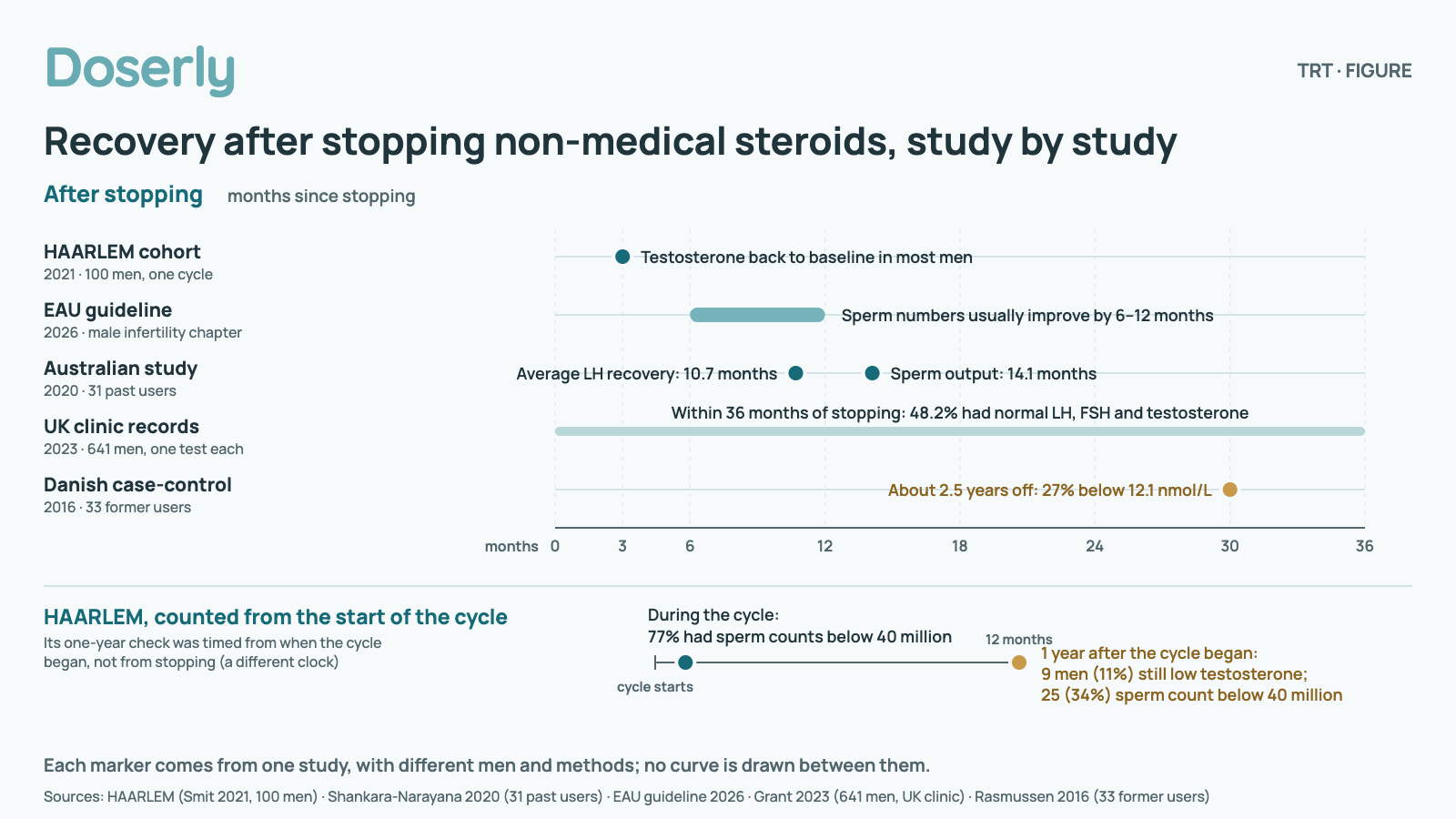
Recovery after stopping non-medical steroids, study by study
After stopping
- About 3 months
HAARLEM (2021, 100 men, one cycle): testosterone back to baseline in most men.
- 6–12 months
EAU guideline (2026): sperm numbers usually improve over this time.
- 10.7 months
Australian study (2020, 31 past users): average time for LH to recover.
- 14.1 months
Same Australian study: average time for sperm output to recover.
- Within 36 months
UK clinic records (2023, 641 men, one test each): 48.2% had normal LH, FSH and testosterone.
- About 2.5 years
Danish case-control study (2016, 33 former users): 27% had testosterone below 12.1 nmol/L (about 350 ng/dL).
HAARLEM, counted from the start of the cycle
- During the cycle
HAARLEM: 77% had a total sperm count below 40 million.
- 1 year after the cycle began
HAARLEM: 9 men (11% of those tested) still had low testosterone and 25 (34%) a sperm count below 40 million.
Each marker comes from one study, with different men and methods; no curve is drawn between them.
Do steroids damage the heart?
The evidence points strongly that way, though most of it is observational.
- Deaths. In Denmark, 1,189 men caught using steroids in gym testing were compared with 59,450 similar men for about 11 years. 33 of the users died (2.8%) against 578 of the others (1.0%), a hazard ratio of 2.81. Deaths from unnatural causes (hazard ratio 3.64) and natural causes (2.24) were both higher. The study was not adjusted for other health factors and cannot prove cause. [11]
- Heart disease. In the same Danish group, users had about three times the rate of heart attack (adjusted hazard ratio 3.00) and nearly nine times the rate of heart-muscle disease (cardiomyopathy, 8.90). They also had more heart failure (3.63), clots in veins (2.42) and rhythm problems (2.26). The abstract gives these as relative figures only, without absolute numbers, and because it is the same cohort, this is not a second confirmation. [44] In Sweden, the 409 men who tested positive for steroids, out of 2,013 men tested, had twice the rate of heart disease and death of those who tested negative (adjusted hazard ratio 2.0). [45]
- Heart structure. In 140 experienced weightlifters, the heart's pumping strength (ejection fraction) averaged 52% in steroid users against 63% in non-users, and users had more plaque in their heart arteries. [12] A 2026 review of 35 studies found pumping strength 2.25 points lower in users, and another found the largest drop, 7.39 points, in athletes who had used steroids for more than six years. [46], [47] In a Danish imaging study of men and women (61 of the 80 current users were men), soft (non-calcified) plaque in the heart (coronary) arteries showed up in 19 of 80 current users (23.8%) against 6 of 58 non-users (10.3%). [48]
- Does it recover? During a single cycle in HAARLEM, pumping strength fell 4.9% and was back to baseline a median of 8 months after stopping. [49] The HAARLEM researchers describe the effects they measured as "generally reversible", with acute life-threatening toxicity rare, in healthy men doing one cycle. [50] But in another study, mildly reduced blood flow in the heart's small vessels was about as common in former users (8 of 31) as in current users (9 of 32), against 1 of 27 non-users. Clearly impaired flow was seen in 6 of 32 current and 1 of 31 former users. [51]
Most of these studies compare users with non-users at one point in time, and users often differ in other ways, such as other drugs and risk-taking. [11]
Does TRT carry the same heart risk?
The largest trial of prescribed testosterone did not find more heart attacks or strokes. TRAVERSE randomly assigned 5,204 men aged 45 to 80 with low testosterone and existing heart disease or high heart risk to daily testosterone gel or placebo gel. Heart attack, stroke or cardiovascular death (MACE) occurred in 7.0% of men on testosterone and 7.3% on placebo (hazard ratio 0.96), which met the trial's safety goal. [13]
Some problems were more common on testosterone: atrial fibrillation 3.5% vs 2.4%, acute kidney injury 2.3% vs 1.5%, and pulmonary embolism 0.9% vs 0.5%. [14] Its limits matter too: it tested only a daily gel, men used it for an average of 21.7 months, about 61% stopped their study gel early, and it enrolled men already at high heart risk. [13], [14]
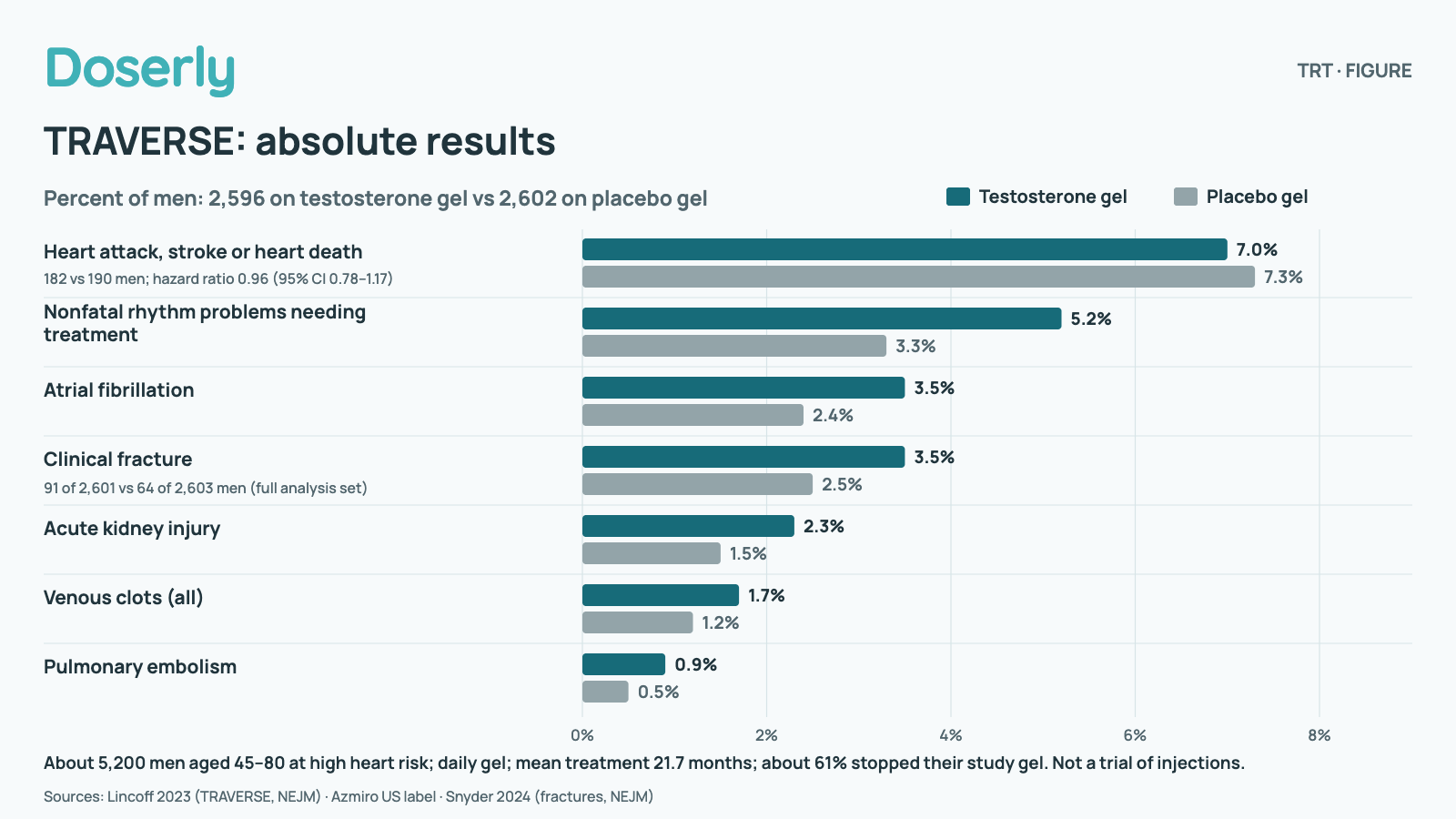
TRAVERSE: absolute results
Testosterone gel (2,596 men)Placebo gel (2,602 men)
- Heart attack, stroke or heart death
- Testosterone 7.0% vs placebo 7.3% (182 vs 190 men; hazard ratio 0.96, 95% CI 0.78–1.17; met the 1.5 safety margin)
- Nonfatal rhythm problems needing treatment
- Testosterone 5.2% vs placebo 3.3%
- Atrial fibrillation
- Testosterone 3.5% vs placebo 2.4%
- Clinical fracture
- Testosterone 3.5% vs placebo 2.5% (91 of 2,601 vs 64 of 2,603 in the full analysis set)
- Acute kidney injury
- Testosterone 2.3% vs placebo 1.5%
- Venous clots (all)
- Testosterone 1.7% vs placebo 1.2%
- Pulmonary embolism
- Testosterone 0.9% vs placebo 0.5%
About 5,200 men aged 45–80 at high heart risk; daily gel; mean treatment 21.7 months; about 61% stopped their study gel. Not a trial of injections.
The two cannot be compared directly: TRAVERSE tested replacement doses in older men under medical care, while the steroid studies describe younger men using far higher doses of several drugs. Neither result transfers to the other group. In February 2025 FDA told the makers of all testosterone products to add the TRAVERSE results to their labels and remove boxed-warning language about increased heart risk. Newer brand labels carry the results, but the Depo-Testosterone vial label (August 2026 version) still says long-term heart-safety trials "have not been conducted". Checked September 2026. [52], [21] The TRT and heart health guide covers the trial in full.
What happens to blood pressure, cholesterol and red blood cells?
They all move in the wrong direction during a cycle, and mostly move back afterwards. In HAARLEM, systolic blood pressure rose by an average of 6.9 mm Hg during a cycle, and hematocrit rose by 0.03 L/L (3 percentage points). HDL cholesterol fell by 0.40 mmol/L (about 15 mg/dL), and LDL ("bad") cholesterol rose by 0.45 mmol/L (about 17 mg/dL). Three months after the cycle, all were back to baseline. [53] The same study found no clear shift toward faster blood clotting. [54]
An expert review lists very low HDL cholesterol, very low SHBG (a protein that carries testosterone in the blood) and an unexplained high red-cell count as clues that someone is using steroids. [33] Prescribed testosterone affects some of these markers too: FDA says blood-pressure studies confirmed "an increase in blood pressure with use of all testosterone products", and hematocrit is one of the main safety checks on TRT. [52], [21] See the hematocrit on TRT guide.
Do steroids cause "roid rage", and are they addictive?
"Roid rage" is not a medical term, and the trials disagree. In a crossover trial, 50 men received 6 weeks of testosterone rising to about six times a typical replacement dose. Of these, 84% had minimal psychiatric change, 12% became mildly hypomanic (unusually elevated, energetic or irritable mood) and 4% markedly so. [55] In another trial, 43 men were randomly assigned to the same dose or to placebo injections for 10 weeks, and "neither mood nor behavior was altered". [40] Both used testosterone alone in screened volunteers, which is not how most people use steroids. US labels list hostility, aggression, mania and major depression among the serious reactions reported with steroid abuse. [21]
Dependence is common. About 30% of users may develop it, according to the Endocrine Society; pooled studies put it at 32.5%, and a 2023 meta-analysis of 18 studies at 34.4%. [3], [56], [57] In HAARLEM, 48% of men described themselves as addicted, and 65% used again in the second year. [22], [58] In a large survey, 60% of attempts to stop failed. [6] Withdrawal is common too: in a UK survey, 95.1% of men who had stopped reported at least one symptom, most often low mood (72.9%), tiredness (58.5%) and low libido (57.0%). [59] Steroid users also report more symptoms of muscle dysmorphia, a preoccupation with not being muscular enough. [60]
For prescribed TRT, US labels state that "drug dependence in individuals using approved doses of testosterone for approved indications has not been documented." [21]
What about the liver, kidneys, tendons and skin?
- Liver. Serious liver damage is linked almost entirely to oral 17-alpha-alkylated steroids. The US label for oxandrolone warned of peliosis hepatis (blood-filled cysts in the liver), liver tumors and cholesterol changes. [3], [61] Testosterone labels also note rare reports of liver cancer with long-term, high-dose androgen use. [21]
- Kidneys. A case series described 10 bodybuilders with long-term steroid use and kidney damage. Biopsies showed scarring of the kidney filters (focal segmental glomerulosclerosis) in 9, and one of 8 men followed for about 2 years progressed to end-stage kidney disease. A case series cannot show how often this happens. [62]
- Tendons. Among 142 bodybuilders, 22% of steroid users had torn a tendon at some point, against 6% of non-users. [63]
- Skin, breasts and libido. Over one year in HAARLEM, every man reported at least one unwanted effect, including acne (28%), breast growth (gynecomastia, 19%) and low libido after the cycle (58%). Four of the 100 had a serious event: heart failure, pancreatitis, suicidal thoughts or a flare of bowel disease. [64]
- Injuries. Danish users had more than twice the rate of fractures in the following year (adjusted hazard ratio 2.23), and any injury was 7.8 percentage points more common than in similar men. [65]
- Not everything rises. The Danish users did not develop diabetes more often (2.0% vs 2.3%), and a small study found only subtle changes in breathing during sleep. [66], [67]
Do the muscle gains last?
Mostly not. In a 2026 study of 79 men followed through a self-chosen cycle, fat-free mass rose by an average of 4.4 kg during the cycle, but only 1.2 kg remained three months after stopping. The authors concluded that "most gains are lost within months." [68] For what prescribed testosterone does to muscle, see the TRT muscle and fat guide.
How common is non-medical steroid use?
A 2014 meta-analysis estimated that 3.3% of people worldwide (6.4% of men) have used steroids at some point, although the surveys varied hugely. [69] A 2014 estimate put the number of Americans aged 13 to 50 who had used them at 2.9 to 4.0 million, of whom about 1 million may have become dependent. [56] In 2022, 1.3% of US 12th graders reported misusing steroids in the past year. [2]
Is TRT safer than steroids?
At replacement doses, with a confirmed diagnosis and monitoring, TRT has a known and much smaller set of risks than non-medical steroid use. This section covers prescribed testosterone; the steroid risks are in the research section.
Is TRT safe?
Its risks are well described and monitored for, but it is not risk-free. The main safety checks are blood pressure and red blood cells, and guidelines add the effect on sperm production described above. TRAVERSE, which tested a daily gel for an average of 21.7 months, found no increase in heart attacks or strokes (7.0% vs 7.3%). It did find more atrial fibrillation (3.5% vs 2.4%), acute kidney injury (2.3% vs 1.5%) and pulmonary embolism (0.9% vs 0.5%) (details above). [52], [21], [5], [13], [14] Since 2016 all US testosterone labels have also carried a warning about abuse and dependence. They tell prescribers to counsel patients on the serious reactions linked to abuse, and to consider abuse in patients who have a serious heart or psychiatric event. [70], [21] The TRT side effects guide covers the full list.
Who should be especially cautious?
- Men who have recently used steroids. Blood tests taken during or soon after use do not show your natural level, and an expert review suggests considering TRT only if symptoms and low testosterone persist after at least 12 months off. [21], [71]
- Men who want children now or soon. Both TRT and steroids lower sperm production. The AUA says testosterone should not be prescribed to men trying to conceive, and the EAU says not to use it to treat male infertility. [5], [27] See TRT and fertility.
- Men with a high hematocrit, untreated severe sleep apnea or high blood pressure. The Endocrine Society lists the first two as reasons for caution or not to start, and all testosterone products raise blood pressure. [4], [52]
- Men with a history of depression, because mood often drops during steroid withdrawal. [41]
- Drug-tested athletes. Testosterone is prohibited at all times. [19]
- Under-18s. Testosterone for teenagers belongs only in specialist care. US labels report that steroid abuse in adolescents has caused early closure of the bones' growth plates, ending growth. [21]
- Women. This guide is written for men. For testosterone treatment in women, see testosterone therapy for women.
Which medicines interact with testosterone and other steroids?
- Blood thinners. US labels say androgens may increase sensitivity to oral anticoagulants such as warfarin, so the anticoagulant dose may need lowering. [21]
- Diabetes medicines. Androgens may lower blood sugar and insulin needs in people with diabetes. [21]
- Other steroids. Adding oral steroids adds their effects on HDL cholesterol and the liver, and extra steroids add to the rise in red blood cells. [3], [53]
Bring a complete list of what you take, including anything not prescribed, to a pharmacist or prescriber. Checked September 2026.
Is it legal to use steroids or testosterone?
Checked September 2026. Laws differ by country and change.
- United States. Testosterone and its esters are Schedule III controlled substances. Possessing a controlled substance without a valid prescription is a federal crime; a first offense can mean up to 1 year in prison, a minimum $1,000 fine, or both. A 2014 law (the Designer Anabolic Steroid Control Act) widened the legal definition of anabolic steroids. No proposal to deschedule testosterone has been published. [15], [72], [73]
- United Kingdom. Testosterone and its esters are Class C drugs. Possessing anabolic steroids for personal use is not an offense, and bringing them into the country is allowed only when you carry them in person for your own use, so steroids posted from abroad are not covered. Supplying them can mean up to 14 years in prison. [16], [74], [75]
- Canada. Testosterone is a Schedule IV controlled substance. Simple possession is not an offense, but importing, exporting or trafficking it without authorization is. [17]
- Australia. Testosterone is a Schedule 4 prescription-only medicine, and possessing anabolic steroids without authority is illegal. Importing them needs written permission, except your own prescribed medicine carried with you when you travel, an exception that athletes cannot use. [18], [76]
- Europe. Rules vary. Germany bans possessing more than a small amount of testosterone for doping in sport; Sweden bans importing, possessing or using it except for medical or scientific purposes; and Denmark allows possession only with a prescription. [77], [78], [79]
A prescription makes testosterone legal to possess for the person it was prescribed to; it does not make extra, non-prescribed testosterone legal. [72]
Is testosterone allowed in sport?
No. The World Anti-Doping Agency (WADA) prohibits testosterone at all times, and its 2027 list, published in September 2026, keeps the ban. [19], [80] An athlete with low testosterone can apply for a therapeutic use exemption, but WADA grants it only for low testosterone from a structural or genetic cause. It does not grant one for low testosterone caused by age, obesity or past use of anabolic steroids or selective androgen receptor modulators (SARMs). [20] Aromatase inhibitors and SERMs, often used during or after cycles, are themselves prohibited in sport. [32], [19] Testing labs track each athlete's urine steroid profile over time as part of the Athlete Biological Passport. [81]
What do guidelines say about stopping steroids and starting TRT?
We found no 2020–2026 medical society guideline on prescribing TRT to current or former steroid users. What exists is a European fertility recommendation, expert reviews from clinicians who treat steroid users, the product labels and the anti-doping rules. This section describes what they say; it is not a personal plan.
What happens when you stop steroids?
Your own testosterone has to restart, which takes months. Withdrawal symptoms such as low mood, fatigue and low libido can last "for weeks or months", and they are a common reason men go back to steroids. [21], [82]
- For fertility, the EAU says low sperm counts caused by steroids "should initially be treated by withdrawal" and usually improve "over a six to twelve-month period". It suggests waiting six to 12 months after stopping before considering fertility medicines (a weak recommendation). [83]
- For symptoms, FDA has not approved clomiphene, hCG or testosterone to treat steroid withdrawal in the US, and no treatment has been tested in trials. [33]
- For mood, withdrawal often includes depression, and in one study 29% of former long-term users had major depression during withdrawal. Severe low mood or thoughts of self-harm need prompt medical help. [82], [41]
Repeated morning tests of testosterone, LH and FSH over the following months show whether your own production is coming back; a single result soon after stopping says little. [33], [34]
Can you get TRT after using steroids?
Sometimes, but not straight away. Guidelines diagnose low testosterone (hypogonadism) with symptoms and at least two low morning tests, which only mean something once your own system has had time to restart. [4], [21]
- An expert approach from Dutch clinicians who treat steroid users says TRT should be considered "only in cases where biochemical hypogonadism with symptoms persists after at least 12 months of abstinence". [71]
- Another expert review lists switching to prescribed testosterone as one option for men who cannot stop, while noting that no approach has been tested in trials. [33]
- Labels warn that testosterone levels "may be in the normal or subnormal range" in men using synthetic steroids other than testosterone, so a normal result does not rule out use. [21]
The low testosterone guide and the starting TRT guide cover how low testosterone is diagnosed and what the first steps are.
Does fertility come back after steroids?
For most men, yes, given time, but not for all. The EAU says sperm counts usually improve over 6 to 12 months after stopping. [83] A year after the cycle began, 25 HAARLEM participants (34% of those tested) still had a total sperm count below 40 million. [9] One clinic study followed men with past anabolic steroid or testosterone use who were treated with clomiphene and hCG. Of 18 men with no sperm at the start, 27.8% still had no sperm at 6 months, and 9 of 24 couples who reported back had a pregnancy. [84] Guidelines say testosterone is not a fertility treatment. [27] The TRT and fertility guide covers semen testing and the medicines used.
Should you tell your doctor about steroid use?
Yes, if you want your results read correctly: past or current use changes what testosterone, LH, FSH, hematocrit and cholesterol results mean. In a survey of 2,385 users, 56.1% had not told their doctor. [6] A review of steroid harms says "all men should be encouraged to stop", and in a Dutch study, 12% of men who had a harm-reduction consultation before a planned cycle decided not to start it. [85], [86]
What else do people ask about TRT and steroids?
Is 200 or 250 mg a week TRT or a cycle?
It depends on the level it produces and whether a diagnosis came first, but 250 mg a week is above every guideline's starting dose. The Endocrine Society starts at 75–100 mg a week, the AUA's example is 100 mg weekly, and the US label's highest dose averages 200 mg a week. [4], [5], [21] Guidelines judge a dose by the blood level it produces. In the 2001 research study, a weekly dose about 3 times a typical replacement dose gave average troughs of 1,345 ng/dL. That is more than twice the top of the US targets (600 ng/dL) and about 1.6 times the top of the BSSM range (about 865 ng/dL). [31], [26] A dose that keeps levels above the normal range is no longer replacement, whatever it is called. The TRT dosage guide covers prescribed doses in detail.
Is underground-lab testosterone the same as pharmacy testosterone?
No. Unlicensed products often do not contain what the label says:
- Counterfeit or substandard. A 2022 meta-analysis of 19 studies (5,413 samples, mostly seized by police or customs) found 36% of black-market steroids were counterfeit and, separately, 37% substandard. The counterfeit figure comes from 18 studies and the substandard figure from 8, so the two cannot simply be added. [39]
- Wrong or missing ingredient. In Denmark, 25–34% of seized products had no active ingredient or the wrong one, though only 7–10% had none or one from a different drug class. [87]
- Contamination. Bacteria grew from 2 of 22 used vials and 1 of 41 unused ampoules and vials sent in by users. [88] In December 2025, Health Canada warned that seized unauthorized testosterone products had "not been assessed for safety, efficacy, and quality" and may contain unlisted contaminants. [89]
- Injecting risks. In a UK survey of men who inject performance drugs, recruited at needle programs, 1.5% had HIV, 9% had signs of past or current hepatitis B and 5% had hepatitis C antibodies. In another UK survey, 42% had ever had redness, swelling or tenderness at an injection site and 6.8% an abscess or open wound. [90], [91]
Is Anavar (oxandrolone) approved?
Not any more in the US. FDA withdrew approval of Oxandrin (oxandrolone) on June 28, 2023, and later determined it had been withdrawn "for reasons of safety or effectiveness", so FDA will not approve generic versions. An FDA advisory committee had unanimously found "no evidence of efficacy" for it in 1984. [61], [92] Checked September 2026.
What about nandrolone (Deca)?
Nandrolone decanoate (Deca-Durabolin) is an injected steroid that was approved in the US; FDA determined in 2010 that it was not withdrawn from sale for safety or effectiveness reasons. [93] We could not confirm whether any nandrolone product is currently marketed in the US or UK (checked September 2026). Prescribed or not, it is an anabolic steroid, and adding it to testosterone is not replacement therapy.
Are SARMs steroids?
Not chemically, but they act on the same receptor. SARMs are "chemical substances that mimic the effects of testosterone and anabolic steroids" and are not approved by FDA. FDA considers products containing them unapproved drugs, not supplements, and links them to heart attack or stroke, liver injury, psychosis and infertility. [94] Anti-doping rules treat past SARM use like past steroid use. [20]
What do people in public communities report about TRT and steroids?
Public testosterone forums mix men on prescribed TRT with men using steroids for muscle, and the same words mean different things to each group. The threads below are recent public Reddit discussions, read with their replies. They show what people describe, not how often anything happens, and this guide does not repeat the doses of non-prescribed use that posters mention.
Where do people draw the line between TRT and a cycle?
The label itself is argued over constantly. One poster urged men already on TRT to push their levels above the natural range and call it "TRT+". Replies listed high blood pressure, high hematocrit, water retention and high estrogen at those levels, several men said they felt better at lower doses, and one wrote that it was not TRT+ but "good ole steroid use". [95] When another man described adding a second steroid to his testosterone as a "TRT+ strategy", the top reply called it a steroid cycle and TRT+ "a silly term". [96] A man whose clinic had prescribed nandrolone alongside his testosterone for joint pain called it TRT+; one reply said it was still a steroid, whoever wrote the prescription. [97]
Others argue about whether the dose or the blood level decides it; one poster said many people use "TRT" and "cruise" to mean the same thing. [98] A man whose testosterone was already in the normal range asked whether to start "TRT" or a cycle; replies said he would not be replacing anything, and he decided to wait for new blood tests. [99] Another later said that calling his planned cycle "TRT" had been a mistake. [100]
What do men on TRT report when they add more?
A recurring pattern is a man stable on a replacement dose who plans to add more. Two men on a prescribed 100 mg a week bought underground testosterone to raise their dose; one found it much thinner than his pharmacy supply and was not sure he could trust the seller's test results. [101], [102] Several asked how a planned cycle would look on the blood tests their prescriber ordered, and one said his specialist would stop prescribing if he saw it. [101], [103]
Accounts of adding more often end with a step back. One man said a higher testosterone dose had pushed his hematocrit and estradiol too high, and that an oral steroid gave him no major extra benefit but a worse cholesterol profile. [104] Another spent five months well above his prescribed dose and reported strength gains alongside collapsed libido, heavy bloating and poor focus; three weeks after cutting back, his libido had returned, and his conclusion was that "more is not better". [105] A man who added a product sold as a different steroid saw his testosterone, dihydrotestosterone (DHT) and estradiol results rise unexpectedly, with severe acne, and was left unsure what the vial had contained. [106]
What problems do people describe during a cycle?
Blood test changes are the most common worry. One man described his HDL cholesterol "crashing" on an oral steroid. [107] Another had very low HDL, raised liver enzymes and very high testosterone and estradiol results on a multi-steroid cycle, and one reply noted that another of his steroids can distort the estradiol test. [108] A third had heart palpitations on a combination of four drugs, which replies said made it impossible to tell which one was responsible. [109] A young man on his first cycle listed spreading acne, flushing and gut problems and decided the side effects outweighed the benefits. [110] Another developed cystic acne on his back and chest about two months after a cycle ended, bad enough to bleed through his clothes; it improved on an antibiotic his doctor prescribed. [111]
What do people report after stopping?
Recovery stories run in both directions. Some men felt normal again fairly quickly. One reported stronger libido than before two months after a short cycle, without blood tests. Another reported his testosterone back at his natural level less than two months after tapering off, and a third found his level higher 11 months after stopping than just after, with no pre-cycle result to compare. [112], [113], [114] After about six years of continuous use, one man had a very low but detectable sperm count two weeks after his last injection and his LH signal returning by four weeks, with repeat semen testing still to come. [115]
Others did not recover as they hoped. One man who had tested normal before cycling found, 20 months after stopping, his total testosterone about half and his LH about a third of his pre-cycle values, although a brief later use of testosterone complicated the picture. [116] A year after his first cycle, another man said his testosterone had climbed from a very low point but he still felt depressed, exhausted and without libido. He had stopped daily cannabis at the same time, which made the cause hard to judge. [117] Others described low libido five months after post-cycle tablets, or hormone results that were lower after a course of those tablets than before it. [118], [119] One recovery diary described two mostly normal weeks after the last injection, then a sharp fall in energy, mood and libido, and feeling mostly better by weeks 9 to 10. [120]
What do former users say about TRT later?
Some men who start prescribed TRT after years of steroid use describe a smaller response than they hoped for. A man who stopped steroids more than 20 years earlier said nearly a year of TRT, with levels in the upper part of the range, had improved his symptoms only slightly; replies split on whether his past use mattered. [121] A man in his mid-20s who had cycled from age 18 said his libido stayed almost absent on a prescribed 100 mg a week. [122] Another, who had started testosterone on his own before his endocrinologist finished testing, worried that the lower results afterward would complicate his diagnosis. [123] One man said a doctor had chastised him for mentioning that he had been prescribing testosterone for himself; he was seeing a sleep specialist before deciding whether to restart. [124]
Cost pulls some men toward unregulated supply: a man unhappy with his clinic's prices weighed an online clinic against underground testosterone, and replies split between price and a legal, prescribed supply. [125]
How can you judge a TRT or steroid story?
Ask: Was low testosterone confirmed with two morning tests before anything started? What exactly was taken, from what source and for how long? Did other drugs, weight-loss medicines, alcohol, cannabis, sleep or training change at the same time? Are there results from before, during and after, drawn at comparable times? How long after the last injection was recovery judged? And what did the next test show?
These selected discussions show what people experience and the questions research has not answered. They are not a survey of all men on TRT or all steroid users, a success rate or a substitute for the studies above.
What should you track?
What to track depends on where you are: on prescribed TRT, or recovering after steroids. Use this summary to prepare questions for your clinician; it is not a personal testing plan.
| What | Why it matters | What guidelines and studies say | Tracking category |
|---|---|---|---|
| Testosterone (morning) | Shows whether a TRT dose is in range, or whether your own production has restarted | On TRT: at 3–6 months, at 12 months, then yearly (Endocrine Society). After steroids: repeat over months; one early result says little | Blood work |
| LH and FSH | Low values with low testosterone mean the brain's signal is still off | Checked when diagnosing low testosterone and during recovery | Blood work |
| Hematocrit and hemoglobin | Testosterone and steroids raise red blood cells | Checked periodically on long-term androgens (US label); rose 3 points during a cycle in HAARLEM | Blood work |
| Blood pressure | All testosterone products raise it; steroids raise it more | Rose 6.9 mm Hg during a cycle in HAARLEM | Blood Pressure |
| HDL and LDL cholesterol | Oral steroids in particular lower HDL | Fell and rose during a cycle, back to baseline 3 months after (HAARLEM) | Blood work |
| Semen analysis | Blood testosterone does not show sperm production | Sperm usually improves 6–12 months after stopping steroids (EAU) | Hormonal & Reproductive |
| Mood, libido and energy | Withdrawal symptoms can last weeks or months | Low mood was the most common withdrawal symptom in a UK survey | Mood & Mental Health |
[4], [33], [21], [53], [52], [83], [59]
Because the time of day, the time since the last injection and recent steroid use all move the numbers, a series of morning results drawn under similar conditions says more than any one test. The TRT blood work guide explains when to draw each test.
Common questions about TRT and steroids
Is TRT a steroid?
Yes. Testosterone is an anabolic-androgenic steroid, and US law names it in its definition of anabolic steroids. The difference between TRT and steroid use is medical: TRT follows a confirmed diagnosis, uses a replacement dose aimed at the normal range, comes from a pharmacy and is monitored with blood tests. Non-medical use usually means far higher doses of several steroids with no diagnosis or monitoring. [1], [4], [3] See the difference.
Will one steroid cycle shut down my testosterone for good?
Usually not, but it can take months, and some men stay low. In a Dutch study of 100 men doing one cycle, testosterone was back to baseline 3 months after the cycle in most, but 9 of the men tested (11%) still had low testosterone a year after the cycle began. About 2.5 years after stopping, 27% of former users in a Danish study were still below 12.1 nmol/L. Longer use and more drugs make recovery slower. [9], [10], [34] See the recovery research.
Can former steroid users get TRT?
Sometimes, once the steroids have cleared and your own system has had time to restart. An expert approach from clinicians who treat steroid users suggests considering TRT only if symptoms and low testosterone persist after at least 12 months off. No medical society has a specific guideline on this, and anti-doping rules do not accept past steroid use as a reason for a testosterone exemption. [71], [20] See what guidelines say.
Is TRT addictive?
Not at prescribed doses, as far as is known. US labels state that dependence has not been documented in people using approved doses for approved uses. Non-medical steroid use is different: about a third of users develop dependence, and withdrawal symptoms are common. [21], [57], [59] See dependence.
Do steroids cause "roid rage"?
Sometimes, but not in most people in trials. At about six times a typical replacement dose of testosterone alone, one trial found that 84% of 50 men had minimal psychiatric change while 16% became hypomanic; another found no change in mood or behavior. Labels list hostility and aggression among the reactions reported with steroid abuse, often alongside other drugs. [55], [40], [21] See the research.
Glossary
Plain explanations of the medical, legal and research terms used in this guide. Underlined terms in the text link here.
- Anabolic-androgenic steroid (AAS)
- A drug that acts like testosterone, building muscle (anabolic) and producing male traits (androgenic). Testosterone itself is one; nandrolone and oxandrolone are others.
- Aromatase inhibitor
- A medicine, such as anastrozole, that blocks the enzyme that turns testosterone into estradiol.
- Blast and cruise
- Community slang for continuous non-prescribed steroid use: high-dose periods (blasts) alternated with lower-dose periods (cruises), never fully stopping. It is not a medical treatment.
- Cohort study (records study)
- A study that follows a group of people, or looks back at their records, without assigning treatments. It can show links but not prove that one thing caused another.
- Controlled substance
- A medicine whose prescribing and possession are restricted by law because it can be misused. Testosterone is Schedule III in the US, Schedule IV in Canada and Class C in the UK.
- Controlled trial
- A study that compares people who receive a treatment with a similar group who do not, often receiving a placebo instead. Randomly assigning people to each group makes the comparison fairer.
- Cycle
- In the steroid community, a period of non-prescribed steroid use followed by a break before any further use.
- Dependence
- A pattern in which a person keeps using a drug despite harm, finds it hard to stop, or has withdrawal symptoms when stopping. About a third of non-medical steroid users develop it.
- Ejection fraction
- The share of blood the heart's main pumping chamber pushes out with each beat. A lower value means weaker pumping.
- FSH (follicle-stimulating hormone)
- A pituitary hormone that acts on the cells supporting sperm production. Testosterone therapy lowers it.
- Gynecomastia
- Growth of breast tissue in men, often tender at first. It is linked to a higher estrogen-to-testosterone balance.
- Hazard ratio
- A measure comparing how often an event happens over time in two groups. A hazard ratio of 1 means no difference; 0.96 means about 4% lower in the first group.
- hCG (human chorionic gonadotropin)
- A hormone that acts like LH, telling the testicles to make testosterone and support sperm production. It is an approved medicine used in some fertility treatment.
- Hematocrit
- The share of the blood made up of red blood cells. Testosterone raises it, and most guidelines act when it reaches about 54%.
- Hypogonadism
- Low testosterone caused by a problem in the testicles or in the brain and pituitary signals that control them, confirmed with symptoms and repeated morning blood tests.
- Hypogonadotropic hypogonadism
- Low testosterone because the brain and pituitary send too little LH and FSH to the testicles. It can be present from birth or start later. Also called secondary hypogonadism.
- Leydig cells
- Cells in the spaces between the testicle's tubules that make testosterone when LH or hCG reaches them.
- LH (luteinizing hormone)
- A pituitary hormone that tells the testicles to make testosterone. Testosterone therapy switches it off.
- MACE (major adverse cardiovascular events)
- A combined measure used in heart-safety trials. In TRAVERSE it meant heart attack, stroke or death from heart disease.
- Meta-analysis and systematic review
- A systematic review gathers all studies on a question in a planned way. A meta-analysis combines their results statistically.
- Placebo
- A dummy treatment with no active ingredient, used as a comparison in studies.
- Polycythemia (erythrocytosis)
- Too many red blood cells, shown by a high hematocrit. Testosterone therapy is a common cause.
- Post-cycle therapy (PCT)
- Drugs taken after an anabolic-steroid cycle to try to speed the return of the body's own testosterone, most commonly SERM tablets, hCG and aromatase inhibitors. The schedules used online have not been tested in trials.
- SARM (selective androgen receptor modulator)
- A lab-made drug designed to act on the same receptor as testosterone. None is approved by FDA, which treats products containing them as unapproved drugs.
- SERM (selective estrogen receptor modulator)
- A tablet, such as clomiphene, enclomiphene or tamoxifen, that blocks estrogen's feedback in the brain so the pituitary releases more LH and FSH.
- SHBG (sex hormone-binding globulin)
- A blood protein that carries testosterone. Testosterone bound to it is not immediately available to tissues, so SHBG affects how much free testosterone there is.
- Stacking
- Taking two or more steroids at the same time, often mixing tablets and injections.
- Supraphysiologic
- Above the body's natural range. No guideline sets a milligram cut-off for testosterone; a dose that keeps levels above the normal range is supraphysiologic.
- Therapeutic use exemption (TUE)
- Permission from an anti-doping body for an athlete to use a prohibited medicine for a genuine medical need. For testosterone, WADA grants it only for low testosterone with a structural or genetic cause.
- Trough level
- The lowest level of a drug in the blood, measured just before the next dose.
- TRT (testosterone replacement therapy)
- Prescribed testosterone, by injection, gel or other forms, for men with low testosterone. It switches off the brain's LH and FSH signals.
- Underground lab (UGL)
- An unlicensed maker of steroids and other drugs. Its products are not approved, inspected or tested by a regulator.
- WADA
- The World Anti-Doping Agency, which publishes the list of substances banned in sport. Testosterone is banned at all times.
How this guide was researched
This guide is built from a thorough review of the sources cited throughout it: clinical guidelines, US product labels, laws and regulator notices from several countries, anti-doping rules, and published studies of people using steroids with and without a prescription. We also reviewed public online forums where people describe their own experiences with TRT and steroids.
The guide cites 125 sources, including 42 original studies in people, 25 guidelines, reviews and expert statements, 27 labels, laws and regulator documents, and 31 public community discussions. Each type of source answers a different question. Guidelines and labels show what clinicians are told to do. Studies show what researchers measured, mostly by following people who chose to use steroids. Personal accounts show what individual people experienced. Every numbered citation links to its entry below, labeled by source type.
How this guide was made
Research and drafting were AI-assisted. Every cited source was checked against the original, and the guide was reviewed and edited by Doserly before publication. It has not had an independent clinical review, and Doserly does not currently have medical reviewers. Doserly makes a medication and health-tracking app and runs Doserly Academy, both of which are promoted in this guide. Read our editorial policy for how guides are researched, updated and corrected.
This guide is for educational purposes. It summarizes what the reviewed sources report so the research is easier to understand; it is not medical advice, and it does not describe how to use steroids. For a deeper dive, or to check any point for yourself, go straight to the cited sources.
Explore the sources
These are the documents cited in this guide. Guidelines, labels, laws, studies and personal accounts answer different questions. A source being listed does not mean every statement on its page is endorsed.
Showing 125 sources
- 01
21 U.S.C. 802(41): definition of anabolic steroid ↗
Law (US)
Official text reviewed.
Detail: The statutory definition of anabolic steroid names testosterone.
- 02
Anabolic Steroids and Other Appearance and Performance Enhancing Drugs (APEDs) Research Report ↗
Agency research report (US)
Official text reviewed.
Detail: Misuse doses can be 10–100 times medical doses; defines stacking and cycling; 1.3% of 12th graders misused steroids in 2022.
- 03
Adverse health consequences of performance-enhancing drugs: an Endocrine Society scientific statement ↗
Scientific statement
Original full text reviewed.
Detail: Non-medical users typically take several times a replacement dose, often more than 10 times; about 30% develop dependence; liver toxicity is linked almost entirely to oral 17-alpha-alkylated steroids.
- 04
Testosterone Therapy in Men With Hypogonadism: An Endocrine Society Clinical Practice Guideline ↗
Clinical guideline
Full guideline reviewed.
Detail: Diagnose with symptoms and consistently low morning testosterone; typical injection starts 75–100 mg a week or 150–200 mg every 2 weeks; adjust if mid-interval testosterone is above 600 or below 350 ng/dL; lists a high hematocrit and untreated severe sleep apnea among reasons for caution.
- 05
Evaluation and Management of Testosterone Deficiency: AUA Guideline ↗
Clinical guideline (US)
Full guideline reviewed.
Detail: Example starting dose 100 mg weekly; target 450–600 ng/dL; do not prescribe testosterone to men trying to conceive, and discuss its effect on sperm.
- 06
Characteristics and Attitudes of Men Using Anabolic Androgenic Steroids (AAS): A Survey of 2385 Men ↗
Human study (survey)
Original full text reviewed.
Detail: Most common weekly amount (47%) five to 10 times a replacement dose; 47.3% reported continuous use (blast and cruise); 56.1% had not told their doctor; 60% of attempts to stop failed.
- 07
Anabolic androgenic steroid abuse in young males ↗
Review
Original full text reviewed.
Detail: Defines blast and cruise; states a normal injectable replacement dose should not exceed 100 mg a week.
- 08
Anabolic-Androgenic Steroid Misuse: Mechanisms, Patterns of Misuse, User Typology, and Adverse Effects ↗
Review
Original full text reviewed.
Detail: Defines blast and cruise as alternating high and low doses without ever stopping.
- 09
Disruption and recovery of testicular function during and after androgen abuse: the HAARLEM study ↗
Human study (cohort)
Original abstract reviewed.
Detail: HAARLEM: 77% had sperm counts below 40 million during a cycle; testosterone back to baseline 3 months after in most; a year after the cycle began, 9 men (11% of those tested) had low testosterone and 25 (34%) a low sperm count.
- 10
Former Abusers of Anabolic Androgenic Steroids Exhibit Decreased Testosterone Levels and Hypogonadal Symptoms Years after Cessation: A Case-Control Study ↗
Human study (case-control)
Original abstract reviewed.
Detail: About 2.5 years after stopping, 27% of former users had testosterone below 12.1 nmol/L vs none of the controls.
- 11
Mortality Among Users of Anabolic Steroids ↗
Human study (registry)
Original full text reviewed.
Detail: 33 of 1,189 users vs 578 of 59,450 controls died over about 11 years (hazard ratio 2.81); unadjusted, does not establish causality.
- 12
Cardiovascular Toxicity of Illicit Anabolic-Androgenic Steroid Use ↗
Human study (cross-sectional)
Original abstract reviewed.
Detail: Weightlifters using steroids: ejection fraction 52% vs 63% in non-users, and more coronary plaque.
- 13
Cardiovascular Safety of Testosterone-Replacement Therapy ↗
Human trial
Original abstract reviewed.
Detail: TRAVERSE: heart attack, stroke or cardiovascular death in 7.0% on testosterone gel vs 7.3% on placebo (hazard ratio 0.96); 5,204 men aged 45–80 at high heart risk; mean treatment 21.7 months.
- 14
KYZATREX (testosterone undecanoate) capsules, prescribing information, section 5 and 6.1 (TRAVERSE class text) ↗
Product label (US)
Relevant label sections reviewed.
Detail: Class TRAVERSE text: atrial fibrillation 3.5% vs 2.4%, acute kidney injury 2.3% vs 1.5%, pulmonary embolism 0.9% vs 0.5%; about 61% stopped gel or placebo.
- 15
21 CFR 1308.13(f) Schedule III: anabolic steroids ↗
Regulation (US)
Official text reviewed.
Detail: Lists anabolic steroids, including testosterone and its esters, in Schedule III; no descheduling proposal published as of September 2026.
- 16
Misuse of Drugs Act 1971, Schedule 2 Part III (Class C drugs) ↗
Law (UK)
Official text reviewed.
Detail: Lists testosterone, and its esters, as Class C drugs.
- 17
Controlled Drugs and Substances Act (S.C. 1996, c. 19): ss. 4, 6 and Schedule IV ↗
Law (Canada)
Official text reviewed.
Detail: Testosterone is in Schedule IV; possession of Schedule IV substances is not an offense, while import, export and trafficking without authorization are.
- 18
Therapeutic Goods (Poisons Standard—June 2026) Instrument 2026 (F2026L00633) ↗
Regulation (Australia)
Official text reviewed.
Detail: Poisons Standard: testosterone is a Schedule 4 prescription-only medicine; possession of anabolic steroids without authority is illegal (Appendix D).
- 19
World Anti-Doping Code International Standard: Prohibited List 2026 ↗
Anti-doping list
Full list reviewed.
Detail: Testosterone is prohibited at all times (S1.1); aromatase inhibitors and SERMs are prohibited (S4).
- 20
TUE Physician Guidelines – Male Hypogonadism, Version 9 (January 2026) ↗
Anti-doping guideline
Full document reviewed.
Detail: A testosterone exemption is granted only for organic hypogonadism, not for functional causes such as age, obesity or prior anabolic steroid or SARM use.
- 21
Depo-Testosterone (testosterone cypionate) 100 and 200 mg/mL prescribing information ↗
Product label (US)
Relevant label sections reviewed.
Detail: Depo-Testosterone: 50–400 mg every 2–4 weeks after two low morning tests; not shown safe or effective for athletic performance; abuse and dependence section (withdrawal after supratherapeutic doses, no documented dependence at approved doses, adolescent and psychiatric reactions with abuse); anticoagulant and insulin interactions; still carries the older sentence that long-term heart-safety trials have not been conducted.
- 22
Baseline characteristics of the HAARLEM study: 100 male amateur athletes using anabolic androgenic steroids ↗
Human study (cohort)
Original abstract reviewed.
Detail: Average weekly amount about 9 times a typical replacement dose; only 47% of 272 samples contained the labeled steroid; 48% self-reported addiction.
- 23
Anabolic androgenic steroids: a survey of 500 users ↗
Human study (survey)
Original abstract reviewed.
Detail: 59.6% of 500 users took at least 10 times a typical replacement dose; 78.4% were noncompetitive.
- 24
Anabolic-Androgenic Steroid Use in Sports, Health, and Society ↗
Consensus statement
Original abstract reviewed.
Detail: Therapeutic use is an accepted mainstream treatment; ACSM deplores illicit use for sport and recreation.
- 25
Canadian Urological Association guideline on testosterone deficiency in men: Evidence-based Q&A ↗
Clinical guideline (Canada)
Full guideline reviewed.
Detail: Cypionate 200 mg every 2 weeks or 100 mg weekly; target mid-normal total testosterone, 14–17 nmol/L, measured mid-cycle for injections (weak recommendation).
- 26
The British Society for Sexual Medicine Guidelines on Male Adult Testosterone Deficiency, with Statements for Practice ↗
Clinical guideline (UK)
Full guideline reviewed.
Detail: Aim for total testosterone 15–30 nmol/L (mid to upper range); injections judged on the trough level, gels 2–4 hours after application; enanthate every 2–3 weeks.
- 27
EAU Guidelines on Sexual and Reproductive Health, Chapter 3: Male Hypogonadism (2026 edition) ↗
Clinical guideline (Europe)
Full guideline chapter reviewed.
Detail: Cypionate 200 mg or enanthate 250 mg every 2–3 weeks; follow-up could keep testosterone in the young-men range used in the T Trials, 9.6–30 nmol/L (280–873 ng/dL); do not use testosterone to treat male infertility or in men wishing to become fathers.
- 28
Male hypogonadism: recommendations from the Fifth International Consultation on Sexual Medicine (ICSM 2024) ↗
Clinical guideline (international)
Recommendations reviewed.
Detail: Aim for the mid-normal range on treatment (strong recommendation); short-acting injections are checked midway between injections.
- 29
Comparison of the effects of high dose testosterone and 19-nortestosterone to a replacement dose of testosterone on strength and body composition in normal men ↗
Human trial
Original abstract reviewed.
Detail: 100 mg enanthate a week kept testosterone at pretreatment levels (replacement-dose comparison).
- 30
Prolonged post-androgen abuse hypogonadism: potential mechanisms and a proposed standardized diagnosis ↗
Review (proposed definition)
Original abstract reviewed.
Detail: Proposes a research definition of lasting low testosterone after steroid use (at least 150 mg a week for at least six months).
- 31
Testosterone dose-response relationships in healthy young men ↗
Human trial
Original abstract reviewed.
Detail: Research doses in 61 young men with their own testosterone suppressed: average troughs 542, 1,345 and 2,370 ng/dL at 125 mg a week and at about 3 and 6 times a typical replacement dose; fat-free mass and hemoglobin rose and HDL fell with dose. Not a treatment protocol.
- 32
Post-cycle therapy after androgen abuse: a narrative review of mechanisms, evidence, and clinical perspectives ↗
Review
Original abstract reviewed.
Detail: Defines PCT; evidence is limited, and from an academic standpoint PCT is generally not recommended.
- 33
Diagnosis and Management of Anabolic Androgenic Steroid Use ↗
Review
Original full text reviewed.
Detail: Users of less than a year typically recover within a year; low HDL and SHBG and unexplained erythrocytosis are clues; FDA has not approved clomiphene, hCG or testosterone for withdrawal, and there are no trials.
- 34
Factors predicting normalization of reproductive hormones after cessation of anabolic-androgenic steroids in men: a single center retrospective study ↗
Human study (records)
Original abstract reviewed.
Detail: 48.2% of 641 men had normal hormones within 36 months; PCT linked with faster early recovery only.
- 35
Post-cycle therapy after short-term anabolic-androgenic steroid use: comparative outcomes in recreational bodybuilders ↗
Human study (records)
Original abstract reviewed.
Detail: 79 men after 6 months or less of steroid use: hormones normal in all groups by month 6; normal semen at 12 months 87.5% (clomiphene plus hCG), 69.2% (clomiphene), 58.6% (no treatment); not randomized.
- 36
Rate and Extent of Recovery from Reproductive and Cardiac Dysfunction Due to Androgen Abuse in Men ↗
Human study
Original abstract reviewed.
Detail: Recruited through social media: past users did not differ from non-users apart from smaller testes; average recovery 10.7 months for LH and 14.1 months for sperm output; longer use slowed sperm recovery.
- 37
Characterization of Leydig Cell Dysfunction in Previous Illicit Androgen Users ↗
Human study (cross-sectional)
Original abstract reviewed.
Detail: Reduced Leydig cell capacity on stimulation testing about 2 years after stopping.
- 38
Serum Insulin-like Factor 3 Levels Are Reduced in Former Androgen Users, Suggesting Impaired Leydig Cell Capacity ↗
Human study (cross-sectional)
Original abstract reviewed.
Detail: INSL3 lower in former users about 32 months after stopping.
- 39
Fake anabolic androgenic steroids on the black market - a systematic review and meta-analysis on qualitative and quantitative analytical results found within the literature ↗
Systematic review
Original abstract reviewed.
Detail: 36% of black-market steroid samples counterfeit (18 studies) and 37% substandard (8 studies), mostly seized samples.
- 40
The effects of supraphysiologic doses of testosterone on muscle size and strength in normal men ↗
Human trial
Original abstract reviewed.
Detail: 43 healthy men randomly assigned to a research dose or placebo for 10 weeks: fat-free mass rose on testosterone, with no change in mood or behavior in any group.
- 41
Prolonged hypogonadism in males following withdrawal from anabolic-androgenic steroids: an under-recognized problem ↗
Human study
Original abstract reviewed.
Detail: Former long-term users: 5 of the 19 not on treatment had testosterone below 200 ng/dL 3–26 months after stopping; 7 of 24 (29%) had major depression during withdrawal.
- 42
Anabolic androgenic steroid-induced hypogonadism, a reversible condition in male individuals? A systematic review ↗
Systematic review of case reports
Original abstract reviewed.
Detail: 179 steroid users from published reports; only 4 of 38 with known outcomes fully reversible; heavily selected toward severe cases.
- 43
Persistently Decreased Quality of Life and its Determinants in Previous Illicit Androgen Users ↗
Human study (cross-sectional)
Original abstract reviewed.
Detail: Former users about 2 years off: median testosterone 14 vs 19 nmol/L in controls, with lower quality of life.
- 44
Cardiovascular Disease in Anabolic Androgenic Steroid Users ↗
Human study (registry)
Original abstract reviewed.
Detail: Same Danish cohort: heart attack aHR 3.00, cardiomyopathy 8.90, heart failure 3.63, venous clots 2.42, arrhythmia 2.26; the abstract gives no absolute numbers.
- 45
Anabolic steroids and cardiovascular risk: A national population-based cohort study ↗
Human study (registry)
Original abstract reviewed.
Detail: The 409 of 2,013 men testing positive for steroids had twice the cardiovascular morbidity and mortality of those testing negative (aHR 2.0).
- 46
Anabolic-androgenic steroids on cardiac structure and function in resistance-trained athletes: A systematic review and meta-analysis ↗
Systematic review
Original abstract reviewed.
Detail: 35 studies: ejection fraction 2.25 points lower in steroid users.
- 47
Duration-Dependent Cardiac Effects of Anabolic-Androgenic Steroid Use in Strength-Trained Athletes: A Systematic Review and Meta-Analysis ↗
Systematic review
Original abstract reviewed.
Detail: Largest ejection fraction reduction (7.39 points) beyond six years of use; cross-sectional comparisons.
- 48
Illicit Anabolic Steroid Use and Cardiovascular Status in Men and Women ↗
Human study (cross-sectional)
Original abstract reviewed.
Detail: Men and women: non-calcified coronary plaque in 19 of 80 active users (23.8%) vs 6 of 58 non-users (10.3%).
- 49
Anabolic Androgenic Steroids Induce Reversible Left Ventricular Hypertrophy and Cardiac Dysfunction. Echocardiography Results of the HAARLEM Study ↗
Human study (cohort)
Original abstract reviewed.
Detail: Ejection fraction fell 4.9% during one cycle and returned to baseline after a median of 8 months.
- 50
Health effects of androgen abuse: a review of the HAARLEM study ↗
Review
Original abstract reviewed.
Detail: Effects measured in HAARLEM were generally reversible; acute life-threatening toxicity was rare.
- 51
Coronary Microvascular Dysfunction Years After Cessation of Anabolic Androgenic Steroid Use ↗
Human study (cross-sectional)
Original abstract reviewed.
Detail: Subclinically reduced coronary flow reserve in 9 of 32 current and 8 of 31 former users vs 1 of 27 controls; impaired in 6 current and 1 former user.
- 52
FDA issues class-wide labeling changes for testosterone products ↗
Regulator announcement (US)
Official page reviewed.
Detail: Told makers of all testosterone products to add TRAVERSE results to their labels and remove boxed-warning language on increased cardiovascular outcomes, and required blood-pressure warnings after studies confirmed a class-wide rise. Some labels, such as Depo-Testosterone, still carry the older text (checked Sep 2026).
- 53
Prospective study on blood pressure, lipid metabolism and erythrocytosis during and after androgen abuse ↗
Human study (cohort)
Original abstract reviewed.
Detail: During a cycle: systolic blood pressure +6.9 mm Hg, HDL −0.40 and LDL +0.45 mmol/L, hematocrit +0.03 L/L; back to baseline 3 months after.
- 54
Coagulation profiles during and after anabolic androgenic steroid use: data from the HAARLEM study ↗
Human study (cohort)
Original abstract reviewed.
Detail: No clear procoagulant state during or after a cycle.
- 55
Effects of supraphysiologic doses of testosterone on mood and aggression in normal men: a randomized controlled trial ↗
Human trial
Original abstract reviewed.
Detail: Of 50 men on a research dose, 84% had minimal psychiatric change, 12% became mildly and 4% markedly hypomanic.
- 56
The lifetime prevalence of anabolic-androgenic steroid use and dependence in Americans: current best estimates ↗
Review (pooled estimates)
Original full text reviewed.
Detail: 2014 estimate: 2.9–4.0 million Americans aged 13–50 had used steroids; pooled dependence 32.5%.
- 57
Prevalence and correlates of androgen dependence: a meta-analysis, meta-regression analysis and qualitative synthesis ↗
Systematic review
Original abstract reviewed.
Detail: Lifetime dependence 34.4% across 18 studies (1,782 users).
- 58
Predictors of Ongoing Androgen Abuse. A Prospective 2-year Follow up of 100 Male Androgen Abusers ↗
Human study (cohort)
Original abstract reviewed.
Detail: 65% of HAARLEM participants used steroids again in the second year.
- 59
The use of post-cycle therapy is associated with reduced withdrawal symptoms from anabolic-androgenic steroid use: a survey of 470 men ↗
Human study (survey)
Original abstract reviewed.
Detail: 95.1% of men who stopped reported at least one withdrawal symptom; low mood 72.9%.
- 60
Investigating anabolic-androgenic steroid dependence and muscle dysmorphia with network analysis among male weightlifters ↗
Human study (cross-sectional)
Original abstract reviewed.
Detail: Users had more muscle dysmorphia symptoms than weightlifting controls.
- 61
Gemini Laboratories, LLC, et al.; Withdrawal of Approval of One New Drug Application for OXANDRIN (Oxandrolone) Tablets and Four Abbreviated New Drug Applications ↗
Federal Register notice (US)
Official text reviewed.
Detail: Oxandrin approval withdrawn 28 Jun 2023; 1984 advisory committee found no evidence of efficacy; label warned of peliosis hepatis and liver tumors.
- 62
Development of focal segmental glomerulosclerosis after anabolic steroid abuse ↗
Case series
Original abstract reviewed.
Detail: Focal segmental glomerulosclerosis in 9 of 10 bodybuilders; one of 8 followed progressed to end-stage kidney disease.
- 63
Ruptured Tendons in Anabolic-Androgenic Steroid Users: A Cross-Sectional Cohort Study ↗
Human study (cross-sectional)
Original abstract reviewed.
Detail: Lifetime tendon rupture in 22% of users vs 6% of non-users.
- 64
Positive and negative side effects of androgen abuse. The HAARLEM study: A one-year prospective cohort study in 100 men ↗
Human study (cohort)
Original abstract reviewed.
Detail: Every participant reported at least one negative effect; acne 28%, gynecomastia 19%, low libido after the cycle 58%; four serious adverse events.
- 65
Injury and Poisoning Profile in Anabolic Steroid Users ↗
Human study (registry)
Original abstract reviewed.
Detail: Fractures more than doubled in steroid users (aHR 2.23); any injury 7.8 percentage points more common.
- 66
Anabolic androgenic steroid use and risk of diabetes mellitus in males ↗
Human study (registry)
Original abstract reviewed.
Detail: Diabetes developed in 2.0% of users vs 2.3% of controls.
- 67
Effect of androgen abuse on sleep apnea in men: a prospective cohort study ↗
Human study (cohort)
Original abstract reviewed.
Detail: Subtle breathing changes during sleep, unlikely to mean clinically important sleep apnea for most users.
- 68
Effect of real-world androgen abuse on body composition: a prospective cohort study ↗
Human study (cohort)
Original abstract reviewed.
Detail: Fat-free mass +4.4 kg during a cycle; only 1.2 kg retained three months after.
- 69
The global epidemiology of anabolic-androgenic steroid use: a meta-analysis and meta-regression analysis ↗
Systematic review
Original abstract reviewed.
Detail: Lifetime prevalence 3.3% worldwide, 6.4% in men; surveys very heterogeneous.
- 70
ANDRODERM supplement approval letter S-034 (abuse and dependence labeling) ↗
Regulator approval letter (US)
Official document reviewed.
Detail: Example approval of the 2016 class-wide warning on testosterone abuse and dependence.
- 71
Approach to the Young Male Patient Who Abuses Androgens: Harm Reduction as a Clinical Strategy ↗
Review (expert approach)
Original abstract reviewed.
Detail: Consider TRT only if symptomatic low testosterone persists after at least 12 months off steroids.
- 72
21 U.S.C. 844: Penalties for simple possession ↗
Law (US)
Official text reviewed.
Detail: Possession without a valid prescription is unlawful; first offense up to 1 year, a minimum $1,000 fine, or both.
- 73
Implementation of the Designer Anabolic Steroid Control Act of 2014 (final rule) ↗
Federal Register rule (US)
Official text reviewed.
Detail: The 2014 Designer Anabolic Steroid Control Act expanded the definition of anabolic steroids.
- 74
Misuse of Drugs Regulations 2001, regulation 4 and Schedule 4 Part II (consolidated) ↗
Regulation (UK)
Official text reviewed.
Detail: Possession of anabolic steroids is not an offense; import or export is exempt only when carried in person for the person's own use.
- 75
Drugs penalties ↗
Government guidance (UK)
Official text reviewed.
Detail: Possessing anabolic steroids for personal use is not an offense; supply can mean up to 14 years in prison.
- 76
Customs (Prohibited Imports) Regulations 1956, reg 5G and Schedule 7A (compilation 13 July 2026) ↗
Regulation (Australia)
Official text reviewed.
Detail: Importing anabolic or androgenic substances needs written permission, except a passenger's own prescribed medicine; the exception does not apply to athletes.
- 77
Anti-Doping-Gesetz (AntiDopG) § 2 and Anlage ↗
Law (Germany)
Official text reviewed.
Detail: Anti-Doping Act: acquiring or possessing a not-small quantity of a listed substance, including testosterone, for doping in sport is prohibited.
- 78
Lag (1991:1969) om förbud mot vissa dopningsmedel ↗
Law (Sweden)
Official text reviewed.
Detail: Doping law: importing, transferring, possessing or using testosterone is prohibited except for medical or scientific purposes.
- 79
Dopingmidler (special product area) ↗
Regulator page (Denmark)
Official page reviewed.
Detail: Testosterone falls under the doping-substance law; importing and possessing it is lawful only when prescribed.
- 80
World Anti-Doping Code International Standard: Prohibited List 2027 (and explanatory note) ↗
Anti-doping list
Full list reviewed.
Detail: Keeps testosterone prohibited at all times.
- 81
WADA Technical Document TD2021EAAS v2.0: Measurement and Reporting of Endogenous Anabolic Androgenic Steroid (EAAS) Markers of the Urinary Steroid Profile ↗
Anti-doping technical document
Official text reviewed.
Detail: Harmonizes urine steroid-profile testing for the Athlete Biological Passport (effective 1 Jun 2021).
- 82
Harm Reduction in Male Patients Actively Using Anabolic Androgenic Steroids (AAS) and Performance-Enhancing Drugs (PEDs): a Review ↗
Review
Original abstract reviewed.
Detail: Withdrawal (depression, low libido) is a common barrier to stopping.
- 83
EAU Guidelines on Sexual and Reproductive Health (2026), Chapter: Male Infertility, 11.5.3.d Anabolic steroid abuse and recommendations ↗
Clinical guideline (Europe)
Official text reviewed.
Detail: Treat steroid-related low sperm counts by withdrawal first; improvement usually over 6–12 months; wait 6–12 months before SERMs or gonadotrophins (weak).
- 84
Fertility outcomes in men with prior history of anabolic steroid use ↗
Human study (records)
Original abstract reviewed.
Detail: Men with past anabolic steroid or testosterone use and no sperm, treated with clomiphene plus hCG: 27.8% of 18 followed still had no sperm at 6 months; 9 of 24 responding couples reported a pregnancy.
- 85
Androgen abuse: Risks and adverse effects in men ↗
Review
Original abstract reviewed.
Detail: All men should be encouraged to stop androgen abuse.
- 86
The efficacy of a harm reduction intervention for androgen abuse: a historically controlled trial ↗
Human study (historically controlled)
Original abstract reviewed.
Detail: 12% of men who received a harm-reduction consultation did not start their planned cycle.
- 87
Do you get what you see? The illicit doping market in Denmark-An analysis of performance and image enhancing drugs seized by the police over a 1-year period ↗
Laboratory analysis
Original abstract reviewed.
Detail: 25–34% of seized products had no or the wrong active ingredient; only 7–10% had none or one from a different drug class.
- 88
Microbiological contamination in androgens from the black market ↗
Laboratory analysis
Original abstract reviewed.
Detail: Bacteria in 2 of 22 used and 1 of 41 unused products.
- 89
Unauthorized health products sold online and seized at Rize Fitness may pose serious health risks (RA-81403) ↗
Regulator advisory (Canada)
Official text reviewed.
Detail: Seized unauthorized testosterone products had not been assessed for safety, efficacy or quality and may contain unlisted contaminants (24 Dec 2025).
- 90
Prevalence of, and risk factors for, HIV, hepatitis B and C infections among men who inject image and performance enhancing drugs: a cross-sectional study ↗
Human study (survey)
Original abstract reviewed.
Detail: Men injecting performance drugs: 1.5% HIV, 9% hepatitis B core antibody, 5% hepatitis C antibody.
- 91
Injection site infections and injuries in men who inject image- and performance-enhancing drugs: prevalence, risks factors, and healthcare seeking ↗
Human study (survey)
Original abstract reviewed.
Detail: 42% ever had injection-site redness, swelling or tenderness; 6.8% an abscess or open wound.
- 92
Determination That Oxandrin (Oxandrolone) Tablets, 2.5 Milligrams and 10 Milligrams, Were Withdrawn From Sale for Reasons of Safety or Effectiveness ↗
Federal Register notice (US)
Official text reviewed.
Detail: Oxandrin was withdrawn for reasons of safety or effectiveness; FDA will not approve generics.
- 93
Determination That DECA-DURABOLIN (Nandrolone Decanoate) Injection, 200 Milligrams/Milliliter, 1 Milliliter, Was Not Withdrawn From Sale for Reasons of Safety or Effectiveness ↗
Federal Register notice (US)
Official text reviewed.
Detail: Deca-Durabolin 200 mg/mL was not withdrawn for reasons of safety or effectiveness (2010 determination).
- 94
FDA Warns of Use of Selective Androgen Receptor Modulators (SARMs) Among Teens, Young Adults ↗
Regulator consumer page (US)
Official text reviewed.
Detail: SARMs are not FDA approved and are unapproved drugs; linked to heart attack or stroke, liver injury, psychosis and infertility (content current 26 Apr 2023).
- 95
If youre gonna be on TRT, might as well make it TRT+ and go SUPRAPHYSIOLOGICAL ↗
Community account
Public thread reviewed: opening post and 81 comments.
Detail: A poster urged men on TRT to aim above the natural range; replies described blood pressure, hematocrit, water retention and estrogen problems at those levels.
- 96
TRT+ strategy with a little boost with boldenone/equipoise and later masteron ↗
Community account
Public thread reviewed: opening post and 20 comments.
Detail: A plan to add a second steroid, called a "TRT+ strategy", was described by the top reply as a steroid cycle.
- 97
Those of you on TRT+ (Low-dose Nandrolone Decanoate or NPP) For Joint Pain - How Long Before It Helped? ↗
Community account
Public thread reviewed: opening post and 28 comments.
Detail: A man prescribed nandrolone alongside testosterone for joint pain called it TRT+; one reply said it remained a steroid regardless of prescription.
- 98
Combating Skin Aging from high Test cycles/TRT ↗
Community account
Public thread reviewed: opening post and 44 comments.
Detail: Men debated whether weekly amounts above guideline doses can be called TRT; the poster said TRT and cruise are used interchangeably.
- 99
TRT vs. Cycle: Finding it very hard to work out potential dosage ↗
Community account
Public thread reviewed: opening post and 32 comments.
Detail: A man with normal-range testosterone weighed TRT against a cycle; replies said he would not be replacing anything, and he chose to wait for new tests.
- 100
On TRT and retatrutide, training 5 days a week. What's the realistic ceiling on how much lean mass I could gain on a 15 week cycle? ↗
Community account
Public thread reviewed: opening post and 60 comments.
Detail: The poster said calling his planned cycle "TRT" in the title was a mistake.
- 101
Running a cycle on trt ↗
Community account
Public thread reviewed: opening post and 49 comments.
Detail: On a prescribed 100 mg a week, the poster planned to add underground testosterone and asked how it would look on his next ordered blood test.
- 102
Ugl vs pharma testosterone ↗
Community account
Public thread reviewed: opening post and 83 comments.
Detail: On a prescribed 100 mg a week, the poster found underground testosterone much thinner than his pharmacy supply and doubted the seller's test results.
- 103
Advice for a blast as a "real" TRT patient ↗
Community account
Public thread reviewed: opening post and 50 comments.
Detail: A diagnosed TRT patient planning a cycle said his prescribing specialist would stop prescribing if he saw it on blood tests.
- 104
TRT + HCG + possible Masteron — what could I realistically expect? ↗
Community account
Public thread reviewed: opening post and 17 comments.
Detail: A higher testosterone dose raised hematocrit and estradiol too much for the poster; an oral steroid added no major benefit but worsened his lipids.
- 105
Personal opinion on going from a prescribed TRT dose to a much higher dose and back down (title paraphrased: the original lists non-prescribed doses) ↗
Community account
Public thread reviewed: opening post and 21 comments.
Detail: Five months well above his prescribed dose brought strength gains with low libido, bloating and poor focus; these eased within three weeks of cutting back.
- 106
Adding onto my TRT - Primo Acne concerns / Better Alternatives? ↗
Community account
Public thread reviewed: opening post and 7 comments.
Detail: A product sold as a different steroid raised testosterone, DHT and estradiol unexpectedly and caused severe acne; the poster doubted its contents.
- 107
Lipids on cycle crashed ↗
Community account
Public thread reviewed: opening post and 16 comments.
Detail: The poster reported HDL cholesterol falling sharply on an oral steroid and said he would not use it again.
- 108
Bloodwork came back rough on a two-steroid cycle: stopping one, lowering the other (title paraphrased: the original lists non-prescribed doses) ↗
Community account
Public thread reviewed: opening post and 7 comments.
Detail: Blood tests on a multi-steroid cycle showed low HDL, raised liver enzymes and very high testosterone and estradiol; one reply questioned the estradiol assay.
- 109
Heart Palpitations on Cycle ↗
Community account
Public thread reviewed: opening post and 29 comments.
Detail: Palpitations on a combination of four drugs; replies said the combination made the cause impossible to identify.
- 110
20M - Acne, gut issues, flushing and feeling worse on first cycle. Looking for opinions before I come off. ↗
Community account
Public thread reviewed: opening post and 22 comments.
Detail: On a first cycle, acne, flushing and gut problems led the poster to judge that the side effects outweighed the benefits.
- 111
Cystic acne coming off cycle ↗
Community account
Public thread reviewed: opening post and 11 comments.
Detail: Severe cystic acne about two months after a cycle ended improved on an antibiotic prescribed by a doctor.
- 112
Libido stronger than ever after mini Cycle. No PCT? ↗
Community account
Public thread reviewed: opening post and 3 comments.
Detail: Two months after a short cycle, the poster reported stronger libido than before, without blood tests.
- 113
My journey through 3 years on TRT + a Blast. ↗
Community account
Public thread reviewed: opening post (no comments).
Detail: After tapering off, the poster reported his testosterone back at his natural level less than two months after the last injection.
- 114
23M — 569 after PCT → 780 eleven months later… no baseline before cycles, should I even run another? ↗
Community account
Public thread reviewed: opening post and 21 comments.
Detail: Total testosterone was higher 11 months after stopping than just after; there was no pre-cycle result for comparison.
- 115
Fertility- 6 years on testosterone/AAS, no HCG/HPTA recovery so far ↗
Community account
Public thread reviewed: opening post and 7 comments.
Detail: After about six years of continuous use, sperm were very low but detectable at two weeks and LH was returning at four weeks.
- 116
I thought I recovered after 1 year of mild blast/cruise. 20 months later my T is half and LH is 1/3 of pre-cycle, what now? ↗
Community account
Public thread reviewed: opening post and 5 comments.
Detail: Twenty months after stopping, total testosterone was about half and LH about a third of pre-cycle values; a brief later use complicates the picture.
- 117
My First Cycle Ruined Me – 1 Year Later I Can’t Recover. Help. ↗
Community account
Public thread reviewed: opening post and 87 comments.
Detail: A year after a first cycle, testosterone had risen from a very low point but low mood, fatigue and low libido persisted; cannabis was stopped at the same time.
- 118
No Libido 5 month after pct ↗
Community account
Public thread reviewed: opening post and 4 comments.
Detail: Low libido and fatigue five months after finishing post-cycle tablets.
- 119
PCT Possible Failure ↗
Community account
Public thread reviewed: opening post and 17 comments.
Detail: Hormone results three weeks after post-cycle tablets were lower than two weeks after the last injection.
- 120
PCT experience after long term TRT ↗
Community account
Public thread reviewed: opening post and 31 comments.
Detail: A recovery diary: mostly normal for two weeks, then a sharp fall in energy, mood and libido, and mostly better by weeks 9 to 10.
- 121
Anabolic steroid use and TRT ↗
Community account
Public thread reviewed: opening post and 8 comments.
Detail: Twenty years after stopping steroids, nearly a year of TRT with upper-range levels brought only slight improvement.
- 122
25M – Past steroid use, on TRT now (100 mg/week) – looking for advice on getting libido and drive back ↗
Community account
Public thread reviewed: opening post and 32 comments.
Detail: After cycling from age 18, libido stayed almost absent on a prescribed 100 mg a week.
- 123
Confused about TRT after a mini cycle and recent bloodwork ↗
Community account
Public thread reviewed: opening post and 9 comments.
Detail: Having started testosterone before his endocrinologist finished testing, the poster worried the later results would complicate his diagnosis.
- 124
Bodybuilding, Sleep Apnea, Depression, Confidence, Fertility ↗
Community account
Public thread reviewed: opening post and 12 comments.
Detail: A former user said a doctor chastised him for mentioning self-prescribed testosterone; he was seeing a sleep specialist before deciding whether to restart.
- 125
How did you decide online clinic vs UGL? ↗
Community account
Public thread reviewed: opening post and 95 comments.
Detail: Unhappy with clinic prices, the poster weighed an online clinic against underground testosterone; replies split between price and a legal prescribed supply.
No matching sources
Try a different term or show the full list.
Updates and corrections
Published September 28, 2026. This is a new guide. It brings together the steroid-related information that was scattered across the earlier TRT guides and corrects several of their statements: steroid users' doses are described with their sources rather than as an unsourced "5–20 times" TRT; the TRT comparison uses guideline doses (75–100 mg a week) instead of an unsourced range; the idea that therapeutic TRT never affects mood is replaced by what the trials actually found; and recovery is described with the studies' own numbers, including that most men recover and a minority do not. The date describes this version, not a fresh check of every source.
Found an error or a relevant study we missed? Report a correction with the guide title, the specific passage and a supporting source if available. Please leave out personal health records. See our editorial policy for how we handle attribution, evidence limits and corrections.