
Stopping & Tapering HRT: The Complete HRT Guide
On this page
Quick Reference Card
Attribute
Topic
- Value
- How and why people stop systemic menopausal hormone therapy, including tapering, abrupt stopping, and what happens afterward
Attribute
Guide Type
- Value
- Educational guide / discontinuation decision support
Attribute
Main Clinical Questions
- Value
- Should I stop? Should I taper or stop abruptly? What should I do if symptoms return?
Attribute
Most Common Reasons to Stop
- Value
- Symptoms improved, side effects or bleeding problems, change in risk profile, surgery or cancer diagnosis, medication burden, cost/access problems, patient preference
Attribute
Strongest Evidence Point
- Value
- Vasomotor symptoms commonly return after systemic HRT is stopped; direct evidence does not clearly prove tapering is better than abrupt cessation [1][2][4][5][6][7][8]
Attribute
Major Safety Rule
- Value
- If a uterus is present, do not continue systemic estrogen without an endometrial-protection plan
Attribute
Route-Specific Reality
- Value
- Oral tablets and measured gels/sprays may allow more dose steps; patches are limited by marketed strengths and product-specific instructions [10][11]
Attribute
Vaginal Estrogen After Stopping Systemic HRT
- Value
- Often a separate decision for persistent GSM; not a substitute for systemic symptom control [1][2][3]
Attribute
Bone Health Note
- Value
- Bone-protective benefit attenuates after stopping systemic HRT; higher-risk women may need a transition plan [1][9]
Attribute
Best Managed With
- Value
- Shared decision-making, symptom tracking, route-aware taper planning, and follow-up after dose changes
Attribute
Medical Supervision
- Value
- Required for systemic HRT changes
Overview / What Is Stopping and Tapering HRT?
The Basics
Stopping HRT sounds simple, but clinically it is usually not a single act. It is a decision about whether the reasons you started hormone therapy still outweigh the reasons to continue it. For some people, that decision comes after symptoms have settled. For others, it happens because the regimen is causing side effects, breakthrough bleeding, reflux, breast tenderness, cost problems, surgery-related questions, or a major change in health history.
The most important point is that there is no universal age when everyone must stop. Modern menopause guidance does not support a hard stop at 60 or 65 for every patient. Some people taper off easily. Some stop abruptly and do fine. Some try to stop and discover that hot flashes, night sweats, sleep disruption, or mood instability return fast enough that the decision needs to be revisited. [1][2][3]
Stopping also does not mean one thing. A person may stop systemic estrogen entirely. Another may step down to a lower systemic dose. Another may stop oral progesterone because it is intolerable but continue systemic estrogen only after changing the uterine-protection strategy. Another may stop systemic HRT but continue low-dose vaginal estrogen because vaginal or urinary symptoms persist. Those are different clinical scenarios, and this guide treats them separately.
The Science
Contemporary guidance from The Menopause Society and NICE frames hormone therapy as an individualized treatment that should be periodically reevaluated rather than automatically discontinued at a predetermined age. The 2022 NAMS position statement specifically notes that vasomotor symptoms return in approximately half of women after discontinuation and that there is no consensus on whether stopping abruptly or tapering gradually is preferable. [1]
That uncertainty matters because patients often receive very confident advice on a question that does not have a strong evidence base. Direct randomized comparisons of tapering versus abrupt cessation are small and inconsistent, while observational work suggests tapering may feel easier for some women but does not reliably prevent symptom recurrence or guarantee successful discontinuation. [4][5][6]
The clinical meaning is straightforward: the discontinuation conversation should start with indication, symptom burden, route, uterus status, and risk profile, not with a calendar rule. The right plan is the one that matches the patient’s current goals, medical context, and tolerance for recurrence.
Medical / Chemical Identity
Property
Topic Classification
- Value
- Educational guide on discontinuation of menopausal hormone therapy
Property
Applies To
- Value
- Systemic estrogen therapy, combined estrogen-progestogen therapy, sequential regimens, continuous-combined regimens, and route changes during discontinuation
Property
Not The Same As
- Value
- Stopping low-dose local vaginal estrogen for GSM, stopping contraception, or stopping gender-affirming hormone therapy
Property
Main Hormones Involved
- Value
- Estradiol or other estrogens; progesterone/progestins for endometrial protection when uterus present
Property
Main Routes Discussed
- Value
- Oral tablets, transdermal patches, gels, sprays, vaginal local therapy
Property
Core Decision Variables
- Value
- Symptom burden, age and years since menopause, reason for use, route, side effects, bleeding pattern, uterus status, fracture risk, vascular risk
Property
High-Stakes Error To Avoid
- Value
- Continuing systemic estrogen without adequate endometrial protection in a person with a uterus
Property
Key Terms
- Value
- Abrupt cessation, dose taper, interval taper, symptom recurrence, GSM, shared decision-making
A Practical Note
In real care, "stopping HRT" often means "changing the current hormone plan." That may involve lower-dose systemic therapy, a different progestogen strategy, or switching from systemic treatment to local vaginal therapy rather than walking away from all hormones at once.
Mechanism of Action / Pathophysiology
The Basics
Symptoms often return after HRT is stopped because the treatment was not "curing" menopause. It was stabilizing or replacing a hormonal environment that had become too low or too erratic to feel tolerable. Once systemic estrogen is withdrawn, the body goes back to whatever menopausal physiology was present underneath it.
That is why the first things people often notice are old familiar symptoms: hot flashes, night sweats, sleep disruption, brain fog, joint aches, vaginal dryness, or mood volatility. Some of those return quickly, especially vasomotor symptoms. Others show up more gradually. Bone loss is not something you feel day to day, but it also matters because systemic HRT’s protective effect does not simply persist unchanged after therapy ends.
Progesterone adds another layer. Many people associate it only with uterine protection, but in practice it also affects sleep, sedation, bloating, reflux, and mood. When people say they want to stop HRT, they are sometimes really saying they cannot tolerate the progesterone component, not that estrogen itself is no longer helpful.
The Science
Systemic estrogen therapy helps vasomotor symptoms by widening the narrowed thermoneutral zone that characterizes menopause. When estrogen is withdrawn, thermoregulatory instability can re-emerge, which is why vasomotor recurrence is common after discontinuation. [1][7][8]
Bone physiology also changes quickly. Estrogen slows bone resorption while it is used; once withdrawn, bone turnover rises again, and fracture protection attenuates. Older systematic review data documented rapid bone loss after stopping therapy, and newer observational data suggest fracture risk rises after discontinuation, especially in the years immediately following cessation. [1][9]
Endometrial physiology remains critical when a uterus is present. Systemic estrogen stimulates the endometrium. Progestogen counters that proliferative effect. This is why stopping progesterone but continuing systemic estrogen without a clinician-directed alternative is unsafe. [1][3]
Pathway & System Visualization
Pharmacokinetics / Hormone Physiology
The Basics
How HRT leaves your system depends partly on the route. Oral therapy stops after the last swallowed dose. Patches, gels, and sprays behave differently because they are delivered through the skin, but the practical lesson is the same: once you stop systemic delivery, circulating estrogen falls and symptoms can reappear if your body still depends on that support.
Route also affects how easy it is to taper. A person on oral estradiol may be able to step down using a lower tablet strength or a clinician-guided schedule. Someone on a patch is limited by the strengths that exist for that exact product. A gel or spray may allow a more granular step-down if the product is measured in pumps or sprays. Vaginal low-dose estrogen is different again because it is mainly for local vulvovaginal or urinary symptoms and usually does not replace systemic control of hot flashes.
Hormone physiology underneath the regimen matters too. Still-cycling perimenopausal patients are often harder to taper because their own hormone production is still fluctuating. Postmenopausal patients are sometimes more predictable. People using HRT because of premature ovarian insufficiency or early menopause are a different group altogether and usually should not be treated like someone deciding whether to stop at the average menopause age.
The Science
Systemic estrogen exposure differs by route, but all routes discussed here can produce clinically meaningful whole-body estrogen levels when used in systemic doses. Withdrawal therefore reduces systemic estradiol exposure and removes its stabilizing effect on vasomotor pathways, sleep disruption driven by night sweats, and bone turnover. [1][3][10][11]
Practical taper design is constrained by formulation. DailyMed labeling for estradiol patches describes discrete dose strengths and scheduled application intervals, but does not standardize cutting a patch as a taper strategy. That matters because patients frequently assume transdermal products can be halved in an interchangeable way. They should not make that assumption without product-specific clinician or pharmacist input. [10]
Local vaginal estrogen has a different physiologic role. Low-dose local therapy is used for GSM and has minimal systemic effect relative to systemic HRT. It can often remain part of care after systemic therapy is discontinued when vaginal dryness, dyspareunia, or urinary symptoms persist. [1][2][3]
Research & Clinical Evidence
Symptom Recurrence After Stopping Systemic HRT
The Basics
This is the most important evidence point in the guide: symptoms can come back, and hot flashes are the classic example. Not everyone relapses, but recurrence is common enough that no one should be told stopping is automatically easy if they "just taper properly."
The Science
NAMS states that vasomotor symptoms return in approximately 50% of women after hormone therapy discontinuation. [1] WHI post-stopping analyses showed that women who had been on active treatment were more likely than placebo users to report vasomotor symptoms after stopping, especially if they had symptoms before starting and if they were younger. [7][8]
Tapering Versus Abrupt Stopping
The Basics
This is where patient advice often outruns the evidence. Many clinicians taper because it feels gentler and because patients prefer not to stop suddenly. That is reasonable. But it is not the same as proving tapering prevents rebound symptoms.
The Science
Randomized and observational discontinuation studies do not show a clear, consistent advantage for tapering. Cunha et al. found that reducing estrogen dose over 2 or 4 months did not outperform abrupt cessation for hot flush outcomes once treatment ended. [4] Observational work suggests taperers may report fewer immediate symptoms but also may be more likely to restart therapy, which may reflect who chooses tapering as much as the taper itself. [5][6]
Bone and Fracture Effects After Discontinuation
The Basics
Bone protection is one of the reasons stopping should be a planned decision rather than an afterthought. If you were relying on systemic HRT partly for bone health, you may need another bone strategy after stopping.
The Science
The 2022 NAMS statement notes that hormone therapy prevents bone loss and fracture while in use. [1] The 2025 Lancet Healthy Longevity study found fracture risk increased after discontinuation, with an early rebound pattern followed by attenuation over time. [9] Older reviews also documented rapid post-discontinuation bone loss in the first year. [9]
Cardiovascular and Post-Stopping Outcome Signals
The Basics
Some people have heard that stopping HRT suddenly is dangerous for the heart. This is not a settled guideline rule, but it is not a made-up question either.
The Science
Finnish registry studies found increased cardiac and stroke mortality in the first year after systemic hormone therapy discontinuation, particularly in women younger than 60 years. [12] These studies are observational and cannot establish causality. They are best interpreted as a caution against casual stop-start cycling and as a reason to individualize discontinuation, not as proof that everyone must taper. Current major guidelines do not base stopping recommendations on these findings alone. [1][3][12]
Evidence & Effectiveness Matrix
The table below scores how well the evidence explains what happens when systemic HRT is stopped. Community scores here reflect how manageable stopping appears in real-world discussion, not whether HRT itself works as a treatment.
Category
Vasomotor Symptoms
- Evidence Strength
- 9/10
- Reported Effectiveness
- 7/10
- Summary
- Strong evidence supports recurrence as a common issue after stopping, but stopping remains manageable for some women. [1][4][7][8]
Category
Sleep Quality
- Evidence Strength
- 6/10
- Reported Effectiveness
- 6/10
- Summary
- Sleep disruption often follows symptom rebound, especially when night sweats return. Community reports frequently mention sleep loss during stopping or regimen changes.
Category
Mood & Emotional Wellbeing
- Evidence Strength
- 5/10
- Reported Effectiveness
- 5/10
- Summary
- Evidence is less direct than for VMS, but both trials and community reports suggest emotional volatility can recur when symptoms return.
Category
Anxiety & Stress Response
- Evidence Strength
- 4/10
- Reported Effectiveness
- 5/10
- Summary
- Formal evidence is limited. Community discussion shows anxiety is common around the stopping process itself, especially after prior severe symptoms.
Category
Genitourinary Health (GSM)
- Evidence Strength
- 7/10
- Reported Effectiveness
- 4/10
- Summary
- Stronger evidence supports continuing local vaginal therapy when GSM persists, but community data in these stopping threads are thinner. [1][2][3]
Category
Bone Health & Osteoporosis
- Evidence Strength
- 8/10
- Reported Effectiveness
- 4/10
- Summary
- Bone protection attenuates after stopping, and fracture risk can rise. Community discussion shows concern but limited direct experience tracking. [1][9]
Category
Cardiovascular Health
- Evidence Strength
- 4/10
- Reported Effectiveness
- N/A
- Summary
- Observational post-discontinuation risk signals exist, but certainty is lower than for symptom rebound or bone outcomes. [12]
Category
Menstrual & Reproductive
- Evidence Strength
- 5/10
- Reported Effectiveness
- 5/10
- Summary
- Perimenopausal users describe messy bleeding patterns and less predictable stopping experiences than stable postmenopausal users.
Category
Other Physical Symptoms
- Evidence Strength
- 6/10
- Reported Effectiveness
- 6/10
- Summary
- Community reports show discontinuation is often triggered by GI issues, breast tenderness, patch problems, or progesterone intolerance rather than symptom resolution alone.
Categories not scored (insufficient direct topic-specific data): Sexual Function & Libido, Metabolic Health & Insulin Sensitivity, Body Composition & Weight, Joint & Musculoskeletal Health, Skin, Hair & Appearance, Energy & Fatigue, Headache & Migraine, Breast Cancer Risk, Endometrial Safety, Thrombotic Risk, Cognitive Function
Benefits & Therapeutic Effects
The Basics
Stopping HRT can be the right choice. The main benefit is alignment: using less treatment because you no longer need it, or because the burdens now outweigh the gains. That may mean fewer medication costs, less nuisance bleeding, less breast tenderness, less progesterone-related sedation or reflux, less patch irritation, or simply fewer moving parts in daily life.
Another real benefit is diagnostic clarity. Some people stop because they want to know what symptoms are still menopause-driven and what needs separate evaluation. If sleep, mood, or pain remains poor after a thoughtful discontinuation, that can sharpen the next clinical question instead of leaving everything attributed to hormones.
But "benefit" depends on the reason you are stopping. Someone leaving HRT because symptoms are gone is in a different position from someone leaving because progesterone is intolerable. In the second case, a better regimen or route change may be more beneficial than full discontinuation.
The Science
There is no RCT showing that stopping HRT is broadly beneficial in a symptom-management sense. Benefits are contextual and individualized. The most evidence-based statement is that ongoing use should be reevaluated periodically, and longer use can still be appropriate when symptoms, quality of life, or bone-protection needs remain compelling. [1][2][3]
That means the benefit of discontinuation is mainly a reduction in exposure or treatment burden when the indication has weakened, not a universal clinical gain. For many women, the best outcome is not "off HRT at all costs" but "the least burdensome, safest effective plan for the current phase of life."
Risks, Side Effects & Safety
The Basics
The biggest risk of stopping HRT is not that menopause somehow gets worse than before. It is that the symptoms HRT was controlling may come back strongly enough to disrupt sleep, mood, work, or function. For many people, that is the main issue.
Stopping can also expose problems that were quieter while on treatment: vaginal dryness, urinary symptoms, joint aches, insomnia, and worsening quality of life. In people using systemic HRT for bone protection or early menopause replacement, the risk conversation is broader because there may be longer-term consequences from losing estrogen support.
There are also regimen-specific safety traps. The most important one is stopping progesterone while continuing systemic estrogen in a person with a uterus. Another is assuming low-dose vaginal estrogen will continue to protect against hot flashes after systemic estrogen stops. It usually will not.
The Science
The symptom-recurrence risk is the highest-certainty risk domain. NAMS estimates about half of women experience vasomotor recurrence after discontinuation. [1] WHI post-stopping analyses support a clinically meaningful rebound burden in former active-treatment users, especially those symptomatic at baseline. [7][8]
Bone risk is also important. Fracture protection during therapy does not mean protection remains unchanged after stopping. The 2025 primary-care data study suggests a post-discontinuation fracture-risk rebound, especially relevant for women who used HRT partly for bone health, early menopause, or premature ovarian insufficiency replacement. [9]
Key safety points when stopping:
- Uterus present: do not continue systemic estrogen without endometrial protection. [1][3]
- Persistent GSM: stopping systemic HRT does not require stopping local vaginal estrogen if GSM still needs treatment. [1][2][3]
- Perimenopause: stopping may be less predictable because endogenous hormone fluctuations continue underneath the taper.
- Sudden new bleeding: needs evaluation according to menopausal status and regimen context.
Absolute-risk framing still matters here. Stopping HRT can lower ongoing exposure-related risks in some women, but it can also re-expose them to severe symptoms or loss of bone benefit. There is no one-directional "safer" answer without context.
Dosing & Treatment Protocols
The Basics
There are three common stopping patterns:
- Abrupt cessation: stop the systemic hormone on a defined date.
- Dose taper: step down to lower marketed doses before stopping.
- Interval taper: keep the same dose but use it less often for a limited period.
All three are used in real practice. None has a proven universal advantage. The best protocol depends on why you are stopping, how severe symptoms were before treatment, what route you use, whether you still have a uterus, and how many dose increments exist for your product.
Practical examples:
- Oral estrogen: may allow step-down through lower tablet strengths or clinician-guided schedule changes.
- Gel or spray: may allow measured reduction if the product is dispensed in pumps or sprays.
- Patch: usually requires switching to a lower marketed patch strength rather than improvising.
- Combined capsule or tablet: may be harder to taper cleanly because the estrogen and progestogen are fixed together.
- Continuous combined regimens with a uterus: usually require keeping endometrial protection in place until the systemic estrogen plan is changed or stopped.
The Science
Direct discontinuation studies do not support a standard evidence-based taper schedule that clearly outperforms abrupt cessation. [4][5][6] That leaves clinicians working with lower-certainty strategies based on patient preference, route logistics, and symptom history.
The route-specific practicality is more evidence-based than the taper theory itself. Labeling and society dose guides show that marketed strengths create the real taper options. This is especially important with patches, where patients often ask about cutting. DailyMed labeling does not present cutting as a standard strategy, so the safest patient-facing advice is to use only product-specific, clinician-confirmed changes. [10][11]
What to Expect (Timeline)
Days 1-14 after dose reduction or stopping
Some people feel nothing dramatic. Others notice warmer nights, lighter sleep, mood dips, headaches, or a sense that the old symptom pattern is returning. This phase is often easier to interpret in fully postmenopausal users than in perimenopause, where natural cycle fluctuations can obscure what is happening.
Weeks 3-6
If symptoms are going to rebound, this is a common window for hot flashes, night sweats, sleep fragmentation, and irritability to feel more obvious. People who stopped because of side effects may still feel better overall in this phase if the side effect burden was the bigger problem.
Months 2-3
This is often the real decision point. Some people discover they are fine off systemic HRT. Others realize the regimen was doing more than they appreciated and decide to restart, taper more slowly, switch route, or use nonhormonal therapy.
Months 3-6
Bone and GSM questions become more important here. Vaginal dryness, urinary symptoms, or painful sex may be more noticeable. If systemic HRT was part of a bone-health strategy, this is a good time to confirm what the next prevention plan is.
6-12+ months
Some women remain comfortably off therapy. Others continue to cycle between restarting and trying to stop again. That does not mean failure; it means the benefit-risk balance may still favor treatment, or that the wrong stopping method was chosen for that person and product.
Timelines in studies describe averages. Your own timeline is what matters. Doserly's trend analysis turns your daily symptom entries into visual trajectories, showing you how each symptom is progressing over weeks and months of treatment.
The app helps you see patterns that day-to-day experience can obscure - like a gradual improvement in sleep quality that started two weeks after a dose increase, or hot flash frequency dropping steadily even when individual bad days make it feel like nothing has changed. These insights give both you and your provider a clearer picture of treatment response.
See where a dose, cycle, or change fits in time.
Doserly gives each protocol a timeline so dose changes, pauses, restarts, and observations are easier to compare later.
Timeline
Cycle history
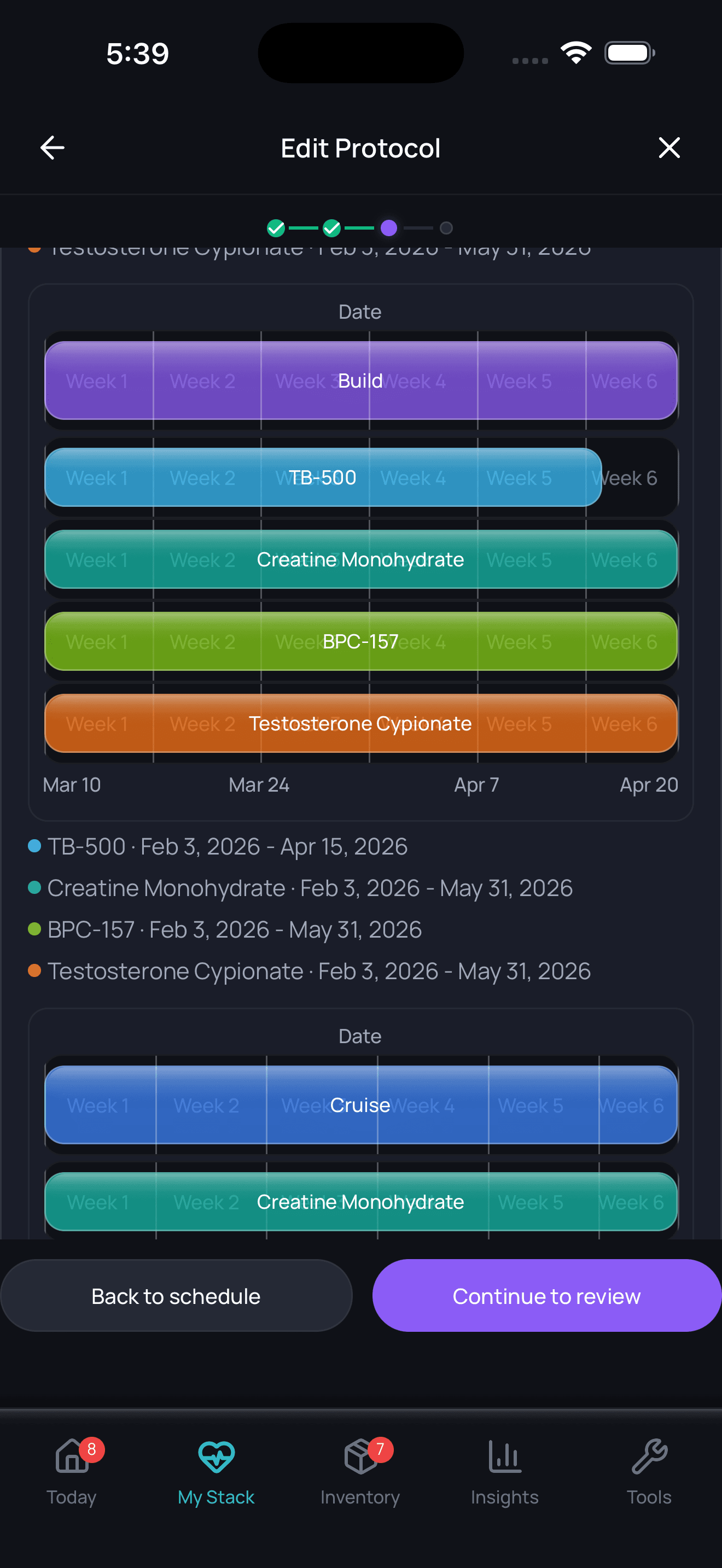
Timeline tracking helps with recall; it is not a treatment recommendation.
Timing Hypothesis & Window of Opportunity
The Basics
The timing hypothesis is usually discussed for starting HRT, not stopping it. But it still matters here because it explains why there is no single off-ramp that fits everyone.
If you started HRT during the usual menopause window for symptoms, the question later is often whether symptoms and risks have changed enough to justify stopping. If you are on HRT because of premature ovarian insufficiency or early menopause, that is different. In those situations, treatment is often used as physiologic replacement until around the average age of natural menopause, not as an optional short-term symptom trial. [1][3]
Stopping is also different in someone who is still in perimenopause. Ovarian activity may still be erratic, which can make discontinuation less predictable and more symptomatically messy.
The Science
The timing hypothesis comes from age- and time-since-menopause differences in HRT risk-benefit, especially cardiovascular outcomes. [1] It does not create a mirrored "must stop by X age" rule. NAMS instead recommends individualized continuation for persistent symptoms or documented indications, with periodic reevaluation. [1]
For premature menopause or POI, continuing therapy to around the average age of natural menopause remains the standard framework because the treatment is addressing early estrogen deficiency, not simply elective symptom management. [1][3]
Interactions & Compatibility
SYNERGISTIC
- Menopause-specific CBT: useful during or after HRT discontinuation for vasomotor distress, sleep, and coping. [3]
- Nonhormonal vasomotor options: fezolinetant, certain SSRIs/SNRIs, gabapentin, or oxybutynin may be considered when recurrent hot flashes drive the stop-or-restart decision.
- Bone-health therapy: calcium/protein adequacy, resistance training, vitamin D when appropriate, and osteoporosis medications when indicated can support transition after stopping systemic HRT.
- Local vaginal estrogen or DHEA for GSM: often compatible with systemic discontinuation when vulvovaginal or urinary symptoms persist. [1][3]
CAUTION
- Lamotrigine and estrogen changes: estrogen exposure can affect lamotrigine levels; medication review matters when starting or stopping systemic estrogen.
- Thyroid replacement: symptom changes after stopping HRT can overlap with thyroid symptoms; do not assume one explains the other.
- Alcohol and sleep-disrupting habits: can amplify rebound vasomotor symptoms and sleep fragmentation during discontinuation.
AVOID
- Stopping progesterone but continuing systemic estrogen when uterus intact
- Using unregulated compounded products to self-taper without clinician review
- Treating refill gaps, surgical pauses, or conflicting advice as permission to self-design a stop plan
Decision-Making Framework
Before stopping HRT, ask four questions:
- Why am I stopping? Improved symptoms, side effects, fear, cost, surgery, new diagnosis, or outside pressure all lead to different next steps.
- What problem was HRT solving best? Hot flashes, sleep, vaginal symptoms, bone protection, or early menopause replacement should not be treated as interchangeable reasons.
- What matters most if symptoms come back? Sleep, work function, intimacy, mood stability, and bone-health goals should be named explicitly.
- What is the fallback plan? Restart, slower taper, route switch, local therapy, or nonhormonal therapy should be decided before stopping.
Questions to bring to a clinician:
- Was I started on HRT for symptom control, bone protection, early menopause, or more than one reason?
- If I still have a uterus, how should progesterone change as estrogen changes?
- If my main symptoms return, do you want me to restart, taper more slowly, or switch to another option?
- If GSM persists, can I continue or start local vaginal therapy?
- Do I need a bone-health plan if systemic therapy stops?
Shared decision-making works best when both you and your provider have good data. Doserly gives you a personalized health picture that makes treatment discussions more meaningful - your symptoms, their severity, how they've changed over time, and how they connect to your current protocol.
Whether you're evaluating whether to start HRT, considering a switch to a different route, or discussing whether it's time to adjust your dose, having your own tracked data alongside the clinical evidence puts you in a stronger position to make decisions that reflect your individual experience and goals.
Connect protocol changes to labs and health markers.
Doserly can keep lab results, biomarkers, symptoms, and dose history close together so follow-up conversations have better context.
Insights
Labs and trends
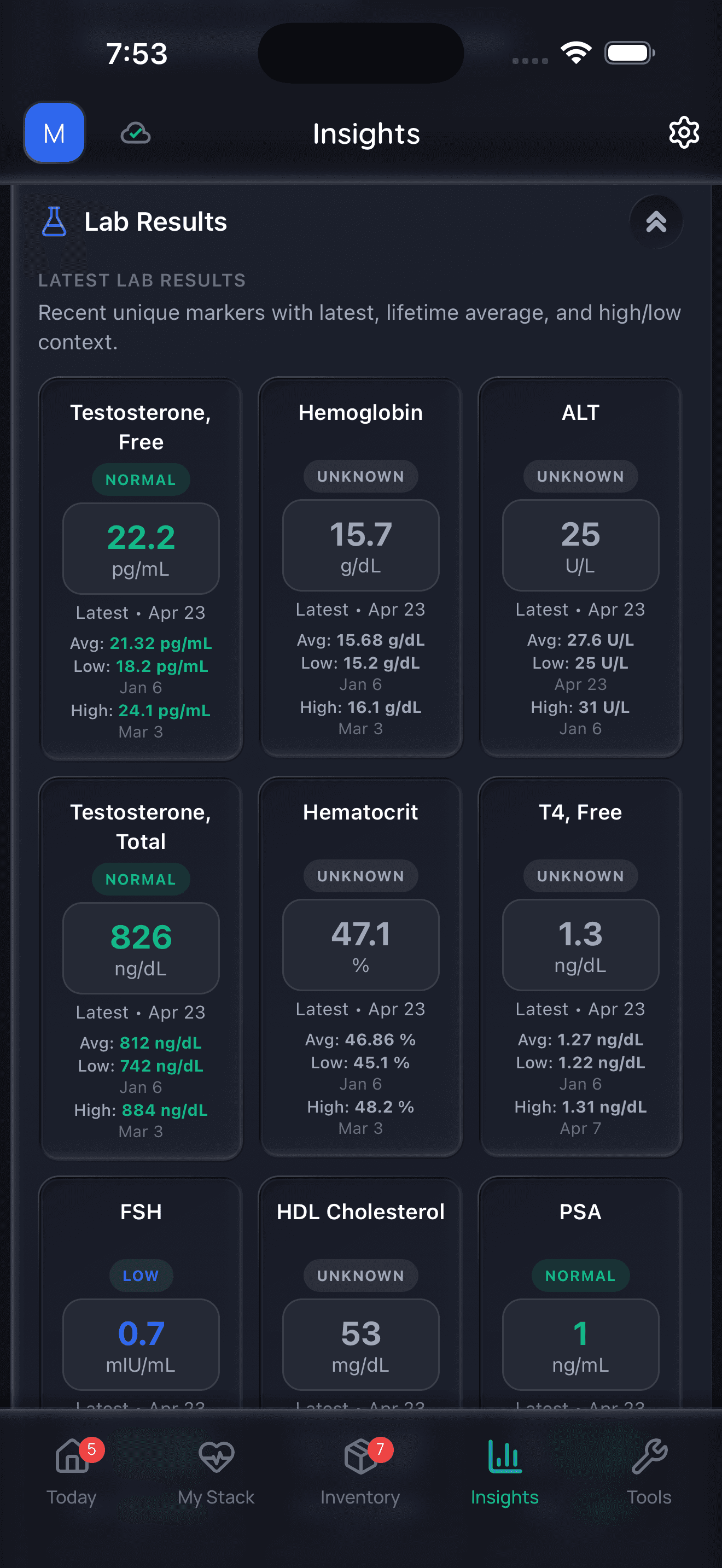
Doserly organizes data; it does not diagnose or interpret labs for you.
Administration & Practical Guide
Oral estrogen
- Ask whether lower tablet strengths are available before you stop.
- If a step-down schedule is used, follow the exact regimen rather than alternating randomly.
- If nausea or reflux was part of the reason to stop, document whether symptoms improve off therapy.
Transdermal patches
- Use lower marketed strengths when tapering if available.
- Do not assume cutting, trimming, or extending wear time is appropriate for your specific patch.
- Keep a record of symptom changes near patch-change days because some people are actually struggling with route performance, not readiness to stop.
Gels and sprays
- These may allow finer step-downs when the product is measured in pumps or sprays.
- Maintain the same application technique during a taper so you are changing dose, not dose plus absorption quality.
Progesterone or progestin component
- If the uterus is intact, keep endometrial protection aligned with the systemic estrogen plan.
- If progesterone intolerance is the reason for wanting off HRT, ask about route changes, different progestogens, or alternate uterine-protection strategies before assuming full discontinuation is the only choice.
Local vaginal therapy
- This is often continued or started after systemic discontinuation when GSM persists.
- It does not replace systemic estrogen for vasomotor symptom control.
Getting the administration routine right can take some experimenting. Doserly tracks not just whether you took your dose, but when and how - building a picture of your actual routine that can reveal opportunities for optimization.
The app's analytics can show whether small timing shifts affect how you feel, whether your adherence is consistent or has gaps on certain days, and how your routine has evolved since you started treatment. When your provider asks about compliance, you'll have real data - not an estimate - and when something feels off, you can check whether an administration change might be the reason.
Keep vial dates, inventory, and reminders visible.
Doserly helps you track what you have, when it was opened, and which reminders you set so guide context is easier to compare against your own log.
Protocol view
Inventory and reminders
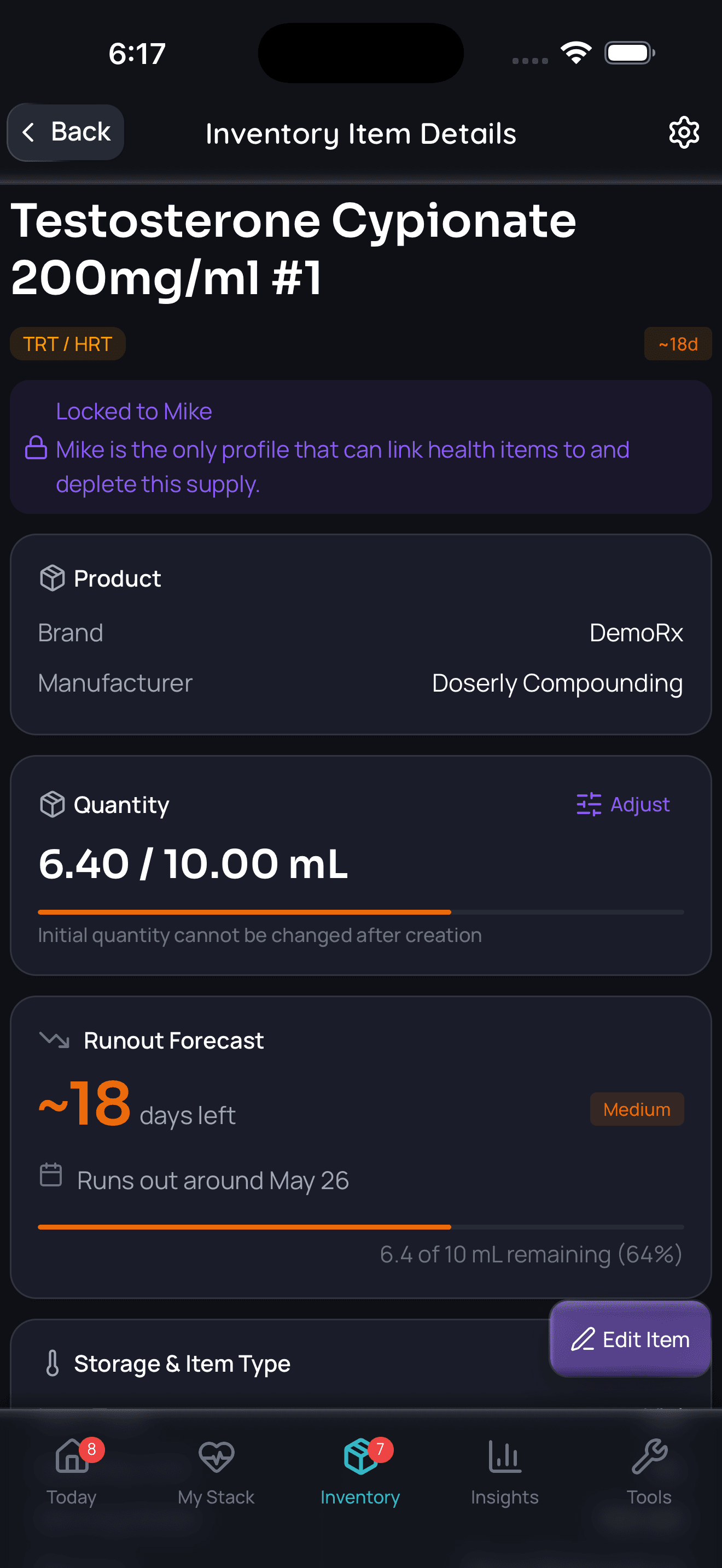
Tracking supports organization; it does not replace clinical guidance.
Monitoring & Lab Work
When stopping systemic HRT, monitoring is usually more about symptoms and risk review than hormone labs.
Useful monitoring topics
- hot flashes, night sweats, sleep, mood, vaginal symptoms
- bleeding or spotting pattern
- blood pressure and cardiovascular risk review
- bone-health plan if fracture risk matters
- breast screening and gynecologic follow-up according to age and history
When labs help less than people expect
- Routine estradiol or FSH testing usually does not tell you whether you are "ready" to stop.
- In perimenopause, hormone levels fluctuate too much to act as a simple discontinuation permission slip.
When to contact a clinician sooner
- new or heavy bleeding after menopause
- severe rebound symptoms that are not tolerable
- suspected VTE, stroke, or cardiac symptoms
- unexplained pelvic pain
- major mood destabilization
Complementary Approaches & Lifestyle
Stopping HRT goes better when symptom support is not reduced to hormones alone.
- Sleep protection: cool bedroom, regular wake time, alcohol reduction, and paced adjustment of evening routines can matter more during rebound weeks than before.
- CBT for vasomotor symptoms: NICE now recommends menopause-specific CBT as an option alongside or instead of HRT for some patients. [3]
- Exercise: resistance training and weight-bearing activity matter especially if bone protection is one reason systemic HRT was used.
- Protein, calcium, and vitamin D strategy: useful when building a post-HRT bone-health plan.
- Pelvic and vulvovaginal care: moisturizers, lubricants, and local prescription therapy help when GSM persists after systemic discontinuation.
- Trigger management: spicy food, hot rooms, poor sleep, and alcohol can magnify rebound vasomotor symptoms even if they were manageable before.
Stopping HRT / Discontinuation
This guide’s bottom line is simple:
- There is no universal age when everyone must stop HRT.
- Symptom recurrence after stopping is common.
- Tapering is reasonable but not proven superior.
- Route and uterus status matter.
- Vaginal estrogen is often a separate decision from systemic HRT.
People most likely to need a careful stop plan include:
- those who started HRT for severe vasomotor symptoms
- those with prior failed stop attempts
- those using HRT for early menopause or POI
- those relying on HRT partly for bone protection
- those whose problem is progesterone intolerance rather than estrogen benefit
Reasons to consider stopping include:
- symptoms have faded enough that treatment burden no longer feels worth it
- new contraindication or new major health event
- side effects or bleeding problems
- patient preference after informed review
Reasons to consider continuing or modifying instead of stopping include:
- significant rebound symptoms with prior attempts
- persistent GSM
- strong quality-of-life benefit
- early menopause replacement needs
- unresolved route or progestogen intolerance that might improve with a different regimen
Special Populations & Situations
Premature Ovarian Insufficiency / Early Menopause
These patients usually should not be counseled as though they are simply deciding whether to stop elective symptom therapy. Hormone treatment commonly continues until around the average age of menopause unless contraindications emerge. [1][3]
Surgical Menopause
Symptoms can be abrupt and severe, so discontinuation may feel more dramatic than in natural menopause. Stopping often deserves extra caution and symptom contingency planning.
People With a Uterus and Progesterone Intolerance
Do not assume the only options are "suffer" or "stop everything." Different progestogens, delivery routes, or combination strategies may change tolerability.
Persistent GSM After Systemic HRT
Systemic discontinuation does not automatically mean local vaginal estrogen must stop. Many patients can continue local therapy for GSM if needed. [1][2][3]
Perioperative Pauses
Temporary surgical stopping is a different problem from long-term discontinuation. Follow the operative plan for the specific surgery and product rather than general forum advice.
High Fracture Risk
If systemic HRT was part of bone protection, do not stop without a follow-up bone-health plan.
Regulatory, Insurance & International
United States
FDA labeling for systemic estrogen products emphasizes using the lowest effective dose for the shortest duration consistent with treatment goals, but product inserts generally do not provide detailed taper algorithms. Discontinuation is therefore mostly clinician-driven rather than label-driven. [10]
United Kingdom
NICE emphasizes individualized review and shared decision-making rather than mandatory age-based stopping. Lower-dose and route-switch options often shape the practical discontinuation discussion. [3]
Australia
The Australasian Menopause Society publishes dose-equivalence tools that make taper conversations more concrete across available products. [11]
Canada / EU
Access varies by jurisdiction and product availability, but the same broad principles apply: use approved products, reassess periodically, and build a route-aware plan rather than improvising.
Insurance / Cost
Stopping decisions are sometimes driven by cost, shortage, or refill friction. If that is the real problem, address it directly rather than assuming it means treatment is no longer clinically useful.
FAQ
Will my hot flashes come back if I stop HRT?
They might. About half of women have vasomotor symptom recurrence after hormone therapy discontinuation, although severity varies. [1][2]
Is tapering better than quitting cold turkey?
It may feel easier for some people, but direct studies have not shown a clear universal advantage. [4][5][6]
Can I stop progesterone first and stay on estrogen?
Not safely if you still have a uterus, unless your clinician gives you another endometrial-protection plan.
Can I keep using vaginal estrogen if I stop systemic HRT?
Often yes, because GSM treatment is a separate decision from systemic symptom control. [1][2][3]
Can I cut my estrogen patch to taper?
Do not assume that is appropriate. Patch tapering should follow the exact product’s instructions and clinician/pharmacist guidance. [10]
I stopped and feel terrible. Did I fail?
No. It usually means the benefit-risk balance may still favor treatment, or that another route, dose, or nonhormonal plan is needed.
Do I need hormone blood tests to know when to stop?
Usually not. Symptoms, indication, and risk review are more useful than routine estradiol or FSH testing for this decision.
If I started HRT because of POI, should I stop at the same time as everyone else?
Usually no. POI and early menopause replacement are different from average-age menopause symptom treatment. [1][3]
What if bleeding starts after I reduce or stop my dose?
The answer depends on menopausal status and regimen, but new or persistent bleeding always deserves clinical review.
What if I am only stopping because progesterone bothers me?
Ask about route changes, different progestogens, or alternate strategies before assuming full systemic discontinuation is the only solution.
Should I stop before surgery?
Only according to the perioperative plan for your specific surgery, clot-risk profile, and hormone product.
Can I restart if symptoms return?
Sometimes yes, but the choice should be re-evaluated with your clinician rather than done reflexively and repeatedly without a plan.
Myth vs. Fact
Myth: Everyone must stop HRT at age 60 or 65.Fact: Modern guidance supports individualized continuation for persistent symptoms or other documented reasons, with periodic reevaluation. [1][2][3]
Myth: Tapering has been proven to prevent symptom rebound.Fact: It is widely used, but direct evidence does not prove it is better than abrupt cessation. [4][5][6]
Myth: If symptoms return after stopping, you are addicted to HRT.Fact: Recurrence usually reflects persistent menopause-related physiology, not addiction. [1][7][8]
Myth: If I stop systemic HRT, I must stop vaginal estrogen too.Fact: Local GSM treatment is often a separate decision. [1][2][3]
Myth: Stopping progesterone while staying on estrogen is harmless.Fact: In a person with a uterus, that can expose the endometrium to unsafe unopposed estrogen. [1]
Myth: Bone benefits from HRT stay in place after treatment ends.Fact: Bone protection attenuates after stopping, and fracture risk may rise. [1][9]
Myth: The only reason people stop HRT is fear of cancer.Fact: Many women stop because of side effects, cost, surgical planning, refill problems, or a desire to reassess whether treatment is still needed.
Myth: Patch wear-off or progesterone intolerance means HRT no longer works for you.Fact: Sometimes the problem is route fit or progestogen fit, not that hormone therapy has no role.
Myth: A single lab test can tell me whether I am ready to stop.Fact: In most cases, symptoms and clinical context are more informative than routine hormone labs.
Sources & References
- The North American Menopause Society. The 2022 hormone therapy position statement of The North American Menopause Society. Menopause. 2022;29(7):767-794. doi:10.1097/GME.0000000000002028.
- The Menopause Society. Menopause Topics: Hormone Therapy; Hot Flashes patient education pages. Accessed March 26, 2026. Available at: menopause.org.
- National Institute for Health and Care Excellence. Menopause: identification and management (NG23). Reviewed November 7, 2024; minor amendments May 2025. Available at: nice.org.uk/guidance/ng23.
- Cunha EP, et al. Effect of abrupt discontinuation versus gradual dose reduction of postmenopausal hormone therapy on hot flushes. Maturitas. 2010;65(2):136-141. PMID: 20151792.
- Haskell SG, et al. Discontinuing postmenopausal hormone therapy: an observational study of tapering versus quitting cold turkey. Menopause. 2009. PMID: 19182695.
- Grady D, et al. Predictors of difficulty when discontinuing postmenopausal hormone therapy. Obstet Gynecol. 2003;102(6):1233-1239. PMID: 14662209. Grady D, Sawaya GF. Discontinuation of postmenopausal hormone therapy. Am J Med. 2005;118 Suppl 12B:163-165. PMID: 16414343.
- Ockene JK, et al. Symptom experience after discontinuing use of estrogen plus progestin. JAMA. 2005;294(2):183-193. PMID: 16014592.
- Brunner RL, et al. Menopausal symptom experience before and after stopping estrogen therapy in the Women's Health Initiative randomized, placebo-controlled trial. Menopause. 2010;17(5):946-954. PMID: 20505547.
- Vinogradova Y, et al. Discontinuation of menopausal hormone therapy and risk of fracture: nested case-control studies using routinely collected primary care data. Lancet Healthy Longev. 2025;6(7):100729. PMID: 40713950.
- DailyMed. Estradiol transdermal system prescribing information, various patch products. Accessed March 26, 2026. Available at: dailymed.nlm.nih.gov.
- Australasian Menopause Society. AMS Guide to MHT/HRT Doses; Combined Menopausal Hormone Therapy Information Sheet. Accessed March 26, 2026.
- Mikkola TS, et al. Increased cardiovascular mortality risk in women discontinuing postmenopausal hormone therapy. J Clin Endocrinol Metab. 2015;100(12):4588-4594. PMID: 26414962. Mikkola TS, et al. Increased cardiac and stroke death risk in the first year after discontinuation of postmenopausal hormone therapy. Menopause. 2018;25(4):375-379. PMID: 29112596.
Related Guides & Cross-Links
Same Category
Related Conditions
Related Medication Guides
Related Symptom Guides
- Genitourinary Syndrome of Menopause
- Menopause, Heart & Bone Health
- Menopause and Mental Health
- Vaginal Estrogen Therapy