
The WHI Study Explained: What It Means for HRT
On this page
Quick Reference Card
Attribute
Definition
- Value
- Educational guide to the Women's Health Initiative (WHI) hormone therapy trials and how their interpretation changed over time
Attribute
Study Years
- Value
- Enrollment 1993-1998; major hormone-trial results published 2002 and 2004; long-term follow-up continues to inform care
Attribute
Core Question
- Value
- Did oral menopausal hormone therapy prevent chronic disease in postmenopausal women?
Attribute
Trial Arms
- Value
- Oral CEE 0.625 mg + MPA 2.5 mg daily in women with a uterus; oral CEE 0.625 mg daily in women with prior hysterectomy
Attribute
Age Range Studied
- Value
- 50 to 79 years
Attribute
Average Participant Age
- Value
- Approximately 63 years
Attribute
Most Important Limitation
- Value
- WHI tested specific oral formulations in an older prevention population, not every modern HRT regimen
Attribute
Most Important Lasting Lesson
- Value
- Hormone therapy is not for chronic disease prevention, but it remains appropriate for symptom relief in selected women
Attribute
Biggest Interpretation Shift
- Value
- Age, years since menopause, uterus status, route, and progestogen type all matter
Attribute
Why Clinicians Still Discuss It
- Value
- WHI remains the largest randomized evidence base for menopause hormone therapy risks and benefits
Attribute
Medical Supervision
- Value
- Required for all systemic HRT decisions
Overview / What Is The WHI Study?
The Basics
The Women's Health Initiative, or WHI, was a large US research program designed to test whether common postmenopausal interventions prevented major chronic diseases. The hormone-therapy part of WHI became the most famous because it changed menopause care almost overnight. In July 2002, the combined hormone arm was stopped early, and the message that reached the public was blunt: HRT is dangerous.[1]
That message was not completely fabricated, but it was incomplete. WHI did find important risks. The problem is that the early public narrative flattened several distinctions that turned out to matter a lot: which trial arm a woman was in, whether she had a uterus, which hormones were used, how old she was when therapy began, and how many years had passed since menopause.[1][2][3]
So the modern task is not to dismiss WHI. It is to read it correctly. WHI still matters because it remains the biggest randomized hormone-therapy trial in postmenopausal women. But it matters today as a study of specific oral regimens in a specific prevention-oriented population, not as a universal verdict on every patch, gel, dose, or progesterone strategy used in 2026.[8][10]
The Science
The hormone trials enrolled 27,347 postmenopausal women aged 50 to 79 years between 1993 and 1998. Women with an intact uterus were randomized to daily oral conjugated equine estrogens (CEE) 0.625 mg plus medroxyprogesterone acetate (MPA) 2.5 mg or placebo. Women with prior hysterectomy were randomized to daily oral CEE 0.625 mg alone or placebo.[1][2][4]
The original research question was prevention, not simply relief of hot flashes. The primary monitored outcomes were coronary heart disease and invasive breast cancer, and the trials also tracked stroke, pulmonary embolism, fractures, colorectal cancer, dementia in older participants, and death.[1][2][4] That prevention framing is one reason WHI can be misunderstood when applied to a 52-year-old woman seeking symptom relief with a transdermal estradiol patch and micronized progesterone. WHI did not study that scenario directly.[8][10]
Medical / Chemical Identity
Property
Program Name
- Value
- Women's Health Initiative (WHI)
Property
Hormone Trials
- Value
- Estrogen plus progestin trial; estrogen-alone trial
Property
Parent Sponsor
- Value
- National Heart, Lung, and Blood Institute (NIH)
Property
Combined-Therapy Population
- Value
- Postmenopausal women with intact uterus
Property
Estrogen-Alone Population
- Value
- Postmenopausal women with prior hysterectomy
Property
Studied Estrogen
- Value
- Oral conjugated equine estrogens (CEE) 0.625 mg/day
Property
Studied Progestogen
- Value
- Oral medroxyprogesterone acetate (MPA) 2.5 mg/day
Property
Combined-Trial Publication
- Value
- JAMA, July 17, 2002
Property
Estrogen-Alone Publication
- Value
- JAMA, April 14, 2004
Property
Key Later Reanalyses
- Value
- Timing analysis (2007), integrated follow-up (2013), mortality (2017), age 50-59 and breast cancer follow-up (2020), practice review (2024)
Property
Core Identity Problem
- Value
- WHI is often referenced as a single study, but it contains two distinct randomized hormone trials with different populations and different outcome patterns
A Practical Note
When someone says "WHI showed...," the first question should be: which arm? If that is not answered, the statement is already too imprecise to guide a clinical decision.
Mechanism of Action / Pathophysiology
The Basics
WHI was not just a statistics story. It was also a pharmacology story. The regimens studied were oral. That matters because oral estrogen passes through the liver first, which changes clotting factors, triglycerides, and other downstream pathways differently from transdermal estrogen. The progestogen also matters. MPA is not the same molecule as micronized progesterone, and modern menopause practice does not assume every progestogen has identical breast, mood, vascular, or metabolic effects.[8][10]
Timing matters too. Estrogen started closer to menopause may interact with blood vessels differently than estrogen started much later, when atherosclerosis is more established. That idea became known as the timing hypothesis. WHI did not prove that hormone therapy prevents heart disease in younger women, but later analysis showed the coronary picture looked less adverse, and sometimes numerically favorable, closer to menopause than it did decades afterward.[3][4]
The Science
The biologic rationale behind WHI reinterpretation has three main parts. First, oral CEE undergoes first-pass hepatic metabolism, which helps explain why stroke and venous thromboembolic risk remained important concerns in later interpretation.[1][2][8] Second, continuous MPA exposure is not biologically interchangeable with micronized progesterone or with avoiding progestogen entirely in women without a uterus; this helps explain why the breast-cancer story diverged so sharply between the combined and estrogen-alone trials.[7][8][9]
Third, vascular context changes with age and years since menopause. In the 2007 timing analysis, coronary heart disease risk trends were more favorable when therapy was initiated within 10 years of menopause and less favorable when initiated 20 or more years later, whereas stroke risk stayed elevated without the same timing signal.[3] That difference is one of the clearest reasons current societies advise using WHI as a framework for age- and risk-stratified counseling rather than as a simple yes-or-no rule.[8][10]
Visual guide
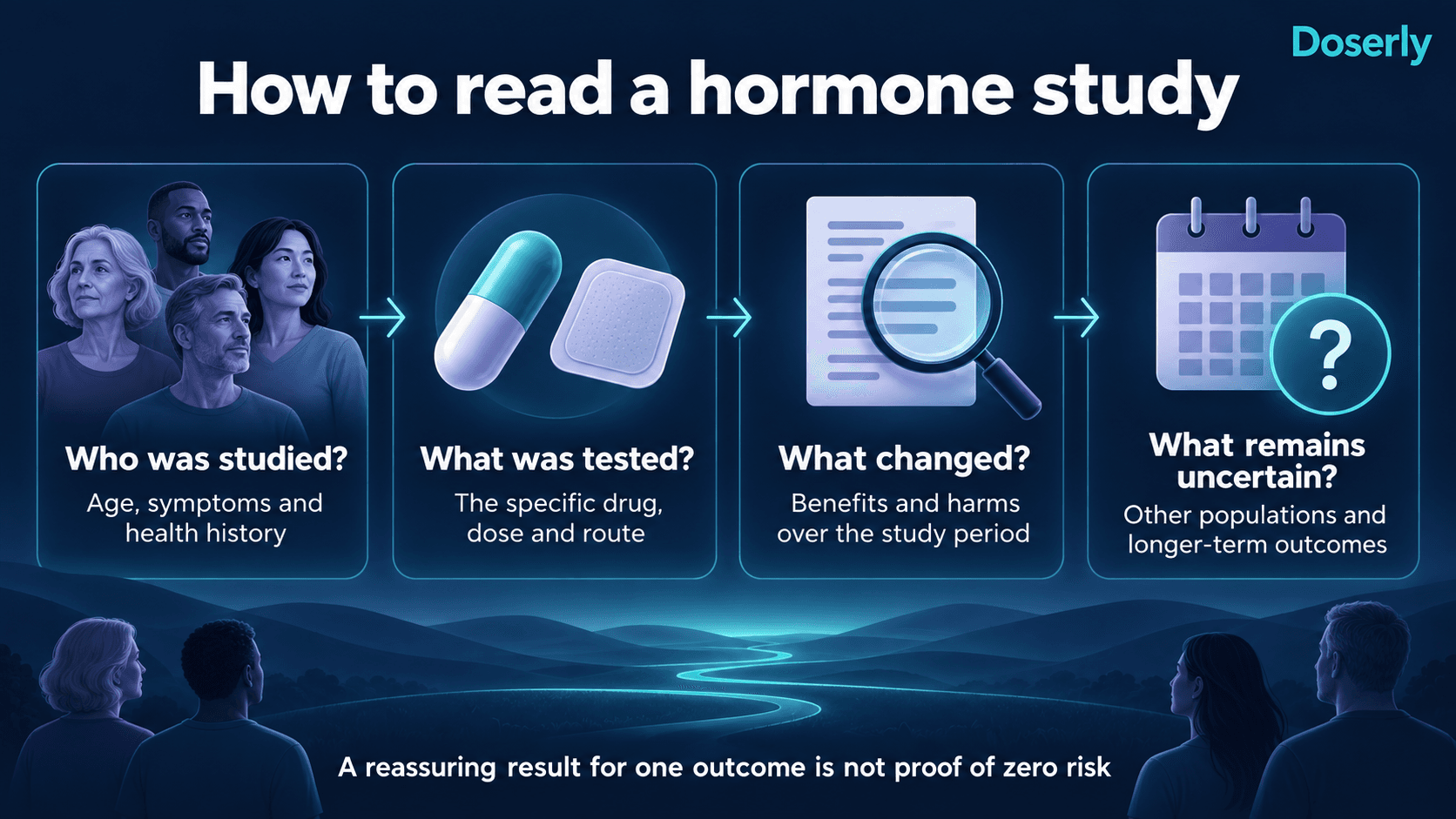
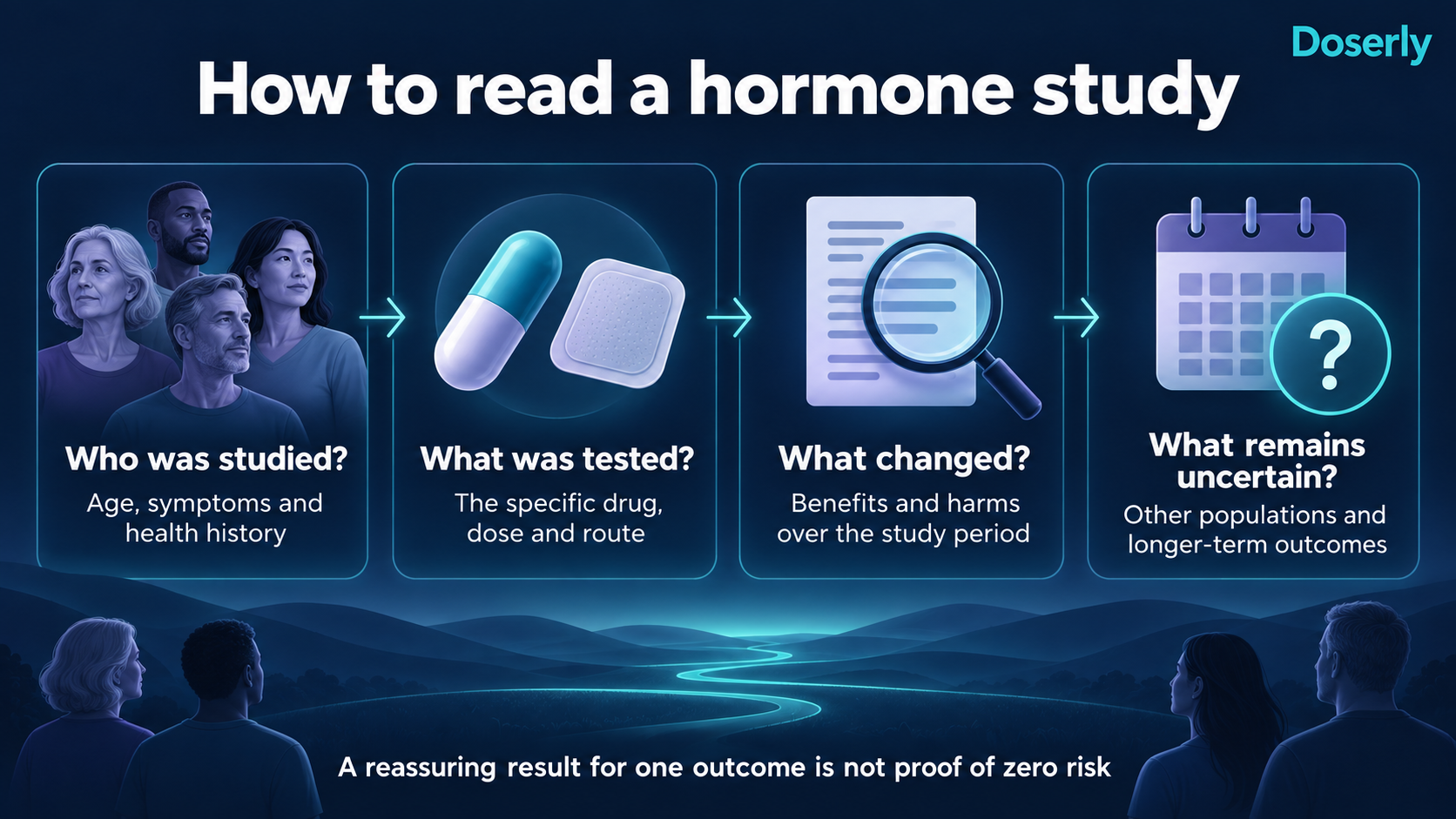
Study results belong to the population, formulation and follow-up period tested. A change in one outcome or a product warning does not establish safety for every person, route or long-term outcome.
NHLBI Women’s Health Initiative.
Pharmacokinetics / Hormone Physiology
The Basics
To understand WHI, you need to understand what was actually swallowed. The estrogen was oral CEE, not a patch and not oral estradiol. The progestogen in the combined arm was MPA, not micronized progesterone. Those are not trivial details. They shape how the liver, blood vessels, breast tissue, and endometrium respond, and they are a major reason clinicians are careful about extrapolating WHI to modern regimens.[8][10]
WHI also enrolled many women years beyond menopause. That means the study was looking at hormones introduced into bodies that were, on average, older and farther from the final menstrual period than the classic modern "early symptomatic starter."[1][2][4] The physiology of a 63-year-old who starts oral hormones for prevention is not automatically the physiology of a 52-year-old starting symptom treatment.
The Science
CEE is a mixed oral estrogen preparation, and MPA is a synthetic progestin. The Menopause Society position statement explicitly notes that WHI used only one route of administration, one estrogen formulation, and one progestogen, limiting generalizability.[8] Later reviews also highlight that WHI cannot answer whether transdermal estradiol, lower oral estradiol doses, or micronized progesterone would reproduce the same risk pattern.[8][10]
This section matters because many post-WHI misunderstandings come from treating "hormone therapy" as one homogeneous exposure. WHI studied a particular oral pharmacologic package in a prevention trial. Modern clinicians still discuss WHI precisely because it is high-quality randomized evidence, but they also qualify it because pharmacology and physiology differ across current treatment choices.[8][10]
Research & Clinical Evidence
The 2002 Combined-Hormone Shock
The Basics
The 2002 paper is the one most people mean when they say WHI. It studied oral CEE plus MPA in women with a uterus and found more breast cancer, stroke, pulmonary embolism, and coronary events, with fewer fractures and fewer colorectal cancers.[1] That was enough to stop the trial early and enough to transform clinical practice.
The Science
In absolute terms, the combined arm produced 7 more coronary heart disease events, 8 more strokes, 8 more pulmonary emboli, and 8 more invasive breast cancers per 10,000 person-years, alongside 6 fewer colorectal cancers and 5 fewer hip fractures.[1] The global index showed 19 excess events per 10,000 person-years.[1] Those numbers remain essential because they show WHI was never only a relative-risk story.
The 2004 Estrogen-Alone Correction
The Basics
The 2004 estrogen-alone publication made the public story more complicated. In women with prior hysterectomy taking oral CEE alone, the main clear harms were stroke and clotting concerns, while breast cancer did not increase in the same way seen in the combined arm.[2]
The Science
The estrogen-alone arm reported a breast cancer HR of 0.77 and a hip fracture HR of 0.61, with 12 additional strokes and 6 fewer hip fractures per 10,000 person-years.[2] This is why any modern WHI discussion that ignores uterus status is clinically misleading.
The Timing Hypothesis
The Basics
After the original headlines, researchers asked whether starting hormones closer to menopause changes the risk picture. The answer was not "everything becomes safe," but it was also not "the same risk applies to everyone."
The Science
The 2007 timing analysis found CHD HRs of 0.76 within 10 years of menopause, 1.10 at 10 to 19 years, and 1.28 at 20 or more years since menopause. Stroke remained elevated overall and did not show the same favorable timing pattern.[3]
[!CONFLICT Timing-hypothesis caution
The timing analysis supports more favorable coronary outcomes closer to menopause, but it does not prove hormone therapy should be used for heart-disease prevention. Later reviews and society statements still reject chronic disease prevention as the indication.[3][8][10]]
Long-Term Follow-up and Reinterpretation
The Basics
Later WHI follow-up changed the tone of counseling more than the original 2002 articles did. The newer message became: do not use hormone therapy to prevent chronic disease, but do not apply one undifferentiated fear message to every symptomatic woman either.[4][5][6][10]
The Science
The 2013 integrated follow-up showed age-specific global-index patterns ranging from 12 excess cases per 10,000 women-years with combined therapy in ages 50 to 59 to 38 excess in ages 70 to 79. For estrogen alone, the same measure ranged from 19 fewer cases per 10,000 women-years in ages 50 to 59 to 51 excess in ages 70 to 79.[4] The 2017 mortality paper then showed no significant increase in all-cause mortality overall with either regimen over long-term follow-up.[5]
The Breast Cancer Story After 20 Years
The Basics
Breast cancer is the single area where WHI remains most emotionally and clinically charged. The crucial point is that the two arms did not behave the same way.[7][9]
The Science
In 2020 follow-up, CEE alone was associated with lower breast cancer incidence and lower breast cancer mortality in women with prior hysterectomy, while CEE + MPA was associated with higher breast cancer incidence and no statistically significant rise in breast cancer mortality.[7]
[!CONFLICT Breast-cancer interpretation
Observational studies often report increased breast cancer risk with both estrogen-only and combined therapy, while randomized WHI data show reduced breast cancer incidence with CEE alone and increased incidence with CEE + MPA. Current reviews treat this as a real evidence disagreement and emphasize that regimen, population, and study design all matter.[7][9]]
Current Society Interpretation
The Basics
Current menopause societies do not treat WHI as obsolete. They treat it as foundational, but specific.
The Science
The 2022 Menopause Society statement and the 2024 JAMA review both conclude that WHI does not support hormone therapy for chronic disease prevention, yet supports symptom treatment in appropriately selected women in early menopause without contraindications.[8][10]
Benefits & Therapeutic Effects
The Basics
WHI is often remembered only for risk, but it also documented real benefits. The combined and estrogen-alone regimens reduced hip fractures, improved vasomotor symptoms, and lowered diabetes risk during treatment phases.[4][10] Those benefits matter because they explain why hormone therapy was not abandoned permanently despite the 2002 shock.
The more subtle benefit of WHI is educational. It forced menopause medicine to get more precise. After WHI, clinicians became less willing to talk about "HRT" as a single product class and more likely to discuss age, uterus status, route, formulation, dose, and treatment goal separately.[8][10]
The Science
In the combined arm, hip fractures fell with HR 0.66, and in the estrogen-alone arm they fell with HR 0.61.[1][2] Later integrated analyses also identified lower diabetes risk during intervention phases for both regimens, although those effects attenuated after stopping.[4] Current reviews therefore frame WHI as showing a mixed benefit-risk profile rather than a purely harmful one.[4][10]
For modern practice, the most durable therapeutic lesson is negative but important: hormone therapy can be a reasonable symptomatic treatment, but WHI does not justify using it to prevent chronic disease in average-risk postmenopausal populations.[8][10]
Risks, Side Effects & Safety
The Basics
The safest way to understand WHI risk is with denominators. The most famous 2002 results came from the combined oral CEE + MPA arm in women with a uterus. In that arm, the excess risk was measured in additional events per 10,000 women per year, not in vague statements like "doubles your risk" without context.[1]
The second safety rule is to separate the arms. The estrogen-alone arm did not reproduce the same breast cancer pattern seen in the combined arm.[2][7] If a clinician or article cites WHI without saying whether the exposure was CEE + MPA or CEE alone, the counseling is incomplete.
The Science
Combined CEE + MPA arm, main 2002 intervention-phase absolute effects per 10,000 person-years:[1]
- 7 more coronary heart disease events
- 8 more strokes
- 8 more pulmonary emboli
- 8 more invasive breast cancers
- 6 fewer colorectal cancers
- 5 fewer hip fractures
CEE-alone arm, main 2004 intervention-phase absolute effects per 10,000 person-years:[2]
- 12 more strokes
- 6 fewer hip fractures
- No significant global-index excess
High-priority safety interpretation points:
- Stroke remained a meaningful caution across later interpretation and did not show the same favorable timing pattern as CHD.[3][8]
- VTE and pulmonary embolism remain central concerns for oral therapy.[1][2][8]
- Breast cancer risk diverged strongly by arm:
- Higher incidence with CEE + MPA
- Lower incidence and lower mortality with CEE alone after hysterectomy in long-term follow-up.[7]
- WHI studied oral therapy only. It does not directly quantify the safety profile of transdermal estradiol plus micronized progesterone.[8][10]
HRT always requires medical supervision because the relevant question is never just "does WHI worry me?" It is "which regimen, for which person, at what age, for which goal, and against which baseline risks?"
Understanding your personal risk profile isn't a one-time calculation - it evolves as your treatment progresses. Doserly helps you see the bigger picture by analyzing side effect patterns over time, showing whether issues are resolving, persisting, or emerging as your body adjusts to therapy.
The app's analytics can reveal connections between side effects and specific aspects of your protocol - like whether symptoms correlate with a particular point in your patch cycle or a recent dose change. This kind of insight helps you and your provider make informed adjustments based on your actual experience, not just population-level averages.
Dosing & Treatment Protocols
The Basics
If you want to understand WHI precisely, you need the dosing details. The combined trial was not a patch study, not an estradiol study, and not a micronized progesterone study. It was a daily oral CEE 0.625 mg plus daily oral MPA 2.5 mg trial in women with a uterus.[1]
The estrogen-alone trial was daily oral CEE 0.625 mg in women with prior hysterectomy.[2] Those exact protocols matter because modern menopause care often uses lower doses, transdermal routes, or different progestogens.
The Science
- Combined arm protocol: CEE 0.625 mg/day + MPA 2.5 mg/day, continuous combined regimen.[1]
- Estrogen-alone arm protocol: CEE 0.625 mg/day, no progestogen because participants had prior hysterectomy.[2]
- Median intervention duration in later integrated reporting:
The practical implication is simple: WHI gives high-quality evidence about those exact regimens. It does not directly answer whether a lower-dose estradiol patch plus micronized progesterone behaves identically.
What To Expect / Timeline
The WHI story is easier to understand as a timeline than as a single headline:
- 1991: WHI launched as a broad postmenopausal prevention program.
- 1993-1998: Hormone-trial participants enrolled.
- July 17, 2002: Combined CEE + MPA results published; trial stopped early.[1]
- April 14, 2004: Estrogen-alone results published; trial stopped early.[2]
- 2007: Timing analysis introduces age and years-since-menopause nuance.[3]
- 2013: Integrated intervention and poststopping overview reframes age-specific absolute risk.[4]
- 2017: Long-term mortality follow-up shows no overall mortality increase.[5]
- 2020: Long-term age 50 to 59 and breast-cancer analyses sharpen arm-specific interpretation.[6][7]
- 2022-2024: Society statements and reviews place WHI into modern symptom-treatment guidance.[8][10]
Timelines in clinical literature describe averages. Your own timeline is what matters. Doserly's trend analysis turns your daily symptom entries into visual trajectories, showing you how each symptom is progressing over weeks and months of treatment.
The app helps you see patterns that day-to-day experience can obscure - like a gradual improvement in sleep quality that started two weeks after a dose increase, or hot flash frequency dropping steadily even when individual bad days make it feel like nothing has changed. These insights give both you and your provider a clearer picture of treatment response.
Timing Hypothesis & Window Of Opportunity
The Basics
One of the biggest post-WHI changes in menopause medicine was recognizing that when hormone therapy starts may matter almost as much as what is prescribed. Starting therapy close to menopause is not the same as starting it decades later.
This does not mean there is a magical safe window where all risks disappear. It means the balance shifts. Coronary outcomes looked more favorable nearer menopause, while stroke and clotting concerns remained important.[3][8]
The Science
The 2007 WHI timing analysis found a CHD HR of 0.76 among women within 10 years of menopause, compared with 1.28 among women 20 or more years from menopause onset.[3] The absolute CHD differences moved from 6 fewer events per 10,000 person-years within 10 years of menopause to 17 more events per 10,000 person-years at 20 or more years.[3]
Later syntheses and society statements turned that pattern into the modern "younger than 60 or within 10 years" framing for symptomatic care, while still rejecting hormone therapy as a chronic disease prevention strategy.[8][10]
Interactions & Compatibility
WHI findings interact with several modern clinical variables:
- Uterus status: determines whether the estrogen-alone or combined trial is the closer match.[1][2]
- Route: WHI used oral therapy only; transdermal therapy is not directly tested by WHI.[8][10]
- Progestogen type: WHI combined therapy used MPA, not micronized progesterone.[1][8][9]
- Age and vascular risk: older age and greater distance from menopause worsen absolute risk.[3][4][8]
- Goal of treatment: symptom treatment is compatible with current interpretation; chronic disease prevention is not.[8][10]
The practical mistake is to ignore one of these interaction layers and then cite WHI as though it answers every modern scenario equally well.
Decision-Making Framework
When WHI comes up in a clinical discussion, these are the right questions to ask:
- Which WHI arm is actually relevant to me: combined therapy or estrogen alone?
- Do I have a uterus?
- Am I close to menopause onset, or many years beyond it?
- Is the proposed treatment oral or transdermal?
- Is the progestogen MPA, micronized progesterone, or something else?
- Are we treating symptoms, or talking as if hormones prevent chronic disease?
- What are the absolute risks for someone with my age and risk profile?
Shared decision-making works best when both you and your provider have good data. Doserly gives you a personalized health picture that makes treatment discussions more meaningful - your symptoms, their severity, how they've changed over time, and how they connect to your current protocol.
Whether you're evaluating whether to start HRT, considering a switch to a different route, or discussing whether it's time to adjust your dose, having your own tracked data alongside the clinical evidence puts you in a stronger position to make decisions that reflect your individual experience and goals.
Administration & Practical Guide
The most practical way to read any WHI claim is to run a six-part checklist:
- Identify the arm.
- Identify the regimen.
- Identify the route.
- Identify the participant age and years since menopause.
- Convert the claim into absolute numbers if possible.
- Ask whether the point applies to symptom treatment, chronic disease prevention, or both.
If a source fails any of those steps, treat the conclusion cautiously. This reading method is often more useful than memorizing a long list of hazard ratios.
Monitoring & Lab Work
WHI helps explain what modern monitoring should and should not focus on:
- Do monitor: blood pressure, clotting history, breast screening adherence, abnormal bleeding, migraine or stroke risk factors, and evolving cardiovascular risk.[8][10]
- Do not over-rely on: routine hormone levels as a universal decision tool for standard menopause care.[8]
- If uterus is present: endometrial protection and evaluation of persistent unscheduled bleeding remain essential.[8]
In other words, good post-WHI care is risk-stratified monitoring, not reflex avoidance of all hormones.
Complementary Approaches & Lifestyle
WHI did not make lifestyle measures irrelevant. In fact, its long arc pushed menopause care toward broader risk discussion:
- resistance training and weight-bearing exercise for bone protection
- blood pressure, lipids, and diabetes risk management
- smoking cessation and VTE risk reduction
- sleep, mood, and stress care alongside symptom treatment
- local GSM treatment when vaginal symptoms are the main problem
Lifestyle does not replace hormone therapy when hormone therapy is indicated, but it does change the baseline risk profile into which any HRT decision is made.[8][10]
Stopping HRT / Discontinuation
WHI also matters because both trials have poststopping data. Many treatment-phase risks and benefits attenuated after discontinuation, but not every signal vanished on the same timeline.[4] Breast-cancer risk with combined CEE + MPA remained elevated during cumulative follow-up, whereas many other excesses were concentrated during active treatment.[4][7]
Current guidance therefore avoids arbitrary universal stop dates. Instead, it recommends periodic reassessment of ongoing symptom burden, route, dose, age, and risk profile.[8] WHI supports reassessment; it does not justify a simplistic "everyone must stop at five years" rule.
Special Populations & Situations
- Women with prior hysterectomy: the estrogen-alone WHI arm is the relevant comparator, not the combined arm.[2][7]
- Women with a uterus: the combined arm is more relevant for endometrial-protection discussions.[1][8]
- Women with early menopause or POI: WHI is a poor direct fit because the study did not enroll women with premature or early menopause.[8]
- Older initiators: WHI is especially important here because absolute risks rose with age and time since menopause.[3][4]
- Breast cancer survivors: systemic HRT decisions require specialist input; WHI is informative but not sufficient on its own.[8]
- Women considering transdermal estradiol: WHI remains background evidence, but it is not a direct route-specific trial.[8][10]
Regulatory, Insurance & International
In the United States, HRT labels are now in a product-specific transition. FDA requested broad menopausal hormone therapy label revisions in November 2025, and on February 12, 2026 approved updated prescribing information for six products: Prometrium, Divigel, Cenestin, Enjuvia, Estring, and Bijuva. WHI-era safety themes still matter for counselling, but they should be translated into individualized risk rather than treated as a single warning for every product and patient: age, years since menopause, formulation, route, progestogen choice, uterus status, and indication all matter.[8][10]
Across major menopause societies, the practical consensus is similar: do not use systemic hormone therapy for chronic disease prevention, but do consider it for bothersome symptoms in appropriate candidates, especially earlier in menopause.[8][10]
FAQ
Did WHI prove all HRT is dangerous?
No. WHI showed that specific oral regimens should not be used for chronic disease prevention and that risks vary by arm, age, and timing.[1][2][4][10]
Why do people say WHI studied "old women"?
Because the average participant age was about 63, older than many women who start HRT today for symptoms.[4][7]
Did WHI study patches?
No. WHI studied oral CEE, with or without oral MPA.[1][2]
What is the difference between the two WHI hormone arms?
Women with a uterus got oral CEE + MPA; women with prior hysterectomy got oral CEE alone.[1][2]
Why is hysterectomy status so important?
Because it determines whether progestogen is needed for endometrial protection and because the WHI outcome patterns differed sharply by arm.[1][2][7]
Did WHI show more breast cancer?
Yes for the combined CEE + MPA arm; no, and eventually less, for the estrogen-alone CEE arm in women with prior hysterectomy.[1][2][7]
Did WHI show more strokes?
Yes. Stroke was a consistent caution in both arms and did not show the same favorable timing pattern as CHD.[1][2][3]
Did WHI show lower fracture risk?
Yes. Hip fracture risk fell in both arms.[1][2]
Did WHI show higher death rates overall?
Long-term follow-up did not show a significant increase in all-cause mortality overall.[5]
Why do clinicians still talk about WHI in 2026?
Because it is still the largest randomized menopause hormone trial and remains central to discussing risk, especially breast cancer, stroke, VTE, and age-specific absolute risk.[8][10]
What is the timing hypothesis?
It is the observation that coronary outcomes looked more favorable when therapy started closer to menopause than when started much later, though stroke risk still remained a concern.[3][8]
What is the single biggest mistake people make when citing WHI?
Treating it as one undifferentiated result instead of two separate hormone trials with different populations and different outcome patterns.[1][2][7]
Myth vs. Fact
Myth: WHI proved all hormone therapy is dangerous.
Fact: WHI showed that specific oral regimens should not be used for chronic disease prevention, but later analysis made clear that age, timing, and regimen matter.[1][3][4][8][10]
Myth: WHI was one single HRT study.
Fact: It contained two randomized hormone trials: combined CEE + MPA in women with a uterus and CEE alone in women with prior hysterectomy.[1][2]
Myth: WHI studied the same hormones most women use today.
Fact: WHI studied oral CEE, with or without MPA. It did not test modern transdermal estradiol plus micronized progesterone directly.[1][2][8]
Myth: The breast-cancer result was identical in both trial arms.
Fact: Long-term follow-up showed higher breast cancer incidence with CEE + MPA and lower incidence with CEE alone after hysterectomy.[7][9]
Myth: Later reanalyses proved WHI was wrong.
Fact: The reanalyses refined interpretation; they did not erase the original findings.[3][4][10]
Myth: If CHD looked better closer to menopause, then WHI supports hormones for heart prevention.
Fact: Current guidance still rejects chronic disease prevention as the indication, even while recognizing more favorable coronary patterns in earlier starters.[3][8][10]
Myth: WHI showed long-term hormone therapy raises death rates overall.
Fact: The 2017 mortality follow-up found no significant overall increase in all-cause mortality.[5]
Myth: WHI no longer matters because it is old.
Fact: It still matters precisely because it is large randomized evidence, but it must be interpreted with attention to arm, age, route, and treatment goal.[8][10]
Sources & References
[1] Rossouw JE, Anderson GL, Prentice RL, et al. Risks and benefits of estrogen plus progestin in healthy postmenopausal women: principal results from the Women's Health Initiative randomized controlled trial. JAMA. 2002;288(3):321-333.
[2] Anderson GL, Limacher M, Assaf AR, et al. Effects of conjugated equine estrogen in postmenopausal women with hysterectomy: the Women's Health Initiative randomized controlled trial. JAMA. 2004;291(14):1701-12. PubMed: 15082697. DOI: 10.1001/jama.291.14.1701.
[3] Rossouw JE, Prentice RL, Manson JE, et al. Postmenopausal hormone therapy and risk of cardiovascular disease by age and years since menopause. JAMA. 2007;297(13):1465-77. PubMed: 17405972. DOI: 10.1001/jama.297.13.1465.
[4] Manson JE, Chlebowski RT, Stefanick ML, et al. Menopausal hormone therapy and health outcomes during the intervention and extended poststopping phases of the Women's Health Initiative randomized trials. JAMA. 2013;310(13):1353-1368.
[5] Manson JE, Aragaki AK, Rossouw JE, et al. Menopausal Hormone Therapy and Long-term All-Cause and Cause-Specific Mortality: The Women's Health Initiative Randomized Trials. JAMA. 2017;318(10):927-938. PubMed: 28898378. DOI: 10.1001/jama.2017.11217.
[6] Prentice RL, Aragaki AK, Chlebowski RT, et al. Randomized Trial Evaluation of the Benefits and Risks of Menopausal Hormone Therapy Among Women 50-59 Years of Age. Am J Epidemiol. 2021;190(3):365-375. PubMed: 33025002. DOI: 10.1093/aje/kwaa210.
[7] Chlebowski RT, Anderson GL, Aragaki AK, et al. Association of menopausal hormone therapy with breast cancer incidence and mortality during long-term follow-up of the Women's Health Initiative randomized clinical trials. JAMA. 2020;324(4):369-380.
[8] The 2022 hormone therapy position statement of The North American Menopause Society. Menopause. 2022;29(7):767-794.
[9] Chlebowski RT, Manson JE, Anderson GL, et al. The Women's Health Initiative randomized trials of menopausal hormone therapy and breast cancer: findings in context. Menopause. 2023.
[10] Manson JE, Crandall CJ, Rossouw JE, et al. The Women's Health Initiative Randomized Trials and Clinical Practice: A Review. JAMA. 2024;331(20):1748-1760. PubMed: 38691368. DOI: 10.1001/jama.2024.6542.
Related Guides & Cross-Links
Same Category
- Getting Started with HRT -
/hrt-guides/getting-started-with-hrt - HRT Monitoring & Lab Work Guide -
/hrt-guides/hrt-monitoring-lab-work - HRT Myths vs Facts -
/hrt-guides/hrt-myths-facts
Related Conditions
- Perimenopause -
/hrt-guides/perimenopause - Early Menopause -
/hrt-guides/early-menopause - Premature Ovarian Insufficiency (POI) -
/hrt-guides/premature-ovarian-insufficiency
Related Medication Guides
- Conjugated Equine Estrogens -
/hrt-guides/conjugated-equine-estrogens - Medroxyprogesterone Acetate -
/hrt-guides/medroxyprogesterone-acetate - Micronized Progesterone -
/hrt-guides/micronized-progesterone - Conjugated Estrogens + MPA (Prempro) -
/hrt-guides/ce-mpa-prempro
Related Treatment Approaches
- Transdermal HRT (Patches, Gels, Sprays) -
/hrt-guides/transdermal-hrt - Vaginal Estrogen Therapy -
/hrt-guides/vaginal-estrogen-therapy