
HRT Myths and Facts: Evidence-Based Answers
On this page
Quick Reference Card
Attribute
Topic
- Value
- Common menopause HRT myths versus evidence-backed corrections
Attribute
Guide Type
- Value
- Educational guide
Attribute
Main Clinical Goal
- Value
- Replace fear-driven or marketing-driven claims with current guideline and trial-based counseling
Attribute
Highest-Friction Myths Covered
- Value
- Cancer, clots, weight gain, duration of use, "bioidentical" safety, hormone testing, perimenopause use
Attribute
Most Important Reality Check
- Value
- "HRT" is not one single exposure; risk depends on regimen, route, age, timing, uterus status, and personal history
Attribute
Best Supported Benefits
Attribute
Most Important Safety Distinctions
Attribute
Duration Rule
Attribute
Bioidentical Clarification
- Value
- Some FDA-approved products are bioidentical; compounded products are not routinely recommended when approved options exist [5]
Attribute
Routine Hormone Testing Required?
Attribute
Prescription Required
- Value
- Yes for systemic HRT and FDA-approved local hormone products
Attribute
Medical Supervision
- Value
- Required for all systemic HRT and strongly advised for local hormone therapy
Overview / What Is HRT Myths vs Facts?
The Basics
The biggest HRT problem in 2026 is not that women have no information. It is that they are buried in contradictory information. A single person can hear, often in the same week, that HRT causes cancer, that HRT prevents heart disease, that "bioidentical" hormones are always safer, that everyone must stop after 5 years, and that patches and pills are basically the same. Those statements cannot all be true as written, and in practice most of them are incomplete or wrong.
This guide is not trying to sell HRT, and it is not trying to scare people away from it. Its job is narrower: identify the highest-friction claims and replace them with evidence-backed corrections that match current guideline thinking. For some women, that will make HRT feel more reasonable. For others, it will clarify why HRT is still not the right choice. Both outcomes are useful.
The key principle is that "HRT" is too broad a word to carry the risk discussion by itself. Estrogen-only therapy after hysterectomy is not the same as combined estrogen-progestogen therapy in a woman with a uterus. A transdermal estradiol patch is not the same as oral estrogen from a clot-risk standpoint. Low-dose vaginal estrogen for GSM is not the same as systemic therapy used for hot flashes. If a myth ignores those distinctions, it is probably not clinically reliable.
The Science
Current major guidance is aligned on several core points. The 2022 NAMS position statement says hormone therapy remains the most effective treatment for vasomotor symptoms and GSM, helps prevent bone loss and fracture, and must be individualized by route, dose, timing, duration, and progestogen exposure [1]. NICE NG23, last updated April 15, 2026, similarly emphasizes individualized care, shared decision-making, and explicit risk-benefit discussion rather than blanket rules [2]. WHI long-term follow-up and subgroup analyses also show why simple headlines mislead: the benefit-risk pattern changes by age, years since menopause, and whether therapy is estrogen-only or combined [3][4].
That means myth correction has to be disciplined. "HRT causes cancer" is too broad. "HRT has no cancer risk" is also too broad. The accurate version is regimen-specific and history-specific. The same is true for clot risk, body-weight claims, and duration-of-use rules. Inference: the safest educational posture is not reassurance-by-slogan, but structured nuance anchored to primary sources.
Medical / Chemical Identity
Property
Topic Classification
- Value
- Educational guide about menopausal hormone therapy counseling
Property
Main Hormone Classes Discussed
- Value
- Estrogens, progestogens/progestins, local vaginal hormones
Property
Core Routes Discussed
- Value
- Oral, transdermal, vaginal
Property
Major Regimen Split
- Value
- Estrogen-only after hysterectomy versus combined estrogen-progestogen when uterus is present
Property
Main Misused Marketing Term
- Value
- "Bioidentical"
Property
Key Scientific Distinction
- Value
- Molecular identity is not the same thing as regulatory quality or proven safety
Property
Current U.S. Regulatory Context
- Value
- FDA approved labeling changes for an initial group of menopausal hormone therapy products on February 12, 2026 [9]
A Practical Note
"Bioidentical" can describe the chemistry of a hormone, but it does not tell you whether the product is FDA-approved, compounded, well-tested, dose-consistent, or safer than alternatives. That is one of the most persistent language traps in menopause care [5].
Mechanism of Action / Pathophysiology
The Basics
Menopause symptoms happen because ovarian hormone production becomes unstable and then falls. Estrogen decline affects the brain's temperature regulation, the vulva and vagina, the bladder, bone turnover, sleep, and many day-to-day functions people often experience as "whole-body aging." HRT works by replacing or supplementing some of that hormone signaling.
Why myths spread so easily is that different tissues respond differently. The same estrogen that improves hot flashes does not create the same risk profile in every organ, every age group, or every delivery route. Progesterone or another progestogen is usually added when a uterus is present because estrogen alone can overstimulate the uterine lining.
The Science
Modern HRT counseling is driven by pathophysiology plus risk stratification, not by a single "good" or "bad" label. Estrogen stabilizes the thermoregulatory instability that drives hot flashes and night sweats, supports vulvovaginal tissue health, and reduces bone resorption [1][2]. Progestogen is used primarily to oppose estrogen's proliferative effect on the endometrium in people with a uterus [2].
Route matters mechanistically. Oral estrogen undergoes first-pass hepatic metabolism, which helps explain its greater effect on clotting factors and some inflammatory markers. Transdermal estrogen bypasses that first-pass liver exposure and therefore does not produce the same thrombotic profile in the available evidence [6]. That biological difference is the reason the "all estrogen causes clots equally" myth does not hold up.
Visual guide
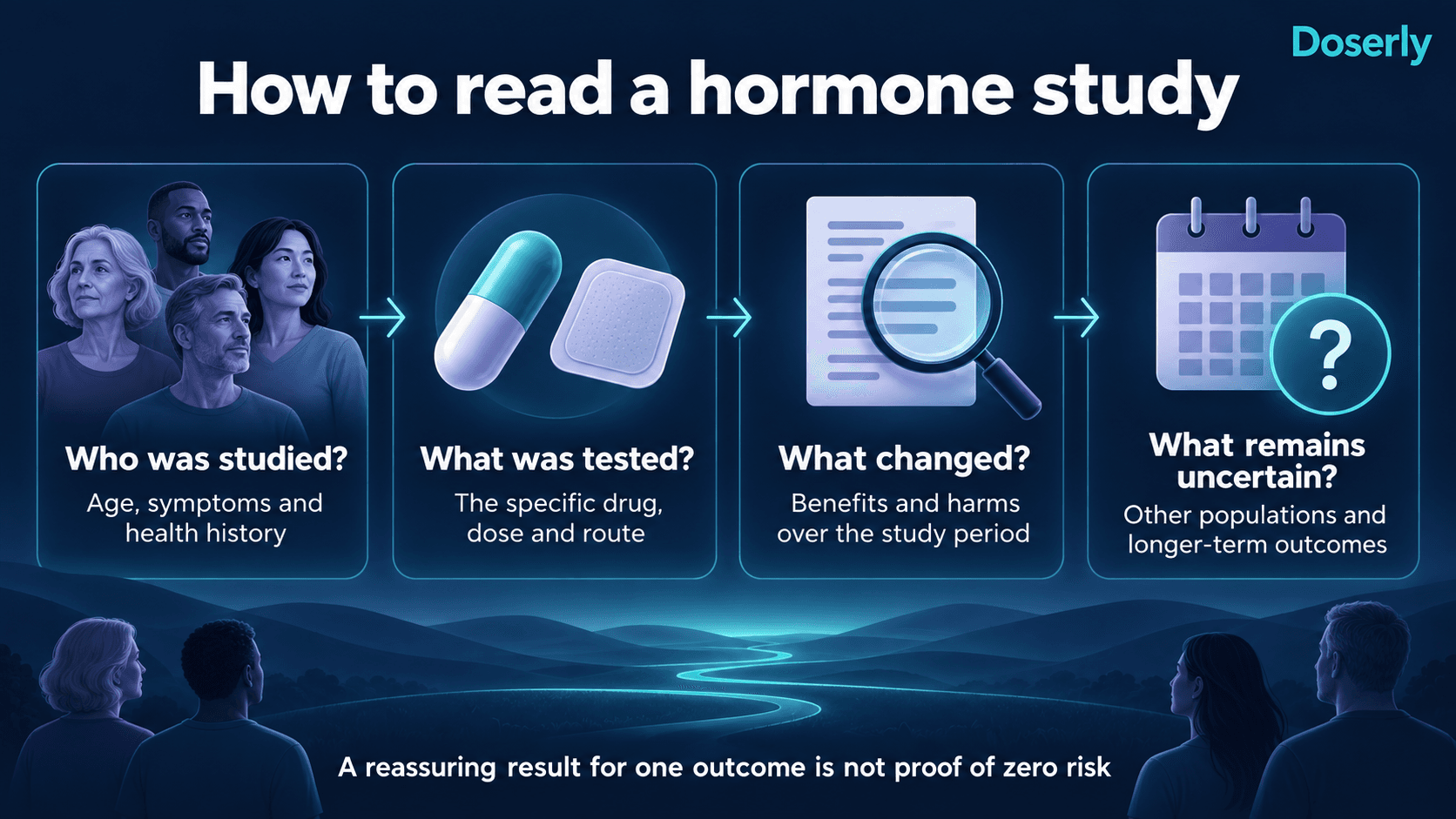
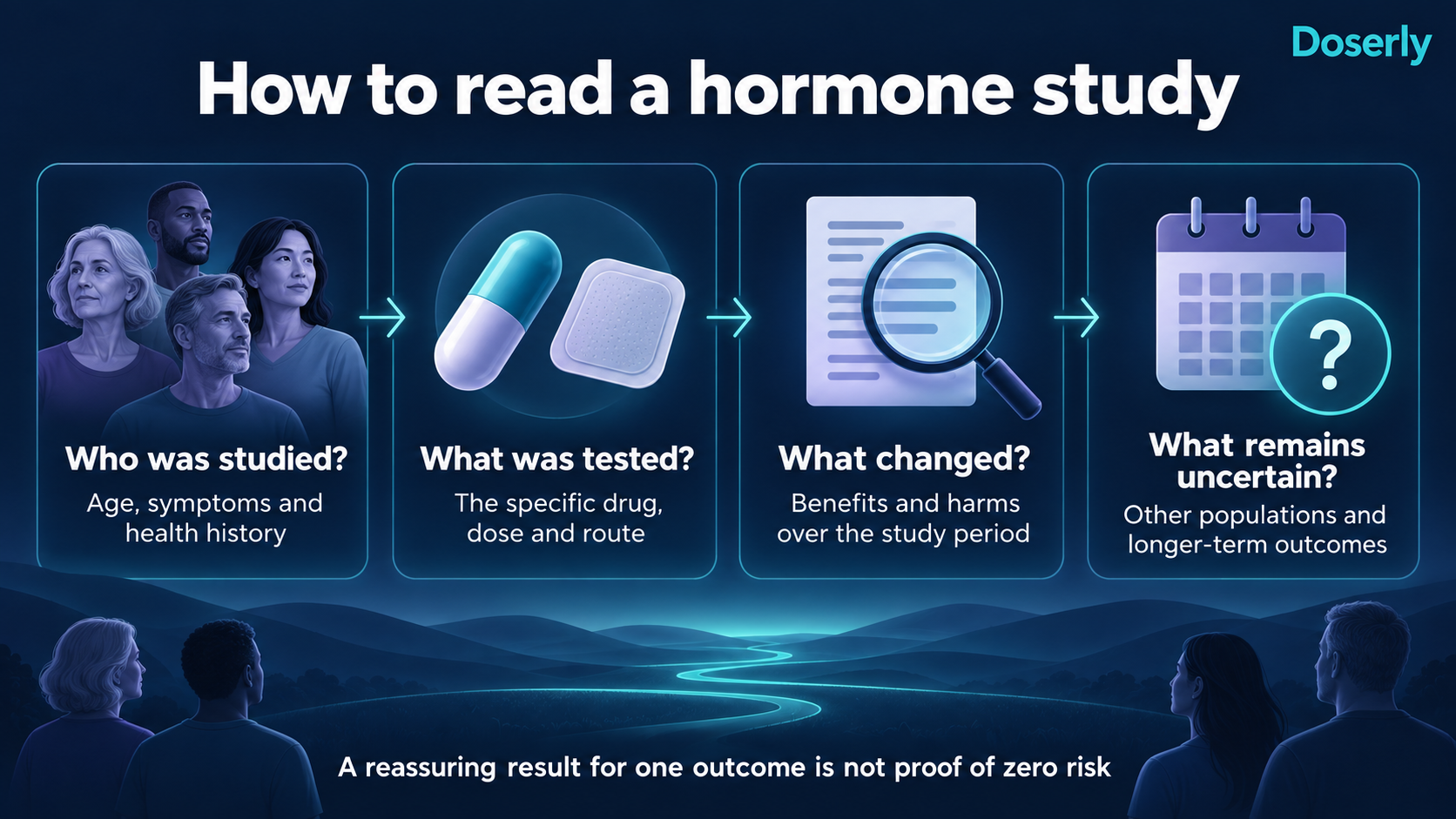
Study results belong to the population, formulation and follow-up period tested. A change in one outcome or a product warning does not establish safety for every person, route or long-term outcome.
NHLBI Women’s Health Initiative.
Pharmacokinetics / Hormone Physiology
The Basics
Two myths collapse quickly when you understand route. First: a patch is not just a pill on the skin. Second: vaginal estrogen is not simply "systemic HRT in a smaller dose." Different routes change how much hormone reaches the bloodstream, how much hits the liver first, and what tissues are mainly being targeted.
That matters in real life. If a person's main issue is vaginal dryness, recurrent urinary symptoms, or painful sex, local vaginal treatment may be the relevant therapy. If the main problem is hot flashes and night sweats, local treatment is usually not enough. If clot risk is a major concern, route becomes part of the risk discussion rather than a cosmetic choice.
The Science
ACOG's route-specific review explains that orally administered estrogen can increase prothrombotic signaling through hepatic first-pass metabolism, whereas transdermal estrogen has little or no effect on prothrombotic substances in the evidence reviewed [6]. NICE NG23 rationale likewise notes that transdermal HRT was not associated with increased stroke risk and retains the earlier lower-VTE interpretation for transdermal versus oral therapy [2].
Physiologically, low-dose vaginal estrogen products are different again. They are primarily used for GSM and have far less systemic effect than systemic oral or transdermal therapy. Treating them as risk-equivalent to systemic HRT is therefore misleading. Inference: when myths ignore route, they usually overgeneralize from data that came from only one formulation or one trial population.
Research & Clinical Evidence
Myth Domain 1: "HRT causes cancer"
The Basics
This is the most common myth, and it survives because it sounds simple. Unfortunately, it is too simple to be trustworthy. The evidence does not support one universal cancer story for all HRT.
The Science
WHI long-term follow-up showed that estrogen-only therapy in women with prior hysterectomy and combined estrogen plus progestin therapy in women with a uterus had different breast-cancer outcomes [4]. Estrogen-only use in that WHI population was associated with lower breast-cancer incidence and mortality than placebo, while combined CEE plus MPA was associated with higher breast-cancer incidence [4]. That does not mean estrogen-only therapy is "protective HRT" for everyone, and it does not mean combined therapy is unsafe for everyone. It means regimen matters, and myth language that erases that distinction is inaccurate.
Myth Domain 2: "All HRT causes dangerous blood clots"
The Basics
The real question is not whether clot risk exists in any form. The real question is how much risk, in whom, and with which route.
The Science
ACOG notes that baseline venous thromboembolism risk rises with age and that oral estrogen may exert a prothrombotic effect, while transdermal estrogen has little or no effect on prothrombotic markers in the evidence reviewed [6]. In the ESTHER study summarized by ACOG, oral estrogen had a VTE odds ratio of 4.2 compared with nonuse, while transdermal estrogen was 0.9 [6]. That is why modern counseling increasingly prefers transdermal routes when vascular risk factors matter.
Myth Domain 3: "HRT always causes weight gain"
The Basics
Weight change during midlife is real. That does not prove HRT caused it.
The Science
The randomized and systematic-review evidence used here does not support the idea that standard HRT causes extra menopausal weight gain as a class effect [7][8]. The Cochrane review found no significant additional weight gain versus non-HRT users, and the PEPI trial found slightly less weight gain in women assigned to active hormone therapy than placebo over 3 years [7][8]. HRT is not a weight-loss treatment, but "HRT always makes women gain weight" is not evidence-based.
Myth Domain 4: "You must stop at 5 years"
The Basics
The myth exists because it feels safer to have a single deadline. Current guideline language does not support that shortcut.
The Science
NAMS states that longer durations may be acceptable for documented indications such as persistent symptoms, with shared decision-making and periodic reevaluation [1]. NICE keeps starting and stopping HRT in dedicated decision sections and does not impose a universal automatic stop date [2]. The right question is not "Have you hit the deadline?" It is "Does this regimen still make sense for your symptoms and risk profile now?"
Myth Domain 5: "Bioidentical means safer"
The Basics
This is partly a language trick. Some approved prescription products are bioidentical. That does not prove every product marketed as bioidentical is safer or better.
The Science
ACOG explicitly states that evidence supporting safety and effectiveness claims for compounded bioidentical menopausal hormone therapy is lacking and that compounded products should not be routinely prescribed when FDA-approved formulations exist [5]. ACOG also notes potency variability and limited long-term safety data for compounded products [5]. So the accurate correction is: some FDA-approved products are bioidentical; compounded products are not automatically safer because they use that term.
Benefits & Therapeutic Effects
The Basics
The benefit story around HRT is usually where myths split in two directions. One side says HRT is dangerous and should be avoided. The other treats it as a universal anti-aging solution. Neither framing is clinically sound.
For the right candidate, the main benefits are still clear: better control of hot flashes and night sweats, better GSM treatment, and prevention of menopause-related bone loss [1][2]. Many women also experience second-order improvements in sleep, daily function, sexual comfort, and ability to exercise because the primary symptoms are no longer driving everything else.
The Science
NAMS and NICE both support systemic HRT as the most effective treatment for vasomotor symptoms and recognize bone-loss prevention as a major benefit [1][2]. WHI subgroup and long-term analyses also show that younger starters, especially in the 50 to 59 age range, do not map neatly onto the broad fear generated by the earliest WHI headlines [3]. The correct takeaway is not that HRT should be used for chronic disease prevention in everyone. It is that meaningful benefit exists, and benefit-risk balance is more favorable in the typical symptomatic starter than public memory often assumes [1][3].
Reading about the potential benefits gives you a framework for what to look for. Tracking whether those benefits are actually showing up in your own experience turns hope into evidence. Doserly lets you monitor the specific symptoms that matter most to you — from hot flashes and sleep quality to mood and energy — building a personal record of how your treatment is working.
When it's time for your next provider appointment, you'll have concrete data showing which symptoms have improved, which haven't changed, and when shifts started happening. That kind of detail makes follow-up conversations more productive and dose adjustments more precise.
Risks, Side Effects & Safety
The Basics
The safest way to talk about HRT risk is to ask four questions:
- Which regimen?
- Which route?
- Which patient?
- Which time window?
That is less dramatic than saying "HRT is safe" or "HRT is dangerous," but it is much more honest. The major risk categories that deserve disciplined counseling are breast cancer, clot and stroke risk, endometrial risk when a uterus is present, gallbladder disease, and bleeding changes that need evaluation.
The Science
WHI follow-up shows combined estrogen plus progestin and estrogen-only therapy do not have identical breast-cancer patterns [4]. ACOG's route-specific review shows oral and transdermal estrogen do not carry the same thrombotic profile [6]. NICE maintains that HRT should not be used for primary or secondary prevention of cardiovascular disease or dementia, even while acknowledging updated health-outcome evidence and emphasizing individualized menopause treatment [2].
The most important safety correction for patient education is this: absence of a universal warning slogan does not equal absence of risk. The February 12, 2026 FDA labeling change is relevant because it updates how boxed warnings are presented, but it does not remove the need for regimen-specific counseling [9]. If a person has a uterus, estrogen without adequate progestogen can increase endometrial hyperplasia and cancer risk [2]. If a person has active or prior hormone-sensitive cancer, stroke, VTE, liver disease, or unexplained bleeding, systemic HRT may be inappropriate or require specialist oversight [1][2].
Being informed about potential risks is important. Being able to track and document any side effects you actually experience is what turns awareness into safety. Doserly lets you log side effects as they happen, with timestamps and severity ratings, so nothing falls through the cracks between appointments.
If you're experiencing breakthrough bleeding, headaches, breast tenderness, or any other change, having a documented timeline helps your provider distinguish between expected adjustment effects and signals that warrant a protocol change. The app also checks for interactions between your HRT and any other medications or supplements you're taking.
Dosing & Treatment Protocols
The Basics
This is where myth language often becomes dangerous. There is no single "correct HRT dose," no universal requirement for pellet therapy, no need to chase laboratory targets in most standard menopause care, and no reason to assume everyone needs the same route.
General principles remain consistent:
- start with the lowest effective dose
- choose route based on symptoms and risk profile
- add progestogen if the uterus is present
- use local vaginal therapy when the problem is GSM rather than whole-body symptoms
- adjust to symptoms and tolerability rather than to social-media promises [1][2][5]
The Science
NICE and NAMS both support individualized dosing rather than universal protocol claims [1][2]. NICE specifically advises clinical rather than broad laboratory diagnosis for most people aged 45 or older and treats HRT adjustment as a shared decision-making process [2]. ACOG also states that adjunct hormone testing for compounded bioidentical prescribing is limited and not routinely recommended [5].
What to Expect (Timeline)
First 1-2 weeks: Some women feel better quickly, especially in sleep and hot-flash burden. Others mainly notice side effects such as breast tenderness, mild bloating, nausea, or patch-skin irritation.
Weeks 3-6: This is a more realistic window for judging whether vasomotor symptoms are meaningfully improving. If symptoms are unchanged and side effects are mounting, the regimen may need adjustment.
Months 2-3: This is a common follow-up point for reviewing bleeding pattern, symptom response, adherence, blood pressure, and overall fit. Early myths often start to fall apart here because actual response becomes clearer than pre-treatment fear.
Months 3-6: Regimen-fitting is often still happening. A first prescription is not always the final regimen.
Longer term: If the person remains well-controlled and tolerates therapy, the conversation shifts toward ongoing reevaluation rather than a fixed stop date [1][2].
Timing Hypothesis & Window of Opportunity
The Basics
One reason early WHI messaging became so misleading is that it blurred together women starting therapy at very different ages and distances from menopause. Current counseling is much more timing-sensitive.
The Science
NAMS continues to state that benefit-risk is most favorable for symptomatic women younger than 60 years or within 10 years of menopause onset who do not have contraindications [1]. WHI age 50 to 59 analysis and long-term follow-up support a more favorable profile in typical younger starters than in the older populations that dominated the original public narrative [3]. This does not make HRT a prevention drug for everyone. It means the timing of initiation materially affects how trial findings should be interpreted.
Interactions & Compatibility
Synergistic
- Vaginal estrogen plus nonhormonal moisturizers for persistent GSM
- Bone-health exercise plus appropriately selected HRT
- Symptom tracking plus shared decision-making
Caution
- Oral estrogen in women with obesity, smoking exposure, migraine with aura, or other VTE-sensitive profiles [6]
- Compounded products when FDA-approved options are available [5]
- Unopposed estrogen in a person with a uterus [2]
Avoid
- Systemic HRT in many cases of active or prior hormone-sensitive breast cancer unless specialist-directed [2]
- Systemic HRT in unexplained vaginal bleeding until evaluated [1][2]
- Routine saliva testing as the basis for individualized compounded prescribing [5]
Related Guide Cross-Links
/hrt-guides/getting-started-with-hrt/hrt-guides/compounded-bioidentical-hrt/hrt-guides/transdermal-hrt/hrt-guides/vaginal-estrogen-therapy/hrt-guides/whi-study-explained/hrt-guides/perimenopause
Decision-Making Framework
The decision is not "Do I believe in HRT?" It is "Does this specific regimen make sense for my symptoms, anatomy, age, history, and preferences?"
Start with four filters
- What symptoms are you actually trying to treat?
- Do you have a uterus?
- Are there major contraindications or specialist-only issues?
- Does route choice change the safety profile meaningfully for you?
Questions to bring to your appointment
- What is my best-supported benefit from HRT in my situation?
- What is the main risk we are actively trying to reduce?
- Why are you recommending this route instead of another?
- If I have a uterus, what is the endometrial-protection plan?
- What bleeding changes are expected, and what bleeding needs evaluation?
- What would make us continue, lower, switch, or stop therapy?
- Do I need local therapy, systemic therapy, or both?
- Are we using an FDA-approved product or a compounded product, and why?
The best HRT decisions happen when you walk into your appointment prepared. Doserly helps you organize your symptom data, treatment history, and questions ahead of time, so you can make the most of your consultation time and ensure nothing important gets forgotten.
The app generates appointment-ready summaries of your recent symptom trends, current protocol, and any side effects you've logged. Instead of trying to recall three months of experience in a ten-minute appointment, you have a clear, organized record to share with your provider.
Administration & Practical Guide
- Oral estrogen: convenient and familiar, but carries the more important clot-related route discussion [6].
- Transdermal patch / gel / spray: useful when trying to avoid first-pass hepatic effects; practical issues include skin irritation, adhesion, and variable absorption.
- Vaginal estrogen: usually chosen when GSM is the main problem; not a substitute for systemic symptom treatment when hot flashes dominate.
- Progesterone / progestogen: if a uterus is present, understand exactly how endometrial protection is being handled.
- Compounded products: ask what medical problem compounding is solving. "Because it is safer" is not an evidence-based answer when approved alternatives exist [5].
Monitoring & Lab Work
Before Starting
- blood pressure
- breast-screening status according to age and risk
- bleeding history
- personal and family history of VTE, stroke, breast cancer, endometrial disease, and liver disease
- uterus status
During Early Follow-up
- symptom response
- side effects
- bleeding pattern
- adherence and route tolerance
- whether dose or route still looks appropriate
What Usually Does Not Need Routine Use
- estradiol levels
- progesterone levels
- saliva hormone panels
- AMH or inhibin testing for ordinary menopause diagnosis in people aged 45 or older [2][5]
When Escalation Is Needed
- bleeding after established menopause
- new breast findings
- symptoms concerning for VTE or stroke
- persistent side effects that do not settle after dose or route review
Complementary Approaches & Lifestyle
Complementary care matters most when it is used to support good menopause care rather than replace evidence with wishful thinking.
- resistance training and regular physical activity support bone and muscle health
- sleep support, CBT-based approaches, and stress reduction can improve quality of life
- nutrition and weight management still matter whether or not HRT is used
- OTC "hormone-balancing" products should not be treated as equivalent to regulated menopause therapy
Lifestyle change is not a substitute for an appropriate prescription when symptoms are severe, but it also should not be dismissed as irrelevant.
Stopping HRT / Discontinuation
The main myth here is that stopping is supposed to happen automatically once a timer runs out. Current guidance does not support that [1][2].
Some people taper. Some stop more directly. Some continue longer because symptoms remain substantial and the benefit-risk balance still makes sense. The key is periodic reevaluation, not ritualized discontinuation. Local vaginal estrogen may continue on a different timeline from systemic therapy because the indications and risk framing are different.
If symptoms return after stopping, that does not prove someone has "become dependent" on HRT. It usually means the underlying menopause symptoms were still there.
Special Populations & Situations
Prior or active hormone-sensitive breast cancer: usually requires oncology-informed decision-making; systemic HRT may be contraindicated [2].
High inherited or family risk without personal cancer history: not the same question as active cancer, but still requires individualized counseling.
Prior hysterectomy: changes the regimen discussion because estrogen-only therapy may be appropriate [2][4].
History of VTE / thrombophilia / strong vascular risk factors: route becomes especially important, and systemic therapy may be inappropriate without specialist input [6].
Perimenopause: HRT may still be used when symptoms justify it; the myth that it is "not allowed until postmenopause" is inaccurate as a blanket statement [2].
GSM as the dominant problem: local therapy may be sufficient and should not be confused with systemic HRT risk discussions [1][2].
Regulatory, Insurance & International
United States
The most important recent regulatory update is the FDA announcement on February 12, 2026 approving labeling changes for an initial group of menopausal hormone therapy products, including removal of certain boxed-warning risk statements for those products [9]. That is meaningful regulatory context, but it should not be read as a declaration that all HRT risk questions are solved.
United Kingdom
NICE NG23 remains a major reference point, with the guideline last updated April 15, 2026 [2]. The current recommendations now include updated material on unscheduled bleeding and nonhormonal options, including fezolinetant when HRT is unsuitable.
Practical Access Notes
- Approved generic estradiol and progesterone products are often cheaper than branded or compounded alternatives.
- Patch shortages, insurance variation, and route-specific coverage continue to affect real-world choices.
- Cost pressure is one reason some patients drift toward compounding or OTC products, even when the evidence does not support that move.
FAQ
1. Did the WHI prove HRT is unsafe?
No. WHI identified real risks, but later analyses showed those risks differ by age, timing, and regimen [3][4].
2. Does HRT cause breast cancer?
That is too broad. Breast-cancer risk differs between estrogen-only and combined therapy in the WHI trials [4].
3. Is estrogen-only safer than combined therapy?
It can be safer in some respects for women without a uterus, but it is not appropriate for a person with a uterus because of endometrial risk [2].
4. Are patches safer than pills?
Not in every respect, but transdermal estrogen has a more favorable clot-risk profile than oral estrogen in the evidence reviewed [6].
5. Does HRT make everyone gain weight?
No. The best trial and review data used here do not support a class effect of extra menopausal weight gain [7][8].
6. Do I need blood or saliva testing to find the right dose?
Usually no. Most standard menopause prescribing is based on symptoms, history, and tolerability rather than hormone-target chasing [2][5].
7. Does "bioidentical" mean safer?
No. Some approved prescription products are bioidentical, but the term does not validate compounded or OTC products [5].
8. Do all women have to stop after 5 years?
No. Current guidance supports periodic reevaluation rather than a universal stop date [1][2].
9. Can you use HRT in perimenopause?
Sometimes yes. The claim that it cannot be used until full postmenopause is too absolute [2].
10. Is vaginal estrogen the same risk as systemic HRT?
No. Low-dose local vaginal therapy is generally discussed separately because its systemic exposure and clinical role are different [1][2].
11. If I still have a uterus, can I skip progesterone?
Not usually. Endometrial protection is a core safety requirement when systemic estrogen is used and the uterus is present [2].
12. Does the 2026 FDA labeling change mean HRT is risk-free now?
No. It changes current U.S. labeling context, but it does not eliminate individualized counseling [9].
Myth vs. Fact
Myth: HRT causes cancer.
Fact: Cancer risk depends on regimen and tissue. WHI follow-up showed different breast-cancer patterns for estrogen-only and combined therapy [4].
Myth: A patch and a pill carry the same clot risk.
Fact: Oral and transdermal estrogen do not have the same thrombotic profile in the evidence reviewed by ACOG [6].
Myth: If the scale goes up after starting HRT, HRT caused fat gain.
Fact: Early fluid retention, baseline menopausal change, and true fat change are not the same outcome. Randomized evidence does not support universal HRT-related extra weight gain [7][8].
Myth: Everyone must stop after 5 years.
Fact: Major guidance supports individualized duration with periodic reevaluation, not a universal timer [1][2].
Myth: Bioidentical means compounded and safer.
Fact: Some FDA-approved products are bioidentical. Compounded products are a separate category with weaker evidence and less regulatory oversight [5].
Myth: You need saliva or blood tests to dose HRT correctly.
Fact: Routine adjunct hormone testing is not recommended for most standard menopause care [2][5].
Myth: You cannot use HRT in perimenopause.
Fact: HRT may still be used in symptomatic perimenopause; the issue is individualized fit, not a blanket prohibition [2].
Myth: Vaginal estrogen carries the same whole-body risk story as systemic HRT.
Fact: Local vaginal treatment is generally handled separately because exposure and indication are different [1][2].
Myth: If you have a uterus, progesterone is optional.
Fact: Unopposed systemic estrogen in a person with a uterus is an endometrial safety problem [2].
Myth: The updated FDA labeling means old WHI risk findings no longer matter.
Fact: WHI remains foundational evidence. The newer issue is how to interpret it correctly in the right population and regimen context [3][4][9].
Sources & References
[1] "The 2022 hormone therapy position statement of The North American Menopause Society." Menopause. 2022.
[2] National Institute for Health and Care Excellence. Menopause: identification and management (NG23). Published November 12, 2015; last updated April 15, 2026. https://www.nice.org.uk/guidance/ng23.
[3] Prentice RL, Aragaki AK, Chlebowski RT, et al. Randomized Trial Evaluation of the Benefits and Risks of Menopausal Hormone Therapy Among Women 50-59 Years of Age. Am J Epidemiol. 2021;190(3):365-375. PubMed: 33025002. DOI: 10.1093/aje/kwaa210.
[4] Chlebowski RT, et al. "Association of Menopausal Hormone Therapy With Breast Cancer Incidence and Mortality During Long-term Follow-up of the Women's Health Initiative Randomized Clinical Trials." JAMA. 2020.
[5] American College of Obstetricians and Gynecologists. Compounded Bioidentical Menopausal Hormone Therapy. Clinical Consensus No. 6. 2023. Reaffirmed 2026.
[6] American College of Obstetricians and Gynecologists. Postmenopausal Estrogen Therapy: Route of Administration and Risk of Venous Thromboembolism. Committee Opinion No. 556. 2013. Reaffirmed 2024.
[7] Norman RJ, Flight IH, Rees MC. Oestrogen and progestogen hormone replacement therapy for peri-menopausal and post-menopausal women: weight and body fat distribution. Cochrane Database Syst Rev. 2000(2):CD001018. PubMed: 10796730. DOI: 10.1002/14651858.CD001018.
[8] Espeland MA, Stefanick ML, Kritz-Silverstein D, et al. Effect of postmenopausal hormone therapy on body weight and waist and hip girths. Postmenopausal Estrogen-Progestin Interventions Study Investigators. J Clin Endocrinol Metab. 1997;82(5):1549-56. PubMed: 9141548. DOI: 10.1210/jcem.82.5.3925.
[9] U.S. Food and Drug Administration. "FDA Approves Labeling Changes to Menopausal Hormone Therapy Products." February 12, 2026.
Related Guides & Cross-Links
Same Category
/hrt-guides/whi-study-explained/hrt-guides/compounded-bioidentical-hrt/hrt-guides/stopping-tapering-hrt/hrt-guides/hrt-monitoring-lab-work
Related Conditions
/hrt-guides/perimenopause/hrt-guides/menopause/hrt-guides/gsm
Related Treatment Approaches
/hrt-guides/getting-started-with-hrt/hrt-guides/transdermal-hrt/hrt-guides/vaginal-estrogen-therapy/hrt-guides/non-hormonal-menopause-treatments/hrt-guides/menopause-weight-body-composition