
Transdermal HRT: Patches, Gels, Sprays, Risks
On this page
Quick Reference Card
Attribute
Topic
- Value
- Systemic transdermal menopausal hormone therapy delivered through the skin as patches, gels, or sprays
Attribute
Hormones Usually Used
- Value
- Estradiol for estrogen replacement; a progestogen is still required if the uterus is present
Attribute
Main Goal
- Value
- Relieve vasomotor symptoms and deliver systemic estrogen while avoiding oral first-pass hepatic exposure
Attribute
Common Formats
- Value
- Twice-weekly patches, weekly patches, daily gels, daily sprays
Attribute
Typical Candidates
- Value
- Women with hot flashes or night sweats who prefer steadier delivery, cannot tolerate oral estrogen, or have migraine, hypertriglyceridemia, gallbladder concerns, or elevated clot risk factors
Attribute
Key Advantages
- Value
- No gastrointestinal absorption step; lower hepatic first-pass effect; practical option when oral estrogen raises triglyceride or clot concerns
Attribute
Key Limitations
- Value
- Skin reactions, adhesion failure, transfer precautions for gels/sprays, brand variability, still requires prescription supervision
Attribute
Uterus Present?
- Value
- Add endometrial protection with an appropriate progestogen or LNG-IUS unless a clinician documents a specific alternative plan
Attribute
Prescription Required
- Value
- Yes
Attribute
Key Monitoring
- Value
- Symptom response, vaginal bleeding, breast screening, blood pressure, individual cardiovascular and clot risk review, tolerability of the chosen delivery system
Attribute
When Not Appropriate
- Value
- Active or prior DVT/PE or arterial thrombosis without specialist input, unexplained vaginal bleeding, active estrogen-dependent cancer, active liver disease, known thrombophilia unless expert-guided
Overview / What Is Transdermal HRT?
The Basics
Transdermal HRT is hormone therapy that delivers estrogen through your skin instead of through your digestive tract. In practical terms, that usually means an estradiol patch, gel, or spray. The hormone is absorbed into the bloodstream directly from the skin, which changes how the body handles it compared with oral estrogen.
This route matters because many of the real-world decisions around menopause treatment are not only about which hormone to use, but how to deliver it. For a woman with bothersome hot flashes and night sweats, oral and transdermal estrogen can both work. But if she also has migraine, high triglycerides, gallbladder problems, variable gut absorption, or clot-risk concerns, the route can become one of the most important parts of the decision. Current menopause guidance consistently treats transdermal estrogen as a mainstream option, not a specialist workaround [1][2][3].
Transdermal HRT is best understood as a route family rather than a single product. Patches, gels, and sprays all avoid oral first-pass metabolism, but they differ in dosing frequency, transfer precautions, convenience, and the kinds of practical problems people run into. Patches are usually the simplest on paper, but they can fail in practice if they irritate the skin or do not stay on. Gels and sprays avoid adhesives but require careful timing, drying, and contact precautions.
It is also important to separate "transdermal" from "risk-free." This route often has a more favorable clot and metabolic profile than oral estrogen, but it does not cancel the need for medical screening, bleeding review, breast surveillance, or individualized risk assessment. If you have a uterus, transdermal estrogen is still estrogen, which means the endometrium still needs protection unless your clinician advises otherwise.
The Science
Systemic transdermal HRT usually uses 17-beta-estradiol delivered across the stratum corneum into the dermal microcirculation, bypassing intestinal absorption and the first-pass hepatic metabolism that characterizes oral estrogen [3][4]. That route difference affects serum estradiol-to-estrone balance, hepatic protein synthesis, and multiple downstream markers linked to coagulation and triglyceride metabolism.
The modern evidence base has moved transdermal therapy into a distinct safety and pharmacology category within menopausal hormone therapy. The 2022 Menopause Society position statement notes that transdermal routes and lower doses may decrease venous thromboembolism and stroke risk [1]. NICE guidance continues to recommend transdermal rather than oral HRT for people with increased VTE risk and to include patches, gels, and sprays within systemic HRT choices [2][3].
Historically, many of the most influential menopause risk signals came from oral conjugated equine estrogen, with or without medroxyprogesterone acetate, in the Women's Health Initiative. That matters because product labels for transdermal estradiol still retain or inherit class-wide estrogen warnings even though the foundational randomized data were not generated with patches, gels, or sprays. Inference from route-comparison studies is therefore central to modern transdermal counseling [4][5][6].
Medical / Chemical Identity
Property
Topic Classification
- Value
- Treatment overview: systemic transdermal menopausal hormone therapy
Property
Core Active Hormone
- Value
- Estradiol (most commonly 17-beta-estradiol)
Property
Delivery Forms
- Value
- Patch, topical gel, transdermal spray
Property
Systemic or Local?
- Value
- Systemic; intended to treat whole-body menopause symptoms rather than only local vulvovaginal symptoms
Property
Common US Patch Strengths
- Value
- 0.025, 0.0375, 0.05, 0.075, 0.1 mg/day depending on product [8]
Property
Common US Gel / Spray Pattern
Property
Typical Schedules
- Value
- Twice weekly or weekly patch changes; daily gel or spray
Property
Hormone Class
- Value
- Estrogen replacement therapy
Property
Progestogen Requirement
- Value
- Yes if uterus intact, unless clinician documents a specific exception
Property
Main Routes Compared In Practice
- Value
- Oral estrogen vs transdermal estrogen
Product Family Note
Transdermal HRT is not one brand or one system. It includes matrix or reservoir-style patches, alcohol-based gels, and metered-dose sprays. All of them aim to provide systemic estradiol without oral first-pass hepatic exposure, but their real-world usability differs enough that patients often succeed on one format after failing another [3][8][9][10].
Mechanism of Action / Pathophysiology
The Basics
Menopause symptoms happen because estrogen levels fall and, just as importantly, because they become less stable across the transition. Transdermal HRT works by putting estradiol back into circulation in a way that often produces steadier hormone delivery than taking a tablet by mouth. That is why patches, gels, and sprays are frequently preferred for women who feel worse with hormonal peaks and valleys.
Once estradiol reaches the bloodstream, it acts like estrogen from any other route: it binds estrogen receptors in the brain, blood vessels, bones, skin, genitourinary tissues, and many other organs. The difference is not the hormone itself. The difference is the path it takes to get there.
That path matters because oral estrogen sends a much larger hormone load through the liver first. The liver then changes the balance of clotting proteins, triglycerides, and hormone-binding proteins more than transdermal delivery usually does. Transdermal therapy does not eliminate estrogen effects on the rest of the body, but it changes the early hepatic exposure enough to matter clinically [3][4].
The Science
Estradiol exerts genomic and non-genomic effects through estrogen receptors alpha and beta in thermoregulatory, skeletal, vascular, and urogenital tissues. Relief of vasomotor symptoms is primarily mediated through central hypothalamic effects that widen the narrowed thermoneutral zone of menopause, while bone and urogenital effects reflect broader receptor activity in target tissues [1][2].
The route-dependent distinction arises before receptor binding. Oral estradiol or other oral estrogens undergo intestinal absorption and portal delivery to the liver, where they stimulate hepatic synthesis of clotting factors, binding globulins, and lipoprotein changes more strongly than transdermal products. ACOG specifically describes the proposed prothrombotic effect of orally administered estrogen as linked to this first-pass hepatic exposure, whereas transdermal estrogen has little or no effect on several prothrombotic markers in available studies [4].
Transdermal systems bypass gastrointestinal conversion of estradiol to estrone and produce less hepatic stimulation of triglycerides, globulins, and clotting factors than oral estrogen does [3][4][7]. That mechanistic difference is the main reason modern guidelines repeatedly favor transdermal estrogen for women with elevated VTE risk, migraine history, gallbladder concerns, or hypertriglyceridemia [1][2][3].
Visual guide
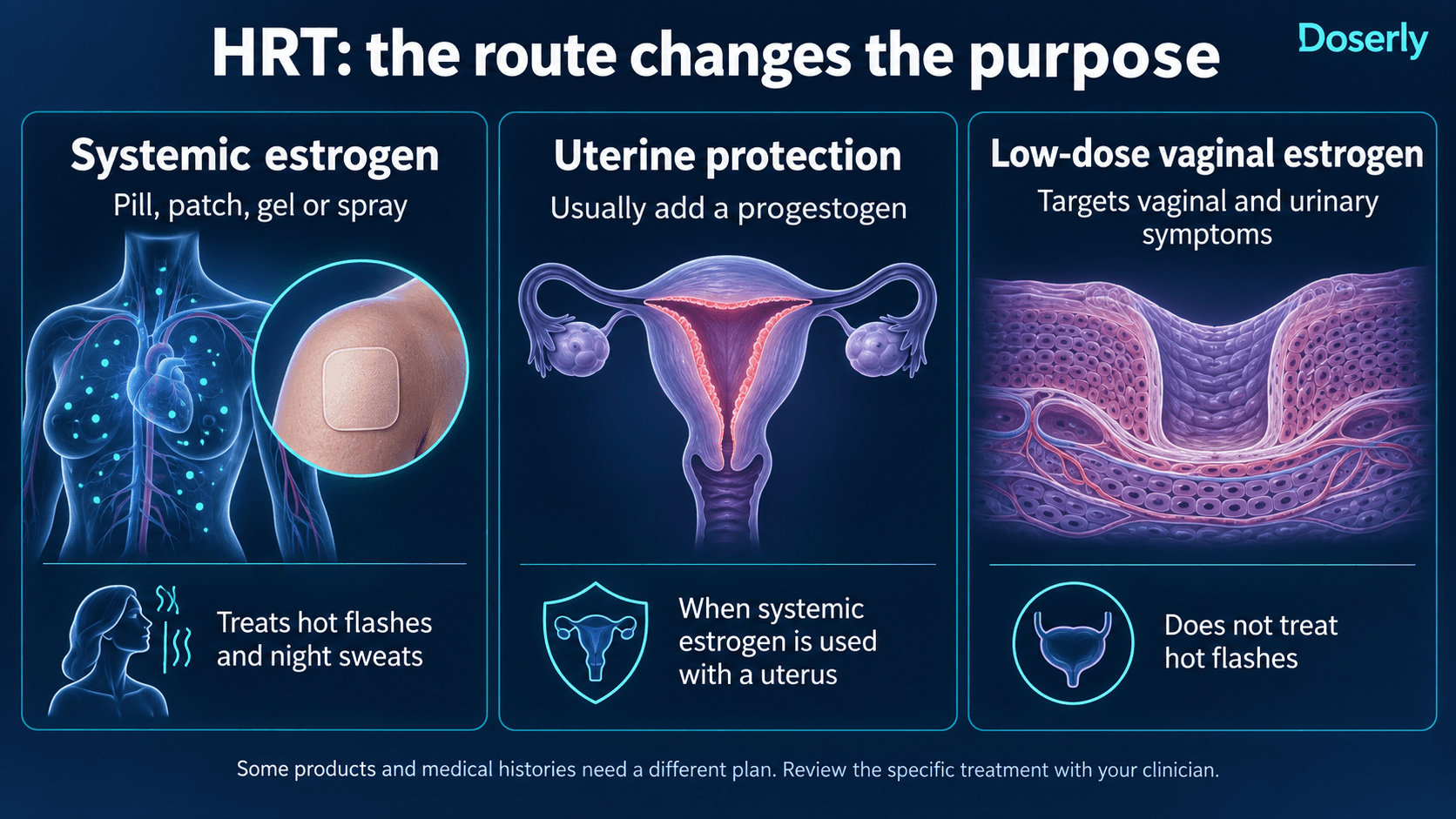
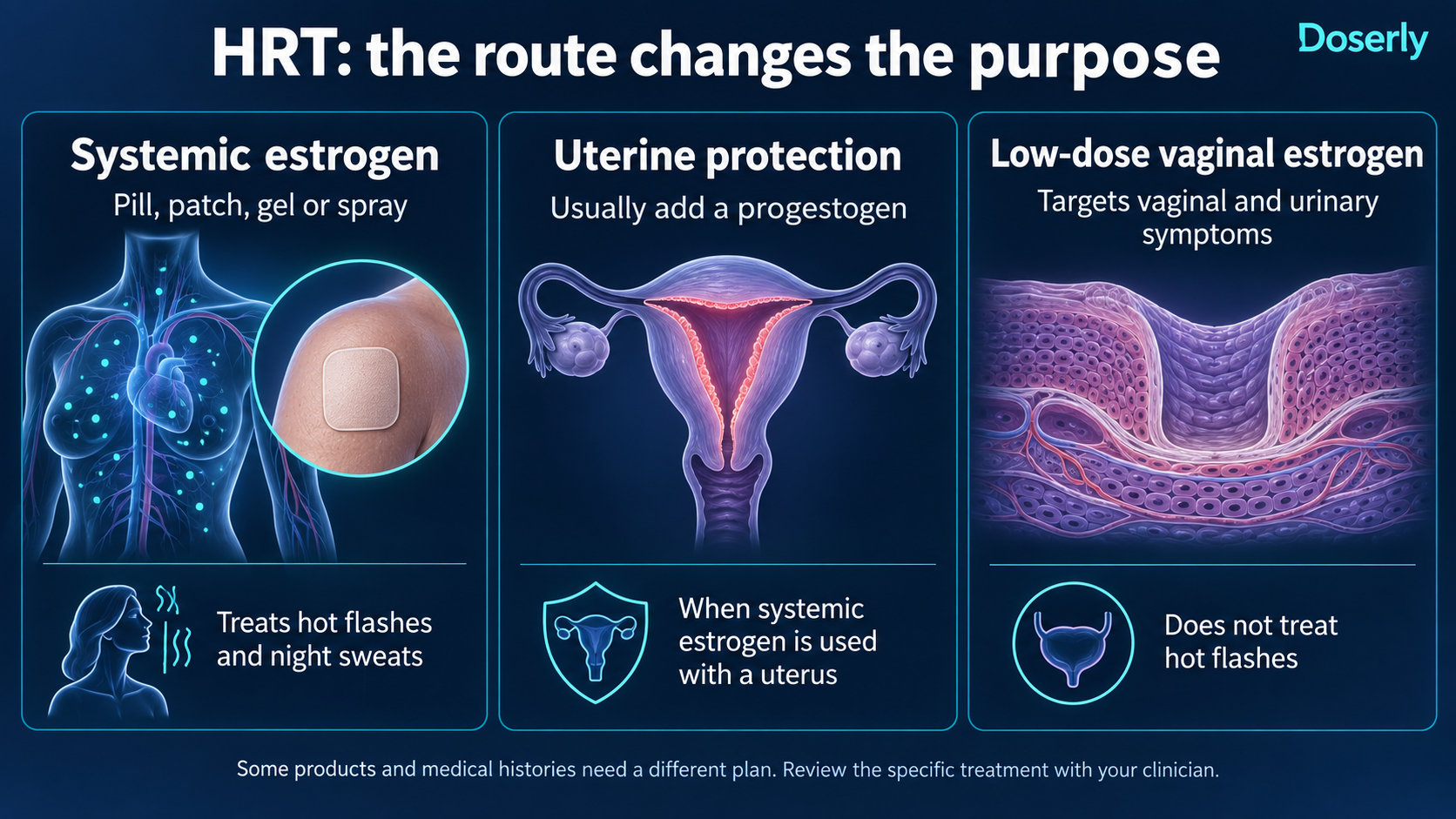
Systemic and low-dose local treatments serve different purposes. Systemic estrogen usually needs endometrial protection when a uterus is present; conjugated estrogens with bazedoxifene and tibolone are distinct approaches described in their guides. Patch placement must follow the specific product label.
NICE menopause recommendations.
Pharmacokinetics / Hormone Physiology
The Basics
If you swallow estrogen, your body has to absorb it through the gut and process it through the liver before the hormone reaches the rest of your circulation. If you use a patch, gel, or spray, the hormone enters through the skin and goes straight into the bloodstream. That is the simplest way to understand why transdermal HRT behaves differently.
For many women, the practical result is steadier symptom control with fewer route-related metabolic tradeoffs. Transdermal estrogen is often preferred when the goal is to avoid the triglyceride rise or clotting-protein changes more commonly linked to oral estrogen. It is also often easier to justify in women with migraine, gallbladder concerns, obesity, hypertension, or a background risk profile that makes clinicians want less hepatic exposure [1][3][4][7].
Patches, gels, and sprays are not interchangeable in daily life. Patches deliver hormone continuously over several days, but only if they adhere well. Gels and sprays depend on correct daily technique, drying time, and not washing the area too soon. Gels and sprays also introduce transfer precautions that patches largely avoid [8][9][10].
In general:
- Patches are the lowest-maintenance option when they stick reliably.
- Gels are useful when a patient wants daily titration without an adhesive.
- Sprays can work well for some people but require careful skin-contact precautions.
The Science
Transdermal estradiol enters the systemic circulation without portal first-pass metabolism, which reduces hepatic stimulation of coagulation factors and triglyceride-related changes compared with oral therapy [3][4][5][7]. Observational evidence pooled in a 2015 meta-analysis found oral estrogen carried higher risk than transdermal estrogen for first VTE and DVT, consistent with the biologic plausibility of lower hemostatic disturbance with skin delivery [5].
The metabolic distinction is not limited to clotting. A 2024 meta-analysis of randomized clinical trials found oral estrogen increased HDL more than transdermal estrogen, but it also increased triglycerides more, with an average triglyceride difference of about 19.82 mg/dL favoring transdermal therapy [7]. This is clinically relevant for women with baseline hypertriglyceridemia or a prior history of estrogen-associated triglyceride problems.
Label-level pharmacokinetic precautions differ by product:
- Patch: site rotation, waistline avoidance, and adequate skin contact are essential for consistent delivery [8].
- Gel: washing within 1 hour can reduce estradiol exposure by roughly 30% to 38% in the studied product; transfer risk exists until dry [9].
- Spray: forearm application, 2-minute drying, 1-hour no-wash interval, and avoidance of child or pet contact are emphasized [10].
Understanding pharmacology is useful. Tracking what you actually used, where you applied it, and when you changed it is what makes that information clinically useful. Doserly lets you log route-specific doses and application schedules so your prescriber can see what your real-world protocol looked like between visits.
If your symptoms fluctuate after a patch change, a brand switch, or a missed application, good records matter. The app helps you track timing, route, symptom patterns, and adherence in one place, which is especially helpful for transdermal regimens where technique affects results.
Research & Clinical Evidence
Transdermal HRT for Vasomotor Symptoms
The Basics
Transdermal HRT works well because it is still systemic estrogen. For hot flashes and night sweats, the route does not need to be oral to be effective. Patches, gels, and sprays can all reduce vasomotor symptoms if the dose is appropriate and the product is used correctly [1][2][8][9][10].
In clinical practice, the main question is usually not whether transdermal estrogen works, but whether it works reliably enough for a given person. Someone with repeated patch lift-off may do better on a gel. Someone who struggles with the daily routine of gel may do better on a twice-weekly patch. That is a route-implementation problem, not necessarily a failure of estrogen therapy itself.
The Science
Current guideline bodies continue to frame systemic hormone therapy as the most effective treatment for vasomotor symptoms, with route chosen according to risk profile, patient preference, and tolerability [1][2][3]. Smaller early-menopause trials and the broader modern hormone therapy literature support transdermal estradiol as an effective systemic route, particularly when the goal is symptom control with less hepatic metabolic effect than oral therapy.
Transdermal HRT and VTE / Stroke / Cardiometabolic Risk
The Basics
This is the section that makes transdermal HRT different from "just another way to take estrogen." If a woman has higher-than-average clot concerns, a history of migraine, high triglycerides, or several cardiovascular risk factors, clinicians often choose transdermal estrogen because the route appears safer than oral estrogen on these measures. That does not mean risk disappears. It means the route changes the balance [1][2][3][4].
The Science
The most consistent route-specific finding is lower thrombotic risk with transdermal estrogen than with oral estrogen. A 2015 systematic review found oral estrogen was associated with higher risk than transdermal estrogen for first VTE and DVT [5]. A large 2019 UK nested case-control study likewise found oral HRT increased VTE risk, whereas transdermal preparations were not associated with increased VTE in that dataset [6].
For stroke and broader cardiovascular outcomes, the evidence is less definitive than it is for VTE. The 2015 meta-analysis found only a possible stroke signal for oral vs transdermal estrogen from limited data, and no clear myocardial infarction difference [5]. The Menopause Society therefore uses cautious wording: transdermal routes and lower doses may decrease stroke risk, rather than stating that they definitively do [1].
Practical Evidence Gaps
The Basics
Many of the questions women care about most are not well answered by traditional trials. Are some generic patches stickier than others? Do some people absorb one gel much better than another? How much does swimming, sauna use, or sunscreen change real-world delivery? These questions matter, but the best evidence often comes from labels, pharmacology, and community experience rather than head-to-head trials.
The Science
Product labels document route-specific technique issues such as washing effects, transfer risk, site rotation, and interaction with other topicals [8][9][10]. However, the comparative evidence base for patch versus gel versus spray in usual care is much thinner than the oral-versus-transdermal evidence base. This is why administration technique, symptom tracking, and follow-up matter when switching among transdermal products.
Benefits & Therapeutic Effects
The Basics
The main reason to use transdermal HRT is simple: it can deliver systemic estrogen effectively while avoiding some of the disadvantages of taking estrogen by mouth. For many women, the first major benefit is reliable relief of hot flashes and night sweats. Once that happens, sleep, mood, daytime focus, and general functioning often improve as well.
The second major benefit is route fit. Transdermal therapy is often a better choice for women who have migraine, elevated triglycerides, gallbladder concerns, GI absorption problems, or a personal risk profile that makes clinicians uneasy about oral estrogen. In those cases, the benefit is not only symptom relief. It is getting symptom relief through a route that better matches the person sitting in front of you [1][2][3][4][7].
The third benefit is flexibility. If a patch irritates your skin, a gel or spray may still work. If a daily gel feels burdensome, a twice-weekly patch may be easier. That flexibility makes transdermal HRT a useful category, not just a single formulation.
The Science
Systemic transdermal estrogen retains the core established benefits of menopausal hormone therapy for vasomotor symptoms and bone protection [1][8][9][10]. The route-specific advantages are most evident in thrombotic and metabolic comparisons versus oral estrogen: lower observed VTE risk, less hepatic stimulation of clotting proteins, and less triglyceride rise [4][5][6][7].
NICE CKS specifically identifies transdermal preparations as appropriate where migraine, gallbladder disease, hypertriglyceridemia, GI absorption concerns, or elevated VTE risk are present [3]. That does not make the route superior for every woman, but it makes it especially attractive in the common clinical situations where oral therapy becomes less comfortable from a risk standpoint.
Risks, Side Effects & Safety
The Basics
Transdermal HRT is often safer than oral estrogen for clot and metabolic concerns, but it is still systemic estrogen. That means the major safety questions do not disappear. They shift.
The most common practical side effects are local: patch rash, itch, poor adhesion, visible marks, or frustration when the product does not stay on. With gels and sprays, the main route-specific problems are transfer to other people, washing the product off too soon, or feeling uncertain about whether the dose is really getting in. Community experience suggests these issues are common enough to influence whether a person stays on therapy, even when the hormone itself is working.
The serious risks remain the familiar estrogen risks: abnormal vaginal bleeding, clotting events, stroke, breast cancer considerations, liver disease, gallbladder disease, and the need for endometrial protection if the uterus is present. The route can improve the safety profile. It does not erase it [1][4][8][9][10].
The Science
The safest way to describe transdermal HRT is this:
- Lower VTE risk than oral estrogen is supported by observational evidence and guideline preference [1][2][4][5][6].
- A stroke advantage is plausible and may exist, but is less certain than the VTE advantage [1][5].
- Product labels still carry major estrogen precautions because direct randomized outcome data for each transdermal product do not exist, and WHI findings cannot be fully excluded for all routes [8][9][10].
Absolute-risk context matters. In the WHI estrogen-alone trial cited in product labeling, oral conjugated estrogen increased VTE from 22 to 30 cases per 10,000 women-years and increased stroke from 33 to 45 per 10,000 women-years in the overall 50 to 79 age range studied [8]. Those numbers come from oral conjugated estrogen, not transdermal estradiol, but they explain why every systemic estrogen plan still requires careful product-specific counseling.
Common side effects and route-specific safety issues include:
- Patch: redness, itching, dermatitis, edge lift, premature detachment [8]
- Gel: skin irritation, unintentional transfer, reduced exposure if washed too early, flammability until dry [9]
- Spray: secondary exposure to children or pets, forearm technique errors, flammability until dry [10]
- Systemic estrogen in any transdermal form: breast tenderness, headache, nausea, bloating, spotting or bleeding, especially early in therapy [8][9][10]
Being informed about risks matters. Tracking what actually happens on your regimen is what makes that information useful. Doserly lets you log side effects, bleeding changes, headaches, skin reactions, and missed doses so you and your clinician can see whether a problem is settling, worsening, or tied to a specific product change.
That is particularly helpful with transdermal HRT, where the question is often not "Is estrogen wrong for me?" but "Is this exact patch, gel, or spray working for me?" Good tracking helps answer that earlier.
Dosing & Treatment Protocols
The Basics
Dosing in transdermal HRT depends on the product, the symptom target, the stage of menopause, and whether you still have a uterus. As a general rule, clinicians start with the lowest effective dose and adjust based on symptom response and side effects [1][2][3].
Common patterns include:
- Twice-weekly estradiol patches
- Weekly estradiol patches
- Daily estradiol gels
- Daily estradiol sprays
If you have a uterus, estradiol alone is not enough for long-term systemic use. You need a progestogen strategy for endometrial protection unless your clinician has a documented reason to do something different. That may mean oral micronized progesterone, a combined patch in some markets, or an LNG-IUS depending on the regimen and jurisdiction [2][3].
The Science
Label examples are helpful but not interchangeable:
- DOTTI patch commonly starts at 0.0375 mg/day changed twice weekly for vasomotor symptoms [8].
- Estradiol gels are usually dosed once daily, often with a lower starting amount titrated upward as needed [9].
- Evamist spray is a once-daily forearm spray with product-specific priming and spray-count instructions [10].
Dose adjustment is clinical, not formulaic. Symptoms may recur during oral-to-transdermal switching if the initial patch or gel dose undershoots the prior oral exposure. A settling period of several weeks can occur after dose or route changes, so follow-up should look at symptom pattern, side effects, adherence, and application technique rather than a single day of response.
What to Expect / Timeline
Many women notice fewer hot flashes and night sweats within the first 2 to 4 weeks of effective systemic estrogen, but the full picture usually takes longer. Sleep, mood, and daytime steadiness often improve after the vasomotor symptoms do. If the first dose is too low, or if the product is not adhering or being absorbed reliably, improvement can be incomplete.
During the first 6 to 12 weeks, a few things are common and not always signs that the route is wrong:
- temporary symptom fluctuation after switching from oral to patch, or patch to gel
- spotting or bleeding during the first 6 months of systemic HRT, or within 3 months after a dose or product change
- local skin irritation while figuring out patch placement
- uncertainty during a manufacturer switch or shortage period
If symptoms are clearly worse after the first settling period, or bleeding continues past the expected early window, that is a reason to review the regimen rather than just "wait it out" indefinitely [2][3][8][9][10].
Timing Hypothesis / Menopause Window
The Basics
Transdermal HRT does not replace the usual timing principles of menopausal hormone therapy. The route may improve the safety profile, but age, time since menopause, and overall health still matter. Most modern guidance remains most comfortable with hormone therapy started in symptomatic women who are younger than 60 or within 10 years of menopause onset, assuming there is no contraindication [1][2][9].
The Science
The Menopause Society continues to recommend age- and timing-based risk stratification, with the benefit-risk ratio most favorable in healthy symptomatic women younger than 60 years and within 10 years of menopause onset [1]. Product labels for estradiol gel now also explicitly note that initiation timing can affect overall benefit-risk balance and advise considering treatment in women younger than 60 or within 10 years since menopause onset [9]. Route matters, but timing still frames the background cardiovascular and neurological context.
Interactions & Compatibility
Transdermal does not mean interaction-free. Estradiol remains a systemic hormone, and product labels still note metabolism can be affected by CYP3A4 inducers and inhibitors [8][9][10]. In practical terms, the biggest compatibility issues are often not classic drug-drug interactions but route-management issues:
- sunscreen or topicals can alter exposure for some gel products [9]
- washing too soon lowers gel or spray exposure [9][10]
- occlusive clothing or waistbands can dislodge patches [8]
- a second product may still be needed for local GSM symptoms, such as vaginal estrogen [3]
- thyroid replacement users may need monitoring because estrogen can affect thyroid-binding globulin [8][9]
For women with a uterus, "compatibility" also means compatibility with an endometrial protection plan. Route choice for estrogen does not remove that requirement.
Decision-Making Framework
Transdermal HRT often makes the most sense when the answer to one of these questions is yes:
- Do you need systemic estrogen but want to minimize oral first-pass hepatic effects?
- Do you have migraine, especially if hormonal fluctuations trigger it?
- Are triglycerides, gallbladder issues, or GI absorption a concern?
- Do you have obesity or other VTE risk factors that make oral estrogen less attractive?
- Did you feel poorly on oral estrogen or have troublesome oral side effects?
- Do you want a steadier delivery pattern rather than a daily pill?
It may be a less comfortable fit when:
- you have severe adhesive allergy and cannot tolerate patches
- your routine makes transfer precautions difficult for gels or sprays
- you have a strong history of forgetting daily applications
- you have an estrogen contraindication, where route does not solve the underlying problem
The best route is usually the one that matches both your risk profile and your ability to use the product correctly.
Administration & Practical Guide
Patch
- Apply to clean, dry skin of the lower abdomen, buttocks, or other label-approved trunk area depending on the product [8].
- Avoid breasts, irritated skin, oily skin, and the waistband area.
- Rotate sites and do not reuse the same spot too quickly.
- Press firmly for about 10 seconds, especially around the edges.
- If the patch falls off, reapply or replace according to the label and continue the original schedule.
Gel
- Apply exactly to the product-approved body area; common products use alternating upper thighs [9].
- Let dry before dressing.
- Do not wash the area for at least 1 hour.
- Wash hands after use.
- Avoid direct skin contact with other people until dry; cover the site if needed.
Spray
- Apply to the inner forearm using the product-specific applicator [10].
- Allow at least 2 minutes to dry before covering and 1 hour before washing.
- Avoid transfer to children, adults, or pets.
- Do not rub the product in unless the label says to.
Missed-dose practicalities
- Patch: replace as soon as remembered and resume the established schedule [8].
- Gel or spray: follow product instructions and ask your prescriber or pharmacist if you are unsure; doubling later is not a universal rule.
Travel and routine
- Pack extra patches if you are swimming, sweating heavily, or traveling long enough that an adhesion failure would leave you short.
- Keep gels and sprays away from flame until dry and store at room temperature per label [9][10].
- If one transdermal format fails, that does not mean all transdermal therapy has failed.
Knowing how to use transdermal HRT correctly is half the battle. Remembering when to change a patch, which side you used last, or whether you washed too soon is where many regimens fall apart. Doserly helps by turning those steps into a routine with reminders, confirmations, and a visible history.
That is especially useful for twice-weekly patches and daily topical formats, where timing drift can look like "poor absorption" when it is really an adherence pattern. The app reduces that ambiguity.
Monitoring & Lab Work
Timing
Before starting
- What to review
- Contraindications, VTE/stroke history, migraine pattern, bleeding history, breast screening status, BP, medication list
- Why it matters
- Determines whether transdermal route is appropriate and what precautions are needed
Timing
3-month review
- What to review
- Hot flash response, sleep, mood, bleeding, skin reactions, adherence, product fit
- Why it matters
- NICE recommends early efficacy and tolerability review [2]
Timing
Ongoing annual review
- What to review
- Ongoing need, lowest effective dose, breast screening, cardiovascular changes, bleeding status
- Why it matters
- Confirms continued benefit-risk balance
Routine estradiol or FSH testing is usually not needed for standard menopausal symptom management. Product labeling for estradiol gel specifically notes that FSH and estradiol levels are not useful in managing moderate to severe vasomotor symptoms [9]. That said, clinicians may occasionally check levels when there is a specific concern about non-absorption, unusual symptoms, or off-label higher-dose regimens.
Any vaginal bleeding after the early adjustment window deserves attention. In women with a uterus, persistent or recurring bleeding is a signal to review both the estrogen and the endometrial protection plan.
Complementary Approaches & Lifestyle
Transdermal HRT works best when it is part of a broader menopause plan rather than the entire plan.
Helpful additions commonly include:
- resistance training and impact exercise for bone and muscle support
- cardiovascular exercise for metabolic and mood health
- adequate protein intake and calcium/vitamin D sufficiency
- sleep hygiene and temperature-control strategies while symptoms are still settling
- CBT-informed coping strategies for anxiety, insomnia, and symptom hypervigilance
- vaginal estrogen if GSM symptoms persist despite systemic therapy [1][3]
For patch users, simple skin-care discipline helps: apply to clean, dry, lotion-free skin and avoid improvising elaborate hacks before checking product instructions. For gel and spray users, build the application into a predictable part of the morning or evening routine so washing, dressing, and contact precautions are easier to maintain.
Stopping HRT / Discontinuation
There is no universal age or duration at which transdermal HRT must be stopped. The right time to taper depends on why you are using it, how much it helps, what your risk profile looks like now, and whether symptoms recur when you reduce it [1][2].
NICE advises offering a choice between gradual reduction and immediate stopping, explaining that tapering may reduce short-term recurrence but does not clearly change long-term recurrence [2]. In real-world transdermal practice, tapering often means stepping down patch strength, reducing gel dose, or decreasing spray count over time.
If discontinuation is forced by skin intolerance, shortage, cost, or transfer concerns, the better question is often not "Should I stop estrogen?" but "Should I switch route or product family?" For many women, a different transdermal format or a clinician-guided oral alternative is a more useful next step than abrupt abandonment.
Special Populations & Situations
Migraine with or without aura
Transdermal estrogen is commonly preferred because it provides steadier delivery and avoids the oral route that many clinicians consider less desirable in migraine-prone patients [3].
Elevated VTE risk or obesity
Transdermal estrogen is generally preferred over oral estrogen when systemic HRT is still being considered, but specialist input is appropriate for strong family history, inherited thrombophilia, or prior clotting events [2][3][4].
Hypertriglyceridemia or gallbladder concerns
Transdermal therapy is often favored because it causes less triglyceride rise than oral estrogen and avoids first-pass hepatic exposure [3][7].
GI disorders or variable oral absorption
Patch, gel, or spray can be especially helpful when oral absorption is unreliable or oral therapy causes bothersome GI effects [3].
Premature ovarian insufficiency and early menopause
Hormone therapy is usually treated more like physiologic replacement than elective symptom treatment, and transdermal estradiol can be an excellent route when systemic estrogen is indicated [1].
Surgical menopause
These patients often need systemic estrogen promptly because symptoms can be abrupt and intense. Transdermal therapy is commonly used when rapid symptom control is needed with route flexibility.
Breast cancer survivors
Systemic transdermal HRT is usually contraindicated unless specialist oncology and menopause teams judge a narrow exception appropriate. Route does not neutralize systemic estrogen concerns.
Regulatory, Insurance & International
In the United States, transdermal estradiol products are FDA-regulated prescription drugs with product-specific labeling for patches, gels, and sprays [8][9][10]. Coverage is inconsistent: some insurers prefer generics, some require substitution, and real-world users frequently report that manufacturer changes affect tolerability and confidence more than clinicians expect.
In the United Kingdom, NICE explicitly treats transdermal HRT as a standard route and recommends it for people with increased VTE risk [2][3]. In practice, UK menopause care commonly uses estradiol patches, gels, and sprays, with product choice shaped by NHS formularies, supply, and clinician familiarity.
Across Canada, Australia, and parts of Europe, transdermal estradiol is also a routine menopause option, but product names, subsidy rules, and preferred combined regimens vary by jurisdiction. Availability can change faster than guidelines do, so product-level formulary checks matter more than assumptions.
As of September 13, 2026, U.S. transdermal labeling still shows a product-specific transition in risk communication. Divigel is on FDA’s list of the first six products with updated prescribing information, while estradiol patches were not part of that first batch. Patients should be counselled using the current label for the exact product plus current menopause guidance, not either one in isolation [8][9].
FAQ
Does transdermal HRT mean patch only?
No. It includes patches, gels, and sprays that deliver estrogen through the skin [2][3].
Is transdermal HRT safer than oral estrogen?
It is generally considered more favorable for VTE risk and triglycerides, but it is not risk-free and still requires medical supervision [1][4][5][6][7].
Do I still need progesterone with an estrogen patch?
Yes, if you have a uterus, you usually still need endometrial protection [2][3][8].
What if my patch keeps falling off?
That is a product-fit problem, not proof that transdermal HRT cannot work for you. Another patch brand, a gel, or a spray may be better.
Are gels and sprays weaker than patches?
Not necessarily. They are different delivery systems with different instructions, not automatically lower-potency options.
Can I shower or swim with a patch?
Often yes, but product instructions matter, and poor placement can still cause lift-off [8].
Can I use sunscreen over estrogen gel or spray?
Be careful. Some topical products can alter absorption; check the product insert [9].
Why did I feel worse right after switching routes?
Short-term fluctuation is common during dose or route changes. If it persists beyond the adjustment window, review the regimen.
Do clinicians need blood tests to see whether my transdermal HRT is working?
Usually no. Symptom response, bleeding pattern, and tolerability are more useful in routine care [9].
Who tends to benefit most from transdermal estrogen?
Women who need systemic symptom relief but want to avoid oral first-pass effects, especially those with migraine, hypertriglyceridemia, gallbladder concerns, GI issues, or elevated VTE risk factors [1][2][3].
Myth vs. Fact
Myth: Transdermal HRT is automatically safe for everyone.
Fact: It often has a better risk profile than oral estrogen for clot and metabolic concerns, but standard estrogen contraindications and monitoring still apply [1][4][8][9][10].
Myth: If a patch fails, transdermal HRT has failed.
Fact: Patch adhesion failure does not predict gel or spray failure.
Myth: You do not need progesterone if your estrogen is transdermal.
Fact: If you have a uterus, route does not remove the need for endometrial protection [2][3][8].
Myth: Transdermal estrogen eliminates all stroke and clot concerns.
Fact: The VTE evidence is favorable, but risk is reduced, not abolished, and stroke evidence is less definitive [1][5][6].
Myth: Patches, gels, and sprays are basically interchangeable.
Fact: They differ in dosing frequency, technique, transfer precautions, and real-world usability [8][9][10].
Myth: If symptoms return after a brand switch, it must be psychological.
Fact: Manufacturer switches can affect adhesion, skin tolerance, and application experience for some patients, even when formal comparative data are sparse.
Myth: Transdermal HRT is only for high-risk women.
Fact: It is a routine first-line route for many average-risk women as well [1][2][3].
Myth: Blood levels are always needed to personalize transdermal dosing.
Fact: Routine estradiol and FSH testing are usually not needed for standard menopause symptom treatment [9].
Sources & References
[1] The North American Menopause Society. The 2022 Hormone Therapy Position Statement of The North American Menopause Society. Released July 7, 2022.
[2] National Institute for Health and Care Excellence. Menopause: identification and management (NG23). Published November 12, 2015; last updated April 15, 2026. https://www.nice.org.uk/guidance/ng23.
[3] NICE Clinical Knowledge Summaries. Menopause: hormone replacement therapy prescribing information. Accessed March 25, 2026.
[4] American College of Obstetricians and Gynecologists. Postmenopausal Estrogen Therapy: Route of Administration and Risk of Venous Thromboembolism. Committee Opinion No. 556. Reaffirmed 2024.
[5] Mohammed K, Abu Dabrh AM, Benkhadra K, et al. Oral vs Transdermal Estrogen Therapy and Vascular Events: A Systematic Review and Meta-Analysis. J Clin Endocrinol Metab. 2015;100:4012-4020.
[6] Vinogradova Y, Coupland C, Hippisley-Cox J. Use of hormone replacement therapy and risk of venous thromboembolism: nested case-control studies using the QResearch and CPRD databases. BMJ. 2019;364:k4810.
[7] Alzahrani H, et al. Efficacy of oral versus transdermal estrogen therapy on cardiovascular and lipid parameters among postmenopausal women: a systematic review and meta-analysis of randomized clinical trials. Menopause. 2024.
[8] DailyMed. DOTTI (estradiol transdermal system) prescribing information. Revised May 2024.
[9] DailyMed. Estradiol gel 0.1% prescribing information. Revised February 2026.
[10] DailyMed. EVAMIST (estradiol transdermal spray) prescribing information. Revised October 2024.
Related Guides & Cross-Links
Same Category
- Getting Started with HRT -
/hrt-guides/getting-started-with-hrt - Vaginal Estrogen Therapy -
/hrt-guides/vaginal-estrogen-therapy - Compounded & Bioidentical HRT -
/hrt-guides/compounded-bioidentical-hrt
Related Medication Guides
- 17B-Estradiol (Bioidentical) -
/hrt-guides/estradiol - Micronized Progesterone -
/hrt-guides/micronized-progesterone - Estradiol + Progesterone (Bijuva) -
/hrt-guides/estradiol-progesterone-bijuva - Estradiol + Norethindrone Acetate (Activella) -
/hrt-guides/estradiol-norethindrone-activella
Related Conditions
- Perimenopause -
/hrt-guides/perimenopause - Menopause -
/hrt-guides/menopause - Surgical Menopause -
/hrt-guides/surgical-menopause - Premature Ovarian Insufficiency -
/hrt-guides/premature-ovarian-insufficiency
Related Educational / Symptom Guides
- HRT Monitoring & Lab Work Guide -
/hrt-guides/hrt-monitoring-lab-work - Stopping & Tapering HRT -
/hrt-guides/stopping-tapering-hrt - Menopause, Heart & Bone Health -
/hrt-guides/menopause-heart-bone-health - Sexual Health During Menopause -
/hrt-guides/menopause-sexual-health