
Vaginal Estrogen Therapy: GSM Benefits and Safety
On this page
Quick Reference Card
Attribute
Definition
- Value
- Local estrogen treatment delivered into or around the vagina to treat genitourinary syndrome of menopause (GSM), including dryness, irritation, dyspareunia, and some urinary symptoms
Attribute
Primary FDA-Labeled Targets
- Value
- Atrophic vaginitis / vulvovaginal atrophy, dyspareunia due to menopause, lower urinary tract symptoms related to postmenopausal atrophy
Attribute
Common U.S. Product Forms
- Value
- Estradiol vaginal insert/tablet, estradiol vaginal ring, estradiol vaginal cream, conjugated estrogen vaginal cream
Attribute
Typical Starting Pattern
- Value
- Often a short loading phase, then lower-frequency maintenance; exact schedule depends on product and prescriber
Attribute
Typical Maintenance Pattern
- Value
- Twice weekly for inserts/tablets, every 90 days for low-dose ring, individualized lower-frequency maintenance for creams
Attribute
Prescription Required
- Value
- Yes in the United States
Attribute
Need for Progestogen
- Value
- Generally not required with low-dose vaginal estrogen used for GSM, though unexpected bleeding still requires evaluation
Attribute
Key Monitoring
- Value
- Symptom response, local irritation, bleeding, recurrent infection pattern, breast cancer history context, formulation tolerance
Attribute
Best-Supported Symptom Domain
- Value
- Genitourinary health (dryness, irritation, dyspareunia, urinary urgency, recurrent UTI prevention support)
Attribute
Major Clinical Distinction
- Value
- Low-dose local therapy is not the same as systemic menopausal hormone therapy; U.S. label warnings are now product-specific, and Estring was among the first products with 2026 FDA-approved updated prescribing information
Attribute
When to Seek Prompt Medical Care
- Value
- New postmenopausal bleeding, severe pelvic pain, breast symptoms needing evaluation, suspected clot/stroke symptoms, or severe irritation/infection symptoms
Overview / What Is Vaginal Estrogen Therapy?
The Basics
Vaginal estrogen therapy is one of the most established treatments for the vaginal and urinary changes that often show up during perimenopause and after menopause. It is used when falling estrogen levels leave the tissues of the vagina, vulva, urethra, and lower bladder thinner, drier, less elastic, and more easily irritated. That cluster of changes is now usually called genitourinary syndrome of menopause, or GSM.
What makes vaginal estrogen different from a patch, pill, or gel is the goal. Systemic hormone therapy is designed to move estrogen through the bloodstream and treat whole-body symptoms such as hot flashes. Vaginal estrogen is usually meant to work mainly where it is placed. The practical result is that it is often used for people who do not need systemic hormone therapy at all, and it can also be added when systemic therapy is already helping hot flashes but not fixing vaginal dryness, painful sex, bladder irritation, or recurrent UTIs.
This matters because GSM is not a temporary nuisance that usually resolves on its own. Unlike hot flashes, these symptoms often become more persistent with time unless they are treated. Many people try lubricants or moisturizers first, which is reasonable for mild symptoms. But when symptoms are moderate, recurrent, or clearly affecting quality of life, low-dose vaginal estrogen is one of the best-supported prescription options available. HRT requires medical supervision, but vaginal estrogen is often the part of menopause care that most directly changes day-to-day comfort, urinary confidence, and sexual function.
The Science
The 2020 GSM position statement from The North American Menopause Society and the 2025 AUA/SUFU/AUGS guideline both place local low-dose vaginal estrogen at the center of evidence-based GSM management, especially for dryness, vulvovaginal discomfort, dyspareunia, and recurrent UTI risk reduction in appropriately selected patients [1][3]. The 2022 NAMS hormone therapy position statement further distinguishes low-dose vaginal estrogen from systemic menopausal hormone therapy, recommending it for bothersome GSM symptoms not relieved with over-the-counter measures when systemic hormone therapy is not otherwise indicated [2].
Vaginal estrogen therapy is not a single product. In U.S. practice it includes estradiol tablets or inserts, a low-dose estradiol ring worn continuously for 90 days, estradiol creams, and conjugated estrogen cream [8][9][10]. Those products differ in convenience, leakage, external-vulvar reach, serum exposure patterns, and cost burden, but they share the same basic clinical purpose: restoring estrogen-responsive tissue in the lower genitourinary tract.
The main reason the topic remains confusing is that regulatory labels and specialty guidance have not always moved at the same pace. FDA approved updated prescribing information for Estring in February 2026 as part of the first six menopausal hormone therapy label updates, while other vaginal estrogen products may still carry older systemic-estrogen warning language until their own labels change. That mismatch does not mean labels are meaningless. It means the risk conversation has to use the current label for the specific product plus the evidence that low-dose local vaginal therapy is clinically distinct from systemic therapy [1][2][7].
Medical / Chemical Identity
Property
Treatment Type
- Value
- Local menopausal hormone therapy / local estrogen therapy
Property
Main Active Hormones Used
- Value
- Estradiol; conjugated estrogens
Property
Major Target Tissues
- Value
- Vaginal epithelium, vulva, urethra, bladder trigone, periurethral tissue
Property
U.S. Low-Dose Insert Example
- Value
- Estradiol 10 mcg vaginal insert/tablet
Property
U.S. Low-Dose Ring Example
- Value
- Estradiol vaginal ring releasing approximately 7.5 mcg/day over 90 days
Property
Cream Examples
- Value
- Estradiol 0.01% vaginal cream; conjugated estrogen 0.625 mg/g vaginal cream
Property
First U.S. Approval Era
- Value
- Vaginal estrogen products have been available in the U.S. for decades; current low-dose insert labeling traces to 1999 approval data [8]
Property
Core Mechanistic Aim
- Value
- Reverse estrogen-deficiency changes in the genitourinary tract rather than provide full-body estrogen replacement
Property
Route
- Value
- Vaginal only; some clinicians also direct limited vulvar/periurethral application with cream when external symptoms are prominent
Property
U.S. Labeling Theme
U.S. product-form summary:
- Insert / tablet: lowest-mess option for many patients; useful when the main target is internal vaginal tissue.
- Ring: continuous low-dose delivery over 3 months; often preferred for convenience and steady routine.
- Cream: most flexible for dosing and for external vulvar/introital application, but also the messiest and most variable in real-world use.
Mechanism of Action / Pathophysiology
The Basics
Estrogen helps keep the vaginal and lower urinary tissues thick, elastic, well-lubricated, and resistant to friction. When estrogen falls, those tissues become thinner and more fragile. The normal vaginal environment also becomes less acidic, which can change the microbiome and make irritation and urinary infections more likely. Vaginal estrogen works by bringing estrogen back to those tissues locally so they can rebuild some of their former structure and function.
In practical terms, that means the lining becomes less raw, natural lubrication improves, the tissue is less likely to tear, sex becomes less painful, and the urethra and bladder outlet may become less irritable. That is why people sometimes notice benefits not just in vaginal dryness but in urinary urgency, burning, and recurrent UTIs as well.
The Science
The vagina, vulva, urethra, and bladder trigone are estrogen-responsive tissues. In hypoestrogenic states, the vaginal epithelium thins, glycogen content falls, lactobacilli decline, vaginal pH rises, and tissue resilience worsens [1][3]. Local estrogen reverses part of this process by improving epithelial maturation, lowering vaginal pH, increasing superficial cells, and restoring a tissue environment that better supports comfort and barrier function [1][7].
This is why symptom domains that seem different on the surface often move together. A woman may describe dryness, recurrent fissures, pain with penetration, post-coital burning, urinary frequency, and more frequent UTIs. Biologically those symptoms are linked to the same estrogen-deficiency state in the lower genitourinary tract [1][3]. Local estrogen therapy is not acting like a lubricant alone. It is altering the tissue biology that made lubrication insufficient in the first place.
The amount of systemic exposure depends on the product, dose, timing, and condition of the vaginal tissue. Early absorption can be higher when the tissue is markedly atrophic, then fall as the epithelium thickens with treatment [7][9]. That is one reason local therapy can still produce measurable serum changes in some circumstances while remaining clinically distinct from systemic estrogen therapy.
Visual guide
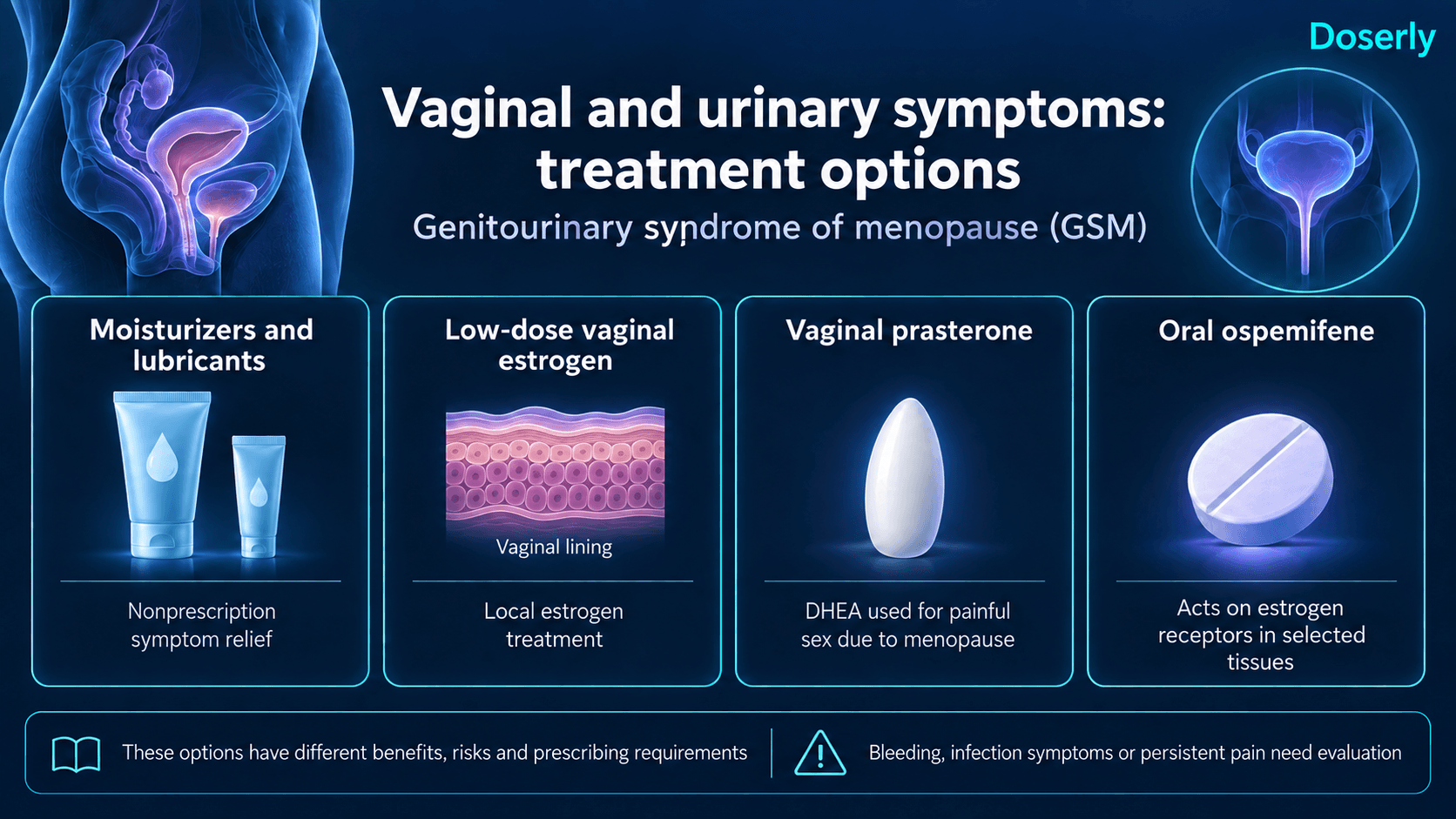
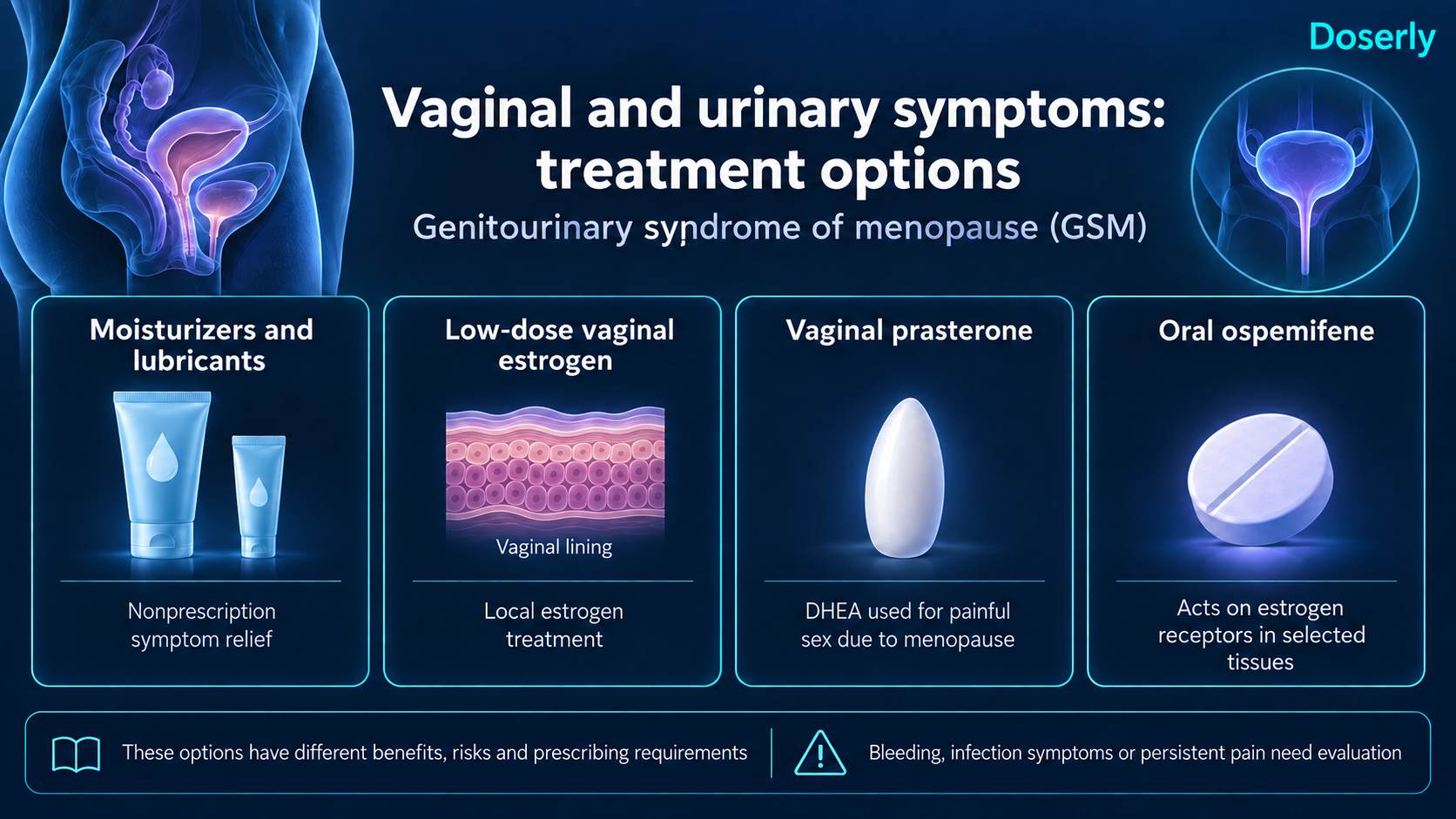
The options differ in indication, evidence and contraindications. Prasterone is a vaginal hormone precursor; ospemifene is an oral estrogen-receptor modulator. The diagram is not a head-to-head efficacy comparison or a recommendation to combine treatments.
Pharmacokinetics / Hormone Physiology
The Basics
The safest way to think about vaginal estrogen absorption is this: low-dose products are usually low-systemic, not zero-systemic. Small amounts can enter the bloodstream, but the degree varies a lot by product. Low-dose inserts and the low-dose ring tend to produce the most predictable, lower systemic exposure. Creams can be more variable because the actual amount used, where it is placed, and how the tissue absorbs it all matter.
At the start of treatment, especially when tissue is severely atrophic, absorption may be a bit higher. As the tissue becomes healthier, exposure often becomes steadier and lower. This is one reason clinicians often speak differently about ultra-low-dose tablets or rings versus more generously dosed creams.
The Science
Santen's pharmacokinetic review concluded that low-dose vaginal estrogen regimens limit but do not fully eliminate systemic absorption, and that dose, preparation, tissue condition, and timing all materially influence serum estradiol patterns [7]. In that review, low-dose therapy was operationally represented by the 7.5-mcg vaginal ring and 10-mcg tablet; chronic use generally stayed within the postmenopausal range, whereas intermediate and higher vaginal doses could approach or exceed 20 pg/mL [7].
DailyMed labeling for estradiol vaginal inserts explicitly states that systemic absorption occurs, even though the product is intended for vaginal use only [8]. The usual labeled schedule is one insert daily for 2 weeks followed by one insert twice weekly [8]. Estring labeling describes a ring containing 2 mg estradiol that releases approximately 7.5 mcg per 24 hours over 90 days. After insertion there is an early serum estradiol rise, then levels drop near baseline and remain within a low postmenopausal range during continued use [9].
Creams are pharmacologically useful but less tidy from a PK standpoint. Premarin vaginal cream labeling also notes systemic absorption and instructs clinicians to consider systemic-estrogen warnings in counseling [10]. That does not prove that cream carries the same real-world risk profile as oral estrogen. It does mean that cream dosing, product choice, and patient context deserve more caution and more individualized counseling than many "it's only local" conversations provide.
Research & Clinical Evidence
Vaginal Dryness, Irritation, and Dyspareunia
The Basics
This is the area where vaginal estrogen has the strongest and most consistent evidence. If someone has menopause-related dryness, burning, or pain with sex that is not improving with lubricants and moisturizers alone, vaginal estrogen is one of the most evidence-backed next steps.
The Science
The 2020 NAMS GSM statement and the 2025 AUA/SUFU/AUGS guideline both identify local low-dose vaginal estrogen as a core effective treatment for moderate to severe GSM symptoms [1][3]. Across trials and product labels, improvement is typically demonstrated by better symptom scores, lower vaginal pH, and a shift toward more mature epithelial cells [1][8][9][10]. The evidence base is strongest for dryness, irritation, and dyspareunia; evidence is weaker for making one vaginal estrogen formulation the clear winner over every other [3].
Urinary Symptoms and Recurrent UTIs
The Basics
Many people are surprised that a "vaginal" therapy can help the bladder and urethra. But urethral and periurethral tissues are also estrogen-responsive, so urinary urgency, burning, and recurrent UTI patterns may improve when local estrogen deficiency is treated.
The Science
The 2025 AUA/SUFU/AUGS guideline specifically supports local low-dose vaginal estrogen for GSM and recommends it to reduce future recurrent UTI risk in the appropriate clinical setting [3]. The biologic rationale is plausible and consistent: lower vaginal pH, improved epithelial integrity, and a more protective microbiome may reduce colonization by uropathogens [1][3]. Urinary urgency, dysuria, and recurrent UTI history should be tracked separately from vaginal dryness and pain because they may respond on different timelines and may have other causes.
Product Form, Adherence, and Patient Preference
The Basics
Many failures of vaginal estrogen are not true pharmacologic failures. They are product-fit failures. Some people hate the mess of cream. Others dislike inserting a ring. Some find tablets too dry or too limited for external symptoms. The "best" product is often the one a patient can comfortably continue.
The Science
Label and comparative trial data do not show a universal efficacy winner across ring, insert, and cream, but they do show important differences in use experience [9][10]. Estring label data reported similar efficacy to conjugated estrogen cream with better comfort and ease ratings in the cited studies [9]. Product choice should consider severity, insertion comfort, messiness, dosing frequency, cost, availability, and whether a fixed-dose ring, insert, tablet, or flexible cream best fits the patient.
Special Populations: Breast Cancer Survivors
The Basics
This is the most emotionally loaded part of vaginal estrogen counseling. The short version is not "always safe" and not "absolutely forbidden." The current evidence base supports careful, individualized use in some patients after nonhormonal measures fail, especially when symptoms are severe, but the decision should be shared and sometimes multidisciplinary.
The Science
ACOG states that after failure of nonhormonal approaches, low-dose vaginal estrogen may be used in individuals with a history of breast cancer, including those taking tamoxifen, while aromatase inhibitor users should involve the patient, gynecologist, and oncologist in shared decision-making [4]. McVicker et al. found no increase in breast cancer-specific mortality in a pooled cohort of 49,237 females with breast cancer who used vaginal estrogen therapy after diagnosis [5]. The Danish observational cohort likewise did not show an overall increase in recurrence or mortality with vaginal estrogen therapy, but it did find a higher recurrence signal in the subgroup using aromatase inhibitors [6]. This is reassuring evidence, but it is still observational rather than randomized.
Benefits & Therapeutic Effects
The Basics
The main benefit of vaginal estrogen therapy is not "more estrogen" in a generic sense. It is better-functioning genitourinary tissue. For many patients that translates into less dryness, less burning, easier penetration, less tearing, less post-sex pain, and better comfort sitting, walking, wiping, or exercising. Some also notice less urinary urgency, less burning with urination, and fewer recurrent UTI cycles.
Another practical benefit is that vaginal estrogen can solve a problem that systemic HRT sometimes leaves behind. A person may have fewer hot flashes on a patch or pill and still feel raw, dry, or repeatedly UTI-prone. Vaginal estrogen is often the missing local treatment in that situation.
The Science
The best-established therapeutic effects are improvement in vulvovaginal dryness, discomfort, irritation, dyspareunia, vaginal pH, and objective epithelial maturation [1][3][8][9][10]. Urinary symptom improvement is more heterogeneous, but the 2025 guideline gives enough weight to the evidence to recommend local low-dose vaginal estrogen for recurrent UTI reduction in the relevant GSM population [3]. That makes vaginal estrogen unusual among menopause treatments: it is a therapy that improves both comfort and tissue biology, and it may reduce downstream urinary complications.
Benefits are not uniform across product forms. Cream may better reach external vulvar tissue. Inserts are often cleaner and simpler. Rings reduce the burden of remembering a weekly routine. These are practical rather than theoretical differences, but they often determine who actually experiences sustained benefit.
Benefits don't always arrive all at once. Some symptoms respond in days, others take weeks or months to shift. Doserly's analytics help you see the full picture by correlating your treatment timeline with changes across every symptom you're tracking, surfacing patterns that are easy to miss when you're living through the transition day by day.
The app can help you understand which benefits came first, whether improvements plateau or continue building, and how different aspects of your health connect to each other. When you can see the trajectory clearly, it's easier to stay the course through the adjustment period and to share meaningful updates with your provider.
Risks, Side Effects & Safety
The Basics
The safest accurate message is this: low-dose vaginal estrogen is usually much lower-risk than systemic oral estrogen for most of the problems people fear most, but it is not consequence-free and it is not self-prescribing territory.
Common side effects are usually local: irritation, itching, discharge, spotting, or the feeling that the product is messy or not staying where it should. A minority of users report breast tenderness, headaches, bloating, or palpitations. These do not happen to most patients, but they happen often enough that they should not be dismissed.
The most important safety rule is simple: any new postmenopausal bleeding needs evaluation, whether or not you are using vaginal estrogen. The second is that breast-cancer history, especially aromatase inhibitor use, changes the conversation and should not be managed casually online. The third is that boxed warnings on labels mostly come from systemic oral estrogen data, so they must be interpreted in context rather than pasted onto low-dose local therapy without thought.
The Science
Low-dose local therapy differs from systemic estrogen in both pharmacokinetics and outcome evidence. Specialty guidance from NAMS and AUA states that when low-dose vaginal estrogen is used for GSM, a progestogen is generally not indicated, and routine endometrial surveillance is not recommended solely because of that use [1][3]. The 2019 systematic evidence review found no supported increase in endometrial hyperplasia or cancer with low-dose vaginal estrogens and reported endometrial cancer and hyperplasia rates of 0.03% and 0.4% across reviewed randomized trials, though long-term data remain limited [11].
Breast-cancer counseling is nuanced rather than binary. ACOG allows low-dose vaginal estrogen after failure of nonhormonal options, including in tamoxifen users, with oncologist-involved shared decision-making for aromatase inhibitor users [4]. Observational outcome data are increasingly reassuring: McVicker et al. found no increase in breast-cancer-specific mortality [5]. But the Danish cohort found a recurrence signal in the aromatase-inhibitor subgroup, even though mortality did not rise [6]. That means the right sentence is "conditional and individualized," not "proven universally safe."
For thrombotic and cardiovascular outcomes, the key issue is route. WHI oral conjugated equine estrogen data showed 12 additional strokes and 8 additional DVTs per 10,000 women-years in the estrogen-alone arm relative to placebo, but those were systemic oral data, not low-dose local-use data [2][8]. Low-dose local therapy has not demonstrated the same level of thrombotic signal, and pharmacokinetic studies support far lower systemic exposure for ultra-low-dose ring and insert products than for systemic oral therapy [7][9]. That is why most menopause specialists do not treat low-dose vaginal estrogen as risk-equivalent to oral systemic HRT.
Understanding your personal risk profile isn't a one-time calculation — it evolves as your treatment progresses. Doserly helps you see the bigger picture by analyzing side effect patterns over time, showing whether issues are resolving, persisting, or emerging as your body adjusts to therapy.
The app's analytics can reveal connections between side effects and specific aspects of your protocol — like whether symptoms correlate with a particular point in your patch cycle or a recent dose change. This kind of insight helps you and your provider make informed adjustments based on your actual experience, not just population-level averages.
Dosing & Treatment Protocols
The Basics
Most vaginal estrogen treatment plans use two phases: a short loading phase to help restore the tissue, then a maintenance phase to keep symptoms from returning. The exact schedule depends on the product. Inserts and rings have the clearest standardized regimens. Creams are more individualized and can be better when symptoms involve the vulva or urethral opening, but they are also more variable in real-world use.
This is not a "finish the course and you're cured" therapy for most people. GSM is usually chronic and progressive. If treatment is stopped, symptoms often return over time.
The Science
Common low-dose U.S. product patterns
Product form
Estradiol vaginal insert/tablet 10 mcg
Product form
Estradiol vaginal ring 7.5 mcg/day
Product form
Estradiol vaginal cream 0.01%
- Typical starting approach
- Often used more frequently at initiation
- Typical maintenance approach
- Often reduced to 1 to 3 times weekly, individualized
- Notes
- Flexible but messy; external application may help introital symptoms
Product form
Conjugated estrogen vaginal cream
- Typical starting approach
- Often used more frequently at initiation
- Typical maintenance approach
- Lower-frequency maintenance, individualized
- Notes
- External and internal reach; more variable exposure
Cream regimens are where clinical practice varies most. That variation is not necessarily bad medicine; it reflects different symptom patterns, external-vulvar involvement, prior systemic HRT use, and patient tolerance. But it does mean patients should follow the specific plan attached to their own product rather than general internet advice.
Clinical note: No single cream dose or schedule is best for every patient. If cream is chosen because symptoms are external, periurethral, or refractory between weekly doses, the treatment plan should be individualized by the prescribing clinician.
What to Expect (Timeline)
Days 1-7: Some patients feel less burning or less friction quickly, especially with cream or when tissue irritation has been severe. Others feel no meaningful change yet.
Weeks 2-4: This is when many people begin to notice clearer improvement in dryness, less stinging after urination, and better comfort with daily movement or external touch. The initial loading phase often ends around here for insert-based regimens.
Weeks 4-8: Pain with intercourse often improves more noticeably here than in the first two weeks. Urinary urgency or recurrent post-sex burning may also start easing if GSM was driving those symptoms.
Months 2-3: Tissue restoration is usually more stable. Patients often have a better sense of whether the chosen formulation actually fits their lifestyle. Product-fit problems often become obvious here: cream too messy, ring very convenient, insert not enough for external symptoms, and so on.
Beyond 3 months: This becomes a maintenance conversation. Symptoms usually stay improved only if treatment continues. If benefit is partial, clinicians may adjust the formulation, frequency, or add complementary measures such as moisturizers, lubricants, pelvic floor therapy, or, where appropriate, systemic HRT.
Some patients notice early relief, but the more common clinical expectation is meaningful improvement over several weeks with ongoing maintenance use.
Timing Hypothesis & Window of Opportunity
The Basics
The classic HRT "window of opportunity" is mostly about systemic hormone therapy and cardiovascular risk, not local vaginal estrogen therapy. That distinction matters. Vaginal estrogen is usually started because local GSM symptoms exist, not because someone is trying to capture systemic heart or bone benefits.
That means vaginal estrogen can still make sense many years after menopause, when dryness, painful sex, urinary irritation, or recurrent UTIs become a bigger problem. It is not governed by the same age-60 or 10-years-since-menopause framing that shapes systemic HT conversations.
The Science
The 2022 NAMS hormone therapy statement applies the timing hypothesis to systemic hormone therapy, where age and years since menopause affect the cardiovascular and thrombotic balance of risk and benefit [2]. Vaginal estrogen used at low doses for GSM is conceptually different: the therapeutic target is the local genitourinary tract, and current specialty guidance does not require the same timing-window framework for local treatment [1][2][3].
Clinically, this means a woman can begin low-dose vaginal estrogen well after menopause if GSM symptoms warrant it. If she is also considering systemic HT for hot flashes, osteoporosis prevention, or broader menopausal symptom management, then the systemic timing discussion still matters. But it belongs to the systemic component, not the local vaginal one.
Interactions & Compatibility
SYNERGISTIC
- Vaginal moisturizers and lubricants for immediate friction relief while estrogen restores tissue
- Pelvic floor physical therapy when GSM coexists with pelvic floor guarding or painful penetration
- Systemic HRT when vasomotor symptoms and GSM both need treatment
- Vaginal DHEA or ospemifene discussions when estrogen is not preferred or not tolerated
CAUTION
- Aromatase inhibitor therapy: requires oncology-aware shared decision-making [4][6]
- CYP3A4 inducers or inhibitors: label-based theoretical interaction concern because absorbed estrogen is still metabolized systemically [8][9][10]
- History of unexplained vaginal bleeding: evaluate before assuming symptoms are GSM alone
- Very high-frequency or unsupervised cream escalation: may increase local irritation and systemic exposure variability
AVOID / DO NOT SELF-DIRECT
- Using a friend's prescription or internet dosing advice
- Applying vaginal estrogen to non-prescribed body areas as a substitute for evidence-based skin or hormone care
- Assuming recurrent "UTI symptoms" are always GSM without ruling out actual infection
- Ignoring new bleeding, breast symptoms, clot symptoms, or neurologic symptoms
Device / barrier compatibility note
- Premarin vaginal cream labeling warns that the cream may weaken latex or rubber condoms, diaphragms, and cervical caps [10].
Related guide cross-links
/hrt-guides/gsm/hrt-guides/estradiol/hrt-guides/estriol/hrt-guides/dhea-prasterone/hrt-guides/ospemifene-osphena/hrt-guides/non-hormonal-menopause-treatments
Decision-Making Framework
Vaginal estrogen therapy tends to be a strong option when these statements are true:
- Your main symptoms are vaginal dryness, irritation, painful sex, urinary burning, urgency, or recurrent UTIs rather than hot flashes alone.
- OTC lubricants or moisturizers are not enough, or they help only during sex and not day to day.
- You want a local treatment rather than systemic HRT, or you already use systemic HRT and still have GSM symptoms.
- You are willing to use an ongoing maintenance therapy if it works.
Questions to ask your clinician:
- Are my symptoms most consistent with GSM, infection, pelvic floor dysfunction, dermatologic disease, or more than one of these?
- Which product form matches my symptoms best: cream, insert, or ring?
- Do I need treatment for internal vaginal symptoms, external vulvar symptoms, urinary symptoms, or all three?
- If I have a uterus, why are you or are you not recommending progesterone?
- What should I do if I notice spotting, irritation, discharge, or breast symptoms?
- If I have a history of breast cancer or use an aromatase inhibitor, how will this decision be coordinated with oncology?
What to bring to the appointment:
- A symptom timeline including sex-related pain, urinary urgency, dryness, tearing, burning, and recurrent UTI history
- A list of OTC products already tried
- Current hormone therapy, cancer history, clot history, migraine history, and all prescription drugs
- Your actual preferences about product form. Convenience is not trivial here.
If you want a menopause specialist, The Menopause Society practitioner directory is commonly used in the U.S. for menopause-focused care. HRT requires medical supervision, and this is especially true when vaginal estrogen is being considered after estrogen-dependent cancer or alongside other hormone therapies.
Administration & Practical Guide
Cream
- Usually best when symptoms involve the vaginal opening, vulva, or periurethral area in addition to internal dryness.
- Expect more mess, more leakage, and more routine friction with applicators.
- Some clinicians recommend bedtime use to reduce immediate leakage.
- Follow the prescribed amount carefully; "a little extra" is not a harmless habit.
Insert / tablet
- Usually cleaner than cream and easier to standardize.
- Helpful when the main symptoms are internal dryness and dyspareunia.
- If tissue is extremely dry at the start, some patients feel tablets are less comfortable until the tissue begins to recover.
Ring
- Best for people who want the least frequent maintenance routine.
- Must sit high enough in the vagina to be comfortable; many users stop feeling it once positioned well.
- Can be a strong option when adherence with twice-weekly dosing is poor.
General use tips
- Do not use a product more often or in a different body area than prescribed unless your clinician explicitly instructs you to.
- If you miss a dose, use the product according to your prescriber's instructions rather than doubling later.
- Report persistent irritation, troublesome discharge, spotting, or inability to tolerate insertion.
- If intercourse is painful, use lubricant even if you have started vaginal estrogen; tissue recovery takes time.
Getting the administration routine right can take some experimenting. Doserly tracks not just whether you took your dose, but when and how — building a picture of your actual routine that can reveal opportunities for optimization.
The app's analytics can show whether small timing shifts affect how you feel, whether your adherence is consistent or has gaps on certain days, and how your routine has evolved since you started treatment. When your provider asks about compliance, you'll have real data — not an estimate — and when something feels off, you can check whether an administration change might be the reason.
Monitoring & Lab Work
Routine serum estradiol testing is usually not needed for standard low-dose vaginal estrogen therapy. This is a symptom-guided treatment, not a lab-titrated protocol for most patients [8][9][10].
Reasonable baseline and follow-up elements include:
- Symptom history: dryness, dyspareunia, urinary urgency, burning, recurrent UTIs
- Bleeding history and pelvic history
- Breast cancer history, endocrine therapy history, and clot history
- Pelvic examination when diagnosis is uncertain or symptoms are severe
- Standard age- and risk-based preventive care such as mammography, not because vaginal estrogen mandates it, but because overall care still matters
What usually does require action:
- New postmenopausal bleeding
- Worsening pelvic pain
- Persistent discharge that suggests infection or irritation
- Symptoms that fail to improve despite apparent adherence
- Breast cancer survivor on aromatase inhibitor considering initiation or escalation
Monitoring note: There is no single universal monitoring interval required for all users of low-dose vaginal estrogen. Many clinicians reassess after the loading phase or within 6 to 12 weeks, then periodically based on symptom control and patient complexity.
Complementary Approaches & Lifestyle
Vaginal estrogen works best as part of a tissue-care strategy, not as a substitute for every supportive measure.
Useful complements include:
- Vaginal moisturizers for regular nonsexual comfort
- Lubricants for intercourse even while tissue restoration is underway
- Pelvic floor physical therapy if penetration triggers guarding, pain, or pelvic floor spasm
- Regular sexual activity or vaginal dilator therapy, when desired and appropriate, to help maintain comfortable tissue stretch
- Smoking cessation, which matters for tissue health and healing
- Prompt evaluation of true UTI symptoms rather than repeated self-treatment
These measures do not replace vaginal estrogen when GSM is moderate to severe, but they can make the treatment easier to tolerate and more effective in practice.
Stopping HRT / Discontinuation
Vaginal estrogen is often a maintenance therapy rather than a time-limited correction. If it is stopped, the underlying hypoestrogenic state usually persists, so symptoms often return over time [1][2].
That does not mean everyone must stay on it forever. Some people stop because symptoms have become manageable with nonhormonal support. Others switch product forms. Some continue long term because symptom recurrence is obvious when they pause treatment. A common real-world pattern is that vaginal estrogen remains useful even after systemic HRT is reduced or stopped.
Current menopause guidance does not impose an arbitrary short time limit on low-dose vaginal estrogen for GSM. The better question is whether it is still helping, still tolerated, and still aligned with the patient's risk profile and goals [1][2][3].
Special Populations & Situations
Breast cancer survivors
Nonhormonal therapy is first-line. If symptoms remain significant, low-dose vaginal estrogen may still be considered after risk-benefit discussion; tamoxifen users are generally easier to manage than aromatase inhibitor users, who need closer multidisciplinary decision-making [4][5][6].
Premature Ovarian Insufficiency (POI)
POI often requires systemic estrogen replacement for physiologic reasons, but local vaginal estrogen may still be useful if GSM symptoms persist despite systemic therapy.
Surgical menopause
Symptoms can arrive abruptly and severely. Vaginal estrogen may be especially helpful when tissue symptoms escalate faster than expected.
Cardiovascular disease history
Low-dose vaginal estrogen is usually a more acceptable option than systemic oral estrogen when the therapeutic goal is local GSM relief rather than vasomotor control. Individual risk review still matters.
Type 2 diabetes
Diabetes can compound infection risk, tissue fragility, and wound healing problems. GSM treatment may still be very valuable, but recurrent infections should not automatically be blamed on GSM alone.
BRCA1 / BRCA2 carriers
Local therapy may become relevant after risk-reducing oophorectomy if GSM symptoms develop. Management should be individualized with the broader cancer-risk context in mind.
Thrombophilia or prior VTE
Low-dose local therapy is usually discussed differently from oral systemic estrogen because exposure is lower and route matters, but a clot history still belongs in the decision process.
Migraine with aura
This is mainly a systemic-estrogen route problem, not a local-vaginal one. Still, patients who report headache worsening on vaginal estrogen should be heard and reassessed.
Endometriosis history
Local treatment is usually easier to justify than systemic estrogen when the target is GSM, but unexplained pelvic pain or bleeding should not be brushed aside.
Transgender and gender-diverse individuals
Some patients with vaginal tissue atrophy related to low estrogen states may benefit from local vaginal estrogen, but care should be individualized within gender-affirming treatment goals and anatomy-specific needs.
Regulatory, Insurance & International
United States
Prescription-only in the United States. Current U.S. labeling is product-specific: Estring is listed by FDA among the six menopausal hormone therapy products with updated prescribing information approved in February 2026, while other vaginal estrogen products may still show older systemic-estrogen warning language until revised. Coverage varies widely by insurer, and cost can influence product choice more than efficacy does.
United Kingdom
Local estrogen products are commonly used for GSM. Some low-dose vaginal estrogen access models are more pharmacy-forward than in the U.S., but exact product availability and over-the-counter status should be confirmed locally at the time of prescribing or purchase.
Canada
Local vaginal estrogen products are available, but formulary coverage varies by province and plan.
Australia
Vaginal estrogen products are available, with access and subsidy depending on product and PBS status.
European Union
Multiple local estrogen formulations are available across EU markets, but brands, strengths, and reimbursement vary by country.
Coverage note: Exact country-by-country cost, formulary status, and retail availability change often and should be verified at the point of care. This guide does not attempt a static price table because those details are too unstable to publish responsibly without a live update process.
FAQ
1. Is vaginal estrogen the same as taking estrogen pills or wearing a patch?
No. Low-dose vaginal estrogen is intended mainly for local GSM treatment and usually produces much lower systemic exposure than oral or transdermal systemic therapy.
2. Do I need progesterone if I have a uterus?
Usually not for low-dose vaginal estrogen used for GSM, according to specialty guidance, but unexpected bleeding still needs evaluation [1][3].
3. How long does it take to work?
Some people notice improvement within days, but more typical benefit builds over several weeks, especially for painful sex and tissue fragility.
4. Can I use vaginal estrogen if I am already on systemic HRT?
Yes, sometimes. Many patients need local treatment for GSM even when systemic therapy helps hot flashes.
5. Does vaginal estrogen help recurrent UTIs?
It can help reduce future recurrent UTI risk in appropriately selected postmenopausal patients with GSM [3].
6. Is it safe after breast cancer?
Sometimes, but not automatically. Nonhormonal therapy is usually tried first, and decisions should be individualized, especially if you take an aromatase inhibitor [4][5][6].
7. Will it raise my estrogen levels?
Some absorption occurs. Low-dose inserts and rings usually stay in a low postmenopausal range, while creams can be more variable [7][9].
8. Why do product labels still sound scary?
Because labels carry class-style estrogen warnings that rely heavily on systemic estrogen data, while local-use evidence has evolved separately [8][9][10].
9. What if I get spotting?
Report it. Postmenopausal bleeding should not be assumed to be "just the estrogen."
10. Is cream better than ring or insert?
Not universally. Cream is more flexible for external symptoms, ring is easier for routine adherence, and inserts are cleaner for many users.
11. Can I stop once I feel better?
You can discuss that with your clinician, but symptoms often return after stopping because GSM is usually chronic [1][2].
12. Should I check blood estrogen levels while using it?
Usually no. Treatment is mainly guided by symptoms and clinical context rather than routine hormone testing.
Myth vs. Fact
Myth: Vaginal estrogen is just a weak version of systemic HRT.
Fact: It is a different therapeutic strategy with a local target, lower exposure, and different clinical use-case.
Myth: If symptoms are vaginal, they are only sexual-health issues.
Fact: GSM can also affect bladder comfort, urinary urgency, recurrent UTIs, and day-to-day physical comfort [1][3].
Myth: Low-dose vaginal estrogen has zero systemic absorption.
Fact: Some absorption occurs. The real question is how much, with which product, and in which patient [7][8][9][10].
Myth: Everyone with a uterus needs progesterone with vaginal estrogen.
Fact: Specialty guidance generally does not require progesterone with low-dose vaginal estrogen used for GSM [1][3].
Myth: Product labels prove that vaginal estrogen has the same risks as oral estrogen.
Fact: Labels preserve class warnings, but low-dose local-use evidence and pharmacokinetics are different from oral systemic therapy [2][7][8][9][10].
Myth: If a lubricant helps during sex, you do not need vaginal estrogen.
Fact: Lubricants reduce friction; they do not reverse estrogen-deficiency changes in tissue.
Myth: Vaginal estrogen is unsafe for every breast cancer survivor.
Fact: The decision is individualized. Nonhormonal therapy comes first, but some survivors may still use low-dose vaginal estrogen after careful discussion [4][5][6].
Myth: If the first formulation is annoying, vaginal estrogen just is not for you.
Fact: Many "failures" are actually product-fit problems. Ring, insert, and cream can feel very different in practice.
Myth: Once symptoms improve, the tissue is permanently fixed.
Fact: GSM usually recurs over time if maintenance therapy stops [1][2].
Sources & References
[1] The NAMS 2020 GSM Position Statement Editorial Panel. The 2020 genitourinary syndrome of menopause position statement of The North American Menopause Society. Menopause. 2020;27(9):976-992. doi:10.1097/GME.0000000000001609
[2] The 2022 Hormone Therapy Position Statement of The North American Menopause Society Advisory Panel. The 2022 hormone therapy position statement of The North American Menopause Society. Menopause. 2022;29(7):767-794. doi:10.1097/GME.0000000000002028
[3] Kaufman MR, Ackerman AL, Amin KA, et al. The AUA/SUFU/AUGS Guideline on Genitourinary Syndrome of Menopause. J Urol. Epub April 29, 2025. doi:10.1097/JU.0000000000004589
[4] American College of Obstetricians and Gynecologists. Treatment of urogenital symptoms in individuals with a history of estrogen-dependent breast cancer. Clinical Consensus No. 2. December 2021.
[5] McVicker L, Labeit AM, Coupland CAC, et al. Vaginal Estrogen Therapy Use and Survival in Females With Breast Cancer. JAMA Oncol. 2024;10(1):103-108. PubMed: 37917089. DOI: 10.1001/jamaoncol.2023.4508.
[6] Cold S, Cold F, Jensen MB, et al. Systemic or vaginal hormone therapy after early breast cancer: a Danish observational cohort study. J Natl Cancer Inst. 2022;114(10):1347-1354.
[7] Santen RJ. Vaginal administration of estradiol: effects of dose, preparation and timing on plasma estradiol levels. Climacteric. 2015;18(2):121-134.
[8] DailyMed. Estradiol vaginal inserts prescribing information. Revised June 2025. Accessed March 25, 2026.
[9] DailyMed. ESTRING (estradiol vaginal ring) prescribing information. Accessed March 25, 2026.
[10] DailyMed. PREMARIN vaginal cream prescribing information. Revised May 2025. Accessed March 25, 2026.
[11] Constantine GD, Graham S, Lapane K, et al. Endometrial safety of low-dose vaginal estrogens in menopausal women: a systematic evidence review. Menopause. 2019;26(7):800-807. PubMed: 30889085. DOI: 10.1097/GME.0000000000001315.
Related Guides & Cross-Links
Same Category / Related Local Hormonal Options
/hrt-guides/estradiol/hrt-guides/estriol/hrt-guides/dhea-prasterone/hrt-guides/ospemifene-osphena
Related Conditions
/hrt-guides/gsm/hrt-guides/perimenopause/hrt-guides/menopause/hrt-guides/post-menopause/hrt-guides/premature-ovarian-insufficiency/hrt-guides/surgical-menopause
Related Treatment Approaches
/hrt-guides/non-hormonal-menopause-treatments/hrt-guides/menopause-sexual-health/hrt-guides/menopause-heart-bone-health