
In this guide
Are compounded and bioidentical hormones the same thing?
No. Bioidentical describes a hormone’s chemical relationship to hormones made by the body. Compounded describes how a particular medicine is prepared. An approved estradiol patch or oral micronized progesterone product can be bioidentical without being compounded. A custom preparation can contain the same molecule while having different delivery, quality controls and evidence. The terms answer different questions. [1], [3]
For menopausal symptoms, ACOG recommends approved treatments over routine use of custom-compounded hormones when suitable approved formulations exist. Compounding can serve a specific clinical need, such as an ingredient allergy or a needed formulation that available products cannot provide. That exception does not establish a general safety advantage. The decision should name the problem, the exact preparation and the appropriate alternatives. [1], [2]
What should you clarify before choosing a preparation?
| Question | What a useful answer contains | Why it matters |
|---|---|---|
| What symptom or deficiency is being treated? | A defined clinical goal and relevant diagnosis | A broad promise to balance hormones does not identify a treatment |
| What exactly is in the medicine? | Each active ingredient, concentration, route and measured amount | A mixture name or pump count alone is incomplete |
| Why is compounding needed? | A specific need and the approved options considered | Personalization can also occur with approved products |
| What protects the uterine lining? | The complete protection plan when systemic estrogen is used with a uterus | Feeling better does not prove protection |
| Who makes it and follows it up? | Pharmacy identity, instructions, storage, supply and review arrangements | The finished preparation needs its own practical plan |
These questions are an editorial discussion framework based on FDA, ACOG and BMS guidance. They are not a prescribing algorithm or a declaration that one formulation suits every person. Ask for the answers in writing, especially when a clinic supplies several hormones in one container. [1], [2], [4], [5]
What do bioidentical, compounded and natural actually describe?
Estradiol and progesterone have recognizable molecular structures. Calling a hormone bioidentical does not specify the amount reaching the body, how it is absorbed, whether its finished formulation was approved, or whether it is appropriate for the intended symptom. A plant-derived starting material also does not turn a processed prescription medicine into a food or establish that it has no adverse effects. [1], [3]
Compounding involves preparing a medicine for a particular need, often by combining an active ingredient with a base or other ingredients. Changing the base, route or concentration can change practical use and exposure. Evidence for an approved patch cannot simply be transferred to a troche containing estradiol, or to a cream containing several hormones. Molecular identity is relevant; it is only part of the formulation’s clinical story. [1], [2], [8]
The phrase “synthetic hormones” is also too broad to make a decision. A manufactured estradiol product can contain the same hormone molecule the body makes. Different progestogens have different molecules and evidence, and those comparisons deserve their own assessment. A reassuring marketing category cannot replace a discussion of the actual estrogen, protection medicine, route and personal history. [1], [5]
Can treatment be individualized using approved products?
Yes. Personalization can mean choosing the symptom to treat, selecting a suitable route, adjusting an approved strength under its instructions, choosing continuous or sequential protection, or treating persistent local symptoms separately. It does not require a custom mixture. Approved estradiol and micronized progesterone products are examples of bioidentical medicines, with indications and precautions attached to their actual formulations. [1], [3], [6]
| Treatment discussion | Approved-product approach to consider | Boundary to retain |
|---|---|---|
| Hot flashes and night sweats | An appropriate systemic estrogen product, with protection where needed | Oral, patch and gel instructions are product-specific |
| Uterine protection | An appropriate progestogen or a specifically assessed complete regimen | A skin progesterone cream is not a reliable substitute |
| Isolated vaginal symptoms | A suitable low-dose local treatment | Some vaginal rings instead deliver systemic estrogen. [12] |
| A fixed daily combination | A named complete estrogen/progestogen product where appropriate | Its evidence does not validate a custom ratio |
The table identifies discussions, not a complete inventory or a dose conversion. Local authorization, access and the exact label must be checked. In particular, approval of oral progesterone does not establish that every vaginal or skin progesterone preparation has a menopausal protection indication. [1], [5], [6]
An approved medicine can still be unsuitable or poorly tolerated. Review the ingredient list, formulation, route and relevant contraindications with the pharmacist and clinician. If an alternative approved product solves the problem, a need for compounding should be reconsidered rather than assumed permanent. [1], [2]
When might compounding address a real clinical need?
A documented allergy to an inactive ingredient, inability to use an available dosage form, or another specific formulation need can justify discussing compounding. ACOG gives ingredient intolerance as an example; FDA recognizes that some people cannot be treated with an available approved medicine. The reason should be concrete enough to explain why the relevant approved alternatives do not meet the need. [1], [2], [4]
Start with the actual ingredient or administration problem. “I reacted to that product” is useful information, but it does not automatically show that every approved preparation is unsuitable. A pharmacist may identify another base, capsule or route. A compounded alternative also has inactive ingredients and handling requirements; custom preparation does not guarantee absence of an allergen or predictable absorption. [1], [2]
Ask how benefit and tolerability will be reviewed, what would prompt a change and whether the original reason still applies. Cost, availability and preference matter to shared decisions, but they are not evidence that a mixture prevents cancer, reverses aging or is safer than all approved treatment. A clinician can acknowledge a person’s experience without endorsing those claims. [1], [2]
Does not approved mean there is no regulatory oversight?
No. In the United States, compounded drugs are not FDA-approved finished products. FDA does not review their safety, effectiveness and quality before marketing in the way it reviews approved medicines. That statement does not mean that a pharmacy or outsourcing facility is beyond regulation. A facility’s status and a medicine’s approval are different facts. [2], [4]
FDA describes state boards of pharmacy as the main day-to-day overseers of ordinary state-licensed pharmacies, while FDA can also inspect them. Registered outsourcing facilities under section 503B have FDA oversight and current good manufacturing practice requirements. Preparations meeting section 503A conditions have different exemptions, including from those manufacturing requirements. Federal rules against insanitary conditions still apply. Do not collapse these settings into “all compounded drugs are unregulated” or “FDA registration means this hormone product is approved.” [4]
In the United Kingdom, MHRA guidance describes unlicensed medicines known as specials. Its clinical-need framework concerns patients whose needs cannot be met by available licensed medicines; unlicensed products do not have a UK marketing authorization and may not have been assessed by MHRA. Manufacturing or import licenses do not convert the supplied medicine into an individually authorized product. This UK framework is not the US 503A/503B framework. [7]
Country authorization also differs for individual hormones. FDA states there are no FDA-approved estriol drugs; that US fact is not a worldwide ban on estriol or evidence that licensed vaginal estriol elsewhere is a compounded mixture. Use the estriol guide and the relevant country access guide to keep product and jurisdiction visible. This overview does not certify every Canadian, Australian or European compounding pathway, pharmacy or current product. [3]
Doserly
ORIGINAL EXPLANATORY DIAGRAM
Approval and oversight are different facts
US examples retain their specific regulatory settings; UK specials use another framework.
Finished medicine
Compounded drugs are not FDA-approved finished products. [2], [4]
US setting
503A and 503B have different oversight and manufacturing requirements. [4]
Clinical exception
A specific unmet need can justify discussion; registration does not prove approval. [1], [4]
What do mixture names, pumps, troches and pellets leave out?
Biest usually refers to an estradiol/estriol mixture; Triest adds estrone. The names do not establish one universal ratio, strength, base, route or daily schedule. [15] Ask for the actual prescription and dispensing label. The presence of several estrogens does not provide a progestogen, and estriol has not been established as protection against estrogen-related uterine stimulation. [1], [3], [5]
A cream’s concentration and the amount applied are different numbers. A pump delivers an amount specific to its device and preparation; a troche is a different route with its own exposure questions. Total mixture milligrams do not become a verified patch release rate. This is why copying another person’s pump count or substituting a patch by arithmetic can change the treatment unpredictably. [1], [8]
Pellets introduce another practical limitation: after insertion, the ongoing exposure cannot be adjusted like the next tablet or patch. ACOG recommends delivery methods other than testosterone pellets because of limited safety data and difficulty removing the exposure. That is a specific recommendation about testosterone pellet therapy, not evidence that every implanted or injected medicine in every field has the same status. Discuss the intended indication and alternatives before an invasive administration. [1]
For any preparation, request instructions for application, missed use, storage and the pharmacy-assigned beyond-use date. Do not import a commercial gel’s drying time, a capsule’s expiry or a patch’s replacement interval into a custom formulation. A label saying “hormone cream” is not enough to reconstruct those instructions. [2], [4]
What can the research show, and what remains uncertain?
Clinical evidence is limited. ACOG’s consensus finds insufficient high-quality evidence to support routinely choosing compounded menopausal hormones over available approved formulations. Much of the literature is observational or short, and different preparations are grouped together. A symptom improvement can be real without showing that compounding caused an advantage over an appropriate approved medicine. Long-term comparative cancer and cardiovascular questions remain inadequately answered. [1]
A small trial tested absorption, not long-term safety. A 2013 randomized, blinded study assigned 40 postmenopausal women to four treatment groups for 16 days; results were analyzable for 37. The tested compounded Biest creams produced lower measured estrogen exposure than the comparison estradiol patch at the studied amounts. That finding challenges assumptions of interchangeable exposure. It does not establish a conversion for every cream, a symptom-response rate, or endometrial protection. Only the original abstract was accessed for this guide. [8]
A laboratory study tested the supplied content. In a 2019 study, 13 US pharmacies filled sampled prescriptions for combined estradiol/progesterone capsules and creams. Measurements varied between and within preparations. The study supports concern about assuming that a written amount always predicts measured content, but it did not follow patients or measure cancer, clots or symptom outcomes. It was sponsored by TherapeuticsMD and includes disclosed financial relationships. Its sample is not a current market-wide failure rate. [9]
A normal test or a brief reassuring trial cannot close every safety question. Blood exposure, measured content, symptom relief and uterine outcomes are different endpoints. Each can answer part of a question; none automatically proves the others. There is also no valid way to claim that an unstudied mixture is exempt from hormone-related risks because it was absent from WHI. The WHI explanation keeps that trial’s actual regimens and populations separate from modern formulation decisions. [1], [5], [8], [9]
Doserly
ORIGINAL EXPLANATORY DIAGRAM
Which question did the study answer?
Content, absorption and clinical outcomes are different endpoints.
Absorption study
2013: 40 randomized; 37 analyzable; 16 days. Specific Biest creams versus a patch. Abstract accessed. [8]
Content study
2019: 13 pharmacies filled sampled prescriptions. Laboratory variability, not patient outcomes. Industry-sponsored. [9]
Safety question
Neither establishes long-term cancer or cardiovascular safety of every mixture. [1], [8], [9]
What protection is needed when the uterus remains?
Systemic estrogen generally needs adequate endometrial protection when the uterus is present. The plan depends on the complete regimen, estrogen exposure, protection medicine, route and exposure days. A person can have fewer hot flashes and still receive inadequate opposition of the uterine lining. A mixture containing progesterone does not establish adequate protection simply because the ingredient is listed. [5]
BMS concludes that transdermal micronized progesterone cream or gel does not provide sufficient endometrial protection. This concerns progesterone applied to the skin; it does not mean that a licensed combined estrogen/progestin patch is ineffective. Likewise, uncertainty about skin progesterone must not be turned into advice to use an oral capsule vaginally without a prescribed, appropriately assessed plan. [5]
Low-dose local vaginal estrogen is a separate guideline category and generally does not require systemic progestogen solely for that local treatment. [14] The exact product matters: a systemic vaginal ring is not a low-dose local product. Any separate systemic regimen keeps its own protection requirement. Complete treatments have product-specific instructions rather than a transferable rule for custom mixtures. See the tibolone and CEE/bazedoxifene guides for those distinct products. [5], [6], [12]
Tell the clinician about unexpected bleeding, missed protection and changes to either component. NICE describes bleeding as common in the first six months of systemic HRT or within three months after a change, with prompt help beyond those windows. Heavy, prolonged or otherwise concerning bleeding can require earlier assessment. Those systemic windows are not permission to wait through unexplained bleeding with local treatment or an inadequately understood custom regimen. [5], [6], [13]
Doserly
ORIGINAL EXPLANATORY DIAGRAM
Do not infer uterine protection from symptom relief
Systemic estrogen with a uterus needs an appropriately assessed complete plan.
Name the exposure
Actual estrogen, route and amount; vaginal does not always mean local. [5], [6]
Name the protection
Product, route and exposure days. Skin progesterone cream is insufficient protection. [5]
Report bleeding
Review unexpected or concerning bleeding; systemic timing windows are not permission to wait. [5], [6]
Can saliva, urine or blood tests make a custom mixture safer?
A test needs a clinical purpose and a reliable interpretation. ACOG does not recommend adjunct hormone testing to prescribe or dose compounded menopausal hormone therapy, because interpretation data are limited. Saliva-based customization does not establish a validated optimum or prove that the tissues receive the required treatment. An attractive report of “balanced” hormones cannot certify content, absorption or uterine protection. [1]
That does not mean every blood test is useless. A particular symptom, younger-age diagnostic question, medical condition or named medication can require testing. Testosterone treatment has its own indication and monitoring framework. Ask what question a proposed test will answer and how the result could change care; do not copy a generic panel or male hormone target into menopausal treatment. See the monitoring guide. [1], [6]
ACOG also describes selected serum testing when a person is already using compounded therapy, including assessment for excessive testosterone exposure with pellets. This is a clinician-led assessment of an existing treatment, not validation of a universal mixture target or proof of endometrial protection. [1]
NICE ordinarily reviews menopause treatment after three months and then annually, with earlier review for lack of benefit, unwanted effects or events. A custom medicine also needs a practical check of the exact formulation, pharmacy instructions, actual use and the reason for compounding. Routine review cannot replace assessment of bleeding, a new breast change or suspected serious adverse effects. [1], [5], [6]
Discuss relevant cancer, clot and liver history and the full medication list before treatment. An unapproved preparation does not cancel a contraindication associated with its hormones. If new chest pain, severe breathlessness, stroke-like symptoms or another serious reaction occurs, seek urgent care rather than assuming the formulation needs more time to settle. [1], [2], [5]
How can you review a current mixture or switch treatments?
Bring the bottle, dispensing label or written formula to the appointment. List each hormone, concentration, route, measured amount, actual days used and any separate medicines. Explain which symptoms improved, which did not, and which new effects appeared. The goal is to understand the current exposure before choosing a new complete regimen, not to judge whether a past decision was morally right or wrong. [1], [2]
Ask whether an appropriate approved alternative now meets the need and how the transition will preserve any required uterine protection. Do not independently stop progesterone while continuing systemic estrogen unchanged, or infer that a cream total equals a patch rate. A switch can also alter the application routine, supply and symptom review. The Biest and Triest guides explain why mixture names cannot provide a conversion. [1], [5], [8]
NICE allows either gradual reduction or immediate stopping of menopausal HRT after discussion, but does not supply a validated pump-by-pump taper for every custom preparation. An already inserted pellet also cannot be managed like an omitted tablet. The actual formulation and reason for stopping determine the clinical plan. New concerning bleeding or suspected serious harm requires assessment, rather than waiting to finish a planned reduction. [1], [5], [6]
What can public experiences add to the discussion?
The legacy public collection contains both accounts of substantial symptom improvement and accounts of partial benefit, dissatisfaction or improvement after a different treatment. It also records confusion between bioidentical molecules and compounded preparations. Those themes are useful prompts for asking what changed, which hormones were involved and whether an approved option could meet the same need. [10], [11]
The two exact public threads could not be refreshed in full for this guide: October 2026 crawls were unavailable and exact-thread searches did not retrieve their text. These are explicitly archived themes, not fresh quotations, current sentiment or a representative survey. The older collection does not establish that a named preparation usually works, that a pellet has a predictable adjustment period, or that a dosing practice is safe. [10], [11]
A perceived benefit deserves attention alongside unwanted effects and continued symptoms. It does not prove a manufacturing advantage or identify which ingredient caused the change. No usernames, identifying histories, personal doses, clinic advertising or numerical sentiment scores are reproduced. The useful follow-up is a clear treatment record and a clinical discussion of benefit, tolerability and alternatives. [1], [10], [11]
What should you record for a useful appointment?
Keep the exact product or formula and the actual instructions together. Record the pharmacy, dispensing date, ingredient concentrations, route, measured applications or tablets, start/change dates, omissions and separate protection medicine. Keep the prescribed schedule distinct from what you actually used; a vague entry such as “bioidentical hormones” loses information that can matter at a switch. [1], [2], [5]
Track the symptom that motivated treatment and its effect on daily life. Separate night sweating from insomnia that continues without sweating, and local discomfort from hot-flash burden. Note bleeding and unwanted effects separately, including their timing relative to product changes. A short, accurate record is more useful than repeated measurements without a clinical question. It cannot diagnose a problem or decide whether treatment is safe to continue. [1], [5], [6]
Doserly tracks the schedule you and your clinician choose. It does not recommend doses. Bring the dispensing instructions and clinical questions to review; do not expect a reminder, symptom note or adherence history to verify a preparation’s potency or its protection of the uterine lining.
Common questions
Does bioidentical mean I need a compounding pharmacy?
No. Approved estradiol and micronized progesterone products can be bioidentical. The term describes the molecule, while compounding describes preparation of the finished medicine. Ask which exact product and route are proposed and why an available approved formulation does not meet the need. You can discuss ingredient tolerance, symptom goals and schedule preferences without assuming that personalization requires a mixture. See definitions and approved options. The actual product’s evidence and precautions remain relevant regardless of the marketing term. [1], [3]
When is a compounded preparation a reasonable discussion?
A specific clinical need, such as an ingredient allergy or an unavailable suitable formulation, can justify discussing it. Start by checking the actual ingredient and available alternatives with the clinician and pharmacist. A reaction to one product does not automatically exclude every approved option, and a custom preparation still has ingredients and handling requirements. Ask how benefit, tolerability and continuing need will be reviewed. See clinical need. Preference for the word natural alone does not establish a safety advantage. [1], [2], [4]
Is an FDA-registered compounder the same as an approved hormone product?
No. FDA registration of an outsourcing facility concerns the facility’s regulatory setting; it does not mean its finished compounded hormone is FDA-approved. Different US compounding settings have different oversight and manufacturing requirements. Obtain the identity of the actual compounder, the dispensing instructions and the reason for the preparation rather than relying only on a registration claim. See country rules. Likewise, a pharmacy or manufacturing license in another country is not automatically an authorization for every supplied formulation. [2], [4], [7]
Does progesterone in my skin cream protect my uterus?
Do not assume it does. BMS concludes that transdermal micronized progesterone cream or gel does not provide sufficient endometrial protection. With systemic estrogen and a uterus, the complete protection plan needs review even if symptoms improve. This concern is different from a licensed estrogen/progestin combination patch. Bring the exact formula, route and actual use to the prescriber rather than adding or omitting hormones yourself. See uterine protection. New or concerning bleeding still needs appropriate assessment. [5], [6]
Can hormone tests tell me the perfect mixture?
There is no validated universal mixture target established here. ACOG does not recommend adjunct hormone testing for prescribing or dosing compounded menopausal treatment, and saliva-based customization does not prove tissue effect or uterine protection. A blood test can still have a specific clinical purpose, including a separate diagnostic or medication-monitoring question. Ask what the result would change before buying a recurring panel. See monitoring. A reassuring hormone report does not verify the preparation’s content or replace assessment of continuing symptoms. [1], [6]
If my mixture helps, does that prove it is safer?
No. Improvement is useful information, but it does not establish a manufacturing advantage or long-term cancer or cardiovascular safety. An active hormone may help symptoms without the custom preparation being superior to an appropriate approved product. The small absorption trial and laboratory content study answer narrower questions and do not provide that safety comparison. See the evidence. Record improvement alongside unwanted effects and symptoms that remain, then review the exact formulation and alternatives without dismissing the benefit you experienced. [1], [8], [9]
Can I switch by converting cream milligrams into a patch rate?
No verified universal conversion is established for a custom preparation. Concentration, applied amount, base and route affect exposure, while a patch rate describes delivery over time. The tested Biest creams in a small trial did not produce interchangeable exposure with the comparison patch. Bring the actual formula and use history to the prescriber and arrange a complete transition, including required uterine protection. See switching and formulations. An app reminder cannot perform that clinical conversion or decide how to end pellet exposure. [1], [5], [8]
Glossary
Terms for distinguishing the molecule, medicine and evidence.
- Bioidentical
- A hormone molecule chemically identical to one made by the body.
- Compounding
- Preparation of a medicine for a specific need; distinct from approval of its finished formulation.
- Formulation
- The active ingredients, other ingredients and dosage form of a medicine.
- Active ingredient
- An ingredient intended to produce the medicine’s therapeutic effect.
- Excipient
- An inactive ingredient used in a medicine’s formulation.
- Estradiol
- An estrogen hormone used in named systemic and local treatments.
- Estriol
- An estrogen hormone; not a progestogen or proven substitute for uterine protection.
- Estrone
- An estrogen included in some custom mixtures.
- Progesterone
- A hormone in the progestogen family; its route and schedule affect its clinical role.
- Progestogen
- A family of medicines with progesterone-like effects.
- Micronized
- Processed into small particles to assist absorption in a particular formulation.
- Systemic treatment
- Treatment producing exposure throughout the body.
- Low-dose local treatment
- A named treatment intended mainly for the application site, with product-specific exposure.
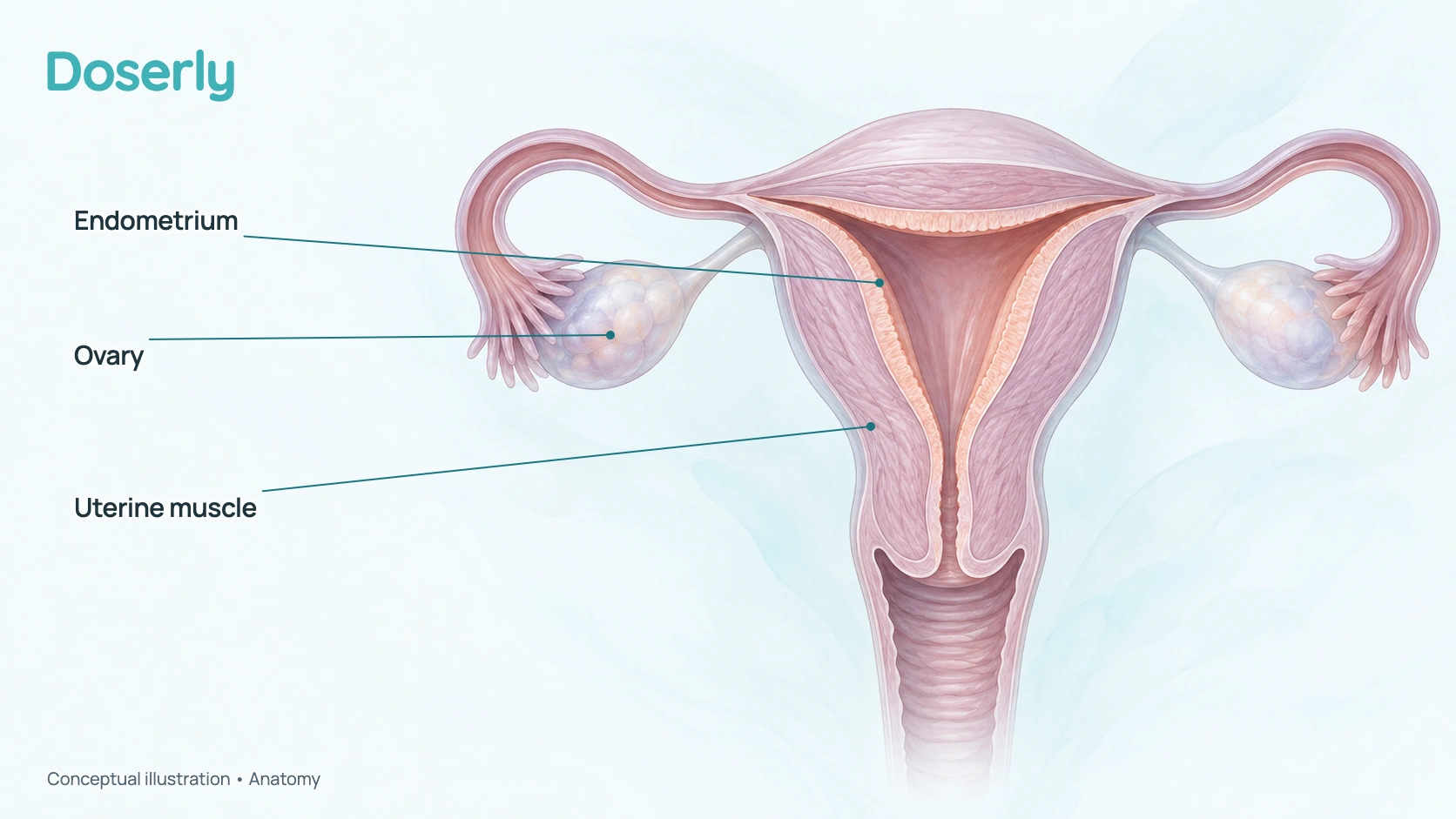
- Endometrium
- The lining inside the uterus.
- Endometrial protection
- Adequate opposition of estrogen-related lining stimulation through an appropriate regimen.
- Hyperplasia
- Excess tissue growth; not the same endpoint as cancer.
- Concentration
- The amount of an active ingredient per specified quantity of a preparation.
- Release rate
- The amount delivered over a specified time, distinct from content or applied amount.
- Troche
- A medicated lozenge; its instructions and route are formulation-specific.
- Hormone pellet
- An implanted preparation that supplies hormone over time.
- Pharmacokinetics
- How a medicine is absorbed, distributed, metabolized and eliminated.
- Surrogate endpoint
- An intermediate measure that does not itself establish a patient-important outcome.
- Randomized trial
- A study assigning comparison treatments by chance.
- Observational study
- Research observing exposure and outcomes without random treatment assignment.
- CGMP
- Current good manufacturing practice requirements in the named regulatory setting.
- UK specials
- Unlicensed medicines supplied under a specific clinical-need framework.
- Beyond-use date
- A pharmacy-assigned limit for use of a compounded preparation.
- GSM
- Genitourinary syndrome of menopause, involving genital and urinary symptoms.
How this guide was researched
Sources and limits
We reviewed the full original ACOG consensus, official FDA/MHRA pages, May 2026 BMS tool, current NICE recommendations, the BMS bleeding recommendations and the full 2019 content study. The dated November 2023 Femring label establishes the systemic vaginal exception; it is not certified as the latest complete October 2026 label. The small 2013 pharmacokinetic trial was accessed as its original abstract only. Relevant NICE rationale and National Academies chapter 5 sections were also inspected; the whole chapter is not certified reviewed. Linked supplements are not certified reviewed; no worldwide compounding rule or universal finished-product monograph is claimed. The two public threads retain their archive status after unsuccessful refresh attempts. [1]–[15]
This Doserly editorial guide was prepared with AI assistance from public sources checked October 3, 2026. No independent clinician review is claimed. Doserly develops a commercial tracking app. Original figures explain decisions and limitations rather than predict individual outcomes. New evidence or a regulatory change can require review before the January 2027 target.
Sources
Titles and metadata identify original sources. Access levels describe what was actually reviewed; an older source can remain relevant without becoming current worldwide authorization.
Showing 15 sources
- 01
Compounded Bioidentical Menopausal Hormone Therapy ↗
Full original consensus
Clinical need, approved alternatives, evidence limitations, pellets and adjunct hormone testing. Full text retrieved; linked supplements not independently audited.
- 02
Understanding the Risks of Compounded Drugs ↗
Full official regulator guidance
Finished compounded drugs are not FDA-approved; legitimate needs, quality risks and labeling limitations. No inference that every pharmacy lacks oversight.
- 03
Menopause ↗
Full official consumer guidance
Approved bioidentical molecules and absence of FDA-approved estriol products. Does not establish authorization outside the US or certify every current label.
- 04
Compounding and the FDA: Questions and Answers ↗
Full official regulator guidance
US 503A/503B oversight, inspection and CGMP distinctions. Regulatory oversight is separate from finished-product approval.
- 05
Progestogens and endometrial protection ↗
Full original clinician guidance
Systemic estrogen opposition and insufficient protection from transdermal progesterone cream/gel; no custom dose conversion.
- 06
Menopause: identification and management — Recommendations ↗
Full original recommendations
Treatment and review, low-dose local care, systemic-HRT bleeding context and stopping. Guideline does not authorize compounded preparations.
- 07
Supply unlicensed medicinal products (specials) ↗
Full official guidance page
UK unlicensed specials, clinical need and manufacturing/import oversight. Linked Guidance Note 14 and entire manufacturing guidance not independently audited here.
- 08
Bioidentical compounded hormones: a pharmacokinetic evaluation in a randomized clinical trial ↗
Original abstract only
40 randomized, 37 analyzable, 16-day PK comparison. Full article and supplements not accessed; not a long-term symptom or protection trial.
- 09
Determination of estradiol and progesterone content in capsules and creams from compounding pharmacies ↗
Full original laboratory study
13 pharmacies filled the sampled prescriptions; measured content variability. TherapeuticsMD-sponsored with disclosed financial relationships; not clinical outcomes or a current market failure rate.
- 10
Public discussion: bioidentical hormone terminology ↗
Archive reference; fresh full thread unavailable
Exact-URL crawl unavailable and exact-thread search returned no thread text. Archive supports terminology confusion and pellet concerns, not current prevalence or prescribing.
- 11
Public discussion: perceived benefit with compounded hormones ↗
Archive reference; fresh full thread unavailable
Exact-URL crawl unavailable and exact-thread search returned no thread text. Archive contains improvement, partial benefit and comparisons with approved treatment; no refreshed consensus.
- 12
Femring: US prescribing information ↗
Full dated original label
Sections 1–3 and 5.7 establish systemic vaginal delivery and its protection context. Dated source supports the exception; not certified as the latest complete October 2026 label.
- 13
Management of unscheduled bleeding on hormone replacement therapy (HRT) ↗
Full original current recommendations page
Individual risks, adherence and earlier investigation for heavy/prolonged or higher-risk bleeding. Full linked algorithm, FAQs and supplements not independently re-audited here.
- 14
Menopause: identification and management — Rationale and impact ↗
Relevant original rationale sections retrieved
Genitourinary treatment rationale explicitly distinguishes minimal local absorption and no additional systemic progestogen solely for local care. Entire linked evidence appendices not audited.
- 15
Compounded Bioidentical Hormone Preparations ↗
Selected original chapter sections; extraction capped
Examples of Complexity and Types of Preparations inspected for Bi-est/Tri-est ingredients and variable amounts/routes. Full chapter, appendices and old product-warning table are not certified current or fully reviewed.
No matching sources
Try a different term or show the full list.