
NAD+: IV Kinetics, NR/NMN Precursors, and Dose References
On this page
Quick Reference Card
Attribute
Compound identity
- Research reference
- NAD+ is nicotinamide adenine dinucleotide, a cellular redox coenzyme and signaling substrate. It is not a peptide [1].
Attribute
Direct NAD+ human evidence
- Research reference
- The main IV NAD+ human pilot infused 750 mg over 6 hours and measured blood and urine metabolite kinetics, not anti-aging outcomes [1].
Attribute
Precursor distinction
Attribute
Recent human research
Attribute
Regulatory context
Attribute
Doserly tracking angle
- Research reference
- NAD-related records need compound identity, route, formulation, infusion duration, precursor type, target outcome, tolerability, and lab context kept separate.
Quick dose reference
NAD+ dosing is route- and product-specific. This summary separates intravenous human studies, precursor contexts and reported clinic practice. Any dosing protocol should be reviewed with a qualified healthcare practitioner.
Intravenous NAD+ infusion (into a vein)
Based on clinical study details
750 mg intravenous kinetic pilot
- Amount studied
- 750 mg
- Frequency
- About 2 mg/min
- Duration
- 6 hours
- Dose adjustment
- None
- Reported range & limits
- This study used 750 mg infused over 6 hours. It does not establish a lower effective dose, safe upper limit, or wellness benefit.
Evidence and range contextReview the full source references below.
750 mg intravenous kinetic pilot
Selected because it is a direct NAD+ human-infusion amount with metabolite endpoints, not a wellness outcome trial.
Do not treat this as proof of anti-aging, fatigue or addiction benefit.
Intravenous NAD+ add-on (into a vein)
Based on clinical study details
Heart-failure intravenous NAD+ trial
- Amount studied
- 10 mg
- Frequency
- Once daily
- Duration
- 7 days
- Dose adjustment
- None specified
- Reported range & limits
- This cardiac trial used 10 mg/day intravenous add-on for 7 days. It does not set a safe maximum or translate to wellness infusion tiers.
Evidence and range contextReview the full source references below.
Heart-failure intravenous NAD+ trial
Included because it is a disease-specific randomized human trial and is much lower than wellness infusion claims.
This 10 mg/day cardiac protocol is not interchangeable with 750 mg intravenous kinetic studies or NR/NMN precursor trials.
Intravenous NAD+ clinic protocols (into a vein)
Online sourced dosing details
- Reported amount
- 250–500 mg
- Frequency
- Per infusion session
- Duration
- Varies by protocol
- Dose adjustment
- 100–500 mg maintenance claimed
- Reported range & limits
- Public clinic tiers often report 250–500 mg loading and 100–500 mg maintenance. These are not established effective minimums or safe maximums.
Evidence and range contextReview the full source references below.
Public wellness intravenous tiers
Included to document public clinic practice while preserving that these tiers are not controlled efficacy dosing.
FormBlends frames 250–500 mg as loading examples and 100–500 mg as maintenance. Other clinic pages list 100–1,000 mg tiers, but those are not merged here.
Full Dosing Reference SourcesClinical research, registered studies and online dosing sources, with their context and limitations.
NAD+, NR and NMN amounts are not interchangeable, and the 10 mg heart-failure protocol is separate from 750 mg wellness-style infusions.
Grant et al. intravenous NAD+ pilot
750 mg NAD+ in saline; infusion rate about 2 mg/min [1]
- Route / formulation
- intravenous NAD+
- Schedule / duration
- 6-hour infusion in 8 men, with 3 control participants
- Evidence limits
- Kinetic and metabolite study only; no anti-aging, fatigue, addiction, cognition, or performance endpoint trial [1].
ChromaDex comparison pilot, 2024 preprint
500 mg intravenous NAD+, 500 mg intravenous NR, 500 mg oral NR, or saline [2][14]
- Route / formulation
- Distinct administered compounds
- Schedule / duration
- Single administration; first study part: 37 participants
- Evidence limits
- Results are available as a preprint despite no registry results; manufacturer-funded and not peer reviewed [14].
Yu et al. cardiac trial
10 mg/day [16]
- Route / formulation
- intravenous NAD+ added to heart-failure treatment
- Schedule / duration
- 7 days; roughly 40–60-minute infusions; follow-up to 6 months
- Evidence limits
- 180 patients; ejection-fraction improvement at 1 month, no significant six-month composite clinical-event difference; separate from wellness use.
2026 injection pilot, preprint
100 mg NAD+ or NR [15]
- Route / formulation
- intravenous, intramuscular, or subcutaneous, with separate placebo groups
- Schedule / duration
- Once daily for 3 days; assessment after a week without administration
- Evidence limits
- 45 participants across 9 groups; descriptive safety, no efficacy proof or peer review.
Second 2026 pilot: NR precursor
50 mg or 100 mg NR [15]
- Route / formulation
- Initially intramuscular or subcutaneous, then subcutaneous
- Schedule / duration
- 3 days, 7-day washout, then 3 administrations/week for 90 days
- Evidence limits
- 39 participants; NR protocol, not NAD+; open-label safety preprint.
Trammell oral NR trial
100 mg, 300 mg, and 1,000 mg single doses [3][4]
- Route / formulation
- Oral nicotinamide riboside chloride
- Schedule / duration
- Randomized crossover in 12 healthy adults
Yi et al. NMN trial
300 mg/day, 600 mg/day, or 900 mg/day [5][6]
- Route / formulation
- Oral NMN
- Schedule / duration
- 60 days in middle-aged adults
Pencina et al. MIB-626 trial
1,000 mg twice daily, 2,000 mg/day total [7]
- Route / formulation
- Oral microcrystalline beta-NMN investigational product
- Schedule / duration
- 28 days in overweight or obese adults aged 45 or older
- Evidence limits
- Raised circulating NAD; cardiometabolic signals were exploratory and performance outcomes were not broadly positive [7].
PeptideWiki public NAD+ guide
intravenous 250 mg, 500 mg, and 750-1,000 mg tiers; subcutaneous examples from 50-200 mg [10]
- Route / formulation
- intravenous and subcutaneous public protocol claims; oral NR/NMN ranges also listed
- Schedule / duration
- Weekly, multi-week, or maintenance examples
- Evidence limits
- Named public page; blends clinic convention with precursor discussion and is not a clinical trial [10].
AZ intravenous Medics public clinic page
100 mg, 250 mg, 500 mg, 750 mg, and 1,000 mg intravenous options [11]
- Route / formulation
- intravenous NAD+ clinic menu
- Schedule / duration
- Session duration varies by amount and tolerance
- Evidence limits
- Vendor/clinic page notes no universal dose-to-result formula; efficacy evidence is not equivalent to a controlled trial [11].
FormBlends public longevity page
250-500 mg per intravenous session for loading examples; 100-500 mg monthly or bimonthly maintenance examples; 25-100 mg subcutaneous daily or every other day as convention [12]
- Route / formulation
- intravenous, subcutaneous, intramuscular public convention summary
- Schedule / duration
- Scenario-dependent clinic conventions
- Evidence limits
- Page explicitly frames much of parenteral NAD+ dosing as convention rather than human efficacy data [12].
Biomogging public NAD+ compound page
subcutaneous 50-100 mg 2-3 times weekly; intravenous 250-1,000 mg per session [13]
- Route / formulation
- subcutaneous and intravenous public protocol claims
- Schedule / duration
- Wellness-cycle examples
- Evidence limits
- Community/vendor-style page; useful for documenting public claims but not a controlled evidence source [13].
Expanded review reached 31 distinct records across direct NAD+ infusion evidence, a real-world intravenous NAD+/NR tolerability pilot, NR/NMN precursor trials and registries, FDA supplement context, preprints and public clinic pages. Direct NAD+ outcome evidence remains much thinner than precursor biomarker evidence.
Applicable product labels and human studies carry the most weight. A registry entry does not establish study results. Animal studies, public guides and forums add context; they do not establish a safe human dose limit.
Official product and regulatory sources
- Submitted 75-day premarket notifications for new dietary ingredients
FDA · 2026 · Background context
FDA NDI page was reviewed for supplement-status context around precursors, not direct NAD+ indication approval.
- Questions and Answers on Dietary Supplements
FDA · 2026 · Background context
FDA supplement Q&A supports general regulatory framing; it does not validate anti-aging dosing.
Human clinical research
- A Pilot Study Investigating Changes in the Human Plasma and Urine NAD+ Metabolome During a 6 Hour Intravenous Infusion of NAD+
Frontiers in Aging Neuroscience · 2019
Direct NAD+ pilot infused 750 mg over 6 hours in healthy men and measured kinetics/metabolites, not wellness outcomes.
- Nicotinamide riboside is uniquely and orally bioavailable in mice and humans
Nature Communications · 2016 · Background context
NR precursor trial used single oral 100, 300 and 1,000 mg doses; kept separate from direct NAD+ dosing.
- The efficacy and safety of beta-nicotinamide mononucleotide supplementation in healthy middle-aged adults
GeroScience · 2023 · Abstract reviewed · Background context
NMN study informs precursor context and was not used to change NAD+ quick rows.
- MIB-626 increases blood NAD levels in middle-aged and older adults
Journal of Clinical Endocrinology & Metabolism · 2023 · Abstract reviewed · Background context
MIB-626/NMN source supports precursor-dose comparison only.
- Randomized pilot study evaluating acute Niagen+ intravenous and NAD+ intravenous
medRxiv · 2024 · Abstract reviewed · Background context
Preprint was reviewed as preliminary comparator context and kept below peer-reviewed evidence.
- Preliminary Safety Analysis of Two Pilot Clinical Trials Involving Injections of Niagen
medRxiv · 2026 · Abstract reviewed
Preprint contributes safety context for injected NR/Niagen, not direct NAD+ dosing.
- Effect of Nicotinamide Adenine Dinucleotide on Heart Failure Caused by Ischemic Cardiomyopathy
PMC / clinical journal · 2025
Randomized heart-failure trial used 10 mg/day intravenous NAD+ for 7 days; disease-specific and not interchangeable with wellness infusion tiers.
- Intravenous infusion of nicotinamide adenine dinucleotide (NAD+) versus nicotinamide riboside (NR): a retrospective tolerability pilot study in a real-world setting.
Frontiers in aging · 2026 · Abstract reviewed
Retrospective real-world tolerability pilot compares intravenous NAD+ and intravenous NR; useful but not randomized efficacy evidence.
- Treatment of Parkinson's disease with NADH.
Acta neurologica Scandinavica · 1994-Nov · Abstract reviewed · Background context
Double-blind Parkinson NADH study used reduced NADH, not NAD+ infusion; historical context only.
- Nicotinamide adenine dinucleotide (NADH)--a new therapeutic approach to Parkinson's disease. Comparison of oral and parenteral application.
Acta neurologica Scandinavica. Supplementum · 1993 · Abstract reviewed · Background context
Open-label oral/parenteral NADH Parkinson record; distinct from NAD+ wellness infusion.
- Nicotinamide Mononucleotide Is Safely Metabolized and Significantly Reduces Blood Triglyceride Levels in Healthy Individuals.
Cureus · 2022-Sep · Abstract reviewed · Background context
Human NMN safety/metabolism study is precursor context only.
Registered clinical trials
- NCT06382688 intravenous Niagen compared to NAD+
ClinicalTrials.gov · 2026
Registry lists 500 mg intravenous NAD+ comparator against intravenous/oral nicotinamide riboside and saline; outcomes were not treated as posted efficacy evidence.
- NCT02191462 Nicotinamide Riboside Pharmacokinetics
ClinicalTrials.gov · 2016 · Background context
Registry anchor for NR pharmacokinetic work; precursor evidence was not merged with NAD+ infusion scenarios.
- NCT04823260 Uthever NMN trial
ClinicalTrials.gov · 2022 · Background context
Registry source for NMN precursor trial context; not a direct NAD+ protocol.
- A Clinical Trial to Assess the Absorption, Safety, and Efficacy of an Oral Nicotinamide Adenine Dinucleotide (NAD+) Supplement in Healthy Adults
ClinicalTrials.gov · 2026-08-11 · Background context
Registry for oral NAD+ supplement bioavailability/safety in healthy adults; not intravenous dosing. Registry status: NOT_YET_RECRUITING.
- Effects of Nicotinamide Riboside on Bioenergetics and Oxidative Stress in Mild Cognitive Impairment/Alzheimer's Dementia
ClinicalTrials.gov · 2026-06-30 · Background context
Registry lists oral NR 1000 mg/day for 12 weeks in MCI/Alzheimer context; precursor only. Registry status: COMPLETED.
- NAD Supplementation to Prevent Progressive Neurological Disease in Ataxia Telangiectasia
ClinicalTrials.gov · 2022-08-17 · Background context
Two-year nicotinamide riboside intervention in ataxia telangiectasia; precursor only. Registry status: ACTIVE_NOT_RECRUITING.
- NAD+ and Exercise in FA
ClinicalTrials.gov · 2026-03-11 · Background context
Registry lists NR capsules plus exercise in Friedreich ataxia; precursor evidence only. Registry status: COMPLETED.
- NR Supplementation and Exercise
ClinicalTrials.gov · 2023-02-10 · Background context
Registry lists Niagen NR supplementation with exercise in older/metabolic participants; not direct NAD+. Registry status: COMPLETED.
- ACEs, SIRT1, and Premature Vascular Aging in Humans
ClinicalTrials.gov · 2026-08-19 · Background context
Registry lists 1,000 mg NR twice daily in vascular-aging research; precursor only. Registry status: RECRUITING.
Published evidence reviews
- NAD⁺ supplementation for anti-aging and wellness: A PRISMA-guided systematic review of preclinical and clinical evidence.
Ageing research reviews · 2026-Apr · Abstract reviewed · Background context
PRISMA-guided review of NAD+ anti-aging/wellness evidence supports caution around outcome claims.
- NAD⁺ biology and supplementation: From mechanisms to clinical perspectives.
Molecular biology reports · 2026-Jul-23 · Abstract reviewed · Background context
NAD biology/supplementation review summarizes clinical perspectives without establishing intravenous wellness dosing.
Animal and laboratory research
- On the safety of reduced nicotinamide adenine dinucleotide (NADH).
Journal of environmental pathology, toxicology and oncology : official organ of the International Society for Environmental Toxicology and Cancer · 2004 · Abstract reviewed
Reduced NADH safety paper provides formulation-specific safety context, not NAD+ dosing.
- Quantitative Analysis of NAD Synthesis-Breakdown Fluxes.
Cell metabolism · 2018-May-01 · Abstract reviewed · Background context
NAD synthesis-breakdown flux paper supports mechanistic separation of NAD and precursors.
- Nicotinamide riboside and nicotinamide mononucleotide facilitate NAD+ synthesis via enterohepatic circulation.
Science advances · 2025-Mar-21 · Abstract reviewed · Background context
NR/NMN enterohepatic-circulation paper clarifies precursor metabolism, not direct NAD+ injection.
- Intravenous nicotinamide riboside elevates mouse skeletal muscle NAD+ without impacting respiratory capacity or insulin sensitivity.
iScience · 2022-Feb-18 · Abstract reviewed · Background context
Intravenous NR mouse study is precursor/preclinical context, not direct NAD+ human evidence.
Public dosing guides and calculators
- NAD+ Dosage Guide: intravenous, subcutaneous & Oral Protocols
PeptideWiki · not stated
Public guide reports 250–1,000 mg intravenous sessions and 50–200 mg subcutaneous practice; treated as reported practice, not trial-backed efficacy.
- NAD+ 250mg vs 500mg vs 1000mg dose guide
AZ IV Medics · not stated · Background context
Clinic page provides public intravenous dose-tier claims and was weighted below human studies.
- NAD 500 mg Dosage Guide
FormBlends · not stated
Named public source frames 250–500 mg loading and 100–500 mg maintenance tiers used in the quick reference.
- NAD+ Injection Protocol — subcutaneous Dosing, intravenous & Longevity Stack
Biomogging · not stated · Background context
Public practice page was reviewed for comparison only and did not override trial anchors.
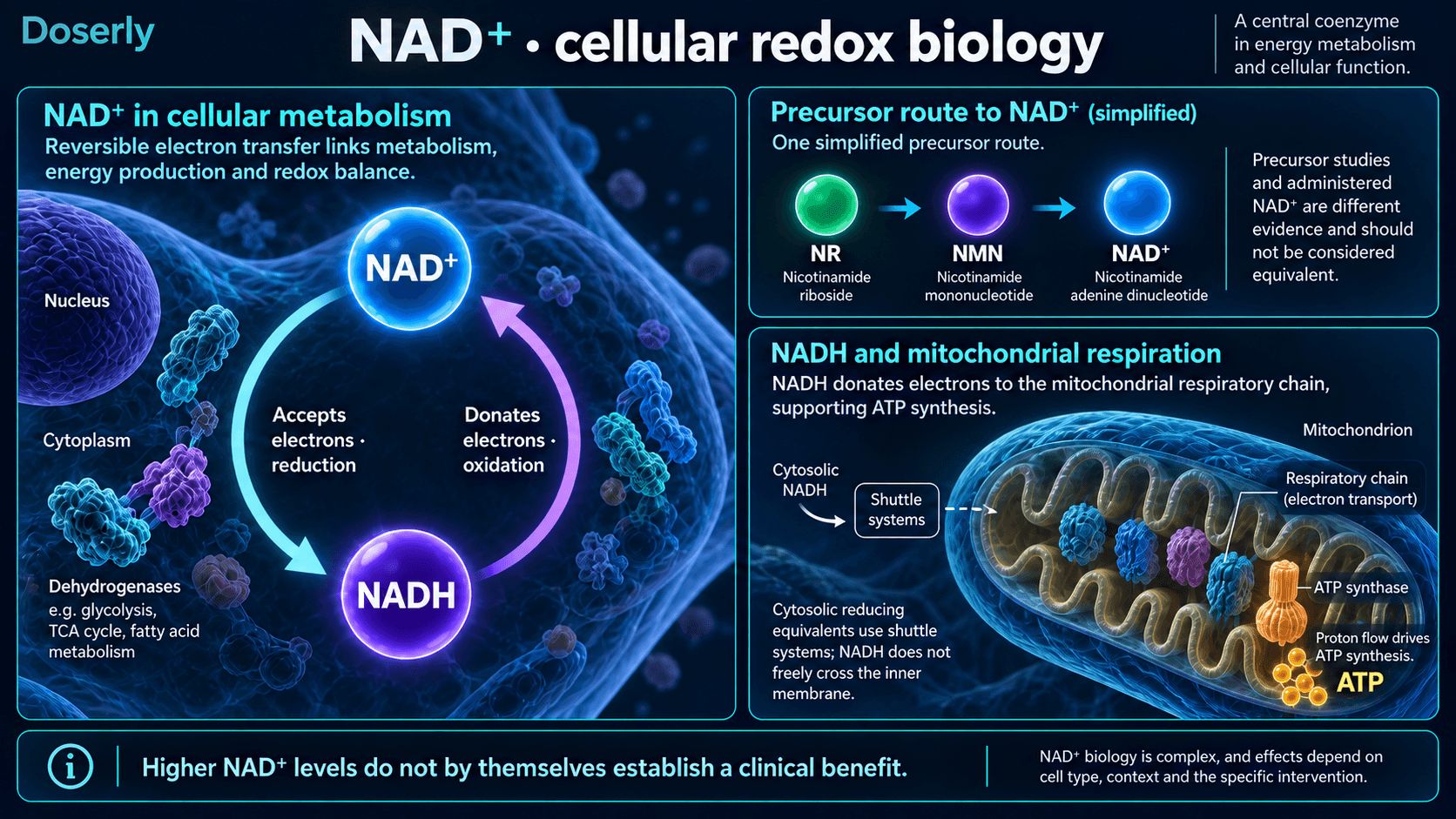
This schematic separates normal NAD metabolism from the evidence for administered NAD+, NR and NMN. The cardiac trial and preliminary injection reports address specific products and settings, not general rejuvenation [1][3][14][15][16].
What NAD+ is
NAD+ is a nucleotide coenzyme central to redox reactions, mitochondrial metabolism, DNA repair signaling, sirtuin activity, and PARP activity. It is not a peptide and it is not interchangeable with peptide hormones or growth-factor fragments [1].
The NAD marketplace often compresses three different categories into one story: direct NAD+ administration, oral precursor supplementation, and anti-aging claims. The evidence is clearer when those categories remain separate.
Direct IV NAD+ evidence
The best-known direct IV NAD+ human study is a pilot that infused 750 mg NAD+ over 6 hours in men and measured changes in plasma and urine metabolites [1]. Plasma NAD+ and metabolites did not show major changes early in the infusion, while urinary NAD+ and methylated metabolites increased later. The authors interpreted the pattern as rapid metabolism and clearance rather than straightforward durable plasma NAD+ loading [1].
That study is useful because it describes human kinetics under a defined IV condition. It does not test longevity, cognition, addiction recovery, fatigue, athletic performance, or mitochondrial rejuvenation outcomes.
NCT06382688 has no results posted in its registry, which has unknown status after its last update in April 2024 [2]. However, a linked June 2024 preprint reports the comparison of 500 mg IV NAD+, IV NR, oral NR, and placebo [14]. The authors reported shorter infusions and better tolerability with IV NR. This ChromaDex-funded pilot has not been peer reviewed and did not demonstrate anti-aging benefit.
An April 2026 preprint adds a 45-person pilot of 100 mg NAD+ or NR by IV, IM, or SC administration over three days. Its second trial extended NR administration, not NAD+, in 39 participants [15]. These descriptive safety findings do not establish the effectiveness of commercial protocols.
A trial published online in September 2025 and in the January 2026 journal issue studied 180 patients with ischemic heart failure. Adding 10 mg/day IV NAD+ for seven days to usual treatment improved ejection fraction at one month. The six-month composite cardiovascular event endpoint did not differ significantly (p = 0.089) [16]. This single-center study provides disease-specific evidence; it does not validate 250–1,000 mg wellness doses.
NR and NMN are precursor evidence, not NAD+ evidence
NR and NMN can raise NAD-related metabolites, but they are not the same administered compound as NAD+. The Trammell study tested oral nicotinamide riboside chloride at 100 mg, 300 mg, and 1,000 mg single doses in healthy adults and showed dose-related changes in the NAD metabolome [3][4].
NMN studies use different products and schedules. NCT04823260 and the associated publication evaluated 300 mg/day, 600 mg/day, and 900 mg/day for 60 days [5][6]. Pencina and colleagues studied MIB-626, a microcrystalline beta-NMN product, at 1,000 mg twice daily for 28 days in overweight or obese adults [7].
These studies support NAD-precursor biology. They do not prove that direct IV or SC NAD+ clinic protocols produce the same exposure, outcomes, or safety profile.
Regulatory and claims context
FDA dietary-supplement information emphasizes that supplements are regulated differently from drugs and are not preapproved for safety and effectiveness before marketing [9]. FDA’s submitted-NDI page listed NMN-related notifications in 2026, reflecting an evolving supplement-status record [8]. Those records do not create an FDA-approved drug indication for anti-aging, mitochondrial enhancement, addiction treatment, or cognitive enhancement.
For NAD+ itself, this refresh did not identify an FDA-approved NAD+ injectable label for wellness or anti-aging use. Public IV pages and compound guides therefore sit in a different evidence category from approved drug labeling.
Where the evidence conflicts
Direct evidence includes the 750 mg IV kinetics pilot, a 10 mg/day cardiac trial, and preliminary safety reports [1][14][15][16]. The strongest oral evidence often comes from NR and NMN precursor trials [3][4][5][6][7]. Public NAD+ clinic pages list 250-1,000 mg IV sessions, SC ranges, loading cycles, and maintenance concepts [10][11][12][13].
Those categories answer different questions. Direct IV NAD+ data describe rapid metabolism and urinary metabolite changes. Precursor trials describe oral bioavailability and NAD-related metabolite changes. Clinic pages describe commercial practice patterns. A single consensus dose would erase that difference.
Safety and tolerability details worth preserving
The direct IV pilot was small and not designed to define rare safety risks [1]. Public IV clinic pages commonly discuss infusion tolerance, including nausea, flushing, headache, abdominal discomfort, fatigue, muscle tension, and chest tightness when infusion speed is poorly tolerated [11]. These symptoms are practice-page claims, but they are still useful logging fields because IV NAD+ is often marketed as a long infusion.
Supplement-status questions are separate from tolerability. NR and NMN oral trials cannot be used as safety substitutes for compounded IV NAD+ products, because product quality, sterile handling, dose timing, and route differ.
What Doserly helps track
Doserly NAD-related records work best when the entry name is specific: NAD+, NR, NMN, reduced NADH, or a branded precursor product. Useful fields include route, dose, infusion duration, product identity, vendor or clinic source, co-administered compounds, adverse effects during infusion, labs, sleep or energy scales, and the cited source row used for comparison.
Academy discussions can separate direct NAD+ kinetics from NR/NMN precursor studies and from public clinic dose menus, which makes contradictions easier to evaluate.
FAQ
Is NAD+ a peptide?
No. NAD+ is a nucleotide coenzyme. It belongs in a redox and metabolism category rather than a peptide-signaling category [1].
Does the 750 mg IV pilot prove anti-aging benefit?
No. The 750 mg infusion study measured plasma and urine NAD-related metabolites during a 6-hour infusion. It did not test lifespan, biological age, frailty, cognition, or symptom outcomes [1].
Can NR or NMN trial doses be used as NAD+ doses?
No. NR and NMN are precursors with their own pharmacology and product-specific data [3][4][5][6][7]. Their oral trial doses provide context for NAD biology, not direct IV NAD+ dosing proof.
What makes the public NAD+ dose pages useful?
They document what clinics and community pages publish: IV 250-1,000 mg sessions, SC ranges, and maintenance concepts [10][11][12][13]. The guide treats those rows as public claims because they are not equivalent to controlled outcome trials.
Did the refresh find FDA-approved NAD+ anti-aging labeling?
No approved anti-aging or wellness NAD+ label was identified. FDA supplement resources and NDI listings are regulatory-context sources, not approvals for anti-aging use [8][9].
References
[1] Grant R. et al. A Pilot Study Investigating Changes in the Human Plasma and Urine NAD+ Metabolome During a 6 Hour Intravenous Infusion of NAD+.
[2] ClinicalTrials.gov: IV Administration of ChromaDex’s Niagen as Compared to NAD+, NCT06382688.
[3] Trammell S.A.J. et al. Nicotinamide riboside is uniquely and orally bioavailable in mice and humans.
[4] ClinicalTrials.gov: Nicotinamide Riboside Pharmacokinetics, NCT02191462.
[5] ClinicalTrials.gov: Assessment of the Efficacy and Safety of Uthever in Middle Aged and Older Adults, NCT04823260.
[6] Yi L. et al. The efficacy and safety of beta-nicotinamide mononucleotide supplementation in healthy middle-aged adults.
[7] Pencina K.M. et al. MIB-626 increases blood NAD levels in middle-aged and older adults.
[8] FDA: Submitted 75-day premarket notifications for new dietary ingredients.
[9] FDA: Questions and Answers on Dietary Supplements.
[10] PeptideWiki: NAD+ dosage guide.
[11] AZ IV Medics: NAD IV dose guide.
[12] FormBlends: Longevity dosage guide including NAD+.
[13] Biomogging: NAD+ compound page.
[14] Hawkins et al. Randomized, placebo-controlled pilot study evaluating acute Niagen+ IV and NAD+ IV (2024; preprint).
[15] Nkrumah-Elie et al. Preliminary Safety Analysis of Two Pilot Clinical Trials Involving Injections of Niagen (2026; preprint).
[16] Yu et al. Effect of Nicotinamide Adenine Dinucleotide on Heart Failure Caused by Ischemic Cardiomyopathy: A Randomized, Placebo-Controlled Trial.