
Glutathione: Oral Evidence, IV Safety Signals, and Dose References
On this page
Quick Reference Card
Attribute
Compound identity
- Research reference
- Glutathione is an endogenous tripeptide, gamma-glutamyl-cysteinyl-glycine, that cycles between reduced GSH and oxidized GSSG during cellular redox buffering [1].
Attribute
Best human dose evidence
Attribute
Formulation issue
Attribute
Cosmetic claim status
Attribute
Main safety distinction
Attribute
Doserly tracking angle
- Research reference
- Glutathione logs need route, formulation, lot/source, co-administered compounds, lab context, skin or symptom endpoints, and adverse-event notes kept separate.
Quick dose reference
Glutathione dosing is formulation- and route-specific. This summary separates oral human studies from reported injectable practice and safety limits. Any dosing protocol should be reviewed with a qualified healthcare practitioner.
Intravenous administration (into a vein)
Online sourced dosing details
- Reported amount
- 600–1,200 mg/session
- Frequency
- Per session
- Duration
- Varies by protocol
- Dose adjustment
- None established
- Reported range & limits
- Public intravenous protocols list 600–1,200 mg/session. FDA warning and recall context means this should not be read as a safe ceiling.
Evidence and range contextReview the full source references below.
Public intravenous protocol
Included only to document common public claims; FDA warnings and recalls prevent treating this as an approved wellness dose.
Peptide Dosing Protocols lists 600–1,200 mg intravenously per session. FDA warning/recall context is safety context, not a dosing source.
Oral reduced glutathione
Based on clinical study details
Oral reduced GSH RCT
- Amount studied
- 250 or 1,000 mg daily total
- Frequency
- Daily study amount
- Duration
- 6 months
- Dose adjustment
- None specified
- Reported range & limits
- Same oral reduced-GSH RCT compared 250 and 1,000 mg/day. It does not define a minimum effective dose or a safe maximum beyond the study.
Evidence and range contextReview the full source references below.
Oral reduced GSH RCT
Selected as the strongest dose anchor because it is randomized human oral supplementation with body-store biomarkers.
Total daily exposure was 250 or 1,000 mg/day, given as 125 or 500 mg twice daily.
Oral liposomal glutathione
Based on clinical study details
Oral liposomal study
- Amount studied
- 500 or 1,000 mg daily total
- Frequency
- Once daily
- Duration
- 4 weeks
- Dose adjustment
- None specified
- Reported range & limits
- This liposomal study used 500 or 1,000 mg/day. It does not establish the lowest effective dose or a safe chronic upper limit.
Evidence and range contextReview the full source references below.
Oral liposomal study
Included as a formulation-specific human row, but the sample was small and not interchangeable with standard capsules.
Keep formulation separate because liposomal exposure is not the same as reduced-GSH tablets.
Full Dosing Reference SourcesClinical research, registered studies and online dosing sources, with their context and limitations.
Do not combine oral, liposomal and injectable glutathione ranges into a single dose range.
Additional sources cited in the summary
Penn State/Hershey randomized trial registry
250 mg/day or 1,000 mg/day, given as 125 mg twice daily or 500 mg twice daily [1]
- Route / formulation
- Oral reduced glutathione
- Schedule / duration
- 6 months, with follow-up after discontinuation
Oral liposomal glutathione registry
500 mg/day or 1,000 mg/day [3]
- Route / formulation
- Oral liposomal glutathione
- Schedule / duration
- Two parallel dose groups over 4 weeks in 12 older healthy adults
Micellar glutathione crossover trial
Single doses: 300 mg micellar GSH, 300 mg liposomal GSH, or 500 mg standard GSH; 600 mg/day micellar follow-up [5]
- Route / formulation
- Oral micellar glutathione
- Schedule / duration
- Acute crossover plus 30-day safety follow-up
- Evidence limits
- Small 2026 study; pharmacokinetic and short safety outcomes only; formulation-specific exposure advantage does not establish clinical outcomes [5].
Type 2 diabetes randomized study
500 mg/day [7]
- Route / formulation
- Oral glutathione
- Schedule / duration
- 6 months
- Evidence limits
- Oxidative-stress and glycemic-marker study; subgroup signals do not make GSH a diabetes treatment [7].
Oral skin-lightening registry
500 mg once daily [6]
- Route / formulation
- Oral glutathione capsule
- Schedule / duration
- 12 weeks in healthy women
FDA adverse-event report from compounded sterile glutathione
Reported administrations included 1,400 mg and 2,400 mg from 200 mg/mL compounded vials [10]
- Route / formulation
- intravenous compounded L-glutathione
- Schedule / duration
- Event reports, not a regimen
- Evidence limits
- Excess endotoxin was found; nausea, vomiting, chills, body aches, lightheadedness, and hospitalization were reported [10].
FDA 2026 compounded-injectable warning and recall
Recall involved compounded glutathione 200 mg/mL multi-dose vials [8][9]
- Route / formulation
- Injectable compounded glutathione
- Schedule / duration
- Lot-specific safety action
Peptide Dosing Protocols public page
Oral 250-1,000 mg/day; intranasal 100-200 mg three times daily; intravenous cosmetic/wellness 600-1,200 mg per session [13]
- Route / formulation
- Oral, intranasal, intravenous protocol claims
- Schedule / duration
- Varies by listed scenario
- Evidence limits
- Public guide aggregates trial and clinic practice ranges. Its intravenous rows remain claims rather than FDA-approved indications [13].
Peptide Protocol Wiki public calculator
Oral 250-500 mg/day; intramuscular 200 mg 1-2 times weekly; subcutaneous 200-400 mg 2-3 times weekly; intravenous 600-1,200 mg twice weekly [14]
- Route / formulation
- Oral, intramuscular, subcutaneous, intravenous community protocol claims
- Schedule / duration
- 4-8 week cycles and maintenance examples
- Evidence limits
- Contains injection-preparation content and calculator assumptions; dose claims are not validated by the oral human trials [14].
FormBlends public peptide hub
Oral 250-1,000 mg/day; subcutaneous 200-600 mg; intravenous 600-2,400 mg per session [15]
- Route / formulation
- Oral, subcutaneous, intravenous clinic-style summary
- Schedule / duration
- Scenario-dependent clinic conventions
- Evidence limits
- Named vendor/education page; useful for documenting public claims, not for proving benefit or sterility quality [15].
Expanded review found substantial same-compound oral, intranasal and intravenous human dosing evidence, plus regulatory warnings for unapproved injection products. Full-text/abstract mirrors are deduplicated, so the intranasal Parkinson source is counted once.
Applicable product labels and human studies carry the most weight. A registry entry does not establish study results. Animal studies, public guides and forums add context; they do not establish a safe human dose limit.
Official product and regulatory sources
- FDA highlights concerns with using dietary ingredient glutathione to compound sterile injectables
U.S. Food and Drug Administration · 2019-06-07
FDA described adverse events after intravenous L-glutathione 200 mg/mL, including 1,400 mg and 2,400 mg administrations linked to excessive endotoxin in dietary-supplement-grade ingredient.
- FDA reminds compounders not to use dietary supplement grade glutathione for injectables
U.S. Food and Drug Administration · 2026-08-27
FDA reported at least 30 adverse events after intravenous glutathione alone or with other ingredients, with endotoxin-consistent symptoms and hospitalizations.
- Victory Medical Center Pharmacy Issues Voluntary Nationwide Recall of Certain Lots of Compounded Glutathione 200 mg/mL Multi-Dose Vials Due to Elevated Endotoxin Levels
U.S. Food and Drug Administration · 2026-08-05
FDA-posted recall identifies compounded glutathione 200 mg/mL multi-dose vials with elevated endotoxin and reports adverse events including fever, chills, headache and blood-pressure changes.
- Drug Recalls
U.S. Food and Drug Administration · 2026-08
FDA drug recall table independently lists glutathione injection 200 mg/mL recall activity for elevated endotoxin level.
Human clinical research
- Randomized controlled trial of oral glutathione supplementation on body stores of glutathione.
European Journal of Nutrition · 2015-03 · Abstract reviewed
Six-month randomized trial in 54 non-smoking adults used oral reduced GSH 250 or 1,000 mg/day and measured blood/tissue GSH markers.
- Oral supplementation with liposomal glutathione elevates body stores of glutathione and markers of immune function.
European Journal of Clinical Nutrition · 2018-01 · Abstract reviewed
One-month pilot in 12 healthy adults used oral liposomal GSH 500 or 1,000 mg/day; underpowered for dose separation.
- A Targeted Metabolomic Assessment of Oral Glutathione Bioavailability and Safety in Humans: A Randomized Crossover Clinical Trial
Antioxidants · 2026-01
Small human crossover compared acute 300 mg micellar, 300 mg liposomal and 500 mg standard GSH, then followed 600 mg/day micellar GSH for 30 days.
- Randomized Clinical Trial of How Long-Term Glutathione Supplementation Offers Protection from Oxidative Damage and Improves HbA1c in Elderly Type 2 Diabetic Patients
Antioxidants · 2022
Pragmatic randomized diabetes study added oral GSH 500 mg once daily for six months; subgroup findings do not make it a diabetes-treatment dose.
- Evaluating Oral Glutathione Plus Ascorbic Acid, Alpha-lipoic Acid, and Zinc Aspartate as a Skin-lightening Agent: An Indonesian Multicenter, Randomized, Controlled Trial
Journal of Clinical and Aesthetic Dermatology · 2021-07
Indonesian RCT used one daily capsule containing 500 mg L-glutathione plus cofactors for 12 weeks; outcomes were not statistically significant overall.
- Glutathione as an oral whitening agent: a randomized, double-blind, placebo-controlled study.
Journal of Dermatological Treatment · 2010 · Abstract reviewed
Skin-color RCT used oral glutathione 500 mg/day in two divided doses for four weeks and noted long-term safety was not established.
- Glutathione and its antiaging and antimelanogenic effects.
Clinical, Cosmetic and Investigational Dermatology · 2017 · Abstract reviewed
Randomized study compared oral GSH 250 mg/day, GSSG 250 mg/day and placebo for 12 weeks; no serious adverse effects were reported.
- The effects of the oral supplementation of L-Cystine associated with reduced L-Glutathione-GSH on human skin pigmentation: a randomized, double-blinded, benchmark- and placebo-controlled clinical trial.
Journal of Cosmetic Dermatology · 2021 · Abstract reviewed
12-week trial used 500 mg L-cystine plus 250 mg reduced L-glutathione daily and separate single-agent comparators; combination data should not be pooled as GSH-only dosing.
- A Randomized, Double-Blind Phase I/IIa Study of Intranasal Glutathione in Parkinson’s Disease
Movement Disorders · 2015
Full text states 600 mg/day and 300 mg/day intranasal groups and notes the 4,200 mg/week maximum matched the 1,400 mg three-times-weekly intravenous pilot.
- Central nervous system uptake of intranasal glutathione in Parkinson's disease.
NPJ Parkinson’s Disease · 2016 · Abstract reviewed
MRS study gave a single 200 mg intranasal GSH dose in the scanner and measured CNS GSH increases over about one hour.
- Phase IIb Study of Intranasal Glutathione in Parkinson's Disease.
Journal of Parkinson’s Disease · 2017 · Abstract reviewed
Phase IIb Parkinson’s study used intranasal 100 mg or 200 mg three times daily for three months; neither active group was superior to placebo.
- Reduced intravenous glutathione in the treatment of early Parkinson's disease.
Progress in Neuro-Psychopharmacology and Biological Psychiatry · 1996-10 · Abstract reviewed
Open-label early Parkinson’s study administered intravenous reduced GSH 600 mg twice daily for 30 days; not blinded and not general wellness dosing.
- Randomized, double-blind, pilot evaluation of intravenous glutathione in Parkinson's disease.
Movement Disorders · 2009-05-15 · Abstract reviewed
Randomized pilot used intravenous glutathione 1,400 mg three times weekly for four weeks; well tolerated but efficacy was not significant.
- Glutathione in the prevention of cisplatin induced toxicities. A prospectively randomized pilot trial in patients with head and neck cancer and non small cell lung cancer.
Oncology Reports · 2000 · Abstract reviewed
Oncology pilot gave intravenous glutathione 5 g immediately before cisplatin; chemotherapy-protection context should not be averaged with supplement dosing.
- A feasibility study of cisplatin administration with low-volume hydration and glutathione protection in the treatment of ovarian carcinoma.
Gynecologic Oncology · 1991 · Abstract reviewed
Ovarian-cancer feasibility study used 5 g GSH in 200 mL saline before cisplatin, demonstrating oncology-specific high-dose intravenous context.
Registered clinical trials
- Oral Glutathione Supplementation on the Levels of Blood Glutathione
ClinicalTrials.gov · 2010-02
Registry lists oral glutathione arms as 500 mg twice daily and 125 mg twice daily, which correspond to 1,000 mg/day and 250 mg/day totals.
- Oral Liposomal Glutathione Supplementation in Healthy Subjects
ClinicalTrials.gov · 2014-11
Registry for completed oral liposomal GSH pilot with low- and high-dose groups; paired with the 500 and 1,000 mg/day publication.
- Oral Glutathione As A Skin Whitening Agent
ClinicalTrials.gov · 2019-09-26
Registry reports oral glutathione 500 mg once daily for 12 weeks in healthy women for skin-whitening outcomes.
- Glutathione (GSH) In The Treatment of Parkinson’s Disease
ClinicalTrials.gov · 2010-08-09
Registry describes intravenous glutathione 1,400 mg Monday/Wednesday/Friday for four weeks, infused/pushed over 10 minutes in 10 mL saline.
Published evidence reviews
- The clinical effect of glutathione on skin color and other related skin conditions: A systematic review.
Journal of Cosmetic Dermatology · 2019-06 · Abstract reviewed · Background context
Systematic review found oral skin studies around 250–500 mg/day and concluded evidence was inconclusive and quality-limited.
- Glutathione as a skin whitening agent: Facts, myths, evidence and controversies.
Indian Journal of Dermatology, Venereology and Leprology · 2016 · Abstract reviewed
Review distinguishes oral/topical evidence from popular injectable use and states intravenous skin-lightening efficacy is unproven with safety concerns.
- Systemic glutathione for skin lightening - A scoping review of current evidence.
Journal of the European Academy of Dermatology and Venereology · 2026-05-25 · Abstract reviewed · Background context
Current scoping review record confirms systemic glutathione for skin lightening remains an active but limited evidence area.
- Potential use of glutathione as a treatment for Parkinson's disease.
Experimental and Therapeutic Medicine · 2021 · Abstract reviewed · Background context
Meta-analysis/review included seven RCTs and discusses 300 vs 600 mg subgroup effects; useful for context, not broad dose approval.
Public dosing guides and calculators
- Glutathione Dosing Calculator
Peptide Protocol Wiki · 2026
Public calculator reports intravenous 600 mg twice weekly default plus subcutaneous 200–400 mg two to three times weekly, intramuscular 200 mg one to two times weekly, nebulized and oral rows; values are public practice, not official guidance.
- Glutathione Dosage Guide: Complete Guide
FormBlends · 2025
Public clinical-marketing guide reports 200–400 mg subcutaneously two to three times weekly or 600–1,200 mg intravenous once to twice weekly for broad antioxidant support.
- Glutathione — dosing, safety and storage
Bioalmanac · 2026
Public page separates community intravenous 600–2,400 mg from Parkinson’s clinical-trial intravenous 1,400 mg three times weekly and flags FDA-warning relevance.
- Glutathione dosing schedule
Longeva · 2026-09-09
Public schedule lists intramuscular/subcutaneous 200–600 mg one to two times weekly and intravenous 500–1,400 mg two to three times weekly, explicitly not an official regimen.
- Glutathione Injection Dosing Protocol: 600 mg Vial — Antioxidant & Detox Guide
MyPeptideMatch · 2026-02
Public protocol lists 600 mg twice weekly by intravenous push or intramuscular route and an alternative 1,200 mg intravenous saline infusion row; public practice only.
- Glutathione Dosage Protocol
Everything Peptide · 2025-03
Public protocol reports 200–1,200 mg/day titrated with intravenous/intramuscular two to three times weekly and subcutaneous daily rows; not clinical authority.
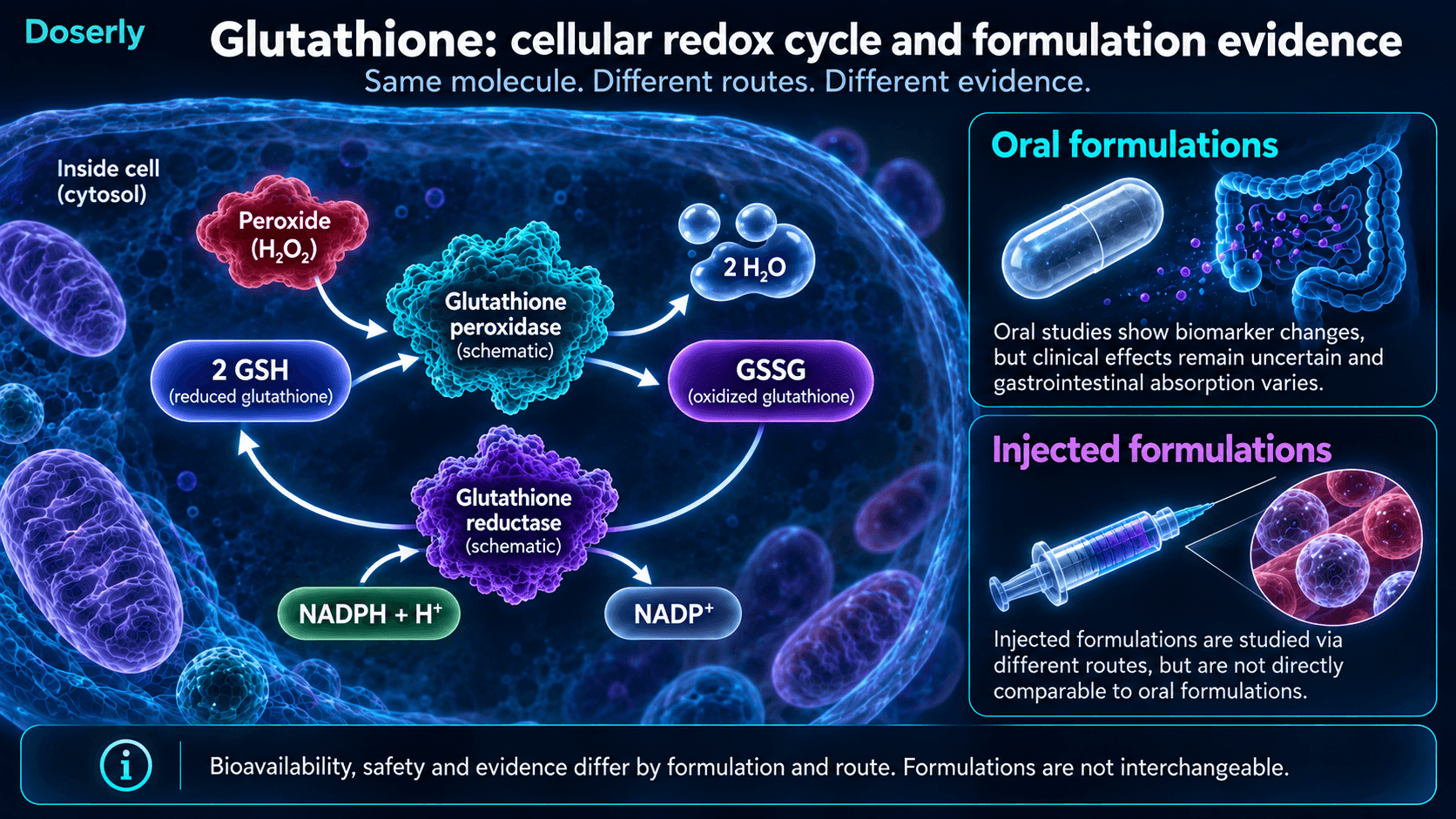
The simplified GSH–GSSG cycle describes cellular biology. Oral biomarker studies and small formulation trials do not establish the benefits or safety of compounded injections [2][4][5][8].
What glutathione is
Glutathione is a sulfur-containing tripeptide made from glutamate, cysteine, and glycine. It is not a peptide hormone or receptor agonist. Its core biology is redox buffering: reduced glutathione donates electrons, oxidized glutathione reflects redox turnover, and enzyme systems recycle the pool [1][2].
That biology explains why glutathione appears in wellness, dermatology, liver, fertility, neurodegeneration, and detox marketing. The stronger question is narrower: whether a given formulation changes a measurable glutathione compartment, whether that change matters clinically, and whether the route creates risks that outweigh the signal.
What human studies actually test
The clearest oral reference is the Penn State/Hershey randomized, placebo-controlled study registered as NCT01044277. It compared placebo with 250 mg/day and 1,000 mg/day oral glutathione for six months in healthy adults [1][2]. The study supports the idea that repeated oral GSH can raise glutathione stores under trial conditions, but it does not establish IV cosmetic, injectable wellness, or disease-treatment protocols.
Small formulation studies point in different directions. Liposomal glutathione at 500 mg/day and 1,000 mg/day was studied in only 12 older adults [3][4]. A 2026 crossover study in 14 adults compared 300 mg micellar glutathione, 300 mg liposomal glutathione, and 500 mg standard glutathione, followed by 600 mg/day micellar glutathione for 30 days [5]. The doses were unequal; dose-normalized comparisons need to be distinguished from measured exposures. These results support formulation-specific bioavailability questions, not a single universal glutathione dose.
The diabetes study at 500 mg/day for six months reported changes in blood glutathione and oxidative-stress markers, with glycemic signals mainly in a subgroup [7]. It adds useful biomarker context, but the trial does not turn glutathione into a glucose-lowering drug.
Skin lightening and cosmetic IV claims
Skin-lightening claims are one of the most common places where glutathione evidence gets overstated. An oral skin-lightening registry entry used 500 mg/day for 12 weeks in healthy women [6]. Dermatology reviews describe the evidence base as small, heterogeneous, and stronger for oral or topical study contexts than for IV cosmetic practice [11][12].
The route distinction matters. IV glutathione clinics often cite oral skin or antioxidant studies, then list larger injectable session amounts. That is a category jump: oral cosmetic trials do not prove that IV cosmetic glutathione is effective, sterile, or safe.
Injectable safety signals are a separate evidence stream
FDA communications give the injectable category a different risk profile from oral capsules. In 2019, FDA described adverse events after compounded IV L-glutathione, including administrations of 1,400 mg and 2,400 mg from 200 mg/mL vials; testing found excessive endotoxin [10]. In 2026, FDA again warned compounders not to use dietary-supplement-grade glutathione in injectables and described at least 30 adverse-event reports associated with IV glutathione alone or in combination products [8]. A 2026 recall involved compounded glutathione 200 mg/mL multi-dose vials with elevated endotoxin [9].
Those notices do not prove that every sterile glutathione product is contaminated. They do show that route, source grade, compounding quality, lot number, and co-administered ingredients belong in the safety record. A public dose range without product-quality evidence is incomplete.
Where the evidence conflicts
The main conflict is not between 250 mg and 1,000 mg. It is between evidence categories:
- Oral RCTs and formulation studies measure blood or tissue glutathione markers under defined conditions [1][2][3][4][5].
- Cosmetic and wellness IV pages list larger session-based amounts, often with clinic experience as the evidence base [13][14][15].
- FDA safety communications describe injectable adverse events tied to compounding and endotoxin exposure [8][9][10].
- Dermatology reviews caution that skin-lightening claims are ahead of the evidence, especially for IV use [11][12].
Averaging those rows into a typical dose would hide the central uncertainty.
What Doserly helps track
Doserly records work best when glutathione entries preserve the source context. Useful fields include route, formulation, named product or compounder, lot/source notes when available, amount, schedule, duration, co-administered ingredients, lab markers, skin endpoints, adverse effects, and the public page or trial that supplied the number.
Academy discussions can then compare like with like: oral reduced GSH against oral trials, liposomal or micellar products against formulation studies, and injectable claims against compounding-risk evidence.
FAQ
Is glutathione a peptide?
It is a tripeptide because it contains three amino acids. It does not behave like the signaling peptides commonly discussed in peptide therapy.
Does oral glutathione work?
Some human studies report increases in glutathione measures after sustained oral use, including 250 mg/day and 1,000 mg/day for six months [1][2]. Other formulation studies are smaller and formulation-specific [3][4][5]. The evidence is stronger for biomarker movement than for broad wellness outcomes.
Does liposomal or micellar glutathione prove standard capsules are obsolete?
No. Liposomal and micellar studies ask whether a delivery system changes exposure [3][4][5]. They do not prove that every product using those words has the same pharmacokinetics or clinical effect.
Is IV glutathione FDA-approved for skin lightening or detox?
No FDA approval for those indications was identified in the source check. FDA communications instead focused on compounded injectable safety concerns, including endotoxin contamination [8][9][10].
Why are public IV doses much larger than oral study doses?
Clinic and community protocol pages commonly list session-based IV amounts such as 600-1,200 mg or 600-2,400 mg [13][14][15]. Those pages are describing public practice patterns, while the strongest oral data use different routes, outcomes, and populations [1][2][3][4][5][6][7].
What are the safety signals worth tracking?
For oral use, studies commonly track tolerability and labs. For injectable use, the safety record also needs sterile-source details, lot information, infusion context, co-administered compounds, fever, chills, nausea, vomiting, dizziness, hypotension, pain, and any emergency-care events [8][9][10].
References
[1] ClinicalTrials.gov: Oral Glutathione Supplementation on the Levels of Blood Glutathione, NCT01044277.
[2] Richie JP Jr. et al. Randomized controlled trial of oral glutathione supplementation on body stores of glutathione.
[3] ClinicalTrials.gov: Oral Liposomal Glutathione Supplementation in Healthy Subjects, NCT02278822.
[4] Sinha R. et al. Oral supplementation with liposomal glutathione elevates body stores of glutathione and markers of immune function.
[5] A Targeted Metabolomic Assessment of Oral Glutathione Bioavailability and Safety in Humans.
[6] ClinicalTrials.gov: Oral Glutathione As A Skin Whitening Agent, NCT04105504.
[7] Clinical efficacy of oral glutathione supplementation in patients with type 2 diabetes mellitus.
[8] FDA: FDA reminds compounders not to use dietary supplement grade glutathione in injectables.
[9] FDA recall: Victory Medical Center Pharmacy compounded glutathione recall.
[10] FDA: Concerns using dietary ingredient glutathione to compound sterile injectables.
[11] Glutathione as a skin whitening agent: Facts, myths, evidence and controversies.
[12] Glutathione for skin lightening: a regnant myth or evidence-based verity?.
[13] Peptide Dosing Protocols: Glutathione.
[14] Peptide Protocol Wiki: Glutathione dosing calculator.
[15] FormBlends: Glutathione dosage guide.