
Weight Management Research: The Complete Stack Guide
Compare approved medicines, investigational incretins and amylin analogs. Grouping compounds does not establish a combination protocol.
On this page
Carte de référence rapide
Attribut
Rôle de la page
- Référence de recherche
- Couche comparative qui conserve l'URL pour la recherche sur la gestion du poids. Elle compare des protocoles de sources et des étiquettes sans créer un plan combiné.
Attribut
Ancrages actuels avec étiquette américaine
Attribut
Programmes expérimentaux incrétines et glucagon
Attribut
Voie amyline
Attribut
Limite principale
- Référence de recherche
- Le regroupement sur cette page n'implique pas une synergie, une interchangeabilité, un statut d'approbation équivalent ni une utilisation simultanée.
Chaque ligne résume la dose et la fréquence rapportées pour un composé. Les sources ci-dessous expliquent les données disponibles et leurs limites. Ces références distinctes n’établissent pas un protocole pour combiner les composés.
Doses en bref
Chaque ligne résume les sources posologiques d’un composé distinct. Les preuves et les usages approuvés diffèrent; ces lignes n’établissent pas de protocole combiné. Tout protocole posologique devrait être examiné avec un professionnel de la santé qualifié.
Semaglutide
Injection Wegovy sous la peau (sous-cutanée)
D’après la monographie du produit
Wegovy injectable : gestion du poids chez l’adulte
- Dose de la monographie
- 2,4 mg habituel; max 7,2 mg
- Fréquence
- Une fois par semaine
- Durée
- Traitement étiqueté continu
- Ajustement de la dose
- 0,25 → 0,5 → 1 → 1,7 → 2,4 mg, 4 semaines par palier. Chez l’adulte si une perte additionnelle est indiquée : 7,2 mg après ≥4 semaines de tolérance à 2,4 mg.
- Plage rapportée et limites
- Maximum de l’étiquette : 7,2 mg par semaine seulement chez certains adultes; 0,25 mg est une dose initiale, pas d’entretien. Ce maximum n’est pas un seuil de surdose.
Données et contexte des dosesConsultez les références complètes ci-dessous.
Semaglutide · Wegovy injectable : gestion du poids chez l’adulte
Meilleur repère rapide pour Wegovy injectable au long cours. La dose d’entretien habituellement recommandée demeure 2,4 mg; le stylo HD à 7,2 mg est limité à la réduction du poids chez l’adulte après tolérance à 2,4 mg et besoin clinique d’une perte supplémentaire.
La réduction du risque CV utilise 2,4 mg recommandé ou 1,7 mg; la réduction du poids chez l’adulte utilise 1,7 mg ou 2,4 mg recommandé, avec 7,2 mg comme maximum conditionnel. L’entretien pour la MASH est de 2,4 mg, avec diminution à 1,7 mg si non toléré.
Tous les scénarios de ce composéTirzepatide
Injection Zepbound sous la peau (sous-cutanée)
D’après la monographie du produit
Entretien Zepbound — poids
- Dose de la monographie
- 5, 10 ou 15 mg
- Fréquence
- Une fois par semaine
- Durée
- Traitement au long cours pour la gestion du poids
- Ajustement de la dose
- 2,5 mg pendant 4 semaines, puis 5 mg; augmenter par paliers de 2,5 mg après au moins 4 semaines, au besoin
- Plage rapportée et limites
- Maximum de l’étiquette : 15 mg par semaine. La dose initiale de 2,5 mg n’est pas une dose d’entretien ni une cible efficace.
Données et contexte des dosesConsultez les références complètes ci-dessous.
Tirzepatide · Entretien Zepbound — poids
Les options d’entretien sont le repère utile; la dose de départ de 2,5 mg n’est pas une dose d’entretien.
15 mg par semaine est la dose maximale adulte selon l’étiquette.
Tous les scénarios de ce composéRetatrutide
Produit d’essai injecté sous la peau (sous-cutanée)
D’après les données d’une étude clinique
Bras phase 2 à 4 mg, départ à 2 mg
- Dose étudiée
- 4 mg
- Fréquence
- Une fois par semaine
- Durée
- 48 semaines
- Ajustement de la dose
- 2 mg par semaine pendant 4 semaines → cible assignée de 4 mg par semaine
- Plage rapportée et limites
- La phase 2 a étudié 1, 4, 8 et 12 mg par semaine. 4 mg n’est pas une dose minimale efficace; 12 mg n’est pas un plafond de sécurité.
Données et contexte des dosesConsultez les références complètes ci-dessous.
Retatrutide · Bras phase 2 à 4 mg, départ à 2 mg
Il s’agit d’un parcours étudié plus faible et cohérent provenant de l’essai de phase 2 évalué par les pairs, inclus pour éviter que le bras maximal à 12 mg semble être la cible par défaut ou optimale.
Le même essai comprenait aussi 1 mg; 4 mg avec dose initiale de 4 mg; 8 mg avec dose initiale de 2 mg ou 4 mg; et 12 mg avec dose initiale de 2 mg. Les événements GI étaient plus fréquents dans les groupes 8 mg et 12 mg et avec les départs à 4 mg plutôt qu’à 2 mg.
Tous les scénarios de ce composéToutes les sources de référence posologiqueÉtudes cliniques, études enregistrées et sources en ligne, avec leur contexte et leurs limites.
Les quantités de composés différents ne se comparent pas sur une même échelle. Les fiches individuelles expliquent les autres scénarios et les écarts entre les sources.
Autres sources citées dans le résumé
Semaglutide / étiquette Wegovy
L'entretien Wegovy injectable adulte est habituellement 2,4 mg une fois par semaine; l'étiquette inclut aussi 1,7 mg une fois par semaine dans certains contextes de réduction pondérale et une concentration Wegovy HD de 7,2 mg une fois par semaine. Les comprimés Wegovy utilisent 25 mg une fois par jour comme entretien adulte pour le risque CV et la réduction pondérale.
- Voie
- Agoniste approuvé du récepteur GLP-1 en injection et comprimé aux États-Unis.
- Limites
- L'étiquette concerne les produits approuvés, pas les produits composés ou de recherche. Elle indique que la coadministration avec d'autres produits au sémaglutide ou d'autres agonistes GLP-1 n'est pas recommandée.
- Liens sources
- DailyMed Wegovy
Tirzepatide / étiquette Zepbound
L'escalade commence à 2,5 mg une fois par semaine. L'entretien pour la réduction pondérale est 5, 10 ou 15 mg une fois par semaine; maximum 15 mg une fois par semaine.
- Voie
- Agoniste GIP/GLP-1 injectable approuvé aux États-Unis.
- Limites
- L'étiquette ne soutient pas la coadministration avec d'autres produits au tirzépatide ou tout agoniste du récepteur GLP-1.
- Liens sources
- DailyMed Zepbound
Orforglipron / étiquette Foundayo
L'étiquette commence à 0,8 mg une fois par jour, puis 2,5 mg, puis 5,5 mg, avec augmentations possibles à 9, 14,5 ou 17,2 mg une fois par jour; maximum 17,2 mg une fois par jour.
- Voie
- Agoniste oral non peptidique du récepteur GLP-1, approuvé aux États-Unis.
- Limites
- Sa cible GLP-1 le rend pertinent pour cette page; sa chimie signifie qu'il n'est pas un peptide.
- Liens sources
- DailyMed Foundayo
Retatrutide TRIUMPH-1, résultat de promoteur
Les bras cibles rapportés sont 4, 9 et 12 mg une fois par semaine sur 80 semaines.
- Voie
- Agoniste expérimental hebdomadaire injectable des récepteurs GIP/GLP-1/glucagon.
- Limites
- Un résultat de promoteur ou de congrès n'est pas une approbation et ne justifie pas l'ajout du retatrutide à un ancrage incrétine approuvé.
- Liens sources
- Lilly TRIUMPH-1
Cagri/Sema et cagrilintide, données REDEFINE
REDEFINE 1 a étudié une cible fixe de 2,4 mg de cagrilintide + 2,4 mg de sémaglutide une fois par semaine. Une étude de recherche antérieure avec cagrilintide seul a étudié 0,3 à 4,5 mg une fois par semaine.
- Voie
- Programme expérimental analogue de l'amyline plus agoniste GLP-1; recherche sur le cagrilintide seul.
- Limites
- Les données d'un produit expérimental à dose fixe ne valident pas les mélanges en ligne, les ratios improvisés ni l'empilement plus large d'incrétines.
- Liens sources
- Garvey et coll., Lau et coll.
Mazdutide, étiquette chinoise et essais
L'étiquette Xinermei utilise 2 mg une fois par semaine aux semaines 1-4, 4 mg une fois par semaine aux semaines 5-8, puis 4 ou 6 mg une fois par semaine. Les programmes américains de phase 2 et 9 mg restent un contexte de recherche.
- Voie
- Double agoniste GLP-1/glucagon injectable approuvé en Chine; pas approuvé par la FDA dans les sources vérifiées.
- Limites
- Le statut régional contrôle l'interprétation. Une étiquette chinoise ne crée pas une dose approuvée aux États-Unis.
- Liens sources
- Communiqué Innovent, GLORY-1
Survodutide SYNCHRONIZE-1
SYNCHRONIZE-1 phase 3 a ajusté la dose jusqu'à 3,6 mg ou 6,0 mg une fois par semaine jusqu'à la semaine 76.
- Voie
- Double agoniste expérimental GLP-1/glucagon injectable.
- Limites
- Les résultats de phase 3 publiés sur l'obésité ne sont pas une approbation de mise en marché ni une équivalence avec des fioles grand public.
- Liens sources
- le Roux et coll.
Pemvidutide, programme MASLD/MASH
L'extension MASLD publiée a étudié 1,2, 1,8 ou 2,4 mg une fois par semaine; PERFORMA phase 3 titre de 1,2 mg vers 1,8 ou 2,4 mg.
- Voie
- Double agoniste expérimental GLP-1/glucagon injectable avec développement hépato-métabolique.
- Limites
- Les données sur le gras hépatique et la MASH ne constituent pas une approbation générale pour l'obésité.
- Liens sources
- Browne et coll., Altimmune PERFORMA
Zenagamtide et recherche amycretin antérieure
L'étude ultérieure zenagamtide sous-cutané de phase 2 dans le diabète de type 2 a étudié 0,4, 1,5, 5, 10, 20 ou 40 mg une fois par semaine après un départ à 0,2 mg. Une recherche antérieure amycretin sous-cutanée dans l'obésité incluait un bras titré jusqu'à 60 mg une fois par semaine.
- Voie
- Programme expérimental agoniste des récepteurs GLP-1/amyline/calcitonine.
- Limites
- L'étude diabète à 40 mg et l'étude obésité à 60 mg appartiennent à des cohortes, durées et critères d'évaluation différents.
- Liens sources
- Mora et coll., Dahl et coll.
Petrelintide, phase 1 et contexte ZUPREME
La partie 2 MAD de phase 1 a titré jusqu'à 2,4, 4,8 ou 9,0 mg une fois par semaine. ZUPREME-1 a rapporté cinq doses de phase 2, mais les bras exacts en mg restaient masqués dans les sources publiques vérifiées.
- Voie
- Analogue expérimental de l'amyline à longue action injectable.
- Limites
- Le regroupement amyline est un contexte comparatif, pas une identité GLP-1 ni une preuve de combinaison.
- Liens sources
- Olsen et coll., Zealand petrelintide
Ces sources proviennent des examens des composés de cette collection. Les données sur chaque composé ne prouvent pas l’efficacité ni la sécurité de leur association. Les documents portant sur une même étude ne sont pas des confirmations indépendantes.
Les monographies applicables et les études humaines ont le plus de poids. Les registres ne prouvent pas qu’un essai a produit des résultats. Les études animales, les guides publics et les forums apportent du contexte; ils n’établissent pas une limite de sécurité chez l’humain.
Sources officielles sur les produits et la réglementation
- Ozempic (semaglutide) injection prescribing information
FDA/CDER · 2026-05
Ozempic débute à 0,25 mg/semaine, puis 0,5 mg; le maximum adulte pour la glycémie est 2 mg/semaine.
- Wegovy (semaglutide) injection and tablets prescribing information
FDA/CDER · 2026-03
Wegovy injectable augmente à 1,7/2,4 mg par semaine, avec maximum adulte conditionnel de 7,2 mg HD; les comprimés montent à 25 mg/jour.
- Rybelsus and Ozempic tablets prescribing information
FDA/CDER · 2026-01
Les comprimés ont des calendriers séparés : Rybelsus 3/7/14 mg et Ozempic comprimés 1,5/4/9 mg.
- Wegovy (semaglutide injection) product monograph
Health Canada · 2025-04-08
La monographie canadienne utilise l’escalade 0,25 à 2,4 mg/semaine et permet 1,7 mg si 2,4 mg n’est pas toléré.
- Ozempic (semaglutide injection) product monograph
Health Canada · 2026-02-25
L’étiquette canadienne d’Ozempic soutient la posologie injectable du diabète et la distingue de Wegovy pour la gestion du poids.
- Rybelsus (semaglutide tablets) product monograph
Novo Nordisk Canada · 2025-08-21
La monographie canadienne de Rybelsus distingue les teneurs originales et optimisées sans substitution mg pour mg.
- FDA approves higher-dose semaglutide product under national priority voucher program
FDA · 2026-03-19
L’annonce FDA confirme le contexte d’approbation Wegovy à dose plus élevée chez certains adultes après la dose standard.
- FDA’s concerns with unapproved GLP-1 drugs used for weight loss
FDA · 2026-09-01
FDA warning lists cagrilintide among non-approved components and supports attribution-only public protocols.
- FDA alerts health care providers, compounders and patients of dosing errors associated with compounded injectable semaglutide products
FDA · 2024-07-26
Alerte FDA sur des erreurs de dose du sémaglutide composé, dont des surdoses 5 à 20 fois liées aux unités/mL/mg.
- Mounjaro prescribing information
DailyMed / FDA · 2026
Mounjaro starts 2.5 mg weekly for 4 weeks; adult maintenance begins at 5 mg and maximum is 15 mg weekly.
- Getting patients started on Mounjaro
Eli Lilly · 2026
Manufacturer HCP page reinforces labeled initiation, escalation and pen-strength workflow.
- Zepbound prescribing information
DailyMed / FDA · 2026
Zepbound label separates weight-management maintenance from OSA maintenance and keeps 15 mg weekly as maximum.
- Mounjaro Canadian product monograph
Eli Lilly Canada · 2026
Canadian Mounjaro monograph provides country-specific diabetes dosing and product information.
- Drug Product Database: Mounjaro
Health Canada · 2026 · Contexte
Health Canada DPD confirms Canadian product identity and authorization context.
- Zepbound Canadian product monograph
Eli Lilly Canada · 2026
Canadian Zepbound monograph gives country-specific obesity dosing distinct from U.S. OSA wording.
- Drug Product Database: Zepbound
Health Canada · 2026 · Contexte
DPD record confirms Canadian Zepbound authorization context and product identity.
- Notice of Compliance: Zepbound
Health Canada · 2026 · Contexte
NOC record supports Canadian approval timing and indication context.
- Lilly triple agonist retatrutide delivered powerful weight loss in phase 2
Eli Lilly · 2023-06-26 · Contexte
Sponsor release summarizes phase 2 obesity results and dose targets; not independent publication.
- TRIUMPH-1 ADA 2026 presentation
Eli Lilly · 2026 · Contexte
Sponsor congress page reports phase 3 TRIUMPH-1 context; not an approved label.
- Retatrutide successful in two additional phase 3 obesity trials
Eli Lilly / PRNewswire · 2026-07-23 · Contexte
Sponsor release describes additional phase 3 obesity/T2D results; no approved regimen established.
- Lilly to present retatrutide TRIUMPH-1 and orforglipron ACHIEVE data at ADA 2026
Eli Lilly · 2026 · Contexte
Communiqué du promoteur sur la présentation des résultats TRIUMPH-1 de phase 3; pas une étiquette approuvée.
- Retatrutide: what to know
Eli Lilly · 2026 · Contexte
Sponsor overview confirms investigational status and clinical-development framing.
- Lilly clinical development pipeline
Eli Lilly · Contexte
Le pipeline confirme que le rétatrutide reste expérimental, sans directive posologique approuvée.
- Novo Nordisk files for FDA approval of CagriSema
Novo Nordisk · 2025-12-18 · Contexte
Sponsor release reports NDA filing for CagriSema 2.4/2.4 mg for weight management.
- Novo Nordisk R&D pipeline
Novo Nordisk · 2026 · Contexte
Pipeline page lists CagriSema filing status and cagrilintide development status.
- CagriSema REDEFINE 4 topline announcement
Novo Nordisk · 2026-02-23 · Contexte
Sponsor topline release reports head-to-head REDEFINE 4 results; not peer-reviewed full dosing guidance.
- FDA approves first new molecular entity under national priority voucher program
FDA · 2026
La source d’approbation de la FDA confirme Foundayo/orforglipron comme produit oral approuvé pour la gestion du poids.
- Foundayo prescribing information
DailyMed / FDA · 2026
L’étiquette utilise une escalade quotidienne 0,8→2,5→5,5 mg, puis 9, 14,5 ou 17,2 mg au besoin; maximum de 17,2 mg.
- FDA approves Lilly’s Foundayo (orforglipron)
Eli Lilly · 2026 · Contexte
Le communiqué du promoteur confirme le positionnement oral quotidien; l’étiquette demeure l’autorité posologique.
- Frequently Asked Questions about Foundayo (orforglipron)
Eli Lilly · Contexte
La FAQ officielle destinée aux patients énumère les comprimés d’escalade : 0,8, 2,5, 5,5, 9, 14,5 et 17,2 mg.
- Information for Healthcare Providers: LillyDirect Foundayo
Eli Lilly · 2026 · Contexte
La page officielle destinée aux professionnels liste les comprimés Foundayo 0,8, 2,5, 5,5, 9, 14,5 et 17,2 mg et renvoie à la monographie.
- Xinermei prescribing information
Innovent Biologics · 2025
La monographie chinoise énumère les stylos 2, 4 et 6 mg/0,5 mL et l’escalade hebdomadaire vers 4 ou 6 mg d’entretien.
- Innovent announces mazdutide received NMPA approval for chronic weight management
Innovent Biologics · 2025-06-27 · Contexte
Le communiqué rapporte l’approbation chinoise pour la gestion du poids; la monographie demeure l’autorité posologique.
- Mazdutide injection NMPA approval notice
National Medical Products Administration · 2025 · Contexte
L’avis de la NMPA est l’ancrage réglementaire cité par la revue de première approbation.
- Innovent announces mazdutide received approval for glycemic control in adults with type 2 diabetes
Innovent Biologics · 2025-09-19 · Contexte
Le communiqué rapporte l’approbation diabète de type 2 fondée sur DREAMS-1 et DREAMS-2 avec 4 et 6 mg par semaine.
- Innovent announces mazdutide 9 mg supplementary application accepted
Innovent Biologics · 2025 · Contexte
Le communiqué indique le contexte d’examen réglementaire du 9 mg; il ne remplace pas l’étiquette actuelle 4/6 mg.
- Prime Sciences warning letter
FDA · 2026-03-31
La lettre de la FDA vise un vendeur précis et soutient la mention qu’aucun produit mazdutide n’est approuvé aux États-Unis.
- Survodutide pipeline page
Zealand Pharma · Contexte
La page du promoteur confirme le statut expérimental et le contexte de développement Boehringer Ingelheim/Zealand.
- NuScience Peptides warning letter
FDA · 2026-08-24
Lettre FDA visant un vendeur précis, utile pour distinguer les produits en ligne du matériel d’essai clinique.
- Novo Nordisk zenagamtide ADA 2026 update
Novo Nordisk · 2026-06-06 · Contexte
La mise à jour du promoteur rapporte les données sous-cutanées de phase 2 jusqu’à 40 mg et jusqu’à 14,6 % de perte de poids à la semaine 36.
- Novo Nordisk ADA 2026 cardiometabolic pipeline announcement
Novo Nordisk · 2026-05-27 · Contexte
Le communiqué de pipeline identifie les données injectables de phase intermédiaire présentées à l’ADA 2026.
- Novo Nordisk to advance subcutaneous and oral amycretin into phase 3
Novo Nordisk / SEC · 2025 · Contexte
Le document déposé à la SEC signale le passage des programmes oral et sous-cutané amycrétine/zenagamtide en phase 3.
- Roche announces positive Phase II results for petrelintide
Roche · 2026-03-05
Le communiqué rapporte ZUPREME-1 sous-cutané hebdomadaire, escalade toutes les 4 semaines, cinq bras actifs et jusqu’à 10,7 % à la semaine 42.
- Zealand Pharma ZUPREME-1 ADA 2026 data update
Zealand Pharma · 2026-06-05
La mise à jour ADA rapporte 485 adultes randomisés 5:1 vers cinq doses sous-cutanées hebdomadaires de petrelintide ou placebo.
- Petrelintide pipeline page
Zealand Pharma · Contexte
La page pipeline confirme le statut expérimental d’analogue long de l’amyline et le contexte de partenariat.
- Altimmune announces positive topline results from the IMPACT Phase 2b trial of pemvidutide in MASH
Altimmune · 2025-06-26
La source du promoteur rapporte 212 participants, 1,2/1,8 mg hebdomadaire sous-cutané, résolution MASH/perte de poids à 24 semaines et faible arrêt lié au médicament.
- Altimmune announces that pemvidutide achieved key measures of success at 48 weeks in IMPACT
Altimmune · 2025-12-19 · Contexte
La source à 48 semaines rapporte les effets 1,2/1,8 mg hebdomadaires sur graisse hépatique, marqueurs non invasifs et poids, toujours sans titration.
- Pemvidutide demonstrates significant metabolic improvements in patients with MASH in new 48-week IMPACT data
Altimmune · 2026-05-28 · Contexte
La mise à jour EASL ajoute les lipides, la tension et le poids à 48 semaines; elle ne change pas les bras 1,2/1,8 mg.
- New IMPACT phase 2b data highlight concurrent improvements across multiple non-invasive markers and qFibrosis
Altimmune · 2026-05-27 · Contexte
L’analyse qFibrosis/NIT du promoteur est un contexte de soutien; les critères de biopsie conventionnels restent la preuve posologique principale.
- Altimmune initiates PERFORMA phase 3 trial of pemvidutide in patients with MASH
Altimmune / GlobeNewswire · 2026-08-03
La source d’initiation de phase 3 soutient les cibles 1,8 et 2,4 mg et la lecture primaire à 52 semaines; aucun résultat d’efficacité.
- Altimmune announces second quarter 2026 financial results and business update
Altimmune · 2026-08-12 · Contexte
La mise à jour confirme PERFORMA, RECLAIM et RESTORE; aucune dose d’étiquette n’existe car le pemvidutide reste expérimental.
- Altimmune announces positive topline results from RECLAIM phase 2 trial of pemvidutide in alcohol use disorder
SEC / Altimmune · 2026-07-28
L’annexe SEC rapporte que l’essai AUD utilisait 2,4 mg et a atteint le critère principal des jours de forte consommation.
- Pemvidutide
Altimmune · Contexte
La page produit résume MASH/AUD/ALD et la tolérance IMPACT sans titration; ce n’est pas un protocole indépendant.
- Altimmune clinical trials
Altimmune · Contexte
La page d’essais identifie les programmes actifs et terminés et aide à concilier statut promoteur et registres.
- Altimmune 2023 Form 10-K
SEC / Altimmune · 2024
Le 10-K rapporte les données obésité/MASLD 1,2, 1,8 et 2,4 mg hebdomadaires et note une courte titration de 4 semaines pour 2,4 mg en MASLD.
- Altimmune announces positive topline results from MOMENTUM 48-week phase 2 obesity trial
Altimmune · 2024-03-27
Le communiqué rapporte 391 participants randomisés à 1,2, 1,8, 2,4 mg hebdomadaires ou placebo pendant 48 semaines avec régime et activité.
- Altimmune presents data from phase 2 MOMENTUM trial during ADA 2024
Altimmune · 2024-06-24 · Contexte
Le communiqué ADA ajoute le contexte de composition corporelle à MOMENTUM, avec les mêmes bras hebdomadaires.
Recherche clinique chez l’humain
- Once-Weekly Semaglutide in Adults with Overweight or Obesity
New England Journal of Medicine · 2021-03-18 · Résumé consulté
STEP 1 a utilisé 2,4 mg/semaine pendant 68 semaines après escalade chez des adultes sans diabète.
- Semaglutide 2.4 mg once a week in adults with overweight or obesity, and type 2 diabetes
The Lancet · 2021-03-13 · Résumé consulté
STEP 2 a comparé 2,4 mg, 1,0 mg et placebo par semaine pendant 68 semaines en DT2.
- Effect of Subcutaneous Semaglutide vs Placebo as an Adjunct to Intensive Behavioral Therapy
JAMA · 2021-02-24
STEP 3 a utilisé 2,4 mg/semaine avec thérapie comportementale intensive et régime hypocalorique initial.
- Effect of Continued Weekly Subcutaneous Semaglutide vs Placebo on Weight Loss Maintenance
JAMA · 2021-03-23 · Résumé consulté
STEP 4 a randomisé après 20 semaines de rodage vers 2,4 mg/semaine continué ou placebo.
- Two-year effects of semaglutide in adults with overweight or obesity
Nature Medicine · 2022-10-10 · Résumé consulté
STEP 5 a suivi le sémaglutide 2,4 mg/semaine versus placebo pendant 104 semaines.
- Weight regain and cardiometabolic effects after withdrawal of semaglutide
Diabetes, Obesity and Metabolism · 2022 · Résumé consulté
L’extension a montré une reprise pondérale notable après l’arrêt du 2,4 mg, soutenant le cadre de traitement chronique.
- Semaglutide and Cardiovascular Outcomes in Obesity without Diabetes
New England Journal of Medicine · 2023-12-14 · Résumé consulté
SELECT a utilisé 2,4 mg/semaine chez des adultes avec surpoids/obésité et MCV établie sans diabète.
- Long-term weight loss effects of semaglutide in obesity without diabetes in the SELECT trial
Nature Medicine · 2024 · Résumé consulté
L’analyse pondérale prédéfinie de SELECT soutient des effets durables du 2,4 mg sur le poids.
- Once-weekly semaglutide 7.2 mg in adults with obesity (STEP UP)
The Lancet Diabetes & Endocrinology · 2025 · Résumé consulté
STEP UP a testé 7,2 mg versus 2,4 mg et placebo pendant 72 semaines chez des adultes sans diabète.
- Once-weekly semaglutide 7.2 mg in adults with obesity and type 2 diabetes
The Lancet Diabetes & Endocrinology · 2025-11 · Résumé consulté
STEP UP T2D a évalué 7,2 mg chez des adultes avec obésité et DT2, éclairant la sécurité HD.
- Oral semaglutide 50 mg taken once per day in adults with overweight or obesity
The Lancet · 2023 · Résumé consulté · Contexte
OASIS 1 a étudié le sémaglutide oral 50 mg/jour, montrant que les comprimés de recherche diffèrent des comprimés Wegovy étiquetés.
- Tirzepatide as Compared with Semaglutide for the Treatment of Obesity.
New England Journal of Medicine · 2025 · Résumé consulté
Head-to-head obesity trial compared tirzepatide 10/15 mg with semaglutide 2.4 mg.
- Semaglutide and Nonarteritic Anterior Ischemic Optic Neuropathy
JAMA Ophthalmology · 2025
Contexte de sécurité pour conseil clinique; ce n’est pas une source de posologie.
- Tirzepatide Once Weekly for the Treatment of Obesity
New England Journal of Medicine · 2022 · Résumé consulté
SURMOUNT-1 studied 5, 10 and 15 mg once weekly for obesity over 72 weeks.
- Tirzepatide once weekly for the treatment of obesity in people with type 2 diabetes (SURMOUNT-2): a double-blind, randomised, multicentre, placebo-controlled, phase 3 trial.
The Lancet · 2023 · Résumé consulté
SURMOUNT-2 studied 10 and 15 mg weekly in adults with obesity and type 2 diabetes.
- Tirzepatide after intensive lifestyle intervention in adults with overweight or obesity: the SURMOUNT-3 phase 3 trial.
Nature Medicine · 2023 · Résumé consulté
SURMOUNT-3 a randomisé des adultes sans diabète après intervention intensive de mode de vie vers tirzepatide 10 ou 15 mg/semaine à dose maximale tolérée ou placebo pendant 72 semaines.
- Continued Treatment With Tirzepatide for Maintenance of Weight Reduction in Adults With Obesity
JAMA · 2024
SURMOUNT-4 withdrawal design supports chronic-treatment framing after maximum tolerated 10 or 15 mg.
- Tirzepatide for the Treatment of Obstructive Sleep Apnea and Obesity.
New England Journal of Medicine · 2024 · Résumé consulté
SURMOUNT-OSA supports the OSA-specific Zepbound maintenance context of 10 or 15 mg weekly.
- Tirzepatide versus Semaglutide Once Weekly in Patients with Type 2 Diabetes.
New England Journal of Medicine · 2021 · Résumé consulté
SURPASS-2 studied tirzepatide 5, 10 and 15 mg weekly against semaglutide 1 mg in T2D.
- Cardiovascular Outcomes with Tirzepatide versus Dulaglutide in Type 2 Diabetes.
PubMed-indexed journal · 2025 · Résumé consulté
Cardiovascular-outcomes context for T2D dosing; not a consumer dosing protocol.
- Retatrutide for Obesity — A Phase 2 Trial
New England Journal of Medicine · 2023 · Résumé consulté
Phase 2 obesity trial studied 1, 4, 8 and 12 mg weekly targets with protocol escalation.
- Retatrutide, a GIP, GLP-1 and glucagon receptor agonist, for people with type 2 diabetes: a randomised, double-blind, placebo and active-controlled, parallel-group, phase 2 trial conducted in the USA.
The Lancet · 2023 · Résumé consulté
Diabetes phase 2 trial provides T2D dose-response context distinct from obesity-only dosing.
- Triple hormone receptor agonist retatrutide for MASLD: a randomized phase 2a trial
Nature Medicine · 2024 · Résumé consulté
MASLD phase 2a supports liver-fat context for investigated weekly retatrutide doses.
- Effects of retatrutide on body composition in people with type 2 diabetes: a substudy of a phase 2, double-blind, parallel-group, placebo-controlled, randomised trial.
PubMed-indexed journal · 2025 · Résumé consulté · Contexte
Body-composition substudy contextualizes weight-loss composition, not a separate dosing protocol.
- LY3437943: discovery, receptor pharmacology and early clinical proof of concept
Cell Metabolism · 2022 · Résumé consulté · Contexte
Mechanistic and early human proof-of-concept source; contextual rather than public dosing.
- Efficacy and safety of retatrutide, a GIP, GLP-1, and glucagon receptor agonist, in people with type 2 diabetes and inadequate glycaemic control with diet and exercise (TRANSCEND-T2D-1): a double-blind, randomised, phase 3 trial.
The Lancet · 2026 · Résumé consulté
TRANSCEND-T2D-1 a étudié 4, 9 et 12 mg/semaine en DT2; le produit reste expérimental.
- Retatrutide for the treatment of obesity, obstructive sleep apnea and knee osteoarthritis: Rationale and design of the TRIUMPH registrational clinical trials.
Diabetes, Obesity and Metabolism / PMC · 2026 · Contexte
Article de conception décrivant les méthodes TRIUMPH-1 à 4 et l’escalade; pas de résultats d’efficacité.
- Once-weekly cagrilintide for weight management in people with overweight and obesity: a multicentre, randomised, double-blind, placebo-controlled and active-controlled, dose-finding phase 2 trial.
The Lancet · 2021 · Résumé consulté · Contexte
Component monotherapy source explains cagrilintide dose history but does not define CagriSema dosing.
- Safety, tolerability, pharmacokinetics, and pharmacodynamics of concomitant administration of multiple doses of cagrilintide with semaglutide 2·4 mg for weight management: a randomised, controlled, phase 1b trial.
The Lancet · 2021 · Résumé consulté
Cagrilintide 0.16–4.5 mg weekly was co-escalated with semaglutide 2.4 mg.
- Efficacy and safety of co-administered once-weekly cagrilintide 2·4 mg with once-weekly semaglutide 2·4 mg in type 2 diabetes: a multicentre, randomised, double-blind, active-controlled, phase 2 trial.
The Lancet · 2023 · Résumé consulté
Phase 2 diabetes study supports cagrilintide 2.4 mg plus semaglutide 2.4 mg combination context.
- Coadministered Cagrilintide and Semaglutide in Adults with Overweight or Obesity.
New England Journal of Medicine · 2025 · Résumé consulté
REDEFINE 1 used CagriSema 2.4/2.4 mg once weekly over 68 weeks in obesity without diabetes.
- Cagrilintide-Semaglutide in Adults with Overweight or Obesity and Type 2 Diabetes
New England Journal of Medicine · 2025
REDEFINE 2 tested CagriSema 2.4/2.4 mg in adults with T2D and BMI at least 27.
- Efficacy and safety of once-weekly cagrilintide-semaglutide (CagriSema) in adults with type 2 diabetes inadequately controlled on diet and exercise (REIMAGINE 1): a randomised, double-blind, placebo-controlled, phase 3a study.
The Lancet Diabetes & Endocrinology · 2026 · Résumé consulté
REIMAGINE 1 a étudié CagriSema 1,0/1,0 et 2,4/2,4 mg une fois par semaine contre placebo dans le diabète de type 2 précoce traité par diète et exercice.
- Cagrilintide-semaglutide (CagriSema) versus semaglutide or cagrilintide in people with type 2 diabetes (REIMAGINE 2): a double-blind, randomised, controlled, phase 3 study.
The Lancet Diabetes & Endocrinology · 2026 · Résumé consulté
REIMAGINE 2 a comparé CagriSema hebdomadaire au sémaglutide ou au cagrilintide dans le diabète de type 2 sous metformine avec ou sans inhibiteur SGLT2.
- Cagrilintide-semaglutide (CagriSema) as an add-on to basal insulin in adults with type 2 diabetes (REIMAGINE 3): a randomised, double-blind, placebo-controlled, multicentre, phase 3 study.
The Lancet Diabetes & Endocrinology · 2026 · Résumé consulté
REIMAGINE 3 a étudié CagriSema 1,0/1,0 et 2,4/2,4 mg une fois par semaine comme ajout à l’insuline basale dans le diabète de type 2.
- Efficacy and safety of co-administered cagrilintide and semaglutide versus semaglutide alone in adults with overweight or obesity with or without type 2 diabetes in Japan and Taiwan (REDEFINE 5): a multicentre, randomised, active-controlled, phase 3a trial.
The Lancet · 2026 · Résumé consulté
REDEFINE 5 a comparé CagriSema 2,4/2,4 mg au sémaglutide 2,4 mg, et non au tirzepatide, au Japon et à Taïwan.
- CagriSema Reduces Blood Pressure in Adults With Overweight or Obesity: REDEFINE 1.
Hypertension / PubMed · 2026 · Résumé consulté
L’analyse de pression artérielle de REDEFINE 1 rapporte CagriSema 2,4/2,4 mg contre placebo; contexte d’innocuité, pas un schéma posologique distinct.
- Orforglipron, an Oral Small-Molecule GLP-1 Receptor Agonist for Obesity Treatment
New England Journal of Medicine · 2025 · Résumé consulté
ATTAIN-1 a étudié 6, 12 et 36 mg une fois par jour pendant 72 semaines chez des adultes obèses sans diabète.
- Orforglipron, an oral small-molecule GLP-1 receptor agonist, for the treatment of obesity in people with type 2 diabetes (ATTAIN-2): a phase 3, double-blind, randomised, multicentre, placebo-controlled trial.
The Lancet / PubMed · 2026 · Résumé consulté
ATTAIN-2 a étudié 6, 12 et 36 mg une fois par jour pendant 72 semaines chez des adultes obèses avec diabète de type 2.
- Orforglipron, an Oral Small-Molecule GLP-1 Receptor Agonist, in Early Type 2 Diabetes
New England Journal of Medicine / PubMed · 2025 · Résumé consulté
ACHIEVE-1 a étudié 3, 12 et 36 mg une fois par jour pendant 40 semaines dans le diabète de type 2 précoce.
- Efficacy and safety of once-daily oral orforglipron compared with oral semaglutide in adults with type 2 diabetes
The Lancet / PubMed · 2026 · Résumé consulté
ACHIEVE-3 a comparé orforglipron 12 ou 36 mg/jour au sémaglutide oral 7 ou 14 mg/jour pendant 52 semaines.
- Orforglipron Added to Titrated Insulin Glargine in Type 2 Diabetes: The ACHIEVE-5 Randomized Clinical Trial
JAMA / PubMed · 2026 · Résumé consulté
ACHIEVE-5 ajoute un contexte d’innocuité avec insuline de fond pour l’orforglipron quotidien dans le diabète de type 2.
- Daily Oral GLP-1 Receptor Agonist Orforglipron for Adults with Obesity
New England Journal of Medicine / PubMed · 2023 · Résumé consulté
L’essai de phase 2 en obésité a utilisé 12, 24, 36 et 45 mg/jour pendant 36 semaines, une plage historique distincte de l’étiquette actuelle.
- Efficacy and safety of oral orforglipron in patients with type 2 diabetes
The Lancet / PubMed · 2023 · Résumé consulté
L’essai de phase 2 dans le diabète de type 2 a étudié 3, 12, 24, 36 et 45 mg/jour, avec deux schémas d’escalade pour 36 et 45 mg.
- Orforglipron Phase 1a single- and multiple-ascending-dose study in healthy participants
Diabetes, Obesity and Metabolism / PubMed · 2023 · Résumé consulté
La phase 1a a testé des doses uniques de 0,3 à 6 mg et une escalade quotidienne sur 4 semaines jusqu’à 24 mg chez des adultes sains.
- Orforglipron Phase 1b multiple-ascending-dose study in people with type 2 diabetes
Diabetes, Obesity and Metabolism / PubMed · 2023 · Résumé consulté
Les données précoces d’escalade dans le diabète de type 2 soutiennent la plage historique avant les phases 2/3.
- Orforglipron improves markers of beta-cell function and insulin sensitivity in type 2 diabetes
Diabetes, Obesity and Metabolism / PubMed · 2025 · Résumé consulté · Contexte
L’analyse post hoc de phase 2 utilise les bras 3, 12, 24, 36 et 45 mg pour interpréter les biomarqueurs métaboliques.
- Once-Weekly Mazdutide in Chinese Adults with Obesity or Overweight
New England Journal of Medicine / PubMed · 2025 · Résumé consulté
GLORY-1 a étudié 4 et 6 mg une fois par semaine pendant 48 semaines chez des adultes chinois avec obésité ou surpoids.
- Treatment With 9-mg Mazdutide for Weight Reduction in Chinese Adults With Obesity
JAMA / PubMed · 2026 · Résumé consulté
GLORY-2, phase 3, a étudié mazdutide 9 mg sous-cutané hebdomadaire pendant 60 semaines chez des adultes chinois obèses.
- Mazdutide vs placebo as monotherapy in Chinese adults with type 2 diabetes
American Diabetes Association · 2025 · Résumé consulté
Le résumé de l’ADA rapporte DREAMS-1 en monothérapie avec 4 et 6 mg/semaine dans le diabète de type 2.
- Mazdutide versus placebo in Chinese adults with type 2 diabetes
Nature / PubMed · 2026 · Résumé consulté
DREAMS-1 a étudié 4 et 6 mg/semaine contre placebo pendant 24 semaines, puis une prolongation sous mazdutide.
- Mazdutide versus dulaglutide in Chinese adults with type 2 diabetes
Nature / PubMed · 2026 · Résumé consulté
DREAMS-2 a comparé mazdutide 4 ou 6 mg/semaine au dulaglutide 1,5 mg pendant 28 semaines.
- Mazdutide 9 mg in Chinese adults with BMI at least 30 kg/m2 without diabetes
The Innovation Medicine / PubMed · 2026 · Résumé consulté
L’étude de phase 2 a évalué 9 mg une fois par semaine pendant 24 semaines chez des adultes chinois obèses sans diabète.
- Efficacy and safety of mazdutide in adults with obesity or overweight: a US phase 2 trial
The Lancet Diabetes & Endocrinology / PubMed · 2026 · Résumé consulté
La phase 2 américaine a testé des bras sous-cutanés hebdomadaires 3–6 mg, 10 mg et 16 mg pendant 48 semaines.
- A phase 2 randomised controlled trial of mazdutide in Chinese overweight adults or adults with obesity
Nature Communications / PubMed · 2023 · Résumé consulté
Une phase 2 chinoise antérieure donne le contexte dose-réponse 3, 4,5 et 6 mg/semaine.
- Glucagon and GLP-1 receptor dual agonist survodutide for obesity
The Lancet Diabetes & Endocrinology / PubMed · 2024 · Résumé consulté
La phase 2 en obésité a testé 0,6, 2,4, 3,6 et 4,8 mg une fois par semaine pendant 46 semaines, dont 20 semaines d’escalade.
- A Phase 2 Randomized Trial of Survodutide in MASH and Fibrosis
New England Journal of Medicine / PubMed · 2024 · Résumé consulté
La phase 2 MASH a testé 2,4, 4,8 et 6,0 mg sous-cutanés une fois par semaine pendant 48 semaines.
- Survodutide Once Weekly for the Treatment of Adults with Obesity
New England Journal of Medicine / PubMed · 2026 · Résumé consulté
SYNCHRONIZE-1 a étudié le survodutide sous-cutané hebdomadaire ajusté jusqu’à 3,6 ou 6,0 mg pendant 76 semaines.
- Survodutide for treatment of obesity: rationale and design of SYNCHRONIZE-1 and -2
Obesity / PubMed · 2024 · Résumé consulté
L’article de conception indique des doses de phase 3 titrées vers 3,6 ou 6,0 mg, avec flexibilité permise.
- Survodutide in people with MASLD: SYNCHRONIZE-MASLD
Nature Medicine · 2026 · Résumé consulté · Contexte
La source MASLD de phase 3 ajoute un contexte hépatique; l’interprétation posologique reste séparée des lignes obésité.
- Dose-response effects of survodutide compared with placebo and semaglutide in type 2 diabetes
Diabetologia · 2023
La phase 2 diabète de type 2 a testé 0,3, 0,9, 1,8, 2,7 mg hebdomadaires et 1,2 ou 1,8 mg deux fois par semaine.
- Survodutide improves biomarkers of beta-cell function and insulin sensitivity
Diabetes, Obesity and Metabolism / PubMed · 2026 · Résumé consulté · Contexte
Analyse post hoc reliant les doses de phase 2 en diabète de type 2 et obésité aux biomarqueurs métaboliques.
- A randomized Phase I study of the safety, tolerability, pharmacokinetics and pharmacodynamics of BI 456906, a dual glucagon receptor/glucagon-like peptide-1 receptor agonist, in healthy Japanese men with overweight/obesity.
Diabetes, Obesity and Metabolism / PubMed · 2023 · Résumé consulté
La phase 1 japonaise a escaladé vers 1,8 mg/semaine, 4,8 mg/semaine ou 2,4 mg deux fois par semaine sur 16 semaines.
- Efficacy and safety of once-weekly subcutaneous zenagamtide, a novel unimolecular GLP-1 and amylin receptor agonist, in type 2 diabetes: a multicentre, randomised, parallel, double-blind, placebo-controlled, dose-finding, phase 2 trial.
The Lancet / PubMed · 2026 · Résumé consulté
L’essai de phase 2 en diabète de type 2 a testé 0,4, 1,5, 5, 10, 20 et 40 mg sous-cutanés hebdomadaires après un départ à 0,2 mg.
- Efficacy and safety of once-daily oral zenagamtide, a novel unimolecular GLP-1 and amylin receptor agonist, in adults with type 2 diabetes: a multicentre, randomised, parallel, double-blind, placebo-controlled, dose-finding, phase 2 trial.
The Lancet / PubMed · 2026 · Résumé consulté
L’essai oral de phase 2 a testé 6, 25 et 50 mg/jour après un départ à 1,5 mg avec escalades de 4 semaines.
- Safety, tolerability, pharmacokinetics, and pharmacodynamics of the first-in-class GLP-1 and amylin receptor agonist, amycretin: a first-in-human, phase 1, double-blind, randomised, placebo-controlled trial.
The Lancet / PubMed · 2025 · Résumé consulté
Le premier essai humain oral a testé des doses uniques 1–25 mg et des escalades orales multiples jusqu’à des équivalents 50–100 mg/jour.
- Amycretin, a novel, unimolecular GLP-1 and amylin receptor agonist administered subcutaneously: results from a phase 1b/2a randomised controlled study.
The Lancet / PubMed · 2025 · Résumé consulté
L’amycrétine sous-cutanée a escaladé de 0,3 mg vers des cibles 1,25, 5, 20 ou 60 mg sur 20–36 semaines.
- Safety, tolerability, pharmacokinetics, and pharmacodynamics of petrelintide for weight management
Diabetes, Obesity and Metabolism · 2026
Le texte intégral rapporte des doses uniques sous-cutanées 0,04–2,4 mg et par voie intraveineuse 0,35 mg; répétées 0,6/1,2 mg et cibles 2,4, 4,8, 9,0 mg.
- Safety and efficacy of weekly pemvidutide versus placebo for metabolic dysfunction-associated steatohepatitis (IMPACT): 24-week results from a multicentre, randomised, double-blind, phase 2b study.
Lancet (London, England) · 2025 · Résumé consulté
L’article IMPACT du Lancet rapporte 1,2 ou 1,8 mg sous-cutané hebdomadaire sans titration en MASH F2/F3; la résolution MASH à 24 semaines s’améliore, mais pas clairement la fibrose conventionnelle.
- The dual GLP-1-glucagon agonist pemvidutide in MASH: a phase 2b trial.
Lancet (London, England) · 2025 · Résumé consulté · Contexte
Le rapport/commentaire du Lancet confirme le contexte MASH de phase 2b; il reste groupé avec IMPACT plutôt que comme schéma indépendant.
- Safety and efficacy of 24 weeks of pemvidutide in metabolic dysfunction-associated steatotic liver disease: A randomized, controlled clinical trial.
JHEP reports : innovation in hepatology · 2025 · Résumé consulté
L’extension MASLD a poursuivi 1,2, 1,8 ou 2,4 mg sous-cutané hebdomadaire jusqu’à 24 semaines avec résultats de graisse hépatique et poids.
- Pemvidutide in subjects with overweight or obesity — 48-week MOMENTUM trial
American Diabetes Association / Diabetes · 2024 · Résumé consulté
Le résumé ADA rapporte MOMENTUM : 1,2, 1,8 et 2,4 mg sous-cutané hebdomadaire pendant 48 semaines avec réponse pondérale selon la dose.
Essais cliniques enregistrés
- ClinicalTrials.gov NCT04184622
ClinicalTrials.gov
Registry source for SURMOUNT-1 dose-arm and eligibility context.
- ClinicalTrials.gov NCT04657003
ClinicalTrials.gov
Registry source for SURMOUNT-2 trial identity and T2D obesity population.
- ClinicalTrials.gov NCT04660643
ClinicalTrials.gov
Registry source for maintenance-withdrawal trial identity and dose assignment.
- ClinicalTrials.gov NCT05412004
ClinicalTrials.gov
Registre pour une étude SURMOUNT-OSA soutenant le contexte posologique propre à l’AOS.
- ClinicalTrials.gov NCT05929066
ClinicalTrials.gov
Registry verifies phase 3 obesity trial identity and assigned weekly dose framework.
- ClinicalTrials.gov NCT04881760
ClinicalTrials.gov
Registry context for the phase 2 obesity dose-ranging trial.
- ClinicalTrials.gov NCT04867785
ClinicalTrials.gov
Registry context for type 2 diabetes dose-ranging work.
- ClinicalTrials.gov NCT05929079
ClinicalTrials.gov · Contexte
Registry source for phase 3 retatrutide obesity/T2D program context.
- ClinicalTrials.gov NCT05882045
ClinicalTrials.gov · Contexte
Registry source for additional phase 3 retatrutide indication context.
- ClinicalTrials.gov NCT05931367
ClinicalTrials.gov · Contexte
Registry source for phase 3 retatrutide maintenance/outcomes context.
- ClinicalTrials.gov NCT06383390: TRIUMPH-Outcomes
ClinicalTrials.gov · Contexte
Registre décrivant une escalade hebdomadaire jusqu’à la dose maximale tolérée pour contexte CV/rénal.
- ClinicalTrials.gov NCT03856047
ClinicalTrials.gov
Registry source for cagrilintide monotherapy dose-ranging context.
- ClinicalTrials.gov NCT03600480
ClinicalTrials.gov
Registry source for concomitant cagrilintide with semaglutide study identity.
- ClinicalTrials.gov NCT05567796
ClinicalTrials.gov
Registry source for REDEFINE 1 trial identity and dose assignment context.
- ClinicalTrials.gov NCT05394519
ClinicalTrials.gov
Registry source for REDEFINE 2 trial identity and diabetes population.
- ClinicalTrials.gov NCT05669755
ClinicalTrials.gov
Registry source for cardiovascular outcomes dosing context.
- ClinicalTrials.gov NCT06131437
ClinicalTrials.gov · Contexte
Registry source for head-to-head CagriSema versus tirzepatide context.
- ClinicalTrials.gov NCT06065540
ClinicalTrials.gov
Registry source for phase 3 T2D CagriSema study details.
- ClinicalTrials.gov NCT06323174
ClinicalTrials.gov
Registry source for early T2D CagriSema trial details.
- ClinicalTrials.gov NCT06323161
ClinicalTrials.gov
Registry source for basal-insulin T2D CagriSema trial details.
- ClinicalTrials.gov NCT06131372
ClinicalTrials.gov · Contexte
Registry adds kidney-outcomes program context without establishing approval.
- A Study of Orforglipron in Adult Participants With Obesity or Overweight With Weight-Related Comorbidities
ClinicalTrials.gov · 2025
Le registre confirme le devis ATTAIN-1 en obésité, l’administration orale et le critère principal de poids à 72 semaines.
- A Study of Orforglipron in Adult Participants With Obesity or Overweight and Type 2 Diabetes
ClinicalTrials.gov · 2025
Le registre relie ATTAIN-2 à NCT05872620 et confirme le traitement oral quotidien contre placebo.
- A Study of Orforglipron in Adult Participants With Type 2 Diabetes and Inadequate Glycemic Control With Diet and Exercise Alone
ClinicalTrials.gov · 2026
Le registre indique des capsules orales débutant à 1 mg avec escalade toutes les 4 semaines vers 3, 12 ou 36 mg.
- A Study of Orforglipron Compared With Semaglutide in Participants With Type 2 Diabetes Inadequately Controlled With Metformin
ClinicalTrials.gov · 2025
Le registre confirme le devis ACHIEVE-3 oral comparatif terminé dans le diabète de type 2.
- A Study Comparing IBI362 vs Semaglutide in Chinese Adults With Early Type 2 Diabetes and Obesity
ClinicalTrials.gov · 2026
Le registre décrit mazdutide 6 mg/semaine contre sémaglutide 1 mg, avec prolongation impliquant 6 ou 9 mg.
- Mazdutide for Adults With Prediabetes
ClinicalTrials.gov · 2026
Le registre prédiabète liste les titrations sous-cutanées hebdomadaires 2→4 mg et 2→4→6 mg.
- Mazdutide in type 2 diabetes with early-stage cognitive impairment (LIGHT-COG Study)
ClinicalTrials.gov · 2026 · Contexte
Le registre utilise un départ à 2 mg/semaine, cible 4 mg et entretien optionnel à 6 mg dans le diabète de type 2 avec atteinte cognitive précoce.
- Mazdutide as Adjuvant Therapy Following Sleeve Gastrectomy in Severe Obesity
ClinicalTrials.gov · 2026 · Contexte
Le registre après sleeve utilise 2→4→6 mg sous-cutané hebdomadaire, avec retour possible à 4 mg en cas d’intolérance.
- SYNCHRONIZE-1, NCT06066515
ClinicalTrials.gov · 2026
Le registre confirme les bras 3,6 et 6,0 mg de phase 3 chez des adultes obèses sans diabète de type 2.
- SYNCHRONIZE-2, NCT06066528
ClinicalTrials.gov · 2026
Le registre couvre l’essai compagnon de phase 3 avec diabète de type 2 utilisant le survodutide sous-cutané hebdomadaire.
- SYNCHRONIZE-CVOT, NCT06077864
ClinicalTrials.gov · 2026 · Contexte
Le registre cardiovasculaire liste des bras sous-cutanés hebdomadaires 3,6 et 6,0 mg pour le contexte d’innocuité à long terme.
- ClinicalTrials.gov NCT04982575
ClinicalTrials.gov
Registry source for phase 2 cagrilintide 2.4 mg with semaglutide 2.4 mg in T2D.
- ClinicalTrials.gov NCT05813925
ClinicalTrials.gov · Contexte
Registry source for CagriSema versus tirzepatide head-to-head trial identity.
- AMAZE 7: Zenagamtide versus semaglutide in obesity
ClinicalTrials.gov · 2026 · Contexte
Le registre décrit une phase 3 hebdomadaire sous-cutanée en obésité contre sémaglutide; les doses ne sont pas divulguées.
- AMAZE 13: Zenagamtide in Asian participants with overweight or obesity
ClinicalTrials.gov · 2026 · Contexte
Le registre identifie une phase 3 asiatique sous-cutanée hebdomadaire en obésité; les doses publiques restent masquées.
- AMAZE 9: once-daily oral zenagamtide tablets in obesity
ClinicalTrials.gov · 2026 · Contexte
Le registre identifie une phase 3 orale quotidienne en obésité; les doses ne sont pas publiques dans l’enregistrement.
- ZUPREME-1: Once-weekly petrelintide versus placebo
ClinicalTrials.gov · 2026 · Contexte
Le registre confirme la phase 2 ZUPREME-1 terminée; les doses actives en mg restent masquées publiquement.
- ZUPREME 2: petrelintide in overweight/obesity and type 2 diabetes
ClinicalTrials.gov · 2026 · Contexte
Le registre décrit trois doses sous-cutanées hebdomadaires contre placebo chez des participants avec surpoids/obésité et diabète de type 2.
- IMPACT TRIAL: Efficacy and Safety of Pemvidutide in Subjects With Nonalcoholic Steatohepatitis (NASH)
ClinicalTrials.gov
Le registre confirme IMPACT : pemvidutide 1,2 mg, 1,8 mg ou placebo une fois par semaine par injection sous-cutanée.
- Phase 3 Study of the Efficacy, Safety, and Clinical Outcomes of Pemvidutide in MASH
ClinicalTrials.gov
Le registre PERFORMA de phase 3 liste des bras 1,8 mg et 2,4 mg par injection sous-cutanée contre placebo en MASH.
- Efficacy and Safety of ALT-801 in the Treatment of Obesity
ClinicalTrials.gov
Le registre de phase 2 obésité consigne des doses hebdomadaires sous-cutanées ALT-801/pemvidutide contre placebo.
- ALT-801 in Overweight and Obese Subjects With Type 2 Diabetes Mellitus (T2DM)
ClinicalTrials.gov
Le registre DT2 avec surpoids/obésité précise 1,2, 1,8 et un bras 2,4 mg avec escalade hebdomadaire 0,6→1,2→1,8→2,4 mg.
- ALT-801 in Diabetic and Non-Diabetic Overweight and Obese Subjects With Non-alcoholic Fatty Liver Disease (NAFLD)
ClinicalTrials.gov
Le registre NAFLD de phase 1 liste des bras de dose sous-cutanée hebdomadaire pendant 12 semaines.
- Extension of ALT-801 in Diabetic and Non-Diabetic Overweight and Obese Subjects With (NAFLD)
ClinicalTrials.gov
Le registre d’extension prolongeait les bras hebdomadaires 12 semaines de plus, concordant avec la publication MASLD de 24 semaines.
- ALT-801 (Pemvidutide) in Healthy Overweight and Obese Volunteers to Study Safety and Tolerability
ClinicalTrials.gov
Le registre de première administration humaine décrit des cohortes sous-cutanées à dose unique et doses répétées hebdomadaires sur 12 semaines.
- Pemvidutide (ALT-801) DDI Study in Healthy Volunteers
ClinicalTrials.gov
Le registre d’interactions a utilisé des doses uniques sous-cutanées de 0,6 mg autour de médicaments sondes.
- RECLAIM STUDY: Phase 2 Study of the Efficacy and Safety of Pemvidutide in the Treatment of Alcohol Use Disorder (AUD) in Subjects With Obesity or Overweight
ClinicalTrials.gov
Le registre RECLAIM AUD liste pemvidutide 2,4 mg sous-cutané hebdomadaire contre placebo chez des participants AUD avec surpoids/obésité.
- RESTORE TRIAL: Study of the Efficacy and Safety of Pemvidutide in the Treatment of Alcohol-Associated Liver Disease (ALD)
ClinicalTrials.gov
Le registre RESTORE ALD liste pemvidutide 2,4 mg par injection sous-cutanée contre placebo en maladie hépatique liée à l’alcool.
Revues publiées des données probantes
- Long-acting amylin analogues for the management of obesity.
Current Opinion in Endocrinology, Diabetes and Obesity / PubMed · 2022 · Résumé consulté · Contexte
Revue résumant le cagrilintide et d’autres analogues de l’amyline longue action en obésité; contexte seulement, pas protocole posologique.
- Efficacy and Safety of Cagrilintide Alone and in Combination with Semaglutide (Cagrisema) as Anti-Obesity Medications: A Systematic Review and Meta-Analysis.
PubMed-indexed review · 2024 · Résumé consulté · Contexte
Review places CagriSema/cagrilintide among incretin and amylin-based obesity therapies.
- Amylin Analogs: The Next Major Class of Weight Loss Therapy: A Review of Experimental Data and Early-Phase Clinical Trials.
PubMed-indexed review · 2026 · Résumé consulté · Contexte
Review discusses amylin analog dosing concepts without establishing product dose limits.
- Long-acting amylin-related peptides as therapies for obesity and type 2 diabetes
PubMed-indexed review · 2026 · Résumé consulté · Contexte
La revue situe le petrelintide parmi les agents amyliniques longue action en développement pour l’obésité.
- Orforglipron: A Comprehensive Review of an Oral Small-Molecule GLP-1 Receptor Agonist
International Journal of Molecular Sciences · 2026 · Contexte
La revue résume les doses de phases 1–3 et distingue les anciennes doses d’essai du positionnement clinique ultérieur.
- Orforglipron as an anti-obesity medicine: systematic review and meta-analysis
Obesity Science & Practice · 2024
La méta-analyse regroupe les bras précoces 12–45 mg/jour en obésité et souligne les limites gastro-intestinales.
- Efficacy and safety of orforglipron on cardiometabolic outcomes
PMC-indexed review · 2026 · Contexte
La revue systématique soutient des effets pondéraux et glycémiques cohérents dans les essais d’obésité et de diabète de type 2.
- Small-Molecule GLP-1 Receptor Agonists: A Promising Pharmacological Approach
PMC-indexed review · 2025 · Contexte
Cette revue de classe situe l’orforglipron parmi les GLP-1 oraux à petite molécule et résume le contexte posologique.
- The evolving therapeutic landscape of gut-pancreatic peptide signalling
PMC-indexed review · 2026 · Contexte
Revue de classe résumant les plages de doses du survodutide en obésité, diabète de type 2 et MASH.
- Mazdutide: First Approval
Drugs / PubMed · 2025 · Résumé consulté · Contexte
La revue confirme la première approbation chinoise pour la gestion du poids puis l’approbation dans le diabète de type 2.
- Efficacy and safety of Mazdutide on weight loss: systematic review and meta-analysis
Frontiers in Endocrinology · 2024
La méta-analyse résume des doses de 0,05 à 10 mg une fois par semaine et note la voie sous-cutanée dans les essais inclus.
- Efficacy and Safety of Mazdutide in Predominantly Chinese Adults With Obesity and/or Type 2 Diabetes
PubMed-indexed review · 2026 · Résumé consulté · Contexte
Méta-analyse récente rapportant les données 4 et 6 mg dans le diabète de type 2 et la gestion du poids; certitude variable.
- Comparative efficacy of incretin drugs on glycemic control, body weight, and blood pressure
PMC-indexed review · 2025 · Contexte
Méta-analyse en réseau donnant un contexte inter-médicaments et incluant mazdutide 6 mg.
- Innovative Drugs First Implemented in Type 2 Diabetes Mellitus and Obesity and Their Effects on Metabolic Dysfunction-Associated Steatohepatitis (MASH)-Related Fibrosis and Cirrhosis.
PMC-indexed review · 2025 · Contexte
La revue résume les doses MASH 2,4, 4,8 et 6,0 mg et contextualise les critères hépatiques.
- Evaluating the efficacy and safety of survodutide for obesity
PMC-indexed review · 2025
La méta-analyse résume les doses d’essai de 0,3 à 4,8 mg et note les différences de voie/fréquence.
- Efficacy and Safety of Twincretin Survodutide, a Dual Glucagon-Like Peptide-1 and Glucagon Receptor Agonist as an Anti-Obesity and Anti-Diabetes Medication: A Systematic Review and Meta-Analysis.
PMC-indexed review · 2025
La méta-analyse discute les essais sous-cutanés hebdomadaires 0,3–6,0 mg et les arrêts gastro-intestinaux.
- Effect of survodutide on weight loss: meta-analysis of randomized controlled trials
PMC-indexed review · 2024 · Contexte
La méta-analyse soutient le contexte pondéral de plusieurs bras, sans définir une dose optimale clinique.
- Novel Amylin-Based Therapies for Weight Management
PMC-indexed review · 2026 · Contexte
Revue en réseau résumant les bras sous-cutanés et oraux d’amycrétine, comme preuve secondaire.
- Beyond GLP-1: Amylin-based pharmacotherapy and better-tolerated weight-loss drugs
PubMed-indexed review · 2026 · Résumé consulté · Contexte
La revue discute la sélectivité des récepteurs et la tolérabilité du petrelintide et d’autres agents amyliniques.
- Efficacy and safety of pemvidutide in metabolic dysfunction-associated steatohepatitis: a GRADE-assessed meta-analysis of randomized controlled trials.
Naunyn-Schmiedeberg's archives of pharmacology · 2026 · Résumé consulté
La méta-analyse GRADE regroupe les essais MASH/MASLD et soutient de garder les plages 1,2–2,4 mg comme contexte de recherche seulement.
- Efficacy and Safety of Dual and Triple Glucagon-Like Peptide-1-Based Polyagonists in Metabolic Dysfunction-Associated Steatotic Liver Disease and Steatohepatitis: A Systematic Review and Meta-Analysis.
Cureus · 2026 · Résumé consulté · Contexte
La revue systématique compare les polyagonistes GLP-1 doubles/triples en MASLD/MASH et situe le pemvidutide parmi les agents hépatiques expérimentaux.
Ressources de référence clinique
- Semaglutide (Subcutaneous Route): Proper Use
Mayo Clinic · 2026
Mayo Clinic résume l’escalade sous-cutanée, dont le départ à 0,25 mg et les paliers hebdomadaires d’entretien.
- Semaglutide
StatPearls / NCBI Bookshelf · 2026 · Contexte
StatPearls examine les voies et doses de type étiquette, comme 3/7/14 mg oral et l’escalade injectable hebdomadaire.
- Semaglutide Dosage Guide
Drugs.com · 2026-07-09
Drugs.com reflétait les changements 2026, dont Wegovy HD 7,2 mg/semaine et Wegovy comprimés jusqu’à 25 mg/jour.
- Zepbound Dosage Guide
GoodRx · 2026
GoodRx résume Zepbound : départ 2,5 mg/semaine et entretien 5, 10 ou 15 mg.
- Mounjaro Dosage Guide
GoodRx · 2026
GoodRx résume Mounjaro : initiation 2,5 mg, entretien à partir de 5 mg et maximum 15 mg/semaine.
- Tirzepatide Dosage Guide
Drugs.com · 2026
Drugs.com résume l’initiation 2,5 mg et les hausses de 2,5 mg jusqu’à 15 mg/semaine.
- Mounjaro Dosage Guide
Drugs.com · 2026
La page Mounjaro de Drugs.com répète le schéma diabète : départ 2,5 mg, entretien 5 mg, maximum 15 mg.
- What is orforglipron?
Drugs.com · 2026 · Contexte
Référence clinique destinée aux patients; elle ne remplace pas l’étiquette pour le choix de dose.
Recherche animale et en laboratoire
- The pharmacological basis for nonpeptide agonism of the GLP-1 receptor
Science Translational Medicine · 2025 · Résumé consulté · Contexte
Source mécanistique soutenant l’agonisme non peptidique du récepteur GLP-1; contexte seulement, pas protocole humain.
- BI 456906 discovery and preclinical pharmacology
PubMed-indexed journal · 2022 · Résumé consulté · Contexte
Source préclinique confirmant l’identité et le mécanisme; elle ne sert pas de ligne posologique humaine.
- Development of Petrelintide: a Potent, Stable, Long-Acting Human Amylin Analogue
Journal of Medicinal Chemistry / PubMed · 2025 · Résumé consulté · Contexte
L’article de développement soutient l’identité et la conception amylinique longue action; pas un protocole humain.
Guides posologiques et calculateurs publics
- Semaglutide Dosage Chart for Weight Loss & Dosing Guide
Ro · 2025-06-17 · Contexte
Article public présentant le maximum Wegovy à 2,4 mg avant les changements HD/comprimés de 2026; exemple de décalage.
- Semaglutide research profile
PeptideFox · Contexte
Page publique rapportant une titration injectable hebdomadaire autour de 0,25–2,4 mg; non utilisée au-dessus des doses FDA.
- Semaglutide guide
Peptides.id · Contexte
Guide public discutant des doses hebdomadaires autour de 0,25–2,4 mg; attribution seulement, pas une directive officielle.
- Semaglutide 10 mg vial dosage protocol
PeptideDosages · Contexte
Protocole commercial de fiole 10 mg avec titration hebdomadaire vers des cibles de type étiquette; non approuvé comme stylo/comprimé.
- Semaglutide clinical research overview
Professor Peptides · Contexte
Aperçu de recherche citant des études, sans remplacer les détails d’étiquette Wegovy HD 7,2 mg ou comprimé 25 mg.
- Tirzepatide research overview
Aesis Health · Contexte
Aperçu public discutant des doses hebdomadaires autour des cibles cliniques 5/10/15 mg; contexte inférieur aux étiquettes.
- Tirzepatide research profile
PeptideFox · Contexte
Source publique décrivant une titration hebdomadaire rapportée de 2,5 mg vers 15 mg; non utilisée pour fixer les limites approuvées.
- Tirzepatide 30 mg vial dosage protocol
PeptideDosages · Contexte
Protocole commercial de fiole 30 mg avec titration hebdomadaire; ce n’est pas une étiquette de stylo approuvée.
- Tirzepatide guide
Peptides.id · Contexte
Guide public discutant une titration hebdomadaire de type 2,5–15 mg; attribution seulement.
- Tirzepatide peptide profile
Pep-Pedia · Contexte
Profil public avec contexte tirzépatide de type calculateur 2,5–15 mg; pas une autorité clinique.
- Retatrutide 10 mg vial dosage protocol
PeptideDosages
Public trial-style ladder reaches 12 mg weekly; attributed, not endorsed.
- Retatrutide dosing calculator
PeptideFox
Le calculateur rapporte des départs bas, 0,3–0,5 mg/semaine, à distinguer des échelles 2–12 mg inspirées des essais.
- Retatrutide research profile
PeptideFox · Contexte
Profil public discutant des doses d’essai autour de 1–12 mg/semaine et l’usage de recherche; pas une directive officielle.
- Retatrutide research overview
Aesis Health · Contexte
Source publique résumant des plages de recherche autour de 1–12 mg/semaine sans établir de plafond sûr.
- Retatrutide triple agonist weight loss research
Professor Peptides · Contexte
Article de recherche sur les doses d’essai du triple agoniste; aucun maximum approuvé ni schéma clinique.
- Retatrutide guide
Peptides.id · Contexte
Guide public rapportant des allégations de titration hebdomadaire en mg; contexte de recherche seulement.
- Retatrutide peptide profile
Pep-Pedia · Contexte
Profil public avec contexte de type calculateur, inférieur aux preuves de phase 2 à 1–12 mg.
- Retatrutide Dosage Chart, Schedule & Reconstitution Protocol
PeptideDosage.org · 2026-05-21
Calculateur public rapportant des échelles 2→4→6→8 mg et 2→4→8→12 mg/semaine; attribution seulement.
- Retatrutide Dosage Chart: Trial Titration Schedule
Peptide Dossier · 2026-06
Guide public indiquant une escalade de quatre semaines jusqu’à 12 mg/semaine dans phase 2/TRIUMPH; attribution seulement.
- Cagrilintide dosage: titration chart and schedule
Peptide Dossier · 2026-09
Public site reports a 0.25 to 2.4 mg weekly ladder; attribution only.
- Cagrilintide dosing and reconstitution guide
DosingCalc
Public guide reports a similar 2.4 mg target ladder; not official guidance.
- Oral GLP-1 public guide including orforglipron
PeptideFox
Guide public utilisé seulement pour attribuer les pratiques orales en ligne par rapport au dosage fondé sur l’étiquette.
- Orforglipron dosing calculator
Pepwizard
Calculateur public donnant un contexte de dose de recherche non étiquetée; ce n’est pas un schéma approuvé.
- Orforglipron dosage guide
Research Dosing
Guide public rapportant des paliers oraux de style historique jusqu’à 36 mg/jour, au-dessus des teneurs actuelles de Foundayo.
- Better than Ozempic? Orforglipron data discussion
Professor Peptides · Contexte
Commentaire public utilisé seulement pour contextualiser l’interprétation grand public des doses d’essai.
- Mazdutide peptide table
PeptideTables
Page publique rapportant des plages hebdomadaires de recherche autour de 3–9 mg; attribution seulement, pas guide officiel.
- Mazdutide dosing protocol 10 mg
MyPeptideMatch
Le protocole public donne un palier concret 3→6→9 mg par semaine, sans préciser clairement la voie d’injection.
- Mazdutide public peptide page
Professor Peptides · Contexte
Page publique inspectée pour les plages rapportées et comparée à la posologie Xinermei.
- Mazdutide 5 mg vial dosage protocol
PeptideDosages
Protocole public en fiole attribué seulement; il n’équivaut pas à la posologie du stylo approuvé en Chine.
- Mazdutide profile
Pep-pedia · Contexte
Profil public donnant un contexte grand public; il n’établit ni dose approuvée ni plafond d’innocuité.
- Survodutide peptide guide
Peptides Insider · 2026
Guide public inspecté pour les horaires de doses en ligne; attribution seulement, pas guide officiel.
- Survodutide dosing education
Standard Peptides · 2026
L’éducation posologique publique donne un comparateur de pratique rapportée, pas une dose établie ni une limite d’innocuité.
- Survodutide public peptide page
Professor Peptides · Contexte
Page publique inspectée pour le langage posologique grand public et comparée aux essais de phases 2/3.
- Survodutide 10 mg vial dosage protocol
PeptideDosages
Protocole public en fiole attribué seulement et non équivalent au produit d’essai.
- Survodutide peptide profile
Peptidings · Contexte
Profil public donnant un contexte en ligne sans établir un maximum approuvé ni une dose minimale efficace.
- CagriSema dosing schedule
The RX Index · 2026-08
Public article reports a 0.25/0.25 to 2.4/2.4 mg weekly ladder; attribution only.
- CagriSema dosing protocol
Peptide Dosing Protocols · 2026-08
Public stack page reports a 2.4+2.4 mg target and discusses blend formats; not equivalence evidence.
- Amycretin dosage chart and reconstitution protocol
PeptideDosage.org · 2026-06-21
Guide public rapportant un schéma sous-cutané hebdomadaire modélisé 1,25→5→20 mg et 60 mg comme plus haute dose étudiée.
- Amycretin/Zenagamtide: what the evidence actually shows
PeptideRank · 2026 · Contexte
Revue publique distinguant les programmes oral et sous-cutané et rappelant l’absence d’approbation.
- Petrelintide dosing guide
PeptIQ · 2026-08-02 · Contexte
Guide public qui évite d’inventer les doses masquées de ZUPREME-1 et résume l’escalade sous-cutanée hebdomadaire toutes les 4 semaines.
- Petrelintide dosage chart and reconstitution protocol
PeptideDosage.org · 2026-06-21
Guide public modélisant 0,6 mg de départ puis 2,4, 4,8 et 9,0 mg d’entretien, comme les cibles de phase 1 répétée.
Carte des preuves
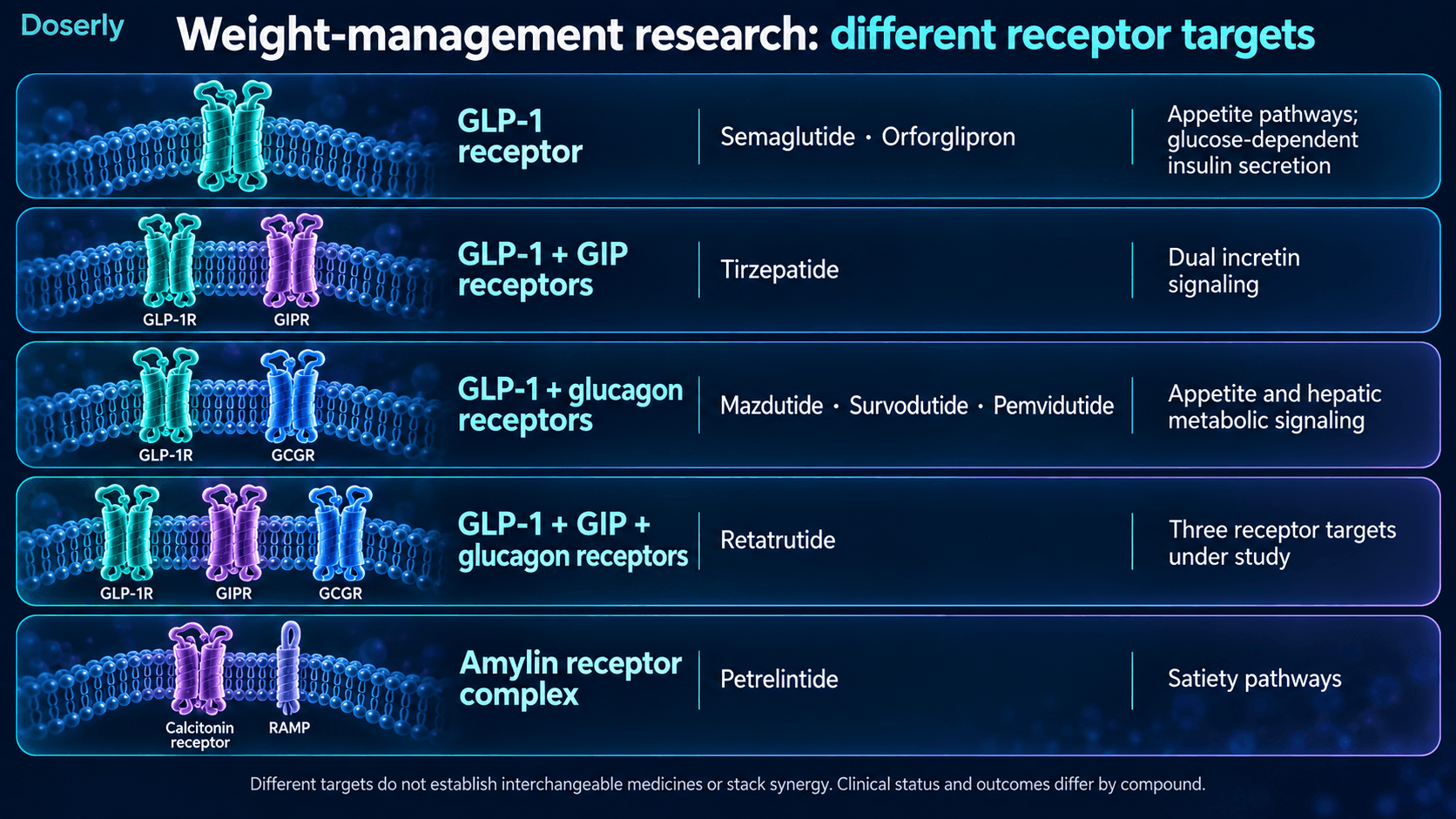
Les voies de preuve séparent les étiquettes approuvées, les programmes incrétines/glucagon expérimentaux et la recherche proche de l’amyline. Le visuel soutient la comparaison seulement; il ne recommande pas l’usage simultané d’incrétines et n’implique pas une synergie de stack. [1][2][3][5][6][11][12]
Cette page a maintenant trois niveaux de preuve. Le premier contient les étiquettes américaines approuvées pour la gestion du poids : semaglutide, tirzepatide et orforglipron. Le deuxième contient des programmes cliniques humains avec données publiées ou communiquées par promoteur, sans approbation américaine dans les sources vérifiées : retatrutide, Cagri/Sema, cagrilintide, survodutide, pemvidutide, mazdutide, zenagamtide et petrelintide. Le troisième est la couche de statut des sources : approbations régionales, programmes actifs de phase 3, registres d'essais, résultats de promoteur et pages publiques de protocoles.
Ces niveaux ne sont pas interchangeables. Une étiquette américaine commercialisée, une étiquette chinoise, un essai randomisé publié, un résultat de promoteur, un registre et une page commerciale de protocole répondent à des questions différentes. Une page de collection est utile parce qu'elle garde ces réponses au même endroit.
Groupes de mécanismes
Ancrages approuvés GLP-1 ou du marché des incrétines : Semaglutide agit par agonisme du récepteur GLP-1; tirzepatide ajoute l'agonisme GIP; orforglipron est un agoniste oral non peptidique du récepteur GLP-1. Ces produits portent leurs propres étiquettes, avertissements, formulations et limites de coadministration. [1][2][3]
Agonistes expérimentaux incrétines et glucagon : Retatrutide combine l'activité GIP, GLP-1 et glucagon. Survodutide, mazdutide et pemvidutide combinent l'activité GLP-1 et glucagon, mais leurs axes cliniques, statuts d'approbation et populations diffèrent. [4][7][8][9]
Programmes amyline et proches de l'amyline : Cagrilintide et Cagri/Sema sont dans la voie de satiété de l'amyline. Zenagamtide fait le pont entre GLP-1 et récepteurs amyline/calcitonine. Petrelintide est un analogue de l'amyline sans agonisme du récepteur GLP-1. Leur placement commun soutient la comparaison, pas l'utilisation simultanée. [5][6][10][11]
Données humaines, animales et pages Web
Les membres nommés sur cette page ont des données humaines, mais le type de données varie. Les produits approuvés ont une information posologique officielle. CagriSema, survodutide, pemvidutide, zenagamtide et petrelintide ont des publications d'essais ou des communications de promoteur. Retatrutide a des résultats majeurs de phase 3 dans l'obésité rapportés par le promoteur, alors qu'une publication complète révisée par les pairs reste une étape ultérieure. Mazdutide a une approbation en Chine et une littérature d'essais, tandis qu'aucune approbation FDA n'a été trouvée dans les sources vérifiées.
Les protocoles Web et tableaux de vendeurs peuvent décrire ce que le marché affirme. Ils ne comblent pas les écarts de revue réglementaire, qualité de produit, population d'essai, voie, formulation ou sécurité à long terme.
Sécurité et limite de combinaison
Les étiquettes approuvées créent déjà une limite importante. Wegovy indique que l'utilisation avec d'autres produits contenant du sémaglutide ou d'autres agonistes du récepteur GLP-1 n'est pas recommandée. Zepbound indique que l'utilisation avec d'autres produits contenant du tirzépatide ou tout agoniste du récepteur GLP-1 n'est pas recommandée. La FDA avertit aussi que les produits GLP-1 non approuvés ne passent pas par son examen de sécurité, d'efficacité ou de qualité avant commercialisation. [1][2][12]
Les composés expérimentaux ont leurs propres incertitudes. Retatrutide, cagrilintide et petrelintide ne sont pas des composants de médicaments approuvés par la FDA dans l'avertissement de préparation magistrale vérifié pour cette mise à jour. La participation à un essai, les produits fixes de promoteur et les pages publiques de protocoles sont des catégories de preuves séparées. [12]
Suivre les comparaisons sans créer un stack
Un outil de suivi peut garder les noms de produits, les dates de source, les quantités d'essai rapportées, les symptômes, les tendances de poids, les laboratoires et les notes de clinicien côte à côte. L'interprétation reste séparée du journal. Cette collection soutient la comparaison; elle ne transforme pas les membres en protocole combiné.
Questions fréquentes
Cette page est-elle encore un stack?
C'est une URL de stack avec un rôle de comparaison de recherche. Le titre et le contenu correspondent maintenant au libellé plus large de l'application : Recherche sur la gestion du poids. Le regroupement ne signifie pas que tous les membres appartiennent à un seul protocole.
Quels membres sont approuvés aux États-Unis pour la gestion du poids?
Les étiquettes américaines vérifiées soutiennent semaglutide/Wegovy, tirzepatide/Zepbound et orforglipron/Foundayo pour des indications de gestion du poids. Les autres membres sont expérimentaux aux États-Unis ou propres à une région dans les sources vérifiées. [1][2][3][7]
Pourquoi inclure petrelintide s'il n'est pas GLP-1?
Petrelintide est inclus parce que les analogues de l'amyline se placent maintenant à côté des programmes GLP-1 et multiagonistes dans les décisions de recherche sur la gestion du poids. Son mécanisme n'est pas l'agonisme du récepteur GLP-1. [11]
Cagri/Sema valide-t-il les mélanges en ligne séparés?
Non. Les données CagriSema viennent d'un produit expérimental fixe étudié. Elles ne valident pas les ratios en fioles séparées ni l'empilement généralisé d'incrétines. [5][6]
Sources et références
Sources vérifiées le 12 septembre 2026.
[1] DailyMed. Étiquette Wegovy sémaglutide. Étiquette américaine actuelle ouverte le 12 septembre 2026.
[2] DailyMed. Étiquette Zepbound tirzépatide. Étiquette américaine actuelle ouverte le 12 septembre 2026.
[3] DailyMed. Étiquette Foundayo orforglipron. Étiquette américaine actuelle ouverte le 12 septembre 2026.
[4] Eli Lilly. Annonce TRIUMPH-1 retatrutide. 21 mai 2026.
[5] Garvey et coll. Coadministered Cagrilintide and Semaglutide in Adults with Overweight or Obesity. New England Journal of Medicine, 2025. PMID: 40544433. DOI: 10.1056/NEJMoa2502081.
[6] Lau et coll. Once-weekly cagrilintide for weight management in people with overweight and obesity. The Lancet, 2021. PMID: 34798060. DOI: 10.1016/S0140-6736(21)01751-7.
[7] Innovent. Communiqué d'approbation chinoise NMPA du mazdutide pour la gestion chronique du poids. 27 juin 2025. Vérification GLORY-1 : PMID 40421736.
[8] le Roux et coll. Survodutide Once Weekly for the Treatment of Adults with Obesity. New England Journal of Medicine, 2026. PMID: 42253238. DOI: 10.1056/NEJMoa2600751.
[9] Browne et coll. Safety and efficacy of 24 weeks of pemvidutide in MASLD. JHEP Reports, 2025. PMID: 41113119. DOI: 10.1016/j.jhepr.2025.101483.
[10] Mora et coll. Once-weekly subcutaneous zenagamtide in type 2 diabetes. The Lancet, 2026. PMID: 42532080. Contexte amycretin antérieur dans l'obésité : Dahl et coll..
[11] Olsen et coll. Petrelintide for weight management: two randomized controlled phase 1 trials. Diabetes, Obesity and Metabolism, 2026. PMID: 42017294. DOI: 10.1111/dom.70753.
[12] FDA. FDA's concerns with unapproved GLP-1 drugs used for weight loss. Ouvert le 12 septembre 2026.
Peptides in This Stack
Cagri/Sema
Guide du mélange Cagri/Sema : doses étudiées de CagriSema, protocoles en ligne, statut FDA, limites du ratio fixe et frontières des preuves en septembre 2026.
Cagrilintide
Guide de recherche sur le cagrilintide : doses étudiées, données CagriSema, statut FDA, protocoles rapportés en ligne et limites de sécurité en septembre 2026.
Mazdutide
Guide actuel sur la mazdutide couvrant les approbations chinoises de Xinermei, la posologie hebdomadaire étiquetée de 2/4/6 mg, le contexte de recherche à 9 mg, les données d'essais, la sécurité et les protocoles commerciaux de fioles.
Orforglipron
Guide actuel sur Foundayo (orforglipron) couvrant la posologie orale GLP-1 approuvée par la FDA pour la gestion du poids, le lien avec les doses d'essais, les avertissements de sécurité, l'entreposage et les limites des données.
Retatrutide
Doses étudiées du rétatrutide, protocoles rapportés en ligne, effets indésirables et nouveautés de phase 3 en 2026, avec sources et limites des données.
Semaglutide
Guide factuel sur le semaglutide comparant les posologies de référence d'Ozempic, Wegovy et Rybelsus, les essais cliniques, l'innocuité, l'entreposage et le contexte réglementaire actuel aux États-Unis et au Canada.
Survodutide
Guide de recherche sur survodutide couvrant les doses étudiées, les résultats des essais sur l'obésité et la MASLD/MASH, le statut FDA, les allégations de guides de doses en ligne et les limites des données en septembre 2026.
Tirzepatide
Guide fondé sur les données probantes comparant les monographies et étiquettes actuelles de Mounjaro et Zepbound, les essais SURMOUNT/SURPASS, les mises en garde de sécurité et les sites populaires de dosage, sans donner de recommandation posologique.
Zenagamtide
Guide de recherche sur le zenagamtide couvrant les doses orales et sous-cutanées étudiées, l'ancien nom amycretin, les données de phase 2, le statut de phase 3, les effets indésirables et les limites des preuves.
Petrelintide
Guide de recherche sur le petrelintide couvrant les doses de phase 1, les essais ZUPREME-1 et ZUPREME-2, le mécanisme d'analogue de l'amyline, les signaux de tolérance et les lacunes publiques.
Pemvidutide
Guide de recherche sur le pemvidutide couvrant le mécanisme glucagon/GLP-1, les résultats IMPACT en MASH, l'initiation de PERFORMA en phase 3, les doses d'essai, la sécurité et les lacunes des preuves.