
Undécanoate de testostérone chez la femme : données et risques
On this page
Référence rapide
Attribut
Nom(s) de marque
- Valeur
- Kyzatrex (É.-U., hommes seulement); Andriol / Andriol Testocaps (international, hommes seulement); aucun produit féminin approuvé
Attribut
Nom générique
- Valeur
- Undécanoate de testostérone (UT)
Attribut
Classe / Type de médicament
- Valeur
- Androgène; prodrogue ester de testostérone
Attribut
Indications approuvées par la FDA (femmes)
- Valeur
- Aucune. Expérimental pour le TDSH chez les femmes post-ménopausées
Attribut
Indications approuvées par la FDA (hommes)
- Valeur
- Traitement de remplacement de la testostérone pour les hommes adultes présentant des conditions associées à un déficit de testostérone endogène
Attribut
Doses expérimentales (femmes)
- Valeur
- 40 mg deux fois par semaine (ECR Tungmunsakulchai); 50 mg par jour (essai de phase 2 Kyzatrex)
Attribut
Voie(s) d'administration
- Valeur
- Orale (capsule, à prendre avec les repas)
Attribut
Calendrier de dosage
- Valeur
- Une fois par jour ou deux fois par semaine (expérimental; varie selon l'étude)
Attribut
Exigences de surveillance clés
- Valeur
- Testostérone totale (de base et à 3-6 semaines), bilan lipidique, fonction hépatique, signes d'excès androgénique
Attribut
Statut réglementaire
- Valeur
- Expérimental pour les femmes; approuvé par la FDA pour les hommes (Kyzatrex, mars 2022)
Attribut
Différenciateur clé
- Valeur
- Seule formulation de testostérone orale sous investigation clinique active pour les femmes; utilise l'absorption lymphatique pour contourner le métabolisme hépatique de premier passage
Vue d'ensemble / Qu'est-ce que l'undécanoate de testostérone?
Les bases
L'undécanoate de testostérone est une forme orale de testostérone actuellement étudiée pour une utilisation chez les femmes ménopausées qui éprouvent un faible désir sexuel persistant. Il est important de comprendre dès le départ que ce médicament n'est approuvé pour les femmes nulle part dans le monde. Il est approuvé pour les hommes dans plusieurs pays comme traitement du faible taux de testostérone, et les chercheurs étudient maintenant si une dose beaucoup plus faible pourrait aider de manière sûre les femmes atteintes d'une condition spécifique appelée trouble du désir sexuel hypoactif (TDSH).
La plupart des gens pensent à la testostérone comme une « hormone masculine », mais le corps des femmes la produit aussi, simplement en quantités beaucoup plus petites. La testostérone joue des rôles importants dans le désir sexuel, l'énergie et le bien-être général. Pendant et après la ménopause, les niveaux de testostérone déclinent graduellement, et certaines femmes développent une perte de désir sexuel source de détresse qui ne répond pas à l'hormonothérapie à base d'estrogènes seule. Pour ces femmes, la supplémentation en testostérone a montré des bienfaits dans les essais cliniques, principalement en utilisant des timbres et des crèmes appliqués sur la peau.
Le défi est qu'il n'existe aucun produit de testostérone approuvé spécifiquement conçu pour les femmes aux États-Unis ou dans la plupart des autres pays. Les femmes qui reçoivent une testostéronothérapie aujourd'hui utilisent généralement des produits masculins à une fraction de la dose prévue, ou des formulations magistrales. C'est là que l'undécanoate de testostérone entre en jeu. Sa formulation unique lui permet d'être absorbé par le système lymphatique intestinal plutôt que de passer par le foie comme la plupart des médicaments oraux, ce qui peut offrir des avantages en termes de sécurité. Un essai clinique de phase 2 évalue actuellement une dose quotidienne de 50 mg (environ un huitième de la dose de départ masculine) chez les femmes ménopausées atteintes de TDSH.
Ce guide résume ce qui est actuellement connu sur l'undécanoate de testostérone dans le contexte de la santé des femmes. Parce que la recherche est à un stade précoce, une grande partie de ce guide s'appuie sur les données probantes plus larges concernant la testostéronothérapie pour les femmes et la pharmacologie établie de l'UT oral. Les lectrices devraient comprendre que des recommandations de pratique clinique ne peuvent pas être faites pour un agent expérimental, et que toutes les décisions de traitement devraient être prises avec un fournisseur de soins de santé qualifié.
Au 13 septembre 2026, aucun produit de testostérone n’est approuvé par la FDA pour les femmes ménopausées; les données soutiennent une testostérone transdermique physiologique surveillée pour le DSHA, pas des protocoles supraphysiologiques d’undécanoate. [18][19]
La science
L'undécanoate de testostérone (UT) est une prodrogue ester d'acide gras à longue chaîne de la testostérone (17-bêta-hydroxyandrost-4-èn-3-one undécanoate). L'ester d'acide undécanoïque rend la molécule suffisamment lipophile pour être absorbée préférentiellement par les vaisseaux lymphatiques intestinaux plutôt que par le système veineux portal, contournant ainsi partiellement le métabolisme hépatique de premier passage qui rend la testostérone orale non estérifiée virtuellement inactive [1][2].
Le composé a été développé pour la première fois dans les années 1970 et est disponible internationalement pour l'hypogonadisme masculin (sous le nom d'Andriol/Andriol Testocaps) depuis plus de trois décennies. Aux États-Unis, trois produits d'UT oral ont reçu l'approbation de la FDA pour les hommes depuis 2019 : JATENZO (2019), TLANDO (2022) et KYZATREX (2022), tous utilisant des systèmes d'administration de médicaments auto-émulsifiants (SEDDS) pour améliorer l'absorption lymphatique [3].
L'intérêt pour l'UT oral chez les femmes provient d'un besoin clinique non comblé. Malgré la déclaration de consensus mondial de 2019 de 11 sociétés médicales internationales endossant la testostéronothérapie pour le TDSH post-ménopausique, aucun produit de testostérone spécifique aux femmes n'a reçu d'approbation réglementaire aux É.-U., en Europe ou dans la plupart des autres juridictions [4]. La seule exception est l'Australie, où la crème de testostérone AndroFeme 1 % a été approuvée en 2022. Les femmes dans le monde entier sont traitées avec des formulations masculines hors indication à des doses ajustées ou des préparations magistrales, une situation que le panel de consensus a décrite comme un « besoin non comblé » nécessitant une attention urgente [4].
Le seul essai contrôlé randomisé d'UT oral spécifiquement chez les femmes (Tungmunsakulchai et al., 2015) a démontré une amélioration significative des scores de fonction sexuelle avec 40 mg deux fois par semaine sur 8 semaines, avec un profil de sécurité comparable au placebo à cette dose et cette durée [5]. Un essai de phase 2 en ouvert (NCT06082817) évalue la formulation SEDDS moderne (Kyzatrex) à 50 mg par jour chez 30 femmes ménopausées atteintes de TDSH et de faible testostérone [6].
Identité médicale / chimique
Propriété
Nom générique
- Valeur
- Undécanoate de testostérone
Propriété
Nom chimique
- Valeur
- 17-bêta-hydroxyandrost-4-èn-3-one 17-undécanoate
Propriété
Classe chimique
- Valeur
- Androgène; ester d'acide gras à longue chaîne de la testostérone
Propriété
Formule moléculaire
- Valeur
- C30H48O3
Propriété
Masse moléculaire
- Valeur
- 456,7 g/mol
Propriété
Numéro CAS
- Valeur
- 5949-44-0
Propriété
Métabolite actif
- Valeur
- Testostérone (libérée par hydrolyse de l'ester)
Propriété
Approbation FDA (hommes)
- Valeur
- KYZATREX : mars 2022 (NDA 215089); JATENZO : mars 2019; TLANDO : mars 2022
Propriété
Approbation FDA (femmes)
- Valeur
- Aucune. Expérimental
Propriété
Fabricant (Kyzatrex)
- Valeur
- Marius Pharmaceuticals
Propriété
Classification DEA
- Valeur
- Substance contrôlée de l'annexe III (produits de testostérone)
Noms de marque (formulations masculines) :
Pays
États-Unis
- Marque(s)
- Kyzatrex, JATENZO, TLANDO
- Formulation
- Capsules orales (SEDDS)
Pays
International
- Marque(s)
- Andriol, Andriol Testocaps
- Formulation
- Capsules orales (à base d'huile)
Pays
États-Unis (IM)
- Marque(s)
- Aveed
- Formulation
- Injection intramusculaire (undécanoate de testostérone)
Notes structurelles clés :
- Prodrogue ester : l'UT lui-même est pharmacologiquement inactif; l'activité dépend de l'hydrolyse en testostérone
- L'ester d'acide undécanoïque à longue chaîne confère une lipophilie suffisante pour l'absorption lymphatique
- Distinct de la méthyltestostérone (17-alpha-méthylée), qui cause une hépatotoxicité
- Aucune alkylation 17-alpha, ce qui élimine le risque d'hépatotoxicité associé aux anciens androgènes oraux
Mécanisme d'action
Les bases
Pour comprendre comment l'undécanoate de testostérone fonctionne, il est utile de connaître deux choses : ce que fait la testostérone dans le corps d'une femme, et comment cette formulation particulière l'y amène.
La testostérone est un androgène, une classe d'hormones que les hommes et les femmes produisent. Chez les femmes, la testostérone est produite principalement par les ovaires et les glandes surrénales. Elle agit sur les récepteurs des androgènes trouvés dans tout le corps, incluant dans le cerveau (où elle influence le désir sexuel et l'humeur), dans les muscles et les os (où elle soutient la force et la densité), et dans la peau et les follicules pileux (où elle peut affecter les patrons de pilosité et la production de sébum).
Durant la ménopause, la production de testostérone décline graduellement. Ce déclin est moins abrupt que la chute des estrogènes, mais au milieu de la vie, les niveaux de testostérone des femmes sont environ 50 % plus bas que dans la vingtaine. Pour certaines femmes, ce déclin contribue à une perte marquée du désir sexuel qui cause une détresse personnelle significative, une condition formellement appelée trouble du désir sexuel hypoactif (TDSH).
L'undécanoate de testostérone est une forme de testostérone spécialement conçue, attachée à une chaîne d'acide gras. Lorsque vous avalez la capsule avec de la nourriture, l'attachement d'acide gras fait que le médicament est absorbé par votre système lymphatique (le réseau de vaisseaux qui transporte normalement les graisses alimentaires) plutôt que d'aller directement au foie. Cela compte parce que le foie dégrade très efficacement la testostérone non modifiée, c'est pourquoi simplement prendre un comprimé de testostérone ne fonctionne pas. En utilisant la voie lymphatique, l'undécanoate de testostérone fait parvenir une partie de sa charge utile intacte dans la circulation sanguine. Une fois là, les enzymes dans le sang et les tissus détachent la chaîne d'acide gras, libérant la testostérone active.
L'exigence alimentaire est importante. L'undécanoate de testostérone doit être pris avec un repas contenant des matières grasses pour déclencher la voie d'absorption lymphatique. Le prendre à jeun réduit dramatiquement son efficacité.
La science
L'undécanoate de testostérone exploite la voie de transport lymphatique intestinal pour l'absorption du médicament. La chaîne ester d'acide undécanoïque (C11) confère une lipophilie suffisante (log P d'environ 7,2) pour favoriser l'incorporation dans les chylomicrons intestinaux pendant l'absorption lipidique postprandiale [1][2].
Après l'administration orale avec un repas contenant des matières grasses, l'UT est absorbé par les entérocytes intestinaux et incorporé dans les chylomicrons dans l'appareil de Golgi, qui sont ensuite sécrétés dans les vaisseaux lymphatiques mésentériques plutôt que dans le système veineux portal. Cette voie lymphatique délivre l'UT à la circulation systémique via le canal thoracique, contournant le métabolisme hépatique de premier passage [2].
Des études définitives utilisant la méthodologie des isotopes stables dans des modèles cannulés du canal lymphatique ont démontré que 91,5 à 99,7 % de l'ester d'UT systémiquement disponible est délivré par le transport lymphatique, et 83,6 à 84,1 % de la testostérone systémiquement disponible provient de l'hydrolyse de l'UT transporté par voie lymphatique [2]. La biodisponibilité orale absolue de l'UT est faible (environ 3 %) pour l'ester parent, mais le critère d'évaluation cliniquement pertinent est l'élévation sérique de testostérone résultante, qui est suffisante aux doses appropriées.
Une fois dans la circulation systémique, l'UT subit une hydrolyse par des estérases non spécifiques dans le plasma et les tissus pour libérer la testostérone et l'acide undécanoïque. La fraction d'acide undécanoïque est métabolisée par bêta-oxydation (une voie normale de dégradation des acides gras). La testostérone libérée agit alors par le récepteur des androgènes (RA), un récepteur d'hormones nucléaires exprimé dans les tissus reproducteurs, le cerveau, les os, les muscles, le tissu adipeux et l'endothélium cardiovasculaire [7].
La testostérone peut aussi être convertie en deux métabolites importants : la 5-alpha-dihydrotestostérone (DHT) via la 5-alpha-réductase (un agoniste du RA plus puissant), et l'estradiol via l'aromatase (CYP19A1) [7]. Chez les femmes recevant une supplémentation physiologique en testostérone, la conversion en estradiol est quantitativement faible et ne modifie pas significativement les niveaux circulants d'estradiol [4].
Les formulations SEDDS modernes (système d'administration de médicaments auto-émulsifiant) telles que Kyzatrex incorporent des surfactants et des cosolvants qui favorisent l'émulsification spontanée dans le tractus gastro-intestinal, améliorant l'incorporation dans les chylomicrons et potentiellement la constance de l'absorption lymphatique comparativement aux formulations plus anciennes à base d'huile [3].
Guide visuel
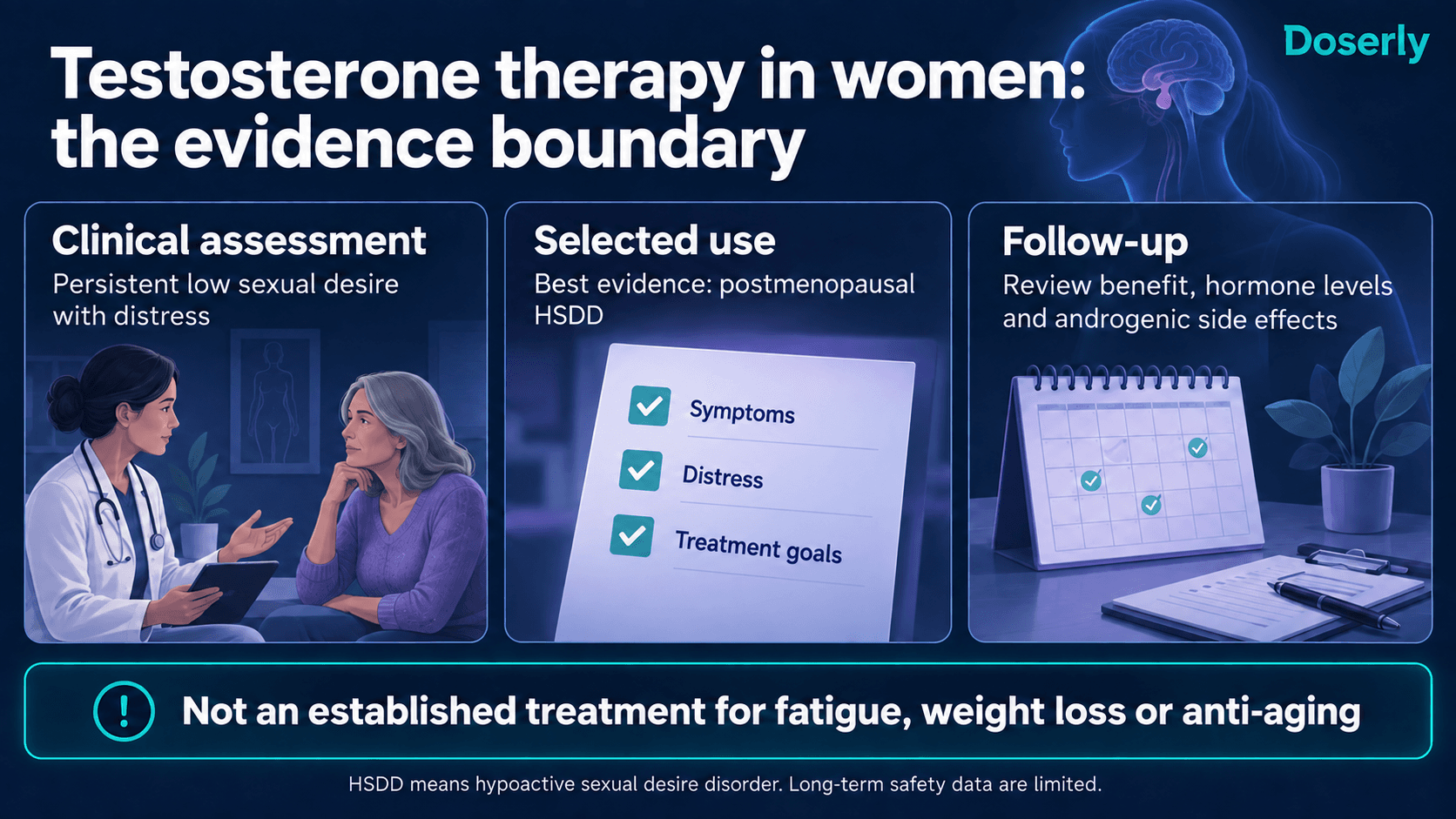
Ouvrir le schéma en grand format.
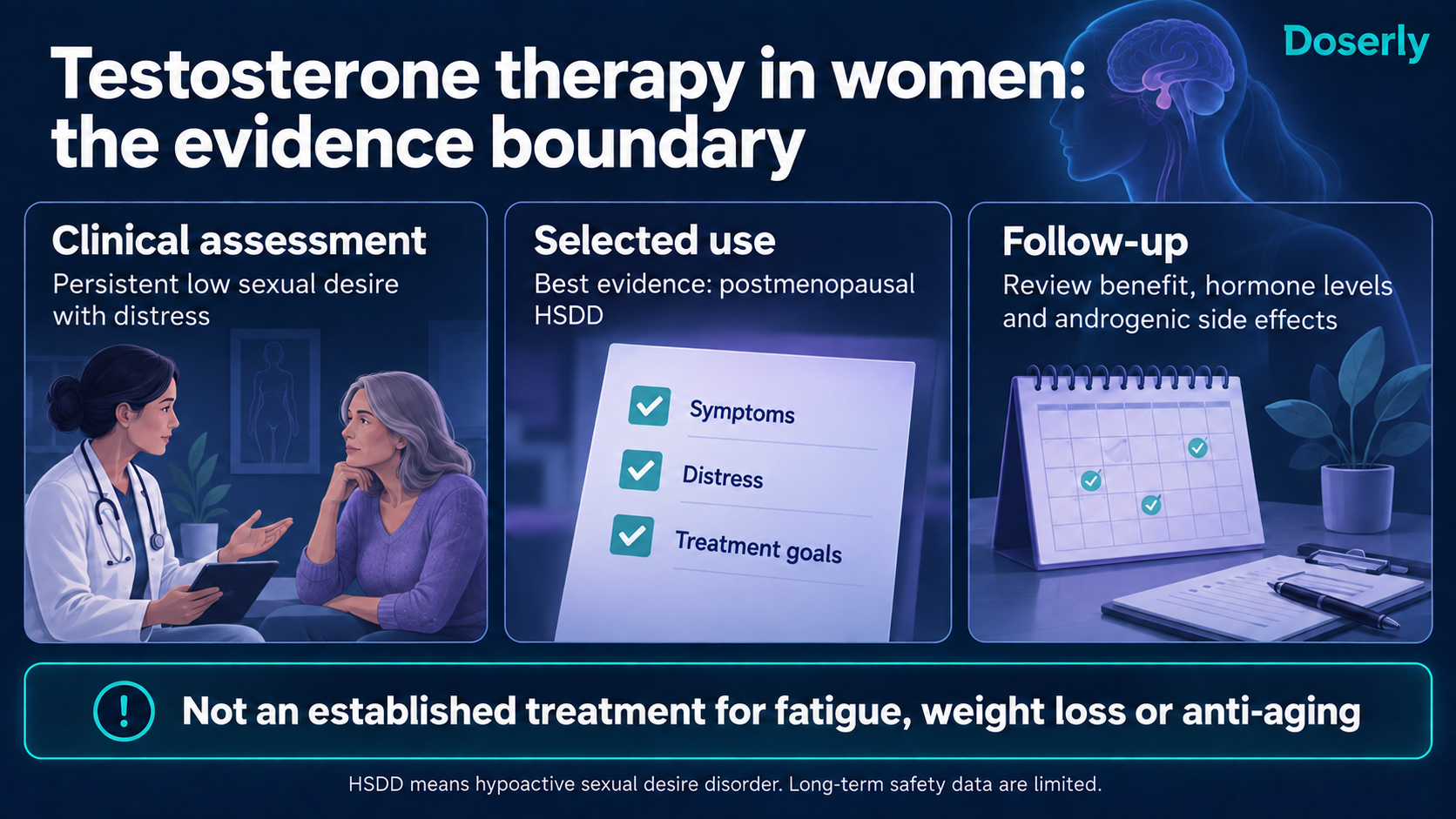
Schéma explicatif en anglais; les points essentiels sont expliqués ci-dessous en français. Les meilleures données concernent la testostérone transdermique systémique pour le trouble du désir sexuel hypoactif après la ménopause et après évaluation. Elles ne valident pas l’undécanoate oral comme traitement équivalent. Un taux de testostérone seul ne permet pas ce diagnostic.
ISSWSH testosterone guideline for women.
Pharmacocinétique / Physiologie hormonale
Les bases
Comprendre comment l'undécanoate de testostérone se déplace dans votre corps aide à expliquer à la fois ses bienfaits potentiels et ses limites.
Lorsque vous prenez une capsule d'undécanoate de testostérone avec un repas, le médicament voyage avec les graisses que vous avez mangées. Vos cellules intestinales emballent les graisses alimentaires dans de minuscules particules appelées chylomicrons, et l'undécanoate de testostérone est incorporé dans ces particules. Au lieu d'aller au foie (où la testostérone serait dégradée), les chylomicrons voyagent par votre système lymphatique, se vidant éventuellement dans votre circulation sanguine près du cœur.
Une fois dans le sang, la chaîne d'acide gras est détachée par des enzymes, libérant la testostérone active. Ce processus n'est pas parfaitement efficace; seul un petit pourcentage de la dose parvient réellement à devenir de la testostérone active. Mais à des doses appropriées, c'est suffisant pour élever les niveaux de testostérone dans la plage normale préménopausique pour les femmes.
Dans la seule étude pharmacocinétique dédiée chez les femmes (utilisant Andriol Testocaps à des doses de 20, 40 et 80 mg), les niveaux de testostérone ont augmenté de manière proportionnelle à la dose, signifiant que doubler la dose doublait approximativement le niveau de testostérone [8]. La dose de 40 mg a produit des élévations de testostérone dans une plage qui serait considérée physiologique pour les femmes préménopausées.
La dépendance au repas est l'une des réalités pratiques de ce médicament. Un repas contenant des matières grasses est essentiel. Prendre la capsule à jeun ou avec un repas très faible en gras réduit significativement l'absorption.
La science
Absorption : La biodisponibilité de l'UT oral est fortement dépendante de la nourriture. L'administration postprandiale avec un repas contenant des matières grasses est requise pour une absorption lymphatique adéquate. La biodisponibilité orale absolue de l'ester d'UT est d'environ 3 % [2], mais cela est suffisant pour produire des élévations de testostérone cliniquement significatives en raison de la haute puissance de la testostérone aux concentrations physiologiques féminines (typiquement 15 à 70 ng/dL de testostérone totale).
Chez les femmes post-ménopausées en bonne santé ayant reçu Andriol Testocaps [8] :
Paramètre
Élévation de la Cmax de testostérone
- 20 mg
- Proportionnelle à la dose
- 40 mg
- Proportionnelle à la dose
- 80 mg
- Proportionnelle à la dose
Paramètre
ASC(0-12) de l'UT
- 20 mg
- Proportionnelle à la dose
- 40 mg
- Proportionnelle à la dose
- 80 mg
- Plus élevée que prévu
Paramètre
Niveaux de DHT
- 20 mg
- Proportionnels
- 40 mg
- Proportionnels
- 80 mg
- Plus bas que prévu
La réponse proportionnelle à la dose de la testostérone avec une DHT sous-proportionnelle aux doses plus élevées suggère une saturation de la conversion par la 5-alpha-réductase, ce qui peut être cliniquement favorable (limitant les effets secondaires androgéniques médiés par la DHT) [8].
Distribution : La testostérone chez les femmes est approximativement 66 % liée à la globuline liant les hormones sexuelles (SHBG), 33 % à l'albumine et 1 à 2 % circule libre [7]. La liaison à la SHBG est importante parce qu'elle affecte la disponibilité de la testostérone libre. L'estrogénothérapie (souvent concomitante chez les utilisatrices de THS) augmente la production de SHBG, ce qui peut réduire la testostérone libre. L'ECR de Tungmunsakulchai a observé une diminution de la SHBG dans le groupe testostérone (de 81,09 à 65,84 nmol/L), cohérent avec l'effet connu de la testostérone sur l'abaissement de la SHBG [5].
Métabolisme : L'UT est hydrolysé par des estérases non spécifiques en testostérone et en acide undécanoïque. La testostérone est ensuite métabolisée via :
- la 5-alpha-réduction en DHT (5-alpha-réductase types 1 et 2)
- l'aromatisation en estradiol (CYP19A1)
- la conjugaison hépatique (glucuronidation, sulfatation) pour l'excrétion rénale
- l'oxydation médiée par le CYP3A4 (voie mineure)
Élimination : La testostérone a une demi-vie plasmatique d'environ 10 à 100 minutes. L'ester (UT) lui-même a une demi-vie apparente plus longue en raison de la libération lente à partir du dépôt lymphatique et de l'hydrolyse continue [3].
Contexte clinique — Calendrier de dosage pour les femmes.
Comprendre comment votre corps absorbe et métabolise les hormones est une chose. Suivre votre protocole réel — doses, horaires et voie — vous donne les données pour avoir des conversations plus productives avec votre prescripteur. Doserly vous permet d'enregistrer chaque dose avec des détails spécifiques à la voie, construisant un historique clair de votre protocole hormonal au fil du temps.
Que vous preniez des timbres, des gels, des comprimés oraux ou une combinaison, l'application suit votre calendrier et vous signale quand les doses sont dues. Quand votre fournisseur de soins vous demande comment votre protocole se déroule, vous aurez une réponse précise plutôt qu'une estimation approximative.
Recherche et données cliniques
Les bases
La recherche sur l'undécanoate de testostérone spécifiquement pour les femmes est à un stade précoce. Un petit essai contrôlé randomisé et un essai clinique en cours forment le cœur de la base de données probantes. Cependant, les données probantes plus larges sur la testostéronothérapie chez les femmes atteintes de TDSH sont plus robustes et fournissent un contexte important.
La conclusion principale à travers toutes les études sur la testostérone chez les femmes : ajouter de la testostérone (principalement sous forme de timbres ou de crèmes) au THS à base d'estrogènes peut modestement mais significativement améliorer le désir sexuel et la satisfaction chez les femmes post-ménopausées atteintes de TDSH. Une méta-analyse exhaustive de 2019 regroupant les données de multiples essais randomisés a trouvé que la testostéronothérapie augmentait le nombre d'événements sexuels satisfaisants d'environ un événement supplémentaire par mois comparativement au placebo et améliorait le désir sexuel, l'excitation et l'orgasme [9].
Ce que l'étude sur l'UT oral a trouvé : Le seul essai randomisé utilisant spécifiquement l'undécanoate de testostérone oral chez les femmes (Tungmunsakulchai et al., 2015) a recruté 70 femmes post-ménopausées avec une dysfonction sexuelle. Le groupe testostérone (40 mg deux fois par semaine avec estrogènes quotidiens) a montré des scores de fonction sexuelle globale et des scores d'excitation significativement meilleurs comparativement au groupe estrogènes seuls après 8 semaines. Aucune différence significative dans les effets secondaires n'a été observée [5].
Ce que nous ne savons pas encore : Si la formulation moderne d'UT oral (Kyzatrex) à 50 mg par jour produit des niveaux de testostérone physiologiques chez les femmes de manière sûre, si les effets lipidiques qui préoccupent les cliniciens à propos de la testostérone orale sont évités avec les formulations à absorption lymphatique, et si les bienfaits observés dans le petit essai thaïlandais peuvent être reproduits dans une population plus grande et plus diverse.
La science
Tungmunsakulchai et al. (2015) — Le seul ECR d'UT oral chez les femmes [5]
Cet essai en double aveugle, contrôlé par placebo, a randomisé 70 femmes post-ménopausées pour recevoir de l'UT oral 40 mg deux fois par semaine plus du valérate d'estradiol 1 mg par jour, ou un placebo plus du valérate d'estradiol 1 mg par jour, pendant 8 semaines. Le critère d'évaluation principal était le score total de l'Indice de fonction sexuelle féminine (FSFI).
Résultats : Le FSFI post-traitement était de 28,6 +/- 3,6 (UT) vs 25,3 +/- 6,7 (placebo), p = 0,04. Le sous-domaine de l'excitation a montré l'amélioration la plus robuste (p = 0,02). Les marqueurs de sécurité (hématocrite, enzymes hépatiques, bilan lipidique) n'ont montré aucun changement significatif. L'indice d'androgènes libres a augmenté significativement dans le groupe UT (1,42 vs placebo 0,51, p < 0,05).
Limites : Petit échantillon (n = 70), courte durée (8 semaines), centre unique, pas d'évaluation endométriale, formulation d'UT plus ancienne à base d'huile.
Islam et al. (2019) — Revue systématique et méta-analyse de la testostéronothérapie pour les femmes [9]
La méta-analyse la plus exhaustive à ce jour, publiée dans le Lancet Diabetes and Endocrinology, a regroupé les données de 36 ECR (8 480 participantes). Résultats clés pour la testostérone transdermique (la voie la plus étudiée) :
- Événements sexuels satisfaisants : augmentation significative (différence moyenne d'environ 0,85 événement/4 semaines)
- Désir sexuel : amélioration significative à travers les mesures
- Excitation, orgasme, réactivité, image de soi et réduction de la détresse sexuelle : tous significativement améliorés
- Pas d'augmentation significative des événements indésirables graves
- L'acné légère et la pilosité accrue étaient les effets secondaires les plus courants
Essai de phase 2 Kyzatrex (NCT06082817) — En cours [6]
Étude en ouvert, à bras unique, monocentrique de 50 mg par jour d'UT oral (formulation SEDDS) chez 30 femmes ménopausées atteintes de TDSH et de faible testostérone (< 30 ng/dL). Critères d'évaluation principaux : sécurité et pharmacocinétique. Critère d'évaluation secondaire : efficacité sur le TDSH. Résultats pas encore disponibles.
Houwing et al. (2003) — Étude PK chez les femmes [8]
Étude de proportionnalité de dose chez 45 femmes post-ménopausées en bonne santé à 20, 40 et 80 mg d'UT oral (Andriol Testocaps). A démontré une réponse proportionnelle à la dose de la testostérone avec des preuves de saturation de la 5-alpha-réductase aux doses plus élevées (DHT plus basse que prévu).
Bienfaits et effets thérapeutiques
Les bases
Le bienfait potentiel de l'undécanoate de testostérone pour les femmes se concentre sur une indication spécifique : améliorer le désir sexuel chez les femmes post-ménopausées atteintes de TDSH. Les données probantes plus larges sur la testostéronothérapie chez les femmes montrent une amélioration significative du désir sexuel, de l'excitation, de l'orgasme et de la satisfaction, accompagnée d'une réduction de la détresse sexuelle.
Si vous êtes une femme post-ménopausée qui a connu un déclin significatif du désir sexuel causant une détresse personnelle, et que vous avez déjà essayé d'optimiser le THS à base d'estrogènes sans amélioration adéquate, la supplémentation en testostérone peut aider. Les données probantes suggèrent que les femmes atteintes de TDSH qui reçoivent une testostéronothérapie connaissent environ un événement sexuel satisfaisant supplémentaire par mois comparativement à celles qui reçoivent un placebo, accompagné d'améliorations du désir et de l'excitation qui, bien que statistiquement modestes, peuvent être personnellement significatives [4][9].
Il convient de noter ce que la supplémentation en testostérone N'A PAS montré d'améliorer chez les femmes : le bien-être général, l'énergie, la fonction cognitive, l'humeur, la densité osseuse ou la composition corporelle. Les données d'essais cliniques ne soutiennent pas la testostérone pour ces indications. La déclaration de consensus mondial endossée par 11 sociétés médicales internationales est claire sur ce point : le TDSH est la seule indication fondée sur les données probantes [4].
L'avantage potentiel d'une formulation orale comme l'undécanoate de testostérone, si elle s'avère sûre et efficace chez les femmes, serait la commodité. La testostérone transdermique actuellement disponible nécessite une application quotidienne de gels ou de crèmes, une attention particulière aux risques de transfert cutané et un ajustement de dose utilisant des produits non conçus pour la physiologie féminine. Une capsule orale prise avec un repas simplifierait l'expérience de traitement.
La science
Fonction sexuelle (TDSH)
La méta-analyse d'Islam et al. (2019) est la synthèse de données probantes définitive. À travers 36 ECR incluant 8 480 participantes, la testostéronothérapie (principalement transdermique) a démontré des améliorations statistiquement significatives [9] :
- Événements sexuels satisfaisants (DME 0,36, IC à 95 % 0,22-0,50)
- Désir sexuel (DME 0,36, IC à 95 % 0,22-0,49)
- Orgasme (DME 0,27, IC à 95 % 0,14-0,40)
- Excitation et réactivité
- Réduction de la détresse personnelle liée à la fonction sexuelle
Pour l'UT oral spécifiquement, l'ECR de Tungmunsakulchai a montré une amélioration du score total FSFI (28,6 vs 25,3, p = 0,04) et du domaine de l'excitation (4,17 vs 3,45, p = 0,02) à 8 semaines. Bien que ce seul petit essai ne puisse pas établir l'efficacité, il est directionnellement cohérent avec la base de données probantes plus large sur la testostérone [5].
Autres critères d'évaluation (preuves insuffisantes)
Selon la déclaration de consensus mondial de 2019 [4] :
- Bien-être : Aucun effet (niveau I, grade A)
- Humeur/dépression : Aucun effet (niveau I, grade B)
- Cognition : Preuves insuffisantes
- Densité minérale osseuse : Aucun effet à 12 mois (niveau I, grade A)
- Composition corporelle : Aucun effet significatif sur la masse maigre, la graisse ou la force (niveau I, grade A)
Risques, effets secondaires et sécurité
Les bases
Comprendre le profil de sécurité de l'undécanoate de testostérone nécessite de distinguer entre ce que nous savons sur la testostéronothérapie chez les femmes en général, ce que nous savons sur la testostérone orale spécifiquement, et ce qui reste inconnu concernant les formulations d'UT oral plus récentes.
Les effets secondaires courants de la testostéronothérapie chez les femmes (aux doses physiologiques) incluent l'acné légère et de légères augmentations de la pilosité faciale ou corporelle. Ceux-ci sont généralement gérables et se résolvent souvent avec un ajustement de dose. Aux doses physiologiques, la testostéronothérapie N'A PAS été associée à un approfondissement de la voix, une perte de cheveux significative ou une clitoromégalie [4].
La préoccupation liée à la voie orale est la considération de sécurité la plus importante pour l'undécanoate de testostérone chez les femmes. La déclaration de consensus mondial de 2019 recommande spécifiquement contre la testostérone orale pour les femmes parce que la testostérone orale est associée à des changements lipidiques indésirables, en particulier des réductions du HDL (« bon » cholestérol) et des augmentations du LDL (« mauvais » cholestérol) [4]. Cette recommandation était basée principalement sur les formulations plus anciennes de testostérone orale et la méthyltestostérone, qui subissent un métabolisme hépatique de premier passage extensif.
La question clé pour les formulations plus récentes d'UT oral comme Kyzatrex est de savoir si l'absorption lymphatique (qui contourne partiellement le foie) résulte en un profil lipidique plus favorable. C'est précisément ce que l'essai de phase 2 en cours vise à évaluer, mais les résultats ne sont pas encore disponibles.
Ce que le petit essai existant a montré : Dans l'ECR de Tungmunsakulchai (40 mg deux fois par semaine pendant 8 semaines), il n'y avait pas de changements significatifs dans le cholestérol total, le HDL, le LDL ou les triglycérides dans le groupe testostérone comparativement au placebo [5]. Cependant, 8 semaines est trop court et 70 patientes trop peu pour tirer des conclusions de sécurité définitives.
Risque cardiovasculaire : La testostéronothérapie chez les femmes n'a pas été associée à des augmentations de la tension artérielle, de la glycémie ou de l'HbA1c. Il y a une tendance non significative vers un risque accru de thrombose veineuse profonde, bien que le rôle de l'estrogénothérapie concomitante dans cette observation ne puisse pas être exclu [4].
Cancer du sein : La testostérone transdermique à court terme n'augmente pas la densité mammographique et ne semble pas augmenter le risque de cancer du sein. Les données à long terme font défaut, et les femmes avec un cancer du sein hormonosensible étaient exclues des essais cliniques [4].
La science
Effets lipidiques (dépendants de la voie)
La recommandation de la déclaration de consensus contre la testostérone orale est basée sur des preuves de niveau I, grade A montrant des profils lipidiques indésirables avec la testostérone orale [4]. Cependant, ces données proviennent principalement d'études sur :
- La méthyltestostérone (17-alpha alkylée; profil métabolique complètement différent de l'UT)
- Les formulations plus anciennes d'UT oral sans absorption lymphatique optimisée
Contexte clinique — Sécurité lipidique de l'undécanoate de testostérone oral chez les femmes.
Effets secondaires androgéniques aux doses physiologiques [4]
Effet secondaire
Acné (légère)
- Incidence
- Courante
- Sévérité
- Légère; dépendante de la dose
Effet secondaire
Pilosité faciale/corporelle
- Incidence
- Certaines femmes
- Sévérité
- Légère; dépendante de la dose
Effet secondaire
Alopécie
- Incidence
- Non observée
- Sévérité
- Aux doses physiologiques
Effet secondaire
Changements de la voix
- Incidence
- Non observés
- Sévérité
- Aux doses physiologiques
Effet secondaire
Clitoromégalie
- Incidence
- Non observée
- Sévérité
- Aux doses physiologiques
Dans l'ECR de Tungmunsakulchai : acné 17,6 % (UT) vs 14,2 % (placebo), hirsutisme 8,8 % vs 8,5 %; ni l'un ni l'autre statistiquement significatif [5].
Considérations cardiovasculaires [4]
- Tension artérielle : Pas d'augmentation avec la testostéronothérapie
- Glycémie / HbA1c : Pas d'augmentation
- Risque de TVP : Tendance non significative vers l'augmentation; estrogènes concomitants confondants
- Infarctus du myocarde / décès : Données insuffisantes pour évaluer
Sécurité mammaire [4]
- Densité mammographique : Non augmentée par la testostérone (niveau I, grade A)
- Risque de cancer du sein à court terme : Pas d'augmentation apparente avec la testostérone transdermique (niveau I, grade A)
- Risque à long terme : Données insuffisantes (données de sécurité disponibles uniquement jusqu'à 24 mois)
- Femmes avec cancer du sein hormonosensible : exclues de tous les essais; prudence recommandée
Sécurité hépatique
L'undécanoate de testostérone ne possède pas l'alkylation 17-alpha qui a causé l'hépatotoxicité avec la méthyltestostérone et la fluoxymestérone. Les formulations plus récentes d'UT oral n'ont pas montré d'hépatotoxicité cliniquement significative dans les essais cliniques masculins, bien que certaines élévations transitoires des enzymes hépatiques aient été rapportées aux doses masculines (200 à 800 mg/jour) [3]. Aux doses expérimentales féminines beaucoup plus basses (40 à 50 mg), les préoccupations de sécurité hépatique sont théoriquement minimales, mais les données à long terme chez les femmes n'existent pas.
Contre-indications (générales pour la testostérone chez les femmes)
- Cancer du sein actif ou antécédent
- Maladie cardiovasculaire active (jusqu'à ce que d'autres données de sécurité soient disponibles)
- Grossesse ou grossesse planifiée
- Saignement vaginal non diagnostiqué
- Maladie hépatique active
- Polyglobulie ou hématocrite > 48 %
Être informée des risques potentiels est important. Être capable de suivre et documenter les effets secondaires que vous éprouvez réellement est ce qui transforme la sensibilisation en sécurité. Doserly vous permet d'enregistrer les effets secondaires au fur et à mesure, avec des horodatages et des évaluations de sévérité, pour que rien ne passe entre les mailles du filet entre les rendez-vous.
Si vous éprouvez des saignements intermenstruels, des maux de tête, une sensibilité mammaire ou tout autre changement, avoir une chronologie documentée aide votre fournisseur de soins à distinguer entre les effets d'ajustement attendus et les signaux qui justifient un changement de protocole. L'application vérifie aussi les interactions entre votre THS et tout autre médicament ou supplément que vous prenez.
Protocoles de dosage et de traitement
Les bases
Parce que l'undécanoate de testostérone est expérimental pour les femmes, il n'y a pas de lignes directrices de dosage établies pour ce médicament spécifique. Ce qui existe, ce sont des protocoles de recherche issus d'essais cliniques et une justification de dosage basée sur la compréhension plus large de la testostéronothérapie pour les femmes.
Le principe général pour le dosage de la testostérone chez les femmes est d'utiliser environ 5 à 10 % de la dose masculine, visant à atteindre des niveaux de testostérone dans la plage préménopausique féminine normale (typiquement 15 à 70 ng/dL de testostérone totale, bien que les seuils exacts varient selon le dosage). C'est un contexte très différent du remplacement de testostérone chez l'homme, où l'objectif est de 300 à 1 000 ng/dL.
Doses étudiées dans les essais cliniques :
- 40 mg d'UT oral deux fois par semaine (ECR Tungmunsakulchai, formulation plus ancienne)
- 50 mg d'UT oral par jour (essai de phase 2 Kyzatrex, formulation SEDDS)
- 20, 40 et 80 mg en doses uniques (étude PK Houwing)
Contexte important : La dose de 50 mg de Kyzatrex a été choisie parce que c'est la plus faible résistance de capsule actuellement fabriquée et représente 12,5 % de la dose de départ masculine (400 mg/jour). Les lignes directrices de pratique clinique de l'ISSWSH suggèrent que la dose de départ de testostérone pour les femmes devrait être d'environ 10 % d'une dose de produit approuvé pour les hommes [6].
Estrogènes concomitants : L'essai Tungmunsakulchai utilisait des estrogènes quotidiens concomitants. L'essai Kyzatrex n'exige pas d'estrogènes concomitants. La déclaration de consensus mondial note que la plupart des essais incluaient des femmes sous estrogénothérapie concomitante, et que les données ne peuvent pas être généralisées aux femmes ne prenant pas d'estrogènes [4].
Contexte clinique — Exigence d'estrogènes concomitants.
La science
Justification du dosage
La dose féminine de testostérone est dérivée de la différence physiologique entre les sexes dans la production de testostérone. Les femmes préménopausées produisent environ 0,1 à 0,4 mg de testostérone par jour (comparativement à 3 à 10 mg/jour chez les hommes), générant une testostérone totale circulante de 15 à 70 ng/dL [7]. L'objectif thérapeutique dans le TDSH est de restaurer la testostérone à des niveaux préménopausiques normaux médians sans dépasser la limite supérieure de la plage féminine.
Pour l'UT oral, la faible biodisponibilité (environ 3 % pour l'ester) signifie qu'une dose orale beaucoup plus élevée est nécessaire par rapport au taux de production de testostérone cible. La dose orale de 40 à 50 mg d'UT chez les femmes vise à délivrer environ 1,2 à 1,5 mg de testostérone biodisponible, atteignant des niveaux sériques dans la plage physiologique féminine [5][8].
Protocole de surveillance (basé sur les lignes directrices générales sur la testostérone) [4]
Point temporel
Base
- Évaluation
- Testostérone totale (LC-MS/MS préférée), SHBG, bilan lipidique, fonction hépatique, FSC, mammographie selon les lignes directrices
Point temporel
3-6 semaines
- Évaluation
- Répéter la testostérone totale pour confirmer les niveaux physiologiques
Point temporel
6 mois
- Évaluation
- Évaluation de la réponse clinique, signes d'excès androgénique, répéter testostérone, lipides, bilan hépatique, FSC
Point temporel
Annuellement
- Évaluation
- Réévaluation complète; continuer la surveillance des paramètres ci-dessus
Durée du traitement
Selon la déclaration de consensus mondial : si aucun bénéfice n'est ressenti à 6 mois, la testostéronothérapie devrait être discontinuée [4]. Les données de sécurité pour la testostérone aux doses physiologiques féminines ne sont pas disponibles au-delà de 24 mois.
Trouver le bon dosage prend souvent du temps et de l'ajustement fin avec votre fournisseur de soins. Garder un historique exact de ce que vous prenez réellement — doses, horaires et tout ajustement — rend ce processus plus fluide. Doserly suit vos doses de THS parallèlement à tout le reste de votre plan de santé, pour que votre protocole complet soit toujours au même endroit.
Ne vous demandez plus si vous avez pris votre dose du matin ou quand vous avez changé votre timbre pour la dernière fois. L'application enregistre chaque dose avec un horodatage et envoie des rappels quand la prochaine est due, vous aidant à maintenir la constance qui rend l'hormonothérapie plus efficace.
À quoi s'attendre (chronologie)
Parce que l'undécanoate de testostérone est expérimental pour les femmes, les données chronologiques spécifiques sont limitées. Ce qui suit est basé sur les données probantes plus larges sur la testostérone pour le TDSH et l'essai de 8 semaines de Tungmunsakulchai :
- Jours 1 à 7 : Aucun changement immédiat attendu. Les niveaux de testostérone commencent à augmenter. Certaines femmes remarquent des changements subtils d'humeur ou d'énergie, bien que cela puisse refléter une attente placebo. Prenez la capsule avec un repas contenant des matières grasses de manière constante.
- Semaines 2 à 4 : Des changements précoces du désir sexuel peuvent commencer. L'essai de Tungmunsakulchai a mesuré les résultats à 8 semaines, suggérant que les effets se développent sur cette période. De l'acné légère ou une peau grasse peuvent apparaître.
- Mois 1 à 3 : Les améliorations du désir sexuel, de l'excitation et de la satisfaction deviennent généralement plus apparentes. L'essai de phase 2 Kyzatrex évalue les résultats à 3 mois (12 semaines). Les effets secondaires (le cas échéant) sont habituellement évidents à ce stade.
- Mois 3 à 6 : Si efficace, les bénéfices devraient être clairement établis. Selon les lignes directrices de consensus, si aucun bénéfice n'est ressenti à 6 mois, le traitement devrait être discontinué. Le fournisseur de soins devrait réévaluer les niveaux de testostérone et surveiller l'excès androgénique.
- En continu : Les données à long terme pour la testostérone chez les femmes sont limitées à 24 mois. Une réévaluation annuelle avec le fournisseur de soins de santé est recommandée. Surveillance continue des lipides, de la fonction hépatique et des signes d'excès androgénique.
La réponse individuelle varie. Les données de la méta-analyse suggèrent que l'effet du traitement est modéré; la supplémentation en testostérone aide certaines femmes significativement mais n'est pas une solution universelle pour le faible désir.
Hypothèse du timing et fenêtre d'opportunité
L'hypothèse du timing, qui suggère que le THS initié dans les 10 ans suivant le début de la ménopause ou avant 60 ans présente un profil risques-bénéfices plus favorable, s'applique principalement aux thérapies à base d'estrogènes et à leurs effets cardiovasculaires et neurologiques. Son applicabilité à la testostéronothérapie spécifiquement est moins claire.
Ce qui est connu sur le timing de la testostérone :
- Les niveaux de testostérone déclinent graduellement tout au long des années reproductives, pas abruptement à la ménopause [4]
- Aucun seuil de testostérone ne différencie les femmes avec et sans dysfonction sexuelle [4]
- La déclaration de consensus ne spécifie pas de fenêtre d'âge ou de timing pour l'initiation de la testostérone
- La plupart des données d'ECR proviennent de femmes post-ménopausées (naturelle ou chirurgicale) avec une plage d'âge moyen de 50 à 60 ans
Pour les femmes envisageant une supplémentation en testostérone pour le TDSH, les considérations de timing sont plus cliniques que biologiques : s'assurer que le THS à base d'estrogènes a été optimisé en premier, confirmer que le TDSH n'est pas attribuable à des facteurs modifiables (problèmes relationnels, effets secondaires de médicaments, conditions psychologiques), et mener une évaluation biopsychosociale complète avant d'initier la thérapie [4][10].
Interactions et compatibilité
Interactions médicamenteuses :
- Inducteurs du CYP3A4 (rifampicine, carbamazépine, phénytoïne, millepertuis) : Peuvent réduire les niveaux de testostérone en augmentant le métabolisme hépatique. La pertinence pour l'UT oral peut être moindre que pour d'autres testostérones orales en raison de l'absorption lymphatique, mais l'interaction demeure possible pour la fraction subissant un métabolisme hépatique.
- Inhibiteurs du CYP3A4 (kétoconazole, itraconazole, ritonavir, pamplemousse) : Peuvent augmenter les niveaux de testostérone. Surveiller les signes d'excès androgénique.
- Anticoagulants (warfarine) : La testostérone peut renforcer l'effet anticoagulant; surveillance de l'INR conseillée.
- Insuline et hypoglycémiants oraux : La testostérone peut améliorer la sensibilité à l'insuline; les doses de médicaments hypoglycémiants peuvent nécessiter un ajustement.
- Corticostéroïdes : L'usage concomitant peut augmenter le risque de rétention liquidienne.
- Estrogénothérapie : Les estrogènes augmentent la SHBG, qui peut lier et réduire la testostérone libre. Un ajustement de dose de testostérone peut être nécessaire chez les femmes sous estrogènes concomitants.
Interactions avec les suppléments :
- DHEA (déhydroépiandrostérone) : La DHEA est un précurseur de la testostérone; l'usage concomitant peut mener à des niveaux androgéniques supraphysiologiques. Non recommandé parallèlement à la testostéronothérapie [4].
- Actée à grappes noires : Aucune interaction connue avec la testostérone
- Palmier nain : Inhibition théorique de la 5-alpha-réductase pouvant réduire la conversion en DHT; signification clinique incertaine
Facteurs de mode de vie :
- Tabagisme : N'a pas la même amplification spécifique aux estrogènes du risque de TEV mais le risque cardiovasculaire général s'applique
- Alcool : Interaction modeste avec le métabolisme hépatique; aucune interaction testostérone-alcool spécifique établie aux doses féminines
- Repas riches en gras : Requis pour une absorption optimale de l'UT oral. Prendre la capsule sans matières grasses adéquates réduit l'efficacité.
Références croisées :
- DHEA / Prastérone (Intrarosa) — thérapie androgénique connexe
- Testostéronothérapie pour les femmes (vue d'ensemble) — guide complet sur la testostérone
- Estradiol (bioidentique) — estrogène couramment utilisé en concomitance
Cadre de prise de décision
Décider si la testostéronothérapie est appropriée implique une conversation soigneuse et structurée avec un fournisseur de soins de santé compétent en santé sexuelle et en gestion de la ménopause. Pour l'undécanoate de testostérone spécifiquement, la conversation doit inclure la considération supplémentaire qu'il s'agit d'un usage expérimental.
Qui pourrait être candidate à la testostéronothérapie :
- Femmes post-ménopausées (naturelle ou chirurgicale) atteintes de TDSH
- Diagnostic de TDSH confirmé par une évaluation biopsychosociale complète
- Le THS à base d'estrogènes a été optimisé et jugé insuffisant pour les symptômes sexuels
- Aucune contre-indication à la testostéronothérapie
- Volonté d'accepter un traitement hors indication (pour la testostérone en général) ou participation à un essai clinique (pour l'UT oral spécifiquement)
Qui n'est probablement PAS candidate :
- Femmes dont le faible désir est principalement lié à des problèmes relationnels, la dépression, les effets secondaires de médicaments ou d'autres facteurs modifiables
- Femmes cherchant la testostérone pour l'énergie, l'humeur, la cognition ou la gestion du poids (preuves insuffisantes)
- Femmes avec un cancer du sein hormonosensible actif ou antérieur
- Femmes qui ne sont pas à l'aise avec une approche de traitement expérimentale ou hors indication
Questions à discuter avec votre fournisseur de soins :
- « Mon faible désir est-il probablement lié aux changements hormonaux, ou d'autres facteurs pourraient-ils y contribuer? »
- « Avons-nous pleinement optimisé mon THS à base d'estrogènes avant d'envisager la testostérone? »
- « Quelle formulation de testostérone recommanderiez-vous, et pourquoi? »
- « Comment surveillerons-nous mes niveaux de testostérone et observerons-nous les effets secondaires? »
- « Quelles sont les données probantes pour la formulation spécifique que vous prescrivez? »
- « Combien de temps devrais-je essayer la testostérone avant de déterminer si elle fonctionne? »
Trouver un spécialiste :
- NAMS Certified Menopause Practitioners : menopause.org
- Répertoire de fournisseurs ISSWSH : isswsh.org
- Spécialistes en médecine sexuelle
- Endocrinologues avec expérience en thérapie androgénique féminine
Administration et guide pratique
Capsules d'undécanoate de testostérone oral (expérimental pour les femmes) :
- Prenez avec un repas : C'est essentiel, pas optionnel. La capsule doit être prise avec un repas contenant des matières grasses pour activer la voie d'absorption lymphatique. La prendre à jeun réduit dramatiquement l'efficacité.
- Horaire : Prenez approximativement à la même heure chaque jour pour des niveaux constants. Repas du matin ou du soir; choisissez celui qui est le plus constamment un repas substantiel.
- Avalez entière : Ne mâchez pas, n'écrasez pas et n'ouvrez pas la capsule.
- Dose oubliée : Si une dose est oubliée, prenez-la avec le prochain repas. Ne doublez pas la dose.
- Conservation : Conservez à température ambiante. Certaines formulations peuvent avoir des exigences de conservation spécifiques.
Notes importantes :
- Ces informations sont éducatives et basées sur les orientations générales d'administration de l'UT oral provenant de l'étiquetage des produits masculins et des protocoles d'essais cliniques
- Les femmes devraient UNIQUEMENT prendre de l'undécanoate de testostérone sous la supervision d'un fournisseur de soins de santé, idéalement dans le cadre d'un essai clinique
- L'autoprescription de produits de testostérone masculins à des doses autodéterminées est fortement déconseillée par toutes les lignes directrices de pratique clinique
Surveillance et analyses de laboratoire
Bilan de base pré-traitement :
- Testostérone totale (dosage LC-MS/MS préféré pour la précision dans la plage féminine)
- SHBG
- Bilan lipidique (cholestérol total, HDL, LDL, triglycérides)
- Bilan hépatique (ALT, AST)
- Formule sanguine complète avec hématocrite
- Mammographie (selon les lignes directrices appropriées à l'âge)
- Évaluation clinique des signes d'excès androgénique
Suivi initial (3 à 6 semaines) :
- Répéter la testostérone totale pour confirmer la plage physiologique féminine (typiquement 15 à 70 ng/dL)
- Si au-dessus de la plage physiologique, réduction de dose ou discontinuation indiquée
- Évaluation des symptômes
Surveillance continue (tous les 6 mois la première année, annuellement par la suite) :
- Testostérone totale
- Bilan lipidique
- Bilan hépatique
- Formule sanguine complète
- Évaluation clinique pour l'acné, l'hirsutisme, les changements de patron capillaire
- Examen mammaire et mammographie selon les lignes directrices
- Évaluation de la fonction sexuelle (p. ex., FSFI ou entrevue clinique)
Quand discontinuer :
- Aucun bénéfice ressenti après 6 mois [4]
- Niveaux de testostérone supraphysiologiques qui ne peuvent pas être corrigés par un ajustement de dose
- Développement d'effets secondaires androgéniques significatifs
- Développement d'une contre-indication (diagnostic de cancer du sein, événement cardiovasculaire)
- Préférence de la patiente
Considérations de dosage :
La déclaration de consensus mondial souligne que les immunodosages directs pour la testostérone ne sont pas fiables dans la plage féminine. La chromatographie en phase liquide couplée à la spectrométrie de masse en tandem (LC-MS/MS) est la norme de référence pour mesurer la testostérone chez les femmes [4]. Si la LC-MS/MS n'est pas disponible, les dosages directs peuvent être utilisés pour exclure des niveaux très élevés ou très bas, mais la quantification précise peut être inexacte.
Approches complémentaires et mode de vie
Pour les femmes atteintes de TDSH, une approche globale qui aborde de multiples facteurs contributifs parallèlement à tout traitement pharmacologique est la plus efficace.
Stratégies complémentaires fondées sur les données probantes :
- Thérapie cognitivo-comportementale (TCC) et thérapies basées sur la pleine conscience : Démontrent une efficacité pour la dysfonction sexuelle féminine, seules et en combinaison avec la pharmacothérapie. Le modèle biopsychosocial du traitement du TDSH recommande l'intervention psychologique comme traitement de première intention ou adjuvant [10].
- Physiothérapie du plancher pelvien : Particulièrement pertinente si la dysfonction sexuelle inclut la douleur ou la difficulté d'excitation. Peut améliorer la conscience du plancher pelvien et réduire la dyspareunie.
- Exercice : L'activité physique régulière améliore l'image corporelle, la condition cardiovasculaire et peut modestement améliorer la fonction sexuelle. L'entraînement en résistance soutient la masse musculaire et l'énergie.
- Optimisation du sommeil : La perturbation du sommeil (courante dans la ménopause) peut significativement nuire au désir et à l'excitation sexuels. Aborder le sommeil par la TCC-I ou des modifications environnementales peut améliorer indirectement la fonction sexuelle.
- Gestion du stress : Le stress chronique et l'élévation du cortisol peuvent supprimer la fonction gonadique et réduire le désir sexuel. La pleine conscience, le yoga et les pratiques de relaxation structurée peuvent aider.
- Counseling relationnel : Le TDSH est fréquemment entrelacé avec les dynamiques relationnelles. La thérapie de couple ou la sexothérapie peut aborder les facteurs interpersonnels que la pharmacothérapie seule ne peut pas résoudre.
Suppléments avec données probantes limitées :
- DHEA : La DHEA systémique n'a pas montré d'amélioration significative de la fonction sexuelle chez les femmes post-ménopausées avec une fonction surrénalienne normale [4]. La DHEA vaginale (prastérone) est approuvée pour le SGM mais pas pour le TDSH spécifiquement.
- Racine de maca : Quelques données préliminaires pour une légère amélioration de la libido; insuffisantes pour une recommandation clinique.
- Fenugrec : De petites études suggèrent un possible bénéfice; preuves insuffisantes.
Liens croisés :
Arrêt du THS / Discontinuation
Quand envisager d'arrêter la testostéronothérapie :
- Après 6 mois si aucun bénéfice n'a été ressenti [4]
- Annuellement dans le cadre de la réévaluation routinière du besoin continu
- Si des effets secondaires significatifs se développent qui ne sont pas gérables par un ajustement de dose
- Si des contre-indications se développent
- Préférence de la patiente
Approche de discontinuation :
- La testostéronothérapie peut généralement être arrêtée sans diminution progressive formelle
- Contrairement aux estrogènes, la cessation de la testostérone ne cause typiquement pas de symptômes vasomoteurs de rebond
- Le désir sexuel peut revenir aux niveaux pré-traitement; cela n'indique pas un « sevrage » mais plutôt un retour au statut hormonal de base
- Certaines femmes choisissent de passer de l'UT oral à une testostérone transdermique établie si la voie orale est discontinuée pour des raisons de sécurité
Quoi surveiller après l'arrêt :
- Fonction sexuelle (attendre un possible retour aux niveaux pré-traitement)
- Aucune surveillance de laboratoire spécifique nécessaire pour la discontinuation de la testostérone seule
- Si les estrogènes concomitants sont aussi modifiés, la surveillance standard du THS s'applique
Populations et situations spéciales
Femmes en ménopause chirurgicale
L'ovariectomie bilatérale cause une réduction abrupte d'environ 50 % de la testostérone circulante. Les femmes qui développent un TDSH après une ménopause chirurgicale représentent l'une des populations les plus étudiées pour la testostéronothérapie. Les données probantes pour la supplémentation en testostérone sont les plus solides dans ce groupe, bien que l'UT oral spécifiquement ait des données limitées [4].
Insuffisance ovarienne prématurée (IOP)
Les femmes avec une IOP (ménopause avant 40 ans) connaissent un déclin prématuré de toutes les hormones ovariennes, incluant la testostérone. L'avis d'experts suggère que la gestion du TDSH devrait suivre la même approche que pour les femmes post-ménopausées, mais les données spécifiques à cette population sont limitées [10].
Femmes préménopausées
Les preuves sont insuffisantes pour recommander la testostéronothérapie chez les femmes préménopausées pour le TDSH ou toute autre indication. La déclaration de consensus mondial note spécifiquement cette lacune de données probantes [4].
Femmes avec antécédents de cancer du sein
Les femmes avec un cancer du sein hormonosensible antérieur étaient exclues de tous les ECR sur la testostérone. La déclaration de consensus recommande la prudence. Certaines données observationnelles suggèrent que la testostérone seule (sans estrogènes) pourrait ne pas augmenter le risque de cancer du sein, mais les données prospectives de sécurité font défaut.
Femmes sous médicaments concomitants
Les femmes prenant des médicaments qui affectent le CYP3A4 ou les niveaux de SHBG peuvent avoir une pharmacocinétique de testostérone altérée. Une surveillance attentive est particulièrement importante pour :
- Les femmes sous anticonvulsivants (inducteurs enzymatiques)
- Les femmes sous antifongiques ou inhibiteurs de protéase du VIH (inhibiteurs enzymatiques)
- Les femmes sous remplacement thyroïdien (les estrogènes augmentent la TBG, affectant indirectement les niveaux d'hormones libres)
Réglementation, assurance et contexte international
États-Unis (FDA) :
- Aucun produit de testostérone n'est approuvé pour les femmes
- La FDA a refusé d'approuver un timbre transdermique de testostérone pour les femmes en 2004 (IntrinsaR) citant un manque de données de sécurité à long terme
- La testostérone pour les femmes est prescrite entièrement hors indication en utilisant des formulations masculines à doses réduites ou des préparations magistrales
- Kyzatrex (UT oral) est approuvé uniquement pour les hommes; essai de phase 2 pour les femmes en cours
- JATENZO et TLANDO sont aussi approuvés uniquement pour les hommes
Australie (TGA) :
- Crème de testostérone AndroFeme 1 % : le seul produit de testostérone spécifique aux femmes approuvé mondialement (approuvé en 2022, Lawley Pharmaceuticals)
- Disponible sur ordonnance pour le TDSH chez les femmes post-ménopausées
Royaume-Uni (MHRA) :
- Aucun produit de testostérone homologué pour les femmes
- NICE NG23 : « envisager la supplémentation en testostérone pour les femmes ménopausées avec un faible désir sexuel si le THS seul n'est pas efficace »
- La British Menopause Society soutient l'usage hors indication de la testostérone pour le TDSH
- Les gels de testostérone masculins (Testogel, Tostran) utilisés hors indication à environ 10 % de la dose masculine
- Variation significative dans les positions de formulaire à travers les régions du NHS (« loterie du code postal »)
Union européenne (EMA) :
- Aucun produit de testostérone autorisé de manière centralisée pour les femmes
- La disponibilité par pays des produits masculins hors indication varie
Canada (Santé Canada) :
- Aucun produit de testostérone féminin approuvé
- Usage hors indication similaire au patron américain
Contexte clinique — Approche réglementaire de la testostérone pour les femmes.
Assurance et coûts :
- Parce qu'aucun produit féminin n'existe dans la plupart des pays, le coût et la couverture d'assurance pour l'usage hors indication de testostérone varient considérablement
- Les préparations magistrales de testostérone peuvent ne pas être couvertes par l'assurance
- Les produits d'UT oral (si jamais approuvés pour les femmes) feraient probablement face à un nouveau paysage de prix et de couverture
Questions fréquemment posées
Q : L'undécanoate de testostérone est-il approuvé pour les femmes?
R : Non. L'undécanoate de testostérone est approuvé pour les hommes avec un faible taux de testostérone dans plusieurs pays (sous les noms Kyzatrex, JATENZO, TLANDO ou Andriol). Il est actuellement en essais cliniques de phase 2 pour les femmes atteintes de TDSH. Aucun produit de testostérone d'aucun type n'est approuvé pour les femmes aux É.-U. ou dans la plupart des autres pays, à l'exception de l'Australie (crème AndroFeme).
Q : Puis-je utiliser les capsules d'undécanoate de testostérone de mon partenaire?
R : C'est fortement déconseillé. Les produits de testostérone masculins contiennent des doses bien plus élevées que ce qui serait approprié pour les femmes. Des niveaux de testostérone supraphysiologiques chez les femmes peuvent causer des effets secondaires irréversibles incluant l'approfondissement de la voix, la clitoromégalie et une pilosité significative. Toutes les lignes directrices de pratique clinique déconseillent l'utilisation de formulations de testostérone masculines sans supervision d'un fournisseur de soins de santé et ajustement de dose.
Q : Pourquoi n'y a-t-il pas de produit de testostérone approuvé pour les femmes?
R : Les agences de réglementation, en particulier la FDA, ont exigé des données de sécurité à long terme qui n'ont pas été générées par les essais cliniques. L'absence de produits approuvés n'est pas parce que la testostérone est considérée comme dangereuse pour les femmes, mais parce que l'industrie pharmaceutique n'a pas complété les grands essais de longue durée que les organismes de réglementation exigent. La déclaration de consensus mondial de 2019 a qualifié cela de « besoin non comblé » et a exhorté l'industrie et les chercheurs à y remédier.
Q : En quoi l'undécanoate de testostérone oral diffère-t-il des gels ou crèmes de testostérone?
R : L'UT oral est pris sous forme de capsule avec de la nourriture et absorbé par le système lymphatique intestinal. Les gels et crèmes sont appliqués sur la peau et absorbés par voie transdermique. La voie transdermique a plus de données cliniques chez les femmes et n'affecte pas les niveaux lipidiques. La testostérone orale a historiquement été associée à des changements lipidiques indésirables, bien que les formulations plus récentes utilisant l'absorption lymphatique puissent atténuer cette préoccupation. L'avantage potentiel de l'UT oral est la commodité.
Q : Qu'est-ce que le TDSH?
R : Le trouble du désir sexuel hypoactif (TDSH) est un déficit persistant ou récurrent (ou une absence) de fantasmes et de désir d'activité sexuelle qui cause une détresse personnelle marquée ou des difficultés interpersonnelles. Ce n'est pas simplement une libido plus basse que souhaitée; cela nécessite à la fois un désir réduit et une détresse significative concernant cette réduction. Le TDSH affecte environ 10 % des femmes, avec une prévalence plus élevée autour de la ménopause.
Q : Si j'ai de faibles niveaux de testostérone, cela signifie-t-il que j'ai un TDSH?
R : Non. Il n'y a pas de niveau sanguin de testostérone qui puisse diagnostiquer le TDSH. Les femmes avec de faibles niveaux de testostérone peuvent avoir une fonction sexuelle parfaitement normale, et les femmes avec des niveaux normaux de testostérone peuvent éprouver un TDSH. Le diagnostic est clinique, basé sur les symptômes et la détresse, pas sur une analyse sanguine [4].
Q : La testostérone aidera-t-elle ma fatigue de ménopause et mon brouillard cérébral?
R : Les données probantes actuelles ne soutiennent pas la testostéronothérapie pour la fatigue, la fonction cognitive, l'humeur ou le bien-être général chez les femmes post-ménopausées. La seule indication fondée sur les données probantes est le TDSH, et les essais cliniques n'ont pas démontré de bénéfices fiables pour l'énergie ou la clarté mentale [4].
Q : L'undécanoate de testostérone oral est-il sûr pour le foie?
R : L'undécanoate de testostérone est structurellement différent des anciens androgènes oraux (méthyltestostérone, fluoxymestérone) qui causaient une toxicité hépatique. Ces anciens médicaments avaient une modification 17-alpha alkyl qui n'est pas présente dans l'UT. L'UT est absorbé principalement par le système lymphatique, contournant une grande partie du foie. Dans les essais cliniques masculins à des doses beaucoup plus élevées, l'UT n'a pas montré d'hépatotoxicité significative, bien que certaines élévations transitoires des enzymes hépatiques aient été rapportées. Les données spécifiques aux femmes à des doses plus basses sont très limitées.
Q : Puis-je prendre de l'undécanoate de testostérone sans estrogènes?
R : C'est une question ouverte. La plupart des données d'essais cliniques sur la testostérone chez les femmes proviennent d'études où les participantes prenaient aussi un THS à base d'estrogènes. L'essai de phase 2 Kyzatrex n'exige pas d'estrogènes concomitants. Si l'UT oral seul est aussi efficace que l'UT oral avec des estrogènes concomitants pour le TDSH est inconnu.
Q : Combien de temps devrais-je prendre de la testostérone?
R : Les lignes directrices recommandent un essai d'au moins 3 à 6 mois. Si aucun bénéfice n'est ressenti à 6 mois, la discontinuation est conseillée. Pour les femmes qui bénéficient du traitement, la durée optimale est inconnue. Les données de sécurité pour la testostérone chez les femmes ne sont disponibles que jusqu'à 24 mois. Une réévaluation annuelle avec un fournisseur de soins de santé est recommandée.
Q : Que se passe-t-il si mes niveaux de testostérone deviennent trop élevés?
R : Des niveaux de testostérone supraphysiologiques chez les femmes peuvent causer de l'acné, une pilosité excessive, des changements de la voix, un amincissement des cheveux et un élargissement clitoridien. Certains de ces effets (en particulier les changements de la voix) peuvent être irréversibles. C'est pourquoi la surveillance des niveaux de testostérone est essentielle, et pourquoi les lignes directrices de consensus recommandent de cibler uniquement les niveaux physiologiques préménopausiques féminins.
Mythe vs. fait
Mythe : La testostérone est une hormone masculine et n'a aucun rôle dans la santé des femmes.
Fait : Les femmes produisent naturellement de la testostérone par les ovaires et les glandes surrénales. Les femmes préménopausées ont des niveaux de testostérone circulante d'environ 15 à 70 ng/dL. La testostérone joue des rôles dans le désir sexuel, la santé osseuse, la fonction musculaire et le bien-être général. Les femmes produisent en fait plus de testostérone que d'estradiol pendant une grande partie de leurs années reproductives, bien que les deux soient présents à des concentrations beaucoup plus faibles que chez les hommes [7].
Mythe : Prendre de la testostérone me donnera une apparence masculine.
Fait : Aux doses physiologiques féminines (ciblant les niveaux préménopausiques normaux), la testostéronothérapie n'a pas été associée à des effets masculinisants significatifs. Les données d'essais cliniques provenant de méta-analyses impliquant plus de 8 000 femmes montrent une acné légère et de légères augmentations de la pilosité corporelle/faciale chez certaines femmes, mais pas d'alopécie, de changements de la voix ou de clitoromégalie aux doses recommandées [4][9]. Ces effets secondaires sont dépendants de la dose et se résolvent généralement avec une réduction de dose. Le risque de masculinisation vient des doses supraphysiologiques, c'est pourquoi la surveillance et le dosage approprié sont essentiels.
Mythe : Un comprimé de testostérone oral serait plus dangereux qu'un timbre ou une crème.
Fait : Historiquement, la testostérone orale était associée à une toxicité hépatique et des changements lipidiques indésirables, mais c'était principalement dû aux formulations plus anciennes contenant des androgènes 17-alpha alkylés (méthyltestostérone). L'undécanoate de testostérone ne possède pas cette modification structurelle hépatotoxique et est absorbé par le système lymphatique, contournant partiellement le foie. Si les formulations modernes d'UT oral ont un profil de sécurité comparable à la testostérone transdermique chez les femmes reste à établir par les essais cliniques en cours. La préoccupation n'est pas résolue dans un sens ou dans l'autre.
Mythe : Si mes niveaux de testostérone sont bas, j'ai besoin d'une supplémentation en testostérone.
Fait : Il n'y a pas de niveau de testostérone défini constituant une « déficience » chez les femmes, et de faibles niveaux de testostérone ne prédisent pas la dysfonction sexuelle. La déclaration de consensus mondial de 2019 indique explicitement qu'aucun seuil sanguin ne peut être utilisé pour différencier les femmes avec et sans dysfonction sexuelle [4]. La testostéronothérapie est indiquée sur la base de symptômes cliniques (TDSH avec détresse associée) après une évaluation complète, pas sur la base d'une valeur de laboratoire.
Mythe : La testostéronothérapie augmente le risque de cancer du sein.
Fait : Les données disponibles des essais contrôlés randomisés montrent que la testostéronothérapie transdermique à court terme n'augmente pas la densité mammographique et ne semble pas augmenter le risque de cancer du sein [4]. Cependant, les données à long terme (au-delà de 24 mois) ne sont pas disponibles, et les femmes avec un cancer du sein hormonosensible étaient exclues des essais cliniques. La relation entre la testostérone et le cancer du sein est complexe et pas entièrement comprise.
Mythe : La testostérone magistrale est plus sûre que les produits pharmaceutiques parce qu'elle est « naturelle ».
Fait : Les préparations magistrales de testostérone ne sont pas soumises à la même surveillance réglementaire, aux mêmes tests de contrôle de qualité et aux mêmes exigences de constance de lot que les produits approuvés par la FDA. La déclaration de consensus mondial recommande contre la testostérone magistrale à moins qu'un équivalent autorisé ne soit pas disponible, et si des produits magistraux sont utilisés, ils devraient provenir de pharmacies conformes aux normes de bonnes pratiques de fabrication [4]. « Bioidentique » et « magistral » ne signifient pas intrinsèquement plus sûr ou plus efficace.
Mythe : La testostérone résoudra tous les problèmes sexuels liés à la ménopause.
Fait : La fonction sexuelle durant la ménopause est influencée par des facteurs biologiques, psychologiques et relationnels. La testostéronothérapie ne traite que la composante hormonale. Les lignes directrices cliniques soulignent qu'une évaluation biopsychosociale complète est essentielle avant d'envisager la testostérone, et que les facteurs modifiables (problèmes relationnels, dépression, effets secondaires de médicaments, sécheresse vaginale traitable par des estrogènes locaux) devraient être abordés en premier [4][10]. Même dans les essais cliniques, l'effet du traitement par la testostérone est modéré, avec en moyenne environ un événement sexuel satisfaisant supplémentaire par mois comparativement au placebo.
Mythe : Une fois que vous commencez la testostérone, vous ne pouvez plus jamais arrêter.
Fait : La testostéronothérapie peut être discontinuée à tout moment sans diminution progressive formelle. Contrairement à la cessation des estrogènes, l'arrêt de la testostérone ne cause typiquement pas de symptômes vasomoteurs de rebond. Le désir sexuel peut revenir aux niveaux pré-traitement, mais cela représente un retour à la base, pas un effet de sevrage. Les lignes directrices recommandent de réévaluer le besoin de thérapie continue annuellement [4].
Sources et références
Lignes directrices cliniques
[1] Davis SR, Baber R, Panay N, et al. Global Consensus Position Statement on the Use of Testosterone Therapy for Women. J Clin Endocrinol Metab. 2019;104(10):4660-4666. doi:10.1210/jc.2019-01603
[2] Parish SJ, Simon JA, Davis SR, et al. International Society for the Study of Women's Sexual Health Clinical Practice Guideline for the Use of Systemic Testosterone for Hypoactive Sexual Desire Disorder in Women. J Sex Med. 2021;18(5):849-867. PubMed: 33814355. DOI: 10.1016/j.jsxm.2020.10.009.
[3] Wierman ME, Arlt W, Basson R, et al. Androgen Therapy in Women: A Reappraisal: An Endocrine Society Clinical Practice Guideline. J Clin Endocrinol Metab. 2014;99(10):3489-3510. doi:10.1210/jc.2014-2260
[4] Parish SJ, Kling JM. Testosterone use for hypoactive sexual desire disorder in postmenopausal women. Menopause. 2023;30(7):781-783. PubMed: 37314872. DOI: 10.1097/GME.0000000000002190.
Essais cliniques
[5] Tungmunsakulchai R, Chaikittisilpa S, Snabboon T, et al. Effectiveness of a low dose testosterone undecanoate to improve sexual function in postmenopausal women. BMC Womens Health. 2015;15:113. doi:10.1186/s12905-015-0270-6
[6] ClinicalTrials.gov. An Open-Label Study of 50 mg Oral Testosterone Undecanoate (Kyztrex) in Menopausal Women with Low Testosterone and HSDD. NCT06082817.
Revues systématiques et méta-analyses
[7] Islam RM, Bell RJ, Green S, et al. Safety and efficacy of testosterone for women: a systematic review and meta-analysis of randomised controlled trial data. Lancet Diabetes Endocrinol. 2019;7(10):754-766. PubMed: 31353194. DOI: 10.1016/S2213-8587(19)30189-5.
[8] Achilli C, Pundir J, Ramanathan P, et al. Efficacy and safety of transdermal testosterone in postmenopausal women with hypoactive sexual desire disorder: a systematic review and meta-analysis. Fertil Steril. 2017;107(2):475-482.e15. PubMed: 27916205. DOI: 10.1016/j.fertnstert.2016.10.028.
[9] Somboonporn W, Davis S, Seif MW, et al. Testosterone for peri- and postmenopausal women. Cochrane Database Syst Rev. 2005(4):CD004509. PubMed: 16235365. DOI: 10.1002/14651858.CD004509.pub2.
Études pharmacocinétiques
[10] Houwing NS, Maris F, Schnabel PG, et al. Pharmacokinetic study in women of three different doses of a new formulation of oral testosterone undecanoate, Andriol Testocaps. Pharmacotherapy. 2003;23(10):1257-65. PubMed: 14594344. DOI: 10.1592/phco.23.12.1257.32707.
[11] Shackleford DM, Faassen WA, Houwing N, et al. Contribution of lymphatically transported testosterone undecanoate to the systemic exposure of testosterone after oral administration of two andriol formulations in conscious lymph duct-cannulated dogs. J Pharmacol Exp Ther. 2003;306(3):925-33. PubMed: 12807999. DOI: 10.1124/jpet.103.052522.
[12] Bagchus WM, Hust R, Maris F, et al. Important effect of food on the bioavailability of oral testosterone undecanoate. Pharmacotherapy. 2003;23(3):319-25. PubMed: 12627930. DOI: 10.1592/phco.23.3.319.32104.
Études observationnelles et revues
[13] Shifren JL. Testosterone for midlife women: the hormone of desire?. Menopause. 2015;22(10):1147-9. PubMed: 26397145. DOI: 10.1097/GME.0000000000000540.
[14] Davison SL, Bell R, Donath S, et al. Androgen levels in adult females: changes with age, menopause, and oophorectomy. J Clin Endocrinol Metab. 2005;90(7):3847-53. PubMed: 15827095. DOI: 10.1210/jc.2005-0212.
[15] Clayton AH, Goldstein I, Kim NN, et al. The International Society for the Study of Women's Sexual Health Process of Care for Management of Hypoactive Sexual Desire Disorder in Women. Mayo Clin Proc. 2018;93(4):467-487. PubMed: 29545008. DOI: 10.1016/j.mayocp.2017.11.002.
Sources gouvernementales / institutionnelles
[16] U.S. Department of Veterans Affairs Pharmacy Benefits Management Services. Testosterone for hypoactive sexual desire disorder (HSDD) in postmenopausal women: clinical summary guidance. March 2025. https://www.va.gov/formularyadvisor/DOC_PDF/CRE_Testosterone_HSDD_Clinical_Summary_Mar_2025.pdf
[17] Bernstein JS, Dhingra OP. A phase III, single-arm, 6-month trial of a wide-dose range oral testosterone undecanoate product. Ther Adv Urol. 2024;16:17562872241241864. PubMed: 38606384. DOI: 10.1177/17562872241241864.
Sources réglementaires et lignes directrices supplémentaires
[18] Davis SR, Baber R, Panay N, et al. Global Consensus Position Statement on the Use of Testosterone Therapy for Women. Climacteric. 2019;22(5):429-434. PubMed: 31474158. DOI: 10.1080/13697137.2019.1637079.
[19] Parish SJ, Simon JA, Davis SR, et al. International Society for the Study of Women's Sexual Health Clinical Practice Guideline for the Use of Systemic Testosterone for Hypoactive Sexual Desire Disorder in Women. Climacteric. 2021;24(6):533-550. PubMed: 33792440. DOI: 10.1080/13697137.2021.1891773.
[20] DailyMed: testosterone undecanoate products labeling search. https://dailymed.nlm.nih.gov/dailymed/search.cfm?query=testosterone%20undecanoate. Accessed September 13, 2026.
Guides connexes et liens croisés
Même catégorie (androgènes — contexte féminin)
- DHEA / Prastérone (Intrarosa) — l'autre option androgénique pour les femmes; DHEA vaginale approuvée pour le SGM
Options de traitement connexes
- Testostéronothérapie pour les femmes (vue d'ensemble) — guide complet de toutes les formulations de testostérone pour les femmes
- 17B-Estradiol (bioidentique) — estrogène principal utilisé dans le THS concomitant
- Progestérone micronisée (Prometrium) — couramment associée à l'estradiol dans le THS
Alternatives non hormonales pour la dysfonction sexuelle
- Fézolinétant (Veozah) — non hormonal pour les symptômes vasomoteurs (pas pour le TDSH)
- Ospémifène (Osphena) — SERM pour la dyspareunie/SGM
Conditions et stades
- Ménopause — le contexte clinique pour l'usage de la testostérone
- Ménopause chirurgicale — population avec les données probantes les plus solides sur la testostérone
- Insuffisance ovarienne prématurée (IOP) — ménopause précoce avec considérations androgéniques
- Santé sexuelle durant la ménopause — guide complet de santé sexuelle
Éducatif
- Commencer le THS — guide THS fondamental
- Guide de surveillance et d'analyses du THS — protocoles de surveillance