
Spermidine: The Complete Supplement Guide
On this page
Quick Reference Card
Attribute
Common Name
- Detail
- Spermidine
Attribute
Other Names / Aliases
- Detail
- Polyamine spermidine, spermidine trihydrochloride, spermidine-rich wheat germ extract
Attribute
Category
- Detail
- Polyamine / longevity-focused supplement
Attribute
Primary Forms & Variants
- Detail
- Purified spermidine, wheat germ extract, plant-enriched formulas
Attribute
Typical Dose Range
- Detail
- Roughly 0.9 mg/day to 15 mg/day in human studies; higher purified doses have also been tested short term
Attribute
RDA / AI / UL
- Detail
- No established RDA, AI, or UL
Attribute
Common Delivery Forms
- Detail
- Capsule, plant extract capsule, powder, food-first intake via wheat germ or legumes
Attribute
Best Taken With / Without Food
- Detail
- Usually taken with food in commercial products; exact PK remains uncertain
Attribute
Key Cofactors
- Detail
- No essential cofactor established; overall diet quality and food-source context matter
Attribute
Storage Notes
- Detail
- Store dry and cool; form-specific long-term stability detail remains limited
Overview
The Basics
Spermidine is a naturally occurring polyamine found in your body and in foods like wheat germ, legumes, mushrooms, and some fermented foods. People are interested in it because it is linked to autophagy, the cell-cleanup process that gets a lot of attention in longevity research [4][5].
That interest has outpaced the human proof. Animal and epidemiology data are interesting, but human supplement trials are still mixed. The strongest human story today is not "anti-aging breakthrough." It is "biologically plausible compound with real mechanistic interest, acceptable short-term safety, and uncertain everyday payoff" [2][3][5].
The Science
Spermidine is an endogenous polyamine involved in cellular growth, translation, stress response, and homeostatic pathways. Review literature links it to autophagy regulation, mitochondrial function, and age-associated physiology, which is why it is frequently discussed as a candidate healthy-aging intervention [5].
Human evidence remains uneven. The category includes food-intake epidemiology, lower-dose wheat-germ extract trials, higher-dose purified safety studies, and a short-term PK study showing that oral dosing does not straightforwardly raise circulating spermidine [2][3][4][5].
Chemical & Nutritional Identity
Property
Chemical Name
- Value
- Spermidine
Property
Molecular Formula
- Value
- C7H19N3
Property
Molecular Weight
- Value
- 145.25 g/mol
Property
CAS Number
- Value
- 124-20-9
Property
PubChem CID
- Value
- 1665
Property
Category
- Value
- Polyamine
Property
Common Supplement Forms
- Value
- Purified spermidine, spermidine trihydrochloride, wheat germ extract
Property
Bioavailability Notes
- Value
- Oral spermidine may be converted presystemically to spermine rather than producing a large rise in plasma spermidine [4]
Property
Daily Value Status
- Value
- No established RDA, AI, or UL
Mechanism of Action
The Basics
The main reason spermidine gets attention is its relationship with cellular maintenance. In plain language, it is tied to how cells clean up damaged components, handle stress, and maintain internal order over time.
That sounds impressive, but it does not mean the supplement automatically produces obvious anti-aging effects in daily life. Mechanistic promise and human outcome proof are not the same thing.
The Science
Mechanistic literature links spermidine to autophagy signaling, proteostasis, inflammation-related pathways, and mitochondrial health [5]. Review work also frames spermidine as part of a broader polyamine system connected to aging biology rather than as a single-target nutrient [5].
The translational problem is that strong mechanistic rationale has not yet cleanly translated into consistent human functional benefits across dosing strategies and study populations [2][3][4][5].
Pathway
Spermidine sits inside the broader polyamine pathway. It is produced from putrescine and feeds forward toward spermine. Oral intake may be absorbed, metabolized, and redistributed in ways that do not show up as simple plasma-spermidine increases, which is one reason supplement interpretation is more complicated than the label suggests [1][4].
Absorption & Bioavailability
The Basics
Spermidine is a good example of why "more on the label" does not always mean "more in the bloodstream." Human PK data suggest the body handles it tightly, and some of what you swallow may be converted into spermine before it shows up in circulation [4].
That matters because people often buy longevity supplements expecting a direct blood-level rise and a direct felt effect. Spermidine is not that straightforward.
The Science
In a placebo-controlled crossover study, 15 mg/day oral spermidine significantly increased plasma spermine but did not clearly increase plasma spermidine itself [4]. A separate short-term safety RCT at 40 mg/day also found minimal effects on circulating polyamines despite good tolerability [2].
The practical implication is that PK expectations should stay conservative. Form, metabolism, tissue uptake, and homeostatic regulation all complicate the usual supplement logic.
Managing absorption timing across multiple supplements gets complicated fast. Some need to be taken with food, others on an empty stomach. Some compete for the same absorption pathways, others enhance each other. Doserly organizes all of this into a single schedule that accounts for the interactions between everything in your stack.
Instead of juggling mental notes about which supplements to separate and which to pair, the app handles the coordination for you. It flags timing conflicts, suggests optimal windows based on the forms you're using, and builds a daily routine that gives each supplement its best chance of being absorbed effectively. One place for all the details that are easy to forget.
Turn symptom and safety notes into a clearer timeline.
Doserly helps you log doses, symptoms, and safety observations side by side so patterns are easier to discuss with a qualified clinician.
Pattern view
Logs and observations

Pattern visibility is informational and should be reviewed with a clinician.
Research & Clinical Evidence
The Basics
Human evidence is mixed. The strongest randomized long-duration cognition trial did not show a significant primary benefit, while short-term purified-spermidine trials mainly strengthen the safety story rather than proving broad functional gains [2][3].
There is enough evidence to justify cautious scientific interest. There is not enough to support sweeping anti-aging promises.
The Science
The SmartAge RCT found no significant benefit on the primary memory endpoint after 12 months of a spermidine-rich extract in older adults with subjective cognitive decline [3]. By contrast, the 2024 purified-spermidine safety RCT found short-term tolerability at 40 mg/day, but that study was not designed to prove durable functional benefit [2].
Evidence & Effectiveness Matrix
Category
Longevity & Healthy Aging
- Evidence Strength
- 5/10
- Reported Effectiveness
- 5/10
- Summary
- Mechanistic and epidemiologic interest is real, but the lived user signal is mostly theory-driven.
Category
Focus & Mental Clarity
- Evidence Strength
- 3/10
- Reported Effectiveness
- 3/10
- Summary
- Human cognition data are weak and the community signal is thin.
Category
Side Effect Burden
- Evidence Strength
- 5/10
- Reported Effectiveness
- 4/10
- Summary
- Safety looks broadly acceptable, but dose tolerance and uncertainty remain relevant.
Category
Treatment Adherence
- Evidence Strength
- 4/10
- Reported Effectiveness
- 4/10
- Summary
- Cost, food-versus-capsule tradeoffs, and vague outcomes limit enthusiasm.
Category
Cost-Benefit Perception
- Evidence Strength
- 3/10
- Reported Effectiveness
- 3/10
- Summary
- Real-world discussion often questions whether branded spermidine is worth the price.
Category
Daily Functioning
- Evidence Strength
- 3/10
- Reported Effectiveness
- 3/10
- Summary
- Community discussion rarely reports clear day-to-day improvements.
Benefits & Potential Effects
The Basics
The best-case practical argument for spermidine is not that it transforms how you feel tomorrow. It is that it may support longer-term cellular maintenance pathways that matter for healthy aging. For many users, that makes it more of a "theory and patience" supplement than an immediately rewarding one [5].
That also creates a problem: if benefits are subtle or delayed, it becomes hard to tell whether the supplement is doing anything at all.
The Science
Review literature and preclinical work support autophagy, cardiometabolic, and neuroprotective interest, but human outcome data remain mixed [3][5]. The strongest human trial in older adults did not confirm a major primary cognitive gain, which materially limits how strongly benefit language should be written [3].
When you're taking multiple supplements, it's hard to know which one is doing the heavy lifting. The benefits described above may overlap with effects from other items in your stack, lifestyle changes, or seasonal variation. Doserly helps you untangle that by keeping everything in one place, with timestamps, doses, and outcomes logged together.
Over time, this builds something more valuable than any product review: your personal evidence record. You can see exactly when you started this supplement, what else was in your routine at the time, and how your tracked health markers responded. That clarity makes the difference between guessing and knowing.
Capture changes while they are still fresh.
Log symptoms, energy, sleep, mood, and other observations alongside protocol events so patterns do not live only in memory.
Trend view
Symptom timeline
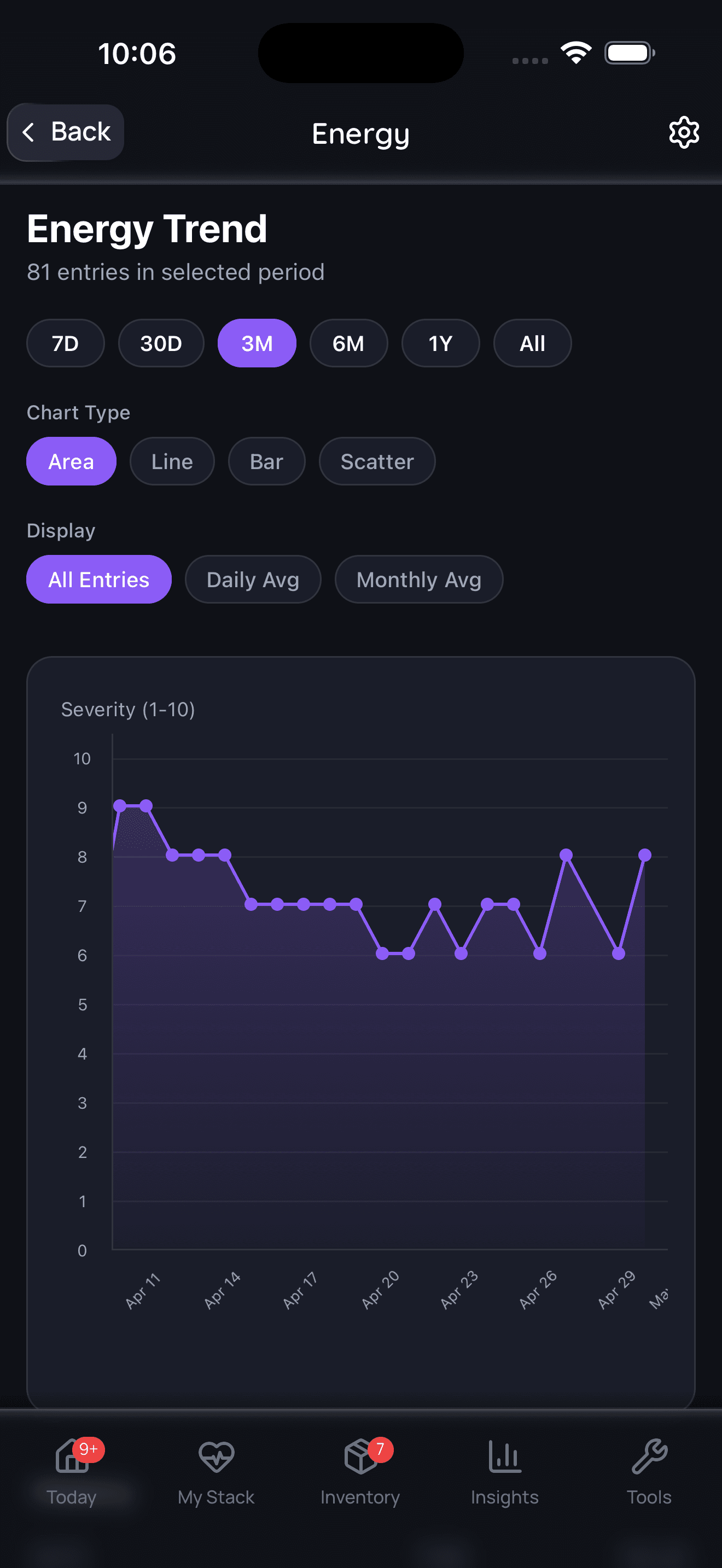
Symptom tracking is informational and should be interpreted with a qualified clinician.
Side Effects & Safety
The Basics
Short-term human tolerability looks reasonably good, but "safe" does not mean "proven useful" or "risk-free for everyone." Most practical concerns are not dramatic toxicity. They are uncertainty, product quality, and whether the supplement is worth the money and complexity.
Community discussion also hints that some people get sleep disruption or vague intolerance, though the anecdotal signal is limited and noisy.
The Science
The 2024 RCT found no study-product related adverse events at 40 mg/day in healthy older men over up to 28 days [2]. The 12-month SmartAge trial also did not show a major safety imbalance at lower extract doses [3]. That said, long-term, high-confidence supplement-specific safety data remain limited compared with the strength of online enthusiasm.
Dosing & Usage Protocols
The Basics
Human spermidine dosing is not standardized. Studies range from about 0.9 mg/day food-extract approaches to much higher purified short-term dosing. That means internet protocols and product labels are often not directly comparable [2][3][4].
If someone wants to use spermidine anyway, the safest interpretation is that the dose should be product-specific, evidence-aware, and kept separate from exaggerated anti-aging promises.
The Science
The SmartAge RCT used a spermidine-rich extract corresponding to about 0.9 mg/day [3]. The PK study used 15 mg/day and found spermine increases without clear plasma spermidine increases [4]. The 2024 safety study used 40 mg/day for up to 28 days and found short-term tolerability [2].
When your stack includes several supplements, each with its own dose, form, and timing requirements, the logistics alone can derail consistency. Doserly consolidates all of it into one protocol view, so every dose across your entire routine is accounted for without spreadsheets or guesswork.
The app also tracks cumulative intake for nutrients that appear in multiple products. Managing a thoughtful supplement protocol should not require guesswork.
Track injection timing, draw notes, and site rotation.
Doserly helps keep syringe-related notes, injection site history, reminders, and reconstitution context together for easier review.
Injection log
Site rotation
Injection logs support record-keeping; follow clinician instructions for administration.
What to Expect (Timeline)
There is no strong evidence that spermidine produces a fast, reliably felt short-term effect in healthy adults. Early use is more likely to feel neutral than dramatic. Over weeks to months, the main realistic outcome is still uncertainty rather than obvious change. If a user is looking for a supplement with a strong subjective signal, spermidine is a poor candidate [2][3][4].
Interactions & Compatibility
SYNERGISTIC
- Nicotinamide Riboside and NMN are commonly discussed in the same longevity stacks, though this reflects community practice more than proven synergy.
- Resveratrol is frequently stacked in longevity routines for the same audience.
- Urolithin A may appeal to similar users focused on mitochondrial or healthy-aging narratives.
CAUTION / AVOID
- Be cautious about treating large longevity stacks as evidence of ingredient-specific benefit.
- Food-first intake via wheat germ or legumes may change cost and adherence decisions relative to capsules.
- Product contamination and label-quality concerns matter for athletes and tested populations [6][7].
How to Take / Administration Guide
Spermidine is usually taken orally in capsule or food-extract form. Taking it with meals is common in commercial products. If using food sources instead of capsules, the practical comparison is usually wheat germ, legumes, mushrooms, or fermented foods rather than purified powder alone. Because PK is uncertain, consistency matters more than chasing large single doses [4][5].
Choosing a Quality Product
- Prefer third-party testing when available.
- Be skeptical of anti-aging language that sounds more certain than the human data.
- For athletes, NSF Certified for Sport or similar programs are better than unlabeled marketplace products [7].
- Avoid assuming that a "higher dose" or "better bioavailability" claim proves meaningful benefit.
Storage & Handling
Lifestyle & Supporting Factors
Food sources like wheat germ, legumes, mushrooms, and fermented foods are part of the practical spermidine conversation [5]. For many users, improving overall diet quality may be a more sensible starting point than buying an expensive capsule. Sleep, exercise, and general metabolic health likely matter more to real-world outcomes than any isolated longevity supplement.
Regulatory Status & Standards
In the United States, spermidine products are generally sold under standard dietary supplement rules, which means they are not pre-approved for efficacy by the FDA [6]. For athletes, the main concern is not that spermidine is a headline prohibited ingredient, but that supplement labels can be inaccurate and contamination risk exists [7].
FAQ
Does spermidine actually work?
Human evidence is mixed. The mechanistic case is interesting, but strong human anti-aging proof is still lacking [2][3][5].
Is spermidine safe?
Short-term human studies suggest reasonable tolerability, but that is not the same as broad long-term proof for every product [2][3].
Does spermidine improve memory?
The strongest longer human cognition trial did not show a significant primary benefit [3].
Why do people still take it if the evidence is mixed?
Because autophagy and longevity narratives are compelling, and many users treat it as a long-range health bet rather than a fast-acting supplement.
Is wheat germ enough instead of capsules?
For some users, maybe. Community discussion repeatedly compares food-first use with higher-priced branded capsules.
Does higher dose mean better results?
Not clearly. Human PK data do not support a simple more-in, more-effect model [2][4].
Can athletes use spermidine?
The bigger risk is supplement contamination and label inaccuracy, not spermidine hype by itself [7].
Is spermidine worth the money?
That depends on how much value you place on a low-certainty, theory-driven healthy-aging supplement versus better-supported basics.
Myth vs. Fact
- Myth: Spermidine is proven as an anti-aging supplement in humans.Fact: Human interest is real, but definitive anti-aging outcome data are limited and mixed [2][3][5].
- Myth: If blood spermidine does not rise, the supplement cannot matter.Fact: PK data suggest presystemic conversion and complex handling, so interpretation is more nuanced [4].
- Myth: Better autophagy theory means obvious daily benefit.Fact: Mechanistic promise does not guarantee clear real-world effects in human trials [3][5].
- Myth: Expensive capsules are automatically better than food sources.Fact: Community discussion repeatedly questions whether capsules add enough value over wheat germ and other foods.
- Myth: More is always better.Fact: Human dosing remains uncertain, and high intake does not automatically produce straightforward biomarker changes [2][4].
Sources & References
- PubChem. Spermidine compound record. https://pubchem.ncbi.nlm.nih.gov/compound/Spermidine
- Keohane P, et al. Supplementation of spermidine at 40 mg/day has minimal effects on circulating polyamines. https://pubmed.ncbi.nlm.nih.gov/39405978/
- Schwarz C, et al. Effects of Spermidine Supplementation on Cognition and Biomarkers in Older Adults With Subjective Cognitive Decline. https://ncbi.nlm.nih.gov/pmc/articles/PMC9136623/
- Senekowitsch S, et al. High-Dose Spermidine Supplementation Does Not Increase Spermidine Levels in Blood Plasma and Saliva of Healthy Adults. https://ncbi.nlm.nih.gov/pmc/articles/PMC10143675/
- Madeo F, et al. Spermidine: a physiological autophagy inducer acting as an anti-aging vitamin in humans? https://ncbi.nlm.nih.gov/pmc/articles/PMC6267286/
- FDA. Dietary Supplements. https://www.fda.gov/food/dietary-supplements
- USADA. Screen Your Dietary Supplements. https://www.usada.org/spirit-of-sport/education/screen-dietary-supplements/
Related Supplement Guides
- Same Category: Resveratrol, Fisetin, Pterostilbene, Urolithin A
- Common Stacks / Pairings: NMN, Nicotinamide Riboside, CoQ10
- Related Health Goal: Sulforaphane, Alpha Lipoic Acid, Green Tea Extract