
In this guide
What is nicotinamide riboside?
Nicotinamide riboside, or NR, is a nucleoside related to vitamin B3. Cells can convert it to nicotinamide mononucleotide and then NAD, a coenzyme used in redox metabolism and by enzymes involved in signaling and repair.
NR’s clearest human finding is biochemical target engagement: oral NR chloride raises blood NAD metabolites. That is useful evidence that the compound reached a measurable pathway. It does not by itself show more energy, better cognition, metabolic disease treatment or longer life.
Typical Nicotinamide Riboside Protocols
| Purpose or population | Form and amount each time | Frequency | Total per day | Duration |
|---|---|---|---|---|
| Dose-response biomarker and safety trial, 140 overweight but otherwise healthy adults | Nicotinamide riboside chloride: 100 mg, 300 mg or 1,000 mg | Once daily | 100, 300 or 1,000 mg | 56 days after a 2-week run-in |
| Metabolic trial, 40 sedentary men age 40–70 with obesity and insulin resistance | Nicotinamide riboside: 1,000 mg | Twice daily | 2,000 mg | 12 weeks |
Neither row is a recommended range. The first trial was designed around NAD pharmacology and short-term safety; the second tested metabolic outcomes in a narrow male population. Neither established an indefinite anti-aging schedule. [1], [2]
Where these schedules come from
Conze and colleagues provide the 100, 300 and 1,000 mg once-daily NR chloride schedules and 56-day biomarker results. [1] Dollerup and colleagues provide the 1,000 mg twice-daily, 12-week metabolic schedule. [2]
The first study was funded by ChromaDex and its authors disclosed employment, intellectual-property and advisory relationships.
From precursor to outcome
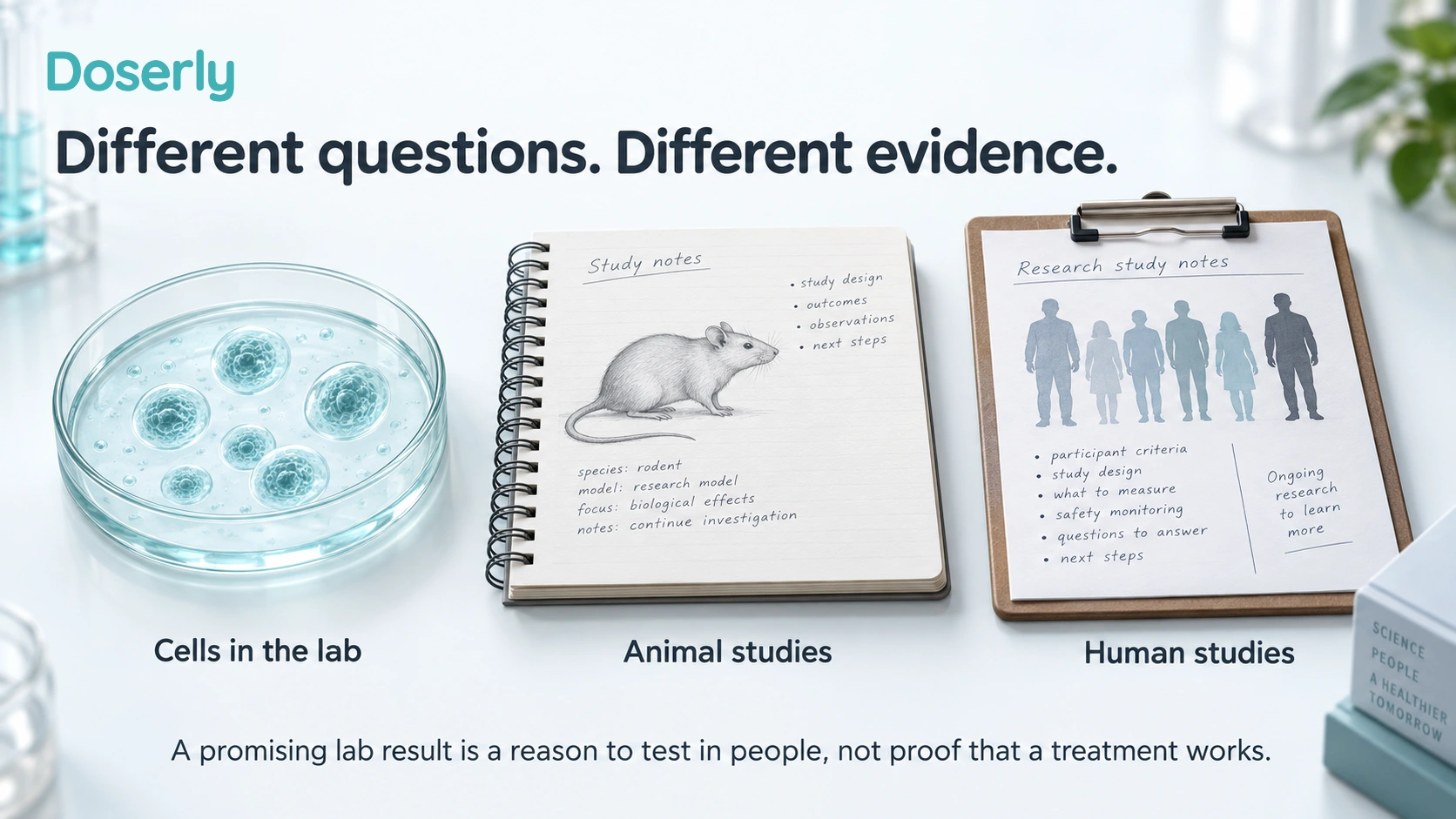
Each step answers a narrower question.
A larger biomarker response does not establish a larger clinical benefit.
Does NR need to be cycled?
No validated NR cycle exists. Trial durations describe study observation windows. A planned personal trial should define the intended outcome, starting conditions, review date and stopping rule instead of borrowing a cycle from marketing.
What happens when NR is stopped?
A withdrawal syndrome has not been established. NAD metabolite elevations depend on ongoing exposure and are expected to move toward baseline after stopping. A subjective change after stopping cannot alone establish causality.
Does food provide meaningful NR?
NR has been detected in foods such as milk, but ordinary food exposure is not equivalent to the hundreds or thousands of milligrams used in trials. There is no NR-specific dietary requirement; vitamin B3 adequacy is assessed through established niacin-equivalent reference intakes rather than an NR target.
Which form was actually studied?
The 140-person dose-response trial used a branded crystalline nicotinamide riboside chloride. FDA’s GRAS response likewise addressed NR chloride under specified food categories and maximum use conditions. Evidence for this defined material should not be transferred automatically to reduced NR, other salts or multi-ingredient products. [1], [3]
A label should state the NR compound, amount per serving, servings per day and other NAD precursors. “NAD booster” is a marketing category, not a standardized chemical identity.
How should NR be stored?
Follow the tested product’s label for temperature, humidity and expiry. Keep it closed in its original container and away from children. Do not infer a universal refrigeration rule for every formulation.
What is NR commonly used for?
NR is marketed for “healthy aging,” energy, metabolic health and cognition. The mechanistic rationale comes from NAD biology and animal research. Human evidence is more restrained: target engagement is repeatable, while direct functional and disease outcomes are inconsistent or absent.
What does human research show?
In the industry-funded randomized trial, 140 overweight but otherwise healthy adults were assigned to placebo or NR chloride 100, 300 or 1,000 mg once daily after a two-week run-in. At two weeks, whole-blood NAD had increased by 22%, 51% and 142% across the three active groups, and the elevations persisted through day 56. Adverse-event rates did not differ significantly and no flushing was reported. This establishes short-term biomarker response for that form and population. [1]
The investigator-initiated trial in 40 sedentary men aged 40–70 with obesity and insulin resistance used 1,000 mg twice daily for 12 weeks. It did not improve insulin sensitivity measured by hyperinsulinemic-euglycemic clamp, endogenous glucose production, glucose disposal or oxidation, resting energy expenditure, lipolysis, fat oxidation or body composition. Safety blood tests were normal and no serious treatment-related event was reported. [2]
Together, the studies show why “raises NAD” and “improves metabolic health” are different claims. They also do not answer whether years of use are safe or whether NR changes lifespan.
How does NR work?
Nicotinamide riboside kinases can phosphorylate NR to NMN, and NMN adenylyltransferases convert NMN to NAD. NAD then acts in energy-transfer reactions and as a consumed substrate for sirtuins, PARPs and CD38-related pathways. Oral NR may also be metabolized to other B3 forms before tissues use it. This network makes a blood NAD change plausible without predicting a particular symptom or longevity result.
What are the risks and regulatory limits?
Short trials suggest that studied NR chloride schedules can be tolerated by selected adults. They do not establish safety during pregnancy or lactation, in children, during cancer therapy, with severe liver or kidney disease, or over years. High-dose combination use with NMN, niacin or niacinamide is especially poorly characterized.
In the United States, dietary supplements generally lack FDA premarket approval for safety or effectiveness. [4]
FDA’s 2016 response to GRAS Notice 635 stated that the agency had no questions about the notifier’s GRAS conclusion for NR chloride in specified foods and at notified use levels. The same letter says ongoing safety and legal compliance remain the firm’s responsibility. That record is not FDA approval of disease claims, supplement efficacy or all NR products. [3]
In Canada, natural health products require a licence and an authorized label with an NPN or DIN-HM. Product-specific authorization should be checked rather than inferred from U.S. records. [5]
Which medicines or conditions matter?
A comprehensive clinical interaction map has not been established. Discuss NR before use with glucose-lowering therapy, chemotherapy or investigational treatment, or when liver or kidney disease may alter handling. Disclose concurrent NMN, niacin and niacinamide because shared NAD metabolites do not make stacking effects predictable.
What should be monitored?
Choose a clinical question before measuring. For metabolic use, reasonable clinician-directed measures may include glucose control, medicines, weight and adverse effects; blood NAD mainly documents target engagement. For energy or cognition claims, use a predefined functional measure and duration. Stop and seek care for severe or persistent symptoms rather than interpreting them as “adaptation.”
What do public communities report?
People report energy, sleep or no noticeable effect, often while using several products. These anecdotes lack standardized product verification, baseline NAD status, controls and reliable denominators. This overhaul did not independently recrawl or quantify community posts.
How does NR compare with nearby options?
| Guide | What it is | Key difference |
|---|---|---|
| Vitamin B3 | Niacin family nutrient | Has established niacin-equivalent RDAs and a source-limited UL |
| NMN | Phosphorylated NAD precursor | Separate human trials and a distinct U.S. regulatory history |
| Vitamin B2 | Riboflavin coenzyme precursor | Established RDA; different biology and evidence |
| Metformin | Prescription medicine | Not a dietary supplement; clinical use and monitoring differ |
Common questions about NR
Does NR raise NAD?
Yes. The cited NR chloride trial showed dose-dependent whole-blood NAD increases over 56 days. [1]
Does raising NAD prove more energy or longer life?
No. A biomarker verifies pathway engagement, not a patient-important outcome.
Is there an NR RDA or UL?
No NR-specific U.S. RDA, AI or UL has been established. That absence is not evidence of unlimited safety.
Did 2,000 mg/day improve insulin sensitivity?
No. In 40 men with obesity and insulin resistance, 12 weeks did not improve clamp-measured insulin sensitivity or the other reported metabolic outcomes. [2]
Does NR cause niacin flushing?
No flushing was reported in the cited 56-day NR chloride trial. That does not prove every formulation or person will be symptom-free. [1]
Is FDA’s GRAS response an approval?
No. It was a no-questions response to a notifier’s conclusion for defined food uses of NR chloride, not efficacy approval. [3]
Should NR be stacked with NMN?
There is no established clinical advantage or safety framework for stacking them. It complicates attribution and increases precursor exposure.
Glossary
Plain explanations of NR research terms.
- Nicotinamide riboside (NR)
- A nicotinamide nucleoside that can contribute to NAD synthesis.
- NAD
- A coenzyme involved in redox metabolism and a substrate for several signaling enzymes.
- Target engagement
- Evidence that an intervention changed its intended biological pathway, such as a blood NAD metabolite.
- Hyperinsulinemic-euglycemic clamp
- A controlled research method used to measure insulin sensitivity.
- GRAS
- Generally recognized as safe for specified food uses under stated conditions; not efficacy approval.
- Tolerable Upper Intake Level (UL)
- A chronic intake boundary; no NR-specific U.S. UL is established.
How this guide was researched
This draft uses two primary randomized NR trials, the FDA response for GRAS Notice 635 and current U.S. and Canadian supplement-regulation pages. Relevant source text was retrieved and read on October 9, 2026.
How this guide was made
Research and drafting were AI-assisted. This draft awaits Doserly editorial and independent clinical review. Doserly makes a tracking app and operates Doserly Academy, both promoted here. Read the editorial policy.
Explore the sources
Primary trials and regulatory records answer different questions about NR.
Showing 5 sources
- 01
Safety and Metabolism of Long-term Administration of NIAGEN (Nicotinamide Riboside Chloride) in a Randomized, Double-Blind, Placebo-controlled Clinical Trial of Healthy Overweight Adults. ↗
Randomized placebo-controlled trial
Primary abstract, design, figures and disclosures read.
Detail: 140 randomized adults; NR chloride 100, 300 or 1,000 mg once daily for 56 days; whole-blood NAD, safety and industry conflicts.
- 02
A randomized placebo-controlled clinical trial of nicotinamide riboside in obese men: safety, insulin-sensitivity, and lipid-mobilizing effects. ↗
Randomized placebo-controlled trial
Primary abstract and bibliographic record read.
Detail: 40 men age 40–70; 1,000 mg twice daily for 12 weeks; clamp-measured insulin sensitivity and metabolic outcomes.
- 03
Agency Response Letter GRAS Notice No. GRN 000635 ↗
Regulatory primary source
Current official page reviewed.
Detail: NR chloride identity, specified food categories and levels, no-questions conclusion and continuing manufacturer responsibility.
- 04
Questions and Answers on Dietary Supplements ↗
Regulatory overview
Current official page reviewed.
Detail: General U.S. dietary-supplement framework.
- 05
Product Licensing ↗
Regulatory overview
Current official page reviewed.
Detail: Canadian licensing and NPN or DIN-HM.
No matching sources
Try a different term or show the full list.