
In this guide
What is eloralintide?
Eloralintide is an experimental weight-loss medicine from Eli Lilly, given as a once-weekly injection, that copies amylin, a hormone that helps you feel full after eating. It has finished a phase 2 trial and is now in large phase 3 trials, but it is not approved anywhere. [1], [2], [3]
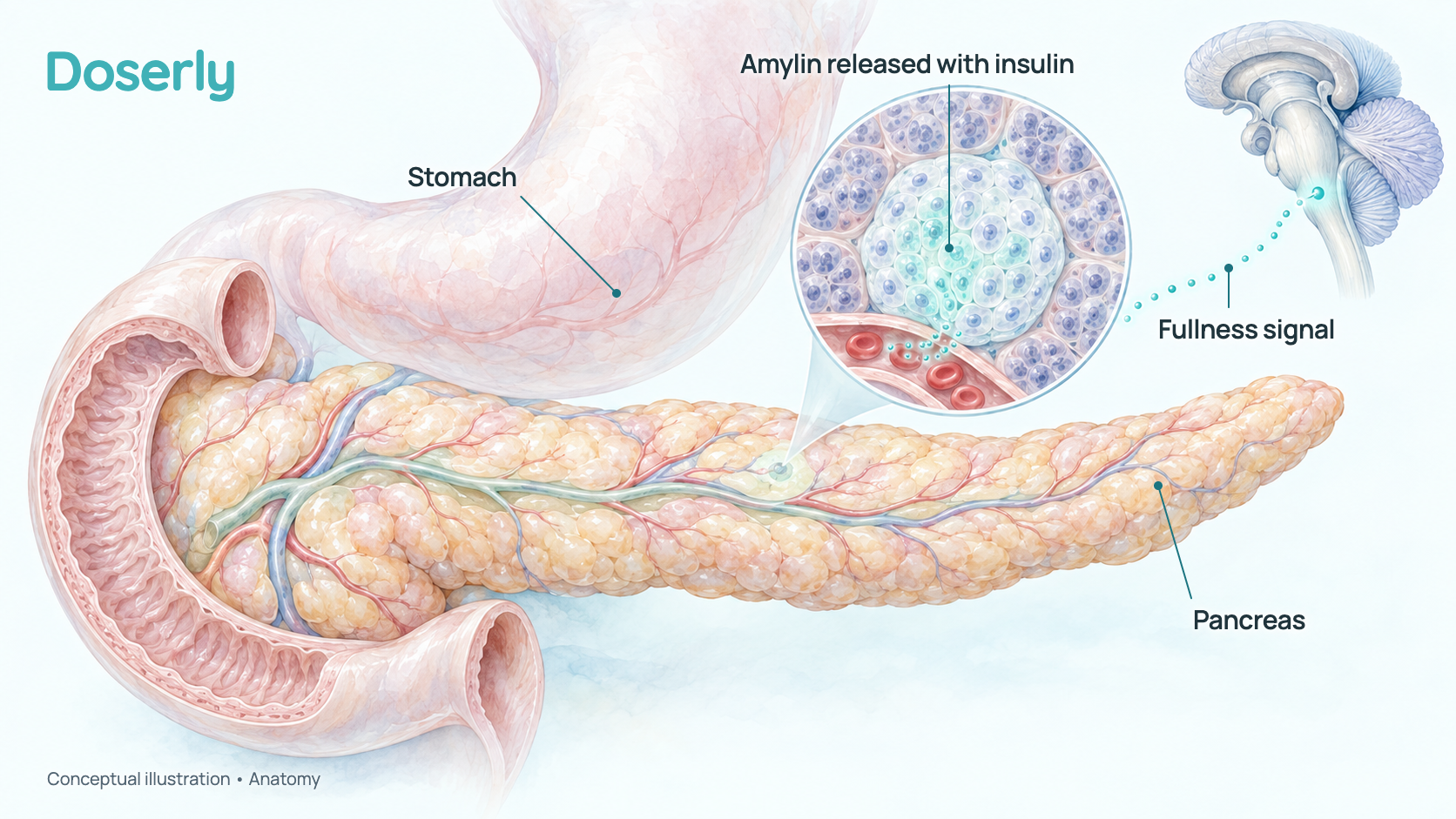
Amylin is made by the pancreas and released with insulin after meals, and it tells the brain you have eaten enough. Eloralintide is a lab-made peptide: a chain of 37 building blocks based on amylin, with three unusual amino acids plus a modified glutamate at the start (four non-standard positions), a small chemical bridge that holds one end in a ring, and a fatty-acid tail that gives it a half-life of about two weeks. Lilly calls it a selective amylin receptor agonist, because it prefers one of the receptors amylin uses. [4], [5], [6]
The key word is investigational: it is still being tested. Unlike most peptides sold online, it has been given to people in controlled trials, and its registered phase 3 program plans to enrol about 5,600 people. You may see it written as LY3841136, AMY-1176 or "Elora", and Lilly's combination with tirzepatide is called eloraTZP. [5], [7], [8], [3], [9], [10], [11]
| At a glance | |
|---|---|
| Other names | LY3841136; AMY-1176; "Elora" (informal) |
| What it is | Long-acting amylin receptor agonist peptide with a fatty-acid tail |
| Developer | Eli Lilly and Company |
| How it is given | Subcutaneous injection, once a week |
| Stage | Phase 3 trials (ENLIGHTEN program), not approved |
| Half-life in people | 12.9 to 15.3 days |
Typical Eloralintide Protocols
| Example | Amount each time | Frequency | Weekly total | Duration |
|---|---|---|---|---|
| Low | 1 mg | Once weekly | 1 mg | 48 weeks Fixed 1 mg from the first week. Average weight change −9.5%, versus −0.4% on placebo. Lilly reports stomach side effects similar to placebo, though constipation was 14.8% versus 5.8%, and 46% of this group stopped treatment early (36% on placebo). |
| Mid | 3 mg | Once weekly | 3 mg | 48 weeks Fixed 3 mg from the first week. Average weight change −12.4%. Nausea 13.0% versus 13.5% on placebo; constipation 17.4% versus 5.8%. |
| High | 3 mg for weeks 1–4, 6 mg for weeks 5–8, then 9 mg | Once weekly | 3 → 6 → 9 mg | 48 weeks (9 mg from week 9) The only published schedule with 4-week steps. Average weight change −16.4%. Nausea 25.0% and fatigue 21.2%, lower than in the groups that started at 6 or 9 mg. |
The most common protocol in the reviewed sources is the phase 2 approach: one subcutaneous injection a week for 48 weeks, either at a fixed dose or stepped up from 3 mg to 6 mg to 9 mg, 4 weeks at each step. Most dosing websites restate these trial groups, and the 3 → 6 → 9 mg schedule is the one tested way of reaching 9 mg gradually. Outside trials, 0.5 to 1 mg once weekly is the amount people most often start with. [17], [19], [20], [21]
- Titration Raising the dose in steps
- In phase 2, most dose groups started at their target dose with no steps at all. Two groups stepped up: one moved 3 → 6 → 9 mg every 4 weeks, the other took 6 mg for 20 weeks and then 9 mg. Among the groups reaching 6 mg or more, the 4-week steps had the lowest nausea, vomiting and fatigue rates (a sponsor comparison of small groups, not a formal test), and participants in Lilly's phase 3 trials also describe stepping up. The long half-life means each step takes weeks to show its full effect. [12], [13], [6]
Read the units: eloralintide amounts are written in milligrams (mg); 1 mg is 1,000 mcg. Each number is the amount of eloralintide itself, given once a week, so the weekly total equals the amount each time. Eloralintide amounts are much larger than for older peptides: 1 mg of eloralintide is not a "high" dose.
Each row is a complete trial schedule, and low, mid and high are alternatives, not steps to move through. These schedules come from a 48-week trial in adults with obesity or overweight, not from an approved label, and there is no human data on the lower, split or add-on doses often used online; the cited references give the full details. Powders sold online are unverified, eloralintide slows the pulse and lowers blood pressure, low mood was reported at 6 to 12 mg, and starting at 6 mg or more brought nausea in up to 64% and fatigue in up to 46% of people. [12], [2], [13], [18], [65]
Other schedules tested in people
The phase 2 trial also tested higher starting doses, and an earlier study gave up to 12 mg a week. In phase 2, starting at 6 or 9 mg gave larger average losses (17.6% to 20.1%) but more side effects, which is why they are not the usual examples. The earlier phase 1b study gave up to 12 mg a week for 12 weeks (about 11% weight loss). [13], [18]
| Schedule | Amount each time | Frequency | Weekly total | Duration |
|---|---|---|---|---|
| Fixed 6 mg (phase 2) | 6 mg | Once weekly | 6 mg | 48 weeks −17.6% on average. Nausea 64.3%, vomiting 25.0%, and 21.4% (6 of 28) stopped because of side effects. |
| Fixed 9 mg (phase 2) | 9 mg from the first week | Once weekly | 9 mg | 48 weeks −20.1% on average, the largest result. Nausea 33.3%, fatigue 42.6%, constipation 24.1%. |
| 6 then 9 mg (phase 2) | 6 mg for weeks 1–20, then 9 mg | Once weekly | 6 → 9 mg | 48 weeks −19.9% on average. Nausea 54.2% and fatigue 45.8%, the highest fatigue rate of any group. |
| 12 mg (phase 1b) | 12 mg from the first week | Once weekly | 12 mg | 12 weeks The highest dose given repeatedly. About −11% at 12 weeks. Low mood was reported by three people on this dose; pulse fell by 14.4 beats per minute, versus 3.4 on placebo. |
What do people use outside trials?
People buying eloralintide online as a "research use only" powder mostly use far less than the trial doses, and almost always alongside another weight-loss injection. The usual pattern in public accounts is 0.5–1 mg once a week added to tirzepatide or retatrutide; some inject 0.5 mg every 4 to 5 days instead. One protocol website that lists the trial doses notes that a 500 mcg start is anecdotal and has not been validated. [19], [20], [21], [17]
Community education groups describe the same thing: most members start at 1 mg weekly, many stay there for weeks, and most add it to retatrutide. The usual reason given is hunger creeping back after months on retatrutide or tirzepatide. Some members plan doses in micrograms, as they would for cagrilintide, which is far below the 1 to 9 mg used in the trials. At least one seller also offers a pre-mixed vial of retatrutide and eloralintide, which fixes the ratio between the two drugs. None of these patterns has been tested, and the combination with retatrutide has never been studied in people.
Where protocols differ: starting dose, step speed, 12 mg, splitting and combinations ↓
Where these numbers come from
All rows in both tables are complete schedules from Lilly's human studies. The phase 2 week-by-week schedules, including the exact step weeks of the 3/6/9 and 6/9 groups, are in the posted registry results; weight changes and side-effect rates by group come from the sponsor's ObesityWeek 2025 presentation and match the Lancet abstract after rounding. Weight changes are the efficacy estimand: they estimate the result if everyone had stayed on treatment. The 12 mg row comes from the phase 1b study paper. [12], [13], [2], [18]
The online pattern comes from public forum accounts and one protocol website that labels the low start as anecdotal. We did not turn it into a table row because no source gives a complete schedule with a duration. [19], [20], [21], [17]
We did not average the groups, merge doses from different groups or build a dose ladder. One widely copied 1 → 3 → 6 → 9 mg monthly ladder is left out because no trial used it (see below). [22], [23]
What is eloralintide commonly used for?
People look into eloralintide to lose weight, mostly because they have heard it causes less nausea than GLP-1 drugs or cagrilintide. Many already take tirzepatide or retatrutide and want to break a plateau or quiet hunger that returns late in the week. A few use it on its own while taking a break from another drug.
The trials show that eloralintide alone lowers body weight more than placebo over 48 weeks. They do not show how it performs at the small add-on doses most people use online, or with retatrutide, which no trial has tested.
Weight loss on its own
This is the only use tested in a completed trial. In the 48-week phase 2 trial, 263 adults with obesity, or overweight plus a weight-related health problem, and no diabetes were randomly assigned to eloralintide or placebo, with lifestyle advice for everyone. Average weight change ranged from −9.5% on 1 mg to −20.1% on 9 mg, versus −0.4% on placebo, if everyone stayed on treatment. In kilograms, that is about 10 kg on 1 mg and 21 kg on 9 mg, from a starting average of 109 kg. [2], [12], [13]
Averages hide a wide range. On 9 mg, 81% of people lost at least 10% of their weight and 57% lost at least 20%; on 1 mg, the figures were about 53% and 21%. The weight curves were still falling at week 48, so the trial did not show where the loss would level off. [13]
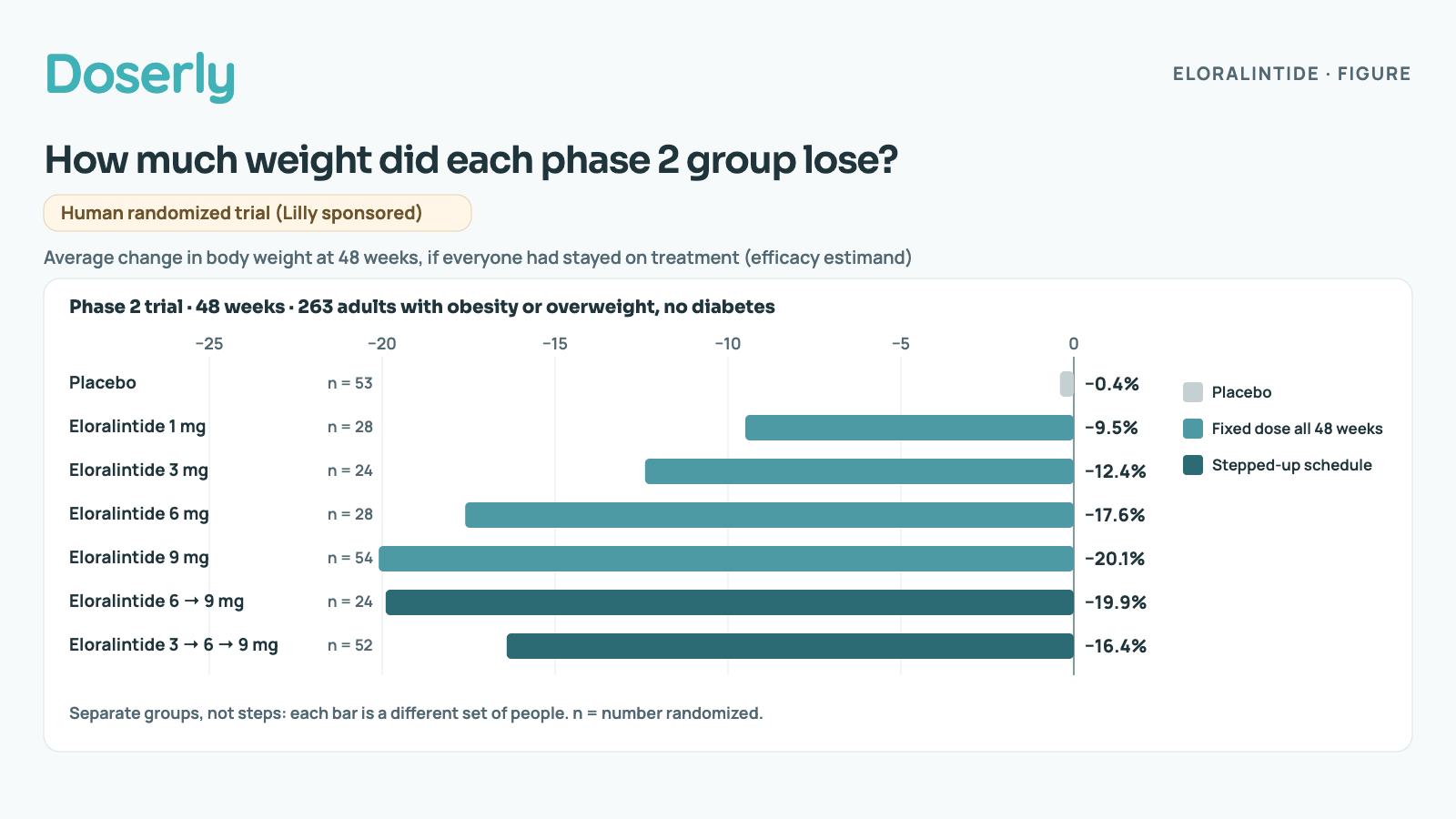
How much weight did each phase 2 group lose?
Average percentage change in body weight at 48 weeks.
- Phase 2 trial · 48 weeks · 263 adults with obesity or overweight, no diabetes
- Efficacy estimand (if everyone kept taking the treatment).
Placebo −0.4% (n = 53)
Eloralintide 1 mg −9.5% (n = 28)
Eloralintide 3 mg −12.4% (n = 24)
Eloralintide 6 mg −17.6% (n = 28)
Eloralintide 9 mg −20.1% (n = 54)
Eloralintide 6 → 9 mg −19.9% (n = 24)
Eloralintide 3 → 6 → 9 mg −16.4% (n = 52)
Separate groups, not steps: each dose was a different set of people.
Every eloralintide group lost far more than placebo; 9 mg and 6 → 9 mg averaged about 20% at 48 weeks.
Quieting hunger and "food noise"
Many people describe eloralintide in terms of appetite: feeling full sooner, smaller meals and fewer intrusive thoughts about food, often called food noise. Lilly says its effect on eating is likely through satiety, the feeling of fullness. Some users say it leaves more normal hunger than cagrilintide, which makes it easier to eat enough protein; others found little difference. [6], [19], [24], [25]
Adding it to tirzepatide (eloraTZP)
Lilly is developing eloralintide both alone and with tirzepatide, the drug in Zepbound and Mounjaro. In an early 16-week study, adding eloralintide 3 mg to tirzepatide 5 mg led to 17% weight loss, versus 10% on tirzepatide 5 mg alone. A larger phase 2 trial of the combination in people with type 2 diabetes was scheduled to report at the EASD 2026 meeting, after this guide's research cut-off; check the trial record for its results. [7], [26], [27]
Other trials go further: ENLIGHTEN-6 (phase 3) adds eloralintide for people whose obesity persists on a weekly incretin drug, and two phase 2 trials are testing it with another Lilly drug, macupatide. The combination with retatrutide, popular online, has not been tested in people. [11], [28], [29]
Sleep apnea, knee pain and diabetes
These are registered study questions, not results. Phase 3 trials are testing eloralintide in obstructive sleep apnea (ENLIGHTEN-3), knee osteoarthritis pain (ENLIGHTEN-4) and type 2 diabetes (ENLIGHTEN-2), all with results expected after 2027. [9], [10], [8]
Heart and metabolic markers
In phase 2, blood pressure, HbA1c (a measure of average blood sugar), blood fats and hsCRP (a marker of inflammation) moved in a healthier direction; hsCRP fell by more than half at higher doses. Pulse also fell (see heart rate under risks). These were exploratory results, not adjusted for multiple testing, in people without diabetes. Whether they lower the risk of heart attacks or strokes has not been studied, and a 2026 review calls for heart-outcome trials. [13], [30]
Where do eloralintide protocols differ?
The trial schedules are clear. Disagreements start where websites and users change them: a different starting dose, a ladder no trial used, a split dose, a combination with another drug, or a dose higher than the published groups.
Is 1 mg a starting dose or a full dose?
In the trial, 1 mg was a full dose. It was one fixed group, taken for 48 weeks, and it produced an average loss of 9.5%. None of the phase 2 groups started at 1 mg and then stepped up: the stepped groups began at 3 mg or 6 mg. [12], [2]
Online, 1 mg is usually treated as a gentle first step, often on top of another drug. Participants in the phase 3 ENLIGHTEN trials describe a different start again: 1.5 mg, then 3, 6 and 9 mg in 4-week steps. Lilly has not published the phase 3 doses, so this rests on participants' reports. [31], [32]
Is 1 → 3 → 6 → 9 mg a tested ladder?
No. Several dosing websites give a ladder of 1 mg for weeks 1–4, 3 mg for weeks 5–8, 6 mg for weeks 9–12 and 9 mg from week 13. It merges the separate 1 mg group with the 3 → 6 → 9 mg schedule, and no trial used it. The tested 3 → 6 → 9 mg schedule reached 9 mg at week 9, not week 13. [22], [23], [33], [12]
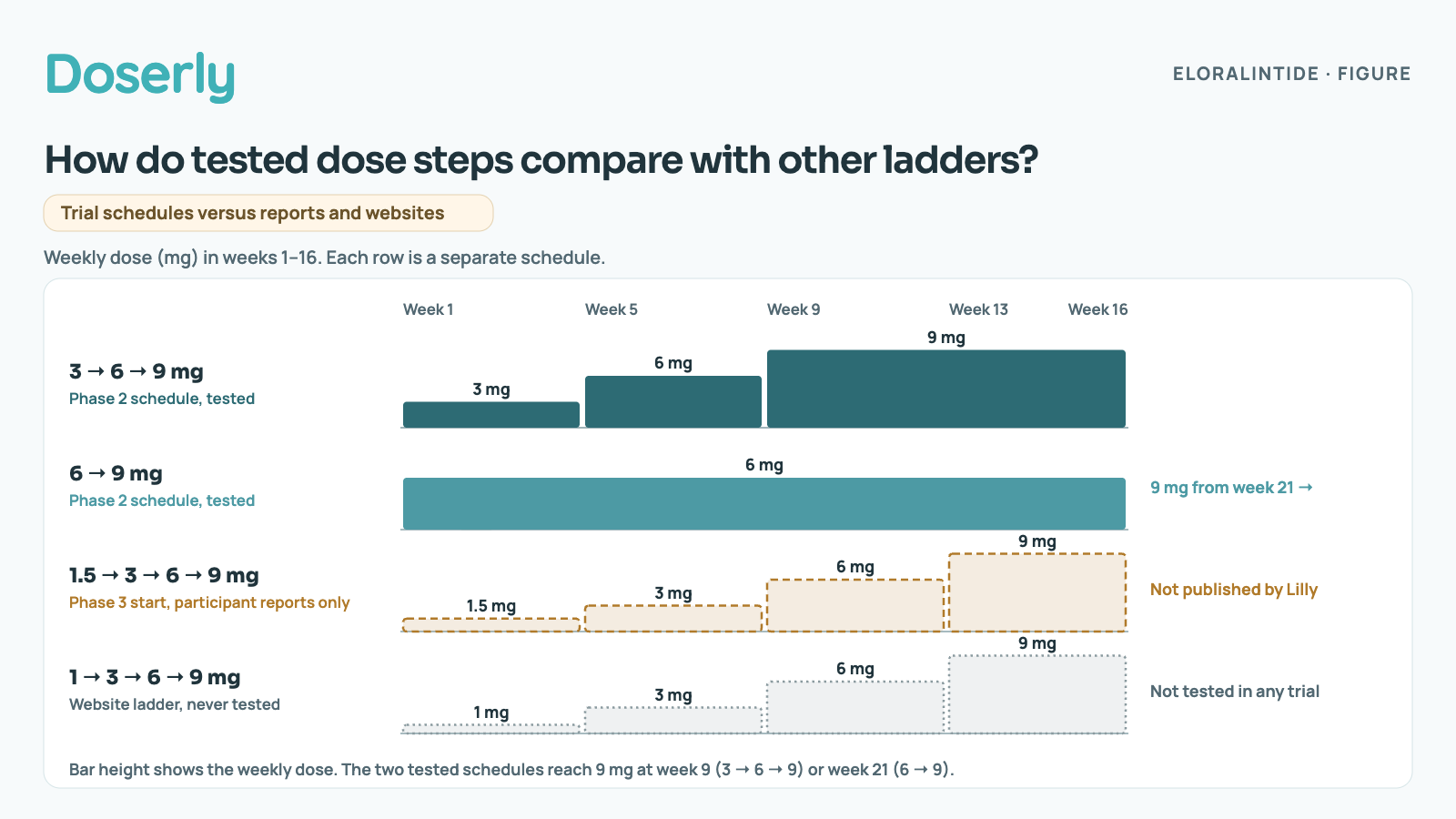
How do tested dose steps compare with other ladders?
- 3 → 6 → 9 mg (phase 2, tested)
- 3 mg in weeks 1–4, 6 mg in weeks 5–8, then 9 mg from week 9.
- 6 → 9 mg (phase 2, tested)
- 6 mg in weeks 1–20, then 9 mg from week 21.
- 1.5 → 3 → 6 → 9 mg (phase 3, participant reports)
- 1.5, 3, 6 then 9 mg in 4-week steps. Lilly has not published the phase 3 doses.
- 1 → 3 → 6 → 9 mg (website ladder)
- 1, 3, 6 then 9 mg in 4-week steps, reaching 9 mg at week 13. Not tested in any trial.
Only the two phase 2 step-up schedules were tested; the 1 mg website ladder merges separate trial groups.
How fast should the dose go up?
The trials give three answers: no steps at all, one step after 20 weeks, or 4-week steps. Among the schedules reaching 6 mg or more, the 4-week steps had the lowest nausea, vomiting and fatigue rates (a sponsor comparison of small groups, not a formal test). Nausea affected 25.0% of people on 3 → 6 → 9 mg, versus 64.3% on a fixed 6 mg and 54.2% on 6 → 9 mg, and vomiting affected 1.9% versus 25.0% and 12.5%. The trade-off was a smaller average loss at 48 weeks (16.4% versus 20.1% on a fixed 9 mg and 19.9% on 6 → 9 mg). The trial was not designed to explain the difference. [13], [12]
With a half-life of about two weeks, each step keeps building for weeks after the dose is raised. Public users often warn against stepping up early for that reason, which fits the pharmacokinetics. [4], [34], [35]
Did phase 2 test 12 mg?
The published phase 2 groups stop at 9 mg. Some phase 2 participants wrote in 2024 that they had been told about a 12 mg (1.2 mL) step after a protocol change, and the registry confirms a change in May 2024 that added a sixth dose group, but it does not list 12 mg. Treat 12 mg in phase 2 as unconfirmed. The only published repeated 12 mg dose is the 12-week phase 1b group. [36], [37], [12], [18]
Once weekly, split, or every other week?
Every trial used one injection a week. Online, some people split 1 mg into two weekly injections because they feel the effect fading by day 5, and a few inject every other week because of the long half-life. Neither has been tested. [19], [21], [4]
A felt effect is not the same as blood levels. With a half-life of 12.9 to 15.3 days, most of each dose is still present a week later, and levels keep rising for about 8 to 10 weeks of weekly dosing (4 to 5 half-lives, a common rule of thumb). Dosing every two weeks would give lower, more uneven levels than any trial studied. [4]
How long, and are breaks needed?
The phase 2 trial ran for 48 weeks without breaks, and phase 3 trials measure their main result at 64 weeks. No study has tested planned breaks. Online use is usually measured in weeks, and we found no public account of use beyond about two months outside trials. [12], [3]
What is known about stopping is covered at the end of this section.
What about adding it to tirzepatide or retatrutide?
Only tirzepatide has human data, and only at specific doses: eloralintide 3 mg with tirzepatide 5 mg for 16 weeks gave 17% weight loss versus 10% on tirzepatide alone. An online report quoting a 2026 conference abstract says higher-dose combinations reached "up to 29%" at 32 weeks, but we could not verify it. The full phase 2 results were scheduled for the EASD 2026 meeting, after this guide's research cut-off; check the trial record. [7], [38], [27]
Retatrutide pairings are untested in people. People who combine drugs online often lower the other drug, report stronger fullness, and sometimes report more fatigue or difficulty eating enough. Two amylin drugs at once (eloralintide plus cagrilintide) act on the same system, and thread advice warns against it. [34], [21], [39]
How do milligrams convert to syringe units?
Eloralintide sold online usually comes as a freeze-dried powder in 5, 10, 20 or 30 mg vials that is mixed with sterile water. [22], [40] Syringe units on an insulin syringe measure volume, not an amount of eloralintide, so the dose in each unit depends on how much water was added.
For example, a 10 mg vial mixed with 1 mL of water gives 10 mg per mL: 1 mg is 0.1 mL, or 10 units on a U-100 syringe, and 3 mg is 30 units. The same vial mixed with 2 mL gives 5 mg per mL, so 1 mg becomes 20 units. Because trial doses are several milligrams, a mix-up between units and milligrams can multiply a dose many times over. Doserly's reconstitution calculator works out the arithmetic for any vial and shows each step. [41], [42], [43]
What happens when you stop eloralintide?
The effect fades slowly, and some weight can come back. Only one study has reported weight after stopping, and it followed people for 10 weeks after treatment ended, with weight still below placebo at week 21. [18]
- The first weeks off treatment. In the phase 1b study, 12 weeks of treatment were followed by a 10-week follow-up. Nine weeks after the last dose (week 21), weight in the 6 mg and 12 mg groups was still significantly lower than on placebo. [18]
- After 48 weeks. The phase 2 trial included about 10 weeks of follow-up after treatment ended, but weight results from that period have not been published. [13], [12]
- How long it stays in the body. With a half-life of about two weeks, eloralintide takes around two months to clear, so there is no sharp drop-off after the last dose. [4]
- What former participants describe. In public discussions, several phase 2 completers say food noise, hunger and joint "inflammation" returned within weeks, with regains from about 5 lb to "most" of the weight; several then started tirzepatide. One person kept their weight within 5 lb for 14 months with occasional tirzepatide. [44], [37], [45], [25]
We found no study comparing tapering down with stopping all at once, or showing that a break restores the effect. Community education groups have no member reports of weight after stopping.
Source-by-source comparison and registered study plans
Which websites copy which numbers?
Most eloralintide pages restate the phase 2 groups faithfully, differing mainly in rounding (9% versus 9.5%) and in which estimand they quote, for example PeptIQ, Pep-Pedia, PeptideUniv and Alethea Health. Vial-arithmetic pages such as PeptideDosages, PeptiMap and Lux BioPure apply correct syringe-unit maths to online vial sizes; none of that comes from trial practice, since the trial product is a ready-made solution. [14], [16], [15], [46], [41], [42], [43], [47]
Which pages contain errors?
PeptideDosage.org, PeptideWiki and a calculator page give the untested 1 → 3 → 6 → 9 mg monthly ladder. Peptide Protocol Wiki attributes 64% nausea to 9 mg (it was the fixed 6 mg group; 9 mg was 33.3%) and gives 15.8% weight loss for the 6 → 9 mg group (it was 19.9%). OptiPin and PeptideBase say no human half-life has been published, although the first human study measured 12.9 to 15.3 days. [22], [23], [33], [48], [49], [50], [51], [4]
What are the registered studies planning?
These are study plans without posted results when checked on September 26, 2026. Separate dose groups are not a personal titration schedule, and Lilly has not disclosed the phase 3 doses.
Weight management without diabetes
About 1,980 adults with obesity or overweight; four dose groups and placebo; main result at week 64.
Recruiting; no results. Started February 2026; last update September 2026.
[3]Weight management with type 2 diabetes
About 1,035 adults; the first phase 3 trial to start, in December 2025.
Recruiting; no results. Last update September 2026.
[8]Added to a weekly incretin drug
About 900 adults with persistent obesity while taking a weekly incretin drug.
Recruiting; no results. Last update September 2026.
[11]eloraTZP in type 2 diabetes
About 367 adults; eloralintide and tirzepatide alone or combined.
No results posted at this guide's research cut-off. Results were scheduled for presentation at the EASD 2026 meeting.
[27], [7]Effect on a combined birth-control pill
About 34 women; levels of levonorgestrel and ethinyl estradiol measured with and without eloralintide.
Not yet recruiting. Last update September 2026.
[52]How is eloralintide taken, and how long does it last?
Eloralintide is taken only by subcutaneous injection (into the fatty layer under the skin), once a week. Every human study used this route, and phase 3 uses a pre-filled syringe. No pill, nasal spray or cream form has been tested in people. [4], [18], [53]
Its long action comes from its design. A fatty-acid tail attached to one building block lets it bind to albumin, a common protein in the blood, which slows its removal. A stable chemical bridge replaces the natural link that closes amylin's ring. In the first human study, its measured half-life, the time for blood levels to fall by half, was 310 to 366 hours (12.9 to 15.3 days), about twice the 6.6 to 8.1 days measured for cagrilintide. Levels peaked 72 to 132 hours (3 to 5.5 days) after a single injection. [4], [54]
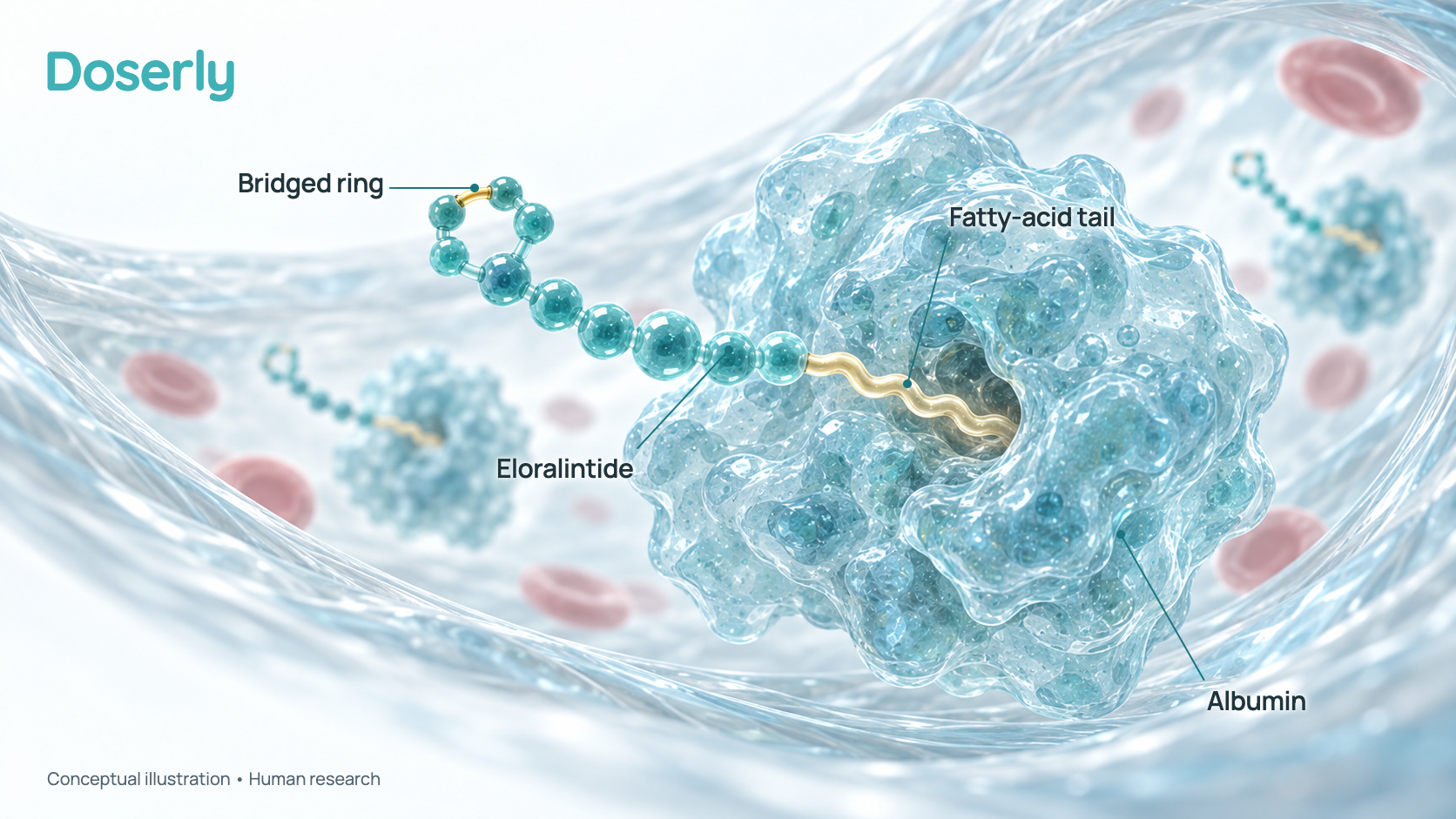
Why does it take weeks to reach full effect?
Because each weekly dose adds to what is still there from earlier doses, blood levels keep climbing for roughly 8 to 10 weeks (a rule-of-thumb estimate of 4 to 5 half-lives) before settling at a steady state. [4] At steady state, levels changed little across the week: peak levels were only about 1.3 to 1.4 times the lowest levels. [18]
That helps explain two common experiences. People who judge it after one or two doses often feel little, and those who step up quickly may find side effects keep building for weeks. Public users describe first effects around days 4 to 5 after the first dose, in line with the time to peak. [34], [35]
Is a pre-filled syringe the same as a vial sold online?
No. Trial participants use a manufactured, ready-to-use solution; phase 2 participants describe doses such as 0.9 mL, which matches a 10 mg per mL solution for the 9 mg dose, and the phase 3 product is registered in Europe as a solution in a pre-filled syringe. Products sold online are powders labelled "research use only", with no approved label, no guaranteed content and no instructions for people. [53], [37], [47]
Do kidney or liver problems change the dose?
Not known yet. Single-dose studies in people with liver impairment and with severe kidney impairment or kidney failure are registered, with results expected in late 2026 and 2027. [55], [56]
How should eloralintide be stored, and how long does it last?
There is no approved label with storage instructions. What is public is limited:
- The trial product. A ready-made solution for injection in a pre-filled syringe, according to the European trial register. Its storage conditions and in-use time are not public. [53]
- The laboratory formulation. In the discovery studies in rats, eloralintide was dissolved in a buffer at pH 8, a slightly alkaline solution. That was an experimental set-up, not a storage instruction. [4]
- Powder sold online. These are unverified website claims, not tested instructions. Protocol websites say the unmixed powder keeps in the fridge or frozen at about −20 °C, and that mixed (reconstituted) eloralintide keeps in the fridge at 2–8 °C for about 28 to 30 days. One site presents the fridge rule as an expectation, and none cites a stability test of eloralintide, so how long a mixed vial stays usable is not established. [57], [48], [22]
- Light. Whether light affects eloralintide has not been published; no storage or light-protection data exist outside the unreleased trial product.
- Cloudy vials. Community education groups include reports of powder that stayed cloudy after mixing with bacteriostatic water, and public forum threads debate the pH used in the rat studies. A cloudy solution can signal a problem with the product or the mix; we found no tested method for fixing it. [35]
This guide does not cover mixing or injection technique; the Academy note below points to practical handling.
What do we actually know about eloralintide in people?
More than for most peptides, but less than for approved weight-loss drugs. About 400 people have taken part in its published studies, and one 48-week controlled trial provides almost all the evidence on weight and side effects. All of it was run and paid for by Lilly. [4], [18], [2]
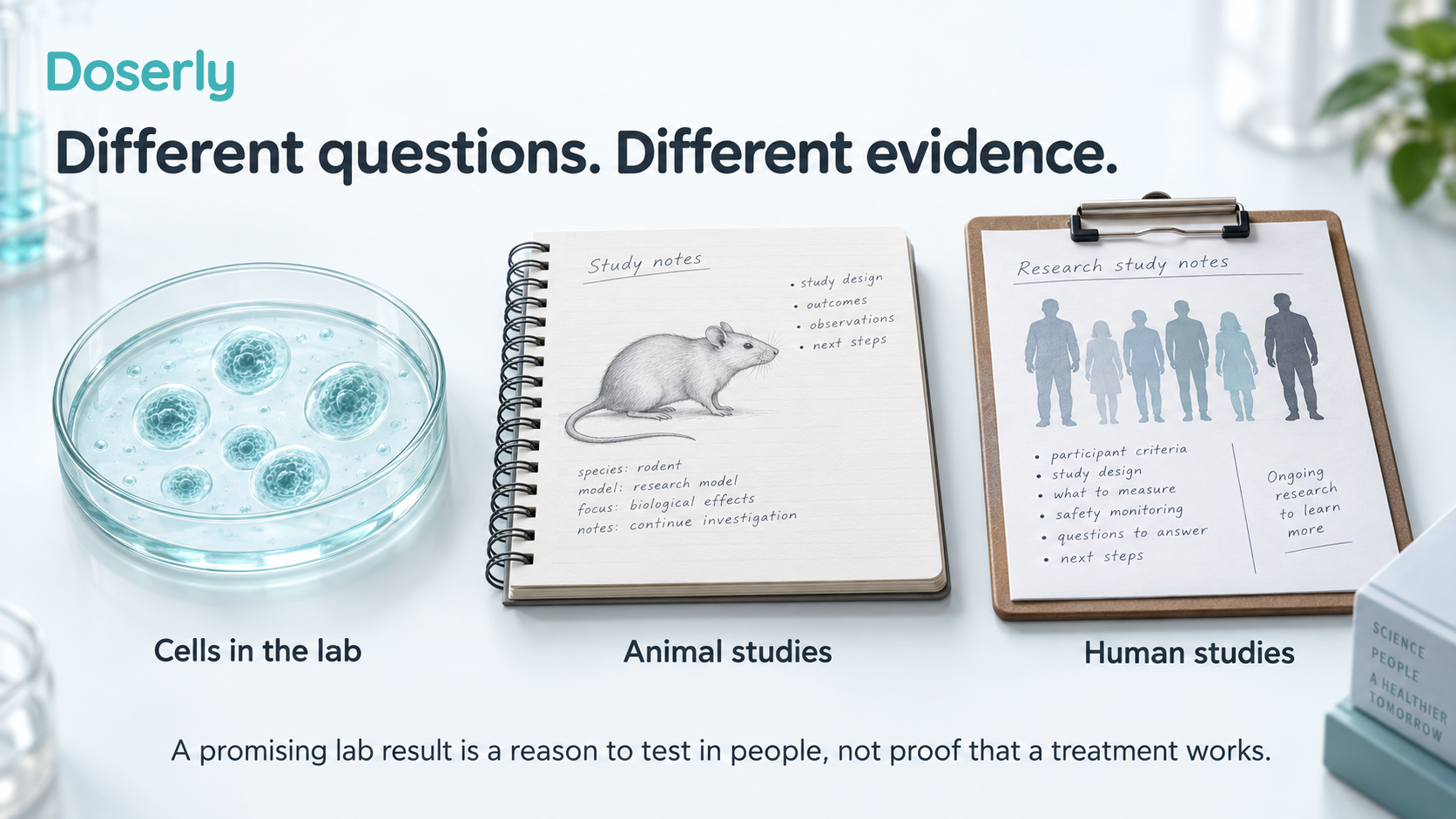
What did the trials find?
| Study | Who and how long | What researchers reported | What it cannot establish |
|---|---|---|---|
| Phase 1 single dose, 2025 | 48 healthy adults with an average BMI (body mass index, weight relative to height) of 27.5; one injection of 0.04 to 12 mg; weight and blood levels to day 29, safety follow-up to day 60 | Half-life 12.9–15.3 days. Weight −4.4% at day 29 after 12 mg, versus +0.6% on placebo. Stomach side effects only at 12 mg. | Effects of repeated dosing; 6 people per dose. [4] |
| Phase 1b multiple dose, 2026 | 100 adults with obesity or overweight; weekly 1.2, 3, 6 or 12 mg, no steps; 12 weeks plus 10 weeks off | Weight −2.6% to −11.3% at week 12 versus +0.2%; still lower than placebo 9 weeks after stopping on 6 and 12 mg. Low mood in 4 people on 6–12 mg; pulse down 14.4 beats per minute on 12 mg. | Long-term effects; groups of 6 to 36 people. [18] |
| Phase 2, 2025 | 263 adults with obesity or overweight, no diabetes; six dose groups or placebo; 48 weeks | Weight −9.5% (1 mg) to −20.1% (9 mg) versus −0.4%, if everyone stayed on treatment. Side effects were more common in the higher-dose groups and less common with 4-week steps. | Results beyond 48 weeks, in diabetes, or after stopping; the full paper is behind a paywall, so group details come from registry results and the sponsor's slides. [2], [12], [13] |
| Phase 1 with tirzepatide (company summary, 2026) | Adults with obesity or overweight; eloralintide 3 mg plus tirzepatide 5 mg; 16 weeks | 17% weight loss versus 10% on tirzepatide 5 mg alone (company summary). | The full data are not yet published. [7], [26] |
Why does the result say "efficacy estimand"?
Trials often report two versions of the same result, called estimands. The phase 2 headline numbers use the efficacy estimand: they estimate the result if everyone had kept taking the drug, using data only up to the point someone stopped. A treatment-policy result counts everyone as assigned, including those who stopped, and is usually a little smaller. The observed averages in phase 2 were very close to the headline figures on eloralintide (for example −20.2% versus −20.1% on 9 mg). On placebo the observed average was −1.6%, and nearly half the 1 mg group stopped treatment early, so its estimate rests on fewer people. [13], [2], [12]
This matters because not everyone finished. Of the people assigned to each group, 15 of 28 finished on 1 mg, 21 of 28 on fixed 6 mg, 48 of 54 on 9 mg and 46 of 52 on 3 → 6 → 9 mg, versus 38 of 53 on placebo. [12]
Was the weight lost mostly fat?
Mostly, as with other weight-loss drugs. In a body-scan (DXA) substudy of about 120 people, 60–70% of the weight lost on eloralintide was fat, which the sponsor describes as on par with other obesity treatments. The rest was lean mass, which includes muscle, organs and water. In rats, eloralintide caused less lean-mass loss than cagrilintide at one dose, although cagrilintide also produced more total weight loss (13.3% versus 11.1%). No human study has shown that it protects muscle better than other drugs. [13], [4]
What would a useful result look like in everyday life?
A trial average is not a prediction for one person. The trial also measured things people notice: waist size fell by up to 16.9 cm, and up to 90% of people moved down at least one BMI category. A useful result might mean steady weight change while still eating enough, and energy that stays manageable, since fatigue was one of the most common side effects. [13]
That is why it helps to track more than weight. Appetite, energy, stomach symptoms, pulse and mood can move in different directions.
What don't the trials tell us?
- The way most people use it online. No trial has tested doses below 1 mg, split doses, or eloralintide with retatrutide. [12]
- Use beyond 48 weeks. Phase 3 trials will add longer data, with main results expected in 2028 and one trial continuing to 2030. [3], [8]
- What happens after stopping. Only a 9-week check in a 12-week study has been published. [18]
- People with type 2 diabetes. No published results at this guide's research cut-off; the first combination results in diabetes were scheduled for the EASD 2026 meeting. [27], [8]
- Who was studied. In phase 2, 78% of participants were women, all were in the United States, and people with a slow heart rhythm, past pancreatitis or recent heart events were excluded. [13]
- Direct comparisons. No head-to-head results had been published at this guide's research cut-off. A phase 2 trial with eloralintide-alone and tirzepatide-alone groups was scheduled to report at the EASD 2026 meeting [27]; no trial has compared it with cagrilintide. A 2026 network analysis that compared trials indirectly rated its certainty as low. [58]
How does eloralintide work?
Eloralintide copies amylin, one of the body's "you've eaten enough" signals, and lasts far longer. Its receptor preferences come from cell studies; that it lowers weight is established in human trials, lower food intake through fullness is the likely explanation, and exactly how it does so in people is still under investigation. [4], [6]
What does "selective" mean?
Amylin acts on a family of receptors built from the calcitonin receptor (the receptor for calcitonin, a hormone involved in calcium balance) paired with a partner protein. In human cell tests, eloralintide switched on the AMY1 amylin receptor at about one-twelfth the concentration needed for the calcitonin receptor (about 12 times more potent) and about 11 times more potently than the AMY3 receptor. [4]
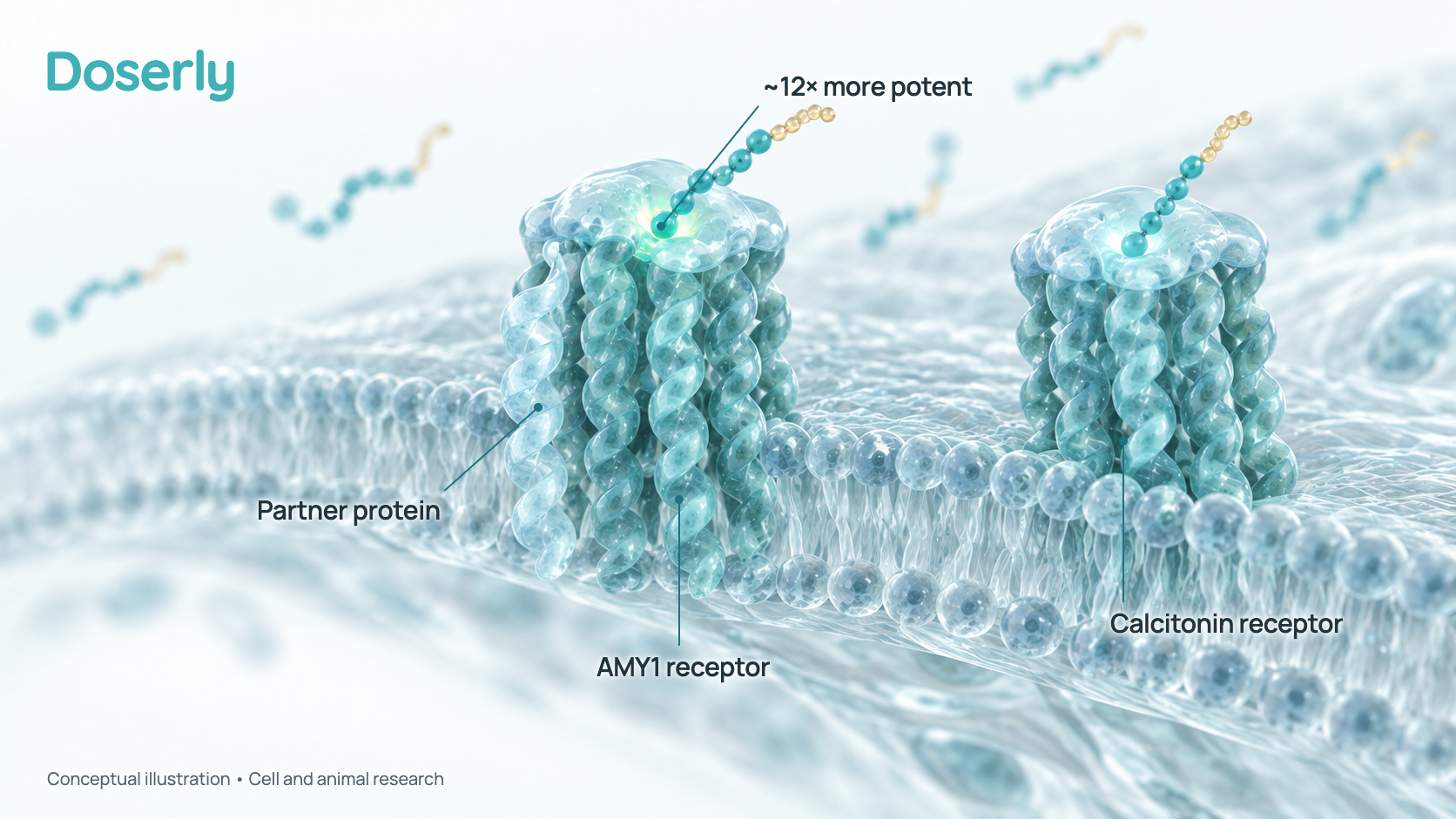
"Selective" means a preference, not an absence of activity. At higher concentrations, eloralintide fully activated all three receptors tested, so online claims that it "does not touch" the calcitonin receptor, or that it blocks amylin receptors, are wrong: it is an agonist, a molecule that switches receptors on. Cagrilintide, by contrast, is designed to act on amylin and calcitonin receptors more equally. [4], [59]
Why might it cause less nausea than cagrilintide?
That is Lilly's hypothesis, not a proven result. In rats, eloralintide caused less taste avoidance (a rat sign of feeling unwell) than cagrilintide at doses with a similar effect on eating. The researchers suggest two reasons: its preference for the AMY1 receptor, and its slow, flat blood levels. No human trial has compared the two drugs, and rat receptors respond differently from human ones: in rats, eloralintide also strongly activates a second amylin receptor, so rat results may not reflect how it acts in people. [4], [18]
In people, the phase 2 results show that nausea is not rare on eloralintide: 32.7% of all people on it had nausea, versus 13.5% on placebo. [13]
Does it slow digestion?
Only a little, and perhaps only at first. In the phase 1b study, researchers used the speed at which swallowed paracetamol (acetaminophen) reaches the blood as a stand-in for gastric emptying. After the first dose at higher doses, absorption was modestly lower; by day 80 it was back to baseline, and the authors say any effect "may be transient". A dedicated gastric-emptying study started in July 2026. [18], [60]
Why does it lower the pulse?
Nobody knows yet. Pulse fell early and stayed lower in both the phase 1b and phase 2 trials, more at higher doses, and blood pressure also fell in phase 2. The drop began within the first week, before much weight was lost; the researchers did not say why, and Lilly has not published a mechanism. Lilly also says the reason for the fatigue is "not well understood". [18], [13], [6]
What are the risks and unanswered questions?
Is eloralintide safe?
It has not been shown to be safe in the long term, and it is not approved. In trials of up to 48 weeks it caused frequent but mostly mild to moderate side effects, with no deaths and serious events at similar rates to placebo. Those data describe a pharmaceutical product under medical supervision, not powders bought online. [13], [2]
The pattern is fairly consistent: stomach and bowel symptoms and fatigue that become more common at higher doses and ease with slower steps, injection-site reactions, a slower pulse and lower blood pressure, and some hair loss. Rarer or slower-developing problems cannot be ruled out in a trial of this size.
What side effects did the trials find?
The phase 2 trial gives the clearest picture: 52 people on placebo and 208 on eloralintide across six groups for 48 weeks. The table shows the pooled result and three groups that illustrate how dose and steps matter. [13]
| Event | Placebo (52) | All eloralintide (208) | 3 → 6 → 9 mg (52) | Fixed 6 mg (28) | Fixed 9 mg (54) |
|---|---|---|---|---|---|
| Any adverse event | 71.2% | 81.2% | 78.8% | 100% | 87.0% |
| Nausea | 13.5% | 32.7% | 25.0% | 64.3% | 33.3% |
| Fatigue | 11.5% | 26.9% | 21.2% | 28.6% | 42.6% |
| Constipation | 5.8% | 14.9% | 7.7% | 7.1% | 24.1% |
| Diarrhea | 9.6% | 14.9% | 17.3% | 35.7% | 11.1% |
| Vomiting | 0 | 8.2% | 1.9% | 25.0% | 11.1% |
| Hair loss (alopecia) | 0 | 6.7% | 9.6% | 3.6% | 9.3% |
| Low blood pressure or fainting | 3.8% | 5.8% | 3.8% | 7.1% | 9.3% |
| Serious adverse events | 5.8% | 5.3% | 1.9% | 3.6% | 5.6% |
| Stopped because of side effects | 7.7% | 10.1% | 11.5% | 21.4% | 7.4% |
Most stomach events and all fatigue were mild or moderate; there were four cases of severe constipation and no severe nausea, vomiting or fatigue. Lilly reports that stomach side effects in the fixed 1 mg and 3 mg groups were similar to placebo. [13], [6], [61]
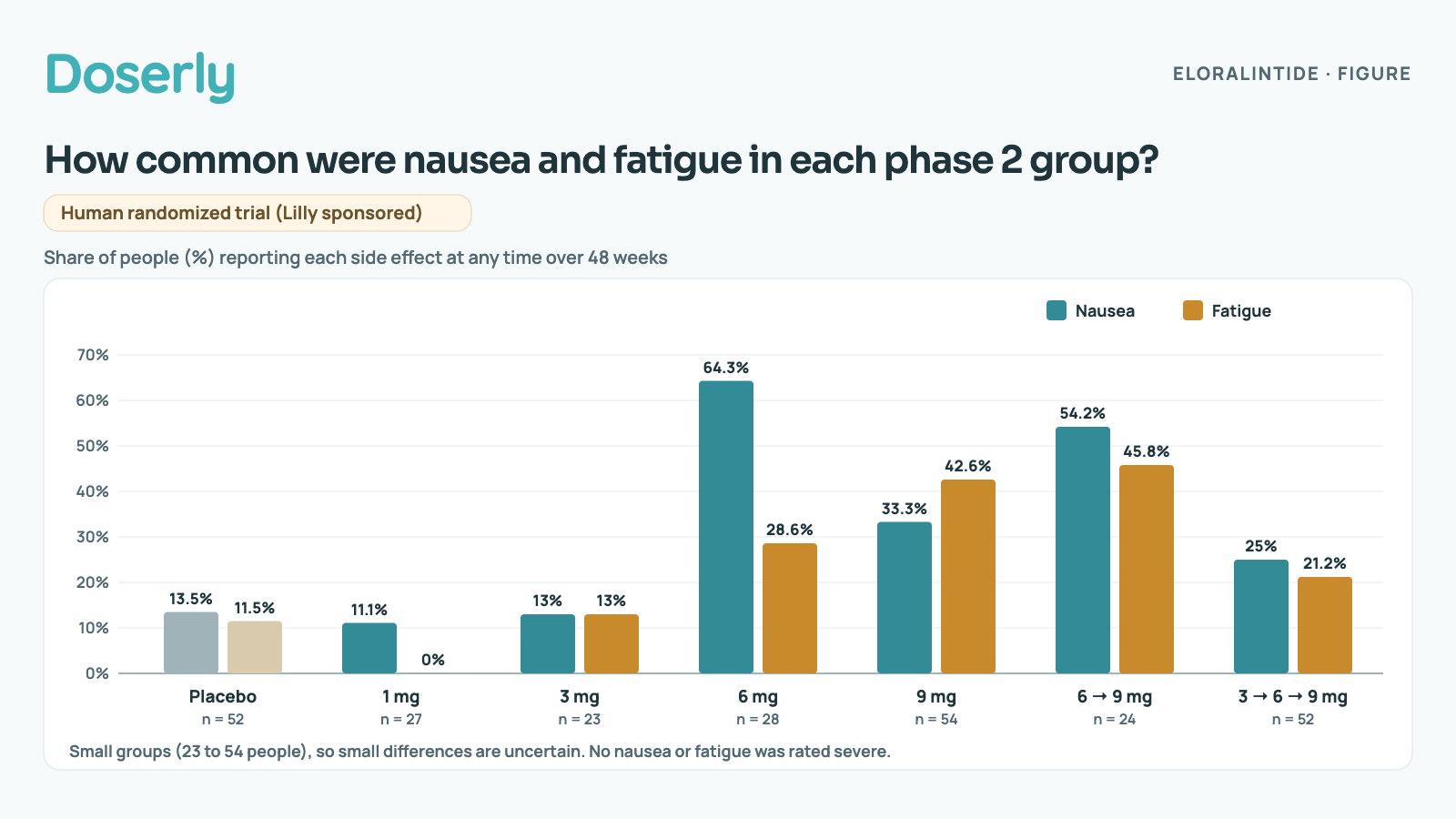
How common were nausea and fatigue in each phase 2 group?
Share of people (%) reporting each side effect over 48 weeks.
- Placebo · n = 52
- Nausea 13.5%; fatigue 11.5%.
- Eloralintide 1 mg · n = 27
- Nausea 11.1%; fatigue 0%.
- Eloralintide 3 mg · n = 23
- Nausea 13%; fatigue 13%.
- Eloralintide 6 mg · n = 28
- Nausea 64.3%; fatigue 28.6%.
- Eloralintide 9 mg · n = 54
- Nausea 33.3%; fatigue 42.6%.
- Eloralintide 6 → 9 mg · n = 24
- Nausea 54.2%; fatigue 45.8%.
- Eloralintide 3 → 6 → 9 mg · n = 52
- Nausea 25%; fatigue 21.2%.
Small groups, so small differences are uncertain. No nausea or fatigue was rated severe.
Nausea and fatigue were most common in the groups that started at 6 mg or 9 mg; 4-week steps from 3 mg had less of both.
Nausea did not rise neatly with dose: it was higher on a fixed 6 mg (28 people) than on a fixed 9 mg (54 people). With groups this small, the safer reading is that nausea was common in every group that started at 6 mg or more.
How much of a problem is fatigue?
It is the side effect that stands out. Fatigue affected 26.9% of people on eloralintide versus 11.5% on placebo, rising to 42.6% on 9 mg and 45.8% on 6 → 9 mg; none of it was rated severe, and 16 cases were moderate. Some community education groups quote "30 to 50%" for all participants, which overstates the pooled figure. In public accounts, fatigue usually comes in the few days after each injection and eases over the first weeks for some people, while others stopped because of it. [13], [44], [62], [32]
What about heart rate and blood pressure?
Eloralintide lowers the pulse. In the phase 1b study, pulse fell by 14.4 beats per minute on 12 mg, 8.3 on 6 mg and 7.1 on 3 mg at week 12, versus 3.4 on placebo, with no symptoms of an abnormally slow heart rate and no heart-safety findings on ECGs, including the QT interval; the ECGs showed the same fall in heart rate. In phase 2, pulse and blood pressure fell early and stayed lower, and the registry lists bradycardia (a slow heart rate) or sinus bradycardia 13 times across the 6 mg, 9 mg and 3 → 6 → 9 mg groups and none on placebo. The sponsor notes these were investigators' reports without a fixed cut-off. [18], [13], [12]
Low blood pressure, dizziness on standing or fainting were reported in 5.8% of people on eloralintide versus 3.8% on placebo. Phase 2 excluded people with a slow heart rhythm. For most people a lower pulse is harmless, but for someone with a slow heart rhythm, low blood pressure, heart disease or a heart-rate-lowering medicine, it is a real consideration. [13]
Can it affect mood?
Possibly, at higher doses. In the phase 1b study, four people on 6 or 12 mg reported mood problems: three with depressed mood and one with a short episode reported as persistent depressive disorder. The three on 12 mg stopped treatment, and their symptoms went away within 2 to 4 days; two of the four also had fatigue. In phase 2, depression was reported in 1.4% on eloralintide versus 1.9% on placebo, and one case of suicidal thoughts in the 1 mg group, 3.5 months after stopping, was judged unrelated. [18], [13]
What about hair loss, gallstones and other serious events?
Hair loss affected 6.7% of people on eloralintide and none on placebo, most often on 9 mg or the step-up schedules. Hair shedding is also common after any rapid weight loss, and one former participant describes regrowth with minoxidil. [13], [44]
Serious events on eloralintide, each in one or two people, included two heart attacks, gallstones, a bowel obstruction, Guillain-Barré syndrome, multiple sclerosis, a small stroke (thalamic infarction) and a kidney injury (full list in the sponsor presentation [13]). One person on 1 mg also had atrial flutter (a fast heart rhythm). Serious events were about as common as on placebo (5.3% versus 5.8%); the published summaries do not say whether investigators judged these events related to eloralintide, and single events cannot show cause. Gallstones are a known risk of rapid weight loss, and one phase 2 completer describes having the gallbladder removed after the study. [13], [44]
What problems do people report outside trials?
Public accounts describe the trial side effects, especially fatigue in the days after each injection, constipation and nausea after large meals, plus insomnia, skin sensitivity and headache. Some users report a lower resting heart rate on their watches. These reports cannot show how often a problem happens or whether eloralintide caused it: nearly all involve another weight-loss drug and unverified products. [62], [21], [63], [39]
Could product quality change the risk?
Yes. Eloralintide has been sold online as a "research use only" powder since about May 2026, while Lilly has no product on sale. One chemist argues that the bridged ring is hard to make correctly and that the mass and purity tests sellers post may not confirm it. Forum members report failed batches, cloudy vials and a secondhand claim that most of a small set of tested samples were empty or the wrong peptide, which we could not verify. [32], [24], [64], [65] In community education groups, members repeatedly doubt that routine purity or mass tests can prove a vial is eloralintide, and one member injected 2 mg by mistake after mixing up hard-to-read vial labels.
Regulators have warned about injectable peptides bought online in general: FDA about unapproved weight-loss drugs, Health Canada about unauthorized peptides, and the UK medicines regulator about unlicensed weight-loss products. [66], [67], [68]
Is eloralintide legal? Is it FDA-approved?
Checked September 26, 2026. Rules differ by country and change quickly.
United States. Eloralintide is not FDA-approved: FDA's drug databases list no application, product or label. It is not on the lists of bulk ingredients pharmacies may use, and with no approved product or official monograph it does not qualify for compounding. Lilly describes it as investigational. [69], [70], [1]
Canada. It is not in Health Canada's Drug Product Database. Health Canada has authorized clinical trials, which is not the same as authorizing sale, and in April 2026 it warned consumers about unauthorized injectable peptides bought online. [71], [72], [67]
Australia. Lilly describes eloralintide as investigational, with phase 3 trials still running, so it is not an approved medicine in Australia; the national register could not be searched directly for this check. TGA treats products not on its register as unapproved and says "research use only" disclaimers do not change that, and it has warned about importing unapproved peptide products. [1], [7], [73], [74]
Europe and the United Kingdom. It is not authorized by the European Medicines Agency. The EU trial register lists authorized ENLIGHTEN trials, and the UK has trial sites, but no UK licence exists. [75], [53], [68]
A "research use only" label does not make a product legal to sell for human use, and it does not make it safe.
Is eloralintide banned in sport? Does it show up on a drug test?
Yes, it is banned. Eloralintide is not named on the World Anti-Doping Agency's 2027 Prohibited List, but category S0 bans, at all times, any substance in clinical development without approval for human use. Tested athletes should treat it as prohibited. The same category applies under the 2026 list now in force. We found no published anti-doping test method or detection window for it. [76], [77]
Who should be especially cautious?
These groups have little or no safety data. That is a reason for caution, not proof of harm.
- Pregnancy and breastfeeding. No human data, and no reproductive toxicity studies have been published. One miscarriage was recorded as a serious event among women on 1 mg in phase 2; a single case cannot show cause. [4], [13]
- Women using birth-control pills. Whether eloralintide changes how well oral contraceptives are absorbed has not been tested; a study is registered but not yet recruiting. [52]
- A slow heart rate, low blood pressure or heart disease. Eloralintide lowers pulse and blood pressure, and phase 2 excluded people with a slow heart rhythm or recent heart events. [18], [13]
- Depression or a history of mood problems. Low mood appeared at 6–12 mg in an early study, and phase 2 excluded anyone with a past suicide attempt. [18], [12]
- Past pancreatitis or gallbladder disease. Phase 2 excluded people with past pancreatitis and symptomatic gallbladder disease within the past 2 years, and gallstones occurred during and after treatment. [12], [13], [44]
- A history of eating disorders or low body weight. Strong appetite suppression can make it hard to eat enough.
- People with diabetes on insulin or sulfonylureas. No results in diabetes have been published yet, and weight-loss drugs can change the need for these medicines. [8]
- Under 18. Not studied. This guide is written for adults.
- Competitive athletes. Covered by WADA's ban on unapproved substances. [76]
Does eloralintide interact with other medicines?
Formal interaction data are limited. The main registered interaction study, with a combined birth-control pill, has not started, and a study of eloralintide given with tirzepatide checked blood levels but has not published results. The older amylin drug pramlintide slows stomach emptying and its label warns about the timing of some oral medicines; eloralintide's effect on digestion looked small and short-lived, but it has not been fully tested. Combining it with other weight-loss drugs, or with medicines that slow the heart or lower blood pressure, adds to effects already seen in trials. Bring a complete list of everything you take, including other peptides, to a pharmacist or doctor. [52], [78], [79], [18]
What should be monitored while using eloralintide?
There is no official monitoring plan, because eloralintide has no prescribing label. What exists is a record of what the trials checked, which shows what researchers were watching for. It can help you prepare questions for a clinician; it is not a personal testing plan. [18], [13]
What did the trials check?
- Weight and related measures. Body weight, waist size, BMI, fat and lean mass by DXA in a subgroup, blood fats, HbA1c, fasting glucose and insulin, and hsCRP. [13]
- Heart and circulation. Pulse and blood pressure throughout, and in phase 1b, 12-lead ECGs including the QT interval (a measure of the heart's electrical recovery time). [18], [13]
- Blood tests. Standard safety tests, plus calcium and bone-turnover markers, because of the calcitonin receptor link; no meaningful changes were seen in the phase 1b study. [18]
- Side effects of special interest. Low blood pressure and fainting, kidney problems, depression and suicidal thoughts were tracked in phase 2 as events of special interest. [13]
- Appetite and digestion. Appetite ratings on a scale, and a paracetamol absorption test as a stand-in for stomach emptying. [18]
Which signals matter, and why?
| Why it matters | What studies measured or flagged | Tracking category |
|---|---|---|
| The result you care about | Weight, waist and BMI; −9.5% to −20.1% at 48 weeks by dose | Weight Management; Fat Loss; Appetite & Satiety; Food Noise |
| Stomach and bowel | Nausea 32.7% versus 13.5% on placebo; constipation and vomiting more common at higher doses | Nausea & GI Tolerance; Digestive Comfort |
| Energy | Fatigue 26.9% versus 11.5% on placebo, up to 45.8% in one group | Energy Levels; Daily Functioning |
| Heart rate and blood pressure | Pulse down by up to 14.4 beats per minute (3.4 on placebo); bradycardia reports on 6 mg and above; low blood pressure or fainting 5.8% versus 3.8% | Heart Rate & Palpitations; Blood Pressure; Heart Health |
| Mood | Low mood in 4 people on 6–12 mg in the phase 1b study | Mood & Wellbeing; Emotional Aliveness |
| Hair | Hair loss 6.7% versus none on placebo | Hair Health |
| Gallbladder | Gallstones reported during and after treatment | Digestive Comfort; Side Effect Burden |
| Injection site | Reactions in 13.9% to 33.3% of the 3–12 mg groups versus 3.7% on placebo in phase 1b | Side Effect Burden; Skin Health |
Anyone taking eloralintide with tirzepatide, semaglutide or another incretin drug is also covered by that medicine's label, which has its own checks, including pancreatitis and gallbladder symptoms, dehydration and low blood sugar with insulin or sulfonylureas. Which checks make sense for you is a question for a clinician. [80]
What do people in public communities report?
Public discussions come from three groups: people who finished the phase 2 trial, blinded participants in phase 3 trials who may be on placebo, and people buying it online, who almost always add it to tirzepatide or retatrutide. Only the trial completers describe eloralintide on its own for months. [44], [81], [32]
What do the positive reports look like?
Among phase 2 completers, the stories are about large weight losses: 49 to 66 lb over about 6 to 10 months, and almost 90 lb in one case. Blinded phase 3 participants describe appetite being "pretty much dead" at 6 mg, or 15 kg lost by week 12, and some in the knee arthritis trial report less joint pain. [37], [45], [44], [31], [81], [32]
People using it online mostly describe quieter hunger at 0.5–1 mg on top of another drug: food noise gone, dinners left unfinished by day 4, or a few pounds lost after a long plateau on tirzepatide. Several compare it favorably with cagrilintide, with less nausea or food aversion. [19], [20], [21], [24], [25]
How long did the effect take, and how long did it last?
Most accounts describe first effects around days 4 to 5 after the first injection, and a stronger effect after several weeks, which fits the drug's slow build-up. Former trial participants describe the effect fading over the weeks after their last dose, with hunger and some weight returning (see what happens when you stop). [34], [35], [44], [45]
Does everyone notice a difference?
No. Some people notice nothing in the first days at 1 mg, and a few found it no stronger than cagrilintide after several weeks while also taking retatrutide. In community education groups, reports of no effect mostly came from people on 1 to 2 mg who were judging within the first one to three weeks, usually on top of a strong incretin drug, and one member felt hungrier than on cagrilintide. [19], [34], [35]
That does not prove the product was weak or the dose too low. The trial's 1 mg group averaged 9.5% over 48 weeks, not in the first fortnight, and products bought online cannot be verified. [12], [65]
What about unwanted effects?
Fatigue is the complaint that stands out. Phase 2 completers describe fatigue and nausea in the first days after each shot during the early months; one stopped after about 6 months because of exhaustion, and another described 24 to 72 hours of barely functioning after each 3 mg dose in a phase 3 trial. Online users describe afternoon tiredness needing a nap. Other reports include constipation, insomnia and skin sensitivity in a participant also taking tirzepatide, and one person who took 10 mg over 5 days on top of two other drugs described their energy as "zapped". [44], [45], [32], [20], [21], [62]
Community education groups report the same themes. Several members found it gentler than cagrilintide, but they were on low doses; the trial groups at 6 mg and above had much more nausea and fatigue. Members also pass on secondhand reports that constipation tends to start around week 4.
How can you judge a weight-loss story?
Useful questions to ask: Was it eloralintide alone, or with another drug? What dose, in milligrams, and was the person blinded in a trial? How long had they been on the other drug, and did its dose change? Were they also eating differently or exercising more? What happened after stopping?
Selected discussions help identify experiences and questions that research should examine. They are not a survey of all users, a response rate or a substitute for the controlled trials described above.
How does eloralintide compare with cagrilintide, petrelintide, tirzepatide and retatrutide?
These are the medicines most often weighed against eloralintide. Cagrilintide and petrelintide are other long-acting amylin drugs; tirzepatide and retatrutide are the incretin drugs people most often combine it with. Status was checked on September 26, 2026.
| Medicine | What it is | Route and schedule | Human evidence | Approval status |
|---|---|---|---|---|
| Eloralintide (this guide) | Long-acting amylin receptor agonist that prefers the AMY1 receptor [4] | Weekly subcutaneous injection [12] | Phase 2: −20.1% at 48 weeks on 9 mg versus −0.4% on placebo (efficacy estimand) [2] | Not approved; phase 3 under way [69], [3] |
| Cagrilintide | Long-acting amylin analogue that acts on amylin and calcitonin receptors [59] | Weekly subcutaneous injection [82] | REDEFINE 1: −11.5% at 68 weeks on 2.4 mg alone versus −3.0% on placebo (treatment-policy) [82] | Not approved (see its guide) |
| Petrelintide | Long-acting amylin analogue from Zealand Pharma, developed with Roche [83] | Weekly subcutaneous injection [83] | Phase 2 (company release): up to −10.7% at 42 weeks versus −1.7% on placebo (efficacy estimand) [84] | Not approved; phase 3 planned [83] |
| Tirzepatide (Zepbound, Mounjaro) | GIP and GLP-1 receptor agonist [80] | Weekly subcutaneous injection [80] | SURMOUNT-1: −20.9% at 72 weeks on 15 mg versus −3.1% on placebo (treatment-regimen) [85] | FDA-approved for weight management and type 2 diabetes [80] |
| Retatrutide | GIP, GLP-1 and glucagon receptor agonist [86] | Weekly subcutaneous injection in trials [86] | TRIUMPH-1 (company report): −28.3% at 80 weeks on 12 mg versus −2.2% on placebo (efficacy estimand) [86] | Not approved anywhere [87] |
These results come from separate trials in different people, over different lengths of time, so the table cannot rank the medicines. No head-to-head results had been published at this guide's research cut-off: a phase 2 trial with eloralintide-alone and tirzepatide-alone groups was scheduled to report at the EASD 2026 meeting [27], and none has compared it with cagrilintide. A 2026 network analysis that compared amylin drugs indirectly estimated about 18% more weight loss than placebo for high-dose eloralintide, with low certainty. The practical differences are clearer: eloralintide's half-life of about two weeks is roughly twice cagrilintide's, it acts mainly through amylin receptors rather than incretin receptors, and tirzepatide is the only approved medicine in the table, with a full label and known storage rules. [58], [4]
Common questions about eloralintide
How long does eloralintide take to work?
People report noticing fuller-feeling meals within the first week, but weight loss builds over months. [34], [35] Blood levels peak 3 to 5.5 days after an injection and keep rising for 8 to 10 weeks of weekly use. In phase 2, weight was still falling at 48 weeks. [4], [13] See why it takes weeks.
Is eloralintide a GLP-1?
No. Eloralintide acts on amylin receptors, mostly the AMY1 receptor, not on the GLP-1 or GIP receptors that semaglutide and tirzepatide target. Lilly stresses that its mechanism differs from tirzepatide's, and the two are being tested together. [6], [4] See how it works.
Is eloralintide the same as cagrilintide?
No. Both are long-acting amylin drugs given weekly, but they come from different companies, have different structures and differ in receptor preference: eloralintide prefers the AMY1 receptor, while cagrilintide acts more broadly on amylin and calcitonin receptors. Eloralintide's half-life is about twice as long. Taking both at once doubles up on the same system and has not been studied. [4], [59], [21] Read the cagrilintide guide.
Can you take eloralintide with tirzepatide or retatrutide?
With tirzepatide, it has been tested in trials: 3 mg added to tirzepatide 5 mg gave 17% weight loss at 16 weeks versus 10% alone, and larger trials are under way. With retatrutide, it has not been tested in people, although it is the most common pairing online. Combining drugs can add to fatigue and make it hard to eat enough. [7], [11], [21] See combinations.
How much weight do people lose on eloralintide?
On average, 9.5% to 20.1% of body weight over 48 weeks in the phase 2 trial, depending on dose, versus 0.4% on placebo, if everyone stayed on treatment. More than half of people on 9 mg lost at least 20%. Results varied widely, and no trial has reported results beyond 48 weeks. [2], [13] See the trial results.
Does eloralintide cause hair loss or fatigue?
Both were reported. Fatigue affected 26.9% of people on eloralintide versus 11.5% on placebo, and hair loss 6.7% versus none, with both more common at 9 mg. Slower dose steps reduced fatigue. [13] See side effects.
Is it legal to buy eloralintide?
It is not approved anywhere, and it does not qualify for US pharmacy compounding. Products sold online as "research use only" are not approved for human use, and their content cannot be fully verified with routine tests. Rules differ by country. [69], [70], [65] See the dated legal-status summary.
When will eloralintide be available?
Not before the phase 3 ENLIGHTEN trials report; the first are due to finish their main phase in 2028, and Lilly has not announced a filing date. [8], [3], [7]
Glossary
Plain explanations of the route, dosing and research terms used in this guide. Underlined terms in the text link here.
- Adverse event
- A harmful or unwanted medical event reported after someone used a treatment. A report alone does not prove the treatment caused it.
- Agonist
- A molecule that switches a receptor on. Eloralintide is an agonist at amylin receptors; a molecule that blocks a receptor is called an antagonist.
- Alopecia
- The medical term for hair loss. In weight-loss trials it is often temporary shedding after rapid weight loss.
- Amino acid
- A small chemical building block. Chains of amino acids make up peptides and proteins.
- Amylin
- A hormone released by the pancreas together with insulin after meals. It helps signal fullness and slows how fast food leaves the stomach.
- Amylin receptor agonist
- A drug that switches on the receptors amylin uses. Eloralintide is one that prefers the AMY1 amylin receptor, which Lilly calls a selective amylin receptor agonist.
- Animal study
- Research in animals such as rats or monkeys. It shows what a substance does in a living body, but results in people can differ.
- Bradycardia
- A slower heart rate than usual, often defined as under 60 beats per minute at rest. It can be harmless, especially in fit people, or cause dizziness and fainting.
- BMI (body mass index)
- Weight relative to height (weight in kilograms divided by height in metres squared), used to group people as healthy weight, overweight or obese.
- Calcitonin receptor
- The receptor for calcitonin, a hormone involved in calcium balance. Amylin receptors are built from the calcitonin receptor plus a partner protein.
- Cell study (in vitro)
- Research on cells grown in a dish. It gives early clues about biology, but it is far from proof of benefit in people.
- Compounding
- When a pharmacy prepares a customized medicine from individual ingredients. In the US, federal rules control which bulk ingredients pharmacies may use.
- Controlled trial
- A study that compares people who receive a treatment with a similar group who do not, often receiving a placebo instead. Randomly assigning people to each group makes the comparison fairer.
- Course and cycle
- A course is the period of repeated use, such as 48 weeks. A cycle is a course plus a planned break before any further use.
- Dose (amount each time)
- The amount given on one occasion. A protocol lists both the dose and how often it is given.
- DXA scan
- Dual-energy X-ray absorptiometry, a low-dose X-ray scan that measures fat, lean mass and bone separately. Trials use it to see what kind of weight was lost.
- ECG
- Electrocardiogram, a recording of the heart's electrical activity taken with sensors on the skin. It shows heart rate and rhythm.
- Estimand
- The exact question a trial result answers. An efficacy estimand estimates what happens if everyone keeps taking the drug; a treatment-policy estimand counts everyone as assigned, including people who stopped.
- Food noise
- An informal term for frequent, intrusive thoughts about food and eating. It is not a medical measurement.
- Freeze-dried (lyophilized)
- A powder made by freezing a solution and removing the water. Peptides sold online usually come this way and must be mixed with sterile water before injection.
- Gastric emptying
- How quickly food leaves the stomach. Slower emptying can make people feel full sooner and can change how fast some tablets are absorbed.
- GLP-1 drugs
- Medicines such as semaglutide that act on the GLP-1 receptor to reduce appetite and lower blood sugar. Tirzepatide and retatrutide also act on other hormone receptors. Eloralintide is not a GLP-1 drug.
- Half-life
- The time it takes for the measured level of a substance in the blood to fall by half. It is not the same as how long an effect lasts.
- HbA1c
- A blood test that reflects average blood sugar over roughly the previous three months.
- Incretin drugs
- Medicines that copy gut hormones released after eating, such as GLP-1 and GIP. Semaglutide, tirzepatide and retatrutide belong to this family; eloralintide does not.
- Investigational
- Still being studied and not approved by a regulator, such as the FDA, to treat any condition.
- Lean mass
- Everything in the body that is not fat, including muscle, organs, bone and water. Body scans measure it separately from fat.
- mcg and mg
- Micrograms and milligrams. 1 mg equals 1,000 mcg, so 0.5 mg is 500 mcg. Eloralintide amounts are written in mg.
- Network analysis
- A method that compares drugs indirectly by combining separate trials that share a common comparison, such as placebo. Its results are less certain than a direct head-to-head trial.
- Peptide
- A short chain of amino acids. Eloralintide is a chain of 37 with a chemical bridge and a fatty-acid tail attached.
- Pharmacokinetics
- How the body absorbs, moves, breaks down and removes a substance, including peak levels and half-life.
- Trial phases
- Stages of testing in people. Phase 1 checks safety and blood levels, phase 2 tests doses in patients, and phase 3 confirms benefits and harms in large groups before approval.
- Placebo
- A dummy treatment with no active ingredient, used as a comparison in studies.
- Preclinical research
- Studies done before research in people: cell studies and animal studies.
- Pre-filled syringe
- A syringe filled by the manufacturer with a measured solution, ready to inject. The eloralintide phase 3 trials use this form.
- Reconstitution
- Mixing a freeze-dried powder with sterile water to make an injectable solution. The amount of water sets how much drug each syringe unit holds.
- Research use only
- A label on products sold for laboratory research. It does not mean a product is approved, tested for human use or legal to sell as a medicine.
- Steady state
- The point, after repeated dosing, when the amount entering the body each week balances the amount removed, so levels stop rising. It usually takes 4 to 5 half-lives.
- Subcutaneous (SC)
- Injected into the fatty layer just under the skin. This is the route used in every eloralintide trial.
- Syringe units
- Markings on an insulin syringe that measure volume. On a U-100 syringe, 100 units equal 1 mL. The amount of drug per unit depends on the vial's concentration.
- Titration and maintenance dose
- Titration means raising a dose in steps, usually to reduce side effects. The maintenance dose is the amount kept once the steps are finished, such as 9 mg in the 3 → 6 → 9 mg schedule.
- WADA
- The World Anti-Doping Agency, which publishes the list of substances banned in sport. Its category S0 covers drugs not approved for human use anywhere.
- Weekly total
- All the amounts given in one week, added together. For example, 0.5 mg twice weekly is a 1 mg weekly total.
Explore more of the research
Go deeper into the laboratory and animal experiments behind the claims. Across this guide, the citations include 6 original scientific papers, 3 of them about eloralintide, plus company presentations and registry results that are labeled as such. All eloralintide research so far is sponsored by Eli Lilly, and its laboratory and animal experiments appear in the same paper as the first human study.
Receptors, rats and monkeys · 1 paper
How selective is it?
Model: Human and rat receptor cells in a dish.
Finding: Eloralintide was about 12 times more potent at the human AMY1 receptor than at the calcitonin receptor and about 11 times more than at AMY3, and it fully activated all three. In rat cells it also strongly activated the AMY3 receptor.
Limit: Cell potency does not show which receptor drives weight loss in people, and rat receptors differ from human ones.
Does it cause less 'nausea' than cagrilintide in rats?
Model: Lean rats given single doses, with a taste-avoidance test (rats avoid a flavour linked to feeling unwell).
Finding: Eloralintide caused taste avoidance at higher doses than cagrilintide (half-maximal doses of about 8.9 versus 4.2 nmol/kg), while reducing food intake and weight by similar amounts at the top dose (about 15% at day 4).
Limit: Taste avoidance is an animal stand-in for nausea; human trials still saw frequent nausea.
What kind of weight did rats lose?
Model: Rats made obese on a high-fat diet, dosed every 3 days for about 2 weeks.
Finding: Weight fell about 11 to 12% at the highest dose, and fat made up 68 to 91% of the weight lost. At that dose, eloralintide caused less lean-mass loss than cagrilintide (5 rats per group), though cagrilintide also produced more total weight loss (13.3% versus 11.1%).
Limit: Short study, small groups; the human DXA substudy found a fat share on par with other obesity drugs.
How long does it last in animals?
Model: Rats and cynomolgus monkeys given single injections.
Finding: Eloralintide reached higher levels, lasted longer and had flatter blood-level curves than cagrilintide.
Limit: Animal half-lives differ from the 12.9 to 15.3 days measured in people.
How this guide was researched
This guide is built from a thorough review of the sources cited throughout it: published clinical trials, registry results, registered study plans, regulatory documents, laboratory and animal research, company presentations and published protocol descriptions. We also reviewed public online forums and community education groups where people describe their own experiences with eloralintide.
The guide cites 87 sources, including 6 original scientific papers (3 about eloralintide; the others describe the medicines it is compared with). Each type of source answers a different question. Trials show what researchers measured. Protocol descriptions show how eloralintide is typically used outside trials. Personal accounts show what individual people experienced. Every numbered citation links to its entry below, labeled by source type.
How this guide was made
Research and drafting were AI-assisted. Every cited source was checked against the original, and the guide was reviewed and edited by Doserly before publication. It has not had an independent clinical review, and Doserly does not currently have medical reviewers. Doserly makes a medication and health-tracking app and runs Doserly Academy, both of which are promoted in this guide. Read our editorial policy for how guides are researched, updated and corrected.
This guide is for educational purposes. It summarizes what the reviewed sources report so the research is easier to understand; it is not medical advice. For a deeper dive, or to check any point for yourself, go straight to the cited sources.
Explore the sources
These are the documents cited in this guide. Trials, company announcements, website advice and personal accounts answer different questions. A source being listed does not mean every statement on its page is endorsed.
Showing 87 sources
- 01
What to know about eloralintide ↗
Company statement
Page reviewed: investigational, not approved, injected once weekly in trials.
- 02
Eloralintide, a selective amylin receptor agonist for the treatment of obesity: a 48-week phase 2, multicentre, double-blind, randomised, placebo-controlled trial ↗
Human trial
Original abstract reviewed; the full text is paywalled, so group-level details were checked against registry results and the sponsor's presentation.
Result detail: 263 adults without diabetes, 48 weeks: about −9% (1 mg) to −20% (9 mg) versus −0.4% on placebo (efficacy estimand); nausea 11–64% and fatigue 0–46% by group.
- 03
ENLIGHTEN-1: A Study of Eloralintide (LY3841136) in Participants With Obesity, or Overweight Without Type 2 Diabetes ↗
Registered study plan
Full registry record reviewed on 26 Sep 2026; status recruiting; no results posted.
- 04
Eloralintide (LY3841136), a novel amylin receptor agonist for the treatment of obesity: From discovery to clinical proof of concept ↗
Human study and laboratory research
Full text reviewed (open access).
Result detail: structure; human receptor potency (about 12 times AMY1 over the calcitonin receptor); rat and monkey studies versus cagrilintide; single doses of 0.04–12 mg in 48 people, half-life 310–366 hours (12.9–15.3 days), peak levels 72–132 hours after a dose.
- 05
Eloralintide substance record (UNII 73G3354J8W) ↗
Identity database
Full record reviewed: names and codes (LY3841136, AMY-1176), sequence and the 2 to 7 bridge.
- 06
What is the mechanism of action for eloralintide? ↗
Company medical information
Page reviewed: effect likely through satiety; mechanism differs from tirzepatide; fatigue mechanism "not well understood".
- 07
Lilly to present new data on Foundayo, retatrutide, and eloraTZP at EASD 2026 ↗
Company announcement
Original release reviewed.
Detail: eloralintide 3 mg added to tirzepatide 5 mg gave 17% weight loss at 16 weeks versus 10% on tirzepatide alone; phase 2 eloraTZP results scheduled for the EASD 2026 meeting; phase 3 trials ongoing.
- 08
ENLIGHTEN-2: A Study of Eloralintide (LY3841136) in Participants With Obesity or Overweight, and Type 2 Diabetes ↗
Registered study plan
Full registry record reviewed on 26 Sep 2026; status recruiting; no results posted.
- 09
ENLIGHTEN-3: A Study of Eloralintide (LY3841136) in Participants With Obstructive Sleep Apnea and Obesity or Overweight ↗
Registered study plan
Full registry record reviewed on 26 Sep 2026; status recruiting; no results posted.
- 10
ENLIGHTEN-4: Efficacy and Safety of Eloralintide (LY3841136) in Participants With Osteoarthritis Knee Pain and Obesity or Overweight ↗
Registered study plan
Full registry record reviewed on 26 Sep 2026; status recruiting; no results posted.
- 11
ENLIGHTEN-6: A Study of Eloralintide (LY3841136) in Participants With Persistent Obesity Who Are Treated With a Weekly Incretin ↗
Registered study plan
Full registry record reviewed on 26 Sep 2026; status recruiting; no results posted.
- 12
A Study of LY3841136 Compared With Placebo in Adult Participants With Obesity or Overweight ↗
Registered study with posted results
Full registry record reviewed on 26 Sep 2026; status completed; results posted.
- 13
Eloralintide Phase 2 Study in Adult Participants With Overweight or Obesity (ObesityWeek 2025 sponsored symposium) ↗
Company conference presentation (not peer reviewed)
Full slide deck reviewed (33 pages).
Result detail: group-level weight, responder, waist, DXA, lipid, hsCRP, side-effect, special-interest and serious-event tables; pulse and blood pressure fell; fat was 60–70% of the weight lost.
- 14
Eloralintide Dosing Guide: Phase 2 Doses, Titration, and Weekly Protocol ↗
Protocol source
Page reviewed; dosing text checked against a saved copy (26 Sep 2026).
- 15
Eloralintide Dosing Guide: Phase 2 Doses & Weekly Trial Protocol ↗
Protocol source
Page reviewed; dosing text checked against a saved copy (26 Sep 2026).
- 16
Eloralintide - Research, Dosing & Protocols ↗
Protocol source
Page reviewed; dosing text checked against a saved copy (26 Sep 2026).
- 17
Eloralintide (Elora): Dosage & Safety ↗
Protocol source
Page reviewed; dosing text checked against a saved copy (26 Sep 2026).
- 18
Eloralintide, a selective, long-acting amylin receptor agonist for treatment of obesity: Phase 1 proof of concept ↗
Human trial
Full text reviewed (open access).
Result detail: 100 adults, weekly 1.2, 3, 6 or 12 mg without steps for 12 weeks: weight −2.6% to −11.3% versus +0.2%; pulse −14.4 beats per minute on 12 mg; mood-related events in 4 people on 6–12 mg; weight still lower than placebo 9 weeks after the last 6 or 12 mg dose.
- 19
Eloralintide Starting Dose? Looking for User Experiences ↗
Community account
Public thread reviewed through a public archive copy, including comments.
- 20
Starting ↗
Community account
Public thread reviewed through a public archive copy, including comments.
- 21
Elora with Reta ↗
Community account
Public thread reviewed through a public archive copy, including comments.
- 22
Eloralintide Dosage Chart, Schedule & Reconstitution Protocol ↗
Protocol source
Page reviewed; dosing text checked against a saved copy (26 Sep 2026).
- 23
Eloralintide — Dosage, Research & Cycle Guide ↗
Protocol source
Page reviewed; dosing text checked against a saved copy (26 Sep 2026).
- 24
Eloralintide!?!? ↗
Community account
Public thread reviewed through a public archive copy, including comments.
- 25
Cagrilintide vs Eloralintide ↗
Community account
Public thread reviewed through a public archive copy, including comments.
- 26
A Study of LY3841136 in Overweight and Obese Participants ↗
Registered study plan
Full registry record reviewed on 26 Sep 2026; status completed; no results posted.
- 27
A Study to Investigate Weight Management With LY3841136 and Tirzepatide (LY3298176), Alone or in Combination, in Adult Participants With Obesity or Overweight With Type 2 Diabetes ↗
Registered study plan
Full registry record reviewed on 26 Sep 2026; status active not recruiting; no results posted.
- 28
A Study of Macupatide (LY3532226) and Eloralintide (LY3841136), Alone or in Combination, in Adults With Obesity or Overweight and With Type 2 Diabetes ↗
Registered study plan
Full registry record reviewed on 26 Sep 2026; status recruiting; no results posted.
- 29
A Study to Investigate Weight Management With Macupatide and Eloralintide, Alone or in Combination, in Adult Participants With Obesity or Overweight ↗
Registered study plan
Full registry record reviewed on 26 Sep 2026; status recruiting; no results posted.
- 30
Cardiometabolic Risk Reduction Through Selective Amylin Receptor Agonism: Emerging Cardiovascular Implications of Eloralintide ↗
Review
Original abstract reviewed.
- 31
Week 10 Elighten -1 ↗
Community account
Public thread reviewed through a public archive copy, including comments.
- 32
I Finally Got It From Gray… ↗
Community account
Public thread reviewed through a public archive copy, including comments.
- 33
Eloralintide Reconstitution Calculator — mg to Units ↗
Protocol source
Page reviewed; dosing text checked against a saved copy (26 Sep 2026).
- 34
Eloralintide dosing ↗
Community account
Public thread reviewed through a public archive copy, including comments.
- 35
- 36
LY3841136, now known as Eloralintide ↗
Community account
Public thread reviewed through a public archive copy, including comments.
- 37
How’s everyone doing!?! ↗
Community account
Public thread reviewed through a public archive copy, including comments.
- 38
Safety, tolerability, pharmacokinetics and pharmacodynamics of eloralintide and tirzepatide co-administered once weekly (conference abstract, as quoted) ↗
Secondary report of a conference abstract
Only the aggregator's quotation could be read; the "up to 29%" figure is unverified against the original abstract.
- 39
Reta and Elora? ↗
Community account
Public thread reviewed through a public archive copy, including comments.
- 40
Eloralintide (10 mg) Dosage Protocol ↗
Protocol source
Page reviewed; dosing text checked against a saved copy (26 Sep 2026).
- 41
Eloralintide (10 mg Vial) Dosage Protocol ↗
Protocol source
Page reviewed; dosing text checked against a saved copy (26 Sep 2026).
- 42
Eloralintide 10mg Dosage & Mixing Guide ↗
Protocol source
Page reviewed; dosing text checked against a saved copy (26 Sep 2026).
- 43
How Much BAC Water for Eloralintide? Reconstitution Calculator ↗
Protocol source
Page reviewed; dosing text checked against a saved copy (26 Sep 2026).
- 44
1+ year after study update ↗
Community account
Public thread reviewed through a public archive copy, including comments.
- 45
Is your study over? ↗
Community account
Public thread reviewed through a public archive copy, including comments.
- 46
Eloralintide Dosage, Titration & Research Guide ↗
Protocol source
Page reviewed; dosing text checked against a saved copy (26 Sep 2026).
- 47
How to Reconstitute Eloralintide: Clinical Product vs Research Vials ↗
Protocol source
Page reviewed; dosing text checked against a saved copy (26 Sep 2026).
- 48
Eloralintide - Dosing Protocols ↗
Protocol source
Page reviewed; dosing text checked against a saved copy (26 Sep 2026).
- 49
Eloralintide Dosing Calculator ↗
Protocol source
Page reviewed; dosing text checked against a saved copy (26 Sep 2026).
- 50
Eloralintide: Uses, Dosing, Half-Life & Reconstitution ↗
Protocol source
Page reviewed; dosing text checked against a saved copy (26 Sep 2026).
- 51
Eloralintide | Research Guide ↗
Protocol source
Page reviewed; dosing text checked against a saved copy (26 Sep 2026).
- 52
A Study of Eloralintide (LY3841136) in Female Participants With Obesity or Overweight ↗
Registered study plan
Full registry record reviewed on 26 Sep 2026; status not yet recruiting; no results posted.
- 53
ENLIGHTEN-1 (EU CT 2025-523657-34-00): product and authorization data ↗
Registered study plan (EU)
Public record reviewed: authorized 27 Mar 2026; eloralintide (LY3841136 sodium) as a solution for injection in a pre-filled syringe, subcutaneous; doses not disclosed.
- 54
Safety, tolerability, pharmacokinetics, and pharmacodynamics of concomitant administration of multiple doses of cagrilintide with semaglutide 2.4 mg for weight management: a randomised, controlled, phase 1b trial ↗
Human trial (cagrilintide)
Original abstract reviewed.
Result detail: cagrilintide half-life 159–195 hours (6.6 to 8.1 days).
- 55
A Study of Eloralintide (LY3841136) in Participants With Different Levels of Liver Damage and in Participants With Healthy Livers. ↗
Registered study plan
Full registry record reviewed on 26 Sep 2026; status recruiting; no results posted.
- 56
A Study of Eloralintide (LY3841136) in Participants With Renal Impairment and in Participants With Normal Renal Function ↗
Registered study plan
Full registry record reviewed on 26 Sep 2026; status active not recruiting; no results posted.
- 57
Eloralintide: storage, shelf life & how long it lasts ↗
Protocol source
Page reviewed; dosing text checked against a saved copy (26 Sep 2026).
- 58
Novel Amylin-Based Therapies for Weight Management in Adults With Overweight or Obesity Without Diabetes: A Network Meta-Analysis ↗
Review (network meta-analysis)
Full text reviewed.
Result detail: indirect comparison across trials; high-dose eloralintide about −18% versus placebo; low certainty.
- 59
- 60
A Study of Eloralintide (LY3841136) in Participants With Obesity or Overweight ↗
Registered study plan
Full registry record reviewed on 26 Sep 2026; status recruiting; no results posted.
- 61
Lilly's selective amylin agonist, eloralintide, demonstrated meaningful weight loss and favorable tolerability in a Phase 2 trial ↗
Company announcement
Release reviewed through its PR Newswire copy.
Detail: weight loss up to 20.1% at 48 weeks; stomach side effects similar to placebo in the 1 mg and 3 mg groups; phase 3 plans.
- 62
Week 3 of Enlighten-6 Study Med Read Out ↗
Community account
Public thread reviewed through a public archive copy, including comments.
- 63
ELORA & HR Response ↗
Community account
Public thread reviewed through a public archive copy, including comments.
- 64
- 65
The Trouble With Elora ↗
Community account
Public post reviewed. Expert opinion on product testing, not tested evidence.
- 66
FDA's Concerns with Unapproved GLP-1 Drugs Used for Weight Loss ↗
Regulatory source
Official page checked; general warning that does not name eloralintide.
- 67
Think twice before injecting peptides bought online: unauthorized products can seriously harm you ↗
Safety advisory
Advisory checked; general warning that does not name eloralintide.
- 68
No summer shortcut for safe weight loss ↗
Safety advisory
Announcement checked; general warning about unlicensed weight-loss products that does not name eloralintide.
- 69
openFDA drug application, product and label search: eloralintide ↗
Regulator database (US)
Application, product (NDC) and label endpoints searched: no match.
- 70
Bulk Drug Substances Used in Compounding Under Section 503A of the FD&C Act ↗
Regulatory source
Page and category lists checked: eloralintide not listed.
- 71
Drug Product Database active-ingredient list ↗
Regulator database (Canada)
Full ingredient list searched: eloralintide absent.
- 72
Health Canada Clinical Trials Database: eloralintide obesity trial ↗
Regulator database (Canada)
Search-result entry only: shows authorization of a clinical trial, not of sale.
- 73
How we regulate therapeutic peptide products ↗
Regulatory source
Guidance page checked for the Doserly cagrilintide guide: products not on the register are unapproved; research-use disclaimers do not change regulation. The register itself could not be reached for this guide.
- 74
TGA warning on the risks of importing unapproved peptide products ↗
Safety advisory
Advisory checked on 23 Sep 2026 for the Doserly cagrilintide guide; a general warning that does not name eloralintide.
- 75
EMA medicines data (JSON report) ↗
Regulator database (EU)
Full medicines list searched: eloralintide absent.
- 76
The 2027 Prohibited List ↗
Regulatory source
Full list checked: eloralintide not named; S0 bans substances in clinical development without approval for human use, at all times.
- 77
The 2026 Prohibited List ↗
Regulatory source
List checked for sibling Doserly guides: S0 covers substances without any current approval for human use.
- 78
A Study of Eloralintide (LY3841136) and Eloralintide With Tirzepatide in Participants With Overweight or Obesity ↗
Registered study plan
Full registry record reviewed on 26 Sep 2026; status completed; no results posted.
- 79
SYMLIN (pramlintide acetate) injection, for subcutaneous use: prescribing information ↗
Label
Official US label checked for the Doserly cagrilintide guide: slows gastric emptying and advises on the timing of oral medicines.
- 80
ZEPBOUND (tirzepatide) injection, for subcutaneous use: prescribing information ↗
Product label (US)
Full label reviewed for the Doserly tirzepatide guide.
- 81
Got my first shot 1h ago...Germany, clinical trial (weekly diary) ↗
Community account
Public thread reviewed through a public archive copy, including comments.
- 82
Coadministered Cagrilintide and Semaglutide in Adults with Overweight or Obesity ↗
Human trial (cagrilintide)
Full text reviewed for the Doserly cagrilintide guide.
Result detail: REDEFINE 1, 3,417 adults, 68 weeks: cagrilintide 2.4 mg alone −11.5% versus −3.0% on placebo (treatment-policy).
- 83
Petrelintide: an amylin analog as an alternative to GLP-1 receptor agonists for weight management ↗
Company statement
Company pipeline page reviewed for the Doserly cagrilintide guide.
Detail: investigational long-acting amylin analogue for once-weekly subcutaneous use, developed with Roche; phase 3 planned.
- 84
Roche announces positive Phase II results for petrelintide, an amylin analog developed for people living with overweight and obesity ↗
Company announcement
Original release reviewed for the Doserly cagrilintide guide. Topline results, not peer reviewed.
Result detail: ZUPREME-1: up to 10.7% mean weight reduction at week 42 versus 1.7% with placebo (efficacy estimand).
- 85
Tirzepatide Once Weekly for the Treatment of Obesity ↗
Human trial (tirzepatide)
Original abstract reviewed.
Result detail: SURMOUNT-1, 2,539 adults without diabetes, 72 weeks: −15.0%, −19.5% and −20.9% on 5, 10 and 15 mg versus −3.1% on placebo.
- 86
Lilly's triple agonist, retatrutide, delivered powerful weight loss in pivotal Phase 3 obesity trial ↗
Company trial report (not peer reviewed)
Full text reviewed for the Doserly retatrutide guide.
Result detail: TRIUMPH-1, 80 weeks: −19.0%, −25.9% and −28.3% versus −2.2% on placebo (efficacy estimand).
- 87
Lilly calls on online platforms, payment companies and regulators to shut down the illegal retatrutide black market ↗
Company announcement
Original release reviewed for the Doserly retatrutide guide: no medicine containing retatrutide is approved anywhere.
No matching sources
Try a different term or show the full list.
Updates and corrections
Updated September 26, 2026. First version of this guide. The phase 2 results of eloralintide combined with tirzepatide were scheduled for presentation at the EASD 2026 meeting, after this guide's research cut-off, and this guide will be revised when they are published; the same applies to phase 3 results and any regulatory filing. The date describes this revision, not a fresh check of every source.
Found an error or a relevant study we missed? Report a correction with the guide title, the specific passage and a supporting source if available. Please leave out personal health records. See our editorial policy for how we handle attribution, evidence limits and corrections.