
Zenagamtide: Dose References, Amycretin Research & Safety
On this page
Quick Reference Card
Attribute
Identity
Attribute
Mechanism label
Attribute
Development status
Attribute
Clinical forms studied
Attribute
Main human evidence
Attribute
Evidence boundary
- Research reference
- Trial doses describe sponsor-manufactured investigational products. They do not validate online vials, reconstitution recipes or self-directed titration.
Quick dose reference
Zenagamtide/amycretin is investigational. This summary separates weekly subcutaneous, daily oral and obesity-escalation trial targets. Any dosing protocol should be reviewed with a qualified healthcare practitioner.
Investigational zenagamtide injected under the skin (subcutaneous)
Based on clinical study details
Weekly subcutaneous 40 mg target
- Amount studied
- 40 mg
- Frequency
- Once weekly
- Duration
- 36 weeks
- Dose adjustment
- 0.2 mg start, escalated every 4 weeks to assigned target
- Reported range & limits
- Weekly subcutaneous arms in type 2 diabetes ranged 0.4–40 mg after a 0.2 mg start. No approved maximum or safe upper limit is established.
Evidence and range contextReview the full source references below.
Weekly subcutaneous 40 mg target
This is the highest weekly type 2 diabetes phase 2 target and keeps route distinct.
Lower weekly targets included 0.4, 1.5, 5, 10, and 20 mg arms.
Investigational amycretin injected under the skin (subcutaneous)
Based on clinical study details
Amycretin obesity 60 mg target
- Amount studied
- 60 mg
- Frequency
- Once weekly
- Duration
- 36 weeks in 60 mg escalation arm
- Dose adjustment
- Weekly escalation to 60 mg over 36 weeks
- Reported range & limits
- Obesity cohorts targeted 1.25, 5, 20 or 60 mg over different durations. The 60 mg arm is not an approved maximum.
Evidence and range contextReview the full source references below.
Amycretin obesity 60 mg target
This explains the high obesity-study figure without turning all cohorts into one ladder.
Other cohorts targeted 1.25, 5, or 20 mg over different durations.
Oral investigational zenagamtide
Based on clinical study details
Oral 50 mg target
- Amount studied
- 50 mg
- Frequency
- Once daily
- Duration
- 36 weeks
- Dose adjustment
- 1.5 mg start, escalated every 4 weeks to 6, 25, or 50 mg maintenance
- Reported range & limits
- Oral type 2 diabetes targets were 6, 25 and 50 mg daily after a 1.5 mg start. No approved maximum or safe upper limit is established.
Evidence and range contextReview the full source references below.
Oral 50 mg target
Daily oral mg amounts are route-specific and should not be compared mg-for-mg with weekly injections.
6 and 25 mg were lower oral maintenance targets in the same program.
Full Dosing Reference SourcesClinical research, registered studies and online dosing sources, with their context and limitations.
Do not average oral daily and subcutaneous weekly zenagamtide amounts; route and program define the dose.
Published phase 2 type 2 diabetes dose-finding trial
Maintenance dose groups of 0.4, 1.5, 5, 10, 20 or 40 mg once weekly for 36 weeks. Starting dose was 0.2 mg, with escalation every 4 weeks until target maintenance dose.
- Route / formulation
- Subcutaneous investigational zenagamtide
- What this does and does not show
- Shows dose-ranging in adults with type 2 diabetes on metformin with or without an SGLT2 inhibitor. It does not establish a consumer regimen or an obesity label.
Novo Nordisk ADA 2026 subcutaneous report
Same public dose range, 0.4 to 40 mg weekly. The highest investigated dose was associated with sponsor-reported weight loss up to 14.6% at week 36.
- Route / formulation
- Subcutaneous investigational zenagamtide
- What this does and does not show
- Adds sponsor topline weight and glycemic details. It is supportive disclosure, not a prescribing label.
- Sources
- Novo Nordisk, June 6, 2026
Published phase 2 type 2 diabetes oral trial
Starting dose 1.5 mg once daily, escalated every 4 weeks to maintenance doses of 6, 25 or 50 mg once daily over 36 weeks.
- Route / formulation
- Oral investigational zenagamtide
- What this does and does not show
- Shows a separate oral development path. Oral milligram amounts are not interchangeable with weekly subcutaneous amounts.
First-in-human oral amycretin study
Single oral doses 1, 3, 6, 12, 18 or 25 mg; short multiple-dose groups of 3, 6 or 12 mg once daily; 12-week fixed-titration groups up to 50 mg daily, 2 x 50 mg daily, or 2 x 25 mg daily.
- Route / formulation
- Oral amycretin, the earlier zenagamtide name
- What this does and does not show
- Early safety, PK and exploratory weight research in adults with overweight or obesity. It was not a phase 3 efficacy trial.
Published phase 1b/2a overweight/obesity trial
Weekly subcutaneous escalation from 0.3 mg to 60 mg over 36 weeks; separate target arms 20 mg (36 weeks), 5 mg (28 weeks), 1.25 mg (20 weeks).
- Route / formulation
- Investigational amycretin
- What this does and does not show
- The 60 mg figure has a primary source. Different cohorts and durations do not form one consumer dose ladder.
- Sources
- Dahl et al., The Lancet
Phase 3 obesity comparator registry
Weekly subcutaneous zenagamtide compared with two semaglutide dose arms. Public registry summary did not list the zenagamtide milligram dose. Estimated start: September 22, 2026.
- Route / formulation
- Subcutaneous prefilled pen injectors in AMAZE 7
- What this does and does not show
- Shows phase 3 intent and comparator design, not results. On September 12, 2026 the public record still described the study as not yet recruiting.
Popular dosing page
A commercial dosing page describes 1.25, 5, 20 and 60 mg weekly-style steps for a 20 mg vial.
- Route / formulation
- Online calculator / reconstitution content
- What this does and does not show
- This is not a primary clinical source. Its amounts correspond to separate arms of the earlier obesity study, including the 60 mg escalation arm. A vial calculator does not establish equivalence to trial drug or turn those arms into a validated personal schedule.
Thirteen meaningful zenagamtide/amycretin sources were included. The published evidence is concentrated in paired oral and subcutaneous trials plus early phase 3 registrations; public dose guides were used only for attribution.
Applicable product labels and human studies carry the most weight. A registry entry does not establish study results. Animal studies, public guides and forums add context; they do not establish a safe human dose limit.
Official product and regulatory sources
- Novo Nordisk zenagamtide ADA 2026 update
Novo Nordisk · 2026-06-06 · Background context
Sponsor update reports phase 2 subcutaneous data with up to 40 mg and up to 14.6% weight loss at week 36.
- Novo Nordisk ADA 2026 cardiometabolic pipeline announcement
Novo Nordisk · 2026-05-27 · Background context
Sponsor pipeline release identifies zenagamtide mid-stage injectable data presented at ADA 2026.
- Novo Nordisk to advance subcutaneous and oral amycretin into phase 3
Novo Nordisk / SEC · 2025 · Background context
SEC-filed release documents advancement of oral and subcutaneous amycretin/zenagamtide programs into phase 3.
Human clinical research
- Efficacy and safety of once-weekly subcutaneous zenagamtide, a novel unimolecular GLP-1 and amylin receptor agonist, in type 2 diabetes: a multicentre, randomised, parallel, double-blind, placebo-controlled, dose-finding, phase 2 trial.
The Lancet / PubMed · 2026 · Abstract reviewed
Phase 2 type 2 diabetes trial tested weekly subcutaneous 0.4, 1.5, 5, 10, 20 and 40 mg after 0.2 mg start.
- Efficacy and safety of once-daily oral zenagamtide, a novel unimolecular GLP-1 and amylin receptor agonist, in adults with type 2 diabetes: a multicentre, randomised, parallel, double-blind, placebo-controlled, dose-finding, phase 2 trial.
The Lancet / PubMed · 2026 · Abstract reviewed
Phase 2 oral trial tested 6, 25 and 50 mg daily after a 1.5 mg start with 4-week escalations.
- Safety, tolerability, pharmacokinetics, and pharmacodynamics of the first-in-class GLP-1 and amylin receptor agonist, amycretin: a first-in-human, phase 1, double-blind, randomised, placebo-controlled trial.
The Lancet / PubMed · 2025 · Abstract reviewed
First-in-human oral amycretin tested single 1–25 mg doses and multiple oral escalation regimens up to 50–100 mg/day equivalents.
- Amycretin, a novel, unimolecular GLP-1 and amylin receptor agonist administered subcutaneously: results from a phase 1b/2a randomised controlled study.
The Lancet / PubMed · 2025 · Abstract reviewed
Subcutaneous amycretin escalated from 0.3 mg to maintenance targets 1.25, 5, 20 or 60 mg over 20–36 weeks.
Registered clinical trials
- AMAZE 7: Zenagamtide versus semaglutide in obesity
ClinicalTrials.gov · 2026 · Background context
Registry describes a phase 3 once-weekly subcutaneous zenagamtide obesity trial versus semaglutide; dose amounts are not disclosed.
- AMAZE 13: Zenagamtide in Asian participants with overweight or obesity
ClinicalTrials.gov · 2026 · Background context
Registry identifies an Asian phase 3 once-weekly subcutaneous obesity trial; public dose amounts remain masked.
- AMAZE 9: once-daily oral zenagamtide tablets in obesity
ClinicalTrials.gov · 2026 · Background context
Registry identifies a phase 3 once-daily oral tablet obesity trial; dose amounts are not public in the record.
Published evidence reviews
- Novel Amylin-Based Therapies for Weight Management
PMC-indexed review · 2026 · Background context
Network review summarizes amycretin subcutaneous and oral arms but remains secondary evidence.
Public dosing guides and calculators
- Amycretin dosage chart and reconstitution protocol
PeptideDosage.org · 2026-06-21
Public guide reports a 1.25→5→20 mg weekly subcutaneous modeled schedule and mentions 60 mg as highest studied.
- Amycretin/Zenagamtide: what the evidence actually shows
PeptideRank · 2026 · Background context
Public evidence review accurately distinguishes oral and subcutaneous programs and warns that no approval exists.
Contradictions and open gaps
Sponsor summaries emphasize GLP-1 and amylin agonism; the peer-reviewed trial abstracts additionally describe calcitonin receptor activity. Amylin receptors contain a calcitonin receptor associated with a receptor activity-modifying protein (RAMP), so these descriptions involve related receptor biology. They are not proof of separate clinical benefits for each target. [1][2][5]
The 60 mg amount comes from the earlier phase 1b/2a obesity trial, whereas the later type 2 diabetes phase 2 study tested up to 40 mg weekly. This is a difference in study design and population, not evidence that one trial corrected an unsafe dose in the other. PeptideRank also discusses the 60 mg study, including its small cohorts and substantial withdrawal. Neither website establishes a consumer regimen. The phase 3 registry does not disclose a milligram target. [1][3][8][9][10]
What is zenagamtide?
Zenagamtide is the current name for Novo Nordisk's investigational compound formerly called amycretin. It is designed as a single molecule rather than a fixed-dose combination of separate semaglutide and amylin analogs. The intended clinical space overlaps with obesity, overweight and type 2 diabetes, but the program remains investigational. [2][4]
The molecule sits in the amylin-incretin lane. GLP-1 receptor activation is associated with appetite reduction, delayed gastric emptying and glucose-dependent insulin secretion. Amylin signaling contributes to meal-related satiety and interacts with hindbrain and hypothalamic circuits. Calcitonin receptor language appears in the Lancet abstract, which matters because amylin receptor complexes include calcitonin receptor biology. That does not mean clinical effects can be split cleanly into independent receptor percentages. [1][7]
Mechanism and evidence balance
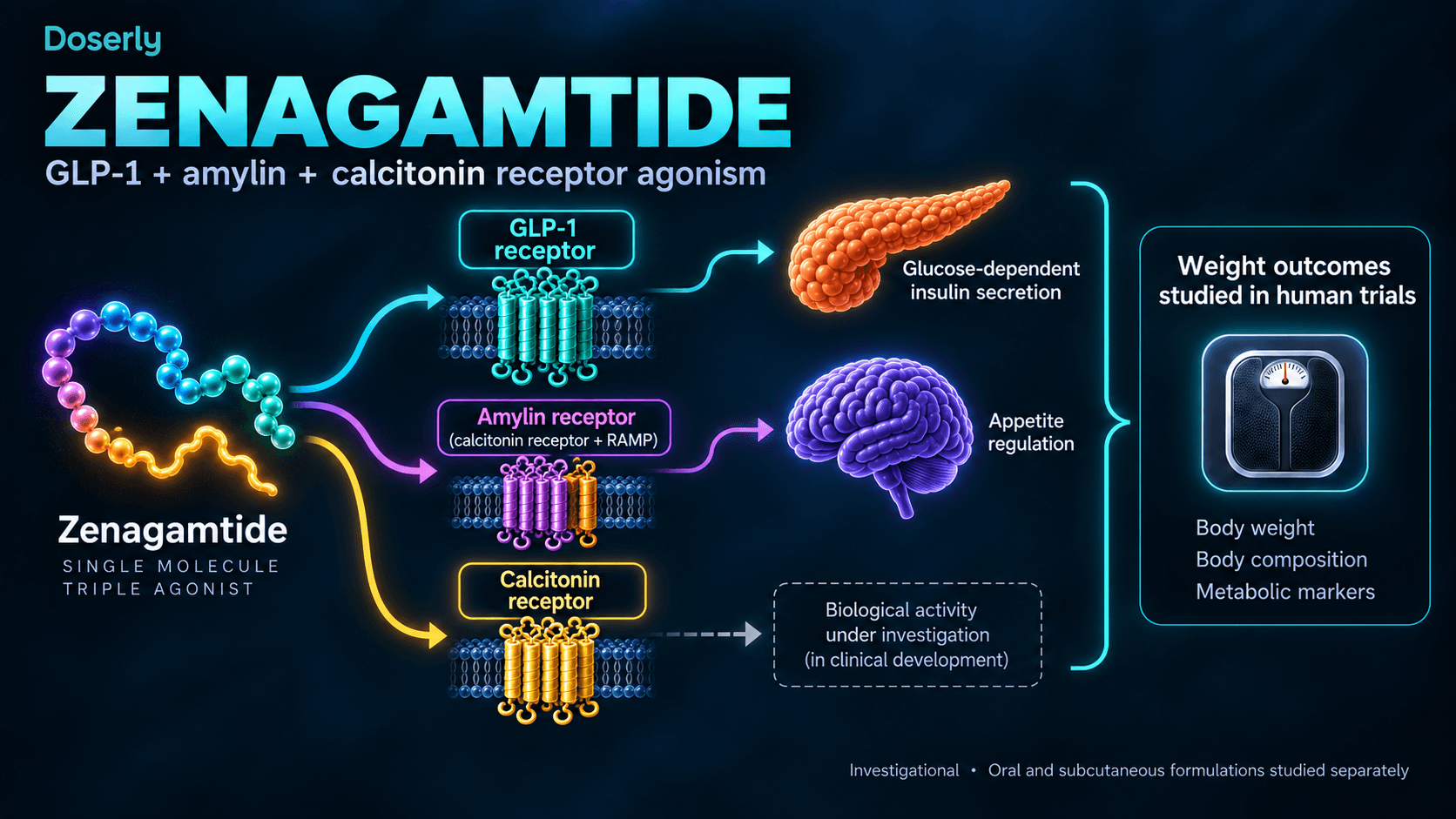
Schematic illustration; receptor shapes are symbolic. The mechanism does not establish a dose or predict an individual outcome.
Human evidence carries the guide. The subcutaneous phase 2 type 2 diabetes trial randomized 262 adults and tested six weekly maintenance doses for 36 weeks. HbA1c changes were statistically significant across all doses versus placebo, and Novo reported larger weight change at higher doses. Gastrointestinal adverse events were the dominant tolerability signal, and no deaths occurred in the published abstract. [1][2]
The oral phase 1 and phase 2 work matters because it shows the same program is not purely injectable. Oral zenagamtide doses are much higher in milligram terms because route, absorption and formulation differ. A 50 mg oral maintenance dose cannot be compared directly with a 40 mg weekly injection. [5][6]
Preclinical findings can explain why the molecule attracted development interest, but they cannot rank zenagamtide against semaglutide, tirzepatide or cagrilintide in humans. Animal feeding preference, liver-fat models and receptor assays remain hypothesis-building until matched clinical endpoints are reported.
Research and clinical evidence
Type 2 diabetes phase 2 data
The weekly subcutaneous phase 2 trial enrolled adults aged 18 to 75 with type 2 diabetes, HbA1c 7.0% to 10.0%, BMI 23 to less than 50 kg/m2, and background metformin with or without an SGLT2 inhibitor. Participants were assigned to zenagamtide or matched placebo, then to one of six dose schedules. At week 36, HbA1c reductions ranged from 0.9 percentage points at 0.4 mg to 1.7 percentage points at 40 mg. [1]
Novo's ADA 2026 release adds body-weight context from the same program: weight loss reached 14.6% at week 36 in the 40 mg group compared with 2.1% on placebo. The release also says the higher maintenance doses had only brief exposure at target dose by week 36, which limits interpretation of plateau and durability. [2]
The oral phase 2 abstract describes 186 randomized participants in 6, 25 and 50 mg daily maintenance groups, with a 1.5 mg daily start and 4-week escalation. This oral study supports a parallel oral development track but does not create a once-weekly injection schedule. [5]
Obesity and weight-management program
The earlier SC trial enrolled 125 adults. Its primary endpoint was treatment-emergent adverse events, with weight change a secondary endpoint. Substantial withdrawal limits interpretation of the large weight changes. It supports further research, not direct superiority claims against another drug. [9]
Novo announced in June 2025 that both oral and subcutaneous amycretin would advance into phase 3 weight-management development after regulatory feedback. By June 2026, ClinicalTrials.gov listed AMAZE 7, a phase 3 trial comparing weekly subcutaneous zenagamtide with semaglutide in participants with obesity. The registry gives a primary weight-change endpoint through week 84, enrollment of 650 and estimated completion in October 2028. [3][4]
In the registry record checked on September 12, 2026, AMAZE 7 was not yet recruiting and had an estimated September 22, 2026 start. No phase 3 outcome data should be assumed from that record.
Safety and tolerability
The tolerability pattern resembles other incretin and amylin-based therapies: nausea and other gastrointestinal events are central. In the subcutaneous phase 2 abstract, most adverse events were gastrointestinal and mild to moderate. Serious adverse events occurred in both zenagamtide and placebo groups, with no deaths reported. [1]
The first-in-human oral amycretin study reported dose-dependent treatment-emergent adverse events, most commonly gastrointestinal events, and no deaths. The trial enrolled adults with overweight or obesity, not a broad real-world population with advanced comorbidities. [6]
Safety gaps remain large. Public evidence does not establish long-term gallbladder, pancreatitis, cardiovascular, psychiatric, pregnancy or rare-event risk. Trial materials differ from online research-market products, and no certificate of analysis can make an online product equivalent to sponsor-manufactured trial drug.
Administration and tracking
Trial protocols preserve five facts together: route, formulation, dose amount, escalation interval and population. Dropping any one of those turns a source dose into a misleading general claim. Zenagamtide is especially easy to misread because oral daily doses and weekly subcutaneous doses are both public.
Doserly can organize a documented clinician-directed plan, reminders, symptoms and outcomes. The app does not determine whether zenagamtide is appropriate or whether an investigational compound should be used.
What to monitor in the evidence
The next meaningful updates are phase 3 obesity dose details, full oral phase 2 data tables, and longer follow-up on diabetes and weight outcomes. Published phase 3 outcomes will matter more than conference or investor-language comparisons. Claims that zenagamtide is already superior to semaglutide or tirzepatide require direct comparative data from matched designs.
Frequently asked questions
Is zenagamtide the same as amycretin?
Yes. Zenagamtide is the newer name used for the compound formerly called amycretin. Older studies and company disclosures may still use amycretin. [4][6]
Is zenagamtide FDA-approved?
No. No FDA-approved zenagamtide product or dosing label was identified on September 12, 2026. Public records describe an investigational development program. [3][4]
What dose has been studied?
The weekly subcutaneous type 2 diabetes phase 2 trial studied 0.4 to 40 mg once weekly after escalation from 0.2 mg. Oral studies used daily milligram ranges that are not interchangeable with weekly injection ranges. [1][5][6]
Why do web pages cite different amounts?
Some pages appear to combine older amycretin, oral, subcutaneous and obesity-development numbers. The source, route and population have to stay attached to the amount. A vial-based calculator is not a clinical trial protocol.
Does the calcitonin receptor mention change the guide?
Amylin receptors and calcitonin receptors are biologically related. The trial abstracts explicitly include calcitonin receptor agonism, but this does not establish an approved calcitonin-related indication. [1][5]
Sources & References
[1] Mora et al. Efficacy and safety of once-weekly subcutaneous zenagamtide in type 2 diabetes. The Lancet, 2026. DOI: 10.1016/S0140-6736(26)01248-1.
[2] Novo Nordisk. Zenagamtide ADA 2026 phase 2 subcutaneous results. June 6, 2026.
[3] ClinicalTrials.gov. AMAZE 7, NCT07668414.
[4] Novo Nordisk SEC filing. Novo Nordisk to advance subcutaneous and oral amycretin into phase 3. June 12, 2025.
[5] Mora et al. Efficacy and safety of once-daily oral zenagamtide in type 2 diabetes. The Lancet, 2026. DOI: 10.1016/S0140-6736(26)01247-X.
[6] Gasiorek et al. First-in-human amycretin phase 1 trial. The Lancet, 2025. DOI: 10.1016/S0140-6736(25)01176-6.
[7] Novo Nordisk. ADA 2026 cardiometabolic pipeline announcement. May 27, 2026.
[8] PeptideDosage.org. Amycretin dosage chart. Popular dosing page reviewed September 12, 2026; included for attribution, not clinical authority.
[9] Dahl K, et al. Subcutaneous amycretin phase 1b/2a randomized trial. The Lancet. 2025;406:149–162. DOI: 10.1016/S0140-6736(25)01185-7.
[10] PeptideRank. Amycretin: what the evidence shows. Popular evidence guide, accessed September 12, 2026.
Related peptide guides
- Cagrilintide: long-acting amylin analog context.
- Semaglutide: GLP-1 receptor agonist comparator background.
- Tirzepatide: dual GIP/GLP-1 comparator background.
- Retatrutide: multi-receptor investigational incretin program.
- GLP-1 weight-management guide: category-level evidence comparison.