
Petrelintide: Dose References, ZUPREME Data & Safety
On this page
Quick Reference Card
Attribute
Identity
Attribute
Sponsor / partner
Attribute
Route studied
Attribute
Regulatory status
Attribute
Development status
Attribute
Evidence boundary
Quick dose reference
Petrelintide is investigational. Public dose labels are incomplete, so this summary uses the clearest cited repeated-dose target. Any dosing protocol should be reviewed with a qualified healthcare practitioner.
Investigational petrelintide injected under the skin (subcutaneous)
Based on clinical study details
Phase 1 repeated 9.0 mg target
- Amount studied
- 9.0 mg
- Frequency
- Once weekly
- Duration
- 16 weekly doses
- Dose adjustment
- 1.0 mg start for 9.0 mg cohort; escalated every 2 weeks to target
- Reported range & limits
- Repeated-dose cohorts included 0.6/1.2 mg and 2.4/4.8/9.0 mg targets. Minimum effective dose and safe upper limit are not established.
Evidence and range contextReview the full source references below.
Phase 1 repeated 9.0 mg target
This is the clearest published repeated-dose milligram scenario.
Other published repeated-dose cohorts used 0.6/1.2 mg for 6 weeks or 2.4/4.8 mg targets; ZUPREME-1 public releases did not disclose all exact dose labels.
Full Dosing Reference SourcesClinical research, registered studies and online dosing sources, with their context and limitations.
Do not invent ZUPREME-1 milligram levels from public releases that only state dose levels and escalation design.
Phase 1 single ascending dose trial
Single subcutaneous doses 0.04, 0.08, 0.16, 0.35, 0.7, 1.4 or 2.4 mg; one additional 0.35 mg intravenous cohort.
- Route / formulation
- Petrelintide investigational product
- What this does and does not show
- Early safety and PK dose escalation in normal-weight or overweight adults. It does not represent weight-management treatment dosing.
Phase 1 multiple ascending dose, part 1
0.6 or 1.2 mg once weekly for 6 weeks without dose escalation.
- Route / formulation
- Subcutaneous investigational petrelintide
- What this does and does not show
- Short repeated-dose exposure; useful for tolerability and PK, not long-term efficacy.
- Sources
- Olsen et al., PubMed
Phase 1 multiple ascending dose, part 2
16 once-weekly doses, escalated every 2 weeks to target doses of 2.4, 4.8 or 9.0 mg. Starting doses were 0.6 mg for the 2.4 and 4.8 mg cohorts and 1.0 mg for the 9.0 mg cohort.
- Route / formulation
- Subcutaneous investigational petrelintide
- What this does and does not show
- Shows the published milligram range that produced up to 8.6% mean weight loss after 16 weeks. It used 2-week escalation, which differs from ZUPREME-1.
- Sources
- Olsen et al., PubMed; PMC full text
ZUPREME-1 phase 2 obesity trial
Five once-weekly petrelintide dose levels versus placebo; dose escalation every 4 weeks for up to 16 weeks, then maintenance through week 42. Exact public milligram labels were not identified in opened primary materials.
- Route / formulation
- Subcutaneous investigational petrelintide
- What this does and does not show
- Shows larger phase 2 dose-finding design and topline results: up to 10.7% mean weight loss at week 42 versus 1.7% placebo. It does not disclose a complete dose ladder in the public release.
ZUPREME-2 phase 2 trial in obesity/overweight with type 2 diabetes
The registry lists three dose groups, each with matching placebo, using weekly subcutaneous injections; milligram targets are undisclosed.
- Route / formulation
- Subcutaneous investigational petrelintide
- What this does and does not show
- Completed August 13, 2026, according to the September 9 registry update. No results are posted in the checked record; completion does not establish an efficacy result.
Popular dosing interpretation
PeptIQ summarizes public ZUPREME-1 dosing as weekly subcutaneous petrelintide, five dose arms and escalation about every 4 weeks, while warning that exact milligram labels remain partially masked.
- Route / formulation
- Popular educational guide
- What this does and does not show
- Useful because it refuses to invent missing milligrams. It is not a clinical authority and does not add a dose beyond primary sources.
- Sources
- PeptIQ, August 2, 2026
Eleven meaningful petrelintide sources were included after deduplicating the PubMed/PMC mirror of the same phase 1 article. Phase 1 milligram targets are public; ZUPREME-1/2 phase 2 records report weekly subcutaneous design but mask exact active milligram arms.
Applicable product labels and human studies carry the most weight. A registry entry does not establish study results. Animal studies, public guides and forums add context; they do not establish a safe human dose limit.
Official product and regulatory sources
- Roche announces positive Phase II results for petrelintide
Roche · 2026-03-05
Sponsor release reports ZUPREME-1 once-weekly subcutaneous dosing, escalation every fourth week, five active arms and up to 10.7% weight loss at week 42.
- Zealand Pharma ZUPREME-1 ADA 2026 data update
Zealand Pharma · 2026-06-05
ADA update reports 485 adults randomized 5:1 to five weekly subcutaneous petrelintide doses or placebo.
- Petrelintide pipeline page
Zealand Pharma · Background context
Pipeline page confirms investigational long-acting amylin analogue status and development partnership context.
Human clinical research
- Safety, tolerability, pharmacokinetics, and pharmacodynamics of petrelintide for weight management
Diabetes, Obesity and Metabolism · 2026
Full text reports single subcutaneous 0.04–2.4 mg and intravenous 0.35 mg; repeated weekly subcutaneous 0.6/1.2 mg and targets 2.4, 4.8, 9.0 mg.
Registered clinical trials
- ZUPREME-1: Once-weekly petrelintide versus placebo
ClinicalTrials.gov · 2026 · Background context
Registry confirms completed phase 2 ZUPREME-1 trial; public registry masks the five active milligram dose levels.
- ZUPREME 2: petrelintide in overweight/obesity and type 2 diabetes
ClinicalTrials.gov · 2026 · Background context
Registry describes three once-weekly subcutaneous petrelintide doses versus placebo in participants with overweight/obesity and type 2 diabetes.
Published evidence reviews
- Long-acting amylin-related peptides as therapies for obesity and type 2 diabetes
PubMed-indexed review · 2026 · Abstract reviewed · Background context
Review places petrelintide among long-acting amylin agents advancing in obesity development.
- Beyond GLP-1: Amylin-based pharmacotherapy and better-tolerated weight-loss drugs
PubMed-indexed review · 2026 · Abstract reviewed · Background context
Review discusses receptor selectivity and tolerability considerations for petrelintide and other amylin agents.
Animal and laboratory research
- Development of Petrelintide: a Potent, Stable, Long-Acting Human Amylin Analogue
Journal of Medicinal Chemistry / PubMed · 2025 · Abstract reviewed · Background context
Development paper supports compound identity and long-acting amylin design; it is not a human dose protocol.
Public dosing guides and calculators
- Petrelintide dosing guide
PeptIQ · 2026-08-02 · Background context
Public guide avoids inventing hidden ZUPREME-1 milligram arms and summarizes weekly subcutaneous escalation every 4 weeks.
- Petrelintide dosage chart and reconstitution protocol
PeptideDosage.org · 2026-06-21
Public guide models 0.6 mg initiation with 2.4, 4.8 and 9.0 mg maintenance cohorts, mirroring phase 1 repeated-dose targets.
Contradictions and open gaps
ZUPREME-1 counts differ by context. Roche describes 493 people in the trial, while Zealand's ADA release says 485 adults were randomized. The likely distinction is enrolled versus randomized or analysis population, but the exact reconciliation should wait for the full publication. [3][5]
The most important public dose gap is the ZUPREME-1 milligram table. The study clearly used five once-weekly dose levels with 4-week escalation, but the opened primary sources did not publish the exact amounts for those five arms. Phase 1 targets of 2.4, 4.8 and 9.0 mg should not be silently mapped onto ZUPREME-1 dose groups. [1][3]
What is petrelintide?
Petrelintide is an investigational amylin analog designed for once-weekly subcutaneous use. Amylin is co-secreted with insulin by pancreatic beta cells after nutrient intake and participates in satiety signaling. Petrelintide is positioned as an alternative or partner to GLP-1-based weight-management therapies rather than as another GLP-1 receptor agonist. [2][3]
The compound was designed for potency, chemical stability and physical stability near neutral pH. Zealand describes this as relevant for co-formulation or co-administration with other peptides. That property supports development strategy; it does not prove that unsupervised combinations are safe or effective. [2][6]
Mechanism and evidence balance
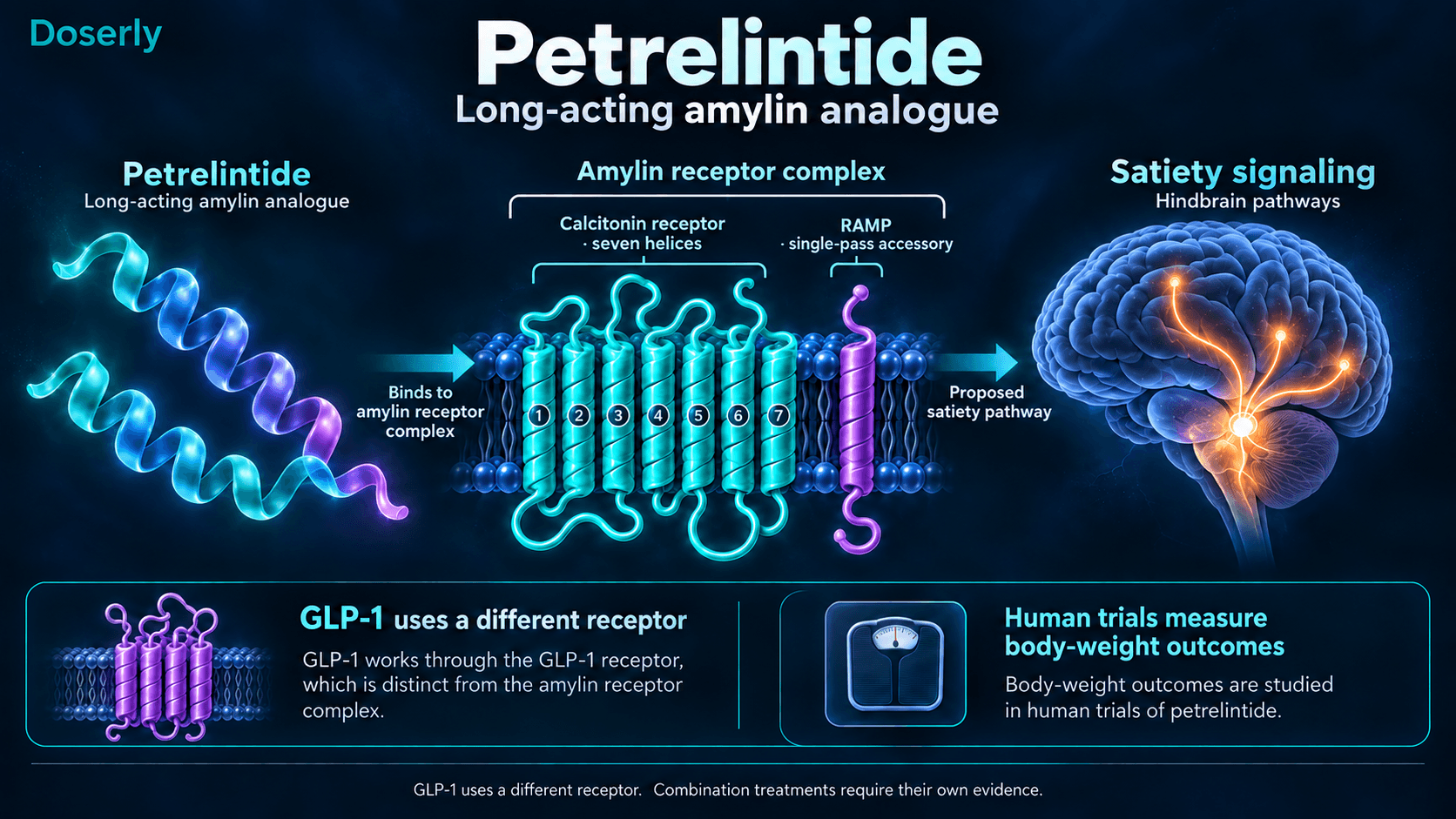
Schematic illustration; receptor shapes are symbolic. The mechanism does not establish a dose or predict an individual outcome.
Petrelintide works through amylin receptor biology, not GLP-1 receptor agonism. Public sponsor materials emphasize satiety and potential leptin-sensitivity effects. The medicinal chemistry publication frames amylin as a physiological satiety signal and describes petrelintide as a stable, long-acting human amylin analog. [2][6]
Human evidence is still early but meaningful: phase 1 dose escalation has been published, and ZUPREME-1 has phase 2 topline and ADA 2026 data. Preclinical and formulation work explains why the molecule can be developed as a weekly peptide and possible combination partner. Claims about lean-mass preservation remain less mature than body-weight and tolerability data; they should not be written as established clinical benefit without body-composition results from completed human trials. [2][5][6]
Research and clinical evidence
Phase 1 published trials
The published phase 1 program included single-dose and multiple-dose trials. In the multiple ascending-dose part that most resembles weight-management development, once-weekly injections were escalated to 2.4, 4.8 and 9.0 mg targets over 16 weeks. Petrelintide was slowly absorbed, had an approximate 10-day half-life, showed dose-proportional steady-state exposure, and produced up to 8.6% body-weight reduction after 16 weeks. [1]
Tolerability in phase 1 was notable because gastrointestinal events were generally mild. In the 16-week higher-dose part, nausea occurred in 16.7% to 33.3% of petrelintide participants versus 16.7% with placebo, diarrhea was rare, and vomiting occurred only in the participant who discontinued due to GI events. These numbers came from small cohorts and should not be generalized as final safety rates. [1]
ZUPREME-1 obesity trial
ZUPREME-1 was a randomized, double-blind, placebo-controlled phase 2 dose-finding trial in people with obesity or overweight with weight-related comorbidities. Roche described 493 participants, mean BMI around 37 kg/m2, and a gender-balanced trial population. Zealand's June 2026 ADA release described 485 randomized adults, 53% female, mean age 47 years, BMI 36.7 kg/m2 and body weight 107.1 kg. [3][5]
The study compared five once-weekly petrelintide dose levels with placebo, added to reduced-calorie diet and increased physical activity. The primary endpoint was percent change in body weight at week 28. Weight change continued through week 42, reaching up to 10.7% mean loss with petrelintide versus 1.7% with placebo by the efficacy estimand. [3][5]
The tolerability signal was central to the sponsor narrative. Zealand reported that 88% to 98% of participants successfully escalated to their targeted maintenance dose, most GI events were mild, nausea occurred in 19.6% on petrelintide versus 6.2% on placebo, vomiting was 3.0% versus 6.2%, and discontinuation due to GI adverse events was 1.5% with petrelintide. Roche reported no vomiting and no GI-related discontinuations in the maximally effective arm. These statements are sponsor communications until the full dataset is published. [3][5]
Development status
Zealand's pipeline page states that petrelintide will advance into phase 3 clinical trials for chronic weight management, with initiation planned in the second half of 2026. The same page lists ZUPREME-2 as the phase 2 trial in overweight or obesity with type 2 diabetes, with topline results expected in the second half of 2026. [2]
Roche and Zealand also plan combination development with CT-388, Roche's incretin asset. Combination rationale does not establish safety for unofficial stacking. It only shows the sponsor's controlled clinical-development direction. [2][3]
ZUPREME-2 was marked completed on August 13, 2026 in the registry update posted September 9. The checked record has no posted results and still masks the three milligram targets. [8]
Safety and tolerability
Public materials emphasize a favorable gastrointestinal profile compared with expectations for some incretin therapies, but petrelintide remains investigational. Phase 1 cohorts were small, ZUPREME-1 is not yet fully published, and rare adverse events require larger and longer exposure.
Known tolerability topics to track include nausea, vomiting, diarrhea, constipation, early fullness, reduced intake, dehydration risk during appetite suppression, gallbladder events and treatment discontinuation. The available evidence does not establish safety in pregnancy, eating disorders, advanced gastrointestinal disease, severe renal or hepatic impairment, or combinations with GLP-1/GIP/GLP-1-glucagon agonists outside trials.
Administration and tracking
The public phase 1 schedule and ZUPREME-1 schedule differ. Phase 1 part 2 escalated every 2 weeks to 2.4, 4.8 or 9.0 mg targets. ZUPREME-1 escalated every 4 weeks and used five masked dose levels. A protocol record should keep the schedule, route, formulation and population attached to the dose number.
Doserly can track injection day, titration holds, nausea, fullness, weight trend, waist trend, protein intake, activity and adverse symptoms. Tracking creates an organized record; it does not validate petrelintide use or determine an appropriate dose.
What to monitor in the evidence
The next high-value source is the full ZUPREME-1 publication or congress table with dose-by-dose milligram labels, efficacy by arm and body-composition findings. ZUPREME-2 results will show whether the profile changes in people with type 2 diabetes. Phase 3 registry records should clarify dose selection and target population.
Frequently asked questions
Is petrelintide a GLP-1 drug?
No. Petrelintide is an amylin analog. It may affect satiety and weight, but it is not a GLP-1 receptor agonist. [2][6]
Is petrelintide approved?
No. Petrelintide is investigational and has not been approved for marketing by a regulatory authority in the sources reviewed. [2]
What dose of petrelintide has been studied?
Published phase 1 data include single subcutaneous doses up to 2.4 mg and weekly repeated-dose targets up to 9.0 mg. ZUPREME-1 used five weekly dose levels with 4-week escalation, but public materials opened for this review did not disclose the complete milligram table. [1][3][5]
Does ZUPREME-1 prove petrelintide is better tolerated than GLP-1 drugs?
No direct broad conclusion is established. ZUPREME-1 sponsor communications report low GI discontinuation and favorable tolerability versus placebo, but comparisons with GLP-1 drugs require matched head-to-head data or careful cross-trial framing. [3][5]
Can petrelintide be combined with incretin drugs?
Sponsors are planning controlled combination studies, including with CT-388. That is different from unmonitored stacking. Safety, dose selection and sequencing need trial evidence. [2][3]
Sources & References
[1] Olsen et al. Safety, tolerability, pharmacokinetics, and pharmacodynamics of petrelintide for weight management. Diabetes, Obesity and Metabolism, 2026. DOI: 10.1111/dom.70753.
[2] Zealand Pharma. Petrelintide pipeline page. Reviewed September 12, 2026.
[3] Roche. Positive Phase II results for petrelintide, ZUPREME-1. March 5, 2026.
[4] ClinicalTrials.gov. ZUPREME-1, NCT06662539.
[5] Zealand Pharma. New data from Phase 2 ZUPREME-1 at ADA 2026. June 5, 2026.
[6] Munch et al. Development of petrelintide: a potent, stable, long-acting human amylin analogue. Journal of Medicinal Chemistry, 2025. DOI: 10.1021/acs.jmedchem.5c01185.
[7] PeptIQ. Petrelintide dosing guide. Popular educational guide, August 2, 2026; included for attribution and missing-dose caution, not clinical authority.
[8] ClinicalTrials.gov. ZUPREME-2, NCT06926842. Registry update September 9, 2026.
Related peptide guides
- Cagrilintide: another long-acting amylin analog program.
- Zenagamtide: GLP-1/amylin unimolecular program.
- Semaglutide: GLP-1 comparator context.
- Tirzepatide: dual GIP/GLP-1 comparator context.
- GLP-1 weight-management guide: category-level comparison.