
In this guide
What is Cortagen?
Cortagen is a very short lab-made peptide, a chain of four amino acids, that people inject hoping to protect the brain, sharpen focus or help injured nerves recover. It has never been tested in people, and it is not an approved medicine anywhere we checked. [1], [2], [3]
The chain is alanine, glutamic acid, aspartic acid and proline, written Ala-Glu-Asp-Pro or AEDP. Its formula is C17H26N4O9 and its molar mass is 430.4 g/mol. [4], [5] It comes from the Russian research group led by Vladimir Khavinson at the St Petersburg Institute of Bioregulation and Gerontology, which calls such short peptides bioregulators and describes Cortagen as a brain-cortex peptide. The group says it built Cortagen from an amino-acid analysis of Cortexin, a Russian prescription medicine extracted from cattle cerebral cortex, the brain's folded outer layer. [6], [7], [8], [9]
Cortagen is not Cortexin. Cortexin is a mixture of many peptides taken from animal brains, sold as 10 mg vials for injection into a muscle. Cortagen is one small synthetic peptide. The developers later wrote that AEDP was found in Cortexin, but we found no independent analysis showing it, and Cortexin's label, doses and patient uses do not transfer to Cortagen. In a 2022 chapter, the developers still describe their Cortagen work as groundwork for creating a medicine. [9], [10]
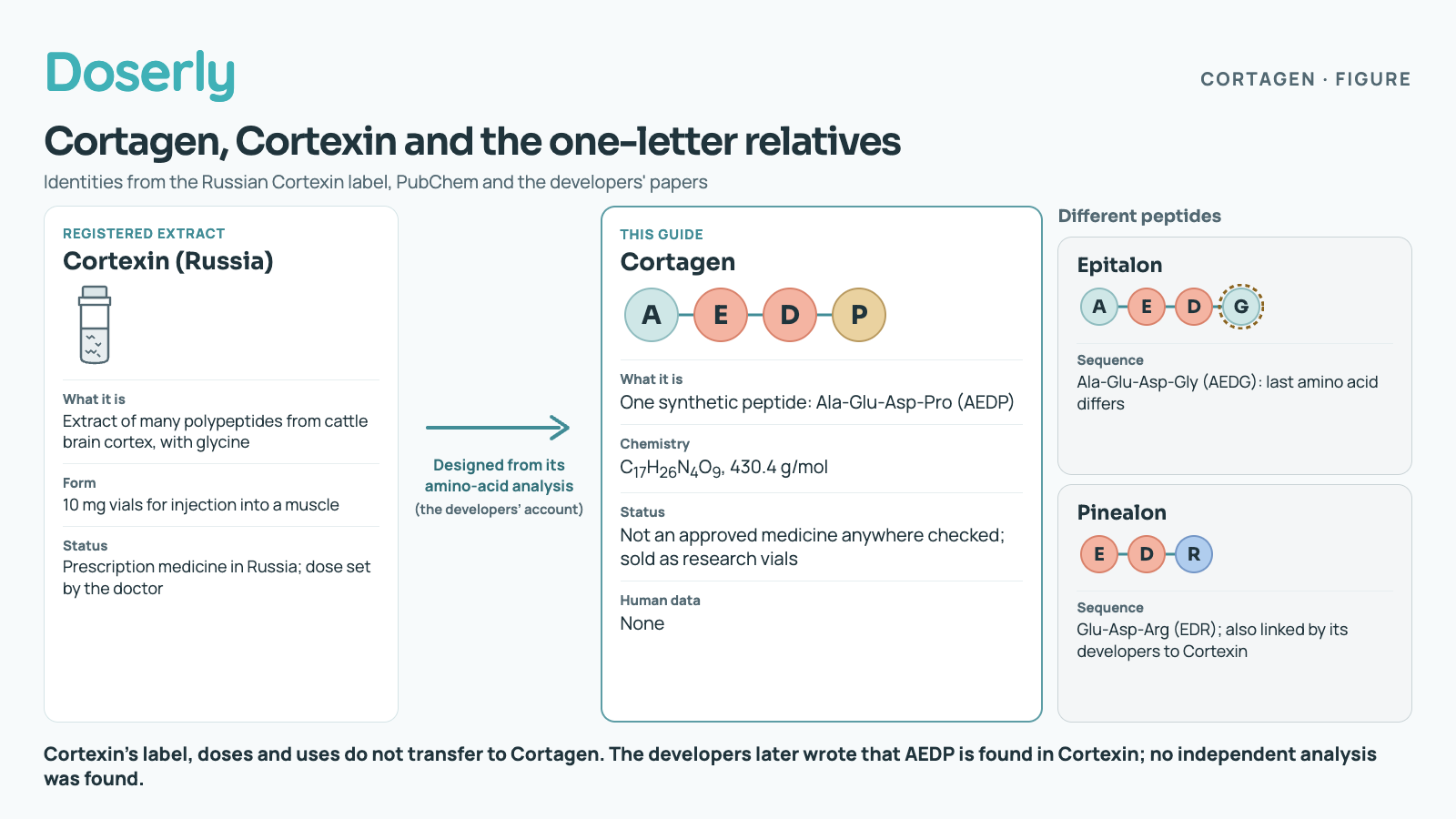
Cortagen, Cortexin and the one-letter relatives
Identities from the Russian Cortexin label, PubChem and the developers' papers
- Cortexin (Russia) · registered extract
- What it is: Extract of many polypeptides from cattle brain cortex, with glycineForm: 10 mg vials for injection into a muscleStatus: Prescription medicine in Russia; dose set by the doctor
↓ designed from its amino-acid analysis (developers)
- Cortagen · this guide
- What it is: One synthetic peptide: Ala-Glu-Asp-Pro (AEDP)Chemistry: C17H26N4O9, 430.4 g/molStatus: Not an approved medicine anywhere checked; sold as research vialsHuman data: None
Different peptides
- Epitalon
- Sequence: Ala-Glu-Asp-Gly (AEDG): last amino acid differs
- Pinealon
- Sequence: Glu-Asp-Arg (EDR); also linked by its developers to Cortexin
Cortexin's label, doses and uses do not transfer to Cortagen. The developers later wrote that AEDP is found in Cortexin; no independent analysis was found.
The name is spelled several ways: cortagene, kortagen, Korthagen and, in Russian, Кортаген. [11], [12], [13] Its close relatives are easy to mix up. Epitalon is Ala-Glu-Asp-Gly and differs from Cortagen only in its last amino acid; Pinealon is Glu-Asp-Arg, a peptide the same group also links to Cortexin; and oleoyl-Cortagen is a version with a fatty acid attached that was tested separately. [11], [14], [15] Some affiliate posts describe a “Cortagen” bioregulator for the adrenal cortex, and similar spellings such as “Cortogen” are used for adrenal products; that is not what the research on Ala-Glu-Asp-Pro is about. [16] In community education groups, one guide gives Cortagen's sequence to Cartalax, a different peptide.
Typical Cortagen Protocols
| Example | Amount each time | Frequency | Total per day | Duration |
|---|---|---|---|---|
| Low | 200–400 mcg | Once daily | 200–400 mcg | 10–20 days, 2–3 times a year Microgram “bioregulator” course from a guide site, copied word for word on a second site [17], [20] |
| Mid | 1 mg (1,000 mcg) in weeks 1–2, then 2 mg in weeks 3–4 | Once daily | 1–2 mg | 4 weeks The 20 mg vial chart repeated on several dosing pages [18] |
| High | 2–10 mg | Once daily | 2–10 mg | 10–20 days A seller's page with no source; its own dosing chart lists 1 mg, 2 mg and a 5 mg “blast” amount [19] |
The most common protocol in the reviewed sources is 1–2 mg once a day by subcutaneous injection, often as 1 mg for two weeks and then 2 mg for two weeks. Of 39 dosing pages we compared, 13 share one template built around a 20 mg vial, and most of them give 1–2 mg a day; five print the same two-step, four-week chart almost word for word. The rest split between microgram courses (100–500 mcg a day), capsule claims of 10–20 mg by mouth, and a 10 mg injection course borrowed from Cortexin. [18], [21], [22], [23], [24], [25], [26]
- Titration Changing the amount in steps
- The copied mid-row chart starts at 1 mg for two weeks and doubles to 2 mg for weeks 3–4; one version allows the course to run to 8 weeks. Most other pages use one fixed amount. No study supports either approach. [18], [21], [25]
- Breaks and cycles
- Most pages describe a 10–20-day course repeated 2–3 times a year, or a 20-day course followed by 4–6 months off. One guide-style post runs 1–2 mg a day for 4–8 weeks. No page describes continuous use, and no study has tested any course length or repeat interval. [17], [27], [28], [29]
Read the units: mcg means micrograms; 1 mg equals 1,000 mcg. The low row's 200 mcg is 0.2 mg, and the high row's 10 mg is 10,000 mcg, a 50-fold spread between rows. Across all the pages, amounts per dose run from 10 mcg to 30 mg, a 3,000-fold spread. A course total is the daily total times the number of days: the mid-row chart adds up to 42 mg over 28 days, more than two 20 mg vials. [31], [32], [18]
Each row is a complete schedule from one source, so its amount and duration belong together. Low, mid and high are alternatives, not steps to move through. These schedules come from protocol websites rather than studies; no study has given Cortagen to people at any amount, and the cited references give the full details.
Cautions for every schedule above:
- No human data at all. We found no trial, case report or safety study in people, so every amount above is untested. The only doses in studies were given to rats and mice (see below), and a dose per kilogram in a rat is not a human dose. [1], [6]
- Not the Cortexin course. “10 mg a day into a muscle for 10 days” describes Cortexin, a different, animal-derived product, not Cortagen. The high row's 10 mg top equals one Cortexin vial, and the same 2–10 mg range appears on other pages as an untraced “Russian clinical” course, so that upper end may be carried over from Cortexin. [33], [34], [17]
- Reported problems. One person described sleeping “all night and half the day” during a first course of 4 mg a day, and another stopped after a few doses because of chest discomfort. Neither report can show that Cortagen was the cause, but chest pain or pressure is a reason to get medical help promptly. [35], [36]
- Mood effects are uncertain. In one rat study it looked depressant-like, and in another, after reduced brain blood flow, antidepressant-like. Do not stop or change prescribed treatment for depression or anxiety to try it. [15], [37]
- Brain injury, stroke and nerve damage need medical care. Cortagen has never been tested as a treatment for any of them in people. [1]
- Pregnancy, breastfeeding and under-18s. Not studied. Even Cortexin's label rules out use in pregnancy because it lacks clinical data. [9]
- Product and unit errors. Health Canada has named Cortagen among seized unauthorized injectable peptides, no public test confirms what any vial contains, and micrograms and milligrams differ 1,000-fold, so check every amount with the reconstitution calculator. [38]
Full risks, legal status and who should be cautious ↓
What doses were used in animal studies?
| Study | Amount each time | How it was given | Frequency | Duration |
|---|---|---|---|---|
| Rats with a cut sciatic nerve (2000) | 10 mcg per kg | Intramuscular (into a muscle) | Once daily from the day of surgery | 10 days 25 rats; faster nerve regrowth at 4 weeks [6] |
| Mice, heart gene activity (2004) | 0.1 mcg per mouse | Subcutaneous | Once daily | 5 days Gene activity only, no health outcome [7] |
| Rats with reduced blood flow to the brain (2016) | 0.25 mg per kg | Intraperitoneal (into the belly cavity) | Once daily | 7 days More rats survived; groups stated as 10, but how survival was calculated is unclear [39] |
| Rats, behaviour tests (2008–2009) | 1 mg per kg | Intraperitoneal | Once, 30–40 minutes before testing | Single dose Depressant-like in a swim test; anxiety results differ between reports [15], [40] |
| Rats, behaviour tests (2008) | 1, 10 or 100 mcg per rat | Into the brain's fluid spaces | Once | Single dose Less anxiety-like behaviour, most at the lowest amount [40] |
These are the only doses given to living animals whose amounts were reported. They are not human doses: an amount per kilogram in a rat cannot simply be multiplied by a person's weight, and no study has worked out a human equivalent. Websites have tried anyway, with opposite results. One turns the rat's 10 mcg per kg into about 0.7 mg a day for a 70 kg adult, while another copies it as a flat 10 mcg, a 70-fold difference from the same study. [41], [31]
What about capsules, nasal sprays and the “10 mg for 10 days” course?
Capsules. Five pages describe Cortagen capsules at 10–20 mg by mouth a day for 10–20 days, 2–3 times a year, and one says each capsule holds about 20 mg of peptide. We found no label, registration or test of any oral Cortagen product, and no study has given it by mouth. Community posts say oral and under-the-tongue products are sold. [42], [43], [44], [45], [46]
Nasal sprays. Some people ask about nasal use, and posts describe a homemade spray of eight bioregulators with about 40 mcg of Cortagen per spray and a seller's blend with about 1.2 mg per spray. No study has measured whether Cortagen is absorbed through the nose. A homemade spray is not a sterile product, the amount per spray depends entirely on the mixing arithmetic, and nothing is known about nose irritation (see product quality). [47], [48], [49]
The 10 mg course. Four pages give 10 mg once a day for 10 days, mostly into a muscle, some calling it a “Russian clinical protocol”. One database describes exactly that as the standard course of Cortexin, which comes in 10 mg vials for injection into a muscle, and no Cortagen study used it. One of the pages cites a 2003 study of 89 older adults given this course; we could not find it in PubMed, Europe PMC, Russian journal libraries or the developer's publication list. [34], [50], [51], [52], [33], [9]
In community education groups, the doses taught disagree by up to 20-fold and none cites a Cortagen study. One lesson uses the same four-week chart of 1 mg and then 2 mg; one educator repeatedly suggests 100–200 mcg a day for 20–30 days, once describing it as taken by mouth; and another group gives “2–5 mg” per course without saying whether that is a daily or a total amount. The members who mention buying Cortagen describe 20 mg vials.
Where protocols differ: units, course length, Cortexin and stacks ↓
Where these numbers come from
The low row comes from The Peptide Toolkit (reference [17]): 200–400 mcg by subcutaneous injection daily for 10–20 days, repeated 2–3 times a year. Optimal Health Manifesto prints the same table (reference [20]). The mid row is PeptiJournal's chart (reference [18]): 1,000 mcg (15 units) daily in weeks 1–2, then 2,000 mcg (30 units) in weeks 3–4, for a 20 mg vial mixed with 3 mL. The high row comes from the seller Flex Pharma (reference [19]): 2–10 mg once daily for a 10–20-day cycle, the same range for men and women; its own dosing chart lists 1 mg, 2 mg and a 5 mg “blast” amount it does not explain. Row-specific caveat: the 10 mg top equals one Cortexin vial, and the same 2–10 mg range appears on two guide pages as an untraced “Russian clinical” course into a muscle (references [17], [20]), so the upper end may be carried over from Cortexin rather than chosen for Cortagen. The Russian seller STbio gives 2–10 mg by subcutaneous injection a day for 10 days (reference [53]); it is a cross-check of the range only, and its shorter course is not part of the row.
The two-step chart also appears on PepGuide, Peptides.ID, Research Stacks and Atlas Prep, and PeptideDosages, Bioalmanac, PeptidWiki and Merit Verified give 1–2 mg a day (references [21], [22], [23], [24], [25], [26], [28], [54]). These pages share a template, so they are not independent confirmations. Microgram pages range from 100 to 650 mcg a day (references [55], [56], [57], [58], [27], [59]).
Excluded from the typical comparison: the rat dose copied as a flat 10 mcg or scaled to about 0.7 mg by body weight; oral capsule figures of 10–20 mg, because no oral product could be identified; the 10 mg injection course, because it describes Cortexin; a page of 0.02–0.04 mg per kg that talks about “skin results”, apparently copied from another compound; and one calculator page's 10–30 mg per dose. (References [31], [41], [42], [34], [60], [32].) Minimum and maximum amounts describe the pages we sampled, not safe or effective limits.
What is Cortagen commonly used for?
People who try Cortagen mostly want a sharper, better-protected brain: clearer thinking, better memory, less “brain fog” and help with brain aging. A second group uses it for nerve injuries, such as neuropathy (damaged nerves causing numbness, tingling or pain) and sciatica. Others try it after concussion or head injury, or for low mood and stress. [61], [62], [63], [64], [65]
None of these uses has been tested in people. The developers' research is on nerve tissue in rats, rat brain tissue in dishes and rats with reduced blood flow to the brain; everything below describes what was measured in those models and does not show that Cortagen treats or prevents any condition. In community education groups, educators mostly present Cortagen as a brain peptide, while members mostly reach for it for nerve repair, usually alongside ARA-290.
Memory, focus and “brain fog”
This is the most common reason people give, and there is no human evidence for it. A developer review says Cortagen improved memory and learning in old rats with induced amnesia (memory loss), but we could not find the underlying experiment to check it. [66] Public accounts range from a subtle calming effect under stress to milder help with brain fog than Cortexin to no change at all (see what people report). [67], [62], [68]
Nerve injury, neuropathy and sciatica
The strongest-looking animal result is here, and it rests on one small study. Rats whose sciatic nerve (the large nerve running down the back of the leg) was cut and sewn back together received Cortagen or salt water into a muscle for 10 days. Four weeks later, the nerves of treated rats conducted signals over a longer regrown stretch and about 40% faster. [6] A follow-up from the same group exists only as a title. [69] No study has tested Cortagen for diabetic or other neuropathy, sciatica or spinal injury, in animals or people. How it might work.
Head injury and stroke recovery
In rats with reduced blood flow to the brain, a model of stroke, more animals survived and fewer had paralysis when given Cortagen for 7 days, in studies by one St Petersburg pharmacology group. [39], [70] A developer review adds that it helped normalize muscle tone and coordination after brain injury in rats. [66] Claims that it was used in patients with head injuries come from mixing it up with Cortexin, which is prescribed for those conditions in Russia (see the human research). [71], [9]
Mood, stress and depression
The rat results point both ways. A single 1 mg per kg injection into the belly cavity made rats spend more time floating still in a forced-swim test, a depressant-like result, while 0.25 mg per kg a day for 7 days in rats with reduced brain blood flow made them swim actively for longer, an antidepressant-like result. [15], [37] The only first-hand mood report we found describes improvement similar to Cortexin that faded after each course, in someone with long-standing depression. [72]
Other uses you may come across
Posts also promote Cortagen as an adrenal “cortisol” regulator or for spinal cord injury, and in community education groups it is described as targeting the lungs or eyes, or as making ARA-290 “up to 40% more effective”. We found no study behind any of these. [16], [73] One commenter who had suggested Cortagen for joints and discs withdrew the idea after checking the research. [74]
Where do Cortagen protocols differ?
Almost every Cortagen number online traces back to one of five starting points: the rat nerve study, a template built around a 20 mg vial, a general “bioregulator” microgram course, capsule pages and the Cortexin course. Knowing which one a page copied explains most of the disagreements.
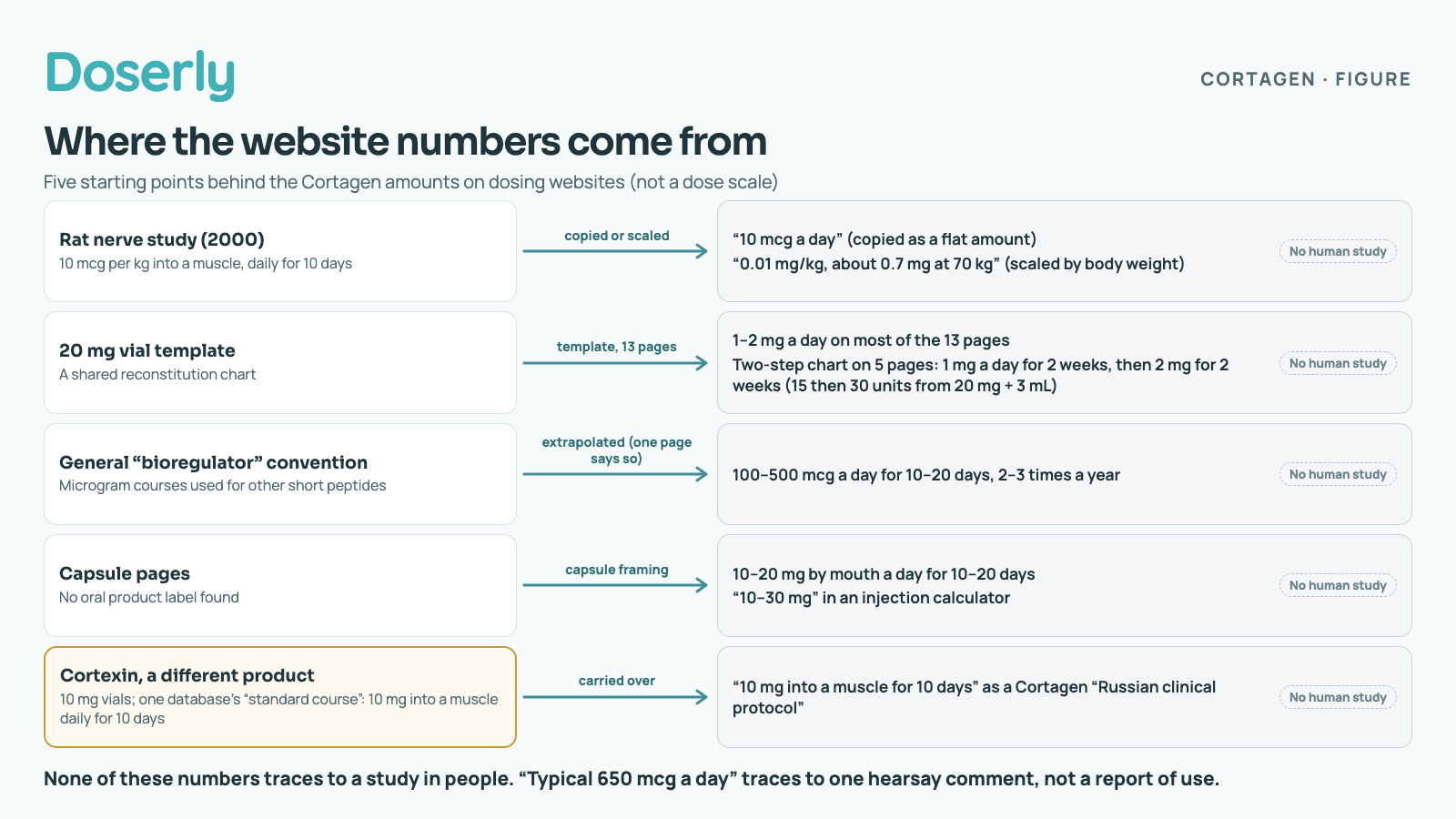
Where the website numbers come from
Five starting points behind the Cortagen amounts on dosing websites (not a dose scale)
- 1. Rat nerve study (2000)
- 10 mcg per kg into a muscle, daily for 10 days↓ copied or scaled“10 mcg a day” (copied as a flat amount)“0.01 mg/kg, about 0.7 mg at 70 kg” (scaled by body weight)No human study
- 2. 20 mg vial template
- A shared reconstitution chart↓ template, 13 pages1–2 mg a day on most of the 13 pagesTwo-step chart on 5 pages: 1 mg a day for 2 weeks, then 2 mg for 2 weeks (15 then 30 units from 20 mg + 3 mL)No human study
- 3. General “bioregulator” convention
- Microgram courses used for other short peptides↓ extrapolated (one page says so)100–500 mcg a day for 10–20 days, 2–3 times a yearNo human study
- 4. Capsule pages
- No oral product label found↓ capsule framing10–20 mg by mouth a day for 10–20 days“10–30 mg” in an injection calculatorNo human study
- 5. Cortexin, a different product
- 10 mg vials; one database’s “standard course”: 10 mg into a muscle daily for 10 days↓ carried over“10 mg into a muscle for 10 days” as a Cortagen “Russian clinical protocol”No human study
None of these numbers traces to a study in people. “Typical 650 mcg a day” traces to one hearsay comment, not a report of use.
Is the number for Cortagen or for Cortexin?
Check this first. Cortexin is sold as 10 mg vials of brain-cortex extract for injection into a muscle, and one database describes its standard course as 10 mg a day for 10 days. Pages that give Cortagen the same “10 mg for 10 days into a muscle” have carried Cortexin's course over to a different substance, sometimes with a study that does not exist. A 2022 Russian review makes the same slip, crediting “the tetrapeptide” with ten years of clinical use that belongs to Cortexin. [9], [33], [50], [71]
Micrograms or milligrams?
The amounts on Cortagen pages span 10 mcg to 30 mg. The low end copies the rat study's 10 mcg per kg as if it were 10 mcg per person; the 100–500 mcg courses come from a general bioregulator convention, which one page admits was extrapolated rather than tested; 1–2 mg comes from the vial template; and 10–30 mg looks like capsule weights moved into an injection calculator. [31], [56], [26], [32] One template page states the problem plainly: the 1–2 mg pattern is described consistently, and consistently without a study behind it. [26]
Where does “650 mcg a day” come from?
One comparison site calls 650 mcg daily the “typical community protocol” and links a single Reddit thread. [59] The only matching comment there says the writer had “heard dosing recommendations anywhere from 650mcg (based on body weight) up to 10mg per day”. That is hearsay about other people's advice, not anyone's report of using it, and another reply in the same thread suggests 200–300 mcg instead. [75], [76]
Is there a “Khavinson protocol” or a “Russian clinical” dose?
Not that we could find. A German page says Khavinson's protocols used 2–5 mg a day, and two English pages list a “Russian clinical” course of 2–10 mg into a muscle for 5–10 days after head injury or stroke; none of these appears in the developers' papers, reviews or patent listings. One evidence-review page says clearly that no human course has been published in a trial. The developers' own experiments used micrograms per kilogram in rats. [28], [17], [20], [77], [6]
Ten days, four weeks or eight?
Pages describe 10 days, 10–20 days, 20 days, a 30-day capsule course, the four-week vial chart, or 4–8 weeks; repeats range from 2–4 times a year to one course every 4–6 months. [26], [56], [27], [44], [18], [29], [55] In community education groups, some members run 30 days about three times a year, following a general bioregulator habit. These are conventions. No study has compared course lengths, and nothing shows that a longer or more frequent course works better.
Injection, capsule or nasal spray?
Most pages and posts describe subcutaneous injection. Pages built on the Cortexin course use injection into a muscle, capsule pages give 10–20 mg by mouth, and some posts describe nasal sprays. [18], [34], [42], [47] The amounts are not interchangeable between routes, and none of the routes has been tested in people (see how route matters).
What about stacks and blends?
Cortagen is rarely taken alone. Public accounts describe it mixed in one morning syringe with Vesugen and Pinealon inside a ten-peptide stack, paired at 500 mcg each with PE-22-28, taken with Epitalon after concussions, or run alongside a Cerebrolysin course or after Cortexin courses. Grey-market blends, including a nasal spray, combine it with Colivelin and humanin; one seller's blend lists about 1.2 mg of Cortagen per spray. [78], [79], [63], [80], [72], [81], [49]
In community education groups, the usual pairing is with ARA-290 for nerve symptoms, and some members run five to ten compounds at once, which one educator warns makes any result impossible to attribute. No study has tested Cortagen in any combination.
How do milligrams convert to syringe units?
Injection pages often give amounts as “units” on an insulin syringe. A U-100 syringe holds 100 units per millilitre, so units measure volume, not an amount of Cortagen. How much Cortagen each unit holds depends on how much water was added to the vial.
For example, a 20 mg vial mixed with 3 mL of water holds about 6.67 mg per mL, so 1 mg is 0.15 mL, or 15 units, and 2 mg is 30 units; this is the example the vial chart uses. From the same vial, a 200 mcg microgram dose would be 3 units, a volume small enough that a small misreading changes the dose a lot. [18], [22] Mistakes happen in practice: a widely copied affiliate post pairs a 20 mg vial mixed with 2 mL with “100mcg daily (10 units)”, but 10 units of that mix hold 1 mg, ten times the stated amount. [16] Doserly's reconstitution calculator works this out for any vial and shows each step.
Source-by-source comparison
The 20 mg vial template (1–2 mg a day)
PeptiJournal, Peptides.ID, PepGuide and Research Stacks: 1,000 mcg daily in weeks 1–2, then 2,000 mcg in weeks 3–4 (15 then 30 units from 20 mg in 3 mL); PepGuide allows extending to 8 weeks. Atlas Prep gives the same two steps, 1 mg a day for two weeks and then 2 mg for two weeks. PeptideDosages and Merit Verified: 1–2 mg a day. Bioalmanac: 1–2 mg daily for a 10-day course, repeated a few times a year, “without a study behind it”. PeptidWiki (German): 1–2 mg a day, often 2 mg, for 10–20 days with 4–6 months off. AnyPeptides: 2 mg (20 units). The Peptide Catalog: about 0.5–2 mg once daily for 10–20 days, described as self-reported. Pacific Peptides (seller): 1,000–2,000 mcg once each morning. Flex Pharma (seller): 2–10 mg a day, with a 5 mg “blast” tier. [18], [22], [21], [23], [24], [25], [54], [26], [28], [82], [83], [30], [19]
Microgram courses
The Peptide Toolkit and Optimal Health Manifesto: 200–400 mcg daily for 10–20 days, 2–3 times a year. PeptideInsight: 100–500 mcg a day for 10–20 days, “extrapolated from general Khavinson peptide conventions”. OnePin: 100 mcg daily for 10–20 days, 2–4 times a year, noting that no study used this route and dose. Research Protocols: 500 mcg once daily for 20 days, then 4–6 months off. PeptideMind: 150 mcg daily for 2 weeks. Peptide Decoding: a 200 mcg calculator default. Ground Truth: 650 mcg daily as a “typical community protocol”. [17], [20], [56], [55], [27], [57], [58], [59]
Rat-based figures
PeptideDosageCharts: “10 mcg once a day for 10 days”, citing the rat study. Dosage Peptide: 0.01 mg per kg a day for about 10 days (0.70 mg at 70 kg). AllOfPeptides: 10 mcg per kg with an invented “95%” bioavailability. Evipedia and BodyHackGuide separate the rat course from human use and say no human dose has been validated. [31], [41], [84], [77], [85]
Capsule and Cortexin-based figures
Peptide Database and PeptideHub: 10–20 mg of oral capsules daily for 10–20 days, 2–3 times a year. PeptScope: 1–2 capsules said to hold about 20 mg each, once or twice daily for 30 days. Peptide Reference: 10–20 mg by mouth or under the tongue, or 1–10 mg by subcutaneous injection. PeptideScams: 5 mg by mouth or under the tongue. Know Your Peptide, WikiPep, Peptadex and the Peptide Database calculator: 10 mg a day for 10 days, mostly into a muscle. [42], [43], [44], [86], [45], [34], [50], [51], [52]
Errors found
Peptide Database and Flex Pharma give a molecular weight of 416 Da; the chain works out to 430.4. Peptide Reference says Cortagen is approved in Russia, which we could not confirm. PeptidWiki says it is allowed in sport. WikiPep cites a 2003 study of 89 older adults that we could not find. PepGuide prints the oral 10–20 mg figure next to the injection route. Peptadex gives a 10 mg default but 1–5 mg in its text. Peptides.wiki writes about “skin results”, apparently copied from another compound. PeptideDosages cites a laboratory-methods chapter for a mouse behaviour study the chapter does not contain. [87], [88], [4], [86], [28], [50], [21], [51], [60], [89]
What happens when you stop Cortagen?
Nobody has studied it. We found no human study, and no animal study looked for withdrawal effects or a rebound after stopping. The closest clue is the rat nerve study: the nerves were tested four weeks after surgery, more than two weeks after the last of ten injections, and the difference was still there. [6]
- Public accounts. One person said mood effects faded within days to weeks after each course; another passed on that results “fade away after a week or two”. No one reported withdrawal symptoms or a rebound. [72], [64]
- Website claims. One guide says effects persist for 2–3 months after a course, which no study has measured. [20]
In community education groups, the usual advice is to repeat courses after a break of months, which assumes effects fade; no one described what happened after stopping.
Do injected, oral and nasal Cortagen behave the same way?
No one knows, because no one has measured it in any species. An oral capsule has to survive stomach acid and digestive enzymes and then cross the gut wall. A nasal spray has to cross the lining of the nose. A subcutaneous injection skips digestion and is absorbed from the fatty layer under the skin, and an intramuscular injection is absorbed from muscle. Those are different starting points, so the same amount would not mean the same exposure.
Bioavailability is how much of a dose reaches the blood in a usable form. For Cortagen it is unknown by every route. One website lists “95%” for injection and “30%” for nasal use, figures with no study behind them. [84] The developers' computer models ranked AEDP last of 26 short peptides for fitting PEPT2, a transporter that carries small peptides into cells, and low to middling for the others; a prediction is not a measurement of absorption. [90], [13]
How long does Cortagen last in the body?
Nobody knows. No study has measured its half-life or blood levels in people or animals, and no pharmacokinetic study has been published by any route. [90], [10]
Does Cortagen reach the brain?
Unknown. Reviews by the developers say it crosses the blood-brain barrier and acts on genes, but they cite no measurement. [8], [91] No study has measured Cortagen in the brain, and rat behaviour tests do not settle it. One report found that the anti-anxiety effect seen when Cortagen was injected straight into the brain's fluid spaces was missing after 1 mg per kg into the belly cavity, while other reports from the same St Petersburg group found an anti-anxiety effect after belly-cavity injections. [40], [15], [37] A computer simulation placed the peptide at the surface of a model nerve-cell membrane rather than passing through it. [92]
Is every product the same molecule?
Not necessarily. Ala-Glu-Asp-Pro has a molar mass of 430.4, but at least two pages list 416 Da. The number 335591-03-2, sold as its CAS number, appears only as a database synonym and could not be confirmed. Some posts describe Cortagen as an adrenal-cortex bioregulator, and it is sometimes mixed up with collagen. [4], [87], [88], [54], [16], [93], [94]
We found no public, independent test of what any Cortagen vial contains. One buyer said there was “very little powder” in a vial and could not tell whether it held the stated amount. [95] In community education groups, one member noted that the laboratory they normally use to test peptides does not test bioregulators at all.
How should Cortagen be stored, and how long does it last?
There is no official answer. Cortagen has no approved label and no published stability study, so every storage instruction is a website claim, and the claims disagree. Health Canada warns that unauthorized injectable peptides may not have been made or stored safely, and cold storage cannot tell you what a vial contains (see product quality). [38]
- Powder, before mixing. Several pages say to keep the freeze-dried powder at −20 °C (−4 °F), away from light; others say the refrigerator at 2–8 °C (36–46 °F) is enough, and one says room temperature is fine for 24 months or more. [41], [17], [26], [53], [50]
- After mixing. Once the powder is mixed with liquid (reconstituted), pages agree on the refrigerator at 2–8 °C, out of light and not frozen, but disagree on how long it lasts: 10 days, 14 days, 2–4 weeks or 28 days. None cites a stability test of Cortagen. [50], [77], [60], [57], [17], [28]
What do we actually know about Cortagen in people?
Nothing from studies. We found no clinical trial, case report, case series, registered study or pharmacokinetic study of Cortagen in people, in English or Russian. The search covered PubMed, Europe PMC, the Russian journal library CyberLeninka, ClinicalTrials.gov, and the developers' publication list, patent list and reviews. In their 2022 chapter, the developers themselves describe the Cortagen work as groundwork for creating a medicine. [1], [10] A 2013 developer review says it describes clinical use of neuroprotective peptides, a group it says includes Cortagen, in older people; we could read only its abstract, which does not say whether any of that use involved Cortagen. [12]
Where does the “in humans” nerve claim come from?
From one sentence in a 2004 abstract. A study of gene activity in mouse hearts opens by saying that “in humans, Cortagen demonstrated a pronounced therapeutic effect” on the recovery of injured peripheral nerves. In the full paper, the reference for that statement is the rat sciatic-nerve study, and the human findings it mentions (on heart and brain circulation) belong to Cortexin. [7], [6] The sentence is still pasted into forum posts as evidence of human use. [96], [97]
The developers also list a 2001 conference abstract titled “Obtaining and medical application of novel synthetic peptide Cortagen”. We could not obtain it, so whether it describes any use in people is unknown. [98]
What about hospital use, “Russian clinical protocols” and the 89-person study?
None of them could be traced to Cortagen. Promotional posts say it was studied in real patients and used in hospitals, and one page says it is approved in Russia; Russia's main drug reference has no Cortagen entry. [99], [86], [3] A 2022 Russian review credits “the tetrapeptide” with ten years of clinical use in head injury and cerebral palsy, but the paragraph slides from Cortagen to Cortexin and cites no Cortagen study. [71] One page cites a 2003 study of 89 older adults with memory problems, and two pages list a “Russian clinical” injection course after head injury or stroke; we found neither in any database or developer source. [50], [17] One forum commenter sums it up accurately: “pretty much no human research”. [100]
Were human cells tested?
Only in dishes. White blood cells taken from people aged 75–88 were treated with Cortagen and other short peptides in the laboratory, and their tightly packed DNA loosened, which the authors read as a sign of more active genes. [101], [102], [103] The donors did not take anything, so these studies say nothing about what happens when a person injects Cortagen.
What did the animal studies measure, and what does it mean for people?
- Nerve conduction is how far and how fast an electrical signal travels along a nerve. In the rat study it was measured on nerves removed after four weeks. It shows nerve fibres regrowing, not whether an animal, or a person, has less pain or numbness. [6]
- Survival and neurological deficits in the stroke models count how many rats lived and how many had paralysis or weakness. [39]
- The forced-swim test times how long a rat keeps swimming in a tank it cannot leave. It is used to screen drugs for antidepressant effects; it is not a measure of depression in people. [15], [37]
- Gene activity and oxidation markers show chemical changes in tissue. On their own they do not show better function. [7], [104]
The outcomes people care about, such as memory, mood, pain, numbness or recovery after a brain injury, have never been measured with Cortagen in anyone.
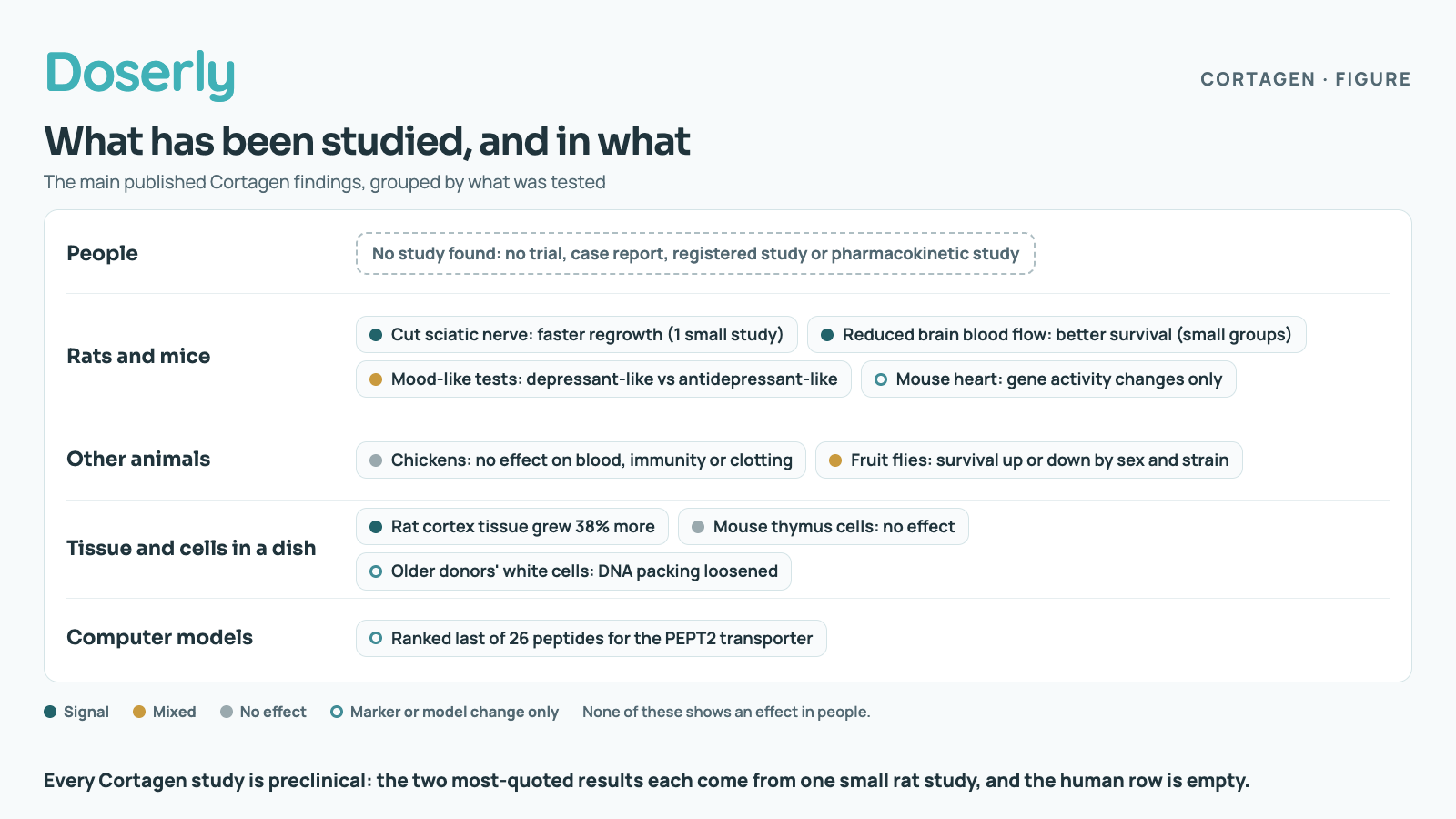
What has been studied, and in what
The main published Cortagen findings, grouped by what was tested. Signal = a reported difference in that model; Mixed = results point different ways; No effect = tested, nothing found; Marker change = chemical or computer result only.
- People
- No study found: no trial, case report, registered study or pharmacokinetic study
- Rats and mice
- Signal: Cut sciatic nerve: faster regrowth (1 small study)Signal: Reduced brain blood flow: better survival (small groups)Mixed: Mood-like tests: depressant-like vs antidepressant-likeMarker change: Mouse heart: gene activity changes only
- Other animals
- No effect: Chickens: no effect on blood, immunity or clottingMixed: Fruit flies: survival up or down by sex and strain
- Tissue and cells in a dish
- Signal: Rat cortex tissue grew 38% moreNo effect: Mouse thymus cells: no effectMarker change: Older donors' white cells: DNA packing loosened
- Computer models
- Marker change: Ranked last of 26 peptides for the PEPT2 transporter
Every Cortagen study is preclinical: the two most-quoted results each come from one small rat study, and the human row is empty.
How might Cortagen work?
The developers' idea is that very short peptides act as signals that switch particular genes on or off in the tissue they were designed from, so a peptide modelled on a brain-cortex extract would act on nerve cells. [105], [91] The experiments below test pieces of that idea. They are all preclinical, in tissue, cells, animals or computer models, and almost all come from the developer network or one St Petersburg pharmacology group.
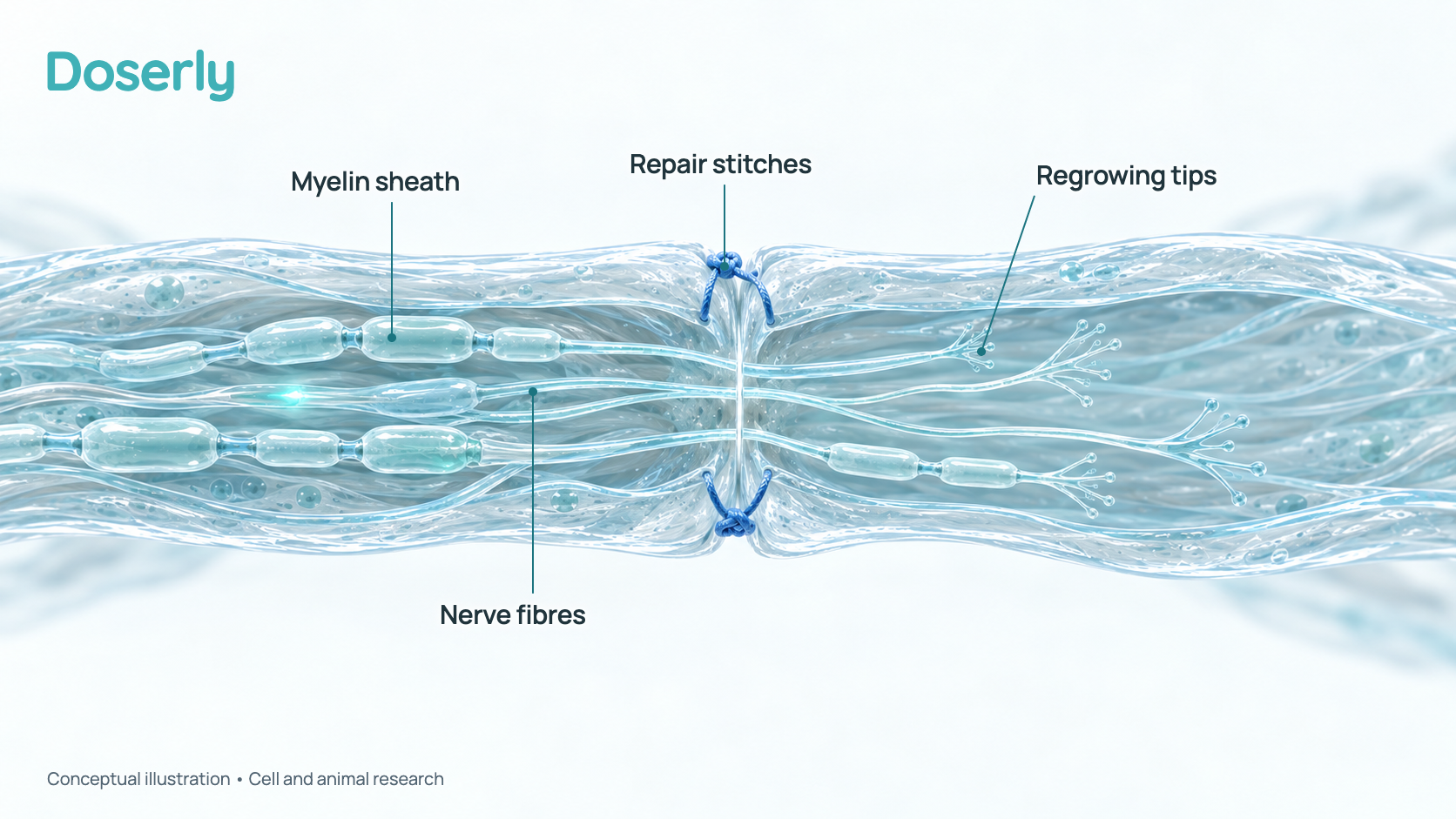
Nerve regrowth in rats
This is the most cited Cortagen result. Twenty-five male rats had the sciatic nerve cut and sewn back together, and received Cortagen at 10 mcg per kg or salt water into a muscle once a day for 10 days. Four weeks after surgery, conduction had returned over 23.3 mm of nerve in treated rats versus 18.3 mm in controls, and signals travelled at 19.4 versus 13.9 metres per second, about 40% faster. [6]
The study does not say how many rats were in each group, whether they were assigned at random or whether the testers knew which rats were treated. A follow-up by the same team exists only as a title we could not read, and no other group has repeated the experiment. [69] One forum post paraphrases the result accurately and then extends it to spinal cord injury, which was never tested. [73]
Protection in rat stroke models
A St Petersburg pharmacology group outside the developer's institute, though using substance supplied by Cortexin's maker, tied off both neck arteries in rats to cut blood flow to the brain, after three brief 5-minute clampings meant to “precondition” it. Cortagen at 0.25 mg per kg into the belly cavity, once a day for 7 days, raised survival in the early series to 80% versus 52% in more hypoxia-resistant rats and 69% versus 36% in less resistant rats, and fewer rats had paralysis. In the later series the differences were smaller, one of them not statistically significant, and Cortexin and another drug, Noopept, did better. [39], [106]
The same group reports that Cortagen lowered lipid oxidation, a chemical sign of damage, in rats with chronic reduced brain blood flow, more strongly than Cortexin did, and a developer study also found lower oxidation products after injections, alongside lower antioxidant activity in blood serum and brain cortex. [70], [39], [104] The paper states 10 rats per group, but survival figures such as 52% or 36% cannot come from a single group of 10, and no raw counts are given, so how survival was calculated is unclear. These are early, unconfirmed results.
Anxiety and mood tests in rats: conflicting results
- Injected into the brain. Cortagen given into the brain's fluid spaces reduced anxiety-like behaviour, most strongly at the smallest amount (1 mcg), and less at 10 or 100 mcg. [40]
- A single injection into the belly cavity. Reports from the same group disagree at 1 mg per kg. One found no effect on anxiety-like behaviour and no antidepressant-like effect. [40] A 2009 screen at the same dose reported an anti-anxiety effect, and found that rats spent more time floating still in the forced-swim test, a depressant-like result it shared with Semax, Selank and Cerebrolysin. [15]
- Daily injections after reduced brain blood flow. In the stroke-model rats described above, 0.25 mg per kg into the belly cavity once a day for 7 days reduced anxiety-like behaviour and lengthened active swimming, which the authors read as antidepressant-like. A conference abstract and the group's 2016 review describe the same experiments, so this is one result, not two. [37], [39]
The rats, models and doses differed, so the results do not cancel out. What they show is that the direction of Cortagen's effect on mood-like behaviour is not settled even in rats.
Brain tissue and nerve cells in a dish
Small pieces of rat brain cortex grown in a dish grew 38% more with Cortagen at 2–20 ng per mL, and in the developers' comparisons it acted on cortex tissue, while their other peptides acted on the liver, thymus or other tissues. [107], [108], [109] On isolated pond-snail nerve cells, low concentrations slightly calmed their firing, while a concentration of 10 millimolar, far higher than those used in the tissue studies, strongly disturbed them in a way the authors call toxic. [110] The developers also report that in frog embryo tissue, AEDP pushed early cells to become connective and skin tissue; we did not review the original experiment. [111], [112]
Genes and chromatin
In mice given 0.1 mcg by subcutaneous injection daily for 5 days, about 1.5–1.7% of the 15,247 heart gene fragments tested changed activity (234 fragments in the abstract; 252 fragments, covering 234 genes, in the paper's body). [7] In white blood cells from older donors, it loosened tightly packed DNA in a dish. [101], [103] The developers describe AEDP as an “epigenetic regulator”, a peptide that changes which genes are read, but that is a hypothesis built on such findings, not something measured in a living brain or nerve. [91], [113]
Immune cells and aging: mostly weak or no effect
Where Cortagen was compared with its sister peptides on the immune system, it usually did less. It had no effect on the response of mouse thymus cells, a weaker effect on an immune-signal gene in spleen cells than Vilon or Epitalon, and route- and time-dependent effects on that gene in the rat hypothalamus. [114], [115], [116] In mice under stress, it lowered a macrophage stress response in young animals and raised it in ageing ones. [117], [118] In chickens, it changed no blood, immune or clotting measure where Epitalon did, and in fruit flies its effect on survival depended on sex and strain. [11], [119] Findings for Epitalon, which differs by one amino acid, cannot be borrowed for Cortagen.
What about BDNF, synapses and glutamate?
In community education groups, one lesson credits Cortagen with raising BDNF (a growth factor that supports nerve cells), synapse proteins and glutamate receptors, and with protecting nerve cells in several models. None of the Cortagen studies we found measured BDNF, synapse proteins or glutamate receptors, and the protection results come from one rat stroke-model group.
What are the risks and unanswered questions?
Is Cortagen safe?
Nobody knows. Its safety in people has never been studied, and we found no standard toxicology study (a single high dose, repeated dosing, DNA damage, effects on pregnancy or cancer) in any species. [1] The animal studies did not report harm, but they were small, short and not designed to look for it. [6], [39] A common reply in forums, that bioregulators are “without any side effects”, is an assertion, not a finding. [120]
What problems have been reported?
- Marked sleepiness. One person on a first course of 4 mg a day wrote that they were sleeping “all night and half the day” for about five days. No follow-up was posted. [35]
- Chest discomfort. Another person stopped after a few doses because of chest discomfort; they did not give the dose. [36]
- A depressant-like effect in rats at 1 mg per kg into the belly cavity, in one behaviour screen. [15]
- Toxicity to snail nerve cells at a very high concentration in a dish, which cannot be translated to a human dose. [110]
In community education groups, no member reported a side effect from Cortagen, but most had not started or gave no follow-up, so this is a gap rather than reassurance. For Cortexin, the extract, members described anxiety that began around day 5 and a very painful injection site. No published case report of harm from Cortagen was found.
Does Cortexin's label apply to Cortagen?
No, but it is the closest official document, and websites often borrow from it. Cortexin's Russian label lists very rare allergic reactions (including anaphylaxis, a severe whole-body reaction, and swelling of the throat), rash and itching, agitation, poor coordination, insomnia, anxiety, a fast heartbeat and redness at the injection site. It says not to use it in pregnancy, and to stop breastfeeding if it is needed, because there are no clinical data. [9] Those warnings describe an animal extract given into a muscle under medical supervision. They are not Cortagen findings, but they show the kinds of reactions a regulator required for a closely related product.
Could product quality change the risk?
Yes. Cortagen is sold as an unregulated “research” chemical, and we found no public, independent test of the identity, purity or sterility of any Cortagen product. Health Canada named Cortagen among unauthorized injectable peptides seized from and sold by an online company, and warned that such products may cause infection, allergic reactions and other poor outcomes, may contain high-risk ingredients or contaminants that are not on the label, and may not have been made or stored safely. [38] Wrong molecular weights, a disputed CAS number and name mix-ups on product pages add to the uncertainty (see is every product the same molecule). [87], [54]
Is Cortagen legal? Is it FDA-approved?
Checked September 26, 2026. Rules differ by country and change quickly. A “research use only” label does not make a product legal to sell or safe to use.
United States. Cortagen is not an FDA-approved medicine: FDA's approved-drug and label databases have no entry for it, and it has no FDA substance identifier. [2], [121] ClinicalTrials.gov lists no study of it, so it is not being tested as an investigational drug in any registered trial. [1] It is not among the substances nominated for pharmacy compounding (list updated May 14, 2026), not on FDA's list of compounding substances that may pose significant safety risks, and not in any Federal Register document. [122], [123], [124] None of these searches is an approval or an FDA safety judgment.
Canada. No Cortagen product is in Health Canada's Drug Product Database. [125] Health Canada's August 1, 2025 advisory about unauthorized injectable peptides seized from and sold by an online company names Cortagen, states that injectable peptides are regulated as prescription drugs in Canada, and says that selling unauthorized drugs is illegal. [38]
Australia. The Therapeutic Goods Administration's April 2026 guidance says unapproved peptide products are not included in the Australian Register of Therapeutic Goods. It does not name Cortagen, and we found no Australian approval, although the register itself was not searched directly. [126]
Russia. Cortagen has no entry in Russia's main drug reference, and its developers describe it as a future medicine; the state drug register itself could not be searched. The registered product is Cortexin, the extract. [3], [10], [9]
Is Cortagen banned in sport? Does it show up on a drug test?
Cortagen is not named on the World Anti-Doping Agency's 2026 list or on the 2027 list that takes effect on January 1, 2027. Category S0 bans at all times any substance “with no current approval by any governmental regulatory health authority for human therapeutic use”, and the 2027 list names peptides among its examples. [127], [128] We found no approval for Cortagen anywhere, so S0 fits its status, although WADA has not ruled on it by name. One German page says it is allowed in sport, which the list does not support. [28] No published anti-doping test for Cortagen was found, and how long it could be detected is unknown.
Who should be especially cautious?
These groups have no safety data. That is a reason for caution, not proof of harm.
- Depression, anxiety or other mental-health conditions. Rat mood tests pointed both ways, and one person reported marked sleepiness. Do not stop or change prescribed treatment to try it. [15], [35]
- Heart conditions or chest symptoms. One person stopped because of chest discomfort, and a fast heartbeat is a very rare reaction on the related extract's label. [36], [9]
- Brain injury, stroke, seizures or nerve damage. These need medical care. Cortagen has never been tested as a treatment for any of them in people. [1]
- Allergies to peptide or animal-derived products. Allergic reactions, rarely severe, are listed for Cortexin; nothing is known for Cortagen. [9]
- Pregnancy and breastfeeding. Not studied. Cortexin's label rules out pregnancy for lack of data. [9]
- Children and teenagers. No study has looked at children, and this guide is written for adults.
- Competitive athletes. See the anti-doping section above. [127]
Has Cortagen been tested alongside other medicines?
No. Nothing is known about combining it with antidepressants, anti-seizure medicines, blood thinners, nerve-pain medicines such as gabapentin or pregabalin, GLP-1 weight-loss medicines or other peptides. Public accounts show it taken with Cerebrolysin, Cortexin, Epitalon, PE-22-28 and stacks of up to ten compounds, sometimes alongside prescribed medicines such as diazepam, with no way to tell what caused what. [80], [72], [63], [79], [78] Bring a complete list of everything you take to a pharmacist or doctor.
What should be monitored while using Cortagen?
No regulator has written a monitoring plan for Cortagen, and the vials are sold for laboratory research with no approved label. What exists is a record of what animal studies measured, two public reports of problems and the warnings on a related product's label. It can help you prepare questions for a clinician; it is not a personal testing plan. [38], [9]
What did the studies check?
Only animal outcomes: nerve conduction in rats, survival and paralysis in stroke models, behaviour tests, oxidation markers, gene activity and immune signals. [6], [39], [15], [7] None of the studies we reviewed reported routine safety checks such as blood counts or liver and kidney tests, and nothing has been measured in people.
Which measures matter, and why?
| Why it matters | What studies measured or reported | Tracking category |
|---|---|---|
| Whether focus or memory actually changes | Memory and learning in rats only, reported in a review; no human test [66] | Cognitive Function |
| Mood changes in either direction | Rat swim tests pointed both ways; one person described a mood lift that faded after each course [15], [37], [72] | Mood & Mental Health |
| Sleepiness | Not measured in studies; one account of marked sleepiness at 4 mg a day [35] | Sleep; Tolerability |
| Chest discomfort or a fast heartbeat | Not measured in studies; one account of chest discomfort; fast heartbeat is a very rare reaction on the related extract's label [36], [9] | Cardiovascular; Tolerability |
| Numbness, tingling or nerve pain | Nerve conduction in rats only [6] | Pain & Inflammation; Recovery & Healing |
| Injection-site problems or allergic reactions | Health Canada warns that unauthorized injectable drugs may cause infection or allergic reactions [38] | Tolerability |
In community education groups, the more careful educators advise taking one or two compounds at a time, recording a baseline first and using defined courses; one group's material says plainly that no laboratory test measures a Cortagen effect. Most members who described their use were taking several compounds and measuring nothing. Health Canada advises anyone who has used an unauthorized injectable drug and has health concerns to talk to a healthcare professional and to report side effects. [38]
What do people in public communities report?
Cortagen comes up rarely. In the public Reddit archive, most mentions are a single line in a list of peptides, several Cortagen threads were removed by moderators, and only about a dozen posts describe someone's own use. Almost all involve other compounds at the same time, products of unknown content and no measurements. [61], [129], [78]
What do the positive reports look like?
Subtle, and hard to separate from everything else. The most detailed report comes from someone with long-standing depression who had run three 10-day Cortexin courses before one Cortagen course: the mood effect was “almost the same” as Cortexin and faded within days to weeks after each course. [72] Others describe a very subtle calming effect felt only under stress, “not anywhere close” to Cerebrolysin, or milder help with brain fog than Cortexin while being treated for a mould-related illness with several other compounds. [67], [62]
After brain injuries, one person with a history of concussions found Cortagen and Epitalon helpful without giving details, and another described a spouse's recovery on “a whole protocol” and said Cortagen's part could not be separated. [63], [130] A 30-day diary of ten peptides, with 1 mg of Cortagen each morning from day 14, reported less anxiety, easier social contact and sharper thinking across the whole stack, with the sharpest thinking after the first phase had ended. [78] One person taking 500 mcg with PE-22-28 described a mood lift lasting several hours. [79]
Does everyone notice a difference?
No. “I did a cycle of Cortagen, I did not notice any difference,” one person wrote; another had “very little success” with it among many bioregulators; and a third noticed no memory improvement after a 10-day Cerebrolysin course taken with Cortagen, without giving the Cortagen amount. [68], [131], [80] In community education groups, one member said they would not buy it again because they saw no results, while other compounds in the same thread did help them.
What about unwanted effects?
Two public accounts describe problems: marked sleepiness during a first course of 4 mg a day, and chest discomfort after a few doses that made the person stop (see the risks). [35], [36] No other side effects were described in the public posts we reviewed, which is expected when so few people describe their use at all. In community education groups, no Cortagen side effects were reported, but almost no one posted a follow-up.
What do community education groups teach?
Educators mostly present Cortagen as a brain-cortex peptide for thinking and memory, sometimes also for stress, and a few describe it as reaching the lungs or eyes. Members mostly use it for nerve symptoms such as neuropathy or disc-related nerve pain, usually alongside ARA-290. The more candid material says the evidence comes from essentially one mostly Russian research group and that no test measures an effect; other lessons present it as one of the most relevant compounds for protecting the brain. Doses taught range from 100 mcg to 2 mg a day, none with a source (see the protocols). Some material repeats errors corrected in this guide: that Cortagen is taken from brain tissue or is the same as Cortexin, a “Cortogen” entry describing an adrenal product, and Cortagen's sequence printed under Cartalax.
How can you judge a Cortagen story?
Ask: Was it Cortagen or Cortexin, and which product? How much, by what route and for how long? What else was taken at the same time, and did any prescribed treatment change? Was anything measured before and after, such as a memory test, a nerve examination or a symptom diary, or is it a general impression? What happened weeks after the course ended? Concussion and nerve injuries often change over time on their own, so improvement during a course does not show that the course caused it.
These selected discussions are not a survey of all users, a response rate or a substitute for controlled studies. Several posts that promote Cortagen link to sellers, and many accounts cover only a few days. [99], [16], [35]
How does Cortagen compare with Pinealon, Epitalon, Semax and ARA-290?
Cortagen is most often weighed against its sister peptides from the same program, Pinealon and Epitalon, against Semax, a Russian “brain peptide” sold as a medicine, and against ARA-290, the peptide people most often pair it with for nerve symptoms. The table compares what each one is and how much has been tested in people.
| Compound | What it is | How it is taken | How often | Human evidence | Approval status |
|---|---|---|---|---|---|
| Cortagen (this guide) | Four amino acids (Ala-Glu-Asp-Pro, AEDP), designed from the Cortexin extract [4], [8] | Websites: subcutaneous injection [18] | Websites: once daily for 10–28 days [18], [26] | None found [1] | Not approved anywhere we found [3], [2] |
| Pinealon | Three amino acids (Glu-Asp-Arg, EDR) from the same program, also linked by its developers to Cortexin [132], [14] | Capsules by mouth in Russia; websites: subcutaneous injection [133], [134] | Capsules 1–2 times a day for 10–30 days; websites once daily for about 20 days [133], [134] | About seven small reports from the developer's network [135] | Sold as a supplement in Russia; not an approved medicine [133] |
| Epitalon | Four amino acids (Ala-Glu-Asp-Gly, AEDG), one amino acid different from Cortagen, modeled on a pineal extract [136], [11] | Websites: subcutaneous injection; studies: into a muscle [137], [138] | Websites: 5 mg once daily for 20 days; a study: 10 mcg a day for 10 days [137], [138] | A few small studies from the same network [136] | Not approved; FDA advisers voted 7 to 4 in July 2026 to add it to the pharmacy compounding list [139] |
| Semax | Seven amino acids based on a fragment of ACTH, a pituitary hormone [140] | 0.1% nose drops [141] | 2–3 drops per nostril 2–4 times a day for 3–14 days, depending on the use (label) [141] | Small Russian patient studies, mostly not randomized [142] | Prescription medicine in Russia; not FDA-approved [141], [140] |
| ARA-290 (cibinetide) | Eleven amino acids modeled on part of the hormone EPO [143] | Trials: subcutaneous injection [144] | Trials: mostly 4 mg once daily for 28 days [144] | Seven small published studies with about 230 people, in nerve and eye conditions [144], [145] | Not approved; an orphan designation is not an approval [146] |
The real differences are in how much has been tested in people. ARA-290 has small placebo-controlled trials in nerve conditions, Semax is a registered Russian medicine with small patient studies, and Pinealon and Epitalon have small reports from the developers' network. Cortagen has none that we found. No study has compared Cortagen with any of them, and combining them has never been tested. Health Canada's 2025 advisory on seized unauthorized injectable peptides names all five. [38]
Common questions about Cortagen
Is Cortagen the same as Cortexin?
No. Cortexin is a registered Russian medicine made of many peptides extracted from cattle brain cortex and injected into a muscle. Cortagen is a single lab-made chain of four amino acids that its developers designed from Cortexin's amino-acid make-up. Cortexin's label, its 10 mg vials and the patient uses it is prescribed for do not apply to Cortagen, and research on one cannot be counted for the other. [9], [6], [71] See what Cortagen is.
Is Cortagen made from cow brain?
No. It is synthesized in a laboratory; only its design was based on the brain extract Cortexin. Posts calling it “cow brain tissue” are describing Cortexin. The early research batches were made by a chemist at the developers' institute, and the pond-snail study used substance supplied by Cortexin's manufacturer. [147], [7], [110] See the identity section.
Has Cortagen been tested in humans?
No. We found no clinical trial, case report or registered study in any language. The often-quoted line that Cortagen helped nerve recovery “in humans” comes from a 2004 abstract whose own reference for it is a rat study, and claims of hospital use confuse it with Cortexin. The only human material tested was white blood cells in a dish. [1], [7], [101] See the human research.
Does Cortagen help nerve damage or neuropathy?
It has not been tested for either in people. In one small rat study, a cut and repaired sciatic nerve regrew faster with 10 days of injections into a muscle, measured four weeks after surgery. That result has not been repeated, and it measured nerve signals, not pain or numbness. No study has tested diabetic or other neuropathy, sciatica or spinal injury. [6], [69] See nerve regrowth in rats.
Is Cortagen a pill or an injection?
Almost always an injection. It is sold as 20 mg vials of powder to be mixed and injected, usually subcutaneously. Some pages describe capsules of 10–20 mg by mouth, and posts mention nasal sprays and under-the-tongue products, but we found no label or test of an oral Cortagen product, and no route has been studied in people. [18], [42], [46] See the protocol tables.
How long does Cortagen take to work?
There is no reliable answer. We found no human study that measured timing. Public accounts range from a mood lift within hours on the days it was taken, in combination with another peptide, to nothing at all after a cycle, and most people were taking several compounds. [79], [68], [78] See what people report.
Is it legal to buy Cortagen?
It depends on the country, but it is not an approved medicine anywhere we checked. It is not FDA-approved, Health Canada has named seized Cortagen among unauthorized injectable peptides and says selling unauthorized drugs is illegal in Canada, and Australia's regulator treats unapproved peptides as outside its register. A “research use only” label does not make a product legal or safe. [2], [38], [126] See the dated legal-status summary.
Is there an established Cortagen dose?
No. No study has given Cortagen to people, so no human dose has been tested for effect or safety. The only doses in studies were for rats and mice, such as 10 mcg per kg into a muscle for 10 days. The usual website amount, 1–2 mg a day by subcutaneous injection, comes from a vial template, and the popular 10 mg course belongs to Cortexin. [6], [18], [33] See the protocol tables.
Glossary
Plain explanations of the route, dosing and research terms used in this guide. Underlined terms in the text link here.
- Adverse event
- A harmful or unwanted medical event reported after someone used a treatment. A report alone does not prove the treatment caused it.
- Amino acid
- A small chemical building block. Chains of amino acids make up peptides and proteins. Cortagen is made of four: alanine, glutamic acid, aspartic acid and proline.
- Animal study
- Research in animals such as rats or mice. It shows what a substance does in a living body, but results in people can differ. All Cortagen research in living bodies is in animals.
- Bioavailability
- How much of a dose reaches the bloodstream in a usable form. It depends heavily on the route. For Cortagen it has not been measured by any route.
- Bioregulator
- The name a Russian research group uses for very short peptides it believes act on particular tissues. It is a research and marketing label, not a regulatory category.
- Blood-brain barrier
- The tightly sealed lining of the brain's blood vessels, which keeps many substances in the blood out of the brain. Whether Cortagen crosses it has never been measured.
- Cell study (in vitro)
- Research on cells or tissue grown in a dish. It gives early clues about biology, but it is far from proof of benefit in people.
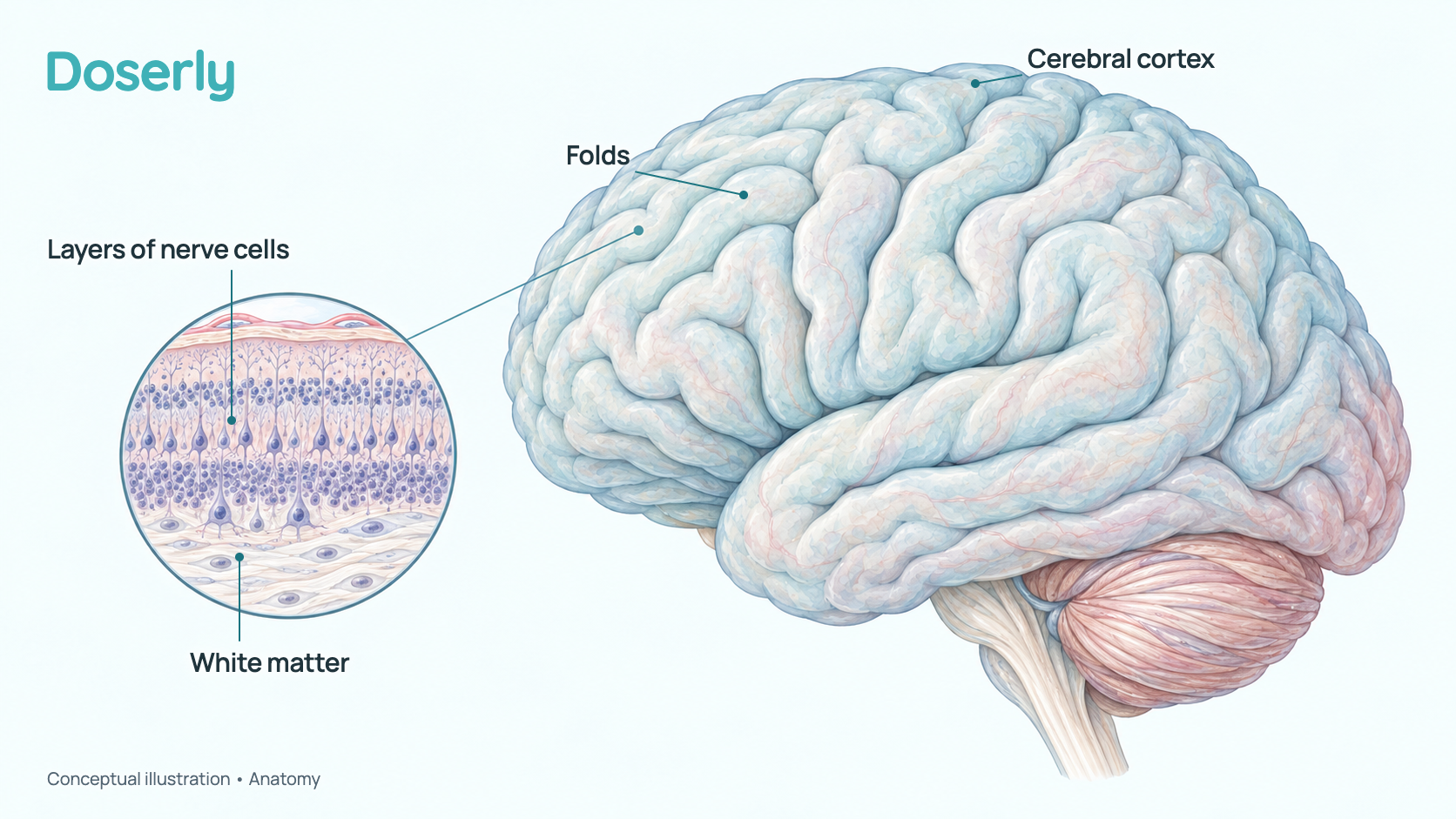
- Cerebral cortex
- The brain's folded outer layer, involved in thinking, memory, senses and movement. Cortexin is extracted from animal cortex, and Cortagen was designed from Cortexin.
- Controlled trial
- A study that compares people who receive a treatment with a similar group who do not, often receiving a placebo instead. We found no controlled trial of Cortagen.
- Course and cycle
- A course is the period of repeated use, such as 20 days. A cycle is a course plus a planned break before any further use.
- Daily total
- All the amounts given in one day, added together. For example, 500 mcg twice daily is a 1,000 mcg (1 mg) daily total.
- Dose (amount each time)
- The amount given on one occasion. A protocol lists both the dose and how often it is given.
- Explant
- A small piece of tissue taken from an animal and kept growing in a dish, used to see how a substance affects that tissue.
- Forced-swim test
- A rodent test that times how long an animal keeps swimming in a tank it cannot leave. Drugs that lengthen active swimming are called antidepressant-like. It is a screening tool, not a measure of depression in people.
- Freeze-dried (lyophilized)
- Dried by freezing and removing the water, leaving a powder. Cortagen vials are sold this way and mixed with liquid before injection.
- Half-life
- The time it takes for the measured level of a substance in the blood to fall by half. It is not the same as how long an effect lasts. It has not been measured for Cortagen.
- Intracerebroventricular
- Injected directly into the fluid-filled spaces inside the brain. It is used in animal research to bypass the blood-brain barrier, never as a way people take a peptide.
- Intramuscular (IM)
- Injected into a muscle. The rat nerve study gave Cortagen this way, and Cortexin is given this way.
- Intraperitoneal (IP)
- Injected into the belly cavity, the space around the gut. A common route in rat and mouse studies that is not used for people.
- Investigational
- Being studied as a possible medicine and not approved by a regulator, such as the FDA, to treat any condition. Cortagen is not in any registered trial.
- mcg and mg
- Micrograms and milligrams. 1 mg equals 1,000 mcg. Cortagen amounts online are given in both, which makes 1,000-fold errors easy.
- Nerve conduction
- How far and how fast an electrical signal travels along a nerve. It measures nerve function, not pain or numbness.
- Oral
- Taken by mouth, as a capsule, tablet or liquid.
- Peptide
- A short chain of amino acids. Cortagen is a chain of four, called a tetrapeptide.
- Pharmacokinetics
- How the body absorbs, moves, breaks down and removes a substance. We found no such data for Cortagen.
- Placebo
- A dummy treatment with no active ingredient, used as a comparison in studies. The rat studies compared Cortagen with injections of salt water.
- Preclinical research
- Studies done before research in people: cell studies, tissue studies and animal studies. All Cortagen research is preclinical.
- Reconstitution
- Mixing a freeze-dried powder with a liquid so it can be measured and injected. The amount of liquid sets how much peptide each unit holds.
- Research use only
- A label on products sold for laboratory research. It does not mean a product is approved, tested for human use or legal to sell as a medicine.
- Subcutaneous (SC)
- Injected into the fatty layer just under the skin. This is the route most Cortagen protocol descriptions use, though no human study has tested it.
- Syringe units
- Markings on an insulin syringe that measure volume. On a U-100 syringe, 100 units equal 1 mL. The amount of drug per unit depends on the vial's concentration.
- Titration
- Adjusting a dose in steps, usually starting lower and increasing if needed.
- WADA
- The World Anti-Doping Agency, which publishes the list of substances banned in sport.
- Withdrawal and rebound
- Withdrawal effects are symptoms caused by stopping a substance. A rebound is a problem returning worse than before after stopping. Neither has been studied for Cortagen.
Explore more of the research
Go deeper into the experiments behind the claims.
Across this guide, the citations include 26 study reports on Cortagen: animal studies in rats, mice, chickens and fruit flies, tissue and cell studies, and computer models. Some describe the same experiments, such as a journal paper and a conference abstract, and one is a title we could not read. None is a study in people. The developers' reviews, book chapter and patent listing are counted separately. Study counts are not counts of independent research teams: almost all come from one research network or one St Petersburg pharmacology group, and some report the same work more than once.
Rats and mice · 13 study reports
Does it help a cut nerve regrow?
Model: 25 male rats with the sciatic nerve cut and sewn back together; Cortagen 10 mcg/kg into a muscle, or salt water, once daily for 10 days.
Finding: At 4 weeks, conduction returned over 23.3 versus 18.3 mm and signals travelled at 19.4 versus 13.9 m/s.
Limit: Group sizes, random assignment and blinding not reported; developer group; not repeated. A 2002 follow-up exists only as a title.
Does it protect rats with reduced blood flow to the brain?
Model: Rats with both neck arteries tied off after three brief 5-minute “preconditioning” clampings; Cortagen 0.25 mg/kg into the belly cavity once daily for 7 days, compared with Cortexin and Noopept; also rats with chronic reduced brain blood flow.
Finding: Higher survival in the early series (80% versus 52% and 69% versus 36%), fewer neurological deficits, less anxiety-like behaviour, longer active swimming and lower lipid oxidation; in the later series the differences were smaller and Cortexin and Noopept did better.
Limit: Groups stated as 10 rats, but the survival percentages cannot come from single groups of 10 and no counts are given; the 2016 journal abstract does not name Cortagen; the 2011 abstract gives no dose.
Does it change anxiety or mood-like behaviour?
Model: Rats given Cortagen once into the brain's fluid spaces (1, 10 or 100 mcg) or once into the belly cavity (1 mg/kg); rats after reduced brain blood flow given 0.25 mg/kg into the belly cavity daily for 7 days.
Finding: Less anxiety-like behaviour when injected into the brain, strongest at 1 mcg. After a single belly-cavity injection, one report found no anxiety or swim-test effect, while a 2009 screen found an anti-anxiety effect and a depressant-like swim-test result. After reduced brain blood flow: less anxiety-like behaviour and an antidepressant-like swim-test result.
Limit: Small groups; the reports disagree with each other; the stroke-model result appears in a conference abstract and a review that describe the same experiments.
Does it lower oxidative damage?
Model: Rats given injections of Epitalon or Cortagen.
Finding: Lower lipid-oxidation products and less protein oxidation, alongside lower antioxidant activity in blood serum and brain cortex.
Limit: Abstract only; dose not given there.
Does it change gene activity?
Model: Female mice given 0.1 mcg by subcutaneous injection daily for 5 days; heart tissue screened with a gene chip.
Finding: About 1.5–1.7% of the 15,247 gene fragments tested changed activity (234 in the abstract; 252 fragments covering 234 genes in the paper's body).
Limit: No health outcome measured; the abstract's “in humans” sentence is not supported by the paper's own reference.
Does it change immune signals?
Model: Rats given Vilon, Epitalon or Cortagen, with interleukin-2 gene activity measured in the hypothalamus; macrophages from young and ageing mice under rotation stress.
Finding: Route- and time-dependent changes in the hypothalamus; the macrophage stress response fell in young mice and rose in ageing mice.
Limit: Abstracts only; doses not given there.
Tissue and cells in a dish · 9 study reports
Does it make brain tissue grow?
Model: Pieces of rat brain cortex and other organs kept growing in a dish (explants), from young and old rats; Cortagen at 2–20 ng/mL.
Finding: Cortex pieces grew 38% more; of the peptides tested, only Cortagen stimulated cortex tissue, and the other peptides acted on their own target tissues.
Limit: Abstracts only; tissue in a dish.
Does it affect immune cells?
Model: Mouse thymus cells and spleen cells, with Vilon, Epitalon and Cortagen.
Finding: No boost to thymus-cell responses, and a weaker effect on interleukin-2 gene activity than Vilon or Epitalon.
Limit: Abstracts only; negative or weak results.
Does it change DNA packing in older people's cells?
Model: White blood cells from donors aged 75–88 (and 20–40 in one study), treated in a dish with short peptides including Cortagen.
Finding: Tightly packed DNA (heterochromatin) loosened.
Limit: Abstracts only; cells in a dish, not people who took Cortagen.
How does it affect nerve-cell signals?
Model: Isolated nerve cells of the pond snail, with Cortagen at 0.1 micromolar to 10 millimolar.
Finding: Slight calming of firing at low concentrations; sodium and calcium currents fell from 100 micromolar; strong, toxic depolarization at 10 millimolar.
Limit: Invertebrate cells; concentrations cannot be converted to a dose.
Chickens, fruit flies, frog tissue and computer models · 4 studies and 4 reviews or background citations
Does it affect immunity or clotting in birds?
Model: Chickens with the pituitary removed at hatching, and old birds, for 40 days, compared with Epitalon.
Finding: Cortagen changed no blood, immune or clotting measure; Epitalon did.
Limit: Abstract only. A useful reminder that Epitalon results cannot be borrowed for Cortagen.
Does it change lifespan in fruit flies?
Model: Inbred fruit-fly lines fed Cortagen at 0.00001% of their food.
Finding: Survival rose or fell depending on sex and line.
Limit: Inconsistent results in insects.
Does it steer how early cells develop?
Model: Frog embryo tissue, described in developer papers.
Finding: AEDP pushed early cells toward connective tissue and skin.
Limit: Reported second-hand in later papers; original experiments not reviewed here.
Could transporters carry it into cells?
Model: Computer docking of 26 short peptides to PEPT and LAT transporter proteins.
Finding: AEDP ranked last for PEPT2 and low to middling for the others.
Limit: Predictions only; absorption was not measured.
How does it sit at a nerve-cell membrane?
Model: Molecular-dynamics computer simulation of AEDP and a model membrane.
Finding: The peptide stayed above the membrane surface.
Limit: A simulation, not an experiment.
How this guide was researched
This guide is built from a thorough review of the sources cited throughout it: published scientific studies, developer reviews and listings, trial-registry and regulator searches, a related product's official label and published protocol descriptions. We also reviewed public online forums and community education groups, where people describe their own experiences with Cortagen.
The guide cites 147 sources, including 26 laboratory and animal study reports on Cortagen and no studies in people, because we found none. Each type of source answers a different question. Studies show what researchers measured. Protocol descriptions show how Cortagen is typically used. Personal accounts show what individual people experienced. Every numbered citation links to its entry below, labeled by source type.
How this guide was made
Research and drafting were AI-assisted. Every cited source was checked against the original, and the guide was reviewed and edited by Doserly before publication. It has not had an independent clinical review, and Doserly does not currently have medical reviewers. Doserly makes a medication and health-tracking app and runs Doserly Academy, both of which are promoted in this guide. Read our editorial policy for how guides are researched, updated and corrected.
This guide is for educational purposes. It summarizes what the reviewed sources report so the research is easier to understand; it is not medical advice. For a deeper dive, or to check any point for yourself, go straight to the cited sources.
Explore the sources
These are the documents cited in this guide. Animal and cell studies, regulator records, website advice and personal accounts answer different questions, and none of them is a study of Cortagen in people, because we found none. A source being listed does not mean every statement on its page is endorsed.
Showing 147 sources
- 01
ClinicalTrials.gov searches: cortagen, kortagen, “Ala-Glu-Asp-Pro”, cortexin ↗
Registry search
No Cortagen study found. The only “cortagen” hit is an unrelated nutrition study matched by a word fragment.
- 02
openFDA approved-drug and label searches: cortagen ↗
Regulator database search
No record: no FDA-approved Cortagen product or label.
- 03
Vidal drug reference search: кортаген (Cortagen) ↗
Drug reference search (Russia)
No results: Cortagen is not listed as a medicine in Russia's main drug reference. The state register itself could not be searched.
- 04
Cortagen (PubChem compound CID 18439621) ↗
Chemical database
Record checked: L-Ala-L-Glu-L-Asp-L-Pro, C17H26N4O9, 430.4 g/mol. The number 335591-03-2 appears only as a depositor synonym, not as a confirmed CAS number.
- 05
alanyl-glutamyl-aspartylprolyine (MeSH supplementary concept; entry terms Ala-Glu-Asp-Pro, cortagen) ↗
Medical vocabulary record
Record checked: the library's indexing term for Cortagen.
- 06
Effect of tetrapeptide cortagen on regeneration of sciatic nerve ↗
Animal study
Full text of the Russian edition reviewed (scanned pages read by eye).
Result detail: 25 male rats had the sciatic nerve cut and sewn back together, then received Cortagen 10 mcg per kg into a muscle, or salt water, once a day for 10 days. At 4 weeks, conduction had returned over 23.3 versus 18.3 mm of nerve (27% more) and signals travelled at 19.4 versus 13.9 m/s. Limitation: group sizes, random assignment and blinding are not reported; developer group; no replication found.
- 07
Elucidation of the effect of brain cortex tetrapeptide Cortagen on gene expression in mouse heart by microarray ↗
Animal study
Full text reviewed.
Result detail: female mice received 0.1 mcg of Cortagen per animal by subcutaneous injection daily for 5 days; about 1.5–1.7% of the 15,247 heart gene fragments tested changed activity (the abstract gives 234 fragments, 1.53%; the paper's body gives 252 fragments covering 234 genes, 1.65%). No health outcome was measured. Limitation: the abstract says Cortagen had a therapeutic effect on nerve recovery “in humans”, but the paper's own reference for that sentence is the rat sciatic-nerve study; the human findings it mentions belong to Cortexin.
- 08
Лекарственные пептидные препараты: прошлое, настоящее, будущее (Peptide medicines: past, present, future) ↗
Review (developer group)
Full text reviewed in Russian: describes the tetrapeptide Ala-Glu-Asp-Pro, named Cortagen, as designed from the amino-acid composition of Cortexin, and summarizes animal findings. No human study is cited.
- 09
Кортексин (Cortexin) lyophilisate 10 mg for intramuscular injection: drug reference entry ↗
Official product label (Cortexin, a different product)
Label reviewed in Russian: 10 mg of cattle brain-cortex polypeptides with glycine per vial, injected into a muscle; dose and course set by the doctor; very rare allergic reactions (including anaphylaxis and throat swelling), agitation, poor coordination, insomnia, anxiety and fast heartbeat; not to be used in pregnancy. This label is for Cortexin, not Cortagen.
- 10
Лекарственные нейропротекторные пептидные препараты (Neuroprotective peptide medicines), in Пептиды и геном: молекулярные механизмы нейропротекции ↗
Book chapter (developer group)
Full text reviewed in Russian: says AEDP and EDR were later found in Cortexin's composition, and describes the Cortagen results as groundwork “for creating a medicine”, so it was not yet a registered drug.
- 11
[Effects of epithalon and cortagene on immunity and hemostasis in neonatally hypophysectomized chicken and old birds] ↗
Animal study
Original abstract reviewed: Cortagen, which differs from Epitalon only in its last amino acid (proline instead of glycine), did not change blood, immune or clotting measures in chickens; Epitalon did.
- 12
[Neuroprotective effects of peptides bioregulators in people of various age] ↗
Review (developer group)
Original abstract reviewed: lists “kortagen” among short neuroprotective peptides and says the review describes clinical use of peptides in older people, without saying which peptides. The full text is not open access and could not be obtained, so whether it reports any human use of Cortagen is unknown.
- 13
Transport of Biologically Active Ultrashort Peptides Using POT and LAT Carriers ↗
Review (developer group) with a docking table
Full text reviewed: a review of peptide transport; its docking table lists “Korthagen (AEDP)” as a neuroprotector. Modelling only.
- 14
EDR Peptide: Possible Mechanism of Gene Expression and Protein Synthesis Regulation Involved in the Pathogenesis of Alzheimer’s Disease ↗
Review (Pinealon)
Reviewed for Doserly's Pinealon guide (comparison section): describes EDR as a tripeptide isolated from Cortexin.
- 15
Психофармакологический профиль ноотропоподобных пептидов (Psychopharmacological profile of nootropic-like peptides) ↗
Animal study
Full text reviewed in Russian: in a comparison of nine peptides given into the belly cavity 30–40 minutes before testing, Cortagen at 1 mg per kg (like Semax and Selank) showed depressant-like activity in the forced-swim test and, in the elevated plus maze, an anti-anxiety effect as the authors report it. A fat-linked version, oleoyl-Cortagen, behaved differently.
- 16
Reddit comment: “Dose: 100mcg daily (10 units), 30 days per cycle” ↗
Community discussion
Public affiliate post reviewed; cited as an example of a claim that circulates, not as evidence. It calls Cortagen a bioregulator for adrenal cortex tissue, and its dose line contains a 10-fold unit error: with a 20 mg vial mixed with 2 mL, 10 units is 1 mg, not 100 mcg.
- 17
Cortagen: Brain Bioregulator Guide 2026 ↗
Protocol source
Page checked: 200–400 mcg by subcutaneous injection daily for 10–20 days, 2–3 times a year (source of the low row); also a “Russian clinical” 2–10 mg into a muscle for head injury or stroke, which could not be traced.
- 18
Cortagen Research Protocol Reference | PeptiJournal ↗
Protocol source
Page checked: 1,000 mcg (15 units) daily in weeks 1–2, then 2,000 mcg (30 units) in weeks 3–4, for a 20 mg vial mixed with 3 mL. Source of the mid row.
- 19
Buy Cortagen 20mg Advanced Endocrine & Stress Balance Support | Bioregulator Peptide | Fle ↗
Protocol source
Seller page checked: 2–10 mg once daily for a 10–20-day cycle, the same range for men and women; its dosing chart lists 1 mg, 2 mg and a 5 mg “blast” amount. No source given. Source of the high row; its 10 mg top equals one Cortexin vial.
- 20
Cortagen: Research, Reported Dosing & Safety · OHM ↗
Protocol source
Page checked: the same table as another guide site, including the untraced 2–10 mg injection row.
- 21
Cortagen: Evidence & Safety | PepGuide ↗
Protocol source
Page checked: 1,000 mcg each morning for weeks 1–2, then 2,000 mcg for weeks 3–4, extendable; the same page also gives an oral 10–20 mg figure next to the injection route.
- 22
Cortagen Research, Dosing & Protocols | Peptides.ID ↗
Protocol source
Page checked: 1,000 mcg (15 units) each morning in weeks 1–2, then 2,000 mcg (30 units) in weeks 3–4.
- 23
Cortagen Protocol, Research Stacks ↗
Protocol source
Page checked: a 20 mg vial with 3 mL (6.67 mg per mL), 1,000 mcg (15 units) daily in weeks 1–2, then 2,000 mcg (30 units) in weeks 3–4.
- 24
Cortagen, Research Guide, Evidence & Protocol | Atlas Prep HQ ↗
Protocol source
Page checked: 1 mg a day for 2 weeks, then 2 mg a day for 2 weeks, described as a community reference.
- 25
Cortagen Dosage Chart – 20 mg Vial Protocol | PeptideDosages.com ↗
Protocol source
Page checked: 1–2 mg daily by subcutaneous injection in “educational protocols”.
- 26
Cortagen, dosing, safety and storage, Bioalmanac ↗
Protocol source
Page checked: 1–2 mg daily for a 10-day course, repeated a few times a year, and says the pattern has no study behind it.
- 27
Cortagen Peptide Protocol & Dosing, Research Protocols ↗
Protocol source
Page checked: 500 mcg once daily for 20 days, then 4–6 months off.
- 28
Cortagen · Wirkung, Dosierung & Studien | PeptidWiki ↗
Protocol source
Page checked (German): 1–2 mg a day for 10–20 days with 4–6 months off; claims Khavinson protocols used 2–5 mg a day, which was not found in any developer source; also says Cortagen is allowed in sport.
- 29
Reddit comment: “Cortagen|20mg|3mL|1-2mg daily|SubQ|4-8 wks|Optional” ↗
Community discussion
Public comment reviewed; cited as an example of a claim or practice that circulates, not as evidence.
- 30
Cortagen (20mg) | Shop Online | Pacific Peptides ↗
Protocol source
Seller page checked: 1,000–2,000 mcg once daily in the morning, and a separate weight-based course of about 0.01 mg per kg for 10 days.
- 31
Cortagen Dosage Chart, Doses, Protocols & Calculator (Cited) | PeptideDosageCharts ↗
Protocol source
Page checked: a table lists “sciatic nerve regeneration, 10 mcg once a day for 10 days” and cites the rat study, which used 10 mcg per kg of body weight, not 10 mcg per person.
- 32
Cortagen Calculator, Reconstitution & Dosing in Units | The Last Peptide ↗
Protocol source
Page checked: says circulating figures run from 10,000 to 30,000 mcg.
- 33
PeptScope: Cortagen page ↗
Website (identity details)
Page checked: describes Cortexin, 10 mg vials of brain-cortex polypeptides, with a “standard course” of 10 mg into a muscle daily for 10 days.
- 34
Cortagen Peptide: Benefits, Side Effects & More | Know Your Peptide ↗
Protocol source
Page checked: 10 mg into a muscle daily for 10 days, 2–3 courses a year, as a “standard bioregulator dose”.
- 35
Is Cortagen peptide supposed to make you sleepy? ↗
Community account
Public thread reviewed: marked sleepiness during a first course of 4 mg a day for about 5 days; a later question about benefits went unanswered. A self-report with unverified product and dose.
- 36
Got an insane panic attack from peptides, thought I was dying, and went to the ER. ↗
Community account
Public comment reviewed: chest discomfort after a few doses, so the person stopped. Dose and product not stated.
- 37
Нейропротекторные эффекты кортагена на фоне ишемического прекондиционирования (Neuroprotective effects of Cortagen with ischemic preconditioning) ↗
Animal study (conference abstract)
Abstract text reviewed in Russian: in rats given ischemic preconditioning and then carotid ligation, Cortagen 0.25 mg per kg into the belly cavity right after surgery and then once daily for 7 days reduced anxiety-like behaviour and lengthened active swimming in the forced-swim test, which the author reads as antidepressant-like. Same model, dose and supplier as the 2016 review, so it describes the same experimental series.
- 38
Unauthorized injectable peptide drugs seized and sold by Canada Peptide may pose serious health risks (RA-77807) ↗
Regulator advisory
Page checked: Cortagen is in the list of seized or sold products; injectable peptides are regulated as prescription drugs in Canada; none of the products was authorized.
- 39
От идеи С. П. Боткина о «предвоздействии» до феномена прекондиционирования (From Botkin's idea of pre-exposure to the phenomenon of preconditioning) ↗
Animal study (reported in a review)
Full text reviewed in Russian.
Result detail: rats had both neck arteries tied off to reduce brain blood flow, then received Cortagen 0.25 mg per kg into the belly cavity right away and once a day for 7 days (substance supplied by Geropharm). In the early series, 80% of more hypoxia-resistant and 69% of less resistant rats survived, versus 52% and 36% without treatment; the later series showed smaller differences, where Cortexin and Noopept did better. Limitation: survival is reported as percentages with error margins for groups of 10, without raw counts.
- 40
Фармакология лекарственных препаратов пептидной структуры (Pharmacology of peptide drugs) ↗
Animal study (reported in a review)
Full text reviewed in Russian.
Result detail: in rats, Cortagen injected into the brain's fluid spaces (1, 10 or 100 mcg) reduced anxiety-like behaviour, most at the lowest amount. Given once into the belly cavity at 1 mg per kg, it had no effect in the anxiety test and no antidepressant-like effect in the forced-swim test, and slightly dampened open-field activity; the author still concludes that the effects by the two routes were broadly similar. Limitation: single-dose behaviour tests with small groups; other reports from the same group found an anti-anxiety effect by the belly-cavity route.
- 41
Cortagen (20mg Vial) Dosage Chart - Dosage Peptide ↗
Protocol source
Page checked: 0.01 mg per kg a day for about 10 days (0.70 mg at 70 kg), drawn from the rat nerve study, which used injections into a muscle.
- 42
Cortagen Overview, Dosing & Safety | Peptide Database ↗
Protocol source
Page checked: 10–20 mg a day as oral capsules for 10–20 days, 2–3 times a year; gives the molecular weight as 416 Da.
- 43
Cortagen Overview, Dosing & Safety | PeptideHub ↗
Protocol source
Page checked: the same oral 10–20 mg template as another database site.
- 44
Cortagen · PeptScope ↗
Protocol source
Page checked: 1–2 capsules once or twice daily for 30 days, said to hold about 20 mg each, and 100–500 mcg a day for vials. No capsule label was found.
- 45
Cortagen Dosage & Reconstitution Guide, PeptideScams ↗
Protocol source
Page checked: 5 mg by mouth or under the tongue once daily for a short course.
- 46
Reddit comment: “Cortagen peptide which is sold both oral and SL” ↗
Community discussion
Public comment reviewed; cited as an example of a claim or practice that circulates, not as evidence.
- 47
Reddit comment: “Was thinking of trying cortagen nasal spray next but can't find many experiences.” ↗
Community discussion
Public comment reviewed; cited as an example of a claim or practice that circulates, not as evidence.
- 48
Reddit comment: “40mcg cortagen” ↗
Community discussion
Public comment reviewed; cited as an example of a claim or practice that circulates, not as evidence.
- 49
Reddit comment: “Per Spray: Colivelin 1219 mcg, HNG 121 mcg, Cortagen 1219 mcg.” ↗
Community discussion
Public comment reviewed; cited as an example of a claim or practice that circulates, not as evidence.
- 50
Cortagen - Wikipep, The Peptide Encyclopedia ↗
Protocol source
Page checked: 10 mg a day into a muscle for 10 days as a Russian clinical protocol, citing a 2003 study of 89 older adults that could not be found anywhere.
- 51
Cortagen: Dosing, Side Effects & Research | Peptadex ↗
Protocol source
Page checked: a 10 mg default dose, but 1–5 mg per dose in its text, by nose or into a muscle.
- 52
Cortagen Reconstitution Calculator | Peptide Database ↗
Protocol source
Page checked: a calculator default of 10 mg daily for 10 days.
- 53
Купить Cortagen 20 мг - нейропептид-биорегулятор Ala-Glu-Asp-Pro | STbio ↗
Protocol source
Seller page checked (Russian): 2–10 mg by subcutaneous injection a day for 10 days. Cross-check of the high row's range only (its 10-day course is not part of the row); grouped with the Cortexin-derived pages.
- 54
Cortagen COA Data & Pricing · Merit Verified ↗
Protocol source
Page checked: vendor protocols commonly cite 1–2 mg a day; lists 335591-03-2 as a CAS number, which could not be confirmed.
- 55
Cortagen: Dosing, Benefits & Safety | OnePin ↗
Protocol source
Page checked: 100 mcg by subcutaneous injection daily for 10–20 days, and notes that no study used this route and dose.
- 56
Cortagen: Research Evidence & Safety Profile | PeptideInsight ↗
Protocol source
Page checked: 100–500 mcg a day by subcutaneous injection for 10–20 days, and says the range is extrapolated from general bioregulator conventions.
- 57
Cortagen Peptide Dosage Guide, Benefits & Side Effects | Peptide Mind ↗
Protocol source
Page checked: 150 mcg per subcutaneous injection daily for 2 weeks, with no human source.
- 58
Cortagen: dosage, cost, and uses | Peptide Decoding ↗
Protocol source
Page checked: a 200 mcg calculator default.
- 59
Cortagen: Dosing, Evidence & Vendor Prices | Ground Truth ↗
Protocol source
Page checked: calls 650 mcg daily the “typical community protocol”, linking a single Reddit thread.
- 60
Cortagen Dosing | Peptides.wiki ↗
Protocol source
Page checked: 0.02–0.04 mg per kg daily or every other day, 4 weeks on and 1–2 off, with text about “skin results” apparently carried over from another compound.
- 61
favorite bioregs and nootropics for brain ↗
Community account
Public post reviewed: a general liking for Cortagen alongside Pinealon, Epitalon and P21, with no specific effect.
- 62
Depression, weight gain, toxic mold illness, and CIRS ↗
Community account
Public comment reviewed: milder help with brain fog than Cortexin, during treatment for mould-related illness with several other compounds.
- 63
intranasal KLOW - Am I going to hurt myself? ↗
Community account
Public comment reviewed: Cortagen and Epitalon described as helpful after concussions; no details given.
- 64
Reddit comment: “the dosage for this stuff seems to be 10 mg a day for 10 days” ↗
Community discussion
Public comment reviewed; cited as an example of a claim or practice that circulates, not as evidence.
- 65
Reddit comment: “closest functional alternative to Cerebrolysin” ↗
Community discussion
Public comment reviewed; cited as an example of a claim or practice that circulates, not as evidence.
- 66
Нейропротекторные эффекты пептидов (Neuroprotective effects of peptides) ↗
Review (developer group)
Full text reviewed in Russian: says Cortagen improved memory and learning in old rats with induced amnesia and helped normalize muscle tone and coordination after acute brain injury in rats. The underlying experiments were not reviewed.
- 67
Cortagen ↗
Community account
Public comment reviewed: a subtle calming effect felt only under stress, judged far weaker than Cerebrolysin.
- 68
Semax and Epitalon for brain repair? ↗
Community account
Public comment reviewed: no difference after one course.
- 69
The delayed effect of cortagen on the restoration of injured nerve function ↗
Animal study
Title only: no abstract in PubMed and the publisher page could not be opened, so its results are not used in this guide.
- 70
[Cortexin and cortagen as correcting agents in functional and metabolic disorders in the brain in chronic ischemia] ↗
Animal study
Original abstract reviewed: in rats with chronic reduced brain blood flow, Cortexin and Cortagen sped recovery of behaviour and lowered lipid oxidation. Doses are not in the abstract.
- 71
Использование регуляторных пептидов у пациентов неврологического и стоматологического профиля (Use of regulatory peptides in neurological and dental patients) ↗
Review
Full text reviewed in Russian. **Error noted:** a paragraph that starts with Cortagen switches to Cortexin and then credits “the tetrapeptide” with 10 years of clinical use in head injury, cerebral palsy and newborn brain injury. No Cortagen clinical study is cited.
- 72
Cortexin and cortagen cruise. ↗
Community account
Public thread reviewed: after three Cortexin courses and one Cortagen course, mood improvements that faded within days to weeks of stopping. A self-report; long-standing depression treated with several prescription medicines.
- 73
Reddit comment: “a 10 microgram/kg intramuscular injection of Cortagen can enhance nerve fiber regeneration by up to 40%” ↗
Community discussion
Public comment reviewed; cited as an example of a claim or practice that circulates, not as evidence.
- 74
Reddit comment: “Scratch the idea about cortagen.” ↗
Community discussion
Public comment reviewed; cited as an example of a claim or practice that circulates, not as evidence.
- 75
Reddit comment: “I've heard dosing recommendations anywhere from 650mcg (based on body weight) up to 10mg per day.” ↗
Community discussion
Public comment reviewed; cited as an example of a claim or practice that circulates, not as evidence.
- 76
Reddit comment: “Cortagen should be 200-300mcg daily” ↗
Community discussion
Public comment reviewed; cited as an example of a claim or practice that circulates, not as evidence.
- 77
Cortagen for Health & Longevity – Evidence Review – evipedia.ai ↗
Protocol source
Page checked: separates the rat course (10 mcg per kg into a muscle for 10 days) from circulating human figures of 1–5 mg a day for 10–20 days, and says no human course has been tested in a trial.
- 78
I tried to rewire my brain with 10 peptides in 30 days-my diary ↗
Community account
Public diary reviewed: 1 mg by subcutaneous injection each morning from day 14 of a 30-day, ten-compound stack, mixed in one syringe with two other peptides; no effect attributed to Cortagen alone.
- 79
Peptide for brain injury? ↗
Community account
Public comment reviewed: 500 mcg by subcutaneous injection with 500 mcg of PE-22-28, 4–5 weekdays a week; a mood lift for several hours credited to the pair.
- 80
Comment in r/Nootropics thread 1rrt8it (post not archived) ↗
Community account
Public comment reviewed: no memory improvement after 10 days of Cerebrolysin 10 mg a day taken with Cortagen.
- 81
Reddit comment: “one has Colivelin + Cortagen + Humanin G” ↗
Community discussion
Public comment reviewed; cited as an example of a claim or practice that circulates, not as evidence.
- 82
Cortagen Dosing Guide: 2 mg Protocol & Cycle | AnyPeptides ↗
Protocol source
Page checked: 2 mg, drawn as 20 units.
- 83
Cortagen Dosage Chart: 10-20 Day Course Protocol (2026) ↗
Protocol source
Page checked: about 0.5–2 mg per dose once daily for 10–20 days, described as self-reported, with no validated human dose.
- 84
Cortagen: Research, Studies & Clinical Trials | AllOfPeptides ↗
Protocol source
Page checked: lists 10 mcg per kg by subcutaneous injection with “95%” bioavailability and 0.1–1 mg by nose with “30%”; no absorption study of Cortagen exists.
- 85
Cortagen: Dosing & Vendor Prices | BodyHackGuide ↗
Protocol source
Page checked: says the only quantified dose is the rat study's and that no human dose has been validated.
- 86
Cortagen, Dosage, Half-Life & Research | Peptide Reference ↗
Protocol source
Page checked: oral or sublingual 10–20 mg, or 1–10 mg by subcutaneous injection, once daily for 10–20 days; says Cortagen is approved in Russia, which could not be confirmed.
- 87
Peptide Database: Cortagen page ↗
Website (identity details)
Page checked: gives a molecular weight of 416 Da; the chain Ala-Glu-Asp-Pro works out to 430.4.
- 88
Flex Pharma (vendor): Cortagen page ↗
Website (identity details)
Seller page checked: gives a molecular weight of 416 Da.
- 89
Application of DNA microarray technology to gerontological studies ↗
Review (methods)
Original abstract reviewed: a laboratory-methods chapter. One dosing website cites it for a mouse behaviour study of Cortagen that it does not contain.
- 90
Feasibility of Transport of 26 Biologically Active Ultrashort Peptides via LAT and PEPT Family Transporters ↗
Computer-modelling study
Full text reviewed: computer docking ranked AEDP last of 26 peptides for the PEPT2 transporter and low to middling for the others. Nothing was measured in cells or animals.
- 91
[Epigenetic regulation of adaptogenesis by pathology and aging] ↗
Review (developer group)
Original abstract reviewed: names AEDP among short peptides the authors describe as “epigenetic regulators”. A hypothesis, not a measurement.
- 92
Исследование взаимодействия тетрапептида Ala-Glu-Asp-Pro с модельной липидной мембраной нервной клетки методом молекулярной динамики (Molecular dynamics of Ala-Glu-Asp-Pro at a model nerve-cell membrane) ↗
Computer-modelling study
Full text reviewed in Russian: in the simulation, the peptide stayed above the membrane surface. A simulation, not an experiment.
- 93
Reddit comment: “Cortagen (Peripheral)” ↗
Community discussion
Public comment reviewed; cited as an example of a claim or practice that circulates, not as evidence.
- 94
Reddit comment: “I think mentally I mixed it up with Collagen” ↗
Community discussion
Public comment reviewed; cited as an example of a claim or practice that circulates, not as evidence.
- 95
Reddit comment: “I was surprised because there was very little powder so idk what to think.” ↗
Community discussion
Public comment reviewed; cited as an example of a claim or practice that circulates, not as evidence.
- 96
Reddit comment: “Cortagen monstrated a pronounced therapeutic effect upon the” ↗
Community discussion
Public comment reviewed; cited as an example of a claim or practice that circulates, not as evidence.
- 97
Reddit comment: “In humans, Cortagen demonstrated a” ↗
Community discussion
Public comment reviewed; cited as an example of a claim or practice that circulates, not as evidence.
- 98
Obtaining and medical application of novel synthetic peptide Cortagen ↗
Conference abstract (title only)
Title only: the abstract could not be obtained, so its content is unknown.
- 99
Reddit comment: “actually studied in real human patients” ↗
Community discussion
Public comment reviewed; cited as an example of a claim or practice that circulates, not as evidence.
- 100
Reddit comment: “Cortagen is synthetic Cortexin, which in turn is similar to Cerebrolysin. But yeah has pretty much no human research.” ↗
Community discussion
Public comment reviewed; cited as an example of a claim or practice that circulates, not as evidence.
- 101
Effects of short peptides on lymphocyte chromatin in senile subjects ↗
Cell study (human cells)
Original abstract reviewed: white blood cells from people aged 75–88 were treated in a dish with five short peptides, including Cortagen; tightly packed DNA loosened. The people themselves received nothing.
- 102
Epigenetic modification under the influence of peptide bioregulators on “aged” heterochromatin ↗
Cell study (human cells)
Original abstract reviewed: cultured white blood cells from older (75–88) and younger (20–40) donors, treated with Ala-Glu-Asp-Pro and other peptides.
- 103
Epigenetic modification under the influence of peptide bioregulators on the “old” chromatin ↗
Cell study (human cells)
Original abstract reviewed: a further dish study of white blood cells from people aged 75–88, including Cortagen.
- 104
Effects of bioactive tetrapeptides on free-radical processes ↗
Animal study
Original abstract reviewed: injections of Epitalon and Cortagen lowered lipid-oxidation products and protein oxidation in rats, alongside lower antioxidant activity in serum and brain cortex. The dose is not given in the abstract.
- 105
Peptides and Ageing ↗
Review (developer group)
Original abstract reviewed: describes the design idea that short peptides made for the heart, liver, brain cortex and pineal gland stimulate tissue from those organs.
- 106
Neuroprotective Effects of Peptides during Ischemic Preconditioning ↗
Animal study
Original abstract reviewed: “neurospecific” peptide preparations reduced neurological deficits in rats. The abstract does not name Cortagen; the authors' 2016 review describes the same model with Cortagen.
- 107
Иммунорегуляция (Immune regulation; abstract collection, tissue-culture abstract) ↗
Tissue study (conference abstract)
Abstract text reviewed in Russian: of the peptides tested at 2–20 ng per mL, only Cortagen stimulated rat brain-cortex tissue pieces, raising their growth index by 38 ± 7%.
- 108
Tissue-specific effects of peptides ↗
Tissue study
Original abstract reviewed: Cortagen, Epitalon, Livagen and Vilon stimulated growth of rat brain-cortex, subcortical, liver and thymus tissue pieces respectively.
- 109
[Tissue-specific action of peptides in tissue culture of rats of various ages] ↗
Tissue study
Original abstract reviewed: short peptides had tissue-specific effects on tissue pieces from young and old rats.
- 110
Нейронопротекторное действие кортексина и кортагена (Neuron-protective action of Cortexin and Cortagen) ↗
Cell study (snail nerve cells)
Full text reviewed in Russian: on isolated pond-snail nerve cells, 0.1–100 micromolar Cortagen slightly calmed firing; sodium and calcium currents fell from 100 micromolar; 10 millimolar strongly depolarized the cells, which the authors call toxic. Substances supplied by Geropharm.
- 111
Effect of short peptides on neuronal differentiation of stem cells ↗
Background citation in a stem-cell study (developer group)
Full text reviewed: an original study of other short peptides (AED, KED, KE, AEDG) in human stem cells; AEDP was not tested. Its introduction summarises earlier work in which AEDP induced mesenchyme and skin tissue in frog embryo tissue.
- 112
Peptide Regulation of Cell Differentiation ↗
Review (developer group)
Original abstract reviewed: says AEDG and AEDP induce differentiation of early cells into skin, connective and nervous tissue.
- 113
Peptide Regulation of Gene Expression: A Systematic Review ↗
Review (developer group)
Full text reviewed: AEDP appears only in the cell-differentiation paragraph.
- 114
Effects of short peptides on thymocyte blast transformation and signal transduction along the sphingomyelin pathway ↗
Cell study
Original abstract reviewed: Vilon and, less strongly, Epitalon boosted the response of mouse thymus cells; Cortagen had no such effect.
- 115
In vitro effect of short peptides on expression of interleukin-2 gene in splenocytes ↗
Cell study
Original abstract reviewed: Vilon and Epitalon were the most potent; Cortagen had a weaker effect on interleukin-2 gene activity in mouse spleen cells.
- 116
Synthesis of IL-2 mRNA in cells of rat hypothalamic structures after injection of short peptides ↗
Animal study
Original abstract reviewed: Vilon, Epitalon and Cortagen changed interleukin-2 gene activity in parts of the rat hypothalamus, depending on timing and route.
- 117
Production of lymphocyte-activating factors by mouse macrophages during aging and under the effect of short peptides ↗
Animal study
Original abstract reviewed: Vilon, Epitalon and Cortagen were tested on immune-signal production by macrophages from young and ageing mice.
- 118
Молекулярные и клеточные основы иммунорегуляции, иммунодиагностики и иммунокоррекции (Molecular and cellular basis of immune regulation; abstract collection, macrophage abstract) ↗
Animal study (conference abstract)
Abstract text reviewed in Russian: in a rotation-stress model, Cortagen lowered the macrophage stress response in young mice and raised it in ageing mice.
- 119
Влияние пептидов на антиоксидантный статус и параметры кривых выживания селектируемых инбредных линий Drosophila melanogaster (Effect of peptides on antioxidant status and survival of inbred fruit-fly lines) ↗
Animal study (fruit flies)
Full text reviewed in Russian: added to larval food at 0.00001%, Cortagen lengthened or shortened survival depending on sex and fly line.
- 120
Reddit comment: “Generally these bioregulators are without any side effects.” ↗
Community discussion
Public comment reviewed; cited as an example of a claim or practice that circulates, not as evidence.
- 121
FDA Global Substance Registration System search: cortagen ↗
Regulator database search
No record: Cortagen has no FDA unique ingredient identifier (UNII).
- 122
Bulk Drug Substances Nominated for Use in Compounding Under Section 503A of the FD&C Act (Updated May 14, 2026) ↗
Regulator list
Searched for cortagen, Ala-Glu-Asp-Pro and cortexin: no entries.
- 123
Certain Bulk Drug Substances for Use in Compounding that May Present Significant Safety Risks ↗
Regulator list
Page checked: Cortagen is not named.
- 124
- 125
Drug Product Database search: cortagen ↗
Regulator database search
No record: no Cortagen product is authorized for sale in Canada.
- 126
Understanding your responsibilities when importing, compounding and supplying unapproved peptide products ↗
Regulator guidance
Page checked: unapproved peptide products are goods not included in the Australian Register of Therapeutic Goods. Cortagen is not named.
- 127
World Anti-Doping Code International Standard: Prohibited List 2026 ↗
Regulator list (sport)
Full list checked: Cortagen is not named; category S0 covers substances with no current approval by any government health authority for human therapeutic use.
- 128
World Anti-Doping Code International Standard: Prohibited List 2027 ↗
Regulator list (sport)
Full list checked: Cortagen is not named; the S0 wording now lists peptides among its examples.
- 129
Has anyone tried various bioregulator peptides? ↗
Community account
Public comment reviewed: ranks Cortagen among the best bioregulators while taking many at once; no specific effect.
- 130
Khavinson bioregulators ↗
Community account
Public comments reviewed: a spouse's recovery after a brain injury on a multi-peptide protocol; the poster says Cortagen's part cannot be separated.
- 131
Are Bioregulators Worth It In 2026? ↗
Community account
Public post reviewed: “very little success” with Cortagen among many bioregulators tried.
- 132
Peptide substance stimulating regeneration of central nervous system neurons, pharmaceutical composition on its base, and the method of its application (WO2007139431A1; same family as RU2301678, EP2024388 and US8524674) ↗
Patent (Pinealon)
Reviewed for Doserly's Pinealon guide (comparison section): Pinealon is Glu-Asp-Arg (EDR).
- 133
Пинеалон: пептид для мозга (Pinealon: peptide for the brain) ↗
Product label (Pinealon)
Reviewed for Doserly's Pinealon guide (comparison section): Russian capsule label, 1–2 capsules 1–2 times a day for 10–30 days.
- 134
Pinealon Dosage Chart – 20 mg Vial Protocol ↗
Protocol source (Pinealon)
Reviewed for Doserly's Pinealon guide (comparison section): 1–2 mg once daily by subcutaneous injection for about 20 days.
- 135
Report on the results of clinical studies of the biologically active food supplement Pinealon® (in: Clinical researches of Cytomaxes and Cytogens; English edition, with the Russian original “Отчет о результатах клинического изучения биологически активной добавки к пище Пинеалон®”) ↗
Human report (Pinealon)
Reviewed for Doserly's Pinealon guide (comparison section): the developer institute's capsule report.
- 136
FDA Evaluation of Epitalon-Related Bulk Drug Substances: Epitalon (Free Base) and Epitalon Acetate (Pharmacy Compounding Advisory Committee briefing document) ↗
Regulator (Epitalon)
Reviewed for Doserly's Epitalon guide (comparison section): Epitalon is Ala-Glu-Asp-Gly; three human studies found.
- 137
Epitalon Dosage Chart – Epithalon Protocol ↗
Protocol source (Epitalon)
Reviewed for Doserly's Epitalon guide (comparison section): 5 mg once daily for 20 days.
- 138
[Normalizing effect of the pineal gland peptides on the daily melatonin rhythm in old monkeys and elderly people] ↗
Human study (Epitalon)
Reviewed for Doserly's Epitalon guide (comparison section): 10 mcg into a muscle daily for 10 days; night melatonin measured.
- 139
Pharmacy Compounding Advisory Committee, July 24, 2026 (official FDA livestream recording) ↗
Regulator (meeting recording)
Reviewed for Doserly's Epitalon guide (comparison section): advisers voted 7 to 4 on adding Epitalon to the compounding list.
- 140
FDA briefing document: Semax-related bulk drug substances ↗
Regulator (Semax)
Reviewed for Doserly's Semax guide (comparison section): not an approved drug in the US.
- 141
Semax 0.1% nasal drops (Семакс, капли назальные 0.1%): drug reference entry ↗
Official product label (Semax)
Reviewed for Doserly's Semax guide (comparison section): official Russian dosing by use.
- 142
Semax in prevention of disease progress and development of exacerbations in patients with cerebrovascular insufficiency ↗
Human study (Semax)
Reviewed for Doserly's Semax guide (comparison section): a non-randomized patient study.
- 143
International Nonproprietary Names for Pharmaceutical Substances (INN): Proposed INN List 114 (cibinetide) ↗
Regulatory source (ARA-290)
Reviewed for Doserly's ARA-290 guide (comparison section): cibinetide, an 11-amino-acid peptide.
- 144
Cibinetide Improves Corneal Nerve Fiber Abundance in Patients With Sarcoidosis-Associated Small Nerve Fiber Loss and Neuropathic Pain ↗
Human trial (ARA-290)
Reviewed for Doserly's ARA-290 guide (comparison section): placebo-controlled trial of daily subcutaneous injections for 28 days.
- 145
A Phase 2 Clinical Trial on the Use of Cibinetide for the Treatment of Diabetic Macular Edema ↗
Human study (ARA-290)
Reviewed for Doserly's ARA-290 guide (comparison section): a small Phase 2 study.
- 146
Orphan designation: Treatment of neuropathic pain in patients with sarcoidosis ↗
Regulatory source (ARA-290)
Reviewed for Doserly's ARA-290 guide (comparison section): orphan designation, not an approval.
- 147
Reddit comment: “gotta have the cow brain tissue and Russian peptides for the full biohack experience” ↗
Community discussion
Public comment reviewed; cited as an example of a claim or practice that circulates, not as evidence.
No matching sources
Try a different term or show the full list.
Updates and corrections
Published September 26, 2026. This is Doserly's first guide to Cortagen. It separates Cortagen from Cortexin, the extract it was designed from; explains that the “in humans” nerve claim rests on a rat study; traces the common website doses to their starting points, including the 10 mg course that belongs to Cortexin and a “typical 650 mcg” figure that traces to hearsay; and adds dated legal status, storage, monitoring, stopping, a comparison table and a searchable source list. The date describes this version, not a fresh check of every source.
Found an error or a relevant study we missed? Report a correction with the guide title, the specific passage and a supporting source if available. Please leave out personal health records. See our editorial policy for how we handle attribution, evidence limits and corrections.