
In this guide
What is Thymalin?
Thymalin is a Russian prescription medicine made from the thymus glands of calves and young cattle under one year old. It is a mixture of many small proteins (peptides), not a single molecule, and it is sold as vials of freeze-dried powder that are mixed with salt water and injected into a muscle. People look into it to support the immune system, recover from serious infections and as part of anti-aging routines. [1], [11]
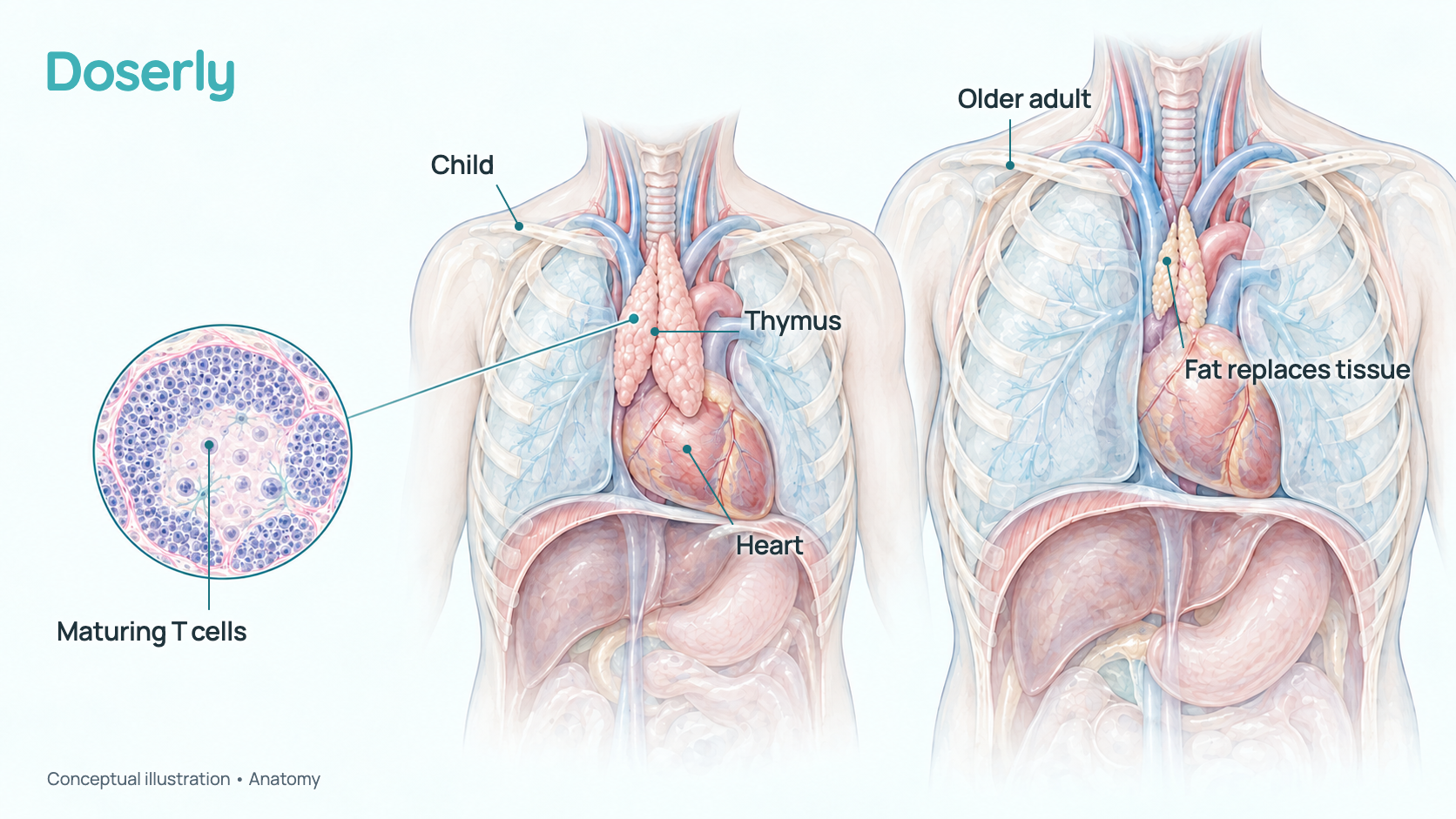
The thymus is a gland behind the breastbone where T cells, a kind of white blood cell, mature. Thymalin is a thymus extract developed by the Soviet researchers Vyacheslav Morozov and Vladimir Khavinson, who published its isolation in 1981, and in 1982 it became the first thymus peptide medicine approved for medical use in the USSR. [12], [13], [14] Its Russian name is Тималин (also spelled Timalin in English papers), and early papers used the name thymarin for the same or a closely related extract. [15]
What is in the vial? Each vial holds 10 mg of thymus extract and 20 mg of glycine, a simple amino acid added to form the powder. [1] The developer's chemical analysis describes the extract as peptides with a molecular mass up to 10 kDa (roughly up to 90 amino acids long). [16] An independent 2026 review describes thymus extracts such as Thymalin as “complex peptide mixtures rather than single defined molecular entities”. [2] So it has no single chemical formula or molecular weight, and “10 mg” is a weight of extract, not a measured amount of any one active ingredient. [17]
Several products are easily confused with it. Thymulin is a different thymus peptide: a defined chain of nine amino acids that needs zinc to work. A chemistry database files the name “Thymalin” under thymulin's record, so thymulin's molecular weight (858.9 g/mol) often appears online as Thymalin's. [18], [19] Thymogen (Glu-Trp) was first isolated from Thymalin and is now made in a lab; Vilon (Lys-Glu) and Crystagen (Glu-Asp-Pro) are lab-made peptides found in Thymalin only as traces, about 0.025 and 0.04 mg per gram. [20], [16] Thymosin alpha-1 is a separate 28-amino-acid thymus peptide with its own trials.
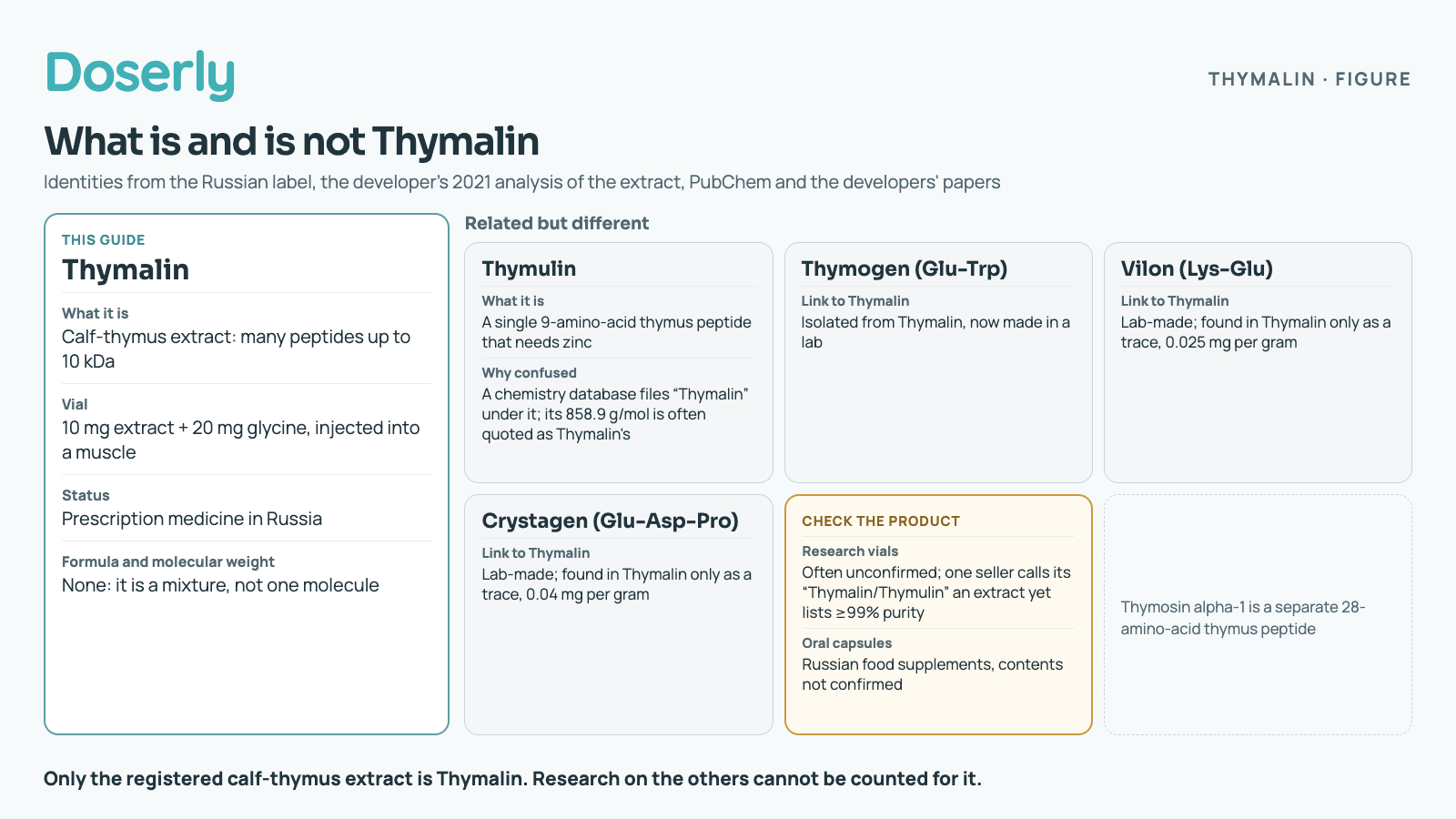
What is and is not Thymalin
Identities from the Russian label, the developer's 2021 analysis of the extract, PubChem and the developers' papers
- Thymalin · this guide
- What it is: Calf-thymus extract: many peptides up to 10 kDaVial: 10 mg extract + 20 mg glycine, injected into a muscleStatus: Prescription medicine in RussiaFormula and molecular weight: None: it is a mixture, not one molecule
Related but different
- Thymulin
- What it is: A single 9-amino-acid thymus peptide that needs zincWhy confused: A chemistry database files “Thymalin” under it; its 858.9 g/mol is often quoted as Thymalin's
- Thymogen (Glu-Trp)
- Link to Thymalin: Isolated from Thymalin, now made in a lab
- Vilon (Lys-Glu)
- Link to Thymalin: Lab-made; found in Thymalin only as a trace, 0.025 mg per gram
- Crystagen (Glu-Asp-Pro)
- Link to Thymalin: Lab-made; found in Thymalin only as a trace, 0.04 mg per gram
Check the product
- Research vials
- Often unconfirmed; one seller calls its “Thymalin/Thymulin” an extract yet lists ≥99% purity
- Oral capsules
- Russian food supplements, contents not confirmed
Thymosin alpha-1 is a separate 28-amino-acid thymus peptide
Only the registered calf-thymus extract is Thymalin. Research on the others cannot be counted for it.
Typical Thymalin Protocols
| Labeled use | Amount each time | Frequency | Total per day | Course |
|---|---|---|---|---|
| Treatment course (immune deficiency with infections, after radiation, chemotherapy or thymus removal, slow healing) | 5–20 mg | Once daily | 5–20 mg | 3–10 days, 30–100 mg in total, chosen by how severe the immune problem is; repeated after 1–6 months if needed |
| Prevention course | 5–10 mg | Once daily | 5–10 mg | 3–5 days |
The most common pattern in the reviewed sources is 10 mg once a day by intramuscular injection for 10 days, a 100 mg course, repeated after a break of several months. It sits inside the label and is the schedule of the only randomized, placebo-controlled trial and of the St Petersburg aging study. On protocol websites, 10 mg is the most common daily amount (14 of 37 pages), usually for 5–10 days, and two of three independent community education groups teach a 5–10 mg course of about 10 days. [4], [5], [21], [22]
- Titration Changing the amount in steps
- The label uses a fixed daily amount for the whole course; there is no starting step. Some websites suggest 5 mg a day for a first course and 10 mg for later ones. One page adds a 5-day, 5 mg “tolerance” run before a full 10-day course, which brings the total to 125 mg, above the label's 100 mg maximum. [1], [23], [24]
- Breaks and cycles
- Thymalin is used in short courses, not continuously. The label allows a repeat course after 1–6 months. The aging studies repeated courses once a year, or every 5–6 months, and the developers write that after thymus removal they prescribed a course every 6 months. Websites most often say once or twice a year; a few say every 3–4 months. [1], [5], [25], [26]
Read the units: one 10 mg vial is the daily dose used in most studies, so a 10-day course uses ten vials, and mg here means milligrams of extract. People who come from other peptides are often surprised by this: a common forum question is how a 10 mg vial can be a single day's amount. [28] Each amount in the table is for one injection given once a day, so the amount and the daily total are the same number. The label also lists smaller doses for children aged 6 months to 14 years (1–5 mg a day, by age), which a doctor prescribes. [1] How milligrams convert to syringe units.
Before you compare any of these numbers, five cautions.
- The label schedules are for the registered medicine. Research vials sold online as “Thymalin” are often not the registered extract, so a label dose may not match what is in them (see product quality). [3], [29]
- The label route is into a muscle only. Subcutaneous use is common online but has never been studied.
- Do not skip or replace treatment for an infection. Every study gave Thymalin alongside usual care, such as antibiotics, surgery or COVID-19 treatment; none tested it instead of them. [4]
- Pregnancy, breastfeeding and allergy. The label rules it out in pregnancy, in breastfeeding and in anyone allergic to the extract or to glycine, and advises caution with a history of allergy. [1]
- Children. The children's doses exist for doctor-prescribed treatment in Russia; nothing supports giving research vials to anyone under 18.
These are the labeled doses from the Russian product information; prescribers there choose the amount and course length by how severe the immune problem is. The tables below show what studies in people used and what protocol websites describe.
What doses did the studies in people use?
| Study | Amount each time | Frequency | Total per day | Duration |
|---|---|---|---|---|
| Severe COVID-19 in hospital (randomized trial, 2021) | 10 mg | Once daily | 10 mg | 10 days (100 mg) 36 people on Thymalin, 44 on salt-water placebo [4] |
| Older women in a veterans' home (aging study, St Petersburg) | 10 mg | Once daily | 10 mg | 10 days (100 mg), repeated a year later 24 women on Thymalin alone [5] |
| Adults with “accelerated aging” (aging study, Kiev) | 10 mg | 5 injections, 2–3 days apart | 10 mg on injection days | 8–12 days (50 mg), repeated every 5–6 months for 3 years (6 courses) 58 people on Thymalin in the table [5] |
| Adults with COVID-19 (an open randomized study in St Petersburg and a look-back study in Chita) | 10 mg | Once daily | 10 mg | 5 days (50 mg) 38 people on Thymalin in one report, 34 in another [30], [31] |
Nearly every published report used 10 mg into a muscle; only course length and spacing varied. A burns study gave 10 mg for 5–10 days, a study of mothers with infection after a caesarean section gave 10 mg for 10 days, and one study in older adults with memory complaints gave 5 mg into acupuncture points. [32], [33], [34] No study compared different amounts or looked for the best dose.
What schedules do protocol websites describe?
Outside Russia, most people buy research vials online rather than the registered medicine. These schedules come from protocol websites.
| Example | Amount each time | Frequency | Total per day | Duration |
|---|---|---|---|---|
| Low | 5 mg | Once daily | 5 mg | 5 days (25 mg), repeated every 3–4 months (described as “maintenance”) Protocol website [26] |
| Mid | 10 mg (5 mg suggested for a first course) | Once daily | 10 mg | 10 days (100 mg), once or twice a year Protocol website [23]; 10 mg a day for 10 days also on many other pages [21], [36], [37] |
| High | 10–20 mg | Once daily | 10–20 mg | 10 days (100–200 mg), once or twice a year Blog protocol [35]; the top of this range is double the label's 100 mg course maximum |
On protocol websites, 10 mg a day is the most common amount, usually for 5–10 days and repeated once or twice a year. Fourteen of the 37 pages compared give 10 mg as the daily amount, and most others give a 5–10 mg range. [21], [38], [25] Low, mid and high are alternatives, not steps to move through, and each row's amount and duration belong together. These schedules come from protocol websites rather than clinical trials; the cited references give the full details.
In community education groups, two of three independent groups teach the label-style course: 5–10 mg once a day for about 10 days, often 10 mg into a muscle, repeated anywhere from once a year to every three months, and one caps it at twice a year. A third group gives 1–2 mg a day as a blanket figure for all “bioregulator” peptides, which is below the label's lowest adult dose and not based on Thymalin research. In member threads, that group's educator explains the split: the registered medicine gets 5–10 mg a day for 5–10 days, while research vials get 1–2 mg a day, because the educator regards them as a different, lab-made product.
Where protocols differ: products, per-course totals and repeat intervals ↓
Where these numbers come from
Label table. The rows reproduce the adult dosing section of the Russian product information for Thymalin 10 mg (registration LP-№(005867)-(RG-RU), 21 June 2024), as summarized in the Vidal drug directory (the state register's own copy was not retrieved), and the manufacturer Samson-Med's English product page, which adds the 1–2 mL of isotonic salt water. A vendor-hosted English translation of the instructions adds that the mixed solution should not be stored. [1], [11], [27]
Study table. Each row is the schedule stated in the full text of the study: the 2021 Chita COVID-19 trial, the two arms of the 2003 aging report (St Petersburg and Kiev) and the St Petersburg and Chita COVID-19 studies that gave 5 days. [4], [5], [30], [31]
Website table. Each row is one publisher's complete schedule: Peptides Institute for the low row (its “maintenance protocol”), BodyHackGuide for the mid row and a Substack post by Derek Pruski for the high row. [26], [23], [35] We compared 37 dosing pages from 36 publishers, checked every quoted dose against a saved copy on September 26, 2026, and grouped them by where their numbers seem to come from: the label (5 pages), the COVID-19 trial (6), a generic “Russian clinical course” of 5–10 mg for 5–10 days repeated every few months (21), micro-doses (4) and extended cycles (1). About 220 more addresses were excluded because they returned errors, were shop pages without dosing or did not mention Thymalin.
Excluded from the typical comparison: 0.005–0.05 mg “per trial”, which one page took from the doses of a different medicine in a mouse study; 200–400 mcg and 1–3 mg “maintenance” tiers with no source; a 1–2 mg pen of unknown content; and 10 mg a day for 20 days or every other day for 60–90 days, which have no clinical source. They are discussed below. [39], [40], [41], [42], [43]
What is Thymalin commonly used for?
People look into Thymalin for four broad reasons: to catch fewer colds and infections, to recover from a serious infection such as COVID-19, to slow the decline of the immune system with age, and, in public forums, to calm allergies or an overactive immune system. It is often taken in autumn and spring courses, alongside other Russian “bioregulator” peptides such as Epitalon. [23], [44], [45]
In Russia its labeled uses are narrower and medical: immune deficiency in adults and children with bacterial or viral infections, including severe ones; lasting thymus problems after radiation injury, a thymus tumor or surgical removal of the thymus; slow healing; and weakened immunity and blood-cell production after chemotherapy or radiotherapy for cancer. [1] The label classes it as an immunostimulant, and its developers call it an immunomodulator: a substance that adjusts immune activity. The sections below describe what was measured; they do not show that Thymalin treats or prevents any condition.
Frequent infections and “immune support”
This is the most common reason people give, and the least tested one in healthy adults. In small Russian reports, adding Thymalin to usual care raised lymphocyte and T-cell counts in the blood of people who were ill, and a developer meta-analysis that kept 4 of about 700 papers from one Russian database called that effect “large”. [14], [5] A higher blood count is not the same as fewer infections. Two small studies from outside the developer's network did count illnesses: Moldovan patients recovering from a skin infection (erysipelas) relapsed less often (5 of 26 versus 10 of 26), and Kazakh children given drops in the nose once a week caught fewer colds over one winter (7 of 35 versus 12 of 35). [46], [47] Neither was a placebo-controlled trial or reported a statistical test, and in groups this small both differences could easily be chance. See the human research.
Recovering from serious infections, including COVID-19
Most of the recent research is here. In the only randomized, placebo-controlled trial, people hospitalized with severe COVID-19 who received 10 mg a day for 10 days alongside usual treatment died less often in hospital (7 of 36 versus 18 of 44 on placebo), although their CT scans and time to improvement did not differ. [4] Older Soviet and Russian reports added it to treatment for burns, lung abscess and infection of the womb after a caesarean section, and describe faster recovery of blood tests and shorter hospital stays. [48], [49], [33] See what the COVID-19 trial found.
Healthy aging and a longer life
The anti-aging reputation rests on one report: a 2003 paper by the developers titled “Peptides of pineal gland and thymus prolong human life”. In a St Petersburg veterans' home, 10 of 24 older women given Thymalin courses died over six years, compared with 18 of 22 on placebo. [5] The groups were small, the methods are thinly described, and some of the paper's death rates do not match its group sizes (see the details). No independent team has tested this, and the lifespan studies in mice gave mixed results (see how it might work).
Allergies, autoimmune conditions and long illnesses
In public forums, people describe using Thymalin for histamine problems, allergies, autoimmune skin conditions and lingering illness after infections, usually alongside thymosin alpha-1 and other products. [50], [44] No study has tested Thymalin in autoimmune disease, and whether an immune-stimulating product could make one worse is unknown (see the risks).
Other uses you may come across
Soviet and Russian reports also added Thymalin to treatment for cervical cancer during radiotherapy, endometrial cancer, gum disease, Parkinson's disease, treatment-resistant schizophrenia, memory complaints in older adults and chronic lung disease in children. [51], [52], [53], [54], [55], [34], [56] Each is a single small report, mostly without random assignment. Claims that Thymalin protects telomeres, rejuvenates stem cells or keeps working for months after a course have no Thymalin study behind them.
Where do Thymalin protocols differ?
The 10 mg, 10-day course is easy to summarize. The disagreements start when pages mix up products, per-day and per-course amounts, routes, or the schedules of different studies. Here is what varies and why it matters.
Which “Thymalin” is the number for?
Check this first. The registered medicine comes in 10 mg vials of extract from one Russian manufacturer, and a Russian reseller sells it abroad. [11], [57] Research vials of 10 or 20 mg sold under the same name often cannot be confirmed as that product. One seller describes its “Thymalin/Thymulin” as a calf-thymus extract yet lists a purity of 99% or more, which cannot apply to a mixture of many peptides, so its label cannot be taken at face value. [3] A prefilled pen sold as “thymalin” in one online shop is titled Crystagen (Glu-Asp-Pro). [29] Oral “Thymalin” capsules and tablets are Russian food supplements, not the injectable medicine, and we could not confirm their contents. The label doses apply to the registered extract, not to whatever else carries the name.
Is the number for one day or the whole course?
The label gives both: 5–20 mg per day, and 30–100 mg per course. [1] Some pages mix them up. One gives “roughly 5 to 20 mg per treatment course, often cited around 10 mg total”, which is a single day's dose presented as a whole course. [58] Another describes 1–3 mg “per course injection” for maintenance. [41] At 10 mg a day, a 10-day course is 100 mg; spreading 10 mg over 10 days would be 1 mg a day, a tenfold difference. The figure below puts the course totals side by side.
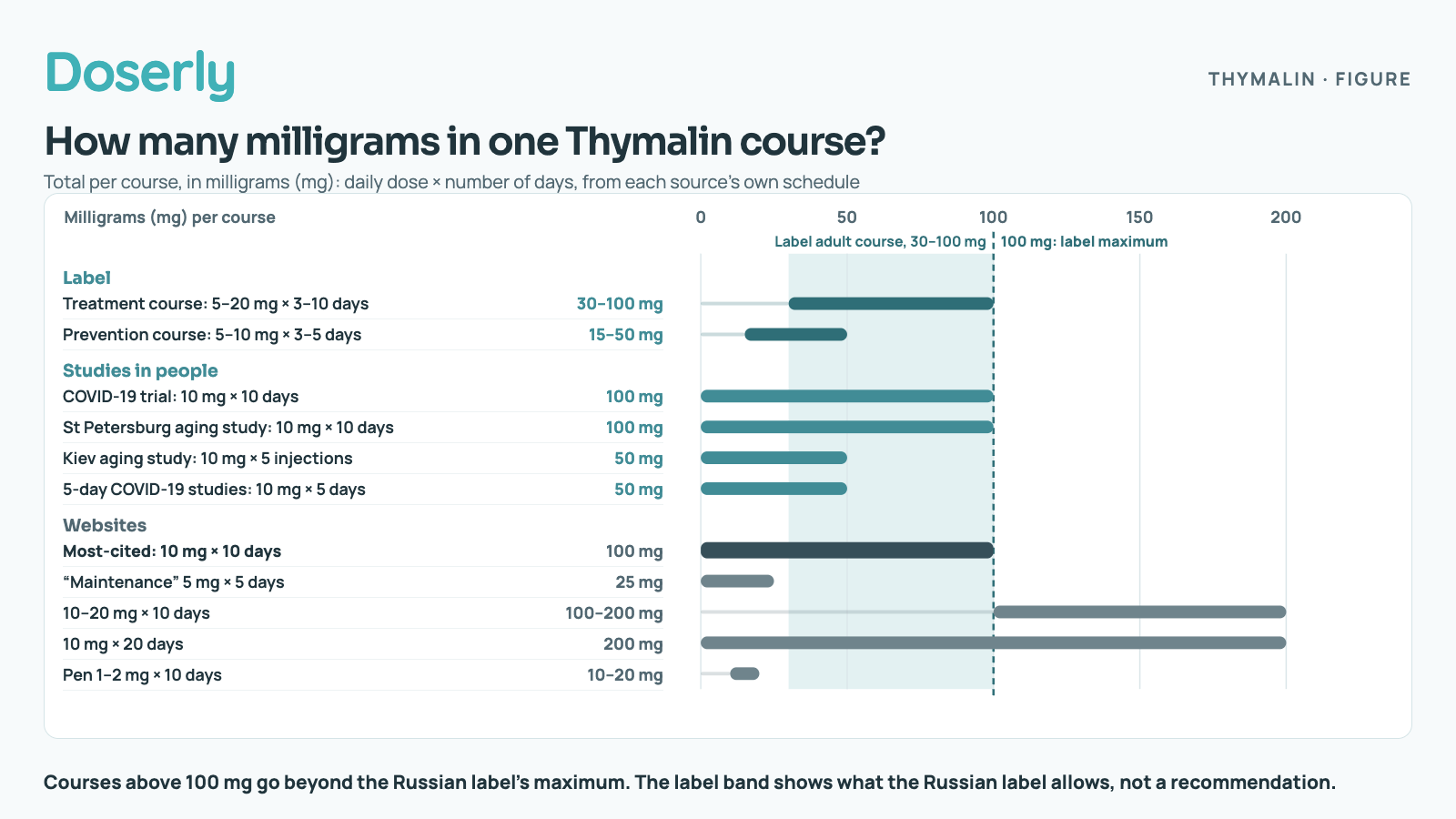
How many milligrams in one Thymalin course?
Total per course, in milligrams (mg): daily dose × number of days, from each source's own schedule. The shaded band is the label adult course (30–100 mg); the dashed line is the label maximum, 100 mg.
Label
- Treatment course: 5–20 mg × 3–10 days
- 30–100 mg per course
- Prevention course: 5–10 mg × 3–5 days
- 15–50 mg per course
Studies in people
- COVID-19 trial: 10 mg × 10 days
- 100 mg per course
- St Petersburg aging study: 10 mg × 10 days
- 100 mg per course
- Kiev aging study: 10 mg × 5 injections
- 50 mg per course
- 5-day COVID-19 studies: 10 mg × 5 days
- 50 mg per course
Websites
- Most-cited: 10 mg × 10 days
- 100 mg per course
- “Maintenance” 5 mg × 5 days
- 25 mg per course
- 10–20 mg × 10 days
- 100–200 mg per course
- 10 mg × 20 days
- 200 mg per course
- Pen 1–2 mg × 10 days
- 10–20 mg per course
Courses above 100 mg go beyond the Russian label's maximum. The label band shows what the Russian label allows, not a recommendation.
Five days or ten?
Both appear in the research, and websites often blur them. The randomized COVID-19 trial gave 10 mg for 10 days, while an open St Petersburg study and a look-back study from Chita gave 10 mg for 5 days. [4], [30], [31] Several pages describe “the COVID-19 study” as 5–10 days or as 5 days, which mixes the designs. [59], [60] The label range is 3–10 days, chosen by severity, and its prevention course is 3–5 days. [1]
How often is a course repeated?
The label allows a repeat after 1–6 months “if needed”. [1] The aging studies repeated a 10-day course a year later in St Petersburg and a 5-injection course every 5–6 months in Kiev. [5] Websites range from once a year through “every 6 months” to every 3–4 months, and one page ties the interval to age: every 6 months over 60, every 12 months if younger. [25], [26], [37], [61] In community education groups, advice runs from once a year to quarterly; the most cautious group allows at most two courses a year, about 6 months apart. One educator and some members also keep vials on hand and start an extra course when a cold begins. Nothing shows that more frequent courses work better, quarterly courses go beyond anything the developers tested, and we found no study of starting a course when symptoms begin.
Longer courses and higher doses
Some pages go past the label. One describes 10–20 mg a day for 10 days, up to 200 mg per course, and another calls 10 mg a day for 20 days, followed by 20 days off, its “most common protocol”, with every-other-day dosing for 60–90 days as an option. [35], [43] Neither cites a study, and both exceed the label's 100 mg course maximum. One protocol website removed its own earlier 10–20 mg, 10–20-day range because the clinical work used 10 mg for 10 days. [36] The most experienced public forum user, after about a dozen courses, found that 10 mg for 20 days “did nothing extra” compared with 10 days, and saw no added benefit from 20 mg a day. [62] In member threads of community education groups, two educators' answers also pass the label's limits: one gives 2–5 mg (up to 10 mg) a day for 10–20 days, up to twice the label's longest course, and another 10–20 mg a day for 10 days, up to twice its 100 mg course total. One member used Thymalin daily for about a month with other peptides, and another planned to include it in an eight-week stack.
Where do 1–2 mg, 200–400 mcg and 0.005 mg come from?
Not from Thymalin research. The 1–2 mg figures match the label's doses for young children, a pen product sold in 100 mcg “clicks”, and a blanket figure some educators apply to every bioregulator peptide. [1], [42] A “conservative” 200–400 mcg course appears to be copied from pages about lab-made short peptides. [40] One page lists 0.005–0.05 mg “per trial”, citing a mouse study; in that study, 0.005 and 0.05 mg per kg were doses of a different peptide medicine, tinrostim, not of Thymalin. [39], [63] Unit confusion also travels between peptides: in the same comment, that experienced forum user adds, without a source, that “the correct dosage is now 100mcg per day”. [62]
Into a muscle or subcutaneously?
The label and every study with a stated route used intramuscular injection. [1], [4] Many websites offer subcutaneous injection as a “community refinement”, and one suggests placing it under the tongue. [64], [65] No one has compared routes, so whether the same amount given subcutaneously behaves the same way is unknown. In community education groups, members ask in several threads whether a subcutaneous injection will do instead, sometimes because an injection into a muscle puts them off, and no one could point to a comparison; one educator said their usual short needle may not reach the muscle anyway. How routes compare.
Do sources start low and step up?
The label does not; the same daily amount runs through the course. [1] Some websites suggest a first course at 5 mg a day and later courses at 10 mg, or a short 5 mg “tolerance” run before the full course. [23], [24] In public forums, a few people start at 1 mg or lower and work up to 3–4 mg, far below the label amounts. [66], [67]
How do milligrams convert to syringe units?
Injection pages often give amounts as “units” on an insulin syringe. A U-100 syringe holds 100 units per millilitre, so units measure volume, not an amount of Thymalin. How much extract each unit holds depends on how much liquid was added to the vial (reconstitution).
For example, a 10 mg vial mixed with 1 mL holds 10 mg per mL, so each unit holds 0.1 mg (100 mcg) and a 10 mg dose is the whole vial, 100 units. [61] The manufacturer's instructions use 1–2 mL of salt water and inject the whole vial into a muscle; with 2 mL, 10 mg is the full 2 mL, more than a standard 1 mL insulin syringe holds. [11], [17] A 20 mg research vial mixed with 2 mL also holds 10 mg per mL. Doserly's reconstitution calculator works this out for any vial and shows each step.
Source-by-source comparison
Unit key: 1 milligram (mg) = 1,000 micrograms (mcg). A 10 mg vial mixed with 1 mL gives 100 mcg per syringe unit.
Label-based pages
PeptideTables: 5–20 mg a day for 5–10 days, cycled once or twice a year. Peptides.media: 5–20 mg a day for 3–10 days, with repeat courses in some settings (it also says Thymalin is registered in Belarus, which we could not confirm). PeptideX: 5–20 mg a day, 10 mg in the aging protocol, noting that 10 mg of an extract is a weight of powder rather than a defined amount of active substance. Kalios: typically 10 mg a day for 10 days, applied to the whole aging cohort. PeptideMind: 1–20 mg a day for 3–10 days, which folds the children's 1 mg dose into an adult range. [68], [69], [17], [70], [71]
COVID-19 trial pages
PeptideDosage.org: 10 mg a day into a muscle for a 5–10-day course. CalcMyPeptide and Peptides.wiki: 10 mg a day for 10 days. StackTrax: now 10 mg for 10 days, having dropped its earlier 10–20 mg for 10–20 days. Peptide Schedule: 5–10 mg for 10 days every 6–12 months. Radix Peptides reports the 5-day schedule of the open studies. [72], [21], [37], [36], [61], [60]
“Russian clinical course” pages
PeptideWiki.co, DosagePeptide, Bioalmanac, The Peptide Catalog, Research Protocols, Wikipep, PeptScope, PepGuide, Peptide Initiative, Bioregulator Peptides UK, Ki Researcher and others: 5–10 mg (usually 10 mg) once a day for 5–10 days, repeated every 3–12 months. Peptides Institute adds 5 mg for 5 days every 3–4 months as “maintenance”; BodyHackGuide suggests 5 mg for a first course and describes up to 3–4 courses a year at 10–15 mg for “intensive” use. Derek Pruski: 10–20 mg for 10 days, one or two cycles a year. [64], [25], [73], [38], [74], [75], [65], [76], [24], [77], [78], [26], [23], [35]
Micro-dose and extended pages
Peptide Dosage Charts: 0.005–0.05 mg “per trial”, citing a mouse study in which those per-kg amounts were doses of a different medicine, tinrostim. The Peptide Toolkit: 5–10 mg standard, or 200–400 mcg subcutaneously for 10 days, 3–4 times a year. MyPeptidePal: 1–3 mg “per course injection” for maintenance. A Ukrainian pen seller: 1–2 mg (10–20 clicks) a day for 10 days. StackBuilder: 10 mg a day for 20 days then 20 days off, or every other day for 60–90 days. [39], [40], [41], [42], [43]
Errors found
Path to Peptides says its dosing was fact-checked against FDA labels; no FDA label for Thymalin exists. Biomogging describes the aging study as yearly 5-day courses in 266 people, and Kalios applies the St Petersburg schedule to everyone; the paper used two different schedules, and 266 counts every group at both centres. SeekPeptides says the COVID-19 study used 5–10 days and claims use in “millions of patients” with no source. Bioalmanac advises refrigerated storage, stricter than the label's 2–25 °C. CalcMyPeptide calls the label dose “Russian labeling folklore”, although the label belongs to a registered prescription medicine. [79], [80], [70], [59], [73], [21], [9]
What happens when you stop Thymalin?
Thymalin is designed to stop: every schedule is a short course. No study has looked for withdrawal or rebound effects, and none has measured how long any change lasts after a single course.
The closest evidence is a developer case series of 7 people who had their thymus removed for a benign tumor. After a Thymalin course their symptoms improved and the “remission was preserved for 6–8 months”, then signs of immune deficiency returned, so the doctors repeated courses every 6 months, some for 15–20 years. [5] That is the reasoning behind twice-yearly courses; it comes from a special group without a thymus, not from healthy adults.
Public forum accounts are few. One person felt that a course made “something of a lasting change” to their sleep; another, after about 12 courses, keeps using 10-day courses for fatigue; someone who had nausea and sweats stopped around day 10 and had no problems after going back to thymosin alpha-1; and a person who developed widespread skin pain on day 6 still had it four days after stopping. [81], [62], [7], [6] In community education groups, one member found a raised eosinophil count near the end of a course and posted no later result, so whether it settled after stopping is unknown.
In community education groups, the more careful educators suggest a blood count before a course and 4–6 weeks after it, and stopping after two measured courses that change nothing. That is educator advice, not a tested rule. The end of a course is a sensible time to review how you feel, and any results, with a clinician.
How is Thymalin taken, and how long does it last?
The registered medicine is made for one route: intramuscular injection, into a muscle, which usually has a rich blood supply. [1] Other routes in circulation are:
- Subcutaneous injection (into the fatty layer under the skin), which many protocol websites offer and many people online use. Nobody has measured how the extract is absorbed this way. [64], [23]
- Drops in the nose (intranasal). One Kazakh study gave children 1–2 drops of the dissolved medicine in each nostril once a week, an unlabeled use. [47]
- Injection into acupuncture points, used in one Russian study in older adults. [34]
- Under the tongue, suggested by one website without a source. [64]
- Oral capsules or tablets sold as “Thymalin” are Russian food supplements, not the medicine; we could not confirm what they contain.
Bioavailability, how much of a dose reaches the blood in a usable form, has not been measured for Thymalin by any route.
How long does Thymalin last in the body?
Nobody knows. No study has measured its half-life or blood levels in people. Pharmacokinetics, the study of how the body absorbs and clears a substance, is simply absent from the label. [1] A vendor-hosted English translation of the instructions says it is “completely absorbed from the injection site and rapidly broken down into its constituent natural amino acids”, but gives no study for it. [27] A laboratory test that can detect the thymus extract in samples was described in 1987, yet we found no human blood-level data from it. [82] Website figures such as a peak at 2.5 hours and 60 hours of activity trace to no study. [80]
For a mixture, a single half-life may not even make sense: each peptide in it could be absorbed and broken down at a different speed. What the developers argue instead is that effects outlast the injections, which is why courses are short and spaced months apart. [5]
Does oral or under-the-tongue Thymalin work?
There is no measurement in people or animals for Thymalin taken by mouth or under the tongue. Most peptides are broken down in the gut, and the Russian medicine is not made or labeled for either route. Capsule products using the name are supplements with their own contents. In community education groups, educators make the same distinction: extract capsules are not the injectable medicine.
What about Thymalin with Epitalon, thymosin alpha-1 and other stacks?
Thymalin is rarely taken alone. Combinations people search for include:
- The “Khavinson stack”: Thymalin with Epitalon. It is modeled on the 2003 aging study, which paired Thymalin with Epithalamin, a calf pineal-gland extract. Epitalon is a lab-made four-amino-acid peptide, not the same product, so the study cannot be counted for the modern pairing. [5], [23]
- Thymalin with thymosin alpha-1, either as separate injections or as premixed “TA-1 complex” vials whose Thymalin content is unknown. [83], [45] Community education groups disagree, sometimes within the same group: some call this the most common immune pairing, and others say never to run two thymus products at once. A premixed thymus blend shared in one of these groups listed thymulin, not Thymalin, beside thymosin alpha-1.
- Thymalin with Vilon, Crystagen or Thymogen, short peptides found in it or first isolated from it.
- Thymalin with growth-hormone peptides or BPC-157, in larger anti-aging stacks. [62], [44]
None of these combinations has been studied. A stack makes any benefit or reaction impossible to attribute, and one group's advice to add zinc to support thymus signaling appears to come from thymulin, which needs zinc, not from Thymalin.
How should Thymalin be stored, and how long does it last?
- Registered medicine, before mixing. The Russian label says to store it at 2–25 °C (36–77 °F). The vendor-hosted English instructions add “protected from light” and a shelf life of 3 years. No stability study was found beyond this. [1], [27]
- Registered medicine, after mixing. The manufacturer's method dissolves the vial in salt water immediately before the injection, and the instructions say the mixed solution should not be stored. [11], [27]
- Research vials. Websites advise keeping the powder refrigerated at 2–8 °C, or frozen at −20 °C for long periods, and mixing it with bacteriostatic water (sterile water containing a preservative) instead of salt water. [72], [40] Their “use within” advice for a mixed vial runs from 1–2 hours to 4–6 weeks, including 5–7 days, 10 days, 14 days and 28–30 days. None cites a stability test. [84], [26], [61], [43], [79], [59]
Because the label course uses a whole vial each day, there is little reason to keep a mixed vial at all. Cold storage cannot tell you what a research vial contains (see product quality).
What do we actually know about Thymalin in people?
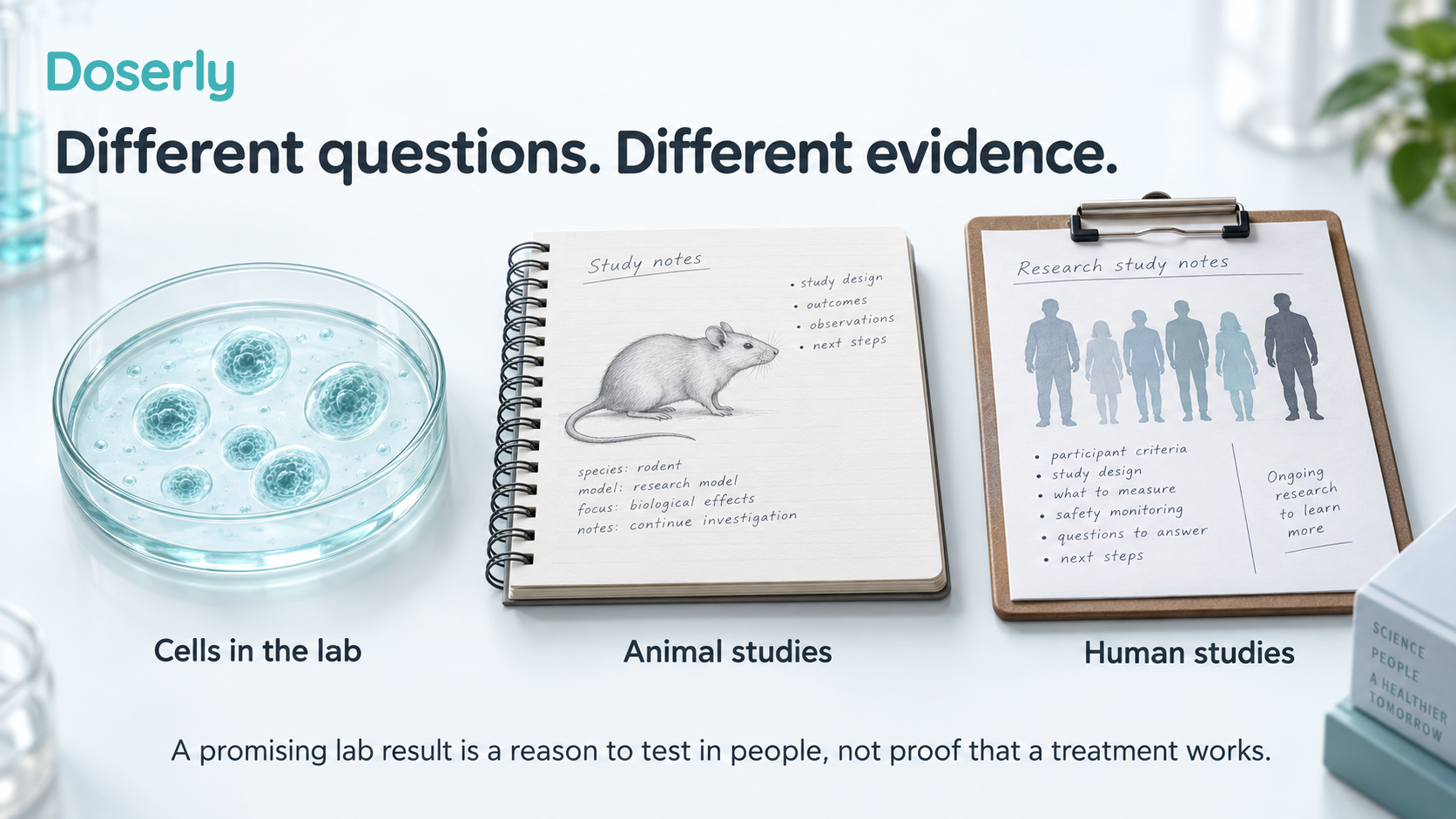
More than for most “bioregulators”, but the evidence is weak by modern standards. PubMed lists well over a hundred human reports since 1981, nearly all Soviet or Russian, most available only as a title or a short abstract. Almost all come from the developers in St Petersburg or their long-standing partners at the Chita medical academy. There is one small randomized, placebo-controlled trial, no study on ClinicalTrials.gov and no Western trial. [4], [85], [86] An independent 2026 review notes “regional clinical use, particularly in Eastern Europe” but says such thymus extracts “remain largely outside global clinical guidelines”. [2]
What did the 2021 COVID-19 trial find?
The question: does Thymalin help older adults hospitalized with severe COVID-19? At the Chita State Medical Academy hospital in Russia, 80 adults with severe COVID-19 (average age about 62, most in intensive care) were assigned by chance to usual treatment plus a daily injection into a muscle for 10 days: salt water as a placebo for 44, and 10 mg of Thymalin for 36. The paper calls it single-blind and says the allocation was hidden from the treating doctors; it does not say who else was blinded. [4]
The trial named three main outcomes (primary endpoints):
- Clinical improvement (two steps up a seven-point World Health Organization scale): 29 of 36 on Thymalin (81%) versus 26 of 44 on placebo (59%), a statistically significant difference.
- Time to improvement: 8.6 days on Thymalin versus 7.6 on placebo, no significant difference.
- Improvement on a CT scan of the lungs at day 14: 31% versus 23%, no significant difference.
Among the secondary endpoints, 7 of 36 people given Thymalin (19.4%) died in hospital versus 18 of 44 given placebo (40.9%). More recovered from low lymphocyte counts (67% versus 43%), and by day 14 the inflammation marker IL-6 and the clotting marker D-dimer were lower than on placebo. C-reactive protein, another inflammation marker, fell further on Thymalin but from a much higher starting level, and at day 14 it was still higher than on placebo. [4]
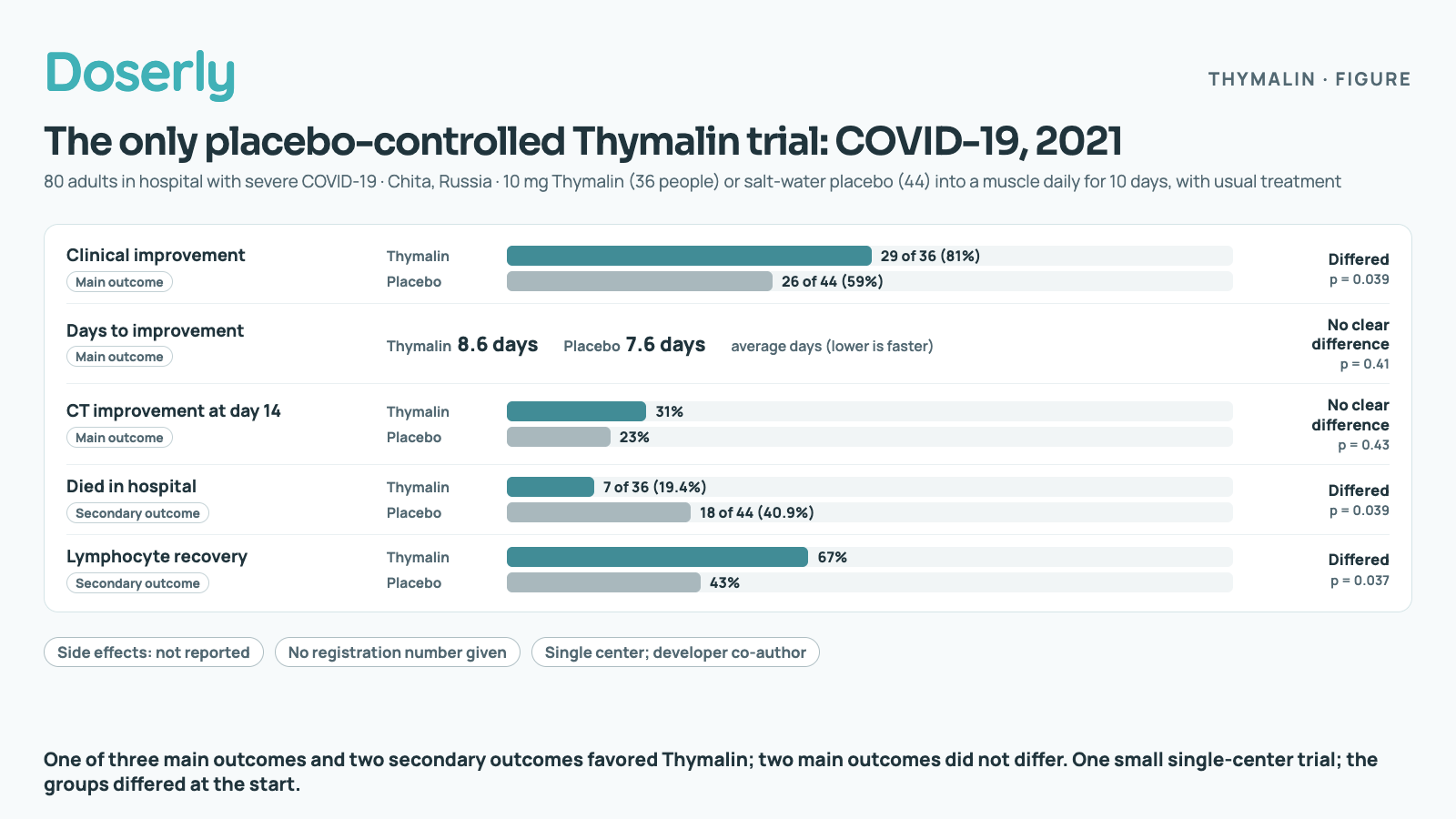
The only placebo-controlled Thymalin trial: COVID-19, 2021
80 adults in hospital with severe COVID-19 · Chita, Russia · 10 mg Thymalin (36 people) or salt-water placebo (44) into a muscle daily for 10 days, with usual treatment
- Clinical improvement (main outcome)
- Thymalin: 29 of 36 (81%)Placebo: 26 of 44 (59%)Result: Differed (p = 0.039)
- Days to improvement (main outcome)
- Thymalin: 8.6 daysPlacebo: 7.6 daysResult: No clear difference (p = 0.41)
- CT improvement at day 14 (main outcome)
- Thymalin: 31%Placebo: 23%Result: No clear difference (p = 0.43)
- Died in hospital (secondary outcome)
- Thymalin: 7 of 36 (19.4%)Placebo: 18 of 44 (40.9%)Result: Differed (p = 0.039)
- Lymphocyte recovery (secondary outcome)
- Thymalin: 67%Placebo: 43%Result: Differed (p = 0.037)
Side effects: not reported · No registration number given · Single center; developer co-author
One of three main outcomes and two secondary outcomes favored Thymalin; two main outcomes did not differ. One small single-center trial; the groups differed at the start.
What it cannot establish. It is one small trial at one hospital, with one of the drug's developers among its authors. The paper gives no registration number and we found none on ClinicalTrials.gov (the WHO and Russian trial registries were not searched), so we could not check whether its outcomes were set in advance. The groups were unequal in size and did not start out alike: the Thymalin group began with significantly lower lymphocyte, T-cell and natural killer cell counts and higher C-reactive protein, so part of its “recovery” may be a drift back toward usual levels rather than a drug effect. Fewer people on Thymalin were put on a breathing machine during the study (25% versus 45%), a difference that fell just short of statistical significance. Many measures were compared, and the death result was a secondary outcome, so it could be a chance finding. Side effects were not reported; the authors state that Thymalin “has no side effects when used in older age groups”, citing earlier work rather than data from this trial. [4] Two 2022 papers from the same team compare Thymalin and tocilizumab with a usual-care group. One reports 20.6% deaths on Thymalin (16.2% in its Russian abstract) against the same 40.9% control death rate, and the difference from 19.4% is not explained. [87] The other describes its control group as 44 people aged about 62 on usual treatment, with no mention of placebo, the same size and age as the trial's placebo group, and gave Thymalin for 5 days to patients chosen by their doctors. [31] So the same control patients appear to have been reused, and how the placebo group was formed is unclear. No other team has repeated the trial.
Did Thymalin help older people live longer?
This claim comes from a 2003 report by the developers, “Peptides of pineal gland and thymus prolong human life”, which combined two studies. [5]
- St Petersburg (1996–2001). 94 women aged 66–94 in a war veterans' home were split into four groups by “stratification randomization”: placebo, Thymalin, Epithalamin (a calf pineal extract) or both. Thymalin was 10 mg into a muscle daily for 10 days, repeated a year later. Over six years, 18 of 22 women on placebo died (81.8%), compared with 10 of 24 on Thymalin (41.7%) and 8 of 24 on both extracts (33.3%). A separate group of 20 people given both extracts every year for six years had a 20% death rate.
- Kiev (1992–1999). Adults with “accelerated aging” received 10 mg injections five times, 2–3 days apart, every 5–6 months for three years. Over eight years, 13.6% of the control group died versus 6.6% on Thymalin.
What it cannot establish. The groups were tiny, the randomization and “double blind” methods are not described, and outcomes were not independently checked. In the Kiev part, the reported death rates (13.6%, 6.6% and 8.5%) cannot be produced from the listed group sizes of 48, 58 and 46; 13.6% of 48, for example, is not a whole number of people. The headline “266 people” counts every group at both centers, including those given only Epithalamin. [5] A Russian version reports the same study. [88] No independent team has tested whether Thymalin extends human life.
What did the other COVID-19 studies find?
- An open randomized study in St Petersburg (2020): 38 adults given 10 mg a day for 5 days with usual treatment, against 37 on usual treatment alone. Antibodies to the virus fell by 21% over the next three and a half months, compared with 53% on usual treatment. [89]
- A follow-up in older adults (2021): 38 people on Thymalin versus 50 on usual treatment; at 200 days, antibody levels were 4.25 times higher and lymphocyte and T-cell counts had returned to normal in the Thymalin group. [30]
- A look-back study in Chita (2022): 159 people with severe COVID-19 on usual treatment, the anti-inflammatory drug tocilizumab or Thymalin (10 mg daily for 5 days); the authors concluded that Thymalin had the best effect on blood clotting. [31]
A developer review and a single case report describe the same work. [90], [91] None of these studies hid who received the drug, and they measured blood tests rather than survival or illness.
What other conditions were studied?
| Report | What was reported | What it cannot establish |
|---|---|---|
| Severe burns, 2000 and 2003 | In 32 patients, skin grafting happened about 5 days earlier and hospital stays were 11 days shorter; in a larger series (76 of 317 on Thymalin, 10 mg daily for 5–10 days), immune tests normalized when it was started early. Started on day 12, it did not help. [48], [32] | Groups were not assigned by chance; the late-start result is a pilot of 10 people. |
| Infection of the womb after caesarean section, 2011 | 30 women on 10 mg daily for 10 days, 30 on Thymogen, against usual care; immune and clotting tests improved in both peptide groups. [33] | Small, open and from the developer's partner academy. |
| Acute lung abscess, 2012 | Faster normalization of signs of whole-body inflammation. [49] | Abstract only; no numbers in it. |
| Cervical and endometrial cancer, 1984–1991 | Added to cancer treatment in 35 women with endometrial cancer and 50 with cervical cancer, with better immune tests reported; in advanced cervical cancer, 38 women given it with radiotherapy more often went on to radical surgery than 58 on radiotherapy alone. [52], [92], [51] | Whether it changed the cancer: abstracts only, no survival comparison we could read. |
| Nervous system and mental health, 1990 and 1999 | Added to treatment in 36 people with treatment-resistant schizophrenia and 15 with Parkinson's disease. [55], [54] | Uncontrolled or abstract-only reports. |
| Memory complaints in older adults, 2018 | 26 people received 5 mg into acupuncture points five times, against 23 controls; no side effects were seen. [34] | An unusual route; the article carries the manufacturer's advertisement. |
| Other reports | Gum disease (30 patients), complicated appendicitis (10 on Thymalin as a comparison group), children with chronic lung disease (1 mg per kg per course). [53], [93], [56] | Small and older; the children's study says patients were divided at random but gives no method. |
Has anyone outside the developer's network studied it?
Two small comparison studies came from elsewhere, plus an uncontrolled Ukrainian report of 15 people with Parkinson's disease. [54] In Moldova, 52 people recovering from erysipelas (a skin infection) who were at high risk of relapse received monthly penicillin injections with or without ten 10 mg doses of Thymalin; 5 of 26 in the Thymalin group relapsed (19.2%) versus 10 of 26 without it (38.5%), over 1–4 years. It is a conference poster, and how patients were allocated is not stated. [46] In Kazakhstan, 35 children given 1–2 drops of Thymalin in each nostril once a week over a winter had fewer colds (7 of 35, or 20.0%, versus 12 of 35, or 34.3%, among comparison children using other preventive measures), and no side effects or allergic reactions were seen. [47] Neither used a placebo or reported a statistical test, and in groups this small both differences could easily be chance.
In animals, results from teams outside the developer's network are mixed. An East German team found that Thymalin had “practically no effect” on the spread of melanoma in mice, and a Soviet team found that it did not lengthen the lives of mice with leukemia. [94], [95] Two other Soviet and Russian teams reported that it strengthened the effect of cancer drugs in mice and shrank transplanted tumors in rats. [96], [97] A developer meta-analysis that searched one Russian database and kept 4 of about 700 papers reported a “large” effect on T-cell counts, but it did not assess the risk of bias, so it does not add independent evidence. [14]
Why are these studies so hard to judge?
- Almost all come from one network. The developers or their Chita partners wrote nearly every paper, and no team outside Eastern Europe has published a trial.
- Added to other treatment. Everyone also had usual care, such as antibiotics, surgery or COVID-19 treatment, and many of these conditions improve on their own.
- Blood tests more than outcomes. Most measured immune cell counts rather than infections, complications or survival.
- Missing methods. Randomization and blinding are rarely described, and some papers' numbers do not agree with each other.
- No side-effect collection. Authors state that Thymalin has no side effects, but none describes looking for them systematically. [13]
- Much of it cannot be read in full. Many reports exist only as a title or a short Russian abstract.
None of this means the reports are false. It means they cannot show that Thymalin caused the improvements, or that it is safe.
What did these studies measure?
- Immune cell counts: lymphocytes, T cells (CD3), helper and cytotoxic T cells (CD4 and CD8), B cells (CD20) and natural killer cells, plus antibodies. [4], [5]
- Inflammation and clotting: C-reactive protein, the cytokine IL-6, D-dimer and fibrinogen in the COVID-19 studies. [4], [87]
- Hormones and metabolism in the aging studies, and clinical milestones such as deaths, days in hospital and relapses. [5], [46]
What they did not measure is what matters most for everyday use: side effects, results in healthy adults, and the effect of repeated courses of research vials.
How might Thymalin work?
The label says Thymalin restores disturbed immune reactivity: it “regulates the number and ratio of T and B lymphocytes”, stimulates cell-based immunity and the engulfing of germs by immune cells (phagocytosis), and stimulates tissue repair and blood-cell formation when these are suppressed. [1] How it would do this is not established. The experiments below are preclinical (cell studies in a dish and animal studies), and nearly all come from the developer's network.
What is actually inside the extract?
Many peptides, and only a few have been identified. In 1997 the developers reported isolating a two-amino-acid peptide, Glu-Trp, from Thymalin; it became the separate lab-made drug Thymogen. [20] A 2021 chemical analysis found Lys-Glu (Vilon) at 0.025 mg per gram and Glu-Asp-Pro (Crystagen) at 0.04 mg per gram, which the authors call “minor components”. [16] By our arithmetic, a 10 mg dose would contain roughly 0.25 mcg of Lys-Glu and 0.4 mcg of Glu-Asp-Pro. The early isolation paper described the active factor, then called thymarin, as similar in some physical properties to a histone, a DNA-packaging protein. [12] The label does not state how much of any peptide each vial contains.
Does it change immune cells?
In people, the small Russian reports describe lymphocyte and T-cell counts moving toward normal when Thymalin was added to treatment (see the human research). In cells, human blood-forming stem cells treated with it carried 6.8 times more CD28, a marker of mature T cells, and less of two stem-cell markers (CD44 and CD117). [98] Whether a higher count in blood leads to fewer or milder infections has only been tested in the small studies above.
Does it calm inflammation?
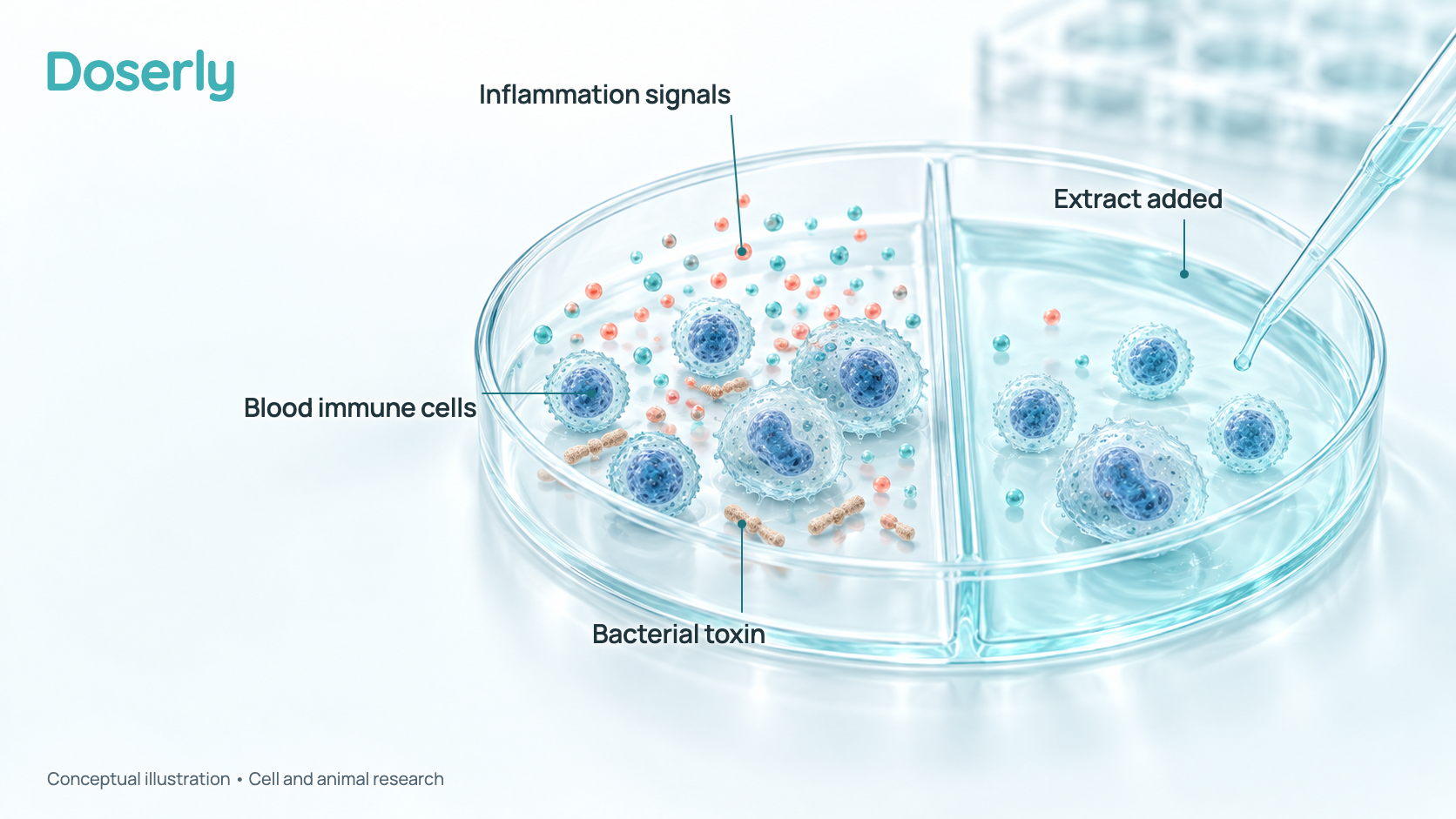
In a dish, it does in some settings. When blood immune cells from four donors were provoked with a bacterial toxin, Thymalin and its two dipeptides lowered three inflammation signals (IL-1β, IL-6 and TNF-α) by 1.4–6.0 times. [99] In a line of human immune cells, it and four other developer peptides lowered TNF and IL-6. [100] Both used cells that had been deliberately provoked. In unprovoked human blood cells, a separate study found that Thymalin raised inflammation signals (TNF-alpha and IL-1) as well as a calming one (IL-10). [63] So “it calms inflammation” is an interpretation, not a finding in people.
Does it bind DNA?
That is the developers' proposal: the short peptides inside Thymalin bind DNA or its packaging proteins and switch immune genes on or off. [13], [99] It rests on computer models and cell work. Given how little of these peptides a dose contains, whether they explain any effect in people is untested.
What happened with tumors and lifespan in animals?
Mixed. In developer studies, female mice given 0.1 mg subcutaneously in 5-day courses each month lived longer only when treatment started young, not in middle age, and had 1.8 times fewer breast tumors. [101] Other developer studies reported longer lives and fewer tumors in another mouse strain and 1.9 times fewer malignant tumors in irradiated rats. [102], [103] But it did not change cancer rates in another developer study of rats exposed before birth to a carcinogen. [104] Teams outside the developer's network also got mixed results: no longer survival in mice with leukemia and practically no effect on melanoma spread, but a stronger effect of cancer drugs in mice and shrinking tumors in rats. [95], [94], [96], [97] No lifespan result applies to people.
What are the risks and unanswered questions?
Is Thymalin safe?
Its safety has not been properly measured. Thymalin has been a prescription medicine in Russia for more than 40 years, and its label lists only one side effect, possible allergic reactions. [1], [14] But no published study describes collecting side effects (adverse events) systematically, including the 2021 COVID-19 trial, and we found no public safety-monitoring reports. The developers' statements that decades of use “have not exposed any allergizing or other side effects” are assertions, not measurements. [5], [4]
Two small studies did look and saw nothing: no side effects that led anyone to stop in 26 older adults (a study led from the developer's institute), and no side effects or allergic reactions in 35 children given nose drops over a winter. [34], [47] That is reassuring for the registered medicine in those settings. It says nothing about research vials, which may be a different substance (see product quality).
What side effects have been reported?
- On the label: allergic reactions. The label adds that side effects of thymus-peptide medicines “may occur more often” in people with severe hormone disorders and in women in the second half of the menstrual cycle. [1]
- In public forums, each from one person, usually with other products and a vial of unknown identity:
- widespread skin pain on light touch (allodynia) from about day 6 of a 10 mg course, still present four days after stopping, in someone also taking two weight-loss drugs [6]
- nausea, sweats and a “different weird symptom every day” at 5 mg a day, stopped around day 10 [7]
- flu-like symptoms on the first day, or on day 4 [8], [105]
- a migraine-like headache on day 4 [106]
- irritability and mood swings during a course combined with Epitalon and a long fast, which the person later thought might be unrelated [107]
- very vivid dreams [108], [81]
- a spleen that felt “harder”, and later the comment that too much “deadens feelings”, from someone taking several peptides at once [67]
- In community education groups: one member's count of eosinophils (white blood cells involved in allergic reactions) roughly quadrupled, to above the top of the lab's normal range, near the end of a course of 10 mg into a muscle every other day. They had no symptoms, were also taking testosterone and other peptides, and posted no follow-up result.
We found no published case report of serious harm.
Could it affect hormones or the thyroid?
Possibly, and the label itself flags hormones. It lists a pituitary tumor (adenoma), acromegaly (excess growth hormone) and the days around a menstrual period as relative contraindications for thymus-peptide medicines. It also says Thymalin may act together with growth hormone, luteinizing hormone and estrogens, and against progestins, androgens (such as testosterone) and adrenal hormones in their effects on lymph tissue and bone marrow, yet it lists glucocorticoid (cortisone-type) medicines as compatible. [1] No study has measured what this means in practice.
One public forum user found high thyroid hormone levels (free T3 and T4) on routine blood tests a week after a 100 mg course, for the first time, while on testosterone therapy; there was no follow-up. [109] One report is not evidence of an effect, but it is a reason to mention Thymalin to whoever orders your blood tests.
Could it make autoimmune disease worse?
Nobody knows. Thymalin is promoted to stimulate the immune system, it has never been tested in autoimmune disease, and the COVID-19 trial excluded people on long-term steroids or other immune-suppressing drugs. [4] The label does not mention autoimmune disease either way. [1] People with autoimmune conditions describe using it in public forums, including one with an autoimmune condition who had flu-like symptoms on day one. [8], [44] In community education groups, members and educators suggest or plan it for Hashimoto's thyroiditis, rheumatoid arthritis, lupus and multiple sclerosis in more than a dozen threads, without citing a study. When one member warned that immune-stimulating products are best avoided in autoimmune disease, others replied that thymosin alpha-1 rebalances immunity rather than simply boosting it. One of them still advised avoiding such products during a severe flare or alongside immune-suppressing drugs, then listed Thymalin as a later addition. Neither view has been tested for Thymalin. Anyone with an autoimmune disease, a thymus tumor, myasthenia gravis or an organ transplant, or who takes immune-suppressing medicine, should not start it without their specialist.
Is there a risk from its animal origin?
The developers acknowledge that medicines made from animal tissue “can cause the risk of contamination with prions, infectious agents” and say their manufacturing tests exclude this. [5] That is the manufacturer's claim for the registered product. It does not extend to research vials or to other products using the name. In community education groups, a member who reacts to cattle collagen injected into the skin asked whether research vials come from calves, and the question went unanswered. The label's caution about a history of allergies applies here too.
Could product quality change the risk?
Yes, and for Thymalin this is the biggest practical question. What a vial contains depends on where it came from:
- The registered medicine is made by one Russian company and resold abroad; one reseller even labels it “Thymalin (Thymulin, Thymus Extract)”, which adds to the confusion. [11], [57]
- Research vials sold as “Thymalin” often cannot be confirmed as that product. One seller describes its “Thymalin/Thymulin” as a calf-thymus extract yet lists a purity of 99% or more, which cannot apply to a mixture of many peptides; a “thymalin” pen in one shop is titled Crystagen (Glu-Asp-Pro). [3], [29] Buyers often cannot tell whether they have an extract, thymulin or something else, and forum posts repeat thymulin's formula as Thymalin's. [19], [110]
- Blends such as “TA-1 complex” list Thymalin next to thymosin alpha-1 without saying what the Thymalin part is. [83]
- In community education groups, most members who named their source used research vials, including 20 mg and 100 mg vials, sizes the registered 10 mg medicine does not come in. Members point out that some sellers list Thymalin and thymulin as one product, and one shared a test result of 99.9% purity for their vial, a figure that fits a single lab-made peptide rather than an extract of many. An educator who uses the registered medicine says it has become hard to get in the United States.
Health Canada warns that unauthorized injectable peptide drugs could cause infections, allergic reactions and interactions with other medicines, and Australia's regulator says unapproved peptide products “have not been evaluated for safety, quality or effectiveness”. [111], [112]
Is Thymalin legal? Is it FDA-approved?
Checked September 26, 2026. Rules differ by country and change quickly. A “research use only” label does not make a product legal to sell or safe to use.
Russia. Thymalin is a registered prescription medicine (registration LP-№(005867)-(RG-RU), 21 June 2024, replacing LS-000267 from 2010), first approved for use in 1982. The same directory lists another Russian product, Immunotim, as an analogue. [1], [91], [14]
United States. Thymalin is not an FDA-approved medicine: FDA's approved-drug and label databases have no entry for it. [9] ClinicalTrials.gov lists no study of it, so it is not being tested as an investigational drug in any registered trial. [85] It is not among the substances nominated for pharmacy compounding (list updated May 14, 2026) and not on FDA's list of compounding substances that may pose significant safety risks. That list of nominations does include “thymulin acetate”, a different substance. [113], [114] It does not appear in federal regulations or the Federal Register. [115] None of these searches is a ruling on whether selling it is legal.
Canada. No Thymalin product is in Health Canada's Drug Product Database. [116] Health Canada's 2025 advisories about seized injectable peptides name Vilon, thymulin and thymosin alpha-1, but not Thymalin; one notes that most injectable peptides are regulated as prescription drugs in Canada. [111], [117]
Australia. The Therapeutic Goods Administration's April 2026 guidance on unapproved peptides does not name Thymalin. We found no Australian approval, but the Australian register was not searched directly. [112]
New Zealand. “Thymic peptide hormones and their analogues” became prescription medicines on 19 December 2025. Thymalin is not named. The committee paper behind the change describes the group as thymus polypeptides, natural or synthetic, and their analogues, but the regulator has not said whether a calf-thymus extract falls under it. [118], [119]
Other countries. One website says Thymalin is also registered in Belarus; we could not confirm registrations outside Russia. [69]
Is Thymalin banned in sport? Does it show up on a drug test?
Thymalin is not named on the World Anti-Doping Agency's 2026 list or on the 2027 list that takes effect on January 1, 2027. [120], [10] Category S0 bans substances “with no current approval by any governmental regulatory health authority for human therapeutic use”. Thymalin has a Russian approval, so whether S0 covers it is unclear, and we found no ruling. A lab-made product sold as “Thymalin” may be a different substance with no approval anywhere. Tested athletes should get a written answer from their anti-doping organization before using any thymus product. None of the sources reviewed describes a test that detects Thymalin.
Who should be especially cautious?
- Anyone who is pregnant or breastfeeding. The label rules it out. [1]
- Anyone allergic to the product or to glycine, which the label rules out, and anyone with a history of allergies, where it advises caution. [1]
- Anyone with a pituitary tumor, acromegaly or another hormone disorder, and anyone taking testosterone, other androgens, progestins, estrogens or growth hormone, because of the label's hormone warnings. [1]
- Anyone with an autoimmune disease, a thymus tumor, myasthenia gravis or a transplant, or taking immune-suppressing medicines. Never studied.
- Anyone with cancer or on chemotherapy. The Russian label includes weakened immunity after chemotherapy or radiotherapy as a use, but that is for prescribed treatment under an oncology team, not self-directed research vials, and the animal tumor results were mixed. [1], [101]
- Children and teenagers. The label's children's doses are for prescribed treatment; nothing supports research vials for anyone under 18.
- Anyone with kidney or liver disease, and older adults. The label says it has no dosing data for them. [1]
- Competitive athletes. See the anti-doping section above.
Has Thymalin been tested alongside other medicines?
Only in the sense that study patients also received antibiotics, surgery, cancer treatment or COVID-19 treatment. The label says it is compatible with the tuberculosis drugs isoniazid and rifampicin, with other immune stimulants, with glucocorticoid steroids and with painkillers, but also says to avoid combining it with medicines that work the same way, and to avoid alcohol during treatment. [1] Nothing is known about combining it with biologic drugs, vaccines, GLP-1 weight-loss medicines or other peptides. Bring a complete list of everything you take to a pharmacist or doctor.
What should be monitored while using Thymalin?
The Russian label sets no monitoring requirements. [1] What exists is a record of what the studies measured, plus a few suggestions from protocol websites and educators. It can help you prepare questions for a clinician; it is not a personal testing plan.
What did the studies check?
The COVID-19 trial took blood at the start and on day 14 for a full blood count, C-reactive protein, IL-6, D-dimer, fibrinogen and a breakdown of lymphocyte types. [4] The aging studies added hormone, metabolic and immune panels and tracked illnesses and deaths over years. [5] None tracked side effects in a structured way.
Which measures matter, and why?
| Why it matters | What studies measured or sources suggest | Tracking category |
|---|---|---|
| Whether anything changed in the immune system | Full blood count with a white-cell breakdown (differential) and lymphocyte types; one website suggests a count before a course and 4–6 weeks after it [4], [61] | Immune System |
| Inflammation | C-reactive protein and IL-6 in the COVID-19 studies [4] | Pain & Inflammation |
| Hormones, for anyone on hormone therapy or with a hormone disorder | The label's hormone warnings; one forum report of high thyroid hormones after a course [1], [109] | Hormonal & Reproductive |
| Infections and illness days | Relapses and colds counted in the two studies from outside the developer's network [46], [47] | Immune System |
| Allergic and injection reactions | The one side effect on the label [1] | Tolerability |
| Sleep, energy and mood | Vivid dreams, better sleep and irritability in personal accounts [81], [107] | Sleep; Energy & Vitality; Mood & Mental Health |
Beyond the before-and-after blood count and the two-course stopping rule described above, educators in community education groups list reasons to stop and see a doctor: an injection-site reaction that is hot, spreading or still worsening after 48 hours, and any new symptom that persists a month after a course. That is educator advice, not a tested plan.
What do people in public communities report?
Public accounts are scattered across Reddit peptide, biohacking and nootropics forums. We found 132 posts mentioning Thymalin through a public archive and 18 people who described their own use. Most were taking other products at the same time, and few knew whether their vial was the registered extract. [62], [107]
We also reviewed 186 discussion threads in four community education groups. About 30 people described their own use or plans there, but only five gave their own dose, most took other products at the same time, and most who named a source had research vials. We summarize these threads without names or citations.
What do the positive reports look like?
- A person with long-standing fatigue “felt a world of improvement” after a first course, went on to about 12 courses, and says that for immune problems “10mg for 10 days is good”; 20 days “did nothing extra”. They were also using other peptides, iron and melatonin at various times. [62]
- Someone who uses Thymalin twice a year, within a large stack of growth-hormone and repair peptides, says they no longer have allergies and get sick less often. [44]
- A person taking 1 mg a day, raised to 3 mg during a chest infection, felt they recovered faster than usual; they believed it was a lab-made thymulin. [66]
- Others describe relief of histamine symptoms within a day or two, one short illness in a winter, no illness in a month and no herpes outbreaks, each alongside thymosin alpha-1 or other products. [50], [45], [121], [122]
- Someone using the Russian pharmaceutical with Epitalon during a long fast noticed better sleep scores and nasal breathing. [107]
In community education groups, benefit stories are framed around fewer seasonal infections and slower immune aging, and educators present it mainly as a long-term, twice-yearly course rather than something to feel. Member threads add a few personal accounts:
- An educator who uses the registered medicine twice a year, plus an extra course when a cold starts, reports going many months without illness. Two members with similar stories were also taking thymosin alpha-1 and other immune products.
- A member recovering from tick-borne infections, with a doctor monitoring their blood tests, credits about a month of daily Thymalin taken with thymosin alpha-1 and another peptide.
- A member coming off night shifts credits a 20-day course of 1 mg a day, taken with Epitalon and Pinealon, with resetting their sleep.
Each is one person's account, with several things changed at once.
Does everyone notice a difference?
No. One person finished a 10-day course and “haven't noticed much. Just some insanely vivid dreams.” [108] In community education groups, a member who ran one course with Epitalon felt nothing, a moderator who used it found thymosin alpha-1 worked better, and one group's thread for sharing results with each bioregulator held no Thymalin results at all. Educators in these groups say that no noticeable change is the most likely outcome. One argues that feeling nothing during a course does not mean it failed, because the claims are about long-term survival; that is a belief, not a finding, and it makes it hard ever to decide that a course did not work.
What about unwanted effects?
Flu-like symptoms, nausea and sweats, headache, irritability, high thyroid results and one case of widespread skin pain, each from one person and usually with other products. See the risks. [8], [7], [106], [109], [6] The more worrying pattern is not a symptom but a habit: courses of 19–20 days, well past the label's 10, and vials whose contents nobody checked. [105], [7]
In community education groups, the only unwanted effect reported was a lab result: a raised eosinophil count near the end of a course, in someone also taking testosterone and other peptides (see side effects). Member threads show the same habits, from a month of daily use to stacks of 13 or more products. It was also discussed for people with a history of cancer and for someone after a recent cardiac arrest, and in those threads no one raised a caution about it. Anyone with either history should not start it without their specialist (who should be especially cautious).
What do community education groups teach?
Educators are more cautious than many members. All three independent groups whose lessons cover Thymalin rank thymosin alpha-1's evidence above Thymalin's, because thymosin alpha-1 has trials from independent teams, and one grades Thymalin's evidence as weak. Two teach the label-style 10-day course; one teaches a 1–2 mg daily figure for bioregulators in general. They disagree about combining Thymalin with thymosin alpha-1, sometimes within the same group. In member threads, educators are less cautious than in their lessons: one calls thymus peptides very safe and suggests Thymalin for lupus and for immune recovery after chemotherapy, without citing a study. Thymalin's safety has not been properly measured (see the risks).
Some lessons also repeat claims we could not trace to any Thymalin study, such as telomere protection, stem-cell effects, about eight weeks to a measurable effect, or benefits that persist after the course. One lesson, copied from a seller, says Thymalin has no side effects, although the label lists allergic reactions, and none of the lessons mentions the label's hormone warnings. [1] The most useful shared advice is practical: measure before and after, keep courses short with months off, add one product at a time, and stop if something feels wrong.
How can you judge a Thymalin story?
Ask: Was the product the registered extract or a research vial, and how do they know? How much, by which route and for how many days? What else started or stopped at the same time: other peptides, the end of an infection, a change of season? Was anything measured before and after, such as a blood count? What happened months later?
These selected discussions are not a survey of all users, a response rate or a substitute for controlled studies. Colds, allergies and fatigue come and go with the seasons, and people are more likely to post when something seems to work.
How does Thymalin compare with thymosin alpha-1, Vilon, Crystagen and Epitalon?
Thymalin is the parent of a family of Russian thymus and “bioregulator” products, and it is often compared with, or combined with, thymosin alpha-1. The table compares what each one is and how much has been tested in people.
| Compound | What it is | How it is taken | How often | Human evidence | Approval status |
|---|---|---|---|---|---|
| Thymalin (this guide) | An extract of calf thymus containing many peptides [1] | Injection into a muscle [1] | Label: 5–20 mg once daily for 3–10 days; most often 10 mg for 10 days [1], [4] | One small randomized, placebo-controlled trial in 80 adults with severe COVID-19, plus many small reports, mostly from one network [4] | Prescription medicine in Russia; not approved in the US or Canada; no Australian approval found [1], [9] |
| Thymosin alpha-1 | A lab-made copy of a single 28-amino-acid peptide first purified from calf thymus [123] | Subcutaneous injection [124] | 1.6 mg twice a week for 6–12 months in hepatitis B (label) [124] | Many trials: a Cochrane review of 10 hepatitis B trials was “not sure” it helps, and a 1,106-person sepsis trial found no fewer deaths [125], [126] | Prescription medicine in Singapore; not FDA-approved [124], [123] |
| Vilon | Two amino acids (Lys-Glu), lab-made; present in Thymalin only as a trace [16] | Injection; into a muscle in the hospital reports [93] | 10 mcg once daily for 5–10 days in the hospital reports [93] | About a dozen small Russian hospital reports without random assignment [93] | Not approved; named in Health Canada seizure advisories [111] |
| Crystagen | Three amino acids (Glu-Asp-Pro), lab-made; present in Thymalin only as a trace [16] | Capsules by mouth [127] | 1–2 capsules 1–2 times a day for a month, repeated after 3–6 months [127] | Small reports on immune blood tests without a placebo [128] | Food supplement in Russia; not an approved medicine [127] |
| Epitalon | Four amino acids (Ala-Glu-Asp-Gly), lab-made, modeled on a calf pineal extract [129] | Injection; into a muscle in the 2007 study [130] | 10 mcg once daily for 10 days in a 2007 study [130] | A few small studies from the same network [130] | Not approved; FDA advisers voted in July 2026 to add it to the compounding list, with no final decision [131] |
The real differences are in what the product is and how much has been tested. Thymalin is the only one that is an extract of many peptides, and the only one that is a registered medicine in Russia. Thymosin alpha-1 is a single defined peptide licensed in several countries, with placebo-controlled trials by independent teams and mixed results. Vilon, Crystagen and Epitalon are lab-made short peptides from the same research program with small reports only. No study has compared Thymalin with any of them. The 2003 aging study paired Thymalin with Epithalamin, the pineal extract, not with Epitalon. [5]
Common questions about Thymalin
Is Thymalin the same as thymulin?
No. Thymalin is an extract of calf thymus containing many peptides. Thymulin is a single nine-amino-acid thymus peptide that needs zinc to work. A chemistry database files the name “Thymalin” under thymulin, and one reseller labels the Russian medicine “Thymulin”, so the mix-up is common, and some research vials sold as Thymalin may really be thymulin. [18], [57], [3] In community education groups the mix-up comes up often, and advice to take zinc with Thymalin, including for hair loss, comes from thymulin. See what Thymalin is.
Is Thymalin a peptide or a steroid?
It is not a steroid. Thymalin is a mixture of peptides, small proteins, extracted from calf thymus, and it is freeze-dried with glycine and injected into a muscle. [1], [16] It is not a single lab-made peptide either, which is why it has no single formula or molecular weight. The label notes that it may act against the effects of some hormones, including androgens, on lymph tissue. See hormones and the thyroid.
Does Thymalin boost the immune system?
It changes immune blood tests in small Russian reports, but that is not the same as proven protection. Adding it to treatment raised lymphocyte and T-cell counts in people who were ill, and two small studies from outside the developer's network counted fewer relapses of a skin infection and fewer colds in children, differences small enough to be chance. None was placebo-controlled, and no study has tested it in healthy adults. [14], [46], [47] See the human research.
Can Thymalin help with COVID-19?
It is not established. In one small trial of 80 adults hospitalized with severe COVID-19, fewer people given 10 mg a day for 10 days died in hospital (19.4% versus 40.9%), and more improved; CT scans and time to improvement did not differ. It was a single-center trial from the developer's network, the groups differed on several blood tests at the start, side effects were not reported, and no one has repeated it. [4] See the trial.
Does Thymalin make you live longer?
That has not been shown. A 2003 developer report found fewer deaths over six years among older women given Thymalin courses (10 of 24 versus 18 of 22 on placebo), but the groups were tiny, the methods are thinly described and the numbers do not all add up. Mouse lifespan results were mixed. [5], [101] See the aging study.
How long does a Thymalin course take to work?
There is no reliable answer. The studies measured results at the end of 5–10-day courses or years later, alongside other treatment. Public accounts range from “a day or two” for histamine symptoms to nothing noticeable after a full course, and educators say no noticeable change is the most likely outcome. [50], [108] Member reports in community education groups show the same spread, from better sleep after the first dose to nothing felt after a course. See what people report.
Can Thymalin be taken with thymosin alpha-1?
Nobody has tested the combination. People take them together, and premixed “TA-1 complex” vials exist, but community education groups disagree about whether to run two thymus products at once, and a stack makes any benefit or reaction impossible to attribute. [83], [45] In member threads, most people who described a benefit were taking the two together, so the credit cannot go to either one. See stacks and the thymosin alpha-1 guide.
Is it legal to buy Thymalin?
It depends on the country. It is a prescription medicine in Russia. It is not an approved medicine in the United States or Canada, we found no Australian approval, and bringing in or selling unapproved injectable drugs is restricted in each. A “research use only” label does not make a product legal or safe. [1], [9], [117], [112] See the dated legal-status summary.
Glossary
Plain explanations of the route, dosing and research terms used in this guide. Underlined terms in the text link here.
- Adverse event
- A harmful or unwanted medical event reported after someone used a treatment. A report alone does not prove the treatment caused it.
- Allodynia
- Pain caused by something that is not normally painful, such as light touch or clothing on the skin.
- Amino acid
- A small chemical building block. Chains of amino acids make up peptides and proteins. Glycine, added to each Thymalin vial, is the simplest one.
- Animal study
- Research in animals such as rats or mice. It shows what a substance does in a living body, but results in people can differ.
- Bioavailability
- How much of a dose reaches the bloodstream in a usable form. It depends heavily on the route. For Thymalin it has not been measured by any route.
- Bioregulator
- The name a Russian research group uses for thymus-derived and other short peptides it believes act on particular tissues. It is a research and marketing label, not a regulatory category.
- Blinded
- A study design in which participants, and often researchers, do not know who got the treatment and who got the comparison. Single-blind means only one side does not know.
- Cell study (in vitro)
- Research on cells grown in a dish. It gives early clues about biology, but it is far from proof of benefit in people.
- Compounding
- A pharmacy making a medicine for an individual patient from raw ingredients. In the US, pharmacies may only use bulk ingredients that meet FDA's criteria, for example a USP monograph, an ingredient of an approved drug or FDA's 503A bulks list; Thymalin meets none of them.
- Controlled trial
- A study that compares people who receive a treatment with a similar group who do not, often receiving a placebo instead. Randomly assigning people to each group makes the comparison fairer.
- Course and cycle
- A course is the period of repeated use, such as 10 days. A cycle is a course plus a planned break before any further use.
- Cytokine
- A small signaling protein that immune cells use to talk to each other. TNF-alpha, IL-1 beta and IL-6 are cytokines that drive inflammation.
- Daily total
- All the amounts given in one day, added together. For example, 5 mg twice daily is a 10 mg daily total.
- Dose (amount each time)
- The amount given on one occasion. A protocol lists both the dose and how often it is given.
- Extract
- A preparation made by drawing substances out of animal or plant tissue. Thymalin is an extract of calf thymus, so it is a mixture of many peptides rather than one defined molecule.
- Half-life
- The time it takes for the measured level of a substance in the blood to fall by half. It is not the same as how long an effect lasts. Thymalin's has not been measured.
- Immunomodulator
- A substance said to adjust immune activity, raising or lowering it. Thymalin's developers describe it this way; its Russian label classes it as an immunostimulant.
- Intramuscular (IM)
- Injected into a muscle. This is the only route on Thymalin's label.
- Intranasal
- Sprayed or dropped into the nose. One Kazakh study gave Thymalin this way to children, outside its label.
- Investigational
- Still being studied and not approved by a regulator, such as the FDA, to treat any condition.
- Lymphocyte
- A type of white blood cell that includes T cells, B cells and natural killer cells. Lymphocyte counts are part of a full blood count with differential.
- Freeze-dried (lyophilized)
- Dried by freezing and removing the water, leaving a powder or cake. Thymalin vials are sold this way and mixed with liquid just before injection.
- mcg and mg
- Micrograms and milligrams. 1 mg equals 1,000 mcg. Thymalin's labeled doses are in milligrams; some websites give micrograms, so check which unit a page means.
- Meta-analysis
- A study that pools the results of several earlier studies. Its value depends on how the studies were found and chosen.
- Peptide
- A short chain of amino acids. Thymalin contains many different peptides.
- Pharmacokinetics
- How the body absorbs, moves, breaks down and removes a substance. For Thymalin, no human data exist.
- Pituitary gland
- A pea-sized gland under the brain that makes hormones controlling growth, the thyroid, the adrenal glands and reproduction. An adenoma is a usually benign tumor of it.
- Placebo
- A dummy treatment with no active ingredient, used as a comparison in studies. The Thymalin COVID-19 trial used salt-water injections.
- Preclinical research
- Studies done before research in people: cell studies, tissue cultures, computer models and animal studies.
- Primary and secondary endpoints
- The main outcomes a trial is designed to test (primary) and the extra outcomes it also reports (secondary). A secondary result is more likely to be a chance finding.
- Randomized
- Assigned to treatment or comparison by chance, so the groups start out alike.
- Reconstitution
- Mixing a freeze-dried powder with a liquid so it can be measured and injected. The amount of liquid sets how much extract each unit holds.
- Research use only
- A label on products sold for laboratory research. It does not mean a product is approved, tested for human use or legal to sell as a medicine.
- Subcutaneous (SC)
- Injected into the fatty layer just under the skin. Many websites describe Thymalin this way, but it is not the labeled route.
- Syringe units
- Markings on an insulin syringe that measure volume. On a U-100 syringe, 100 units equal 1 mL. The amount of drug per unit depends on the vial's concentration.
- T cell
- A white blood cell that matures in the thymus and directs or carries out immune attacks. Helper T cells carry the CD4 marker and cytotoxic T cells carry CD8.
- Thymus
- A gland in the upper chest, behind the breastbone, where T cells mature. It is largest in childhood and shrinks with age.
- Titration
- Adjusting a dose in steps, usually starting lower and increasing if needed.
- WADA
- The World Anti-Doping Agency, which publishes the list of substances banned in sport.
Explore more of the research
Go deeper into the experiments behind the claims.
The research library below groups 18 cell, animal and chemical-analysis papers on Thymalin. Paper counts are not counts of independent research teams: nearly all come from one research network.
Mice and rats: lifespan and tumors · 9 papers
Does it lengthen mouse lifespan?
Model: Female mice given 0.1 mg subcutaneously for 5 days each month, starting young (3.5 months) or in middle age (12 months); a second mouse strain given it long term.
Finding: Longer life and 1.8 times fewer breast tumors when started young; no benefit when started in middle age. Longer life and fewer tumors in the second strain.
Limit: Developer abstracts; the thymus factor is described by its research name in some papers.
Did it prevent tumors caused by radiation or chemicals?
Model: Irradiated rats; rat offspring exposed before birth to the carcinogen ethylnitrosourea, then given 0.5 mg a day subcutaneously.
Finding: 1.9 times fewer malignant tumors after radiation; longer average life in one prenatal-carcinogen study, but no effect on cancer rates in another.
Limit: Abstracts; the two carcinogen studies disagree.
What happened with transplanted tumors and chemotherapy?
Model: Mice with melanoma or leukemia; mice and rats with transplanted tumors given chemotherapy.
Finding: Practically no effect on melanoma spread (an independent East German team); no longer survival in leukemia; a stronger effect of cancer drugs when combined; an anti-tumor effect in rats at below-therapeutic doses.
Limit: Abstracts without full schedules; the four studies by teams outside the developer's network disagree (no effect on melanoma spread or leukemia survival, but anti-tumor effects with chemotherapy and in rat sarcoma).
Radiation, immune cells and what is in the extract · 9 papers
Does it help the thymus recover after radiation?
Model: Irradiated guinea pigs given 1 mg per kg into a muscle daily for 5 days.
Finding: Faster recovery of the thymus and immune measures.
Limit: Developer abstract.
How does it compare with another peptide medicine?
Model: Immune tests in mice and in unprovoked human blood cells, comparing Thymalin with tinrostim, a peptide preparation from squid nerve tissue.
Finding: Similar effects on antibody, cell-based and germ-engulfing immune responses; in blood cells both raised TNF-alpha and IL-1 as well as IL-10.
Limit: The 0.005 and 0.05 mg per kg doses in this study were tinrostim's, yet one website presents them as Thymalin doses.
What does it do to immune and stem cells in a dish?
Model: Human blood-forming stem cells; blood immune cells from four donors provoked with a bacterial toxin; a human monocyte cell line.
Finding: CD28 up 6.8 times on stem cells; IL-1 beta, IL-6 and TNF-alpha down 1.4–6.0 times in provoked blood cells; TNF and IL-6 down in the cell line.
Limit: Developer network; provoked cells only; no measurements in people who received it.
What is in the extract?
Model: Isolation and chromatography of the calf-thymus extract; mass spectrometry; an immune-based laboratory test for the extract.
Finding: An active factor physically similar to a histone (1981); Glu-Trp isolated from it (1997); peptides up to 10 kDa, with Lys-Glu at 0.025 mg per gram and Glu-Asp-Pro at 0.04 mg per gram (2021); a test able to detect the extract at very low concentrations (1987).
Limit: The full composition and the amount of each peptide per vial are not published.
How this guide was researched
This guide is built from a thorough review of the sources cited throughout it: published scientific studies, Soviet and Russian clinical reports, the Russian product information (label), trial-registry searches, regulatory documents and published protocol descriptions. We also reviewed public online forums and community education groups where people describe their own experiences with Thymalin.
The guide cites 133 sources, including 38 original scientific papers and clinical reports. Each type of source answers a different question. Studies show what researchers measured. Protocol descriptions show how Thymalin is typically used. Personal accounts show what individual people experienced. Every numbered citation links to its entry below, labeled by source type.
How this guide was made
Research and drafting were AI-assisted. Every cited source was checked against the original, and the guide was reviewed and edited by Doserly before publication. It has not had an independent clinical review, and Doserly does not currently have medical reviewers. Doserly makes a medication and health-tracking app and runs Doserly Academy, both of which are promoted in this guide. Read our editorial policy for how guides are researched, updated and corrected.
This guide is for educational purposes. It summarizes what the reviewed sources report so the research is easier to understand; it is not medical advice. For a deeper dive, or to check any point for yourself, go straight to the cited sources.
Explore the sources
These are the documents cited in this guide. Studies, clinical reports, the official label, website advice and personal accounts answer different questions. A source being listed does not mean every statement on its page is endorsed.
Showing 133 sources
- 01
Тималин (Thymalin) лиофилизат 10 мг: описание препарата (Russian product information as published in the Vidal directory, registration LP-№(005867)-(RG-RU)) ↗
Product information (Russia)
Full text reviewed (Russian): the Vidal directory's summary of the registered product information, updated 25 Mar 2025. Its dosing matches the manufacturer's product page and a vendor-hosted copy of the instructions; the state register's own instruction was not retrieved. Classed as an immunostimulant. 10 mg calf-thymus extract plus 20 mg glycine per vial; prescription only; adults 5–20 mg into a muscle daily for 3–10 days (30–100 mg per course), repeat after 1–6 months; prevention 5–10 mg for 3–5 days; children 1–5 mg by age; storage 2–25 °C.
Safety sections: possible allergic reactions as the only listed side effect; contraindicated with hypersensitivity to the extract or excipients (glycine), in pregnancy and in breastfeeding; caution with an allergic history; relative contraindications for bovine thymus peptides (the days around a period, pituitary adenoma, acromegaly); hormone interactions (acts with growth hormone, LH and estrogens, against progestins, androgens and adrenal hormones on lymph tissue and bone marrow), while glucocorticoid medicines are listed as compatible; no dosing data in kidney or liver impairment or in older people; avoid alcohol.
- 02
Targeting Leukopoiesis: Pharmacological and Biotechnological Strategies for the Treatment of Leukopenia ↗
Review (independent)
Full text reviewed. Calls thymalin and thymomodulin “complex peptide mixtures rather than single defined molecular entities” with regional use in Eastern Europe, “largely outside global clinical guidelines”.
- 03
Peprimo (vendor standard) ↗
Seller page (product identity)
Seller product standard checked: describes “Thymalin/Thymulin” as a calf-thymus extract yet lists ≥99.0% purity, which cannot apply to a mixture of many peptides. The live page returned an error on 26 Sep 2026; the saved copy was used.
- 04
Peptide Drug Thymalin Regulates Immune Status in Severe COVID-19 Older Patients ↗
Human trial (randomized, single-blind)
Full text reviewed. 80 adults with severe COVID-19 in Chita, Russia: 10 mg into a muscle daily for 10 days (36) or salt-water placebo (44), with usual treatment.
Results: clinical improvement 80.5% versus 59% (p=0.039); time to improvement 8.6 versus 7.6 days (not significant); CT improvement at day 14 30.5% versus 22.7% (not significant); in-hospital deaths 19.4% versus 40.9% (secondary, p=0.039); lymphocyte recovery 66.6% versus 43.2%; at day 14 IL-6 and D-dimer lower on Thymalin, C-reactive protein higher (p=0.018). Limits: single center; developer co-author; unequal arms; at baseline the Thymalin group had lower lymphocyte, T-cell and NK-cell counts and higher C-reactive protein; invasive ventilation 25% versus 45.4% (p=0.06); no registration number in the paper and none on ClinicalTrials.gov; side effects not reported.
- 05
Peptides of pineal gland and thymus prolong human life ↗
Human study (small, stratified allocation)
Full text reviewed (developer PDF).
Result detail: St Petersburg: 94 women aged 66–94, 10 mg into a muscle daily for 10 days, repeated a year later; 6-year deaths 81.8% (placebo, 22) versus 41.7% (Thymalin, 24) and 33.3% (with Epithalamin, 24). Kiev: 10 mg five times, 2–3 days apart, every 5–6 months for 3 years; 8-year deaths 13.6% versus 6.6%. Limits: methods of randomization and blinding not described; the Kiev death rates (13.6%, 6.6%, 8.5%) do not match the listed group sizes (48, 58, 46); developer authors.
- 06
Allodynia from Thymalin ↗
Community account
Public thread reviewed; a self-report with unverified product, dose and diagnosis.
- 07
Experiences with Thymalin? ↗
Community account
Public thread reviewed; a self-report with unverified product, dose and diagnosis.
- 08
Experiences with Thymalin? ↗
Community account
Public thread reviewed; a self-report with unverified product, dose and diagnosis.
- 09
Drugs@FDA and drug-label searches (openFDA): thymalin, timalin ↗
Regulator search
No approved product and no label under either name.
- 10
World Anti-Doping Code International Standard: Prohibited List 2027 ↗
Sport rules
Document text searched: Thymalin not named; S0 covers substances “with no current approval by any governmental regulatory health authority” for human therapeutic use.
- 11
Thymalin® product page ↗
Manufacturer information
Page reviewed: vial contents dissolved before injection in 1–2 mL of isotonic sodium chloride; same adult and children's doses as the label; contraindications allergy, pregnancy and lactation.
- 12
[Isolation, purification and identification of an immunomodulating polypeptide from human and calf thymus] ↗
Chemical analysis
Original abstract reviewed. Developers' isolation of the thymus factor then called thymarin; physically similar in some properties to histone H1.
- 13
The Use of Thymalin for Immunocorrection and Molecular Aspects of Biological Activity ↗
Review (developers)
Full text reviewed. Describes Thymalin as the first peptide drug made by the group's technology and proposes that its short peptides regulate genes; states that Thymalin and Thymogen “have practically no side effects”. Some peptide-specific statements in it are misattributed, so only general statements are used.
- 14
Мета-анализ иммуномодулирующей активности лекарственного пептидного препарата тималина (Meta-analysis of the immunomodulating activity of Thymalin) ↗
Meta-analysis (developers)
Full text reviewed (Russian). States Thymalin was the first thymus peptide medicine approved in the USSR (1982); searched one Russian database (elibrary.ru), kept 4 of about 700 publications by stated criteria, pooled their T-cell counts and calls the effect “large”; no bias assessment.
- 15
MeSH Supplementary Concept: thymalin (registry number 79621-14-0) ↗
Terminology database
Record reviewed: filed under thymus hormones; a related record notes that thymarin “may be same as thymalin”.
- 16
Идентификация коротких пептидов: оптимизация таргетных терапевтических свойств лекарственного препарата тимуса (Identification of short peptides in the thymus medicine Thymalin) ↗
Chemical analysis
Full text reviewed (Russian). Thymalin consists of peptides up to 10 kDa; Lys-Glu at 0.025 mg per gram and Glu-Asp-Pro at 0.04 mg per gram, described as minor components.
- 17
Thymalin (Timalin, Thymalinum) — PeptideX ↗
Protocol source
Page checked: 5–20 mg a day into a muscle; notes that 10 mg of an extract is a weight of powder, not a defined amount of active substance; 10 mg vial plus 2 mL is 2 mL per dose.
- 18
PubChem Compound Summary for CID 3085284, Nonathymulin ↗
Chemical database
Record reviewed: thymulin (nonathymulin), C33H54N12O15, 858.9 g/mol; the synonym list includes “Thymalin”, which is why a name search for Thymalin lands on thymulin.
- 19
Reddit comment: “It has molecular mass of 858.85 g/mol” ↗
Community discussion
Public comment reviewed; quoted as an example of a claim that circulates, not as evidence.
- 20
Natural and synthetic thymic peptides as therapeutics for immune dysfunction ↗
Review (developers)
Original abstract reviewed: “One of the immunomodulatory molecules (L-Glu-L-Trp) has been isolated from Thymalin” by liquid chromatography.
- 21
Thymalin Dosing Guide - Half-Life, Reconstitution & Protocol | CalcMyPeptide ↗
Protocol source
Page checked: 10 mg a day for 10 days; distinguishes Thymalin from Vilon, Thymogen, Crystagen, Vladonix and Thymulin; calls the label dose “Russian labeling folklore”.
- 22
Thymalin: Dosing, Evidence & Vendor Prices | Ground Truth ↗
Protocol source
Page checked: “most commonly 10 mg daily”, with community amounts from 500 mcg to 10 mg.
- 23
Thymalin: Dosing & Vendor Prices | BodyHackGuide ↗
Protocol source
Page checked: 10 mg a day intramuscularly or subcutaneously for 10 days, once or twice a year; 5 mg a day suggested for a first course; up to 3–4 courses a year at 10–15 mg for “intensive” use.
- 24
Thymalin Dosage, Safety & Stacks | Peptide Initiative ↗
Protocol source
Page checked: 5 mg daily for 5 days to check tolerance, then 10 mg daily for 10 days (125 mg in total).
- 25
Thymalin Dosage Chart - Dosage Peptide ↗
Protocol source
Page checked: 5–10 mg once daily for 5–10 days, repeated once or twice a year; mixed vial kept up to about 28 days.
- 26
Thymalin: Research Profile & Guide | Peptides Institute ↗
Protocol source
Page checked: standard 10 mg a day for 5–10 days every 6 months; maintenance 5 mg a day for 5 days every 3–4 months; mixed vial within 5–7 days.
- 27
Thymalin Instruction (English translation of the product information) ↗
Label translation (seller-hosted)
Full text reviewed. Adds that the mixed solution should not be stored, storage protected from light at no more than 25 °C, a 3-year shelf life, and an unreferenced statement that the drug is completely absorbed and rapidly broken down into amino acids. Not checked against an official Russian original for those lines.
- 28
Reddit comment: “it states Thymalin 5-10mg for 10 days but the vial I have is 10mg” ↗
Community discussion
Public comment reviewed; quoted as an example of a claim that circulates, not as evidence.
- 29
Gluta-beauty.com.ua (vendor) ↗
Seller page (product identity)
Seller page checked: a pen whose web address says “thymalin-glu-asp-pro” is titled Crystagen (Glu-Asp-Pro).
- 30
Влияние тималина на показатели клеточного, гуморального иммунитета и качество жизни у пациентов пожилого возраста, перенесших COVID-19 (Thymalin and immunity in older adults after COVID-19) ↗
Human study (open, randomized)
Full text reviewed (Russian). 38 older adults on 10 mg daily for 5 days versus 50 on usual treatment; antibodies 4.25 times higher at 200 days.
- 31
Эозинофилы как предикторы склонности к тромбозам и тяжести заболевания COVID-19 при различных видах терапии (Eosinophils, clotting and COVID-19 severity under different treatments) ↗
Human report (retrospective)
Full text reviewed (Russian). 159 people with severe COVID-19 (44 on usual care, age 62 ± 13.4, the same size and age as the 2021 trial's placebo group; 81 tocilizumab; 34 Thymalin 10 mg daily for 5 days, chosen by doctors partly for lymphocytes below 0.75 × 10⁹/L); authors favor Thymalin for clotting measures.
- 32
Биорегулирующая терапия в комплексном лечении больных с тяжелыми ожогами (Bioregulating therapy in severe burns) ↗
Human report (not randomized)
Full text reviewed (Russian). 317 burn patients, 76 given 10 mg into a muscle for 5–10 days; a pilot of 10 patients started on day 12 was “not effective”.
- 33
Сравнительное влияние тималина и тимогена на иммунитет, гемостаз и течение послеоперационного эндометрита (Thymalin and Thymogen in endometritis after caesarean section) ↗
Human report (not randomized)
Full text reviewed (Russian). 10 mg in 2 mL salt water into a muscle daily for 10 days in 30 women, Thymogen in 30, usual care in 25–30.
- 34
Влияние пептидных биорегуляторов на когнитивные расстройства в комплексной терапии пациентов пожилого и старческого возраста (Peptide bioregulators and cognitive complaints in older adults) ↗
Human report (controlled, not blinded; developer network)
Full text reviewed (Russian). 26 people given 5 mg into acupuncture points for five procedures versus 23 controls; no side effects observed in the treated group.
- 35
The Thymus Peptide Family: Thymalin vs Thymosin Alpha-1 vs Thymulin vs Thymogen vs Thymosi ↗
Protocol source
Page checked: “10–20mg for 10 consecutive days, 1–2 cycles per year”.
- 36
Thymalin Guide — Russian Immune Peptide Dosing & Sourcing | StackTrax ↗
Protocol source
Page checked: 10 mg daily for 10 days, noting that the page previously gave 10–20 mg over 10–20 days.
- 37
Thymalin Dosing | Peptides.wiki ↗
Protocol source
Page checked: 10 mg daily for 10 days; a 5–10 mg, 3–5-day “tune-up”; repeat every 6 months (every 3–4 months if immune-compromised).
- 38
Thymalin Dosage Chart: 5-10mg IM Course Protocol (2026) ↗
Protocol source
Page checked: 5–10 mg into a muscle once daily for 5–10 days, repeated after about six months; mixed vial within 28 days.
- 39
Thymalin Dosage Chart, Doses, Protocols & Calculator (Cited) | PeptideDosageCharts ↗
Protocol source
Page checked: lists 0.005–0.05 mg “per trial”, citing PMID 24734422, whose doses were for tinrostim, not Thymalin.
- 40
Thymalin: Thymic Bioregulator Guide 2026 ↗
Protocol source
Page checked: 5–10 mg daily for 5–10 days, 2–3 times a year, or a “conservative” 200–400 mcg subcutaneously for 10 days, 3–4 times a year; frozen powder, mixed vial within 28 days.
- 41
Thymalin Peptide: Complete Guide to Uses, Dosing & Research - Peptide Library ↗
Protocol source
Page checked: cites the trial's 10 mg for 10 days; also a 1–2–3 mg “per course injection” maintenance tier with no source.
- 42
Buy Thymalin in Ukraine — Khavinson immune peptide | DOZA ↗
Protocol source
Seller page checked: pen of unknown content, 10–20 clicks (1–2 mg) once daily for 10 days.
- 43
Thymalin Protocol: Complete Cycling & Dosing Guide | StackBuilder ↗
Protocol source
Page checked: “most common protocol” 10 mg daily for 20 days, then 20 days off; also every other day for 60–90 days; mixed vial within 14 days. No clinical source.
- 44
Best peptides for autoimmune vitiligo? ↗
Community account
Public thread reviewed; a self-report with unverified product, dose and diagnosis.
- 45
TA-1 Complex (thymosin 1 & thymalin) 10/6 mg dosing question ↗
Community account
Public thread reviewed; a self-report with unverified product, dose and diagnosis.
- 46
Prophylactic treatment with bicillin-5 and timalin of convalescence of erysipelas ↗
Human report (independent)
Full text reviewed. 52 people recovering from erysipelas at high risk of relapse: monthly benzathine penicillin with or without ten 10 mg doses of Thymalin; relapses 5 of 26 (19.2%) versus 10 of 26 (38.5%) over 1–4 years; no statistical test reported; allocation method not stated.
- 47
Профилактика ОРВИ у детей в амбулаторно-поликлинических условиях (Preventing respiratory infections in children) ↗
Human report (independent, not placebo-controlled)
Full text reviewed (Russian). 35 children given 1–2 drops in each nostril weekly for 4 months versus 35 using other prevention; colds in 7 (20.0%) versus 12 (34.3%), called significantly lower with no statistical test reported; no side effects or allergic reactions observed.
- 48
[Effects of thymalin on blood coagulation and contents of proinflammatory and anti-inflammatory cytokines in patients with burns] ↗
Human report
Original abstract reviewed: 32 patients; first skin grafting about 5 days sooner and hospital stay 11 days shorter.
- 49
[The use of Timalin in the treatment of the acute lung abscess] ↗
Human report
Original abstract reviewed: faster normalization of whole-body inflammation markers and clotting; no numbers given.
- 50
Swapping TA-1 -> Thymalin ↗
Community account
Public thread reviewed; a self-report with unverified product, dose and diagnosis.
- 51
[The use of thymalin in the combined treatment of patients with disseminated cancer of the cervix uteri] ↗
Human report
Original abstract reviewed: 38 women given it with radiotherapy versus 58 on radiotherapy alone; more went on to radical surgery.
- 52
Application of thymic factor “Thymalin” in complex treatment of endometrial cancer patients ↗
Human report
Original abstract reviewed: 35 of 111 patients received Thymalin with hormone therapy and surgery; positive effects on cell immunity reported.
- 53
[Thymalin as a modulator of immunogenesis and hemostasis] ↗
Human report
Original abstract reviewed: 30 patients with gum disease (periodontosis).
- 54
[Thymalin in the combined treatment of parkinsonism patients] ↗
Human report (uncontrolled)
Original abstract reviewed: 15 patients examined before and after a course.
- 55
[Use of thymic peptide thymalin in the complex treatment of therapy-resistant schizophrenia] ↗
Human report
Original abstract reviewed: 36 patients with immune abnormalities, alongside psychiatric drugs.
- 56
Применение иммуномодулятора тималина при лечении хронических заболеваний легких у детей (Thymalin in children with chronic lung disease) ↗
Human report (described as randomly divided; method not given)
Full text reviewed (Russian). 10 children given 1 mg per kg per course into a muscle over 5–10 days, versus 18 controls.
- 57
RuPharma (reseller) ↗
Seller page (product identity)
Seller page checked: sells the Samson-Med medicine under the heading “THYMALIN® (Thymulin, Thymus Extract)”.
- 58
Thymalin Peptide: Benefits, Research, and Dosage | PeptidesExplorer ↗
Protocol source
Page checked: “roughly 5 to 20 mg per treatment course, often cited around 10 mg total”, confusing a daily dose with a course total.
- 59
Thymalin peptide benefits: complete guide to immune restoration and longevity - SeekPeptid ↗
Protocol source
Page checked: 5–10 mg once daily for 10 days; says the COVID-19 study used 5–10 days (the trial used 10); unsourced safety claims; mixed vial kept 4–6 weeks.
- 60
Thymalin Research Article | Radix Peptides ↗
Protocol source
Page checked: reports the 5-day schedule of the open COVID-19 studies.
- 61
Thymalin Dosage Guide & Calculator | Peptide Schedule ↗
Protocol source
Page checked: 5–10 mg daily for 10 days, every 6 months over 60 or every 12 months if younger; 10 mg vial plus 1 mL gives 1 mg per 10 units; blood count before and 4–6 weeks after a course; mixed vial within 10 days.
- 62
Thymalin ↗
Community account
Public comment reviewed (about 12 courses; 10 mg for 20 days or 20 mg a day “did nothing extra”; the same comment says “the correct dosage is now 100mcg per day” without a source). The same account's earlier comments in r/Peptides thread pmhszd (Sep 2021) describe the first course. A self-report with unverified product, dose and diagnosis.
- 63
[Comparative study of immunomodulatory activity of peptides, tinrostim and thymalin] ↗
Animal and cell study
Original abstract reviewed: tinrostim's effects were comparable to Thymalin's; both raised TNF-alpha, IL-1 and IL-10 in unprovoked blood cells; the 0.005 and 0.05 mg per kg doses were tinrostim's.
- 64
Thymalin Dosage Guide: Immune Protocols | PeptideWiki ↗
Protocol source
Page checked: 10 mg (5 mg maintenance) once daily for 5–10 days, every 6–12 months; describes subcutaneous use as a “community refinement” and lists an unsourced under-the-tongue use.
- 65
Thymalin (Thymic Polypeptide Bioregulator) · PeptScope ↗
Protocol source
Page checked: 10 mg into a muscle once daily for 5–10 days, every 3–6 months; subcutaneous described as off-label.
- 66
Thymalin experience ↗
Community account
Public thread reviewed; a self-report with unverified product, dose and diagnosis.
- 67
Any ideas? Tongue/cheeks un-swelling, along with upper throat /salivary glands w improved Airway/swallowing after taking thymalin, eptithalon and ghk- basic for 1 bottle each. ↗
Community account
Public comment reviewed. The “deadens feelings” remark is a later comment by the same account in r/Peptidesource thread 1sjgrcc (Apr 2026). A self-report with unverified product, dose and diagnosis.
- 68
Thymalin Reconstitution Calculator & Dosage Chart — Water, Syringe Units & Doses | Peptide ↗
Protocol source
Page checked: 5–20 mg daily for 5–10 days, cycled once or twice a year; mixed vial refrigerated and used within 2–4 weeks.
- 69
Thymalin Evidence Summary | Peptides Media ↗
Protocol source
Page checked: 5–20 mg daily for 3–10 days with repeat courses in some settings; says Thymalin is registered in Belarus (not confirmed).
- 70
Thymalin: The Soviet Thymus Extract | Kalios ↗
Protocol source
Page checked: 10 mg a day for 10 days, yearly for 2–3 years, applied to the whole aging cohort.
- 71
Thymalin Peptide Dosage Guide, Benefits & Side Effects | Peptide Mind ↗
Protocol source
Page checked: 1–20 mg a day for 3–10 days, repeated after 1–6 months, which folds the children's dose into an adult range.
- 72
Thymalin Dosage Chart, Schedule & Reconstitution Protocol ↗
Protocol source
Page checked: 10 mg a day into a muscle for a 5–10-day course; refrigerated powder, frozen for long-term storage.
- 73
Thymalin — dosing, safety and storage — Bioalmanac ↗
Protocol source
Page checked: 5–10 mg daily for 5–10 days, once or twice a year; advises refrigerated storage, stricter than the label's 2–25 °C.
- 74
Thymalin Peptide Protocol & Dosing — Research Protocols ↗
Protocol source
Page checked: 10 mg into a muscle daily for 5–10 days, repeated at intervals of several months.
- 75
Thymalin - Wikipep — The Peptide Encyclopedia ↗
Protocol source
Page checked: 5–10 mg daily for 10 days; preventive 10 mg daily for 5 days, twice yearly.
- 76
- 77
Thymalin: Benefits, Dosage & Evidence Reviewed (2026) ↗
Protocol source
Page checked: about 10 mg into a muscle once daily for 5–10 days, sometimes yearly.
- 78
Thymalin: dosis, mecanismo y protocolos · Ki Researcher ↗
Protocol source
Page checked (Spanish): about 5–10 mg into a muscle daily for about 5–10 days.
- 79
Thymalin Protocol Guide — Dosing, Reconstitution & Administration | Path To Peptides ↗
Protocol source
Page checked: 10 mg once daily for 5–10 days; claims its dosing was fact-checked against FDA labels, which do not exist for Thymalin; mixed vial within 30 days.
- 80
Thymalin Protocol — Dosage, Khavinson Stack & Side Effects | Biomogging ↗
Protocol source
Page checked: describes the aging study as yearly 10 mg, 5-day courses in 266 people (the paper used two other schedules, and 266 counts every group); gives an unsourced peak and duration of action.
- 81
My immune system results using Thymalin ↗
Community account
Public thread reviewed; a self-report with unverified product, dose and diagnosis.
- 82
[Immunoenzyme method of determining thymus polypeptide factor] ↗
Laboratory method
Original abstract reviewed: an immune-based assay for the thymus factor; no human blood-level data found from it.
- 83
Reddit comment: “TA-1 Complex (thymosin 1 & thymalin) 10/6 mg” ↗
Community discussion
Public comment reviewed; quoted as an example of a claim that circulates, not as evidence.
- 84
Thymalin Injection Dosage & Protocol | Peptide Initiative ↗
Protocol source
Page checked: 10 mg into a muscle daily for 5–10 days; says to use a mixed vial within 1–2 hours.
- 85
ClinicalTrials.gov searches for thymalin, timalin, tymalin and thymalinum ↗
Registry search
Searched through the registry's data service: no record under any spelling, including the 2021 COVID-19 trial.
- 86
[Peptide bioregulators: the new class of geroprotectors. Message 2. Clinical studies results] ↗
Review (developers)
Original abstract reviewed: summarizes the authors' own long-term clinical studies of peptide bioregulators, including Thymalin.
- 87
[Morphological compound and indicators of the blood clotting system in severe COVID-19 patients of middle aged and elderly during treatment of Tocilizumab and Thymalin] ↗
Human report (not randomized)
Original abstract reviewed: deaths 40.9% on usual care, 28.4% with tocilizumab and 20.6% with Thymalin in the English abstract (28.8% and 16.2% in the Russian abstract of the same record); the control death rate matches the 2021 trial's placebo group.
- 88
[Geroprotective effect of thymalin and epithalamin] ↗
Human study (duplicate report)
Original abstract reviewed: Russian report of the same aging cohort.
- 89
Влияние тималина на адаптивный иммунитет при проведении комплексной терапии пациентов с COVID-19 (Thymalin and adaptive immunity in COVID-19 treatment) ↗
Human study (open, randomized)
Full text reviewed (Russian). 38 on Thymalin (10 mg daily for 5 days) versus 37 on usual treatment; antibodies fell 21% versus 53% over about 104 days.
- 90
Results and Prospects of Using Activator of Hematopoietic Stem Cell Differentiation in Complex Therapy for Patients with COVID-19 ↗
Review (developers)
Original abstract reviewed: summarizes the St Petersburg and Chita COVID-19 work with Thymalin.
- 91
Peptides: Prospects for Use in the Treatment of COVID-19 ↗
Review (developers) with a case report
Full text reviewed. Gives the earlier registration LS-000267 (26 Feb 2010) and a single COVID-19 case treated with 10 mg daily for 7 days.
- 92
[Clinico-immunologic changes in patients with cervical cancer after treatment with thymalin] ↗
Human report
Original abstract reviewed: 50 patients; beneficial effect on immune suppression reported.
- 93
Сравнительное действие тималина, эпиталамина и вилона на состояние иммунитета у больных с осложненным течением острого аппендицита (Thymalin, Epithalamin and Vilon in complicated appendicitis) ↗
Human report (not randomized)
Full text reviewed (Russian). After surgery, 10 people received Thymalin as a comparison group and 40 received Vilon, 10 mcg into a muscle daily for 5 or 10 days.
- 94
Age-dependent experimental tumor dissemination of murine melanoma B16 ↗
Animal study (independent)
Original abstract reviewed: thymalin was “practically without effect” on melanoma metastasis in mice.
- 95
[The effect of thymalin on the count of large granular lymphocytes in the peripheral blood of mice with leukemia P388] ↗
Animal study
Original abstract reviewed: 0.66 mg per kg kept natural killer cell counts normal but did not lengthen survival.
- 96
[The immunomodulator thymalin in the experimental chemotherapy of tumors] ↗
Animal study
Original abstract reviewed: potentiated cancer drugs in mice and eased drug-induced immune suppression.
- 97
Effect of Thymalin on the Tumor and Thymus under Conditions of Activation Therapy In Vivo ↗
Animal study
Original abstract reviewed: anti-tumor effect in rats with transplanted sarcoma at doses below therapeutic ones.
- 98
Thymalin: Activation of Differentiation of Human Hematopoietic Stem Cells ↗
Cell study
Original abstract reviewed: CD28 up 6.8 times on human blood-forming stem cells; CD44 and CD117 down.
- 99
The Influence of KE and EW Dipeptides in the Composition of the Thymalin Drug on Gene Expression and Protein Synthesis Involved in the Pathogenesis of COVID-19 ↗
Cell study
Full text reviewed: in provoked blood immune cells from four donors, Thymalin, KE and EW lowered IL-1β, IL-6 and TNF-α by 1.4–6.0 times.
- 100
Peptides Regulating Proliferative Activity and Inflammatory Pathways in the Monocyte/Macrophage THP-1 Cell Line ↗
Cell study
Original abstract reviewed: all tested peptides lowered TNF and IL-6 in provoked THP-1 cells.
- 101
Effect of low-molecular-weight factors of thymus and pineal gland on life span and spontaneous tumour development in female mice of different age ↗
Animal study
Original abstract reviewed: 0.1 mg subcutaneously, 5-day courses monthly; lifespan rose only in young mice; breast tumors 1.8 times fewer; no anti-tumor effect in mature mice.
- 102
Carcinogenesis and aging. IV. Effect of low-molecular-weight factors of thymus, pineal gland and anterior hypothalamus on immunity, tumor incidence and life span of C3H/Sn mice ↗
Animal study
Original abstract reviewed: long-term thymus factor lowered spontaneous tumors and lengthened life in female mice.
- 103
[Effect of polypeptide factors of the thymus and epiphysis on radiation carcinogenesis] ↗
Animal study
Original abstract reviewed: thymarin reduced malignant tumors 1.9-fold in irradiated rats.
- 104
[Effect of tocopherol, phenformin and thymus and pineal polypeptide factors on the transplacental carcinogenic effect of N-nitroso-N-ethylurea in rats] ↗
Animal study
Original abstract reviewed: no significant effect on prenatal carcinogenesis.
- 105
Thymalin ↗
Community account
Public thread reviewed; a self-report with unverified product, dose and diagnosis.
- 106
Thymalin experience ↗
Community account
Public thread reviewed; a self-report with unverified product, dose and diagnosis.
- 107
Epitalon & Thymalin irritability and overall mood issues? ↗
Community account
Public thread reviewed; a self-report with unverified product, dose and diagnosis.
- 108
Thymalin peptide? ↗
Community account
Public thread reviewed; a self-report with unverified product, dose and diagnosis.
- 109
Does Thymalin raise free T3 and T4? ↗
Community account
Public thread reviewed; a self-report with unverified product, dose and diagnosis.
- 110
Reddit comment: “Thymalin is synthethic version of it.” ↗
Community discussion
Public comment reviewed; quoted as an example of a claim that circulates, not as evidence.
- 111
Unauthorized injectable peptide drugs seized from Optimum Wellness Centre in Calgary, Alberta may pose serious health risks ↗
Regulator
Live page reviewed 26 Sep 2026: lists “Vilon (Lys-Glu)”, “Thymulin without Mannitol” and thymosin alpha-1 but not Thymalin; most injectable peptides are regulated as prescription drugs in Canada; unauthorized ones could cause infection, allergic reactions and interactions with other medications.
- 112
Understanding your responsibilities when importing, compounding and supplying unapproved peptide products ↗
Regulator
Archived copy reviewed: unapproved peptide products “have not been evaluated for safety, quality or effectiveness by the TGA”. Thymalin not named.
- 113
Bulk Drug Substances Nominated for Use in Compounding Under Section 503A of the FD&C Act (Categories 1–3) ↗
Regulator
Document searched 26 Sep 2026: Thymalin is not listed; “Thymulin acetate”, a different substance, is. Absence is not a legality ruling.
- 114
Certain Bulk Drug Substances for Use in Compounding that May Present Significant Safety Risks ↗
Regulator
Page reviewed: Thymalin not named.
- 115
eCFR and Federal Register searches for “thymalin” ↗
Regulator search
No results in the Code of Federal Regulations or the Federal Register.
- 116
Drug Product Database search: brand name “thymalin” ↗
Regulator search
No Thymalin product in the Canadian database.
- 117
Unauthorized injectable peptide drugs seized and sold by Canada Peptide may pose serious health risks ↗
Regulator
Live page reviewed 26 Sep 2026: lists Vilon and thymosin alpha but not Thymalin; unauthorized injectable drugs may cause infection, allergic reactions and interactions with other medications.
- 118
Classification of Medicines (New Zealand Gazette notice 2025-go7397) ↗
Regulator
Notice reviewed: lists “Thymic peptide hormones and their analogues” as prescription medicines. Thymalin not named individually.
- 119
Classification of Unscheduled Peptides: submission to the Medicines Classification Committee (74th meeting, item 5.7) ↗
Regulator
Document reviewed: defines thymic peptide hormones as polypeptides made in the thymus, naturally occurring or synthetic, and recommends a prescription group entry; notes that thymulin needs zinc and does not appear to have entered clinical trials.
- 120
World Anti-Doping Code International Standard: Prohibited List 2026 ↗
Sport rules
Document text searched: Thymalin not named; category S0 (non-approved substances) quoted.
- 121
Thymalin experience ↗
Community account
Public thread reviewed; a self-report with unverified product, dose and diagnosis.
- 122
My immune system results using Thymalin ↗
Community account
Public thread reviewed; a self-report with unverified product, dose and diagnosis.
- 123
FDA Evaluation of Thymosin Alpha-1 (Ta1)-Related Bulk Drug Substances for Inclusion on the 503A Bulks List (Pharmacy Compounding Advisory Committee briefing) ↗
Regulator (thymosin alpha-1)
Official document reviewed for the Doserly thymosin alpha-1 guide (comparison section).
- 124
ZADAXIN INJECTION [SIN07483P]: National Drug Formulary (Singapore) ↗
Official label (thymosin alpha-1)
Official document reviewed for the Doserly thymosin alpha-1 guide (comparison section): 1.6 mg subcutaneously twice a week.
- 125
Thymosin-ɑ1 for people with chronic hepatitis B ↗
Systematic review (thymosin alpha-1)
Original abstract reviewed (comparison section): 10 trials, 1,349 adults; very low certainty; authors “not sure” of any effect.
- 126
The efficacy and safety of thymosin α1 for sepsis (TESTS): multicentre, double blinded, randomised, placebo controlled, phase 3 trial ↗
Human trial (thymosin alpha-1)
Full text reviewed for the Doserly thymosin alpha-1 guide (comparison section): 1,106 people; 28-day deaths 23.4% versus 24.1%.
- 127
Свидетельство о государственной регистрации RU.77.99.88.003.R.002096.08.25: БАД «КРИСТАГЕН®» (state registration certificate for the dietary supplement Crystagen) ↗
Supplement registration (Crystagen)
Scanned certificate reviewed for the Doserly Crystagen guide: capsules and tablets registered as a dietary supplement; 1–2 units 1–2 times daily for a month, repeated after 3–6 months.
- 128
Отчет о результатах клинического изучения биологически активной добавки к пище Кристаген (Report on the clinical study of the dietary supplement Crystagen) ↗
Human report (Crystagen)
Full scanned report reviewed for the Doserly Crystagen guide: 40 adults on capsules versus 30 on usual care; no random assignment or blinding described.
- 129
FDA Evaluation of Epitalon-Related Bulk Drug Substances: Epitalon (Free Base) and Epitalon Acetate (Pharmacy Compounding Advisory Committee briefing document) ↗
Regulator (Epitalon)
Full document reviewed for the Doserly Epitalon guide: Epitalon and the pineal extract epithalamin are different substances; FDA proposed not adding either to the compounding list.
- 130
[Normalizing effect of the pineal gland peptides on the daily melatonin rhythm in old monkeys and elderly people] ↗
Human study (Epitalon, small)
Full Russian text reviewed for the Doserly Epitalon guide: Epitalon 10 mcg into a muscle daily for 10 days versus epithalamin and salt water.
- 131
Pharmacy Compounding Advisory Committee, July 24, 2026 (official FDA livestream recording) ↗
Regulator (meeting recording)
Voting segments reviewed for the Doserly Epitalon guide: 7 yes, 4 no, 1 abstention for each form of Epitalon. Not certified minutes.
- 132
Study of the post-natal effects of chemopreventive agents on ethylnitrosourea-induced transplacental carcinogenesis in rats. II. Influence of low-molecular-weight polypeptide factors ↗
Animal study
Original abstract reviewed: 0.5 mg per rat daily subcutaneously for life after prenatal carcinogen exposure; mean lifespan about 2 months longer and fewer tumors per rat.
- 133
[Effect of thymalin on the thymus and immunologic indices of irradiated animals] ↗
Animal study
Original abstract reviewed: 1 mg per kg into a muscle daily for 5 days aided thymus recovery in irradiated guinea pigs.
No matching sources
Try a different term or show the full list.
Updates and corrections
Published September 26, 2026. This is Doserly's first guide to Thymalin. It covers the Russian label protocol, the schedules used in studies and on protocol websites, the 2021 COVID-19 trial read from its full text (including which outcomes did and did not differ), the 2003 aging report read from its full text (including its two different schedules and death rates that do not match its group sizes), look-alike products, storage, monitoring, stopping, legal status by country and a comparison with related thymus peptides. The date describes this version, not a fresh check of every source.
Found an error or a relevant study we missed? Report a correction with the guide title, the specific passage and a supporting source if available. Please leave out personal health records. See our editorial policy for how we handle attribution, evidence limits and corrections.