
In this guide
What is thymosin beta-4?
Thymosin beta-4 (often shortened to TB4 or Tβ4) is a natural protein made by nearly every cell in the body. Its main job is to hold a reserve of the building blocks cells use to move and change shape. Lab-made copies are sold as research peptides and injected by people hoping to heal injuries faster, although no study has tested that use in people. [1], [2], [3]
Amino acids are the building blocks of proteins, and thymosin beta-4 is a chain of 43 of them. It was first isolated from calf thymus gland extracts, which is where the name comes from, and its full sequence was published in 1981. A year later researchers showed it is not specific to the thymus: it is found throughout the body, including in mice born without a thymus. Its official international name is timbetasin. [4], [1], [5]
Thymosin beta-4 is a chain of 43 amino acids made by the body: Ser-Asp-Lys-Pro-Asp-Met-Ala-Glu-Ile-Glu-Lys-Phe-Asp-Lys-Ser-Lys-Leu-Lys-Lys-Thr-Glu-Thr-Gln-Glu-Lys-Asn-Pro-Leu-Pro-Ser-Lys-Glu-Thr-Ile-Glu-Gln-Glu-Lys-Gln-Ala-Gly-Glu-Ser, with a natural acetyl cap on the first. Positions 1 to 4, Ac-SDKP, are cut off naturally and are sold separately as "TB4 Frag". Positions 1 to 16 form the start coil needed to grip actin. Positions 17 to 23 are the stretch TB-500 copies, Ac-LKKTETQ, 889 g/mol. Positions 40 to 43, the AGES end, are linked to heart findings in mice and pigs and are absent from TB-500. Thymosin beta-4: 43 amino acids, 4,963 g/mol, made by the body. TB-500: 7 amino acids, 889 g/mol, lab-made. Ac-SDKP: 4 amino acids, cut naturally from thymosin beta-4. Bead positions show order, not 3D structure. Region roles come from cell and animal studies.
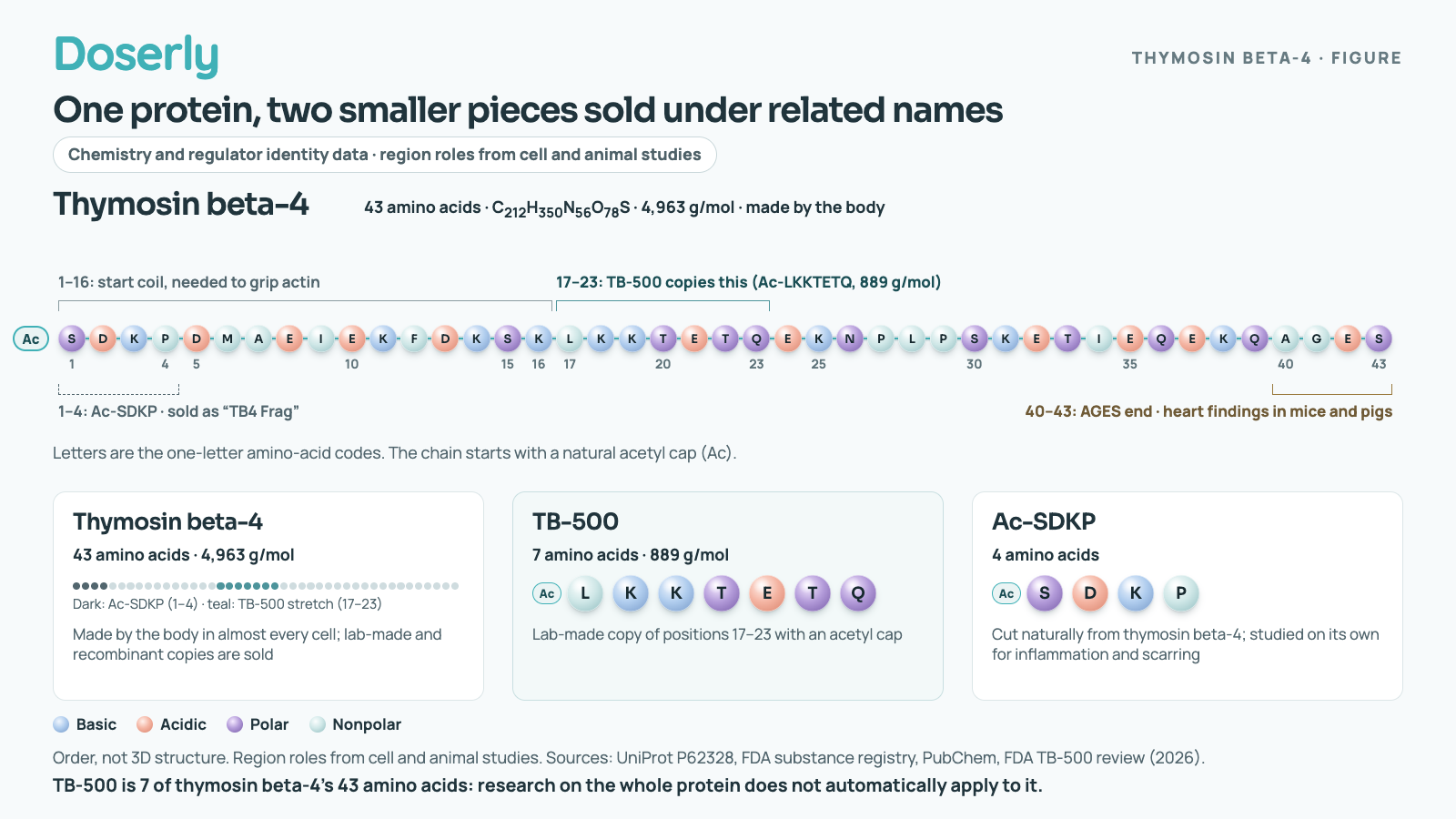
One protein, two smaller pieces sold under related names
Chemistry and regulator identity data · region roles from cell and animal studiesTB-500 is 7 of thymosin beta-4’s 43 amino acids: research on the whole protein does not automatically apply to it.
Chemists have been able to make it since 1983, and synthetic thymosin beta-4 matched the natural protein in laboratory tests. It can also be produced by bacteria as a recombinant protein. Both kinds have been tested in people as eye drops, skin gels and IV doses. [6], [7], [8]
The key word is investigational. After more than a decade of trials, no thymosin beta-4 medicine has been approved, and none appears in the FDA's or Health Canada's drug databases. [9], [10], [11]
Thymosin beta-4 or TB-500: which is which?
They are different molecules. TB-500 is a lab-made copy of just 7 of thymosin beta-4's 43 amino acids (positions 17 to 23), with a small chemical cap added. The two are often sold under each other's names. The only large dataset, a 2026 preprint of self-submitted product tests, found that 1 in 10 TB-500 samples did not contain the stated peptide, but it did not report which molecule was in those vials. [12], [13], [14], [15]
In this guide, thymosin beta-4 means the full 43-amino-acid protein, and TB-500 means the 7-amino-acid fragment. The full comparison is below, and Doserly's TB-500 guide covers the fragment in depth.
Typical Thymosin Beta-4 Protocols
| Example | Amount each time | Frequency | Weekly total | Duration |
|---|---|---|---|---|
| Low | 500 mcg | Once a day | 3.5 mg | 6 weeks Dosing calculator preset listed as a commonly reported protocol [16] |
| Mid | 750 mcg | Once a day | 5.25 mg | 3 months, then 1 month off Protocol page that uses the name TB-500 for the full 43-amino-acid protein [17] |
| High | 750–2,000 mcg | Once a day | 5.25–14 mg | 10–20 days A short course at a higher amount, not a longer one [18] |
Read these cautions before the numbers. No subcutaneous amount of thymosin beta-4 has been tested in people. The only human studies gave it as eye drops, skin gels or IV injections and infusions, so these schedules describe what protocol websites publish, not tested doses. [8], [19]
- The vial may not contain what the label says. Full-length thymosin beta-4, the TB-500 fragment and a third, four-amino-acid piece (Ac-SDKP) are all sold under names containing "TB4", and no public data show how often they are swapped. [20], [21], [18]
- Reactions can come on quickly. Several public accounts describe a racing heart, panic-like anxiety or flushing within about one to two hours of a 250–500 mcg dose, and in one case within 45 minutes on a much higher weekly amount; a few describe allergy-type rashes. [22], [23], [24], [25]
- Not studied in pregnancy, while breastfeeding or trying to conceive, in under-18s, or in people with a cancer history. Extra thymosin beta-4 helps tumours spread in some animal models. [26]
- Micrograms, milligrams and molecules are easy to confuse. 1 mg is 1,000 mcg, a syringe "unit" measures liquid rather than thymosin beta-4, and a milligram of TB-500 is not the same amount of molecule. Check any amount with the reconstitution calculator (worked example below).
- It is banned in sport at all times. [27]
Pages written about full-length thymosin beta-4 split into two patterns of about equal size: daily sub-milligram doses, typically 500–750 mcg by subcutaneous injection once a day for about 2–12 weeks (the table above), and the TB-500 twice-weekly schedule. Public accounts of clinic prescriptions describe daily amounts from 250 mcg to 750 mcg. [16], [28], [17], [18], [29], [22], [30]
- Titration Changing the amount in steps
- Daily pages usually start at the full amount. Some start higher and step down instead: one gives 500 mcg to 1 mg a day for two weeks, then 500 mcg twice a week to week 8. One page that uses the name TB-500 for the full protein does the opposite, starting at 500 mcg a day and stepping up every few weeks to 1 mg a day by week 9. In public accounts, a clinic gave a first 500 mcg dose in the office and then prescribed 250 mcg once or twice a day, and another prescribed course was doubled halfway through. [28], [31], [22], [32]
Read the units: these amounts are in micrograms (mcg); 1,000 mcg equals 1 mg. The weekly total adds up every injection in a week, which is the fairest way to compare a daily schedule with a twice-weekly one: 500 mcg a day is 3.5 mg a week. The amounts refer to thymosin beta-4 alone, not to the total weight of a blend.
Each row is a complete schedule from one published source, so its amount and duration belong together: the high example is a shorter course, not a longer one. Low, mid and high are alternatives, not steps to move through. These schedules come from protocol websites rather than any study of subcutaneous injections in people; the cited references give the full details.
Where protocols differ: daily or twice weekly, trial doses and breaks ↓
Where these numbers come from
The low row comes from The Peptide Catalog's thymosin beta-4 dosing calculator, which lists "Standard Healing" as 500 mcg seven days a week for six weeks among its commonly reported protocols. The mid row comes from Guide to Peptide's product page, whose smaller daily option is 750 mcg once a day for three months, then a month off; the page calls the product TB-500 but describes the 43-amino-acid protein. The high row comes from CalcMyPeptide's thymosin beta-4 page, which gives 750–2,000 mcg once a day for 10–20 days and says it applies only when a certificate confirms the full 43-amino-acid peptide. [16], [17], [18]
The table shows the daily cluster. In the pages we reviewed, explicit daily rows for the full protein (4 rows from 3 publishers) and explicit twice-weekly rows (5 rows from 4 publishers) are about equally common, so neither is called the most common. A Peptides.id page with a step-up daily schedule is not counted, because it describes its product both as the full 43-amino-acid protein and as an 8-amino-acid peptide. The Peptide Catalog's dosing chart (500 mcg to 1 mg daily for two weeks, then 500 mcg twice weekly) and its calculator's other presets (750 mcg daily for two weeks; 500 mcg twice weekly for eight weeks) fall in the same range. Two of these pages come from one publisher, and its comparison article gives a different, twice-weekly schedule, so matching pages are not independent confirmation. Public accounts of clinic prescriptions (750 mcg five days a week; 250–500 mcg a day; about 500 mcg a day) cross-check the amounts. [28], [16], [36], [29], [22], [30]
We kept twice-weekly schedules in their own table below, because most copy the TB-500 schedule, and kept blends separate. We excluded amounts built from animal studies (one page scales a dose of 6 mcg per mouse to about 17 mg for a person), trial doses given by other routes (IV doses of up to 1,260 mg a day), a page about the separate four-amino-acid piece Ac-SDKP, and isolated forum claims of 15 mg a day or IV self-injection. Across the daily pages, single amounts run from 500 mcg to 2 mg; that spread describes websites, not safe or effective limits. [28], [37], [20], [24], [38]
What about twice-weekly schedules?
Many pages titled "thymosin beta-4" give the twice-weekly loading schedule that TB-500 is known for. Some say so openly, describing their 2–5 mg twice-weekly amounts as community practice for TB-500, and others use both names as if they were one product. The rows below come from one telehealth page that gives three complete versions. [39], [40], [41], [33]
| Example | Amount each time | Frequency | Weekly total | Duration |
|---|---|---|---|---|
| Low | 750 mcg–1 mg | Twice a week | 1.5–2 mg | 4–8 weeks, then 4–6 weeks off Described for general recovery |
| Mid | 2 mg for 2–3 weeks, then 1 mg | Twice a week | 4 mg, then 2 mg | 8–11 weeks Described for long-standing tendon problems |
| High | 2–2.5 mg for 4 weeks, then 1–1.5 mg | Twice a week | 4–5 mg, then 2–3 mg | 8–10 weeks Described for a recent injury |
This is essentially the TB-500 pattern, whose most common version is 2–2.5 mg twice a week for 4–6 weeks, then about 2 mg once a week; the TB-500 guide covers it. One protocol page written specifically about the full protein uses a much lower twice-weekly amount, 750 mcg on Monday and Thursday. [42], [43], [19]
Copying the milligram amount from one molecule to the other ignores their size, yet some pages give identical milligram doses for both. [36] See whether 2 mg of one equals 2 mg of the other.
What about blends?
Thymosin beta-4 is also taken inside pre-mixed vials with BPC-157, often sold as "BPC/TB" or Wolverine blends, and in four-peptide blends such as KLOW and GLOW. Many of these labels say "TB-500", while some list the registry number of the full protein, and forum users disagree about which molecule the "TB" part usually is. [44], [45], [46]
In a blend, the number on the label is the total of every peptide, so the thymosin beta-4 part of each dose is only a fraction of what is drawn up. In an equal-parts BPC-157 and TB blend, 1 mg of blend holds 500 mcg of each. [47] In community education groups, equal-parts blends taken at 0.5–1 mg of blend a day are the most common way people describe getting thymosin beta-4. Members who work out the numbers for four-peptide blends such as KLOW find that a typical daily dose holds only about 0.24–0.37 mg of thymosin beta-4. See the Doserly guides to the Wolverine blend, BPC-157 + TB-500 blend math, KLOW and GLOW.
What is thymosin beta-4 commonly used for?
People who buy thymosin beta-4 as a research peptide usually want an injury to settle faster: a tendon that flares with training, a sore shoulder or elbow, a knee that has not recovered, or healing after surgery. Most take it alongside BPC-157 or inside a blend, and often with physiotherapy, rest or other medicines. [22], [34], [32], [48]
Researchers and drug developers have taken it in a different direction. Its human trials tested eye drops for dry eye and a hard-to-heal corneal condition, skin gels for slow-healing ulcers, and IV doses after a heart attack. So the uses people discuss online and the uses that have been tested in people barely overlap. The sections below describe what people hope for and what was studied; they do not establish that thymosin beta-4 treats any condition. [49], [50], [51]
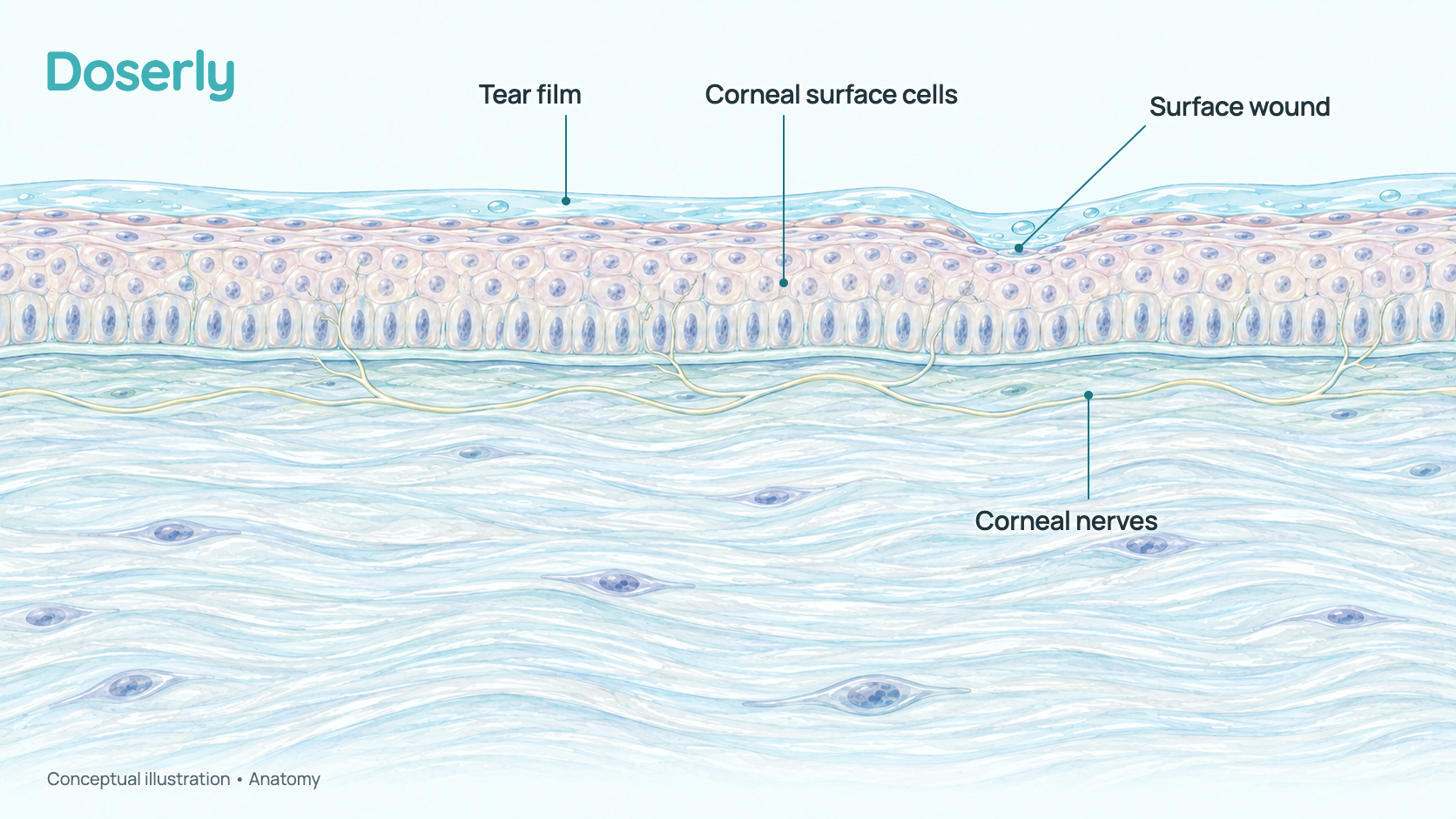
Tendon, ligament, muscle and joint injuries
This is the main reason people inject it. The hoped-for result is practical: less pain when lifting or running, and getting back to training without the injury flaring. Public accounts include biceps tendinitis, long-standing tendon pain in the leg, ankle sprains and wrist inflammation. [22], [34], [48], [32]
The research behind this hope is animal work. In rats, one small dose of thymosin beta-4 placed into an injured knee ligament gave better-organised, stronger repairs, and in mice with broken bones the healing bone was stronger. But in mice with a muscle-wasting disease, six months of thymosin beta-4 added regenerating muscle fibres without making the mice any stronger. No study in people has tested it for a tendon, ligament, muscle or joint injury. [52], [53], [54]
There is also a twist. People with knee osteoarthritis have higher blood levels of thymosin beta-4 than people without it, and joint-fluid levels rise with severity; joint fluid in rheumatoid arthritis contains even more. That is an association, not a cause, but it means "topping up" a sore joint is not a simple idea. [55], [56]
Dry eye and hard-to-heal corneal wounds
This is where most of the human research sits. A company developed a 0.1% thymosin beta-4 eye drop and tested it in dry-eye trials that together enrolled more than 1,600 people, and in a small trial for neurotrophic keratopathy, a condition in which the cornea's nerves fail and surface wounds will not close. The large dry-eye trials missed their main goals, and the corneal trial's main result was not statistically significant. See the trial details. [57], [58], [59], [60], [61], [49]
Those drops were a sterile, formulated medicine. In one public thread, a person recovering from eye surgery asked how to make eye drops from an injectable research vial; that is not the product that was tested, and homemade eye preparations carry a real infection risk. [62]
Skin wounds, ulcers and the scalp
Thymosin beta-4 gels were tested on leg ulcers, pressure sores and the fragile, blistering skin of epidermolysis bullosa (a genetic skin disease). Safety was similar to placebo, and healing rates on gel were no better than on placebo in any of the three trials. [50], [63], [64]
A 2021 Chinese study gave a recombinant thymosin beta-4 scalp gel to 71 people with seborrheic dermatitis (a flaky, itchy scalp condition) for four weeks and reported better and longer-lasting results than a standard antifungal lotion. The abstract does not describe how people were assigned to each treatment, so it is a promising report rather than a confirmed result. [65]
Heart attacks
Thymosin beta-4 drew attention after mouse studies suggested it helped heart muscle survive a heart attack. In people, a recombinant form given into a vein (IV) after a heart attack did not reduce overall heart-muscle damage compared with placebo; only a subgroup treated within eight hours did better, a finding that needs its own trial. This was hospital treatment by IV, not a self-injected product. [66], [51]
Hair, brain, gut and other claims
Websites also mention hair growth, stroke and brain-injury recovery, gut inflammation and "anti-aging". The support is animal research: faster hair regrowth in mice, better function after strokes and brain injuries in rats, and, in a 2026 mouse study, less colitis (gut inflammation) when a recombinant form was given by mouth. The one large human hair study used an injected mixture of six ingredients, so it cannot show what thymosin beta-4 contributed. [67], [68], [69], [70], [71]
See the human study results or explore the supporting animal research.
How is thymosin beta-4 different from TB-500?
Thymosin beta-4 is the whole natural protein; TB-500 is a small synthetic piece of it. They share one short stretch, but they are different molecules with different evidence behind them, and there is no study comparing them head to head. The table sets out what each one is. [3], [12]
| Thymosin beta-4 (TB4) | TB-500 | |
|---|---|---|
| What it is | A natural protein made by nearly every cell in the body | A lab-made peptide that does not occur naturally |
| Length | 43 amino acids | 7 amino acids (positions 17 to 23 of thymosin beta-4) |
| Sequence | Ac-SDKPDMAEIEKFDKSKLKKTETQEKNPLPSKETIEQEKQAGES | Ac-LKKTETQ |
| Weight | About 4,963 g/mol | About 889 g/mol |
| Official names | Timbetasin; registry number (CAS) 77591-33-4 | No official drug name; CAS 885340-08-9 |
| Where the name came from | Calf thymus extracts, sequenced in 1981 | A veterinary product for racehorses and greyhounds, around 2011 |
| Human studies | Phase 1 to 3 trials of eye drops, skin gels and IV doses | None |
| Sport | Banned at all times | Banned at all times |
Sequence, weight and registry details from UniProt, the FDA's substance registry, PubChem and the FDA's TB-500 review. "Ac" is the acetyl cap on the first amino acid. [3], [5], [72], [12], [27]
Why are they so often confused?
Because almost everyone involved, from sellers to one regulator, uses the names loosely. [12], [73]
- Product names. Listings such as "Thymosin Beta 4 (TB-500)" and dosing guides titled "Thymosin Beta-4 (TB-500)" treat the two as one product, and one vendor article uses "TB-500" for the full protein throughout. Some pages describe TB-500 as a 43-amino-acid peptide, and one even calls it an 8-amino-acid peptide on the same page. [13], [33], [74], [31]
- Regulators and reviewers. New Zealand's medicines regulator describes TB-500 as the "synthetic form" of thymosin beta-4. The FDA's own TB-500 review pointed to supplier information listed under the full protein's registry number, and noted that all three studies offered in support of TB-500 were thymosin beta-4 studies. [73], [12]
- Borrowed evidence. Nearly all the research quoted for TB-500, including every human trial, used thymosin beta-4. In community education groups, the more careful educators warn against carrying those results over, while some course materials describe TB-500 as the full 43-amino-acid protein. [12]
- Price. The 43-amino-acid protein is harder and more expensive to make. Websites describe it as significantly more expensive per milligram, and forum users put the difference at roughly two to four times. [75], [36], [76], [45]
- A third molecule. Products called "TB4 Frag" or "TB4 Fragment 1-4" contain Ac-SDKP, the first four amino acids of thymosin beta-4. One page selling it calls TB-500 "the full 43-amino acid peptide", and a capsule listing calls the full protein "TB-500". [20], [77]
Which way does the mislabelling go?
Nobody knows, and the claims point in opposite directions. One calculator site claims over 95% of vendors label their vials TB-500 while the contents are actually full-length thymosin beta-4; another page from the same publisher says research vials labelled thymosin beta-4 are often the fragment; a third says the market skews toward the cheaper fragment. None of them cites data. [21], [18], [78]
Individual tests do not settle it either. A person who tested products in 2020 wrote that everything except products bought specifically as the fragment turned out to be thymosin beta-4, while another forum user says an order labelled "TB4" tested as the fragment. A 2019 test of a vial labelled 2 mg of thymosin beta-4 found about 1 mg and could not say which molecule it was. French racing laboratories report that online products claim to contain either the fragment or thymosin beta-4 itself. [79], [80], [81], [14]
The practical test is a certificate of analysis that names the sequence or the measured mass: about 4,963 for the full protein and about 889 for TB-500. A certificate describes only the batch tested, and "TB-500 (Thymosin Beta-4)" on a label tells you nothing on its own. [72], [12], [82]
Does 2 mg of one equal 2 mg of the other?
No. Because thymosin beta-4 is about 5.6 times heavier, 2 mg of it contains about 0.40 micromoles (a count of molecules), while 2 mg of TB-500 contains about 2.25 micromoles. In other words, the same number of milligrams delivers about 5.6 times as many copies of the shared stretch when the vial holds the fragment. [72], [12]
That does not make either amount "stronger", because the two molecules have not been shown to act the same way. It does mean a schedule written for one cannot simply be reused for the other, which is exactly what many pages do. [36], [40]
Which fits which potential use?
The evidence below compares where each molecule has actually been tested. It is not a recommendation to use either one, and no study has compared them directly.
Dry eye and corneal wounds: thymosin beta-4, human trials, 0.1% drops: most main goals missed; TB-500, animal only, One study of a modified gel. Skin wounds and ulcers: thymosin beta-4, human trials, Gels: benefit unproven; TB-500, cell study only, Did not close scratch wounds. Heart attack: thymosin beta-4, human trial, IV doses: no overall benefit; TB-500, no studies, Nothing published. Tendon, ligament, muscle, joints: thymosin beta-4, animal only, Mixed results; TB-500, animal only, One positive rat study. Subcutaneous injection (any use): thymosin beta-4, no human studies, Only website protocols; TB-500, no human studies, Only website protocols. No study has compared the two molecules directly.
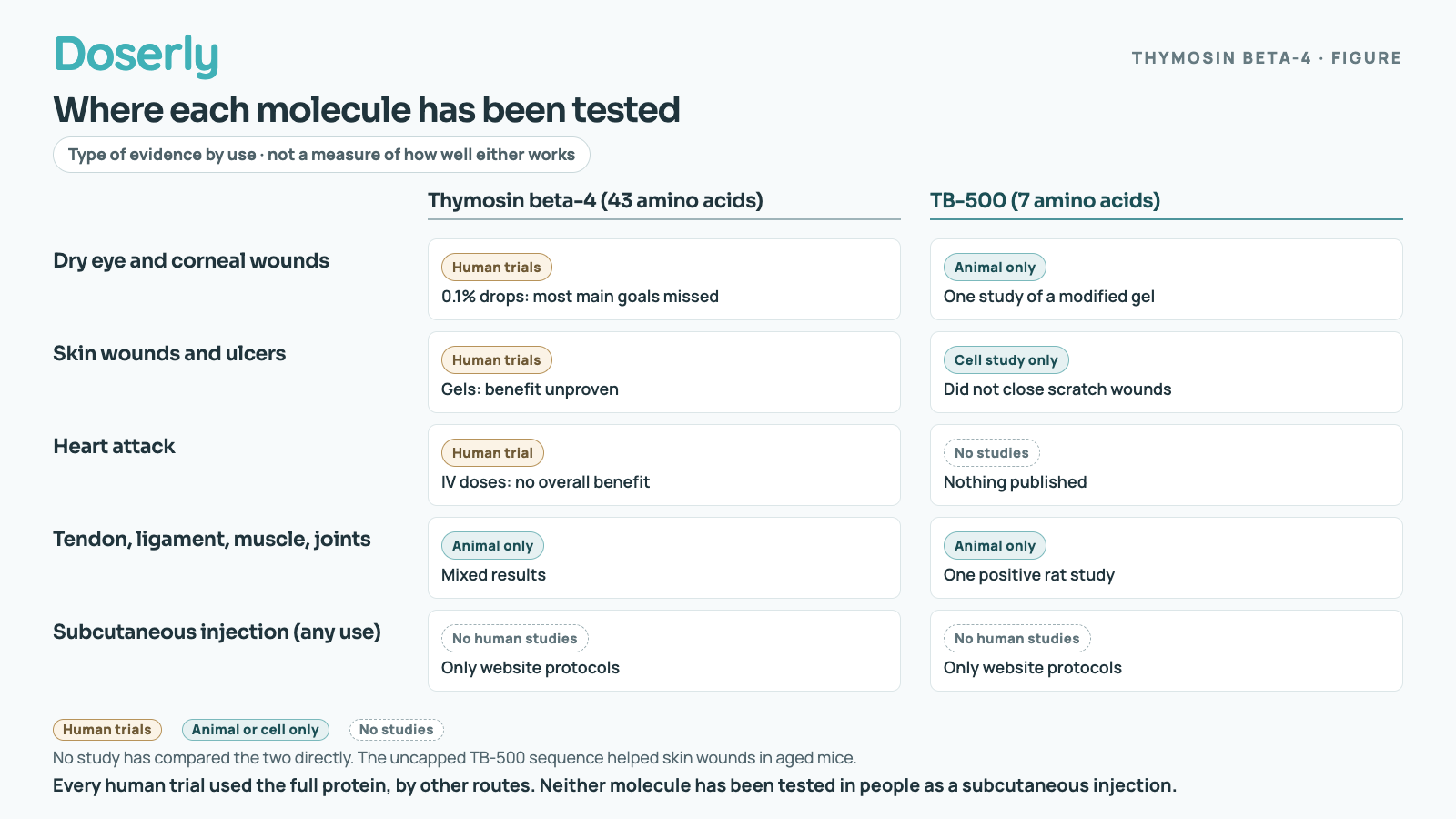
Where each molecule has been tested
Type of evidence by use · not a measure of how well either works- Dry eye and corneal wounds
- Thymosin beta-4Human trials0.1% drops: most main goals missedTB-500Animal onlyOne study of a modified gel
- Skin wounds and ulcers
- Thymosin beta-4Human trialsGels: benefit unprovenTB-500Cell study onlyDid not close scratch wounds
- Heart attack
- Thymosin beta-4Human trialIV doses: no overall benefitTB-500No studiesNothing published
- Tendon, ligament, muscle, joints
- Thymosin beta-4Animal onlyMixed resultsTB-500Animal onlyOne positive rat study
- Subcutaneous injection (any use)
- Thymosin beta-4No human studiesOnly website protocolsTB-500No human studiesOnly website protocols
Every human trial used the full protein, by other routes. Neither molecule has been tested in people as a subcutaneous injection.
| Question | Thymosin beta-4 | TB-500 | What it means |
|---|---|---|---|
| Dry eye and corneal wounds | Human trials of 0.1% drops: mixed, with most main goals missed | One animal study of a modified TB-500 gel | Only the formulated drops of the full protein were tested in people. [49], [60], [83] |
| Skin wounds and ulcers | Phase 2 trials of gels: safety like placebo, benefit unproven | The uncapped sequence helped wounds in old mice; capped TB-500 did not close scratch wounds in a dish | The full protein, applied to the skin, is the tested form. [50], [84], [85] |
| Heart | IV doses after heart attack: no overall benefit; a subgroup finding needs confirming. In mice and pigs, the protein's last four amino acids (absent from TB-500) drove much of the benefit | None | Heart interest belongs to the full protein, given in hospital. [51], [86] |
| Tendon, ligament, muscle and joints | No human study; a local dose helped a rat knee ligament and bone healing in mice, but 6 months did not strengthen dystrophic mice | No human study; one rat Achilles study (daily injections into the abdomen) reported stronger, better-organised repairs; the abstract calls the product "synthetic thymosin beta-4 (TB-500)" and does not report testing which molecule it was | Neither has human evidence for this use, and one rat study is no basis for ranking them in people. [52], [53], [54], [87] |
| Calming inflammation and scarring | Contains Ac-SDKP, studied for this in cells and animals; the whole protein did not prevent lung scarring in one mouse study | Lacks Ac-SDKP | A structural difference, not a proven effect. [88], [89] |
| Cancer concern | Theoretical; extra thymosin beta-4 aided tumour growth and spread in some animal and cell models | Untested; a fragment covering TB-500's stretch also stimulated ovarian cancer cells in a dish | Switching to the fragment is not shown to avoid the concern. [26], [90], [91] |
| Product quality in testing | In a 2026 preprint of self-submitted tests, 64.5% of samples met both purity and amount criteria | 22.5% met both, and 1 in 10 did not contain the stated peptide | Not peer reviewed and self-selected; it did not report whether full-length thymosin beta-4 in a TB-500 vial counted as a match. [15] |
| Sport | Banned | Banned under the same entry | Choosing the fragment is not an exemption. [27] |
In short, the human research belongs to thymosin beta-4 used on the eye or skin, or given in hospital by IV; none of it tested either molecule as a subcutaneous injection for an injury. Anyone considering either product for an injury is relying on animal studies and personal accounts, whichever name is on the vial.
What do the extra parts of thymosin beta-4 do?
The full protein carries regions that TB-500 lacks, and researchers have linked them to separate effects in cell and animal studies. [92]
- The first four amino acids (Ac-SDKP) are cut off naturally by enzymes and studied for calming inflammation and scarring. [93], [88]
- The first 16 amino acids form a coil that thymosin beta-4 needs, together with the stretch TB-500 copies, to grip its partner protein, actin, properly. Pieces missing the first part of the protein did not hold actin at all. [94], [95]
- The last four amino acids were, in mouse and pig heart experiments, the part responsible for much of the protein's benefit after blocked blood flow. [86]
The stretch that TB-500 copies still matters: without its cap, the 7-amino-acid sequence matched the whole protein's effect on blood-vessel growth in cell and tissue tests, and it helped skin wounds heal in older mice. Whether the capped, injected TB-500 behaves the same way is unproven. [96], [84], [12] For everything else about the fragment, read Doserly's TB-500 guide.
Where do thymosin beta-4 protocols differ?
The headline pattern is easy to summarise; the details are not. Sources disagree about whether to give thymosin beta-4 every day or twice a week, how much to give, whether to start with a loading phase and how long to continue. They also disagree about which molecule is in the vial, which changes what any amount means.
Is the number for one injection, one day or one week?
A dose is the amount given each time; a daily total or weekly total adds them up. 500 mcg every day is 3.5 mg a week, while 2.5 mg twice a week is 5 mg a week. Some pages give only a weekly figure, such as "4–10 mg a week, divided", which could mean two injections or several. Check whether each number is per injection, per day or per week before comparing it with anything else. [16], [33], [36]
Blends add a further step: the amount drawn from a pre-mixed vial is the total of every peptide in it. See the blend note.
Every day, or twice a week?
Both styles are common, and the split follows the confusion over names. Pages and clinics that treat thymosin beta-4 as its own product mostly give it daily in sub-milligram amounts; pages that treat it as another name for TB-500 give the TB-500 twice-weekly schedule. Some publishers give both on different pages. [16], [17], [33], [36]
The reason usually given for daily dosing is that thymosin beta-4 is short-lived. That fits the human IV measurements, in which thymosin beta-4 fell by half in about 0.5–2 hours, but nobody has measured it after a subcutaneous injection. In community education groups, educators who teach daily doses of 0.5–1 mg, split morning and evening, rely on a half-life list that gives thymosin beta-4 a few hours and TB-500 about a week; the TB-500 figure has no published source. [8] Public forums repeat a similar split, quoting 2 hours for thymosin beta-4 and 7–10 days for TB-500. [97] In community education groups, members follow both habits: 0.25–0.5 mg once or twice a day for 4–8 weeks, sometimes up to 1 mg twice a day for 7–10 days after a fresh injury, or 2–2.5 mg two or three times a week, such as Monday, Wednesday and Friday. See how long it lasts in the body.
A half-life also says little about how long an effect lasts. Nobody has compared daily with twice-weekly schedules of either molecule, in people or animals.
Why are trial doses so different from website doses?
Because they were given by different routes for different purposes. In the human trials, thymosin beta-4 was given into a vein at 42 to 1,260 mg a day (synthetic) or micrograms per kilogram of body weight (recombinant), or applied as eye drops and gels at 0.01% to 0.1% strength. Protocol websites describe 0.5–2 mg a day, or 2–5 mg twice a week, by subcutaneous injection. [37], [8], [60], [50], [16], [40]
IV infusion (synthetic): 42 to 1,260 mg a day, 14 days; 40 healthy volunteers, safety study. IV injection (recombinant): 0.05 to 25 mcg per kg once; up to 5 mcg per kg a day for 10 days; Healthy volunteers, safety study. Eye drops: 0.1% solution (1 mg per mL); Dry eye and corneal trials. Skin gel: 0.01% to 0.1%; Leg-ulcer trial. Subcutaneous injection (websites): 0.5 to 2 mg a day, or 2 to 5 mg twice a week; Protocol websites; never tested in people. These are different routes and purposes; none of the trial amounts is a tested injection dose.
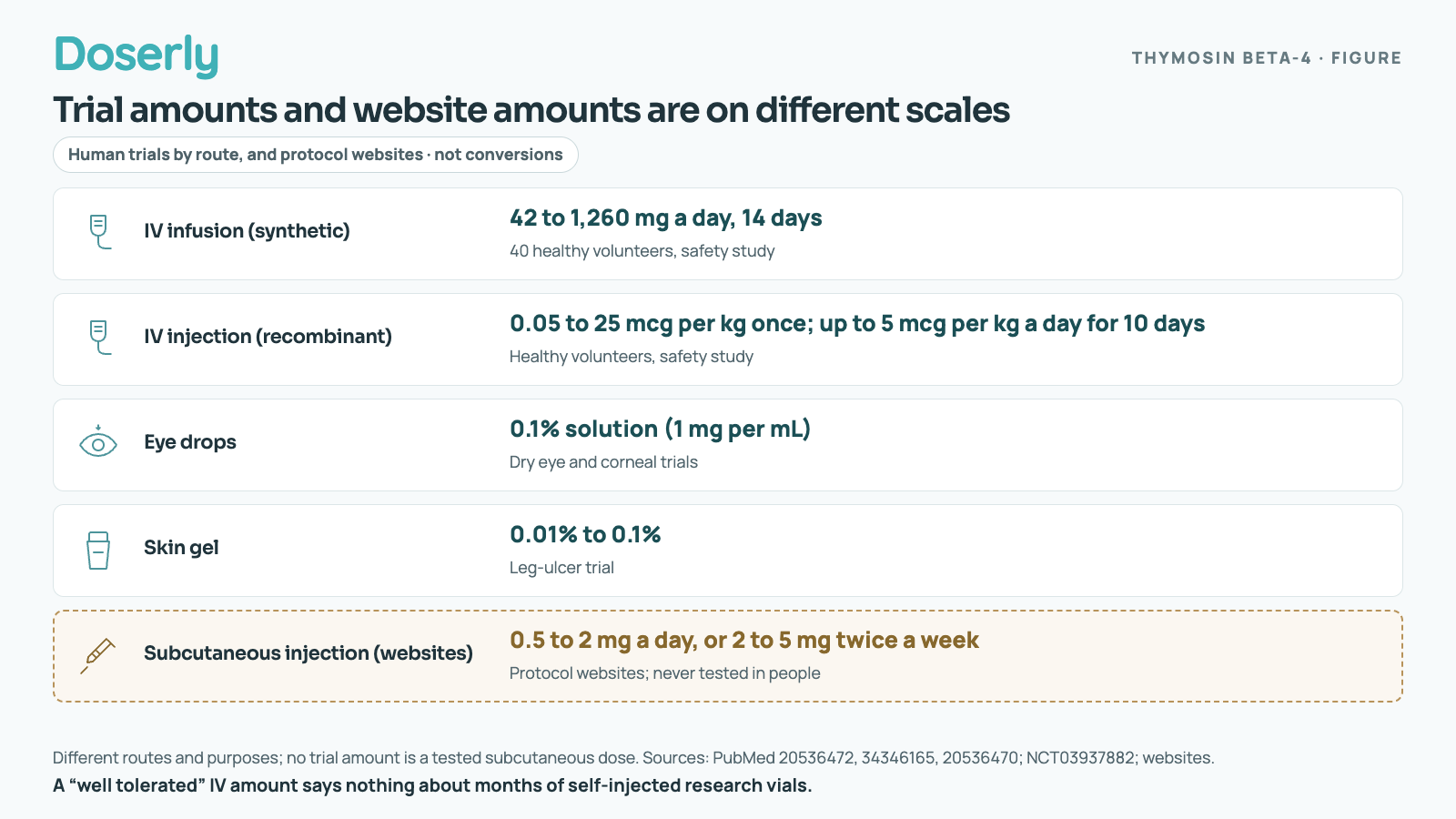
Trial amounts and website amounts are on different scales
Human trials by route, and protocol websites · not conversions- IV infusion (synthetic)
- 42 to 1,260 mg a day, 14 days40 healthy volunteers, safety study
- IV injection (recombinant)
- 0.05 to 25 mcg per kg once; up to 5 mcg per kg a day for 10 daysHealthy volunteers, safety study
- Eye drops
- 0.1% solution (1 mg per mL)Dry eye and corneal trials
- Skin gel
- 0.01% to 0.1%Leg-ulcer trial
- Subcutaneous injection (websites)
- 0.5 to 2 mg a day, or 2 to 5 mg twice a weekProtocol websites; never tested in people
A “well tolerated” IV amount says nothing about months of self-injected research vials.
None of these can be converted into the others. Several websites quote the IV safety study ("well tolerated up to 1,260 mg") next to subcutaneous research-vial doses, but that study gave a pharmaceutical product into a vein for two weeks to 40 healthy adults; it says nothing about months of self-injection. [28], [39], [37]
Do sources start low, or load first?
Most daily pages start at the full amount, and several start higher and then step down: 750 mcg a day for two weeks as a "loading" phase, or 500 mcg to 1 mg a day for two weeks followed by 500 mcg twice a week. One page that uses the name TB-500 for the full protein starts low instead, at 500 mcg a day, and steps up every few weeks to 1 mg a day by week 9. Twice-weekly pages load with 2–2.5 mg for two to four weeks, then drop to 1–1.5 mg. The usual explanation is that loading "saturates" tissue, which has not been shown for either molecule. [16], [28], [31], [33]
In public accounts, people more often move up than down: one person went from 500 mcg to 750 mcg a day after six weeks without change, and a prescribed course was doubled halfway through. There is no established rule that no improvement at a lower amount means a higher amount will work. [34], [32]
How many weeks, and what happens between courses?
A course is the period of repeated use; a cycle is that course plus a planned break. Published patterns include 10–20 days, 6 weeks, 8 weeks with a twice-weekly second half, and 3 months on with 1 month off. Twice-weekly pages describe 8–11 weeks, or 4–8 weeks followed by 4–6 weeks off. [18], [16], [28], [17], [33]
In community education groups, the common advice is 4–8 weeks on and 4–8 weeks off, often as five days on and two days off. A doctor in one public account planned three to six months of treatment. The reasons given for breaks have not been tested. [22]
Why do some pages scale the dose by body weight or from mice?
A few pages work out a human amount from body weight or from animal studies. One suggests about 20–30 mcg per kg; another takes a dose of 6 mcg per mouse and scales it up to a "human equivalent" of about 17 mg as a single dose, or 5–10 mg a week. [33], [28]
That arithmetic produces a number, not a tested dose. Animal doses cannot simply be scaled to people, and no study has checked whether thymosin beta-4 behaves the same way in both.
How do micrograms convert to syringe units?
Many people meet "units" on an insulin syringe. A U-100 syringe holds 100 units per millilitre, so units measure volume, not an amount of thymosin beta-4. How much each unit holds depends on how much liquid was added when the powder was mixed (reconstituted).
For example, a 5 mg vial mixed with 2 mL gives 2.5 mg per mL, or 25 mcg per unit, so a 500 mcg injection is 20 units (0.2 mL) and a 750 mcg injection is 30 units (0.3 mL). The same 750 mcg from a 10 mg vial mixed with 2 mL is only 15 units. [19], [28]
Mistakes happen at every step. In one public thread, a person first described their prescribed amount as "2 ml" of a 3 mg per mL product, which would be 6 mg, before the thread worked out that the intended dose was about 500 mcg. [23] Doserly's reconstitution calculator works this out for any vial and shows each step.
Source-by-source comparison and registered study plans
Which pages give a daily schedule for the full protein?
Unit key: 1 milligram (mg) = 1,000 micrograms (mcg).
The Peptide Catalog's calculator lists 750 mcg daily for two weeks, 500 mcg daily for six weeks and 500 mcg twice weekly for eight weeks as commonly reported protocols; its dosing chart gives 500 mcg to 1 mg daily for two weeks, then 500 mcg twice weekly to week 8. CalcMyPeptide's thymosin beta-4 page gives 750–2,000 mcg once daily for 10–20 days for a vial confirmed as the 43-amino-acid peptide, and says the 2–5 mg twice-weekly calendar belongs to the fragment. Guide to Peptide's page offers 750 mcg daily for three months on and one month off, alongside twice-weekly and every-other-day TB-500 options. [16], [28], [18], [17]
Which pages give twice-weekly schedules?
FormBlends' thymosin beta-4 dosage guide gives loading at 2–2.5 mg twice weekly, then 1–1.5 mg, with separate versions by goal; its monograph page gives 750 mcg to 2 mg two or three times a week with 2–3 mg loading. Peptide Initiative's thymosin beta-4 pages give 2–5 mg once or twice weekly, and its dosing page labels this community practice for TB-500. Path to Peptides gives 750 mcg on Monday and Thursday and states that no validated human dose exists. The Peptide Catalog's comparison article gives 2–5 mg twice weekly for both molecules. [33], [98], [40], [41], [19], [36]
What do the registered studies plan?
No registered trial tests injected thymosin beta-4 for injuries. The live registrations are for IV doses after a heart attack and eye drops. Dose groups in these plans are study designs, not personal schedules, and registry update dates describe the records, not newly completed trials.
10 or 20 mcg per kg daily for 7 days after a heart attack
A Chinese company's recombinant thymosin beta-4 (NL005), planned for 189 people. Two earlier phase 2 studies of the same product are complete with no results posted.
Not yet recruiting at its last registry update (May 2026), with a planned start of May 2026; no later update (checked September 26, 2026).
[99], [100], [101]0.1% drops five times a day for 28 days
A second trial in neurotrophic keratopathy, a hard-to-heal corneal condition, planned for 70 people.
Listed as recruiting; its estimated primary completion (April 2026) has passed, the record has not been updated since December 2025 and no results are posted (checked September 26, 2026).
[102]What happens when you stop thymosin beta-4?
This has not been studied for injected use. No study has looked for withdrawal effects or a rebound after stopping a course, and none of the short trials followed people for long after treatment ended. That is an absence of data, not proof that none exist.
- In the corneal eye-drop trial, the published report says none of the healed wounds had reopened two weeks after the drops stopped, although the registry lists 5 of 10 people fully healed at that point, against 6 at the end of treatment. That tells us about eye drops, not about injections. [49], [103]
- Public accounts point both ways. One person who later said the vial was full-length thymosin beta-4, and who also took BPC-157 and rested completely for 40 days, was still pain-free at their first leg workout two weeks after the course, and later said the pain had not returned. In community education groups, members describe knee pain returning within a week of stopping, shoulder pain returning after a blend was stopped, or a benefit that faded between injection days. One member whose frozen-shoulder pain got worse after adding thymosin beta-4 to BPC-157 said it eased once thymosin beta-4 was stopped. [104]
- Some unwanted effects outlasted the course. In two public accounts, anxiety and a raised heart rate, or stomach upset, flushing and tiredness, continued for days to more than a month after stopping. [30], [105]
Pain that comes back soon after stopping fits short-term symptom relief better than tissue repair, but a single account cannot settle which is happening. The breaks that protocols describe are a convention, not a response to known withdrawal effects.
Do injected, eye-drop, skin and oral forms of thymosin beta-4 behave the same way?
No, and only some of them have been measured. How the body absorbs, moves and removes a substance is called pharmacokinetics, and for thymosin beta-4 it has been measured in people only after IV doses. [8], [37]
- Subcutaneous injection: the route almost every protocol website and clinic uses. It has never been measured in people, so how much reaches the blood (the bioavailability) is unknown. [19], [16]
- Intravenous (IV, into a vein, by injection or infusion): used in two safety studies and a heart-attack trial, always as a pharmaceutical product in a clinical setting. [37], [8], [51]
- Eye drops: tested in people as a sterile 0.1% formulation. Drops made at home from an injectable vial are a different product. [49], [62]
- Skin gels: tested in people at 0.01% to 0.1% on ulcers and at 0.5 mg per mL on the scalp. [50], [65]
- Oral (swallowed): no human data. In a 2026 mouse study, recombinant thymosin beta-4 given by mouth eased gut inflammation; the study did not measure whether it was absorbed. Capsules sold as "TB4 Fragment 1-4" contain Ac-SDKP, a different molecule, and their absorption claims are unsourced. [70], [77]
- Intramuscular injection and nasal sprays: no data for thymosin beta-4 in any species.
How long does thymosin beta-4 last in the body?
Half-life is the time it takes for the level in the blood to fall by half. Two IV studies measured it. Both found the half-life grew longer at higher doses, and the one that reported numbers found recombinant thymosin beta-4 peaked within 3–15 minutes, fell by half in 0.5–2.08 hours, and did not build up over 10 days of daily doses. [8]
In mice given an injection into the abdominal cavity, blood levels rose from 2 minutes and stayed raised for about 40 minutes; much of the dose was then found in urine and organs. The authors noted in 1997 that no human pharmacokinetic study had been reported, and none has been published for subcutaneous injection since. [106]
Websites and forums quote half-lives from about "2–3 hours" to "2–4 days" or "7–10 days", sometimes for thymosin beta-4 and sometimes for TB-500, often to justify a schedule. Only the IV figure comes from a measurement, and a half-life says nothing, by itself, about how long an effect lasts. [107], [17], [97]
Natural thymosin beta-4 complicates blood tests. Blood cells hold large amounts, and when blood sits before it is processed, cells release it: serum levels rose from 0.04 to 2.1 micrograms per mL within 24 hours in a tube. Researchers note large differences between studies and no standard method, so there is no validated blood test to check a dose. [108], [109]
Should thymosin beta-4 be injected near the injury?
No study has compared injecting near an injury with injecting elsewhere, for either molecule. The animal ligament study placed the protein directly into the injury during surgery, which is not something a person can copy. In community education groups, educators warn against injecting into a joint or tendon because of infection risk, and one member describes local inflammation from repeated daily injections at the knee. [52]
Which form of thymosin beta-4 is in the vial?
Several different products are sold under thymosin beta-4 names. [72], [12], [20]
| Product | Weight | What it means |
|---|---|---|
| Thymosin beta-4 (synthetic or recombinant) | About 4,963 g/mol | The full 43-amino-acid protein, made by chemical synthesis or by bacteria (the recombinant NL005 version has 44 amino acids). |
| Thymosin beta-4 acetate | Varies with the salt | The same protein paired with acetate, a common salt form for peptides. |
| TB-500 | About 889 g/mol | The capped 7-amino-acid fragment, often sold as "TB-500 (Thymosin Beta-4)". |
| "TB4 Frag" or "Fragment 1-4" | Much smaller | Ac-SDKP, the first four amino acids, sold separately and sometimes as capsules. |
Weights from PubChem and the FDA's TB-500 review; NL005 length from its first human study. [72], [12], [77], [8]
Laboratories can tell synthetic thymosin beta-4 apart from the body's own: in horses, a manufacturing impurity in the synthetic product showed up in blood after a single dose. [14]
How should thymosin beta-4 be stored, and how long does it last?
No one has published a stability study of a research-vial thymosin beta-4 product, so there is no tested use-by date for a mixed vial. Storage advice comes from suppliers and protocol pages, not from a medicine label.
- The medicine version. The recombinant thymosin beta-4 in a current heart-attack trial is supplied as a 1.5 mg per mL solution stored in a fridge (2–8 °C). [99]
- Powder, before mixing. Protocol pages describe the freeze-dried (lyophilized) powder as stable at room temperature or in a fridge, protected from light, and one says unopened vials last for years at 2–8 °C; neither claim cites a stability test. [19], [40]
- After mixing. The same pages say to keep a mixed vial in the fridge (one adds not to freeze it), and one says to use it within 30 days. [19], [40]
- Room temperature. No public stability data exist for thymosin beta-4 kept at room temperature after mixing. In community education groups, people are advised to keep mixed vials and blends refrigerated.
Thymosin beta-4 contains a methionine, an amino acid that can react with oxygen. In a laboratory study, the oxidised form still held actin, but nobody has measured how oxidation or clumping affects an injected product. This guide does not cover mixing or injection technique; the Academy note below covers practical handling. [95]
What do we actually know about thymosin beta-4 in people?
More than for most research peptides, but not for the way it is usually used. Thymosin beta-4 has been tested in people in several controlled trials as eye drops, skin gels and IV doses. None tested a subcutaneous injection for an injury, and most missed their main goals. [60], [50], [51]
Reviews reach the same conclusion. A 2026 scoping review (a broad map of the research, not yet peer reviewed) found human evidence for thymosin beta-4 concentrated in eye and wound-healing settings, and three 2026 sports-medicine reviews describe promising animal work, very little human data for musculoskeletal use and real uncertainty about safety. [110], [111], [112], [113]
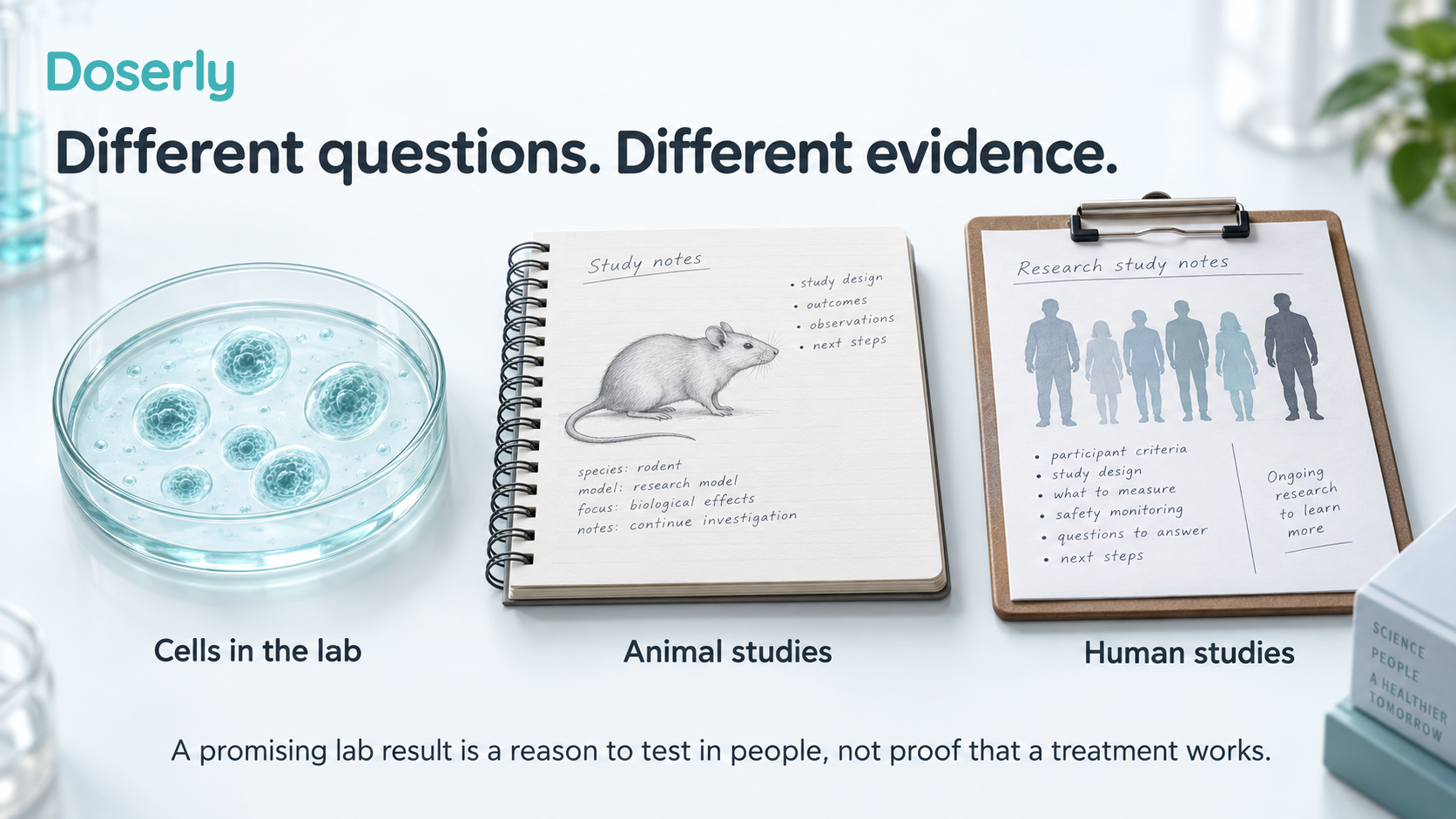
What did the thymosin beta-4 trials find?
| Study | What researchers reported | What it cannot establish |
|---|---|---|
| Severe dry eye, phase 2 (9 people) | 0.1% eye drops six times a day for 28 days. At day 56, less discomfort and less surface damage than inactive (placebo) drops. No adverse events. | Whether the effect holds in larger trials (it did not; see the next row). [57], [114] |
| Dry eye, phase 2 and 3 (72, 601 and 700 people) | In a controlled-environment trial and the two large ARISE trials, the drops missed their main goals (primary endpoints) for eye discomfort and surface damage. Some secondary measures, such as grittiness in ARISE-3, improved; drop discomfort was 6.6% versus 4.6%. A third large trial (317 people) posted no results. | That thymosin beta-4 drops work for dry eye. [115], [58], [59], [60], [116], [61] |
| Neurotrophic keratopathy, phase 3 (18 people) | A hard-to-heal corneal wound fully healed at 4 weeks in 6 of 10 on the drops and 1 of 8 on inactive drops, not a statistically significant difference; the difference was significant at day 43. The trial stopped early for business reasons. A Cochrane review rates the evidence as low certainty. | A reliable healing effect. [49], [103], [117] |
| Venous leg ulcers, phase 2 (73 randomized; 72 analysed) | Thymosin beta-4 gel at three strengths for up to 84 days. 12 of 55 people on gel (22%) and 4 of 17 on placebo (24%) healed within three months, so healing on gel was no higher than on placebo. Safety was similar to placebo; from their own subgroup reading, the authors wrote that the 0.03% gel "may have the potential to accelerate wound healing". | A proven benefit: the trial was small and the groups were not formally compared in the registry. [118], [50] |
| Pressure sores (72 people) and epidermolysis bullosa (30 people) | In the pressure-sore trial, 8 of 54 people on gel (15%) and 3 of 18 on placebo (17%) healed; the groups were not formally compared. In the blistering-disease trial, 8 of 22 healed on gel (36%) and 5 of 8 on placebo (63%), not a significant difference; it was stopped early. | Benefit for either condition. [63], [64] |
| Scalp seborrheic dermatitis (71 people) | A recombinant thymosin beta-4 gel for four weeks was reported to work better, and for longer, than 2% ketoconazole lotion, and to shift the scalp's microbes toward a healthy mix. | A confirmed benefit: the abstract does not describe randomisation or blinding. [65] |
| IV doses in healthy volunteers (40 and 84 people) | Synthetic thymosin beta-4 at 42 to 1,260 mg once, then daily for 14 days, caused no dose-limiting side effects or serious adverse events. A recombinant version at micrograms per kg caused side effects at a similar rate to placebo; antibodies were briefly detected in two volunteers, all samples later tested negative, and the authors put the positives down to borderline assay results. | Effectiveness for anything, long-term safety, or the safety of injecting research products for months. [37], [8] |
| IV doses after a heart attack (96 people) | Recombinant thymosin beta-4 did not reduce overall heart-muscle damage compared with placebo. In a subgroup of 43 people treated within 8 hours, damage was smaller at 90 days. | A heart benefit: subgroup findings need their own trial. Two registered phase 2 trials of the same product (2020–2023) are complete with no results posted; it is not clear whether either is the trial reported here. [51], [100], [101] |
A company-affiliated review of the ulcer trials said thymosin beta-4 sped up healing "by almost a month" in the people whose wounds healed. That describes a subgroup of responders, not everyone treated. [119]
Two other human reports are often quoted but cannot isolate thymosin beta-4. A large open-label hair study injected a mixture of six growth-factor ingredients, one of which was thymosin beta-4, with no comparison group. And a 10-person pilot study treated heart-attack patients with their own blood-vessel precursor cells after soaking the cells in thymosin beta-4, which is not the same as giving it. [71], [120]
Why don't these trials answer the injection question?
Because almost everything about them is different from how research peptides are used. They applied thymosin beta-4 to the eye or skin surface or gave it into a vein under medical supervision, rather than by subcutaneous self-injection; they studied eye disease, skin ulcers and heart attacks rather than tendons or joints; and they used pharmaceutical-grade products of known identity. The IV doses ran from micrograms per kilogram to over a gram a day, a scale that cannot be converted into a subcutaneous dose. [37], [8]
Websites sometimes misread these trials. One describes the IV safety study as a study of patients with chest pain from heart disease, when it enrolled healthy volunteers, and the often-quoted "25 mcg per kg daily for 10 days" was actually a single dose, with the 10-day doses going no higher than 5 mcg per kg. [121], [37], [122], [8]
What would a useful improvement look like?
Pain, function and tissue structure are separate outcomes, and they do not change together. A person with biceps tendinitis described it as noticeably better within about a week, while another with long-standing tendon damage in the leg noticed nothing in six weeks and only "some effects" after raising the amount. Neither account can show what the peptide did rather than time, rest or the other peptides they used. [22], [34]
The eye trials show why a clear, measured outcome matters: the early 9-person dry-eye study looked positive, and larger trials with the same drops did not confirm it. [57], [60]
How might thymosin beta-4 work?
Healing needs cells to move into a damaged area, new blood vessels to supply it, and inflammation to settle. In preclinical research (cell studies and animal studies), thymosin beta-4 is linked to all three. The open questions are how much of that happens when extra thymosin beta-4 is injected into a body that already makes plenty, and whether any of it translates into people.
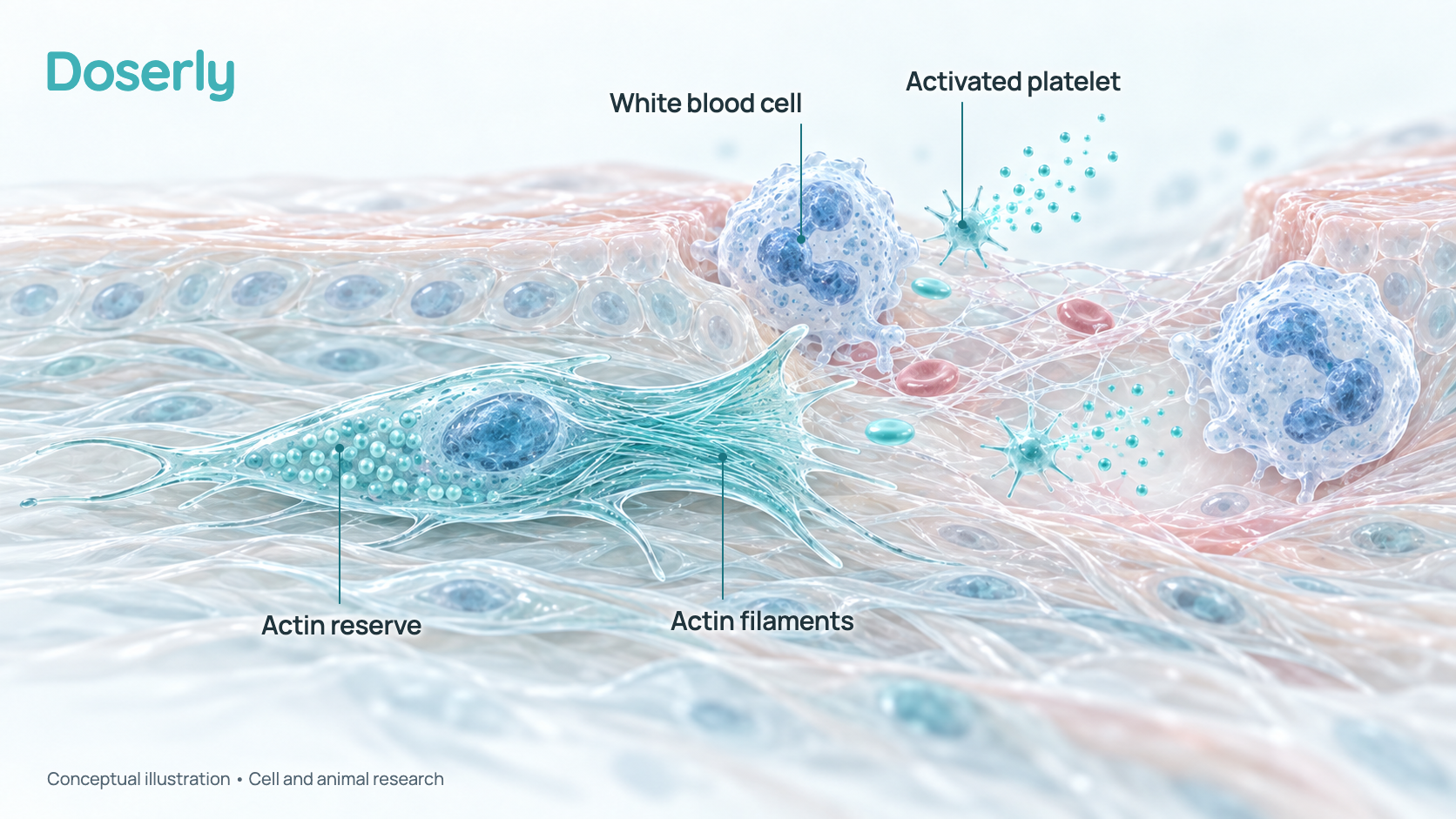
Doesn't the body already make thymosin beta-4?
Yes, in large amounts. It makes up roughly 70–80% of the beta-thymosin family in human cells, and blood cells are packed with it: each white blood cell called a neutrophil holds roughly 170 to 400 femtograms (a femtogram is a millionth of a billionth of a gram), depending on the study, and whole blood contains about 16 micrograms per mL, almost all inside cells. As a rough illustration, that is on the order of 80 mg in an adult's blood, far more than a 2 mg vial, though most of it stays inside cells. [123], [108], [124]
When platelets are activated, for example at a wound, they release thymosin beta-4, which is then bound to the fibrin of the clot; inside the activated platelet, thymosin beta-4 is freed from the actin it was holding. [125], [119], [126] Blood levels also rise briefly with exercise, but in the same study, giving extra thymosin beta-4 to mice did not improve muscle repair. [127]
Holding actin in reserve
Actin is the protein that forms a cell's internal scaffolding. When a cell moves, it builds actin filaments at its front edge from single actin building blocks. Thymosin beta-4 binds those single blocks one to one and keeps them in reserve, and it is the main protein doing this job in most cells. [2], [124], [128]
Gripping actin properly needs both the start of the protein and the stretch that TB-500 copies. Injured muscle makes more thymosin beta-4, and in lab dishes it drew muscle precursor cells toward it. Whether actin binding explains the healing effects seen in animals has not been worked out. [94], [129]
A second messenger: Ac-SDKP
Enzymes in the body cut the first four amino acids off thymosin beta-4 to make a small peptide called Ac-SDKP, studied for calming inflammation and scarring. Ac-SDKP is broken down almost entirely by angiotensin-converting enzyme (ACE), the target of common blood-pressure medicines called ACE inhibitors. In people on dialysis, those taking ACE inhibitors had Ac-SDKP levels 30 to 70 times higher than healthy people. [93], [130], [131], [88]
The whole protein does not always behave like Ac-SDKP. In human lung-scarring cells in a dish, Ac-SDKP reduced scarring signals; in mice, thymosin beta-4 did not prevent lung scarring at 14 and 21 days; the journal has since issued an expression of concern about that paper. [89]
Blood vessels and cell survival
In animal studies, thymosin beta-4 encourages angiogenesis, the growth of new blood vessels, and researchers map that activity to the stretch TB-500 copies. In mouse and pig hearts, the protein's last four amino acids mattered most for recovery after blocked blood flow, and in pigs with narrowed heart arteries, gene delivery of thymosin beta-4 increased small connecting vessels and pumping strength. [96], [86], [132]
New blood vessels are part of normal healing, but tumours also depend on them. That double edge is why the cancer question matters.
Where does the animal research fall short?
Enthusiastic summaries skip the results that did not work: thymosin beta-4 added regenerating muscle fibres without adding strength, shrank stroke damage in aged rats without improving function, failed to protect pig hearts during blocked blood flow, did not turn heart-surface cells into new heart muscle, and worked less well at the highest dose in a rat stroke study. Most of this work used milligrams per kilogram, doses that cannot be scaled into a human dose. [54], [133], [134], [135], [136] See the supporting research library for study-by-study detail.
What are the risks and unanswered questions?
Is thymosin beta-4 safe?
Its safety as a self-injected research product is unknown. The human safety data come from short, supervised studies of pharmaceutical products given into a vein (IV), as eye drops or as skin gels, and none followed people giving themselves subcutaneous injections for weeks or months. [37], [8], [60]
Within those limits, the trials are broadly reassuring. Two IV studies in healthy volunteers found no dose-limiting side effects or serious adverse events, even at 1,260 mg a day for two weeks, although one saw a brief tumour-marker rise that its authors linked to the drug (see cancer); the eye-drop and gel trials reported safety similar to placebo, with more drop discomfort in one large trial. Antibodies against a recombinant version were briefly detected in two volunteers and later tested negative, a reminder that injected proteins can provoke an immune response (immunogenicity). [37], [8], [116], [50]
Research products add risks the trials did not have: uncertain identity, unknown purity and dose, and home preparation. Two 2026 reviews of unregulated peptides warn about contamination, dosing errors and the potential for serious harm. [111], [137]
What side effects have been reported?
In the trials, side effects were few: eye-drop discomfort, one serious episode of depression in the corneal trial, and brief antibody detection with the IV version. In a pressure-sore trial of very ill patients, 13 of 54 people on gel (24%) and 5 of 18 on placebo (28%) had a serious adverse event. [116], [103], [63], [8]
In public accounts of research and compounded products, the recurring problems are a racing heart and anxiety starting about one to two hours after a 250–500 mcg dose (one person needed an emergency visit and took more than a month to recover); flushing, stomach upset, headache and tiredness; allergy-type reactions such as injection-site burning, rashes and hives; and extreme tiredness the day after an evening dose. [22], [23], [30], [24], [105], [25], [35], [138]
In community education groups, members describe similar short-lived problems: nausea, an odd feeling or anxiety with the first doses that settled within about two weeks, soreness on dosing days, local inflammation from repeated injections at one spot, a flare of frozen-shoulder pain that eased after thymosin beta-4 was stopped, and increased appetite that came back with each of three courses taken alongside another peptide. None of these reports can establish how often an effect happens or what caused it; the experience section gives more detail.
Could product quality change the risk?
Yes. What is sold as thymosin beta-4 may be the full protein, the TB-500 fragment, Ac-SDKP, a smaller amount than the label says or something else. [20], [81]
- A 2019 user-commissioned test of a vial labelled 2 mg of thymosin beta-4 found about 1 mg, and could not say which molecule it was. [81]
- A 2026 preprint analysing consumer- and vendor-submitted tests of 14 peptides reported that 64.5% of thymosin beta-4 samples met both purity and amount criteria, compared with 22.5% for TB-500, and that 1 in 10 TB-500 samples did not contain the stated peptide. Many of the tested TB-500 products are named "TB-500 (Thymosin Beta-4)". The preprint is not peer reviewed, the samples were self-selected, and it does not say whether full-length thymosin beta-4 sold as TB-500 counted as a match. [15], [82]
- A French racing laboratory reports that online products claim to contain the fragment or thymosin beta-4 itself, and a 2023 analysis of internet products called TB500 and TB1000 found their contents did not consistently match their descriptions. [14], [139]
One person in a public thread had a sudden reaction to a new supplier's vial after earlier products caused no problem, which is the kind of change a batch difference could explain but cannot prove. [24]
Is thymosin beta-4 legal? Is it FDA-approved?
Checked September 26, 2026. Rules differ by country and change quickly.
United States. No thymosin beta-4 product is FDA-approved; the FDA's drug database has no match for it. The FDA has granted two orphan designations, for neurotrophic keratopathy (December 31, 2013) and epidermolysis bullosa (May 28, 2004). An orphan designation supports development of a drug for a rare disease; it is not an approval. [10], [140]
Full-length thymosin beta-4 is not on any of the FDA's lists of bulk substances nominated for pharmacy compounding. The FDA's compounding safety-risk list, its 2026 review and the July 23, 2026 advisory committee vote all concern TB-500, the fragment; the committee voted 8 to 6, with 1 abstention, for each TB-500 form in favour of adding it to the list pharmacies may compound from. The vote is advisory, and as of September 26, 2026 no final FDA action on TB-500 had followed. Compounded thymosin beta-4 is therefore not an FDA-sanctioned product, whatever a clinic calls it. [141], [142], [12], [91], [143]
Canada. Health Canada's Drug Product Database lists no product containing thymosin beta-4 or timbetasin. Its April 2026 advisory names TB-500 among unauthorized injectable peptides it has seized and warns that a "For Research Use Only" label does not make such products legal. [11], [144]
Australia. Thymosin beta-4 is listed by name in Schedule 4 (prescription-only) of the June 2026 Poisons Standard, separately from TB-500, and on its list of substances that are illegal to possess without authority. [145]
New Zealand. Medsafe states that thymosin beta-4 and TB-500 are prescription medicines in New Zealand and Australia. [73]
United Kingdom and European Union. We found no authorised thymosin beta-4 medicine; a 2026 research paper states that no thymosin beta-4 drug has been approved. It does not appear in the EU register of active orphan designations (checked September 26, 2026). [9], [146]
A "research use only" label does not make a product legal to sell for human use.
Is thymosin beta-4 banned in sport? Does it show up on a drug test?
Yes, it is banned. The World Anti-Doping Agency's 2026 and 2027 lists name "Thymosin-ß4 and its derivatives e.g. TB-500" in category S2 (growth factors), prohibited in and out of competition, and horse-racing and equestrian bodies prohibit it too. [27], [147], [14]
Testing is complicated because the body makes thymosin beta-4 naturally, and levels in a sample rise if blood cells break open before processing. Laboratories have instead found markers of the synthetic product: in horses, an impurity from manufacturing was detectable in blood after a single dose. How long use can be detected in people has not been published. [14], [108]
Does thymosin beta-4 cause cancer?
Nobody knows. There are no human data either way, and no long-term animal cancer studies (carcinogenicity studies) of injected thymosin beta-4 have been published.
The concern comes from cancer research on the body's own thymosin beta-4. In mice, melanoma cells engineered to make extra thymosin beta-4 grew into larger tumours with far more lung spread; in colon cancer cells, extra thymosin beta-4 increased invasion, and switching it off reduced tumour growth from colon cancer stem cells. Thymosin beta-4 and its fragments also made ovarian cancer cells move and multiply faster in dishes. On the other side, added thymosin beta-4 slowed lung cancer growth in one mouse model. [26], [148], [149], [90], [150]
So the concern is theoretical but taken seriously: a member of the FDA's advisory committee cited the overlap between thymosin beta-4 and tumour progression when voting against TB-500. In the IV safety study of a recombinant version, a tumour marker (SCC) rose briefly in 8 of 44 people given the drug, mostly at the highest doses, and in none of 10 on placebo; the authors linked this to the drug's effect on skin-type cells, and all values returned to normal. [8] We found no published case report linking injected thymosin beta-4 to cancer, which reflects the absence of monitoring as much as anything. In community education groups, educators frame the concern the same way and advise short, time-limited use. [91]
Who should be especially cautious?
These groups have no safety data. That is a reason for caution, not proof of harm.
- Pregnancy, trying to conceive and breastfeeding. The trials excluded pregnancy, and no reproductive studies of injected thymosin beta-4 have been published. [8]
- A current or past cancer. See the cancer question above.
- Under 18. No studies include young people. This guide is written for adults.
- Upcoming surgery, bleeding disorders or blood-thinning medicines. In a pig study, high doses of thymosin beta-4 changed blood-vessel tone and weakened clots when combined with an antiplatelet drug in lab tests. In community education groups, members describe surgeons asking them to stop all peptides one to two weeks before an operation. Tell your surgeon and anaesthetist about everything you take. [134]
- A history of allergic reactions or hives. Allergy-type reactions are among the reported problems, and injected proteins can provoke antibodies.
- People prone to anxiety, panic or palpitations. These are among the more frequent public reports, though cause is unproven.
- Competitive athletes. It is banned in and out of competition. [27]
- People taking other medicines. Interactions have not been studied; see the next question.
Has thymosin beta-4 been tested alongside other medicines?
No. There are no interaction studies of injected thymosin beta-4. One real link is known on paper: ACE inhibitors, common blood-pressure medicines, block the breakdown of Ac-SDKP, the small peptide cut from thymosin beta-4, and raise its levels many times over. What that means for someone injecting thymosin beta-4 while taking an ACE inhibitor has not been studied. [130], [131]
In public accounts, people combine it with BPC-157, testosterone and other peptides, which also makes it impossible to tell which one caused a benefit or a side effect. Bring a complete list of everything you take to a pharmacist or doctor. [34], [32], [48]
What should be monitored while using thymosin beta-4?
There is no official monitoring guidance, because no regulator has approved thymosin beta-4 or written a label for it. What can be described is what the human studies measured, and which checks follow from the concerns in this guide. It is information to discuss with a clinician, not a personal testing plan.
The IV recombinant safety study tracked blood chemistry (including liver and kidney markers), blood counts, urine tests, heart tracings (ECG), heart-injury and clotting markers, blood fats, a tumour marker and antibodies against the drug. In the single-dose part, a tumour marker (SCC) was mildly and briefly above normal in 8 of 44 people given the drug, mostly at the two highest doses, and in none of 10 given placebo (4 of 24 versus 2 of 6 in the 10-day part). The authors linked the rise to the drug's effect on skin-type cells, and all values returned to normal. The venous-ulcer trial checked blood chemistry, blood counts, clotting and urine every week. [8], [151]
| Why it matters | What studies measured or flagged | Tracking category |
|---|---|---|
| Immune and allergic reactions | Brief antibodies in the IV study; reported rashes, hives and injection-site reactions | Side Effect Burden; Skin Health; Immune Function |
| Heart rhythm and circulation | ECG in the IV study; public reports of a racing heart and flushing | Heart Rate & Palpitations; Blood Pressure |
| Liver, kidney and blood cells | Blood chemistry and blood counts in both trials | Blood work |
| Clotting | Clotting tests in both trials; a pig study flagged weaker clots with an antiplatelet drug | Blood work |
| Energy, sleep and mood | Public reports of tiredness, poor sleep and anxiety | Energy Levels; Sleep Quality; Anxiety; Mood & Wellbeing |
| Cancer screening | A brief, dose-related rise in a tumour marker (SCC) in the IV study; the unresolved blood-vessel question | Discuss age-appropriate screening with a clinician |
| The problem you care about | Pain, movement, eye comfort or skin healing | Pain Management; Joint Health; Recovery & Healing; Daily Functioning |
Measuring thymosin beta-4 itself in blood is not useful: levels vary widely between studies, rise when a sample sits before processing, and have no reference range for a dose. None of these checks makes an untested product safe. They show what is changing, which is what a clinician needs to judge whether to continue. [109], [108]
What do people in public communities report?
Public discussions of thymosin beta-4 are dominated by one question: which molecule is actually in the vial. Among the accounts that describe using it, there are modest improvements, no change at all, and reactions that made people stop. Almost every account involves other peptides, usually BPC-157, and often rehabilitation, rest or other medicines. [79], [76], [32]
What do the positive reports look like?
The clearest accounts are modest. A person prescribed thymosin beta-4 by a clinic for biceps tendinitis described it as noticeably better within about a week, despite unpleasant side effects. A caregiver described a parent with nerve damage in the legs standing more easily after two weeks of thymosin beta-4 (2 mg a week for 3 weeks, then 1 mg a week) with BPC-157, while tingling in the feet did not change. [22], [138]
The most widely shared recovery story, a chronic knee and lower-leg injury that was pain-free after 40 days, involved a blend with BPC-157 that the poster later said contained full-length thymosin beta-4, taken as 2 mg of each a day for 20 days and then 1 mg of each a day for 20 days, which is two to four times the daily amounts on websites, alongside 40 days of complete rest from running and leg training. Another person with neck pain from spinal narrowing said the pain was gone by day six on a BPC-157 and "TB-500" blend whose label listed the full protein's registry number, while arm pain persisted. [104], [44]
In community education groups, almost every account that names thymosin beta-4 involves taking it with BPC-157, often alongside other peptides. Members describe easier joint pain, including knee osteoarthritis (wear-and-tear arthritis), faster recovery after surgery, reflux that settled after about four weeks, and stronger nails or hair growth noticed along the way. Many of these accounts come from a few long-term users who post often. The few members who describe full-length thymosin beta-4 on its own over about two months report vague or modest benefit, such as easier hand joints. Because nearly all these stories involve blends or stacks, they cannot be credited to thymosin beta-4.
How quickly did people notice anything, and did it last?
Accounts range from a change within a week to steady progress over two months, and some people never noticed anything. Some pain came back soon after stopping, while one person stayed well for months. See what happens when people stop. [22], [104]
These accounts cannot provide an average time to benefit: they involve different problems, products and combinations, and the people posting are not a representative sample of everyone who has used thymosin beta-4.
Does everyone notice a difference?
No. Many of the accounts we reviewed describe no benefit, especially for long-standing problems. [48], [79], [34], [32]
- Ankle, back and shoulder: 700 mcg a day with BPC-157 for four weeks brought no noticeable change, and the person suspected the product.
- A disc problem: about 100 mg in total over three months did nothing.
- Long-standing tendon damage: 500 mcg a day for about six weeks did nothing before the amount was raised.
- A prescribed course: a doctor-prescribed, compounded thymosin beta-4 and BPC-157 course costing about AUD 1,500, with the amounts doubled halfway through, "helped a bit but less than expected" for three years of wrist inflammation.
Members of community education groups describe the same pattern: arthritis, chronic tears and long-standing Achilles problems that did not improve, an elbow tendon that did not change after several weeks of a blend at 0.5 mg twice a day, nerve pain that stayed the same even when joint aches eased, and knee pain that returned within a week of stopping.
Does getting worse mean it is working?
The reviewed accounts do not support that idea. Nothing in them shows that a flare, soreness or a reaction is a sign of healing, and calling it a necessary "healing phase" adds an explanation the accounts cannot establish.
What about unwanted effects?
The detailed accounts are worth reading as stories, not statistics. [30], [23], [24], [25], [152]
- Panic and a racing heart: a person prescribed compounded thymosin beta-4 at about 500 mcg a day developed panic, adrenaline surges and a raised heart rate within days, stopped on day six and went to an emergency department, where tests were normal; it took more than a month to settle. An earlier post that may be from the same person describes feeling like a panic attack about 1.5 hours after a first dose.
- A reaction to a new supplier: within 45 minutes of injecting a vial labelled thymosin beta-4 from a new seller, one person had flushing, stomach churning and hours of racing heart and insomnia, after using another supplier's product without problems.
- Skin reactions: burning at the injection site each time, then a red, tender rash the next day.
- Mood: one person felt mentally unwell on the TB-500 fragment but fine on thymosin beta-4, while another reported low mood on products sold as TB-500.
- In community education groups: one member's frozen-shoulder pain got worse after thymosin beta-4 was added to BPC-157 and eased once it was stopped; another describes increased appetite coming back with each of three courses taken alongside another peptide; a third felt slightly worse after the first week of a blend.
Posts like these cannot establish the cause. The risks section covers what the trials found.
How can you judge a recovery story?
Useful questions to ask: What was the starting problem, and how long had it lasted? What exactly was used, how much, and was the vial ever tested for the full protein or the fragment? What else changed, such as rest, physiotherapy, surgery or other peptides? What happened weeks or months later?
Separate pain relief from restored function and confirmed tissue repair, and remember that many injuries improve with time and rest. These selected discussions help identify experiences that research should examine. They are not a survey of all users, a response-rate estimate or a substitute for controlled human studies.
How does thymosin beta-4 compare with TB-500, thymosin alpha-1 and BPC-157?
These are the peptides thymosin beta-4 is most often confused or combined with. No study has compared any of them directly with thymosin beta-4, so the table compares what each one is and how much human evidence exists. The route and schedule column describes what protocol sources or labels say, not tested injection doses for the research peptides.
| Peptide | What it is | Route and schedule | Human evidence | Approval and sport status |
|---|---|---|---|---|
| Thymosin beta-4 (this guide) | Natural 43-amino-acid protein; lab-made copies sold as research peptides [3] | Subcutaneous injection; protocol websites split between 500–750 mcg a day for about 2–12 weeks and TB-500's 2–2.5 mg twice a week [16], [17], [33] | Controlled trials of eye drops, skin gels and IV doses; none for injuries [60], [51] | Not approved; FDA orphan designations only; banned in sport [140], [27] |
| TB-500 | Lab-made, capped 7-amino-acid fragment of thymosin beta-4 [12] | Subcutaneous injection, 2–2.5 mg twice a week for 4–6 weeks, then about 2 mg weekly [42] | None [12] | Not approved; FDA advisory committee voted 8 to 6 in favour of compounding in July 2026, with no final decision; banned in sport [91], [27] |
| Thymosin alpha-1 | A different 28-amino-acid peptide from the thymus family, studied for the immune system [153] | Labelled dose 1.6 mg subcutaneously twice a week, where approved [154] | Many human trials, for example in hepatitis B and severe infection [153] | A prescription medicine in some countries, such as Singapore; not FDA-approved; not named on WADA's list [155], [153], [27] |
| BPC-157 | Lab-made chain of 15 amino acids [156] | Subcutaneous injection, 250–500 mcg a day for about 4–8 weeks [157] | Three small reports without comparison groups [158], [159], [160] | Not approved; banned in sport [156], [27] |
The real differences are in identity and evidence, not in proven results. Thymosin beta-4 and TB-500 share one short stretch and are sold interchangeably, but only thymosin beta-4 has human trials, and none of those tested subcutaneous injections for injuries. Thymosin alpha-1 shares only part of a name: it is a different molecule with a different job, and it is the only one of these with an approved medicine. BPC-157 is the peptide most often combined with thymosin beta-4 or TB-500, and no study has tested the combination in people.
Common questions about thymosin beta-4
Is thymosin beta-4 the same as TB-500?
No. Thymosin beta-4 is the natural 43-amino-acid protein and TB-500 a capped, lab-made copy of 7 of its amino acids; only a certificate naming the sequence or mass (about 4,963 versus about 889) tells a vial's contents apart. [3], [12] See how thymosin beta-4 differs from TB-500.
Is thymosin beta-4 better than TB-500?
The evidence cannot say: no study has compared them, and websites that call one "superior" cite no head-to-head data. [12], [110], [36] See which fits which potential use.
How long does thymosin beta-4 take to work?
Nobody can say, because no study has measured it for injected use. Public accounts range from a change within about a week, through slow progress over two months, to no change at all, and most involve BPC-157, rest or rehabilitation at the same time. In the eye-drop trial, corneal wounds that healed did so within two to four weeks of starting the drops. [22], [48], [103] It also matters what "working" means: less pain, better function and a healed tissue are separate milestones. See what people reported over time.
Can thymosin beta-4 be taken by mouth or used as eye drops?
There is no human data for taking it by mouth; in one mouse study, a recombinant form given by mouth acted on gut inflammation, which says nothing about reaching an injury elsewhere. Eye drops were tested in people, but as a sterile, formulated 0.1% product whose large trials mostly missed their main goals. Drops made at home from an injectable vial are not that product and carry an infection risk. [70], [60], [62] See why the route matters.
Is thymosin beta-4 FDA-approved or legal to buy?
No, it is not FDA-approved, and its two orphan designations are not approvals. It is not on any FDA list of ingredients pharmacies may compound, Health Canada lists no authorized product, and it is prescription-only in Australia (where possessing it without authority is illegal) and New Zealand. A "research use only" label does not make a product legal or safe to use. [10], [140], [11], [145], [73] See the dated legal-status summary.
Does thymosin beta-4 show up on a drug test?
It is banned in and out of competition under the World Anti-Doping Agency's growth-factor category, so athletes are responsible for it whether or not a standard test catches it. Because the body makes thymosin beta-4 naturally, laboratories look for signs of the synthetic product, such as manufacturing impurities, which have been detected in horses after a single dose. How long use stays detectable in people has not been published. [27], [14]
Is thymosin beta-4 a steroid or a growth hormone?
No. It is a small protein, not a steroid (steroids are built on a ring-shaped core and act on hormone receptors) and not growth hormone. Anti-doping rules place it among growth factors and ban it at all times, but that classification says nothing about whether it works or is safe. [27], [3]
Is a higher dose or a longer course more likely to work?
The available evidence cannot say. Daily amounts on protocol websites run from 500 mcg to 2 mg, and twice-weekly amounts up to 5 mg, yet public accounts include people who raised the amount or continued for months without benefit. In a rat stroke study, the highest dose worked less well than lower ones. Higher and longer use also raises safety questions that no study has answered. [16], [18], [40], [79], [34], [136]
Glossary
Plain explanations of the route, dosing, research and regulatory terms used in this guide. Underlined terms in the text link here.
- Acetylation (acetyl cap)
- Adding a small chemical cap called an acetyl group to a molecule. Natural thymosin beta-4 carries one on its first amino acid, and TB-500 has one added in manufacture.
- Actin
- A protein that forms the filaments of a cell's internal scaffolding. Cells build and dismantle actin filaments to change shape and move.
- Adverse event
- A harmful or unwanted medical event reported after someone used a treatment. A report alone does not prove the treatment caused it.
- Advisory committee
- A panel of outside experts that gives the FDA advice. Its votes are not binding; the FDA makes the final decision.
- Amino acid
- A small chemical building block. Chains of amino acids make up peptides and proteins.
- Angiogenesis
- The growth of new blood vessels from existing ones. It is a normal part of healing, and researchers also study it closely in cancer.
- Animal study
- Research in animals such as rats or mice. It shows what a substance does in a living body, but results in people can differ.
- Bioavailability
- How much of a dose reaches the bloodstream in a usable form. It depends heavily on the route.
- Blend
- A product that combines two or more peptides in one vial, such as BPC-157 with thymosin beta-4 or TB-500. The blend's total amount is not the amount of any one peptide.
- Carcinogenicity study
- A long-term animal study designed to detect whether a substance can cause cancer. None has been published for injected thymosin beta-4.
- Cell study (in vitro)
- Research on cells grown in a dish. It gives early clues about biology, but it is far from proof of benefit in people.
- Certificate of analysis
- A supplier's report of laboratory tests on a product, such as identity and purity. It describes the samples tested, not every vial, and may leave out important tests.
- Compounding
- When a pharmacy prepares a customized medicine from individual ingredients. In the US, federal lists control which bulk ingredients pharmacies may use.
- Controlled trial
- A study that compares people who receive a treatment with a similar group who do not, often receiving a placebo instead. Randomly assigning people to each group makes the comparison fairer.
- Course and cycle
- A course is the period of repeated use, such as six weeks. A cycle is a course plus a planned break before any further use.
- Daily total
- All the amounts given in one day, added together. For example, 250 mcg twice daily is a 500 mcg daily total.
- Dose (amount each time)
- The amount given on one occasion. A protocol lists both the dose and how often it is given.
- Freeze-dried (lyophilized)
- Dried by freezing and removing the water, leaving a powder. Research peptides are sold this way and mixed with liquid before injection.
- Half-life
- The time it takes for the measured level of a substance in the blood to fall by half. It is not the same as how long an effect lasts.
- Immunogenicity
- The tendency of a substance to provoke an immune response, such as antibodies or an allergic reaction.
- Intramuscular (IM)
- Injected into a muscle.
- Intravenous (IV)
- Given directly into a vein, so it enters the bloodstream immediately. The heart-attack and safety trials of thymosin beta-4 gave it by IV injection or infusion.
- Investigational
- Still being studied and not approved by a regulator, such as the FDA, to treat any condition.
- Loading phase
- Starting with a higher amount or more frequent doses for a period, then lowering it. Some thymosin beta-4 pages load for two to four weeks.
- mcg and mg
- Micrograms and milligrams. 1 mg equals 1,000 mcg. Daily thymosin beta-4 amounts are usually written in mcg and twice-weekly amounts in mg.
- Micromole
- A way of counting molecules rather than weighing them. Because thymosin beta-4 is about 5.6 times heavier than TB-500, the same number of milligrams contains about 5.6 times fewer molecules.
- Oral
- Taken by mouth, as a capsule, tablet or liquid.
- Orphan designation
- A status the FDA can give a drug being developed for a rare disease, which brings incentives such as fee waivers. It is not an approval and does not mean the drug works.
- Peptide and protein
- A peptide is a short chain of amino acids; longer chains are called proteins, and the boundary is loose. TB-500 is a chain of 7, and thymosin beta-4 a chain of 43.
- Pharmacokinetics
- How the body absorbs, moves, breaks down and removes a substance.
- Phase 1, 2 and 3 trials
- Clinical trials run in stages. Phase 1 checks safety in small groups, phase 2 looks for effects and doses, and phase 3 tests benefit in larger groups.
- Placebo
- A dummy treatment with no active ingredient, used as a comparison in studies.
- Preclinical research
- Studies done before research in people: cell studies and animal studies.
- Primary endpoint
- The main result a trial is designed to measure. Missing it means the trial did not show the benefit it set out to test.
- Recombinant
- Made by genetically instructed cells, such as bacteria, rather than by chemical synthesis. Recombinant thymosin beta-4 was used in the Chinese IV studies and the scalp-gel study.
- Reconstitution
- Mixing a freeze-dried powder with a liquid so it can be measured and injected. The amount of liquid sets how much peptide each unit holds.
- Research use only
- A label on products sold for laboratory research. It does not mean a product is approved, tested for human use or legal to sell as a medicine.
- Schedule 4 (Australia)
- Australia's prescription-only medicine category. Thymosin beta-4 and TB-500 are each listed there.
- Subcutaneous (SC)
- Injected into the fatty layer just under the skin. This is the route almost every thymosin beta-4 protocol page uses, although it has never been tested in people.
- Syringe units
- Markings on an insulin syringe that measure volume. On a U-100 syringe, 100 units equal 1 mL. The amount of drug per unit depends on the vial's concentration.
- Thymosin beta-4 (TB4)
- A 43-amino-acid protein made by most of the body's cells that holds actin building blocks in reserve. Its official drug name is timbetasin.
- Titration
- Adjusting a dose in steps, either starting lower and increasing or starting higher and stepping down.
- Trial registry
- A public database, such as ClinicalTrials.gov, where studies are recorded before they run. A registration is a plan, not a result.
- WADA
- The World Anti-Doping Agency, which publishes the list of substances banned in sport.
- Weekly total
- All the amounts given in one week, added together. For example, 500 mcg daily is a 3.5 mg weekly total, and 2.5 mg twice a week is 5 mg.
- Withdrawal and rebound
- Withdrawal effects are symptoms caused by stopping a substance. A rebound is a problem returning worse than before after stopping. Neither has been studied for injected thymosin beta-4.
Explore more of the research
Go deeper into the experiments behind the claims. Each entry says which molecule was used; most studied full-length thymosin beta-4 in cells or animals.
Across this guide, the citations include 81 original scientific papers (15 human studies of thymosin beta-4, 64 cell, animal and laboratory papers, and 2 human reports on BPC-157 cited for context), plus 2 preprints that have not yet been peer reviewed. The optional library below explores 62 of them, grouped by question. Paper counts are not counts of independent research teams: several come from the same groups. Registry plans, reviews, regulatory documents, websites and personal accounts are counted separately.
In the route details, intraperitoneal means into the abdominal cavity, and topical means applied to the surface.
Identity and the body's own thymosin beta-4 · 10 papers
When was the structure of thymosin beta-4 worked out?
Model: Protein purified from calf thymus extracts.
Finding: Thymosin beta-4 was sequenced as a chain of 43 amino acids with an acetyl cap on the first one; its weight was reported as 4,982 (current databases give 4,963).
Limit: An early measurement from cow tissue.
Study details and access
Complete amino acid sequence of bovine thymosin beta 4.
1981 · Original abstract reviewed
Route context: Not applicable.
Was the structure confirmed?
Model: Chemical analysis of purified thymosin beta-4.
Finding: It confirmed 43 amino acids beginning with an acetylated serine.
Limit: Early protein chemistry.
Study details and access
Chemical characterization of thymosin beta 4.
1982 · Original abstract reviewed
Route context: Not applicable.
Can it be made in a laboratory?
Model: Chemical (solid-phase) synthesis.
Finding: Synthetic thymosin beta-4 was as active as the natural protein in laboratory tests.
Limit: 1983 laboratory tests, not treatment.
Study details and access
Solid-phase synthesis of thymosin beta 4.
1983 · Original abstract reviewed
Route context: Not applicable.
Is it made only in the thymus?
Model: Tissues from rats and mice, including mice born without a thymus.
Finding: Thymosin beta-4 was found in many tissues, with high levels in macrophages, so it does not come solely from the thymus.
Limit: Rodent tissues.
Study details and access
Thymosin beta 4: a ubiquitous peptide in rat and mouse tissues.
1982 · Original abstract reviewed
Route context: Not applicable.
What does it do inside cells?
Model: Proteins purified from platelets.
Finding: Thymosin beta-4 was identical to a platelet protein that holds single actin units in a one-to-one pair and stops them joining filaments.
Limit: Test-tube chemistry.
Study details and access
Thymosin beta 4 and Fx, an actin-sequestering peptide, are indistinguishable.
1991 · Original abstract reviewed
Route context: Not applicable.
How much is in white blood cells?
Model: Human neutrophils (a type of white blood cell).
Finding: Each cell held about 169 femtograms, making thymosin beta-4 the main actin-holding protein; it let go of actin as cells were stimulated to move.
Limit: Cells in the laboratory.
Study details and access
Thymosin beta 4 sequesters the majority of G-actin in resting human polymorphonuclear leukocytes.
1992 · Original abstract reviewed
Route context: Not applicable.
Do platelets release it?
Model: Human platelets activated in the laboratory.
Finding: Activated platelets released thymosin beta-4 from its partnership with actin.
Limit: Laboratory study.
Study details and access
Thymosin beta 4 (T beta 4) in activated platelets.
1993 · Original abstract reviewed
Route context: Not applicable.
How much is in human blood?
Model: Blood from healthy people.
Finding: Whole blood held about 16.3 micrograms per mL, almost all inside white cells and platelets, with none in red cells; plasma held less than 1% of that, but serum left on a clot rose from 0.04 to 2.1 micrograms per mL within 24 hours.
Limit: A 1987 method; shows why blood tests vary.
Study details and access
Determination of thymosin beta 4 in human blood cells and serum.
1987 · Original abstract reviewed
Route context: Not applicable.
Can bacteria make human thymosin beta-4?
Model: Human thymosin beta-4 produced in E. coli bacteria.
Finding: The bacteria made large amounts, purified to 95%, and the product was tested for biological activity.
Limit: A production method, not a treatment study.
Study details and access
Cloning, expression in E. coli and biological activity of human thymosin beta4.
2002 · Original abstract reviewed
Route context: Not applicable.
Where does injected thymosin beta-4 go in mice?
Model: Mice given 400 mcg of synthetic thymosin beta-4.
Finding: Blood levels rose from 2 minutes and stayed raised for about 40 minutes; of the 83% recovered, most was in urine (44.6%) or organs (37.5%).
Limit: Mice; the authors noted that no human pharmacokinetic study had been reported.
Study details and access
Biodistribution of synthetic thymosin beta 4 in the serum, urine, and major organs of mice.
1997 · Original abstract reviewed
Route context: Intraperitoneal.
Which parts of the protein do what · 11 papers
Which parts are needed to hold actin?
Model: Thymosin beta-4, fragments of it and an oxidised form, tested with actin in the laboratory.
Finding: The whole protein held actin one to one, as did its oxidised form; fragments missing the first 12 or 23 amino acids did not.
Limit: Test-tube study.
Study details and access
Actin-sequestering ability of thymosin beta 4, thymosin beta 4 fragments, and thymosin beta 4-like peptides.
1993 · Original abstract reviewed
Route context: Not applicable.
Which amino acids grip actin?
Model: Altered versions of thymosin beta-4 tested with actin.
Finding: The first 16 amino acids and the stretch at positions 17 to 22 form two separate units, and both contribute to actin binding.
Limit: Test-tube study.
Study details and access
The actin binding site of thymosin beta 4 mapped by mutational analysis.
1996 · Original abstract reviewed
Route context: Not applicable.
Does the TB-500 stretch drive blood-vessel growth?
Model: Human blood-vessel cells and blood-vessel tissue rings.
Finding: The uncapped 7-amino-acid actin-binding stretch matched the whole protein in encouraging vessel-cell movement and sprouting, at about 50 nanomolar; peptides without it were inactive.
Limit: Uncapped, so not TB-500; laboratory models.
Study details and access
The actin binding site on thymosin beta4 promotes angiogenesis.
2003 · Original abstract reviewed
Route context: Added to cells or tissue.
Does the uncapped fragment help wounds heal?
Model: Mice with diabetes and 26-month-old mice; full-thickness skin wounds.
Finding: Thymosin beta-4 improved repair in both groups, and the uncapped 7-amino-acid sequence (LKKTETQ) improved wound closure in the aged mice about as well as the whole protein.
Limit: Uncapped, so not TB-500; the FDA notes there was no test of different amounts.
Study details and access
Thymosin beta 4 and a synthetic peptide containing its actin-binding domain promote dermal wound repair in db/db diabetic mice and in aged mice.
2003 · Original abstract reviewed
Route context: Topical application to the wounds.
What happens to TB-500 in the body, and is it active itself?
Model: Rats given TB-500, human serum and enzymes in the lab, and a scratch-wound test on fibroblasts.
Finding: TB-500 was quickly cut into shorter pieces; one (Ac-LKK) was still in rat urine at 72 hours. It did not harm cells. TB-500 itself did not close scratch wounds, while its breakdown product Ac-LKKTE did.
Limit: A single concentration in a dish over 8 hours; the authors suggest earlier activity may belong to the breakdown product.
Study details and access
Simultaneous quantification of TB-500 and its metabolites in in-vitro experiments and rats by UHPLC-Q-Exactive orbitrap MS/MS and their screening by wound healing activities in-vitro.
2024 · Original abstract reviewed
Route context: Intraperitoneal in rats; added to culture medium in the scratch test.
Do other fragments encourage blood vessels?
Model: Cell and animal models of blood-vessel growth.
Finding: Three overlapping thymosin beta-4 fragments encouraged blood-vessel growth, and the start of the protein strengthened the effect.
Limit: Details are limited in the abstract.
Study details and access
In vitro and in vivo pro-angiogenic effects of thymosin-beta4-derived peptides.
2011 · Original abstract reviewed
Route context: Not stated in the abstract.
Which part of the protein matters for the heart?
Model: Mice and pigs after blocked heart blood flow, testing 17 combinations of the protein's regions.
Finding: The last four amino acids (AGES), which TB-500 lacks, were the essential region for the protein's heart benefit.
Limit: Animals; not tested in people.
Study details and access
C-terminal variable AGES domain of Thymosin beta4: primary contribution to post-ischemic cardiac function and repair.
2015 · Original abstract reviewed
Route context: Not stated in the abstract.
How is Ac-SDKP released?
Model: Rat kidney and enzyme experiments.
Finding: Two enzymes working in sequence, meprin-alpha and then prolyl oligopeptidase, cut Ac-SDKP from thymosin beta-4.
Limit: Animal tissue.
Study details and access
The anti-inflammatory peptide Ac-SDKP is released from thymosin-beta4 by renal meprin-alpha and prolyl oligopeptidase.
2016 · Original abstract reviewed
Route context: Not applicable.
What breaks Ac-SDKP down?
Model: Rats and enzyme studies.
Finding: Prolyl oligopeptidase helps release Ac-SDKP, which is broken down almost entirely by angiotensin-converting enzyme (ACE); ACE inhibitors raised its levels.
Limit: Rats.
Study details and access
Prolyl oligopeptidase is involved in release of the antifibrotic peptide Ac-SDKP.
2004 · Original abstract reviewed
Route context: Not stated in the abstract.
Does it prevent lung scarring?
Model: Human lung scar-forming cells and mice given bleomycin to cause lung scarring.
Finding: Ac-SDKP reduced scarring signals in the cells, but thymosin beta-4 did not prevent lung scarring at 14 and 21 days.
Limit: The journal issued an expression of concern about this paper in 2025.
Study details and access
Effects of thymosin beta4 and Ac-SDKP on TGF-beta-treated human lung fibroblasts and bleomycin lung fibrosis.
2015 · Original abstract reviewed
Route context: Not stated in the abstract.
Are other natural pieces active?
Model: A natural breakdown product (the first 17 amino acids) tested in cells.
Finding: It showed virus-enzyme-blocking and blood-vessel-encouraging activity in laboratory tests.
Limit: Laboratory study; shows that thymosin beta-4 has several active pieces.
Study details and access
Ac-Tbeta(1-17), a thymosin beta4 metabolite: antiviral and proangiogenic activities.
2025 · Original abstract reviewed
Route context: Added to cells.
Skin, eye and hair · 7 papers
How much did thymosin beta-4 speed skin healing in rats?
Model: Rats with full-thickness skin wounds.
Finding: Surface healing was 42% greater than with saline at day 4 and up to 61% greater at day 7, and the protein drew skin cells to move in lab tests.
Limit: Full-length thymosin beta-4; an early rat model.
Study details and access
Thymosin beta4 accelerates wound healing.
1999 · Original abstract reviewed
Route context: Topical or intraperitoneal.
Did it help burns in diabetic mice?
Model: Diabetic (db/db) mice with deep second-degree burns.
Finding: 5 mg per kg injected into the skin near the burn twice a week for two weeks improved closure, repair tissue and blood vessels.
Limit: Mice; full-length protein given into the skin.
Study details and access
Thymosin beta 4 improves dermal burn wound healing via downregulation of receptor of advanced glycation end products in db/db mice.
2014 · Original abstract reviewed
Route context: Intradermal.
What about burned corneas?
Model: Mice with chemical (alkali) burns of the cornea.
Finding: 5 mcg drops twice daily sped surface healing and reduced inflammatory cells at 7 days.
Limit: Mice; eye drops of the full protein.
Study details and access
Thymosin beta 4 promotes corneal wound healing and decreases inflammation in vivo following alkali injury.
2002 · Original abstract reviewed
Route context: Topical eye drops.
Does it help infected corneas?
Model: Mice with a bacterial (Pseudomonas) corneal infection.
Finding: Thymosin beta-4 drops with the antibiotic ciprofloxacin, three times daily, improved sight measures and nerve regrowth more than either treatment alone.
Limit: Mice; used alongside an antibiotic.
Study details and access
Reparative outcomes in corneal infection: adjunctive Tbeta4 treatment.
2026 · Original abstract reviewed
Route context: Topical eye drops.
Could an engineered version help corneas?
Model: An engineered tandem thymosin peptide made by fermentation, tested on corneal wounds.
Finding: It promoted corneal wound healing; the authors name a short half-life and high synthesis cost as limits of thymosin beta-4 itself.
Limit: A modified molecule, not thymosin beta-4.
Study details and access
Engineered tandem thymosin peptide promotes corneal wound healing.
2025 · Original abstract reviewed
Route context: Not stated in the abstract.
Does thymosin beta-4 affect hair growth?
Model: Normal rats and mice.
Finding: Thymosin beta-4 stimulated hair growth by activating stem cells in the hair follicle.
Limit: Animals only; no human hair study.
Study details and access
Thymosin beta4 increases hair growth by activation of hair follicle stem cells.
2004 · Original abstract reviewed
Route context: Not stated in the abstract.
Do mice that make more thymosin beta-4 regrow hair faster?
Model: Mice engineered to overproduce thymosin beta-4 in the skin, and mice lacking it.
Finding: Hair regrew faster in the overproducing mice and more slowly in mice lacking it.
Limit: A genetic model, not a treatment.
Study details and access
Thymosin Beta-4 Induces Mouse Hair Growth.
2015 · Original abstract reviewed
Route context: Not applicable (genetic).
Tendon, ligament, bone and muscle · 7 papers
Did it help an injured knee ligament?
Model: Rats with a medial collateral ligament injury.
Finding: 1 mcg of thymosin beta-4 in a fibrin glue placed in the ligament gap gave better-organised collagen and stronger ligaments at 4 weeks.
Limit: One local dose in one study.
Study details and access
Thymosin β4 enhances the healing of medial collateral ligament injury in rat.
2013 · Original abstract reviewed
Route context: Applied into the ligament gap.
Did it help broken bones?
Model: Mice with a surgical break of the fibula.
Finding: 6 mg per kg increased the force the healing bone could take by 41% and made it about 25% stiffer.
Limit: Mice; full-length protein.
Study details and access
Thymosin β4 administration enhances fracture healing in mice.
2014 · Original abstract reviewed
Route context: Intraperitoneal.
What about bone after tooth extraction?
Model: Rats after molar extraction.
Finding: A synthetic partial thymosin beta-4 peptide, given daily for a week, reduced cell death and inflammation and sped new bone formation.
Limit: The partial peptide's sequence is not given in the abstract.
Study details and access
Promoting effects of thymosin β4 on granulation tissue and new bone formation after tooth extraction in rats.
2012 · Original abstract reviewed
Route context: Intraperitoneal.
And skull bone defects?
Model: Rats with 5 mm skull defects.
Finding: Synthetic partial thymosin beta-4 peptides increased new bone compared with saline.
Limit: Sequence not given in the abstract; rats.
Study details and access
Effects of thymosin β4 on the bone formation of calvarial defects in rats.
2013 · Original abstract reviewed
Route context: Intraperitoneal.
Did long-term use help diseased muscle?
Model: Mice with a Duchenne-like muscle disease (mdx), exercised twice a week.
Finding: 150 mcg twice a week for 6 months increased regenerating muscle fibres but did not improve grip strength, heart function or scarring.
Limit: A disease model rather than an injury.
Study details and access
Evaluation of skeletal and cardiac muscle function after chronic administration of thymosin beta-4 in the dystrophin deficient mouse.
2010 · Original abstract reviewed
Route context: Not stated in the abstract.
Does injured muscle make its own thymosin beta-4?
Model: Injured mouse muscle and muscle precursor cells in a dish.
Finding: Injury raised thymosin beta-4 levels, and the protein attracted muscle precursor cells and sped scratch closure in dishes.
Limit: Natural levels and dish tests, not treatment of an injury.
Study details and access
Muscle injury-induced thymosin β4 acts as a chemoattractant for myoblasts.
2011 · Original abstract reviewed
Route context: Added to culture medium.
Does adding it improve muscle repair in mice?
Model: Human exercise samples and mice.
Finding: Exercise raised thymosin beta-4 in human blood, but giving it to mice did not enhance muscle regeneration or improve obesity-related metabolism; it did increase bone-cell growth and nerve outgrowth in dishes.
Limit: Mouse results; the human part measured natural levels only.
Study details and access
Discovery of thymosin β4 as a human exerkine and growth factor.
2021 · Original abstract reviewed
Route context: Not stated in the abstract.
Heart, brain and gut · 15 papers
What did the landmark heart study find?
Model: Mice after a heart artery was tied off.
Finding: Thymosin beta-4 activated cell-survival signals (ILK and Akt), improved heart-cell survival and improved heart function.
Limit: Mice; later large-animal results were mixed.
Study details and access
Thymosin beta4 activates integrin-linked kinase and promotes cardiac cell migration, survival and cardiac repair.
2004 · Original abstract reviewed
Route context: Not stated in the abstract.
Did repeated dosing help after a heart attack?
Model: Rats after a heart attack.
Finding: Repeated dosing reduced the damaged area and improved some pressure measurements, but not pumping fraction, and did not increase blood-vessel density.
Limit: Rats; mixed results.
Study details and access
Cardioprotection by systemic dosing of thymosin beta four following ischemic myocardial injury.
2013 · Original abstract reviewed
Route context: Systemic dosing.
Did gene delivery help pigs with narrowed heart arteries?
Model: Pigs with chronic heart ischemia, on normal or high-cholesterol diets.
Finding: Delivering the thymosin beta-4 gene increased new connecting vessels and heart function.
Limit: A gene therapy, not injected peptide.
Study details and access
Tβ4 Increases Neovascularization and Cardiac Function in Chronic Myocardial Ischemia of Normo- and Hypercholesterolemic Pigs.
2018 · Original abstract reviewed
Route context: Gene delivery by a viral vector.
Did it protect the heart during bypass-style ischemia in pigs?
Model: Pigs given thymosin beta-4 before and after global heart ischemia.
Finding: No reduction in heart-cell death or improvement in function. At high doses it narrowed gut blood vessels, widened heart vessels, and weakened clots when combined with an antiplatelet drug in lab tests.
Limit: A negative result in a large animal.
Study details and access
Systemic Dosing of Thymosin Beta 4 before and after Ischemia Does Not Attenuate Global Myocardial Ischemia-Reperfusion Injury in Pigs.
2016 · Original abstract reviewed
Route context: Systemic dosing.
Does it turn heart-surface cells into new heart muscle?
Model: Mice after a heart attack, with genetically tracked heart-surface (epicardial) cells.
Finding: Treatment thickened the heart's outer layer and increased capillaries but did not turn those cells into heart muscle.
Limit: A negative result for a widely repeated claim.
Study details and access
Thymosin beta 4 treatment after myocardial infarction does not reprogram epicardial cells into cardiomyocytes.
2012 · Original abstract reviewed
Route context: Not stated in the abstract.
Could a longer-lasting version help the heart?
Model: Animals after a heart attack, given a recombinant thymosin beta-4 modified to last longer (PEGylated).
Finding: The modified protein reduced harmful heart remodelling; the authors note that no thymosin beta-4 drug has been approved after more than 10 years of trials.
Limit: A modified molecule in animals.
Study details and access
PEGylated thymosin beta4 is a thiol-site-specific prodrug treating myocardial infarction in vivo.
2026 · Original abstract reviewed
Route context: Not stated in the abstract.
Did it help after a stroke in rats?
Model: Rats with a clot-induced stroke.
Finding: Thymosin beta-4 improved neurological function without shrinking the damaged area.
Limit: Young rats; function improved, tissue damage did not.
Study details and access
Thymosin beta4 improves functional neurological outcome in a rat model of embolic stroke.
2010 · Original abstract reviewed
Route context: Not stated in the abstract.
Does a higher dose work better?
Model: Rats with a clot-induced stroke, comparing doses.
Finding: 2 and 12 mg per kg improved outcome, but 18 mg per kg did not; the modelled best dose was about 3.75 mg per kg.
Limit: More was not better; animal doses cannot be scaled to people.
Study details and access
A dose-response study of thymosin β4 for the treatment of acute stroke.
2014 · Original abstract reviewed
Route context: Not stated in the abstract.
What happened in older rats?
Model: Aged rats treated 24 hours after a stroke.
Finding: The damaged area was halved, but neurological function did not improve.
Limit: Tissue and function results disagreed.
Study details and access
Thymosin β4 for the treatment of acute stroke in aged rats.
2017 · Original abstract reviewed
Route context: Not stated in the abstract.
Was traumatic brain injury studied?
Model: Rats with a traumatic brain injury.
Finding: 6 mg per kg from day 1, then every 3 days for 4 more doses, did not change lesion size but reduced cell loss, increased new vessels and nerve cells, and improved function.
Limit: Rats; full-length protein.
Study details and access
Treatment of traumatic brain injury with thymosin β₄ in rats.
2011 · Original abstract reviewed
Route context: Intraperitoneal.
Does starting 6 hours after injury help?
Model: Rats with a traumatic brain injury, treated from 6 hours.
Finding: 6 or 30 mg per kg reduced brain damage and improved recovery.
Limit: Rats; high doses by body weight.
Study details and access
Neuroprotective and neurorestorative effects of thymosin β4 treatment initiated 6 hours after traumatic brain injury in rats.
2012 · Original abstract reviewed
Route context: Intraperitoneal.
What about spinal cord injury?
Model: Rats with a mild spinal cord compression.
Finding: Treatment given 30 minutes, 3 days or 5 days after injury increased surviving nerve and myelin-making cells, lowered inflammatory signals and improved movement.
Limit: Rats; full-length protein.
Study details and access
Beneficial effects of thymosin β4 on spinal cord injury in the rat.
2014 · Original abstract reviewed
Route context: Intraperitoneal.
Did it help diabetic nerve damage?
Model: Mice with type 2 diabetes and nerve damage in the legs.
Finding: Thymosin beta-4 increased blood flow in the sciatic nerve and improved nerve function.
Limit: Mice.
Study details and access
Thymosin β4 promotes the recovery of peripheral neuropathy in type II diabetic mice.
2012 · Original abstract reviewed
Route context: Not stated in the abstract.
And a multiple-sclerosis-like disease?
Model: Mice with experimental autoimmune encephalomyelitis, a model of multiple sclerosis.
Finding: 6 mg per kg every 3 days for five doses improved function, reduced inflammation and increased myelin-making cells.
Limit: An animal model; no human trial.
Study details and access
Neurological functional recovery after thymosin beta4 treatment in mice with experimental auto encephalomyelitis.
2009 · Original abstract reviewed
Route context: Not stated in the abstract.
Does it act in the gut?
Model: Mice with chemically induced colitis, and colon samples from people with inflammatory bowel disease.
Finding: Thymosin beta-4 levels were lower in inflamed human colon, and recombinant thymosin beta-4 given by mouth improved survival and colitis in the mice.
Limit: Mice.
Study details and access
Recombinant human thymosin beta4 ameliorates experimental colitis and intestinal fibrosis.
2026 · Original abstract reviewed
Route context: Oral.
Cancer and inflammation · 9 papers
Does extra thymosin beta-4 help tumours grow and spread?
Model: Mice given melanoma cells engineered to make more thymosin beta-4.
Finding: Tumours were larger (21.7 versus 13.3 mm), lung spread was far greater (46.7 versus 10.9 nodules) and tumours had more blood vessels.
Limit: Extra protein made inside cancer cells, not injected thymosin beta-4.
Study details and access
Role of thymosin beta4 in tumor metastasis and angiogenesis.
2003 · Original abstract reviewed
Route context: Cells injected subcutaneously (under the skin) and into a vein.
What about colon cancer cells?
Model: Human colon cancer cells and patient tumour samples.
Finding: More thymosin beta-4 increased invasion, and levels were higher in liver metastases than in the original tumours.
Limit: Cells and tissue samples.
Study details and access
Overexpression of the thymosin beta-4 gene is associated with increased invasion of SW480 colon carcinoma cells and the distant metastasis of human colorectal carcinoma.
2004 · Original abstract reviewed
Route context: Not applicable.
Through which pathway?
Model: Colon cancer cells and patient data.
Finding: Thymosin beta-4 increased migration through the ILK, IQGAP1 and Rac1 signals and was linked to metastasis in patients.
Limit: Cells and association data.
Study details and access
Thymosin beta 4 induces colon cancer cell migration and clinical metastasis via enhancing ILK/IQGAP1/Rac1 signal transduction pathway.
2011 · Original abstract reviewed
Route context: Not applicable.
Is it linked to cancer stage?
Model: Colorectal cancer tissue and cells.
Finding: Thymosin beta-4 was higher in tumour than in nearby normal tissue, rose with stage, and drove invasion through ILK, AKT and beta-catenin.
Limit: Association and cell data.
Study details and access
Thymosin β4 induces invasion and migration of human colorectal cancer cells through the ILK/AKT/β-catenin signaling pathway.
2014 · Original abstract reviewed
Route context: Not applicable.
Can it turn weak tumours aggressive?
Model: Mouse fibrosarcoma cells.
Finding: Raising thymosin beta-4 made weakly tumour-forming cells produce tumours and lung metastases; lowering it reduced them.
Limit: Genetic changes inside cancer cells.
Study details and access
Thymosin-beta4 regulates motility and metastasis of malignant mouse fibrosarcoma cells.
2002 · Original abstract reviewed
Route context: Not applicable.
Does switching it off slow tumours?
Model: Colon cancer stem cells grown in dishes and in mice.
Finding: Lowering thymosin beta-4 reduced growth and migration, and tumours in mice were smaller and less aggressive.
Limit: Genetic knock-down, not a drug.
Study details and access
Thymosin beta4 targeting impairs tumorigenic activity of colon cancer stem cells.
2010 · Original abstract reviewed
Route context: Not applicable.
What about fragments of it?
Model: SKOV3 ovarian cancer cells in dishes.
Finding: Thymosin beta-4 and three fragments (1–15, 12–26 and from 23 onwards) all increased migration, invasion and cell multiplication.
Limit: Dish tests; none of the fragments was TB-500, though 12–26 contains its sequence.
Study details and access
Effects of thymosin β4-derived peptides on migration and invasion of ovarian cancer cells.
2021 · Original abstract reviewed
Route context: Added to culture medium.
Is there contrary evidence?
Model: Mice with lung scarring and implanted lung cancer.
Finding: Added recombinant thymosin beta-4 eased lung damage and slowed lung cancer growth.
Limit: One mouse model.
Study details and access
Exogenous Thymosin Beta 4 Suppresses IPF-Lung Cancer in Mice: Possibly Associated with Its Inhibitory Effect on the JAK2/STAT3 Signaling Pathway.
2023 · Original abstract reviewed
Route context: Not stated in the abstract.
Does it calm severe inflammation?
Model: Rats and mice given bacterial toxin (endotoxin) to cause septic shock.
Finding: Blood thymosin beta-4 fell after the toxin in rats; in mice, 100 mcg three times reduced deaths and inflammatory signals.
Limit: Animal model of sepsis.
Study details and access
Thymosin beta(4) reduces lethality and down-regulates inflammatory mediators in endotoxin-induced septic shock.
2003 · Original abstract reviewed
Route context: Not stated in the abstract.
Product identity and detection · 3 papers
What is actually in a product called TB-500?
Model: Laboratory analysis of a product sold as TB-500.
Finding: High-resolution testing identified the capped 17–23 fragment of thymosin beta-4 (Ac-LKKTETQ); the authors made a reference standard and proposed urine and blood tests.
Limit: One product analysed.
Study details and access
Synthesis and characterization of the N-terminal acetylated 17-23 fragment of thymosin beta 4 identified in TB-500, a product suspected to possess doping potential.
2012 · Original abstract reviewed
Route context: Not applicable.
Can laboratories tell synthetic from natural thymosin beta-4?
Model: Blood samples from racehorses, and one horse given a product containing thymosin beta-4.
Finding: Natural levels did not depend on sex, age or breed but rose in stored plasma; an impurity from manufacturing revealed the synthetic product after a single dose.
Limit: Horses.
Study details and access
Equine doping controls of thymosin beta 4: a population study and strategy for misuse detection.
2025 · Original abstract reviewed
Route context: Not stated in the abstract.
Do internet products match their labels?
Model: Internet products called TB500, TB1000 and SGF1000.
Finding: TB500 and TB1000 contents did not consistently match earlier descriptions; SGF1000 was mostly sheep proteins.
Limit: A small set of products.
Study details and access
TB500/TB1000 and SGF1000: A scientific approach for a better understanding of misbranded and adulterated drugs.
2023 · Original abstract reviewed
Route context: Not applicable.
How this guide was researched
This guide is built from a thorough review of the sources cited throughout it: published scientific studies, registered clinical-trial plans, regulatory and anti-doping documents, identity databases and published protocol descriptions. We also reviewed public online forums and community education groups where people describe their own experiences with thymosin beta-4 and TB-500.
The guide cites 180 sources, including 81 original scientific papers. Each type of source answers a different question. Studies show what researchers measured. Protocol descriptions show how thymosin beta-4 is typically used. Personal accounts show what individual people experienced. Every numbered citation links to its entry below, labeled by source type.
How this guide was made
Research and drafting were AI-assisted. Every cited source was checked against the original, and the guide was reviewed and edited by Doserly before publication. It has not had an independent clinical review, and Doserly does not currently have medical reviewers. Doserly makes a medication and health-tracking app and runs Doserly Academy, both of which are promoted in this guide. Read our editorial policy for how guides are researched, updated and corrected.
This guide is for educational purposes. It summarizes what the reviewed sources report so the research is easier to understand; it is not medical advice. For a deeper dive, or to check any point for yourself, go straight to the cited sources.
Explore the sources
These are the documents cited in this guide. Studies, website advice and personal accounts answer different questions. A source being listed does not mean every statement on its page is endorsed. The human studies listed here used thymosin beta-4 as eye drops, skin gels or IV infusions; none tested injections for injuries, and a few context entries concern TB-500 or other peptides.
Showing 180 sources
- 01
Thymosin beta 4: a ubiquitous peptide in rat and mouse tissues ↗
Laboratory study
Original abstract reviewed.
- 02
Thymosin beta 4 and Fx, an actin-sequestering peptide, are indistinguishable ↗
Laboratory study
Original abstract reviewed.
- 03
UniProtKB P62328 Thymosin beta-4 (TMSB4X, human) ↗
Reference database
Database record reviewed on 26 Sep 2026.
- 04
- 05
FDA GSRS substance record: TIMBETASIN (UNII 2D5MRE3SSY) ↗
Reference database
Database record reviewed on 26 Sep 2026.
- 06
- 07
Cloning, expression in E. coli and biological activity of human thymosin beta4 ↗
Laboratory analysis
Original abstract reviewed.
- 08
A first-in-human, randomized, double-blind, single- and multiple-dose, phase I study of recombinant human thymosin β4 in healthy Chinese volunteers. ↗
Human trial (thymosin beta-4)
Original full text reviewed.
Result detail: Half-life 0.5–2.08 hours; side effects similar to placebo; brief antibody detection in two samples.
- 09
PEGylated thymosin beta4 is a thiol-site-specific prodrug treating myocardial infarction in vivo ↗
Cell / animal research
Original abstract reviewed.
- 10
openFDA Drugs@FDA search: active ingredient thymosin ↗
Regulatory source
Official record or search result reviewed on 26 Sep 2026.
- 11
Health Canada Drug Product Database: active ingredient search thymosin / timbetasin ↗
Regulatory source
Official record or search result reviewed on 26 Sep 2026.
- 12
FDA Evaluation of TB-500-Related Bulk Drug Substances (TB-500 free base and TB-500 acetate) - PCAC briefing document ↗
Regulatory source
Original document reviewed.
- 13
Thymosin Beta 4 (TB-500) - 10mg ↗
Protocol source
Public page reviewed; describes practice, not clinical validation.
- 14
Equine doping controls of thymosin beta 4: a population study and strategy for misuse detection ↗
Animal study (horse)
Original abstract reviewed.
- 15
Evaluation of Research Grade Peptides Marketed Directly to Consumers Reveals Extensive Variability in Purity and Measured Abundance ↗
Product-testing analysis (preprint)
Original full text reviewed.
Result detail: TB-500: 10% identity failure, lowest median purity (97.3%) and lowest pass rate of 14 peptides.
- 16
Thymosin Beta-4 Reconstitution & Dosing Calculator ↗
Protocol source
Public page reviewed; describes practice, not clinical validation.
- 17
TB-500 (Thymosin Beta-4) - Guide to Peptide ↗
Dosing website
Selected original page sections reviewed; describes practice, not a tested dose.
- 18
Thymosin Beta-4: Healing & Recovery (peptide library) ↗
Protocol source
Public page reviewed; describes practice, not clinical validation.
- 19
Thymosin Beta-4 Protocol ↗
Protocol source
Public page reviewed; describes practice, not clinical validation.
- 20
TB-4 FRAG / Ac-SDKP Protocol ↗
Protocol source
Public page reviewed; describes practice, not clinical validation.
- 21
Thymosin Beta-4 vs TB-500: What is the Actual Chemical Difference? ↗
Protocol source
Public page reviewed; describes practice, not clinical validation.
- 22
Thymosin Beta 4 seems to be working. But weird sides . . . ↗
Community account
Public thread and replies reviewed; a personal account, not evidence of effect.
- 23
Thymosin Beta 4 Heart Side Effects? ↗
Community account
Public thread and comments reviewed through a public archive. Personal accounts, not clinical outcomes.
- 24
Adverse Reaction to Thymosin Beta-4 from Nouveaux LTD ↗
Community account
Public thread and replies reviewed; a personal account, not evidence of effect.
- 25
Skin reaction to TB-4 (pics included) ↗
Community account
Public thread and replies reviewed; a personal account, not evidence of effect.
- 26
Role of thymosin beta4 in tumor metastasis and angiogenesis. ↗
Cell / animal research
Original abstract reviewed.
- 27
World Anti-Doping Code International Standard: Prohibited List 2026 ↗
Sport and racing rules
Original document reviewed.
- 28
Thymosin Beta-4 Dosage Chart: 750mcg Loading Protocol ↗
Protocol source
Public page reviewed; describes practice, not clinical validation.
- 29
Thymosin Beta 4 dosage protocol ↗
Community account
Public thread and replies reviewed; a personal account, not evidence of effect.
- 30
Thymosin Beta 4 gave me side effects that haven't went away after stopping them. Please help. ↗
Community account
Public thread and comments reviewed through a public archive. Personal accounts, not clinical outcomes.
- 31
TB-500 (Thymosin Beta-4) ↗
Protocol source
Public page reviewed; describes practice, not clinical validation.
- 32
BPC-157 and TB4. Has it not worked for you? ↗
Community account
Public thread and comments reviewed through a public archive. Personal accounts, not clinical outcomes.
- 33
Thymosin Beta-4 Dosage Guide: Complete Guide ↗
Protocol source
Public page reviewed; describes practice, not clinical validation.
- 34
My heart feels weird after increasing BPC157/TB4 dosage ↗
Community account
Public thread and replies reviewed; a personal account, not evidence of effect.
- 35
Thymosin Beta-4, daily dosing or bi weekly? I only weight 150lbs, so I’m looking at either 2mg twice a week or 500mcg a day. What has worked for you? ↗
Community account
Public thread and replies reviewed; a personal account, not evidence of effect.
- 36
TB-4 vs TB-500: Full Peptide vs Fragment ↗
Protocol source
Public page reviewed; describes practice, not clinical validation.
- 37
A randomized, placebo-controlled, single and multiple dose study of intravenous thymosin beta4 in healthy volunteers. ↗
Human trial (thymosin beta-4)
Original abstract reviewed.
Result detail: No dose-limiting toxicity or serious adverse events at 42–1,260 mg IV daily for 14 days (40 volunteers).
- 38
Thymosin Beta-4 safety trial up to 1200mg I.V for several weeks. ↗
Community account
Public thread and replies reviewed; a personal account, not evidence of effect.
- 39
TB-500 vs Thymosin Beta-4 ↗
Protocol source
Public page reviewed; describes practice, not clinical validation.
- 40
Thymosin Beta-4 dosing & administration ↗
Protocol source
Public page reviewed; describes practice, not clinical validation.
- 41
- 42
TB-500 Dosage Guide: Loading & Maintenance ↗
Dosing website
Selected original page sections reviewed; describes practice, not a tested dose.
- 43
TB-500 Dosage Guide ↗
Dosing website
Selected original page sections reviewed; describes practice, not a tested dose.
- 44
BPC-157 and TB-500 experience so far ↗
Community account
Public thread and comments reviewed through a public archive. Personal accounts, not clinical outcomes.
- 45
Can you mix TB-4 (not TB-500) with GLOW? ↗
Community account
Public thread and replies reviewed; a personal account, not evidence of effect.
- 46
Has anyone heard of GLOW but with TB-4 instead of TB-500? And if so is it more effective? ↗
Community account
Public thread and replies reviewed; a personal account, not evidence of effect.
- 47
Wolverine Stack Dosage Chart & Dosing Guide (2026) ↗
Dosing website
Selected original page sections reviewed; describes practice, not a tested dose.
- 48
No Effects After 4 Weeks on BPC-157 & TB-4—Did I Get Bad Product? ↗
Community account
Public thread and replies reviewed; a personal account, not evidence of effect.
- 49
0.1% RGN-259 (Thymosin ß4) Ophthalmic Solution Promotes Healing and Improves Comfort in Neurotrophic Keratopathy Patients in a Randomized, Placebo-Controlled, Double-Masked Phase III Clinical Trial. ↗
Human trial (thymosin beta-4)
Original full text reviewed.
Result detail: Complete healing at day 29: 6 of 10 versus 1 of 8 (p = 0.0656, not significant); significant at day 43.
- 50
The effect of thymosin treatment of venous ulcers. ↗
Human trial (thymosin beta-4)
Original abstract reviewed.
- 51
Recombinant human thymosin beta 4 improves ischemic cardiac dysfunction in mice and patients with acute ST-segment elevation myocardial infarction after reperfusion. ↗
Human trial (thymosin beta-4)
Original abstract reviewed.
Result detail: Overall heart-muscle damage not different from placebo; smaller in a subgroup treated within 8 hours.
- 52
Thymosin β4 enhances the healing of medial collateral ligament injury in rat. ↗
Cell / animal research
Original abstract reviewed.
- 53
Thymosin β4 administration enhances fracture healing in mice. ↗
Cell / animal research
Original abstract reviewed.
- 54
Evaluation of skeletal and cardiac muscle function after chronic administration of thymosin beta-4 in the dystrophin deficient mouse. ↗
Cell / animal research
Original abstract reviewed.
- 55
Increased thymosin β4 levels in the serum and SF of knee osteoarthritis patients correlate with disease severity. ↗
Human observational study (natural thymosin beta-4 levels)
Original abstract reviewed.
- 56
Increased levels of thymosin β4 in synovial fluid of patients with rheumatoid arthritis: association of thymosin β4 with other factors that are involved in inflammation and bone erosion in joints. ↗
Human observational study (natural thymosin beta-4 levels)
Original abstract reviewed.
- 57
Thymosin β4 significantly improves signs and symptoms of severe dry eye in a phase 2 randomized trial. ↗
Human trial (thymosin beta-4)
Original abstract reviewed.
- 58
Safety and Efficacy of Thymosin Beta 4 Ophthalmic Solution in Patients With Dry Eye ↗
Study registry
Registry record checked on ClinicalTrials.gov. A registration is a plan, not a published result.
Result detail: Both primary endpoints not met.
- 59
Assessment of the Safety and Efficacy of RGN-259 Ophthalmic Solutions for Dry Eye Syndrome : ARISE-2 ↗
Study registry
Registry record checked on ClinicalTrials.gov. A registration is a plan, not a published result.
Result detail: Primary measures showed no benefit over vehicle drops.
- 60
Assessment of the Safety and Efficacy of RGN-259 Ophthalmic Solutions for Dry Eye Syndrome: ARISE-3 ↗
Study registry
Registry record checked on ClinicalTrials.gov. A registration is a plan, not a published result.
Result detail: Primary goals for eye discomfort and surface staining not met.
- 61
Assessment of the Safety and Efficacy of RGN-259 Ophthalmic Solutions for Dry Eye Syndrome: ARISE-1 ↗
Study registry
Registry record checked on ClinicalTrials.gov. A registration is a plan, not a published result.
- 62
Ophthalmic Thymosin Beta 4 Drops DIY ↗
Community account
Public thread and replies reviewed; a personal account, not evidence of effect.
- 63
Study of Thymosin Beta 4 in Patients With Pressure Ulcers ↗
Study registry
Registry record checked on ClinicalTrials.gov. A registration is a plan, not a published result.
- 64
A Phase 2 Study on Effect of Thymosin Beta 4 on Wound Healing in Patients With Epidermolysis Bullosa ↗
Study registry
Registry record checked on ClinicalTrials.gov. A registration is a plan, not a published result.
- 65
Recombinant human thymosin beta-4 improved scalp condition and microbiome homeostasis in seborrheic dermatitis ↗
Human study (thymosin beta-4 gel; design not stated in abstract)
Original abstract reviewed.
- 66
Thymosin beta4 activates integrin-linked kinase and promotes cardiac cell migration, survival and cardiac repair. ↗
Cell / animal research
Original abstract reviewed.
- 67
Thymosin beta4 increases hair growth by activation of hair follicle stem cells. ↗
Cell / animal research
Original abstract reviewed.
- 68
Thymosin beta4 improves functional neurological outcome in a rat model of embolic stroke. ↗
Cell / animal research
Original abstract reviewed.
- 69
Treatment of traumatic brain injury with thymosin β₄ in rats. ↗
Cell / animal research
Original abstract reviewed.
- 70
Recombinant human thymosin beta4 ameliorates experimental colitis and intestinal fibrosis ↗
Cell / animal research
Original abstract reviewed.
- 71
Intradermal injections of a hair growth factor formulation (contains thymosin beta4) - first-in-man pilot ↗
Human report (six-ingredient mixture, no comparison group)
Original abstract reviewed.
- 72
PubChem CID 16132341 Timbetasin / thymosin beta4 ↗
Reference database
Database record reviewed on 26 Sep 2026.
- 73
Classification of Unscheduled Peptides - Submission to the Medicines Classification Committee ↗
Regulatory source
Original document reviewed.
- 74
Thymosin Beta 4 (TB-500) and Tissue Repair ↗
Protocol source
Public page reviewed; describes practice, not clinical validation.
- 75
Engineered tandem thymosin peptide promotes corneal wound healing ↗
Cell / animal research
Original abstract reviewed.
- 76
tb-4 vs tb500 ↗
Community account
Public thread and replies reviewed; a personal account, not evidence of effect.
- 77
Thymosin Beta 4 (Frag 1-4) Capsules ↗
Protocol source
Public page reviewed; describes practice, not clinical validation.
- 78
Thymosin Beta-4 vs TB-500: Full Peptide or Fragment, and Which One You Are Actually Buying ↗
Protocol source
Public page reviewed; describes practice, not clinical validation.
- 79
TB4/TB-500: Human trials, dosages, etc ↗
Community account
Public thread and replies reviewed; a personal account, not evidence of effect.
- 80
Dosing for TB500 (not TB4) ↗
Community account
Public thread and replies reviewed; a personal account, not evidence of effect.
- 81
UK-PEPTIDES Thymosin-Beta-4 Lab Results ↗
Community account
Public thread and comments reviewed through a public archive. Personal accounts, not clinical outcomes.
- 82
Finnrick Analytics - TB-500 test history ↗
Product-testing database
Public summary page reviewed; individual batch certificates were not reviewed.
- 83
Alkaline Phosphatase-Triggered Spatiotemporal Repair of Corneal Injury with TB500 Peptide Hydrogel. ↗
Cell / animal research
Original abstract reviewed.
- 84
Thymosin beta 4 and a synthetic peptide containing its actin-binding domain promote dermal wound repair in db/db diabetic mice and in aged mice. ↗
Cell / animal research
Original abstract reviewed.
- 85
Simultaneous quantification of TB-500 and its metabolites in in-vitro experiments and rats by UHPLC-Q-Exactive orbitrap MS/MS and their screening by wound healing activities in-vitro. ↗
Cell / animal research
Original abstract reviewed.
Result detail: TB-500 itself did not close scratch wounds in a dish; its breakdown product Ac-LKKTE did.
- 86
C-terminal variable AGES domain of Thymosin beta4: primary contribution to post-ischemic cardiac function and repair ↗
Cell / animal research
Original abstract reviewed.
- 87
Effects of BPC-157 and TB-500 on Achilles tendon healing in rats: A histopathological and biomechanical study. ↗
Cell / animal research
Selected original full-text sections reviewed.
Result detail: Stronger repaired tendons and better tissue scores with a commercial product sold as TB-500 in rats (8 per group; 4 tendons per test); identity of the product not tested.
- 88
The anti-inflammatory peptide Ac-SDKP: synthesis, role in ACE inhibition, and therapeutic potential ↗
Review
Original abstract reviewed.
- 89
Effects of thymosin beta4 and Ac-SDKP on TGF-beta-treated human lung fibroblasts and bleomycin lung fibrosis ↗
Cell / animal research
Original abstract reviewed.
- 90
Effects of thymosin β4-derived peptides on migration and invasion of ovarian cancer cells. ↗
Cell / animal research
Original abstract reviewed.
- 91
FDA Pharmacy Compounding Advisory Committee meeting, July 23, 2026 (official livestream recording) ↗
Regulatory meeting record
Voting segment reviewed in automated captions of the official livestream: 8 yes, 6 no, 1 abstention for each form. Not certified minutes.
- 92
Biological activities of thymosin beta4 defined by active sites in short peptide sequences. ↗
Review
Original abstract reviewed.
- 93
The anti-inflammatory peptide Ac-SDKP is released from thymosin-beta4 by renal meprin-alpha and prolyl oligopeptidase ↗
Cell / animal research
Original abstract reviewed.
- 94
The actin binding site of thymosin beta 4 mapped by mutational analysis ↗
Laboratory study
Original abstract reviewed.
- 95
Actin-sequestering ability of thymosin beta 4, thymosin beta 4 fragments, and thymosin beta 4-like peptides ↗
Laboratory study
Original abstract reviewed.
- 96
The actin binding site on thymosin beta4 promotes angiogenesis ↗
Cell / animal research
Original abstract reviewed.
- 97
Thymosin Beta 4 & TB500 are termed interchangeably, but both have different half-lives? ↗
Community account
Public thread and replies reviewed; a personal account, not evidence of effect.
- 98
Thymosin Beta-4 (TB4, full-length thymosin beta-4) ↗
Protocol source
Public page reviewed; describes practice, not clinical validation.
- 99
Recombinant Human Thymosin Beta 4 for Injection(NL005) for Acute Myocardial Infarction ↗
Study registry
Registry record checked on ClinicalTrials.gov. A registration is a plan, not a published result.
- 100
Safety and Efficacy Study of Thymosin Beta 4 in Patients With Acute Myocardial Infarction.Infarction ↗
Study registry
Registry record checked on ClinicalTrials.gov. A registration is a plan, not a published result.
- 101
Efficacy and Safety Study of Thymosin Beta 4 in Patients With Acute Myocardial Infarction ↗
Study registry
Registry record checked on ClinicalTrials.gov. A registration is a plan, not a published result.
- 102
Assessment of the Safety and Efficacy of 0.1% RGN-259 Ophthalmic Solution for the Treatment of NK: SEER-2 ↗
Study registry
Registry record checked on ClinicalTrials.gov. A registration is a plan, not a published result.
- 103
Assessment of the Safety and Efficacy Study of RGN-259 Ophthalmic Solutions for Neurotrophic Keratopathy : SEER-1 ↗
Study registry
Registry record checked on ClinicalTrials.gov. A registration is a plan, not a published result.
- 104
40 Days of BPC-157 & TB-500, No Running, No Leg Training - Chronic Knee Injury Finally Resolved ↗
Community account
Public thread and comments reviewed through a public archive. Personal accounts, not clinical outcomes.
- 105
TB500/TB4 Reaction ↗
Community account
Public thread and replies reviewed; a personal account, not evidence of effect.
- 106
Biodistribution of synthetic thymosin beta 4 in the serum, urine, and major organs of mice ↗
Cell / animal research
Original abstract reviewed.
- 107
- 108
Determination of thymosin beta 4 in human blood cells and serum ↗
Human observational study (natural thymosin beta-4 levels)
Original abstract reviewed.
- 109
Sources of variability in quantifying circulating thymosin beta-4 ↗
Review
Original abstract reviewed.
- 110
Thymosin Beta-4 and TB-500 in Tissue Healing, Regeneration, and Musculoskeletal Repair: A Scoping Review ↗
Scoping review (preprint)
Original abstract reviewed.
- 111
Safety and Efficacy of Approved and Unapproved Peptide Therapies for Musculoskeletal Injuries and Athletic Performance. ↗
Review
Original abstract reviewed.
- 112
Injectable Peptide Therapy: A Primer for Orthopaedic and Sports Medicine Physicians. ↗
Review
Original abstract reviewed.
- 113
Peptide Supplements and Their Therapeutic Applications in Sports Medicine. ↗
Review
Original abstract reviewed.
- 114
Comparative Study of Thymosin Beta 4 Eye Drops vs. Vehicle in the Treatment of Severe Dry Eye ↗
Study registry
Registry record checked on ClinicalTrials.gov. A registration is a plan, not a published result.
- 115
Thymosin beta 4 ophthalmic solution for dry eye: a randomized, placebo-controlled, Phase II clinical trial conducted using the controlled adverse environment (CAE™) model. ↗
Human trial (thymosin beta-4)
Original abstract reviewed.
- 116
RegeneRx Reports Topline Results of ARISE-3 Dry Eye Trial ↗
Company announcement
Original full text reviewed.
- 117
Medical and surgical interventions for neurotrophic keratopathy. ↗
Systematic review
Original abstract reviewed.
- 118
Study of Thymosin Beta 4 in Patients With Venous Stasis Ulcers ↗
Study registry
Registry record checked on ClinicalTrials.gov. A registration is a plan, not a published result.
- 119
The regenerative peptide thymosin β4 accelerates the rate of dermal healing in preclinical animal models and in patients. ↗
Review
Original abstract reviewed.
- 120
Safety and efficacy of autologous thymosin β4 pre-treated endothelial progenitor cell transplantation in patients with acute ST segment elevation myocardial infarction: A pilot study. ↗
Human pilot study (patients' own cells treated with thymosin beta-4)
Original abstract reviewed.
- 121
Thymosin Beta 4 vs TB-500: Are They the Same Peptide? ↗
Protocol source
Public page reviewed; describes practice, not clinical validation.
- 122
TB-500 and Thymosin Beta-4 ↗
Dosing website
Selected original page sections reviewed; describes practice, not a tested dose.
- 123
Thymosin beta4 and actin: binding modes, biological functions and clinical applications ↗
Review
Original abstract reviewed.
- 124
Thymosin beta 4 sequesters the majority of G-actin in resting human polymorphonuclear leukocytes ↗
Cell / animal research
Original abstract reviewed.
- 125
Thymosin beta4 is released from human blood platelets and attached by factor XIIIa (transglutaminase) to fibrin and collagen. ↗
Laboratory study
Original abstract reviewed.
- 126
Thymosin beta 4 (T beta 4) in activated platelets ↗
Cell / animal research
Original abstract reviewed.
- 127
Discovery of thymosin β4 as a human exerkine and growth factor. ↗
Human and animal research
Original abstract reviewed.
- 128
Thymosin beta4: actin-sequestering protein moonlights to repair injured tissues ↗
Review
Original abstract reviewed.
- 129
Muscle injury-induced thymosin β4 acts as a chemoattractant for myoblasts. ↗
Cell / animal research
Original abstract reviewed.
- 130
Prolyl oligopeptidase is involved in release of the antifibrotic peptide Ac-SDKP ↗
Cell / animal research
Original abstract reviewed.
- 131
Quantification of Ac-SDKP in hemodialysis patients administered ACE inhibitors ↗
Human observational study (Ac-SDKP levels)
Original abstract reviewed.
- 132
Tβ4 Increases Neovascularization and Cardiac Function in Chronic Myocardial Ischemia of Normo- and Hypercholesterolemic Pigs. ↗
Cell / animal research
Original abstract reviewed.
- 133
Thymosin β4 for the treatment of acute stroke in aged rats. ↗
Cell / animal research
Original abstract reviewed.
- 134
Systemic Dosing of Thymosin Beta 4 before and after Ischemia Does Not Attenuate Global Myocardial Ischemia-Reperfusion Injury in Pigs. ↗
Cell / animal research
Original abstract reviewed.
- 135
Thymosin beta 4 treatment after myocardial infarction does not reprogram epicardial cells into cardiomyocytes. ↗
Cell / animal research
Original abstract reviewed.
- 136
A dose-response study of thymosin β4 for the treatment of acute stroke. ↗
Cell / animal research
Original abstract reviewed.
- 137
Dangers of Injectable Peptides and Other Unregulated "Biohacking" Drugs. ↗
Review
Original abstract reviewed.
- 138
BPC+TB4 and peripheral neuropathy results ↗
Community account
Public thread and comments reviewed through a public archive. Personal accounts, not clinical outcomes.
- 139
TB500/TB1000 and SGF1000: A scientific approach for a better understanding of misbranded and adulterated drugs. ↗
Laboratory analysis
Original abstract reviewed.
- 140
FDA Orphan Drug Designations: thymosin beta 4 (search result) ↗
Regulatory source
Official record or search result reviewed on 26 Sep 2026.
- 141
Bulk Drug Substances Nominated for Use in Compounding Under Section 503A (categories, updated May 14, 2026) ↗
Regulatory source
Original document reviewed.
- 142
Certain Bulk Drug Substances for Use in Compounding that May Present Significant Safety Risks ↗
Regulatory source
Original document reviewed.
- 143
Federal Register document search: "TB-500" ↗
Regulatory database search
Official API search re-run on 24 Sep 2026: the April 2026 meeting notice and one unrelated 2023 notice; no final action on TB-500.
- 144
Think twice before injecting peptides bought online: unauthorized products can seriously harm you ↗
Regulatory source
Original document reviewed.
- 145
- 146
Community Register of orphan medicinal products: active designations ↗
Regulatory source
Official record or search result reviewed on 26 Sep 2026.
- 147
World Anti-Doping Code International Standard: Prohibited List 2027 ↗
Sport and racing rules
Original document reviewed.
- 148
Overexpression of the thymosin beta-4 gene is associated with increased invasion of SW480 colon carcinoma cells and the distant metastasis of human colorectal carcinoma. ↗
Cell and human tissue research
Original abstract reviewed.
- 149
Thymosin beta4 targeting impairs tumorigenic activity of colon cancer stem cells. ↗
Cell / animal research
Original abstract reviewed.
- 150
Exogenous Thymosin Beta 4 Suppresses IPF-Lung Cancer in Mice: Possibly Associated with Its Inhibitory Effect on the JAK2/STAT3 Signaling Pathway. ↗
Cell / animal research
Original abstract reviewed.
- 151
Thymosin beta-4 and venous ulcers: clinical remarks on a European prospective, randomized study on safety, tolerability, and enhancement on healing. ↗
Human trial (thymosin beta-4)
Original abstract reviewed.
- 152
Thymosin beta 4 forewarning for those susceptible to bouts of severe depression. ↗
Community account
Public thread and replies reviewed; a personal account, not evidence of effect.
- 153
FDA Evaluation of Thymosin Alpha-1 (Ta1)-Related Bulk Drug Substances (Ta1 free base and Ta1 acetate) for Inclusion on the 503A Bulks List ↗
Regulatory source
Full briefing reviewed: identity (28 amino acids), clinical studies and regulatory status. About thymosin alpha-1, not TB-500.
- 154
ZADAXIN Thymosin Alpha 1 Injection (thymalfasin) package insert, Indonesian registration file ↗
Product label
Label checked: 1.6 mg subcutaneously twice weekly for hepatitis B. About thymosin alpha-1, not TB-500.
- 155
ZADAXIN INJECTION [SIN07483P] - National Drug Formulary (Singapore) ↗
Regulatory source
Official entry checked: thymosin alpha-1 (thymalfasin) as a prescription-only medicine.
- 156
FDA Briefing Document: BPC-157-Related Bulk Drug Substances (BPC-157 free base and BPC-157 acetate) ↗
Regulatory source
Selected original briefing sections reviewed, including an adverse-event report involving a product that combined BPC-157 and TB-500.
- 157
BPC-157 Dosage Guide: How Much to Take, How Often & For How Long (2026) ↗
Dosing website
Selected original page sections reviewed; protocol-source claim, not a tested dose.
- 158
Intra-Articular Injection of BPC 157 for Multiple Types of Knee Pain ↗
Human report (BPC-157, not TB-500)
Selected original full-text sections reviewed. About BPC-157, not TB-500.
- 159
Effect of BPC-157 on Symptoms in Patients with Interstitial Cystitis: A Pilot Study ↗
Human report (BPC-157, not TB-500)
Selected original full-text sections reviewed. About BPC-157, not TB-500.
- 160
Safety of Intravenous Infusion of BPC157 in Humans: A Pilot Study ↗
Human report (BPC-157, not TB-500)
Selected original full-text sections reviewed. About BPC-157, not TB-500.
- 161
- 162
In vitro and in vivo pro-angiogenic effects of thymosin-beta4-derived peptides ↗
Cell / animal research
Original abstract reviewed.
- 163
Ac-Tbeta(1-17), a thymosin beta4 metabolite: antiviral and proangiogenic activities ↗
Cell / animal research
Original abstract reviewed.
- 164
- 165
Thymosin beta 4 improves dermal burn wound healing via downregulation of receptor of advanced glycation end products in db/db mice. ↗
Cell / animal research
Original abstract reviewed.
- 166
Thymosin beta 4 promotes corneal wound healing and decreases inflammation in vivo following alkali injury. ↗
Cell / animal research
Original abstract reviewed.
- 167
Reparative outcomes in corneal infection: adjunctive Tbeta4 treatment ↗
Cell / animal research
Original abstract reviewed.
- 168
- 169
Promoting effects of thymosin β4 on granulation tissue and new bone formation after tooth extraction in rats. ↗
Cell / animal research
Original abstract reviewed.
- 170
Effects of thymosin β4 on the bone formation of calvarial defects in rats. ↗
Cell / animal research
Original abstract reviewed.
- 171
Cardioprotection by systemic dosing of thymosin beta four following ischemic myocardial injury. ↗
Cell / animal research
Original abstract reviewed.
- 172
Neuroprotective and neurorestorative effects of thymosin β4 treatment initiated 6 hours after traumatic brain injury in rats. ↗
Cell / animal research
Original abstract reviewed.
- 173
Beneficial effects of thymosin β4 on spinal cord injury in the rat. ↗
Cell / animal research
Original abstract reviewed.
- 174
Thymosin β4 promotes the recovery of peripheral neuropathy in type II diabetic mice. ↗
Cell / animal research
Original abstract reviewed.
- 175
Neurological functional recovery after thymosin beta4 treatment in mice with experimental auto encephalomyelitis. ↗
Cell / animal research
Original abstract reviewed.
- 176
Thymosin beta 4 induces colon cancer cell migration and clinical metastasis via enhancing ILK/IQGAP1/Rac1 signal transduction pathway. ↗
Cell / animal research
Original abstract reviewed.
- 177
Thymosin β4 induces invasion and migration of human colorectal cancer cells through the ILK/AKT/β-catenin signaling pathway. ↗
Cell and human tissue research
Original abstract reviewed.
- 178
Thymosin-beta4 regulates motility and metastasis of malignant mouse fibrosarcoma cells. ↗
Cell / animal research
Original abstract reviewed.
- 179
Thymosin beta(4) reduces lethality and down-regulates inflammatory mediators in endotoxin-induced septic shock. ↗
Cell / animal research
Original abstract reviewed.
- 180
Synthesis and characterization of the N-terminal acetylated 17-23 fragment of thymosin beta 4 identified in TB-500, a product suspected to possess doping potential. ↗
Laboratory analysis
Original abstract reviewed.
No matching sources
Try a different term or show the full list.
Updates and corrections
Published September 26, 2026. This is the first version of this guide. It had no earlier Doserly page to replace. The date describes this version, not a fresh check of every source.
Found an error or a relevant study we missed? Report a correction with the guide title, the specific passage and a supporting source if available. Please leave out personal health records. See our editorial policy for how we handle attribution, evidence limits and corrections.