
In this guide
What is mazdutide?
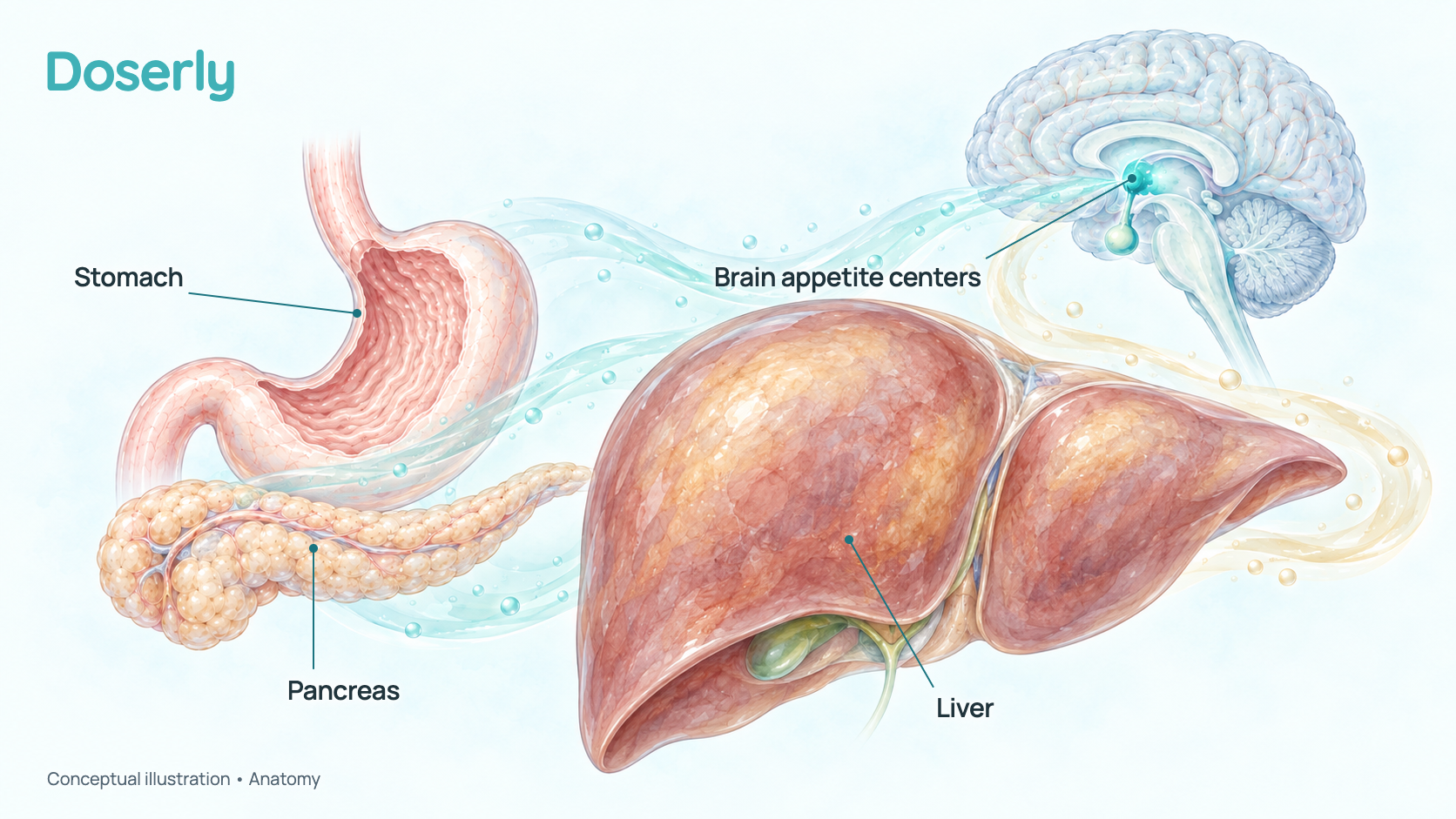
Mazdutide is a once-weekly injectable prescription medicine for weight management and type 2 diabetes. It copies two gut and pancreas hormones at the same time, GLP-1 and glucagon, so it lowers appetite and blood sugar while also acting on the liver. China approved it in 2025 under the brand name Xinermei. [1], [2], [3], [4]
GLP-1 (glucagon-like peptide-1) is a hormone your gut releases after eating; it signals fullness and helps insulin work. Glucagon is a pancreas hormone that tells the liver to release stored energy and burn fat. A medicine that switches on both receptors is called a dual agonist. Mazdutide is a lab-made peptide, a chain of 34 amino acids based on oxyntomodulin, a natural gut hormone that acts on both receptors. A fatty-acid side chain attached to the chain helps it last much longer in the body: its half-life is about 10 days. [5], [1], [6], [7]
Eli Lilly discovered it (code LY3305677), and Innovent Biologics developed it in China (code IBI362), where it holds the rights for mainland China, Hong Kong, Macau and Taiwan. [8], [9] It acts on GLP-1 and glucagon receptors only. It is not a "triple agonist" like retatrutide, and it does not act on the GIP receptor like tirzepatide, even though some dosing websites say so. [1], [8], [10]
| At a glance | |
|---|---|
| Other names | Xinermei (信尔美), IBI362, LY3305677 |
| What it is | Dual GLP-1 and glucagon receptor agonist peptide |
| Approved uses (China) | Weight management in adults; blood-sugar control in type 2 diabetes |
| Form | Single-use prefilled pen: 2, 4 or 6 mg in 0.5 mL |
| How often | Once a week |
| Half-life | About 10 days |
Outside China and Macau, mazdutide is not approved anywhere; it is investigational. People there meet it as an unapproved "research use only" powder sold online, which the FDA treats as an illegal unapproved drug. [11], [12], [13], [14]
Typical Mazdutide Protocols
| Product and use | Starting dose | Dose steps | Maintenance dose (each week) | Duration |
|---|---|---|---|---|
| Xinermei pen · weight management (adults with a BMI of 28 or more, or 24 or more with a weight-related condition) | 2 mg, weeks 1–4 | 4 mg from week 5, for at least 4 weeks | 4 mg or 6 mg from week 9 | Long term 6 mg only after at least 4 weeks on 4 mg, if more weight loss is needed. If 6 mg is not tolerated, the label allows going back to 4 mg |
| Xinermei pen · type 2 diabetes (alone, or with metformin, a sulfonylurea or an SGLT2 inhibitor) | 2 mg, weeks 1–4 (a starting step, not a blood-sugar dose) | 4 mg from week 5 | 4 mg or 6 mg | Long term 6 mg after at least 4 weeks on 4 mg if more blood-sugar control is needed |
The standard schedule, in the label, the pivotal China trials and the most careful dosing references, is 2 mg once a week for 4 weeks, then 4 mg, then either staying on 4 mg or moving up to 6 mg from week 9. [1], [15], [16], [17]
- Titration Raising the dose in steps
- Each step lasts at least 4 weeks, because stomach side effects cluster in the weeks after each increase. In GLORY-1, the 4 mg group went 2 → 4 mg, and the 6 mg group went 2 → 4 → 6 mg, with a check-up visit 1 week after each increase. Moving to 6 mg is optional and depends on response and tolerance; stepping back to 4 mg is allowed. [1], [15]
- Breaks and cycles
- Not applicable in the label: mazdutide is a continuous, long-term treatment with no planned breaks. In trials, weight partly returned within 12 weeks of stopping (see stopping). The label also sets missed-dose rules by delay: up to 2 days late, the dose is given and the usual day kept; 2 to 7 days late, it is given and a new weekly day starts; 7 to 21 days late, treatment restarts one step lower; after more than 21 days, it restarts at 2 mg. The dose day can move if doses stay more than 5 days (120 hours) apart. [1], [18]
Read the units: doses are in milligrams (mg), and each weekly dose is also the weekly total. The Xinermei pens deliver a fixed dose, so there are no syringe units to count. Units only come up with vials sold online; see how units convert. [1]
Each row is a separate labeled schedule, and 4 mg and 6 mg are both maintenance doses rather than a ladder everyone climbs. These are China's labeled doses; prescribers adjust them for tolerance and response. No regulator outside China and Macau has approved any mazdutide dose, and "research" vials sold online are not the labeled product. [1], [11], [13]
What doses were tested beyond the label?
Higher doses have been tested, but none of them is on a label. They are shown here so the numbers people quote online can be placed. [18], [19], [20], [21]
| Trial and top dose | Starting dose | Dose steps | Top dose (each week) | How long |
|---|---|---|---|---|
| GLORY-2 (phase 3, China) · 9 mg | 3 mg, weeks 1–4 | 6 mg, weeks 5–8 | 9 mg from week 9 | 60 weeks, then 12 weeks off Innovent's application for 9 mg was still under review in China in August 2026 |
| US phase 2 (Lilly) · 10 mg | 1.5 mg, weeks 0–3 | 3 mg (weeks 4–7) → 6 mg (weeks 8–11) → 8 mg (weeks 12–15) | 10 mg from week 16 | 48 weeks |
| US phase 2 (Lilly) · 16 mg | 1.5 mg, weeks 0–3 | 3 → 6 → 9 → 12 mg, 4 weeks each | 16 mg from week 20 | 48 weeks 1 in 5 people on 16 mg (19.6%) stopped because of side effects |
| Phase 1b (China) · 10 mg | 2.5 mg, weeks 1–4 | 5 mg → 7.5 mg, 4 weeks each | 10 mg from week 13 | 16 weeks 24 people in two dose groups; a short safety study |
Where schedules differ: 9 mg, 1.5 mg starts, vial ladders, splitting and stopping ↓
Where these numbers come from
The first table comes from the two Chinese Xinermei labels: the weight-management label approved on June 24, 2025, and the type 2 diabetes label approved on September 16, 2025. Both describe the same pens (2, 4 and 6 mg in 0.5 mL) and the same 2 → 4 → 4 or 6 mg steps, and they give the missed-dose rules and the rule that the dose day may move if doses stay more than 5 days (120 hours) apart. The GLORY-1 trial used the same schedule. [1], [2], [15]
The second table keeps each trial's arm as the trial described it. GLORY-2 stepped up by 3 mg every 4 weeks. The US phase 2 schedules are the arm descriptions posted with the trial's results on ClinicalTrials.gov; its protocol also tested two escalation speeds for the 10 mg and 16 mg arms. The phase 1b 10 mg group is a 16-week study of 24 people across two dose groups. [18], [19], [22], [21]
Dosing websites were cross-checks only. Of 30 pages with mazdutide dosing text, 6 describe the label ladder and 11 build their vial advice on the 3, 6 and 9 mg trial doses, not always with the trial's 4-week steps. Pages that call a 1.5 → 3 → 4.5 → 6 mg ladder "approved", pages that give GLORY-1 a 1.5 mg start, pages that mix daily and weekly wording, and a very-low-dose ladder copied from a different drug did not shape either table; they are discussed in the next section. [16], [17], [23], [24], [25], [26], [27], [28], [29]
What is mazdutide commonly used for?
People look into mazdutide for two main reasons: to lose weight, or to control blood sugar in type 2 diabetes. A third reason comes up often: fatty liver, because the glucagon side of the drug acts on the liver. Outside China, many people discuss it online as an alternative to tirzepatide or retatrutide. [1], [2], [15], [30]
The approved uses below apply to the labeled product in China. Using an unapproved online product for any of them is a different situation from the trials described here.
Weight loss
This is the use most people search for. The China label covers adults with a BMI of 28 or more (China's cutoff for obesity), or 24 or more with at least one weight-related problem such as high blood sugar, high blood pressure, abnormal blood fats, fatty liver or sleep apnea, alongside diet and exercise. [1]
In the GLORY-1 trial, 610 Chinese adults took 4 mg, 6 mg or placebo for 48 weeks. Average weight changed by −11.0% on 4 mg, −14.0% on 6 mg and +0.3% on placebo. About half of the 6 mg group (49.5%) lost 15% or more of their weight. In GLORY-2, in adults with a BMI of 30 or more, 9 mg led to −16.65% at 60 weeks versus −1.50% on placebo. [15], [18]
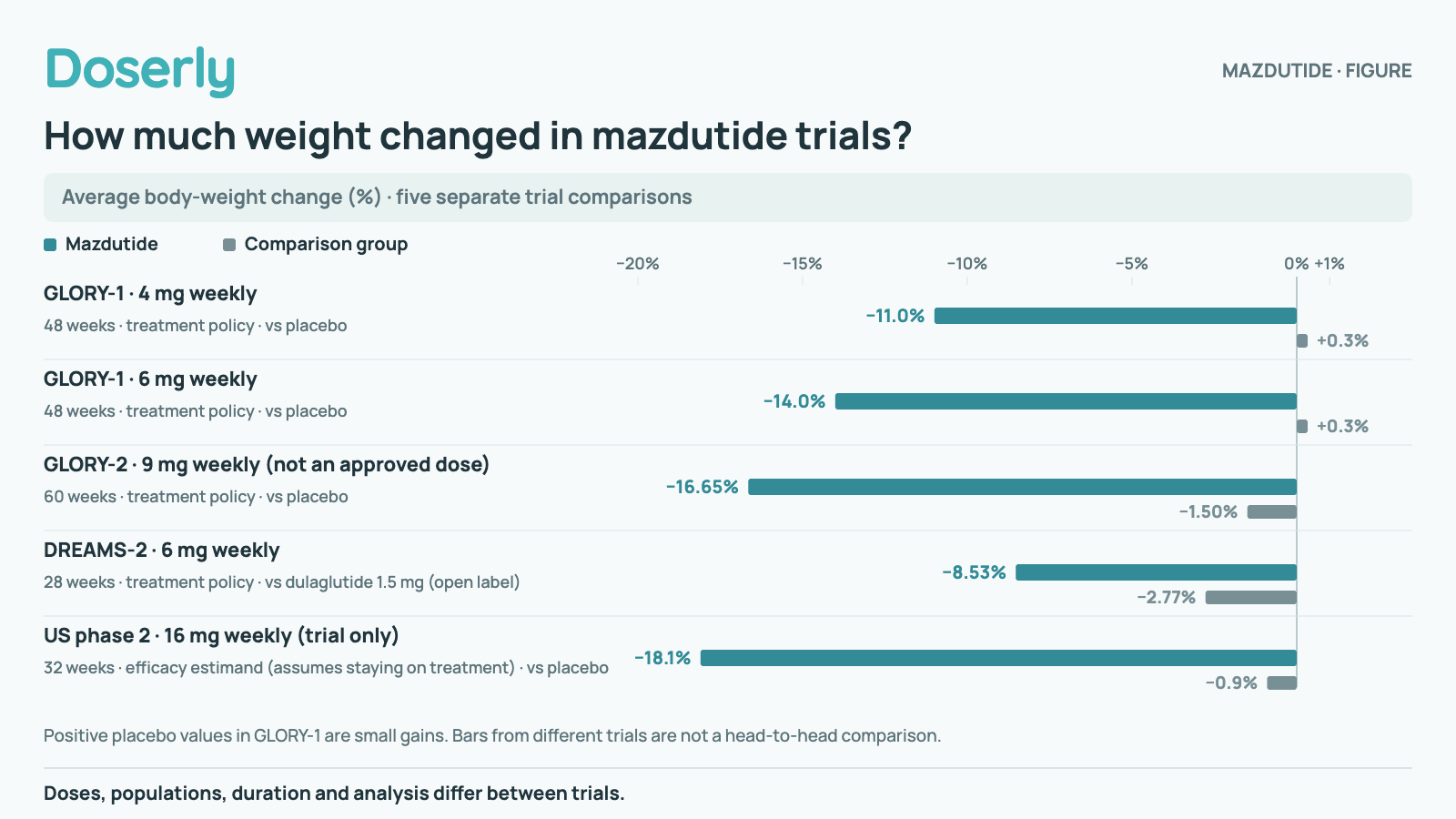
How much weight changed in mazdutide trials?
Average body-weight change (%); each row has its own comparison group.
- GLORY-1 · 4 mg weekly
- Chinese adults, overweight/obesity, no diabetes · 48 weeks · treatment policy. Mazdutide −11.0%; placebo +0.3%.
- GLORY-1 · 6 mg weekly
- same trial · 48 weeks · treatment policy. Mazdutide −14.0%; placebo +0.3%.
- GLORY-2 · 9 mg weekly (not an approved dose)
- Chinese adults, BMI 30+ · 60 weeks · treatment policy. Mazdutide −16.65%; placebo −1.50%.
- DREAMS-2 · 6 mg weekly
- Chinese adults with type 2 diabetes · 28 weeks · treatment policy. Mazdutide −8.53%; dulaglutide 1.5 mg (open label) −2.77%.
- US phase 2 · 16 mg weekly (trial only)
- US adults, no diabetes · 32 weeks · efficacy estimand (assumes staying on treatment). Mazdutide −18.1%; placebo −0.9%.
Positive placebo values in GLORY-1 are small gains. Bars from different trials are not a head-to-head comparison.
Average weight change in mazdutide trials, each against its own comparison group; trials differ in dose, population, length and analysis.
Type 2 diabetes
Xinermei is also approved in China to lower blood sugar in adults with type 2 diabetes, either alone or added to metformin, a sulfonylurea or an SGLT2 inhibitor. It lowers HbA1c, a blood test that reflects average blood sugar over about three months. [2]
In DREAMS-1, 320 adults whose diabetes was not controlled by diet and exercise saw HbA1c fall by 1.58 points on 4 mg and 2.02 points on 6 mg, versus 0.25 on placebo, after 24 weeks. In DREAMS-2, 731 adults already on diabetes pills compared mazdutide with dulaglutide 1.5 mg, an older weekly GLP-1 medicine: HbA1c fell by 1.61 and 1.66 points versus 1.36, and weight by 6.55% and 8.53% versus 2.77%. [31], [32] An earlier phase 2 trial in 250 adults found similar HbA1c falls over 20 weeks (1.41 to 1.67 points, versus 1.35 on dulaglutide and a slight rise on placebo). [33]
Fatty liver
Fatty liver is common in the people these trials enrolled: about half of GLORY-1's participants had it. In GLORY-1, people with a fatty liver lost more liver fat on mazdutide than on placebo, measured by MRI. Blood markers of liver stress (ALT) also fell. [1], [15] Mazdutide is not approved for liver disease; trials in MASH, an inflamed form of fatty liver, and a head-to-head trial against semaglutide in fatty liver are still running. [34], [35]
Other conditions being studied
Trials registered on ClinicalTrials.gov are testing mazdutide in several other groups. These are study plans, not results. [8]
Sleep apnea with obesity (phase 3, China)
About 260 adults with obstructive sleep apnea and a BMI of 28 or more.
Recruiting · no results posted · last update June 2025
[36]Heart failure with obesity (phase 2, China)
About 141 adults with a stiff-heart type of heart failure (preserved or mildly reduced ejection fraction) and obesity.
Active, not recruiting · no results posted · last update September 2026
[37]Teenagers with obesity or overweight (phase 3, China)
About 180 adolescents, two mazdutide doses against placebo. A small earlier study measured blood levels in 36 teenagers.
Recruiting · no results posted · last update January 2026
[38], [39]Alcohol use disorder (phase 2, Lilly)
About 308 adults, mazdutide against placebo.
Completed · no results posted · last update July 2026
[40]High blood pressure with overweight (phase 3, China)
About 336 adults with high blood pressure and overweight or obesity.
Recruiting · no results posted · last update May 2026
[41]Hospital-led studies in China are also registered for prediabetes, polycystic ovary syndrome, gout, weight regain after weight-loss surgery and memory problems in diabetes. [42], [43], [44], [45], [46]
Where do mazdutide protocols differ?
The label ladder is simple. The confusion comes from the 9 mg dose, trial starting doses that websites relabel as "approved", research-vial schedules, splitting doses and stopping.
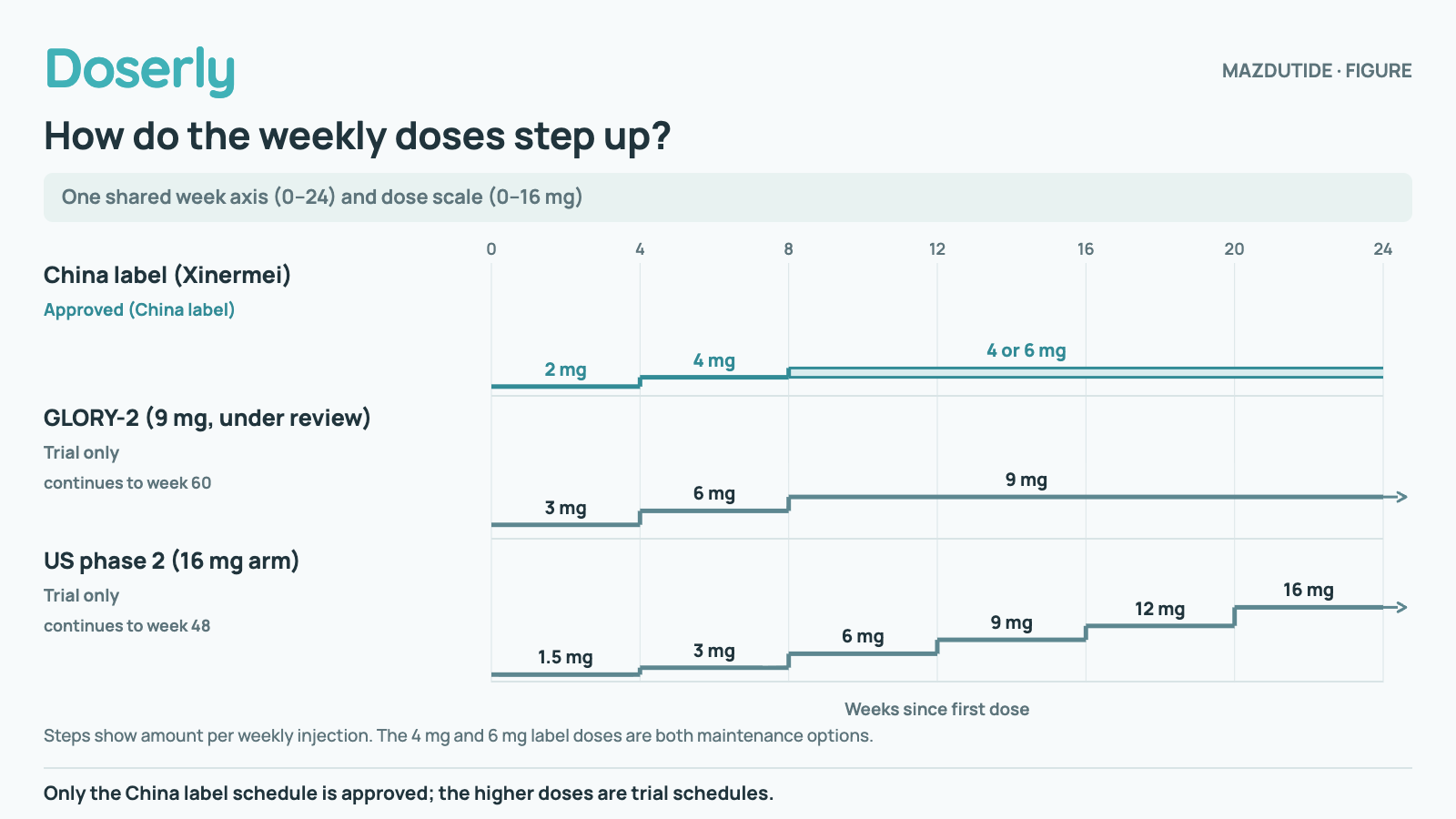
How do the weekly doses step up?
Milligrams per weekly injection, weeks 0–24; later maintenance continues.
- China label (Xinermei) · Approved (China label)
- 2 mg in weeks 1–4; 4 mg in weeks 5–8; 4 or 6 (maintenance) from week 9+.
- GLORY-2 (9 mg, under review) · Trial only
- 3 mg in weeks 1–4; 6 mg in weeks 5–8; 9 mg in weeks 9–60.
- US phase 2 (16 mg arm) · Trial only
- 1.5 mg in weeks 0–3; 3 mg in weeks 4–7; 6 mg in weeks 8–11; 9 mg in weeks 12–15; 12 mg in weeks 16–19; 16 mg in weeks 20–48.
Steps show amount per weekly injection. The 4 mg and 6 mg label doses are both maintenance options.
The approved China label schedule versus the higher-dose trial schedules; only the label schedule is approved.
Is 9 mg an approved dose?
Not yet. Innovent's application for 9 mg, based on GLORY-2, was accepted for review by China's regulator on November 25, 2025, and the company still described it as under review on August 25, 2026. The approved pens come in 2, 4 and 6 mg only. [47], [48], [1]
One line in Innovent's 2025 annual report says the 9 mg application is based on "GLORY-3". Its own November 2025 release names GLORY-2, and GLORY-3 is a separate, ongoing fatty-liver trial against semaglutide, so the annual-report line appears to be an error. [9], [47], [35]
Why do some websites start at 1.5 mg?
Because 1.5 mg was a starting dose in some trials, not on the label. Early Chinese studies started some groups at 1 or 1.5 mg, and Lilly's US trials started at 1.5 mg. [7], [6], [19]
The problem is when a site calls a 1.5 → 3 → 4.5 → 6 mg ladder the approved Chinese schedule, or says GLORY-1 started at 1.5 mg. Both are wrong: the label and GLORY-1 start at 2 mg and step to 4 mg. [24], [25], [26], [27], [1], [15] In community education groups, one educator's dosing card uses 1.5 → 3 → 4.5 → 6 → 7.5 → 9 mg. No trial used that ladder; 7.5 mg appeared only as one step of a small phase 1b group that went on to 10 mg, and it is not a labeled dose. [21]
Do research vials follow the label?
Some copy it; most do not. Among 30 dosing pages reviewed, the most common pattern (11 pages) builds vial advice on the 3, 6 and 9 mg doses from the GLORY-2 trial ladder, sometimes with longer steps. Six pages describe the label ladder. Others use their own steps. Each row below is one site's complete schedule as published. [49], [50], [51], [16], [17], [52]
| Website schedule | Amount each time | Steps | Weekly total at the top | Duration and breaks |
|---|---|---|---|---|
| Website claims | ||||
| GLORY-2 copy | 3 mg to start | 3 mg (weeks 1–4) → 6 mg (weeks 5–8) → 9 mg | 9 mg | 60+ weeks discussed; states there is no trial cycling protocol |
| Slower 9 mg ladder | 3 mg to start | 3 mg (weeks 1–8) → 6 mg (weeks 9–16) → 9 mg from week 17 | 9 mg (the page also describes 6–9 mg maintenance) | 24 weeks on, then 8–12 weeks off The page attributes this ladder to GLORY-1, which did not use it |
| Lower vial ladder | 2.5 mg to start | 2.5 mg (weeks 1–4) → 5 mg | 5 mg | 8–16 weeks in the supply examples The first two steps match a small phase 1b group that went on to 7.5 and 10 mg; no trial stopped at 5 mg |
| Very low "microdose" ladder | 0.25 mg to start | 0.25 → 0.5 → 1 → 1.5 → 2 mg, 4–6 weeks each | 1.5–2 mg (2.4 mg called a plateau) | 4–6 months to reach the top Resembles another drug's dose range; no mazdutide study supports it |
These schedules describe what websites publish, not what was tested. Pages in the same "family" copy each other's tables, so repetition is not independent support. Recurring errors include pages that call mazdutide a triple agonist, give the wrong approval dates or put "daily" and "weekly" on the same page for a once-weekly drug. [10], [50], [28], [26]
Once a week, split doses or daily?
The label and every published trial use one injection a week. With a half-life of about 10 days, a weekly dose keeps levels steady after about 4 weeks. [1] In community education groups, one educator offers splitting the weekly amount into two injections or small daily doses; no mazdutide study has tested either. One trial registered in China is testing injections every 2 weeks at 12 or 15 mg as a later stage of a high-dose study, with no results posted. [53]
Some people online add mazdutide (1.5 to 5 mg a week in the accounts reviewed) to tirzepatide or retatrutide. There is no trial of these combinations, and the risks section explains why stacking two drugs that act on GLP-1 receptors is a concern. [54], [55], [56]
Do you need to cycle mazdutide?
No trial has tested cycling. The label describes continuous treatment. A few websites describe "24 weeks on, 4 to 12 weeks off" without any supporting study. [1], [50], [57] In community education groups, one educator says cycling is unnecessary and that lifestyle keeps the weight off afterward; the trials show partial regain within 12 weeks of stopping (see stopping).
How do milligrams convert to syringe units?
The Xinermei pens do not use units. Units appear only with freeze-dried vials that are mixed with water (reconstitution) and drawn into an insulin syringe. Units measure volume, not drug. On a U-100 syringe, 100 units equal 1 mL, so the amount of mazdutide in each unit depends on how much water went into the vial. [1], [49]
For example, a 10 mg vial mixed with 2 mL of water holds 5 mg per mL, or 0.05 mg per unit. A 4 mg dose is then 0.8 mL, or 80 units. A 6 mg dose is 120 units, more than a standard 1 mL (100-unit) syringe holds, and a 9 mg dose is 180 units. The same 80 units from a vial mixed with 1 mL of water would be 8 mg, double the dose. Doserly's reconstitution calculator works out the arithmetic for any vial and shows each step. Correct arithmetic says nothing about whether the vial contains what its label claims. [49], [58]
What happens when you stop mazdutide?
Weight starts coming back within weeks, but in the trials it had not all returned 12 weeks later. No study has followed people for longer than 12 weeks after their last dose. Because of its long half-life, mazdutide itself takes several weeks to leave the body; the label says to stop at least 3 months before a planned pregnancy for this reason. [1], [18]
- GLORY-2 (9 mg, 60 weeks). Average weight change went from −16.65% at week 60 to −12.42% at week 72, twelve weeks after the last dose. The placebo group went from −1.50% to −1.11%. [18]
- GLORY-1 (4 and 6 mg, 48 weeks). Weight rebounded during the 12-week follow-up after stopping; the numbers are in the paper's supplementary appendix, which this guide could not access. The authors called 12 weeks too short to judge regain, and a published letter made the same criticism. [15], [59]
- Phase 2 (up to 6 mg, 24 weeks). Weight, BMI, waist size and blood pressure rebounded by week 36, twelve weeks after stopping, but stayed lower than on placebo. [6]
- US phase 1 (16 mg, 20 weeks). Average weight change was about −20% to −21% on treatment and −14.1% eight weeks after the last dose. [20]
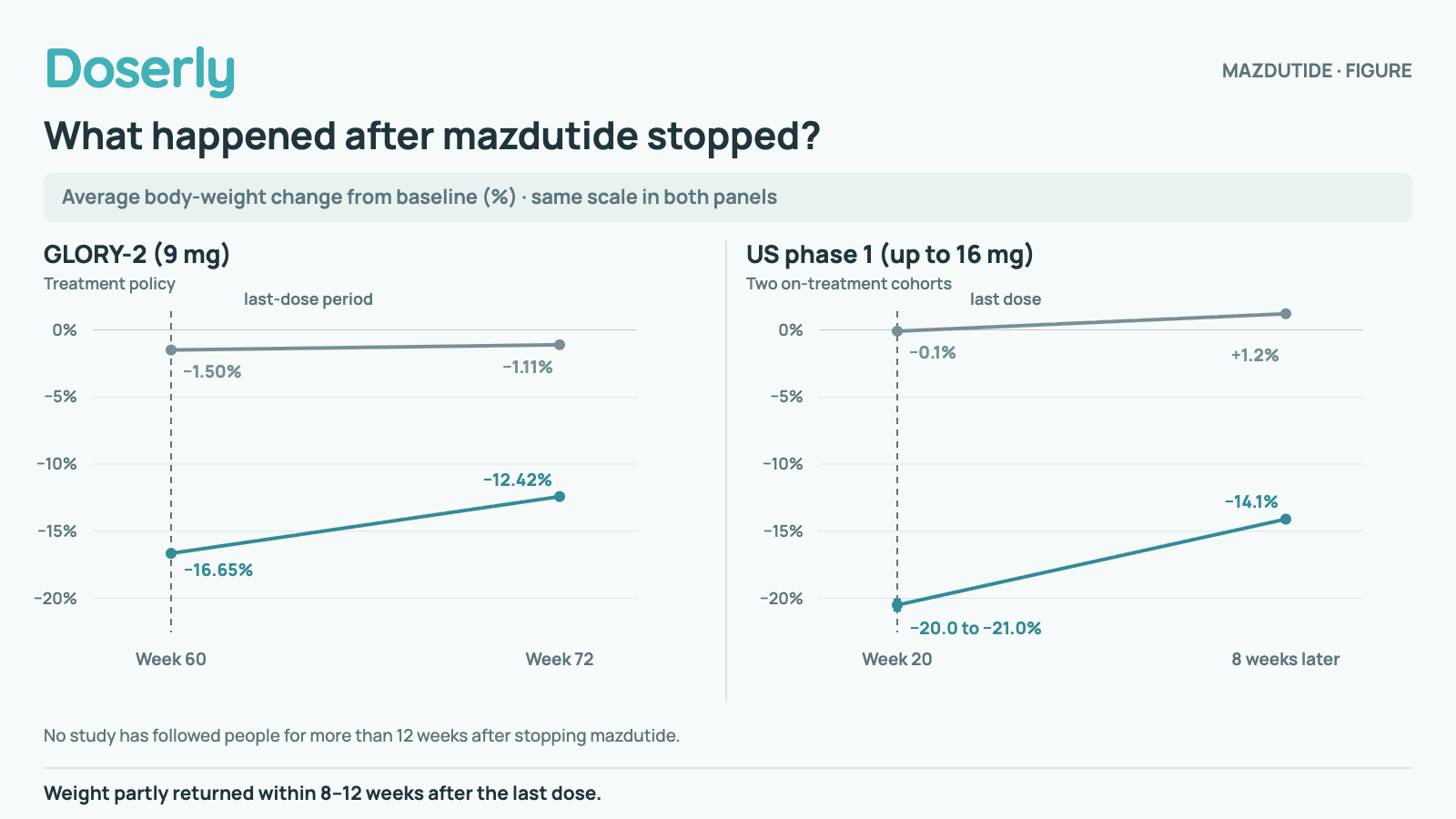
What happened after mazdutide stopped?
Average body-weight change from baseline (%). Lines join measured points only.
- GLORY-2 (9 mg)
- Week 60, last-dose period: mazdutide −16.65% versus placebo −1.50%. Week 72, 12 weeks off: mazdutide −12.42% versus placebo −1.11%. Treatment-policy analysis.
- US phase 1 (up to 16 mg)
- Week 20 on treatment: two mazdutide cohorts ranged from −20.0% to −21.0% versus placebo −0.1%. Eight weeks after the last dose: mazdutide −14.1% versus placebo +1.2%.
No study has followed people for more than 12 weeks after stopping mazdutide.
Weight partly returned within 8–12 weeks of stopping. No study has followed people for longer.
For a longer view, the only data come from other drugs. After stopping semaglutide, people in a trial follow-up had regained about two-thirds of their lost weight a year later. That is a different medicine and cannot be used as a mazdutide estimate. [60] A Chinese trial planned to compare 24 weeks on mazdutide with 24 weeks off in prediabetes had not started recruiting when this guide was checked. [42]
Tapering. The label gives no taper schedule, and no trial has compared tapering with stopping all at once. [1] The heart-rate rise seen in trials faded after stopping in the phase 2 study. [6]
How is mazdutide given, and how long does it last in the body?
Mazdutide is only given by injection. The approved Xinermei pen is a single-use autoinjector that delivers one dose into the fatty layer of the abdomen (a subcutaneous injection), at any time of day, with or without food. The label says it must not be injected into a vein (intravenous) or a muscle (intramuscular). There is no approved pill, nasal spray or under-the-tongue form, and no study has tested one. [1]
After an injection, blood levels peak 7 to 28 hours later. The average half-life, the time for the level in the blood to fall by half, is about 10 days, and levels build up to a steady state after 4 weekly doses. Exposure rises in proportion to the dose. [1] The diabetes label gives a slightly shorter average, about 8 days (196 hours), in Chinese adults with type 2 diabetes. [2] Individual half-lives in the first study ranged from about 6 to 17 days. [7] Some online material, including teaching in community education groups, gives a 7-day half-life; the label figure is about 10 days.
The long half-life explains three practical points. One injection lasts a week. A late dose can still be given within the label's time windows. And the drug keeps acting for weeks after the last dose, which is why the label advises stopping at least 3 months before a planned pregnancy and warns that overdose symptoms may need long observation. [1]
Body weight, age, sex and mild to severe kidney impairment did not meaningfully change blood levels in the studies behind the label. There are no data in people on dialysis or with moderate to severe liver impairment. [1]
Should the injection go near a particular organ?
No. The label names only the abdomen as the injection area, avoiding about 5 cm around the belly button. Because the drug spreads through the whole bloodstream and lasts about 10 days, injecting "near" the liver or stomach does not target it. [1]
How should mazdutide be stored, and how long does it last?
The Xinermei pen label gives clear rules. [1]
| Situation | What the label says |
|---|---|
| Before use | Fridge at 2–8 °C, sealed and protected from light. Do not freeze |
| If a fridge is not available | Once only, in the original box, at room temperature (10–30 °C) for up to 30 days. Do not put it back in the fridge; throw it away if unused after 30 days |
| After the injection | The pen is single-use; the label's instructions include disposal in a sharps container |
| Shelf life | 24 months unopened, as printed on the pack |
Research vials have no tested storage period. No regulator or journal has published stability data for freeze-dried mazdutide after it is mixed with water. The manufacturer's patent says only that the raw drug substance is stable when frozen at −20 °C or colder. [61] Websites give different use-by periods for mixed vials, from 7–14 days to 4–8 weeks, most often 28 days, without published testing behind any of them. [62], [49], [50], [28] One public forum thread describes a vial turning gel-like after a few weeks. [63] In community education groups, members pass around a single informal stability test from a testing channel and aim to use mixed vials within about two months; it is not a validated study.
This guide does not cover pen technique or mixing; the Academy note below covers practical handling.
What do we actually know about mazdutide in people?
A fair amount, mostly from China. Twelve published clinical trials have enrolled about 3,000 people, including four peer-reviewed phase 3 trials: GLORY-1 and GLORY-2 for weight, and DREAMS-1 and DREAMS-2 for type 2 diabetes. A fifth phase 3 trial, DREAMS-3, has results only in company announcements and conference presentations. Only two of the published trials, both run by Lilly, took place in the United States. [15], [18], [31], [32], [64], [7], [65], [21], [33], [6], [66], [20], [67]
In a randomized controlled trial, people are assigned by chance to the medicine or a comparison such as a placebo, so differences between the groups can be credited to the medicine. [15]
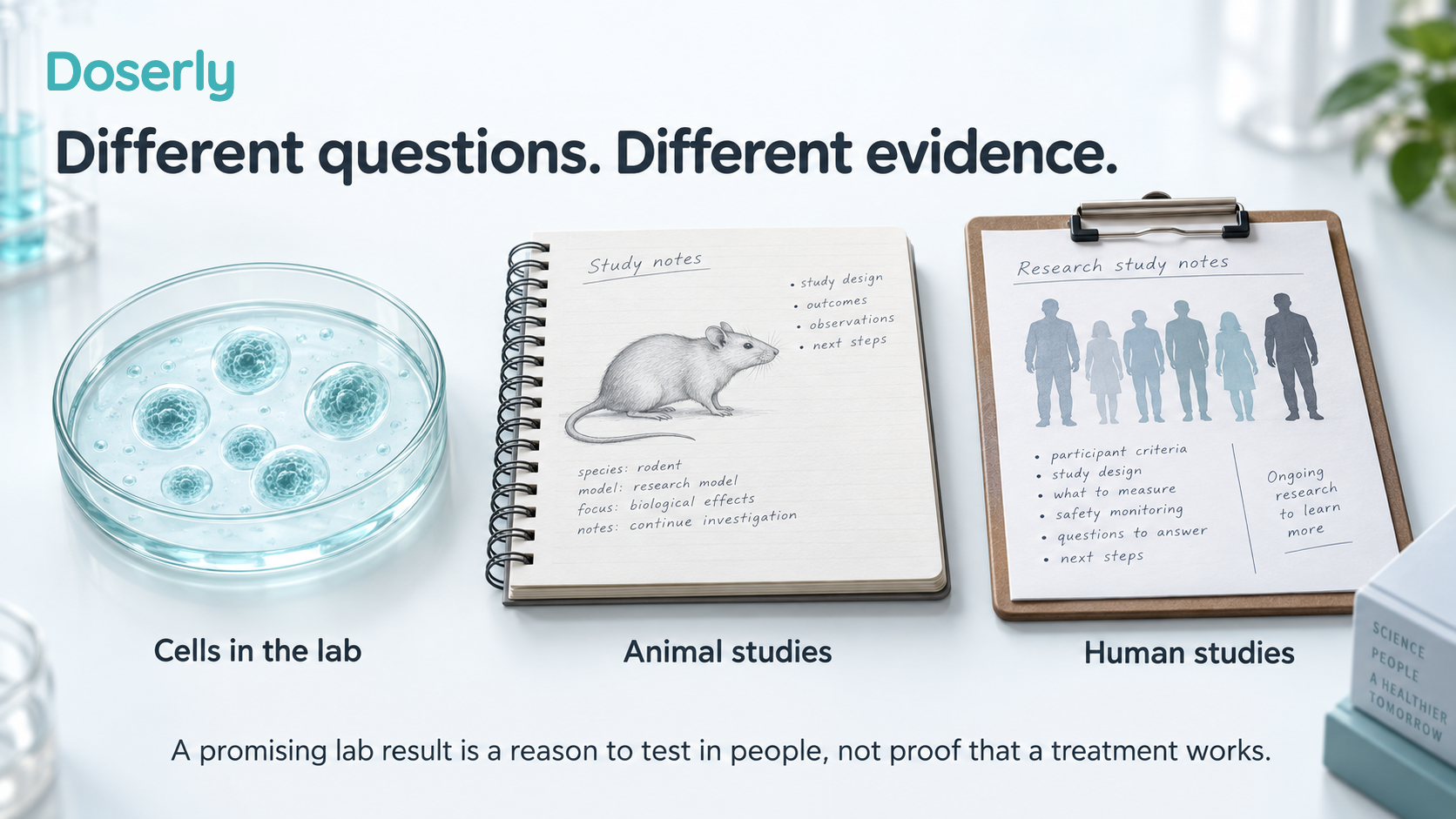
How much weight do people lose in trials?
| Trial | Who and what | Average weight change | What it cannot show |
|---|---|---|---|
| GLORY-1 (2025) | 610 Chinese adults with overweight or obesity, no diabetes; 4 or 6 mg weekly for 48 weeks | −11.0% (4 mg) and −14.0% (6 mg) vs +0.3% on placebo at week 48 | Results beyond 1 year, or in other populations [15] |
| GLORY-2 (2026) | 462 Chinese adults with a BMI of 30 or more (16% with diabetes); 9 mg for 60 weeks | −16.65% vs −1.50% on placebo at week 60 | 9 mg is not an approved dose [18] |
| Phase 2 (2023) | 248 Chinese adults; 3, 4.5 or 6 mg for 24 weeks | −6.7%, −10.4% and −11.3% vs +1.0% | Long-term effects [6] |
| Phase 2, 9 mg (2026) | 80 Chinese adults with a BMI of 30 or more, no diabetes; 24 weeks | −12.78% vs +1.80% | Only 24 weeks; abstract only [66] |
| US phase 2 (2026) | 179 US adults, no diabetes; 48 weeks, in arms reaching 3 mg (6 mg from week 32), 10 mg or 16 mg | −7.3% (3 mg), −15.6% and −18.1% vs −0.9% at week 32 | Figures assume everyone stayed on treatment; small groups [67], [19] |
The main GLORY trials used the "treatment policy" approach, which counts everyone assigned to the drug, including people who stopped taking it. That keeps the averages closer to real life. [15], [18]
An average hides a wide range. At week 48 in GLORY-1, 81.6% of the 6 mg group had lost at least 5% of their weight and 49.5% at least 15%, compared with 10.8% and 2.0% on placebo. In GLORY-2, 42.4% on 9 mg lost 20% or more, versus 2.6% on placebo. [15], [18]
Other measures improved too. In GLORY-1, waist size fell by about 9 to 11 cm, versus 1.4 cm on placebo, and blood pressure, triglycerides, cholesterol, uric acid and the liver enzyme ALT all fell more than on placebo. [15]
Why do GLORY-2's numbers differ between sources?
Because they come from different analyses (different estimands). The peer-reviewed paper in JAMA reports −16.65% at week 60 using the treatment-policy approach. An analysis that assumes people stayed on treatment gives −18.55% versus −3.02%; the paper reports it too, and it is the figure Innovent's November 2025 announcements led with. "Up to 20.1%" refers to −20.08% in the subgroup without diabetes, from the company. All three numbers are real; they answer different questions. When someone quotes "about 20%", it is the most favorable of the three. [18], [68], [47]
How well does it lower blood sugar?
Well, in the trials so far. Besides DREAMS-1 and DREAMS-2 (see type 2 diabetes), about two-thirds to four-fifths of people in DREAMS-1 reached an HbA1c below 7% (66.4% on 4 mg and 81.8% on 6 mg, versus 11.7% on placebo). [2], [31]
DREAMS-3 compared 6 mg of mazdutide with 1 mg of semaglutide (an Ozempic diabetes dose) in 349 Chinese adults with type 2 diabetes and obesity for 32 weeks, and neither the participants nor the doctors were blinded. [69], [70] Innovent reported that 48% on mazdutide reached both an HbA1c below 7% and at least 10% weight loss, versus 21% on semaglutide, with weight change of −10.29% versus −6.00%. These are company-reported results; no peer-reviewed results paper had been published when this guide was checked. [64]
Is the weight lost fat or muscle?
Mostly fat. In GLORY-1, 114 people had body scans (DXA) at the start and at week 48. In both dose groups, the fall in total fat mass appeared larger than the fall in lean mass, the non-fat tissue that includes muscle. The paper shows this only as a figure, and strength was not measured. [15]
Does it reduce liver fat?
Liver fat fell in several studies, but mazdutide has not yet been tested against liver outcomes such as scarring. In GLORY-1, people with fatty liver had a larger fall in liver fat on MRI than on placebo, and more reached a normal liver-fat level. [15] In Innovent's exploratory analysis of 69 of these participants, liver fat fell by 63.3% on 4 mg and 73.2% on 6 mg on average, versus an 8.2% rise on placebo. [71] Innovent reported that in GLORY-2, among people without diabetes who started with at least 10% liver fat, liver fat fell by 71.9% on average, versus a 5.1% rise on placebo; this figure is from a company announcement. [68] In a subgroup of the US phase 2 trial with fatty liver, a conference abstract reported that the excess liver fat cleared in more than 60% of participants. [72]
Were the trials done only in China?
Mostly. GLORY-1's participants were Chinese adults with an average age of about 34 and an average BMI of about 31, younger and lighter than people in most Western obesity trials, and China uses lower BMI cut-offs for obesity. [15], [1] Only 3 people aged 65 or older were in the trial behind the weight label. [1] The two US trials, with 32 and 179 people, found weight loss in the same direction at higher doses. [20], [67] Comparing percentages across trials in different populations is unreliable, a point also made in community education groups.
How does mazdutide work?
Mazdutide switches on two receptors: the GLP-1 receptor and the glucagon receptor. In laboratory tests, it activated both, raising a signaling molecule (cAMP) inside human liver cells and rat insulin-making cells. In animals, it increased insulin release when blood sugar was high, lowered blood sugar, increased the energy the body burns and reduced weight. [1]
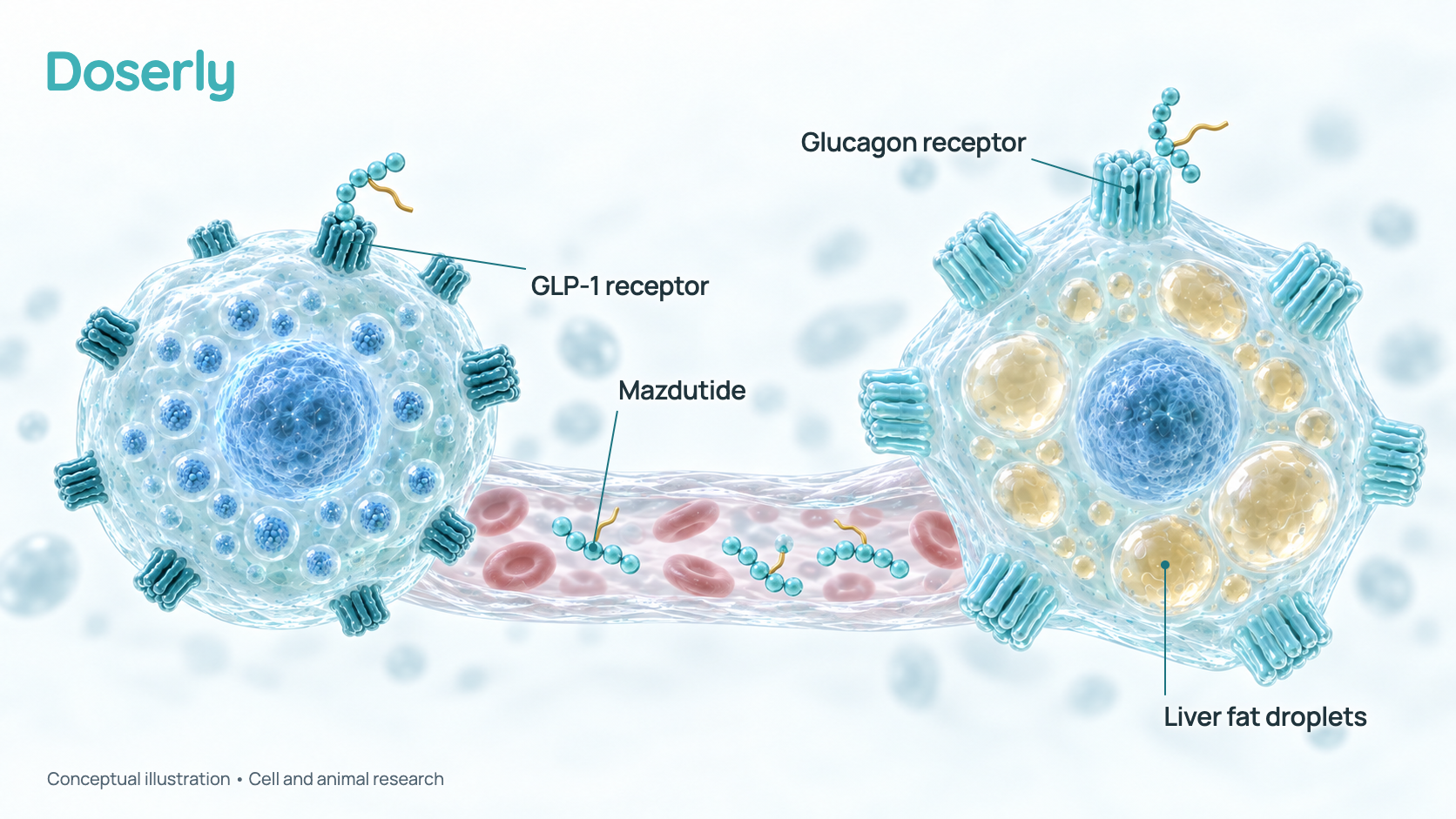
What does the GLP-1 side do?
It works like other GLP-1 medicines such as semaglutide: it makes people feel full sooner, slows how fast the stomach empties and helps the pancreas release insulin only when blood sugar is high. These effects explain the weight loss, the lower blood sugar and many of the stomach side effects. [1], [7]
What does the glucagon side add?
Glucagon normally raises blood sugar by telling the liver to release stored glucose, and it also increases fat burning in the liver and energy use. Pairing it with GLP-1 is meant to add these effects while GLP-1 keeps blood sugar in check. [7], [73]
In mice, mazdutide still lowered weight in animals missing either the GLP-1 receptor or the glucagon receptor, and it raised energy use where semaglutide did not; these findings are described in the first human study's introduction, not in a stand-alone paper. [7] Energy use was not measured in the large human trials, so "it speeds up metabolism" remains a proposed explanation in people, not a measured effect. [15]
Researchers link two features seen in trials partly to the glucagon side: larger falls in liver fat, triglycerides and uric acid, and a small rise in heart rate. The trials tested the dual drug, so they cannot show how much of each change comes from which receptor. [15], [73] In a laboratory experiment on human heart-muscle tissue from surgery, mazdutide increased the force of contraction, which fits with, but does not prove, a direct heart effect. [74]
Why does one dose last a week?
Mazdutide carries two design features also used in semaglutide: a changed second amino acid (Aib) and a fatty-acid side chain, here on the 20th amino acid. [5], [1] In semaglutide, the changed amino acid stops DPP-4, the enzyme that breaks down natural GLP-1 within minutes, from cutting the peptide, and the fatty-acid chain makes it bind to albumin in the blood, which slows its removal. [75] The result for mazdutide is an average half-life of about 10 days. [1]
What did animal studies show?
Only four original animal papers on mazdutide are indexed in PubMed, plus a handful of conference abstracts. They report less liver fat in mice fed a high-fat diet (in one, more than with semaglutide after 4 weeks), better memory scores in diabetic mice, lower uric acid in rats and kidney effects of glucagon receptor activation. These are early findings in animals and are summarized in the research library. [76], [77], [78], [79], [80]
What are the risks and unanswered questions?
Is mazdutide safe?
Mazdutide's safety profile in trials looks like that of other GLP-1 medicines: stomach and bowel side effects are very common, and serious problems are uncommon. The trials lasted up to 60 weeks and mostly enrolled young Chinese adults, so rare or long-delayed harms are not yet known, and no post-marketing safety reports had been published when this guide was checked. Unapproved "research" products add risks of their own. [1], [15], [18]
What are the most common side effects?
Stomach and bowel symptoms, mostly during dose increases. In GLORY-1, nausea affected 32.5% on 4 mg and 50.5% on 6 mg (5.9% on placebo), diarrhea 35.0% and 38.6% (6.3%), and vomiting 26.1% and 43.1% (2.9%). Any stomach or bowel side effect affected 62.6% and 79.7%, versus 20.0% on placebo. [1]
| Side effect (GLORY-1, label table) | 4 mg | 6 mg | Placebo |
|---|---|---|---|
| Nausea | 32.5% | 50.5% | 5.9% |
| Diarrhea | 35.0% | 38.6% | 6.3% |
| Vomiting | 26.1% | 43.1% | 2.9% |
| Bloating | 6.4% | 13.9% | 2.0% |
| Stomach pain | 5.9% | 10.9% | 1.5% |
| Injection-site reactions | 6.9% | 8.4% | 1.5% |
| Dizziness | 5.4% | 7.9% | 3.9% |
| Reflux | 4.4% | 7.9% | 1.0% |
| Tiredness | 5.4% | 5.9% | 1.0% |
Most were mild and short-lived, and they became much less common once the dose stopped rising. Only 1% of people in GLORY-1 stopped treatment because of side effects, the same as on placebo. [1] Higher doses were harder to tolerate: on 9 mg in GLORY-2, 53.1% vomited and 46.9% had nausea, and 2.9% stopped (none on placebo). In the US phase 2 trial, 19.6% of people on 16 mg stopped because of side effects, and 45.1% vomited. [18], [67], [81]
Less common effects on the label include hair loss (1.2% versus 0.5%), low blood pressure (1.5% versus 0%) and allergic reactions (3.5% versus 1.5%, mostly rashes or hives). [1]
Does mazdutide raise heart rate?
Yes, a little on average. In GLORY-1, heart rate rose most while the dose was increasing (up to about 4.6 beats per minute on average) and settled to +2.6 beats per minute at week 48, with no rise on placebo. Sinus tachycardia (a regular heartbeat over 100 at rest) was reported in 4.5% on 6 mg versus 2.9% on placebo. [15], [1]
The effect looked larger at higher doses. On 9 mg in GLORY-2, the average rise peaked at about 7 beats per minute at week 16 and was 2.6 at week 60; sinus tachycardia was reported in 9.1% versus 4.5% on placebo. In a small US study that climbed to 16 mg, 91.7% had a rise of at least 10 beats per minute at two visits in a row, versus 37.5% on placebo. [18], [20] In the phase 2 diabetes trial, heart rate rose by about 6.5 beats per minute on mazdutide and 7.5 on dulaglutide, a GLP-1-only medicine, versus 1.7 on placebo, and a 2026 review likewise found rises similar to those with GLP-1-only medicines. [33], [73] The long-term heart effects are unknown, because no heart-outcome trial has been done.
What serious risks are on the label?
- Thyroid tumors (boxed warning). In lifelong rat studies, mazdutide increased thyroid C-cell tumors, including cancers, at exposures relevant to people; a 6-month study in a special mouse strain found none. Whether it does this in people is unknown. It must not be used with a personal or family history of medullary thyroid cancer or the inherited condition MEN 2. [1]
- Pancreatitis. One case, mild and caused by gallstones, was reported in GLORY-1; none in GLORY-2. Severe stomach pain that spreads to the back needs urgent care, and the drug is stopped if pancreatitis is suspected. People with past pancreatitis were not studied. [1], [18]
- Gallbladder disease. Gallstones affected 2.0% versus 1.0% on placebo in GLORY-1; acute gallbladder disease affected 1.3% versus 0% in GLORY-2. Rapid weight loss raises this risk. [1], [18]
- Kidney injury from dehydration. Vomiting and diarrhea can cause fluid loss that harms the kidneys, so the label advises checking kidney function when starting or raising the dose. [1]
- Low blood sugar (hypoglycemia) with other diabetes medicines. The risk rises with insulin or sulfonylureas, whose doses may need lowering. [2]
- Diabetic eye disease. A fast drop in blood sugar can briefly worsen existing diabetic eye disease; 1 of 698 people on mazdutide in the diabetes trials had this complication. [2]
- Anesthesia. Slower stomach emptying raises the risk of inhaling stomach contents during general anesthesia or deep sedation, so tell the care team beforehand. [1]
- Mood. No suicidal thoughts or behavior were reported in GLORY-1, but because they were reported with other weight-loss products, the label asks for monitoring of mood and says to avoid mazdutide after a suicide attempt. [15], [1]
Does mazdutide cause thyroid cancer?
It is not known. The warning comes from rats, and the label says the relevance to people has not been established. No medullary thyroid cancer or C-cell overgrowth occurred in GLORY-1. In GLORY-2, two people on mazdutide were diagnosed with papillary thyroid cancer, a different and common type, and none on placebo; two cases cannot show whether the drug played a role. [1], [15], [18]
Are online "research" vials the same as Xinermei?
No. Xinermei is a prefilled pen made under Chinese drug regulation. Vials sold online as "research use only" are not approved anywhere, and their identity, purity, strength and sterility are unknown. The FDA calls such products unapproved new drugs and has named mazdutide in warning letters to US sellers. [1], [14], [82], [13] Health Canada warns that "research use only" labeling does not make a product legal. [83] One vendor page advertising at least 99% purity displayed a batch at 98.13%, and a public forum post describes a vial turning gel-like. [84], [63] No published case reports of harm from self-sourced mazdutide vials were found, which reflects a lack of reporting, not proof of safety.
Dosing mistakes are a separate risk: with vials, the dose depends on how much water was added (see units).
Is mazdutide legal? Is it FDA approved?
Checked September 24, 2026. Rules differ by country and change often.
China. Mazdutide (Xinermei) is a prescription medicine. The weight-management label was approved on June 24, 2025 (announced June 27) and the type 2 diabetes label on September 16, 2025 (announced September 19). A 9 mg dose was under review in August 2026. Innovent describes it as the first dual GLP-1 and glucagon receptor medicine approved anywhere. [1], [2], [3], [4], [48], [85]
Macau. Listed as an approved new medicine for weight management in the regulator's March 2026 list; Innovent dates that approval to October 2025. Innovent says a diabetes approval followed in January 2026; the regulator's list does not show it. [11], [9]
United States. Not approved: the FDA's drug-approval database has no mazdutide application. Lilly ran US phase 1 and phase 2 trials under an investigational new drug application, both completed, and has not announced a phase 3 trial or an FDA filing. [12], [22], [20], [67], [86]
- March 31, 2026. The FDA's warning letter to an online seller listed mazdutide among unapproved new drugs sold as research products. [14]
- August 24, 2026. A second warning letter again named mazdutide. [82]
- September 2026. The FDA's page on unapproved GLP-1 drugs named mazdutide among products illegally sold as "research" chemicals. [13]
Canada. No mazdutide product is in Health Canada's Drug Product Database. Health Canada has warned against injecting peptides bought online. [87], [83]
European Union. Mazdutide is not in the European Medicines Agency's list of authorized medicines. [88]
United Kingdom. The UK medicines regulator's product database returns no results for mazdutide, and the regulator warns against buying weight-loss injections online. [89], [90]
Australia. The Australian Register of Therapeutic Goods returns no mazdutide products. [91]
A "research use only" label does not make any of these products legal to sell for human use. [83], [13]
Is mazdutide banned in sport? Does it show up on a drug test?
It is not named on the World Anti-Doping Agency's lists, but its status is unclear. Mazdutide does not appear on WADA's 2026 or 2027 Prohibited Lists, and WADA's Monitoring Program tracks only semaglutide and tirzepatide among these drugs. [92], [93], [94], [95] USADA says GLP-1 medicines are not prohibited in sport. [96]
The catch is WADA's S0 category, which bans substances with no current approval by any government health authority. Because mazdutide is approved in China, S0 does not clearly apply, and no anti-doping body had published a ruling on it when this guide was checked. [92] Tested athletes should ask their anti-doping organization before using it.
Who should be especially cautious?
- Pregnancy and breastfeeding. Not to be used. Stop at least 3 months before a planned pregnancy, and use contraception while taking it. It is not known whether it passes into breast milk. In a rat study, the offspring of treated mothers grew more slowly and some reached developmental milestones later, at blood levels below those in people. [1]
- Thyroid cancer history. Medullary thyroid cancer or MEN 2 in you or your family rules it out. [1]
- Past pancreatitis, acute gallbladder disease or severe stomach and bowel disease. Not studied; the label does not recommend it with acute gallbladder disease or severe gastrointestinal disease. [1]
- Diabetic eye disease. Needs close monitoring. [2]
- Depression or past suicidal thoughts. Monitoring is advised, and it should be avoided after a suicide attempt. [1]
- Under 18. Safety and effectiveness have not been established; trials in teenagers are under way. [1], [38] One case report describes a 15-year-old with obesity and type 2 diabetes given mazdutide off-label alongside metformin and insulin; a single case cannot show safety. [97]
- Over 65. Only 3 people this age were in the weight trial. [1]
- Kidney or liver problems. No dose change is needed for kidney impairment, but there is little experience in moderate or severe cases and none on dialysis. There are no data in moderate or severe liver impairment. [1]
- Upcoming surgery or sedation. Tell the care team. [1]
- Tested athletes. See the sport question above.
- People taking other medicines, especially insulin, sulfonylureas or warfarin; see the next question.
Can mazdutide be taken with other medicines?
It depends on the medicine. [1]
- Insulin and sulfonylureas: higher risk of low blood sugar; their doses may need lowering when mazdutide starts. [1]
- Other pills: slower stomach emptying can change how some pills are absorbed. People on medicines where small changes matter, such as the blood thinner warfarin, need closer monitoring. [1]
- Tested combinations: in formal studies, mazdutide changed blood levels of atorvastatin, digoxin, metformin and warfarin by amounts the label calls not clinically meaningful. [1], [98]
- Other GLP-1 medicines: combining mazdutide with semaglutide, tirzepatide or retatrutide has not been studied, and no registered trial tests such a stack. In community education groups, several educators advise against stacking these drugs, even though members describe doing it.
Bring a full list of everything you take, including supplements, to a pharmacist or doctor.
What is still unknown?
- Whether the weight, blood-sugar and liver results hold beyond 60 weeks, and in people who are not Chinese. [15], [18]
- What happens more than 12 weeks after stopping. [18]
- Whether mazdutide reduces heart attacks, strokes or liver scarring; no outcome trial has reported. [34], [35]
- Rare harms that only show up after wide use; no post-marketing safety data had been published. [1]
- Whether 9 mg or higher doses will be approved, and at what cost in side effects. [48], [67]
- How mazdutide compares with tirzepatide or retatrutide; no head-to-head trial has reported. A Chinese high-dose study includes an open-label tirzepatide group but had posted no results. [53]
What should be monitored while using mazdutide?
Because mazdutide is an approved medicine in China, its labels tell prescribers what to watch. They do not set one blood-test schedule for everyone; most checks depend on your other conditions, your other medicines and any symptoms. Use this summary to prepare questions for your prescriber; it is not a personal testing plan. [1], [2]
What do the labels ask prescribers to check?
| Why it matters | What the label says | Tracking category |
|---|---|---|
| Kidneys | Check kidney function when starting and when raising the dose, especially with vomiting or diarrhea | Blood work; Nausea & GI Tolerance |
| Heart rate | Heart rate rises on average; the label reports the size of the rise | Heart Rate & Palpitations |
| Blood sugar | With insulin or sulfonylureas, watch for low blood sugar and consider lowering their doses | Blood work |
| Pancreas and gallbladder | Watch for severe or lasting stomach pain; stop if pancreatitis is suspected; test the gallbladder if gallstones are suspected | Digestive Comfort; Side Effect Burden |
| Thyroid | Report a neck lump, trouble swallowing, shortness of breath or lasting hoarseness. Routine calcitonin tests or thyroid scans are of uncertain value | Other |
| Eyes (diabetes) | Closely monitor people with existing diabetic eye disease | Other |
| Mood | Watch for new or worsening depression, suicidal thoughts or unusual changes in mood or behavior | Mood & Wellbeing |
| Other medicines | Closer monitoring of drugs where small changes matter, such as warfarin | Blood work |
What did the trials measure?
Beyond weight, the trials tracked waist size, blood pressure, heart rate, HbA1c and fasting blood sugar, blood fats (lipids), uric acid, the liver enzymes ALT and AST, the pancreas enzymes lipase and amylase, calcitonin, and antibodies against the drug. Some trials added MRI scans of liver fat, body-composition scans and mood questionnaires. [15], [18], [6], [1]
Two findings are worth knowing about. Raised lipase, a pancreas enzyme, was recorded as a side effect more often on mazdutide (12.7% versus 1.9% in GLORY-2), usually without pancreatitis, and the label says the meaning of such rises without symptoms is unclear. Anti-drug antibodies appeared in about 44% of people in GLORY-1, but the label reports no effect on blood levels, benefit or safety. [18], [1]
How is the response judged?
The China label does not set a stopping rule based on the amount of weight lost. It allows 6 mg for people who need more weight loss and a return to 4 mg if 6 mg is not tolerated. [1] Weight is only one outcome. People often care about blood sugar, liver tests, blood pressure, energy or how they feel, and trials measure these separately. Tracking what matters to you next to dose changes and side effects makes a conversation with your prescriber more useful.
What do people in public communities report?
Public discussion of mazdutide is thin compared with semaglutide or tirzepatide. Most English-language posts come from people using unapproved vials, often alongside tirzepatide or retatrutide; a few come from trial participants who did not know whether they were on placebo, and some Chinese posts come from people using the approved product or a product of unclear source. Discussions in community education groups are summarized here without identifying anyone.
What do the positive reports look like?
The clearest accounts describe fullness and lower appetite. A trial participant felt nothing for two weeks, then "could barely eat my lunch" after the third injection; another in the same thread described stopping meals early after a volume increase. [99] A Chinese user of the Xinermei pen described slightly less appetite after the first 2 mg injection. [100] One person reported losing about 22 jin (11 kg) over seven injections of 2 and 4 mg and weighing slightly less again almost three months after stopping. [101]
In community education groups, the few members who reported doses mostly used small amounts added to tirzepatide, to break a stall or lower their tirzepatide dose; one described a strong appetite effect at a low add-on dose.
How long do results take?
Accounts vary. Some describe fullness within days of the first dose; others describe nothing until after the first increase. [99], [102] In one secondhand account from a community education group, there was no effect at the starting dose and clear appetite control after the first step up.
Does everyone lose weight?
No. One Chinese user took 2 mg for four weeks and 4 mg for four more and reported not losing any weight, along with nausea and two episodes of vomiting in the second month. [103] One person on 5 mg of mazdutide with retatrutide reported no weight change and more hunger over four weeks. [104] Others said it did nothing for them, or that survodutide worked better. [105], [106] Some trial participants suspected they were on placebo. [107]
What about unwanted effects?
Stomach symptoms, tiredness and heart-rate changes come up most. People describe nausea, vomiting, indigestion, bloating and food "sitting" in the stomach. [103], [108], [101] One person who started at 3 mg described severe indigestion, palpitations and a resting heart rate around 130, and stopped. [109] Others noticed a heart-rate rise while increasing the dose. [56] One described feeling emotionally flat. [110] A forum post cannot show whether mazdutide caused these problems or how often they happen; the risks section gives the trial rates.
In the community education groups reviewed, no member described a side effect from mazdutide, but only eight members described using it at all, so this says little.
Do people combine mazdutide with other drugs?
Often, in online accounts. People describe adding mazdutide to tirzepatide to break a weight-loss stall, to use less tirzepatide or to add glucagon activity, sometimes calling the pair a budget stand-in for retatrutide. [54], [55], [30] No study supports that idea: combining two drugs that overlap on the GLP-1 receptor does not recreate a different medicine, and the combination's safety is untested. In community education groups, educators generally advise switching drugs rather than stacking them, and rank mazdutide below retatrutide, without head-to-head evidence.
How can you judge a weight-loss story?
Ask: Was it the approved pen, a trial injection (possibly placebo) or an online vial? What was the dose in milligrams, not units? Was anything else taken at the same time, such as tirzepatide? How long was each step? What happened months later, and after stopping?
These selected discussions show what people experience and the questions research should answer. They are not a survey of all users, a success rate or a substitute for the trials.
How does mazdutide compare with semaglutide, tirzepatide, retatrutide and survodutide?
These are the medicines most often weighed against mazdutide. All act on GLP-1 signaling, but they differ in which other hormone receptors they switch on and in how far they have got through testing. Status was checked on September 24, 2026.
| Medicine | What it is | Route and schedule | Human evidence | Approval status |
|---|---|---|---|---|
| Mazdutide (this guide) | Dual GLP-1 and glucagon receptor agonist [1] | Weekly subcutaneous injection [1] | Phase 3 trials, mostly in China; GLORY-1: −14.0% at 48 weeks on 6 mg versus +0.3% on placebo [15] | Approved in China (2025) and Macau; not approved in the US, Canada, the EU, the UK or Australia [1], [11], [12], [87], [88], [89], [91] |
| Semaglutide (Ozempic, Wegovy) | GLP-1 receptor agonist [75] | Weekly subcutaneous injection or daily tablet [75] | Large trials, including heart outcomes; STEP 1: −14.9% at 68 weeks versus −2.4% on placebo [111] | Approved in the US [75], Canada [87] and many other countries |
| Tirzepatide (Mounjaro, Zepbound) | Dual GIP and GLP-1 receptor agonist [112] | Weekly subcutaneous injection [112] | Large trials; SURMOUNT-1: −20.9% at 72 weeks on 15 mg versus −3.1% on placebo [113] | Approved in the US for type 2 diabetes (2022) and weight management (2023), and in other countries [114], [115] |
| Retatrutide | Triple GIP, GLP-1 and glucagon receptor agonist [116] | Weekly subcutaneous injection in trials [116] | Phase 2: −24.2% at 48 weeks on 12 mg versus −2.1% on placebo; phase 3 weight-loss results so far in company announcements [116], [117] | Not approved anywhere; the FDA has warned sellers of "research" retatrutide [117], [118] |
| Survodutide | Dual GLP-1 and glucagon receptor agonist, like mazdutide [119] | Weekly subcutaneous injection in trials [119] | Phase 3 SYNCHRONIZE-1: −12.2% (3.6 mg) and −13.0% (6.0 mg) at 76 weeks versus −5.4% on placebo [119] | Not approved anywhere; the FDA has warned sellers of "research" survodutide [120], [13] |
The weight results come from separate trials in different people, so the table cannot rank these medicines. Mazdutide's main trials enrolled younger Chinese adults with a lower average BMI than most Western trials. [15] The only head-to-head result against one of these medicines is DREAMS-3, against 1 mg of semaglutide in type 2 diabetes, reported by the company but not yet peer reviewed; a trial against 2.4 mg of semaglutide in fatty liver (GLORY-3) is still running. [64], [35] Two diabetes trials compared mazdutide with dulaglutide, an older GLP-1 medicine not in this table. [32], [33] No trial has reported a comparison with tirzepatide, retatrutide or survodutide; a Chinese high-dose study with a tirzepatide group had posted no results. [53] Semaglutide's and tirzepatide's heart and kidney results come from their own outcome trials and do not carry over to mazdutide.
Common questions about mazdutide
Is mazdutide FDA approved?
No. There is no mazdutide application in the FDA's approval database, and Lilly has not announced a US phase 3 trial or filing. The FDA has named mazdutide in warning letters to online sellers of "research" peptides. It is approved only in China and Macau. [12], [86], [14], [82], [1] See legal status by country.
Is mazdutide the same as retatrutide or tirzepatide?
No. Mazdutide acts on the GLP-1 and glucagon receptors. Tirzepatide acts on the GIP and GLP-1 receptors, and retatrutide on all three. Some dosing websites wrongly call mazdutide a triple agonist. Adding mazdutide to tirzepatide does not recreate retatrutide; the combination has never been tested. [1], [112], [116], [10] See how it compares.
How much weight can you lose on mazdutide?
In GLORY-1, average weight loss was 11.0% on 4 mg and 14.0% on 6 mg after 48 weeks, versus a 0.3% gain on placebo; 9 mg led to 16.65% after 60 weeks in GLORY-2. Results vary widely between people: about half on 6 mg lost 15% or more, while some lost less than 5%. These were Chinese adults with a lower average BMI than most Western trials. [15], [18] See trial results.
How long does mazdutide take to work?
Appetite effects can start within the first weeks, and weight keeps falling for months. In GLORY-2, the 9 mg group was still losing weight at week 60, according to the company's report. [68] On the label schedule, 4 mg starts in week 5, and 6 mg, if used, from week 9. [1] Some people in public forums describe noticing nothing until the first dose increase. [99] See what people report.
What is the mazdutide dose?
On the China label, 2 mg once a week for 4 weeks, then 4 mg, then 4 or 6 mg from week 9. The 9 mg dose tested in GLORY-2 is under review, and 10 mg and 16 mg were used only in trials. [1], [48], [67] See typical protocols.
Does mazdutide raise your heart rate?
A little, on average: about 2.6 beats per minute at week 48 in GLORY-1, with a larger rise while the dose was increasing and at higher doses. Some people describe palpitations. The label reports the rise, and it is worth tracking your resting heart rate. [1], [15], [18] See heart rate.
What happens if you stop taking mazdutide?
Some weight usually comes back. In GLORY-2, average weight loss shrank from 16.65% to 12.42% in the 12 weeks after the last dose, though it stayed well below placebo. No study has followed people longer after stopping. [18] See what happens when you stop.
Is mazdutide a peptide or a steroid?
A peptide, not a steroid. It is a chain of 34 amino acids with a fatty-acid side chain, based on the gut hormone oxyntomodulin, and it works through the GLP-1 and glucagon receptors. [5], [1] See what mazdutide is.
Glossary
Plain explanations of the medical, dosing and research terms used in this guide. Underlined terms in the text link here.
- Adverse event
- A harmful or unwanted medical event reported after someone used a treatment. A report alone does not prove the treatment caused it.
- Albumin
- The most common protein in blood plasma. Medicines with a fatty-acid side chain, such as semaglutide, bind to it, which protects them and makes them last longer.
- Animal study
- Research in animals such as mice or rats. It shows what a substance does in a living body, but results in people can differ.
- Anti-drug antibodies
- Antibodies the immune system makes against a medicine. About 44% of people in GLORY-1 developed them, with no reported effect on blood levels, benefit or safety.
- Bioavailability
- The share of a dose that reaches the bloodstream. The mazdutide label does not give a figure for the injection.
- BMI (body mass index)
- Weight in kilograms divided by height in meters squared. China classes a BMI of 28 or more as obesity and 24 or more as overweight, lower cut-offs than the 30 and 25 used by the World Health Organization.
- Boxed warning
- The most serious type of warning on a drug label, printed in a box at the top. Mazdutide's is about thyroid tumors seen in rats.
- C-cells (thyroid)
- Cells in the thyroid gland that make the hormone calcitonin. Medullary thyroid cancer starts in these cells.
- Cell study (in vitro)
- Research on cells or tissue grown in a dish. It gives early clues about biology, but it is far from proof of benefit in people.
- Compounding
- Preparing a customized medicine in a pharmacy for a specific patient. Compounded products are not reviewed by regulators the way approved medicines are.
- Randomized controlled trial
- A study that assigns people by chance to a treatment or a comparison, often a placebo, so the groups can be compared fairly.
- Course and cycle
- A course is a period of repeated use. A cycle is a course plus a planned break. The mazdutide label describes continuous use, not cycles.
- Daily and weekly total
- All the amounts given in a day or a week, added together. Mazdutide is injected once a week, so each dose is also the weekly total.
- Dose (amount each time)
- The amount given on one occasion. For weekly mazdutide injections, the dose is also the weekly total.
- Dual agonist
- A single medicine that switches on two different receptors. Mazdutide switches on the GLP-1 and glucagon receptors; tirzepatide switches on the GIP and GLP-1 receptors.
- DXA scan
- Dual-energy X-ray absorptiometry: a low-dose X-ray scan that measures how much of the body is fat, lean tissue and bone.
- Estimand (efficacy versus treatment policy)
- The exact question a trial analysis answers. A treatment-policy analysis counts everyone assigned to a drug; an efficacy analysis estimates the effect if everyone had kept taking it, so it usually shows a larger number.
- GIP (glucose-dependent insulinotropic polypeptide)
- Another gut hormone released after eating that boosts insulin. Tirzepatide and retatrutide switch on its receptor; mazdutide does not.
- GLP-1 (glucagon-like peptide-1)
- A hormone released by the gut after eating. It raises insulin when blood sugar is high, slows the stomach and signals fullness to the brain.
- Glucagon
- A hormone made by the pancreas that raises blood sugar by telling the liver to release stored glucose. It also increases fat burning in the liver and energy use.
- Half-life
- The time it takes for the level of a substance in the blood to fall by half. For mazdutide it is about 10 days on average.
- HbA1c
- A blood test that reflects average blood sugar over roughly the past three months. It is the main measure of diabetes control.
- Hypoglycemia
- Blood sugar that is too low. It can cause shakiness, sweating and confusion, and is more likely when mazdutide is combined with insulin or sulfonylureas.
- Investigational
- Being tested in clinical trials but not approved for sale. Outside China and Macau, mazdutide is investigational.
- Lean mass
- Everything in the body that is not fat or bone, including muscle, organs and water. A body scan measures it; it is not the same as muscle strength.
- Loading phase
- Starting with higher doses to reach a target level quickly. The mazdutide label does the opposite: it starts low and steps up.
- Maintenance dose
- The dose a person stays on after the step-up period ends. For Xinermei it is 4 mg or 6 mg a week.
- MASH
- Metabolic dysfunction-associated steatohepatitis: fatty liver disease with inflammation and sometimes scarring, formerly called NASH.
- Milligram (mg) and microgram (mcg)
- A milligram is a thousandth of a gram; a microgram is a thousandth of a milligram, so 1 mg equals 1,000 mcg. Mazdutide doses are written in mg.
- NMPA
- China's National Medical Products Administration, the regulator that approved Xinermei.
- Pancreatitis
- Inflammation of the pancreas. It causes severe upper stomach pain, often spreading to the back, and needs urgent care.
- Peptide
- A short chain of amino acids. Mazdutide is a chain of 34 with a fatty-acid side chain attached.
- Pharmacokinetics
- How the body absorbs, moves, breaks down and removes a substance.
- Placebo
- A dummy treatment with no active ingredient, used as a comparison in studies.
- Preclinical research
- Cell and animal studies of how a substance works and what harm it might cause, including the safety tests regulators require.
- Reconstitution
- Mixing a freeze-dried powder with a liquid so it can be measured and injected. The amount of liquid sets how much drug each unit holds. The Xinermei pen needs no mixing.
- SGLT2 inhibitor
- A diabetes pill, such as dapagliflozin or empagliflozin, that lowers blood sugar by making the kidneys pass more sugar into the urine.
- Steady state
- The point at which levels in the blood stop building up because the amount taken matches the amount removed. With weekly mazdutide it takes about 4 weeks.
- Subcutaneous (SC)
- Injected into the fatty layer just under the skin. The mazdutide label names the abdomen as the injection area.
- Syringe units
- Markings on an insulin syringe that measure volume. On a U-100 syringe, 100 units equal 1 mL. The amount of drug per unit depends on the vial's concentration.
- Titration
- Adjusting a dose in steps, usually starting low and increasing. The mazdutide label raises the dose after at least 4 weeks at each step.
- Treatment policy
- A way of analyzing a trial that counts everyone assigned to a treatment, including people who stopped taking it.
- Type 2 diabetes
- A long-term condition in which the body does not use insulin well, so blood sugar runs too high.
- WADA
- The World Anti-Doping Agency, which publishes the list of substances banned in sport and a separate Monitoring Program of substances it tracks without banning.
Explore more of the research
Go deeper into the animal experiments and laboratory findings behind the mechanism claims.
Across this guide, the citations include 28 original research studies: 19 human studies and 9 cell and animal studies, counting each study once. The optional library below groups the mazdutide animal and laboratory research by question. Preclinical results show what happened in animals or tissue; they are not proof of the same effect in people, and animal doses are never converted to human doses here.
Liver fat in mice · 2 papers, 1 abstract
Does mazdutide reduce liver fat in animals?
Model: Mice made obese on a high-fat diet, plus liver cells in a dish.
Finding: Four weeks of injections reduced liver fat in a dose-dependent way, with changes in fat-making and stress pathways inside liver cells. In a separate imaging study, liver fat measured by MRI fell more with mazdutide than with semaglutide after 4 weeks, though not after 1 week, and liver iron did not differ. A conference abstract reported less inflammation and scarring in a mouse model of MASH. [76], [77], [121]
Limit: Short mouse studies. Human liver-fat results are in human research, and the MASH trial in people is still running.
Study details and access
Mazdutide ameliorates MASLD via ER stress, lipid metabolism and inflammation (2026). Original abstract reviewed. Subcutaneous injection · 4 weeks. [76]
MRI liver fat and iron after a GLP-1R/GCGR dual agonist in mice fed a high-fat diet (2025). Original abstract reviewed. Injection every 3 days · 4 weeks. [77]
2505-P: Mazdutide alleviates MASH and liver fibrosis (2026). Conference abstract; text reviewed through a search index. [121]
Animal doses are not converted to human doses.
Brain, kidneys, uric acid and heart tissue · 2 papers, 3 abstracts
What else has been tested in animals and tissue?
Memory. In male diabetic (db/db) mice, mazdutide improved behavior in memory tests and nerve-cell markers compared with dulaglutide. A conference abstract reported better memory in mice bred to develop Alzheimer-like disease. [78], [122]
Uric acid. A conference abstract reported lower uric acid in rats with high uric acid; in people, GLORY-1 found uric acid fell by 36.7 µmol/L on mazdutide versus a 7.9 µmol/L rise on placebo. [79], [15]
Kidneys. A 2026 study in genetically modified mice found that switching on glucagon receptors in kidney tubules protected the kidneys; it is context for glucagon-acting drugs rather than a mazdutide dosing study. [80]
Heart tissue. In human heart-muscle strips removed during surgery, mazdutide increased the force of contraction; in mouse heart tissue it increased the beating rate. [74]
Limit: Animal and tissue findings; none has been tested as an outcome in people.
Study details and access
Mazdutide mitigates diabetes-associated cognitive dysfunction in db/db mice (2025). Original abstract reviewed. [78]
Mazdutide improves cognitive function in APP/PS1/Tau triple transgenic mice (2026). Conference-style abstract reviewed by a verification reviewer. [122]
775-P: Mazdutide reduces hyperuricemia (2025). Conference abstract; text reviewed through a search index. Rats · 18 days. [79]
Renoprotective effects of tubular glucagon receptor activation (2026). Original abstract reviewed. [80]
The dual incretin-based agonist mazdutide increased the contractile force in the human atrium (2026). Conference abstract page reviewed. Isolated tissue. [74]
Animal doses are not converted to human doses.
Receptors and early mouse studies · 1 abstract, 1 trial report
How strongly does mazdutide bind its two receptors?
Model: Laboratory binding tests with human and mouse receptors, and mice made obese on a diet.
Finding: A 2021 Lilly conference abstract reported that mazdutide binds the glucagon and GLP-1 receptors with similar strength, and that obese mice lost about a third of their weight in 18 days, more than on semaglutide. The introduction of the first human study adds that weight still fell in mice lacking either receptor, and that energy use rose on mazdutide but not on semaglutide. [123], [7]
Limit: Binding strength is not the same as how strongly a drug switches a receptor on. The abstract could be read only through a search index, and the mouse findings are summarized secondhand.
Study details and access
682-P: Novel dual glucagon and GLP-1 receptor agonist LY3305677 (2021). Conference abstract; text reviewed through a search index. Mice · 18 days. [123]
IBI362 (LY3305677) phase 1b in Chinese adults with overweight or obesity (2021). Full text reviewed; introduction summarizes earlier animal work. [7]
Animal doses are not converted to human doses.
How this guide was researched
This guide is built from a thorough review of the sources cited throughout it: the Chinese product labels, published clinical trials, clinical-trial registry records, regulatory documents, company disclosures and published dosing descriptions. We also reviewed public online forums and community education groups where people describe their own experiences with mazdutide.
The guide cites 123 sources, including 28 original research studies (19 human studies and 9 cell and animal studies, counting each study once and including conference reports). Each type of source answers a different question. Labels and trials show what was approved and measured. Dosing descriptions show how mazdutide is discussed and used online. Personal accounts show what individual people experienced. Every numbered citation links to its entry below, labeled by source type. The research library above summarizes the animal and laboratory studies by question.
How this guide was made
Research and drafting were AI-assisted. Every cited source was checked at the access level stated in its directory entry, and the guide was reviewed and edited by Doserly before publication. It has not had an independent clinical review, and Doserly does not currently have medical reviewers. Doserly makes a medication and health-tracking app and runs Doserly Academy, both of which are promoted in this guide. Read our editorial policy for how guides are researched, updated and corrected.
This guide is for educational purposes. It summarizes what the reviewed sources report so the research is easier to understand; it is not medical advice. For a deeper dive, or to check any point for yourself, go straight to the cited sources.
Explore the sources
These are the documents cited in this guide. Labels, trials, website advice and personal accounts answer different questions. A source being listed does not mean every statement on its page is endorsed.
Showing 123 sources
- 01
Xinermei (mazdutide injection) prescribing information: chronic weight management ↗
Product label (China)
Full Chinese label reviewed.
Detail: 2 → 4 → 4 or 6 mg weekly pens; missed-dose rules; storage 2–8 °C with one 30-day room-temperature allowance; GLORY-1 side-effect table; half-life about 10 days; thyroid C-cell boxed warning.
- 02
Xinermei (mazdutide injection) prescribing information: type 2 diabetes ↗
Product label (China)
Full Chinese label reviewed.
Detail: Same pens and steps; DREAMS-1 and DREAMS-2 results; pooled diabetes-trial safety (698 people on mazdutide).
- 03
Innovent Announces Mazdutide, First Dual GCG/GLP-1 Receptor Agonist, Received Approval from China's NMPA for Chronic Weight Management ↗
Company announcement
Original page or document reviewed.
- 04
Innovent Announces Mazdutide Received Approval from China's NMPA for Glycemic Control in Adults with Type 2 Diabetes ↗
Company announcement
Original page or document reviewed.
- 05
MAZDUTIDE (UNII MB76Z4IBZ5) ↗
Substance database
Original page or document reviewed.
Detail: 34-residue peptide amide with Aib at position 2 and a C20 fatty diacid side chain on lysine 20; synonyms IBI362 and LY3305677.
- 06
A phase 2 randomised controlled trial of mazdutide in Chinese overweight adults or adults with obesity ↗
Human trial
Full text reviewed.
Result detail: 248 adults, 24 weeks: −6.7/−10.4/−11.3% vs +1.0%; weight rebounded by week 36 but stayed below placebo.
- 07
- 08
- 09
Annual results announcement for the year ended December 31, 2025 ↗
Company announcement
Original page or document reviewed.
- 10
Mazdutide - Peptide Research Guide ↗
Protocol source
Page reviewed; dosing text checked against a saved copy.
- 11
List of new medicines approved by the Pharmaceutical Administration Bureau (March 2026), entry 126: Xinermei (mazdutide injection) ↗
Regulator list (Macau)
Original page or document reviewed.
- 12
Drugs@FDA (openFDA) query for active ingredient mazdutide ↗
Regulator database (US)
Query run by the editor: no matching application.
- 13
FDA's Concerns with Unapproved GLP-1 Drugs Used for Weight Loss ↗
Regulator page (US)
Original page or document reviewed.
- 14
- 15
Once-Weekly Mazdutide in Chinese Adults with Obesity or Overweight ↗
Human trial
Full text reviewed.
Result detail: 610 adults, 48 weeks: −11.00% (4 mg), −14.01% (6 mg), +0.30% (placebo); vomiting 26.1/43.1/2.9%; weight rebounded during 12 weeks off treatment.
- 16
- 17
- 18
Treatment With 9-mg Mazdutide for Weight Reduction in Chinese Adults With Obesity: The GLORY-2 Randomized Clinical Trial ↗
Human trial
Full text reviewed through the journal's guest link; supplement not accessed.
Result detail: 462 adults, BMI 30 or more: −16.65% vs −1.50% at week 60 and −12.42% vs −1.11% at week 72 (12 weeks off); vomiting 53.1% vs 1.3%.
- 19
A Study of LY3305677 Compared With Placebo in Adult Participants With Obesity or Overweight ↗
Registered study (results posted)
Full registry record reviewed on 24 Sep 2026; results posted.
Detail: Posted arm schedules: 1.5 mg start; one arm held 3 mg to week 31, then 6 mg; the others stepped up every 4 weeks to 10 or 16 mg; 48 weeks.
- 20
Mazdutide reduces body weight in adults with overweight or obesity: A high-dose Phase 1 trial ↗
Human trial
Full text reviewed.
Result detail: 32 US adults, up to 16 mg for 20 weeks: about −20% to −21% vs −0.1%; −14.1% eight weeks after the last dose.
- 21
- 22
Master protocol W8M-MC-CWMM, intervention-specific appendix for LY3305677 (NCT06124807) ↗
Trial protocol
Original page or document reviewed.
Detail: Lists the US investigational new drug application (IND 163848).
- 23
玛仕度肽的适应症,规格,用法用量(如何递增)、有效期以及贮藏方法? ↗
Protocol source
Page reviewed; dosing text checked against a saved copy.
- 24
- 25
Mazdutide Dosage Guide [2026] ↗
Protocol source
Page reviewed; dosing text checked against a saved copy.
- 26
- 27
Mazdutide Injection Dosage & Protocol ↗
Protocol source
Page reviewed; dosing text checked against a saved copy.
- 28
- 29
- 30
- 31
Mazdutide versus placebo in Chinese adults with type 2 diabetes ↗
Human trial
Original abstract and full supplementary appendix reviewed.
Result detail: 320 adults with type 2 diabetes, 24 weeks: HbA1c −1.58/−2.02 vs −0.25 points (treatment policy).
- 32
Mazdutide versus dulaglutide in Chinese adults with type 2 diabetes ↗
Human trial
Original abstract and full supplementary appendix reviewed.
Result detail: 731 adults on diabetes pills, 28 weeks, open-label dulaglutide comparator: HbA1c −1.61/−1.66 vs −1.36; weight −6.55/−8.53 vs −2.77%.
- 33
- 34
A Study of IBI362 in Participants With Metabolic Dysfunction-Associated Steatohepatitis (MASH) ↗
Registered study (no results posted)
Full registry record reviewed on 24 Sep 2026; no results posted.
- 35
A Study Comparing IBI362 vs Semaglutide in Chinese Overweight or Obese Adults With Metabolic Dysfunction-associated Fatty Liver Disease (MAFLD) ↗
Registered study (no results posted)
Full registry record reviewed on 24 Sep 2026; no results posted.
- 36
A Study of IBI362 in Chinese Subjects With Obstructive Sleep Apnea and BMI≥28 kg/m2 ↗
Registered study (no results posted)
Full registry record reviewed on 24 Sep 2026; no results posted.
- 37
A Study of IBI362 in Subjects With HFpEF or HFmrEF Combined With Obesity ↗
Registered study (no results posted)
Full registry record reviewed on 24 Sep 2026; no results posted.
- 38
A Study of IBI362 in Chinese Adolescents With Obesity or Overweight ↗
Registered study (no results posted)
Full registry record reviewed on 24 Sep 2026; no results posted.
- 39
This is a Study to Evaluate the Pharmacokinetics and Safety of IBI362 in Chinese Adolescents With Obesity ↗
Registered study (no results posted)
Full registry record reviewed on 24 Sep 2026; no results posted.
- 40
A Study to Evaluate Mazdutide Compared With Placebo in Participants With Alcohol Use Disorder ↗
Registered study (no results posted)
Full registry record reviewed on 24 Sep 2026; no results posted.
- 41
Efficacy and Safety of IBI362 in Hypertensive Patients With Overweight/Obesity ↗
Registered study (no results posted)
Full registry record reviewed on 24 Sep 2026; no results posted.
- 42
Mazdutide for Adults With Prediabetes: A Randomized, Double-Blind, Placebo-Controlled Trial (DREAM-PRE) ↗
Registered study (no results posted)
Full registry record reviewed on 24 Sep 2026; no results posted.
- 43
Efficacy of Mazdutide for Treating PCOS ↗
Registered study (no results posted)
Full registry record reviewed on 24 Sep 2026; no results posted.
- 44
Mazdutide for Weight Management and Gout in Adults With Obesity ↗
Registered study (no results posted)
Full registry record reviewed on 24 Sep 2026; no results posted.
- 45
Mazdutide as Adjuvant Therapy Following Sleeve Gastrectomy in Severe Obesity ↗
Registered study (no results posted)
Full registry record reviewed on 24 Sep 2026; no results posted.
- 46
Mazdutide in Type 2 Diabetes With Early-Stage Cognitive Impairment (LIGHT-COG Study) ↗
Registered study (no results posted)
Full registry record reviewed on 24 Sep 2026; no results posted.
- 47
Mazdutide 9mg Supplementary Application Accepted for Review by China's NMPA ↗
Company announcement
Original page or document reviewed.
Limitation: Company announcement; reports −18.55% vs −3.02% (efficacy analysis) and −20.08% without diabetes. Acceptance for review is not approval.
- 48
Interim results announcement for the six months ended June 30, 2026 ↗
Company announcement
Original page reviewed by a verification reviewer.
- 49
Mazdutide Reconstitution Calculator & Dosage Chart ↗
Protocol source
Page reviewed; dosing text checked against a saved copy.
- 50
Mazdutide Dosing Protocol: 10 mg Vial — Full Titration & Maintenance Guide ↗
Protocol source
Page reviewed; dosing text checked against a saved copy.
- 51
Mazdutide Dosing: Up to 20% Weight Loss, GLORY-2 ↗
Protocol source
Page reviewed; dosing text checked against a saved copy.
- 52
Mazdutide Dosage Chart – 5 mg Vial Protocol ↗
Protocol source
Page reviewed; dosing text checked against a saved copy.
- 53
Tolerance and Pharmacokinetic/Pharmacokinetic Study of IBI362 15mg in Patients With Moderate to Severe Obesity ↗
Registered study (no results posted)
Full registry record reviewed on 24 Sep 2026; no results posted.
- 54
- 55
Thoughts on other peps ↗
Community account
Public thread reviewed; quoted text matched against an archived copy.
- 56
Weight loss success? ↗
Community account
Public thread reviewed; quoted text matched against an archived copy.
- 57
- 58
Mazdutide Dosage: Phase 3 Doses & Reconstitution ↗
Protocol source
Page reviewed; dosing text checked against a saved copy.
- 59
Once-Weekly Mazdutide in Obesity or Overweight (correspondence) ↗
Journal letter
Abstract text reviewed through a search index; the publisher page could not be opened.
- 60
Weight regain and cardiometabolic effects after withdrawal of semaglutide: The STEP 1 trial extension ↗
Human trial (extension, semaglutide; class context)
Original abstract reviewed.
Result detail: 327 people followed a year after stopping semaglutide regained about two-thirds of their lost weight. Not a mazdutide result.
- 61
- 62
Mazdutide Calculadora de reconstitución ↗
Protocol source
Page reviewed by a verification reviewer; not re-opened by the editor.
- 63
Mazdutide gelling up??? ↗
Community account
Public thread reviewed; quoted text matched against an archived copy.
- 64
Innovent's Mazdutide Shows Superiority in Glycemic Control with Weight Loss over Semaglutide in a Head-to-Head Phase 3 Clinical Trial (DREAMS-3) ↗
Company announcement
Original page or document reviewed.
Limitation: Company announcement; open-label trial; no peer-reviewed paper at the time of checking.
- 65
- 66
Mazdutide 9 mg in Chinese adults with a body mass index ≥30 kg/m2 but without diabetes: A phase 2 randomized controlled trial ↗
Human trial
Original abstract reviewed.
- 67
Efficacy and safety of mazdutide in adults with obesity or overweight: a US-based, multicentre, phase 2, randomised, placebo-controlled clinical trial ↗
Human trial
Original abstract, registry results and the company's conference poster reviewed.
Result detail: 179 US adults, 48 weeks; week 32: −7.3/−15.6/−18.1% vs −0.9% (efficacy estimand); stopped for side effects 3.1/10.6/19.6% vs 0%.
- 68
Mazdutide 9 mg Achieves Up to 20.1% Weight Loss in Chinese Adults with Obesity, GLORY-2 Study Meets Primary and All Key Secondary Endpoints ↗
Company announcement
Original page or document reviewed.
Limitation: Company announcement, not peer reviewed; liver-fat figure (−71.9%) is from a subset.
- 69
Mazdutide versus Semaglutide for the treatment of type 2 diabetes and obesity: Rationale, design and baseline data of DREAMS-3 phase 3 trial ↗
Trial design paper
Abstract text reviewed through a search index; the publisher page could not be opened.
- 70
A Study Comparing IBI362 vs Semaglutide in Chinese Adults With Early Type 2 Diabetes and Obesity ↗
Registered study (no results posted)
Full registry record reviewed on 24 Sep 2026; no results posted.
- 71
Innovent Announces Mazdutide Demonstrates 80.2% Reduction in Liver Fat Content in Exploratory Analysis of Phase 3 Weight Management GLORY-1 Study at ADA 2024 ↗
Company announcement
Release text reviewed by the editor.
Limitation: Exploratory MRI subset of 69 GLORY-1 participants with at least 5% liver fat (25, 22 and 22 per group); company-reported.
- 72
Mazdutide resolved steatosis in more than 60% of participants with MASLD and obesity (AASLD 2025 abstract) ↗
Conference abstract (human)
Original page or document reviewed.
- 73
- 74
The dual incretin-based agonist mazdutide increased the contractile force in the human atrium (DGK 2026; Clin Res Cardiol) ↗
Conference abstract (animal or laboratory)
Original page or document reviewed.
- 75
WEGOVY (semaglutide) injection, for subcutaneous use; WEGOVY (semaglutide) tablets, for oral use ↗
Product label (US)
Full label reviewed for Doserly's semaglutide guide.
Detail: Semaglutide is a GLP-1 receptor agonist given as a weekly injection or a daily tablet.
- 76
- 77
- 78
Mazdutide, a dual agonist targeting GLP-1R and GCGR, mitigates diabetes-associated cognitive dysfunction: mechanistic insights from multi-omics analysis ↗
Animal study
Original abstract reviewed.
- 79
775-P: Mazdutide reduces hyperuricemia (SD rats; ADA 2025) ↗
Conference abstract (animal or laboratory)
Abstract text reviewed through a search index; the publisher page could not be opened.
- 80
Renoprotective effects of tubular glucagon receptor activation mediated by V-ATPase ↗
Animal study
Original abstract reviewed.
- 81
Mazdutide in adults with obesity or overweight: results of a US phase 2 trial (ObesityWeek 2025 poster) ↗
Conference poster
Original page or document reviewed.
- 82
- 83
Think twice before injecting peptides bought online: unauthorized products can seriously harm your health ↗
Regulator advisory (Canada)
Original page or document reviewed.
- 84
Mazdutide — Research Peptide, ≥99% HPLC ↗
Protocol source
Page reviewed; dosing text checked against a saved copy.
- 85
Innovent Announces 2026 Interim Results and Business Updates ↗
Company announcement
Original page or document reviewed.
- 86
- 87
Drug Product Database: active ingredient list ↗
Regulator database (Canada)
Full ingredient list checked by the editor: semaglutide and tirzepatide present, mazdutide absent.
- 88
Medicines output: European public assessment reports (JSON data) ↗
Regulator database (EU)
Full list checked by the editor: no mazdutide entry.
- 89
MHRA Products search: mazdutide ↗
Regulator database (UK)
Search run by the editor on 24 Sep 2026: "There are no search results for mazdutide."
Detail: No UK-licensed mazdutide product.
- 90
No summer shortcut for safe weight loss ↗
Regulator announcement (UK)
Original page or document reviewed.
- 91
Australian Register of Therapeutic Goods (ARTG) search: mazdutide ↗
Regulator database (Australia)
Search run by the editor on 24 Sep 2026: "There were no matching results." The same search for tirzepatide returned 18 products.
Detail: No mazdutide product is registered in Australia.
- 92
World Anti-Doping Code International Standard: Prohibited List 2026 ↗
Anti-doping document
Original page or document reviewed.
- 93
World Anti-Doping Code International Standard: Prohibited List 2027 ↗
Anti-doping document
Original page or document reviewed.
- 94
- 95
- 96
Weight-Loss Drugs (GLP-1s) in Sport ↗
Anti-doping agency page
Original page reviewed by a verification reviewer.
- 97
- 98
A Study to Evaluate the Drug-drug Interactions (DDIs) of IBI362 With Metformin, Warfarin, Atorvastatin, Digoxin in Overweight or Obese Subjects ↗
Registered study (no results posted)
Full registry record reviewed on 24 Sep 2026; no results posted.
- 99
Anyone doing the clinical trial? ↗
Community account
Public thread reviewed; quoted text matched against an archived copy.
- 100
今天打了信尔美玛仕度肽2mg第一针 (First 2 mg Xinermei injection today) ↗
Community account
Public post reviewed by a verification reviewer; not re-opened by the editor.
- 101
哈利菌 的讨论 (discussion thread on mazdutide use) ↗
Community account
Public post reviewed by a verification reviewer; not re-opened by the editor.
- 102
体检通过 准备开始打减肥针 持续记录中 (Starting a weight-loss injection: ongoing log) ↗
Community account
Public post reviewed by a verification reviewer; not re-opened by the editor.
- 103
玛仕度肽的后续来了。打了两个月,一斤没瘦。 (Mazdutide follow-up: two months, no weight lost) ↗
Community account
Public post reviewed by a verification reviewer; not re-opened by the editor.
- 104
My experience with Mazdutide ↗
Community account
Public thread reviewed; quoted text matched against an archived copy.
- 105
MAZDUTIDE THE NEWEST RESEARCH CHEMICAL IN THE FIGHT AGAINST LAB RAT OBESITY ↗
Community account
Public thread reviewed; quoted text matched against an archived copy.
- 106
Stacking tzt & Survo OR Maz for MASH/liver inflammation? ↗
Community account
Public thread reviewed; quoted text matched against an archived copy.
- 107
Mazdutide Prescribing Information ↗
Community account
Public thread reviewed; quoted text matched against an archived copy.
- 108
Experience with Mazdutide ↗
Community account
Public thread reviewed; quoted text matched against an archived copy.
- 109
Mazdutide ↗
Community account
Public thread reviewed; the reply cited was read by a verification reviewer.
- 110
Mazdutide ↗
Community account
Public post reviewed by a verification reviewer; not re-opened by the editor.
- 111
Once-Weekly Semaglutide in Adults with Overweight or Obesity ↗
Human trial (comparator)
Original abstract reviewed.
Result detail: STEP 1, 1,961 adults: −14.9% vs −2.4% at 68 weeks.
- 112
ZEPBOUND (tirzepatide) injection, for subcutaneous use: prescribing information ↗
Product label (US)
Original label reviewed by a verification reviewer.
Detail: Tirzepatide activates both the GIP and GLP-1 receptors; given by subcutaneous injection once weekly.
- 113
Tirzepatide Once Weekly for the Treatment of Obesity ↗
Human trial (comparator)
Original abstract reviewed by a verification reviewer.
Result detail: SURMOUNT-1, 2,539 adults without diabetes, 72 weeks: −20.9% on 15 mg versus −3.1% on placebo.
- 114
Drug Trials Snapshots: MOUNJARO ↗
Regulator page (US)
Original page reviewed by a verification reviewer.
Detail: Original approval May 13, 2022, for blood-sugar control in adults with type 2 diabetes.
- 115
FDA Approves New Medication for Chronic Weight Management ↗
Regulator announcement (US)
Original page reviewed by a verification reviewer.
- 116
Triple-Hormone-Receptor Agonist Retatrutide for Obesity — A Phase 2 Trial ↗
Human trial (comparator)
Original abstract reviewed by a verification reviewer.
Result detail: 338 adults, once-weekly injections for 48 weeks: −24.2% on 12 mg versus −2.1% on placebo.
- 117
Lilly's triple agonist, retatrutide, successful in two additional Phase 3 obesity trials, delivering significant improvements in weight and A1C ↗
Company announcement
Original release reviewed by a verification reviewer.
Limitation: Topline results announced by the manufacturer, not yet published in a journal; FDA submission planned for early 2027.
- 118
Gram Peptides - 721806 - 03/31/2026 ↗
FDA warning letter
Original letter reviewed by a verification reviewer.
Detail: Names retatrutide sold with "Research Use Only" labeling.
- 119
Survodutide Once Weekly for the Treatment of Adults with Obesity ↗
Human trial (comparator)
Original abstract reviewed.
Result detail: SYNCHRONIZE-1, 725 adults without diabetes, 76 weeks: −12.2% (3.6 mg) and −13.0% (6.0 mg) vs −5.4% on placebo (treatment-regimen estimand); survodutide described as investigational.
- 120
Survodutide ↗
Company pipeline page
Original page reviewed by a verification reviewer.
Detail: Describes survodutide as investigational and not approved by any regulator.
- 121
2505-P: Mazdutide alleviates MASH and liver fibrosis (mouse and cell; ADA 2026) ↗
Conference abstract (animal or laboratory)
Abstract text reviewed through a search index; the publisher page could not be opened.
- 122
Mazdutide improves cognitive function in APP/PS1/Tau triple transgenic mice ↗
Conference abstract (animal or laboratory)
Original page reviewed by a verification reviewer.
- 123
682-P: Novel dual glucagon and GLP-1 receptor agonist LY3305677 (ADA 2021) ↗
Conference abstract (animal or laboratory)
Abstract text reviewed through a search index; the publisher page could not be opened.
No matching sources
Try a different term or show the full list.
Updates and corrections
Updated September 24, 2026. This version replaces the earlier mazdutide guide with a full rewrite. It keeps the China label schedule, storage rules and legal framing from the previous page, and adds the peer-reviewed GLORY-2, DREAMS-1 and DREAMS-2 papers, the US phase 1 and phase 2 trials, the status of the 9 mg application, heart-rate and stopping data, what the label asks prescribers to monitor, research-vial schedules and their errors, a comparison with related medicines and a dated legal-status summary. It corrects the earlier page's GLORY-2 figures (the peer-reviewed result is −16.65%; the −18.55% figure comes from a different company analysis) and the first author of DREAMS-2. The date describes this revision, not a fresh check of every source.
Found an error or a relevant study we missed? Report a correction with the guide title, the specific passage and a supporting source if available. Please leave out personal health records. See our editorial policy for how we handle attribution, evidence limits and corrections.