
Pemvidutide: Dose References, IMPACT MASH Data & Phase 3 Status
On this page
Quick Reference Card
Attribute
Identity
Attribute
Main development focus
Attribute
Route studied
Attribute
Current status
Attribute
FDA designations
Attribute
Evidence boundary
Quick dose reference
Pemvidutide is investigational and has no approved label. This summary summarizes cited MASH and phase 3 target doses. Any dosing protocol should be reviewed with a qualified healthcare practitioner.
Investigational pemvidutide injected under the skin (subcutaneous)
Based on clinical study details
IMPACT 1.8 mg MASH target
- Amount studied
- 1.8 mg
- Frequency
- Once weekly
- Duration
- 24-48 weeks
- Dose adjustment
- Assigned trial arm; 48-week follow-up retained same arm
- Reported range & limits
- IMPACT studied 1.2 and 1.8 mg weekly. The 1.8 mg target is not an approved maximum or safe upper limit.
Evidence and range contextReview the full source references below.
IMPACT 1.8 mg MASH target
This is the higher IMPACT MASH target and keeps biopsy-confirmed MASH context visible.
IMPACT also included a 1.2 mg weekly arm; neither is an approved label dose.
Investigational pemvidutide injected under the skin (subcutaneous)
Based on clinical study details
PERFORMA 2.4 mg phase 3 target
- Amount studied
- 2.4 mg
- Frequency
- Once weekly
- Duration
- 52-week primary readout planned
- Dose adjustment
- Monthly titration from 1.2 mg to 2.4 mg trial dose
- Reported range & limits
- PERFORMA includes 1.8 and 2.4 mg targets. The 2.4 mg row is a study target, not a proven safe upper limit.
Evidence and range contextReview the full source references below.
PERFORMA 2.4 mg phase 3 target
This captures the registrational high target while making clear results were not yet available in the checked source.
PERFORMA also includes a 1.8 mg target; the row selects the high target rather than reporting a pooled range.
Full Dosing Reference SourcesClinical research, registered studies and online dosing sources, with their context and limitations.
Pemvidutide rows should preserve disease context: MASLD, biopsy-confirmed MASH, AUD, and phase 3 design are not interchangeable.
Published MASLD trial extension
1.2, 1.8 or 2.4 mg once weekly; 64 completers continued their randomized 12-week treatment for another 12 weeks.
- Route / formulation
- Subcutaneous investigational pemvidutide
- What this does and does not show
- Shows liver-fat and weight effects in MASLD. MASLD without biopsy-confirmed MASH fibrosis is not the same population as IMPACT or PERFORMA.
- Sources
- PubMed PMID 41113119
IMPACT phase 2b MASH trial, 24-week biopsy endpoints
1.2 or 1.8 mg once weekly versus placebo for 24 weeks in adults with biopsy-confirmed MASH and F2/F3 fibrosis.
- Route / formulation
- Subcutaneous investigational pemvidutide
- What this does and does not show
- Shows MASH-resolution separation from placebo and no statistically significant conventional fibrosis-improvement separation at 24 weeks.
- Sources
- Altimmune, June 26, 2025
IMPACT phase 2b MASH trial, 48-week follow-up
Same 1.2 or 1.8 mg weekly treatment arms followed through 48 weeks.
- Route / formulation
- Subcutaneous investigational pemvidutide
- What this does and does not show
- Shows longer metabolic and non-invasive fibrosis-marker follow-up. These markers support, but do not replace, biopsy endpoints for final regulatory interpretation.
- Sources
- Altimmune, May 28, 2026
PERFORMA phase 3 MASH trial
Simple monthly titration from 1.2 mg to 1.8 mg or 2.4 mg trial doses. Cohort 1 planned for about 990 biopsy-assessed patients; cohort 2 planned for about 800 patients with fibrosis evidenced through non-invasive tests.
- Route / formulation
- Subcutaneous investigational pemvidutide
- What this does and does not show
- Shows the current registrational dose strategy and phase 3 design. It does not provide results; 52-week readout is anticipated in 2029.
RECLAIM phase 2 alcohol use disorder trial
2.4 mg pemvidutide was reported as the dose that met the primary heavy-drinking-days endpoint.
- Route / formulation
- Subcutaneous investigational pemvidutide
- What this does and does not show
- AUD biology and endpoints differ from MASH. This row explains program breadth, not a liver-disease dose recommendation.
28 inspected pemvidutide sources were included. Human evidence is trial-only, centered on weekly subcutaneous 1.2, 1.8 and 2.4 mg programs; no approved label or independent public regimen was found.
Applicable product labels and human studies carry the most weight. A registry entry does not establish study results. Animal studies, public guides and forums add context; they do not establish a safe human dose limit.
Official product and regulatory sources
- Altimmune announces positive topline results from the IMPACT Phase 2b trial of pemvidutide in MASH
Altimmune · 2025-06-26
Sponsor topline source reports 212 randomized participants, 1.2/1.8 mg weekly subcutaneous dosing, 24-week MASH-resolution and weight-loss results, and low study-drug discontinuation.
- Altimmune announces that pemvidutide achieved key measures of success at 48 weeks in IMPACT
Altimmune · 2025-12-19 · Background context
Sponsor 48-week source reports continued 1.2/1.8 mg weekly effects on liver fat, non-invasive markers and weight, still without dose titration.
- Pemvidutide demonstrates significant metabolic improvements in patients with MASH in new 48-week IMPACT data
Altimmune · 2026-05-28 · Background context
EASL sponsor update adds 48-week lipid, blood-pressure and weight data for IMPACT; it does not change the 1.2/1.8 mg dose arms.
- New IMPACT phase 2b data highlight concurrent improvements across multiple non-invasive markers and qFibrosis
Altimmune · 2026-05-27 · Background context
Sponsor qFibrosis/NIT analysis is supportive context only; conventional biopsy endpoints remain the key dosing evidence.
- Altimmune initiates PERFORMA phase 3 trial of pemvidutide in patients with MASH
Altimmune / GlobeNewswire · 2026-08-03
Phase 3 initiation source supports 1.8 and 2.4 mg trial targets and 52-week primary readout timing; no efficacy results yet.
- Altimmune announces second quarter 2026 financial results and business update
Altimmune · 2026-08-12 · Background context
Corporate update confirms PERFORMA initiation, RECLAIM topline readout and RESTORE enrollment status; label dosing remains unavailable because pemvidutide is investigational.
- Altimmune announces positive topline results from RECLAIM phase 2 trial of pemvidutide in alcohol use disorder
SEC / Altimmune · 2026-07-28
SEC exhibit reports the AUD topline trial used pemvidutide 2.4 mg and met its heavy-drinking-days primary endpoint.
- Pemvidutide
Altimmune · Background context
Company product page summarizes MASH/AUD/ALD development and notes IMPACT tolerability without dose titration; not an independent dosing protocol.
- Altimmune clinical trials
Altimmune · Background context
Clinical-trials page identifies active and completed pemvidutide programs and helps reconcile sponsor status with registry records.
- Altimmune 2023 Form 10-K
SEC / Altimmune · 2024
10-K reports early weekly 1.2, 1.8 and 2.4 mg obesity/MASLD data and notes 2.4 mg MASLD used a short 4-week titration.
- Altimmune announces positive topline results from MOMENTUM 48-week phase 2 obesity trial
Altimmune · 2024-03-27
Sponsor release reports 391 participants randomized to weekly 1.2, 1.8, 2.4 mg or placebo for 48 weeks with diet and exercise.
- Altimmune presents data from phase 2 MOMENTUM trial during ADA 2024
Altimmune · 2024-06-24 · Background context
Sponsor ADA release adds body-composition context to MOMENTUM but uses the same weekly dose arms.
Human clinical research
- Safety and efficacy of weekly pemvidutide versus placebo for metabolic dysfunction-associated steatohepatitis (IMPACT): 24-week results from a multicentre, randomised, double-blind, phase 2b study.
Lancet (London, England) · 2025 · Abstract reviewed
Lancet IMPACT article reports once-weekly subcutaneous 1.2 or 1.8 mg without titration for biopsy-confirmed F2/F3 MASH; 24-week MASH resolution improved, conventional fibrosis improvement did not separate clearly.
- The dual GLP-1-glucagon agonist pemvidutide in MASH: a phase 2b trial.
Lancet (London, England) · 2025 · Abstract reviewed · Background context
Lancet clinical-outcomes report/commentary confirms pemvidutide’s phase 2b MASH context; kept with IMPACT rather than counted as an independent regimen.
- Safety and efficacy of 24 weeks of pemvidutide in metabolic dysfunction-associated steatotic liver disease: A randomized, controlled clinical trial.
JHEP reports : innovation in hepatology · 2025 · Abstract reviewed
MASLD extension kept participants on 1.2, 1.8 or 2.4 mg subcutaneous weekly through 24 weeks and reported liver-fat and body-weight outcomes.
- Pemvidutide in subjects with overweight or obesity — 48-week MOMENTUM trial
American Diabetes Association / Diabetes · 2024 · Abstract reviewed
ADA abstract reports MOMENTUM 1.2, 1.8 and 2.4 mg subcutaneous weekly for 48 weeks and weight-loss dose response.
Registered clinical trials
- IMPACT TRIAL: Efficacy and Safety of Pemvidutide in Subjects With Nonalcoholic Steatohepatitis (NASH)
ClinicalTrials.gov
Registry confirms IMPACT randomized pemvidutide 1.2 mg, 1.8 mg or placebo once weekly by subcutaneous injection in NASH/MASH.
- Phase 3 Study of the Efficacy, Safety, and Clinical Outcomes of Pemvidutide in MASH
ClinicalTrials.gov
PERFORMA phase 3 registry lists 1.8 mg and 2.4 mg pemvidutide subcutaneous injection arms versus placebo in MASH.
- Efficacy and Safety of ALT-801 in the Treatment of Obesity
ClinicalTrials.gov
Phase 2 obesity registry records weekly subcutaneous ALT-801/pemvidutide dose levels versus placebo for overweight/obesity.
- ALT-801 in Overweight and Obese Subjects With Type 2 Diabetes Mellitus (T2DM)
ClinicalTrials.gov
Type 2 diabetes overweight/obesity registry specifies 1.2, 1.8 and a 2.4 mg arm with 0.6→1.2→1.8→2.4 mg weekly escalation.
- ALT-801 in Diabetic and Non-Diabetic Overweight and Obese Subjects With Non-alcoholic Fatty Liver Disease (NAFLD)
ClinicalTrials.gov
NAFLD phase 1 registry lists once-weekly subcutaneous dose-level arms for 12 weeks.
- Extension of ALT-801 in Diabetic and Non-Diabetic Overweight and Obese Subjects With (NAFLD)
ClinicalTrials.gov
Extension registry continued dose-level arms once weekly for another 12 weeks, matching the 24-week MASLD publication.
- ALT-801 (Pemvidutide) in Healthy Overweight and Obese Volunteers to Study Safety and Tolerability
ClinicalTrials.gov
First-in-human registry documents single- and multiple-ascending subcutaneous dose cohorts, including weekly 12-week multiple dosing.
- Pemvidutide (ALT-801) DDI Study in Healthy Volunteers
ClinicalTrials.gov
DDI registry used single 0.6 mg pemvidutide subcutaneous doses around metformin, atorvastatin, warfarin/digoxin and oral contraceptive probes.
- RECLAIM STUDY: Phase 2 Study of the Efficacy and Safety of Pemvidutide in the Treatment of Alcohol Use Disorder (AUD) in Subjects With Obesity or Overweight
ClinicalTrials.gov
RECLAIM AUD registry lists pemvidutide 2.4 mg subcutaneous once weekly versus placebo in overweight/obese AUD participants.
- RESTORE TRIAL: Study of the Efficacy and Safety of Pemvidutide in the Treatment of Alcohol-Associated Liver Disease (ALD)
ClinicalTrials.gov
RESTORE ALD registry lists pemvidutide 2.4 mg subcutaneous injection versus placebo for alcohol-associated liver disease.
Published evidence reviews
- Efficacy and safety of pemvidutide in metabolic dysfunction-associated steatohepatitis: a GRADE-assessed meta-analysis of randomized controlled trials.
Naunyn-Schmiedeberg's archives of pharmacology · 2026 · Abstract reviewed
GRADE meta-analysis pools pemvidutide randomized MASH/MASLD evidence and supports keeping 1.2–2.4 mg trial ranges in research context only.
- Efficacy and Safety of Dual and Triple Glucagon-Like Peptide-1-Based Polyagonists in Metabolic Dysfunction-Associated Steatotic Liver Disease and Steatohepatitis: A Systematic Review and Meta-Analysis.
Cureus · 2026 · Abstract reviewed · Background context
Systematic review compares dual/triple GLP-1-based polyagonists in MASLD/MASH and places pemvidutide among investigational liver-disease agents.
Contradictions and open gaps
IMPACT can sound contradictory if the endpoints are collapsed. The 24-week trial met its MASH-resolution endpoint, and sponsor analyses reported AI-based fibrosis reductions plus supportive non-invasive tests. The conventional biopsy endpoint of fibrosis improvement without worsening of MASH was numerically higher with pemvidutide but not statistically significant in the intent-to-treat analysis. Both statements are true and should remain separated. [4][7]
PERFORMA is active and important, but it is a future-results trial. It can support current development status and dose selection, not efficacy claims. The 52-week interim data are anticipated in 2029, and final approval-oriented liver-event outcomes require longer event-driven follow-up. [2]
What is pemvidutide?
Pemvidutide is an investigational peptide from Altimmune designed to activate glucagon and GLP-1 receptors in a balanced 1:1 ratio. The development strategy is liver-centered: glucagon receptor activity is intended to act directly on liver fat and inflammatory biology, while GLP-1 receptor activity contributes appetite, weight and broader cardiometabolic effects. [1][2]
The compound uses Altimmune's EuPort domain to prolong exposure and support weekly dosing. That engineering detail explains the clinical dosing interval; it does not make gray-market materials equivalent to the sponsor's study product. [1]
Mechanism and evidence balance
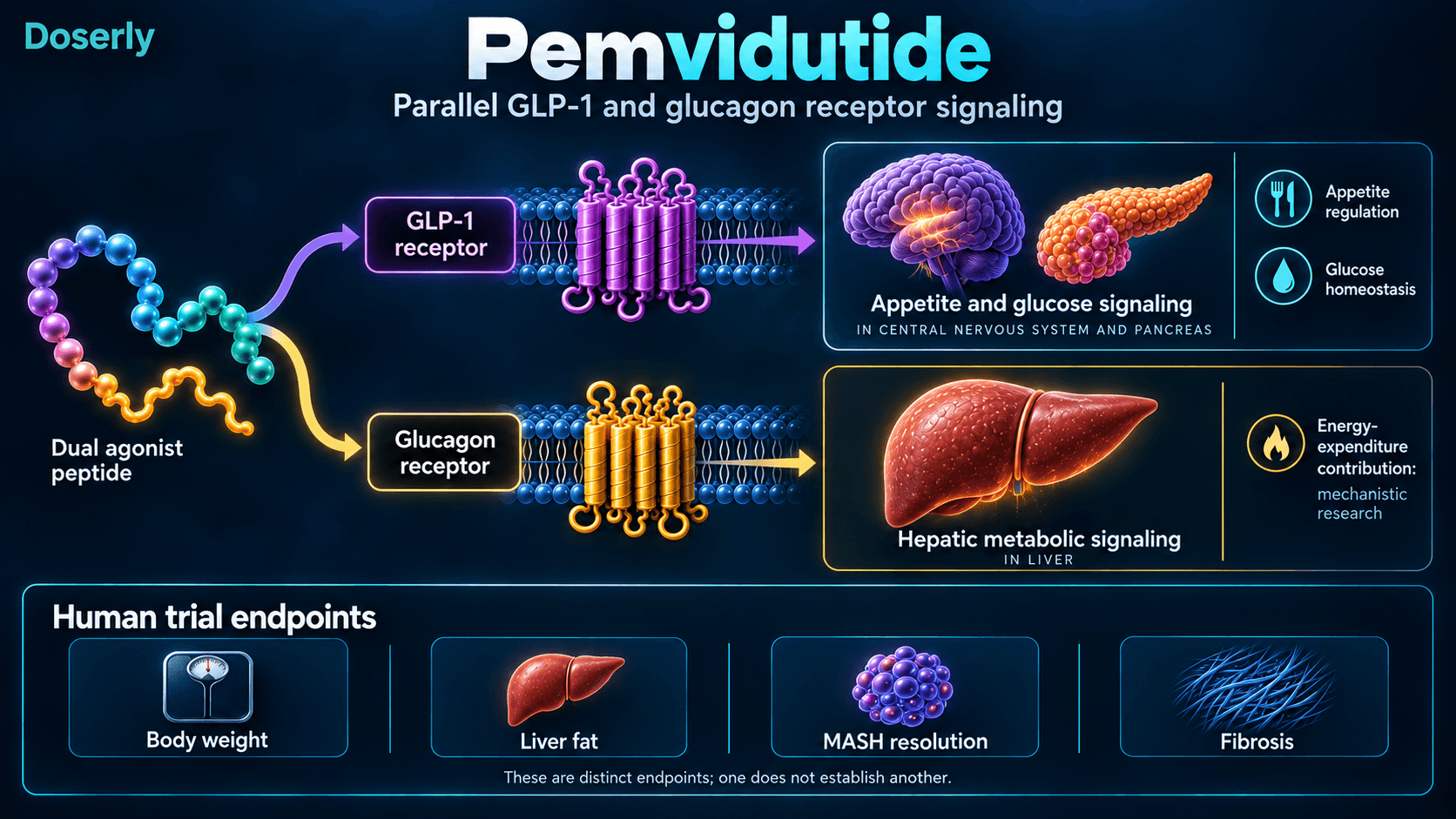
Schematic illustration; receptor shapes are symbolic. The mechanism does not establish a dose or predict an individual outcome.
Pemvidutide belongs to the GLP-1/glucagon dual-agonist class rather than the GLP-1/GIP class. The mechanistic wager is different from a pure weight-loss incretin: glucagon receptor activity may increase hepatic fat oxidation and produce liver-directed effects, while GLP-1 receptor activity can reduce appetite and improve metabolic measures. [1]
Human MASH evidence is stronger than preclinical inference in this guide. IMPACT provides biopsy-based phase 2b data in F2/F3 MASH, and PERFORMA is now the registrational test of whether those signals translate to phase 3 endpoints. Preclinical and molecular-design claims help explain why the compound exists, but they do not prove fibrosis reversal or clinical-outcome benefit. [1][2][4]
Research and clinical evidence
MASLD and liver-fat studies
The earlier 24-week MASLD trial tested 1.2, 1.8 and 2.4 mg weekly doses. The published extension reports relative liver-fat reductions by MRI-PDFF of 56.3%, 75.2% and 76.4% with pemvidutide versus 14.0% with placebo, and body-weight reduction up to 6.2%. Those findings support antisteatotic activity, but MASLD liver-fat reduction is not the same as biopsy-proven MASH resolution or fibrosis improvement. [5]
IMPACT phase 2b MASH trial
IMPACT enrolled 212 participants with biopsy-confirmed MASH and F2/F3 fibrosis, with and without diabetes. Participants received weekly subcutaneous pemvidutide 1.2 mg, pemvidutide 1.8 mg or placebo. The 24-week intent-to-treat analysis counted missing biopsies as non-responders. [4]
MASH resolution without worsening of fibrosis occurred in 59.1% of the 1.2 mg group and 52.1% of the 1.8 mg group versus 19.1% with placebo. Fibrosis improvement without worsening of MASH occurred in 31.8% and 34.5% with pemvidutide versus 25.9% with placebo, a difference the sponsor reported as not statistically significant. Weight loss reached 5.0% and 6.2% with pemvidutide versus 1.0% with placebo, and liver-fat reductions were 58.0% and 62.8% versus 16.2%. [4]
The 48-week EASL 2026 update highlighted metabolic and non-invasive fibrosis-marker signals. For the 1.8 mg dose, Altimmune reported triglyceride reductions of 23.7%, total cholesterol reductions of 15.4%, 7.5% weight loss with no plateau, waist reduction of 5.3 cm and blood-pressure reductions. The same release repeated prior combined non-invasive fibrosis-marker results: at week 48, both a 0.5 or greater ELF reduction and a 30% or greater liver stiffness reduction occurred in 27.8% of the 1.2 mg group and 32.4% of the 1.8 mg group versus 3.2% with placebo. [7]
PERFORMA phase 3 trial
Altimmune announced on August 3, 2026 that PERFORMA had begun enrolling patients. PERFORMA is a global, randomized, double-blind, placebo-controlled phase 3 trial in adults with MASH and confirmed F2/F3 fibrosis. Cohort 1 is designed to support accelerated approval using biopsy-assessed MASH resolution and/or fibrosis improvement at 52 weeks. Cohort 2 adds a larger safety population with fibrosis evidenced through non-invasive tests. Both cohorts support final approval based on liver-related events at about 60 months. [2]
The trial's dose strategy is more explicit than many early programs: monthly titration from 1.2 mg to either 1.8 mg or 2.4 mg trial doses. That phase 3 design is not a recommendation; it is the sponsor's controlled investigational regimen. [2]
Safety and tolerability
In the 24-week IMPACT release, adverse-event related discontinuations were 0.0% at 1.2 mg and 1.2% at 1.8 mg versus 2.4% on placebo. No serious adverse events related to study drug and no arrhythmias were reported at 24 weeks. At 48 weeks, Altimmune said the majority of adverse events were mild to moderate, most gastrointestinal events occurred within the first 8 weeks, and no imbalance in cardiac adverse events was observed. [4][7]
Those results do not settle long-term safety. Larger phase 3 exposure is needed for rare hepatic events, gallbladder events, pancreatitis, cardiovascular outcomes, psychiatric signals, renal tolerability during dehydration, pregnancy exposure and alcohol-related populations. The glucagon component also makes it important to track glucose, lipids, liver enzymes and weight trajectory together rather than treating pemvidutide as a generic GLP-1 substitute.
Administration and tracking
Pemvidutide trial records are unusually liver-focused, so a record should include both metabolic and hepatic measures when available: dose, injection timing, titration step, weight, waist, appetite, gastrointestinal symptoms, alcohol intake when relevant, liver enzymes, lipid panels, glucose or HbA1c, FibroScan or other non-invasive tests, and biopsy context when applicable.
Doserly can organize a documented clinician-directed regimen and related measurements. It does not diagnose MASH, interpret fibrosis or determine whether an investigational compound is appropriate.
What to monitor in the evidence
The next decisive milestone is PERFORMA's 52-week interim biopsy readout, expected in 2029. Before then, useful updates include a peer-reviewed IMPACT 48-week paper, full safety tables, PERFORMA registry details, and clarification of how AIM-MASH AI Assist is used alongside conventional pathology. Claims that pemvidutide is antifibrotic should distinguish biopsy-stage improvement, digital pathology measures and non-invasive tests.
Frequently asked questions
Is pemvidutide FDA-approved?
No. It is investigational. Altimmune reports Fast Track designation for MASH and AUD and Breakthrough Therapy Designation for MASH, but those designations are not approval. [1][2]
What dose of pemvidutide has been studied for MASH?
IMPACT studied 1.2 mg and 1.8 mg once weekly. PERFORMA uses monthly titration from 1.2 mg to 1.8 mg or 2.4 mg trial doses. [2][4]
Did IMPACT prove fibrosis improvement?
The conventional 24-week biopsy endpoint of fibrosis improvement without worsening of MASH was not statistically significant in the sponsor's ITT analysis. Sponsor-reported AI pathology and non-invasive fibrosis markers were more favorable. These are different evidence categories and should not be merged. [4][7]
Is pemvidutide mainly a weight-loss peptide?
No. Weight loss is part of the program, but Altimmune's lead development focus is serious liver disease, especially MASH. The glucagon/GLP-1 mechanism is being tested for both hepatic and metabolic effects. [1][2]
Does the glucagon component make it unsafe for diabetes?
The available trial releases include participants with and without diabetes and report minimal HbA1c changes in IMPACT, but individual glucose risk cannot be inferred from topline statements. Diabetes-specific use would require clinical supervision and trial or label evidence. [4]
Sources & References
[1] Altimmune. Pemvidutide product page. Reviewed September 12, 2026.
[2] Altimmune / GlobeNewswire. Altimmune initiates PERFORMA phase 3 trial of pemvidutide in MASH. August 3, 2026.
[3] Altimmune. Clinical trials page. Reviewed September 12, 2026.
[4] Altimmune. Positive topline IMPACT phase 2b 24-week MASH results. June 26, 2025.
[5] Browne SK, et al. Safety and efficacy of 24 weeks of pemvidutide in MASLD. JHEP Reports. 2025;7:101483. DOI: 10.1016/j.jhepr.2025.101483.
[6] Altimmune SEC exhibit. RECLAIM phase 2 topline results in alcohol use disorder. July 28, 2026.
[7] Altimmune. 48-week IMPACT phase 2b metabolic results at EASL 2026. May 28, 2026.
[8] Altimmune. New IMPACT analyses with non-invasive markers and qFibrosis. May 27, 2026.
Related peptide guides
- Survodutide: GLP-1/glucagon dual agonist in obesity and MASH development.
- Mazdutide: GLP-1/glucagon dual agonist comparator context.
- Retatrutide: multi-receptor incretin program.
- Semaglutide: GLP-1 comparator context.
- GLP-1 weight-management guide: category-level comparison.