
In this guide
What is Orexin A?
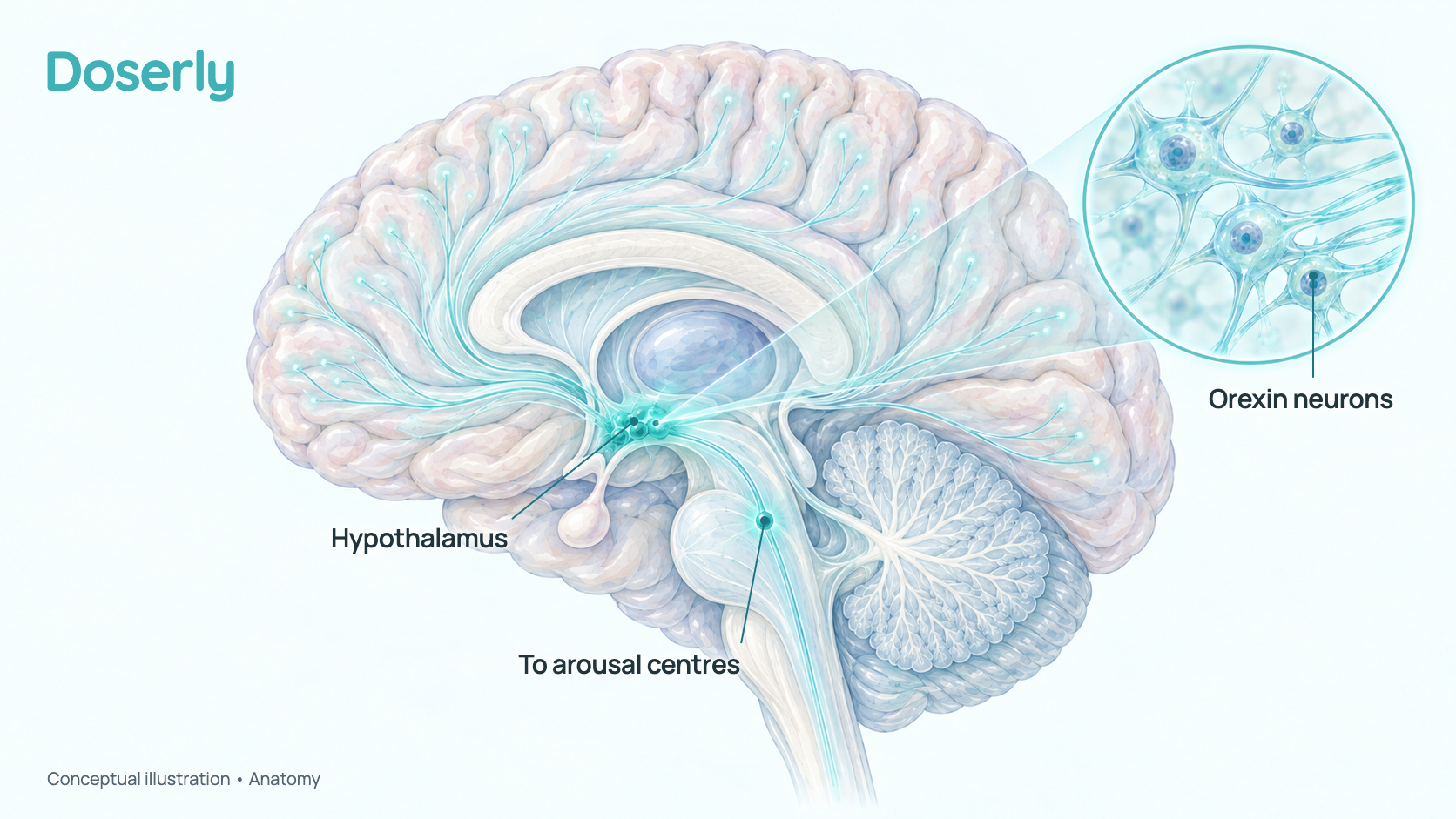
Orexin A is a natural signalling peptide made by a small group of nerve cells in the hypothalamus, the part of the brain that manages sleep, appetite and body states. Its job is to keep the brain in a steady waking state. People search for it because losing the cells that make it causes narcolepsy type 1, and because nasal sprays sold online promise sharper mornings and less need for sleep.
Two research teams found it at the same time in 1998 and gave it two names. One team called the peptides orexin A and orexin B, after the Greek word for appetite, because injecting them into a rat's brain made it eat more. [1] The other team called them hypocretin-1 and hypocretin-2, because they come from the hypothalamus and resemble the gut hormone secretin. [2] Orexin A and hypocretin-1 are the same molecule, and both names are still used.
Chemically it is a chain of 33 amino acids with the formula C152H243N47O44S4 and a molar mass of about 3,561 g/mol. It is not a plain chain: the first amino acid is closed into a ring, the last one is capped, and two disulfide bridges pin the front of the molecule into a fixed shape. It is also far more fat-soluble than orexin B, which helps explain why it crossed into the mouse brain intact while orexin B did not. [3], [4], [5], [23] Both peptides are cut from one parent protein, prepro-orexin, so a single gene produces both. [3]
Products sold as Orexin A are made in a laboratory, not extracted from brains. They are usually 5 mg vials of freeze-dried powder labelled for research use. [78], [81], [84] Some sellers pair the powder with an empty nasal sprayer, as one closed United States vendor did in 2017, and a 2025 self-experiment proposal priced an "Orexin-A+B" product from another seller. [87], [93], [98] None of that is an approved medicine anywhere (see legal status).
Typical Orexin A Protocols
| Source | Amount each time | Frequency | Total per day | Duration |
|---|---|---|---|---|
| Used in human studies | ||||
| Narcolepsy type 1, overnight sleep study (8 adults), intranasal | 435 nmol (about 1.5 mg) | Once, at 10 p.m. | 435 nmol | Single dose; one night of recording Baier and colleagues, 2011: less dream sleep and fewer wake-to-dream jumps; no change in time awake at night [13] |
| Narcolepsy type 1, daytime testing (14 adults), intranasal | 435 nmol (about 1.5 mg) | Once, at 7 a.m. | 435 nmol | Single dose; one day and the following night Weinhold and colleagues, 2014: fewer attention errors and less daytime dream sleep; no change in sleepiness scores [14], [17] |
| Narcolepsy type 1, smell testing (7 adults), intranasal | Not stated in the abstract | Once, at 11 p.m. | Not stated in the abstract | Single dose Baier and colleagues, 2008; the same nasal method as the later studies [12], [17] |
| Narcolepsy type 1, glucose drink test (12 adults), intranasal | Not stated in the abstract | Once, just before a glucose drink | Not stated in the abstract | Single dose Weinhold and colleagues, 2011 conference abstract: blood sugar rose more after the drink in the 7 patients with obesity; no difference in the 5 normal-weight patients [102] |
| Healthy men, nerve-traffic study (10 men), intranasal | 500 nmol (about 1.8 mg) | Once | 500 nmol | Single dose; one session Meusel and colleagues, 2022: nerve traffic to blood vessels rose; blood pressure and heart rate did not change during the session [15] |
| Healthy adults, overnight sleep study (26 adults), intranasal | 500 nmol (about 1.8 mg) | Once, at about 10 p.m. | 500 nmol | Single dose; one night and the next morning University doctoral thesis, Lübeck, 2009: less deep sleep, and people felt less alert and more restless the next morning [101] |
| Healthy adults, activity and eating study (14 adults), intranasal | 100 nmol (about 0.36 mg) | Once | 100 nmol | Single dose; one session University doctoral thesis, Lübeck, 2006: slower brain waves, people felt less active and ate less [100] |
| Healthy men, stomach-emptying study (6 men), intravenous drip | 10 picomoles per kg of body weight per minute | One infusion | Not stated in the abstract | Single infusion Ehrström and colleagues, 2005 [16] |
| Self-experiment (community) | ||||
| Self-experiment by three volunteers, intranasal | 100 mcg (about 28 nmol) in 2.5 mL of water | Once in the morning on sleep-restricted days | 100 mcg | Repeated blocks comparing orexin A with plain water A self-blinded, placebo-controlled trial run and published by the participants themselves, not a clinical study; no outcome differed significantly from placebo [97], [98] |
| Website claims (unvalidated) | ||||
| Research-chemical seller | 0.1 to 1 mg, "as needed" | As needed | Not stated | Not stated Product page for a 5 mg vial; no study is cited for the figure [78] |
| Peptide reference site, intranasal | "25 to 100 nmol", described as the range used in human studies | Not stated | Not stated | Not stated Does not match: the journal studies used 435 to 500 nmol, and no published human study or thesis used less than 100 nmol [79], [13], [14], [15], [100] |
| Peptide reference site, intravenous | 10 to 30 mcg per kg infused over 30 to 60 minutes | Not stated | Not stated | Not stated Does not match the one published human infusion, which ran at a far smaller rate [80], [16] |
| Wellness blog, intranasal | 100 to 150 mcg (about 28 to 42 nmol) | Once a day, early morning | 100 to 150 mcg | Not stated The author's proposed protocol for healthy people; no primary citation for the amount, which is about one-tenth of one study dose [107] |
| Dosing calculator, "beginner" tier | 10 mcg (about 3 nmol) | Daily | 10 mcg | 4 weeks on, 2 weeks off The page labels all three tiers speculative and lists both injection and nasal use; no primary citation [108] |
| Dosing calculator, "moderate" tier | 30 mcg (about 8 nmol) | Daily | 30 mcg | 4 weeks on, 2 weeks off Same page and caveats as the row above [108] |
| Dosing calculator, "aggressive" tier | 50 mcg (about 14 nmol) | Twice daily | 100 mcg | 4 weeks on, 2 weeks off Same page and caveats as the row above; the tiers are alternatives, and the page cites no test of any of them [108] |
| Peptide price aggregator, intranasal | 1 mg (about 280 nmol) | Daily | 1 mg | Not stated; no break described Its one "clinician practice" entry, attributed to another website; no primary citation [109] |
| Peptide library app, intranasal | 50 to 150 mcg (about 14 to 42 nmol) | As needed | Not stated | Not stated Labelled an example dose and "not a protocol"; no primary citation [110] |
Blend claim (orexin A and orexin B together). Kept apart because the page does not say how much of each peptide the amount contains.
| Source | Amount each time | Frequency | Total per day | Duration |
|---|---|---|---|---|
| Peptide app page covering "Orexin A and Orexin B" (website claim, unvalidated), intranasal | 100 mcg, split between the two peptides not stated | Each morning | 100 mcg | 4 weeks on, 4 weeks off [112] |
The recurring amount in the human research is a single nasal dose of 435 to 500 nmol (about 1.5 to 1.8 mg), given once under supervision; one 2006 thesis used 100 nmol. [13], [14], [15], [100], [101] No study, label or registry describes repeated use. Websites that do list a repeated schedule mostly suggest 10 to 150 mcg once or twice a day (about 3 to 42 nmol each time), roughly 10 to 180 times less than one study dose, with one outlier at 1 mg a day; none cites a study for its amount. [107], [108], [109], [110] The rows are separate records and alternatives, not steps to move through.
- Titration: no study has tested starting low and stepping up. One dosing calculator lists beginner, moderate and aggressive tiers of 10 mcg daily, 30 mcg daily and 50 mcg twice daily, and labels them speculative. [108], [17]
- Breaks and cycles: no study has tested a course length or a pause. The same calculator lists 4 weeks on and 2 weeks off, and one page covering orexin A and B together lists 4 weeks on and 4 weeks off; neither cites a source. [108], [112], [17]
- Units: studies give nanomoles (a count of molecules); vials are sold in milligrams (a weight). With a molar mass of about 3,561 g/mol, 1 nmol weighs about 3.56 mcg. Worked example: 435 nmol × 3.56 mcg = about 1,550 mcg, or 1.55 mg, so a 5 mg vial holds about 1,400 nmol, a little over three study-sized doses, and 100 mcg is only about 28 nmol, roughly one-sixteenth of one study dose. The one infusion rate, 10 pmol per kg per minute, is about 0.036 mcg per kg per minute. [4], [13], [16] The Doserly reconstitution calculator does vial-and-volume arithmetic for peptides; it cannot turn a single research dose into a tested schedule.
- Evidence note: the study amounts come from eight single-dose reports in about 97 people (five journal papers, two university theses and one conference abstract); the schedules come from websites, not from any trial of repeated use. The cited references give the full details.
Three cautions matter more than the numbers.
Sleepiness that wrecks your day is a medical problem, not a shopping problem. Falling asleep without warning, sudden muscle weakness when you laugh or feel strong emotion, sleep paralysis or dream-like images as you fall asleep can point to narcolepsy, and diagnosis needs an overnight sleep study or a spinal-fluid test. [11] Since August 2026 there has been an approved medicine for narcolepsy type 1 that acts on the same receptor, so a diagnosis now leads somewhere. [59], [60]
The doses on selling pages are not the doses in the studies. Daily website amounts of 10 to 150 mcg are a small fraction of one study dose, one reference page understates the amounts used in human studies, another misconverts them (see the unit errors), and a third gives an intravenous amount roughly 5 to 30 times the rate used in the one human infusion. [79], [80], [107], [108], [111], [16] A 5 mg vial holds only about three single research doses, so a mix-up between nanomoles, micrograms and milligrams can put a homemade spray far off in either direction. [4], [81]
Single doses tell you nothing about repeated use. Every human study gave one dose and followed people for hours or one night. No formal study has measured blood pressure, sleep, mood or anything else after days or weeks of use. In healthy men one nasal dose increased the nerve signals that tighten blood vessels, and in healthy adults one bedtime dose made the night's sleep lighter and the next morning worse. [15], [101] Whether either matters over time is unknown.
Where these numbers come from
Human study rows. Two of them come from the Kiel narcolepsy group: Baier and colleagues gave 435 nmol of recombinant hypocretin-1 at 10 p.m. before an overnight recording in 8 people, and Weinhold and colleagues gave 435 nmol at 7 a.m. before daytime testing in 14 people. Both used the same delivery pattern, 0.1 mL into each nostril once a minute for ten minutes, described in the systematic review's extraction table, which is also the source for the unchanged sleepiness scores. The 2008 smell study used the same method but its abstract does not state the amount. The healthy-volunteer row is from Lübeck and Tübingen: 500 nmol intranasally in a balanced crossover with placebo in 10 men. The infusion row is from a Stockholm group: 10 pmol per kg per minute intravenously in 6 men, with stomach emptying measured by a scan; the abstract does not give the infusion length, so no total is shown. Only the abstracts of these five journal reports and the review's full text were available. [12], [13], [14], [15], [16], [17]
Thesis and abstract rows. Two doctoral theses from the Lübeck neuroendocrinology institute were read in full. In 2006, 14 healthy adults aged 18 to 30 received 100 nmol in 0.4 mL of water or plain water by nasal spray in a crossover design (the thesis gives two different sex breakdowns for this group). In 2009, 26 healthy adults received 500 nmol in 2 mL of water or plain water between 10 and 10:10 p.m., followed by an overnight sleep recording. A 2011 conference abstract from the Kiel group reports a double-blind crossover in 12 people with narcolepsy type 1 given the peptide or placebo nasally before a glucose drink, without stating the amount. None of these went through journal peer review, and the Kiel narcolepsy reports may share patients. [100], [101], [102]
Animal amounts. Deadwyler and colleagues gave sleep-deprived rhesus monkeys an estimated 1.0 mcg per kg as a nasal mist or 2.5 to 10 mcg per kg intravenously before a memory task. It is the study most often cited on selling pages, but animal amounts per kilogram are never scaled to people, so it is described in the uses section rather than in the table. [19], [89]
Self-experiment row. The only public record of repeated nasal use with a placebo comparison. Its authors published the null result themselves, along with the plan behind it. [97], [98]
Website rows. More than forty dosing, calculator, reference and seller pages were checked in two sweeps. Many say nothing about amounts: several well-known dosing sites list orexin A only as "coming soon" or decline to give a human dose, and others are product pages with no dose. The table shows nine orexin A amounts from seven publishers, and the blend table one more. Jay Campbell's blog gives 100 to 150 mcg each morning; the Peptide Schedule calculator gives three speculative tiers; Ground Truth reports 1 mg daily from a single entry attributed to Peptide List; the OnePin library gives 50 to 150 mcg as needed; The Peptide Mate page covers orexin A and B together. Two claims do not match the primary sources, Peptide Corpus misconverts the study amounts, and a further page misstates the anti-doping rules. A seller page listing 40 mcg each morning could not be captured again to confirm it, so it is not shown. Forum posts from 2017 and 2018 with 50 to 150 mcg are personal accounts, covered under community reports. [78], [79], [80], [90], [107], [108], [109], [110], [111], [112]
Excluded. Amounts given straight into the brain fluid of animals (intracerebroventricular dosing) are not comparable to anything a person could take, so they stay in the research library. Blend sprays that combine orexin A with unrelated peptides are excluded because the orexin content is not stated; the one orexin A and B page with a stated amount has its own table. [87], [112]
What is Orexin A commonly used for?
Orexin A is discussed for four things: narcolepsy and other disorders of excessive sleepiness, staying sharp after a short night, needing less sleep in general, and a scattering of research ideas such as appetite, mood and cancer that come from animal work. None of these is an approved use. Only narcolepsy has been studied in people as a treatment target; the other human data are single doses in healthy volunteers, and they do not support the popular uses.
The reason the idea is attractive is simple. In narcolepsy type 1, the brain has lost 85% to 95% of the nerve cells that make orexin, and the fluid around the brain and spinal cord holds almost none of the peptide. [8], [9], [10], [11] Replacing a missing signal sounds straightforward. Getting a peptide from a nasal spray into the right brain circuits, in the right amount, at the right time, has turned out to be the hard part. [20], [26]
Narcolepsy and cataplexy
This is the only use studied in patients. Three small journal studies in people with narcolepsy type 1 used a single nasal dose. They found less dream sleep, fewer direct jumps from waking into dream sleep, better smell detection and fewer mistakes on an attention test. They did not find longer waking time or lower sleepiness scores. [12], [13], [14], [17]
In other words, the sleep architecture steadied but the daytime sleepiness stayed. The review that summarized the three studies drew that conclusion explicitly and added that orexin loss cannot be the whole story of daytime sleepiness in narcolepsy. [17]
Sleep deprivation and mental sharpness
This use traces almost entirely to one 2007 experiment in monkeys. Rhesus monkeys kept awake for 30 to 36 hours did worse on a memory task, and a nasal mist of orexin A significantly improved their performance, working better than the intravenous route and changing brain activity in the regions the task uses. [19] A university press release about that study, which mentioned interest from military sponsors, is still the reference most selling pages lean on. [89] Consumer blogs build on it too, marketing nasal orexin A to men over 40 for focus and energy, a use no human study has examined. [88]
Rat work points the same way. Nasal orexin A increased the release of two chemical messengers in the front of the brain, activated arousal-related cells and shifted attention performance in aged rats. [47], [48], [49] In people, the only direct test points the other way. A 2006 university thesis gave 14 healthy adults a single 100 nmol nasal dose: their brain waves slowed, they rated themselves less active, and they ate less of a snack, the reverse of what the animal work predicted. [100] No study in healthy people has tested alertness after lost sleep.
Sleeping less without paying for it
This is the hope behind most of the nasal sprays sold online, and it is the one claim with a direct public test. Three volunteers published a placebo-controlled self-experiment in 2026: mild sleep restriction, 100 mcg of orexin A or plain water into the nose in the morning, then mental tests during the day and sleep tracking at night. Nothing reached statistical significance, including the outcome they cared about most, whether the following night's catch-up sleep shrank. [97] They listed their own weaknesses honestly: few data points, possibly too small a dose, and peptide that may have degraded in transit and storage. [97]
The only overnight study in healthy people cuts against the idea: in a university thesis, 500 nmol taken nasally at about 10 p.m. reduced deep sleep (slow-wave sleep) and left people feeling and performing worse the next morning, which the author put down to a worse night rather than a lingering direct effect (see the study details). [101]
Appetite, weight and the gut
The name orexin comes from appetite, but the human picture is small. The one intravenous study in people slowed stomach emptying slightly, lowered the hormone leptin, raised insulin and did not change how hungry people said they felt. [16] In the 2006 thesis, a nasal dose made healthy adults eat less, not more. [100] A 2011 conference abstract from the Kiel group found that one nasal dose in people with narcolepsy type 1 raised blood sugar 90 minutes after a standard glucose drink in the 7 patients with obesity (about 160 against 126 mg/dL on placebo), with no difference in the 5 normal-weight patients. [102] In mice, treatment with orexin A reduced belly fat and, in obesity-prone animals, slowed weight gain, without clear changes in energy use. [44], [45] In rats, continuous delivery into the brain increased daytime eating but did not make them heavier. [35] Nothing here supports using it for weight.
Ideas still confined to laboratories
Several other research lines get quoted on selling pages as though they were benefits. Orexin A killed colon and pancreatic cancer cells in dishes and slowed tumour growth in mice with human tumours, although one pancreatic study reported the opposite, with cell growth being promoted. [41], [42], [43] It reduced gut inflammation in a mouse model of colitis, calmed brain inflammation after cardiac arrest or sepsis in rodents, eased motion sickness in rats and cats, and improved learning in rats with induced seizures. [46], [50], [51], [52], [54] Each is an animal or cell result in a specific model, and none has been tested in a person.
See what the human studies actually measured or how it might work.
Where do Orexin A claims and protocols differ?
The biggest gap is between the studies and the websites: the studies gave one supervised dose of 435 to 500 nmol, while websites that list a schedule suggest 10 to 150 mcg a day, a small fraction of that, repeated without any test. [13], [15], [107], [108] Here is what varies, and why each point matters.
Nanomoles or micrograms?
Research papers state amounts in nanomoles, a count of molecules. Vials are sold in milligrams, a weight. For orexin A, 1 nmol is about 3.56 mcg, so the 435 nmol used in the narcolepsy studies is about 1,550 mcg, or roughly 1.5 mg. [4], [13] Anyone converting badly can be out by a factor of a thousand in either direction. One reference page states that human studies used "25 to 100 nmol", which is not what the published reports say: the journal studies used 435 to 500 nmol, and no published human study or thesis used less than 100 nmol (see the worked conversion). [79], [13], [14], [100] Another page converts the study amounts wrongly, giving 435 nmol as about 1.9 mg and 500 nmol as about 2.2 mg; the correct figures are about 1.55 and 1.78 mg. [111], [4]
Does it even reach the brain?
This is the deepest split in the evidence, and it is unresolved.
- It crosses easily. In mice, radiolabelled orexin A injected into a vein entered the brain quickly by simple diffusion, arrived mostly intact and reached brain tissue rather than sticking to blood-vessel walls. The authors measured it as fat-soluble, which explains the passage. [23], [24]
- It barely gets there. In control dogs, intravenous doses up to 6 mcg per kg did not increase wakefulness, although doses given into the brain fluid did, and only 96 to 384 mcg per kg briefly reduced cataplexy in one dog lacking the peptide. The authors concluded that systemic orexin A hardly crosses into the brain. [26] Dogs with a broken OX2 receptor did not respond even to dosing straight into the brain fluid, so they cannot show whether the peptide gets in; an earlier report of fewer cataplexy attacks after systemic doses in such dogs remains unexplained. [26], [27] A 2018 imaging study labelled orexin A with a radioactive tracer and followed it after nasal dosing in rats and monkeys: brain exposure was poor and similar to the intravenous route, with a possible local increase in the olfactory bulbs. [20]
- The nose helps in anaesthetised rats. In that setting, nasal delivery gave the same brain levels as an intravenous infusion despite a tenfold lower blood level, and roughly 80% of the brain exposure came from direct nose-to-brain transport rather than from the bloodstream. [21]
So nasal delivery clearly beats the bloodstream for efficiency, and it clearly changed something measurable in the human narcolepsy studies. Whether enough peptide reaches the deep brain regions that control wakefulness is still argued.
Which peptide is in the bottle?
Mixed "Orexin-A+B" products have been sold, and one supplier sells a four-peptide nasal set that includes orexin A alongside three unrelated compounds. [87], [98] Orexin B is a different molecule with different behaviour (see the comparison), and in a blend no one can tell which component did anything. Research-grade suppliers also sell orexin A as a trifluoroacetate salt, which is normal for synthetic peptides but means the powder weight is not all peptide. [85]
Is a bigger dose a stronger dose?
Nobody knows: there are no dose-response data in people. The one public account of a very large amount, several milligrams followed by about 70 hours without sleep, came from someone who already had severe insomnia and felt no stimulation from the dose, so it cannot show what the dose did (see the full account). [94] It is still a reason not to treat "just take more" as a plan.
What happens when you stop Orexin A?
Nothing has been studied, because no formal study has kept anyone on it. The human studies were single doses and ended when the recording session or the following morning ended. [13], [14], [15], [16], [101]
Three things can be said honestly:
- The peptide leaves the blood fast. Its half-life in rats is about 27 minutes, and no human measurement exists. [25] Any direct effect is short.
- Most community accounts of stopping are accounts of running out. People describe the effect ending and their usual morning grogginess returning, with no reports of withdrawal symptoms. [91] One person recalled needing larger amounts over about a month for the same effect, from 50 mcg at first to 250 mcg by the end, and stopping when the vial ran out because the effect was short; this is a self-report recalled years later, not a measurement. [113]
- The closest evidence about stopping an orexin-targeting drug comes from the approved medicine, where 277 people who completed or stopped repeat-dose studies showed little sign of physical dependence. That is a different molecule taken by mouth, so it is context and not a finding about orexin A. [59]
Do nasal, injected and oral Orexin A behave the same way?
No. Route changes almost everything for this peptide, and only two routes have ever been used in people.
Intranasal (sprayed into the nose) is the route in seven of the eight human reports. Some of the spray lands on the lining high in the nose, where nerves running to the brain offer a partial shortcut past the blood-brain barrier, the tight lining of brain blood vessels that keeps most large molecules out. In rats, this route delivered the same brain levels as an intravenous infusion with a tenfold lower blood level, and most of the brain exposure came from direct transport rather than from blood. [21] The catch is that delivery depends on where the spray lands, how much liquid the nose can hold and how fast enzymes in the lining break peptides down, which is why nasal peptide products are hard to make reliable. [87]
Intravenous (into a vein) was used in the stomach-emptying study, as a slow drip. [16] Dog studies conflict: an early report found fewer cataplexy attacks after systemic doses [27], while a later one found that doses up to 6 mcg per kg did not wake control dogs and only 96 to 384 mcg per kg briefly helped one dog lacking the peptide (see the brain-entry debate). [26]
Subcutaneous (into the fatty layer under the skin) has never been used with orexin A in a published human study. In a rodent pain model, orexin A worked when given into a vein but not when given subcutaneously. [34]
Oral (swallowed) is not a route for this peptide. Digestive enzymes break peptides apart, and no study has tested swallowed orexin A. The approved orexin-2 receptor medicine works by mouth because it is a small manufactured molecule, not a peptide. [59]
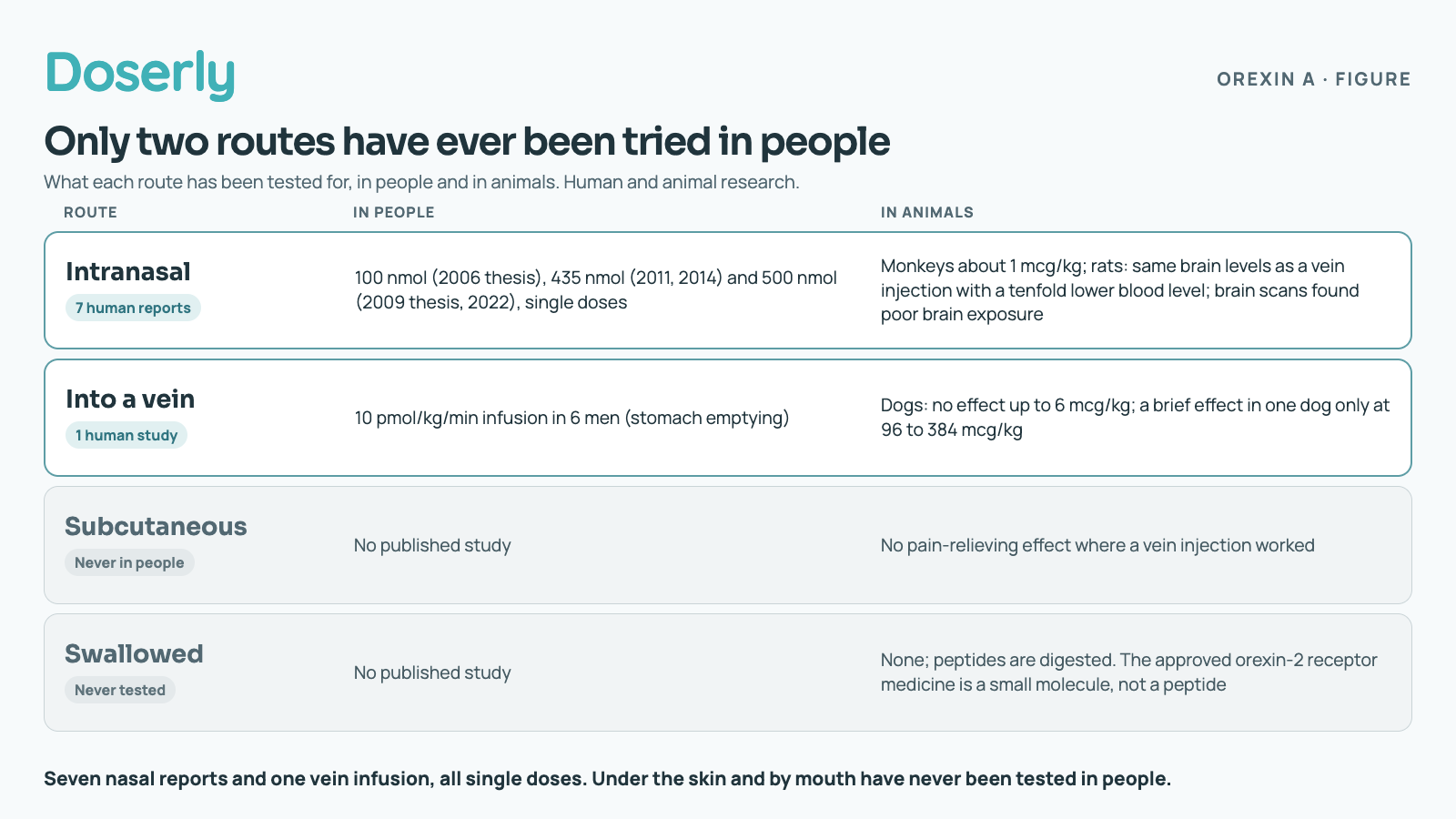
Only two routes have ever been tried in people
What each route has been tested for, in people and in animals. Human and animal research.
- Intranasal · 7 human reports
- In people: 100 nmol (2006 thesis), 435 nmol (2011, 2014) and 500 nmol (2009 thesis, 2022), single dosesIn animals: Monkeys about 1 mcg/kg; rats: same brain levels as a vein injection with a tenfold lower blood level; brain scans found poor brain exposure
- Into a vein · 1 human study
- In people: 10 pmol/kg/min infusion in 6 men (stomach emptying)In animals: Dogs: no effect up to 6 mcg/kg; a brief effect in one dog only at 96 to 384 mcg/kg
- Subcutaneous · Never in people
- In people: No published studyIn animals: No pain-relieving effect where a vein injection worked
- Swallowed · Never tested
- In people: No published studyIn animals: None; peptides are digested. The approved orexin-2 receptor medicine is a small molecule, not a peptide
Seven nasal reports and one vein infusion, all single doses. Under the skin and by mouth have never been tested in people.
How long does it last in the body?
In rats, plasma half-life was 27.1 minutes, longer than many gut peptides, with first-order kinetics and no sign of binding to peripheral tissues. [25] In people it has never been measured, and a 2026 review of the orexin system notes how variable the published measurements of circulating orexin are. [58] A 2026 laboratory study went further: with a very sensitive method, orexin A and orexin B were undetectable in blood, and the nanogram-level blood readings published previously were analytical artefacts. [56] That is a caution about measurements, not proof that an injected dose disappears instantly.
How should Orexin A be stored, and how long does it last?
There is no stability study for any consumer orexin A product, so what follows is supplier instruction, and suppliers disagree.
- Powder. Research suppliers say to keep the freeze-dried (lyophilized) powder at −20 °C (−4 °F), protected from light and moisture, and note that it absorbs water from the air. [81], [85], [86] Some sellers instead say 2 to 8 °C (36 to 46 °F) for the sealed vial. [82], [83]
- After mixing. Pages say to refrigerate at 2 to 8 °C and protect from light, and not to refreeze. Their "use within" advice ranges from 7 days to 14 to 30 days, and none cites a stability test for orexin A. [79], [82], [84] Separately, a laboratory team measuring orexins in monkey spinal fluid found both peptides "sticky": they bind to surfaces unless an acid and a detergent are added. [106]
- Why it matters here. The molecule's shape depends on two disulfide bridges, and suppliers warn that handling conditions can disturb them. [86] The volunteers who ran the self-experiment listed poor storage as one reason their result might have been null: their peptide arrived at room temperature and one shipment sat uncooled in customs for over a week. [97]
For comparison, the approved orexin-2 receptor tablet is simply stored at 20 to 25 °C, because a small manufactured molecule is far more stable than a peptide. [59]
What do we actually know about Orexin A in people?
Less than almost any compound with this much online attention. Eight reports describe giving orexin A to people, about 97 participants in total, each receiving a single dose: five journal papers, two university doctoral theses and one conference abstract. [12], [13], [14], [15], [16], [100], [101], [102] The theses and the abstract did not go through journal peer review, so they are labelled as such below, and the Kiel narcolepsy reports may share patients. One study is registered with ClinicalTrials.gov: NCT00484757, a Kiel study that began in 2007 and planned a night-time nasal dose in 15 people with narcolepsy and 15 healthy controls. Its record was last updated in 2009, its status is unknown and no results have been posted. [99] There is no phase 1, phase 2 or phase 3 programme behind the peptide. [68] Everything else in people is observation: measurements of the peptide in patients, not doses given to them.
The narcolepsy studies
All four come from one sleep-medicine centre in Kiel, Germany, and used nasal dosing in adults with narcolepsy with cataplexy. The first three are journal papers covered by a systematic review; the fourth is a conference abstract. [17], [102]
| Study | People | What was given | Comparator | Main result |
|---|---|---|---|---|
| Baier, 2008 (smell) [12] | 7 of 10 patients dosed; 10 matched healthy controls for the comparison of smell | Single nasal dose | Placebo, crossover, double blind | Smell detection thresholds improved in all patients after orexin A compared with placebo |
| Baier, 2011 (night sleep) [13] | 8 adults | 435 nmol nasally at 10 p.m. | Placebo, crossover, double blind | Less dream sleep in the second half of the night and fewer direct wake-to-dream transitions; no change in how long people were awake at night |
| Weinhold, 2014 (daytime) [14] | 14 adults | 435 nmol nasally at 7 a.m. | Placebo, crossover, double blind | Less daytime dream sleep, fewer wake-to-dream transitions, fewer false responses on a divided-attention test, more stage 2 sleep the following night; no change in sleepiness scores (from the review's extraction table [17]) |
| Weinhold, 2011 (blood sugar; conference abstract) [102] | 12 adults (7 with obesity, 5 normal weight) | Single nasal dose; amount not stated | Placebo, crossover, double blind | Blood sugar 90 minutes after a glucose drink was higher after orexin A than after placebo in the patients with obesity (about 160 against 126 mg/dL); no difference in the normal-weight patients |
The systematic review that summarized the three journal papers concluded that orexin A reduces dream sleep and wake-to-dream transitions but does not increase wake time, and that orexin loss is therefore not the only driver of daytime sleepiness in narcolepsy type 1. [17] An editorial comment was published alongside the 2011 study. [18]
What these studies cannot tell you: whether repeated dosing helps, whether the effect lasts beyond one night, whether anyone feels better day to day, or what happens with long-term use. Each was a single dose with a few hours of follow-up in fewer than 15 people.
The studies in healthy people
In 10 healthy young men, a single 500 nmol nasal dose increased resting sympathetic nerve traffic to blood vessels, measured directly with a fine electrode in a leg nerve. Burst rate rose by about 5.8 bursts per minute against 2.1 after placebo, and total activity rose to 169% of baseline against 115%. Blood pressure, heart rate, heart-rate variability and the blood-pressure reflex response did not change during the session. [15] The authors framed this as the brain resetting the level at which it defends blood pressure, and called for work on the orexin system in high blood pressure.
In 6 healthy men, a slow infusion into a vein slowed the rate of stomach emptying without changing the lag phase or half-emptying time, lowered blood leptin, raised insulin, left the hunger hormone ghrelin unchanged and did not alter how hungry the men said they were. [16]
Two doctoral theses from the University of Lübeck add healthy-volunteer data; neither was published as a journal paper. In 2006, 14 healthy adults aged 18 to 30 received 100 nmol nasally or plain water. Brain waves slowed, people rated themselves less active and they ate less of the snack offered afterwards. [100] In 2009, 26 healthy adults received 500 nmol nasally or plain water at about 10 p.m. and slept in the laboratory. Deep sleep fell and took longer to start. The next morning they described themselves as less alert, less active, more restless and more irritable, and scored worse on finger tapping and number recall. [101] Both results run against the popular picture of orexin A as a simple energiser.
What the human data do not include
- No side-effect tables. None of the journal abstracts mentions side effects, and a systematic review of the three narcolepsy trials found that none reported any. The one report that describes unwanted effects is the 2009 thesis: a lighter night and a worse next morning after a bedtime dose. Absence of a report is not evidence of safety in studies this small. [12], [13], [14], [15], [16], [17], [101]
- No repeated dosing, no dose comparison and no long-term follow-up. [17]
- No study in people without a sleep disorder looking at sleep, alertness or mood over time. The only public attempt is the three-person self-experiment, which found nothing. [97]
- No registered trial with results. The one registered study giving the peptide, NCT00484757, spells it "Orexine A", has not been updated since 2009 and has posted no results. Other ClinicalTrials.gov searches for orexin A and hypocretin-1 return studies of orexin receptor drugs and studies that measure orexin. [68], [99]
Human studies about the peptide rather than the dose
A separate body of human research explains why the idea exists. Hypocretin-1 was undetectable in the spinal fluid of seven of nine people with narcolepsy in 2000. [8] Post-mortem brains showed an 85% to 95% loss of the cells that make it, with neighbouring cell types intact. [9], [10] A 274-patient diagnostic study set the threshold still used today: a spinal-fluid hypocretin-1 level below 110 pg/mL is diagnostic for narcolepsy, and levels above 200 pg/mL are normal. [11] Newer laboratory work has tightened the measurement, showing that older immunoassays overstated concentrations by about 5 to 50 times and that the peptide is not reliably detectable in blood at all. [56], [57]
How does Orexin A work?
The human pharmacology of the orexin system is well established, even though orexin A as a product is not. The peptide acts on two receptors on nerve cells, called OX1R and OX2R. Orexin A activates both with similar strength. [3], [32]
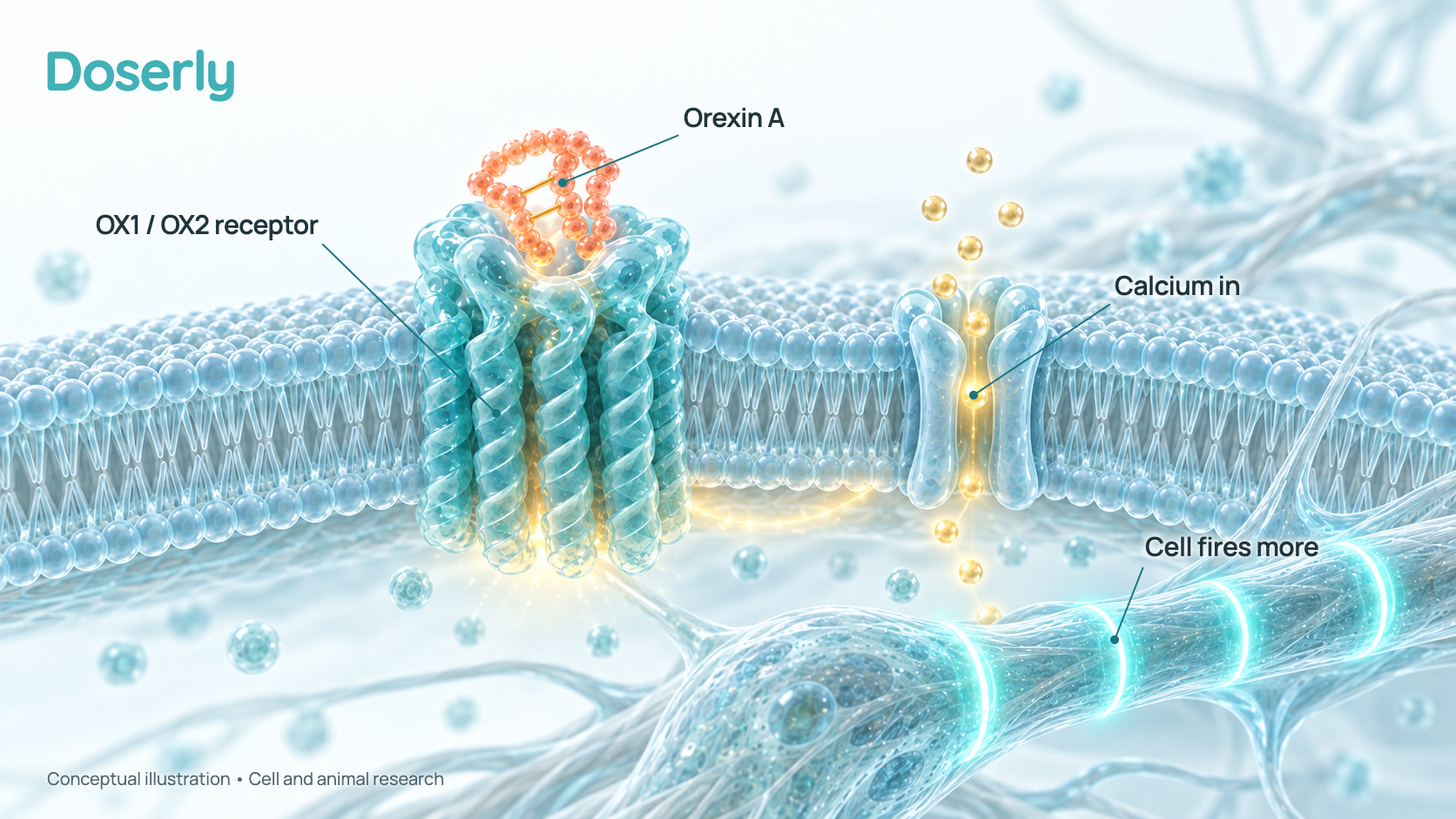
It excites the brain's arousal centres. The densest orexin fibres land on the locus coeruleus, a small brainstem nucleus that sets attention level, where orexin A makes cells fire faster and, in rats, increases arousal and movement. [29] Delivered into the fluid spaces of a rat's brain at the start of its sleep period, it increased waking in the second and third hours in proportion to the amount given, and at the highest amount cut dream sleep and deep sleep. [30] In rats it also increased the release of acetylcholine and glutamate, two messengers involved in attention, in the front of the brain after nasal dosing [47], and glutamate in the amygdala after intravenous dosing. [55]
It stabilises the switch between sleep states. Mice bred without orexin develop a condition that looks like human narcolepsy, and dogs with a broken OX2 receptor develop narcolepsy too. [6], [7] In mice whose orexin cells were destroyed, giving orexin A into the brain suppressed cataplexy-like attacks and increased waking for about three hours, which is the experiment that made receptor agonists worth developing. [28] In narcoleptic dogs, an early study reported that repeated systemic doses reduced cataplexy and consolidated waking [27], but a later study found that receptor-mutant dogs did not respond even to dosing into the brain fluid, and that systemic doses helped only at very high amounts, briefly, in one dog lacking the peptide. [26]
Its reach goes well beyond sleep. In rats, orexin A into the brain raised blood pressure even at amounts that only just increased eating. [33] It reinstated drug-seeking behaviour and raised the threshold for brain reward, an effect blocked by drugs that block stress pathways. [37], [38] It produced anxiety-like behaviour when injected into a specific stress-related nucleus, and people with panic anxiety were found to have higher orexin in their spinal fluid than people without. [39], [40] Infusing orexin into mouse brains raised the level of amyloid beta, the protein that clumps in Alzheimer's disease, while blocking orexin receptors lowered it. [36] It was analgesic in rodent pain models when given into a vein. [34] It also reaches the stress-hormone system: in dishes of human adrenal cells, orexin A, but not orexin B, increased cortisol release. [104]
Why an orexin-shaped drug beat the peptide. The practical problem is delivery, not biology. Peptides are large, water-loving and short-lived, and the body clears them fast. [25] The pharmaceutical answer was to build small molecules that switch the OX2 receptor on and can be swallowed. That approach produced oveporexton, approved in 2026, and alixorexton, still in trials. [59], [65], [66] The same receptor system, approached from the other direction, produced the insomnia medicines that block orexin receptors. [67]
What are the risks and unanswered questions?
Is Orexin A safe?
Its safety in people is not established. About 97 people have received it in the eight reports found, once each, with monitoring. None of the journal abstracts mentions side effects, and the review of the three narcolepsy trials found none reported. [12], [13], [14], [15], [16], [17] The one report that looked for next-day effects found some: a bedtime dose lightened sleep and left healthy adults less alert and more restless the next morning. [101] That is far too little to describe a safety profile, and it says nothing at all about repeated use.
Three specific concerns stand out.
Blood pressure control. The one study that measured it directly found that a single nasal dose in healthy men increased sympathetic nerve traffic to blood vessels, without changing blood pressure during the session. [15] In rats, orexin A into the brain raised blood pressure, and a continuous two-week infusion raised systolic pressure by about 16 mmHg on day 3 before it returned to baseline by day 14. [33], [103] Anyone with high blood pressure, heart disease or a heart rhythm problem should treat this as an open question rather than a settled one.
Stress, anxiety and reward circuits. Animal work ties orexin signalling to panic-like responses, anxiety behaviour and relapse to drug seeking, and people with panic anxiety have higher spinal-fluid orexin. [37], [38], [39], [40] The label of the approved orexin-2 receptor medicine states that it has potential for abuse; in an abuse-potential study in people who use stimulants recreationally, doses 1.5 to 7.5 times the maximum daily dose produced higher drug-liking scores than placebo, similar to or lower than phentermine, a Schedule IV stimulant, and its controlled-substance classification was still pending when its label was issued. [59] That is a different molecule, but it is the closest human read on what stimulating this system repeatedly can do.
Sleep architecture. Taking a wake-promoting substance late in the day is a straightforward way to wreck a night's sleep, and for orexin A this has been measured: 500 nmol by nose at about 10 p.m. reduced deep sleep in healthy adults and left them feeling worse the next morning. [101] In the approved medicine's phase 3 trials, insomnia occurred in 58% of treated patients, with about 90% of cases starting within the first two days. [59] One community report describes about 70 hours without sleep after a very large amount, but from someone who already had severe insomnia, so the link is uncertain (see the report). [94]
What problems have actually been reported?
Nothing serious. None of the journal abstracts mentions adverse events, and no case report of harm from orexin A was found. [12], [13], [14], [15], [16], [17] The 2009 thesis recorded less deep sleep and a worse next-morning mood after a bedtime dose, and the 2011 abstract recorded a higher blood-sugar rise after a glucose drink in patients with obesity. [101], [102] Public accounts describe a burning sensation in the nose after spraying, a brief lift followed by a "light crash", no effect at all in several people, and one long sleepless stretch in someone with existing insomnia (see community reports). [91], [92], [94] These are self-reports from people mixing their own sprays from research powder, with no way to verify what was in the bottle.
Could product quality change the risk?
Yes, and this is a bigger practical risk than the peptide itself. Vials sold as research chemicals are not medicines: nobody checks them for sterility, correct content or contaminants on your behalf. Prices and labels vary widely across sellers, from research-catalogue suppliers selling 1 mg datasheet vials to consumer sites selling 5 mg vials, some with an empty nasal sprayer. [78], [81], [85], [87] Health Canada warns that unauthorized peptide products may contain too much, too little or none of the stated ingredient, may contain unlisted ingredients or contaminants, and may be improperly made or stored. [73] The volunteers who ran their own trial could not rule out that their peptide had degraded before they used it. [97]
Is Orexin A legal? Is it FDA-approved?
Checked September 26, 2026. Rules differ by country and change quickly. A "research use only" label does not make a product legal to sell or safe to use.
United States. Orexin A is not an approved medicine: a search of the FDA's approved-drug database returns no product containing orexin or hypocretin as an active ingredient. [70] It is not among the substances nominated for pharmacy compounding under section 503A (list updated May 14, 2026) and is not on the FDA's list of compounding substances that may pose significant safety risks (content current April 22, 2026). [69], [71] Neither absence is a ruling on whether selling it is legal. Sellers offer it as "research use only" material. [78], [81]
United States, the approved alternative. Oveporexton (brand name Orzeyful), a tablet that activates the orexin-2 receptor, was approved on August 5, 2026 for narcolepsy type 1 in adults, under application NDA 220860, with priority review and orphan designation. Its own label records that the controlled-substance schedule was still to be determined. [59], [60], [66]
Canada. A search of Health Canada's Drug Product Database for orexin, hypocretin and oveporexton returns no authorized product. [72] Health Canada's April 2026 advisory warns the public not to inject peptide products bought online, because unauthorized products are not assessed for safety, effectiveness or quality, and states plainly that a "research use only" label does not make a product legal or exempt from the rules. [73]
Australia. No authorised orexin A product was found in the sources checked; a search of the Australian Register of Therapeutic Goods itself was not run. The Therapeutic Goods Administration's April 2026 guidance on unapproved peptides does not name orexin A. It states that such products are not included in the Australian register and "have not been evaluated for safety, quality or effectiveness by the TGA". [74]
United Kingdom and Europe. No authorised product was found in the sources checked: a search of GOV.UK, which covers the medicines regulator, returns no record for orexin A or hypocretin apart from one unrelated document, and the regulator's product database itself was not searched. [75] Sellers in the United Kingdom list it as a research chemical with a safety data sheet stating that it is not for human use. [81]
Is Orexin A banned in sport? Does it show up on a drug test?
Orexin A is not named on the World Anti-Doping Agency's 2026 Prohibited List or on the 2027 list that takes effect on January 1, 2027. [76], [77] Category S0 bans at all times any pharmacological substance "not addressed by any of the subsequent sections of the List" and with no current approval by any government health authority for human therapeutic use, and the 2027 list adds "peptides" to its examples of that category. [77] Orexin A has no such approval, so athletes subject to testing should assume S0 applies; because it is wake-promoting, the in-competition stimulant section (S6) could also be argued to cover it. [77] One reference website states flatly that orexin peptides are "not on the Prohibited List", which is true as a matter of naming and misleading as a matter of rules. [80] None of the sources reviewed describes a routine test that detects orexin A.
Who should be especially cautious?
These groups have no safety data at all. That is a reason for caution, not proof of harm.
- Anyone with high blood pressure, heart disease or a heart rhythm disorder, because of the sympathetic nerve finding in healthy men and the blood-pressure findings in rats. [15], [33], [103]
- Anyone with diabetes or obesity, because one small report found a higher blood-sugar rise after a glucose drink in patients with obesity. [102]
- Anyone with an anxiety or panic disorder, given the animal work and the higher spinal-fluid orexin found in people with panic anxiety. [39], [40]
- Anyone in recovery from a substance use disorder, given the reinstatement findings in animals and the abuse-potential warning on the approved orexin-2 receptor medicine. [38], [59]
- Anyone with suspected or diagnosed narcolepsy who has not seen a specialist. Diagnosis changes what is available, including an approved medicine. [11], [59]
- Children and teenagers, and anyone pregnant or breastfeeding. Never studied. The approved medicine has not been established as safe or effective in children either. [59]
- Competitive athletes. See the anti-doping section above. [77]
Has Orexin A been tested alongside other medicines?
No. There is no interaction study of any kind. What can be said is indirect and worth raising with a pharmacist or doctor:
- Orexin receptor blockers used for insomnia, such as suvorexant, act in the opposite direction, and suvorexant is contraindicated in narcolepsy. [67]
- Stimulants and wake-promoting medicines used for narcolepsy work through different mechanisms; combining them with anything that raises sympathetic activity has not been studied. [15], [17]
- The approved orexin-2 receptor tablet is contraindicated with strong CYP3A inhibitors and needs a dose reduction with moderate ones, which shows that this class interacts with common medicines even though orexin A itself has never been tested. [59]
Bring a complete list of everything you take to a pharmacist or doctor before adding anything. Health Canada notes that unauthorized injectable products can interact with other medicines. [73]
What should be monitored while using Orexin A?
No regulator has written a monitoring plan for orexin A, and there is no approved label to borrow from. What follows is what the studies measured, plus what the label of the approved orexin-2 receptor medicine requires, clearly separated. It is background for a conversation with a clinician, not a personal testing plan.
What the human studies measured
The narcolepsy studies recorded overnight sleep with polysomnography, daytime ability to stay awake, attention tests and sleepiness scores. [13], [14] The healthy-volunteer study recorded sympathetic nerve activity, blood pressure, heart rate and heart-rate variability. [15] The infusion study recorded stomach emptying, appetite ratings, insulin, leptin, ghrelin and glucose. [16] The theses recorded brain waves, mood, eating, overnight sleep and next-morning mental tasks, and the 2011 abstract recorded blood sugar during a glucose drink test. [100], [101], [102] None of them tracked anything beyond the next morning.
What the approved medicine's label requires
| Why it matters | What the label says | Tracking category |
|---|---|---|
| Sleep at night | Insomnia occurred in 58% of treated patients, usually within 2 days; consider reducing or stopping if it persists beyond 7 days and significantly affects daytime functioning [59] | Sleep Quality |
| Bladder symptoms | Urinary frequency in 58% and urgency in 16% at the higher dose; screen for lower urinary tract symptoms before starting [59] | Side Effect Burden; Other |
| Muscle enzyme rises | Creatine phosphokinase above five times the upper limit in 11% of treated patients against 5% on placebo; report unexplained muscle pain, weakness or dark urine [59] | Side Effect Burden; Pain Management |
| Blood pressure and heart rate | Rises on day 1 were more common than with placebo; by week 12 the average differences were small, and 24-hour monitoring at week 10 showed no significant change [59] | Blood Pressure; Heart Rate & Palpitations |
| Cholesterol | LDL above 160 mg/dL in 32% of treated patients against 20% on placebo over 12 weeks [59] | Other |
Those numbers belong to a swallowed small molecule that switches on one orexin receptor for many hours a day, not to a nasal peptide. They are listed because they are the only systematically collected human safety data for stimulating this system, and because they point at what would be worth watching: sleep, blood pressure, and unexplained muscle pain.
Two things are worth raising with a clinician regardless. First, persistent daytime sleepiness deserves a diagnosis, because a sleep study or spinal-fluid test changes what treatment is possible. [11] Second, any new chest symptom, fainting, severe headache or sudden change in blood pressure after taking anything bought online is a reason to seek medical care and to say what was taken. [73]
What do people in public communities report?
Public discussion of orexin A is old, thin and unusually honest about failure. Most of it dates from 2017 to 2019, when one United States vendor sold 5 mg vials with spray bottles; that vendor closed, and posts after it closed are mostly people asking where to get it or asking whether the new medicines will reach them. [91], [92], [93], [95], [96] Selected discussions are not a survey of users, and people post more readily about dramatic results than about nothing happening.
What the positive reports look like
- A person on a nootropics forum described 100 to 130 mcg a day as a spray, saying it removed morning grogginess and produced a calm, wide-awake feeling. They could not say how long the effect lasted, because by mid-morning they usually felt awake anyway. [91]
- A person with narcolepsy described using it as needed rather than daily, saying it cleared mental fog within a minute or two on bad mornings but did not replace their prescribed stimulant. [92]
- Another person with narcolepsy posted a diary of their first days, then updated later: their general sleepiness did not go away, but they had no cataplexy episodes while using it and felt their other medicines worked better. [93]
Does everyone notice a difference?
No, and the careful accounts are the negative ones. One person with narcolepsy in a 2017 thread said they felt worse, "hopelessly tired since the first day on it". [92] A 2023 thread shows the more common pattern now: someone with undiagnosed daytime sleepiness asked about trying it, and the replies pushed them toward a sleep study instead. [95] Several posters in the older threads reported nothing at all, including one who worked through a whole vial at a range of amounts and could still nap normally. [94] Another described a brief five-minute lift followed by a small crash. [91] The only placebo-controlled public test found no significant effect (see the self-experiment). [97]
What about unwanted effects?
Burning in the nose after spraying, the crash described above, and one longer story. A person who called themselves a non-responder to most substances, and who had severe insomnia at the time, felt nothing at ordinary amounts, then took several milligrams at once. They felt no stimulation but went about 70 hours without sleep; they said they felt less tired than a normal sleepless stretch would leave them, and that afterwards their insomnia eased by an hour or two of sleep a night. With existing insomnia and no felt effect from the dose, the link to orexin A is uncertain, and it is a single unverified self-report. [92], [94] One thread asked specifically whether it raised anxiety, and the people who replied said it had not for them, which is weak evidence in both directions given how few replied. [94] Nobody in these threads had their product tested.
Why the community stories are hard to use
Almost every account involves a homemade spray from research powder, with no way to know the concentration, the sterility or whether the peptide survived shipping and storage. Doses are quoted in micrograms, sprays or "1 mcg per kg twice a day", and often the poster is also taking prescribed stimulants for a diagnosed condition. [92], [93] Being made by the body does not make an unregulated product safe.
In community education groups, orexin comes up mostly in passing, inside broader sleep lessons: as the biology behind narcolepsy, as the target of the newly approved medicine, and as the system the insomnia blockers switch off. No lesson gives an orexin A schedule. Member discussions are just as thin. When people ask for a protocol, the replies say no one knows of one, that the peptide is hard or impossible to find for sale, and that people chasing wakefulness use other drugs instead. The only first-hand mentions involve ready-mixed nasal sprays that did not state how much peptide each spray held. One person felt more awake in the morning after one spray and then two, but it was only the second day, they were taking other nasal peptides at the same time, and the bottle looked almost empty when it arrived. Nobody posted a follow-up. The other mention was a list of benefits that read like product marketing, from a spray that may have contained other ingredients. None of these discussions reports a dose in micrograms, how long anyone used it, any side effects or what happened after stopping.
How can you judge a wakefulness story?
Ask: was there a diagnosis, or is this someone tired for ordinary reasons? What exactly was in the bottle, and who made it? How much, by which route, and at what time of day? What else was running at the same time: prescribed stimulants, caffeine, a new sleep schedule, a holiday? Was anything measured, or is it a morning impression? And what did the same person say three months later? On these threads, the follow-ups are consistently less impressive than the first post.
How does Orexin A compare with Orexin B and the orexin medicines?
Four things get called "orexin" in online discussion, and they behave very differently. Two are the natural peptides, one is a new medicine that switches the same receptor on, and one is a family of sleeping tablets that switch it off.
| Compound | What it is | How it is taken | How often | Human evidence | Approval status |
|---|---|---|---|---|---|
| Orexin A (this guide) | Natural 33 amino-acid peptide with two disulfide bridges; activates both orexin receptors [3], [32] | Nasal spray or a drip into a vein in studies; sold as research powder [13], [16], [78] | Single doses only in every human report [17], [101] | 8 single-dose reports (5 journal papers, 2 theses, 1 conference abstract), about 97 people; one registered 2007 study with no posted results [12], [13], [14], [15], [16], [99], [100], [101], [102] | Not approved anywhere checked [70], [72], [74], [75] |
| Orexin B | Natural 28 amino-acid peptide, a straight chain with no disulfide bridges; strongly prefers the OX2 receptor [3], [32] | No published human administration; sold as research powder [81] | Not applicable | None. Injected into the blood of mice, it was broken down before any intact peptide reached the brain; never tested by the nose [23] | Not approved anywhere checked [70], [72], [75] |
| Oveporexton (Orzeyful) | Manufactured small molecule that switches on the OX2 receptor, not a peptide [59], [66] | Tablet, swallowed [59] | 1 mg or 2 mg after waking and again 3 to 5 hours later; 4 mg a day maximum [59] | Two phase 3 trials, 273 participants, plus a phase 2 trial [61], [62] | Approved in the United States on August 5, 2026 for narcolepsy type 1; controlled-substance schedule pending [59], [60] |
| Orexin blockers (suvorexant and similar) | Small molecules that block orexin receptors, the opposite action | Tablet at bedtime [67] | Nightly [67] | Large insomnia trials | Approved for insomnia; suvorexant is contraindicated in narcolepsy [67] |
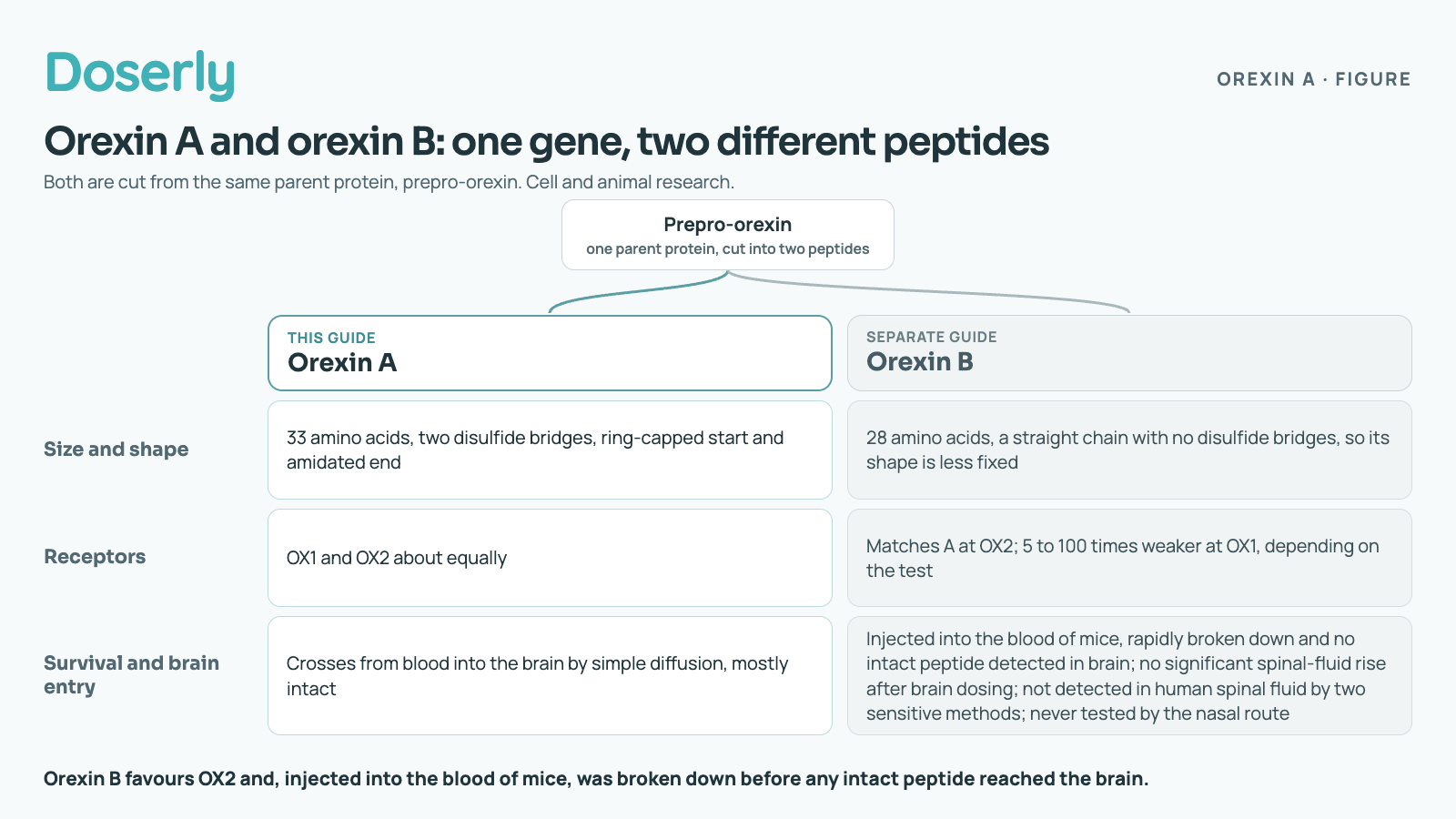
Orexin A and orexin B: one gene, two different peptides
Both are cut from the same parent protein, prepro-orexin. Cell and animal research.
- Size and shape
- Orexin A (this guide): 33 amino acids, two disulfide bridges, ring-capped start and amidated endOrexin B: 28 amino acids, a straight chain with no disulfide bridges, so its shape is less fixed
- Receptors
- Orexin A (this guide): OX1 and OX2 about equallyOrexin B: Matches A at OX2; 5 to 100 times weaker at OX1, depending on the test
- Survival and brain entry
- Orexin A (this guide): Crosses from blood into the brain by simple diffusion, mostly intactOrexin B: Injected into the blood of mice, rapidly broken down and no intact peptide detected in brain; no significant spinal-fluid rise after brain dosing; not detected in human spinal fluid by two sensitive methods; never tested by the nasal route
Orexin B has its own guide: Orexin B.
Orexin B favours OX2 and, injected into the blood of mice, was broken down before any intact peptide reached the brain.
Orexin A and Orexin B are not interchangeable, even though one gene makes both. Orexin A is longer and held in a fixed shape by two disulfide bridges; orexin B is a straight chain with no disulfide bridges, so its shape is less fixed, and it works mainly through the OX2 receptor, being roughly 5 to 100 times weaker than orexin A at OX1 depending on the test. [1], [3], [32], [105] Injected into the blood of mice, orexin A crossed into the brain intact while orexin B was broken down first; orexin B has never been tested by the nose, and no published study has given it to people. [23] The figure above and the Orexin B guide give the fuller comparison; there is no evidence that the orexin B in an "Orexin A+B" blend reaches the brain or adds anything.
The gap between the peptide and the medicine is the point. Oveporexton does what orexin A was hoped to do: in two phase 3 trials people with narcolepsy type 1 stayed awake 14 to 20 minutes longer on a standard test (placebo changed by less than a minute), and weekly cataplexy attacks fell by a median 79% to 89%, against 28% to 39% on placebo. [62] The peptide, given once into the nose, steadied dream sleep but did not increase wake time. [13], [14], [17] The two cannot be compared directly: the tablet was taken twice daily for 12 weeks, while the peptide was given once, and how much reaches the brain from the nose is disputed. [20], [21], [59], [62] Getting there took a failure as well: an earlier drug in the class, TAK-994, was stopped in phase 2 after serious liver injury. [63], [64]
Common questions about Orexin A
Is Orexin A the same as hypocretin-1?
Yes. Two laboratories described the same peptide in 1998 and named it differently: orexin A from one group, hypocretin-1 from the other. [1], [2] Both names appear in research papers, product labels and clinical practice, and the spinal-fluid test used to diagnose narcolepsy is usually called a hypocretin-1 test. [11] Orexin B and hypocretin-2 are likewise the same molecule as each other, and a different molecule from this one (see the comparison).
Does Orexin A make you need less sleep?
No evidence says so. The only public test of that exact question was a placebo-controlled self-experiment by three volunteers, who restricted their sleep and took 100 mcg nasally or plain water in the morning. Neither the following night's catch-up sleep nor any mental test differed significantly, and the authors published the null result themselves. [97] In healthy adults, 500 nmol taken at bedtime made deep sleep lighter and left people less alert the next morning, which is the opposite of a better night. [101] In monkeys, nasal orexin A significantly improved memory-task performance after 30 to 36 hours awake, which is a different thing from removing the need to sleep. [19] See what it is used for.
Is Orexin A a nasal spray or an injection?
Both exist, and neither is a medicine. Seven of the eight human reports sprayed it into the nose, and one gave it as a slow drip into a vein. [13], [14], [15], [16], [100], [101] Sellers offer 5 mg vials of powder sold for making nasal sprays, sometimes with other peptides in the same vial. [78], [84], [87] There is no published human study of a subcutaneous injection of orexin A, and in a rodent pain model it worked intravenously but not by that route. [34] See how routes compare.
How long does Orexin A take to work, and how long does it last?
In the human studies the measurement windows were short: nerve activity was measured 30 to 45 minutes after the nasal dose, and sleep recordings began the same evening or that morning. [13], [14], [15] Its half-life in rat blood is about 27 minutes and has never been measured in people. [25] Community accounts describe an effect within minutes that fades within hours, which fits a short-acting peptide but is not a measurement. [91], [92]
Is Orexin A the same as the new narcolepsy tablet?
No. Oveporexton, approved in the United States in August 2026, is a manufactured small molecule that switches on the OX2 receptor and is swallowed. Orexin A is the natural peptide itself. [59], [66] They act on overlapping targets, but only the tablet has been through large trials, and only the tablet has a label with doses, warnings and monitoring. [59], [62] See the comparison.
Is it legal to buy Orexin A?
It depends where you are, and nowhere is it an approved medicine. In the United States it is sold as a research chemical and is not in the approved-drug database or on the FDA compounding lists. [69], [70], [71] In Canada there is no authorized product, and Health Canada warns the public against injecting peptides bought online. [72], [73] No authorised product was found in the Australian or United Kingdom sources checked, and Australia's regulator says unapproved peptide products have not been evaluated for safety, quality or effectiveness. [74], [75] A "research use only" label is a statement about how a product is sold, not a safety assurance. See the dated legal summary.
Does Orexin A show up on a drug test?
Not on a standard drug test, and no routine test for it was described in any source reviewed. For athletes, that is not the same as being allowed: orexin A is not named on the World Anti-Doping Agency's 2026 or 2027 lists, but category S0 covers any substance that no other section addresses and that lacks approval from a government health authority, and the 2027 list names peptides as an example. [76], [77] One website's claim that orexin peptides are simply "not on the Prohibited List" ignores that rule. [80]
Can Orexin A be combined with modafinil or other stimulants?
Nothing has been studied. There is no interaction study of orexin A with any medicine. [17] The general caution is specific rather than vague: one nasal dose in healthy men increased sympathetic nerve traffic, so stacking it with other stimulants means combining two unmeasured effects on the same system. [15] Anyone taking prescribed medicines for narcolepsy, blood pressure or mental health should raise the question with the prescriber rather than experiment. See risks.
Glossary
Plain explanations of the route, dosing and research terms used in this guide. Underlined terms in the text link here.
- Adverse event
- A harmful or unwanted medical event reported after someone used a treatment. A report alone does not prove the treatment caused it.
- Agonist
- A substance that switches a receptor on, copying the body's own signal. Orexin A is an agonist at both orexin receptors; oveporexton is a manufactured agonist at one of them.
- Amino acid
- A small chemical building block. Chains of amino acids make up peptides and proteins. Orexin A is a chain of 33.
- Amyloid beta
- A protein fragment that builds up in clumps in the brains of people with Alzheimer's disease. In mice, its level in brain fluid rose during wakefulness and after orexin infusion.
- Animal study
- Research in animals such as rats, mice, dogs or monkeys. It shows what a substance does in a living body, but results in people can differ.
- Antagonist
- A substance that blocks a receptor so the body's own signal cannot act on it. The insomnia medicines suvorexant and lemborexant are orexin receptor antagonists.
- Bioavailability
- The share of a dose that reaches the bloodstream, or for a brain-acting peptide the target tissue, in active form. For orexin A it has not been measured in people by any route.
- Blood-brain barrier
- The tight lining of the brain's blood vessels, which keeps most large molecules in the blood from entering brain tissue. It is the main obstacle for peptide treatments aimed at the brain.
- Cataplexy
- A sudden, brief loss of muscle strength triggered by strong emotion such as laughter, while the person stays awake. It is a defining feature of narcolepsy type 1.
- Cell study (in vitro)
- Research on cells grown in a dish. It gives early clues about biology, but it is far from proof of benefit in people.
- Cerebrospinal fluid (CSF)
- The clear fluid around the brain and spinal cord. It is sampled by a lumbar puncture, and its hypocretin-1 level is used to diagnose narcolepsy type 1.
- Compounding
- A pharmacy making a medicine for an individual patient from raw ingredients. In the United States, pharmacies may only compound with bulk ingredients on FDA's allowed lists; orexin A is not on them.
- Controlled trial
- A study that compares people who receive a treatment with a similar group who do not, often receiving a placebo instead. In a crossover design, each person receives both in turn.
- Course and cycle
- A course is a planned period of use; a cycle is a course followed by a break, such as 4 weeks on and 4 weeks off. No study has tested any course or cycle of orexin A.
- Crossover
- A study design in which each person receives both the treatment and the comparison, such as a placebo, at different times, so each person serves as their own control.
- Daily total
- All the amounts given in one day, added together. For example, 50 mcg twice daily is a 100 mcg daily total.
- Deep sleep (slow-wave sleep)
- The deepest stage of non-dream sleep, when brain waves are slow and large. It is linked to feeling rested. In one study, a bedtime dose of orexin A reduced it.
- Disulfide bridge
- A chemical link between two sulfur-containing amino acids that pins part of a peptide into a fixed shape. Orexin A has two; orexin B has none.
- Dose
- The amount given at one time. For orexin A, human studies stated doses in nanomoles, while websites use micrograms.
- FDA
- The United States Food and Drug Administration, the regulator that approves medicines and oversees compounding pharmacies. It has not approved orexin A.
- Freeze-dried (lyophilized)
- Dried by freezing and removing the water, leaving a powder. Research peptide vials are sold this way and mixed with liquid before use.
- Half-life
- The time it takes for the measured level of a substance in the blood to fall by half. It is not the same as how long an effect lasts. For orexin A it is about 27 minutes in rats and unmeasured in people.
- Hypothalamus
- A small region deep in the brain that regulates sleep, appetite, body temperature and hormone release. Orexin-producing cells sit in its lateral part.
- Intracerebroventricular (ICV)
- Injected straight into the fluid-filled spaces of the brain. It is used in animal research to bypass the blood-brain barrier, and it is not a route anyone could use at home.
- Intranasal
- Sprayed or dropped into the nose. This is the route used in seven of the eight human orexin A reports.
- Intravenous (IV)
- Given directly into a vein, usually as an injection or a slow drip. One human orexin A study used a slow drip.
- Investigational
- Still being studied and not approved by a regulator, such as the FDA, to treat any condition.
- Leptin
- A hormone released by fat tissue that signals energy stores to the brain. An orexin A infusion lowered blood leptin in one small human study.
- Loading phase
- A period of higher or more frequent doses at the start of a course, meant to build up an effect quickly. No source describes one for orexin A.
- mcg and mg
- Micrograms and milligrams. 1 mg equals 1,000 mcg. Check which unit a page means: for orexin A the journal studies used about 1,550 to 1,780 mcg, which is 1.5 to 1.8 mg.
- Molar mass
- The weight of one mole of a substance, given in grams per mole. It is what lets you convert between a count of molecules (nanomoles) and a weight (micrograms).
- Nanomole (nmol)
- A way of counting molecules rather than weighing them. For orexin A, 1 nmol weighs about 3.56 micrograms, so 435 nmol is about 1.5 mg.
- Narcolepsy type 1
- A long-term neurological condition with overwhelming daytime sleepiness and cataplexy, caused by the loss of most orexin-producing brain cells.
- Peptide
- A short chain of amino acids. Peptides are usually broken down quickly in the body and do not survive being swallowed.
- Pharmacokinetics
- How the body absorbs, moves, breaks down and removes a substance. For orexin A, no human data exist.
- Picomole (pmol)
- A thousand times smaller than a nanomole. Infusion rates are often given in picomoles per kilogram of body weight per minute.
- Placebo
- A dummy treatment with no active ingredient, used as a comparison in studies. In the 2014 orexin A study the placebo was sterile water sprayed the same way.
- Polysomnography
- An overnight sleep recording that tracks brain waves, breathing, muscle activity and eye movements to show which sleep stages someone passes through.
- Preclinical research
- Studies done before research in people: cell studies, tissue cultures, computer models and animal studies.
- Prepro-orexin
- The parent protein that cells cut up to release orexin A and orexin B. One gene makes both peptides.
- Randomized
- Assigned to treatment or comparison by chance, so the groups start out alike. The narcolepsy studies randomized the order in which each person received the peptide and the placebo.
- Receptor
- A protein on a cell that recognizes a specific signal and changes the cell's behaviour when the signal arrives. Orexin A acts on two: OX1R and OX2R.
- REM sleep
- Rapid eye movement sleep, the stage in which most vivid dreaming happens and the body's muscles are largely switched off. In narcolepsy it intrudes into waking.
- Research use only
- A label on products sold for laboratory research. It does not mean a product is approved, tested for human use or legal to sell as a medicine.
- Subcutaneous (SC)
- Injected into the fatty layer just under the skin. No published human study has given orexin A this way.
- Sympathetic nerve activity
- Signals from the part of the nervous system that prepares the body for action, including nerve traffic that tightens blood vessels and supports blood pressure. One orexin A study measured it directly in a leg nerve.
- Systematic review
- A study that searches for all research on a question using set rules and summarises it. The orexin A review found three narcolepsy trials, all from one centre.
- Titration
- Starting with a lower amount and adjusting it step by step according to response and side effects. No study has tested titration for orexin A.
- WADA
- The World Anti-Doping Agency, which publishes the list of substances banned in sport.
Explore more of the research
Go deeper into the experiments behind the claims.
Across this guide, the citations include 63 original research reports on orexin A and the orexin system: 8 human administration reports (including two university theses and a conference abstract), 6 human observational or diagnostic studies, 4 trials of orexin receptor medicines, and about 45 animal, cell and laboratory studies. Report counts are not counts of independent findings: most of the human reports come from two research groups.
Sleep, wakefulness and narcolepsy models · 10 papers
What happens when orexin is missing?
Model: Mice bred without the orexin gene; dogs carrying a broken OX2 receptor gene.
Finding: Both develop a condition that matches human narcolepsy, including sudden attacks resembling cataplexy.
Limit: These are genetic models, not treatment studies.
Does giving orexin A back help?
Model: Mice whose orexin neurons had been destroyed; narcoleptic dogs given repeated systemic doses.
Finding: Orexin A into the brain suppressed cataplexy-like attacks and increased waking for about 3 hours in mice; in dogs, an early study reported that repeated doses reduced cataplexy and consolidated waking.
Limit: Brain delivery in mice is not a route people can use, and a later study found that receptor-mutant dogs did not respond to intravenous or brain dosing, so the earlier dog result is unexplained (see the delivery group below).
What does it do to a normal sleep-wake cycle?
Model: Rats given orexin A into the brain fluid at the start of their sleep period.
Finding: More time awake in the second and third hours, less dream sleep and less deep slow-wave sleep at the highest amount.
Limit: Dose-dependent effects by a route no person would use.
Which brain cells does it excite?
Model: Rat brain tissue and living rats.
Finding: The densest orexin fibres reach the locus coeruleus, where orexin A increases firing; arousal and movement increase.
Limit: Mechanism, not outcome.
Does it change brain chemistry after nasal dosing?
Model: Young and aged rats given orexin A nasally.
Finding: More acetylcholine and glutamate released in the front of the brain, activation of arousal-related cells, and changes in an attention task in aged rats.
Limit: Rodent studies from one laboratory.
Does intravenous orexin A change brain chemistry?
Model: Anaesthetised rats.
Finding: Glutamate release in the amygdala rose by more than 60% and stayed up for over 50 minutes, with no change in a region lacking orexin fibres.
Limit: Anaesthetised animals; a mechanism finding.
Delivery: does it reach the brain? · 7 papers
Does it cross from blood into the brain?
Model: Mice given radiolabelled orexin A and orexin B into a vein.
Finding: Orexin A entered the brain rapidly by simple diffusion, mostly intact, and reached brain tissue rather than staying in vessel walls. Orexin B was broken down in blood and could not be detected in the brain.
Limit: Mouse study using tracer amounts.
How much reaches the brain after a nasal dose?
Model: Anaesthetised rats given hypocretin-1 nasally or intravenously.
Finding: Similar brain levels from both routes despite a tenfold lower blood level after nasal dosing, with about 80% of brain exposure coming from direct nose-to-brain transport.
Limit: Anaesthesia changes nasal delivery; rats are not people.
What does imaging show?
Model: Rats and monkeys given carbon-11 labelled orexin A nasally, followed by PET imaging.
Finding: Brain exposure was poor and similar to intravenous dosing, with a possible increase confined to the olfactory bulbs.
Limit: The tracer is a methylated version of the peptide; the authors confirmed its structure and activity first.
How much is needed intravenously?
Model: Narcoleptic and control dogs.
Finding: Intravenous doses up to 6 mcg per kg did not increase wakefulness in control dogs, although doses into the brain fluid did; only 96 to 384 mcg per kg produced a brief anti-cataplexy effect, in one dog lacking the peptide. Receptor-mutant dogs did not respond to either route, so they cannot show whether the peptide reaches the brain.
Limit: Small numbers of dogs; the authors concluded that longer-lasting, more brain-penetrant analogues were needed.
How fast does it leave the blood?
Model: Rats given an intravenous infusion.
Finding: Plasma half-life 27.1 minutes, first-order kinetics, no binding to peripheral tissues; glucagon fell during infusion.
Limit: Rat data; no human measurement exists.
How long do the two peptides stay in brain fluid?
Model: Rats given hypocretin-1 or hypocretin-2 into the brain fluid.
Finding: Spinal-fluid levels of hypocretin-1 rose 800-fold and stayed up for over 4 hours; the same amount of hypocretin-2 produced no significant rise.
Limit: A route no person would use; it measures persistence, not effect.
Beyond sleep: appetite, blood pressure, mood, inflammation and cancer · 23 papers
Appetite and body weight
Model: Rats given orexin A into the brain, continuously or as single doses; mice given orexin A by injection.
Finding: Eating increased in the short term and during the day, but continuous dosing did not cause weight gain. In mice, treatment reduced abdominal fat and slowed weight gain in obesity-prone animals.
Limit: Animal work; the human infusion study found no change in appetite ratings.
Blood pressure and the autonomic system
Model: Conscious rats given orexin A and orexin B into the brain fluid.
Finding: Both raised mean arterial blood pressure in a dose-related way, even at amounts that only just increased eating. With a continuous two-week infusion, orexin A raised systolic pressure by about 16 mmHg on day 3, back to baseline by day 14, while orexin B did not.
Limit: Rodent, central route. The human study measured nerve traffic rather than blood pressure change.
Stress hormones
Model: Human adrenal gland cells in a dish.
Finding: Orexin A, but not orexin B, increased cortisol release, acting through the OX1 receptor.
Limit: Cells outside the body; says nothing about a nasal dose.
Reward, stress and relapse
Model: Rats trained to self-administer drugs.
Finding: Activating orexin neurons or giving orexin A reinstated drug seeking; orexin also raised the threshold for brain reward, an effect blocked by drugs acting on stress systems.
Limit: Addiction models in rats.
Anxiety and panic
Model: Rats given orexin A into a stress-related brain nucleus; a rat panic model; spinal fluid from people with and without panic anxiety.
Finding: Anxiety-like behaviour increased in rats, and people with panic anxiety had higher spinal-fluid orexin.
Limit: Association in the human part, not an effect of a dose.
Amyloid and the sleep-wake cycle
Model: Mice with brain microdialysis, including mice bred to develop amyloid plaques.
Finding: Amyloid beta in brain fluid tracked wakefulness, rose during orexin infusion and fell with an orexin receptor blocker; chronic sleep restriction increased plaque formation.
Limit: Mouse study; relevance to people is unproven.
Pain
Model: Mouse and rat pain models.
Finding: Orexin A was analgesic given intravenously but not subcutaneously, with an effect similar to morphine on a heat test; the effect was blocked by an OX1 receptor blocker and not by naloxone.
Limit: Rodent models only.
Inflammation and brain injury
Model: Mice with chemically induced colitis; rats after cardiac arrest; mice with sepsis-associated brain dysfunction.
Finding: Orexin A promoted healing of the gut lining and lowered inflammatory markers, ameliorated brain inflammation and sped recovery of brain activity after resuscitation, and reduced mortality and brain swelling in the sepsis model.
Limit: Three different animal models; no human data.
Cognition in disease models
Model: Mice with drug-induced cognitive impairment; rats with induced seizures; cats and rats with motion sickness.
Finding: Nasal orexin A partly restored discrimination learning in female but not male mice, improved maze learning in seizure-prone rats, and reduced motion-sickness responses.
Limit: Model-specific results, including a clear sex difference in one study.
Cancer cells
Model: Human colon and pancreatic cancer cell lines, tumour tissue slices and mice carrying human tumours.
Finding: Orexin A triggered cell death through the OX1 receptor and slowed tumour growth in mice, including in chemotherapy-resistant cells. One study of a pancreatic cancer cell line reported the opposite, with orexin A protecting cells from death and promoting growth.
Limit: Cell and mouse work with a direct contradiction between studies; no human trial.
How this guide was researched
This guide is built from a thorough review of the sources cited throughout it: published scientific studies, a systematic review, trial-registry searches, regulatory documents and official labels, product and protocol pages, and public forum discussions. We also reviewed community education groups where people discuss sleep, wakefulness and peptides.
The guide cites 113 sources, including 63 original research reports. Each type of source answers a different question. Studies show what researchers measured. Product and protocol pages show what is being sold and claimed. Personal accounts show what individual people experienced. Every numbered citation links to its entry below, labeled by source type.
How this guide was made
Research and drafting were AI-assisted. Every cited source was checked against the original, and the guide was reviewed and edited by Doserly before publication. It has not had an independent clinical review, and Doserly does not currently have medical reviewers. Doserly makes a medication and health-tracking app and runs Doserly Academy, both of which are promoted in this guide. Read our editorial policy for how guides are researched, updated and corrected.
This guide is for educational purposes. It summarizes what the reviewed sources report so the research is easier to understand; it is not medical advice. For a deeper dive, or to check any point for yourself, go straight to the cited sources.
Explore the sources
These are the documents cited in this guide. Studies, regulator records, official labels, product pages and personal accounts answer different questions. A source being listed does not mean every statement on its page is endorsed.
Showing 113 sources
- 01
Orexins and orexin receptors: a family of hypothalamic neuropeptides and G protein-coupled receptors that regulate feeding behavior ↗
Animal and cell study (discovery)
Original abstract reviewed. Names orexin-A and orexin-B, reports that both come from one precursor, that the cells sit in and around the lateral and posterior hypothalamus, and that central administration made rats eat more.
- 02
The hypocretins: hypothalamus-specific peptides with neuroexcitatory activity ↗
Animal and cell study (discovery)
Original abstract reviewed. The independent discovery that gave the peptides the names hypocretin-1 and hypocretin-2; describes their restriction to hypothalamic neurons and their excitatory action on cultured neurons.
- 03
UniProt entry O43612: Hypocretin neuropeptide precursor (human) ↗
Sequence database
Full entry reviewed. Gives the 131 amino-acid precursor, the positions of orexin-A (residues 34-66) and orexin-B (70-97), the pyroglutamate and amide end modifications, the two disulfide bonds and the receptor preferences of each peptide.
- 04
PubChem Compound Summary for CID 56842143, Orexin A ↗
Chemical database
Record reviewed: molecular formula C152H243N47O44S4 and molecular weight 3,561.1 g/mol, used for the nanomole to microgram conversions in this guide.
- 05
GSRS substance record 8RDY08V4VC: OREXIN A ↗
Substance database
Record reviewed: 33 amino-acid sequence QPLPDCCRQKTCSCRLYELLHGAGNHAAGILTL with a pyroglutamate first residue, an amidated leucine at the end and disulfide bonds 6-12 and 7-14; CAS numbers 205599-75-3 and 202936-08-1. A substance record is not an approval.
- 06
Narcolepsy in orexin knockout mice: molecular genetics of sleep regulation ↗
Animal study
Original abstract reviewed. Mice without the orexin gene show behaviour and brain recordings that closely resemble human narcolepsy.
- 07
The sleep disorder canine narcolepsy is caused by a mutation in the hypocretin (orexin) receptor 2 gene ↗
Animal study
Original abstract reviewed. Positional cloning identified a broken OX2 receptor gene as the cause of narcolepsy in a long-studied dog model.
- 08
Hypocretin (orexin) deficiency in human narcolepsy ↗
Human report
Original abstract reviewed. Hypocretin was undetectable in the spinal fluid of seven of nine people with narcolepsy.
- 09
Reduced number of hypocretin neurons in human narcolepsy ↗
Human report (post-mortem)
Original abstract reviewed. An 85% to 95% reduction in orexin-producing neurons, with neighbouring melanin-concentrating hormone neurons preserved.
- 10
A mutation in a case of early onset narcolepsy and a generalized absence of hypocretin peptides in human narcoleptic brains ↗
Human report (post-mortem and genetics)
Original abstract reviewed. Six narcolepsy brains showed global loss of the hypocretins; gene mutations were found in only one early-onset case out of 74 patients screened.
- 11
The role of cerebrospinal fluid hypocretin measurement in the diagnosis of narcolepsy and other hypersomnias ↗
Human report (diagnostic study)
Original abstract reviewed. In 274 patients and 296 controls, a spinal-fluid hypocretin-1 level below 110 pg/mL was diagnostic for narcolepsy; values above 200 pg/mL were considered normal.
- 12
Olfactory dysfunction in patients with narcolepsy with cataplexy is restored by intranasal Orexin A (Hypocretin-1) ↗
Human trial (crossover, placebo-controlled)
Original abstract reviewed. Ten patients and ten matched controls were compared on smell testing; seven patients then received intranasal orexin A or placebo in a double-blind crossover, and detection thresholds improved in every patient after orexin A. The abstract does not state the amount given.
- 13
Effects of intranasal hypocretin-1 (orexin A) on sleep in narcolepsy with cataplexy ↗
Human trial (crossover, placebo-controlled)
Original abstract reviewed. Eight adults received 435 nmol of recombinant hypocretin-1 intranasally before night sleep. No significant effect on nocturnal wakefulness; less REM sleep, particularly in the second half of the night, and significantly fewer direct wake-to-REM transitions.
- 14
The effect of intranasal orexin-A (hypocretin-1) on sleep, wakefulness and attention in narcolepsy with cataplexy ↗
Human trial (crossover, placebo-controlled)
Original abstract reviewed. Fourteen adults received 435 nmol intranasally in the morning; fewer wake-to-REM transitions, shorter REM sleep, more stage 2 sleep the following night and fewer false responses on a divided-attention test.
- 15
Intranasal orexin A modulates sympathetic vascular tone: a pilot study in healthy male humans ↗
Human trial (crossover, placebo-controlled)
Original abstract reviewed. Ten healthy men received 500 nmol intranasally. Resting sympathetic nerve activity rose (burst rate +5.8 against +2.1 per minute with placebo; total activity 169% against 115%), while blood pressure, heart rate, heart-rate variability and baroreflex sensitivity were unchanged during the session.
- 16
Inhibitory effect of exogenous orexin A on gastric emptying, plasma leptin, and the distribution of orexin and orexin receptors in the gut and pancreas in man ↗
Human report (physiology study)
Original abstract reviewed. Six healthy men received an intravenous infusion of 10 pmol per kg per minute. Gastric emptying rate slowed without a change in lag phase or half-emptying time; insulin rose, leptin fell, ghrelin and appetite ratings were unchanged.
- 17
Treatment of Narcolepsy Type 1 With Orexin: A Systematic Review ↗
Systematic review
Full text reviewed. Three randomized controlled trials met the criteria, all from one German centre. Orexin A reduced wake-to-REM transitions and total REM sleep but did not increase wake time; none of the trials reported adverse effects. The extraction table records the nasal delivery method used in each trial.
- 18
Intranasal hypocretin-1: making sense of scents? ↗
Commentary
Original abstract reviewed. Editorial comment published alongside the 2011 nasal sleep study.
- 19
Systemic and nasal delivery of orexin-A (Hypocretin-1) reduces the effects of sleep deprivation on cognitive performance in nonhuman primates ↗
Animal study (monkeys)
Original abstract reviewed. Rhesus monkeys kept awake 30 to 36 hours improved on a memory task after nasal orexin A at an estimated 1.0 mcg per kg or intravenous doses of 2.5 to 10 mcg per kg; the nasal route was more effective, and brain glucose use normalized.
- 20
Positron Emission Tomography Assessment of the Intranasal Delivery Route for Orexin A ↗
Animal study (imaging)
Original abstract reviewed. Carbon-11 labelled orexin A showed poor brain exposure after nasal dosing in rats and monkeys, similar to the intravenous route, with a possible increase confined to the olfactory bulbs.
- 21
Intranasal drug targeting of hypocretin-1 (orexin-A) to the central nervous system ↗
Animal study
Original abstract reviewed. In anaesthetised rats, nasal and intravenous routes produced similar brain concentrations despite a tenfold lower blood level after nasal dosing; about 80% of brain exposure came from direct nose-to-brain transport.
- 22
Food consumption and activity levels increase in rats following intranasal Hypocretin-1 ↗
Animal study
Original abstract reviewed. Nasal hypocretin-1 increased food intake and wheel-running within 4 hours, with no difference over 24 hours; brain distribution was dose-dependent.
- 23
Orexin A but not orexin B rapidly enters brain from blood by simple diffusion ↗
Animal study
Original abstract reviewed. In mice, orexin A entered the brain rapidly and mostly intact, was highly fat-soluble and reached brain tissue; orexin B was rapidly degraded in blood and no intact peptide reached the brain.
- 24
Peptides crossing the blood-brain barrier: some unusual observations ↗
Animal study
Original abstract reviewed. Context for how peptides cross the blood-brain barrier, including the observation that the leptin transport system does not carry orexin A or orexin B.
- 25
Pharmacokinetic profile of orexin A and effects on plasma insulin and glucagon in the rat ↗
Animal study (pharmacokinetics)
Original abstract reviewed. Plasma half-life in rats 27.1 ± 9.5 minutes, first-order kinetics, no binding to peripheral tissues; plasma glucagon fell during infusion. This is the only pharmacokinetic measurement cited in this guide and it is not a human measurement.
- 26
Effects of IV and ICV hypocretin-1 (orexin A) in hypocretin receptor-2 gene mutated narcoleptic dogs and IV hypocretin-1 replacement therapy in a hypocretin-ligand-deficient narcoleptic dog ↗
Animal study
Original abstract reviewed. Intravenous doses up to 6 mcg per kg did not increase wakefulness in control dogs; only 96 to 384 mcg per kg produced a short anti-cataplexy effect. The authors concluded that systemic hypocretin-1 hardly crosses the blood-brain barrier.
- 27
Systemic administration of hypocretin-1 reduces cataplexy and normalizes sleep and waking durations in narcoleptic dogs ↗
Animal study
Original abstract reviewed. Repeated single daily doses reduced cataplexy in narcoleptic dogs and consolidated waking and sleep periods.
- 28
Orexin peptides prevent cataplexy and improve wakefulness in an orexin neuron-ablated model of narcolepsy in mice ↗
Animal study
Original abstract reviewed. Orexin A given centrally suppressed cataplexy-like arrests and increased wakefulness for about 3 hours in mice whose orexin neurons had been destroyed; the authors concluded that receptor agonists would be worth developing.
- 29
Orexin A activates locus coeruleus cell firing and increases arousal in the rat ↗
Animal and tissue study
Original abstract reviewed. The locus coeruleus receives the densest orexin innervation; orexin A increased firing there and raised arousal and locomotor activity in rats.
- 30
The novel brain neuropeptide, orexin-A, modulates the sleep-wake cycle of rats ↗
Animal study
Original abstract reviewed. Orexin A given into the brain fluid at 1, 10 or 30 mcg per rat produced a dose-dependent increase in waking in the second and third hours, with reduced paradoxical and deep slow-wave sleep at the highest amount.
- 31
Differential kinetics of hypocretins in the cerebrospinal fluid after intracerebroventricular administration in rats ↗
Animal study
Original abstract reviewed. Hypocretin-1 given into the brain fluid raised spinal-fluid levels 800-fold for more than 4 hours; the same amount of hypocretin-2 produced no significant rise.
- 32
Distinct recognition of OX1 and OX2 receptors by orexin peptides ↗
Cell study
Original abstract reviewed. Cells expressing human OX1 or OX2 receptors were compared; orexin B has affinity and potency equal to orexin A at OX2 but 10 to 100 times lower at OX1, and the OX2 receptor needs fewer molecular features to be activated.
- 33
Cardiovascular regulatory actions of the hypocretins in brain ↗
Animal study
Original abstract reviewed. In conscious rats, hypocretin-1 and hypocretin-2 given into the brain fluid raised mean arterial blood pressure in a dose-related way, even at the threshold amount for increasing feeding.
- 34
Orexin-A, an hypothalamic peptide with analgesic properties ↗
Animal study
Original abstract reviewed. Orexin A was analgesic when given intravenously but not subcutaneously in mouse and rat models; the effect was blocked by an OX1 receptor antagonist and not by naloxone.
- 35
Chronic intracerebroventricular administration of orexin-A to rats increases food intake in daytime, but has no effect on body weight ↗
Animal study
Original abstract reviewed. Seven days of continuous central infusion raised daytime food intake to 180% of control but left total daily intake, body weight and blood measures unchanged; the rats stayed awake during the day.
- 36
Amyloid-beta dynamics are regulated by orexin and the sleep-wake cycle ↗
Animal study
Original abstract reviewed. In mice, brain fluid amyloid beta tracked wakefulness, increased during orexin infusion and decreased with a dual orexin receptor antagonist; chronic sleep restriction increased plaque formation.
- 37
A role for lateral hypothalamic orexin neurons in reward seeking ↗
Animal study
Original abstract reviewed. Activating orexin neurons reinstated extinguished drug-seeking in rats, and orexin A given directly into a reward-related area did the same.
- 38
Role for hypocretin in mediating stress-induced reinstatement of cocaine-seeking behavior ↗
Animal study
Original abstract reviewed. Hypocretin-1 given into the brain fluid reinstated cocaine seeking and raised brain reward thresholds; the effect was prevented by blocking noradrenaline and stress-hormone systems.
- 39
A key role for orexin in panic anxiety ↗
Animal study with human measurements
Original abstract reviewed. Activation of orexin neurons was necessary for a panic-prone state in a rat model, and people with panic anxiety had higher spinal-fluid orexin than people without. The human part is an association, not a dose given.
- 40
Orexin-A induces anxiety-like behavior through interactions with glutamatergic receptors in the bed nucleus of the stria terminalis of rats ↗
Animal study
Original abstract reviewed. Orexin A injected into a specific stress-related nucleus increased anxiety-like behaviour in rats; injections nearby did not.
- 41
Aberrant expression of OX1 receptors for orexins in colon cancers and liver metastases: an openable gate to apoptosis ↗
Cell and animal study
Original abstract reviewed. Human colorectal tumours and liver metastases expressed the OX1 receptor while normal tissue did not; orexin A caused cell death in nine colon cancer cell lines and slowed tumour growth in mice carrying human tumours.
- 42
In vitro, in vivo and ex vivo demonstration of the antitumoral role of hypocretin-1/orexin-A and almorexant in pancreatic ductal adenocarcinoma ↗
Cell and animal study
Original abstract reviewed. Orexin A triggered cell death in OX1 receptor-positive pancreatic cancer cells and tumour slices and slowed tumour growth in mice.
- 43
The Orexin-A-Regulated Akt/mTOR Pathway Promotes Cell Proliferation Through Inhibiting Apoptosis in Pancreatic Cancer Cells ↗
Cell study
Original abstract reviewed. In the PANC1 pancreatic cancer cell line, orexin A promoted growth and protected cells from death, the opposite direction to the other cancer studies cited here.
- 44
Impact of Orexin-A Treatment on Food Intake, Energy Metabolism and Body Weight in Mice ↗
Animal study
Original abstract reviewed. In healthy mice, orexin A treatment did not change energy expenditure or glucose metabolism but reduced abdominal fat deposits and adiposity and altered several brain receptor expression levels.
- 45
Orexins mitigate obesity-associated dysfunctions in mice ↗
Animal study
Original abstract reviewed. In obesity-prone mice on a high-fat diet, orexin A reduced weight gain, body fat, food intake, fatty liver and insulin resistance.
- 46
Efficiency of Orexin-A for Inflammatory Flare and Mucosal Healing in Experimental Colitis: Comparison with the Anti-TNF Alpha Infliximab ↗
Animal study
Original abstract reviewed. In a mouse colitis model, orexin A promoted healing of the gut lining and lowered inflammatory markers, performing at least as well as infliximab in that model.
- 47
Increased acetylcholine and glutamate efflux in the prefrontal cortex following intranasal orexin-A (hypocretin-1) ↗
Animal study
Original abstract reviewed. Nasal orexin A raised markers of neuronal activation in the prefrontal cortex and basal forebrain and increased acetylcholine and glutamate release in the prefrontal cortex of rats.
- 48
Effects of Intranasal Orexin-A (Hypocretin-1) Administration on Neuronal Activation, Neurochemistry, and Attention in Aged Rats ↗
Animal study
Original abstract reviewed. In aged rats, nasal orexin A activated cortical regions, increased prefrontal acetylcholine release and altered attention-set-shifting performance.
- 49
Intranasal administration of orexin peptides: Mechanisms and therapeutic potential for age-related cognitive dysfunction ↗
Review
Original abstract reviewed. Reviews the mechanisms proposed for nasal orexin delivery and the case for testing it in age-related cognitive problems; written by the group that performed several of the rat studies.
- 50
Intranasal post-cardiac arrest treatment with orexin-A facilitates arousal from coma and ameliorates neuroinflammation ↗
Animal study
Original abstract reviewed. In a rat cardiac-arrest model, nasal orexin A 30 minutes after resuscitation reduced inflammatory markers in the hypothalamus and sped recovery of brain activity and neurological scores.
- 51
Therapeutic effects of orexin-A in sepsis-associated encephalopathy in mice ↗
Animal study
Original abstract reviewed. Nasal orexin A reduced mortality, brain swelling and inflammatory signalling in a mouse model of sepsis-associated brain dysfunction; the effect depended on the OX2 receptor.
- 52
Orexin-A attenuated motion sickness through modulating neural activity in hypothalamus nuclei ↗
Animal study
Original abstract reviewed. Orexin A reduced motion-sickness responses in rotated rats and, given nasally at 60 mcg per kg, reduced vomiting and appetite loss in cats.
- 53
Nasal administration of orexin A partially rescues dizocilpine-induced cognitive impairments in female C57BL/6 J mice ↗
Animal study
Original abstract reviewed. Nasal orexin A partly restored visual discrimination performance in female mice with drug-induced impairment but not in males.
- 54
Orexin-A-induced ERK1/2 activation reverses impaired spatial learning and memory in pentylenetetrazol-kindled rats via OX1R-mediated hippocampal neurogenesis ↗
Animal study
Original abstract reviewed. Orexin A improved maze learning in seizure-kindled rats and increased new cell formation in the hippocampus; both effects were blocked by an OX1 receptor antagonist.
- 55
Intravenously administered hypocretin-1 alters brain amino acid release: an in vivo microdialysis study in rats ↗
Animal study
Original abstract reviewed. Intravenous hypocretin-1 raised glutamate release in the amygdala by more than 60% for over 50 minutes in anaesthetised rats, with no change in a region lacking orexin fibres.
- 56
Tackling the Orexin Conundrum: An Optimized LC-MS/MS Method Demonstrates Accurate CSF Quantification and Absence in Peripheral Blood ↗
Human laboratory study
Original abstract reviewed. In paired spinal fluid and blood samples, orexin-B and peripheral orexins were below the detection limit, and earlier blood measurements were shown to be analytical artefacts; older immunoassays overestimated spinal-fluid orexin A about 50-fold.
- 57
Orexin-A measurement in narcolepsy: A stability study and a comparison of LC-MS/MS and immunoassays ↗
Human laboratory study
Original abstract reviewed. Spinal-fluid orexin A was lower in narcolepsy type 1 than in controls; orexin B was undetectable in every sample, and the mass-spectrometry values were five times lower than the radioimmunoassay values.
- 58
The orexin system as a pharmacological target in inflammation: peripheral mechanisms and safety implications ↗
Review
Original abstract reviewed. Reviews peripheral orexin signalling and notes the limited pharmacokinetic data for orexin peptides and the wide methodological variability in reported plasma concentrations.
- 59
ORZEYFUL (oveporexton) tablets, for oral use: full prescribing information ↗
Official label
Full label reviewed. Indicated for narcolepsy type 1 in adults; 1 mg or 2 mg after awakening and again 3 to 5 hours later, maximum 4 mg a day; warnings for insomnia (58% of treated patients), urinary frequency and urgency, and creatine phosphokinase elevations above five times the upper limit in 11%; day-1 rises in blood pressure and heart rate; LDL above 160 mg/dL in 32%; potential for abuse with the controlled-substance schedule to be determined; half-life about 23.2 hours; store at 20 to 25 °C.
- 60
Drugs@FDA record for NDA 220860 (ORZEYFUL, oveporexton), original approval ↗
Regulator record
Record reviewed: original application approved 5 Aug 2026, priority review, new molecular entity, orphan designation, sponsor Takeda Pharmaceuticals USA, tablets of 0.5 mg, 1 mg and 2 mg.
- 61
Oveporexton, an Oral Orexin Receptor 2-Selective Agonist, in Narcolepsy Type 1 ↗
Human trial (phase 2)
Original abstract reviewed. In 112 participants, all oveporexton groups improved wakefulness and sleepiness against placebo at 8 weeks; the most common adverse events were insomnia (48%), urinary urgency (33%) and urinary frequency (32%), with no liver toxicity.
- 62
Oveporexton for Narcolepsy Type 1: Results from Two Phase 3 Trials ↗
Human trial (phase 3)
Original abstract reviewed. In 273 participants across two trials, mean sleep latency improved by 14.3 to 19.8 minutes against a small decline on placebo, and weekly cataplexy fell by 79.0% to 88.8% against 27.7% to 39.1%; adverse events occurred in 86% to 89% of treated participants, most commonly urinary frequency and transient insomnia.
- 63
Oral Orexin Receptor 2 Agonist in Narcolepsy Type 1 (TAK-994) ↗
Human trial (phase 2, terminated)
Original abstract reviewed. The trial and its extension were stopped early for liver toxicity: clinically important liver-enzyme rises in 5 patients and drug-induced liver injury meeting Hy's law criteria in 3.
- 64
TAK-994 mechanistic investigation into drug-induced liver injury ↗
Cell and animal study
Original abstract reviewed. Investigates why TAK-994 caused liver injury that rat and monkey safety studies had missed, pointing to covalent binding after liver metabolism.
- 65
Safety, tolerability, and efficacy of alixorexton, a selective orexin 2 receptor agonist for narcolepsy type 1 (Vibrance-1): a randomised, double-blind, placebo-controlled, phase 2 trial ↗
Human trial (phase 2)
Original abstract reviewed. In 92 participants, once-daily alixorexton improved wakefulness against placebo at 6 weeks; the most common adverse events were frequent urination (55%), insomnia (28%) and increased saliva (25%). Registered as NCT06358950.
- 66
Oveporexton: The first-in-class orexin receptor 2 (OX2R) agonist approved for treatment of narcolepsy type 1 (NT1) ↗
Review
Original abstract reviewed. Short review of the first approved orexin-pathway therapy for narcolepsy type 1 and the two phase 3 trials that supported it.
- 67
BELSOMRA (suvorexant) tablets: full prescribing information ↗
Official label
Label reviewed: an orexin receptor antagonist indicated for insomnia and contraindicated in patients with narcolepsy. Cited here only as the opposite pharmacology to orexin A.
- 68
ClinicalTrials.gov searches for orexin A, orexin-A, hypocretin, hypocretin-1 and intranasal orexin A as interventions ↗
Registry search
160 unique records reviewed across six searches: trials of orexin receptor drugs or studies that measure orexin levels. The one registered study that gives the peptide itself, NCT00484757 [99], spells it "Orexine A" and was found in a later check.
- 69
Bulk Drug Substances Nominated for Use in Compounding Under Section 503A of the FD&C Act (Categories 1 to 3) ↗
Regulator list
Document searched 26 Sep 2026: orexin and hypocretin are not listed in any of the three categories. Absence is not a ruling on legality.
- 70
Drugs@FDA search (openFDA) for orexin and hypocretin as active ingredients ↗
Regulator search
No approved product contains orexin or hypocretin as an active ingredient. The only approved product in this area acts on the orexin receptor and is a different molecule.
- 71
Certain Bulk Drug Substances for Use in Compounding that May Present Significant Safety Risks ↗
Regulator list
Page saved and searched: orexin and hypocretin are not named.
- 72
Health Canada Drug Product Database searches for orexin, hypocretin and oveporexton ↗
Regulator search
No authorized Canadian product matched any of the three searches. Control searches for other ingredients returned records, confirming the search worked.
- 73
Think twice before injecting peptides bought online: unauthorized products can seriously harm you ↗
Regulator advisory
Saved copy reviewed: unauthorized peptide drugs may contain too much, too little or none of the active ingredient, may contain unlisted or contaminated ingredients, may be poorly labelled or improperly made or stored, and may interact with other medicines; the advisory also states that "For Research Use Only" labelling does not make a product legal. Orexin A is not among the example products named.
- 74
Understanding your responsibilities when importing, compounding and supplying unapproved peptide products ↗
Regulator guidance
Archived copy reviewed: unapproved peptide products are not included in the Australian register and "have not been evaluated for safety, quality or effectiveness by the TGA". Orexin A is not named.
- 75
GOV.UK search for orexin A and hypocretin ↗
Regulator search
Both searches returned a single unrelated document. No UK medicine, authorization or guidance for orexin A was found.
- 76
World Anti-Doping Code International Standard: Prohibited List 2026 ↗
Sport rules
Document reviewed: orexin and hypocretin are not named. Category S0 prohibits at all times any substance with no current approval by any governmental regulatory health authority for human therapeutic use.
- 77
World Anti-Doping Code International Standard: Prohibited List 2027 ↗
Sport rules
Document reviewed: orexin and hypocretin are not named, and the S0 examples now explicitly include "peptides".
- 78
Orexin-A Peptide product page ↗
Protocol source
Page reviewed: sells a 5 mg vial and states "typical dosages ... range from 0.1 to 1 mg per dose, taken as needed" with no study cited for the figure.
- 79
Orexin-A reference page ↗
Protocol source
Page reviewed: states that human studies used 25 to 100 nmol intranasally, which conflicts with the journal reports (435 to 500 nmol; no published human study or thesis used less than 100 nmol), and gives storage advice of -20 °C for powder and 2 to 8 °C for up to 7 days after mixing.
- 80
Orexin: what the research actually shows ↗
Protocol source
Page reviewed: gives a human intravenous figure of 10 to 30 mcg per kg over 30 to 60 minutes, which conflicts with the one published human infusion, and states that orexin peptides are "not on the Prohibited List" without mentioning the S0 catch-all category.
- 81
Orexin A 5mg product page and safety data sheet ↗
Seller page and safety data sheet
Both pages reviewed: 5 mg vial, formula C152H243N47O44S4, molecular weight 3,561.3 g/mol (acetate), purity at least 98%, CAS 205599-75-3, storage at -20 °C protected from light and moisture, and an explicit statement that the product is for research use only and not for human or veterinary use.
- 82
Orexin A Peptide Vial 5mg ↗
Seller page
Page reviewed: 5 mg vial sold with a certificate of analysis, stated storage 2 to 8 °C, refrigerate after mixing, keep away from light and do not refreeze a reconstituted solution.
- 83
Orexin A peptide vial ↗
Seller page
Page reviewed: 5 mg vial or a kit with bacteriostatic water and syringes; advises refrigerated storage at 2 to 8 °C and states the material is for research use.
- 84
Orexin A Spray (5 mg nasal spray solution) ↗
Seller page
Page reviewed: lyophilized 5 mg vial sold as a nasal spray product, with storage advice of -20 °C for the powder and 2 to 8 °C for 14 to 30 days after mixing, "depending on stability data for the specific sequence"; no orexin A stability data are cited.
- 85
Orexin A Peptide datasheet (catalogue 350307) ↗
Research supplier datasheet
Page reviewed: 1 mg of lyophilized peptide supplied as a trifluoroacetate salt under inert gas, sequence with disulfide bonds Cys6-Cys12 and Cys7-Cys14, purity above 95%, solubility in distilled water up to 2 mg/mL, storage at -20 °C, hygroscopic and light-sensitive.
- 86
Orexin A reference and handling page ↗
Seller page
Page reviewed: describes -20 °C long-term storage for the powder, advises avoiding repeated temperature cycling, and notes that handling conditions can affect the two disulfide bonds.
- 87
Nasal peptide spray: what the science says ↗
Seller-affiliated article
Page reviewed: explains why nasal peptide delivery is technically difficult (volume limits, spray placement, enzymes in the lining, device variability) and describes a research set containing Semax, Pinealon, Orexin-A and Selank in one vial.
- 88
Orexin A peptide nasal spray for mental health and cognition for men over 40 ↗
Protocol source
Page reviewed: markets nasal orexin A for alertness and focus in men over 40 based mainly on the 2007 monkey study, without human evidence for that use.
- 89
Researchers reverse effects of sleep deprivation in monkeys with orexin A ↗
Press release
Saved copy reviewed. The university announcement of the monkey study, including the note that the work drew defence-related interest. A press release is not evidence; the study itself is cited separately.
- 90
Orexin A protocol page ("coming soon") ↗
Protocol source
Page reviewed: the site lists orexin A but has published no protocol, which is typical of the dosing sites checked for this guide.
- 91
Orexin-A (r/Nootropics discussion thread) ↗
Community accounts
Full thread and replies reviewed. The original poster describes 100 to 130 mcg a day as a nasal spray with a calm, wide-awake effect and no morning grogginess; other participants report no effect, or a brief lift followed by a small crash. No usernames or identifying details are reproduced.
- 92
Has anyone ever tried intranasal Orexin-A here? (r/Narcolepsy discussion thread) ↗
Community accounts
Full thread and replies reviewed. Accounts of homemade nasal sprays made from research powder, use "as needed" rather than daily, a report of nasal burning, and one person who felt worse after their first use.
- 93
My Experience With Orexin-A Spray (r/Narcolepsy diary thread) ↗
Community account
Full thread and follow-up replies reviewed. A person with diagnosed narcolepsy describes preparing a spray, using it once each morning, and later reports that general sleepiness persisted but that they had no cataplexy episodes while using it.
- 94
Has anyone here tried Orexin nasal spray and found it increased anxiety levels? (r/Nootropics discussion thread) ↗
Community accounts
Full thread and replies reviewed. Replies report no increase in anxiety and, in several cases, no effect at all. One person, who describes pre-existing severe insomnia and not responding to most substances, took several milligrams at once, felt no stimulation, and then went about 70 hours without sleep. Self-reported, with no product testing.
- 95
Has anyone had any experience with Orexin-A? (r/Peptides discussion thread) ↗
Community accounts
Full thread reviewed. Someone with undiagnosed daytime sleepiness asks about using orexin A; replies steer them toward a sleep study instead, and the original poster updates the post to say they were advised against self-treating.
- 96
Orexin Agonist (r/idiopathichypersomnia discussion thread) ↗
Community accounts
Full thread reviewed. Interest in the new orexin receptor medicines rather than the peptide; the thread contains no dosing information.
- 97
Null Results From An Orexin RCT ↗
Self-experiment report
Full post reviewed. Three volunteers ran a self-blinded, placebo-controlled, blocked trial on themselves: mild sleep restriction, then 100 mcg of orexin A in 2.5 mL of water or plain water intranasally in the morning. No outcome reached significance, including next-night sleep duration and the mental acuity tests. The authors list small numbers, a possibly low dose and uncertain peptide storage as limitations.
- 98
Orexin pilot experiment for reducing sleep need (project proposal) ↗
Self-experiment protocol
Page reviewed. The written plan behind the trial above: about 200 nmol per dose (roughly 1 mcg per kg), powder kept frozen and dissolved before each block, spray bottles randomized for blinding. It also records the authors' reasoning from the published human studies, including one unit conversion of the 435 nmol dose that does not match the peptide's molar mass.
- 99
Effect of Intranasal Administration of Orexine A on IL-6-System, Sleep-Wake-Regulation and Neurocognition (NARKOREX) ↗
Registry record
Record reviewed: randomized, double-blind crossover planned in 15 people with narcolepsy and 15 healthy controls, intranasal orexin A at night then placebo about two weeks later, or the reverse, with sleep, cytokine and thinking measures. Start June 2007, estimated completion August 2009; status unknown and no results posted.
- 100
Die Wirkung von intranasal verabreichtem Orexin A auf Aktivität, Nahrungsaufnahme und Spontan-EEG beim Menschen (The effect of intranasal orexin A on activity, food intake and resting EEG in humans) ↗
Human study (doctoral thesis, not peer reviewed)
Full text reviewed. Crossover in 14 healthy adults aged 18 to 30 (the thesis also states a sex breakdown adding to 15): a single 100 nmol nasal dose in 0.4 mL of water against plain water. Resting brain waves slowed, self-rated activity fell and fewer snack pieces were eaten; the author notes these results run against the rodent findings.
- 101
Die Wirkung von intranasal verabreichtem Orexin A auf Nachtschlaf und assoziierte kognitive Maße bei gesunden Probanden (The effect of intranasal orexin A on night sleep and related cognitive measures in healthy volunteers) ↗
Human study (doctoral thesis, not peer reviewed)
Full text reviewed. 26 healthy adults (14 men, 12 women; some analyses 23 or 24) received 500 nmol in 2 mL of water or plain water nasally at about 10 p.m. before overnight sleep recording. Deep sleep was reduced and its onset delayed; the next morning participants rated themselves less alert, less active, more restless and more irritable, and finger-tapping and digit-span results were worse.
- 102
The effect of intranasal hypocretin-1 on glucose tolerance in normal weighted and obese narcolepsy patients ↗
Human study (conference abstract)
Abstract reviewed. Double-blind, placebo-controlled crossover in 12 people with narcolepsy with cataplexy; the dose is not stated. Ninety minutes after a 75 g glucose drink, blood sugar was higher after hypocretin-1 than after placebo in the 7 patients with obesity (160.4 against 125.9 mg/dL, p=0.021) and did not differ in the 5 normal-weight patients.
- 103
Chronic central infusion of orexin-A increases arterial pressure in rats ↗
Animal study
Original abstract reviewed. A continuous brain infusion of orexin-A at 50 pmol per hour raised systolic blood pressure by 15.6 mmHg on day 3, returning to baseline by day 14; the same infusion of orexin-B did not change blood pressure. Neither changed food or water intake.
- 104
Orexin A stimulates cortisol secretion from human adrenocortical cells through activation of the adenylate cyclase-dependent signaling cascade ↗
Cell study (human cells)
Original abstract reviewed. Orexin A, but not orexin B, increased cortisol secretion from dispersed human adrenal cells, acting through the OX1 receptor; neither changed adrenaline-type or aldosterone secretion.
- 105
Characterization of recombinant human orexin receptor pharmacology in a Chinese hamster ovary cell-line using FLIPR ↗
Cell study
Original abstract reviewed. In cells carrying human receptors, potency (pEC50) at OX1 was 8.03 for orexin-A and 7.30 for orexin-B, and at OX2 8.18 for orexin-A and 8.43 for orexin-B.
- 106
Diurnal Fluctuations of Orexin-A and -B in Cynomolgus Monkey Cerebrospinal Fluid Determined by a Novel Analytical Method Using Antiadsorptive Additive Treatment Followed by Nanoflow Liquid Chromatography-High-Resolution Mass Spectrometry ↗
Animal laboratory study
Original abstract reviewed. The authors, employees of the company that developed oveporexton, found orexin-A and orexin-B "sticky" in spinal fluid and added citric acid and a detergent (Tween 80) to prevent nonspecific binding before measurement.
- 107
Orexin A and Sleep: What You Need to Know ↗
Protocol source
Page reviewed: proposes "100-150 mcg administered intranasally once a day in the early morning" for healthy people seeking daytime alertness. No primary study is cited for the amount, which is about 28 to 42 nmol, roughly one-tenth of one study dose.
- 108
Orexin (Hypocretin) Dosage Calculator ↗
Protocol source
Page reviewed: a protocol labelled "Speculative" with tiers Beginner 10 mcg daily, Moderate 30 mcg daily and Aggressive 50 mcg twice daily, a header listing injection or nasal use and "4 w on / 2 w off", and a note that community doses sit 30 to 178 times below the published human doses. No primary citation for the tiers.
- 109
Orexin-A: Dosing, Evidence & Vendor Prices ↗
Protocol source
Page reviewed: reports one "clinician practice" entry of 1 mg intranasal daily, attributed to another website (Peptide List), with no cycling schedule and no primary citation. 1 mg is about 280 nmol.
- 110
Orexin A: Dosing, Benefits & Safety ↗
Protocol source
Page reviewed: lists "50-150 mcg · Nasal · As needed" as an example dose, states "Not a protocol" and gives the injected amount only as "per investigational protocol". No primary citation.
- 111
Orexin-A: dosing, evidence and sources ↗
Protocol source
Page reviewed: records the 435 to 500 nmol single nasal research dose but converts it as "500 nmol (~2.2 mg) or 435 nmol (~1.9 mg)", labelled unverified. At 3.56 mcg per nmol the correct figures are about 1.78 mg and 1.55 mg.
- 112
Orexin A and Orexin B ↗
Protocol source
Page reviewed: gives "100 mcg intranasally each morning", daily, with a cycle of "4 weeks on, 4 weeks off" for orexin A and orexin B together, described as its clinical team's guidance. It does not say how the 100 mcg divides between the two peptides or cite a study.
- 113
Orexin pilot experiment for reducing sleep need (r/slatestarcodex discussion thread) ↗
Community account
Thread and replies reviewed. One reply recalls using a nasal orexin A solution before night classes for about a month around 2017, starting at 50 mcg and ending at 250 mcg because "the needed dose grew very rapidly for the same effect", and stopping after one vial because the effect did not last long. The poster flags uncertainty about the amounts. Self-reported and recalled years later.
No matching sources
Try a different term or show the full list.
Updates and corrections
Published September 26, 2026. This is the first Doserly guide for orexin A, written from primary sources rather than from an earlier version. It records the eight human administration reports found (five journal papers, two university theses and one conference abstract) with the amounts actually used, notes the one registered study (NCT00484757), which has no posted results, separates them from the amounts and schedules stated on selling pages (mostly 10 to 150 mcg a day, never tested), and corrects four specific website claims: a nanomole-to-milligram conversion that overstates the study amounts, an intranasal range given as 25 to 100 nmol, an intravenous figure of 10 to 30 mcg per kg, and the statement that orexin peptides are simply not prohibited in sport. It also separates orexin A from orexin B, and separates both from the approved orexin-2 receptor medicine. Full texts of the five journal studies were not accessible, so those entries record what the abstracts and the systematic review's extraction table report; the two theses were read in full. This is stated in each source entry.
Found an error or a relevant study we missed? Report a correction with the guide title, the specific passage and a supporting source if available. Please leave out personal health records. See our editorial policy for how we handle attribution, evidence limits and corrections.