
In this guide
What is Orexin B?
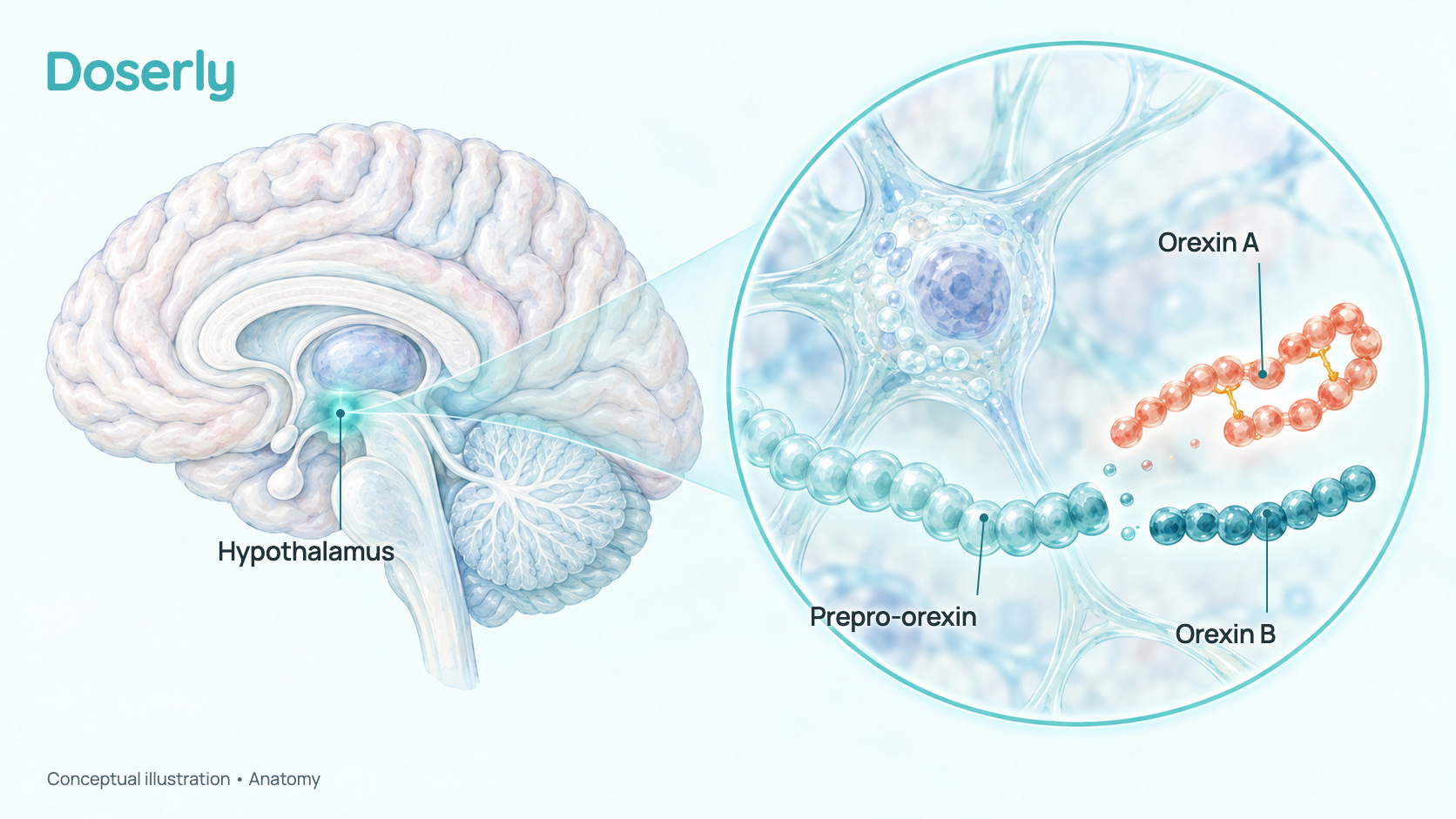
Orexin B is a natural signalling peptide made by a small cluster of nerve cells in the hypothalamus, the part of the brain that manages sleep, appetite and body states. It is one of two orexin peptides that help hold the brain in a stable waking state. People search for it because of narcolepsy, because of the new orexin medicines, and because it is sold online next to its better-known sister, Orexin A.
Two research teams described the pair in 1998 and gave them two sets of names. One team called them orexin-A and orexin-B, found that both are cut from the same parent protein, and showed that both made rats eat more when given into the brain. [1] The other called them hypocretin-1 and hypocretin-2, because they come from the hypothalamus and resemble the gut hormone secretin. [2] Orexin B and hypocretin-2 are the same molecule. Other labels you will see are OXB, OxB, Hcrt-2 and HCRT2.
Chemically it is a straight chain of 28 amino acids: RSGPPGLQGRLQRLLQASGNHAAGILTM, with the last amino acid capped (an "amide"). [4] Its formula is C123H212N44O35S and its molar mass about 2,899 g/mol. [5] Unlike Orexin A, it has no disulfide bridges holding it in shape. The structure studies disagree on its shape in water: one NMR study found two short coils (helices) joined by a linker even in water, while a circular dichroism study found it unordered in water and coiled in a membrane-like environment. [6], [7] A membrane-mimicking study also found two helical sections. [4] Both peptides come from one parent protein, prepro-orexin, so one gene makes both. [3]
Products sold as Orexin B are made in a laboratory. They are 1 mg or 5 mg vials of freeze-dried powder labelled for research, and the sellers state they are not for human use. [52], [53], [54] It is not an approved medicine anywhere (see legal status), and it has its own guide separate from Orexin A because the two behave differently (see the comparison).
Typical Orexin B Protocols
| Example | Amount each time | Frequency | Total per day | Duration |
|---|---|---|---|---|
| Low | Not stated | Daily, or only when needed | 50–100 mcg | As needed, or 2–4 week cycles From a 2026 online "cheat sheet" post that gives the same amount for nasal use [64] |
| Mid | 50 mcg, then 100 mcg | Once daily | 50–100 mcg | Not stated The page calls both amounts "lab examples" and says no human injectable dose is established [63] |
| High | 250 mcg | Once daily | 250 mcg | Not stated Listed under "shorter or higher" courses on the same page, as "not a clinical recommendation" [63] |
Two of the three websites that state an orexin B amount give 50–100 mcg a day; the nasal page gives 100–200 mcg when needed. No study, label or registered trial stands behind any of them. [62], [63], [64]
- Titration Changing the amount in steps
- One calculator page starts at 50 mcg once a day and moves to 100 mcg once a day, with 250 mcg a day listed as a higher alternative. The other pages give no starting step. [63]
Read the units: these amounts are in micrograms (mcg); 1 mg equals 1,000 mcg, so a 5 mg vial holds 5,000 mcg. On an insulin syringe, units measure volume, not an amount of orexin B. As arithmetic only: a 5 mg vial mixed with 2 mL of liquid holds 2.5 mg per mL (25 mcg per unit on a U-100 syringe), so 100 mcg is 0.04 mL, or 4 units. [63] Doserly's reconstitution calculator works this out for any vial. Research papers instead give orexin B in nanomoles (a count of molecules): with a molar mass of about 2,899 g/mol, 1 nmol weighs about 2.9 mcg, so 100 nmol is about 290 mcg (0.29 mg). [5]
Each row is one website's schedule as published, and low, mid and high are alternatives, not steps to move through. These numbers come from websites rather than studies: the pages themselves call them community practice or lab examples, and none cites a human study. [62], [63] (See where the website numbers come from.)
What amounts do sites give for nasal sprays?
| Source | Amount each time | Frequency | Duration |
|---|---|---|---|
| Peptide library page | 100–200 mcg | Only when needed | Not stated [62] |
| 2026 "cheat sheet" post | 50–100 mcg a day (split not stated) | Daily, or only when needed | As needed, or 2–4 week cycles [64] |
The nasal page states its number is "community practice rather than a trial result". [62] Nothing shows how much orexin B, if any, reaches the brain through the nose (see routes). A third chart site lists the route as subcutaneous and gives no amount. [65]
Nothing else supplies a human dose. No published study and no ClinicalTrials.gov record has given orexin B to a person; the registry's orexin-related records are receptor-drug and measurement studies. No orexin B medicine exists in the United States or Canada, so there is no label to follow. A 2025 self-experiment proposal reserved pure nasal orexin B for its highest funding level; the group later tested orexin A only, and no orexin B amount or result has been posted. [42], [43], [50], [56], [70] Every other orexin B amount comes from animals or tissue in a dish, and amounts per kilogram in animals are never scaled to people (see the animal amounts).
Three cautions matter more than any of these numbers.
Serious daytime sleepiness needs a diagnosis, not a research vial. Falling asleep without warning, or sudden muscle weakness when you laugh or feel strong emotion (cataplexy), can point to narcolepsy. A diagnosis opens up approved treatments, including, in the United States since August 2026, a tablet for narcolepsy type 1 that switches on the same receptor orexin B prefers. [40], [41]
An injection may never reach the brain. In mice, orexin B injected into a vein was broken down in the blood, and none arrived in the brain intact. [10] In sheep, an intravenous dose had no effect on eating, while orexin given straight into the brain did. [12] Whatever the effect of an injected research vial, the evidence says it is unlikely to be the brain effect people buy it for, while the risks of an unregulated injection remain.
The side effects of the approved relative are the best warning available. On the approved tablet, insomnia affected 55% to 60% of patients depending on dose, against 1% on placebo; frequent urination, blood-pressure and cholesterol rises were also more common than on placebo; and an earlier drug of the same kind was stopped because of liver injury. [39], [40] Those are different molecules. They show what switching on this receptor for days at a time can do in people, and orexin B has never been tested at all.
Where these numbers come from
Human studies and registries. PubMed searches for orexin B, orexin-B, hypocretin-2 and hypocretin 2 returned 527 records; screening the human-administration, intranasal and peripheral-route subsets found no study that gave orexin B to a person. ClinicalTrials.gov term (150 records) and intervention (78 records, all also in the term results) searches were screened in full, 150 unique records; none gave orexin B to people. The hits were orexin receptor drugs, studies measuring the body's own orexin, or unrelated studies that mention orexin. [50]
Labels. The FDA's substance database has no orexin B entry (it lists orexin A separately), and Health Canada's Drug Product Database returns nothing for orexin or hypocretin as an ingredient. [42], [43]
Websites. Thirty likely pages were first checked by address, mostly the orexin B pages of sites that publish orexin A pages. Twenty-four did not exist, two would not load, one was a "coming soon" placeholder on a protocol site, and three were product listings from UK Peptides, PeppyTides (the same brand) and Abbiotec that sell vials without any amount. [52], [53], [54], [55] A later web search found about 25 more pages. Three state a human amount: the OnePin peptide library (100–200 mcg as a nasal spray when needed, described as community practice; its dosage chart repeats the same number and is not counted separately), the VERIX reconstitution guide, a seller's calculator page (50 mcg, then 100 mcg once daily as lab examples, and 250 mcg as a higher alternative, alongside the statement that no human injectable dose is established) and a March 2026 "peptide cheat sheet" post on Reddit's r/Biohack_Blueprint (50–100 mcg a day, by subcutaneous injection or nasal spray, as needed or in 2–4 week cycles, posted with seller referral links). [62], [63], [64] The low row comes from [64], the mid and high rows from [63], and the nasal rows from [62] and [64]. PeptideDosageCharts lists a subcutaneous route with no amount. [65] About a dozen further pages give storage or mixing details without an amount. Three pages are too few to show a consensus, and none cites a human study.
Self-experiments. A public Manifund funding proposal from 2025 set out a plan to test orexin sprays for sleep need. Pure orexin B was reserved for the top funding tier, the lowest tier would have bought an orexin A+B blend, and the page states that there is little to no research on the safety of nasal orexin B. The group later ran its trial with orexin A only and reported no significant effect; no orexin B amount or result has been posted. [56], [70]
Excluded. Animal amounts are shown separately in the animal-amounts table and are never converted to human doses. Mixed "Orexin A/B" sprays and blend listings are excluded because the orexin B content is not stated; one blend listing also could not be opened for checking.
What is Orexin B commonly used for?
Orexin B is discussed for three things: staying awake or needing less sleep, narcolepsy, and a spread of laboratory ideas such as appetite, brain protection and pain. None of these is an approved use, and none has been tested in people. Everything below comes from animal studies, cell studies, or measurements of the body's own orexin B.
The appeal is easy to see. Orexin keeps the brain's waking state steady, most people with narcolepsy type 1 have lost the cells that make it, and orexin B prefers the receptor most linked to sleep and wakefulness. [8], [14], [17], [19] The problem is getting a peptide from a vial to the right brain cells, and for orexin B the mouse evidence says the bloodstream destroys it first. [10]
Staying awake and needing less sleep
This is what most online interest is about, and there is no study of it. No human has been given orexin B to test alertness, sleep or sleep need. [50] The only relevant public plan, a 2025 self-experiment proposal, chose to test orexin A first and reserved pure orexin B for its highest funding tier (the lowest tier would have bought an A+B blend) because of its poor passage into the brain and lower potency. [56] The group later ran the trial with orexin A only and reported no significant effect (see the Orexin A guide); no orexin B arm has been reported. [70] In online discussions, one commenter who used an "Orexin A/B" blend described orexin B as "much more stimulation" than orexin A, a personal impression from a blend that cannot be credited to either peptide. [57]
Narcolepsy and cataplexy
Here the research is real but indirect. In mice bred without orexin, a modified orexin B that acts almost only on the OX2 receptor, given straight into the fluid spaces of the brain, reduced cataplexy-like attacks and broken-up waking as well as orexin A did. [14] In separate tests in normal mice, orexin A, which also works on the OX1 receptor, triggered drug-seeking behaviour, and the modified orexin B did not. [14] Findings like this are the biological case for OX2 receptor drugs such as oveporexton, the approved narcolepsy tablet, which is a small manufactured molecule and not orexin B. [17], [18], [40]
Appetite and weight
The name orexin comes from feeding research: given into the brain, both orexins made rats eat more. [1] Outside the brain the results split. A single 3 mg per kg injection into the muscle of young pigs raised their 24-hour feed intake by 18%, while an intravenous dose of 3 mcg per kg in sheep did nothing. [12], [13] In human fat tissue in a dish, orexin B switched on a gene involved in fat-cell development. [25] Nothing here supports orexin B for weight loss or weight gain in people.
Brain protection, pain and other laboratory ideas
Several research lines get quoted as if they were benefits. In dishes of rat brain cells, orexin B protected dying dopamine neurons, the cells lost in Parkinson's disease, while orexin A barely did; in mice poisoned with a Parkinson's-inducing chemical, orexin B into the brain reduced the loss of those cells and improved movement. [26], [27], [28] In mice given daily orexin B injections from the day after aneurysm-inducing surgery, brain-artery aneurysms were smaller than in untreated mice (1.93 against 3.72 mm, 6 mice per group), but not in mice lacking OX2; it also reduced deaths and lung injury in a sepsis model. In rats, it eased nerve pain and improved a learning task. [24], [29], [30], [31] Other mouse studies found the opposite for head pain: orexin B applied to the brain's outer lining triggered migraine-like pain in male mice, and it made pain-sensing nerve cells from male mice, monkeys and people more sensitive. [67], [68] In dishes, it triggered the death of colon-cancer and nerve-tumour cells but not normal gut cells. [34], [35] Each is a result in one specific model, mostly from single laboratories, and none has been tested in a person.
Where do Orexin B protocols differ?
No study has tested any human schedule, so the disagreements are about where the website numbers come from, units and product identity. Here is what varies, and why each point matters.
Where do the website amounts come from?
Three websites give human amounts, and they do not agree on route, amount or schedule. [62], [63], [64]
- No human study behind them. The nasal page links its amount to a 1998 animal study and then states that the study "shows the mechanism, not a human dose". [62] The calculator page labels its amounts as lab examples and says no human injectable dose is established. [63] The cheat-sheet post gives no source for its numbers. [64]
- Errors on the pages. The nasal page labels orexin B as "studied in humans" and describes it as containing disulfide bonds. No study has given it to a person, and orexin B is a straight chain with no disulfide bridges. [4], [50], [62] It also states a 1 to 3 hour duration of action that no study measured (see how long it lasts).
- Selling links and claims. The cheat-sheet post links its orexin B entry to a seller with a referral code and describes orexin B as an "alternative to stimulants" with "no jitters". [64] No study supports either claim.
- Route does not change the number. The cheat-sheet post gives the same 50–100 mcg for injection and nasal spray, although the two routes would deliver very different amounts to the body, and neither has been measured. [64]
What amounts appear in animal research?
These are published orexin B amounts in animals and dishes, listed so readers can see them in context. They are not human doses, they are not scaled to people, and several were single experiments.
| Setting | Amount | Route | How often | What happened |
|---|---|---|---|---|
| Young pigs [13] | 3 mg per kg | Intramuscular (into a muscle) | Once | Feed intake over 24 hours rose 18% |
| Sheep [12] | 3 mcg per kg | Intravenous (into a vein) | Once | No change in eating, blood metabolites or hormones |
| Sheep [12] | 0.03 to 3 mcg per kg | Into the brain's fluid spaces | Once | Orexin given this way raised eating and the stress hormone cortisol |
| Mice with experimental aneurysms [24] | 30 mcg per kg | Intraperitoneal (into the belly cavity) | Daily for 7 weeks, from the day after surgery | Smaller aneurysms than in untreated mice (1.93 against 3.72 mm), not in mice lacking the OX2 receptor |
| Mice bred without orexin [14] | 3 nmol of a modified orexin B | Into the brain's fluid spaces | Once | Fewer cataplexy-like attacks; 1 nmol did not work |
| Human fat tissue in a dish [25] | 100 nM for 24 hours | In a dish | Continuous | A fat-cell development gene switched on |
The pig amount is roughly a thousand times the sheep amount per kilogram, and the routes differ. Two studies that injected orexin B outside the brain reported effects: pig feeding (into a muscle) and smaller mouse aneurysms (into the belly cavity, a blood-vessel effect rather than a brain effect). [12], [13], [24] That is why these rows cannot be turned into a human range.
Nanomoles or micrograms?
Research papers usually count molecules in nanomoles; vials are sold by weight in milligrams. For orexin B, 1 nmol is about 2.9 mcg. [5] Orexin A is a longer, heavier chain, so the same number of nanomoles of the two peptides weighs a different amount, and a conversion copied from an Orexin A page will be off. [3] Anyone converting between units by hand can also slip by a factor of a thousand between micrograms and milligrams.
Does an injection even reach the brain?
This is the central problem, and the evidence points one way.
- Broken down in blood. In mice, radiolabelled orexin B injected into a vein was degraded so fast that no intact orexin B could be detected in the brain. Orexin A in the same study crossed in, mostly intact. [10]
- Poor fat solubility. Crossing the blood-brain barrier by simple diffusion depends on being able to dissolve in fat. On a standard oil-and-water test, orexin B scored 0.030 against 0.232 for orexin A, roughly eight times lower. [10]
- No transport system. Researchers found no dedicated carrier that ferries orexin B from blood into the brain. [11]
- No effect from the bloodstream in sheep. An intravenous dose had no effect on eating, while orexin given into the brain did. [12]
Two injected-outside-the-brain studies reported effects: pig feeding after a very large intramuscular dose, where the study did not show where in the body it acted, and smaller mouse aneurysms after daily injections into the belly cavity, a blood-vessel effect rather than a brain effect. [13], [24] No study has tested nasal orexin B in any species, so the nose-to-brain route that researchers have studied for orexin A is untested for orexin B. [69]
Which peptide is in the vial?
Several things can go wrong between the label and the contents.
- A/B blends. Some nasal sprays have been sold as "Orexin A/B" mixtures. [56], [57] In a blend no one can tell which peptide did anything, and there is no evidence that the orexin B part reaches the brain. [10]
- Wrong sequence on a listing. One UK research listing prints two different sequences, a nine-amino-acid one and a 28-amino-acid one ending in the wrong amino acid, and neither matches orexin B or the listing's own formula. [4], [52] A label error like that says nothing definite about what is in the vial, but it shows how little checking these listings get.
- An oxidation-prone peptide. Under oxidizing conditions, the last amino acid (a methionine) oxidizes and another building block changes chemically. [7] That last amino acid and its cap are essential: changing the final five building blocks sharply cuts orexin B's activity at both receptors. [4] A poorly stored vial may contain less working peptide than its label states.
Is orexin B the "stimulating" orexin?
Online, orexin B is sometimes described as the more stimulating of the two, and a thread comparing them drew exactly that claim from someone using a blend. [57] The laboratory picture is more specific. Orexin B works through the OX2 receptor that drives wakefulness in mice, but it is also the one that is destroyed in blood and lacks evidence of reaching the brain from outside it. [10], [14] A felt difference from a blend spray cannot settle which peptide, if either, caused it.
What happens when you stop Orexin B?
Nothing has been studied, because no person has been given it. [50] There are no withdrawal, rebound or recovery data for orexin B in any species.
The nearest evidence comes from the approved OX2 receptor tablet. Its label reports that 277 patients who completed or stopped treatment in repeat-dose studies were monitored after stopping, with limited evidence of withdrawal-related side effects. [40] The same label notes a potential for abuse, higher drug-liking scores than placebo in an abuse-potential study, and a controlled-substance schedule that was still pending. [40] That is a different molecule taken by mouth twice a day, so none of this is a finding about orexin B.
Do injected, nasal and oral Orexin B behave the same way?
No route has been tested in people, so this section is about what animal studies and basic chemistry show. [50]
Intravenous (into a vein) is the route with the clearest animal data, and it is unfavourable. In mice, orexin B was broken down in blood before any intact peptide reached the brain; in sheep, an intravenous dose did nothing to appetite. [10], [12]
Subcutaneous (into the fatty layer under the skin) has never been tested with orexin B in any published study. A subcutaneous dose would have to pass into the bloodstream first, where the mouse data show it is degraded. [10]
Intramuscular (into a muscle) was used once, in young pigs, at 3 mg per kg, and raised feed intake. [13] That dose is enormous by peptide standards, and the study did not show where in the body it acted.
Intranasal (sprayed into the nose) has no orexin B study in any species. Researchers have studied the nose for orexin A because, in rats, nasal nerves offered a partial shortcut to the brain, but that work cannot be transferred to a different peptide with different chemistry. [69] One 2025 self-experiment proposal described its planned nasal orexin B use as among the first in humans, and no result has been posted. [56]
Oral (swallowed) is not a realistic route for a peptide: digestive enzymes break peptides apart. The approved orexin medicine works by mouth because it is a small manufactured molecule, not a peptide. [40]
Into the brain's fluid spaces is how nearly every positive animal result was produced, through a surgically placed tube. [12], [14], [27] It is a research technique, not something a person can do, and it is the main reason animal results do not translate into a usable product.
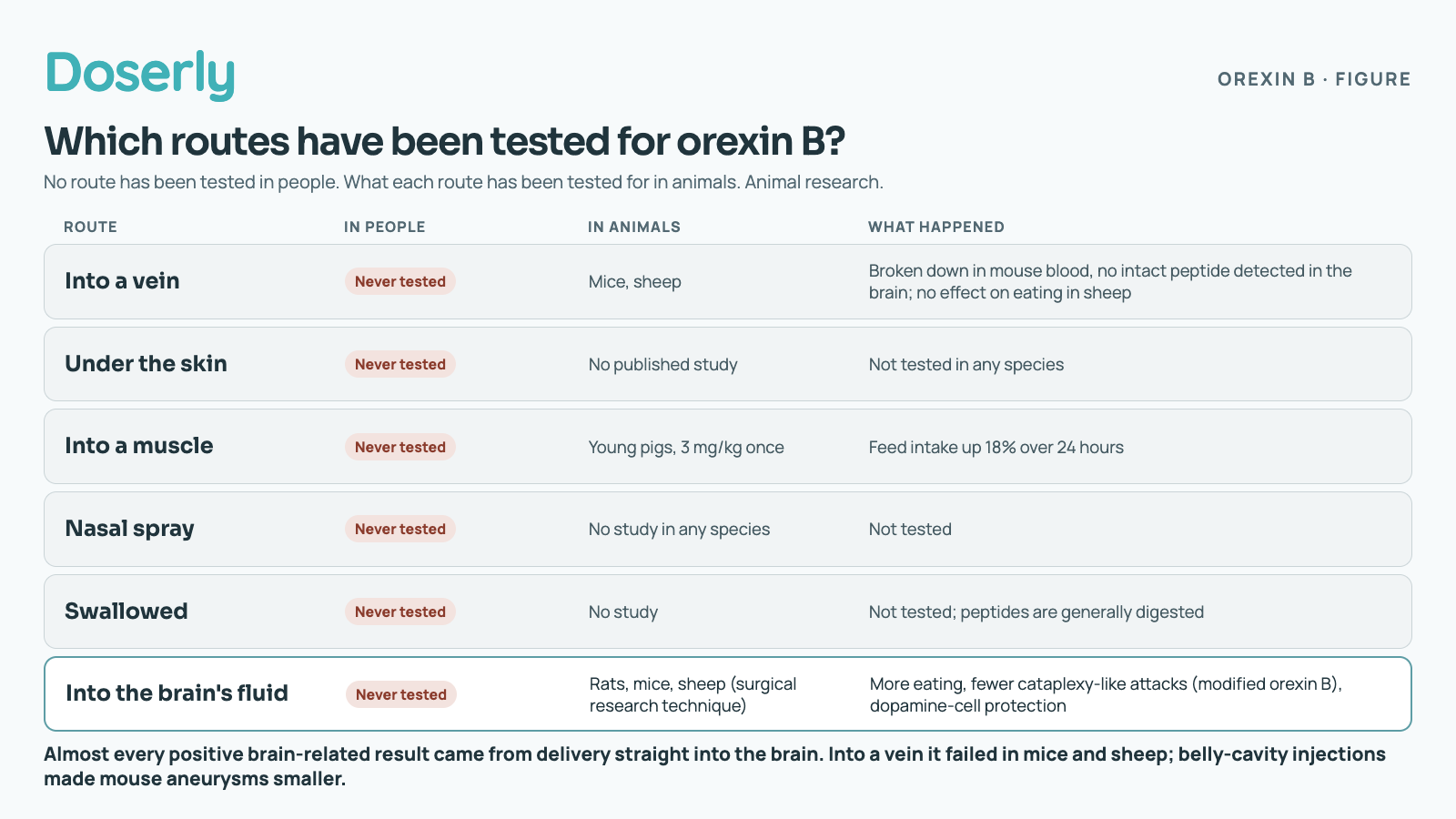
Which routes have been tested for orexin B?
No route has been tested in people. What each route has been tested for in animals. Animal research.
- Into a vein · never tested in people
- In animals: Mice, sheepWhat happened: Broken down in mouse blood, no intact peptide detected in the brain; no effect on eating in sheep
- Under the skin · never tested in people
- In animals: No published studyWhat happened: Not tested in any species
- Into a muscle · never tested in people
- In animals: Young pigs, 3 mg/kg onceWhat happened: Feed intake up 18% over 24 hours
- Nasal spray · never tested in people
- In animals: No study in any speciesWhat happened: Not tested
- Swallowed · never tested in people
- In animals: No studyWhat happened: Not tested; peptides are generally digested
- Into the brain's fluid · never tested in people
- In animals: Rats, mice, sheep (surgical research technique)What happened: More eating, fewer cataplexy-like attacks (modified orexin B), dopamine-cell protection
Almost every positive brain-related result came from delivery straight into the brain. Into a vein it failed in mice and sheep; belly-cavity injections made mouse aneurysms smaller.
How long does it last in the body?
Nobody knows. No measured half-life for orexin B, in people or animals, was found in the studies reviewed. What is known is that it was rapidly degraded in mouse blood. [10] For comparison, the approved OX2 receptor tablet has a half-life of about 23 hours. [40]
How should Orexin B be stored, and how long does it last?
There is no stability study for any orexin B product, so the facts are limited.
- Powder. A research seller says to keep the sealed freeze-dried vial at −20 °C (−4 °F), protected from light and moisture, and to let it reach room temperature before opening so that water does not condense inside. [52] That is a seller's instruction, not a tested shelf life.
- After mixing. No stability study exists for dissolved orexin B. Two seller pages say to keep mixed vials at 2–8 °C (36–46 °F) and use them within about 28 days, and one claims a 2-year shelf life for unopened powder; these are seller statements, not tested data. [52], [63] Sellers also disagree on the powder: one says −20 °C, another just says to refrigerate. [52], [62]
- Why it matters. Orexin B's last amino acid oxidizes under stress, and that part of the molecule is essential for activity. [4], [7] Heat, light, air and repeated handling are all ways to lose working peptide before anyone uses it.
For comparison, the approved OX2 receptor tablet is stored at 20 to 25 °C (68 to 77 °F), because a small manufactured molecule is far more stable than a peptide. [40]
What do we actually know about Orexin B in people?
Very little, and none of it involves giving orexin B to anyone. There is no human dosing study, no case report and no registered trial. [50] Human research on orexin B consists of measurements of the body's own peptide in spinal fluid and blood, and experiments on human tissue in a dish.
What the spinal-fluid studies show
Three studies have used mass spectrometry, a method that identifies molecules by their exact weight, and they disagree.
- Detected and reduced in narcolepsy. A 2025 preprint (not yet peer reviewed) measured active orexin A and orexin B and their broken-down fragments in cerebrospinal fluid. All orexin forms were lower in narcolepsy type 1 than in narcolepsy type 2 or idiopathic hypersomnia, the ratio of short to long orexin B pieces separated those two conditions, and orexin turnover increased during sleep deprivation. [20]
- Not detected at all. A 2026 study with a method sensitive to 0.1 pg/mL found orexin B below that limit in paired spinal-fluid and blood samples from people with narcolepsy and controls, and concluded that spinal-fluid orexin A remains the most reliable clinical marker. [21] An earlier 2021 method, sensitive to 35 pg/mL, also found orexin B undetectable in spinal fluid from 72 people with and without narcolepsy. [61]
The methods differ, and the conflict is unresolved. What both support is that orexin A, not orexin B, is the peptide measured in clinical narcolepsy testing. [21]
Why blood tests for orexin B are not reliable
Several studies, mostly using antibody-based kits, have reported blood orexin B levels: higher in depression (97 patients against 51 controls), unchanged in obesity (36 obese and 16 lean women), and lower in people with brain aneurysms (3.21 against 8.56 pg/mL). [22], [23], [24] The 2026 mass-spectrometry study found orexin B in blood below 0.1 pg/mL in every sample and called previously reported nanogram-level blood orexin readings analytical artefacts. [21] Until methods agree, an orexin B blood result from a commercial kit should not be treated as a meaningful test.
Human tissue in a dish
In human fat tissue, orexin B at 100 nM for 24 hours raised the activity of a gene involved in fat-cell development. [25] In human heart samples, orexin B switched on a cell signalling pathway, and in heart tissue from 54 bypass-surgery patients, lower OX2 receptor levels went with a worse heart-failure symptom class. [9] These are tissue findings and a correlation, not effects of a dose on a person.
What the human data do not include
How might Orexin B work?
The orexin system is well mapped, even though orexin B as a product is not. Both orexins act on two receptors on nerve cells, called OX1R and OX2R. [1] What sets orexin B apart is which of the two it prefers.
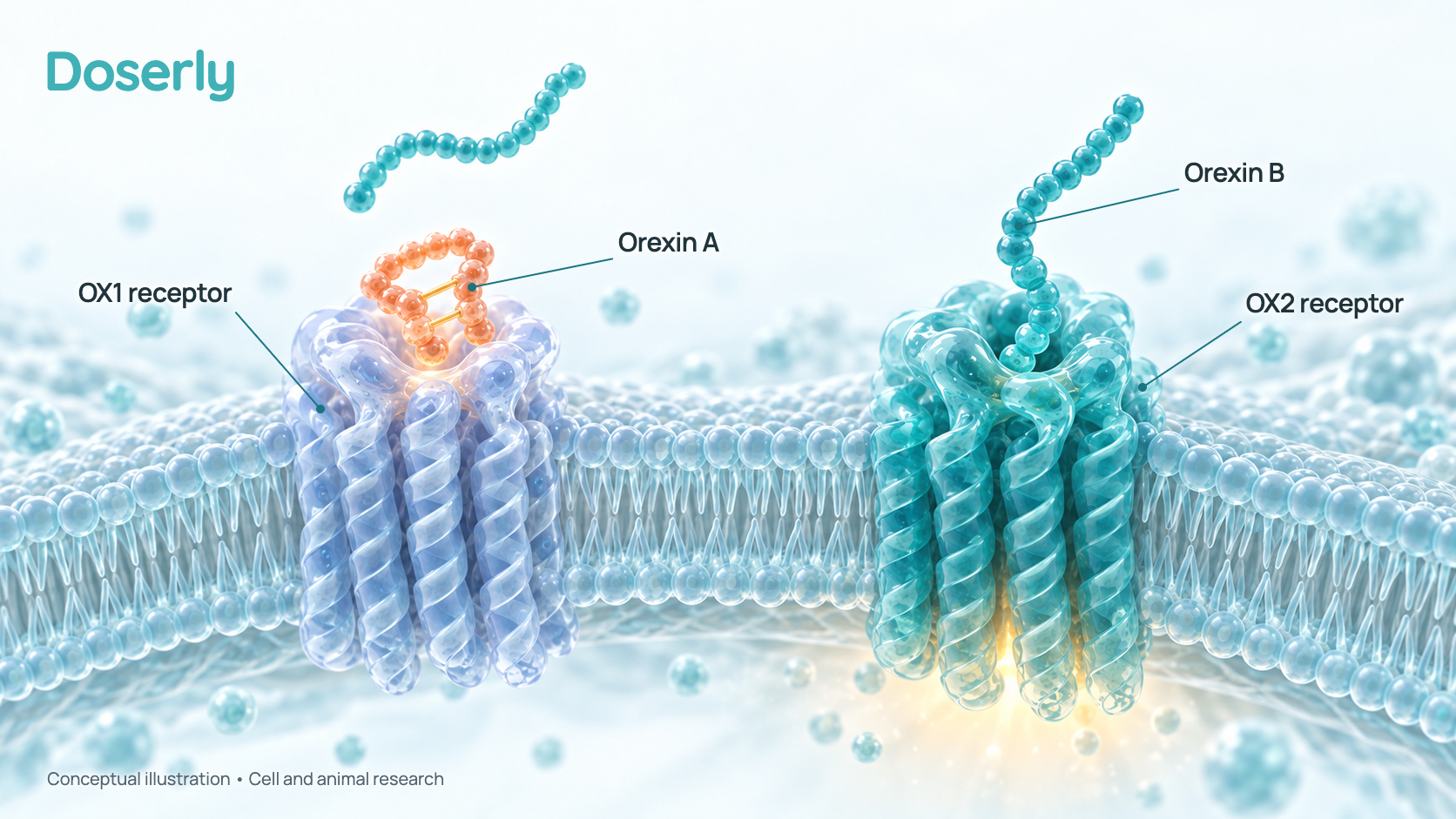
It prefers the OX2 receptor. In the binding measurements from the 1998 discovery work, orexin A and orexin B bound the OX2 receptor equally well (half-maximal values of 38 and 36 nM), while orexin B bound the OX1 receptor about 20 times more weakly than orexin A (420 against 20 nM). [8], [9] Some database entries shorten this to "OX2 only", but the measured OX1 activity is real, just weak, so "prefers OX2" is the accurate description. [3], [8]
| Receptor | Orexin A binding | Orexin B binding | What it means |
|---|---|---|---|
| OX1R | 20 nM | 420 nM | Orexin A preferred about 20-fold |
| OX2R | 38 nM | 36 nM | Both bind about equally |
Lower numbers mean tighter binding. Values from the 1998 discovery work as cited in two later papers, because the original full text was not available for review. [1], [8], [9]
The OX2 receptor is the sleep-wake receptor. Researchers at the company behind the approved medicine describe the OX1 receptor as involved in reward seeking and the OX2 receptor as central to sleep and wake regulation. [17] Most people with narcolepsy type 1 have lost their orexin-making cells. [14], [19] In mice whose orexin cells had been destroyed, orexin A given into the brain suppressed cataplexy-like attacks and increased waking for about three hours. [19] In mice bred without orexin, an OX2-selective orexin B reduced cataplexy-like attacks; in separate tests in normal mice it did not cause the drug-seeking that orexin A caused. [14] That is the biological case for the OX2 receptor drugs that now exist. [18]
Its shape matters at the tail end. The final part of the chain carries most of its activity: the shortest fully active fragment runs from the sixth to the last amino acid, and changing the final five sharply reduces its power at both receptors. [4], [16] Swapping two amino acids produces a research version that is 400 to 1,000 times more selective for OX2. [14], [15] Scientists have also built light-switchable versions to turn the signal on and off with precise timing in cells and zebrafish. [37], [38] These are laboratory tools, not products.
It excites nerve cells. In rat spinal-cord slices, orexin B made pain-processing nerve cells more active through the OX2 receptor. [32] In male mice, orexin B applied to the brain's outer lining made head-pain nerve cells more excitable and triggered migraine-like pain, an effect not seen in females. [67], [68] In isolated newborn-rat brainstem preparations, it counteracted breathing suppression from sevoflurane (at 0.5 micromolar), propofol and a low concentration of remifentanil, but not from a higher remifentanil concentration. [33] In rats, its effect on memory was blocked by an OX2 receptor blocker. [31]
Its reach extends beyond the brain. Human fat tissue and heart tissue carry orexin receptors, and orexin B protected rat hearts after an interruption of blood flow in a laboratory model. [9], [25] In dishes, orexins triggered the death of certain cancer cells through either receptor. [34], [35]
What are the risks and unanswered questions?
Is Orexin B safe?
Its safety in people is unknown, because no one has been given it in a study. [50] There is no safety study, no side-effect report and no case report of harm. An absence of reports for a substance that has never been studied says nothing about safety.
What can be said comes from drugs that switch on the same receptor, and it is worth knowing because it shows what the orexin 2 pathway does in people. These are small manufactured molecules taken by mouth, so the findings are about them, not about orexin B:
- Oveporexton (approved in 2026). In two 12-week phase 3 trials in narcolepsy type 1, insomnia occurred in 55% to 60% of treated patients depending on dose against 1% on placebo, and frequent urination in 53% to 58% depending on dose against 5% on placebo. Rises in systolic blood pressure of more than 20 mm Hg occurred in 22% against 13% on placebo, heart-rate rises of more than 15 beats per minute in 30% against 22%, and LDL cholesterol above 160 mg/dL in 32% against 20%. Muscle-enzyme (creatine phosphokinase) rises above five times normal occurred in 11% against 5%. [40]
- TAK-994 (development stopped). A phase 2 trial in 73 people with narcolepsy type 1 improved sleepiness and cataplexy but was stopped early because of liver problems; 3 patients had drug-induced liver injury meeting a standard severity definition. [39]
Orexin B has never been checked for any of these effects, at any dose. Animal work adds one possible harm signal of its own: in male mice, orexin B applied to the brain's outer lining triggered migraine-like pain, and it made pain-sensing nerve cells from male mice, monkeys and people more sensitive. [67], [68]
What problems have actually been reported?
None specific to orexin B. The only public first-hand account of side effects comes from a person who said that "different Orexins" made them dizzy, without naming which peptide, product or amount. [57] Nobody in the public threads reviewed had their product tested.
Could product quality change the risk?
Yes, and for orexin B this may be the largest practical risk. Research vials are not medicines: no one checks them for sterility, correct content or contaminants on your behalf, and sellers state that they are not for human use. [52], [54] One listing prints a sequence that is not orexin B's. [52] Health Canada warns that unauthorized peptide products may contain too much, too little or none of the stated ingredient, may contain unlisted ingredients or contaminants, and may be improperly made or stored. [46] A peptide that oxidizes easily adds another way for a vial to contain less than its label says. [7]
Is Orexin B legal? Is it FDA-approved?
Checked September 26, 2026. Rules differ by country and change quickly. A "research use only" label does not make a product legal to sell or safe to use.
United States. Orexin B is not an approved medicine, and the FDA's substance database has no entry for it. [42] It is not among the substances nominated for pharmacy compounding under section 503A (list updated May 14, 2026), and it is not on the FDA's list of compounding substances that may pose significant safety risks (content current April 22, 2026). [44], [45] Neither absence is a ruling that selling it is legal. Sellers offer it as research material. [52], [54]
United States, the approved relative. Oveporexton (brand name Orzeyful), a tablet that switches on the orexin 2 receptor, was approved on August 5, 2026 for narcolepsy type 1 in adults under application NDA 220860. Its label records that its controlled-substance schedule was still pending. It is not orexin B. [40], [41]
Canada. Health Canada's Drug Product Database returns no product with orexin or hypocretin as an ingredient. [43] Health Canada's April 2026 advisory warns that unauthorized peptide products are illegal in Canada and have not been assessed for safety, efficacy and quality. [46]
Australia. The Therapeutic Goods Administration's April 2026 guidance on unapproved peptide products does not name orexin B. It states that such products "have not been evaluated for safety, quality or effectiveness by the TGA". [47] The June 2026 Poisons Standard, which lists the medicines and chemicals Australia schedules, does not mention orexin or hypocretin. [66] Not being listed there is not a ruling that selling or importing orexin B is legal.
United Kingdom. A web search found no statement from the UK medicines regulator naming orexin B, and its lists were not checked directly for this guide. UK sellers list orexin B as a research peptide and state that it is "not designed for human consumption or clinical application". [52]
Is Orexin B banned in sport? Does it show up on a drug test?
Orexin B is not named on the World Anti-Doping Agency's 2026 Prohibited List or its 2027 list, which takes effect on January 1, 2027. [48], [49] Category S0 bans at all times any substance with no current approval by any government health authority for human use, and the 2027 list adds "peptides" to its examples. [48], [49] Orexin B has no such approval anywhere, so athletes who are tested should treat it as prohibited. None of the sources reviewed describes a routine test that detects it.
Who should be especially cautious?
These groups have no safety data at all. That is a reason for caution, not proof of harm.
- Anyone with suspected narcolepsy or unexplained daytime sleepiness who has not seen a specialist. Diagnosis changes what is available, including an approved medicine. [40]
- Anyone with high blood pressure, heart disease or a heart rhythm disorder, given the blood-pressure and heart-rate rises seen with the approved OX2 receptor tablet. [40]
- Anyone with liver disease, given the liver injury that stopped an earlier OX2 receptor drug. [39]
- Anyone with bladder problems or an overactive bladder, given how common urinary frequency was with the approved tablet, whose label asks prescribers to screen for these symptoms. [40]
- Children and teenagers, and anyone pregnant or breastfeeding. Never studied; the approved OX2 receptor tablet is not established as safe or effective in children either. [40]
- Competitive athletes. See the anti-doping section above. [48]
Has Orexin B been tested alongside other medicines?
No. There is no interaction study of any kind. What can be said is indirect and worth raising with a pharmacist or doctor:
- The orexin blocker sleeping pills, such as suvorexant, act in the opposite direction, and suvorexant's label says it must not be used by people with narcolepsy. [51]
- The approved OX2 receptor tablet must not be combined with strong CYP3A inhibitors, a group of common medicines that slow its breakdown in the liver, and needs a lower dose with moderate ones. That shows this drug class can interact with everyday medicines, even though orexin B itself has never been tested. [40]
- Combining orexin B with stimulants or other wake-promoting medicines has never been studied, so any combination adds effects that no one has measured together.
Bring a complete list of everything you take to a pharmacist or doctor before adding anything.
What should be monitored while using Orexin B?
No regulator has written a monitoring plan for orexin B, and no study has measured anything after giving it to a person. [50] What follows is what the approved OX2 receptor tablet's label and the trials of that drug class tracked, clearly marked as coming from different molecules. It is background for a conversation with a clinician, not a personal testing plan.
| Why it matters | What the related drugs showed | Tracking category |
|---|---|---|
| Sleep at night | Insomnia in 55% to 60% of patients on the approved tablet against 1% on placebo, about 90% of cases starting within the first 2 days [40] | Sleep Quality |
| Blood pressure | Systolic rises over 20 mm Hg in 22% against 13% on placebo, noted on day 1 more often than with placebo; placebo-adjusted average changes were under 5 mm Hg by week 12 [40] | Blood Pressure |
| Heart rate | Rises over 15 beats per minute in 30% against 22% on placebo [40] | Heart Rate & Palpitations |
| Bladder symptoms | Urinary frequency in 53% to 58% against 5% on placebo, and urgency in 15% to 16% against 1%; the label asks prescribers to screen for lower urinary tract symptoms first [40] | Side Effect Burden |
| Muscle enzyme | Creatine phosphokinase above five times normal in 11% against 5%; report unexplained muscle pain, weakness or dark urine [40] | Other (lab result) |
| Cholesterol | LDL above 160 mg/dL in 32% against 20% on placebo over 12 weeks [40] | Other (lab result) |
| Liver enzymes | Drug-induced liver injury in 3 patients stopped an earlier OX2 receptor drug [39] | Other (lab result) |
| Daytime sleepiness | Trials measured the ability to stay awake on a standard test, sleepiness scores and weekly cataplexy attacks [39], [40] | Energy Levels |
Two things are worth raising with a clinician regardless. First, persistent daytime sleepiness deserves a proper diagnosis, because a sleep study or spinal-fluid test changes what treatment is possible. Second, Health Canada's advice for anyone who has used an unauthorized peptide and feels unwell is to talk to a healthcare professional right away, and it helps to say exactly what was taken. [46]
What do people in public communities report?
Almost nothing about orexin B on its own. Searches of 13 public Reddit communities on sleep, narcolepsy, nootropics and peptides returned 37 matching posts, many only loosely related, and four threads were worth including; none described someone using orexin B alone. [57], [58], [59], [60] A 2026 "peptide cheat sheet" post that lists an orexin B amount is a protocol list with seller referral links, not a report of use; it is covered with the website amounts. [64] Selected discussions are not a survey of users, and comment-only mentions could not be searched, so quieter reports may have been missed.
What the one positive report looks like
In a 2022 thread asking which orexin is more active, the original poster was planning a nasal spray and noted how little information exists on the two peptides' relative strength. One commenter who had used a blend described orexin B as "much more stimulation" and orexin A as "more of a sleep stabilizer". The same commenter said that other orexin products had made them dizzy and gave no amounts, in a thread that also discussed prescription wake-promoting drugs. [57] That is one impression from a blend product, and it cannot be credited to orexin B.
A 2025 thread asked whether orexin B could significantly reduce the need for sleep. It correctly described orexin B as the natural, moderately selective activator of the orexin 2 receptor, and no one replied with experience. [58]
Does "orexin B" in a post mean the peptide?
Often not. Public threads regularly mix up the two peptides (orexin A and orexin B) with the two receptors (OX1 and OX2). In a 2026 narcolepsy thread about orexin agonist drugs, one commenter described "Orexin B-receptors" as regulating sleep and wake, and another corrected them: there are orexin A and B peptides and orexin 1 and 2 receptors. [59] A 2025 insomnia post described seltorexant, an experimental sleep drug that blocks the orexin 2 receptor, as "an Orexin B antagonist". [60] When a post says "orexin B", check whether it means the peptide sold in vials, the receptor, or a drug that acts on the receptor.
How can you judge an orexin story?
Ask: was there a diagnosis, or is this someone tired for ordinary reasons? Which peptide, from which seller, and was it a blend? How much, by which route, and at what time of day? What else was running at the same time: prescribed stimulants, caffeine, a new sleep schedule? Was anything measured, or is it a morning impression? And given that injected orexin B did not reach the mouse brain intact, what route could plausibly explain the effect? [10]
In community education groups, teaching about orexin covers the system's biology and the approved medicines rather than the native peptides. Educators treat the new OX2 receptor tablet as something for diagnosed narcolepsy under a specialist, explain that the orexin-blocking sleep medicines work in the opposite direction, and warn that wake-promoting drugs hide sleep debt rather than remove the need for sleep. Member discussions in these groups never mention orexin B by name. When members asked about orexin peptides in general, the replies said no protocol was known and no one had seen the peptides for sale, so there are no member experiences, side effects or stopping reports to share for orexin B.
How does Orexin B compare with Orexin A and the orexin medicines?
Four different things get called "orexin" online. Two are the natural peptides, one is a new medicine that switches the orexin 2 receptor on, and one is a family of sleeping tablets that switch orexin receptors off.
| Compound | What it is | How it is taken | How often | Human evidence | Approval status |
|---|---|---|---|---|---|
| Orexin B (this guide) | Natural 28 amino-acid peptide, a straight chain with no disulfide bridges; prefers the OX2 receptor [3], [4], [8] | Never given to people; sold as research powder [50], [52] | Not established; websites state daily or when needed [62], [63], [64] | None; broken down in blood in mice [10] | Not approved anywhere checked [42], [43] |
| Orexin A | Natural 33 amino-acid peptide with two disulfide bridges; activates both receptors about equally [3], [8], [9] | Nasal spray or into a vein in small single-dose research studies; sold as research powder (see its guide) | Single research doses (details in its guide) | Small single-dose studies, covered in its own guide; crossed into the mouse brain intact [10] | Not approved as a medicine; no Canadian product [43] |
| Oveporexton (Orzeyful) | Manufactured small molecule that switches on the OX2 receptor; not a peptide [40] | Tablet, swallowed [40] | 1 mg or 2 mg after waking and again 3 to 5 hours later; 4 mg a day at most [40] | Two 12-week phase 3 trials in narcolepsy type 1 [40] | Approved in the United States on August 5, 2026 for narcolepsy type 1 in adults [41] |
| Orexin blockers (suvorexant and similar) | Small molecules that block orexin receptors, the opposite action [51] | Tablet at bedtime [51] | Nightly [51] | Approved insomnia medicines | Approved for insomnia; suvorexant must not be used in narcolepsy [51] |
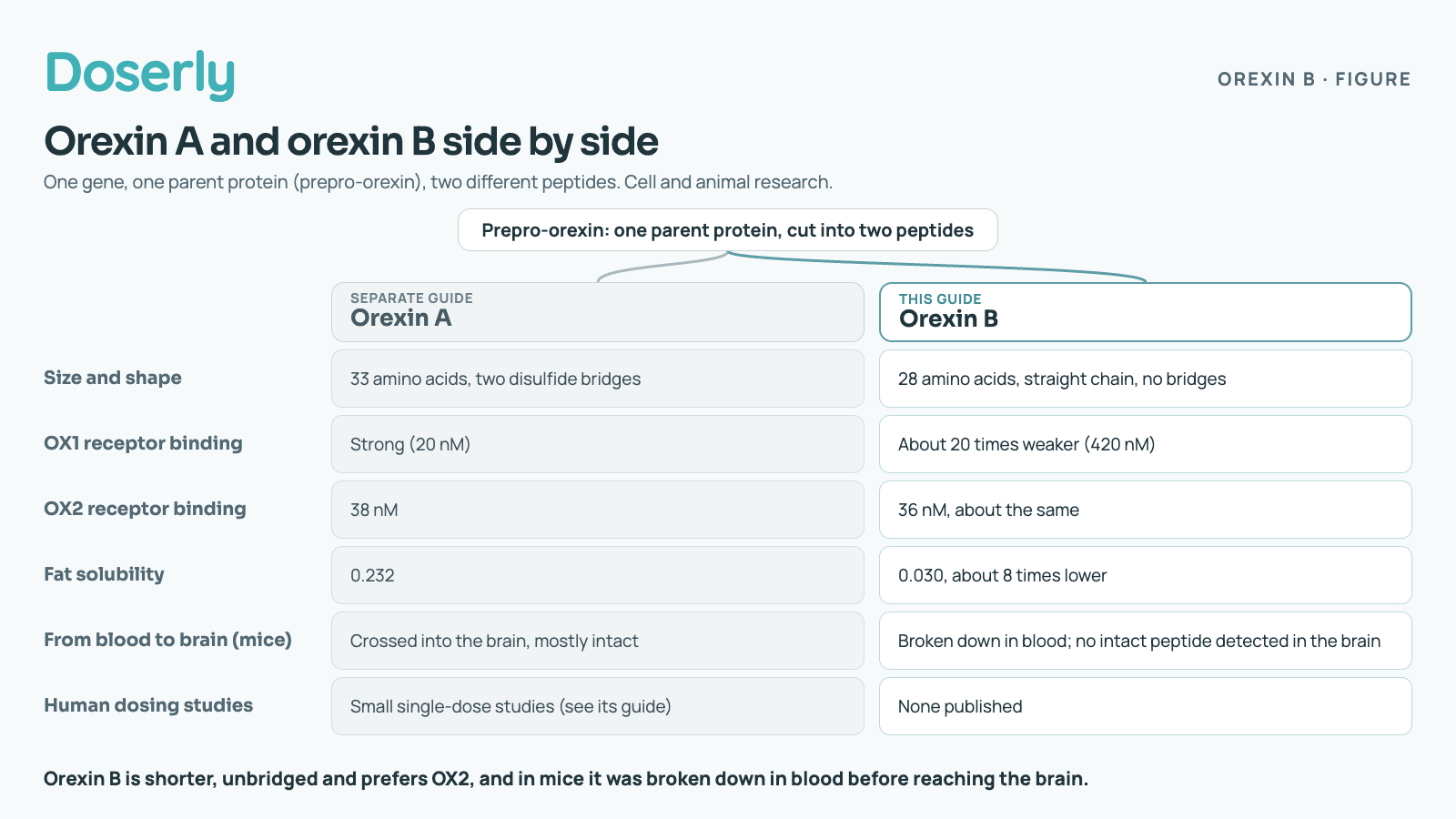
Orexin A and orexin B side by side
One gene, one parent protein (prepro-orexin), two different peptides. Cell and animal research.
- Size and shape
- Orexin A: 33 amino acids, two disulfide bridgesOrexin B (this guide): 28 amino acids, straight chain, no bridges
- OX1 receptor binding
- Orexin A: Strong (20 nM)Orexin B (this guide): About 20 times weaker (420 nM)
- OX2 receptor binding
- Orexin A: 38 nMOrexin B (this guide): 36 nM, about the same
- Fat solubility
- Orexin A: 0.232Orexin B (this guide): 0.030, about 8 times lower
- From blood to brain (mice)
- Orexin A: Crossed into the brain, mostly intactOrexin B (this guide): Broken down in blood; no intact peptide detected in the brain
- Human dosing studies
- Orexin A: Small single-dose studies (see its guide)Orexin B (this guide): None published
Orexin A has its own guide: Orexin A.
Orexin B is shorter, unbridged and prefers OX2, and in mice it was broken down in blood before reaching the brain.
Orexin A and orexin B are separate peptides, even though one gene makes both. They are cut from the same parent protein in the same nerve cells, but the finished molecules differ in three ways that matter. [1], [3] Orexin A is 33 amino acids long and pinned into shape by two disulfide bridges; orexin B is 28 amino acids long and has no bridges, so its shape is looser and less fixed. [3], [4], [6], [7] Orexin A activates both receptors about equally, while orexin B binds the OX1 receptor about 20 times more weakly in the original binding tests (5 to 100 times across later tests) and works mainly through OX2. [8], [9] And in a mouse study, orexin A injected into a vein crossed into the brain mostly intact, while orexin B was broken down in blood and no intact orexin B could be detected in the brain. [10] Later dog and imaging studies found orexin A's own entry into the brain from blood poor (see the Orexin A guide). In an "Orexin A/B" blend, there is no evidence the orexin B part reaches the brain. [10] The Orexin A guide covers its own human studies in detail.
The gap between the peptide and the medicine is the point. Oveporexton does what an orexin B product would be hoped to do: it switches on the OX2 receptor, and it reached approval after two phase 3 trials. [40] It is a small molecule taken by mouth with a half-life of about 23 hours, while orexin B is a peptide that, in mice, did not survive the bloodstream intact. [10], [40] Getting to an approved drug also took a failure: TAK-994, an earlier drug of the same kind, was stopped after liver injury. [39]
Common questions about Orexin B
Is Orexin B the same as hypocretin-2?
Yes. Two laboratories described the same peptide in 1998 and named it differently: orexin-B from one group and hypocretin-2 from the other. [1], [2] Both names appear in research papers and product listings, along with abbreviations such as OXB, OxB and Hcrt-2. Hypocretin-1 is the same molecule as orexin A, which is a different peptide from this one (see the comparison).
Is Orexin B the same as the orexin 2 receptor?
No. Orexin B is a peptide, a signal. The orexin 2 receptor (OX2R, also called HCRTR2) is the protein on nerve cells that receives the signal. [1], [3] Orexin B happens to prefer that receptor, which is why the two get mixed up, but orexin A binds it just as strongly. [8] The approved narcolepsy tablet is an orexin 2 receptor drug, and seltorexant, an experimental sleep drug, blocks the same receptor; neither is orexin B, and a post calling a receptor blocker an "Orexin B antagonist" is using the names loosely. [40], [60] See how it works.
Is Orexin B the same as Orexin A?
No. Both come from one parent protein, but orexin B is shorter (28 amino acids against 33), has no disulfide bridges, binds the OX1 receptor about 20 times more weakly in binding tests, and in mice was broken down in blood rather than crossing into the brain. [3], [8], [10] Orexin A has been given to people in a few small research studies, described in its own guide; orexin B never has. [50] Read the Orexin A guide or see the comparison.
Does Orexin B make you need less sleep?
No evidence says so, because it has never been tested in people. [50] The one public self-experiment plan that mentioned orexin B reserved pure orexin B for a top funding tier; the group later tested orexin A only and found no significant effect, and has published no orexin B result. [56], [70] In mice, an OX2-selective orexin B analogue put directly into the brain reduced narcolepsy signs, which is a different question from reducing sleep need in healthy people. [14] See what it is used for.
Is Orexin B a nasal spray or an injection?
Neither has been studied in people. [50] Sellers offer freeze-dried powder in 1 mg and 5 mg vials, and some sprays have been sold as orexin A and B blends. [52], [54], [56] Websites describe both routes: 100–200 mcg as a nasal spray when needed, or 50–250 mcg a day by injection, with no human study behind either. [62], [63], [64] There is no study of nasal orexin B in any species. In mice, orexin B injected into a vein was broken down in blood and did not reach the brain intact, and in sheep an intravenous dose had no effect on appetite. [10], [12] See how routes compare.
Is Orexin B the same as the new narcolepsy tablet?
No. Oveporexton, approved in the United States in August 2026 for adults with narcolepsy type 1, is a manufactured small molecule that switches on the orexin 2 receptor and is swallowed. Orexin B is a natural peptide. [40], [41] They share a target receptor, but only the tablet has been through large trials and has a label with doses, warnings and monitoring. [40] See the comparison.
Is it legal to buy Orexin B?
Nowhere is it an approved medicine. In the United States it is sold as research material and is not in the FDA substance database or on the FDA's compounding lists. [42], [44], [45] In Canada there is no authorized product, and Health Canada says unauthorized peptide products are illegal and unassessed. [43], [46] Australia's regulator says unapproved peptide products have not been evaluated for safety, quality or effectiveness. [47] A "research use only" label describes how a product is sold, not whether it is safe. See the dated legal summary.
Does Orexin B show up on a drug test?
Not on a standard drug test, and none of the sources reviewed describes a routine test for it. For athletes, that is not the same as being allowed. Orexin B is not named on the World Anti-Doping Agency's 2026 or 2027 lists, but category S0 bans any substance without approval from a government health authority, and the 2027 list names peptides as an example. [48], [49] See the sport rules.
Glossary
Plain explanations of the route, dosing and research terms used in this guide. Underlined terms in the text link here.
- Adverse event
- A harmful or unwanted medical event reported after someone used a treatment. A report alone does not prove the treatment caused it.
- Agonist
- A substance that switches a receptor on, copying the body's own signal. Orexin B is a natural agonist at the orexin receptors; oveporexton is a manufactured agonist at the OX2 receptor.
- Amino acid
- A small chemical building block. Chains of amino acids make up peptides and proteins. Orexin B is a chain of 28.
- Animal study
- Research in animals such as mice, rats, pigs or sheep. It shows what a substance does in a living body, but results in people can differ.
- Antagonist
- A substance that blocks a receptor so the body's own signal cannot act on it. The insomnia medicine suvorexant is an orexin receptor antagonist.
- Blood-brain barrier
- The tight lining of the brain's blood vessels, which keeps most large molecules in the blood from entering brain tissue. Orexin B did not get through it intact in mice.
- Cataplexy
- A sudden, brief loss of muscle strength triggered by strong emotion such as laughter, while the person stays awake. It is a defining feature of narcolepsy type 1.
- Cell study (in vitro)
- Research on cells or tissue grown in a dish. It gives early clues about biology, but it is far from proof of benefit in people.
- Compounding
- A pharmacy making a medicine for an individual patient from raw ingredients. In the United States, pharmacies may only compound with bulk ingredients on FDA's allowed lists; orexin B has not even been nominated.
- Controlled trial
- A study that compares people who receive a treatment with a similar group who do not, often receiving a placebo instead.
- Creatine phosphokinase (CPK)
- An enzyme that leaks from muscle into the blood when muscle is strained or damaged. The approved OX2 receptor tablet raised it in some patients.
- Cerebrospinal fluid (CSF)
- The clear fluid around the brain and spinal cord, sampled by a lumbar puncture. Its orexin A (hypocretin-1) level is used to diagnose narcolepsy type 1.
- Disulfide bridge
- A chemical link between two sulfur-containing amino acids that pins part of a peptide into a fixed shape. Orexin A has two; orexin B has none.
- Half-life
- The time it takes for the measured level of a substance in the blood to fall by half. It is not the same as how long an effect lasts. For orexin B, no measured value was found in the studies reviewed.
- Hypothalamus
- A small region deep in the brain that regulates sleep, appetite, body temperature and hormone release. Orexin-producing cells sit in its lateral and back parts.
- Intramuscular (IM)
- Injected into a muscle. One study gave orexin B this way, to young pigs.
- Intranasal
- Sprayed or dropped into the nose. No study has given orexin B this way in any species.
- Intravenous (IV)
- Given directly into a vein. In mice, no intact orexin B given this way could be detected in the brain; in sheep, it did not change eating.
- Investigational
- Still being studied and not approved by a regulator, such as the FDA, to treat any condition.
- Freeze-dried (lyophilized)
- Dried by freezing and removing the water, leaving a powder. Research peptide vials are sold this way and mixed with liquid before use.
- Mass spectrometry
- A laboratory method that identifies and counts molecules by their exact weight. It is more specific than the antibody-based kits often used to measure orexins in blood.
- mcg and mg
- Micrograms and milligrams. 1 mg equals 1,000 mcg. Orexin B vials are sold as 1 mg or 5 mg of powder.
- Molar mass
- The weight of one mole of a substance, in grams per mole. It converts a count of molecules (nanomoles) into a weight (micrograms). For orexin B it is about 2,899 g/mol.
- Nanomole (nmol)
- A way of counting molecules rather than weighing them. For orexin B, 1 nmol weighs about 2.9 micrograms.
- Narcolepsy type 1
- A long-term neurological condition with overwhelming daytime sleepiness and cataplexy, caused by the loss of most orexin-producing brain cells.
- OX2 receptor (OX2R)
- One of the two orexin receptors, also called HCRTR2 or the orexin 2 receptor. It is the one most tied to sleep and wakefulness, and the one orexin B prefers. It is a receptor, not a peptide.
- Peptide
- A short chain of amino acids. Peptides are usually broken down quickly in the body and do not survive being swallowed.
- Pharmacokinetics
- How the body absorbs, moves, breaks down and removes a substance. For orexin B, no human data exist.
- Placebo
- A dummy treatment with no active ingredient, used as a comparison in studies.
- Preclinical research
- Studies done before research in people: cell studies, tissue experiments and animal studies. All orexin B dosing research is preclinical.
- Prepro-orexin
- The parent protein that cells cut up to release orexin A and orexin B. One gene makes both peptides.
- Receptor
- A protein on a cell that recognizes a specific signal and changes the cell's behaviour when the signal arrives. Orexins act on two: OX1R and OX2R.
- Research use only
- A label on products sold for laboratory research. It does not mean a product is approved, tested for human use or legal to sell as a medicine.
- Subcutaneous (SC)
- Injected into the fatty layer just under the skin. No published study has given orexin B this way.
- Syringe units
- Markings on an insulin syringe that measure volume. On a U-100 syringe, 100 units equal 1 mL. The amount of peptide per unit depends on the vial's concentration.
- WADA
- The World Anti-Doping Agency, which publishes the list of substances banned in sport.
Explore more of the research
Go deeper into the experiments behind the claims.
Across this guide, the citations include 38 original research papers on orexin B and the orexin system: 5 studies measuring the body's own orexin B in people, 1 human trial of an OX2 receptor drug, and 32 animal, cell, tissue and chemistry studies (one of which also measured orexin B in patients' blood). Three reviews are cited separately. Paper counts are not counts of independent findings: several come from the same laboratories, and most were reviewed as abstracts.
Identity, structure and receptor binding · 11 sources
What is orexin B made of?
Model: Chemical and structural studies of the synthetic peptide.
Finding: A 28 amino-acid chain ending in a capped methionine. The studies disagree on its shape in water: one NMR study found two short helices joined by a linker, while a circular dichroism study found it unordered; in membrane-like conditions it forms two helical sections. Changing the last five building blocks sharply cuts its activity.
Limit: Test-tube chemistry.
How was it discovered?
Model: Rat brain, cells carrying the receptors.
Finding: Two teams found the same pair of peptides in 1998. Both come from one parent protein, both activate the two orexin receptors, and both increased eating when given into rat brains.
Limit: Discovery work; receptor binding values were reviewed through later citations.
Can it be made more selective?
Model: Cells carrying one receptor or the other.
Finding: Two amino-acid swaps give a version about 400-fold selective for OX2; trimmed and swapped versions can exceed 1,000-fold. The shortest fully active piece runs from the sixth amino acid to the end.
Limit: Research tools, not products.
Can its signal be switched on with light?
Model: Cells, brain tissue and zebrafish larvae.
Finding: A caged orexin B released active peptide when lit, and a light-switchable OX2-selective version controlled orexin receptors in living zebrafish.
Limit: Laboratory methods for studying timing.
Delivery, sleep and narcolepsy models · 8 sources
Does it cross from blood into the brain?
Model: Mice given radiolabelled orexin A and orexin B into a vein.
Finding: Orexin A entered the brain rapidly by simple diffusion, mostly intact. Orexin B was degraded in blood and could not be detected intact in the brain; it was also far less fat-soluble. A separate review found no dedicated carrier for it.
Limit: Mouse tracer study, reviewed as an abstract.
Does it work from outside the brain?
Model: Young pigs given one intramuscular dose; sheep given intravenous or into-the-brain doses.
Finding: A 3 mg per kg muscle injection raised pig feed intake by 18% over 24 hours; 3 mcg per kg into a sheep's vein did nothing, while orexin given into the brain raised eating and cortisol.
Limit: Livestock feeding studies with very different doses and routes.
Can an OX2-selective orexin B treat narcolepsy signs?
Model: Mice bred without orexin; normal mice for drug-seeking tests.
Finding: A modified orexin B given into the brain at 3 nmol, but not 1 nmol, reduced cataplexy-like attacks and broken-up waking. Orexin A caused drug-seeking behaviour; the modified orexin B did not. Earlier work showed orexin A into the brain rescued narcolepsy-model mice for about 3 hours.
Limit: Delivery straight into the brain; a modified peptide, not native orexin B.
Why did drug makers move to small molecules?
Model: Monkeys given the oral OX2 drug TAK-994; a review of agonist development.
Finding: An OX2-selective pill increased wakefulness in monkeys, and a review summarizes peptide and small-molecule agonist development.
Limit: Industry and review sources.
Beyond sleep: brain protection, pain, heart, blood vessels and cancer cells · 16 sources
Dopamine neurons and Parkinson's models
Model: Rat midbrain cell cultures; mice given the toxin MPTP; a human nerve-cell line.
Finding: Orexin B protected dying dopamine neurons through OX2 (orexin A barely did). Given into the brain of MPTP mice, it reduced dopamine-cell loss and improved movement.
Limit: Cell and mouse models; brain delivery.
Brain aneurysms
Model: Mice with experimentally induced brain-artery aneurysms, and blood samples from 38 patients and 43 controls.
Finding: Daily intraperitoneal orexin B at 30 mcg per kg for 7 weeks, starting the day after surgery, left normal mice with smaller aneurysms than untreated mice (1.93 against 3.72 mm, 6 per group) but had no such effect in mice lacking OX2. Patients had lower blood orexin B, measured with antibody (ELISA) kits.
Limit: One laboratory; small groups; the blood test method is disputed.
Sepsis and lung injury
Model: Mice with surgically induced sepsis; lung blood-vessel cells in a dish.
Finding: Orexin B reduced deaths, lung damage and leakiness of lung blood vessels.
Limit: One mouse model.
Pain and spinal cord
Model: Rats with a nerve-constriction injury; rat spinal-cord slices; mice given orexin B on the brain's outer lining; pain-sensing nerve cells from mice, monkeys and people.
Finding: Orexin B eased nerve pain in rats in a dose-dependent way and reduced spinal inflammation; in slices it excited pain-processing nerve cells through OX2. In the opposite direction, it triggered migraine-like and post-injury headache-like pain in male but not female mice and made male pain-sensing nerve cells more sensitive.
Limit: Animal and tissue models with conflicting directions.
Memory and breathing
Model: Rats in a learning task; isolated newborn-rat brainstem preparations.
Finding: Orexin B improved learning and memory through OX2, and counteracted breathing suppression from sevoflurane (at 0.5 micromolar), propofol and low-dose remifentanil, but not from a higher remifentanil concentration.
Limit: Brain delivery and tissue preparations.
Heart
Model: Isolated rat hearts, rat heart cells and human heart samples.
Finding: Orexin B, but not orexin A, protected rat hearts after interrupted blood flow; lower OX2 levels went with a worse heart-failure symptom class in heart tissue from 54 bypass-surgery patients.
Limit: Tissue work and a correlation in people.
Cancer cells
Model: Human colon-cancer and nerve-tumour cell lines; engineered cells carrying OX2.
Finding: Orexins triggered cell death in cancer cells but not in normal gut cells, through either receptor; the tail of orexin B was important for the effect.
Limit: Cells in a dish only; no animal or human cancer trial of orexin B.
How this guide was researched
This guide is built from a thorough review of the sources cited throughout it: published scientific studies, trial-registry searches, regulatory documents and the official label of a related medicine, product and protocol pages, and public forum discussions. We also reviewed community education groups where people discuss sleep, wakefulness and peptides.
The guide cites 70 sources, including 38 original research papers. Each type of source answers a different question. Studies show what researchers measured. Product and protocol pages show what is being sold and claimed. Personal accounts show what individual people experienced. Every numbered citation links to its entry below, labeled by source type.
How this guide was made
Research and drafting were AI-assisted. Every cited source was checked against the original, and the guide was reviewed and edited by Doserly before publication. It has not had an independent clinical review, and Doserly does not currently have medical reviewers. Doserly makes a medication and health-tracking app and runs Doserly Academy, both of which are promoted in this guide. Read our editorial policy for how guides are researched, updated and corrected.
This guide is for educational purposes. It summarizes what the reviewed sources report so the research is easier to understand; it is not medical advice. For a deeper dive, or to check any point for yourself, go straight to the cited sources.
Explore the sources
These are the documents cited in this guide. Studies, labels, product pages and personal accounts answer different questions. A source being listed does not mean every statement on its page is endorsed.
Showing 70 sources
- 01
Orexins and orexin receptors: a family of hypothalamic neuropeptides and G protein-coupled receptors that regulate feeding behavior ↗
Animal and cell study
Original abstract reviewed.
Discovery paper: two peptides cut from one precursor activate two receptors and increased eating in rats. Full text not accessible; binding values reviewed through later citations [8], [9].
- 02
The hypocretins: hypothalamus-specific peptides with neuroexcitatory activity ↗
Animal and cell study
Original abstract reviewed.
Independent discovery that named the peptides hypocretin-1 and hypocretin-2.
- 03
UniProtKB O43612: Hypocretin neuropeptide precursor (HCRT_HUMAN) ↗
Protein database
Record reviewed.
Places orexin A at residues 34–66 with two disulfide bonds and orexin B at residues 70–97 with a C-terminal methionine amide. Its note that orexin B binds OX2R only is a simplification of measured data [8].
- 04
NMR conformational studies of micelle-bound orexin-B ↗
Laboratory study
Original abstract reviewed.
States the human orexin B sequence and the importance of its final five amino acids.
- 05
PubChem compound summary: Orexin B (CID 44404987) ↗
Chemical database
Record reviewed.
Formula C123H212N44O35S, molecular weight 2899.3.
- 06
Solution structure of a new hypothalamic neuropeptide, human hypocretin-2/orexin-B ↗
Laboratory study
Original abstract reviewed.
Two helices joined by a short linker, in water and in trifluoroethanol. Conflicts with [7] on the shape in water.
- 07
Circular Dichroism Study of Orexin B under Oxidative Stress Conditions ↗
Laboratory study
Original abstract reviewed.
Unordered in water, helical in a membrane-like environment; methionine oxidation and asparagine changes under oxidative stress. Conflicts with [6] on the shape in water.
- 08
The Orexin System in Addiction: Neuromodulatory Interactions and Therapeutic Potential ↗
Review
Full text reviewed.
Restates the 1998 receptor binding values (OX1R 20 vs 420 nM; OX2R 38 vs 36 nM).
- 09
Functional cardiac orexin receptors: role of orexin-B/orexin 2 receptor in myocardial protection ↗
Animal and human tissue study
Full text reviewed.
Orexin B protected rat hearts through OX2R; lower OX2R with worse NYHA class in heart tissue from 54 bypass-surgery patients.
- 10
Orexin A but not orexin B rapidly enters brain from blood by simple diffusion ↗
Animal study
Original abstract reviewed.
Mice: orexin B degraded in blood, none intact in brain; partition coefficient 0.030 vs 0.232 for orexin A.
- 11
Peptides crossing the blood-brain barrier: some unusual observations ↗
Review
Original abstract reviewed.
No saturable blood-brain barrier transporter for orexin B.
- 12
Effect of intracerebroventricular orexin-B on food intake in sheep ↗
Animal study
Original abstract reviewed.
Intravenous orexin B (3 mcg/kg) did not change eating; orexin given into the brain did.
- 13
Cloning of porcine prepro-orexin cDNA and effects of an intramuscular injection of synthetic porcine orexin-B on feed intake in young pigs ↗
Animal study
Original abstract reviewed.
26 weanling pigs; 3 mg/kg intramuscular raised 24-hour intake by 18% (P = 0.05).
- 14
OX2R-selective orexin agonism is sufficient to ameliorate cataplexy and sleep/wake fragmentation without inducing drug-seeking behavior in mouse model ↗
Animal study
Full text reviewed.
Modified OX2-selective orexin B at 3 nmol into the brain reduced cataplexy-like attacks in orexin-knockout mice; in normal mice it did not cause drug-seeking, unlike orexin A.
- 15
Development of an orexin-2 receptor selective agonist, [Ala(11), D-Leu(15)]orexin-B ↗
Cell study
Original abstract reviewed.
About 400-fold OX2 selectivity.
- 16
Structure-activity studies of orexin A and orexin B at the human orexin 1 and orexin 2 receptors ↗
Cell study
Original abstract reviewed.
Orexin B 6–28 is the shortest fully active form; several analogues over 1,000-fold OX2-selective.
- 17
The orexin receptor 2 (OX2R)-selective agonist TAK-994 increases wakefulness without affecting cerebrospinal fluid orexin levels in cynomolgus monkeys ↗
Animal study
Original abstract reviewed.
Describes OX1R as involved in reward seeking and OX2R in sleep/wake regulation.
- 18
The present and future of synthetic orexin receptor agonists ↗
Review
Original abstract reviewed.
Review of peptide and small-molecule orexin receptor agonists.
- 19
Orexin peptides prevent cataplexy and improve wakefulness in an orexin neuron-ablated model of narcolepsy in mice ↗
Animal study
Original abstract reviewed.
Orexin A into the brain suppressed cataplexy and increased waking for 3 hours; tests orexin A, not orexin B.
- 20
Mass Spectrometry-Based Quantification of Orexin Species in Human Cerebrospinal Fluid Reveals Differential Dynamics Associated with Sleep ↗
Human measurement study
Original abstract reviewed.
Measured orexin B in spinal fluid; all orexin forms lower in narcolepsy type 1. Conflicts with [21] on detectability.
- 21
Tackling the Orexin Conundrum: An Optimized LC-MS/MS Method Demonstrates Accurate CSF Quantification and Absence in Peripheral Blood ↗
Human measurement study
Original abstract reviewed.
Orexin B and blood orexins below 0.1 pg/mL; earlier nanogram blood readings called artefacts.
- 22
Association between peripheral orexin A/B levels and depression with childhood trauma ↗
Human measurement study
Original abstract reviewed.
Antibody-kit blood orexin B higher in depression (97 patients, 51 controls); method disputed by [21].
- 23
Plasma orexin A, orexin B, leptin, neuropeptide Y (NPY) and insulin in obese women ↗
Human measurement study
Original abstract reviewed.
Blood orexin B unchanged in obesity (36 obese, 16 lean women); method disputed by [21].
- 24
Orexin B Reduces Cerebral Aneurysms Through Inhibition of SP-1 ↗
Animal study with human blood measurements
Full text reviewed (open access).
Daily intraperitoneal 30 mcg/kg for 7 weeks from 24 h after surgery: smaller aneurysms than untreated controls (1.93 vs 3.72 mm, n = 6 per group) in normal but not OX2R-knockout mice; lower serum orexin B in patients, measured by ELISA.
- 25
Orexin receptor expression in human adipose tissue: effects of orexin-A and orexin-B ↗
Human tissue study
Original abstract reviewed.
Orexin B 100 nM for 24 hours raised PPAR-gamma-2 gene activity in fat tissue.
- 26
The sleep-modulating peptide orexin-B protects midbrain dopamine neurons from degeneration, alone or in cooperation with nicotine ↗
Cell study
Original abstract reviewed.
Orexin B protected dying dopamine neurons through OX2R; orexin A had only marginal effects.
- 27
Orexin-B exerts excitatory effects on nigral dopaminergic neurons and alleviates motor disorders in MPTP parkinsonian mice ↗
Animal study
Original abstract reviewed.
Orexin B into the brain reduced dopamine-neuron loss and improved movement.
- 28
Orexin B protects dopaminergic neurons from 1-Methyl-4-phenyl-1,2,3,6-tetrahydropyridine-induced neurotoxicity associated with reduced extracellular signal-regulated kinase phosphorylation ↗
Animal and cell study
Original abstract reviewed.
Reduced dopamine-neuron death in MPTP mice and protected a human nerve-cell line.
- 29
Orexin B alleviates sepsis-associated lung injury through the attenuation of pulmonary endothelial barrier dysfunction by regulating the rho-associated coiled-coil containing protein kinase 2/zonula occludens-1 (ROCK2/ZO-1) axis ↗
Animal and cell study
Original abstract reviewed.
Lower mortality and lung injury in septic mice.
- 30
The protective effects of orexin B in neuropathic pain by suppressing inflammatory response ↗
Animal study
Original abstract reviewed.
Dose-dependent relief of nerve pain in rats.
- 31
The action of orexin B on passive avoidance learning. Involvement of neurotransmitters ↗
Animal study
Original abstract reviewed.
Improved learning and memory in rats through OX2R.
- 32
Orexin B Modulates Spontaneous Excitatory and Inhibitory Transmission in Lamina II Neurons of Adult Rat Spinal Cord ↗
Animal tissue study
Original abstract reviewed.
Excited spinal pain-processing neurons through OX2R.
- 33
Orexin-B antagonized respiratory depression induced by sevoflurane, propofol, and remifentanil in isolated brainstem-spinal cords of neonatal rats ↗
Animal tissue study
Original abstract reviewed.
0.5 micromolar orexin B reversed sevoflurane breathing suppression; 0.1 micromolar antagonized propofol and low-dose remifentanil, not higher-dose remifentanil.
- 34
Orexins acting at native OX(1) receptor in colon cancer and neuroblastoma cells or at recombinant OX(1) receptor suppress cell growth by inducing apoptosis ↗
Cell study
Original abstract reviewed.
Cancer-cell death through OX1R, not in normal colonic cells.
- 35
Orexin-induced apoptosis: the key role of the seven-transmembrane domain orexin type 2 receptor ↗
Cell study
Original abstract reviewed.
Cell death through OX2R; orexin B EC50 98 nM.
- 36
Crucial role of the orexin-B C-terminus in the induction of OX1 receptor-mediated apoptosis ↗
Cell study
Original abstract reviewed.
The tail end of orexin B drives its cell-death effect.
- 37
A photocaged orexin-B for spatiotemporally precise control of orexin signaling ↗
Cell study
Original abstract reviewed.
Light releases active orexin B.
- 38
In vivo photocontrol of orexin receptors with a nanomolar light-regulated analogue of orexin-B ↗
Animal study
Original abstract reviewed.
Light-switchable OX2-selective analogue in zebrafish.
- 39
Oral Orexin Receptor 2 Agonist in Narcolepsy Type 1 ↗
Human trial (related drug)
Original abstract reviewed.
TAK-994 phase 2 in 73 people improved sleepiness and cataplexy but was stopped early for liver injury. Not orexin B.
- 40
ORZEYFUL (oveporexton) tablets: prescribing information (NDA 220860), revised August 2026 ↗
Label (related drug)
Full text reviewed.
OX2R agonist for narcolepsy type 1; doses, warnings, adverse reactions, storage. Not orexin B.
- 41
openFDA Drugs@FDA record: NDA 220860 (oveporexton), original approval ↗
Regulator database
Full text reviewed.
Approval status dated August 5, 2026.
- 42
FDA Global Substance Registration System search: OREXIN-B, HYPOCRETIN-2 ↗
Regulator database
Record reviewed.
No orexin B substance record; orexin A is listed separately.
- 43
Health Canada Drug Product Database: active-ingredient search for OREXIN and HYPOCRETIN ↗
Regulator database
Record reviewed.
No results.
- 44
Bulk Drug Substances Nominated for Use in Compounding Under Section 503A of the Federal Food, Drug, and Cosmetic Act ↗
Regulator list
Full text reviewed.
Orexin B is not nominated in any category.
- 45
Certain Bulk Drug Substances for Use in Compounding that May Present Significant Safety Risks ↗
Regulator list
Full text reviewed.
Orexin and hypocretin are not listed.
- 46
Think twice before injecting peptides bought online: unauthorized products can seriously harm you ↗
Regulator advisory
Full text reviewed.
Class-level advisory; does not name orexin B.
- 47
Understanding your responsibilities when importing, compounding and supplying unapproved peptide products ↗
Regulator guidance
Full text reviewed.
Class-level guidance; does not name orexin B.
- 48
World Anti-Doping Agency Prohibited List 2026: S0 Non-approved substances ↗
Anti-doping rule
Full text reviewed.
Orexin B not named; S0 covers substances without human approval.
- 49
World Anti-Doping Agency Prohibited List 2027: S0 Non-approved substances ↗
Anti-doping rule
Full text reviewed.
Adds peptides to the S0 examples; orexin B not named.
- 50
ClinicalTrials.gov searches for "orexin B" and "hypocretin-2" (term and intervention fields) ↗
Registry search
Record reviewed.
150 unique records screened (term search 150, intervention search 78); none gives orexin B to people.
- 51
BELSOMRA (suvorexant) prescribing information: openFDA label record (NDA 204569) ↗
Label (related drug)
Full text reviewed.
Orexin receptor blocker for insomnia; contraindicated in narcolepsy.
- 52
Orexin B - 5mg ↗
Product listing
Page reviewed.
Research-use 5 mg vial; no dose. Powder at −20 °C, 2-year unopened shelf life and 28 days at 2–8 °C after mixing, all as seller claims. Prints two sequences (9 and 28 amino acids) that match neither orexin B nor its own formula, and a CAS number that differs from PubChem's.
- 53
- 54
- 55
- 56
Orexin Pilot Experiment for Reducing Sleep Need ↗
Self-experiment proposal
Page reviewed.
Pure orexin B only at the top funding tier; the lowest tier listed an orexin A+B blend; no orexin B amount or result posted.
- 57
Orexin A vs B, which is active/more potent? ↗
Community account
Page reviewed.
The one first-hand positive report concerns an A+B blend; the same commenter reports dizziness from other orexin products. A different commenter in the thread mentions narcolepsy.
- 58
Can Orexin-B significantly decrease the need for sleep? ↗
Community discussion
Page reviewed.
Question thread; no first-hand use.
- 59
Orexin Agonists ↗
Community discussion
Page reviewed.
Shows peptide and receptor names being confused, then corrected.
- 60
This is hopeful: Seltorexant Outperforms Placebo, Standard Insomnia Treatment ↗
Community discussion
Page reviewed.
Calls an OX2 receptor blocker an "Orexin B antagonist".
- 61
Orexin-A measurement in narcolepsy: A stability study and a comparison of LC-MS/MS and immunoassays ↗
Human measurement study
Original abstract reviewed.
LC-MS/MS on spinal fluid from 72 people (22 narcolepsy type 1, 6 type 2, 44 controls), limit 35 pg/mL: orexin B undetectable. Added orexin B was stable in frozen spinal fluid for 3 months.
- 62
Orexin B (Hypocretin-2) ↗
Protocol source
Page reviewed.
States 100–200 mcg as a nasal spray, as needed, as "community practice rather than a trial result". Its dosage chart repeats the same amount. Wrongly labels orexin B as studied in humans and as containing disulfide bonds.
- 63
Orexin B 5 mg reconstitution guide ↗
Protocol source
Page reviewed.
50 mcg then 100 mcg once daily as "lab examples", 250 mcg daily as a higher alternative; states there is no established human injectable dose. 5 mg in 2 mL gives 2.5 mg/mL, 25 mcg per unit.
- 64
2026 PEPTIDE CHEAT SHEET ↗
Protocol source
Post reviewed.
Protocol list, not a use report: orexin B 50–100 mcg daily, subcutaneous or intranasal, as needed or 2–4 week cycles. The orexin B entry links to a seller with a referral code. No source given for the numbers.
- 65
Orexin B dosage chart ↗
Protocol source
Page reviewed.
Lists the route as subcutaneous; gives no human amount (dose columns not applicable) and refers to animal studies.
- 66
Therapeutic Goods (Poisons Standard—June 2026) Instrument 2026 ↗
Regulator list
Full text searched.
A full-text search found no mention of orexin or hypocretin. Not being listed is not a legal-status ruling.
- 67
A male-specific mechanism of meningeal nociceptor sensitization promoting migraine headache ↗
Animal study
Original abstract reviewed.
Orexin B applied over the brain's outer lining (supradural) induced migraine-like pain and light sensitivity in male but not female mice; orexin B increased trigeminal nerve-cell excitability in males.
- 68
Sexually dimorphic mediation of experimental post-traumatic headache by orexin receptor signaling ↗
Animal and tissue study
Original abstract reviewed.
States that orexin B sensitizes male but not female mouse, monkey and human pain-sensing (dorsal root ganglion) nerve cells; low-dose supradural orexin B reinstated post-traumatic headache-like pain only in male mice.
- 69
Intranasal drug targeting of hypocretin-1 (orexin-A) to the central nervous system ↗
Animal study
Original abstract reviewed.
Orexin A (not orexin B) in anaesthetised rats: nasal and intravenous dosing gave similar brain levels despite a tenfold lower blood level after nasal dosing; about 80% of brain exposure came from direct nose-to-brain transport.
- 70
Null Results From An Orexin RCT ↗
Self-experiment report
Post reviewed.
The group behind the Manifund proposal [56] ran a small self-blinded, placebo-controlled trial of nasal orexin A only; no outcome reached statistical significance. No orexin B arm was run.
No matching sources
Try a different term or show the full list.
Updates and corrections
First published September 26, 2026. This is Doserly's first guide to orexin B; there was no earlier page. It was researched alongside the separate Orexin A guide, and the two share class-level sources such as the approved OX2 receptor medicine's label and the anti-doping rules. Before publication, a later web search added three websites that state orexin B amounts, which replaced an earlier finding that no dosing page gave one, and a check of Australia's Poisons Standard. The UK regulator was covered only through a web search and seller pages. A revision date does not mean every source was rechecked.
To report an error, email a correction with the guide title, the specific passage and a supporting source if available. Please leave out personal health records. See our editorial policy for how we handle attribution, evidence limits and corrections.