
In this guide
What is GHRP-6?
GHRP-6 is a lab-made peptide, a chain of six amino acids, that prompts the pituitary gland to release a pulse of growth hormone. People use it mainly to increase appetite and gain weight, and sometimes for muscle or recovery. It is not FDA-approved, and we found no country where it is approved as a medicine. [1], [2], [3]
It works by copying ghrelin, the "hunger hormone" made mainly in the stomach. Ghrelin acts at the ghrelin receptor, found in the hypothalamus (the brain's appetite and hormone control centre) and in the pituitary gland (a pea-sized gland just below it). GHRP-6 makes the body release its own growth hormone rather than supplying the hormone itself, so it is called a growth hormone secretagogue. [2], [4], [5]
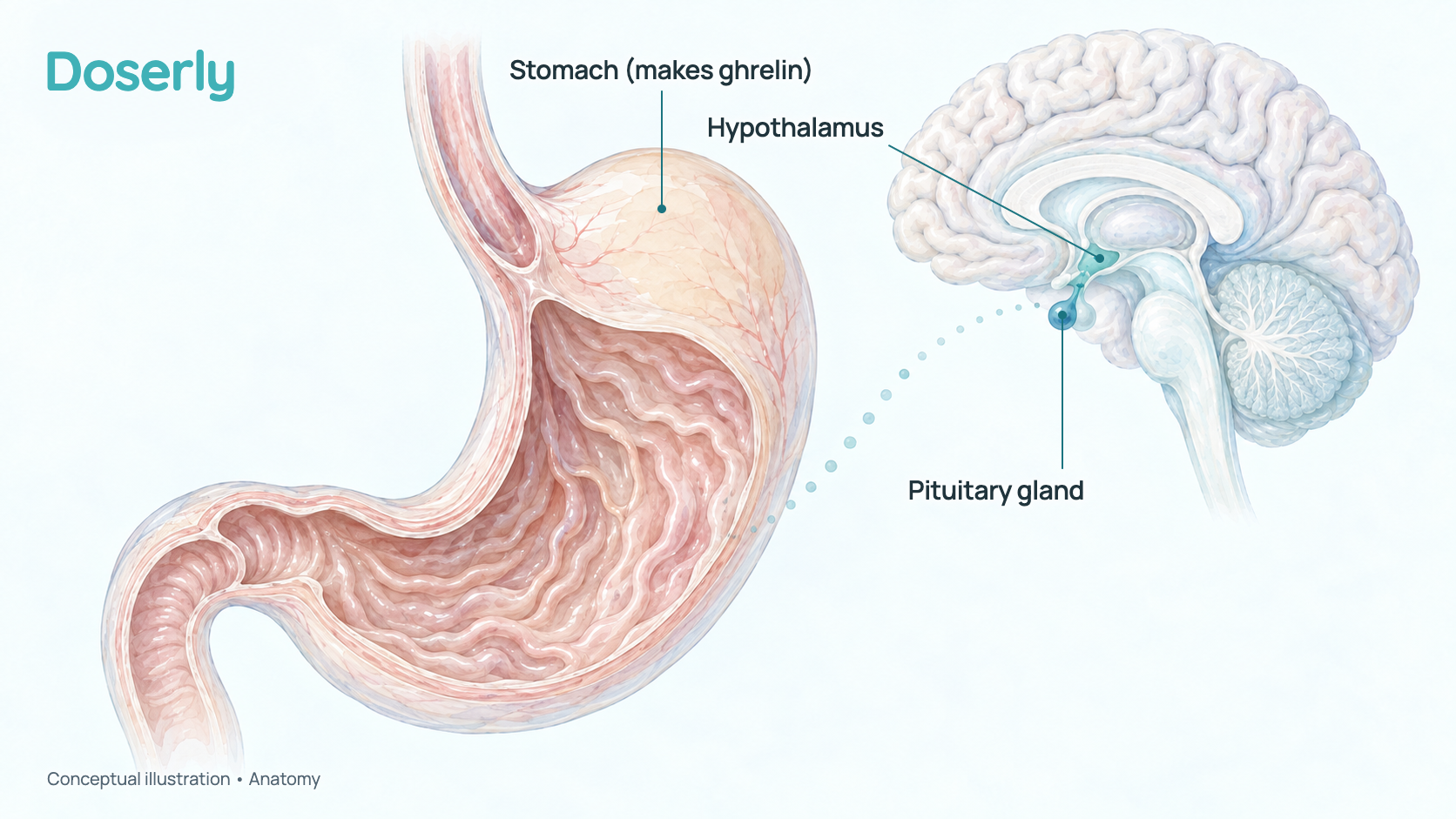
The name stands for growth hormone-releasing peptide 6. Its sequence is His-D-Trp-Ala-Trp-D-Phe-Lys-NH2: two of its six building blocks are "D" (mirror-image) forms that the body does not normally make. It has also been called SK&F 110679 and, in Cuban drug development, CIGB-500, and it appears in the substance registry of the US Food and Drug Administration (FDA) as Hexapeptide-2. [1], [6], [7]
GHRP-6 was first given to people in 1989. In 1990 FDA granted it an orphan designation for children with growth failure, but that designation was later withdrawn and no product was approved. A Cuban research centre later tested it as a hospital drug, given into a vein alongside another protein, for stroke. It remains investigational: there is no approved product and no approved dose. [6], [3], [8], [9]
Typical GHRP-6 Protocols
| Example | Amount each time | Frequency | Total per day | Duration |
|---|---|---|---|---|
| Low | 100 mcg | Once or twice daily | 100–200 mcg | 8–12 weeks, then 8–12 weeks off Its source describes this level as causing minimal appetite stimulation |
| Mid | 100–200 mcg | 2–3 times daily | 200–600 mcg | 8–12 weeks, then 8–12 weeks off |
| High | 300 mcg | 2–3 times daily | 600–900 mcg | 8–12 weeks, then 8–12 weeks off Its source notes significant hunger at this level |
The most common pattern in the reviewed sources is 100–300 mcg per injection, given two or three times a day on an empty stomach, for 8–12 weeks followed by a break. Across 30 website schedules, the usual starting amount is 100 mcg per injection and the usual top amount 300 mcg. Common timings are on waking, before a workout and at bedtime. [10], [11], [12], [13], [14], [15], [16]
- Titration Changing the amount in steps
- The most widely repeated schedule starts at 100 mcg and adds 100 mcg every two weeks: 100 mcg three times daily in weeks 1–2, 200 mcg in weeks 3–4 and 300 mcg from week 5 to week 12 (one template copied across seven pages). Another schedule starts with a single 100 mcg bedtime dose in week 1 "to gauge hunger response", then moves to 100 mcg two or three times daily. Tiered pages simply start at 100 mcg once a day. [17], [18], [19], [16]
Read the units: mcg means micrograms, and each dose is the amount given at one time; 1 mg equals 1,000 mcg. Nearly every website amount is per injection, so 300 mcg three times a day is a 900 mcg daily total. The early hormone studies instead dosed by body weight (for example, 1 mcg per kilogram), a different kind of number; the stroke trials used fixed milligram amounts into a vein. [18], [2], [8]
Each row is a complete schedule as its source published it. Low, mid and high are alternatives, not steps to move through. These schedules come from protocol websites rather than clinical trials: the controlled human studies of GHRP-6 gave it into a vein, by mouth or into the nose, mostly as single doses. [10], [2], [22]
Before relying on any row: no study has tested GHRP-6 on its own as a subcutaneous injection, and the longest controlled human dosing lasted 7 days, in hospital, into a vein. After single IV doses, half of 18 healthy volunteers had sweating and 44% had a slow heart rate lasting up to about 3 hours, more often at the higher doses. GHRP-6 raises cortisol and prolactin, and FDA cites a possible rise in blood sugar. The hunger it causes works against anyone trying to lose weight, taking a GLP-1 medicine, or living with diabetes, prediabetes or a history of binge eating; unexplained weight loss needs a medical assessment rather than an appetite peptide. There are no studies in pregnancy or breastfeeding, and children have received only single research doses; repeated use under 18 has not been studied. No approved product exists, so strength and purity depend on the maker, and FDA has warned pharmacies for compounding it. It is banned in sport at all times. [23], [2], [24], [25], [26] Full risks and who should be cautious.
What are the usual blend amounts?
GHRP-6 is often taken, separately or as a premixed blend, with a lab-made version of the brain's growth-hormone-releasing hormone (GHRH), usually CJC-1295 without DAC (drug affinity complex, an add-on that makes the other version last for days) or sermorelin. The two work through different receptors, and together they release more growth hormone than either alone, which was shown in people after single IV doses. The amounts below are per peptide, not the vial total. [2], [27]
| Combination | Amount each time | Frequency | GHRP-6 per day | Duration |
|---|---|---|---|---|
| With CJC-1295 (no DAC) [10] | 100 mcg GHRP-6 + 100 mcg CJC-1295 | 2–3 times daily | 200–300 mcg | 8–12 weeks, then 8–12 weeks off |
| With a GHRH peptide [11] | 100–200 mcg GHRP-6 + 100–200 mcg CJC-1295 (no DAC) | 2–3 times daily, fasted | 200–600 mcg | 8–12 weeks (break not stated) |
| Three-peptide blend, standard [28] | 100 mcg each of sermorelin, GHRP-6 and GHRP-2 (300 mcg total) | Once daily | 100 mcg | 12–16 weeks |
| Three-peptide blend, advanced [28] | 200 mcg each (600 mcg total) | Twice daily | 400 mcg | 12–16 weeks |
A US men's health clinic prescribed a similar three-peptide mix, 100 mcg each of GHRP-6, GHRP-2 and sermorelin three times a day, to men already on testosterone therapy; results are under human research. [29] In community education groups, the usual pairing is CJC-1295 without DAC and GHRP-6 at 100–200 mcg of each, two or three times a day on an empty stomach.
Where these numbers come from
The complete low, mid and high rows for GHRP-6 alone come from reference [10], which lists entry-level, standard and high-dose schedules and a cycle of 8–12 weeks on and 8–12 weeks off. References [16] and [20] publish the same three tiers with slightly different frequencies (100 mcg once daily, 200 mcg twice daily, 300 mcg three times daily), and references [11], [12], [13], [14] and [15] cross-check the recurring 100–300 mcg, two-to-three-times-daily range.
We reviewed 37 GHRP-6 dosing pages and used 30 single-peptide schedules for the typical range. Across them, the lower amount per injection was most often 100 mcg (range 50–200 mcg) and the upper amount most often 300 mcg (range 150–300 mcg). Those figures describe what websites say, not safe or effective limits. Many pages copy one another: a three-step 100, 200 and 300 mcg schedule appears on seven pages, and a generic "100–300 mcg, two to three times daily" line on ten, so matching pages are not independent confirmation.
We keep amount, frequency and course length together rather than taking a low number from one page and a duration from another. Excluded from the typical comparison: evidence-summary pages that give no protocol, a page whose table lists hospital diagnostic doses, blend pages (shown separately above), duplicate pages from the same publisher, and weight-based amounts with no fixed dose. The hospital stroke dose (5 mg into a vein twice daily with another drug) is a different route and population and is covered under human research.
What is GHRP-6 commonly used for?
People usually look into GHRP-6 for one of two reasons. The first is appetite: bodybuilders who struggle to eat enough to gain weight, sometimes called "hard gainers", use it to make themselves hungry. The second is growth hormone: people hope a bigger growth-hormone pulse will help with muscle, recovery or sleep, usually alongside a GHRH peptide. Websites also market it for gut healing, injuries and heart health. [20], [11], [30], [31]
The honest summary is short. Growth-hormone release is well measured in people, but only after single doses given into a vein, by mouth or into the nose. Hunger has been measured in rats (animal studies), and in people only for a related peptide. The heart, brain and organ-protection work is almost all in animals, and the only large human trials tested a hospital drug combination for stroke. None of the popular uses has been tested with subcutaneous injections of GHRP-6 on its own. [2], [32], [33], [9]
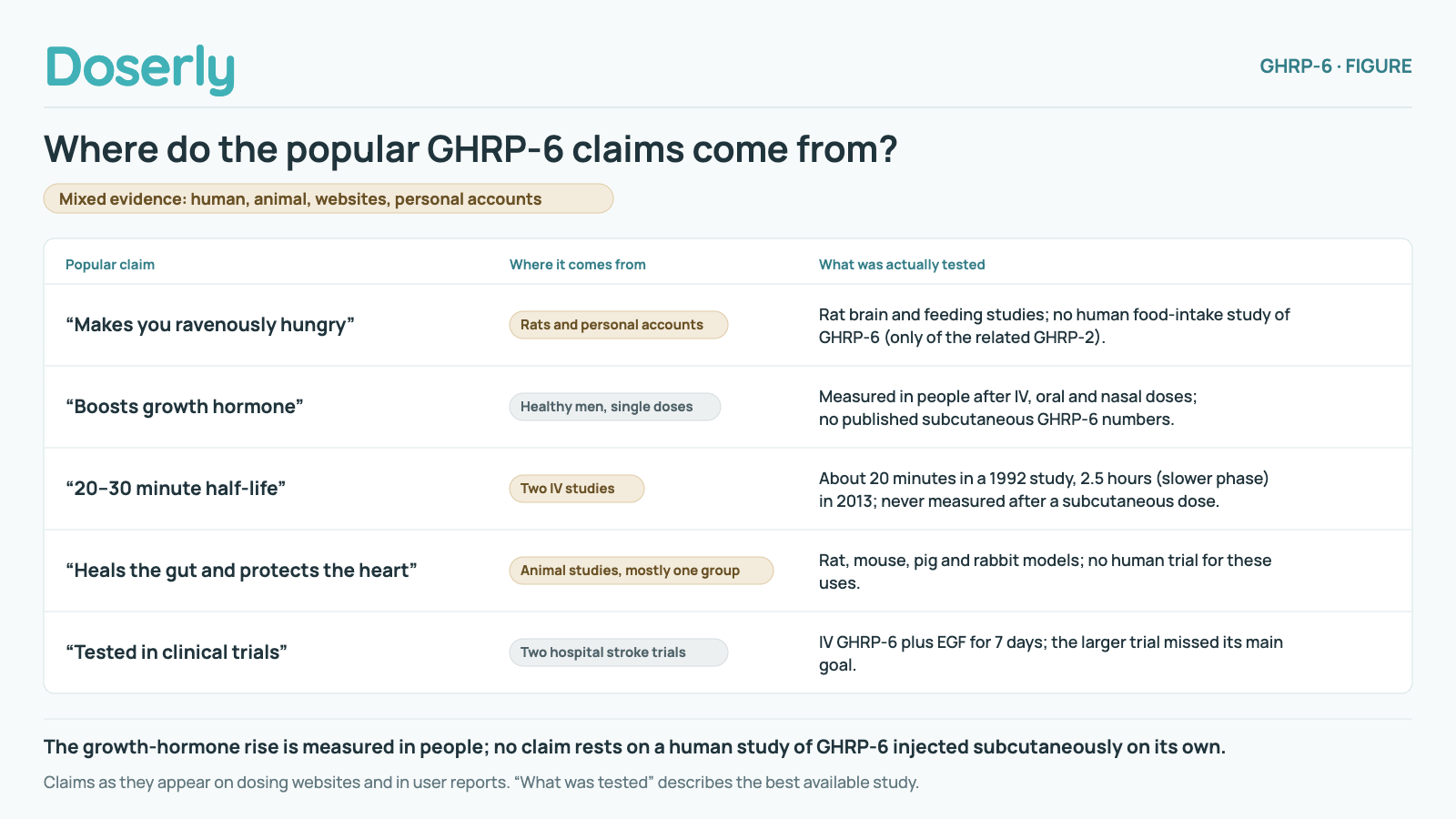
Where do the popular GHRP-6 claims come from?
“Makes you ravenously hungry”
Rats and personal accounts
Rat brain and feeding studies; no human food-intake study of GHRP-6 (only of the related GHRP-2).
“Boosts growth hormone”
Healthy men, single doses
Measured in people after IV, oral and nasal doses; no published subcutaneous GHRP-6 numbers.
“20–30 minute half-life”
Two IV studies
About 20 minutes in a 1992 study, 2.5 hours (slower phase) in 2013; never measured after a subcutaneous dose.
“Heals the gut and protects the heart”
Animal studies, mostly one group
Rat, mouse, pig and rabbit models; no human trial for these uses.
“Tested in clinical trials”
Two hospital stroke trials
IV GHRP-6 plus EGF for 7 days; the larger trial missed its main goal.
Claims as they appear on dosing websites and in user reports. “What was tested” describes the best available study.
The growth-hormone rise is measured in people; no claim rests on a human study of GHRP-6 injected subcutaneously on its own.
Increasing appetite and gaining weight
Hunger is the effect people talk about most. Personal accounts describe strong hunger starting anywhere from a few minutes to about 45 minutes after an injection, and some people take it precisely for that. See what people report. [34], [35], [36]
No human study has measured how much people eat after GHRP-6. The evidence comes from rats: a single dose into a vein switched on appetite-driving nerve cells in the hypothalamus, a dose into the brain's fluid spaces started eating within an hour without changing growth hormone, and a continuous infusion into the brain increased food intake and body weight over 6 days. [5], [32], [37]
The closest human evidence is for GHRP-2, a related peptide: in a randomized, placebo-controlled study of 19 adults, a 4.5-hour subcutaneous infusion raised the amount people chose to eat at lunch by 10% at a low dose and 34% at a higher dose. For MK-677, a swallowed drug acting on the same receptor, extra appetite in a two-year trial of older adults faded within a few months. Neither result has been tested for GHRP-6. [33], [38]
Hunger is not always helpful. In diabetic rats, GHRP-6 increased weight and body fat only when insulin was also given, a reminder that the effect depends on metabolism. [39] People who are underweight because of illness, poor appetite in older age or an eating disorder need a medical assessment first; community education groups themselves advise against GHRP-6 for fat loss, with GLP-1 medicines or with a history of binge eating.
Raising growth hormone and IGF-1
This is the effect measured in people. In 18 healthy men, single IV doses of 0.1, 0.3 and 1 mcg per kilogram raised peak growth hormone to about 8, 17 and 69 micrograms per litre, against about 1 on placebo. Given with GHRH, lower doses released more growth hormone together than either did alone. [2]
Growth hormone in turn prompts the liver to make IGF-1 (insulin-like growth factor 1), the blood test people use to check for an effect. In six men, seven nasal doses over about two days raised IGF-1 from about 95 to 126 micrograms per litre. In seven older women, four days of oral doses kept the growth-hormone response going, but IGF-1 did not rise significantly. A clinic chart review found higher IGF-1 in men taking GHRP-6 with two other peptides for several months, but it cannot show what GHRP-6 did by itself. [40], [41], [29]
A secretagogue gives its full effect only when the pituitary and the brain's own GHRH signal are intact. Blocking GHRH cut the growth-hormone rise from GHRP-6 by about 80% in healthy men, and children whose pituitary stalk was cut at birth barely responded. The response to the combined GHRP-6 and GHRH test is also smaller in severe obesity. [4], [42], [43]
Muscle, fat and body composition
No human trial has tested GHRP-6 for muscle or fat. Animal results are mixed: continuous GHRP-6 raised bone mineral content in adult female rats, chronic dosing raised growth hormone but not IGF-1 in old rats, and 60 days of GHRP-6 with GHRH did not change food intake or weight gain in adult obese rats. Personal accounts of weight gain usually involve very high-calorie diets and steroids. [44], [45], [46], [47], [48]
Sleep
Two small studies tested it: four IV doses of 50 mcg during the night in young men increased light (stage 2) sleep but did not change deep sleep, and raised cortisol. In the later study, a nasal dose raised night-time growth hormone, while an oral capsule changed no measured hormone and slightly reduced light sleep late in the night. Some people report worse sleep with an evening dose. [49], [50], [51]
Gut problems, wounds and injuries
GHRP-6 sped up stomach emptying in rats and mice, including septic and diabetic mice, and protected the stomach lining in stressed rats. A gel applied to wounds reduced scarring in rabbits. No study has tested it for gut conditions, tendon or joint injuries, or wound healing in people; a handful of personal accounts describe easier digestion, alongside other treatments. [52], [53], [54], [55], [56], [57], [58]
Heart attack and stroke: the tested hospital uses
A Cuban research group has studied GHRP-6 for about 20 years as a protective drug for the heart and brain. In pigs with an induced heart attack, one IV dose reduced the mass of dead heart muscle by 78%, and in rats it protected the heart from the chemotherapy drug doxorubicin. We found no published human trial of GHRP-6 for heart attack or heart failure. [59], [60], [61]
In people, the same group combined 3.5 or 5 mg of IV GHRP-6 with epidermal growth factor (EGF) twice daily for 7 days after stroke. A small 2024 trial found the combination acceptably safe, but the larger 2026 trial of 188 patients did not improve disability overall. These results apply to that hospital combination, not to GHRP-6 injections at home. See the trial results. [8], [9]
Testing for growth hormone deficiency
Researchers have used 1 mcg per kilogram of GHRP-6 into a vein, often with GHRH, as a stimulation test for growth-hormone deficiency in adults and children, and as a test of the stress-hormone system. In a 250-person study of the combined test, and in a 69-person study of GHRP-6 alone, no side effects were reported. It never became an approved test: FDA notes that GHRP-6 is not a component of any FDA-approved human drug. [62], [63], [64], [65]
Where do GHRP-6 protocols differ?
Is the number for one injection or the whole day?
The same "100–300 mcg" can mean three times as much, depending on the source. Websites almost always mean each injection, two or three times a day, which adds up to 200–900 mcg a day. [10], [15] In community education groups, one source uses the same per-injection framing, while another gives 100–300 mcg as the whole day's total, split into two or three doses or given once at bedtime.
Pages also get their own arithmetic wrong: one lists weekly totals that only add up if the dose were given once a day, although its schedule says three times. [66]
Once, twice or three times a day?
All three appear. The three-step template uses three injections a day at least four hours apart; others give one bedtime dose with optional extra doses at least three hours apart. [17], [67]
The case for several doses usually rests on a short half-life, quoted as 20 or 30 minutes, usually with no source. Two human studies measured it after IV doses: a 1992 study found about 20 minutes, and a 2013 study with a more specific test found a fast phase of about 8 minutes and a slower phase of about 2.5 hours. Neither measured a subcutaneous dose, and no study has compared one daily injection with several. [20], [68], [94], [69]
Where does the "100 mcg saturation dose" come from?
Several pages say that 1 mcg per kilogram, or about 100 mcg, is the dose at which the growth-hormone response "saturates", so higher doses only add side effects. That rule of thumb matches a 2014 bodybuilding forum guide. [70], [71], [72]
The human data behind it were IV. In the key IV study, 1 mcg per kilogram, the highest dose tested, gave the largest response, so no ceiling was found. By mouth, it took 300 mcg per kilogram, about 300 times the IV dose, to get a response of similar size. No study has found a ceiling for subcutaneous injections. One page states that the best-studied human dose was given subcutaneously; the studies it describes used a vein. [2], [22], [71]
Do sources start low?
Many do, but several repeat the same schedule. The 100, 200 and 300 mcg three-step template appears on seven pages with near-identical wording, so it is one schedule copied, not several independent ones. Another source uses a single bedtime dose in week 1 to see how strong the hunger is. Others use body-weight tiers and label them "convention, not pharmacology". [17], [18], [19], [11]
In community education groups, a common piece of advice is to start one peptide at a time before combining them, so that any reaction can be traced to one ingredient.
When should it be taken relative to food and sleep?
Almost every source says an empty stomach: typically at least 2 hours after a meal, because food is said to blunt the growth-hormone pulse. Websites put the next meal 30–60 minutes after the injection. In community education groups the advice ranges from 20–30 to 45–60 minutes, and educators note that GHRP-6's hunger makes the wait hard to keep. [10], [13], [20]
Timing splits into two camps. One puts a dose at bedtime to line up with night-time growth-hormone release. The other takes it about 30 minutes before meals to use the hunger. Some educators warn that an evening dose can wake people up hungry, and one person reported insomnia after an evening dose. None of this has been tested. [67], [20], [51]
How long, and what happens between courses?
Course lengths range from 6–12 weeks to 16 weeks, and one community education source goes to "20+ weeks". Breaks range from 2–4 weeks to as long as the course. Some take weekends off. [16], [11], [19], [13], [10], [21]
Breaks are meant to stop the body getting used to the peptide (desensitization). Human data are short: during continuous IV infusions the response to an extra dose was partly blunted, yet growth hormone stayed raised for 24 to 34 hours, and the response held up over 4 days of oral dosing and about 2 days of nasal dosing. Several people describe the hunger fading after 2–4 weeks. Whether breaks restore anything after months of injections has not been studied. [73], [74], [75], [41], [40], [35], [76], [47]
Can two GHRPs be combined?
Community education groups usually pair one GHRH peptide with one GHRP and say not to stack two GHRPs, although one of their own courses offers GHRP-2 and GHRP-6 together. Premixed blends also combine GHRP-6 with GHRP-2, and a men's clinic prescribed the two together with sermorelin. The one-GHRP rule has some laboratory support: in rat pituitary cells, GHRP-2 and GHRP-6 worked through the same receptor, each blunted the response to the other, and together at full strength they released no more growth hormone than either alone. No study in people has compared these combinations. [28], [29], [155]
How do micrograms convert to syringe units?
A U-100 insulin syringe has 100 units per millilitre, so units measure volume. How much GHRP-6 each unit holds depends on how much liquid was added to the vial.
For example, 5 mg (5,000 mcg) mixed into 2 mL gives 2,500 mcg per mL, or 25 mcg per unit. So 100 mcg is 4 units, 200 mcg is 8 units and 300 mcg is 12 units. Mixed into 2.5 mL instead, each unit holds 20 mcg and 100 mcg is 5 units. [11], [67]
Watch the difference between micrograms and micrograms per kilogram. One dosing chart lists the hospital test dose as "1 mcg", when the studies used 1 mcg per kilogram, about 70 times more for a 70 kg adult. Doserly's reconstitution calculator works out units for a single-peptide vial and shows each step; for a blend, it cannot split the vial into its ingredients. The arithmetic assumes the vial holds what its label says; it cannot check a product's strength, purity or sterility. [68], [63]
Source-by-source comparison
Which pages share the same numbers?
The three-step 100, 200 and 300 mcg, three-times-daily, 12-week template appears on PeptiJournal, Peptide Dosages (and its mirror), DosagePeptide, ResearchProtocols.net, Peptide Dosing Hub and Peptide Dosing Protocols. PeptideSchedule and PeptIQ share beginner, moderate and maximum tiers. Peptidepedia, Peptide Initiative, Peptidex, The Peptide Catalog, FormBlends and Bioalmanac anchor on the "1 mcg per kilogram or 100 mcg" figure. A generic "100–300 mcg, two to three times daily" line appears on StackTrax, Peptide Protocol Wiki, PepEdHub, Peptabase, Professor Peptides, PeptideProbe, PeptideTables and others. [17], [18], [77], [78], [66], [79], [80], [20], [16], [70], [81], [67], [19], [71], [82], [11], [13], [14], [12], [83], [15], [84]
Which pages cite research that does not support them?
FormBlends and Bioalmanac describe the 1 mcg per kilogram human studies as subcutaneous; they were IV. PeptideSchedule gives a 20-minute half-life and credits its human data to the wrong author. Peptide Dosages cites a 1998 study under the wrong author name and presents the 2.5-hour IV half-life as if it applied to injections. MyPeptideMatch describes a veterans' hospital study of 300 mcg three times daily that we could not find. PeptideDosageCharts lists "1 mcg" where the studies used 1 mcg per kilogram. Some pages also cite a PubChem record for GHRP-6 that lists "GHRP-2 acetate" among its names; the correct record is different (see the identity question). [71], [82], [20], [18], [85], [68], [86]
Which pages are more careful?
StackTrax labels its body-weight tiers "convention, not pharmacology" and reports the human half-life study accurately. FormBlends states that no clinical trials have validated repeated-dose regimens, and Peptidex calls its numbers assertions rather than findings. PeptideReader and Peptide Dosages' evidence page decline to give a protocol at all. [11], [71], [67], [87], [88]
What happens when you stop GHRP-6?
This has not been studied. No study has looked for withdrawal effects or a rebound, or at how the body's own growth-hormone system recovers, after GHRP-6. That is missing data, not proof that nothing happens.
What is known is short-term: after a single IV infusion, growth hormone returned to its starting level within about 3.5 hours. [6] Related peptides give context, not proof about GHRP-6:
- Hexarelin, a close relative: in adults given subcutaneous injections twice daily for 16 weeks, the growth-hormone response shrank by almost half, then returned to its starting level 4 weeks after stopping. IGF-1 and body composition did not change significantly. [89]
- GHRP-2: in nine healthy young men, the peak growth-hormone response fell by about 40% over five days of daily subcutaneous injections, and IGF-1 did not rise. [90]
Personal accounts add a few details. One person who took GHRP-6 with GHRP-2 on a very high-calorie diet said they had become insulin resistant by month 5 and that it recovered about two weeks after stopping, by their own account. Another said hunger faded on an old vial and came back with a fresh one. In community education groups, educators disagree: some say stopping at once is fine because nothing is shut down, some suggest tapering down for comfort, and others say constant use can blunt your own growth-hormone output. Members there have described worse sleep after stopping other growth-hormone peptides, though not GHRP-6. None of these views cites evidence. [91], [47]
Does GHRP-6 work the same by injection, by mouth or as a nasal spray?
No, and the route people use most is the least studied. Hormone studies gave GHRP-6 intravenously (into a vein), orally (swallowed), intranasally (sprayed into the nose) and sublingually (dissolved under the tongue). Early researchers reported that it also works by subcutaneous injection, but those reports give no subcutaneous GHRP-6 numbers, and we found no published growth-hormone or blood-level results after a subcutaneous GHRP-6 dose. The only published human use of that route is a clinic chart review in which men injected it together with two other peptides (see human research). [2], [22], [40], [50], [92], [93], [29]
The route changes how much reaches the blood. Bioavailability, the share of a dose that reaches the circulation, has been stated for people only for swallowed doses: a 1994 absorption study, mainly in animals, reported that less than 1% of an oral dose reaches the blood in both animals and people, without describing the human measurements. [168] The growth-hormone responses show the size of the gap:
- By mouth. In ten men, swallowed doses of 30, 100 and 300 mcg per kilogram gave peak growth hormone of about 5, 9 and 18 micrograms per litre, against about 4 on placebo and 26 after just 1 mcg per kilogram into a vein; only the highest oral dose clearly beat placebo. Oral doses also released growth hormone in children of short stature. In a later sleep study, an enteric-coated capsule of 300 mcg per kilogram changed no measured hormone. [22], [94], [93], [50]
- Nasal spray. In six men, 30 mcg per kilogram in the nose raised peak growth hormone to about 40 micrograms per litre, against about 55 after 1 mcg per kilogram into a vein. [40]
- Under the tongue. 30 mcg per kilogram produced only a trend toward more growth hormone. [50]
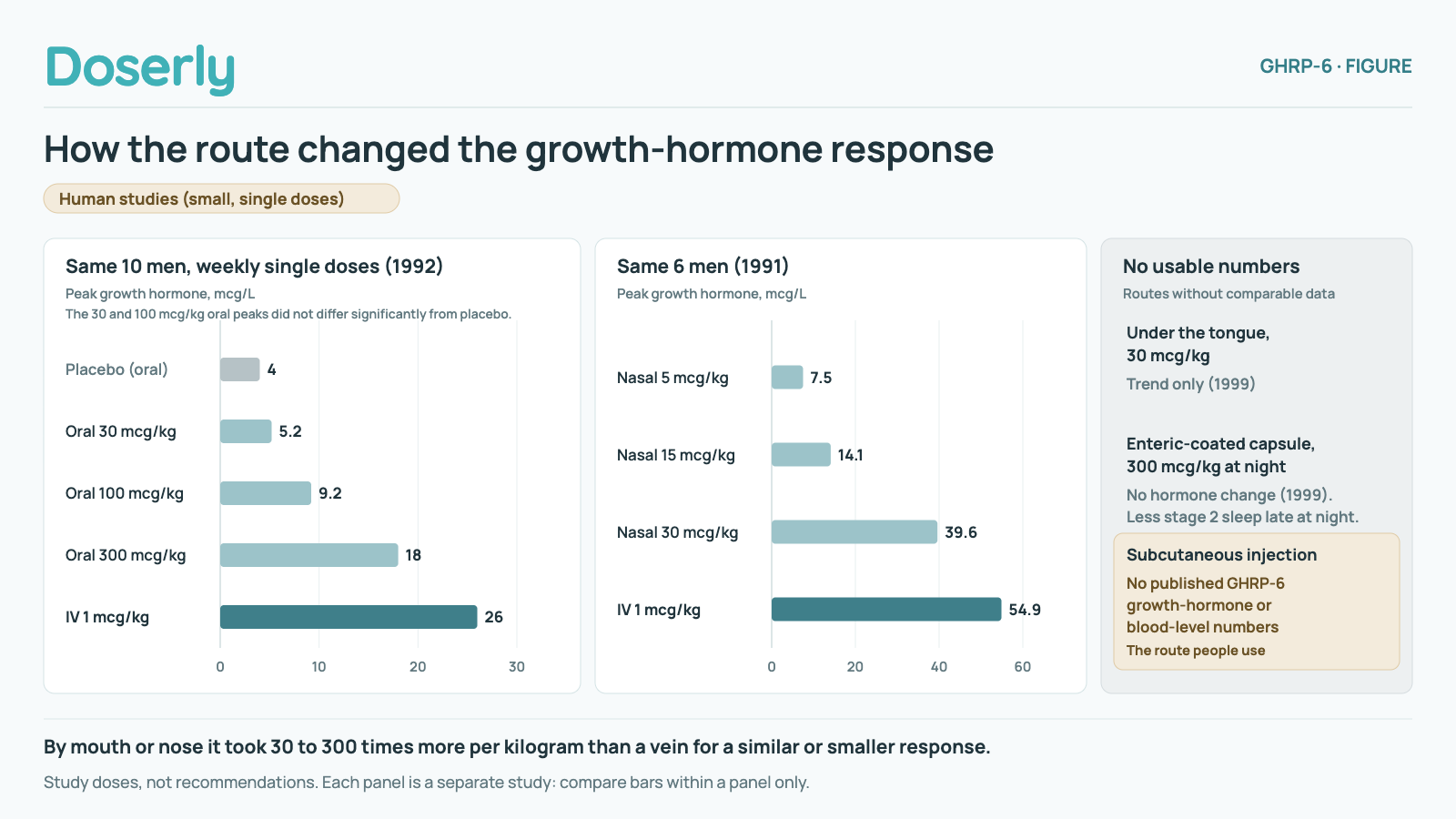
How the route changed the growth-hormone response
Same 10 men, weekly single doses (1992)
Peak growth hormone, mcg/L
The 30 and 100 mcg/kg oral peaks did not differ significantly from placebo.
- Placebo (oral)
- 4
- Oral 30 mcg/kg
- 5.2
- Oral 100 mcg/kg
- 9.2
- Oral 300 mcg/kg
- 18
- IV 1 mcg/kg
- 26
Same 6 men (1991)
Peak growth hormone, mcg/L
- Nasal 5 mcg/kg
- 7.5
- Nasal 15 mcg/kg
- 14.1
- Nasal 30 mcg/kg
- 39.6
- IV 1 mcg/kg
- 54.9
No usable numbers
- Under the tongue, 30 mcg/kg
- Trend only (1999)
- Enteric-coated capsule, 300 mcg/kg at night
- No hormone change (1999). Less stage 2 sleep late at night.
- Subcutaneous injection
- No published GHRP-6 growth-hormone or blood-level numbers
Study doses, not recommendations. Each panel is a separate study: compare bars within a panel only.
By mouth or nose it took 30 to 300 times more per kilogram than a vein for a similar or smaller response.
Nasal sprays are sold, and some people make their own from powder and saline. A homemade spray is not sterile and its strength is unknown. [95], [96]
How long does GHRP-6 last in the body?
After single IV doses of 100–400 mcg per kilogram in nine healthy men, GHRP-6 levels fell in two phases: a fast drop with a half-life of about 8 minutes as it spread into the body, then a slower phase with a half-life of about 2.5 hours as it was removed. Four of the nine men had unexpected spikes in their blood levels. An earlier 1992 study, using a less specific antibody test, reported a half-life of about 20 minutes after both IV and oral doses. [69], [94]
The growth-hormone pulse is shorter than the drug's presence: after an IV infusion, growth hormone peaked at about 45 minutes and was back to baseline by about 3.5 hours. In an anti-doping study, GHRP-6 was still found in urine 23 hours after one nasal dose, mostly unchanged. [6], [97]
No published study reports GHRP-6's half-life after a subcutaneous injection, which is usually absorbed more slowly than a dose into a vein. Dosing pages quote 20- or 30-minute half-lives, usually without a source; the 20-minute figure matches the 1992 IV and oral measurement, and the "2.5-hour" figure is the 2013 IV value. Neither describes a subcutaneous injection. [20], [68], [83], [94], [69]
Is GHRP-6 the same as GHRP-2, "GHRP" or Hexapeptide-2?
- GHRP-2 (pralmorelin) is a different, related peptide with its own sequence. It is approved in Japan as a one-time diagnostic injection and is covered in its own guide. [98], [99]
- "GHRP" on its own usually means the whole family. Papers from the late 1980s and early 1990s often call GHRP-6 simply "GHRP" or "the hexapeptide". [6], [73]
- Hexapeptide-2 and Melanostatine 2 are other names FDA's substance registry lists for the same molecule as GHRP-6. [1]
One identity trap: a name search for GHRP-6 in the PubChem chemical database returns a record without the mirror-image detail that lists "GHRP-2 acetate" among its names, and some dosing sites cite it. The record that matches GHRP-6's registry number (CAS 87616-84-0) is a different one. GHRP-6 is also sold as an acetate salt, which FDA's registry treats as a related substance with its own code. [86], [1]
Does the injection site matter?
Protocol pages use the belly, thigh or upper arm, and no study has compared sites. FDA notes that compounded GHRP-6 may carry a risk of immune reactions for certain routes of administration, because of clumped peptide (aggregation) or manufacturing impurities. [10], [24]
How should GHRP-6 be stored, and how long does it last?
How long GHRP-6 keeps its strength once mixed is not established. No GHRP-6 product has an approved label, and no published study sets a use-by period for a vial mixed from powder, so the windows below come from websites, not from a tested medicine label.
- Powder, before mixing. GHRP-6 is sold as a freeze-dried powder. In the stroke trials, the freeze-dried hospital product was kept at 2–8 °C (fridge temperature) at all times. Websites variously say to refrigerate or freeze the powder and to protect it from light. [8], [16], [67], [100]
- After mixing. Once reconstituted, websites give 14 days, 28 days or 3–4 weeks in the fridge, without citing a stability test. [100], [16], [67]
- What breaks it down. In a laboratory study that heated GHRP-6 solutions to 60 °C, it lost its end amide group at acidic and alkaline pH, broke apart or closed into a ring in phosphate buffers around neutral pH, and reacted with traces of formaldehyde from additives or rubber stoppers. It did resist digestive enzymes and blood in another laboratory test. [101], [102]
- The mixing liquid. The label of bacteriostatic water, the liquid these pages name, says not to store drug solutions made with it unless the drug's maker says so. Answers pasted into community education groups sometimes claim GHRP-6 must be mixed with acetic acid; we found no source for that. [103]
Tested rules for GHRP-2's approved diagnostic product are much stricter: stored below 10 °C, used as soon as possible after mixing, with stability confirmed for only 24 hours at room temperature. Those rules belong to that product, not to GHRP-6. [99]
This guide does not cover mixing or injection technique; the Academy note below covers practical handling.
What do we actually know about GHRP-6 in people?
More than for most research peptides, but almost none of it matches how GHRP-6 is used today. The human studies asked narrow questions: how much growth hormone one dose releases, how the body handles it (pharmacokinetics), whether it can diagnose hormone deficiencies, and whether a hospital IV combination helps after stroke.
What did the human studies find?
| Study | What researchers reported | What it cannot establish |
|---|---|---|
| Healthy men, 1989–1992 | Single IV doses (0.05–2.5 mcg per kilogram) released growth hormone in a dose-related way and were well tolerated; at 1 mcg per kilogram prolactin and cortisol roughly doubled. By mouth, only 300 mcg per kilogram, about 300 times the IV amount, clearly beat placebo. | Anything about repeated injections, body composition or long-term safety. [6], [2], [22] |
| Nasal and oral repeat dosing, 1991–1994 | Seven nasal doses over about 2 days raised IGF-1 without the response fading (6 men). Four days of oral doses kept the response in 7 older women, without a significant IGF-1 rise. | Effects beyond a few days, or of subcutaneous injections. [40], [41] |
| Sleep, 1995 and 1999 | Night-time IV doses increased light sleep, not deep sleep, and raised cortisol. | Whether it improves sleep quality in daily life. [49], [50] |
| Diagnostic testing, 1993–2010 | 1 mcg per kilogram into a vein, often with GHRH, separated people with and without growth-hormone deficiency; no side effects were reported in studies of up to 250 people. | Any treatment effect; each person had one dose. [62], [63], [43] |
| Half-life study, 2013 | Single IV doses of 100–400 mcg per kilogram in 9 men: elimination half-life about 2.5 hours. | How it behaves after a subcutaneous injection. [69] |
| Safety study, 2014 | Single IV doses of 1–400 mcg per kilogram in 18 healthy volunteers: no serious adverse events; sweating in 50% and a slow heart rate in 44%. | Repeated or long-term use; three people per dose level. [23] |
| Clinic chart review, 2017 | 14 of 105 men on testosterone who took GHRP-6, GHRP-2 and sermorelin (100 mcg each, three times daily) as prescribed had IGF-1 rise from about 160 to 239 ng/mL. | What GHRP-6 did by itself; there was no comparison group and many men were excluded. [29] |
| Stroke trials, 2024 and 2026 | IV GHRP-6 with EGF twice daily for 7 days in hospital. The small trial met its safety goal; the 188-patient trial did not improve disability overall. | Any effect of GHRP-6 alone, outside hospital, or by subcutaneous injection. [8], [9] |
Most of these studies were small and short. The half-life study, the safety study and both stroke trials came from the Cuban centre developing GHRP-6. [69], [23], [9]
What did the stroke trials show?
In the 2024 phase I/II controlled trial, 36 adults within 12 hours of a stroke were randomly assigned to standard care or to standard care plus EGF with 3.5 or 5 mg of GHRP-6 into a vein twice daily for 7 days. Its main goal was safety. Serious adverse events occurred in 3 of 10 and 2 of 10 treated patients, against 9 of 16 on standard care, and two deaths occurred in the 5 mg group against seven on standard care. The authors reported better recovery scores with treatment, but the trial was small and not blinded. [8]
The 2026 phase III trial (COURAGE-2) enrolled 188 adults with moderate stroke: 95 received EGF plus 5 mg of GHRP-6 twice daily for 7 days, and 93 received standard care. It missed its main goal: disability at 3 and 6 months, daily-living scores and survival did not differ overall. In a subgroup of 27 patients with severe strokes, treated patients did better, but a finding in a small subgroup is a lead for future research, not proof. [9]
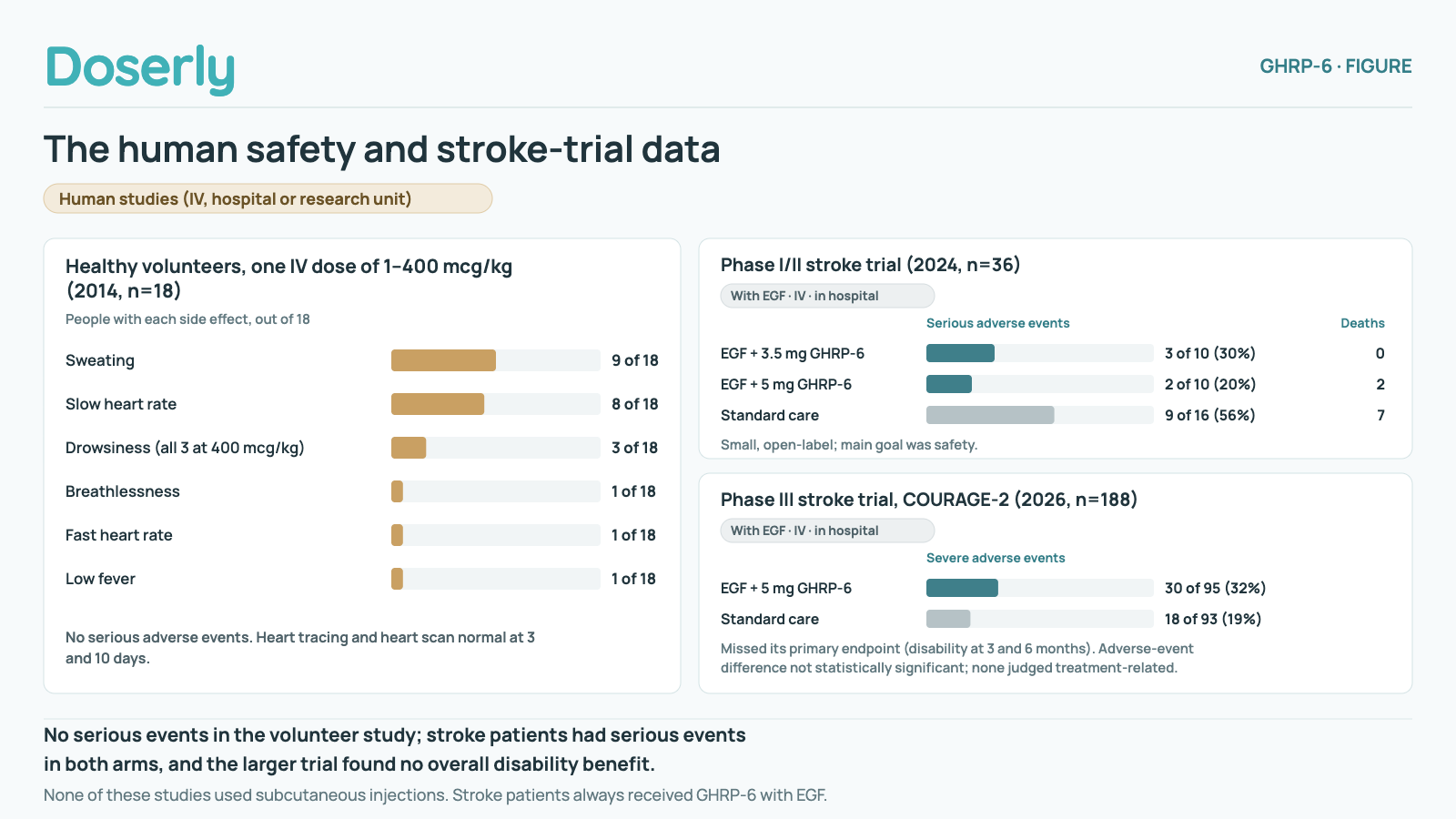
The human safety and stroke-trial data
Healthy volunteers, one IV dose of 1–400 mcg/kg (2014, n=18)
People with each side effect, out of 18
- Sweating
- 9 of 18
- Slow heart rate
- 8 of 18
- Drowsiness (all 3 at 400 mcg/kg)
- 3 of 18
- Breathlessness
- 1 of 18
- Fast heart rate
- 1 of 18
- Low fever
- 1 of 18
No serious adverse events. Heart tracing and heart scan normal at 3 and 10 days.
Phase I/II stroke trial (2024, n=36)
With EGF · IV · in hospital
Serious adverse events; deaths
- EGF + 3.5 mg GHRP-6
- 3 of 10 · 0 deaths
- EGF + 5 mg GHRP-6
- 2 of 10 · 2 deaths
- Standard care
- 9 of 16 · 7 deaths
Small, open-label; main goal was safety.
Phase III stroke trial, COURAGE-2 (2026, n=188)
With EGF · IV · in hospital
Severe adverse events
- EGF + 5 mg GHRP-6
- 30 of 95
- Standard care
- 18 of 93
Missed its primary endpoint (disability at 3 and 6 months). Adverse-event difference not statistically significant; none judged treatment-related.
None of these studies used subcutaneous injections. Stroke patients always received GHRP-6 with EGF.
No serious events in the volunteer study; stroke patients had serious events in both arms, and the larger trial found no overall disability benefit.
Are there registered GHRP-6 trials?
The two Cuban stroke trials are the only registered treatment trials we found. A ClinicalTrials.gov search on September 24, 2026 found no GHRP-6 studies, and the European Union's current trial register found none. The stroke trials are in Cuba's public trial registry, which we read through the World Health Organization's trial search portal. [104], [156], [157], [158]
The registry plans and the papers do not fully match. The first trial registered 30 patients and doses of 3.5 and 7.0 mg; the paper reports 36 patients and 3.5 and 5 mg, and does not explain the change. The phase III trial registered 5.0 mg for 220 patients and published results for 188. Neither registry entry shows posted results. A UK-based registry lists one Dutch study that used GHRP-6 only as a one-time diagnostic test. [157], [8], [158], [9], [159]
36 adults after ischemic stroke (RPCEC00000214)
EGF plus 3.5 or 5 mg GHRP-6 twice daily for 7 days, against standard care. Run 2017–2018.
Registered 2016; published 2024. The registry planned 3.5 or 7.0 mg in 30 patients; the paper reports 3.5 or 5 mg in 36.
[157], [8]188 adults after ischemic stroke (COURAGE-2, RPCEC00000300)
EGF plus 5 mg GHRP-6 twice daily for 7 days, against standard care.
Registered 2019 for 220 patients; published 2026; missed its primary endpoint. Abstract reviewed.
[158], [9]No GHRP-6 studies found
Searches for GHRP-6 and its other names returned only unrelated ghrelin and growth-hormone studies.
Checked September 24, 2026.
[104]Does more growth hormone mean better health?
Not automatically. A growth-hormone pulse, an IGF-1 number, a change in weight and feeling better are four different outcomes. For GHRP-6, only the first two have been measured in people: growth hormone after single doses, and IGF-1 over a few days of nasal dosing and, in one clinic chart review of a three-peptide mix, after several months. A higher IGF-1 shows that growth-hormone signalling changed; it does not show that muscle, recovery or health improved, or that the change is safe. [2], [40], [29]
How does GHRP-6 work?
GHRP-6 activates the ghrelin receptor (also called GHS-R1a), which sits on nerve cells in the hypothalamus and on the growth-hormone-making cells of the pituitary gland. The pituitary answers with a burst of growth hormone. In people, most of that burst depends on the brain's own GHRH signal: when GHRH was blocked, the response fell by about 80%, and in patients whose pituitary is cut off from the hypothalamus GHRP-6 released almost no growth hormone. [4], [5], [105], [160]
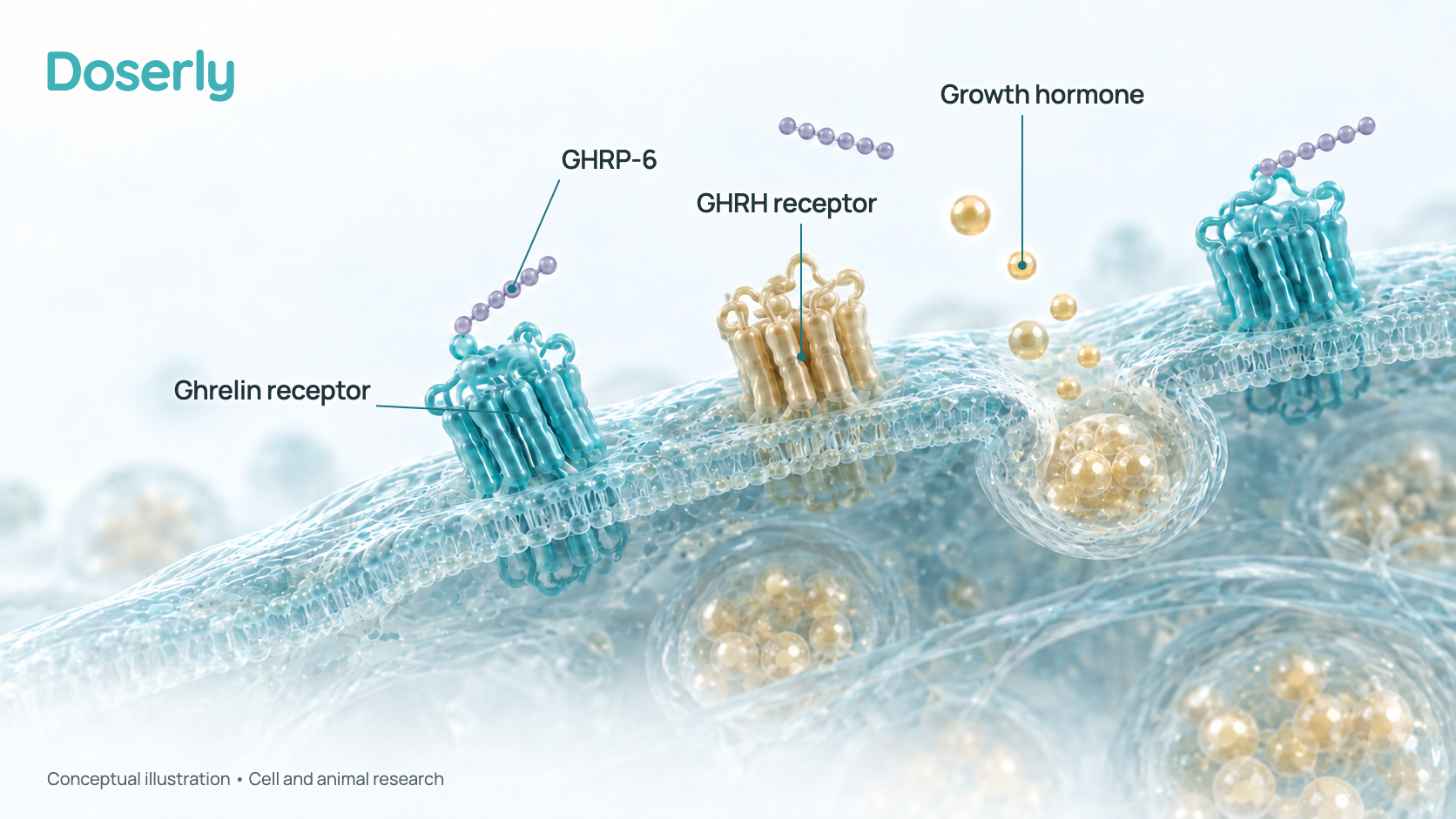
That is why GHRP-6 is paired with GHRH peptides. The two press different "release" switches, and together they release far more growth hormone than either alone. In healthy adults, 90 mcg of GHRP-6 into a vein released about three times as much growth hormone as GHRH, and the pair together released more than the two added up; in obese adults the combination produced a peak about six times higher than GHRH by itself. [160], [2], [27]
Why does it make people hungry?
Ghrelin is the body's main hunger hormone, and the ghrelin receptor is found in the brain's appetite centres. In rats, a single GHRP-6 dose switched on nerve cells in the arcuate nucleus of the hypothalamus; about half of them make neuropeptide Y, a powerful appetite signal. Given directly into the brain, GHRP-6 started eating in rats without changing growth hormone, so the hunger effect does not depend on growth hormone. [5], [32]
GHRP-6 does not work by making the body release more of its own ghrelin, as is sometimes claimed; it acts on the ghrelin receptor directly. [105], [5]
Why does it raise cortisol and prolactin?
GHRP-6 also stimulates the body's stress-hormone system. At 1 mcg per kilogram into a vein, prolactin (a pituitary hormone best known for milk production) and cortisol roughly doubled. Night-time doses raised ACTH, the pituitary hormone that triggers cortisol release, and cortisol. Researchers have even tested GHRP-6 as a way to check whether the body's stress-hormone system can make enough cortisol. [2], [49], [64]
The size of the rise depends on dose and design: the very first human study, a slow 30-minute infusion, found no change in ACTH. Related peptides GHRP-2 and hexarelin also raise prolactin, ACTH and cortisol in people. In pigs, GHRP-6 raised ACTH and cortisol while ipamorelin did not, which is why ipamorelin is marketed as "selective". [6], [98], [105]
What does it do to blood sugar and insulin?
Growth hormone works against insulin, so medicines that raise it can raise blood sugar. FDA cites "increase in blood glucose due to decreases in insulin sensitivity" among its concerns about compounded GHRP-6. In one human study, GHRP-6 raised insulin about eightfold and blood sugar from 4.2 to 6.0 mmol/L, but only when growth hormone's own receptor was blocked with another drug and people had eaten. No long-term blood-sugar study of GHRP-6 exists; in a two-year trial of MK-677, a swallowed drug acting on the same receptor, fasting blood sugar rose and insulin sensitivity fell. [24], [106], [38]
What is CD36 and the "cell protection" research?
Besides the ghrelin receptor, GHRP-6 binds a second receptor called CD36. The Cuban group behind the stroke trials links this binding to protection of heart, gut, liver, kidney, skin and brain cells after injury in animals and in cells in a dish. This work is extensive but comes largely from one research group, and it has not been confirmed in people. [56], [61], [107]
Does the body get used to it?
Partly, over hours to days: continuous IV infusions blunted the response without stopping growth-hormone release, while a few days of nasal or oral dosing did not. No study has checked this after months of GHRP-6 (see the details). [74], [75], [40]
What are the risks and unanswered questions?
Is GHRP-6 safe?
Its safety for the way people use it has not been established. Short studies of IV, oral and nasal doses found it well tolerated, but no study has tested repeated subcutaneous injections of GHRP-6 on its own. The only human record of months of use is a clinic chart review of 14 men who injected it with GHRP-2 and sermorelin, and it reported no side-effect data. The only repeated-dose animal safety study, 28 days of IV doses in dogs, found no organ damage, but we found no studies of cancer risk or of effects on fertility and pregnancy. [23], [2], [29], [7]
What is known comes from several hundred people, most of whom had one dose in a hormone study, plus about 115 hospital patients who received it into a vein for 7 days with another drug after a stroke. Short, small studies can miss uncommon problems and anything that takes months to appear. [62], [8], [9]
What happened in the human studies?
In the 2014 safety study, 12 of 18 healthy volunteers had an adverse event after one IV dose, almost all mild, and none was serious. Sweating affected 50% and a slow heart rate (bradycardia) 44%; the slow heart rate lasted from about an hour to 3 hours, appeared only from 50 mcg per kilogram upward and was strongest at the two highest doses, with normal blood pressure. All three people given the highest dose, 400 mcg per kilogram, became drowsy; one person each had breathlessness, a fast heart rate and a low fever. Heart tracings and heart scans were normal 3 and 10 days later. [23]
In the smaller stroke trial, treated patients reported fever, shivering, tremor, nausea, vomiting, sweating, headache and dizziness, and doctors judged some of these related to the treatment in 3 of 10 and 4 of 10 patients. Patients also received EGF, which commonly causes fever and shivering, so no symptom can be pinned on GHRP-6 alone. In the larger trial, severe adverse events occurred in 30 of 95 treated patients and 18 of 93 on standard care; the difference was not statistically significant and the researchers judged none of them treatment-related. [8], [9]
Can GHRP-6 slow the heart?
At high IV doses, yes. In the safety study it became more common as the dose rose, and in dogs given GHRP-6 into a vein daily for 28 days, heart rate fell at every dose and recovered after dosing stopped. In the smaller stroke trial, no patient given 3.5–5 mg twice daily developed it. Whether typical subcutaneous amounts affect heart rate has not been measured. Some people report a brief racing heart or warmth right after injecting instead. [23], [7], [8], [108]
What side effects do people report?
The most common report is strong hunger, followed by flushing, warmth or sweating, water retention, tingling or cramping in the hands, an urgent need to empty the bowels soon after injecting, trouble sleeping after evening doses, and nausea. A few people suspect hormone effects: one had high prolactin on a blood test while taking several drugs, another noticed fuller breast tissue, and a third blamed a "cortisol response" without lab tests. Most of these people were also using steroids, other peptides or both. Read the accounts. [109], [110], [111], [35], [112], [113], [51], [30], [36], [114]
The bowel urgency fits animal studies in which GHRP-6 sped up the stomach and gut. [52], [54]
Does GHRP-6 raise cortisol, prolactin or blood sugar?
It raises cortisol and prolactin: both roughly doubled after 1 mcg per kilogram into a vein, and night-time doses doubled cortisol levels over several hours. In stroke patients treated for 7 days, hormone levels stayed within normal ranges. Nobody has measured these hormones during months of injections. [2], [49], [8]
On blood sugar, FDA lists "increase in blood glucose due to decreases in insulin sensitivity" among its concerns, and one human study showed a sharp rise in insulin and glucose under special conditions. There are no long-term data. A person who already has high blood sugar has extra reason for caution. [24], [106]
Can GHRP-6 cause an allergic reaction?
It is possible. FDA says compounded GHRP-6 may pose a risk of immune reactions for certain routes, because of clumped peptide and manufacturing impurities. [24] In community education groups, one person described hive-like welts and swelling around the throat and eyes after several uneventful doses of an unnamed GHRP taken with another peptide; which ingredient caused it is unknown. Swelling of the face, eyes or tongue, or difficulty breathing, can be signs of anaphylaxis, a severe allergic reaction that needs emergency care right away.
Does GHRP-6 cause cancer?
Nobody knows. We found no cancer studies of GHRP-6 in animals or people. The concern people raise comes from growth hormone and IGF-1 in general. One laboratory study found binding sites for GHRP-6-like peptides in human lung-cancer tissue, where a related peptide slowed cancer cell growth in a dish, which says nothing either way about risk in people. [115]
Could product quality change the risk?
Yes. There is no approved GHRP-6 product, so what is sold is compounded or labelled "research use only". Compounded drugs are not reviewed by FDA for safety, effectiveness or quality before they are sold. Between 2018 and 2020 FDA sent at least five warning letters to US pharmacies that had compounded GHRP-6. [116], [25], [117], [118], [119], [65]
Anti-doping laboratories have found an altered version, Gly-GHRP-6, in black-market products and seized doping material. [120], [161] In community education groups, members have pointed out that routine purity tests can miss a wrong mirror-image amino acid or a missing end group, and shared a supplier certificate for "growth hormone" that carried GHRP-6's chemical formula and registry number.
Is GHRP-6 legal? Is it FDA-approved?
Checked September 24, 2026. Rules differ by country and change quickly.
United States. GHRP-6 is not an FDA-approved medicine and is not a component of any approved drug. The key steps:
- May 23, 1990. FDA granted an orphan designation to SmithKline Beecham for long-term treatment of children with growth failure. It was later withdrawn, and no product was approved. [3]
- 2018–2020. FDA warning letters told pharmacies that GHRP-6 could not be used in compounding: it is not on the list of permitted bulk ingredients, is not part of any approved drug and was not nominated with adequate support. [25], [65]
- September 29, 2023. FDA placed GHRP-6 in "Category 2" for outsourcing facilities (larger-scale compounding pharmacies): substances that may present significant safety risks, citing immune reactions, cortisol and blood sugar. It is still there. [24], [121]
- Now. On FDA's list for ordinary compounding pharmacies, GHRP-6 sits in "Category 3", substances nominated without adequate support (list updated May 14, 2026). [122]
Canada. Health Canada has not authorized GHRP-6. Its August 1, 2025 advisory lists "GHRP 6" among seized unauthorized injectable peptide drugs that may pose serious health risks. [123]
United Kingdom and European Union. We found no authorized GHRP-6 medicine. It is not among the medicines authorized across the EU by the European Medicines Agency, and a search of UK government pages found no regulator page naming it. It is not named in the schedules of the UK's Misuse of Drugs Act or Regulations. That does not make it legal to sell as a medicine. [162], [163], [164]
Australia. GHRP-6 is named in the Poisons Standard as a prescription-only medicine (Schedule 4) and on the list of substances that are illegal to possess without authority, such as a legal prescription. [124]
A "research use only" label does not make a product legal to sell for human use, or safe.
Is GHRP-6 banned in sport? Does it show up on a drug test?
Yes, it is banned. The World Anti-Doping Agency names GHRP-6 in section S2.2.4 of its Prohibited List, among growth-hormone-releasing peptides prohibited in and out of competition, on both the 2026 list and the 2027 list that takes effect on January 1, 2027. US military rules also prohibit peptide hormones, including GHRPs, as supplement ingredients. [26], [125], [126]
It is detectable. Anti-doping laboratories test urine for GHRP-6, which is mostly excreted unchanged; after one nasal dose it was found for 23 hours. The US Anti-Doping Agency has given two-year sanctions to athletes whose out-of-competition samples contained GHRP-6, from samples taken in 2016, 2018 and 2019; in the 2019 sample the urine held GHRP-6 and two of its breakdown products. A 2021 four-year ban was for possessing and using GHRP-6 and other banned substances, without a positive test. [97], [127], [128], [129], [165], [166]
Who should be especially cautious?
These groups have no safety data for repeated use. That is a reason for caution, not proof of harm.
- Pregnancy and breastfeeding. There are no studies.
- Diabetes, prediabetes or insulin resistance. Because of FDA's blood-sugar concern and the unknown effect of months of use. [24]
- Anyone trying to lose weight, or taking a GLP-1 medicine. The hunger works against both, and the combination has not been studied.
- A history of binge eating or another eating disorder. Strong, sudden hunger is the main reported effect.
- Unexplained weight loss or poor appetite. These need a medical diagnosis first.
- Heart rhythm problems or a slow heart rate. Because of the bradycardia at high IV doses. [23]
- Taking corticosteroids such as prednisone, or with adrenal or pituitary disease. GHRP-6 raises cortisol and depends on the pituitary. [49], [64]
- A history of cancer. Its long-term effect on growth signals is unknown.
- Under 18. No studies of repeated use include young people; this guide is written for adults.
- Competitive athletes and military personnel. It is banned. [26], [126]
Has GHRP-6 been tested alongside other medicines?
Hardly at all. Single-dose studies showed that some drugs change its growth-hormone response: the blood-pressure drug prazosin increased it, the dietary amino acid arginine boosted it in older people, and pyridostigmine, a drug that boosts a nerve signal called acetylcholine, doubled it in obese adults. Nothing has been published on interactions with GLP-1 medicines such as semaglutide, diabetes medicines, testosterone or corticosteroids, although accounts often combine them. Bring a complete list of everything you take to a pharmacist or doctor. [130], [131], [27]
What should be monitored while using GHRP-6?
There is no official monitoring plan, because no regulator has approved GHRP-6. What exists is what the human studies checked, plus what labels require for related approved medicines. It can help you prepare questions for a clinician; it is not a personal testing plan.
What did the human studies check?
- Safety study (healthy volunteers). Vital signs, heart tracings (ECGs) and heart ultrasound, routine blood counts, blood chemistry and urine, plus growth hormone, IGF-1 and its binding protein, prolactin, cortisol, ACTH and aldosterone, from before the dose until 10 days later. [23]
- Stroke trials. Vital signs and ECGs during the hospital stay, blood counts and chemistry (the registry plan lists liver enzymes, glucose, kidney markers, cholesterol, clotting tests and blood salts), and growth hormone, ACTH, aldosterone, cortisol, prolactin and insulin up to 6 months later. [8], [157]
- What was not studied. No study has tracked blood sugar, HbA1c, weight or heart rate during months of subcutaneous use. IGF-1 was tracked over months only in the clinic chart review, where GHRP-6 was injected together with two other peptides. [29]
What do labels and related-drug trials show?
These are class-based considerations for medicines that raise growth hormone or act on the ghrelin receptor, not GHRP-6 findings.
- Macimorelin, an approved ghrelin-receptor drug swallowed once as a diagnostic test: it lengthens the QT interval by about 11 milliseconds, so its label warns against combining it with other drugs that do the same. [132]
- MK-677 (ibutamoren), a swallowed drug acting on the same receptor: fasting blood sugar rose and insulin sensitivity fell in a two-year trial in older adults, and a trial in people recovering from hip fracture was stopped early because of a signal of heart failure. [38], [133]
Which signals matter, and why?
| Why it matters | Where it comes from | Tracking category |
|---|---|---|
| Appetite and body weight | Strong hunger in personal accounts; appetite studies in rats and with related drugs | Appetite & Satiety; Weight Management |
| Heart rate | Slow heart rate at high IV doses and in dogs; brief racing heart in personal accounts | Heart Rate & Palpitations |
| Blood sugar (glucose, HbA1c) and insulin | FDA's concern; the GH-receptor-blockade study; MK-677 trial | Blood work |
| Cortisol and prolactin | Raised after IV doses in people | Blood work; Stress Tolerance |
| Growth-hormone activity (IGF-1) | The usual blood marker; measured after nasal dosing and in the clinic review | Blood work |
| Sweating and flushing | 50% sweating in the safety study; flushing in personal accounts | Temperature Regulation |
| Water retention and hand tingling | Personal accounts; known effects of raised growth hormone | Fluid Retention |
| Sleep | Light-sleep change in the IV study; insomnia reports | Sleep Quality |
| Bowel urgency and nausea | Personal accounts; faster gut transit in animals | Nausea & GI Tolerance |
Every row comes from the studies and reports cited above. [23], [7], [24], [2], [40], [49]
A single IGF-1 or blood-sugar result is hard to read without a starting value. In community education groups, the most evidence-minded educators advise testing IGF-1, fasting glucose or insulin and HbA1c before starting and again after 6–12 weeks, and tracking appetite, weight, swelling and sleep. No study has tested that timing, so any testing is worth discussing with a clinician.
What do people in public communities report?
GHRP-6 is talked about more than it is used. In the accounts we reviewed, almost nobody took it alone: most combined it with anabolic steroids, a GHRH peptide or other peptides, and many were deliberately eating far more than usual. What follows are experiences with GHRP-6-containing routines, not effects that can be pinned on GHRP-6. [47], [30], [134]
What does the hunger feel like, and how fast does it start?
This is the defining report. One person taking 100 mcg three times a day said the hunger reached full strength 30–45 minutes after each injection and they were eating meals of about 1,000 calories. Another felt hungry within 3 minutes of 100 mcg at first. Others describe "ravenous hunger half an hour later" or hunger "within 15 minutes", and a first-time user wrote "I can't stop eating". [34], [35], [30], [36], [109]
In community education groups, educators describe the same pattern, and one coach who used it with clients who struggle to eat called the hunger overwhelming for the average person.
Does everyone get hungry?
No. A commenter said hunger "only increased a bit", another said GHRP-6 hunger "never even came close" to that from MK-677, and a third said it did not make them hungry at all while taking another compound. In community education groups, a member on a strict, tracked diet reported no hunger problem. [109], [135], [136]
Several people describe the hunger fading: after about 4 weeks one person's hunger took 20 minutes instead of 3 to start, and another said it faded after 2–3 weeks on a vial and returned with a fresh one. [35], [47], [76]
What do the weight and body stories look like?
One person using 100 mcg three times daily after a steroid cycle went from 182 to 194 lb over about two months. Another, taking GHRP-6 with GHRP-2 and a GHRH peptide and eating about 8,000 calories a day, reported gaining 60 lb in six months. One person on about 250 mcg a day with IGF-1 described leaner muscle, while another took about 500 mcg a day for 7–8 weeks and "never really noticed fat loss nor noticeable muscle gains". [35], [91], [48]
In community education groups, a young man bulking on about 4,000 calories a day with several peptides reported no weight change after a month, though he felt he looked more muscular, and a member who had tried several secretagogues before prescription growth hormone considered them a waste of money. Some members describe GHRP-6 as outdated, and some educators see no advantage over ipamorelin; that is opinion, since no human study has compared the two.
What unwanted effects come up?
- Flushing, warmth and sweating right after injecting, sometimes with a brief rise in heart rate. [108], [110], [76], [35]
- Water retention: mild on 250 mcg a day; in community education groups, one person described it as severe. [111]
- Hand tingling or cramping. [35], [47]
- Urgent bowel movements about 20–30 minutes after an injection. [112], [113]
- Insomnia with a dose shortly before bed. [51]
- Nausea, which one person said made the injections not worth continuing. [30]
- Suspected hormone effects: high prolactin on a blood test while taking several drugs, and fuller breast tissue in another person. [36], [112]
How can you judge a GHRP-6 story?
Ask what exactly was taken and how much; what else changed (steroids, other peptides, diet, a GLP-1 medicine); whether weight or IGF-1 was measured before starting; and what happened weeks later. A blend or steroid-cycle story cannot tell you which ingredient did what.
These selected discussions show which questions and experiences matter to people. They are not a survey of all users, a response rate or a substitute for controlled studies. Forums where some of the "no effect" and water-retention discussions sit were not accessible to us, so nonresponse is probably under-represented here.
How does GHRP-6 compare with GHRP-2, ipamorelin, hexarelin and MK-677?
All five act on the ghrelin receptor. The table compares what has actually been measured; schedules for the peptides describe protocol sources, not tested doses.
| Compound | What it is | How it is given | Half-life | Human evidence | Approval and sport status |
|---|---|---|---|---|---|
| GHRP-6 (this guide) | Lab-made chain of six amino acids [1] | Subcutaneous, 100–300 mcg two or three times daily in protocol sources; studies used IV, oral and nasal doses [10], [2] | About 20 minutes (1992) or 2.5 hours for the slower phase (2013), given into a vein [94], [69] | Dozens of small hormone studies; a safety study; two stroke trials with EGF, the larger negative [2], [23], [9] | Not approved; on FDA's compounding safety-risk list; banned in sport [24], [26] |
| GHRP-2 (pralmorelin) | A related lab-made peptide [98] | A single IV dose as a diagnostic test in Japan; daily subcutaneous injections in small studies [99], [90] | About 25–40 minutes, given into a vein [99] | Small hormone studies; the only human food-intake study in this family [33] | Approved in Japan as a one-dose diagnostic; not FDA-approved; on FDA's compounding safety-risk list; banned in sport [99], [24], [26] |
| Ipamorelin | A lab-made chain of five amino acids [105] | Subcutaneous in protocol sources; IV in studies [137] | About 2 hours, given into a vein [137] | An IV dosing study in healthy men; a bowel-surgery trial with no benefit over placebo [137], [138] | Not approved; on FDA's compounding safety-risk list; banned in sport [24], [26] |
| Hexarelin | A close lab-made relative of GHRP-6 [98] | Subcutaneous twice daily for 16 weeks in one study [89] | No human value published; see its guide | Small hormone studies; response shrank by about half over 16 weeks, then recovered [98], [89] | Not approved; unauthorized in Canada; restricted in Australia; banned in sport [123], [124], [26] |
| MK-677 (ibutamoren) | A swallowed drug, not a peptide [38] | By mouth, once daily in trials [38] | Not verified in the sources reviewed | Randomized trials in older adults; raised blood sugar; a hip-fracture trial stopped early [38], [133] | Not approved; on FDA's compounding safety-risk list; banned in sport [24], [26] |
The real differences are in how each one is taken, how long it lasts and what has been measured in people. GHRP-6 and its close relatives GHRP-2 and hexarelin raise prolactin and cortisol in people; ipamorelin did not raise cortisol in pigs but has never been tested for this in people. GHRP-2 is the only one with a human appetite study, and MK-677 the only one with year-long trials. No study has compared GHRP-6 with any of these in people, so the table cannot say which works better. [2], [98], [105], [33], [38] See also the Doserly guides to CJC-1295 and sermorelin, the GHRH peptides most often combined with GHRP-6.
Common questions about GHRP-6
How fast does GHRP-6 work?
Growth hormone rises within minutes of an IV dose and peaks at about 45 minutes; personal accounts describe hunger within 3–45 minutes of an injection. There is no established timeline for any longer-term change, and some people notice nothing. [6], [34], [35], [135] See what people report.
Does GHRP-6 make you hungry? Is it the "hunger peptide"?
Usually, yes, according to personal accounts, which is why it is nicknamed that. In rats it switches on the brain's appetite circuits and starts eating, but no human study has measured food intake with GHRP-6. Some people report little hunger, or hunger that fades after a few weeks. [5], [32], [109], [35] See why it makes people hungry.
Is GHRP-6 the same as GHRP-2? Which is better?
No. They are different peptides from the same family. Both release growth hormone and raise prolactin and cortisol in people; GHRP-2 is approved in Japan as a diagnostic test and has the only human appetite study. In sheep pituitary cells in a dish, GHRP-2 worked at about a tenth of the amount, which does not show how the two compare in people. Sources disagree on which is stronger or causes more hunger, and no study has compared them head to head for everyday use. [98], [33], [99], [167] Read the GHRP-2 guide.
Can GHRP-6 help with weight loss, or be taken with semaglutide?
It is not a weight-loss peptide: its main reported effect is hunger, and FDA flags a possible rise in blood sugar. [5], [24] No study has tested it with GLP-1 medicines such as semaglutide or tirzepatide, which work in the opposite direction on appetite, and community education groups advise against the combination. See who should be cautious.
Is GHRP-6 a steroid, or is it growth hormone?
Neither. It is a six-amino-acid peptide that prompts the body to release its own growth hormone. Growth hormone itself is a much larger protein, and anabolic steroids are a different kind of molecule. It is still banned in sport. [1], [120], [26]
What doses were used in human studies, and why do websites say 100–300 mcg?
Human studies dosed by body weight, mostly into a vein: 0.1–1 mcg per kilogram for hormone tests, up to 400 mcg per kilogram once in the safety study, and 3.5–5 mg twice daily with EGF in stroke patients. The 100–300 mcg injections come from protocol websites and forum guides, not from these studies. [2], [23], [8], [72] See where protocols differ.
Can GHRP-6 be taken by mouth or as a nasal spray?
It works by both routes in studies, but it takes far more: about 300 times the IV amount by mouth and about 30 times into the nose for a smaller or similar response. Homemade nasal sprays are not sterile. [22], [40], [96] See routes.
Is it legal to buy GHRP-6?
It depends on where you live. It is not approved in the United States, where FDA flags it as a compounding substance that may present significant safety risks; it is unauthorized in Canada; no authorized GHRP-6 medicine was found in the UK or the European Union; and in Australia it is prescription-only and illegal to possess without authority. [24], [123], [162], [124] See the dated legal-status summary.
Glossary
Plain explanations of the route, dosing and research terms used in this guide. Underlined terms in the text link here.
- ACTH
- Adrenocorticotropic hormone, a pituitary hormone that tells the adrenal glands to release cortisol. GHRP-6 raises it in some conditions.
- Adverse event
- A harmful or unwanted medical event reported after someone used a treatment. A report alone does not prove the treatment caused it.
- Aggregation
- Peptide molecules clumping together in a product. Clumps can make a peptide less effective and more likely to trigger an immune reaction.
- Amino acid
- A small chemical building block. Chains of amino acids make up peptides and proteins.
- Animal study
- Research in animals such as rats, pigs or dogs. It shows what a substance does in a living body, but results in people can differ.
- Bioavailability
- How much of a dose reaches the bloodstream in a usable form. It depends heavily on the route.
- Blend
- A product that combines GHRP-6 with other peptides, such as sermorelin or GHRP-2. The blend's total amount is not its GHRP-6 amount.
- Bradycardia
- A slower-than-normal heart rate. High IV doses of GHRP-6 caused it for up to a few hours in a safety study.
- CD36
- A receptor on the surface of many cell types. GHRP-6 binds it as well as the ghrelin receptor, and animal research links this to cell protection.
- Cell study (in vitro)
- Research on cells grown in a dish. It gives early clues about biology, but it is far from proof of benefit in people.
- CJC-1295
- A lab-made version of growth-hormone-releasing hormone. The version without DAC (drug affinity complex), also sold as Mod GRF 1-29, is short-acting and is the one usually combined with GHRP-6.
- Compounding
- When a pharmacy prepares a customized medicine from individual ingredients. In the US, federal lists control which bulk ingredients pharmacies and larger outsourcing facilities may use.
- Controlled trial
- A study that compares people who receive a treatment with a similar group who do not, often receiving a placebo or standard care instead. Randomly assigning people to each group makes the comparison fairer.
- Course and cycle
- A course is the period of repeated use, such as 12 weeks. A cycle is a course plus a planned break before any further use.
- Daily total
- All the amounts given in one day, added together. For example, 100 mcg three times daily is a 300 mcg daily total.
- Desensitization
- When the body responds less to a substance after repeated or continuous exposure. With growth-hormone peptides it means a smaller growth-hormone response to the same dose.
- Dose (amount each time)
- The amount given on one occasion. A protocol lists both the dose and how often it is given.
- ECG (electrocardiogram)
- A recording of the heart's electrical activity, sometimes called a heart tracing. It shows heart rate and rhythm changes.
- EGF (epidermal growth factor)
- A natural protein that helps cells grow and repair. In the stroke trials it was given into a vein together with GHRP-6.
- Freeze-dried (lyophilized)
- Dried by freezing and removing the water, leaving a powder. GHRP-6 is sold this way and mixed with liquid before injection.
- Ghrelin
- A hormone made mainly in the stomach, often called the hunger hormone. It acts on the ghrelin receptor to trigger hunger and growth-hormone release.
- Ghrelin receptor (GHS-R1a)
- The receptor that ghrelin, GHRP-6 and similar peptides switch on. It is found in the brain, the pituitary gland and many other organs.
- GHRH
- Growth-hormone-releasing hormone, the brain's own signal telling the pituitary to release growth hormone. CJC-1295, sermorelin and tesamorelin are lab-made versions.
- GHRP-2 (pralmorelin)
- A related growth-hormone-releasing peptide with a different sequence. It is approved in Japan as a one-time diagnostic test.
- GLP-1 medicine
- A drug that copies the gut hormone glucagon-like peptide-1 (GLP-1), used for diabetes or weight loss, such as semaglutide or tirzepatide. These medicines reduce appetite.
- Growth hormone (GH)
- A hormone released in pulses by the pituitary gland. It affects growth, metabolism and body composition, and prompts the body to make IGF-1.
- Half-life
- The time it takes for the measured level of a substance in the blood to fall by half. It is not the same as how long an effect lasts.
- HbA1c
- A blood test that reflects average blood sugar over roughly the previous three months.
- Hypothalamus
- A small region at the base of the brain that controls hunger, body temperature and many hormones, including the signals that reach the pituitary gland.
- IGF-1
- Insulin-like growth factor 1, a hormone made mainly in the liver in response to growth hormone. A blood test for IGF-1 is the usual way to check growth-hormone activity.
- Intranasal
- Sprayed or dropped into the nose, to be absorbed through its lining.
- Intravenous (IV)
- Given directly into a vein, so it enters the bloodstream immediately.
- Investigational
- Still being studied and not approved by a regulator, such as the FDA, to treat any condition.
- mcg and mg
- Micrograms and milligrams. 1 mg equals 1,000 mcg. GHRP-6 protocol amounts are usually written in mcg; study doses are often in mcg per kilogram of body weight.
- Oral
- Taken by mouth and swallowed, as a capsule, tablet or liquid.
- Orphan designation
- A US status that gives incentives to develop a drug for a rare condition. It is not an approval: GHRP-6's 1990 designation was withdrawn without any product being approved.
- Peptide
- A short chain of amino acids. GHRP-6 is a chain of six.
- Pharmacokinetics
- How the body absorbs, moves, breaks down and removes a substance.
- Pituitary gland
- A pea-sized gland at the base of the brain that releases growth hormone, prolactin, ACTH and several other hormones.
- Placebo
- A dummy treatment with no active ingredient, used as a comparison in studies.
- Preclinical research
- Studies done before research in people: cell studies and animal studies.
- QT interval
- A measurement on an ECG of how long the heart takes to recharge between beats. A lengthened (prolonged) QT interval can raise the risk of dangerous heart rhythms.
- Reconstitution
- Mixing a freeze-dried powder with a liquid so it can be measured and injected. The amount of liquid sets how much peptide each unit holds.
- Research use only
- A label on products sold for laboratory research. It does not mean a product is approved, tested for human use or legal to sell as a medicine.
- Schedule 4 (Australia)
- Australia's prescription-only medicine category. GHRP-6 is also on a list of substances that are illegal to possess without authority.
- Secretagogue
- A substance that makes a gland release a hormone. A growth hormone secretagogue makes the pituitary release growth hormone rather than supplying it.
- Subcutaneous (SC)
- Injected into the fatty layer just under the skin. This is the route most GHRP-6 protocol descriptions use.
- Sublingual
- Placed under the tongue to dissolve and be absorbed through the lining of the mouth.
- Syringe units
- Markings on an insulin syringe that measure volume. On a U-100 syringe, 100 units equal 1 mL. The amount of drug per unit depends on the vial's concentration.
- Titration
- Adjusting a dose in steps, usually starting lower and increasing if needed.
- WADA
- The World Anti-Doping Agency, which publishes the list of substances banned in sport.
- Withdrawal and rebound
- Withdrawal effects are symptoms caused by stopping a substance. A rebound is a problem returning worse than before after stopping. Neither has been studied for GHRP-6.
Explore more of the research
Go deeper into the preclinical experiments behind the claims. Most of the heart, brain and organ-protection work below comes from one Cuban research group that is also developing GHRP-6 as a medicine, and none of it has been confirmed in people.
Across this guide, the citations include 80 original scientific papers: 37 reports of human studies (29 of them on GHRP-6 itself; the rest on related drugs, cited for context) and 43 laboratory, animal or anti-doping analysis papers. Paper counts are not counts of independent research teams. Registry searches, reviews, websites and personal accounts are counted separately.
In the route details, intraperitoneal means injected into the abdominal cavity, and intracerebroventricular means into the fluid-filled spaces of the brain.
Appetite and the brain · 3 papers
Which brain cells does it switch on?
Model: Rats given 50 mcg of GHRP-6 into a vein.
Finding: Thirty minutes later, many more cells in the arcuate nucleus of the hypothalamus were active; about half made neuropeptide Y, a strong appetite signal, and about a quarter made GHRH.
Limit: Shows which cells respond, not how much the rats ate.
Does it start eating on its own?
Model: Well-fed adult rats given GHRP-6 into the brain's fluid spaces.
Finding: The chance of eating within an hour rose with the dose, while growth hormone in the blood did not change with dose.
Limit: A direct brain injection, far from any human route.
What does a continuous brain infusion do?
Model: Rats given a 6-day infusion into the brain, with free or restricted feeding.
Finding: Freely fed rats ate more and gained weight.
Heart · 6 papers
Did it limit heart attack damage in pigs?
Model: Pigs with a coronary artery blocked for 1 hour; 400 mcg per kilogram of GHRP-6 or saline.
Finding: The mass of dead heart muscle was 78% smaller and the damaged wall 50% thinner than with saline.
Limit: From the developer group; one experiment.
Did it help after a permanent heart attack in rats?
Model: Rats with a permanently tied coronary artery, treated for 7 days.
Finding: Heart pumping (ejection fraction) was 68% with GHRP-6 against 48% with saline at day 7, with less scarring.
Did it protect against a chemotherapy drug?
Model: Rats given doxorubicin for 52 days, with or without 400 mcg per kilogram of GHRP-6 into the abdomen twice daily.
Finding: GHRP-6 prevented heart enlargement and loss of pumping function, reduced damage to other organs, and reduced illness and deaths caused by doxorubicin.
Limit: A rat model from the developer group; no human cardiology result exists.
What about inherited heart-muscle disease?
Model: Hamsters with a genetic heart-muscle disease; 100 mcg per kilogram a day for 4 weeks.
Finding: Heart pumping improved and the heart enlarged less, without a rise in growth hormone or IGF-1.
And in dogs with heart failure?
Model: Dogs with pacing-induced heart failure given subcutaneous GHRP-6, growth hormone or placebo, then a blocked coronary artery.
Finding: No GHRP-6 dog died during the blockage, against survival of about 55–57% in the other groups.
Limit: Eight dogs on GHRP-6.
Did similar peptides help in chronic heart failure?
Model: Rats with pressure-overload heart failure given GHRP-1, GHRP-2, GHRP-6 or hexarelin subcutaneously twice daily for 3 weeks.
Finding: Heart function and weight loss from heart failure improved, and stress hormones fell.
Brain, stroke and nerve protection · 6 papers
Did EGF plus GHRP-6 limit stroke damage in animals?
Model: Gerbils with 15 minutes of blocked blood flow to the brain, treated into the abdominal cavity.
Finding: Only the combination reduced symptoms and the size of the damaged area; it worked when given up to about 4 hours after the injury.
Limit: These animal results led to the stroke trials, where the larger trial found no overall benefit.
What about a multiple sclerosis model?
Model: Rats and mice with an autoimmune brain inflammation similar to multiple sclerosis.
Finding: Only the EGF and GHRP-6 combination reduced symptoms, and it improved survival in the severe form.
Did it affect memory in mice?
Model: Old mice and mice with chemically induced memory problems, given EGF plus GHRP-6.
Finding: Treated mice did better on walking and memory tests.
Did it protect nerve cells from damage?
Model: Adult rats given glutamate, a nerve toxin at high levels; old rats.
Finding: GHRP-6 reduced nerve-cell death in the hypothalamus and cerebellum and raised brain IGF-1.
Organ protection and wounds · 7 papers
Did it protect the liver and gut?
Model: Rats with blood flow to the liver cut off and restored; gut cells in a dish.
Finding: 120 mcg per kilogram into the abdominal cavity reduced liver and gut damage markers by 50–85%, and gut cells moved three times faster to close a wound in a dish.
Did it protect the stomach under stress?
Model: Rats restrained in water for 6 hours, a model of stress ulcers.
Finding: GHRP-6 injected into the abdominal cavity 2 hours beforehand prevented the stomach lining damage; given into the brain, it did not.
Did it help the kidneys and lungs?
Model: Rats overdosed with the antibiotic kanamycin; mice with kidney injury given a GHRP-6 gel; mice with chemically induced lung injury.
Finding: Kidney tissue damage was smaller and recovery faster (most complete when combined with EGF), and lung inflammation and later scarring were reduced.
Did it help wounds and scars?
Model: Skin wounds in rats and a scar model in rabbit ears, treated with a gel containing 400 mcg per millilitre.
Finding: The gel reduced inflammation and prevented thick scars from forming, but did not reverse scars that were already established.
Gut movement · 3 papers
Does it speed up the stomach?
Model: Rats; mice with septic shock; mice with chemically induced diabetes; doses of 10–200 mcg per kilogram into the abdominal cavity.
Finding: GHRP-6 sped up stomach emptying in each model and small-bowel movement in diabetic mice, but not the colon.
Limit: Short animal experiments, not a treatment for gastroparesis in people.
Metabolism, bone and ageing · 5 papers
Does it change weight and fat?
Model: Diabetic rats given GHRP-6, insulin or both for 8 weeks; obese rats given GHRP-6 with GHRH for 60 days; rats without ovaries for 8 weeks.
Finding: GHRP-6 increased weight and fat only together with insulin in diabetic rats; it did not change food intake or weight gain in adult obese rats or in rats without ovaries, though it improved blood sugar, insulin and fat levels in the latter.
Does it build bone?
Model: Young adult female rats given continuous subcutaneous GHRP-6 for 12 weeks.
Finding: Body weight and bone mineral content rose, as they did with growth hormone.
Does it work in old animals?
Model: Old rats given GHRP-6 or hexarelin long term.
Finding: Growth hormone rose, but IGF-1 did not.
Stress hormones, cancer cells and toxicology · 3 papers
Does it trigger the stress-hormone system in rats?
Model: Conscious rats given 10 mcg into a vein.
Finding: ACTH and corticosterone responses varied and were largest in rats with the lowest starting stress-hormone levels.
Does it affect cancer cells?
Model: Human lung tumour tissue and a lung-cancer cell line.
Finding: Tumour tissue carried binding sites for GHRP-6-like peptides, and a related peptide slowed cancer cell growth in a dish.
Limit: Says nothing about cancer risk in people.
What did the dog safety study find?
Model: Beagle dogs given 300, 1,000 or 2,000 mcg per kilogram a day into a vein for 28 days, from the developer.
Finding: No organ damage at any dose. Heart rate fell at every dose, and salivation, sluggishness, breathing changes, pale gums and a flushed head appeared at the two higher doses; all were temporary.
Limit: IV route, 28 days, no cancer or fertility testing.
Stability, anti-doping and black-market analysis · 5 papers
What breaks GHRP-6 down in solution?
Finding: At 60 °C it lost its end amide group at acidic and alkaline pH, broke apart or closed into a ring in phosphate buffers near neutral pH, and reacted with formaldehyde traces from additives or stoppers. In another test it resisted digestive enzymes and blood.
How do anti-doping labs find it?
Finding: Urine tests detect GHRP-6 and related peptides; after one nasal dose, GHRP-6 was mostly excreted unchanged and detectable for 23 hours.
What turns up in seized products?
Finding: Laboratories identified Gly-GHRP-6, a GHRP-6 with an extra amino acid added, in black-market products.
Limit: Does not show how common such products are.
How this guide was researched
This guide is built from a thorough review of the sources cited throughout it: published scientific studies, registered clinical-trial records, regulatory documents and published protocol descriptions. We also reviewed public online forums and community education groups where people describe their own experiences with GHRP-6.
The guide cites 168 sources, including 80 original scientific papers. Each type of source answers a different question. Studies show what researchers measured. Protocol descriptions show how GHRP-6 is typically used. Personal accounts show what individual people experienced. Every numbered citation links to its entry below, labeled by source type.
How this guide was made
Research and drafting were AI-assisted. Every cited source was checked against the original, and the guide was reviewed and edited by Doserly before publication. It has not had an independent clinical review, and Doserly does not currently have medical reviewers. Doserly makes a medication and health-tracking app and runs Doserly Academy, both of which are promoted in this guide. Read our editorial policy for how guides are researched, updated and corrected.
This guide is for educational purposes. It summarizes what the reviewed sources report so the research is easier to understand; it is not medical advice. For a deeper dive, or to check any point for yourself, go straight to the cited sources.
Explore the sources
These are the documents cited in this guide. Studies, website advice and personal accounts answer different questions. A source being listed does not mean every statement on its page is endorsed.
Showing 168 sources
- 01
- 02
Growth hormone (GH)-releasing peptide stimulates GH release in normal men and acts synergistically with GH-releasing hormone. ↗
Human study
Original abstract reviewed.
Result detail: peak growth hormone 1.2, 7.6, 16.5 and 68.7 mcg/L after placebo and 0.1, 0.3 and 1.0 mcg/kg IV; prolactin and cortisol about doubled at 1.0 mcg/kg.
- 03
Orphan Drug Designation: His-D-Trp-Ala-Trp-D-Phe-Lys NH2 ↗
Regulator record (US)
Full document reviewed.
- 04
Growth hormone (GH)-releasing peptide-6 requires endogenous hypothalamic GH-releasing hormone for maximal GH stimulation. ↗
Human study
Original abstract reviewed.
- 05
- 06
Effect of a new synthetic hexapeptide to selectively stimulate growth hormone release in healthy human subjects. ↗
Human study
Original abstract reviewed.
- 07
Subchronic safety assessment of CIGB-500 in beagle dog after repeated daily dose administration over 28 days. ↗
Animal study
Original abstract reviewed.
Result detail: no adverse effect level at the top dose (2,000 mcg/kg/day IV for 28 days); heart rate fell at all doses.
- 08
Combination therapy of Epidermal Growth Factor and Growth Hormone-Releasing Hexapeptide in acute ischemic stroke: a phase I/II non-blinded, randomized clinical trial. ↗
Human study
Full text reviewed (open access).
Result detail: EGF plus 3.5 or 5 mg GHRP-6 IV twice daily for 7 days; serious adverse events 30% and 20% versus 56% on standard care.
- 09
Phase III Open-Label, Randomized Clinical Trial of Epidermal Growth Factor and Growth Hormone Releasing Hexapeptide in Acute Ischemic Stroke. ↗
Human study
Original abstract reviewed.
Result detail: 188 patients; missed its primary endpoint (disability at 3 and 6 months); severe adverse events 30/95 versus 18/93, none judged treatment-related.
- 10
GHRP-6: Research Profile & Guide ↗
Dosing website
Page text checked against a saved copy; a protocol-source claim, not a tested dose.
Row source: entry-level 100 mcg once or twice daily, standard 100–200 mcg two or three times daily, high 300 mcg two or three times daily; 8–12 weeks on, 8–12 weeks off.
- 11
GHRP-6 Guide: Mechanism, Dosing, and Why It's the 'Hunger' GHRP ↗
Dosing website
Page text checked against a saved copy; a protocol-source claim, not a tested dose.
- 12
GHRP-6 Protocol - Dosing & Research ↗
Dosing website
Page text checked against a saved copy; a protocol-source claim, not a tested dose.
- 13
GHRP-6 Dosing Information and Administration ↗
Dosing website
Page text checked against a saved copy; a protocol-source claim, not a tested dose.
- 14
GHRP-6 - Growth Hormone Releasing Peptide ↗
Dosing website
Page text checked against a saved copy; a protocol-source claim, not a tested dose.
- 15
GHRP-6 Therapy: Benefits, Side Effects, Cost & Providers ↗
Dosing website
Page text checked against a saved copy; a protocol-source claim, not a tested dose.
- 16
GHRP-6 (Growth Hormone Releasing Peptide-6): Dosing, Side Effects, FDA Status & Research ↗
Dosing website
Page text checked against a saved copy; a protocol-source claim, not a tested dose.
- 17
GHRP-6 Research Protocol Reference ↗
Dosing website
Page text checked against a saved copy; a protocol-source claim, not a tested dose.
- 18
GHRP-6 Dosage Chart – 5 mg Vial Protocol ↗
Dosing website
Page text checked against a saved copy; a protocol-source claim, not a tested dose.
Error noted: presents the 2.5-hour IV half-life as applying to injections and cites a 1998 study under the wrong author.
- 19
GHRP-6 Dosage Chart: 100mcg 3x/Day + Hunger Control (2026) ↗
Dosing website
Page text checked against a saved copy; a protocol-source claim, not a tested dose.
- 20
GHRP-6 Dosage Guide & Calculator ↗
Dosing website
Page text checked against a saved copy; a protocol-source claim, not a tested dose.
Error noted: gives a 20-minute half-life and credits the human half-life study to the wrong author.
- 21
GHRP-6 Protocol Guide: Dosing, Reconstitution & Administration ↗
Dosing website
Page text checked against a saved copy; a protocol-source claim, not a tested dose.
- 22
Oral administration of growth hormone (GH)-releasing peptide stimulates GH secretion in normal men. ↗
Human study
Original abstract reviewed.
- 23
Seguridad clínica del péptido liberador de la hormona de crecimiento-6 (GHRP-6) en voluntarios sanos ↗
Human study
Full text (Spanish) reviewed, including the adverse-event tables.
Result detail: single IV doses of 1–400 mcg/kg in 18 volunteers; no serious adverse events; sweating 50%, slow heart rate 44%, drowsiness in all 3 at 400 mcg/kg.
- 24
Certain Bulk Drug Substances for Use in Compounding that May Present Significant Safety Risks ↗
Regulator list (US)
Full document reviewed.
Entry: GHRP-6, 503B, September 29, 2023: immunogenicity risk for certain routes; limited safety information; concerns about cortisol and blood glucose.
- 25
- 26
- 27
- 28
Sermorelin, GHRP-6, GHRP-2 Research, Dosing & Protocols ↗
Dosing website
Page text checked against a saved copy; a protocol-source claim, not a tested dose.
Blend page: amounts are per peptide within a three-peptide vial, not GHRP-6 alone.
- 29
Growth Hormone Secretagogue Treatment in Hypogonadal Men Raises Serum Insulin-Like Growth Factor-1 Levels. ↗
Human study
Original abstract reviewed; full text available.
Limitation: retrospective; 14 of 105 men analysed; three peptides taken together alongside testosterone therapy.
- 30
Anyone take ghrp-6 just for hunger? ↗
Community account
Public thread and its available comments read; usernames removed.
- 31
Ghrp-6 for strict weight gain?? ↗
Community account
Public thread and its available comments read; usernames removed.
- 32
Intracerebroventricular growth-hormone-releasing peptide-6 stimulates eating without affecting plasma growth hormone responses in rats. ↗
Animal study
Original abstract reviewed.
- 33
Obese subjects respond to the stimulatory effect of the ghrelin agonist GHRP-2 on food intake ↗
Human study
Original abstract reviewed (related drug, cited for context).
- 34
- 35
My Experience Ghrp2, Ghrp6 ↗
Community account
Public thread and its available comments read; usernames removed.
- 36
My PEDs Experience (LGD-4033, MK-677, GHRP-6, HGH...) ↗
Community account
Public thread and its available comments read; usernames removed.
- 37
- 38
Effects of an oral ghrelin mimetic on body composition and clinical outcomes in healthy older adults: a randomized trial ↗
Human study
Original abstract reviewed (related drug, cited for context).
- 39
The positive effects of growth hormone-releasing peptide-6 on weight gain and fat mass accrual depend on the insulin/glucose status. ↗
Animal study
Original abstract reviewed.
- 40
- 41
- 42
- 43
The GHRH/GHRP-6 test for the diagnosis of GH deficiency in elderly or severely obese men. ↗
Human study
Original abstract reviewed.
- 44
The GH secretagogues ipamorelin and GH-releasing peptide-6 increase bone mineral content in adult female rats. ↗
Animal study
Original abstract reviewed.
- 45
Growth Hormone (GH) but not IGF-I-Secretion is Stimulated in Aged Rats by Chronic Hexarelin and GHRP-6 administration. ↗
Animal study
Original abstract reviewed.
- 46
Effects of coadministered growth hormone (GH)-releasing hormone and GH-releasing hexapeptide on maladaptive aspects of obesity in Zucker rats. ↗
Animal study
Original abstract reviewed.
- 47
GHRP & GHRH 90 day review ↗
Community account
Public thread and its available comments read; usernames removed.
- 48
GHRP-6 results - WOW ↗
Community account
Public thread and its available comments read; usernames removed.
- 49
Growth hormone-releasing peptide-6 stimulates sleep, growth hormone, ACTH and cortisol release in normal man. ↗
Human study
Original abstract reviewed.
- 50
- 51
Insomnia! I cannot sleep from the cjc and ghrp 6! ↗
Community account
Public thread and its available comments read; usernames removed.
- 52
Comparison of the gastroprokinetic effects of ghrelin, GHRP-6 and motilin in rats in vivo and in vitro. ↗
Animal study
Original abstract reviewed.
- 53
Effect of ghrelin and growth hormone-releasing peptide 6 on septic ileus in mice. ↗
Animal study
Original abstract reviewed.
- 54
Prokinetic effects of a ghrelin receptor agonist GHRP-6 in diabetic mice. ↗
Animal study
Original abstract reviewed.
- 55
Gastric mucosal damage in water immersion stress: mechanism and prevention with GHRP-6. ↗
Animal study
Original abstract reviewed.
- 56
Growth Hormone-Releasing Peptide 6 Enhances the Healing Process and Improves the Esthetic Outcome of the Wounds. ↗
Animal study
Selected original full-text sections reviewed.
- 57
Peptides for stomach pain, gastritis (follow up) ↗
Community account
Public thread and its available comments read; usernames removed.
- 58
- 59
Growth-hormone-releasing peptide 6 (GHRP6) prevents oxidant cytotoxicity and reduces myocardial necrosis in a model of acute myocardial infarction. ↗
Animal study
Original abstract reviewed.
- 60
Growth hormone releasing peptide-6 (GHRP-6) prevents doxorubicin-induced myocardial and extra-myocardial damages by activating prosurvival mechanisms. ↗
Animal study
Selected original full-text sections reviewed.
- 61
Synthetic Growth Hormone-Releasing Peptides (GHRPs): A Historical Appraisal of the Evidences Supporting Their Cytoprotective Effects. ↗
Review
Original abstract reviewed; a review by the group developing GHRP-6.
- 62
GH-releasing hormone and GH-releasing peptide-6 for diagnostic testing in GH-deficient adults. ↗
Human study
Original abstract reviewed.
- 63
Diagnosis of growth hormone deficiency in adults: provocative testing with GHRP6 in comparison to the insulin tolerance test. ↗
Human study
Original abstract reviewed.
- 64
- 65
- 66
GHRP-6 Peptide Protocol & Dosing ↗
Dosing website
Page text checked against a saved copy; a protocol-source claim, not a tested dose.
Error noted: weekly totals match once-daily dosing, not the three-times-daily schedule shown.
- 67
GHRP-6 ↗
Dosing website
Page text checked against a saved copy; a protocol-source claim, not a tested dose.
- 68
GHRP-6 Dosage Chart, Doses, Protocols & Calculator (Cited) ↗
Dosing website
Page text checked against a saved copy; a protocol-source claim, not a tested dose.
Error noted: lists the diagnostic dose as "1 mcg"; the studies used 1 mcg per kilogram.
- 69
Pharmacokinetic study of Growth Hormone-Releasing Peptide 6 (GHRP-6) in nine male healthy volunteers. ↗
Human study
Original abstract reviewed.
Result detail: after IV doses, distribution half-life 7.6 minutes and elimination half-life 2.5 hours.
- 70
GHRP-6 Dosage Guide: Protocols, Timing & How Much to Take (2026) ↗
Dosing website
Page text checked against a saved copy; a protocol-source claim, not a tested dose.
- 71
GHRP-6 Dosage: Bodybuilding, Reconstitution & Evidence ↗
Dosing website
Page text checked against a saved copy; a protocol-source claim, not a tested dose.
Error noted: describes the 1 mcg per kilogram human studies as subcutaneous; they were intravenous.
- 72
Beginners guide to GHRP/GHRH peptides ↗
Community account
Public thread and its available comments read; usernames removed.
- 73
Growth hormone (GH) secretion during continuous infusion of GH-releasing peptide: partial response attenuation. ↗
Human study
Original abstract reviewed.
- 74
- 75
Effects of a prolonged growth hormone (GH)-releasing peptide infusion on pulsatile GH secretion in normal men. ↗
Human study
Original abstract reviewed.
- 76
- 77
GHRP-6 (5 mg Vial) ↗
Dosing website
Page text checked against a saved copy; mirrors the Peptide Dosages schedule.
- 78
GHRP-6 (5mg Vial) Dosage Chart ↗
Dosing website
Page text checked against a saved copy; a protocol-source claim, not a tested dose.
- 79
GHRP-6: Dosing, Protocols & Research ↗
Dosing website
Page text checked against a saved copy; a protocol-source claim, not a tested dose.
- 80
GHRP-6 Peptide Guide: Dosing, Reconstitution, Side Effects & Safety (2026) ↗
Dosing website
Page text checked against a saved copy; a protocol-source claim, not a tested dose.
- 81
GHRP-6 (Growth Hormone Releasing Peptide-6) Injection ↗
Dosing website
Page text checked against a saved copy; a protocol-source claim, not a tested dose.
- 82
GHRP-6: dosing, safety and storage ↗
Dosing website
Page text checked against a saved copy; a protocol-source claim, not a tested dose.
Error noted: lists a subcutaneous human study dose; the human studies were intravenous.
- 83
GHRP-6 - Peptide Research Guide ↗
Dosing website
Page text checked against a saved copy; a protocol-source claim, not a tested dose.
- 84
GHRP-6 Reconstitution Calculator & Dosage Chart: Water, Syringe Units & Doses ↗
Dosing website
Page text checked against a saved copy; a protocol-source claim, not a tested dose.
- 85
GHRP-6 Dosage Guide: How Much Should You Take? (2026) ↗
Dosing website
Page text checked against a saved copy; a protocol-source claim, not a tested dose.
Error noted: describes a veterans' hospital GHRP-6 study that we could not find.
- 86
PubChem compound 9919153 (GHRP-6, CAS 87616-84-0) ↗
Substance registry
Record reviewed; a name search returns a different record (CID 4345065) that lists GHRP-2 acetate among its names.
- 87
GHRP-6: evidence, safety, legality ↗
Dosing website
Page text checked against a saved copy; a protocol-source claim, not a tested dose.
- 88
GHRP-6 Peptide: Dosage, Benefits, Risks & Evidence ↗
Dosing website
Page text checked against a saved copy; a protocol-source claim, not a tested dose.
- 89
Growth hormone status during long-term hexarelin therapy ↗
Human study
Original abstract reviewed (related drug, cited for context).
- 90
A five day treatment with daily subcutaneous injections of growth hormone-releasing peptide-2 causes response attenuation ↗
Human study
Original abstract reviewed (related drug, cited for context).
- 91
- 92
- 93
Growth hormone-releasing effect of oral growth hormone-releasing peptide 6 (GHRP-6) administration in children with short stature. ↗
Human study
Original abstract reviewed.
- 94
The growth hormone-releasing activity of a synthetic hexapeptide in normal men and short statured children after oral administration. ↗
Human study
Original abstract reviewed.
- 95
Ghrp-6 vs. Mk677 for increasing appetite ↗
Community account
Public thread and its available comments read; usernames removed.
- 96
Use of intranasal GHRP ... log ↗
Community account
Public thread and its available comments read; usernames removed.
- 97
Determination of growth hormone releasing peptides metabolites in human urine after nasal administration of GHRP-1, GHRP-2, GHRP-6, Hexarelin, and Ipamorelin. ↗
Laboratory study (anti-doping)
Original abstract reviewed.
- 98
Effects of GHRP-2 and hexarelin, two synthetic GH-releasing peptides, on GH, prolactin, ACTH and cortisol levels in man ↗
Human study
Original abstract reviewed (related drug, cited for context).
- 99
GHRP Kaken 100 (pralmorelin hydrochloride for injection) package insert ↗
Medicine label (Japan)
Full document reviewed.
- 100
GHRP-6 Dosage Protocol - Reconstitution & Titration Guide ↗
Dosing website
Page text checked against a saved copy; a protocol-source claim, not a tested dose.
- 101
Mass spectrometric and kinetics characterization of modified species of Growth Hormone Releasing Hexapeptide generated under thermal stress in different pH and buffers. ↗
Cell / laboratory study
Original abstract reviewed.
- 102
In-house standards derived from doping peptides: Enzymatic and serum stability and degradation profile of GHRP and GHRH-related peptides. ↗
Cell / laboratory study
Original abstract reviewed.
- 103
Bacteriostatic Water for Injection, USP (Hospira/Pfizer label) ↗
Product label (US)
Full document reviewed.
- 104
ClinicalTrials.gov search for GHRP-6 and its other names ↗
Registry search
No GHRP-6 studies found; alias searches returned only unrelated studies.
- 105
Ipamorelin, the first selective growth hormone secretagogue. ↗
Cell / animal study
Original abstract reviewed.
- 106
Blockade of the growth hormone (GH) receptor unmasks rapid GH-releasing peptide-6-mediated tissue-specific insulin resistance. ↗
Human study
Original abstract reviewed.
- 107
Use of growth-hormone-releasing peptide-6 (GHRP-6) for the prevention of multiple organ failure. ↗
Animal study
Original abstract reviewed.
- 108
Your ghrp6 w/ mod grf experience ↗
Community account
Public thread and its available comments read; usernames removed.
- 109
GHRP-6.. the hunger is real gang. ↗
Community account
Public thread and its available comments read; usernames removed.
- 110
- 111
GHRP6, GHRP2, Ipamorelin, MK677 ↗
Community account
Public thread and its available comments read; usernames removed.
- 112
Thoughts on Sermorelin GHRP6 ↗
Community account
Public thread and its available comments read; usernames removed.
- 113
GHRP-6 and CJC-1295 ↗
Community account
Public thread and its available comments read; usernames removed.
- 114
Not every Peptide is for You! ↗
Community account
Public thread and its available comments read; usernames removed.
- 115
The antiproliferative effect of synthetic peptidyl GH secretagogues in human CALU-1 lung carcinoma cells. ↗
Cell / laboratory study
Original abstract reviewed.
- 116
- 117
- 118
- 119
- 120
Analysis of new growth promoting black market products. ↗
Laboratory study (anti-doping)
Original abstract reviewed.
- 121
Bulk Drug Substances Nominated for Use in Compounding Under Section 503B (Updated March 21, 2025) ↗
Regulator list (US)
Full document reviewed.
- 122
Bulk Drug Substances Nominated for Use in Compounding Under Section 503A (Updated May 14, 2026) ↗
Regulator list (US)
Full document reviewed.
- 123
Unauthorized injectable peptide drugs seized and sold by Canada Peptide may pose serious health risks ↗
Regulator advisory (Canada)
Full document reviewed.
- 124
- 125
- 126
- 127
Determination of growth hormone releasing peptides (GHRP) and their major metabolites in human urine for doping controls by means of liquid chromatography mass spectrometry. ↗
Laboratory study (anti-doping)
Original abstract reviewed.
- 128
- 129
- 130
Influence of sex, age and adrenergic pathways on the growth hormone response to GHRP-6. ↗
Human study
Original abstract reviewed.
- 131
- 132
MACRILEN (macimorelin) for oral solution, prescribing information (NDA 205598) ↗
Medicine label (US)
Full document reviewed.
- 133
MK-0677 (ibutamoren mesylate) for the treatment of patients recovering from hip fracture: a multicenter, randomized, placebo-controlled phase IIb study ↗
Human study
Original abstract reviewed (related drug, cited for context).
- 134
Constantly tired all day but sleeping 12 hours ↗
Community account
Public thread and its available comments read; usernames removed.
- 135
- 136
GH and IGF1 knocks out programmed cell death... ↗
Community account
Public thread and its available comments read; usernames removed.
- 137
Pharmacokinetic-pharmacodynamic modeling of ipamorelin, a growth hormone releasing peptide, in human volunteers. ↗
Human study
Original abstract reviewed (cited for ipamorelin comparison).
- 138
Prospective, randomized, controlled, proof-of-concept study of the Ghrelin mimetic ipamorelin for the management of postoperative ileus in bowel resection patients. ↗
Human trial
Original abstract reviewed (cited for ipamorelin comparison).
- 139
Growth Hormone-Releasing Peptide-6 (GHRP-6) Ameliorates Post-Infarct Ventricular Remodeling and Systolic Dysfunction in a Model of Permanent Coronary Ligation. ↗
Animal study
Selected original full-text sections reviewed.
- 140
Growth hormone-releasing peptide can improve left ventricular dysfunction and attenuate dilation in dilated cardiomyopathic hamsters. ↗
Animal study
Original abstract reviewed.
- 141
A growth hormone secretagogue prevents ischemic-induced mortality independently of the growth hormone pathway in dogs with chronic dilated cardiomyopathy. ↗
Animal study
Original abstract reviewed.
- 142
- 143
Epidermal growth factor and growth hormone-releasing peptide-6: combined therapeutic approach in experimental stroke. ↗
Animal study
Original abstract reviewed.
- 144
Assessment of dose-effect and therapeutic time window in preclinical studies of rhEGF and GHRP-6 coadministration for stroke therapy. ↗
Animal study
Original abstract reviewed.
- 145
Coadministration of epidermal growth factor and growth hormone releasing peptide-6 improves clinical recovery in experimental autoimmune encephalitis. ↗
Animal study
Original abstract reviewed.
- 146
EGF and GHRP6 Co-Administration Attenuates Cognitive Decline in Preclinical Models: Behavioral and Molecular Evidences. ↗
Animal study
Original abstract reviewed.
- 147
Growth hormone releasing peptide-6 acts as a survival factor in glutamate-induced excitotoxicity. ↗
Animal study
Original abstract reviewed.
- 148
Growth hormone-releasing peptide-6 inhibits cerebellar cell death in aged rats. ↗
Animal study
Original abstract reviewed.
- 149
Role of epidermal growth factor and growth hormone-releasing peptide-6 in acceleration of renal tissue repair after kanamycin overdosing in rats. ↗
Animal study
Original abstract reviewed.
- 150
Growth hormone-releasing peptide 6 (GHRP-6) hydrogel for acute kidney injury therapy via metabolic regulation. ↗
Animal study
Original abstract reviewed.
- 151
Growth hormone releasing peptide-6 (GHRP-6) ameliorates acute lung injury and its subsequent evolvement to interstitial fibrosis. ↗
Animal study
Original abstract reviewed.
- 152
Growth hormone-releasing peptide 6 prevents cutaneous hypertrophic scarring: early mechanistic data from a proteome study. ↗
Animal study
Original abstract reviewed.
- 153
Protective effect of GHRP-6 and estrogen supplementation against some cardiometabolic risk factors in ovariectomized rats. ↗
Animal study
Original abstract reviewed.
- 154
Activation of the hypothalamo-pituitary-adrenal axis by the growth hormone (GH) secretagogue, GH-releasing peptide-6, in rats. ↗
Animal study
Original abstract reviewed.
- 155
Growth hormone releasing peptides: a comparison of the growth hormone releasing activities of GHRP-2 and GHRP-6 in rat primary pituitary cells. ↗
Cell / laboratory study
Original abstract reviewed.
- 156
EU and UK trial registry searches for GHRP-6 ↗
Registry search
EU register: no GHRP-6 records. ISRCTN: one diagnostic-test study.
- 157
COURAGE: EGF plus GHRP-6 in acute ischemic stroke (RPCEC00000214) ↗
Trial registry record
Registry record read in full; status Pending, no results posted.
- 158
COURAGE-2: EGF plus GHRP-6 in acute ischemic stroke, phase III (RPCEC00000300) ↗
Trial registry record
Registry record read in full; status Pending, no results posted. Matched to the phase III paper by sponsor, product, design and dose.
- 159
The prevalence of growth hormone deficiency in autoimmune thyroid disease (ISRCTN57632130) ↗
Trial registry record
Registry record read in full; GHRP-6 used only as part of a diagnostic test.
- 160
- 161
Glycine-modified growth hormone secretagogues identified in seized doping material. ↗
Laboratory study (anti-doping)
Original abstract reviewed.
- 162
Searches of EMA-authorized medicines, Health Canada's Drug Product Database and GOV.UK for GHRP-6 ↗
Regulatory database search
No authorized GHRP-6 medicine found. The UK medicines regulator's product database could not be searched.
- 163
- 164
Misuse of Drugs Regulations 2001, Schedule 4 ↗
Legislation (UK)
Full schedule searched; GHRP-6 is not listed.
- 165
Independent Arbitrator Imposes Two-Year Sanction on Gilbert Melendez for UFC Anti-Doping Policy Violation ↗
Anti-doping sanction
Full announcement reviewed (archived copy).
- 166
U.S. Cycling Athlete Vahe Aivazian Accepts Sanction for Anti-Doping Rule Violation ↗
Anti-doping sanction
Full document reviewed.
- 167
The effect of GH-releasing peptide-2 (GHRP-2 or KP 102) on GH secretion from primary cultured ovine pituitary cells can be abolished by a specific GH-releasing factor (GRF) receptor antagonist. ↗
Cell / laboratory study
Original abstract reviewed.
- 168
SK&F 110679: comparison of absorption following oral or respiratory administration ↗
Cell / animal study
Original abstract reviewed. Oral bioavailability below 1% in animals and people; the abstract gives no human study details. In dogs, a dose placed in the windpipe reached about 43% of the blood level seen after an IV dose.
No matching sources
Try a different term or show the full list.
Updates and corrections
Updated September 27, 2026. Added a 1994 absorption study reporting that less than 1% of a swallowed dose of GHRP-6 reaches the blood in animals and people. It corrects the earlier statement that bioavailability had not been reported for any route in people. The date describes this revision, not a fresh check of every source.
First published September 24, 2026. This guide replaced Doserly's earlier GHRP-6 page.
Found an error or a relevant study we missed? Report a correction with the guide title, the specific passage and a supporting source if available. Please leave out personal health records. See our editorial policy for how we handle attribution, evidence limits and corrections.