
Supplements
October 16, 2026
The NAD supplement stack can make the evidence harder to interpret
On this page
A NAD supplement stack often arrives with a tidy explanation: one ingredient supplies a precursor, another supports a related pathway, and a third supposedly helps the first two work better. The biological story may sound coherent. The evidence question is less tidy: has this particular combination improved an outcome that matters, and do we know what each added ingredient contributes?
Nicotinamide riboside, or NR, is sometimes combined with pterostilbene or resveratrol. Nicotinamide mononucleotide, or NMN, appears in other mixtures. These are not interchangeable interventions simply because they share a NAD-related marketing theme.
Combination studies do exist. Some show biochemical responses, some report secondary signals, and others miss their main clinical target. Understanding the design prevents a study of one mixture from becoming apparent proof for every product sold as a longevity stack.
Our NAD precursor guide explains the broader category. Here we’ll examine what combination trials can—and cannot—tell you before another ingredient joins your routine.
Start with the question the comparison can answer
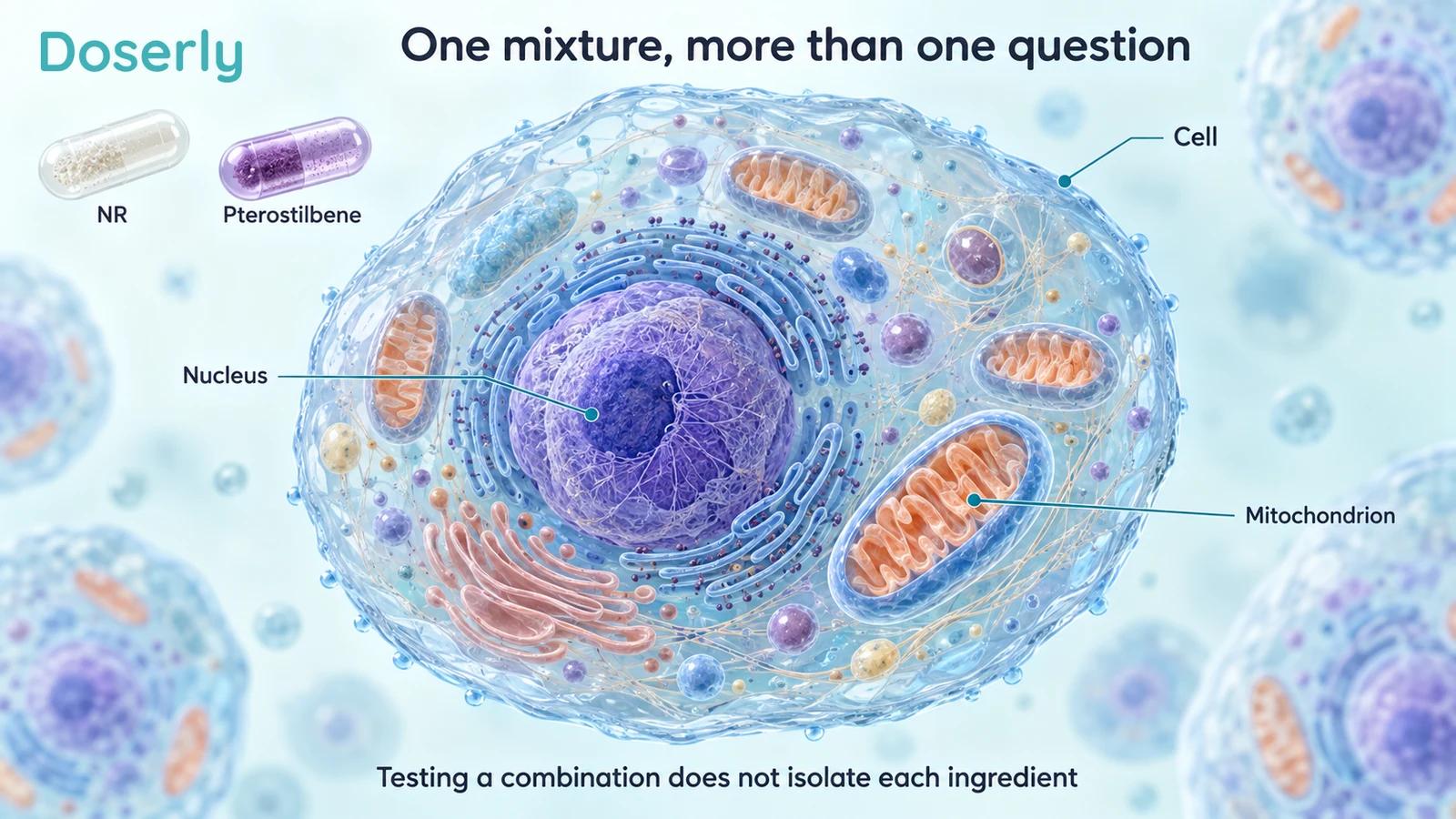
Imagine a trial with two groups: NR plus pterostilbene, and placebo. If the combination changes blood NAD, the trial can attribute that difference to receiving the combined intervention rather than placebo, subject to the study’s limitations.
It cannot determine whether pterostilbene was necessary. NR alone might have produced the same response, a smaller response or a larger response. Without an NR-only group, those possibilities remain unresolved.
Testing added value requires a more informative comparison: the same NR regimen with and without the second ingredient. To establish a statistical interaction often described as “synergy,” a suitable design may need placebo, each ingredient alone and their combination. A larger response to a mixture than to placebo is not, by itself, evidence of synergy.
This distinction is practical. Someone paying for an additional ingredient is interested in its incremental benefit and risk. A study can be valid and useful while not answering that purchase question.
What the early NR–pterostilbene trial showed
A 2017 blinded randomized trial enrolled 120 healthy adults aged sixty to eighty. Participants received placebo or one of two amounts of a fixed NR–pterostilbene combination for eight weeks. The lower combination contained 250 mg NR and 50 mg pterostilbene daily; the other used twice those amounts.
Whole-blood NAD rose by approximately 40% in the lower group and 90% in the higher group after four weeks compared with placebo and baseline, and the increase persisted through eight weeks. No serious adverse events were reported. Original NRPT trial.
That establishes a biochemical response to the tested products over the observed period. It does not establish extended lifespan, prevention of disability or the contribution of pterostilbene. There was no NR-only group.
The two amounts also changed both ingredients together. Consequently, the larger NAD response cannot identify which ingredient, or which relationship between them, accounts for the difference. The study’s commercial involvement is relevant context when assessing the need for independent replication.
These are research amounts, not a suggested regimen.
More NAD did not automatically translate into less liver fat
A later six-month trial studied the combination in 111 adults with what the paper called nonalcoholic fatty liver disease. It again used placebo and two combination amounts.
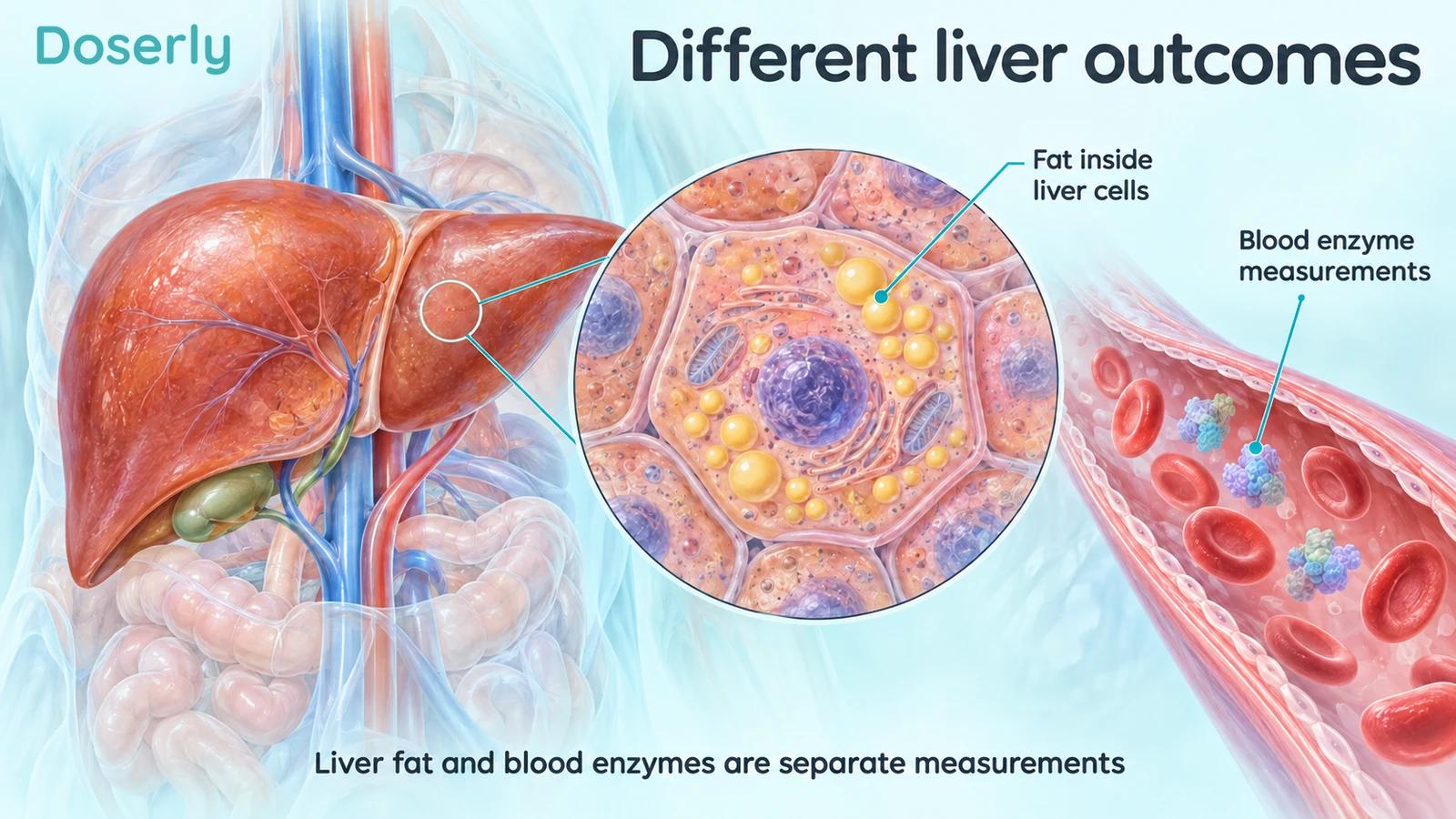
The primary endpoint, liver fat fraction, did not significantly improve compared with placebo. Some prespecified secondary outcomes were more favorable: the lower-dose combination reduced the liver enzymes ALT and GGT and a particular circulating ceramide. The higher amount did not show a corresponding dose-dependent advantage. Liver trial.
Liver fat, blood enzymes and fibrosis are not equivalent outcomes. A change in an enzyme associated with liver injury may be worth investigating, but it does not establish removal of liver fat, reversal of scarring or prevention of liver failure.
The study illustrates why the primary outcome should remain prominent when a headline emphasizes a favorable secondary result. It also challenges the assumption that doubling a combination necessarily doubles its clinical benefit.
The paper’s findings belong to its formulation and disease population. They cannot establish that adding several separate over-the-counter products reproduces the same exposure or effect.
A hospital safety study answers a narrower question
In a 2020 study, twenty-four hospitalized patients with acute kidney injury entered a short, escalating-dose experiment with NR plus pterostilbene or placebo. Each dose step lasted two days.
When the active-treatment steps were pooled, whole-blood NAD increased from baseline. Individual responses varied, and most separate dose steps did not reach statistical significance. Kidney-function measurements, including creatinine and estimated filtration rate, did not change with treatment. Three of the twenty active-treatment participants reported minor gastrointestinal symptoms. Acute kidney injury study.
This was a safety and biochemical-response study, not evidence that the mixture repairs injured kidneys. Pooling several small dose groups can help describe an overall signal but does not provide a precise therapeutic estimate for every dose.
Hospital monitoring also differs from unsupervised use. The study cannot be used to claim that a stack is universally safe in kidney disease or that a person with an abnormal kidney test should try it.
What happened when a trial actually included an NR-only group?
The NICE study, published in 2024, offers a more useful design for one added-ingredient question. Ninety people with peripheral artery disease received NR, NR plus resveratrol, or placebo for six months.
NR produced a favorable signal in six-minute walking distance compared with placebo. The authors did not find added benefit from resveratrol. They called for a larger trial to confirm the findings. The study used a one-sided statistical design, which also matters when assessing the strength of the result. NICE randomized trial.
This does not prove that resveratrol has no possible use. It means the extra ingredient did not establish the expected extra benefit in that particular comparison. A plausible mechanism was insufficient to guarantee a better functional result.
It also illustrates why results from different studies should not be compared as though they were randomized arms of the same trial. A favorable NR study in one population and a favorable polyphenol study in another do not establish that combining them improves either outcome.
A 2026 menopause pilot needs its design kept visible
A May 2026 report examined seven days of NR plus pterostilbene in forty women, including thirty-two who reported menopause-related symptoms. Participants knew they were receiving the supplement, and there was no placebo group.
The symptomatic group reported improvements in some symptoms, including hot flashes, bloating and poor sleep. Researchers also measured urinary hormonal and vitamin B3-related compounds. Open-label pilot.
Those observations can motivate a controlled study. They cannot separate a treatment effect from expectation, ordinary symptom fluctuation or regression toward a person’s usual level after a particularly difficult period. The eight participants with few or no symptoms were not a randomized placebo comparison.
The trial also cannot identify which ingredient contributed, nor show that the mixture substitutes for established menopause treatment. Its one-week duration is especially important when interpreting safety or durability. The authors’ company affiliations are disclosed in the report.
A newer publication can add useful observations without being stronger evidence than an older randomized experiment.
A safety paper can miss the risk you care about
The safety of a combination is not settled by one reassuring sentence about tolerability. Different studies measure different kinds of harm, over different timescales.
For example, an eighty-person pterostilbene trial reported an increase in LDL cholesterol with pterostilbene alone, even though some other measurements, including blood pressure at the higher amount, moved favorably. Pterostilbene metabolic trial.
That does not quantify the risk of every NR–pterostilbene product. It does show why an ingredient cannot be treated as a harmless accessory simply because it is included to support another ingredient’s mechanism. Laboratory tolerability, symptoms and cardiovascular risk markers are different parts of a safety assessment.
Similarly, “no serious adverse events” in a small, short study means none were observed under those conditions. It does not rule out uncommon reactions, interactions or effects of years of use.
Match the product before borrowing the evidence
Check the exact ingredients and amounts used in the cited study. NR is not NMN; pterostilbene is not resveratrol. A different delivery system, ratio or added ingredient creates a different intervention.
The NR guide, NMN guide and pterostilbene guide can help identify those distinctions. Their shared placement in a supplement category does not establish equivalence.
Product quality and clinical efficacy are also separate questions. Evidence that a batch contains its labeled ingredients is useful. It does not demonstrate that the mixture improves health.
In the United States, FDA does not approve dietary supplements for safety and effectiveness before they are sold. Its consumer guidance advises discussing supplements with a health professional and warns against substituting them for prescribed treatment. FDA supplement guidance.
A polished label, scientific diagram or reference list should therefore lead to closer questions about the actual experiment, not replace them.
What makes a personal stack hard to interpret?
Suppose you start NR, resveratrol and a new training program in the same week, then feel more energetic. The timing is real. The cause remains uncertain. Any ingredient, the exercise change, expectation, sleep or ordinary variation could have contributed.
The problem also applies to adverse effects. If several products change together, identifying the responsible exposure becomes harder. A complete dated record can help a clinician reconstruct the sequence, but it cannot create the missing randomized comparison.
Record the product name, ingredient list, amount actually used, frequency and start or stop date. Distinguish an intended daily routine from what you actually took. Include combination products that duplicate ingredients in other bottles.
In Doserly, that record can support a focused conversation about whether the routine still has a clear purpose. It should not become a scorecard that treats more products or a higher NAD result as automatic success.
Do not create a self-directed withdrawal or rechallenge experiment if you suspect a serious reaction. Contact a clinician, and seek urgent care for severe symptoms. The objective is a safer, interpretable treatment history, not proving causality at home. FDA guidance on supplement use and reactions.
Questions worth answering before adding another ingredient
First, name the outcome you want: a specific symptom, a functional limitation or a diagnosed condition. “Longevity support” is too broad to evaluate against an eight-week biomarker study.
Next, identify the closest relevant comparison. Was it the exact mixture against placebo, or the base ingredient with and without the proposed addition? Did the primary endpoint improve? Was the favorable result exploratory, restricted to a subgroup or measured without blinding?
Finally, ask what uncertainty the extra ingredient introduces. That includes adverse effects, interactions, cost, duplicated exposure and difficulty recognizing what is helping. More complex is not automatically more effective.
The strongest case for a stack would connect the actual formulation to a meaningful benefit, show why the added components are worthwhile and characterize harms over an appropriate period. The existing trials provide pieces of that picture. They do not make every plausible combination a proven intervention.
Sources
- NRPT trial, 2017.
- NRPT liver trial, 2022.
- NRPT acute kidney injury study, 2020.
- NICE trial, 2024.
- Menopause pilot, 2026.
- Pterostilbene metabolic trial, 2014.
- FDA: dietary supplements.