
TRT
October 16, 2026
Gonadorelin on TRT: Why Pulsatile Treatment Evidence Does Not Prove an Add-On Works
On this page
Gonadorelin is sometimes presented as a way to keep the reproductive hormone system active during testosterone replacement. The explanation often starts with a true statement: gonadotropin-releasing hormone, or GnRH, stimulates the pituitary to release hormones that support testicular function.
The next step is where the evidence can become blurred. Studies showing that carefully delivered pulsatile GnRH helps men with a specific hormonal deficiency do not automatically prove that occasional gonadorelin injections preserve fertility during ongoing TRT.
For this hormone, how it is delivered is part of the intervention. The starting diagnosis, the delivery pattern, whether testosterone is continued, and the outcome measured all matter. Keeping those details attached to the evidence makes it possible to assess a proposed treatment without dismissing legitimate specialist uses.
Gonadorelin acts upstream of the testes
Gonadorelin is a synthetic form of GnRH. It acts on pituitary gonadotroph cells, prompting release of luteinizing hormone, or LH, and follicle-stimulating hormone, or FSH. Those hormones then act at the testes.
hCG works at a different level. It has LH-like activity and stimulates Leydig cells in the testes directly. It does not need the pituitary to release LH first. Gonadorelin product information, PREGNYL prescribing information
That difference is enough to make “an hCG replacement” an incomplete description of gonadorelin. Two medicines can be discussed for the same goal while acting on different organs and depending on different conditions for a response.
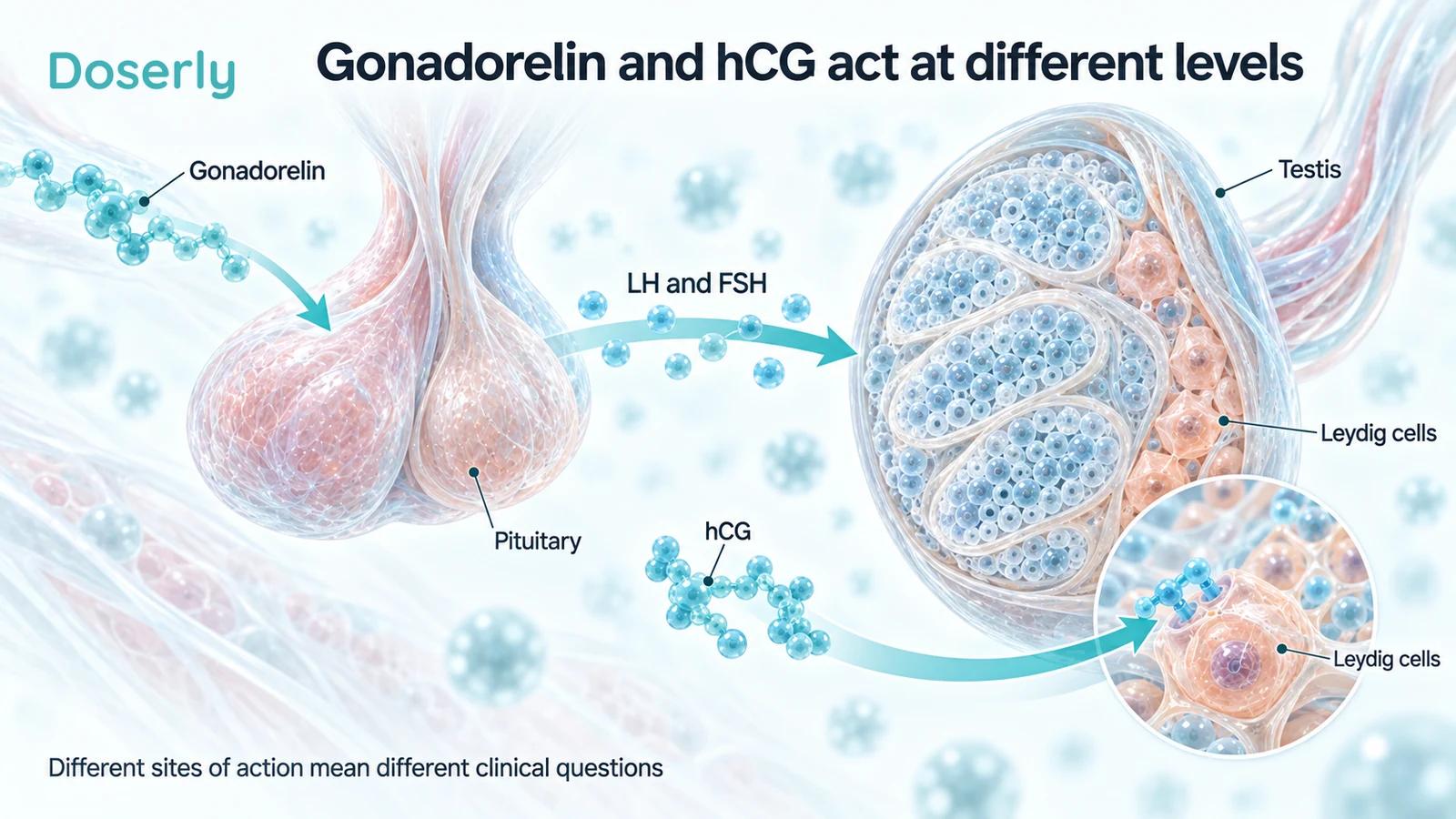
Doserly's comparison of hCG, gonadorelin and enclomiphene explains the different sites of action. Similar goals do not make the medicines dose-for-dose or evidence-for-evidence substitutes.
The pituitary responds to a pattern, not just a total amount
The normal GnRH signal is pulsatile. A classic experiment in rhesus monkeys with hypothalamic lesions showed why that pattern matters: intermittent GnRH restored pituitary gonadotropin secretion, whereas constant infusion did not sustain it. Continuous exposure could desensitize the response. Belchetz and colleagues
This is animal physiology evidence, not a trial of gonadorelin added to TRT in men. Its value is the principle it establishes: changing the timing pattern can change the biological response even when the same hormone is involved.
That principle should be applied carefully in both directions. It undermines the assumption that any injection schedule must reproduce a physiological pattern. It also does not prove that every intermittent schedule causes suppression or that every proposed adjunct is ineffective.
A drug name alone is therefore an incomplete description of treatment. The delivery method and schedule belong in the evidence comparison, just as the diagnosis and other medications do.
Short plasma half-life does not answer the whole clinical question
The UK product information describes gonadorelin as rapidly broken down, with a plasma half-life of about four minutes. That helps explain why a brief injection and ongoing pulsatile replacement are different exposures. Gonadorelin product information
It does not mean every downstream effect ends four minutes later. A signal can trigger responses that outlast the signal itself. Conversely, observing an LH response after an injection does not establish that sperm production will be maintained over months.
Both shortcuts miss the relevant question: does the complete regimen produce the desired clinical outcome in the intended population? Pharmacokinetics can explain why a schedule deserves scrutiny, but it cannot supply a pregnancy result that has not been measured.
This is also a reason not to treat native GnRH, longer-acting GnRH agonists and GnRH antagonists as interchangeable. Their pharmacology and intended clinical uses differ. A study of one is not automatically evidence for another.
What specialist pulsatile treatment has achieved
A clinical series published in 2002 treated eleven men with idiopathic hypogonadotropic hypogonadism using long-term pulsatile GnRH. Eight developed spermatogenesis on GnRH alone; another did so after subsequent gonadotropin treatment. Seven pregnancies were reported during follow-up. Christiansen and Skakkebaek
The separation matters. Saying “nine of eleven responded to GnRH” would incorrectly attribute the additional patient's outcome entirely to GnRH. The report also emphasized that some men required one to two years to maximize testicular growth and sperm development.
This is evidence that replacing a deficient signal can have meaningful reproductive effects in selected patients. It is not a trial showing that a small number of weekly injections overcomes suppression from ongoing exogenous testosterone.
The diagnosis and the treatment context are integral to the result. Removing them turns a useful clinical observation into a much broader claim than the study supports.
Even within a deficiency diagnosis, responses differ
Another study followed 76 men with idiopathic hypogonadotropic hypogonadism receiving pulsatile GnRH for twelve to twenty-four months. Outcomes depended partly on prior pubertal development and other baseline features. Hormone normalization was more uniform than sperm-production recovery.
Men without prior pubertal development had less complete testicular and sperm responses than those with partial or completed puberty. A history of undescended testes was an unfavorable predictor. Pitteloud and colleagues
This is a useful corrective to the idea that restoring one signal necessarily restores the entire reproductive system. The testes' developmental history and condition matter, even when the pituitary can respond.
It also explains why a specialist asks about puberty, prior testicular problems and previous fertility. These details are not administrative extras. They help determine how closely a patient resembles the people in whom a treatment has been studied and what expectations are reasonable.
A pump-versus-injection study asks a more relevant question
An older comparative study in thirty men with carefully diagnosed incomplete idiopathic hypogonadotropic hypogonadism compared twice-daily injections with delivery through a portable pump at ninety-minute intervals. The investigators reported better endocrine, sperm and fertility outcomes with the pump. Shargil
This was a historical, selected clinical population. It is not a modern randomized trial of an occasional adjunct during TRT, and its schedule should not be copied as a personal prescription.
Its relevance is narrower and important: researchers treated delivery pattern as something that needed direct comparison. They did not assume that two regimens were equivalent because both contained GnRH.
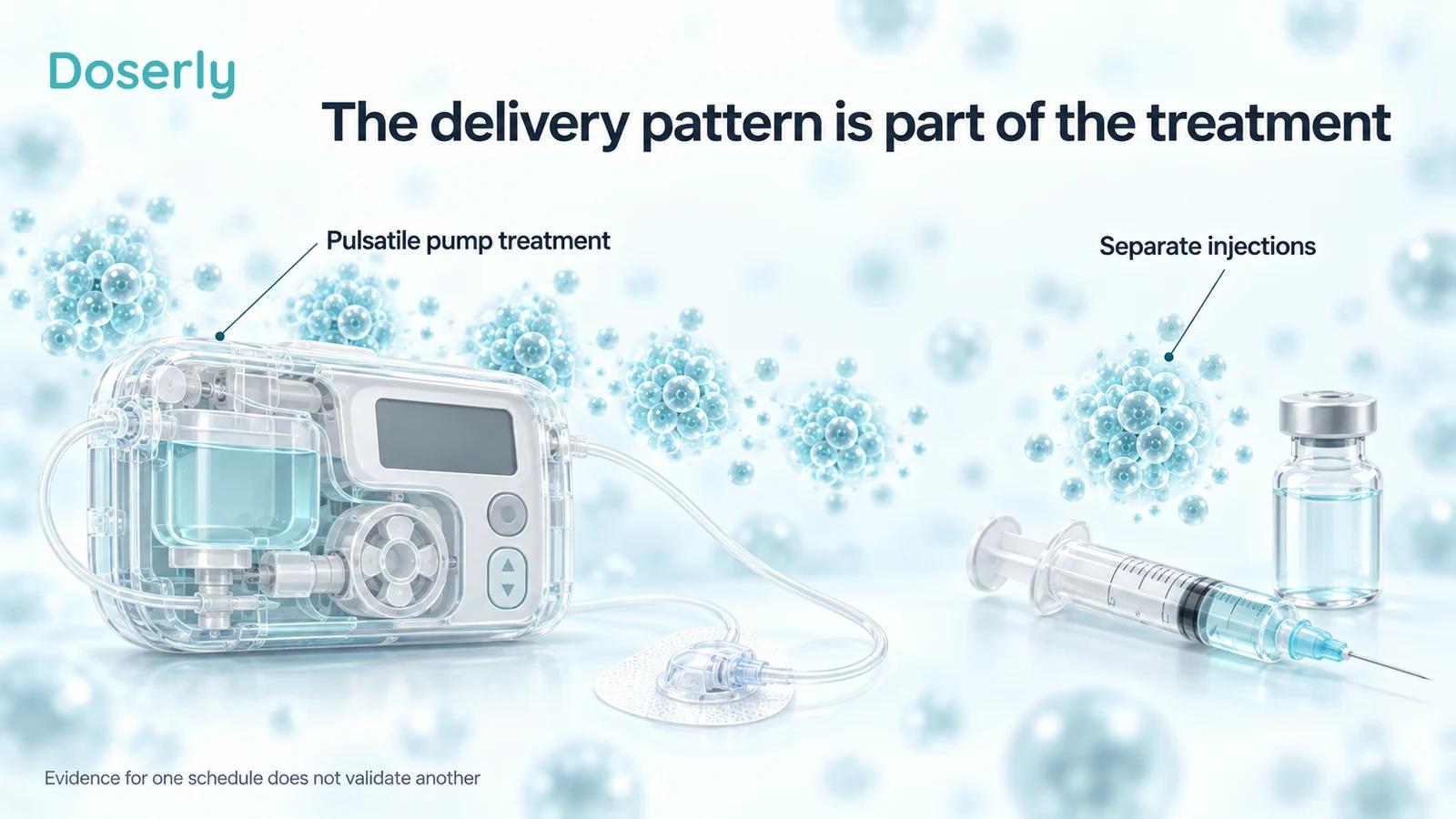
The practical question for a proposed regimen is therefore not just “does GnRH work?” It is “what evidence supports this delivery pattern for this diagnosis and this goal?”
Ongoing TRT changes the problem being treated
Exogenous testosterone suppresses hypothalamic-pituitary signaling through hormone feedback and can reduce or stop sperm production. A person receiving TRT is not automatically equivalent to someone whose primary problem is an untreated deficiency of GnRH.
The AUA/ASRM guideline advises against exogenous testosterone for men interested in current or future fertility, with additional discussion of individualized counseling for more distant plans. It also treats evidence for adjunctive preservation strategies as limited. AUA/ASRM guideline
In the primary and guideline sources reviewed for this article, the strong inference needed to endorse occasional gonadorelin as reliable fertility protection during continuing TRT was not established. The directly relevant trials would need to study that combination and schedule, with semen and reproductive outcomes.
That is an evidence gap, not proof that a transient pituitary response never occurs. A blood-test change after a dose can be real while still being insufficient evidence for the advertised long-term goal.
A diagnostic injection is not a fertility-treatment endorsement
The currently listed UK gonadorelin product has a single-injection diagnostic indication: assessing pituitary gonadotroph function. Its information explicitly describes limits to what that test can reveal. A response can demonstrate functioning cells without establishing the full cause of a hormonal problem or the pituitary's reserve. Gonadorelin product information
A licensed diagnostic use does not authorize every repeated-treatment claim. Likewise, availability of a medicine in one country does not establish that the same product, indication or supply arrangement applies everywhere.
This matters when a clinic points to an official product page as evidence. Read the indication and the actual use being described. “This molecule has a medical use” and “this exact regimen has proven fertility benefits during TRT” are different claims.
Doserly's gonadorelin guide covers the compound in more detail. The hCG guide provides a separate account of the medicine it is often compared with.
A post-injection result needs its timing attached
If a clinician measures LH or FSH after gonadorelin, the collection time helps define what the result means. A stimulation test deliberately measures a response to a particular exposure. It is not equivalent to a sample collected at an unrelated point in an ongoing regimen. Gonadorelin product information
Keep dose and collection times with the result, and ask what inference the clinician intends to draw. Demonstrating that the pituitary can respond is useful information; demonstrating adequate reproductive function over time requires a different assessment.
Match the outcome to the patient's goal
A treatment conversation can become confused when several aims are bundled under the word fertility. Preventing changes in testicular size, raising LH temporarily, maintaining blood testosterone, producing sperm and achieving pregnancy are distinct outcomes.
If the concern is sperm production, semen analysis provides direct information that blood testosterone cannot. WHO's laboratory manual supports standardized assessment and monitoring during interventions that affect spermatogenesis. WHO laboratory manual
If the goal is a pregnancy soon, the partner's reproductive circumstances and the time available also matter. Waiting on an uncertain regimen has a different consequence when a couple is already undergoing fertility evaluation than when someone is considering children many years later.
Be explicit about the goal before deciding what counts as success. A normal testosterone result should not be allowed to answer a question about sperm that was never measured.
What to ask when an adjunct is proposed
Ask the prescriber to identify the evidence that matches the proposal. A helpful explanation should name the diagnosis studied, whether testosterone continued, the delivery method, the duration and the actual outcome.
Then ask how the plan will be evaluated in your case. Is there a baseline semen analysis? When will it be reviewed? What happens if blood hormones look reassuring but sperm results worsen? Who coordinates care if a reproductive specialist becomes involved?
These questions do not require you to become an endocrinologist. They make the rationale specific enough to review.
A clear treatment record also helps. Keep the exact product name, formulation, dates, other hormone treatments and laboratory results together. If the regimen changes, record the reason. Otherwise it can become difficult to tell which intervention preceded an improvement or a problem.
Avoid replacing one oversimplification with another
There are two tempting but unsupported conclusions: that gonadorelin is automatically interchangeable with hCG, and that gonadorelin has no legitimate reproductive role. The evidence supports neither.
Pulsatile GnRH can help selected men with specific hypothalamic-pituitary disorders. The clinical studies also show that response depends on the starting condition and may take prolonged treatment. That is a substantial therapeutic use, not a reason to dismiss the hormone.
At the same time, a valid use in a deficiency disorder does not validate every add-on schedule offered to someone continuing TRT. Mechanism, a short-lived hormone response and a product's availability cannot substitute for outcome evidence.
The most useful next step is a reproductive plan built around the diagnosis and timeline. Doserly's TRT and fertility guide explains that broader planning process. A proposed adjunct should fit into that plan with a measurable goal and an honest account of what is known.
Sources
- Gonadorelin: UK Summary of Product Characteristics
- Belchetz et al. Continuous versus intermittent GnRH delivery
- Christiansen and Skakkebaek: Pulsatile GnRH in idiopathic hypogonadotropic hypogonadism
- Pitteloud et al. Predictors of long-term GnRH response
- Shargil: Daily injections compared with pulsatile pump treatment
- PREGNYL prescribing information
- AUA/ASRM Diagnosis and Treatment of Infertility in Men, amended 2024
- WHO laboratory manual for human semen, sixth edition