
Peptides
October 16, 2026
Peptide half-life explained: how doses build up and wear off
On this page
If a peptide has a half-life of one week, does that mean it works for a week? Is it gone before the next injection? And if you take another dose while some of the previous one remains, will the amount keep building forever?
These are good questions. Half-life helps explain why a medicine can be taken daily or weekly, why the first dose can feel different from later doses, and why a change may take time to show its full effect. You don't need a background in chemistry to understand it.
The starting point is simple: a half-life is the time it takes for a drug's concentration to fall by half during the part of its decline being measured. What happens next depends on how the drug enters the body, how often it's given, and what biological effects it sets in motion. Let's work through those pieces, then look at actual human data for several peptides.
What “half” actually means
Imagine that a drug's blood concentration has reached 100 on an imaginary scale. We're using a made-up scale so we can focus on the pattern rather than a treatment dose.
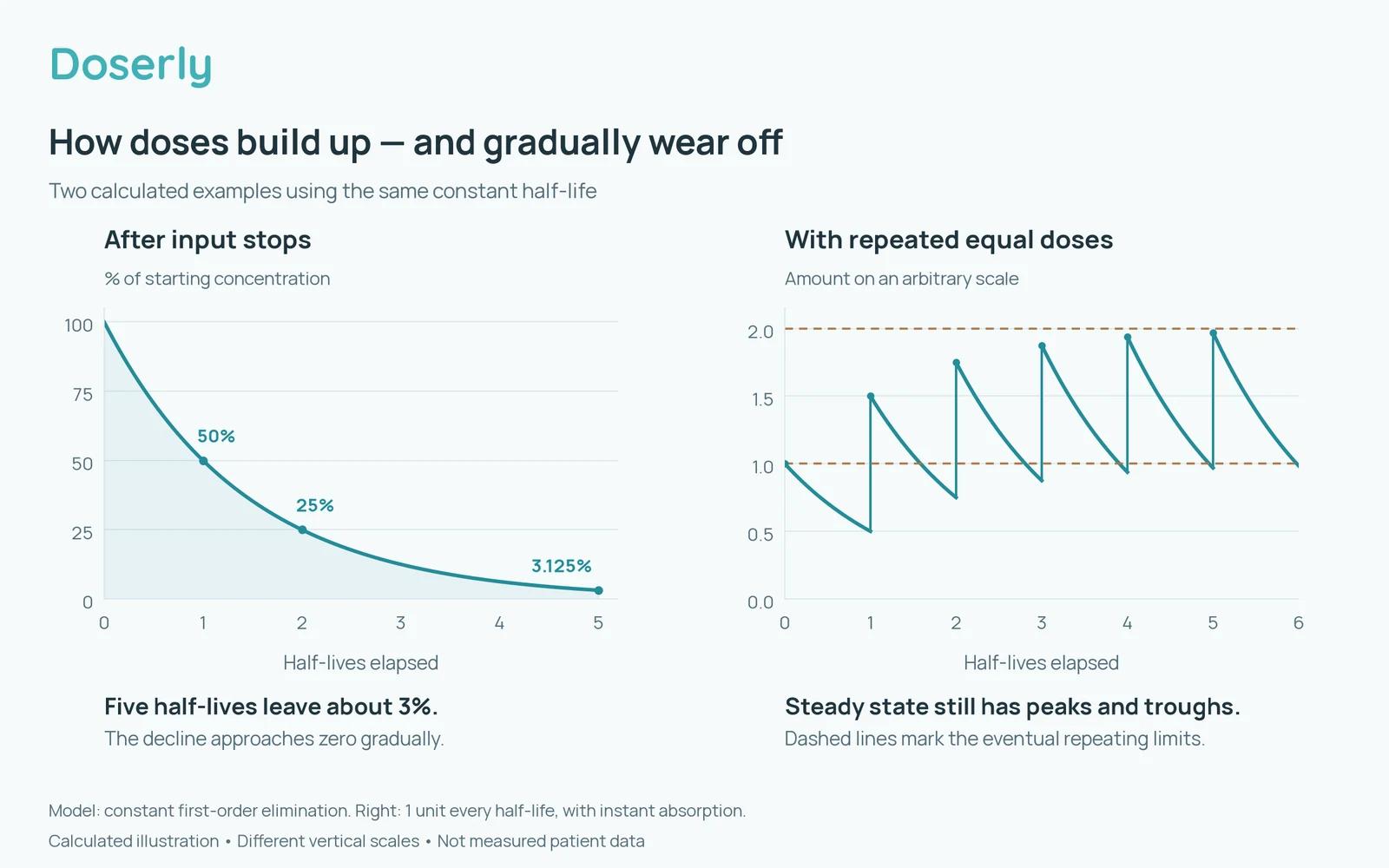
After one half-life, the concentration is 50. After another, it is 25. Then 12.5, then 6.25. Each interval removes half of what remains, rather than subtracting the same amount every time.
Half-lives elapsed
0
- Percentage of the starting concentration remaining
- 100%
Half-lives elapsed
1
- Percentage of the starting concentration remaining
- 50%
Half-lives elapsed
2
- Percentage of the starting concentration remaining
- 25%
Half-lives elapsed
3
- Percentage of the starting concentration remaining
- 12.5%
Half-lives elapsed
4
- Percentage of the starting concentration remaining
- 6.25%
Half-lives elapsed
5
- Percentage of the starting concentration remaining
- 3.125%
These percentages come from the calculation 100 × (1/2)ⁿ, where n is the number of half-lives. They describe a simple model with a constant half-life and no further drug entering the circulation. This is often called first-order elimination. Background on elimination half-life
The clock could be measuring minutes, hours or days. Five half-lives for a two-hour drug would be ten hours; five for a seven-day drug would be 35 days. The percentage pattern is identical, but the calendar is very different.
An injection doesn't necessarily reach its highest blood concentration immediately. The drug may still be moving from tissue into the bloodstream. A published terminal half-life describes the later decline in the measured concentration; it should not be treated as a stopwatch that starts with an instant peak at the moment of injection.
Why peptide half-lives vary so much
A peptide is a chain of amino acids, the building blocks also used to make proteins. That description covers many different molecules. Small changes in the chain or its attachments can substantially change how the body handles it.
Enzymes can cut peptide chains into smaller pieces. A drug developer may modify a vulnerable part of a molecule to make that happen more slowly. Another approach is to encourage binding to albumin, a plentiful protein in blood. Binding can reduce clearance and help protect some peptides from breakdown. How quickly a formulation is absorbed also contributes to the concentration pattern.
Semaglutide illustrates two of these design choices. Its structure includes a modification that improves resistance to the enzyme DPP-4 and a fatty-acid-containing attachment that promotes albumin binding. Those features help explain its prolonged exposure. Wegovy prescribing information, sections 11 and 12.3
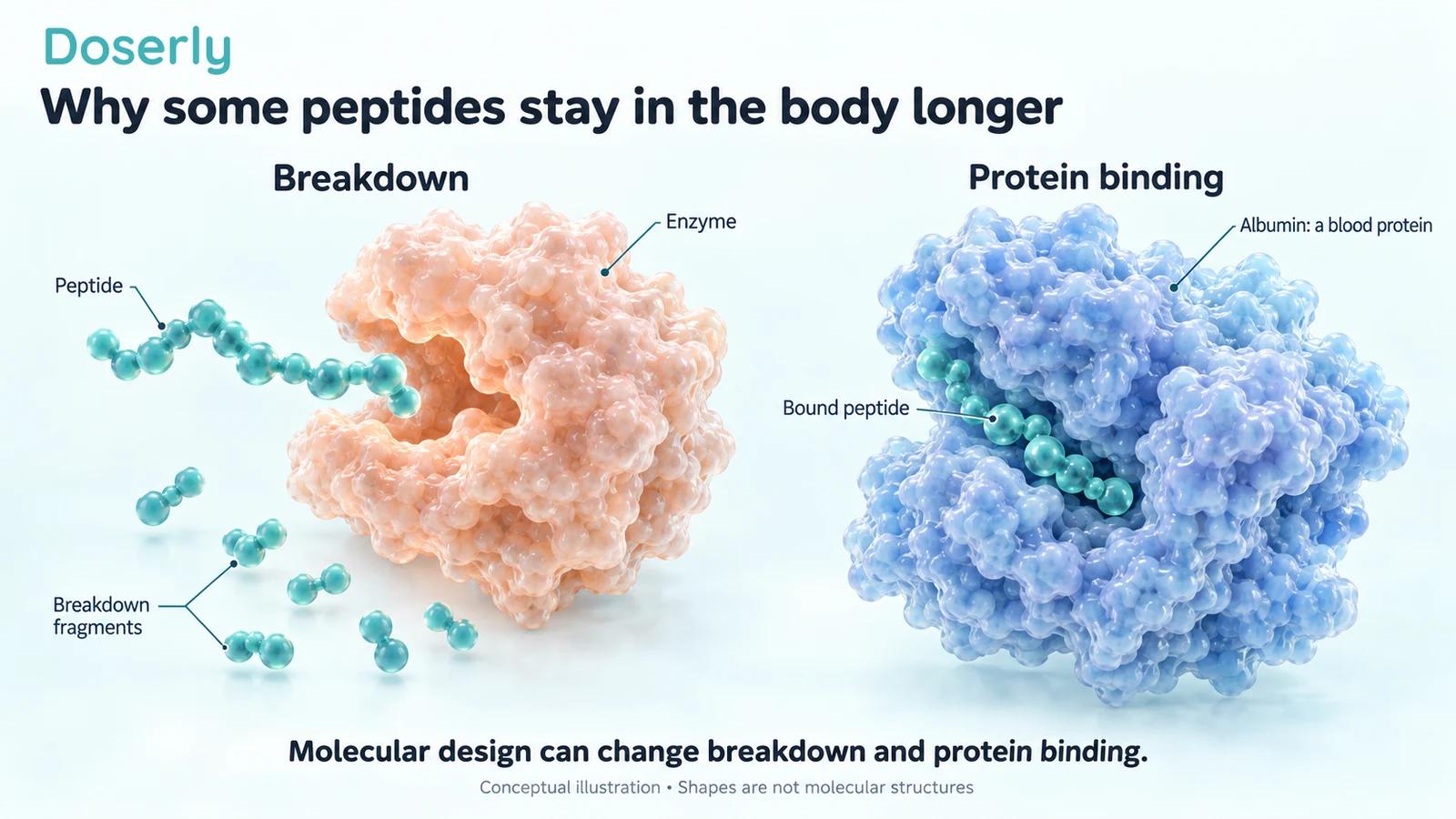
Even closely related signals can behave very differently. The Saxenda label describes a half-life of roughly 1.5–2 minutes for the body's own GLP-1, compared with about 13 hours for subcutaneous liraglutide. Liraglutide's slower absorption, protein binding and resistance to breakdown contribute to that difference. Saxenda prescribing information
That is why “peptides clear quickly” is too broad to be useful. Some do. Others have been deliberately designed to remain much longer.
Real examples: minutes, hours and days
The estimates below come from human pharmacology studies or prescribing information. Each belongs to the named molecule and formulation. The schedules describe approved products; they are not a way to calculate a schedule for a different peptide.
Peptide and context
Tesamorelin, Egrifta WR formulation
- Reported half-life
- Mean 11 minutes after a single subcutaneous dose in healthy participants
- What helps put it in perspective
- The approved product is given daily; its effects involve growth-hormone signaling.
Peptide and context
Liraglutide, Saxenda
- Reported half-life
- About 13 hours after subcutaneous administration
- What helps put it in perspective
- A daily medicine despite a half-life shorter than 24 hours.
Peptide and context
Tirzepatide, Zepbound
- Reported half-life
- About 5–6 days in the populations described in the current label
- What helps put it in perspective
- Weekly administration; steady-state concentrations reached after four weeks.
Peptide and context
Semaglutide, Wegovy
- Reported half-life
- About one week
- What helps put it in perspective
- The injectable product is administered weekly.
Peptide and context
Long-acting CJC-1295 studied in healthy adults
- Reported half-life
- Estimated 5.8–8.1 days
- What helps put it in perspective
- An investigational study result, not an approved dosing schedule.
Sources: Egrifta WR, section 12.3, Saxenda, Zepbound, section 12.3, Wegovy, and the CJC-1295 human study.
Notice that half-life and dosing interval do not have to match. The interval also depends on the concentrations needed for an effect, tolerability, and how long the biological response lasts. Tesamorelin's brief measured half-life doesn't mean that its downstream hormone response ends after eleven minutes.
Our tesamorelin guide, semaglutide guide and tirzepatide guide explain what those medicines do and which clinical outcomes have been studied.
How repeated doses “stack”
Here, stacking means accumulation of the same drug from repeated doses. It is different from combining several peptides in a “stack.”
Suppose a fictional medicine adds one unit to the body immediately, and another equal dose is given every one half-life. Just before the second dose, half a unit remains. The new unit brings the total to 1.5. One interval later, half of that remains: 0.75. Adding the third dose brings the total to 1.75.
The amounts immediately after successive doses are therefore 1, 1.5, 1.75, 1.875 and so on. They approach two units. They do not keep increasing without limit because, at higher amounts, more drug is removed during each interval under this model.
This is an arithmetic illustration with instant absorption and constant elimination, not a simulation of a specific injectable peptide. Its purpose is to show why a repeated dose can add to what is already present. Actual injections can produce rounded, delayed peaks rather than these immediate jumps.
Accumulation is often an expected part of treatment. It becomes important when someone assumes that the next injection starts from zero, or adds an extra dose because the first one seemed weak. The earlier dose may still be contributing even when there is no obvious sensation of it working.
What steady state means
With an unchanged dose and interval, the amount entering and leaving eventually balances over each dosing cycle. This is steady state. For repeated injections, it usually means a similar rise and fall each cycle—not one perfectly flat concentration all day.
In a simple linear model, a drug is roughly 94% of the way toward its eventual repeating pattern after four half-lives and 97% after five. That familiar four-to-five-half-lives rule is an approximation. Delayed absorption, changing doses and more complicated drug handling can affect the timeline. Elimination half-life and steady state
The tirzepatide label gives a product-specific example: steady-state concentrations were reached after four weeks of weekly administration. That is more useful for interpreting tirzepatide than borrowing a generic estimate from another peptide. Zepbound prescribing information
“Steady” also doesn't mean that appetite, body weight or every side effect has finished changing. Drug concentration is one measurement; the body's response is another. And if a prescriber changes the dose, the concentration pattern starts moving toward a new steady state. It isn't fully established the day the new dose is taken.
How long until it is out of your system?
The everyday phrase “out of your system” can mean several things: very little parent drug remains, a laboratory test can no longer detect it, an effect has worn off, or it is appropriate to start another treatment. Those are different questions.
After five half-lives, the simple calculation leaves about 3.1% of the starting concentration. That is a large reduction, but it is not zero. The starting concentration matters too: 3.1% of a higher concentration is still a larger absolute amount.
For an actual medicine, use its product information and the clinical context. The Wegovy label states that semaglutide can remain in circulation for about five to seven weeks after the specified maintenance doses. It also gives a separate recommendation to discontinue it at least two months before a planned pregnancy. A rough five-half-lives calculation should not replace that instruction. Wegovy prescribing information, sections 8.3 and 12.3
A drug's pharmacokinetics describe its movement through the body. Pharmacodynamics describe its effects. Learning those two terms helps explain why a falling drug concentration doesn't necessarily mean a hormone signal, symptom or adverse effect ends at the same moment.
In the original CJC-1295 trials, the investigators measured the peptide and downstream hormones separately. After a single injection, mean growth hormone remained elevated for at least six days, while mean IGF-1 remained elevated for nine to eleven days. These are different measurements from the peptide's estimated half-life. Teichman and colleagues
Why some online half-life charts are unreliable
The most useful half-life entry names the exact substance, formulation, route, population and source. Without those details, a precise-looking number can answer a different question from the one you intended to ask.
For example, the long-acting CJC-1295 studied in humans should not be treated as interchangeable with products sold as “CJC-1295 no DAC.” FDA's scientific review distinguishes the DAC and non-DAC substances. Importing the long-acting molecule's half-life into a calculator for a different product creates an error before the calculation even begins. FDA CJC-1295 scientific review
Other entries may come from an animal experiment, stability testing in a tube, or repetition across vendor websites. A peptide surviving in a storage vial is a different measurement from its persistence in human blood. A rat study can help researchers plan a human investigation, but it does not establish the human number.
If the human data do not establish a dependable half-life for the product in question, “unknown” is a useful answer. It tells you that a detailed-looking washout calendar or accumulation graph would depend on an unverified assumption. Our CJC-1295 half-life article works through that example in more detail.
How half-life helps with a real treatment conversation
Half-life is useful for understanding an existing prescription, planning the timing of follow-up, and describing what happened after a change. It is only one ingredient in choosing an interval. The tested formulation, benefits, adverse effects, device and missed-dose instructions matter as well.
If you notice a repeating pattern, describe it plainly: what changed, when it began relative to the dose, and whether it happened again. Recording the actual product, amount and administration time gives a clinician a better starting point than “it wore off early.” It also helps distinguish a missed dose from an intentional change.
The questions worth bringing to that conversation are practical: How long should this particular regimen take to settle? When should its benefits be assessed? Which symptoms should prompt earlier contact? And does the product have specific instructions for an interruption or a planned switch?
Once you understand that each dose can overlap with earlier doses, the timing becomes much easier to follow. Half-life explains part of the pattern; the medicine's human evidence and your clinical response determine what that pattern means for treatment.
Sources
- Elimination Half-Life of Drugs, NCBI Bookshelf — educational background on first-order elimination and steady state.
- Wegovy prescribing information — semaglutide design, persistence and pregnancy planning.
- Saxenda prescribing information — liraglutide and native GLP-1 pharmacology.
- Egrifta WR prescribing information — formulation-specific human tesamorelin half-life.
- Zepbound prescribing information — tirzepatide half-life and time to steady state.
- Teichman and colleagues, 2006 — randomized human CJC-1295 pharmacology studies.
- FDA CJC-1295 scientific review, 2024 — distinctions between the substances discussed under this name.