
Peptides
October 16, 2026
CJC-1295 half-life: what lasts for days, and why does it matter?
On this page
The original long-acting CJC-1295 molecule was developed to prolong stimulation of growth hormone release. Its human pharmacology paper reported an estimated half-life of 5.8–8.1 days, a duration that helps explain why the peptide remains a frequent topic in discussions about hormone timing.
But what exactly lasts that long? The drug in blood, the growth hormone response and the later insulin-like growth factor 1 response are different measurements. Their time courses overlap without being identical. None is a direct measure of how long someone experiences a benefit.
A long half-life describes exposure; it does not establish that the exposure improves health or provide a validated schedule for use. This article separates those timing questions and explains what the human studies actually found. Our CJC-1295 guide covers the wider evidence and product-identity issues.
What does half-life measure?
A drug half-life is an estimate of the time over which its measured concentration falls by half during a specified phase of its decline. It is calculated from concentration measurements using a pharmacokinetic model. Pharmacokinetics describes what happens to a substance in the body, including absorption, distribution and elimination.
The estimate also refers to a particular measured substance. A paper reporting disappearance of the parent drug is not necessarily measuring its downstream hormones at the same time. Keeping the analyte name beside the time estimate prevents two different biological clocks from being merged.
Half-life is not an expiration alarm. At one half-life, the concentration has not become zero. Nor does the number specify when every downstream biological effect ends. Hormone production, tissue responses and feedback can have their own timing.
It is also a study estimate, not a personal guarantee. The route, formulation, population and analytical method help define what the estimate means. A range reported from a development program should not be converted into an exact countdown for a person using a differently characterized product.
For CJC-1295, the distinction is especially important because the long-acting molecule binds to albumin and acts by stimulating another hormone system. The drug's disappearance and the response it provokes must be measured separately.
Why albumin binding was part of the design
Growth-hormone-releasing hormone, or GHRH, signals the pituitary gland to release growth hormone, abbreviated GH. Investigators wanted a GHRH analogue that would act longer than short-lived forms of the natural signal.
The DAC modification in the original CJC-1295 design enables covalent attachment to albumin, a protein in blood. In preclinical development, albumin-associated analogues retained biological activity and showed greater stability. CJC-1295 was detectable in rat plasma beyond 72 hours, with evidence of albumin association. Jetté and colleagues, 2005.
That experiment explains the design rationale. It does not establish a human half-life by itself. The human estimate came from later studies of the investigational molecule in people, and the two contexts should remain separate.
The albumin-binding feature also distinguishes the studied molecule from products described as “CJC-1295 no DAC.” FDA's review treats DAC and non-DAC active moieties as distinct. A duration attached to one cannot simply be assigned to the other. FDA CJC-1295 briefing.
What timing did the human paper report?
Teichman and colleagues reported two randomized, placebo-controlled, double-blind trials in healthy adults aged 21–61. Their study periods were 28 and 49 days, with single or limited repeated subcutaneous administration. The main purpose was to characterize exposure, hormone responses and short-term tolerability. Teichman and colleagues, 2006.
The findings involved three related measurements:
- The estimated CJC-1295 half-life was 5.8–8.1 days.
- After a single injection, mean GH increased approximately 2- to 10-fold for at least six days, depending on exposure.
- Mean IGF-1 increased approximately 1.5- to 3-fold for nine to eleven days.
IGF-1 is a hormone produced in response to GH signaling, including production by the liver. Its later response is therefore not another measurement of the amount of CJC-1295 remaining in blood. Repeated administration also produced a cumulative effect, with mean IGF-1 remaining above baseline for up to 28 days.
These numbers answer how the investigational product and hormone system behaved. They do not show that sleep, recovery or body composition improved for a matching number of days. The study's observation period should also not be mistaken for continuous daily dosing throughout that period.
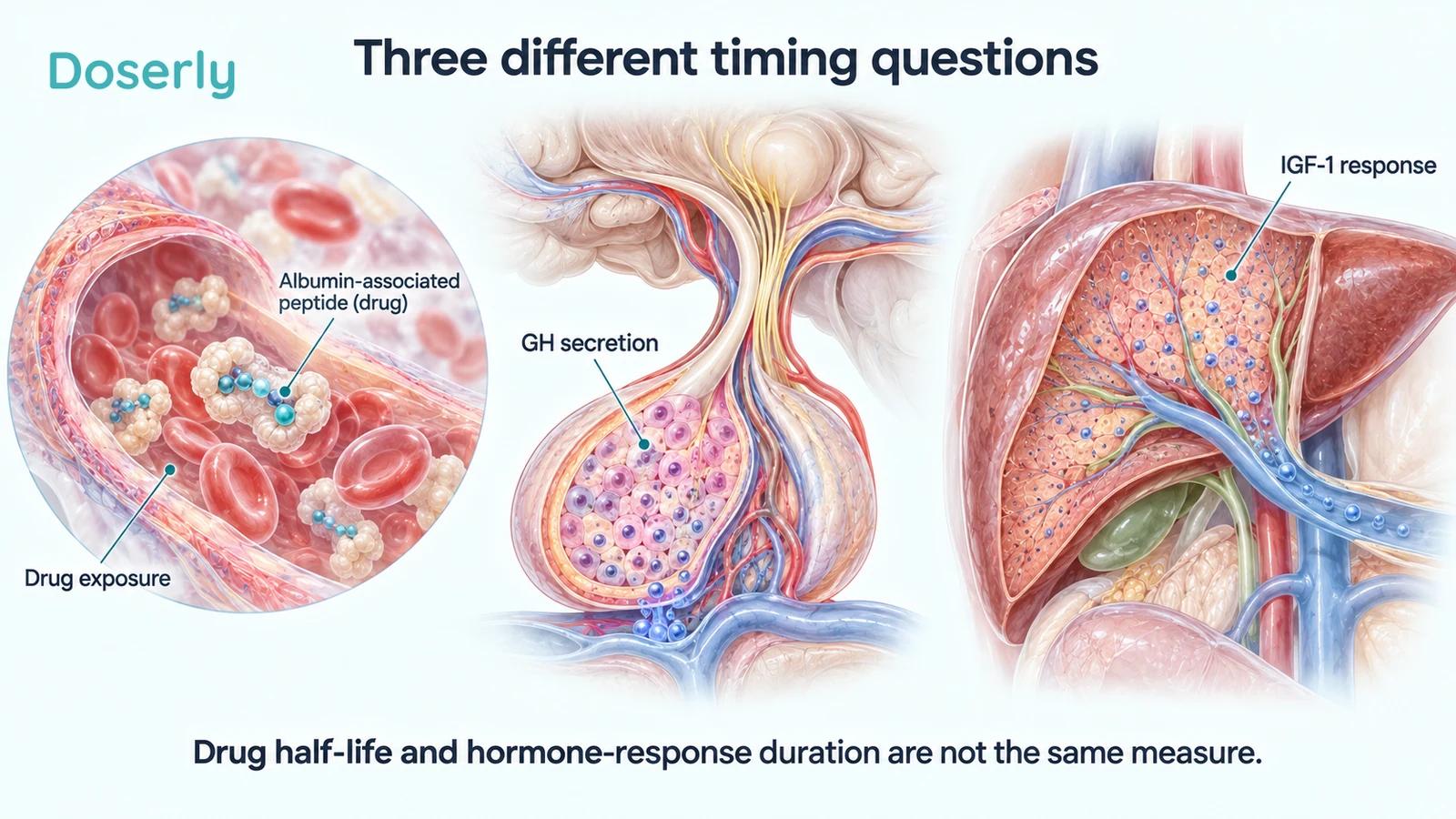
Why can the hormone response outlast a particular drug measurement?
CJC-1295 acts upstream of GH and IGF-1. A change in the initiating signal can alter secretion and production elsewhere in the system, while those products are themselves distributed and cleared. Measuring one part does not reveal the complete time course of all the others.
This is the distinction between pharmacokinetics, the drug's exposure, and pharmacodynamics, the biological response to that exposure. A pharmacodynamic result may be a hormone concentration without yet being a clinical benefit.
For a reader, the practical implication is that “it lasts a week” is incomplete. Ask which substance or response was measured and what endpoint defined the duration. Remaining detectable, staying above baseline and improving a symptom are three different statements.
A product page may combine these statements because they all concern time. The original paper keeps them separate, which is necessary for understanding what it supports. The difference is not technical trivia; it determines whether a claim describes a laboratory observation or a treatment effect.
Did the long signal flatten natural GH pulses?
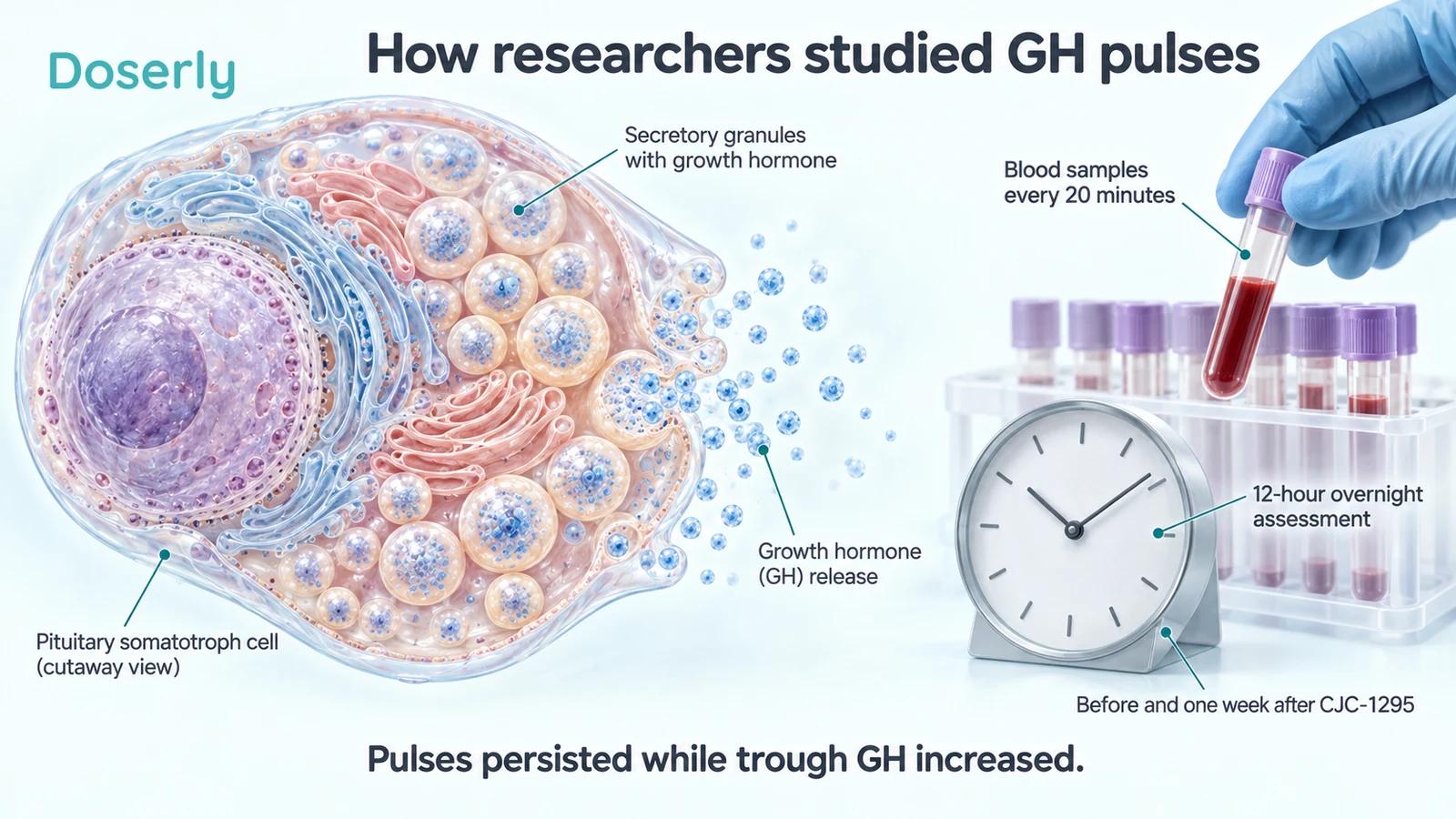
The available human pulse experiment does not support that description. Ionescu and Frohman studied healthy men using blood samples every 20 minutes across a 12-hour overnight period, before and one week after a single CJC-1295 exposure. Ionescu and Frohman, 2006.
GH secretion remained pulsatile. Pulse frequency and magnitude were not significantly changed in that assessment. Trough concentrations, the lower values between pulses, rose about 7.5-fold. Mean GH rose 46%, and IGF-1 rose 45%.
The finding is more specific than either “natural pulses are unchanged” or “GH becomes a flat line.” Some characteristics of the observed pulses persisted, while the background level rose considerably. Retained pulsatility does not mean the entire pattern remained physiologically identical to baseline.
It also does not establish a benefit from that pattern. The study was designed to characterize hormone secretion, not to prove that higher trough concentrations improve sleep or muscle function. The same caution applies to claims that a more intermittent product must be better: that comparison needs actual outcome data.
Peak, trough and total exposure are different
A peak is the highest observed or modeled concentration during a specified interval. A trough is a low point between higher values. An area under the concentration-time curve summarizes exposure across an interval rather than describing a single moment.
These measures can move differently. A sustained background increase may substantially change total exposure without creating a dramatic new peak. A brief high peak may contribute relatively little to a much longer observation period. Which feature matters depends on the biological question and needs to be studied.
That is why the CJC-1295 papers report more than a single hormone value. Looking only at the most striking fold-change can obscure the pattern. The 7.5-fold trough increase and the 46% mean increase, for example, refer to different quantities and should not be presented as competing estimates of the same effect.
For clinical interpretation, the next step is to connect those exposure patterns with outcomes and harms. A more sustained signal might be useful for some treatment goal, inconvenient for another, or produce no worthwhile benefit. Duration alone cannot rank these possibilities.
What does repeated exposure add?
When a substance persists, a later administration may occur while an earlier exposure is still contributing to the measured concentration or response. The original human report described cumulative effects after repeated CJC-1295 administration. That makes repeated use a different scientific question from a single exposure. Teichman and colleagues.
A repeated-use study would need to examine whether the pattern stabilizes, whether the response changes over time, and whether unwanted effects become more frequent or persistent. It would also need to follow participants after treatment ends rather than assuming that stopping administration immediately resets the system.
These considerations do not establish that a particular schedule is dangerous or beneficial. They explain why a half-life estimate cannot be used alone to design or validate one. The original early-phase studies were not comparisons of long-term wellness schedules.
Changing the product, route or adding another secretagogue makes the inference even less direct. An exposure model cannot compensate for uncertainty about what substance was actually administered.
Why short-lived GHRH numbers are not no-DAC instructions
An older study compared GHRH(1–29)-NH2 with its D-alanine-substituted analogue during intravenous infusions in ten healthy men. Their disappearance half-times were approximately 4.3 and 6.7 minutes. The substitution altered clearance under those conditions. GHRH analogue comparison, 1994.
This is useful evidence that a seemingly modest molecular change can affect exposure. It is not a direct clinical measurement of every product described today as modified GRF or no DAC. The exact sequence, formulation and route remain essential.
Placing the old minute-scale values beside the DAC study's day-scale estimate can explain the general development problem, but it does not create a head-to-head comparison. The studies involved different interventions and designs. A precise number assigned to the wrong molecule is less informative than an explicit statement that the product's duration has not been established by the cited source.
Does longer exposure mean more risk?
It changes the safety questions, but the available studies do not provide a simple rule that longer always means more harmful. A prolonged exposure can be relevant to how quickly an unwanted effect resolves, while a brief exposure can still provoke important biological consequences.
FDA's current information identifies limited clinical data for CJC-1295 and serious adverse events associated with it, including increased heart rate and systemic vasodilatory reactions. It also highlights characterization and immune-response concerns. These are reasons to avoid interpreting an appealing duration as a safety advantage. FDA risk information.
The information does not supply an individual risk estimate, and an association is not proof of causation in every report. A useful clinical assessment needs the actual product, exposure history, symptoms and relevant medical context.
How to use timing information in a clinical conversation
If timing is the reason you are considering a treatment, identify the goal first. Fewer administrations, a sustained hormone change and better daily function are not the same goal. Ask which of them the supporting study actually demonstrated.
When discussing an existing exposure, preserve the exact product description and dates alongside symptoms and laboratory measurements. A sample taken shortly after an exposure and one taken later may answer different questions. A clinician can use that context without assuming that the published half-life predicts every individual's course.
CJC-1295's long-acting design is a meaningful pharmacological feature. The evidence shows prolonged drug exposure and hormone responses, with pulses still visible in the studied setting. Whether that timing offers a worthwhile advantage for a particular health problem remains a clinical-outcome question, not a conclusion contained in the half-life number.
Explore the research
- Teichman et al., 2006: human half-life and hormone-response estimates.
- Jetté et al., 2005: albumin-binding design and rat experiments.
- Ionescu and Frohman, 2006: intensive overnight hormone sampling.
- GHRH analogue comparison, 1994: different short-lived molecules administered intravenously.
- FDA CJC-1295 briefing: identity and evidence distinctions.
- FDA risk information: safety signals and limited clinical data.