
In this guide
What is vanadium?
Vanadium is a transition metal present in trace amounts in food. Human essentiality has not been demonstrated. Supplements often contain vanadyl sulfate and are marketed for insulin sensitivity, glucose control or bodybuilding. [1]
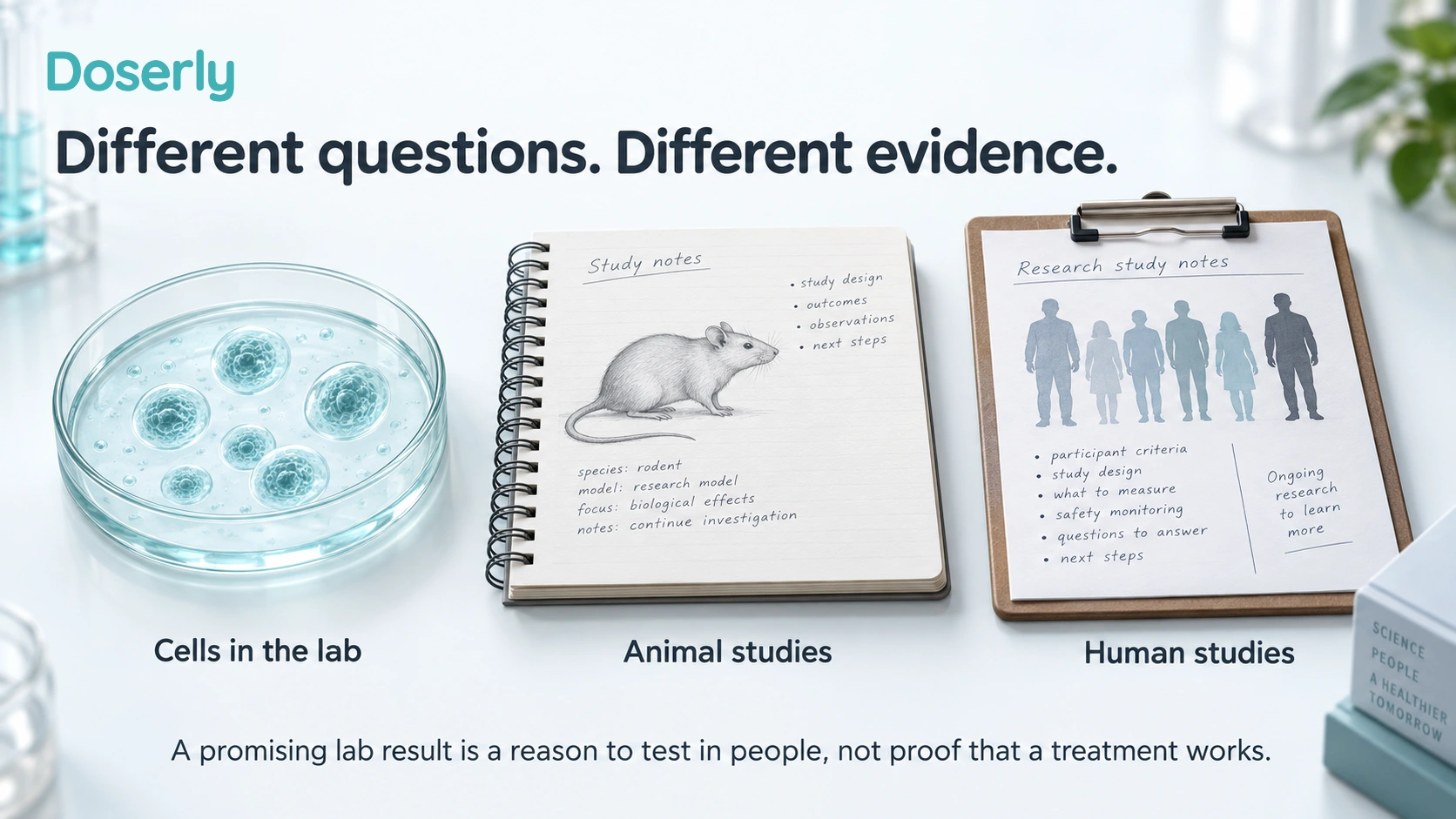
Those claims come from insulin-like effects in cells and animals plus a few small human experiments. The doses used in those experiments are pharmacologic-scale exposures, not nutrition requirements.
Typical Vanadium Protocols
| Purpose or population | Form and amount each time | Frequency | Total per day | Duration |
|---|---|---|---|---|
| Boden study · 8 adults with type 2 diabetes | 50 mg vanadyl sulfate | Twice daily | 100 mg vanadyl sulfate/day | 4 weeks |
| Jentjens acute phase · 7 healthy active adults | 100 mg vanadyl sulfate | One administration | 100 mg vanadyl sulfate | Night before the day-1 glucose test |
| Jentjens short phase · same 7 adults | 50 mg vanadyl sulfate | Twice daily | 100 mg vanadyl sulfate/day | 6 days, final test on day 7 |
The papers report vanadyl-sulfate salt mass, not elemental vanadium in these schedules. Converting the number into elemental vanadium without the exact hydrate/formulation would be unreliable. [2], [3]
Why salt mass is not rewritten as elemental vanadium
Both primary abstracts report milligrams of vanadyl sulfate. [2], [3] Hydration state changes molecular mass, and the accessible reports do not supply enough formulation detail for a dependable elemental conversion.
The guide therefore preserves the stated salt amount. It also keeps the acute one-administration phase separate from six days of twice-daily use.
Micrograms in food, milligrams in trials
Scale and chemical form change the safety question.
EFSA estimated about 10–20 mcg vanadium per day.
Often 100 mg/day of vanadyl-sulfate salt, not elemental vanadium.
GI symptoms were common; longer-term organ and reproductive safety is unresolved.
The 1.8 mg/day North American adult UL is a safety boundary, not a nutrition target; EFSA set no UL.
Should vanadium be cycled?
No cycling schedule is evidence based. Short trials do not prove that intermittent exposure prevents toxicity or maintains a glucose effect.
What happens when it is stopped?
There is no established withdrawal syndrome. In small diabetes studies, glucose effects sometimes persisted briefly after stopping, but that does not support self-directed medication changes.
Which foods provide vanadium?
Foods provide very small amounts. EFSA estimated usual intake around 10–20 mcg/day. Dietary exposure is therefore fundamentally different from milligram-scale vanadyl-sulfate trials and supplements. [1]
Which vanadium forms are used?
Products use vanadyl sulfate, sodium metavanadate and organic complexes. Oxidation state, salt, hydration and elemental vanadium all matter. A label stating “100 mg vanadyl sulfate” does not mean 100 mg elemental vanadium.
How should vanadium be stored?
Keep it sealed, dry and away from children. Preserve the full Supplement Facts panel so salt form and declared elemental amount can be distinguished.
What is vanadium commonly used for?
Vanadium is marketed for glucose control, insulin sensitivity, muscle gain and athletic performance. Small diabetes studies found some glucose or clamp changes, but healthy-participant studies were null and no trial establishes prevention of diabetic complications, durable control or athletic benefit. [2], [3]
What does human research show?
The Boden single-blind controlled study gave eight adults with type 2 diabetes 50 mg vanadyl sulfate twice daily for four weeks; six then received placebo for four more weeks. Fasting glucose and hepatic glucose output decreased modestly, while total-body glucose uptake and several metabolic pathways did not change. Six of eight reported gastrointestinal effects during week one. [2]
The Jentjens study tested seven healthy active adults. Participants took 100 mg once before one glucose test, then 50 mg twice daily for six days before a final test on day seven. Neither acute nor short-term exposure changed fasting glucose, insulin or the study’s insulin-sensitivity index. [3]
How does vanadium work?
Vanadium compounds can inhibit protein tyrosine phosphatases and influence insulin-signaling pathways. These mechanisms explain research interest but do not establish a nutrient requirement or a favorable long-term benefit-risk balance.
What are the risks and interactions?
The U.S./Canada DRI set an adult UL of 1.8 mg/day elemental vanadium using animal data and a large uncertainty factor; EFSA could not derive a UL from its evidence review. These are framework-specific safety judgments, not recommended intakes. [6], [1]
Animal studies identified kidney, spleen, lung, blood-pressure, reproductive and developmental effects; human studies frequently report gastrointestinal symptoms. Athlete and bodybuilding products can approach doses associated with adverse effects. [1]
Glucose-lowering medicines create concern for additive hypoglycemia even though supplement effects are inconsistent. Kidney disease, pregnancy, trying to conceive and childhood are poor contexts for unsupervised use.
In the United States, dietary supplements generally lack FDA premarket approval for safety or efficacy. In Canada, natural health products require licensing and authorized labels carry an NPN or DIN-HM. [4], [5]
Which medicines interact with vanadium?
Review insulin, sulfonylureas and other glucose-lowering medicines. Also review kidney-active drugs and every mineral or bodybuilding product. Do not reduce diabetes treatment because of a supplement reading.
What should be monitored?
No validated vanadium-status test guides wellness use. If exposure occurs around diabetes, clinicians may focus on glucose, HbA1c, hypoglycemia, gastrointestinal symptoms, kidney function and medication changes. Serum vanadium belongs to specialized exposure assessment.
What do public communities report?
People discuss glucose readings, pumps and bodybuilding stacks. Reports rarely preserve salt versus elemental amount, diabetes-medication changes or gastrointestinal symptoms. This overhaul did not independently recrawl or quantify community posts.
How does vanadium compare with nearby guides?
| Guide | Main question | Key difference |
|---|---|---|
| Chromium | Mixed glucose evidence at microgram doses | Has a U.S. AI but no UL |
| Inositol | PCOS and metabolic evidence | Different compound and safety profile |
| Magnesium | Established adequacy and forms | Essential nutrient with RDA and supplement UL |
| Silicon | Connective-tissue trials | No established essentiality, but different formulations and risks |
Common questions about vanadium
Is vanadium essential for humans?
No human essentiality has been demonstrated. [1]
Is there an RDA or upper limit?
No RDA or AI is established. The U.S./Canada adult UL is 1.8 mg/day elemental vanadium, derived from animal kidney data with uncertainty; EFSA did not derive a UL. Neither value is a target intake. [6], [1]
Did the diabetes study prove treatment efficacy?
No. It involved eight adults, lasted four weeks and measured glucose metabolism rather than complications. [2]
Were gastrointestinal effects common?
Yes. Six of eight participants in the Boden study reported them during week one. [2]
Did healthy active adults benefit?
No insulin-sensitivity benefit was detected after the acute or six-day exposure. [3]
Is 100 mg vanadyl sulfate equal to 100 mg vanadium?
No. One is salt mass; elemental content depends on the exact compound and hydration state.
Can vanadium replace diabetes medication?
No. The evidence is too small and the safety margin too uncertain.
Glossary
Plain explanations of vanadium terms.
- Vanadyl sulfate
- A vanadium(IV) salt used in several small glucose studies.
- Elemental vanadium
- The mass of vanadium itself rather than the full salt compound.
- Tolerable Upper Intake Level (UL)
- A population safety boundary. The U.S./Canada DRI sets 1.8 mg/day elemental vanadium for adults; EFSA did not derive one.
- Euglycemic clamp
- A research method for measuring insulin sensitivity under controlled glucose and insulin delivery.
- Hepatic glucose output
- Glucose released by the liver into circulation.
- Nutrient essentiality
- Evidence that a substance is required for normal human function and cannot be made adequately by the body.
How this guide was researched
This draft uses the U.S./Canada DRI chapter, EFSA’s vanadium safety opinion and live NCBI metadata/primary abstracts for the Boden and Jentjens studies. Titles, authors, journals, DOI identifiers and schedules were checked on October 9, 2026.
How this guide was made
Research and drafting were AI-assisted. This draft awaits Doserly editorial and independent clinical review. Read the editorial policy.
Explore the sources
Two framework-specific official safety reviews and two very small trials define the evidence boundary.
Showing 6 sources
- 01
Opinion of the Scientific Panel on Dietetic Products, Nutrition and Allergies on a request from the Commission related to the Tolerable Upper Intake Level of Vanadium ↗
Official safety opinion
Retrieved opinion read for essentiality, ordinary food exposure, toxicology, gastrointestinal effects and inability to derive a UL.
Detail: Typical food intake about 10–20 mcg/day; no human essentiality; data inadequate for a UL.
- 02
Effects of vanadyl sulfate on carbohydrate and lipid metabolism in patients with non-insulin-dependent diabetes mellitus. ↗
Single-blind placebo-controlled study
Live NCBI metadata and primary abstract checked for authors, journal, DOI, exact schedule, outcomes and adverse effects.
Detail: 8 adults; 50 mg vanadyl sulfate twice daily for 4 weeks; modest glucose effects; GI symptoms in 6 of 8.
- 03
Effect of acute and short-term administration of vanadyl sulphate on insulin sensitivity in healthy active humans. ↗
Acute and short-term intervention study
Live NCBI metadata and primary abstract checked for authors, journal, DOI, one-administration phase, twice-daily phase and null outcomes.
Detail: 7 healthy active adults; 100 mg once, then 50 mg twice daily for 6 days; no insulin-sensitivity benefit.
- 04
Questions and Answers on Dietary Supplements ↗
Regulatory overview
Current official page reviewed.
Detail: General U.S. supplement framework.
- 05
Product Licensing ↗
Regulatory overview
Current official page reviewed.
Detail: Canadian natural-health-product licensing and NPN or DIN-HM.
- 06
Arsenic, Boron, Nickel, Silicon, and Vanadium ↗
U.S./Canada dietary reference intake chapter
Current official NCBI Bookshelf chapter read for lack of EAR or AI, animal kidney endpoint, uncertainty factor and adult UL.
Detail: Adult UL 1.8 mg/day elemental vanadium; derived from animal data and not a recommended intake.
No matching sources
Try a different term or show the full list.