
Type II Collagen (UC-II): The Complete Supplement Guide
On this page
Quick Reference Card
Attribute
Common Name
- Detail
- Type II Collagen (UC-II)
Attribute
Other Names / Aliases
- Detail
- UC-II, undenatured type II collagen, native type II collagen, chicken sternum cartilage collagen
Attribute
Category
- Detail
- Cartilage-derived joint support supplement
Attribute
Primary Forms & Variants
- Detail
- Undenatured type II collagen (native structure preserved, typically 40 mg daily); generic type II collagen powders and hydrolyzed collagen products are different materials and should not be treated as interchangeable [1][4]
Attribute
Typical Dose Range
- Detail
- Commonly studied range: 40 mg/day of undenatured type II collagen [1][2][3]
Attribute
RDA / AI / UL
- Detail
- No established RDA, AI, or UL. Not classified as an essential nutrient.
Attribute
Common Delivery Forms
- Detail
- Capsules and tablets; usually once-daily low-dose products
Attribute
Best Taken With / Without Food
- Detail
- Reviewed human trials center on once-daily oral use. Product labels vary on meal timing, and the available sources do not establish a single best timing rule.
Attribute
Key Cofactors
- Detail
- No essential cofactor identified in the reviewed sources. Common joint-stack pairings include Glucosamine, Chondroitin, MSM, Collagen, and Hyaluronic Acid.
Attribute
Storage Notes
- Detail
- Commercial UC-II products are usually shelf-stable capsules. Follow the product label and keep the container dry and sealed.
Overview
The Basics
UC-II is a very specific kind of collagen supplement. It is not the same thing as the large scoops of collagen peptides people stir into coffee. UC-II refers to undenatured type II collagen, usually sourced from chicken sternum cartilage, with the native structure kept as intact as possible [1][4].
That distinction matters because the use case is much narrower. UC-II is discussed mainly for joint comfort, stiffness, and mobility, especially around knee symptoms or activity-related discomfort. It is not usually taken for skin, hair, or broad protein support in the way generic collagen products are [1][2][3].
The other unusual thing is the dose. Most UC-II studies use 40 mg per day, which looks tiny compared with gram-level collagen powders. That small dose is one of the strongest clues that this ingredient is supposed to work differently from standard collagen peptides [1][2][3][4].
The Science
Type II collagen is the dominant collagen in hyaline cartilage, where it helps create the load-bearing matrix that allows joints to tolerate compression and movement [4]. Commercial UC-II products are generally derived from chicken sternum cartilage and processed to preserve the native triple-helical structure and antigenic epitopes that would be lost in hydrolyzed collagen production [1][4].
The human evidence base for UC-II is narrower than the broader collagen literature. The main clinical studies involve low-dose oral supplementation, usually 40 mg daily, in either knee osteoarthritis or activity-related joint discomfort models [1][2][3]. That evidence is promising but limited enough that the guide should stay focused on symptom support rather than disease-modifying claims.
Chemical & Nutritional Identity
Property
Chemical Name
- Value
- Type II collagen (undenatured native cartilage collagen)
Property
Category
- Value
- Structural cartilage protein / joint support ingredient
Property
Molecular Formula
- Value
- No single small-molecule formula applies to the intact protein ingredient
Property
Molecular Weight
- Value
- Native collagen is a high-molecular-weight structural protein; reviewed sources emphasize preserved native structure rather than a single commercial molecular-weight standard [4]
Property
CAS Number
- Value
- No single standardized UC-II commercial ingredient CAS number was identified in the reviewed source set
Property
PubChem CID
- Value
- No single PubChem small-molecule identifier applies to the intact commercial UC-II ingredient
Property
Natural Source
- Value
- Usually chicken sternum cartilage [1][4]
Property
FDA Classification
- Value
- Dietary supplement ingredient framework under DSHEA, not an approved drug treatment [5]
Property
Canada Classification
- Value
- Falls within the natural health product regulatory framework when sold through licensed pathways [6]
UC-II is best understood as a preserved structural protein ingredient, not as an essential nutrient. There is no deficiency state, no RDA, and no upper intake framework comparable to vitamins or minerals [5][6]. In practical terms, identity and processing matter more than nutrient chemistry here. The question is whether the native type II collagen structure is actually preserved from source material to finished product [4][7].
Mechanism of Action
The Basics
UC-II is usually explained through an oral tolerance concept. The basic idea is that a very small amount of native type II collagen may interact with immune tissue in the gut and nudge the body toward a calmer response to cartilage-related antigens. That is very different from the "drink collagen to rebuild collagen" story used for generic collagen peptides [4].
This is why the dose is so small. The goal is not to flood the body with protein. The goal is to preserve a recognizable collagen structure and let that structure trigger a regulatory response. If the native structure is lost, the rationale for using UC-II gets weaker [1][4].
The Science
The 2023 review literature describes UC-II as a structurally preserved form of type II collagen whose proposed activity depends on retained native conformation, source characteristics, and manufacturing conditions [4]. The review frames oral tolerance as the leading mechanistic hypothesis, with gastrointestinal immune interaction rather than bulk amino-acid delivery as the central concept [4].
That proposed mechanism fits the low-dose human trial design. Across the core clinical studies, participants received 40 mg daily rather than gram-level protein dosing [1][2][3]. The reviewed sources therefore support a mechanistic distinction between UC-II and hydrolyzed collagen products, even if the full biological pathway is not yet nailed down with absolute certainty [4].
Pathway
The practical pathway for UC-II looks like this: oral capsule intake, transit through the gastrointestinal tract with the native structure still partly preserved, local immune interaction in gut-associated lymphoid tissue, and then a downstream effect on joint comfort or motion rather than direct cartilage rebuilding [4]. That pathway is conceptual, not a guaranteed effect.
The key takeaway is that UC-II is pathway-sensitive. If the product is not truly undenatured, or if a shopper substitutes a generic type II collagen powder and expects the same result, the logic of the ingredient changes [4]. That form-specific distinction belongs at the center of the guide.
Absorption & Bioavailability
The Basics
Bioavailability is a tricky concept for UC-II because the usual question, "How much enters the bloodstream?" may not be the most important one. The reviewed material focuses more on whether the native structure survives enough of digestion to interact with the gut immune system than on classic plasma pharmacokinetics [4].
That means UC-II is not usually discussed as a high-absorption protein supplement. It is discussed as a structure-dependent ingredient. If the native form is preserved, the small dose may still matter. If the native form is lost, the product starts looking more like ordinary collagen material [4].
The Science
The review literature highlights structural preservation, digestive stability, thermal stability, and solubility as central technical issues for undenatured type II collagen [4]. The implication is that manufacturing choices may materially affect whether the ingredient still behaves like UC-II by the time it is swallowed [4].
The human trial record does not provide a robust public pharmacokinetic dossier with clear serum exposure numbers the way small-molecule supplements often do [1][2][3]. As a result, the guide has to treat absorption as a form-integrity question rather than a clean percent-absorbed figure. This is one reason generic type II collagen and UC-II should not be described as interchangeable.
Research & Clinical Evidence
Knee Osteoarthritis
The Basics
The strongest direct clinical use case for UC-II is knee osteoarthritis symptom support. In the key placebo-controlled trial, people taking UC-II reported better WOMAC symptom scores than placebo, and the active ingredient also compared favorably against a glucosamine plus chondroitin combination on some endpoints [1].
That does not mean UC-II reverses osteoarthritis or regrows cartilage. The human evidence supports symptom improvement and function support, not a cure claim. The benefit also appears modest enough that readers should think in terms of meaningful but limited symptom support, not a dramatic reset [1][4].
The Science
In a multicenter randomized trial, adults with knee osteoarthritis received UC-II 40 mg daily, glucosamine hydrochloride plus chondroitin sulfate, or placebo for 180 days [1]. The UC-II group showed statistically significant improvement in total WOMAC score compared with placebo and with the glucosamine plus chondroitin comparator, with supporting improvements in pain, stiffness, and physical function measures in the abstract record [1].
The result is clinically relevant because the comparator was not trivial. Glucosamine plus chondroitin is one of the most common joint-support combinations in the market. UC-II outperforming that comparator in the published abstract gives it a credible joint-support signal, even though the evidence base remains small and sponsor-linked [1].
Activity-Related Joint Discomfort
The Basics
UC-II has also been studied in people without diagnosed osteoarthritis who still get joint discomfort from activity. This matters because many real-world users are not trying to manage formal arthritis. They are trying to feel less stiff, recover more comfortably, or move better during training and daily activity [2][3].
In that population, the results lean toward improved range of motion and better tolerance of knee stress rather than dramatic pain relief. That makes UC-II feel more like a mobility-support supplement than a broad anti-inflammatory product [2][3].
The Science
In a randomized trial of healthy volunteers with exercise-related knee discomfort, UC-II 40 mg daily for 120 days improved average knee extension and increased the time participants could exercise before discomfort appeared [2]. A later multicenter trial in healthy adults with activity-related joint discomfort found greater knee flexion improvement versus placebo after 24 weeks, with additional extension benefit over time in the active group [3].
Those results suggest the ingredient may help in non-arthritic populations, but the outcomes are still joint-specific and gradual [2][3]. They do not support broad claims about whole-body inflammation, recovery, or generalized athletic enhancement.
Evidence & Effectiveness Matrix
Category
Joint Health
- Evidence Strength
- 7/10
- Reported Effectiveness
- 7/10
- Summary
- Best-supported use case. Human trials show improvement in knee symptoms or flexibility, and community feedback is directionally positive though limited [1][2][3].
Category
Pain Management
- Evidence Strength
- 6/10
- Reported Effectiveness
- 6/10
- Summary
- Clinical pain-related outcomes improve in osteoarthritis settings, but the evidence base is still narrow and not all users report clear relief [1].
Category
Daily Functioning
- Evidence Strength
- 6/10
- Reported Effectiveness
- 6/10
- Summary
- The best evidence is easier movement, less stiffness, and improved range of motion rather than broad functional transformation [2][3].
Category
Side Effect Burden
- Evidence Strength
- 6/10
- Reported Effectiveness
- 7/10
- Summary
- Trial abstracts do not show a major tolerability problem, and community sources rarely focus on side effects, but the adverse-event database is not deep enough for a higher certainty score [1][2][3].
Category
Treatment Adherence
- Evidence Strength
- 5/10
- Reported Effectiveness
- 7/10
- Summary
- The once-daily low-dose format is simple, but value perception may be weakened by confusion with cheaper generic collagen products.
Benefits & Potential Effects
The Basics
The realistic benefit profile for UC-II is fairly narrow. People use it because they hope for less stiffness, less knee discomfort, and easier movement over time. The reviewed evidence supports that direction, especially for knee symptoms and flexibility, but it does not support broad beauty, muscle, or anti-aging claims [1][2][3].
The practical value of UC-II is that it may offer a low-dose, relatively simple option for people who are specifically focused on joint comfort. The practical limit is that response is not guaranteed, and the evidence is still nowhere near broad enough to make it sound like a foundational supplement for everyone [1][4].
When you're taking multiple supplements, it's hard to know which one is doing the heavy lifting. The benefits described above may overlap with effects from other items in your stack, lifestyle changes, or seasonal variation. Doserly helps you untangle that by keeping everything in one place, with timestamps, doses, and outcomes logged together.
Over time, this builds something more valuable than any product review: your personal evidence record. You can see exactly when you started this supplement, what else was in your routine at the time, and how your tracked health markers responded. That clarity makes the difference between guessing and knowing, whether you're talking to a healthcare provider or simply deciding if it's worth reordering.
Connect protocol changes to labs and health markers.
Doserly can keep lab results, biomarkers, symptoms, and dose history close together so follow-up conversations have better context.
Insights
Labs and trends
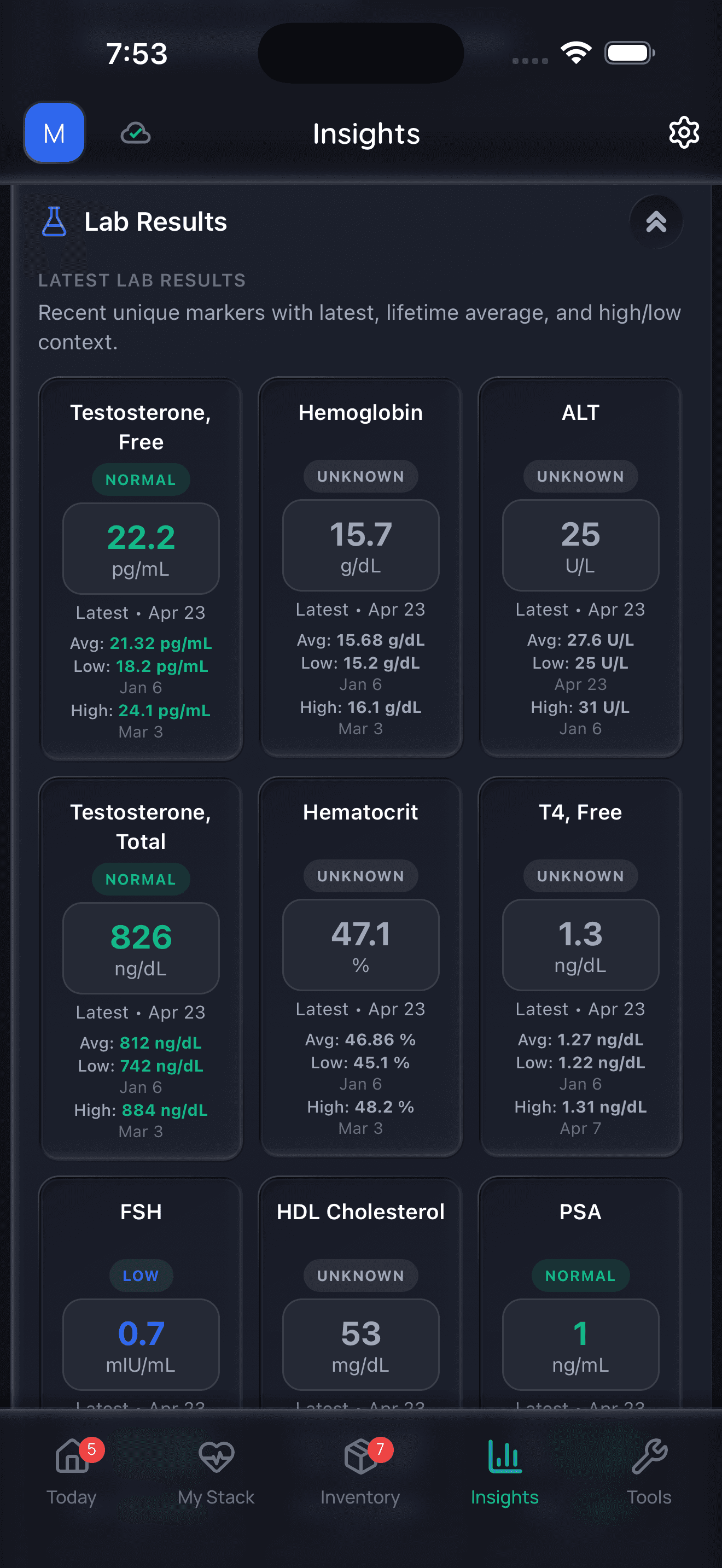
Doserly organizes data; it does not diagnose or interpret labs for you.
The Science
The clinical benefits observed in the reviewed studies cluster around WOMAC symptom improvement, flexibility, range of motion, and discomfort tolerance during activity [1][2][3]. The strongest mechanistic review also supports the idea that preserved native structure is a prerequisite for any meaningful benefit signal [4].
That means the benefit conversation should stay product-specific and joint-specific. The reviewed sources do not justify extrapolating UC-II results to all collagen products, nor do they justify strong claims about cartilage regeneration, fracture prevention, or systemic anti-inflammatory therapy [1][2][3][4].
Side Effects & Safety
The Basics
The available public UC-II studies do not point to a major safety problem at the studied 40 mg daily dose. In practice, the bigger safety concerns are less about the ingredient doing something dramatic and more about product quality, inaccurate labeling, or using joint-support supplements as a substitute for appropriate medical evaluation [1][2][3][5].
Source material also matters. UC-II is usually derived from chicken cartilage, so people with relevant source sensitivities should pay attention to labeling and formulation details. The reviewed sources do not provide a large public list of UC-II-specific side effects, which is reassuring but not the same as proving risk is absent [1][4].
The Science
The major human studies summarized in the source set report favorable tolerability at 40 mg daily, without a strong adverse-event signal in the abstract-level data [1][2][3]. Regulatory sources shift the safety emphasis toward manufacturing and labeling responsibility rather than a known intrinsic toxicity problem for UC-II itself [5][6][7].
For athletes and risk-sensitive users, contamination is a more concrete concern than the named ingredient alone. USADA and Global DRO both stress that supplements may not reliably reflect their labels and that contamination risk cannot be ruled out by ingredient name alone [8][9]. That belongs in the safety discussion because a joint supplement sold into sport can still create problems if the manufacturing chain is weak.
Dosing & Usage
The Basics
The commonly studied UC-II dose is strikingly small: 40 mg once daily [1][2][3]. That is the number readers should expect to see in the research record, and it is the clearest sign that UC-II should not be confused with collagen peptide products taken in grams.
What the sources do not show is a broad menu of well-validated alternative dosing strategies. The reviewed evidence is mostly built around one low-dose pattern. That makes the dosing section simple, but it also means there is not much room to sound overly precise or inventive here.
When your stack includes several supplements, each with its own dose, form, and timing requirements, the logistics alone can derail consistency. Doserly consolidates all of it into one protocol view, so every dose across your entire routine is accounted for without spreadsheets or guesswork.
The app also tracks cumulative intake for nutrients that appear in multiple products. If your multivitamin, standalone supplement, and fortified protein shake all contain the same nutrient, Doserly adds them up and shows you the total alongside recommended and upper limits. Managing a thoughtful supplement protocol shouldn't require a degree in nutrition science. The app handles the complexity so you can focus on staying consistent.
Build reminders around the routine, not just the compound.
Doserly can keep timing, skipped doses, and schedule changes organized so the plan you read about becomes easier to follow and review.
Today view
Upcoming reminders

Reminder tracking supports consistency; it does not select a protocol for you.
The Science
Across the key human studies, UC-II was administered orally at 40 mg daily in both osteoarthritis and activity-related discomfort settings [1][2][3]. The consistency of that dosing pattern is useful because it suggests the evidence base is not built on a wide, conflicting dose range.
At the same time, the review literature argues that structure preservation, source material, and manufacturing conditions matter enough that even a perfectly matched label dose may not guarantee the same biological behavior across all commercial products [4]. The most accurate dosing summary is therefore: 40 mg daily is the commonly studied range for true undenatured type II collagen, but the product form and integrity matter as much as the nominal dose.
What to Expect
UC-II is a patience ingredient. The human studies track changes over 120 days, 180 days, and 24 weeks, not over a weekend [1][2][3]. That does not prove a person must wait that long to notice anything, but it does suggest that the meaningful signal is gradual.
In the first few weeks, many users would realistically expect no obvious change. By the one- to three-month range, the most plausible outcomes are subtler stiffness reduction, slightly easier movement, or better tolerance of knee discomfort rather than dramatic pain elimination [1][2][3]. In longer runs, some users may feel that day-to-day movement is smoother. Others may feel very little.
One of the hardest parts of any supplement routine is knowing whether it's working when results unfold gradually over weeks or months. Without a record, it's easy to abandon something too early or keep taking something that isn't delivering. Doserly solves that by giving you a visual timeline of your entire supplementation history mapped against the outcomes you care about.
When everything is in one view, you can compare how different supplements in your stack are performing over the same period. You can see whether adding this supplement coincided with the improvement you've noticed, or whether the timing points to something else entirely. That kind of clarity turns patience into a strategy rather than a gamble.
Keep sensitive protocol records in a purpose-built app.
Doserly is designed for private health tracking with structured records, offline-ready workflows, and exportable history when you need it.
Privacy
Health records
Privacy controls help you manage records; keep clinical records where required.
Interactions & Compatibility
SYNERGISTIC
- Glucosamine and Chondroitin: Common comparison and pairing ingredients in the joint-support space. The reviewed UC-II literature suggests its mechanism and dosing are distinct from those higher-dose structural joint formulas [1].
- MSM: Frequently paired in real-world joint stacks, though the reviewed UC-II source set does not establish a specific UC-II plus MSM trial protocol.
- Collagen and Hyaluronic Acid: Common consumer pairings for joint support and mobility. These pairings may make stack attribution difficult.
- Vitamin C: Common connective-tissue support companion, though no essential UC-II-specific cofactor relationship was identified in the reviewed sources.
CAUTION / AVOID
- Generic "type II collagen" assumptions: The clearest compatibility problem is conceptual. Do not assume any type II collagen product behaves like UC-II [4].
- Proprietary joint blends: Mixed-ingredient products can make dose verification, quality review, and response attribution harder [5][8].
- Source sensitivity concerns: Because UC-II is typically derived from chicken sternum cartilage, product-source review matters for people with relevant sensitivities or dietary restrictions [1][4].
- Medical-condition self-substitution: The reviewed sources support symptom-focused use, not replacement of diagnostic workup or disease-directed care.
How to Take
The practical administration pattern in the reviewed studies is simple: oral, once daily, low dose [1][2][3]. Beyond that, the evidence becomes less rigid. Community discussions show that users often get distracted by whether to take it with food, with vitamin D, or on an empty stomach, but the strongest public evidence centers on product identity and consistency rather than on a highly specific timing trick.
That means the most defensible administration guidance is modest. Readers should focus first on whether the product is truly undenatured type II collagen and whether they can take it consistently over an adequate timeframe. Timing details may matter less than avoiding product-form confusion and sticking with a routine long enough to observe whether anything changes [1][4].
Choosing a Quality Product
UC-II is one of those supplements where label language matters a lot. A quality review starts with verifying that the product is actually undenatured type II collagen rather than a generic collagen blend. If the label blurs that distinction, the research match gets weak immediately [4].
Quality also means looking past marketing. Health Canada quality guidance emphasizes identity, quantity, purity, contaminant control, and documented specifications [7]. FDA and Health Canada both place real responsibility on manufacturers and licence holders rather than promising that every product on the market has already been vetted for performance [5][6][7].
For athletes or anyone highly risk-sensitive, third-party sport testing is especially relevant. USADA highlights NSF Certified for Sport as the most useful certification program for reducing anti-doping contamination risk, while also warning that no supplement or company is approved by USADA itself [8]. For this ingredient, quality selection is more about identity and contamination control than about chasing aggressive claims.
Storage & Handling
The reviewed sources do not identify a special UC-II-specific refrigeration or cold-chain requirement. Most commercial products appear to be shelf-stable capsules, so the practical storage baseline is the standard supplement approach: keep the container sealed, dry, and out of excess heat.
The more important handling issue is preserving product integrity through normal storage and buying from manufacturers that can document quality control. Because UC-II depends on native structure, sloppy storage or poor manufacturing is a more meaningful concern than it would be for a generic amino-acid powder [4][7].
Lifestyle & Supporting Factors
UC-II is easiest to understand as one small part of a broader joint-support picture. The clinical studies focus on knee symptoms, flexibility, and activity-related discomfort, which means movement habits, cumulative load, and realistic expectations still matter [1][2][3].
Lifestyle support in this context usually means protecting the signal. If someone starts UC-II while also changing training volume, body weight, footwear, rehab work, or several other joint supplements, it becomes very hard to know what helped. A cleaner routine and better symptom tracking are often more useful than adding more products to the stack.
Regulatory Status & Standards
In the United States, UC-II is sold under the dietary supplement framework rather than as an approved drug treatment for osteoarthritis [5]. In Canada, comparable products fit into the natural health product regulatory framework, which requires product licensing and site licensing when sold legally through that system [6].
Those regulatory categories matter because they define how the ingredient can be marketed, what quality documentation manufacturers should hold, and how post-market oversight works [5][6][7]. They do not guarantee that every product on the shelf will match the exact ingredient profile used in the published trials.
For athlete-facing guidance, the public sources reviewed here focus mainly on contamination risk rather than on a UC-II-specific prohibited-substance designation. Global DRO states that supplements are not covered the same way regulated pharmaceutical products are, and USADA warns that label accuracy and contamination remain central concerns [8][9]. The most practical sports-regulation message is conservative: regulatory status and anti-doping rules change, contamination is real, and athletes should verify current status with their governing body, qualified sports medicine professionals, and a credible certification program before use.
FAQ
Is UC-II the same thing as collagen peptides?
No. The reviewed sources treat UC-II as an undenatured type II collagen ingredient with a joint-specific use case, while generic collagen peptides are processed very differently and are usually taken in gram-level doses [1][4].
Why is the dose only 40 mg?
Based on the available human studies, 40 mg daily is the commonly studied range for UC-II [1][2][3]. That low dose is part of the reason the ingredient is framed differently from generic collagen products.
Does UC-II rebuild cartilage?
The current evidence supports symptom and function support more clearly than cartilage rebuilding. The reviewed trials are about WOMAC outcomes, range of motion, and activity-related discomfort rather than proof of cartilage restoration [1][2][3].
How long does UC-II usually take to show anything?
Based on the available trial timelines, the public evidence tracks outcomes across roughly 4 to 24 weeks, with longer studies often used for the most meaningful readout [1][2][3].
Is UC-II mainly for osteoarthritis?
That is the strongest clinical use case in the reviewed sources, but the ingredient has also been studied in healthy adults with activity-related joint discomfort [1][2][3].
Can I treat all collagen supplements as equivalent?
No. The biggest repeat theme in both the clinical and community material is that UC-II should not be assumed equivalent to generic type II collagen or hydrolyzed collagen peptides [4].
Is UC-II easy to tolerate?
The reviewed public studies do not show a major adverse-effect pattern at 40 mg daily, and community discussion is relatively quiet on side effects, but that does not remove the need for product-quality review and individualized medical judgment [1][2][3][5].
Is UC-II safe for athletes?
The named ingredient is not the only issue. USADA and Global DRO emphasize contamination and labeling uncertainty across supplements more generally, which means athletes still need current verification and third-party testing where relevant [8][9].
Myth vs. Fact
Myth 1: All collagen supplements work the same way.
Fact: UC-II is a specific undenatured type II collagen ingredient studied at 40 mg daily. That is not the same evidence base as gram-level collagen peptides [1][4].
Myth 2: More UC-II must be better.
Fact: The public human trials reviewed here consistently center on 40 mg daily. The available evidence does not establish a "more is better" rule for this ingredient [1][2][3].
Myth 3: UC-II has been proven to regrow cartilage.
Fact: The reviewed human evidence supports symptom and mobility benefits more clearly than structural cartilage regeneration [1][2][3].
Myth 4: If a label says "type II collagen," it should count as UC-II.
Fact: The review literature stresses that preserved undenatured structure matters. A generic type II collagen product does not automatically inherit UC-II data [4].
Myth 5: A supplement is safe for sport if the ingredient name looks clean.
Fact: USADA and Global DRO warn that contamination and labeling uncertainty remain major supplement risks even when the named ingredient itself is not the whole problem [8][9].
Sources & References
- Lugo JP, Saiyed ZM, Lane NE. Efficacy and tolerability of an undenatured type II collagen supplement in modulating knee osteoarthritis symptoms: a multicenter randomized, double-blind, placebo-controlled study. Nutr J. 2016;15:14. https://pubmed.ncbi.nlm.nih.gov/26822714/
- Lugo JP, Saiyed ZM, Lau FC, Molina JPM, Pakdaman MN, Shamie AN, Udani JK. Undenatured type II collagen (UC-II) for joint support: a randomized, double-blind, placebo-controlled study in healthy volunteers. J Int Soc Sports Nutr. 2013;10:48. https://pubmed.ncbi.nlm.nih.gov/24153020/
- Schon C, Knaub K, Alt W, Durkee S, Saiyed Z, Juturu V. UC-II Undenatured Type II Collagen for Knee Joint Flexibility: A Multicenter, Randomized, Double-Blind, Placebo-Controlled Clinical Study. J Integr Complement Med. 2022;28(6):540-548. https://pubmed.ncbi.nlm.nih.gov/35377244/
- Xu R, Wu J, Zheng L, Zhao M. Undenatured type II collagen and its role in improving osteoarthritis. Ageing Res Rev. 2023;91:102080. https://pubmed.ncbi.nlm.nih.gov/37774932/
- U.S. Food and Drug Administration. Dietary Supplements. https://www.fda.gov/food/dietary-supplements
- Health Canada. The approach to natural health products. https://www.canada.ca/content/dam/hc-sc/migration/hc-sc/dhp-mps/alt_formats/pdf/prodnatur/nhp-psn-eng.pdf
- Health Canada. Quality of Natural Health Products Guide. https://www.canada.ca/en/health-canada/services/drugs-health-products/natural-non-prescription/legislation-guidelines/guidance-documents/quality-guide.html
- U.S. Anti-Doping Agency. Supplement Connect. https://www.usada.org/substances/supplement-connect/
- Global DRO. FAQ. https://www.globaldro.com/CA/search/FAQ