
Glucosamine: The Complete Supplement Guide
On this page
Quick Reference Card
Attribute
Common Name
- Detail
- Glucosamine
Attribute
Other Names / Aliases
- Detail
- D-glucosamine, glucosamine sulfate, glucosamine hydrochloride, 2-amino-2-deoxy-D-glucose
Attribute
Category
- Detail
- Amino sugar / joint health supplement
Attribute
Primary Forms & Variants
- Detail
- Glucosamine sulfate, glucosamine hydrochloride, crystalline glucosamine sulfate, and N-acetylglucosamine. These are not interchangeable in the evidence base.
Attribute
Typical Dose Range
- Detail
- Commonly reported supplemental range: 1,500 mg/day, usually once daily or split into 500 mg doses
Attribute
RDA / AI / UL
- Detail
- No established RDA, AI, or UL. Glucosamine is not an essential nutrient.
Attribute
Common Delivery Forms
- Detail
- Capsules, tablets, powders, softgels, and joint-support combination formulas
Attribute
Best Taken With / Without Food
- Detail
- Often taken with or without food; some users take it with meals to reduce GI discomfort
Attribute
Key Cofactors
- Detail
- Vitamin C, Chondroitin Sulfate, MSM, Collagen, Hyaluronic Acid
Attribute
Storage Notes
- Detail
- Store tightly sealed in a cool, dry place away from heat and moisture
Overview
The Basics
Glucosamine is one of the best-known joint supplements on the market. Your body already uses it as part of the raw material for cartilage and other connective tissues, which is why it keeps showing up in products marketed for knees, hips, and general joint comfort [1][2].
Most people reach for glucosamine because they want less stiffness, less creaking, or easier movement over time. The usual target is osteoarthritis, especially in the knee. That does not mean glucosamine acts like a fast painkiller. When people do feel a benefit, it is usually gradual and more about day-to-day comfort than dramatic relief [1][5].
The big complication is that glucosamine is not one single thing in practice. Sulfate and hydrochloride products are sold as if they are interchangeable, but the evidence does not treat them that way. Some studies and guideline groups give the sulfate form a cautious green light, while others conclude that the overall benefit is too inconsistent to matter clinically [1][7].
The Science
Glucosamine is an amino monosaccharide, specifically D-glucosamine, that serves as a precursor for glycosaminoglycans and proteoglycans within cartilage extracellular matrix [1][3]. It is sold predominantly as glucosamine sulfate or glucosamine hydrochloride in oral supplement products, with crystalline glucosamine sulfate representing the best-studied pharmaceutical-style formulation in the literature [1][4][7].
In the United States, glucosamine is marketed as a dietary supplement under DSHEA rather than as an approved drug product [3][8]. In some non-U.S. markets, certain glucosamine sulfate preparations are sold as prescription products, which partly explains why trial quality and product standardization differ across countries [1].
The research interest centers on symptomatic knee osteoarthritis, where pooled results remain mixed. Some meta-analyses suggest modest benefit or function-related improvement in specific formulations, while large pragmatic trials have shown no overall advantage over placebo in general knee-osteoarthritis populations [1][5][7].
Chemical & Nutritional Identity
Property
Chemical Name
- Value
- D-glucosamine
Property
Molecular Formula
- Value
- C6H13NO5
Property
Molecular Weight
- Value
- 179.17 g/mol
Property
CAS Number
- Value
- 3416-24-8
Property
PubChem CID
- Value
- 439213
Property
Category
- Value
- Amino sugar / hexosamine
Property
Common Supplement Forms
- Value
- Glucosamine sulfate, glucosamine hydrochloride, crystalline glucosamine sulfate
Property
Related Forms
- Value
- N-acetylglucosamine, which is related but not interchangeable for joint evidence
Property
Regulatory Classification
- Value
- Dietary supplement in the U.S.
Glucosamine is not an essential nutrient with a deficiency syndrome, so it does not have a dietary reference intake framework like vitamins and minerals do [1][3]. The most important practical identity issue is form. The supplement label may say only "glucosamine" even though the evidence is substantially more form-sensitive than that wording implies [1][7].
Mechanism of Action
The Basics
The simplest way to think about glucosamine is that it supports the ingredients and signaling environment around cartilage rather than acting like a direct anesthetic. It is closer to a building-material and tissue-environment supplement than a pain blocker [1][3].
That is why the benefit story, when it exists, tends to be slow. People are not looking for a fast numbing effect. They are hoping the joint environment becomes a little less hostile over time, with less stiffness and slightly smoother movement [1][5].
Glucosamine is also often described as anti-inflammatory. That description is partly fair, but it is not the full picture. It may influence inflammatory signaling and cartilage turnover, yet the main reason people take it is still joint comfort and function, not broad inflammation control across the body [1].
The Science
Glucosamine participates in the hexosamine biosynthetic pathway and contributes to the synthesis of glycosaminoglycans and proteoglycans within cartilage matrix [1][3]. This provides a mechanistic basis for its long-standing use in osteoarthritis, where matrix degradation and impaired repair are central features.
Experimental work summarized in institutional and review sources suggests glucosamine can influence inflammatory mediators relevant to cartilage biology, including nitric oxide and prostaglandin signaling, while also affecting matrix-regulating pathways [1]. Mechanistic plausibility, however, does not guarantee consistent clinical efficacy, especially when different salt forms and product standards are pooled together in human studies [1][7].
Pathway
After oral intake, glucosamine is absorbed into circulation, where measurable plasma levels rise above endogenous baseline values [4]. From there, it distributes into extravascular compartments and may reach joint-related tissues, supporting the idea that oral dosing can expose cartilage and synovial environments to the compound [4].
The conceptual pathway is: oral dose -> intestinal absorption -> circulating glucosamine -> tissue distribution -> participation in glycosaminoglycan and proteoglycan-related metabolism [1][4]. In practical terms, this is why glucosamine is discussed as a slow joint-support intervention rather than an acute analgesic.
Absorption & Bioavailability
The Basics
Glucosamine is orally absorbed, but that does not make all products equal. The best-studied pharmacokinetic work comes from crystalline glucosamine sulfate, not from every product sold over the counter [4].
That matters because supplement users usually buy a label, not a study formulation. If a bottle simply says "glucosamine," the real question is which form it contains and whether that form maps to the research being cited in the marketing copy [1][7].
For general use, the most commonly cited supplemental amount is 1,500 mg per day. That amount appears often enough in both trials and consumer materials that it anchors the typical dose conversation, but it should still be understood as a commonly studied range rather than a universal rule [2][4][5].
The Science
In a crossover pharmacokinetic study in healthy volunteers, crystalline glucosamine sulfate was rapidly absorbed after oral dosing, showed roughly linear pharmacokinetics between 750 mg and 1,500 mg, and reached peak concentrations around 10 micromolar at the standard 1,500 mg daily dose [4]. Plasma concentrations remained above baseline through the final collection period, and the estimated elimination half-life averaged about 15 hours [4].
The clinical implication is not that hydrochloride is automatically useless or that sulfate is automatically effective. It is that the evidence base is substantially stronger and more interpretable for some sulfate preparations than for generic glucosamine claims [1][4][7].
Research & Clinical Evidence
Knee Osteoarthritis
The Basics
Knee osteoarthritis is the main reason glucosamine stays relevant. This is where most of the clinical trials live, and it is also where the disagreement is strongest [1][5][7].
Some analyses suggest glucosamine can modestly improve symptoms, especially in sulfate-based or prescription-style formulations. Other large trials show little or no meaningful improvement compared with placebo. That split is not noise. It is the central fact a reader needs to understand [1][5][7].
The Science
The GAIT trial randomized 1,583 patients with symptomatic knee osteoarthritis to glucosamine 1,500 mg/day, chondroitin sulfate, the combination, celecoxib, or placebo for 24 weeks [5]. In the overall cohort, glucosamine alone did not significantly outperform placebo for the primary pain-response endpoint, though the combination showed benefit in the moderate-to-severe pain subgroup [5].
Institutional guideline syntheses report that later reviews remain divided. Some guideline groups strongly recommend against glucosamine for knee osteoarthritis because the best data do not show important benefit, while others consider it potentially helpful in mild-to-moderate disease if formulation quality is high and expectations remain modest [1].
Formulation-Specific Findings
The Basics
One of the most repeated themes in the glucosamine literature is that "glucosamine" is too broad a category. Sulfate and hydrochloride are often discussed as if they are the same intervention, but the evidence does not support that shortcut [1][7].
The Science
The 2013 meta-analysis of randomized, double-blind, placebo-controlled trials found that glucosamine hydrochloride showed no meaningful pain-reduction effect in knee osteoarthritis, whereas glucosamine sulfate showed possible function-related benefit in studies lasting longer than 24 weeks [7]. That does not make sulfate a high-certainty win, but it does mean the form distinction matters when interpreting any product claim [7].
Structural Outcomes
The Basics
Because glucosamine is tied to cartilage biology, many people assume it must rebuild cartilage. The long-term structural evidence is far weaker than the marketing language usually suggests [1][2].
The Science
Institutional summaries describe the structural data as uncertain. In large 2-year trials, glucosamine alone did not consistently improve joint-space outcomes relative to placebo, though some combination studies showed signal for reduced joint-space narrowing [1]. This is enough to justify scientific interest, but not enough to support strong cartilage-restoration claims.
Evidence & Effectiveness Matrix
Category
Joint Health
- Evidence Strength
- 7/10
- Reported Effectiveness
- 7/10
- Summary
- This is the best-supported use case. The evidence is mixed, but enough human data and community signal exist to justify a moderate-to-strong score.
Category
Pain Management
- Evidence Strength
- 6/10
- Reported Effectiveness
- 6/10
- Summary
- Pain outcomes are inconsistent overall, though some users and some sulfate-focused studies report meaningful improvement.
Category
Side Effect Burden
- Evidence Strength
- 6/10
- Reported Effectiveness
- 5/10
- Summary
- Clinical safety looks generally acceptable, but community reports show enough GI and allergy-type issues to keep the score mixed.
Category
Nausea & GI Tolerance
- Evidence Strength
- 5/10
- Reported Effectiveness
- 4/10
- Summary
- GI tolerability is one of the most common practical complaints in user reports, especially nausea, bloating, gas, and heartburn.
Category
Treatment Adherence
- Evidence Strength
- 5/10
- Reported Effectiveness
- 6/10
- Summary
- Users who perceive a benefit often stay on glucosamine for months, but large pills, slow onset, and uncertainty about effectiveness reduce adherence confidence.
Category
Daily Functioning
- Evidence Strength
- 5/10
- Reported Effectiveness
- 6/10
- Summary
- Function-oriented improvements such as easier stairs, bending, and walking are a recurring user theme, though still anecdotal.
Benefits & Potential Effects
The Basics
The realistic benefit profile for glucosamine is narrow and practical. It is mainly about joint stiffness, creaking, and day-to-day comfort, especially in people already dealing with knee osteoarthritis or chronic overuse symptoms [1][2][5].
When it works, users usually describe the benefit as being able to move a little more freely, worry less about bending or stairs, or feel less "old knee" irritation during normal activity. That is a meaningful outcome, even if it is not a miracle [2].
The Science
The strongest clinical use case remains symptomatic knee osteoarthritis, where glucosamine sulfate formulations have shown modest or formulation-dependent benefits in some trials and meta-analyses [1][5][7]. The benefit signal is generally stronger for function or slower-developing symptom change than for fast pain reduction [1][7].
Community review data align with that narrower profile. Users who rate glucosamine highly are usually describing less stiffness, less creaking, and better movement rather than whole-body transformation. The positive signal is present, but it is gradual, conditional, and often tied to specific forms or longer use windows.
Reading about potential benefits gives you a framework. Seeing whether those benefits are showing up in your own body turns knowledge into confidence. Doserly lets you track the specific health markers relevant to this supplement, building a personal dataset that captures what's actually changing week over week.
The app's AI analytics go further than simple logging. By correlating your supplement intake with the biomarkers and health outcomes you're tracking, Doserly surfaces patterns you might miss on your own, like whether a dose adjustment three weeks ago corresponds to the improvement you're noticing now. When it's time to evaluate whether a supplement is earning its place in your stack, you have your own data to guide the decision.
Capture changes while they are still fresh.
Log symptoms, energy, sleep, mood, and other observations alongside protocol events so patterns do not live only in memory.
Trend view
Symptom timeline
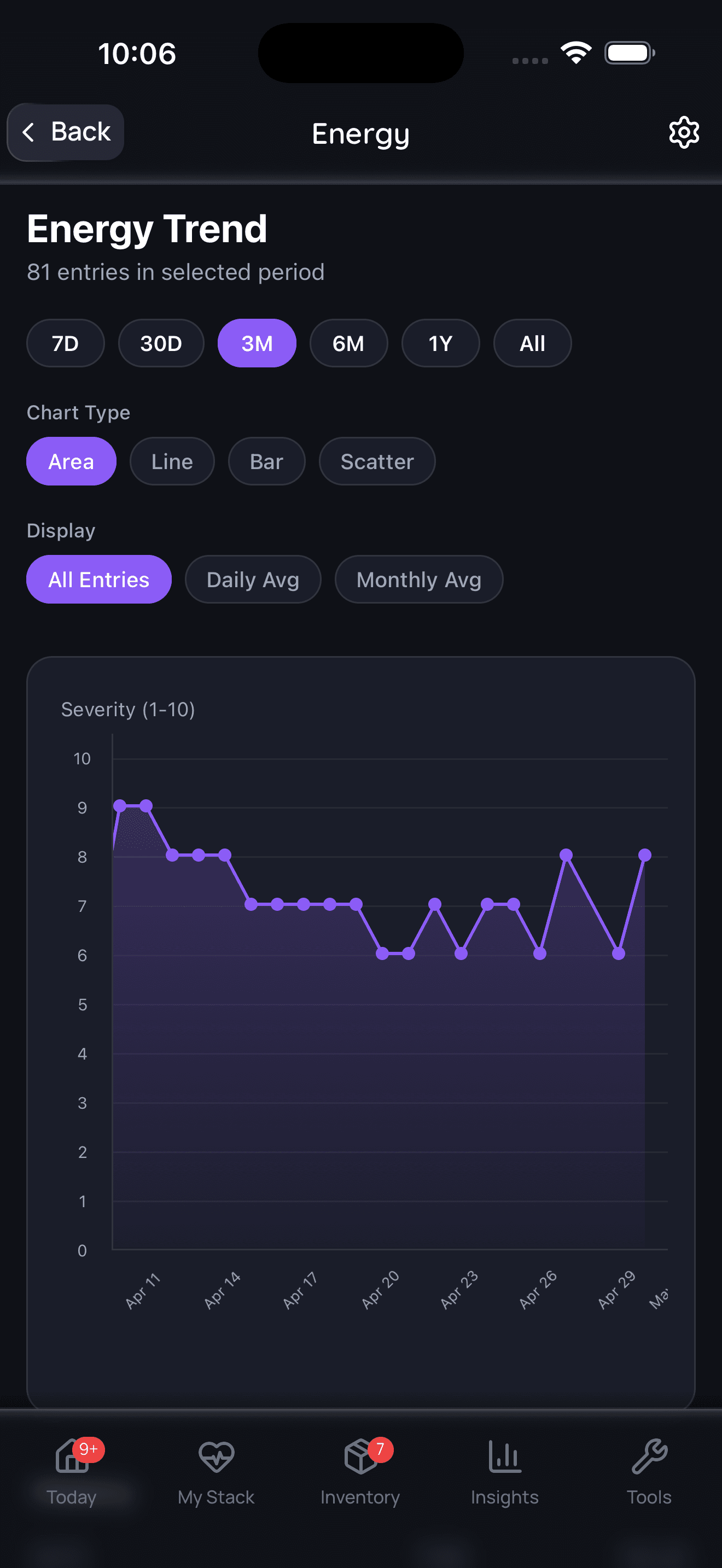
Symptom tracking is informational and should be interpreted with a qualified clinician.
Side Effects & Safety
The Basics
Glucosamine is usually described as well tolerated, but that phrase can hide the real-world nuance. Many people take it without major issues, yet enough users report nausea, bloating, gas, heartburn, rash, swelling, or allergy-type reactions that it should not be framed as side-effect free [1][6].
Two practical safety themes keep coming up. One is glucose metabolism, especially for people with diabetes or insulin resistance. The other is interaction caution with warfarin and related bleeding concerns [1][6].
The Science
Human safety reviews have generally been reassuring. One review covering more than 3,000 human subjects concluded that oral glucosamine was safe under normal conditions of use and did not worsen glucose metabolism in the reviewed data set [6]. However, a later systematic review of glucose-metabolism outcomes found mixed human evidence, with some studies suggesting worsened insulin sensitivity or fasting glucose in higher-risk populations [1].
Warfarin-related bleeding caution remains one of the clearest recurring safety notes in institutional sources [1]. Community review data also add a more practical layer: the most common reasons for stopping glucosamine are GI symptoms, swelling, rashes, and difficulty tolerating the pill size rather than dramatic systemic toxicity.
Knowing the possible side effects is the first step. Catching them early in your own experience is what keeps a supplement routine safe. Doserly lets you log any symptoms as they arise, tagging them with severity, timing relative to your dose, and whether they resolve on their own or persist.
The app's interaction checker cross-references everything in your stack, supplements and medications alike, flagging known interactions before they become a problem. It also monitors your total intake against established upper limits, alerting you if your combined sources of a nutrient are approaching thresholds where risk increases. Think of it as a safety net that works quietly in the background while you focus on the benefits.
Connect protocol changes to labs and health markers.
Doserly can keep lab results, biomarkers, symptoms, and dose history close together so follow-up conversations have better context.
Insights
Labs and trends
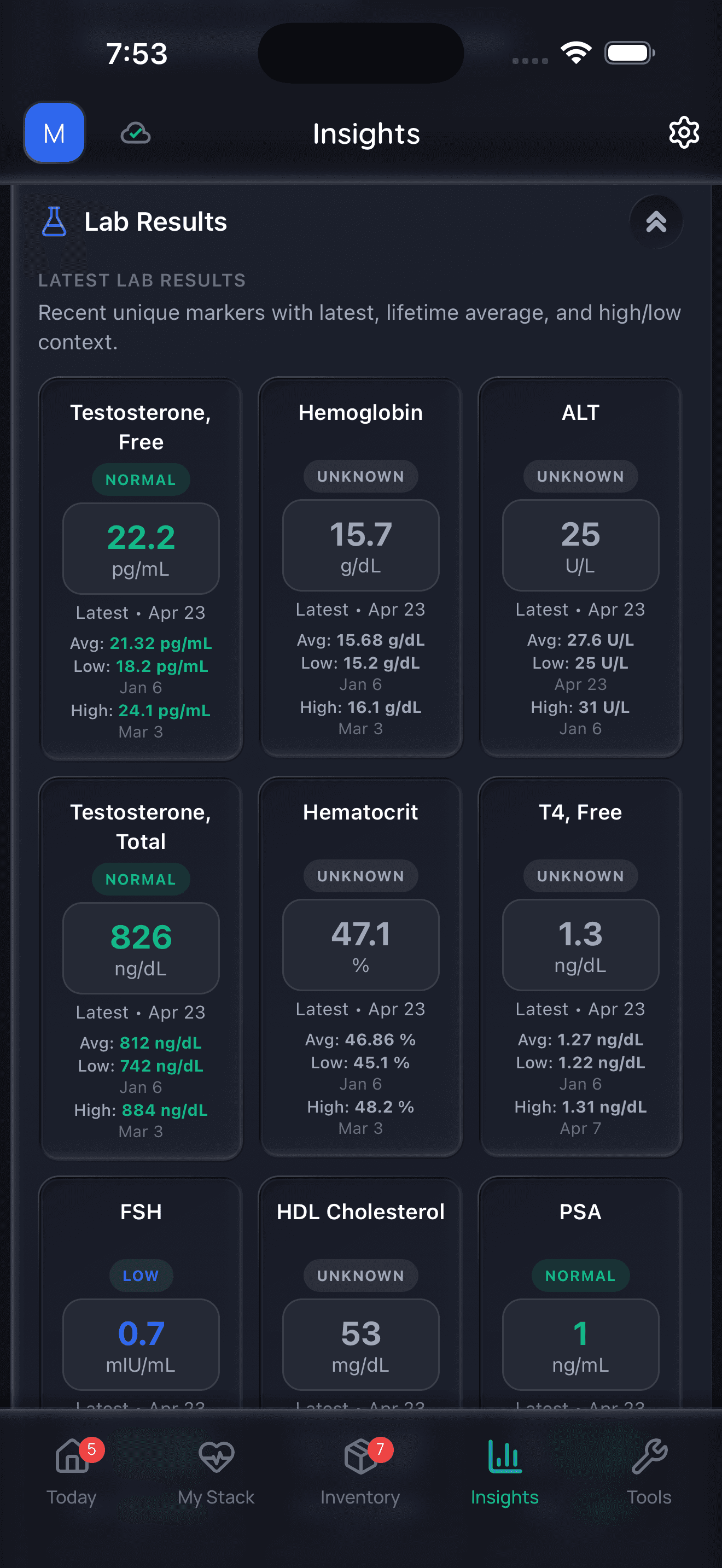
Doserly organizes data; it does not diagnose or interpret labs for you.
Dosing & Usage
The Basics
The most commonly reported glucosamine amount in research and consumer materials is 1,500 mg per day [2][4][5]. That figure appears in once-daily and divided-dose formats, usually depending on product design and tolerability preferences rather than a proven universal advantage of one schedule over the other.
What matters more than clever timing is form and consistency. A sulfate product used steadily for weeks is more aligned with the evidence than a random label carrying generic glucosamine language with unclear formulation details [1][7].
The Science
Clinical and pharmacokinetic sources repeatedly center 1,500 mg/day as the most studied oral amount [4][5]. The 1,500 mg daily dose is also the amount used in the GAIT trial and in the pharmacokinetic study showing measurable systemic exposure with crystalline glucosamine sulfate [4][5].
The most responsible summary is that 1,500 mg/day is the commonly studied reference point, sulfate formulations have stronger support than hydrochloride formulations, and the data do not support treating glucosamine as a universally effective short-term pain protocol [1][4][7].
Getting the dose right matters more than most people realize. Too little may be ineffective, too much wastes money or introduces risk, and inconsistency undermines both. Doserly tracks every dose you take, across every form, giving you a clear record of what you're actually consuming versus what you planned.
The app helps you compare RDA recommendations against therapeutic ranges discussed in the research, so you can see exactly where your intake falls. If you switch forms, say from a standard capsule to a liposomal liquid, Doserly adjusts your tracking to account for different bioavailabilities. Pair that with smart reminders that keep your timing consistent, and the precision that makes a real difference in outcomes becomes effortless.
Turn symptom and safety notes into a clearer timeline.
Doserly helps you log doses, symptoms, and safety observations side by side so patterns are easier to discuss with a qualified clinician.
Pattern view
Logs and observations

Pattern visibility is informational and should be reviewed with a clinician.
What to Expect
Most glucosamine users should expect a slow and uncertain timeline rather than a dramatic early shift. Based on available research and community reports, a practical timeline often looks like this:
- Weeks 1-2: many users notice little or nothing. Some experience GI irritation before any benefit shows up.
- Weeks 3-6: users who respond may begin noticing less creaking, slightly easier stairs, or less morning stiffness.
- Weeks 6-12: this is where community reports most often describe clearer functional benefit.
- Beyond 12 weeks: long-term users who believe glucosamine helps often describe it as a maintenance supplement. The evidence still remains mixed, so continued use should be judged cautiously rather than assumed.
This slow timeline is part of why glucosamine produces so much disagreement. People wanting fast pain relief are often disappointed, while people looking for gradual joint support may rate it more favorably.
Interactions & Compatibility
Synergistic
- Chondroitin Sulfate: commonly paired in joint-support formulas, though combination efficacy remains inconsistent in trials [1][5]
- MSM: commonly stacked for joint comfort in commercial products
- Vitamin C: often included conceptually because of collagen and connective-tissue support
- Collagen: frequently paired in joint-health routines focused on connective-tissue support
- Hyaluronic Acid: often marketed alongside glucosamine in mobility-focused stacks
Caution / Avoid
- Warfarin and related anticoagulant regimens: institutional sources repeatedly flag bleeding-risk concerns [1]
- Poorly defined proprietary joint blends: form ambiguity and under-dosed glucosamine content make interpretation difficult
- Shellfish-sensitive contexts: some glucosamine products are derived from shellfish and require extra label scrutiny in sensitive users
How to Take / Administration Guide
Glucosamine products are typically sold as capsules, tablets, softgels, or powders. The main administration issue is not sophistication. It is product clarity. Many products mix glucosamine with chondroitin, MSM, boswellia, collagen, or added minerals, which makes it harder to tell what is doing what.
Commonly cited practical patterns include:
- taking the supplement once daily or in divided doses
- taking it with food when GI tolerance is an issue
- committing to a longer trial window rather than judging it after only a few days
From a form standpoint, readers should pay close attention to whether the label specifies sulfate or hydrochloride. That detail is more meaningful than most branding language.
Choosing a Quality Product
Glucosamine is a supplement category where quality language matters because formulation differences appear to affect both interpretation and confidence [1][7].
Markers that may improve confidence include:
- clear disclosure of the exact form, such as glucosamine sulfate or glucosamine hydrochloride
- transparent milligram labeling without hiding the glucosamine amount inside a blend
- manufacturing language consistent with dietary-supplement GMP expectations [8]
- third-party certification where relevant, especially for athlete-facing products [9]
Red flags include:
- proprietary joint blends that obscure the glucosamine contribution
- products implying drug-like certainty from generic glucosamine claims
- athlete-targeted products that lack third-party banned-substance screening
For sport settings, USADA guidance favors third-party certified products, especially NSF Certified for Sport, as a risk-reduction strategy [9].
Storage & Handling
Glucosamine products are generally stored at room temperature in a cool, dry place away from heat and moisture. Powders and capsules benefit from tight sealing to reduce moisture exposure. There is no general requirement for refrigeration in standard oral products.
Lifestyle & Supporting Factors
Glucosamine fits better into a broader joint-support strategy than as a standalone fix. Institutional arthritis guidance still centers movement, weight management, and overall symptom management as the main tools, with supplements occupying a secondary role [1][2].
Lifestyle factors that shape the glucosamine conversation include:
- body weight and joint load
- ongoing strength and mobility work
- realistic expectations for chronic knee or hip symptoms
- paying attention to whether the supplement is being added alongside many other simultaneous changes
This last point matters because glucosamine is often started during a broader "joint-health reset" that includes braces, activity changes, pain relievers, or other supplements, which makes attribution harder.
Regulatory Status & Standards
In the United States, glucosamine products are regulated as dietary supplements rather than as FDA-approved drugs [3][8]. FDA guidance relevant to this category focuses on manufacturing practice, labeling, claims, new dietary ingredients, and adverse-event reporting rather than pre-market efficacy approval [8].
In some non-U.S. settings, certain glucosamine sulfate products have been sold as prescription products, which partly explains why the sulfate literature sometimes looks more standardized than the broader U.S. supplement market [1].
For athletes, the main issue is not that glucosamine is presented as a named prohibited substance in the guidance reviewed here. The main issue is supplement-product uncertainty. USADA's supplement guidance emphasizes that labels are not fully reliable, products may contain undeclared ingredients, and third-party certification is the best available risk-reduction step for athletes who still choose to use supplements [9].
Regulatory status and prohibited-substance classifications change over time. Athletes should verify current sport-specific rules, product certification status, and clinician guidance before relying on any supplement.
Frequently Asked Questions (FAQ)
Is glucosamine the same thing as glucosamine sulfate?
No. Glucosamine is the broad ingredient family, while glucosamine sulfate is one specific form. The available evidence suggests the form matters, and sulfate-focused research is not interchangeable with hydrochloride products [1][4][7].
Does glucosamine rebuild cartilage?
Available sources do not support confident claims that oral glucosamine rebuilds cartilage in a clinically reliable way. Structural outcome data remain mixed, and symptom support is a better-supported frame than cartilage restoration [1][2].
How long does glucosamine usually take to work?
Based on available research and user reports, glucosamine is generally discussed as a slower supplement. When people do perceive benefit, it often takes several weeks rather than days [2][4][5].
Is glucosamine sulfate better than glucosamine hydrochloride?
The available evidence leans that way, but not strongly enough to justify absolute claims. Sulfate products have a more favorable evidence profile than hydrochloride products in the sources reviewed here [1][4][7].
Is glucosamine safe for people with diabetes?
The answer is not completely settled. Some human reviews are reassuring, while institutional guidance still advises caution because glucose-metabolism effects may differ across individuals and risk profiles [1][6].
Can glucosamine be taken with chondroitin?
It commonly is. Combination products are widespread, but the trial evidence for the combination is still mixed, so the pairing should not be treated as automatically superior [1][5].
Why do some people stop glucosamine even when others love it?
Three reasons show up repeatedly: no obvious benefit, GI intolerance, or confusion about whether a stacked formula or a different lifestyle change was actually responsible for the improvement.
What matters most when choosing a glucosamine product?
Based on available sources, the most useful quality questions are the specific form, the label transparency, whether the product avoids vague proprietary blending, and whether sport-facing products carry trusted third-party certification [8][9].
Myth vs. Fact
Myth: All glucosamine products work the same way.
Fact: The evidence does not support treating sulfate and hydrochloride as interchangeable. Formulation appears to matter for both pharmacokinetic interpretation and clinical confidence [1][4][7].
Myth: If glucosamine helps, you should feel it immediately.
Fact: Glucosamine is usually discussed as a slower joint-support supplement. Positive reports often emerge after several weeks, not after one or two doses [2][4][5].
Myth: Glucosamine rebuilds damaged cartilage.
Fact: Structural claims remain uncertain. Some long-term data suggest interest in cartilage-related outcomes, but the evidence is not strong enough to promise rebuilding or reversal of osteoarthritis [1][2].
Myth: Natural means glucosamine is automatically risk-free.
Fact: GI side effects, swelling, rash, shellfish-source issues, and warfarin-related bleeding concerns all remain relevant. Natural products still require risk assessment [1][6][8].
Myth: Any joint formula with glucosamine is automatically evidence-based.
Fact: Many joint formulas combine multiple ingredients and hide exact amounts in blends. That makes it harder to know whether the product matches the formulations studied in the literature [7][8].
Sources & References
Clinical Trials & RCTs
- Clegg DO, Reda DJ, Harris CL, et al. Glucosamine, chondroitin sulfate, and the two in combination for painful knee osteoarthritis. New England Journal of Medicine. 2006. PMID: 16495392. https://pubmed.ncbi.nlm.nih.gov/16495392/
- Persiani S, Roda E, Rovati LC, et al. Glucosamine oral bioavailability and plasma pharmacokinetics after increasing doses of crystalline glucosamine sulfate in man. Osteoarthritis and Cartilage. 2005. PMID: 16168682. https://pubmed.ncbi.nlm.nih.gov/16168682/
Systematic Reviews & Meta-Analyses
- Wu D, Huang Y, Gu Y, Fan W. Efficacies of different preparations of glucosamine for the treatment of osteoarthritis: a meta-analysis of randomised, double-blind, placebo-controlled trials. International Journal of Clinical Practice. 2013. PMID: 23679910. https://pubmed.ncbi.nlm.nih.gov/23679910/
- Anderson JW, Nicolosi RJ, Borzelleca JF. Glucosamine effects in humans: a review of effects on glucose metabolism, side effects, safety considerations and efficacy. Food and Chemical Toxicology. 2005. PMID: 15621331. https://pubmed.ncbi.nlm.nih.gov/15621331/
Government / Institutional Sources
- National Center for Complementary and Integrative Health. Glucosamine and Chondroitin for Osteoarthritis: What You Need To Know. Updated October 2023. https://www.nccih.nih.gov/health/glucosamine-and-chondroitin-for-osteoarthritis
- MedlinePlus Medical Encyclopedia. Medicines, injections, and supplements for arthritis. Reviewed September 2, 2025. https://medlineplus.gov/ency/patientinstructions/000374.htm
- U.S. Food and Drug Administration. Dietary Supplements Guidance Documents & Regulatory Information. https://www.fda.gov/food/guidance-documents-regulatory-information-topic-food-and-dietary-supplements/dietary-supplements-guidance-documents-regulatory-information
- U.S. Anti-Doping Agency. Supplement Connect. https://www.usada.org/athletes/substances/supplement-connect/supplement-guide/
Reference Databases
- PubChem. D-Glucosamine, CID 439213. https://pubchem.ncbi.nlm.nih.gov/compound/GLUCOSAMINE