
In this guide
What is rapamycin?
Rapamycin is another name for sirolimus, a prescription macrolide drug that inhibits mechanistic target of rapamycin complex 1, or mTORC1. mTOR integrates nutrient, growth and energy signals with protein synthesis, cell growth and autophagy. The drug has approved medical uses, but treatment of normal aging or lifespan extension is not one of them.
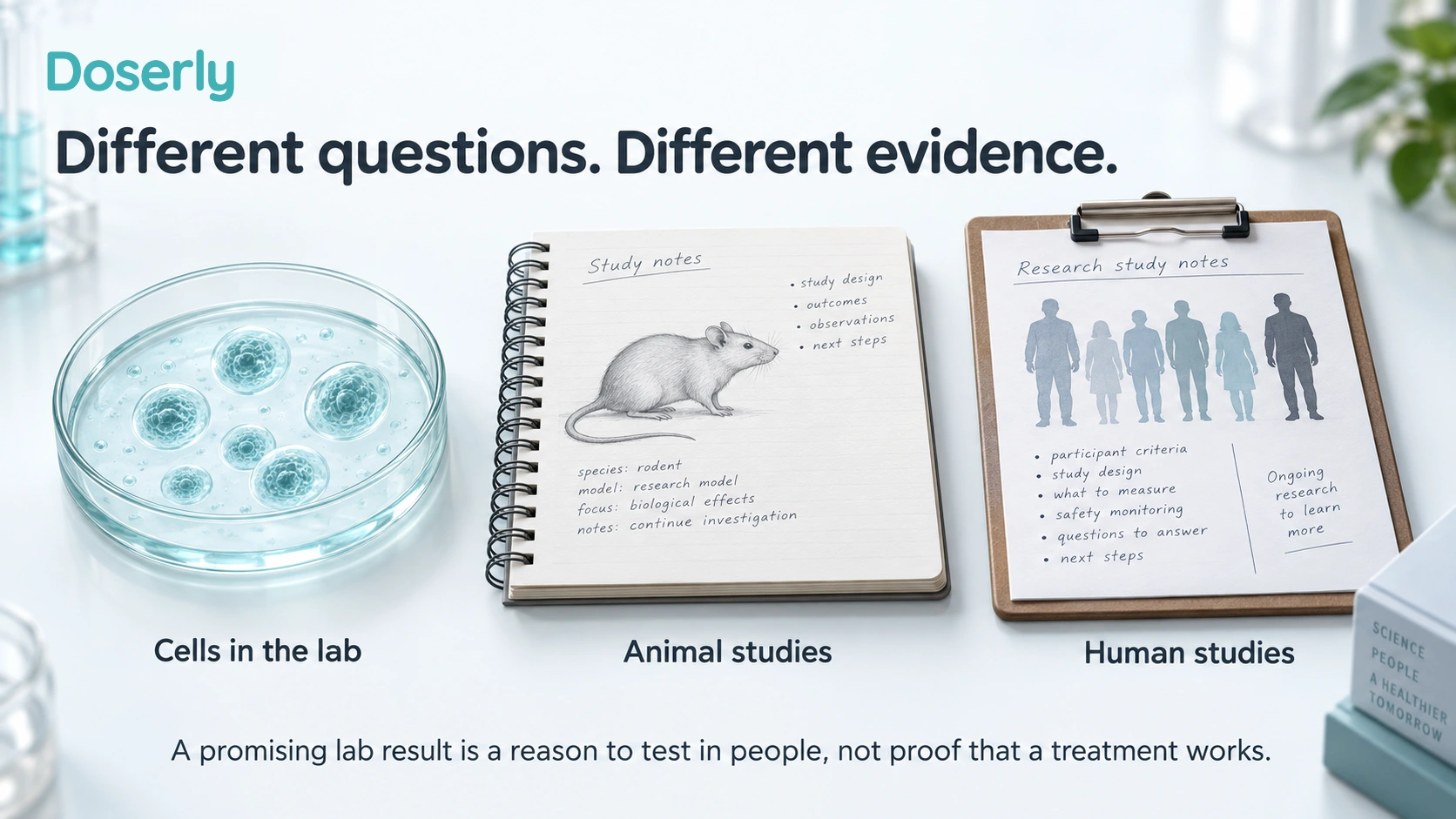
Interest in geroscience comes from repeated lifespan extension in mice and effects across animal models. Human evidence is much smaller and mixes sirolimus with related rapalogs, daily with weekly exposure, topical with oral routes, and healthy volunteers with disease populations. These are not interchangeable evidence streams. [1]–[6]
No RDA, adequate intake, tolerable upper intake level or deficiency state applies. Rapamycin is not a nutrient.
Typical Rapamycin Research Protocols
| Study and population | Product and route | Amount each administration | Daily or weekly total | Frequency and duration | Main interpretation |
|---|---|---|---|---|---|
| Kraig 2018 · 25 generally healthy adults aged 70–95 who completed ≥8 weeks | Commercial oral sirolimus | 1 mg | 1 mg/day | Once daily; 8 weeks in phase 2, up to 4 months planned in phase 1 | Small safety pilot; no broad function or cognition benefit; modest blood-cell changes |
| PEARL 2025 · 114 healthy-aging completers aged 50–85 | Compounded oral rapamycin | 5 mg or 10 mg | 5 mg/week or 10 mg/week | Once weekly for 48 weeks | Primary visceral-fat endpoint null; secondary and sex-subgroup signals |
| Stanfield protocol 2024 · planned 40 adults aged 65–85 | Oral sirolimus | 6 mg | 6 mg/week | Once weekly for 13 weeks plus home exercise | Protocol only; no outcome results in the publication |
| Chung 2019 · photoaged hands | Topical rapamycin formulation | 0.5 cc of 10 μM formulation | Not an oral daily total | Once daily for 6–8 months | Exploratory local skin markers; high attrition and small biopsy subsets |
The rows do not form a progression from daily to weekly use. The small Kraig trial is the direct source for the 1 mg daily record. [2] Kraig used a commercial product and monitored blood levels. PEARL used a compounded product later found to produce about one-third the 24-hour blood concentration of commercial tablets in a separate cohort. The 6 mg exercise study is a protocol, not a positive trial. Topical concentration cannot be converted to an oral dose. [1]–[4]
- Product identity
- Record sirolimus versus a rapalog, commercial versus compounded product, manufacturer, strength and route.
- Administration
- Keep amount each time separate from daily or weekly total; daily and weekly schedules create different exposure.
- Clinical context
- Record indication, prescriber, target blood level if used, interacting medicines and planned monitoring.
What is rapamycin commonly used for?
Longevity and healthspan
Rapamycin reliably extends lifespan in multiple mouse experiments, including when begun later in life. That finding makes it an important research tool. It does not show that a particular human dose extends life. Human studies are too short, too small and focused on biomarkers, safety or narrow functions rather than mortality or broad disease prevention. [5], [6]
Body composition and self-reported outcomes
PEARL's prespecified primary visceral-adiposity endpoint was null. A small female subgroup assigned 10 mg weekly showed lean-mass and pain signals, while 5 mg participants reported changes in general health and emotional well-being. These were secondary or subgroup analyses, the female 10 mg group was small, and all authors were employees/shareholders of the sponsoring telehealth company. The results are hypotheses for replication, not proof of rejuvenation. [1]
Immunity, skin and other systems
The 2024 systematic review found selected signals in immune, cardiovascular and skin outcomes across 19 rapamycin or rapalog studies. It found no overall endocrine, muscular or neurological effect. Some disease populations had more infections or higher total cholesterol, LDL cholesterol and triglycerides. Heterogeneous drugs and populations prevent a universal benefit claim. [4]
The topical skin trial found lower p16 and higher collagen VII in small biopsy subsets after 6–8 months, but 19 of 36 enrollees discontinued or were lost. Local skin exposure does not validate systemic use. [3]
Evidence ladder
Mouse lifespan does not complete the human chain
How do forms and labels differ?
Sirolimus may be supplied as commercial tablets or oral solution, a pharmacy-compounded capsule, or an experimental topical preparation. Everolimus and other rapalogs share pathway activity but differ in pharmacology, approved indications and evidence. A study of one cannot be relabelled as the other.
PEARL is an important warning about formulation. Its compounded capsules produced substantially lower blood concentration at 24 hours than commercial tablets in an independent comparison. That does not justify multiplying a dose; it shows why labelled milligrams alone do not establish equivalent exposure. [1]
How should rapamycin be stored?
Follow the dispensing label and product-specific instructions. Commercial tablets and oral solution can have different storage and handling requirements. Keep the drug in its original labelled container, away from children and household members, and do not transfer prescription or compounded capsules into an unlabelled longevity stack.
What does the human evidence show?
| Question | Best direct evidence | Finding | Boundary |
|---|---|---|---|
| Does rapamycin extend mammalian lifespan? | Repeated mouse experiments | Yes | Does not establish human benefit or dose |
| Did PEARL improve its primary endpoint? | 114 completers over 48 weeks | No | Compounded product; secondary subgroup signals |
| Is low-dose daily use benign in older adults? | 25-person pilot | Mostly tolerated short term | Blood-cell changes; too small for uncommon harm |
| Does topical rapamycin change aged skin markers? | Exploratory split-site study | Selected markers changed | Local route, attrition and small biopsy subsets |
| Does rapamycin extend human life? | No direct trial | Unknown | Human studies are short and use surrogate outcomes |
PEARL result map
The primary result and exposure limit lead
The systematic review and newer PEARL trial support continued research. They do not establish a standard anti-aging prescription or a favourable long-term benefit-risk balance in healthy people. [1], [4]
What are the risks and interactions?
Sirolimus can cause mouth sores, nausea, diarrhea, edema, rash, headache, high lipids, high glucose, blood-cell abnormalities and impaired wound healing. Prescription labelling also addresses infection, interstitial lung disease and other serious risks. Frequency and severity depend on dose, exposure, duration, indication and co-medications; transplant data cannot be copied directly to intermittent research use, but the hazards remain clinically relevant. [7], [8]
Sirolimus is metabolized through CYP3A4 and transported by P-glycoprotein. Strong inhibitors or inducers, grapefruit and some other products can change exposure materially. Vaccination planning, surgery, active infection, liver disease, abnormal blood counts, pregnancy potential and fertility concerns need prescriber review. Do not use a consumer interaction checker as clearance.
Seek prompt care for fever, breathing difficulty, severe mouth ulcers, unusual bruising or bleeding, marked swelling, a poorly healing wound, severe rash or another significant change.
What is the legal and regulatory status?
Sirolimus is a prescription drug in the United States and Canada. Approved uses and labelling concern defined medical indications, not normal aging or lifespan extension. Prescribing it for longevity is off-label and does not turn it into a supplement. Compounding does not establish FDA approval, bioequivalence or anti-aging efficacy for the compounded preparation. [7]–[9]
What happens when you stop?
No healthy-aging trial defines a universal taper, withdrawal syndrome or duration of putative benefit. A person taking prescribed sirolimus for an approved condition must not interrupt it without the treating team. For experimental off-label use, the prescriber should decide whether symptoms, infection, surgery, laboratory changes or interactions require holding or stopping.
What should you monitor?
Monitoring belongs to the prescription plan. Depending on context, clinicians may review complete blood count, kidney and liver measures, fasting lipids, glucose, drug concentration, blood pressure, infection, oral ulcers, edema and wound healing. PEARL used repeated blood tests, DXA assessments and weekly adverse-event collection; this did not prove that the schedule was safe for unmonitored use. [1]
What does community experience add?
Public reports can surface mouth sores, scheduling confusion, cost, lab trends and differences between compounded and commercial products. They cannot establish drug concentration, mTOR target engagement, causal benefit or lifespan extension. No systematic current community sample was assembled, so this guide reports no consensus longevity dose or cycling schedule.
How does rapamycin compare with related options?
| Option | Practical distinction | Evidence boundary |
|---|---|---|
| Commercial sirolimus | Approved prescription product with defined labelling | Longevity remains off-label and unproven |
| Compounded rapamycin | Prepared for an individual prescription | Exposure may differ; not automatically bioequivalent |
| Everolimus or another rapalog | Related mTOR inhibitor with different pharmacology | Results cannot be assigned to sirolimus |
| Topical rapamycin | Local experimental or medical route | Does not validate systemic longevity use |
| Established risk-factor care | Targets measured blood pressure, lipids, diabetes and function | Has condition-specific clinical-outcome evidence |
Common questions
Does rapamycin extend human lifespan?
No human trial has shown that it does. The strongest lifespan evidence is in mice. [5], [6]
What did PEARL find?
It found similar overall adverse-event counts across groups and no improvement in the primary visceral-fat endpoint. Selected secondary and subgroup signals require replication. [1]
Is 5 mg compounded rapamycin equal to a 5 mg commercial tablet?
PEARL's authors reported substantially lower 24-hour blood concentration with their compounded product in a separate comparison. Do not assume equivalence or calculate a correction factor. [1]
Is weekly use safer than daily use?
Weekly exposure is different and may reduce continuous pathway inhibition, but no schedule removes infection, metabolic, blood-cell, wound-healing or interaction risks.
Is rapamycin a supplement?
No. Sirolimus is a prescription drug. Marketing context does not change its legal or pharmacologic status.
Does a lower p16 skin marker mean slower whole-body aging?
No. The topical study measured local surrogate markers in small subsets. It did not measure systemic aging or lifespan. [3]
Can I track rapamycin without blood tests?
A symptom log is useful but cannot replace monitoring selected by the prescriber.
Glossary
Plain explanations of rapamycin research terms.
- Sirolimus
- The generic drug name for rapamycin.
- mTOR
- A signalling kinase that integrates nutrient, growth and energy inputs with cell growth and metabolism.
- Rapalog
- A rapamycin-related drug, such as everolimus, with its own pharmacology and evidence.
- Trough concentration
- A drug concentration measured near the end of a dosing interval; relevance depends on indication and schedule.
- Surrogate endpoint
- A marker used instead of a direct patient outcome, whose clinical meaning may remain uncertain.
- Off-label use
- Prescription use for a purpose not included in the regulator-approved product label.
How this guide was researched
Seven PubMed identities and linked publication-status records were checked through NCBI EFetch. Full PMC methods were read for PEARL and Kraig. Oral and topical routes, commercial and compounded forms, per-administration amounts, exposure interval, primary outcomes and subgroup outcomes were extracted separately.
Research record · checked October 9, 2026
Identity verification: PMID 40188830 is PEARL; PMID 29408453 the older-adult daily-dose pilot; PMID 31761958 the topical skin trial; PMID 38310895 the human systematic review; PMID 35861940 the musculoskeletal review; PMID 39354527 the weekly exercise-study protocol; PMID 37011714 the longevity update.
Publication status: no linked erratum, expression of concern or retraction appeared. The record linked to the skin paper is a commentary, not a correction.
Full-method review: PEARL used 5 mg or 10 mg compounded capsules once weekly for 48 weeks; Kraig used commercial sirolimus 1 mg once daily.
Endpoint hierarchy: PEARL's null primary visceral-fat result remains ahead of subgroup and self-report findings.
Conflict context: PEARL's authors were AgelessRx employees and shareholders.
Safety boundary: research schedules are not consumer instructions.
Explore the sources
Primary human studies, reviews and official drug information.
Showing 9 sources
- 01
Influence of rapamycin on safety and healthspan metrics after one year: PEARL trial results. ↗
Randomized 48-week trial
Null primary visceral-fat result, secondary subgroup signals and compounded-exposure limitation.
- 02
A randomized control trial to establish the feasibility and safety of rapamycin treatment in an older human cohort: Immunological, physical performance, and cognitive effects. ↗
Small randomized safety pilot
Commercial sirolimus 1 mg daily; short follow-up and modest blood-cell changes.
- 03
Topical rapamycin reduces markers of senescence and aging in human skin: an exploratory, prospective, randomized trial. ↗
Exploratory topical trial
Local surrogate markers, high attrition and small biopsy subsets.
- 04
Targeting ageing with rapamycin and its derivatives in humans: a systematic review. ↗
Systematic review
Nineteen heterogeneous studies; selected system signals and safety limits.
- 05
A single-center, double-blind, randomized, placebo-controlled, two-arm study to evaluate the safety and efficacy of once-weekly sirolimus (rapamycin) on muscle strength and endurance in older adults following a 13-week exercise program. ↗
Randomized trial protocol
Planned 6 mg weekly for 13 weeks; publication contains no results.
- 06
Rapamycin, the only drug that has been consistently demonstrated to increase mammalian longevity. An update. ↗
Preclinical longevity update
Explains animal evidence and translational uncertainty; not human lifespan proof.
- 07
Rapamune prescribing information ↗
Official drug record
Approved indications, dosage forms, warnings, interactions and labelling.
- 08
Sirolimus Drug Information ↗
Official patient drug information
Administration, precautions, interactions, storage and urgent symptoms.
- 09
Drug Product Database ↗
Official drug database
Verifies authorized Canadian prescription drug products and labelling.
No matching sources
Try a different term or show the full list.
Editorial note
This guide keeps mouse longevity, human surrogate outcomes, primary and subgroup results, formulation exposure and prescription safety separate. It does not turn a study schedule into a longevity prescription.