
CJC No DAC / Ipamorelin: Modified GRF(1-29), Blend Doses and Evidence Limits
On this page
Quick Reference Card
Attribute
Identity
- Research reference
- This page covers the short-acting no-DAC pairing: Modified GRF(1-29), commonly sold as CJC-1295 without DAC, plus ipamorelin.
Attribute
Core distinction
Attribute
Component roles
Attribute
US FDA status
- Research reference
- No FDA-approved fixed CJC no DAC/ipamorelin blend label was identified. FDA has listed ipamorelin acetate as a compounding safety-risk substance for outsourcing facilities, and FDA warning-letter language has treated CJC-1295 and ipamorelin products as ineligible compounded drugs in a 503A context. [6][7]
Attribute
Main dosing problem
Quick dose reference
This fixed blend has no established clinical dose. Total blend amount and per-component exposure should stay separate. Any dosing protocol should be reviewed with a qualified healthcare practitioner.
Injection under the skin (subcutaneous)
Online sourced dosing details
- Reported amount
- 200-600 mcg total blend
- Frequency
- Once or twice daily
- Duration
- 12 weeks on Peptide Schedule example
- Dose adjustment
- Public tiers list 200 mcg daily, 300 mcg daily, or 600 mcg twice daily
- Reported range & limits
- Same fixed-blend public examples span 200 mcg daily to 600 mcg twice daily total blend. No clinical minimum effective dose or safe upper limit.
Evidence and range contextReview the full source references below.
Public 1:1 blend calculator
Selected because it is an applicable fixed-blend public calculator row; component intravenous ipamorelin evidence belongs in expandable context, not the quick-dose scenario list.
Peptide Schedule lists beginner 200 mcg total once daily, moderate 300 mcg once daily, and aggressive 600 mcg twice daily for a 10 mg total blend example. PeptideDosingCalc lists 100-600 mcg total draw examples. If the vial is 1:1, per-component exposure is half the total, but other ratios change that arithmetic.
Full Dosing Reference SourcesClinical research, registered studies and online dosing sources, with their context and limitations.
These entries summarize source-reported study, label, or public protocol amounts. They are context for tracking and comparison, not personal dosing advice.
Current FDA-approved fixed blend label
No FDA-approved CJC no DAC/ipamorelin fixed-blend label and therefore no FDA-reviewed dose.
- Route / population
- Not applicable
- Interpretation and limits
- Commercial vial labels and clinic protocols are not FDA prescribing information.
CJC-1295 with DAC healthy-adult studies
Published human study used CJC-1295 with DAC in ascending subcutaneous dose trials; 30 or 60 mcg/kg were described as relatively well tolerated, and the estimated half-life was 5.8 to 8.1 days.
- Route / population
- Healthy adults, DAC form
- Interpretation and limits
- This is the long-acting albumin-binding molecule. It should not be borrowed for no-DAC daily-pulse dosing.
- Sources
- [2]
Registered CJC-1295 Phase 2 trial
Low-dose CJC-1295, high-dose CJC-1295 or placebo for 12 weeks, with 6-week follow-up.
- Route / population
- HIV-associated visceral obesity; terminated, no posted results
- Interpretation and limits
- The registry does not provide usable efficacy results for the blend and does not establish no-DAC/ipamorelin dosing.
- Sources
- [3]
CJC-1295 animal chemistry/pharmacology
CJC-1295 is a tetrasubstituted hGRF(1-29) analog with a maleimide albumin-binding group; in rats it produced longer plasma residence and higher GH AUC than hGRF(1-29).
- Route / population
- Rat and ex vivo albumin-conjugation work
- Interpretation and limits
- Explains why DAC lasts days. Removing the DAC changes the exposure profile.
- Sources
- [1]
Ipamorelin animal pharmacology
Ipamorelin released GH in rat and swine models, with swine ED50 2.3 nmol/kg, and did not significantly raise ACTH or cortisol even at very high multiples of the GH-release ED50.
- Route / population
- Animal pharmacology
- Interpretation and limits
- Supports ipamorelin selectivity language. It is not a human fixed-blend outcome trial.
- Sources
- [4]
Acute GHRH plus GHRP pathway synergy
GHRH plus GHRP-2 produced synergistic GH secretion under controlled conditions, with response modified by visceral fat, age and endocrine background.
- Route / population
- Human physiology studies
- Interpretation and limits
- Supports the pathway logic of pairing GHRH and GHS-R signals. It does not validate a commercial vial ratio or chronic protocol.
- Sources
- [5]
Peptide Schedule blend calculator
Beginner 200 mcg daily, moderate 300 mcg daily, aggressive 600 mcg twice daily; gives 10 mg total vial examples and U-100 unit math.
- Route / population
- Popular/community calculator
- Interpretation and limits
- Direct source for current online blend dose ranges. It is not a clinical trial.
- Sources
- [8]
PeptideDosingCalc blend calculator
Lists 100 to 600 mcg total-dose examples for a 10 mg vial, including U-100 draw amounts.
- Route / population
- Popular calculator
- Interpretation and limits
- Useful for marketplace arithmetic. If the vial is 1:1, a 200 mcg total draw corresponds to about 100 mcg of each component; different ratios change that.
- Sources
- [9]
Thirty distinct inspected sources were retained. No controlled human trial of the fixed CJC-1295 no-DAC/ipamorelin blend was found; public calculators provide the direct blend rows, while component and synergy literature remains context only.
Applicable product labels and human studies carry the most weight. A registry entry does not establish study results. Animal studies, public guides and forums add context; they do not establish a safe human dose limit.
Human clinical research
- Prolonged stimulation of growth hormone (GH) and insulin-like growth factor I secretion by CJC-1295, a long-acting analog of GH-releasing hormone, in healthy adults
J Clin Endocrinol Metab · 2006 Mar · Abstract reviewed · Background context
DAC human study; included to avoid borrowing DAC schedules for no-DAC blends.
- Pharmacokinetic-pharmacodynamic modeling of ipamorelin, a growth hormone releasing peptide, in human volunteers
Pharm Res · 1999 Sep · Abstract reviewed · Background context
Human ipamorelin intravenous PK/PD exposure; route and product differ from blend calculators.
- Prospective, randomized, controlled, proof-of-concept study of the Ghrelin mimetic ipamorelin for the management of postoperative ileus in bowel resection patients
Int J Colorectal Dis · 2014 Dec · Abstract reviewed · Background context
Ipamorelin POI trial used 0.03 mg/kg intravenous twice daily; component-only clinical evidence.
- Determinants of GH-releasing hormone and GH-releasing peptide synergy in men
Am J Physiol Endocrinol Metab · 2009 May · Abstract reviewed · Background context
Human GHRH/GHRP synergy physiology; not this exact fixed blend.
Registered clinical trials
- CJC-1295 in HIV-Associated Visceral Obesity
ClinicalTrials.gov · 2005 · Background context
Terminated DAC CJC-1295 registry; not a no-DAC/ipamorelin blend dose.
- Ipamorelin for Postoperative Ileus in Bowel Resection Patients
ClinicalTrials.gov · 2008 · Background context
Component or pharmacology context only; it does not validate the fixed subcutaneous blend.
- Safety and Efficacy of Ipamorelin in Patients Undergoing Bowel Resection
ClinicalTrials.gov · 2011 · Background context
Component or pharmacology context only; it does not validate the fixed subcutaneous blend.
Animal and laboratory research
- Human growth hormone-releasing factor (hGRF)1-29-albumin bioconjugates activate the GRF receptor on the anterior pituitary in rats: identification of CJC-1295 as a long-lasting GRF analog
Endocrinology · 2005 Jul · Abstract reviewed · Background context
Component or pharmacology context only; it does not validate the fixed subcutaneous blend.
- Ipamorelin, the first selective growth hormone secretagogue
Eur J Endocrinol · 1998 Nov · Abstract reviewed · Background context
Component or pharmacology context only; it does not validate the fixed subcutaneous blend.
Public dosing guides and calculators
- CJC-1295 + Ipamorelin Dosage Calculator
Peptide Schedule · 2026
Direct fixed-blend calculator: 200 mcg total daily, 300 mcg daily, and 600 mcg twice daily tiers.
- CJC-1295 / Ipamorelin blend dosage calculator
PeptideDosingCalc · 2026
Calculator lists 100-600 mcg total draw examples and 1:1 component arithmetic.
- CJC-1295 NO DAC + Ipamorelin Dosage Chart, Schedule & Reconstitution Protocol
PeptideDosage.org · 2026
Public ladder titrates from 100 mcg each to 250-300 mcg each once daily subcutaneous.
- CJC-1295 Ipamorelin Dosage Calculator and Chart
Klarovel · 2026
Calculator shows per-component targets and ceilings for fixed-ratio draws.
- CJC-1295 / Ipamorelin Stack Reconstitution Calculator
Disclosed Labs · 2026
Public calculator states common 100 mcg CJC no-DAC plus 200-300 mcg ipamorelin in one injection.
- CJC-1295 Ipamorelin Dosage Calculator
DexoCalc · 2026
Public calculator reports community-documented 100-300 mcg of each peptide per injection.
- CJC-1295 / Ipamorelin dose calculator
PepSync · 2026
Public calculator gives 200, 250 and 300 mcg total blend examples.
- CJC-1295 / Ipamorelin dosage calculator
PepHub · 2026
Calculator discusses per-component calculations, often 100 mcg CJC and 200-300 mcg ipamorelin.
- Peptide Dosage Chart: Doses, Frequency & Reconstitution for 40+ Peptides
Peptide Tables · 2026
Chart lists CJC/ipamorelin blend 200-600 mcg, 1-2x daily, subcutaneous.
- CJC-1295 without DAC: Dosing Protocols
Peptide Protocol Wiki · 2026
No-DAC page lists 100 mcg 2-3x daily and combination with 100-200 mcg ipamorelin/GHRP.
- CJC-1295 Dosage Guide: DAC vs No DAC
PeptideWiki · 2026
Guide warns DAC and no-DAC are not interchangeable and lists no-DAC plus ipamorelin patterns.
- CJC-1295 + Ipamorelin Stack Guide
PeptideWiki · 2026
Stack guide gives separate no-DAC CJC and ipamorelin math for combined use.
- Ipamorelin Dosage Guide: Timing & Protocols
PeptideWiki · 2026 · Background context
Ipamorelin page describes CJC no-DAC pairing and 200-300 mcg ipamorelin conventions.
- CJC-1295 Dosage Chart: No DAC vs DAC
PeptideSolver · 2026
Chart separates no-DAC 100-300 mcg from DAC weekly milligram calculations.
- CJC-1295 DAC vs No DAC research
Professor Peptides · 2026
Comparison source used to keep DAC and no-DAC identity distinct.
- CJC-1295 with DAC vs CJC-1295 no DAC vs Mod GRF 1-29 comparison
Neemio · 2026
Comparison page notes form differences that change half-life and frequency.
- GH secretagogue comparison
PeptideFox · 2026
Public comparison includes CJC/ipamorelin among GH-secretagogue options; context only.
- Advanced Recomp Peptide Stack: Retatrutide + CJC-1295 + Ipamorelin Dosing Guide (2026)
Peptide Dosing Protocols · 2026
Public stack page lists 100-200 mcg each, 1-2x daily, and 1:1 combo-vial math.
- CJC-1295 Dosage Calculator & Chart
CJC-1295.com · 2026
Public guide reports no-DAC frequent dosing and DAC weekly dosing separately.
- CJC-1295
Peptides.id · 2026 · Background context
Public monograph for no-DAC/DAC distinction and reported-practice context.
Community reports and discussions
- CJC-1295 No DAC Community Protocols & Anecdotal Reports
Peptide Protocol Wiki · 2026
Community page reports 100 mcg plus 100 mcg ipamorelin 2-3x daily and pre-bed simplifications.
Why the blend numbers disagree
Three ideas often get compressed into one number: vial content, total blend dose and per-component dose. A "10 mg CJC/ipamorelin vial" often describes total vial content, not 10 mg per injection. A "200 mcg blend dose" may mean 200 mcg total peptide; in a true 1:1 blend that is approximately 100 mcg of Modified GRF(1-29) and 100 mcg of ipamorelin. The label, ratio and draw volume must all be known before the number means anything. [8][9]
What is CJC no DAC / ipamorelin?
This blend packages two short-acting GH-axis signals in one vial. The CJC no DAC side is best understood as Modified GRF(1-29), a short-acting GHRH analog. The ipamorelin side is a GHS-R1a agonist, the ghrelin-receptor pathway. The pairing is biologically plausible because GHRH-pathway and ghrelin-pathway stimulation can interact at the pituitary. [4][5]
The naming problem matters. CJC-1295 with DAC is a different exposure from no-DAC Modified GRF(1-29). The DAC form was designed to bind albumin and produce multi-day GH/IGF-1 elevation. A no-DAC blend is used in pulse-style marketplace protocols. Using the DAC trial half-life or weekly/biweekly schedules to justify no-DAC blend dosing is a category error. [1][2]
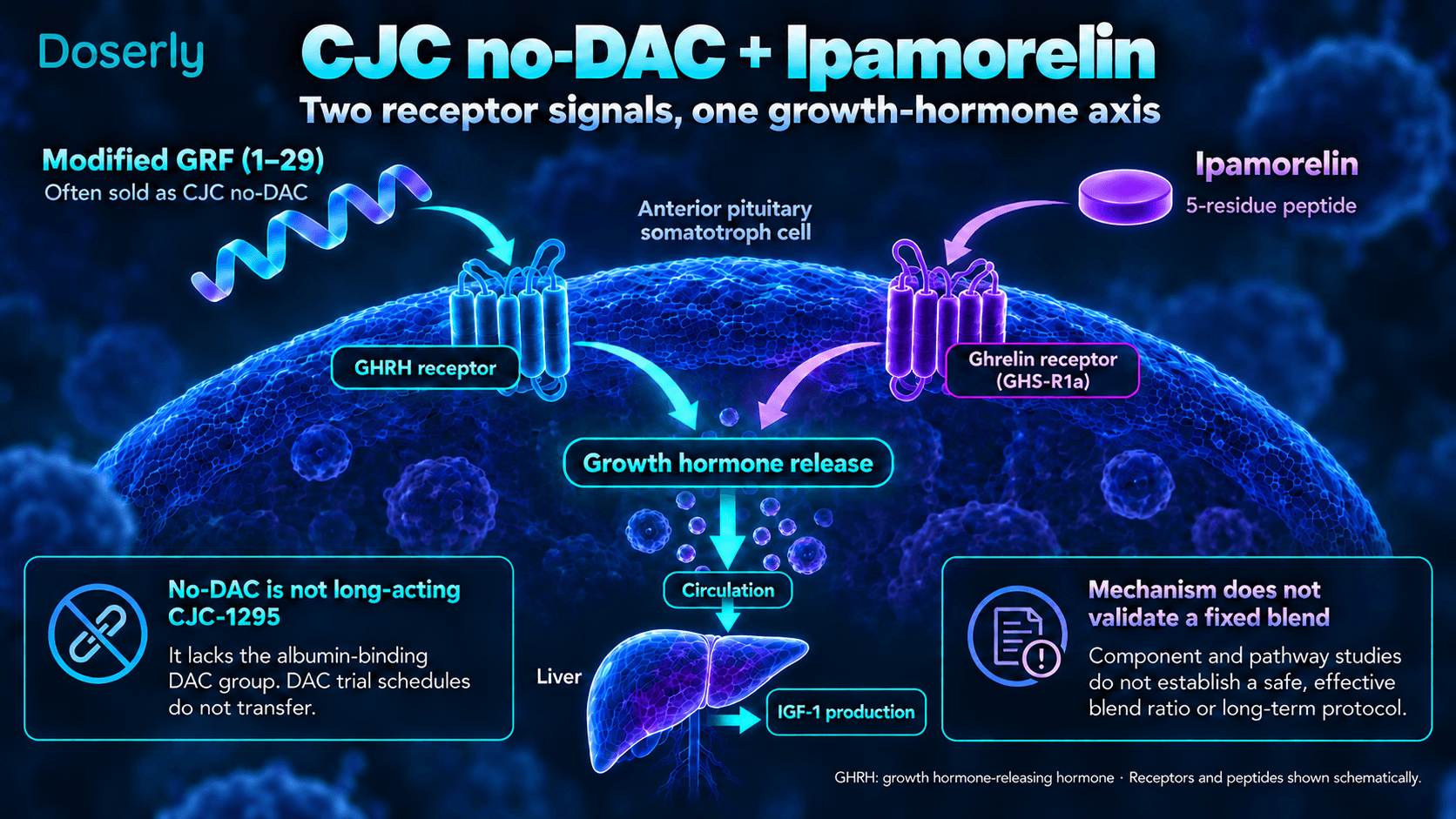
Evidence and evidence limits
The component literature is stronger than the blend literature. Ipamorelin has animal pharmacology showing selective GH release without the ACTH/cortisol pattern seen with older GHRPs. CJC-1295 has published DAC-form human pharmacokinetic studies, but those are not no-DAC blend studies. GHRH plus GHRP synergy has controlled human physiology support, but not as a commercial fixed-ratio CJC no DAC/ipamorelin vial. [2][4][5]
No reliable controlled human joint, tendon or injury-recovery trial of the fixed blend was retained. Claims about "joint repair" or "recovery stacks" should be presented as marketing or mechanism unless tied to a named controlled study. A fixed vial also makes attribution harder: changes in appetite, edema, sleep, glucose or IGF-1 cannot be cleanly assigned to one component without separate-component comparison.
Safety and regulatory context
FDA's compounding safety-risk page lists ipamorelin acetate for outsourcing-facility compounding concerns, including aggregation or peptide-related impurities, unnatural amino acids and limited safety information for certain injectable routes. FDA warning-letter language has also named CJC-1295 and ipamorelin among substances that did not meet 503A bulk-substance conditions in that inspected context. [6][7]
The practical safety concerns are the expected GH-secretagogue themes: water retention, glucose/insulin changes, injection-site issues, possible appetite changes and difficulty interpreting IGF-1 elevation when more than one GH-axis agent is used. The blend also removes dose independence. Raising ipamorelin raises Modified GRF(1-29), and lowering one lowers the other.
How to keep records useful
A useful record names the actual label ratio, total vial content, reconstitution volume, total draw amount and estimated per-component amount. It should not record "10 mg" as a dose unless 10 mg was actually administered. Doserly can keep the product label, dose math, reminders and observations together so that a vial-size label does not become a false protocol.
Frequently asked questions
Why are the 5 mg and 10 mg pages not separate guides?
They are the same concept at different vial amounts or naming conventions. Vial content affects how long a vial lasts and how concentration math works after reconstitution. It does not create a different molecule or separate evidence base.
Is CJC no DAC the same as long-acting CJC-1295?
No. The no-DAC name refers to the short-acting Modified GRF(1-29) style material sold without the drug affinity complex. The published long-acting CJC-1295 studies involve the DAC albumin-binding molecule. [1][2]
Is there a proven fixed-ratio clinical dose for the blend?
No FDA-approved fixed-blend dose and no controlled human fixed-ratio outcome trial were retained. Popular sites publish total-dose ranges such as 200 to 600 mcg, but those are marketplace protocols, not clinical consensus. [8][9]
Does the blend prove joint or tendon repair?
No. The retained evidence supports GH-axis signaling and component pharmacology, not a controlled joint or tendon repair claim for the fixed blend.
References
[1] Jette et al. Identification of CJC-1295 as a long-lasting hGRF(1-29) analog
[2] Teichman et al. Prolonged GH and IGF-1 stimulation by CJC-1295 with DAC in healthy adults
[3] ClinicalTrials.gov NCT00267527, terminated CJC-1295 Phase 2 trial in HIV-associated visceral obesity
[4] Raun et al. Ipamorelin, the first selective growth hormone secretagogue
[5] Veldhuis and Bowers. Determinants of GHRH and GHRP synergy in men
[6] FDA compounding safety-risk list including ipamorelin acetate
[7] FDA Tailor Made Compounding warning letter naming CJC-1295 and ipamorelin in 503A bulk-substance context
[8] Peptide Schedule CJC-1295 plus ipamorelin dosage calculator
[9] PeptideDosingCalc CJC-1295/ipamorelin blend calculator