
Peptides
October 16, 2026
Why MOTS-c studies disagree about blood levels
On this page
Read a few MOTS-c papers and you can encounter apparently conflicting findings. One study reports lower levels in a metabolic condition; another finds higher levels; another finds little difference. Aging research adds a further complication: a blood result and a muscle result can move in opposite directions.
These disagreements matter if you're trying to understand whether MOTS-c is a marker of metabolic health. They don't necessarily mean one study must be wrong. Researchers may have studied different people, collected different samples or used methods that don't produce directly comparable measurements.
The useful starting point is therefore the complete finding: which participants, which sample, which method and which comparison? We'll examine the actual studies rather than force them into a universal “higher is better” or “lower is worse” rule. For background on the peptide itself, see our MOTS-c guide.
Begin with three different obesity findings
A 2018 study compared ten lean adults with ten adults with obesity. Mean plasma MOTS-c concentrations were similar: 0.48 ± 0.16 and 0.52 ± 0.15 ng/mL, respectively, with p=0.60. Associations with insulin-sensitivity measures were more evident in the lean subgroup. Cataldo and colleagues, 2018
That finding is narrower than “obesity doesn't affect MOTS-c.” It means this small comparison did not identify a clear group difference under its study conditions. With only twenty participants, the study provides limited precision and cannot settle every possible relationship across different forms or stages of metabolic disease.
A 2026 study compared 22 lean adults with 32 adults with obesity scheduled for bariatric surgery. It reported higher circulating levels in the obesity group, but the paper contains a numerical discrepancy: its abstract gives 273 ± 56 versus 223 ± 50 pg/mL (p<0.01), while its main Results section gives 263.6 ± 53.1 versus 213 ± 53.5 pg/mL (p=0.001). Both support the same direction of association; the inconsistent means should not be treated as interchangeable estimates. In ten participants followed for six months after surgery, MOTS-c did not change significantly despite weight loss. Yoon and colleagues, 2026
A 2023 pediatric study went in another direction. It included 225 children with obesity and 218 healthy children, with average ages around eight years. Serum MOTS-c, measured by ELISA, was lower in the obesity group, as was a measure of peripheral vascular function. This was an observational association, not a treatment experiment. Luo and colleagues, 2023
Taken together, these studies don't identify a single concentration pattern that applies to everyone with obesity. They also don't justify treating children and adults as interchangeable populations.
The comparisons differ before the samples reach a laboratory
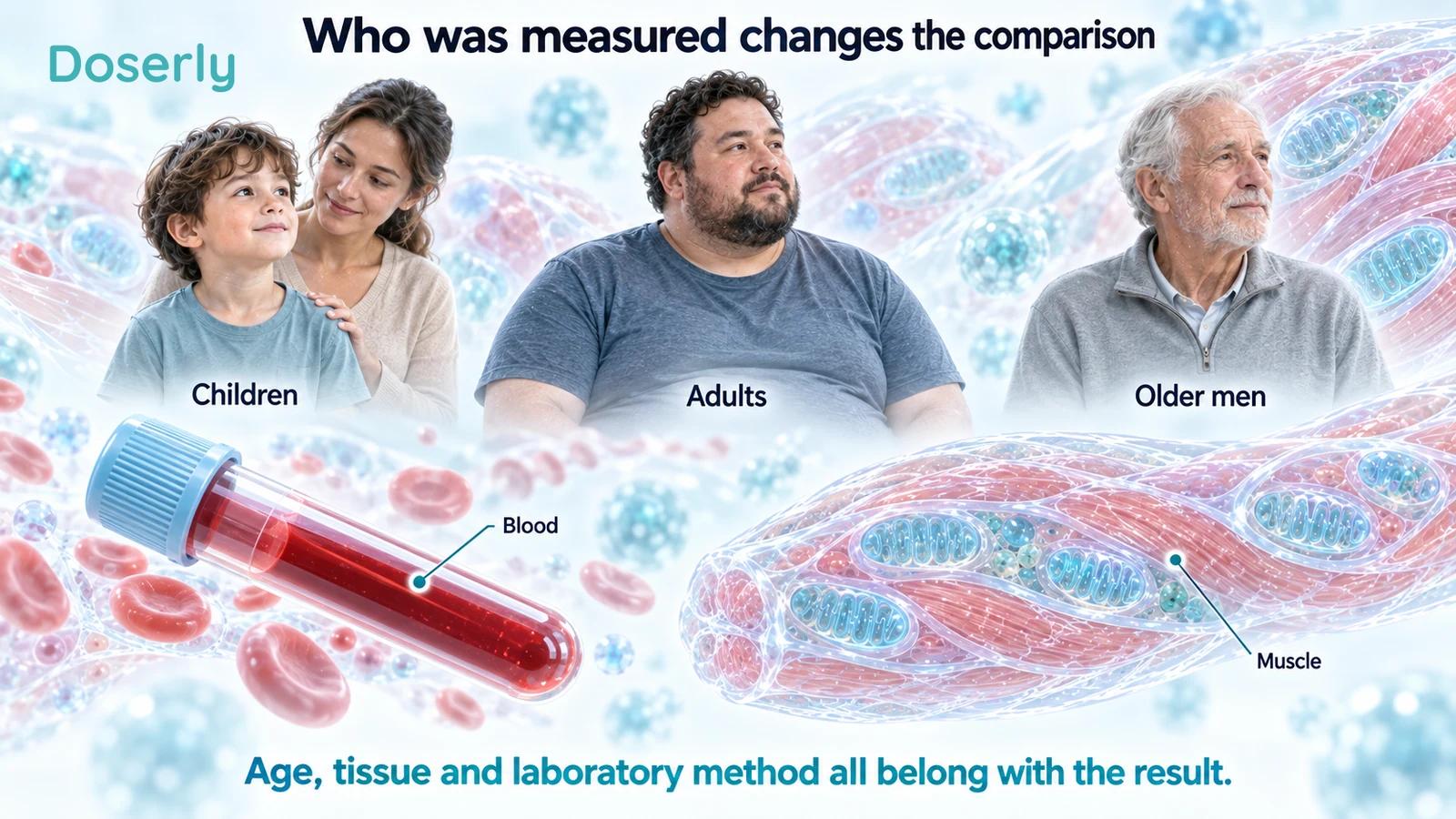
The adult surgery cohort was selected in a particular clinical setting. The children were at a different life stage, and the small 2018 adult comparison had its own eligibility and metabolic characteristics. A broad label such as “obesity” doesn't make the groups identical in age, body composition, disease duration or metabolic state.
This is why the control group matters as much as the group of interest. A difference is always relative to the people used for comparison. If two studies recruit different control populations, their estimates need not match even when both measurements are technically sound.
The sample size also changes how confidently a study can distinguish patterns from noise. A larger study can estimate an association more precisely, but size alone doesn't remove bias or make its participants representative of every patient. A smaller study can reveal a real signal, but its estimate may be unstable.
For readers, a useful comparison table records those design features without pretending the numerical concentrations share one universal scale:
Study
Cataldo, 2018
- Participants
- 10 lean and 10 obese adults
- Main reported pattern
- Similar average plasma concentrations
Study
Luo, 2023
- Participants
- 225 children with obesity and 218 healthy children
- Main reported pattern
- Lower serum MOTS-c in the obesity group
Study
Yoon, 2026
- Participants
- 32 adults awaiting bariatric surgery and 22 lean adults
- Main reported pattern
- Higher circulating MOTS-c in the obesity group
These are different observational cohorts, not three arms of one experiment. The table summarizes the reports cited above; it should not be used to rank an individual person's result.
Blood and muscle are different compartments
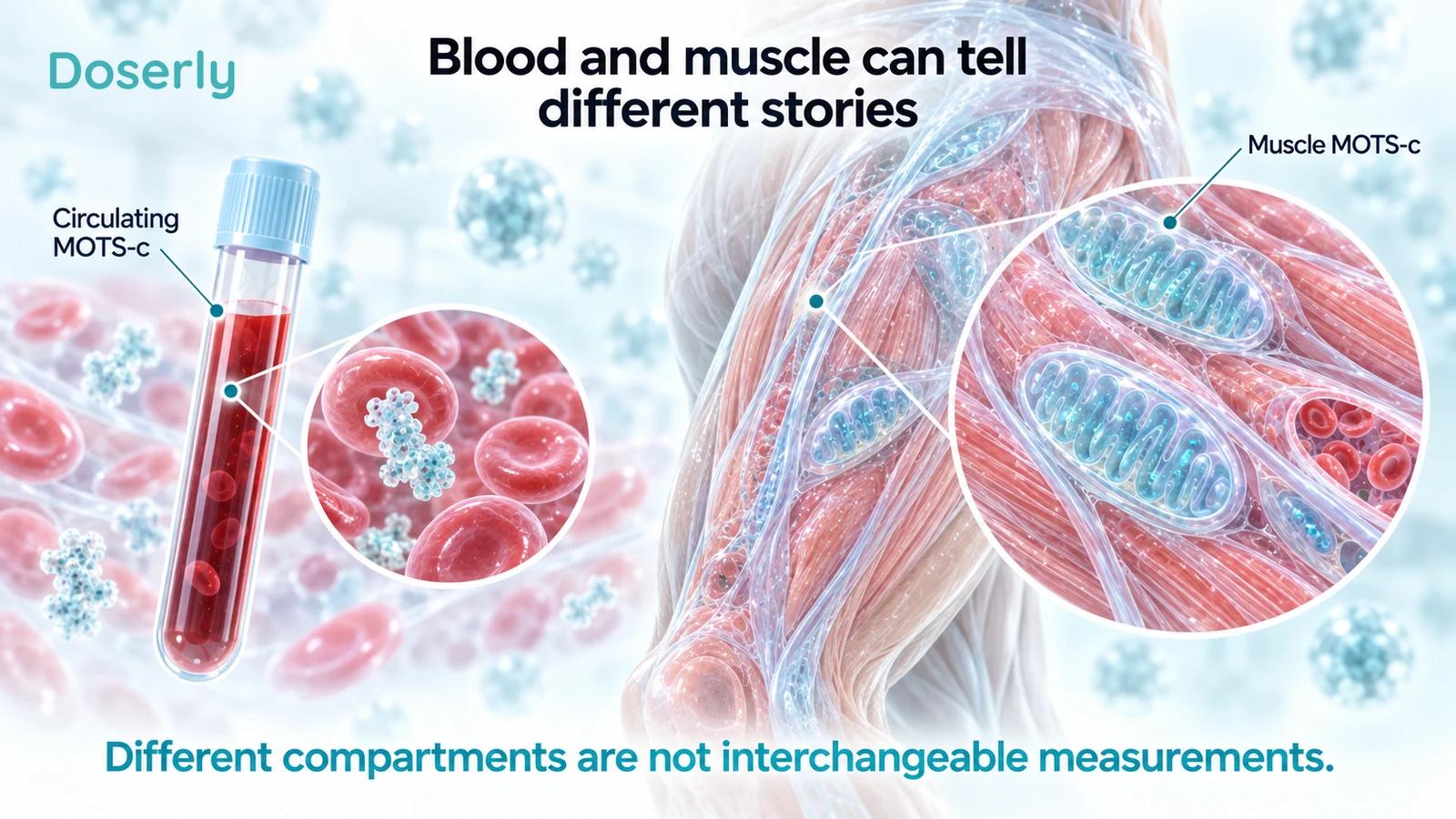
The aging literature shows why even measurements from the same person can need separate interpretation. In a 2020 study, investigators compared young men aged 18–30, middle-aged men aged 45–55 and older men aged 70–81, with 26 participants per group. Circulating MOTS-c was lower with age, while muscle expression was about 1.5-fold higher in the middle-aged and older groups than in the young group. D'Souza and colleagues, 2020
The authors also examined muscle-fiber characteristics and associations with muscle quality. Their findings argue against describing aging as a uniform MOTS-c decline throughout the body. They do not show that an individual man's blood level will fall at a particular rate, because the study compared age groups rather than following the same men across decades.
Blood is a circulating compartment. A muscle specimen measures material in a specific tissue, using its own preparation and analysis. Local expression, release into circulation and clearance from circulation are different processes. A blood concentration therefore cannot automatically stand in for muscle content.
The same principle applies when a study examines adipose tissue, the body's fat tissue. A local tissue result is not required to mirror a blood result. Researchers need direct evidence for that relationship rather than assuming every compartment shares the same pattern.
Timing can change the biological question
A sample collected at rest and a sample collected around exercise describe different physiological conditions. In the human portion of a 2021 study, ten sedentary healthy young men completed stationary cycling. MOTS-c measurements increased around exercise, and circulating levels returned toward baseline after four hours of rest. Participants were not given MOTS-c. Reynolds and colleagues, 2021
The observation supports asking when a sample was collected in relation to activity. It does not establish a universal four-hour preparation rule for every assay or population. The experiment used a particular protocol in a small group of young men.
Timing also matters in longitudinal studies. A measurement shortly after an intervention and one six months later test different hypotheses. The ten-person postsurgery follow-up in the Yoon study, for example, cannot reveal every possible transient change that might have occurred between its sampling points.
A paper should therefore report enough of the collection conditions to make comparisons meaningful. If those details differ or are missing, the disagreement may remain unresolved. It's better to preserve that uncertainty than to invent a biological explanation for it.
Different assays may not be measuring the same signal equally well
ELISA uses antibody binding to generate a signal that is compared with standards. Liquid chromatography–mass spectrometry separates sample components and examines mass-related properties. These methods have different strengths, assumptions and possible sources of error.
The issue is more than theoretical for MOTS-c. In work developed for doping control, the original investigators described twenty healthy-volunteer samples analyzed by both approaches. A commercial ELISA reported 45.9–218.5 ng/mL, but the mass-spectrometry method did not detect endogenous MOTS-c. Added synthetic peptide was detectable. The authors raised assay specificity as a possible explanation for the discrepancy. Knoop and colleagues, 2019 proceedings
This doesn't establish that all ELISA findings are wrong or that human blood contains no MOTS-c. It does mean that agreement between methods cannot be taken for granted. An apparent difference between study populations may be mixed with a difference in what the assays recognize and quantify.
Before interpreting a disagreement biologically, researchers need to examine calibration, specificity, sample handling and measurement limits. A method that performs well for one purpose, such as identifying an administered substance, also needs separate justification before it is used to define a clinical reference range.
Units can confuse the comparison without explaining all of it
The 2018 adult results were reported in ng/mL; the 2026 results were reported in pg/mL. One ng/mL equals 1,000 pg/mL. Thus, 0.48 ng/mL is 480 pg/mL, not a value smaller than 223 pg/mL merely because its printed number is smaller.
Converting units is an essential first check. It is not enough to make the studies directly comparable. The converted values still come from different cohorts and methods. Presenting them together on one numerical graph could suggest a shared, calibrated measurement system that hasn't been demonstrated.
Likewise, a percentage difference within one study does not remove every methodological issue. Relative changes may be useful within a consistent assay, but the reliability of the underlying measurement still matters. A precise-looking calculation cannot correct an uncertain signal.
Could higher levels be a compensatory response?
The 2026 obesity investigators discussed a possible compensatory response to metabolic dysregulation. That is a plausible interpretation of an association: the body may increase a signal while responding to a problem. It is different from showing that the signal caused the problem or that increasing it further would help. Yoon and colleagues
Compensation is a hypothesis that needs testing. The same cross-sectional pattern can sometimes fit several explanations. Differences in production, tissue uptake or clearance could contribute, and an observational blood sample cannot by itself distinguish them.
The pediatric vascular findings require the same care. An association between MOTS-c and a vascular measurement does not establish that administering MOTS-c improves vascular function in children. A statistical model can explore relationships, but cannot substitute for an intervention that tests the causal claim.
What would make future results easier to compare?
Useful progress would include clearer assay validation, standardized reporting of sample conditions and independent replication in well-described populations. Studies that measure more than one tissue or use complementary analytical methods can help explain where a discrepancy arises.
Following the same participants over time would also answer questions that cross-sectional age comparisons cannot. It could distinguish a within-person change from differences between generations or recruitment groups. Repeated measurement would still need consistent methods and enough follow-up to address the biological question.
For now, the studies support a nuanced conclusion: MOTS-c measurements relate to human metabolic and exercise biology, but the direction and meaning depend on context. They do not establish a universal deficiency threshold, an ideal level or a rule that one should always try to raise it.
If you encounter a claim based on one paper, look for the population, compartment, assay and timing attached to it. Those details usually explain more than the isolated words “high” or “low.” The MOTS-c guide connects this measurement research with the wider evidence without treating circulating levels as a treatment prescription.
Sources
- Cataldo and colleagues, 2018: small adult plasma comparison and insulin-sensitivity associations.
- Luo and colleagues, 2023: pediatric serum and vascular-function observations.
- Yoon and colleagues, 2026: adult obesity and postsurgery follow-up.
- D'Souza and colleagues, 2020: divergent blood and muscle patterns across age groups.
- Reynolds and colleagues, 2021: endogenous measurements around human exercise.
- Knoop and colleagues, 2019 proceedings: original investigators' report of assay disagreement.