
Peptides
October 16, 2026
What a MOTS-c blood test can and cannot tell you
On this page
MOTS-c is a small peptide connected with how cells respond to changing energy demands. Researchers have measured it in human blood and muscle, including around exercise and in people with metabolic conditions. That makes a blood test sound appealing: perhaps one number could explain tiredness, show how well mitochondria are working or identify who might benefit from treatment.
The research doesn't yet support those uses. A laboratory may report a MOTS-c concentration, but measuring a substance and knowing what to do with the result are separate achievements. Current studies leave important questions about the measurement itself, the meaning of a high or low value, and whether acting on it improves health.
If you've been offered a test, the useful question is therefore more specific than whether MOTS-c can be detected. What does this particular method measure, in which sample, and what evidence connects its result to the decision you face? Our MOTS-c guide introduces the peptide's biology; here we'll concentrate on the blood-test question.
A concentration isn't a measurement of energy production
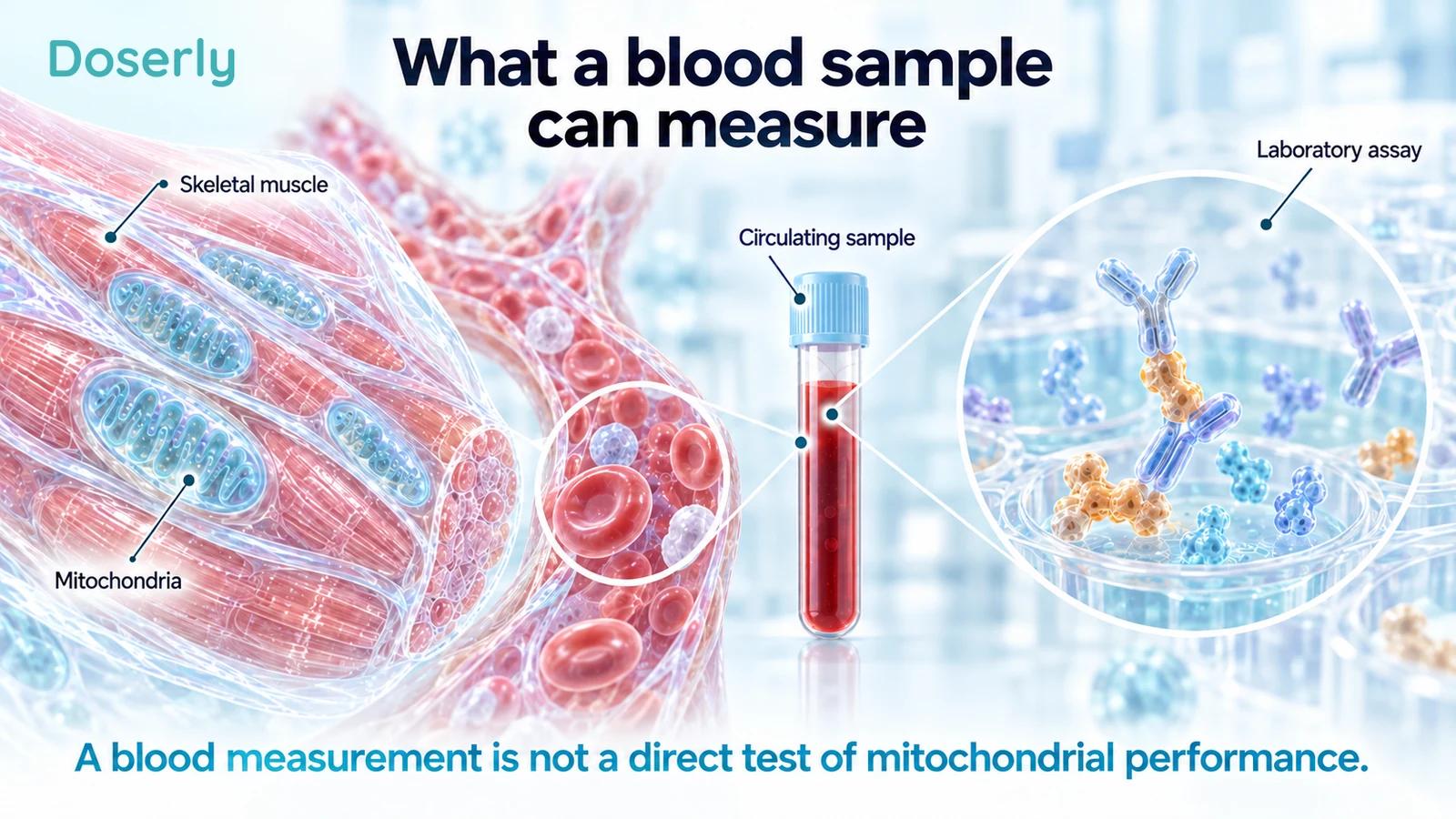
Mitochondria help cells make ATP, a molecule used to transfer energy. MOTS-c is associated with mitochondrial genetic information and cellular responses to metabolic stress. Its concentration in a blood sample is a different kind of measurement from the rate at which muscle produces ATP, the distance someone can walk or how fatigued they feel.
A helpful way to separate these questions is to think about what the laboratory actually receives. It receives a tube containing a sample collected at one time. It doesn't receive a direct recording of every mitochondrion in your muscles. Even an analytically excellent result would describe the substance in that sample, under that assay's conditions.
Human research illustrates why the distinction matters. A study comparing young, middle-aged and older men found lower circulating MOTS-c with age but higher muscle expression in the older groups. There were 26 participants in each age group. Blood and muscle therefore did not tell a single, uniform story about aging. This was an observational comparison, not a test of supplementation. D'Souza and colleagues, 2020
A low blood result cannot simply be translated into “all my muscles lack MOTS-c.” Nor can it identify why you feel tired. Those are larger clinical claims that would need their own validation.
What does the laboratory method recognize?
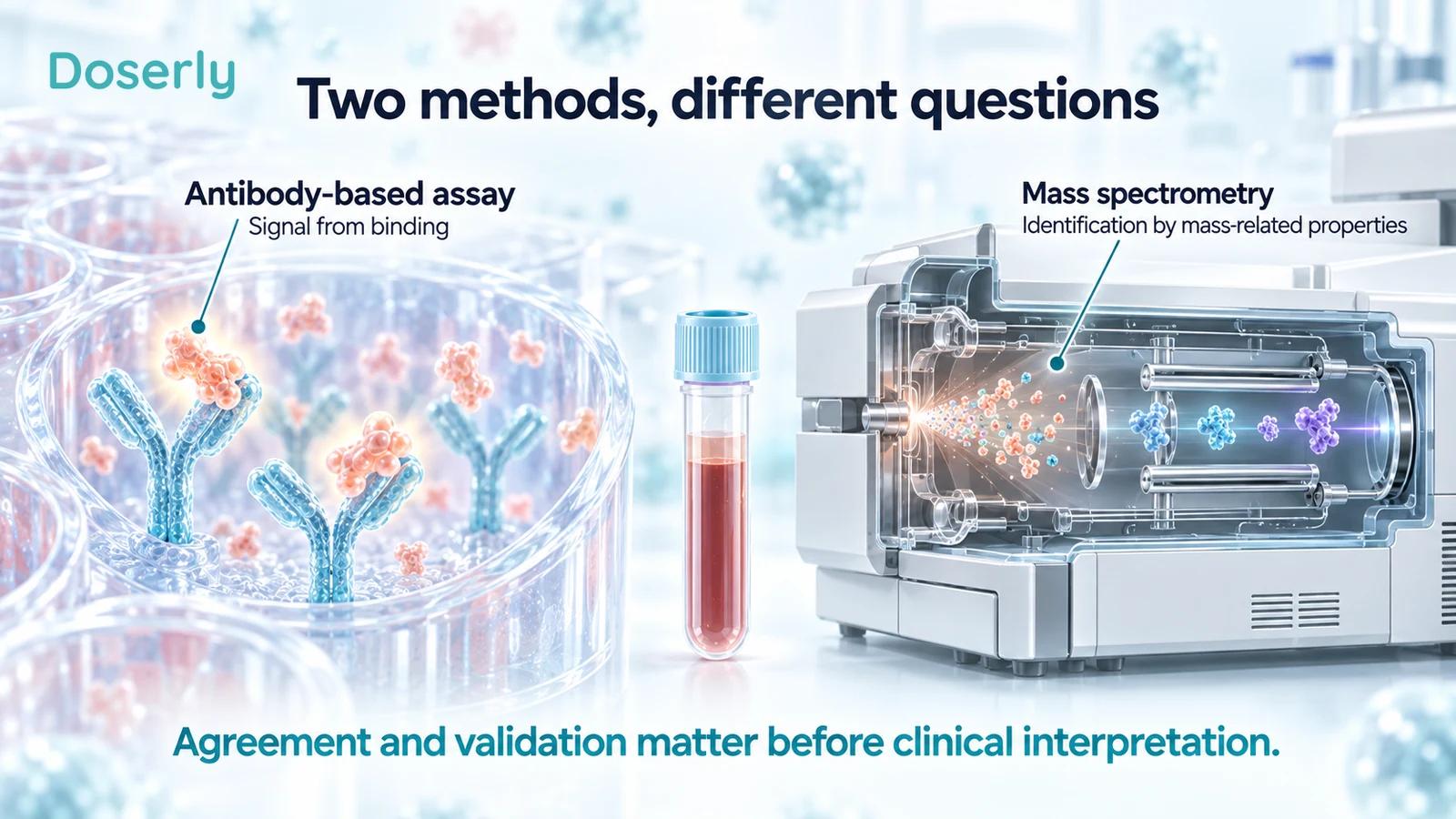
Many published studies use an enzyme-linked immunosorbent assay, usually shortened to ELISA. The basic idea is to use antibodies that recognize a target and produce a measurable signal. The signal is compared with standards to estimate a concentration. The method can be useful, but its accuracy depends on how specifically those antibodies recognize the intended material in a complex biological sample.
A second approach uses liquid chromatography with mass spectrometry. Chromatography separates components of a sample; mass spectrometry examines their mass-related properties. The methods answer overlapping questions using different physical principles. Neither method becomes suitable for every clinical purpose simply because its name sounds sophisticated.
In a primary methods study developed for doping control, investigators compared mass-spectrometry findings with a commercial ELISA. Their institutional report describes 20 healthy volunteers: the ELISA produced readings of 45.9–218.5 ng/mL, while the mass-spectrometry approach did not detect endogenous MOTS-c. Added synthetic MOTS-c could be detected. The authors highlighted the disagreement as a question about assay specificity and reported circulating levels. Knoop and colleagues, original institutional proceedings
That result doesn't prove that MOTS-c is absent from human blood or that every antibody assay is invalid. It does show why a number needs a method attached to it. A result from one platform cannot automatically be interpreted using a threshold established on another.
“Detected” and “accurately quantified” are different
Laboratories distinguish the ability to notice a signal from the ability to assign a reliable amount to it. Near a method's lower limits, small differences can be difficult to interpret. A reported value with several decimal places may look precise without having equivalent biological or clinical precision.
For a reader, the practical details are straightforward. Ask whether the result falls within the method's validated measuring range, how repeatable the measurement is, and whether the laboratory has tested for interference from other sample components. If these details aren't available, the uncertainty doesn't disappear because the report provides a reference bar or a colored flag.
This is also why units matter. One nanogram per millilitre equals 1,000 picograms per millilitre. A value written in ng/mL and another written in pg/mL can appear dramatically different before conversion. Converting units is necessary when comparing reports, but it doesn't solve differences in assay specificity, calibration or sample preparation.
Suppose two laboratories report different values from samples collected on the same day. There are at least two questions: did the samples contain different amounts, and did the methods measure them differently? Without appropriate comparison work, the reports alone can't settle that question. It would be premature to interpret their difference as a sudden change in mitochondrial health.
Exercise changes the context of a sample
In the human part of a 2021 study, ten sedentary healthy young men performed a stationary-bike exercise session. Researchers collected blood and muscle samples around exercise and recovery. Circulating MOTS-c increased during and after exercise and returned toward baseline after four hours of rest. The investigators measured the participants' own peptide; they did not administer MOTS-c. Reynolds and colleagues, 2021
This provides a concrete reason to record recent activity when interpreting a research measurement. A resting sample and a sample taken after exercise need not describe the same physiological state. It doesn't establish a universal rule that everyone must wait exactly four hours before testing: the study was small, involved one exercise protocol and enrolled young men.
For repeated measurements, comparable collection conditions make the comparison easier to understand. That includes documenting when the sample was taken in relation to exercise and following the laboratory's actual preparation instructions. It does not mean changing prescribed treatment or deliberately manipulating activity to obtain a more reassuring number.
The question is what you are trying to learn. Measuring an exercise response requires a defined exercise and sampling protocol. Comparing resting values requires a defined resting protocol. Mixing the two can create an apparent trend whose explanation is timing.
Higher isn't consistently better
A familiar laboratory-test pattern is that a low concentration indicates deficiency and replacement restores it. It is tempting to apply that model to MOTS-c, but the human observational findings do not establish it.
A 2018 study included ten lean and ten obese participants. Average plasma concentrations were similar between groups, and associations with insulin-sensitivity measures differed when the groups were examined separately. It was a small metabolic comparison, not a study defining a healthy target or demonstrating that raising the peptide improves insulin sensitivity. Cataldo and colleagues, 2018
A later study compared 22 lean adults with 32 adults with obesity awaiting bariatric surgery. It reported higher circulating MOTS-c in the obesity group. Ten participants were followed after surgery, and their MOTS-c did not change significantly at six months despite weight loss. The authors regarded the findings as exploratory and called for independent validation. Yoon and colleagues, 2026
These studies do not establish that high MOTS-c causes poor metabolic health, either. A measured association could reflect a response to a metabolic condition rather than its cause. Differences between populations and laboratory methods also matter. The findings make “higher is healthier” an unsuitable default interpretation.
A reference interval isn't necessarily a treatment target
A reference interval describes values observed in a defined reference population using a particular method. A clinical decision threshold answers a different question: at what result does a particular action become justified? A treatment target goes further, proposing a value that treatment should achieve.
Consider a hypothetical report that flags your result below its range. Before interpreting that flag as a deficiency, you would need to know who defined the range, which assay was used, and whether people below it have a reproducible clinical problem. To justify treatment, you would also need evidence that an intervention helps those people and that its benefits justify its risks.
The MOTS-c studies discussed here don't provide that chain of evidence. They investigate biology, compare groups or evaluate measurement methods. None validates a routine blood-test threshold for diagnosing the cause of fatigue or selecting a MOTS-c treatment regimen.
This distinction protects the usefulness of laboratory research. A promising biomarker can deserve further study without already being ready to direct individual care. Calling it exploratory isn't dismissing the science; it describes the work still needed to connect a measurement to a decision.
Can a blood result tell you whether injections worked?
A change after treatment would still leave several questions. Did the assay detect the intended peptide? Was the timing comparable? Did the change exceed the method's ordinary variability? Most importantly, did the person experience the outcome treatment was intended to improve?
Even a confirmed rise in circulating peptide would show exposure or a biological change, not necessarily better endurance, improved metabolic health or safer aging. Those outcomes need to be measured separately. A laboratory number should not be used to fill in an unmeasured benefit.
FDA's July 2026 briefing on MOTS-c-related bulk drug substances reported that its evaluation had not identified clinical studies or human exposure data adequate to assess administration of those substances, including important pharmacokinetic and safety information. That assessment is about administering MOTS-c, rather than measuring the body's own peptide. FDA briefing, pages 27–30
A blood test cannot supply the missing treatment evidence. Nor does a reassuring test result establish the identity, sterility or safety of a product someone has used. These are separate questions that require different kinds of evidence.
What to ask before paying for a test
Start with the decision you hope the test will change. If the concern is persistent fatigue or reduced exercise tolerance, tell your clinician about the symptom, its timing and its effect on daily life. That allows assessment to begin with the problem rather than with an assumed peptide deficiency.
For the proposed test itself, useful questions are:
- Which method and sample does the laboratory use? Ask for the assay name, units and whether the sample is serum or plasma.
- How was the reference range established? The relevant comparison should match the method and have a defensible reference population.
- What does an abnormal result predict? An association in a small research study is different from a validated diagnosis.
- What would we do differently, and what supports that action? A test is most useful when its result leads to a decision that has evidence behind it.
If the answer is that testing is exploratory, that should be clear before the sample is collected. A research result can be interesting without offering a reliable answer to your health question. The complete MOTS-c guide places these measurement findings alongside the animal experiments, human observational work and remaining treatment questions.
Sources
- Knoop and colleagues, 2019 institutional proceedings: original investigators' account of mass-spectrometry and ELISA disagreement; a doping-control method, not a clinical diagnostic validation.
- Cataldo and colleagues, 2018: plasma MOTS-c and insulin-sensitivity measures in 20 adults.
- D'Souza and colleagues, 2020: blood and muscle findings across three age groups of men.
- Reynolds and colleagues, 2021: human exercise sampling alongside separate animal treatment experiments.
- Yoon and colleagues, 2026: exploratory obesity comparison and small postsurgery follow-up.
- FDA MOTS-c briefing, July 2026: gaps in evidence for administration of MOTS-c-related substances.