
Peptides
October 16, 2026
MOTS-c and aging in people: why blood and muscle tell different stories
On this page
MOTS-c is sometimes described as a peptide that declines with age and therefore needs replacing. That explanation is easy to follow, but it leaves out an important human finding: blood and muscle did not move in the same direction.
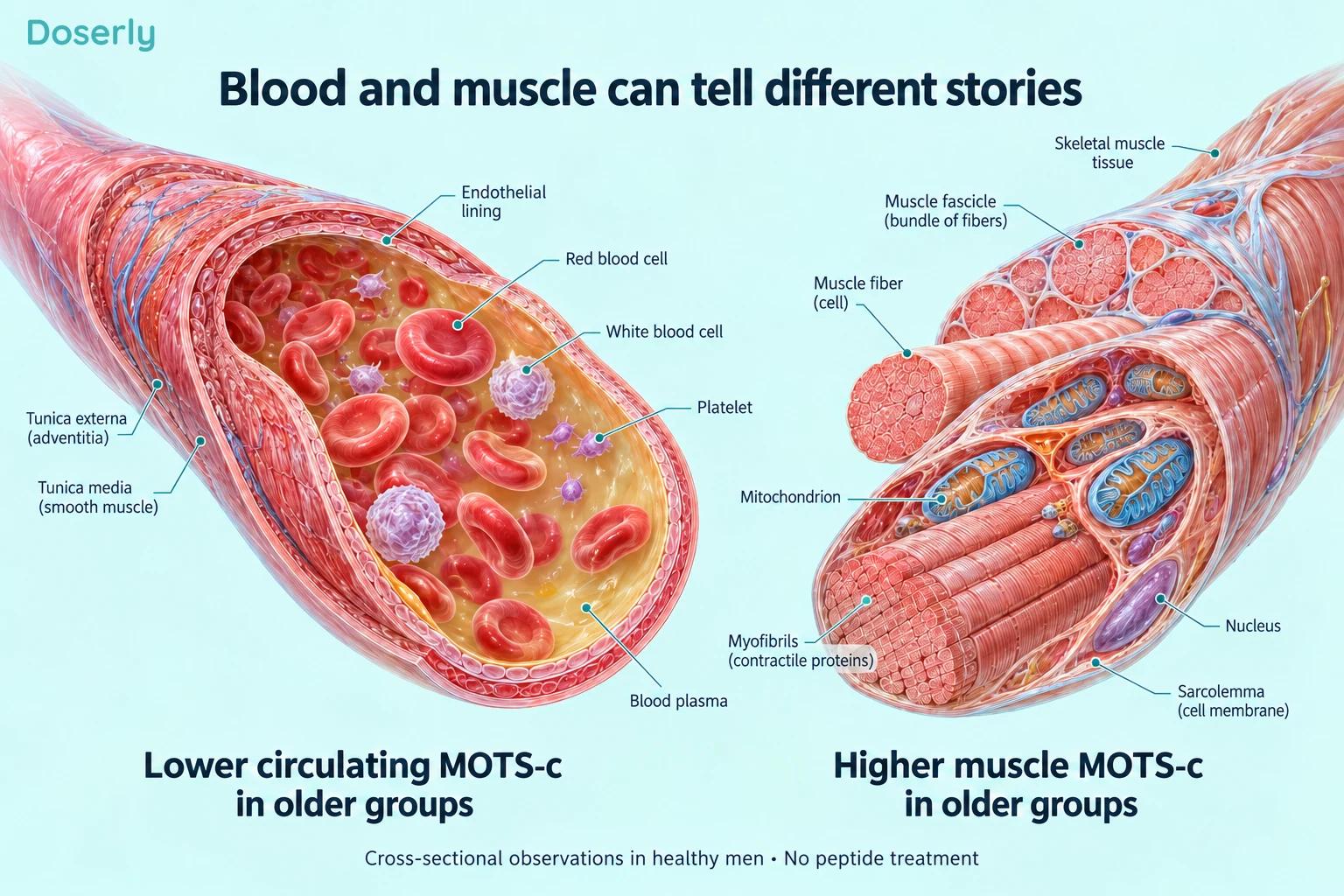
In a study of healthy men across age groups, circulating MOTS-c was lower in the older groups while muscle MOTS-c was higher. The finding does not tell us that older people have too much or too little of a treatment target. It tells us that where a peptide is measured changes the biological question. Human aging study
For someone concerned about strength, energy or healthy aging, the distinction matters. A lower blood concentration is not automatically a diagnosis of deficiency, and raising that concentration is not automatically a way to improve function. The research is more useful when its measurements, participants and uncertainties remain visible.
What the human aging study found
The 2020 study recruited 104 healthy men across young, middle-aged and older groups. Its main comparisons included 26 samples per age group for blood and muscle, but the older blood and muscle samples came from separate participants. Compared with young men, circulating MOTS-c was about 11% lower in the middle-aged group and 21% lower in the older group; muscle expression was approximately 1.5 times higher in the older age groups. Study methods and results
Muscle MOTS-c was associated with markers of slow-type fibers. In the older muscle group, it was associated with leg-press performance relative to thigh size, rather than with absolute leg-press load or thigh size alone. The study compared age groups at a point in time; it did not administer MOTS-c or follow the same men from youth into old age.
Those observations complicate a replacement narrative. A result described only as “MOTS-c falls with age” omits the tissue in which the direction was different.
A blood concentration is not a whole-body inventory
A circulating measurement describes what is present in a blood sample at a particular time. A muscle biopsy describes material within a small piece of a particular tissue. Neither is a direct inventory of every MOTS-c molecule in the body.
It helps to separate several questions. How much is present inside cells? How much reaches the fluid around them? How much enters circulation? How quickly does it leave circulation? Different combinations of those processes could produce a similar blood value. A concentration alone cannot identify which process explains it.
A 2026 study illustrates why investigators make these distinctions. During one-legged knee-extensor exercise in humans, it found increased MOTS-c in interstitial fluid but no change in the arterial-to-venous difference across the leg. The authors suggested that exercising muscle might not be the source of the circulating response. That was an exercise experiment, not a study establishing the cause of age-related blood differences. Human compartment measurements
The broader inference is modest: tissue content and circulation should not be assumed to be interchangeable. A blood test can be informative without revealing everything happening inside muscle, and an anatomical explanation should not draw an unproven secretion pathway simply because both locations contain the peptide.
Why separate older participants matter
If blood and muscle are sampled from the same person, researchers can ask whether individuals with more peptide in one compartment also have more in the other. If the samples come from different people, they can compare group averages, but they cannot calculate that within-person relationship for those groups.
Imagine a hypothetical study with one group of older adults providing blood and another providing muscle samples. The blood donors might differ from the muscle donors in activity, body composition or other characteristics, even if both groups meet the study's eligibility criteria. Matching age categories does not make them the same people.
This does not make the observations invalid. It changes the strength of the interpretation. The opposing averages can motivate a study collecting both samples from the same older participants. They cannot prove that an individual person's MOTS-c became trapped in muscle or stopped entering blood.
That is an especially important limit when a proposed treatment rests on a transport explanation. “The blood is lower because muscle cannot release the peptide” is a mechanism that would need direct investigation, not a conclusion supplied by the group comparison alone.
Muscle composition can influence a tissue average
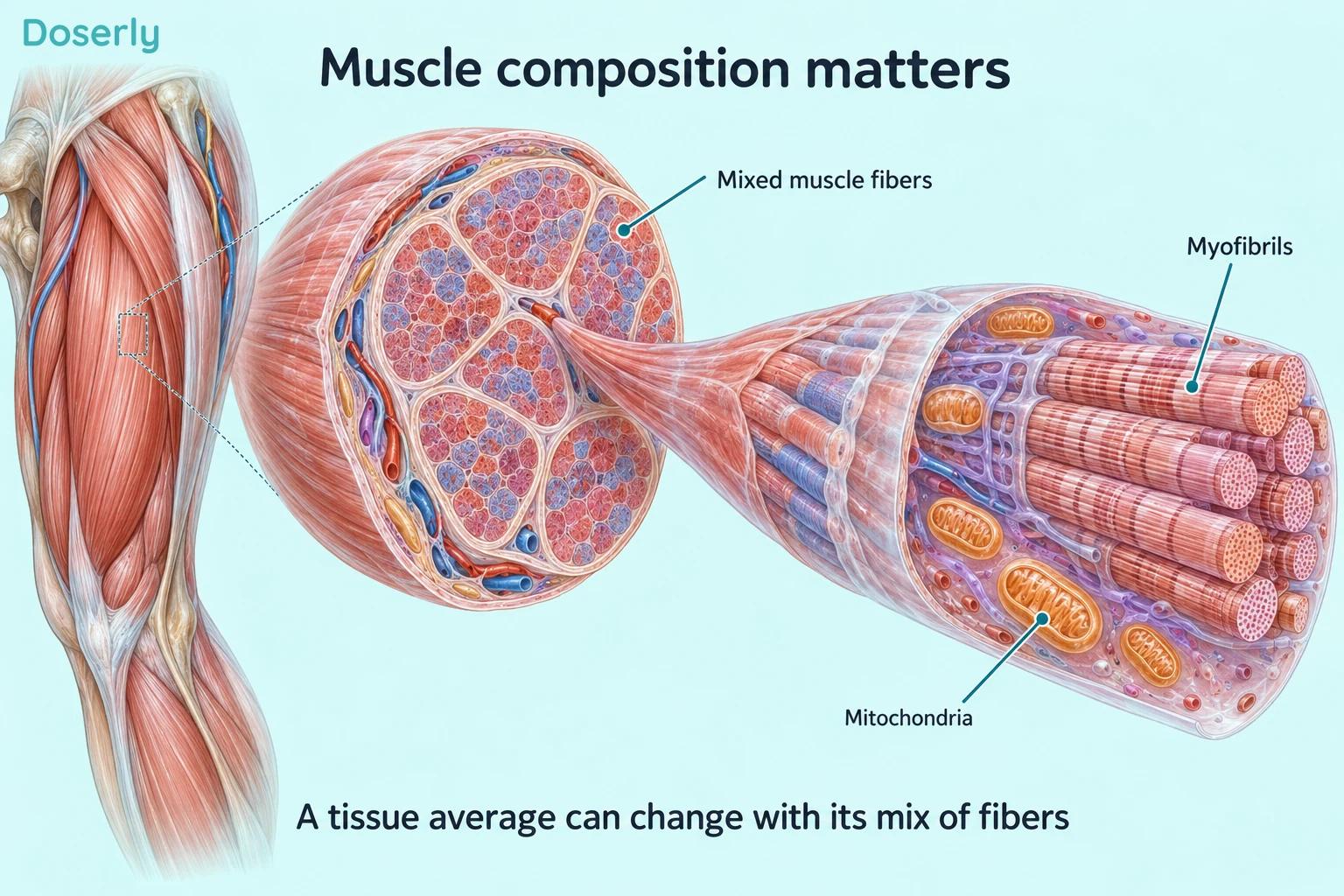
Skeletal muscle contains different kinds of fibers, with differing functional and metabolic characteristics. A biopsy measures a mixture. If the mixture changes, an average molecular measurement can change even without every cell behaving in the same way.
Consider a conceptual example with two fiber populations, one containing more of a measured protein than the other. A sample with a larger proportion of the higher-content population could produce a higher overall result. That would be different from every fiber increasing its production by the same amount.
This is why muscle composition is relevant to interpreting a biopsy. The association with slow-type fiber markers in the aging study suggests a question worth testing. It does not establish that changing MOTS-c will convert fibers, rejuvenate muscle or restore lost strength.
It also argues against labeling a higher tissue measurement as automatically good or bad. A change could reflect an adaptation, a shift in cell composition or another process. Those possibilities have different implications for treatment, and an observational result cannot choose among them by itself.
A strength association is not a strength treatment
A molecular measurement can correlate with a performance measure without causing it. The measurement may reflect muscle composition, habitual activity or another characteristic that also relates to performance. Giving more of the molecule is a different experiment.
A separate preliminary study in 2023 measured resting serum MOTS-c in 20 healthy, physically active volunteers, most of them men, with a median age of 30. Concentrations were associated with muscle mass and some force and power measures during jumping, but not with peak oxygen uptake during exercise testing. MOTS-c and physical-performance associations
This finding does not replicate a treatment benefit in older adults. It concerns a younger sample and associations among existing measurements. It also shows why “fitness” is too broad a label: jump power and peak oxygen uptake describe different abilities, and a marker need not relate to both.
For someone worried about declining function, the clinically meaningful outcome is what they can do—such as their measured strength, mobility or endurance—not merely whether a research marker moves in an appealing direction. A treatment study would need to demonstrate a useful change in those outcomes directly.
Metabolic context changes the interpretation too
MOTS-c measurements do not fit a simple rule that a higher concentration always means better metabolic health.
A small 2018 study compared ten lean and ten obese people. It found similar plasma MOTS-c concentrations in the two groups despite differences in insulin-sensitivity measures. Associations between MOTS-c and those measures depended on the group, with the within-group relationships evident in the lean participants. Lean and obese human comparison
That result should not be generalized into a universal claim that obesity never affects MOTS-c. The study was small. Its value here is that it prevents treating an isolated concentration as though it already has one established meaning across populations.
Another human experiment measured MOTS-c during lipid and insulin infusions in women with polycystic ovary syndrome and healthy controls. The circulating peptide responded to these metabolic manipulations, and eight weeks of exercise training did not produce a change in circulating levels. Lipid, insulin and exercise study
Together, these studies encourage attention to the conditions surrounding a measurement. A result from healthy men at rest, women undergoing an infusion experiment and younger adults performing exercise cannot be combined into a single treatment threshold simply because each paper mentions MOTS-c.
Cross-sectional aging is different from following aging
Comparing a younger group with an older group can reveal age-associated differences. It cannot show the exact path any individual took between those ages.
The distinction becomes important when a graph is interpreted as a personal forecast. People born decades apart have different histories. Recruitment can also select unusually healthy older volunteers. A study of participants free of overt chronic disease may teach us about healthy aging while leaving open questions about frailty, disability or specific illnesses.
A longitudinal study would repeatedly measure the same people and assess how changes relate to later outcomes. Even that would not automatically prove causation, but it could answer questions a one-time comparison cannot: whether a marker changes before function declines, whether the relationship persists after accounting for other factors, and how much variation occurs within a person.
The next step toward a treatment claim would go further still. Researchers would need to alter the exposure and show that doing so improves an outcome against a suitable comparison. Each step adds information; none should be silently substituted for the next.
Why the mouse findings do not settle the human question
MOTS-c treatment experiments in mice are part of the reason researchers remain interested in the peptide. A 2021 paper reported physical-capacity benefits in treated mice at different ages and examined late-life treatment. Its human component involved endogenous peptide measurements around exercise in young men, not treatment of older adults. Mouse treatment and human exercise research
An intervention in mice offers evidence that changing exposure can have effects in that model. It does not establish the effective exposure, safety or functional benefit in older humans. Species, health status and the outcome being measured all matter.
It is also useful to distinguish physical capacity from lifespan. A better performance result in an animal test is not, by itself, proof of longer human life. A claim about longevity should be supported by the outcome it names, rather than borrowing certainty from a different measure of health.
What would establish a useful human treatment?
A convincing trial would identify the actual molecule and preparation, enroll a relevant population and compare treatment with placebo or appropriate care. It would measure an outcome patients can benefit from, define the analysis in advance and follow adverse effects over a period appropriate to the proposed use.
If the rationale is correcting a deficiency, the research would also need to establish what deficient means. That includes a reproducible measurement, a threshold related to meaningful problems and evidence that treating people selected by that threshold helps them. An age-group average does not provide those pieces.
As checked on October 15, 2026, MOTS-MET was registered as recruiting, with 120 participants planned and no posted results. Its proposed population has prediabetes and overweight or obesity, and its main assessments concern insulin sensitivity and safety over a defined treatment period. It is not a completed longevity or older-adult strength trial. MOTS-MET registry
The FDA's July 2026 staff briefing separately described missing clinical exposure and pharmacokinetic evidence for evaluating native MOTS-c safety. The briefing was part of an advisory process, not an approval. A new registration does not fill those evidence gaps until actual data become available. FDA MOTS-c briefing
What the findings mean for someone interested in healthy aging
The human evidence gives a reason to be curious about MOTS-c, but not a validated replacement prescription. A lower circulating value can coexist with a higher tissue measurement, and neither finding alone tells us whether administering a peptide will improve health.
If loss of strength or endurance is the concern, start the clinical conversation with that change: when it began, what activities are affected and how it can be assessed. A research biomarker is useful only if it helps answer the person's actual question.
The Doserly MOTS-c guide provides background on the research and the distinction between native MOTS-c and related investigational analogues. For aging claims, keep one additional distinction in view: observing how healthy older people differ from younger people is the beginning of an explanation, not proof that those differences need to be reversed.
Sources
- Human MOTS-c measurements in blood and muscle across age groups, 2020
- MOTS-c bioenergetics and human compartment sampling, 2026
- MOTS-c and muscle force, power and oxygen uptake, 2023
- MOTS-c in lean and obese individuals, 2018
- Lipid, insulin and exercise effects on MOTS-c, 2019
- Mouse treatment and human exercise study, 2021
- MOTS-MET trial registration
- FDA MOTS-c briefing, July 2026