
Peptides
October 16, 2026
Does zenagamtide beat other weight-loss medicines? What the trials can tell us
On this page
Zenagamtide, previously called amycretin, is being developed to act on hormone receptors involved in appetite and glucose regulation. Its early injection trial reported a striking estimated weight reduction in one study group: 24.3% at 36 weeks. For someone trying to understand future obesity treatments, the obvious question is whether that makes it more effective than medicines already studied in large phase 3 trials. Early zenagamtide trial
The result is promising, but a ranking requires more than ordering percentages from largest to smallest. Trials differ in who entered, how treatment was increased, how long people were followed and how the analysis handled stopping treatment. Those differences are especially relevant when a small early study is compared with a much larger confirmatory trial.
We can learn a great deal by putting the studies beside one another, provided the comparison explains those differences. What we cannot do is turn that exercise into proof that one medicine would outperform another in the same person. Our zenagamtide guide covers its development; this article examines the specific numbers behind the comparisons.
Where the 24.3% figure comes from
The 2025 phase 1b/2a study randomized 125 people overall, including 101 assigned to amycretin and 24 to placebo. Participants were aged 18–55 and had overweight or obesity. The study had several parts, testing different regimens and durations. The entire sample did not receive the regimen associated with the largest result.
The estimate of −24.3% belonged to the group escalating to a 60 mg weekly target, assessed at week 36, compared with −1.1% for its placebo comparison. Other parts included different targets and endpoints at 20, 28 or 36 weeks. Safety and tolerability were central objectives. The report also described substantial withdrawal, with many departures unrelated to treatment-emergent adverse events. Primary early trial report
A large effect in a small study is not automatically false. It can be an important signal that motivates larger research. But selecting the highest estimate from several small groups introduces a question that a single headline cannot answer: how stable will that estimate be when a larger, more diverse group receives the regimen?
A bigger study is less vulnerable to a few unusually large responses moving the average. It also has more opportunity to reveal the range of responses: people who lose substantial weight, those with modest change and those unable to continue treatment. That range matters when the reader's question is what might happen to them.
What the familiar phase 3 numbers describe
In STEP 1, researchers enrolled 1,961 adults with overweight or obesity who did not have diabetes. They compared weekly semaglutide with placebo, alongside lifestyle intervention, for 68 weeks. Mean weight change was −14.9% with semaglutide and −2.4% with placebo. STEP 1 primary publication
In SURMOUNT-1, 2,539 adults with obesity or overweight and a weight-related complication, excluding diabetes, were randomized to tirzepatide or placebo for 72 weeks. The treatment-regimen estimate at the highest studied dose was −20.9%, compared with −3.1% for placebo. The trial included a 20-week escalation period. SURMOUNT-1 primary publication
These are useful reference points. They show that substantial weight reduction has been demonstrated in large controlled trials. They also show why “24.3 versus 20.9 versus 14.9” is an incomplete comparison: the numbers come from different populations, treatment plans, follow-up periods and analyses.
The question is not whether the early zenagamtide result is allowed to be discussed alongside them. It should be discussed. The question is whether those numbers alone identify a winner. They do not, because participants were never randomized between all three treatments within those separate trials.
For broader background on the established medicines, the semaglutide guide and tirzepatide guide explain their mechanisms and clinical uses. Their individual trial histories provide context, not a direct estimate of zenagamtide's advantage over them.
The participants can change the expected response
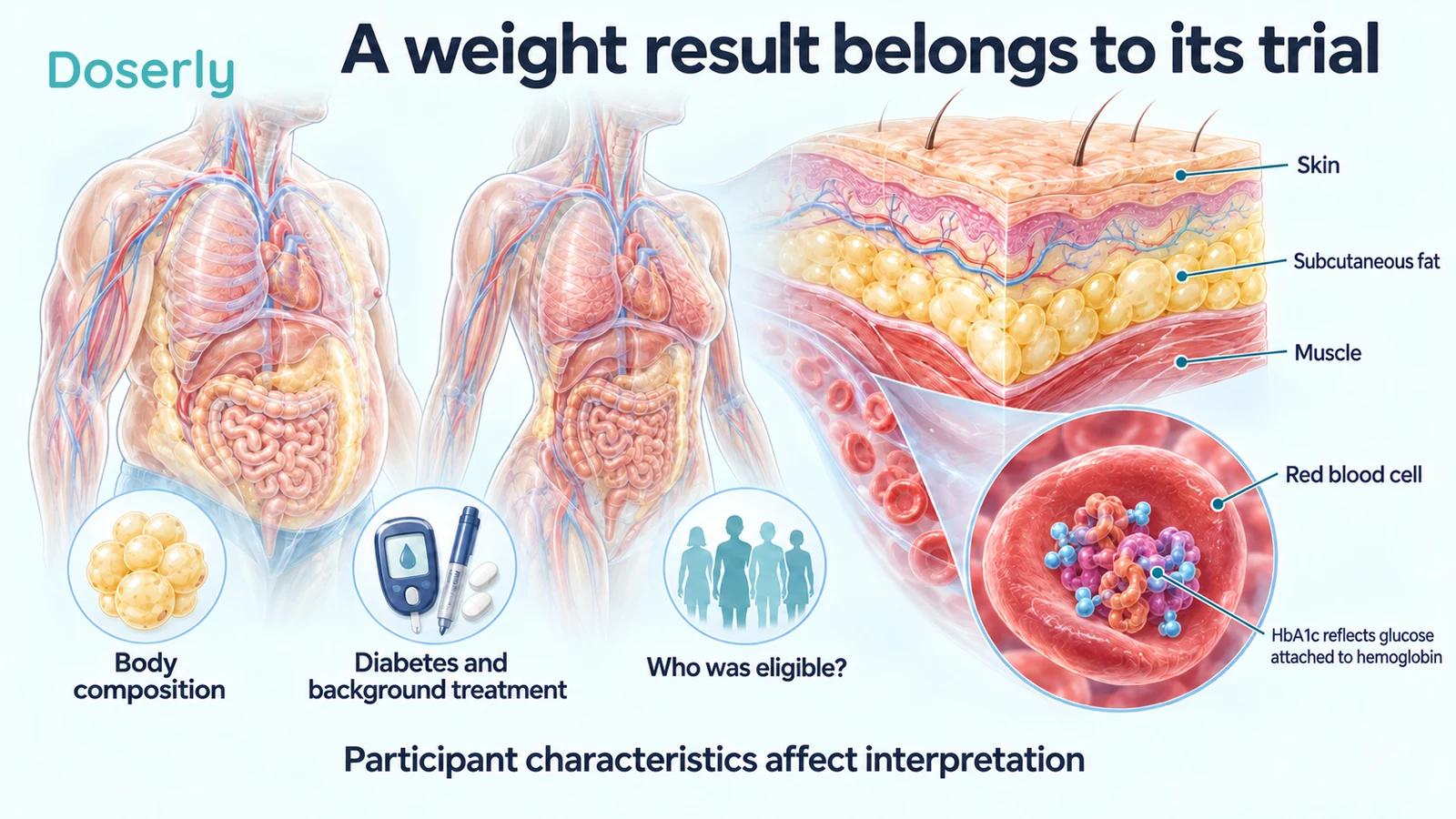
Obesity studies do not all recruit interchangeable groups. Age limits, starting body size, diabetes status, other illnesses and current medicines determine who can participate. These choices help protect participants and answer a defined research question, but they also limit how broadly a result can be applied.
The early zenagamtide injection study enrolled adults only up to age 55. Its later diabetes trial allowed adults aged 18–75 and required type 2 diabetes treated with metformin, with or without an SGLT2 inhibitor. The latter study's primary goal was improving HbA1c, a measure of longer-term blood glucose. Zenagamtide diabetes trial
A reader with diabetes should not assume an obesity result from people without diabetes predicts the same response while they continue their current diabetes medicines. Conversely, a smaller weight change in a diabetes trial does not by itself mean the molecule became less effective. The clinical question and the people being studied changed.
Longer treatment does not make the comparison simple
A common response to the 36-week result is that zenagamtide might do even better if studied for 68 or 72 weeks. That is a hypothesis worth investigating, not a calculation we can complete from the early percentage.
Weight change may continue, slow, stabilize or reverse. People may remain on treatment, change exposure or stop. The time spent reaching a target also differs from the time spent receiving that target. A 36-week trial can include many weeks of escalation, leaving a much shorter period at the final amount.
For example, the sponsor's diabetes report notes that the highest injection group had only four weeks at its 40 mg maintenance target. That observation helps explain why investigators want longer exposure data. It does not establish what the final weight change or tolerability will be after another year. Sponsor's phase 2 results explanation
Nor can weight loss be projected by multiplying the weekly average. Losing a certain percentage over the first months does not imply continuing at the same rate indefinitely. A fair comparison uses observed outcomes at a relevant time point, with uncertainty and treatment exposure described.
Why one trial can produce more than one answer
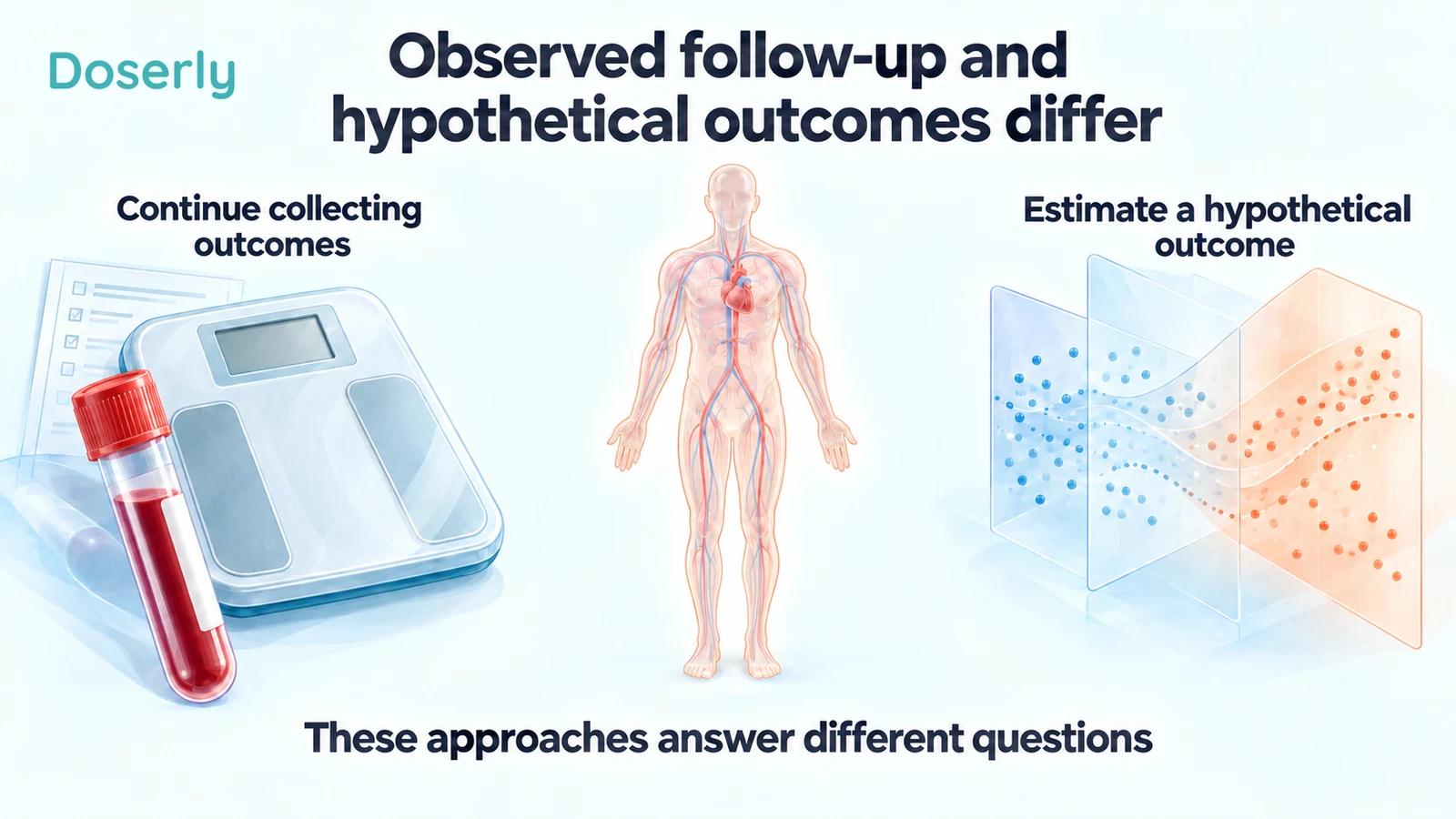
Researchers sometimes report multiple estimates because they are answering different questions about treatment. An estimand is the precise treatment effect they want to estimate, including what should happen analytically when someone stops treatment or uses additional medication.
A treatment-policy question asks about the effect of assignment to treatment while accounting for outcomes even if treatment changes or stops. A hypothetical question asks what would happen under a specified scenario, such as everyone continuing the assigned regimen. The latter may require modeling outcomes that were not observed. These distinctions are part of international trial methodology, not a special exception invented for weight-loss drugs. ICH E9(R1) training materials
Both questions can be useful. A person considering treatment cares about what the medicine can achieve when taken and also about what tends to happen when people begin it under the study's rules. Confusion arises when a favorable hypothetical estimate from one study is compared with a more pragmatic estimate from another as though both describe the same experience.
The published zenagamtide diabetes report explicitly used an efficacy estimand based on on-treatment data without rescue medication for its primary outcome. That wording tells readers to examine what happened after discontinuation and how missing observations were handled before treating the result as the average experience of everyone who started. Primary diabetes report
Does subtracting placebo solve the problem?
Subtracting each trial's placebo result can make a comparison more informative, but it does not recreate randomization between drugs. Placebo groups reflect the people, setting, background care and follow-up of their own trials. They are not a universal correction factor that removes every design difference.
For an arithmetic illustration, the reported 24.3% and 1.1% losses differ by 23.2 percentage points. That subtraction describes those two published estimates. It does not supply the uncertainty around a comparison with semaglutide or tirzepatide, and it does not adjust for different durations or missing-data assumptions.
A well-designed indirect comparison can use statistical methods to account for some differences. It still depends on whether the studies are sufficiently comparable and whether important differences were measured. A simple internet table generally does not provide those safeguards. The most persuasive answer to a superiority question is a suitable randomized head-to-head study.
What direct comparisons are planned?
The AMAZE 7 registry describes a phase 3 comparison of once-weekly injected zenagamtide with once-weekly semaglutide in adults with obesity. It plans 650 participants and an 84-week primary weight assessment. The record listed recruiting status and no posted results when checked on October 15, 2026. AMAZE 7
AMAZE 8 addresses overweight or obesity with type 2 diabetes, with a planned 1,000 participants and an 84-week primary weight assessment. Its record still listed not-yet-recruiting status and no results on the same date. AMAZE 8
These studies are more directly suited to a comparison because participants are assigned within a common study framework. Their eventual answers will still depend on the regimens, eligibility rules and analysis. A result in adults with diabetes will remain a result in that population. A trial registration also cannot supply an effect size before the results exist.
A useful comparison includes what people can sustain
The largest weight change is only one part of a treatment decision. People also want to know how many participants could continue, how disruptive adverse effects were, whether physical function improved and whether the benefit persisted. A medicine can produce a strong effect in those able to take it while presenting a different average experience among everyone who starts.
This does not mean early results should be dismissed until every question is answered. The early zenagamtide study gives a substantial reason for interest. It means that “promising candidate” and “proven better treatment” describe different stages of knowledge.
When a new comparison appears, ask which population and route it describes, whether the time points match, how the analysis treated stopping, and whether the medicines were directly compared. Those details preserve the genuine excitement of a strong result while keeping the conclusion useful for an actual treatment conversation.
Sources
- Early subcutaneous amycretin randomized trial, 2025
- STEP 1 semaglutide trial, 2021
- SURMOUNT-1 tirzepatide trial, 2022
- Subcutaneous zenagamtide diabetes trial, 2026
- Novo Nordisk phase 2 results statement, June 2026
- ICH E9(R1) estimand training materials
- AMAZE 7 primary registry
- AMAZE 8 primary registry