
Supplements
October 16, 2026
Pterostilbene's bioavailability advantage does not establish a health advantage
On this page
Pterostilbene is often introduced as resveratrol’s better-absorbed relative. That sounds like an upgrade: if more of a compound reaches the bloodstream, surely more benefit should follow.
The missing step is whether the extra exposure improves a meaningful health outcome without introducing unacceptable harm. Bioavailability describes exposure; it does not establish benefit. The distinction matters especially when a widely repeated numerical comparison comes from animals rather than people.
Pterostilbene has human research, including a small trial with mixed metabolic findings. Blood pressure fell under one regimen, while LDL cholesterol increased with pterostilbene alone. Those results deserve more attention than a simple absorption ranking.
This article follows the evidence from the familiar animal comparison to the human findings, and explains what remains uncertain. Our pterostilbene guide provides broader context for the ingredient and its uses.
What does bioavailability actually measure?
For an orally administered compound, absolute bioavailability describes the proportion reaching systemic circulation as the measured parent compound, typically estimated by comparing exposure after oral and intravenous administration while accounting for dose.
It is not just a measure of how much crosses the intestinal wall. Metabolism in the intestine and liver can change a compound before it reaches the general circulation. Researchers may also measure metabolites, which are chemically altered products rather than the original molecule.
Several related quantities appear in pharmacokinetic reports. Peak concentration describes the highest measured level. Area under the concentration–time curve summarizes exposure over time. Half-life describes how quickly a measured concentration declines during a specified phase. These quantities answer different questions; none directly counts prevented heart attacks, improved memory or added years of life.
The primary pterostilbene studies use these measurements to characterize how the body handles the compound. They provide a basis for designing further experiments, not a shortcut around clinical testing. Comparative pharmacokinetic study.
Where did the “80% versus 20%” comparison come from?
A study published online in 2010 and in a 2011 journal issue compared pterostilbene and resveratrol in rats. It used oral and intravenous dosing and measured both parent compounds and metabolites. The authors summarized oral bioavailability as approximately 80% for pterostilbene and 20% for resveratrol under the experimental conditions.
The doses were equimolar, meaning they supplied comparable numbers of molecules rather than identical weights in milligrams. Pterostilbene produced greater systemic exposure in this animal experiment. Kapetanovic and colleagues.
The species is not a footnote. Those percentages are not a validated promise that a person absorbs four times as much useful treatment from a pterostilbene capsule. They also do not show four times the clinical effect.
It is reasonable for scientists to consider the finding when selecting compounds for further research. It is not reasonable to replace “higher exposure in rats” with “better health outcomes in humans” without the studies connecting those statements.
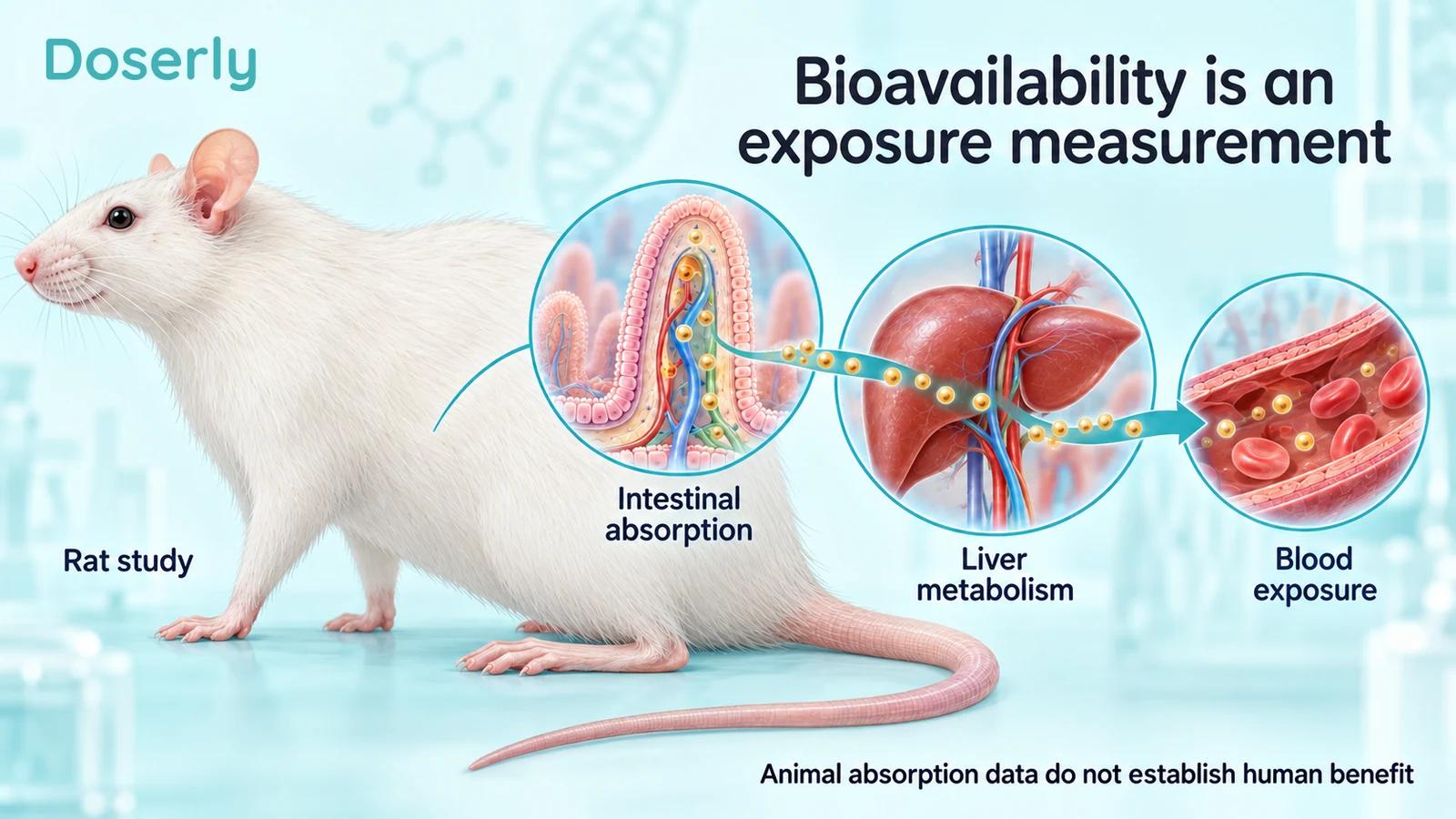
Even in rats, there is no single universal absorption percentage
Another rat study examined how formulation, fasting, amount and administration route affected pterostilbene exposure. An oral suspension had substantially lower bioavailability than a formulation that improved solubility; fasting and dose changes also altered the results. Formulation study.
That finding does not tell a consumer how to optimize a human dose. It shows why one percentage should not be treated as an intrinsic property that applies to every bottle under every condition.
A further rat study found approximately 35% oral bioavailability under its own protocol and measured different patterns of parent compound and sulfate metabolite across tissues. Tissue-distribution study.
Different estimates are not necessarily contradictions. Experimental conditions, formulations and analytical choices differ. The studies also illustrate that blood concentration is not identical to tissue exposure.
The practical reading habit is to ask what was administered, to which species, by which route and under which conditions. A headline that omits those details can turn a useful laboratory result into an apparently universal consumer fact.
Why more exposure is not automatically better
An intervention’s value depends on the relationship between exposure and outcomes. More exposure might increase a desired effect, an adverse effect, both or neither. A compound can reach the bloodstream efficiently and still fail to improve the clinical problem.
That is a general principle of interpreting pharmacokinetic evidence, not a claim that higher pterostilbene exposure always causes harm. The relevant relationship has to be established for the particular intervention.
It also means “better than resveratrol” needs a specified endpoint. Better absorbed in a particular experiment is one claim. Better tolerated, more effective for a disease, or more useful for an otherwise healthy person are different claims.
The human studies below do not provide a head-to-head clinical-outcome comparison establishing pterostilbene’s superiority over resveratrol. The resveratrol guide should therefore be read as evidence about a related but distinct compound, not as a benefit profile that pterostilbene automatically inherits.
The human trial contained a clinically relevant trade-off
An eighty-person randomized, blinded trial enrolled adults with elevated total or LDL cholesterol. Four groups received a higher pterostilbene amount, a lower amount, the lower amount combined with grape extract, or placebo for six to eight weeks.
The metabolic analysis found that LDL cholesterol increased with pterostilbene alone, with an estimated rise of 17.1 mg/dL. This increase was not observed in the grape-extract combination group. At the higher pterostilbene amount, systolic and diastolic blood pressure decreased. Metabolic trial.
A favorable blood-pressure finding does not cancel an unfavorable lipid finding. They are different measurements, and the short study did not establish the net effect on cardiovascular events.
The combination result also does not justify adding grape extract as a self-directed remedy. The groups were small, and a finding about one tested mixture does not demonstrate a reliable way to neutralize a side effect.
The study provides a reason to assess more than one outcome. An ingredient selected for a general “healthy aging” goal can move different risk-related measurements in different directions.
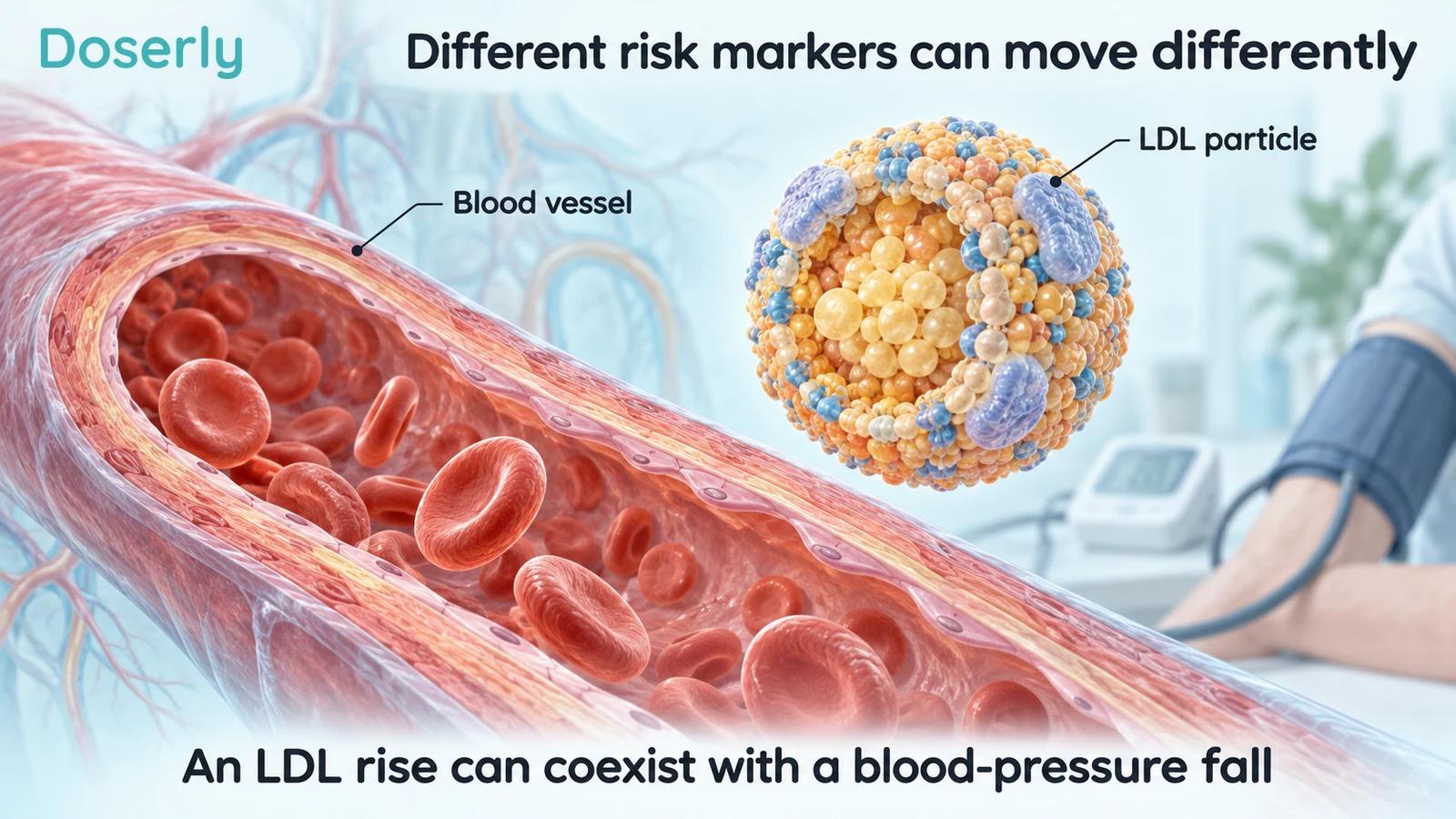
Why the safety paper sounds more reassuring
A separate publication analyzed safety from the same eighty-person trial. It reported no adverse changes in the examined liver, kidney or glucose markers and no statistically significant increase in reported major adverse reactions. The study lasted six to eight weeks, and most participants completed it. Safety analysis.
That is useful short-term information. It is not an independent second trial, and it does not erase the lipid findings reported from the same research program.
“Safe” depends on which outcomes were measured and for how long. A study can find no meaningful liver-enzyme signal while identifying a change in LDL. A small trial can also miss uncommon reactions or effects that emerge after longer exposure.
Reading the safety and efficacy reports together gives a more complete picture than choosing the more reassuring title. It also prevents counting two publications as two separate participant populations supporting the same conclusion.
Do NAD combination studies prove a pterostilbene benefit?
Pterostilbene has also been studied alongside nicotinamide riboside, or NR. A 2017 trial in 120 healthy older adults compared two amounts of the fixed combination with placebo over eight weeks and found increases in whole-blood NAD.
The design did not include an NR-only group. It therefore could not determine whether pterostilbene was necessary for the NAD response or whether it added a clinical benefit. NR–pterostilbene trial.
A later six-month trial in 111 adults with fatty liver disease found no significant improvement in its primary endpoint of liver fat fraction. Some secondary blood measurements improved at the lower combination amount, without a corresponding dose-dependent advantage at the higher amount. Combination liver trial.
These are studies of mixtures, with their own endpoints and limitations. They do not convert the animal absorption advantage into evidence that pterostilbene alone improves longevity or prevents disease.
For the broader combination question, see our NAD precursor guide. The distinction between a mixture’s effect and an individual ingredient’s contribution remains important even when the mixture has randomized research.
What about brain and tissue findings?
Animal distribution studies can show that a compound or metabolite reaches a tissue. They do not establish improved memory or protection against neurodegeneration in humans.
The rat tissue study found different distributions of parent pterostilbene and its sulfate metabolite, including a relatively high proportion of parent compound in brain tissue. That is an exposure observation, not a cognitive-outcome trial. Rat tissue-distribution report.
The same distinction applies to cell experiments. A response in an isolated system can suggest a mechanism worth studying, but the concentrations, surrounding biology and clinical context may differ substantially from oral supplement use.
An evidence chain needs each link: plausible mechanism, achievable exposure, relevant biological response and meaningful benefit with acceptable harms. A strong result at one stage does not fill in the untested stages automatically.
How should you read a “more bioavailable” product claim?
Look for the original comparison. Was it performed in humans or animals? Did it compare pterostilbene with resveratrol, or two formulations of the same compound? Was it absolute bioavailability or a relative change in blood exposure? The original rat comparison illustrates why these details belong beside the headline.
Then identify what was measured. A parent-compound concentration, a total including metabolites and a tissue measurement are not interchangeable. A large relative increase can also start from a small baseline; the percentage alone does not describe clinical usefulness.
Finally, look for the health outcome attached to the marketing claim. If the supporting study only collected blood concentrations, it cannot directly support a promise about memory, energy, disease prevention or lifespan.
Check the denominator in a comparison, too. Equal capsule counts, equal milligrams and equal numbers of molecules are different ways to match an intervention. A fourfold difference in an exposure measurement cannot be converted directly into a quarter-dose recommendation, because the clinical response and adverse effects may not scale proportionally. If a product claim makes that conversion without a human study testing it, the crucial dosing conclusion is an inference rather than a demonstrated result.
These questions do not require you to become a pharmacologist. They require the claim to stay at the same level as the experiment. “This formulation increased blood exposure” can be an informative statement without being promoted into an outcome the study never measured.
What is useful to discuss with a clinician?
Bring the actual product label, including whether pterostilbene is alone or combined with NR, grape extract or other ingredients. Record the amount you use and when you started. An ingredient list is more useful than a broad description such as “an antioxidant.”
Explain the goal. If you are addressing cholesterol, blood pressure or another diagnosed condition, discuss how the proposed supplement fits with established care. Do not change prescribed treatment to accommodate a speculative supplement benefit.
If laboratory results change after a new product, a dated Doserly record can help reconstruct the sequence. Timing alone does not prove causality, but it gives the clinician a more accurate exposure history. Include other changes made during the same period.
Pterostilbene’s pharmacokinetic profile makes it scientifically interesting. The human findings make a blanket upgrade claim premature. Greater exposure is a property to investigate; the benefit–harm balance is the outcome that ultimately matters.
Sources
- Kapetanovic et al., rat comparison.
- Rat formulation and bioavailability study, 2013.
- Rat tissue-distribution study, 2014.
- Pterostilbene metabolic trial, 2014.
- Safety analysis of the same trial, 2013.
- NR–pterostilbene trial, 2017.
- Combination liver trial, 2022.