
Peptides
October 16, 2026
Petrelintide and other amylin drugs: a useful comparison
On this page
Amylin medicines are often discussed together because they build on a hormone involved in appetite and the body's response to meals. But sharing a biological starting point doesn't make them interchangeable. Petrelintide, cagrilintide and pramlintide are different molecules, developed with different exposure patterns and clinical purposes.
There is another source of confusion: a result for an amylin drug alone may appear beside a result for an amylin drug combined with a GLP-1 medicine. The second treatment has an additional active ingredient. Comparing their headline percentages without that distinction can make an ordinary difference in study design look like a discovery about which amylin molecule is best.
A useful comparison starts with what was given, who received it and what question the trial answered. That helps explain where petrelintide fits without pretending that separate trials form a reliable ranking.
First separate the molecule from its treatment partner
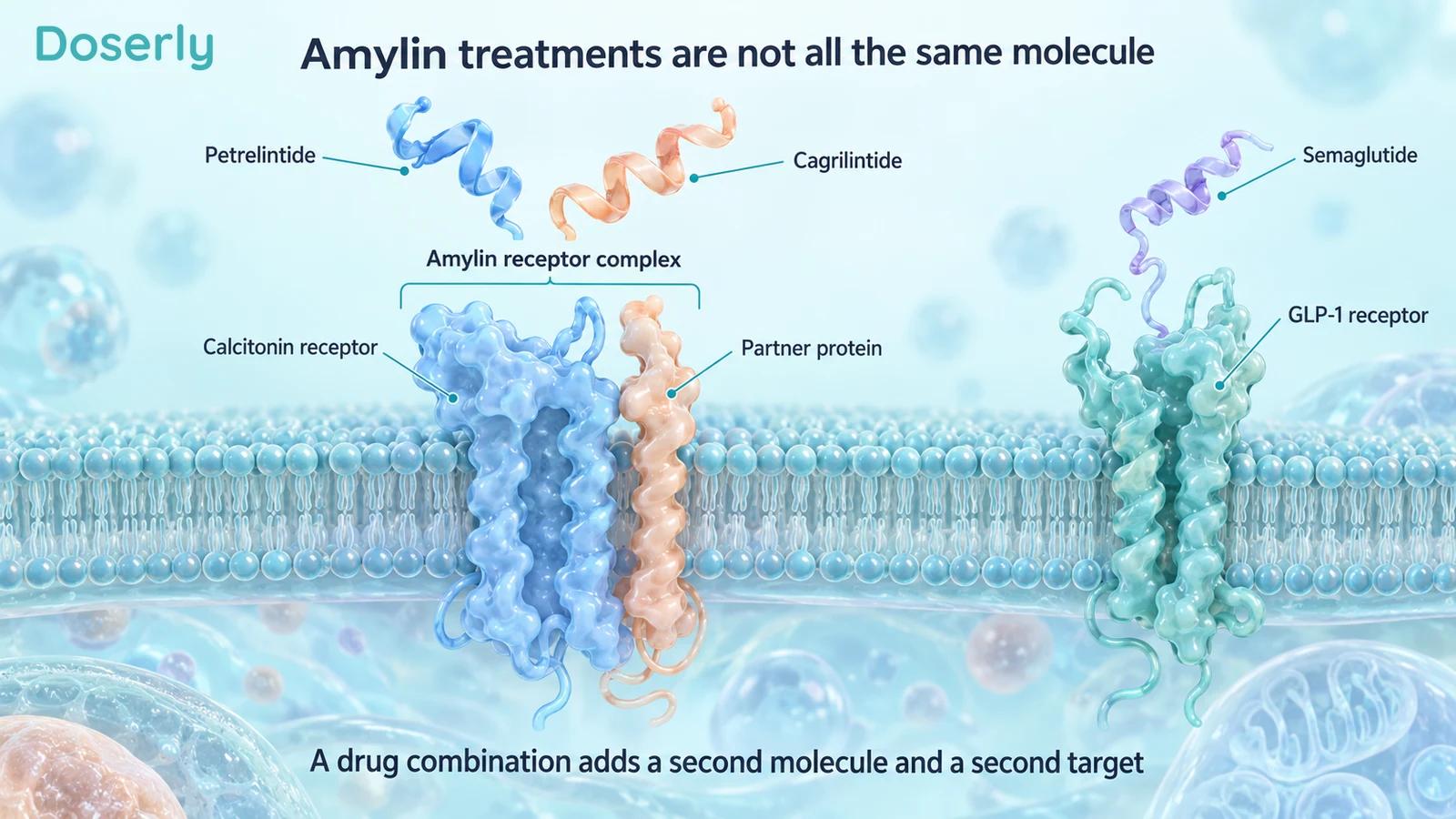
Petrelintide is a modified, long-acting amylin analogue. Its development emphasized stability near neutral pH and prolonged exposure. Laboratory studies describe activity at amylin receptors and the calcitonin receptor. Its published human trials have investigated weekly administration. Petrelintide development
Cagrilintide is another long-acting amylin analogue, with its own molecular modifications and lipid attachment. It has been studied alone and with semaglutide. The name CagriSema refers to the combination, not to cagrilintide alone. Cagrilintide development
Eloralintide is described in its clinical publication as a selective amylin receptor agonist. Its receptor profile is part of its development rationale, but selectivity is not a patient outcome. Whether it improves weight, symptoms or tolerability has to be measured. Eloralintide phase 2 trial
These distinctions sound technical until a comparison becomes personal. If someone says an “amylin drug” produced a particular weight reduction, the first useful question is whether that result involved one molecule, two molecules or a molecule acting on two receptor systems.
Where does pramlintide belong?
Pramlintide provides an older clinical precedent for amylin-based treatment. The historical Symlin label describes its use alongside mealtime insulin in selected patients with diabetes. It has a much shorter half-life than the newer weekly candidates and is used around meals.
That context makes it a poor entry in an obesity-drug leaderboard. Its intended treatment setting, exposure pattern and background insulin differ from trials designed around chronic weight management. Its label also carries a severe-hypoglycemia warning when used with insulin. FDA Symlin label
Pramlintide is nevertheless scientifically useful in the comparison. It shows that amylin pharmacology has an established treatment history. Newer candidates are attempts to change how that biology can be delivered and studied, rather than evidence that earlier researchers overlooked the hormone.
A longer half-life may reduce administration frequency, but that alone doesn't establish a better overall medicine. Clinical value also depends on the treatment goal and how the individual responds.
How do receptor differences help explain the research?
A receptor is a protein through which a cell responds to a signal. Amylin receptors include a calcitonin receptor associated with a receptor-modifying partner protein. GLP-1 receptors are a different system. Petrelintide's receptor activity therefore isn't the same as semaglutide's, even though both may affect food intake.
A combination can bring these different targets into one treatment approach. That provides a biological reason to test it. The size of the clinical benefit still depends on the actual molecules, exposure and patients.
Laboratory potency is also not a dose conversion chart. A molecule can activate a receptor at a low concentration in a cell experiment without being the most effective or best-tolerated treatment in humans. Absorption, distribution, persistence and other biological responses intervene between the laboratory assay and a person's experience.
What is the strongest comparison involving cagrilintide?
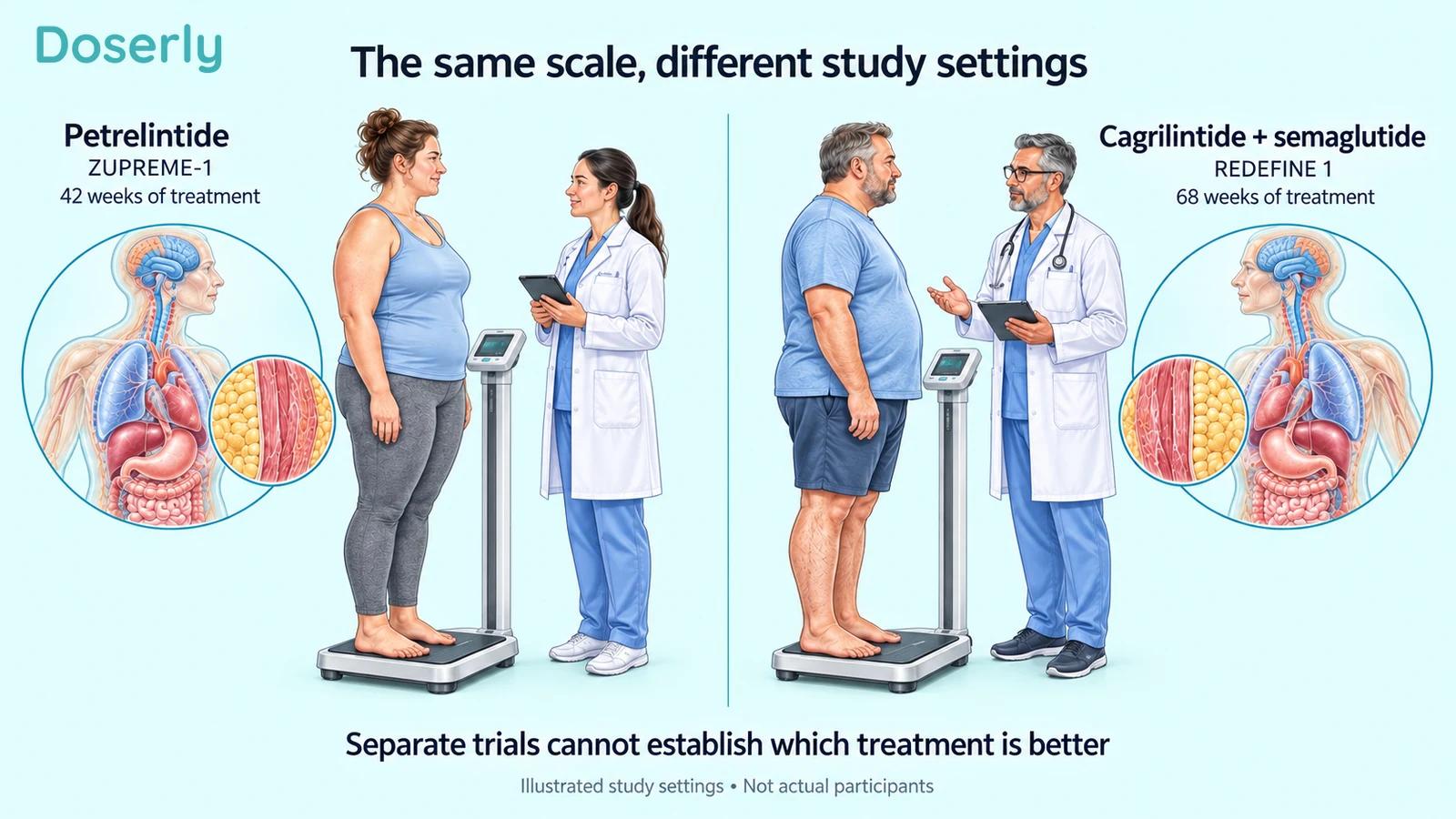
REDEFINE 1 offers a particularly informative design because it included the combination, each component alone, and placebo within the same randomized study. It enrolled 3,417 adults without diabetes and followed treatment for 68 weeks.
Using the treatment-policy estimand, estimated mean weight reductions were 20.4% with cagrilintide plus semaglutide, 14.9% with semaglutide, 11.5% with cagrilintide and 3.0% with placebo. The study directly supported greater weight reduction with the combination than with either component in that setting. REDEFINE 1 primary report
This is stronger evidence for the added effect of that combination than comparing cagrilintide from one trial with semaglutide from another. Randomization within one protocol makes the groups more comparable.
It still doesn't answer whether cagrilintide is better than petrelintide. Petrelintide wasn't one of the treatments. The result belongs to cagrilintide and semaglutide at the studied doses and schedule, with the trial's population and support.
For broader context about the amylin component, our cagrilintide guide explains its development separately from the combination.
What does petrelintide's published phase 2 trial show?
ZUPREME-1 randomized 493 adults without type 2 diabetes; 485 received treatment. It evaluated five maintenance doses against placebo, with a primary weight endpoint at 28 weeks and continued treatment through week 42.
At the primary endpoint, mean weight reduction ranged from 7.9% to 9.8% across active groups under the efficacy estimand, which addresses the specified continued-treatment scenario, compared with 1.7% with placebo. The largest reduction at week 42 was 10.7%. These are different time points, and the later value shouldn't be described as the primary endpoint. ZUPREME-1
The study establishes a weight effect compared with placebo. It does not establish superiority or inferiority to cagrilintide. Even a numerically similar result would not prove equivalence, because the studies weren't designed to test an equivalence margin between those drugs.
The petrelintide guide covers the broader evidence. For this comparison, the key is to keep the trial's duration, analysis and comparator attached to its result.
Why isn't the largest percentage automatically the best result?
Weight reduction develops over time. A study lasting 68 weeks gives a different observation window from one lasting 28 or 42 weeks. Participants also spend different amounts of time escalating toward maintenance treatment.
The populations differ as well. Baseline body size, diabetes status, age, sex distribution and previous treatment can all affect how relevant a result is to another group. Lifestyle support and permitted dose adjustments may also differ.
The analysis introduces another distinction. An estimand specifies the treatment question being estimated, including how events such as stopping treatment are handled. A treatment-policy approach generally aims to describe outcomes under assignment to treatment despite discontinuation or other specified events. An efficacy or trial-product approach may estimate an outcome under continued treatment assumptions.
Neither label should be shortened to “the real number” or “the fake number.” They answer different questions. A comparison that takes the most favorable analysis from one study and a more pragmatic analysis from another is especially difficult to interpret.
REDEFINE 1 itself illustrates this: its trial-product estimate for the combination was larger than its treatment-policy estimate. That difference isn't a second trial or a stronger dose. It reflects the analytic question. REDEFINE 1 methods and results
What does eloralintide add to the picture?
The eloralintide phase 2 trial enrolled 263 adults without type 2 diabetes and tested several dose and escalation regimens for 48 weeks. Its primary publication reported efficacy-estimand mean weight reductions ranging from approximately 9% to 20% across active groups, versus 0.4% with placebo.
The participants differed from those in ZUPREME-1: 78% were women and mean BMI was 39.1. Its nausea rates also varied substantially between dose regimens. These details matter when interpreting the large weight reductions. Eloralintide trial
The finding broadens the evidence that amylin-based approaches can produce meaningful weight change. It doesn't tell us that every selective agonist will behave the same way, or that receptor selectivity caused the observed difference from another drug's trial.
A future direct comparison could investigate both weight and tolerability under comparable conditions. Until then, the clinical development programs supply information about their own interventions rather than a definitive ordering of the class.
Where does zenagamtide fit?
Zenagamtide, previously developed under the name amycretin, is a single molecule designed to act on both GLP-1 and amylin receptors. That differs from administering two separate molecules, as in cagrilintide plus semaglutide. The 2026 primary clinical publication explicitly identifies zenagamtide as formerly amycretin and describes calcitonin-receptor activity as well. Zenagamtide phase 2 report
Its 2025 injected phase 1b/2a study randomized 125 participants across several parts with different durations and dose schedules. The striking weight findings came from small early cohorts, with substantial participant withdrawal noted in the report. They cannot simply be placed beside larger phase 2 or phase 3 averages as if the evidence were equally mature. Injected amycretin study
By 2026, the program also had a published 36-week phase 2 trial in 262 adults with type 2 diabetes. Its primary outcome was HbA1c change, so it adds evidence in a different population and for a different primary question. It does not create a direct comparison with petrelintide, and its later publication does not erase the limitations of the earlier obesity cohorts. 2026 primary report
The distinction also prevents a naming mistake: zenagamtide is neither petrelintide plus a GLP-1 drug nor another name for CagriSema. Our zenagamtide guide explains the single-molecule approach.
How should tolerability be compared?
Look for the same symptom and the same kind of count. Nausea, vomiting and “any gastrointestinal event” are different endpoints. A pooled rate across all doses is different from a selected dose group's rate. Participants affected are different from total episodes.
Petrelintide's published phase 2 trial reported more nausea than placebo, even though vomiting was uncommon. REDEFINE 1 reported gastrointestinal events in 79.6% of combination recipients and 39.9% of placebo recipients. Those statements describe their own studies; they aren't a valid direct comparison of overall safety. Petrelintide trial, REDEFINE 1
Persistence adds another dimension. A low stopping rate can reflect manageable symptoms, close support, flexible dosing or participant motivation. It doesn't automatically predict persistence when people must arrange prescriptions, pay for treatment and manage competing responsibilities.
The early petrelintide trials also involved selected, mostly male participants and relatively short exposure. Their favorable observations support development but cannot carry the same weight as years of broad clinical experience. Phase 1 report
What comparison would actually help a patient?
The useful question is rarely “Which molecule wins?” It is more often: which option has evidence for my condition, supports the outcome I care about, and has a practical treatment burden I can manage?
Someone concerned about glucose control needs diabetes-specific evidence. Someone concerned about cardiovascular events needs outcomes research that counts those events. Someone who previously stopped because of vomiting needs a clear description of symptom patterns and treatment persistence, not just an average weight curve.
A direct trial could compare treatments using the same eligibility rules, follow-up and outcome definitions. It could also examine function, quality of life, nutrition and discontinuation alongside weight. Those measurements would explain tradeoffs that a single percentage cannot capture.
For now, the sensible comparison is descriptive: petrelintide offers a particular long-acting design and a growing program; cagrilintide has both standalone and combination evidence; eloralintide has its own selective-agonist trial results; and pramlintide provides an older diabetes-treatment precedent. Their differences are reasons to study them carefully, not shortcuts to choosing one.
Sources
- Petrelintide development.
- Petrelintide phase 1.
- ZUPREME-1.
- Historical FDA Symlin label.
- Cagrilintide development.
- REDEFINE 1 primary report.
- Eloralintide phase 2.
- Injected amycretin phase 1b/2a.
- 2026 zenagamtide phase 2 report.